WASHINGTON (RNS)—In late March of 2021, the Religious Exemption Accountability Project filed a class action lawsuit charging the U.S. Department of Education as complicit “in the abuses that thousands of LGBTQ+ students endured at taxpayer-funded religious colleges and universities.”
The case, Elizabeth Hunter, et al v. U.S. Department of Education, was thrown out by the Oregon federal district court.
Three years later, the Hunter plaintiffs are back in court to make their case. In August 2023, the Hunter plaintiffs appealed the decision, filing their opening brief before the 9th Circuit Court of Appeals.
Appealing the case are a mix of current students, recent alumni and recently expelled students. With the case now fully briefed, the legal team will appear before the Court of Appeals on July 16 for oral argument.
At the center of the case is the issue of religious exemption from Title IX, an exemption the plaintiffs argued has allowed religious schools to discriminate against LGBTQ+ students.
Although the students bringing the case are connected to a number of religious institutions, including Brigham Young University, they coalesce around one point: that schools that violate LGBTQ+ nondiscrimination protections should lose access to federal education funds.
ERLC supports institutions’ right to their convictions
Religious liberty groups applauded the case’s original dismissal, arguing that the lawsuit was an attempt to subvert the constitutional right of religious freedom.
Following the lawsuit’s dismissal in 2023, the Ethics and Religious Liberty Commission of the Southern Baptist Convention stated, “No student of any faith should be deprived of their right ‘to attend a school that shares their beliefs’ and no educational institution should be stripped of its freedom to ‘live out their deeply and sincerely held convictions.’”
But in the aftermath of the dismissal, the case also received strong support, with 19 state attorneys general filing friends of the court briefs in the Ninth Circuit Court of Appeals in the Hunter v. U.S. Department of Education case in favor of the plaintiffs.
Oregon Attorney General Ellen Rosenblum said in a statement, “During the Trump administration, his Department of Education gutted protections for women, members of the LGBTQ+ community and other classes of students that had been in place for decades.”
Rosenblum added: “Title IX needs to be strengthened, not systematically weakened. Students ought to know before they get to campuses whether their academic institutions will protect their rights or undermine them.”
The original lawsuit argues the Department of Education is responsible under the federal civil rights law Title IX to “protect sexual and gender minority students at taxpayer-funded” schools, including “private and religious educational institutions.”
It alleges that in violation of Title IX, LGBTQ+ students have endured abuses, including “conversion therapy, expulsion, denial of housing and health care, sexual and physical abuse and harassment,” as well as the “less visible, but no less damaging, consequences of institutionalized shame, fear, anxiety, and loneliness.”
Protests at some religiously affiliated schools
During the two years the original case was being considered, a broader reckoning spread among religious higher education institutions across the United States as their students became increasingly vocal about experiences of discrimination at the schools.
Students at some religious schools engaged in a range of protests. At Seattle Pacific University, a private school with ties to the Free Methodist Church, students protested against a policy that forbids the hiring of LGBTQ+ people.
(Baylor University Photo)
At Baylor University, protests focused on the school’s Statement on Human Sexuality, which defines marriage between a man and a woman as the “biblical norm” and on Baylor’s refusal to recognize an LGBTQ+ student advocacy group as an officially chartered organization.
In October 2022, students organized at more than 100 campuses to walk out of school in protest of religious exemptions to Title IX, which they argued leave loopholes for LGBTQ+ discrimination, harassment and erasure.
When Hunter v. U.S. Department of Education was dismissed in January 2023 by Federal District Court Judge Ann Aiken of the U.S. District Court in Eugene, Ore., Aiken ruled the plaintiffs had “satisfactorily alleged” their injury by religious exemption.
However, Aiken also ruled: “Plaintiffs do not plausibly demonstrate that the religious exemption was motivated by any impermissible purpose—let alone that Congress was ‘wholly’ motivated by such an impermissible purpose.”
The decision left the 40 students and former students responsible for filing the lawsuit with recognition of the harms committed but no legal recourse.
In a press release from the Religious Exemption Accountability Project, Plaintiff Kalie Hargrove, former student at Lincoln Christian University, was quoted saying: “I am disappointed in the ruling. The actions of the U.S. Department of Education and the U.S. Department of Justice have shown once again that human dignity is optional.
“I was publicly dehumanized, kicked out of school, received death threats, and had people call for my execution for being a Christian student at a Christian school who happened to be trans, and my government refused to protect me then, and refuses to protect me now.”
Baptists respond to Trump assassination attempt
July 16, 2024
Baptists and other Christians offered prayers and pleas for peace in the aftermath of the attempted assassination of former President Donald Trump at a July 13 campaign rally in Pennsylvania.
Trump sustained an injury to his right ear, but a statement from his campaign said he is “fine after being checked out at a local hospital.” A rally attendee, former fire chief Corey Comperatore, was killed, as was the shooter. Two other people also were wounded.
Texas Baptists’ Christian Life Commission issued a statement expressing grief for the loss of life and prayers for the “speedy and full recovery” for the former president and “for our entire nation.”
“The murder of at least one rally attendee and attempted murder of the former president is an assault on the image of God, and gun violence is in direct opposition to the pro-life values of Texas Baptists,” the CLC statement reads.
“The CLC unequivocally condemns all acts of political violence as an affront to democracy and our nation.”
The CLC called on Christians to “lead the way in loving our neighbors as ourselves.”
“This moment is a reminder of the sacredness of all human life and that we have more in common than what divides us. We invite Texas Baptists to pray for healing in our nation.”
‘May your people be peacemakers’
Julio Guarneri, executive director of the Baptist General Convention of Texas. (Texas Baptists Photo)
On Sunday morning, July 14, Baptist General Convention of Texas Executive Director Julio Guarneri tweeted a prayer on X, the platform formerly known as Twitter: “As we prepare to gather in our houses of worship, we grieve. Our country, and the world, has been shaken by the tragedy that occurred yesterday.
“The violent attack on former President Trump and the senseless loss of lives reminds us of our divisions and our brokenness. Regardless of political persuasion, your people hold human life sacred because you do. Any attack on those made in your image is a transgression against you.
“Today may your gathered people pray in humility. May we grieve before you for the state of our world. May we repent of bitterness, hatred, malicious talk and pettiness. May we seek your forgiveness, experience your grace, and desire to be like you.”
Guarneri continued: “May we learn to pray for and talk to those who disagree with us. May your people be peacemakers so that we can truly be called the children of God.”
Appeal to ‘the better angels of our nature’
Bart Barber, immediate past president of the Southern Baptist Convention, posted a message on his blog for members of his congregation, First Baptist Church in Farmersville, asking them to “pray for our nation.”
“Let us make it clear that this kind of behavior is unacceptable. Unlike people in many other places around the world, we get to speak by way of our votes,” Barber wrote.
“We live in a nation where our votes are not coerced, we are not threatened or intimidated in our voting, our votes are fairly counted every time, and our country transfers power every time in accord with the expressed wishes of the people.”
He urged prayer for Trump “no matter how you plan to vote in November.”
“Let us all speak with one voice saying that this kind of behavior is WRONG. Let us not contribute to making things worse, but let us be the ones summoning what Lincoln called ‘the better angels of our nature’ in all of those around us,” Barber wrote.
“Let us do all of those things around our family tables, in our Sunday School classrooms, and in our presence online.”
‘No place whatsoever in America’
Brent Leatherwood, president of the SBC Ethics and Religious Liberty Commission, stated: “In a democracy like ours, we voice our opinions, we passionately press our case, we bravely dissent, and we loudly campaign for our cause. But we must never cross the line to harm those we disagree with.
“Political violence has hurt too many individuals and taken too many lives in our history. Now is the moment for all of us to unite and bring a swift and universal condemnation to this vile act that has no place whatsoever in America.
“While it will be easy to use this moment as an opportunity to dig in our heels, I urge Americans to pause, lament this violence, and realize how far we have strayed from our nation’s ideals. Let’s commit to praying for our leaders, those who are willing to serve in public office, and appeal to our Lord that his reconciling work would be poured out on this nation to overcome the hatred that is so prevalent in our culture.”
Leatherwood’s predecessor at the ERLC, Trump critic Russell Moore, editor in chief of Christianity Today, tweeted:“Political violence is evil to the core and is an attack on everything this country represents. Attempted murder is an attack on the image of God. This is awful.”
Bible teacher Beth Moore tweeted a prayer: “Jesus have mercy on us in these horrors and sorrows. We on this bloodied soil are desperate for your peace. Bind this heinous violence and cause sound minds to prevail and vicious plans to fail. Oh Jesus, Jesus, hasten to save.”
Faith and Gen Z: Kenzie Eifert
July 16, 2024
It’s tough out there for Gen Z, research shows. Mental and physical health statistics suggest a generation under strain. But some graduates of Texas Baptist universities are bucking these negative trends.
Kenzie Eifert is one Gen Z example of faith’s positive impact.
Effect at L.D. Bell High School. (Courtesy photo)
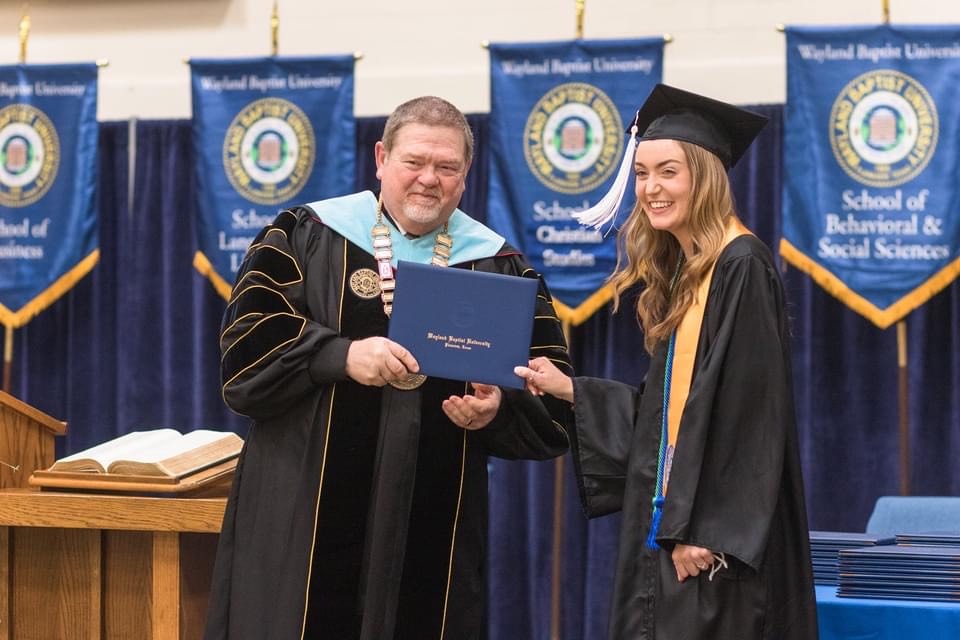
Eifert graduated from Wayland Baptist University in 2021 with a degree in secondary education in English. She currently teaches 10th and 11th grade English at L.D. Bell High School in Hurst.
How she ended up at Wayland “is kind of a funny story,” Eifert explained.
She was a competitive swimmer in high school and planned to continue swimming in college, too. But it was important to her to attend college at a smaller campus that provided a Christ-centered environment.
She got a scholarship to swim at Wayland, but about a month before she was to arrive, Wayland abruptly cancelled the swim program because the coaches were moving to Colorado.
As she’d already been guaranteed a scholarship for swimming, Wayland honored the agreement for all four years. So, Eifert went to Wayland on a swimming scholarship, but didn’t have to swim.
Laughing, she remarked, “God worked all that out for me.”
Although at first it was heartbreaking because “you work so hard to be a college athlete,” she said.
“But looking back at it, I just see how God worked through the whole situation, because I got to really enjoy my college experience and make really great friends, and not have to be so focused on a sport the whole time.”
Blessing in disguise
She wouldn’t have changed it. She ended up meeting her husband, Kyle, and it was a blessing in disguise, Eifert continued.
Eifert arrived at secondary education as her major and career because she comes from a family of teachers and preachers, she said. Almost everyone in her family is either a teacher, preacher or youth pastor.
Growing up, she saw her mom teach elementary school, and she always wanted to be just like her mom. Then in high school, she had an English teacher who was “the most amazing English teacher you could ask for,” Ms. Harvey.
Retired Wayland President Bobby Hall presents Eifert’s degree. (Courtesy photo.)
The rigor of high school English and the in-depth approach of Ms. Harvey drew Eifert’s interest away from elementary toward secondary education. And she decided high school English teacher is what she wanted to be.
COVID-19 interrupted the end of her junior year at Wayland, but the pivot to online classes in the spring of 2020 went remarkably well, she said. Professors were especially helpful during distance learning. And they were easy to contact by Zoom, when needed.
By the fall semester of 2020, students were able to return to campus for in-person classes. Eifert expressed how thankful she was to be back on campus for her senior year.
How she ended up in her current position is “also kind of a funny story,” Eifert said. Her principal, Mr. Belcher, had been principal at the elementary school where her mother taught and Kenzie attended when she was a child.
Eifert remembered her mom talking about how great Mr. Belcher was as a principal, “just because he had high standards, but also in the fact that he was willing to clean up trays in the lunchroom. … He had a servant heart.”
Eifert kept up with Mr. Belcher through the years because of the respect she had for him as a leader. So, when she graduated from college, she reached out to him. He was principal at a junior high at that time, but she was certified to teach middle grades, too.
He showed her around the campus, and they talked about her plans. Her plans were 100 percent to teach in the Hurst-Euless-Bedford school district, she said. She’s a product of the district, her mom and aunt still worked there, and “I loved going through school in H-E-B,” Eifert continued.
Belcher shared with her that he was moving up to high school to L.D. Bell the next year, which “was such a blessing from God. Because, truly, I wanted to teach high school. I didn’t want to teach junior high.”
She would have done it to get her foot in the door and work for Mr. Belcher, Eifert said. But she was thrilled to interview with Belcher at L.D. Bell and get the job. She loves teaching there, even though the other high school in the district is the one she went to.
An added blessing, her mom has now moved up to high school and teaches with her, right across the hall. The staff at L.D. Bell is welcoming, and she loves working with her mother.
“I have thoroughly enjoyed my three years there,” Eifert said.
“Teachers are kind of like police officers in that they have very interesting stories,” Eifert continued.
“It’s always a good profession to be in, because there’s never a dull moment. You’re always on your toes. Your workdays go by fast, and it’s always very rewarding.”
Growing up in a godly home
Eifert grew up in Watauga, at Spring Valley Baptist Church, where she and her husband attend again since moving back to the area. Her grandfather is pastor. Her uncle is youth minister, and her father is associate pastor.
Eifert credits her upbringing in a godly home for shielding her from the hopelessness many in her generation face. While Gen Z may not be known for its optimism, personally, she is a very optimistic person.
Throughout anything, her parents have taught her: “God’s going to take care of you. And you can only control the circumstances and the things that are in your control.
Kenzie and Kyle Eifert. (Courtesy photo)
“And other than that, you just have to put it in God’s hands.”
Throughout her life, she’s seen God work. Not that she’s never had hardships, Eifert said, but things worked out for her in getting into college and having scholarships. Then she was able to go on from college straight into the career she was praying for, which is the exact career she wanted.
Apart from career, she points to God’s hand in her personal life, as well. She met her husband, who she describes as “amazing,” in college at Wayland. They worked through an early change in career for him with grace, and he loves what he’s doing now.
Then six months ago, they had their daughter, Austyn Jane.
“There’s a lot of things in life that are uncertain,” Eifert said, “but the goodness of God is never one of them.”
Throughout her life she’s seen God’s faithfulness, so she’s never worried that he won’t take care of her, no matter what.
Eifert acknowledged it was hard for her in college, though, when swimming for Wayland didn’t work out. It’s one time her faith was challenged, somewhat, because she had prayed so much about swimming in college and had had such a peace about Wayland.
At first, it was disappointing and hard to understand why things turned out the way they did, Eifert noted. But once she got there, she was able to see how God worked in that situation.
The Eiferts. (Courtesy photo)
She graduated college debt-free, made great friends, and met her husband who she “wouldn’t trade for the world.” She’s glad she trusted God and her belief that he was leading her to Wayland, even with such a big change in plans.
College in Plainview also gave Eifert the opportunity to participate in a faith community not made up of her own family. It was good for her to get to do that, she said, because it helped her take responsibility for growing her own faith.
She was able to serve in her college church, teaching Sunday school just as she had back home. But in having more ownership of her faith, she discovered her relationship with God was only going to be as good as the work she put into it.
She needed to be faithful, Eifert explained. Being at Wayland—where classes included Scripture, professors demonstrated care and prayed for students, and the whole atmosphere was Christ-honoring—supported her independent spiritual growth.
She and her family are happy where they are and would be content to be there for many years, she said.
Texans on Mission offer refreshing hope in Houston
July 16, 2024
HOUSTON—The city is hot, and it’s not just the temperature. People are angry and frustrated.
Five days after Hurricane Beryl swept across southeast Texas, large parts of Houston remain dark. Traffic lights, restaurants, homes all lack power in many places. Internet service is sporadic.
But the temperature is hot, as well, with the typical 95 degrees and high Houston humidity.
An electricity of frustration fills the air like the oppressive heat. People are on edge. It’s like having your wallet stolen, replacing your driver’s license and credit cards only to have the wallet taken again.
Waking up before dawn each morning, a group of Texans on Mission and church volunteers are ushering in a refreshing breeze of hope.
First they cooked 6,000 meals. The next day they did 7,500. Then 8,500. Soon, it’ll be 10,000 meals delivered across the city.
A reminder of God’s love
“A meal is more than just some food,” said David Wells, Texans on Mission disaster relief director. The ministry is cooking meals for Houstonians across the city. “It’s a gift. It’s a reminder people care about you. And when it’s prayed over by our volunteers and distributed by churches, it’s a way to show each person that God loves them.”
Terry White (right), executive secretary/treasurer of the National Baptist Convention of America Home Mission Board, serves alongside Texans on Mission volunteers to make sure food is delivered to overlooked areas of Houston. (Texans on Mission Photo / Russ Dilday)
The Texans on Mission state feeding unit will continue breathing hope into Houston. The volunteers are working with the Salvation Army, which is distributing meals, and the National Baptist Convention of America and city leaders to identify distribution points.
Terry White, executive secretary and treasurer of NBCA’s Home Mission Board, is helping make sure the food is getting into often overlooked communities where suffering is at its worst.
On July 10, one of the meals cooked by TXM went to a woman who hadn’t eaten in two days. She had no electricity. She doesn’t drive. And her food spoiled.
“I hope this gives them hope that someone cares,” White said. “Trials and tribulations come, but they can count on the church. We are to be a beacon of hope. Hopefully, that will resonate in their hearts and minds.”
New Mount Calvary Missionary Baptist Church distributed some of the meals. Pastor Ronald Smith wants people to know the congregation is there to minister to people in their time of need.
Volunteers from Texans on Mission and New Mount Calvary Missionary Baptist Church in Houston bring hope to Houston after Hurricane Beryl. (Texans on Mission Photo / John Hall)
It is a resource and asset to the community, he said. Without the church, it’s doubtful this neighborhood would have much assistance.
“It is our desire to become a united front when disasters hit,” Smith said. “This church can be a place people turn to for help. There’s many people here who are still without power, without food. We are here to provide as much as we can to those who need it the most.”
In other places across the region, Texans on Mission chainsaw teams are cutting up fallen trees and limbs. They’re making it possible for people to enter their homes again.
Each job they do saves the family they serve thousands of dollars they don’t have, Wells said. The teams prioritize the uninsured, elderly and impoverished.
“Disasters turn everyone’s life upside down,” he said. “But they’re especially difficult for people who were struggling before the storm. By removing the trees, we’re clearing the way for people to recover from the storms.”
But chainsaw ministry is about more than saving people money and getting trees out of the way, Wells continued.
“The teams listen to what families are going through,” he said. “They pray with people and encourage them.”
And at the end of the project, each team presents a Bible to the family they serve.
“We serve because God loves us and the Bible tells us to love our neighbors,” Wells said. “That’s what we’re doing after Hurricane Beryl. We aim to transform homes physically with our hard work and equipment. While there, aim to be vessels through which God transforms homes spiritually with the gospel.”
Vietnamese Baptist gathering bolsters connections
July 16, 2024
ATLANTA—Vietnamese-language pastor Peter Le and English-language pastor Linh Huynh, both from Vietnamese Faith Baptist Church in Dallas, translated for each other during the opening session of the 39th annual meeting of the Vietnamese Baptist Union of North America.
“Your struggles are real, but here’s the thing,” Huynh preached in English, which Pastor Le translated into Vietnamese. “There’s nothing wrong with struggles as long as you overcome them and don’t let them overcome you.”
The July 3-7 event drew 1,353 registered participants, as well as many other locals who didn’t register. In addition to the standing-room-only sessions in a hotel ballroom, more than 400 gathered for English-language sessions and 214 more for children’s age-graded VBS activities.
The event’s theme, Mature in Christ, came from Ephesians 4:13—“until we all reach unity in the faith, and in the knowledge of God’s son, growing into a mature man, with a stature measured by Christ’s fulness.”
The group welcomed visitors from Southern Baptist Convention agencies, including Jeremy Sin from the North American Mission Board and Ezra Bae from the International Mission Board. Among the IMB’s 3,500 missionaries who serve in 122 nations are 300 Asians, Bae said.
Christian Phan Phước Lành of Gulf Breeze, Fla., begins his third year as executive director of the Vietnamese Baptist Union of North America. (BP Photo)
Speakers during the Vietnamese language sessions included Executive Director Christian Phan Phước Lành of Gulf Breeze, Fla.; Union President Peter Lê Hồng Phúc, pastor of Vietnamese Faith Baptist Church of Dallas; Henry Phan Minh Hội of Gilbert, Ariz., IMB’s diaspora ministry coordinator; Hồ Thế Vũ, pastor of Thien-An True Living Church of Seattle; Đặng Quy Thế, pastor of Vietnamese Baptist Church of Fort Worth in Haltom City and president of the Union’s prayer ministry.; Bryant Wright of Marietta, Ga., president of NAMB’s Send Relief; and Đỗ Đăng Phú, pastor of Emmanuel Baptist Church of Lake City, Ga.
Worship was led in the Vietnamese services by Duy Tran of Garland, Texas, and in the English services by Isaiah Hua, youth leader of Vietnamese Gwinnet Church in Suwanee, Ga.
Reports, business, worship and workshops comingled with preaching, along with generous blocks of time for fellowship
‘Came to be encouraged’
Alib Cil of Montagnard Alliance Church in Charlotte, N.C., told Baptist Press he’s a student at the Vietnamese Baptist Theological Seminary, and “came to be encouraged.”
Peter Nguyen of Vietnamese Baptist Church in High Point, N.C. said this was his 25th year to attend the union’s annual meeting. He does so for “the reunion,” he said. He also likes to help, he said, as he moved cases of bottled water in place for the next meal.
The organization needed for the event was managed by a 12-person team led by Phuong Khuu of San Diego. More than 150 volunteers worked in registration, tech support, food services and other arrangements.
Two hours before each meal, packaged hot meals and individual containers of soup started arriving—at least four entrees totaling at least 1,200 servings per meal came in from area Vietnamese restaurants.
“Vietnamese food is ‘comfort food’ especially to the first generation,” Phan said. “I am always amazed how smooth is the process. It starts with good organization, making sure there is enough of everything, even napkins.”
Displays include one for a Bible study in the Vietnamese language, books from various authors as well as one for the Vietnamese Baptist Theological Seminary. Seminary President Tran Liru Chuyen told Baptist Press the school has 100 students in the United States and 600 in Vietnam, with classes on Zoom so students can study as they serve where they live.
The Vietnamese Union’s missions entity also was represented. The group raises up church planters in Vietnam and connects them with existing churches, so they don’t have to be vetted by the communist government.
Began with time of prayer
The event began July 3 with an evening prayer night and prayer walk going out from Emmanuel Baptist Church in Lake City, an Atlanta suburb.
“We want to start our annual meeting with God through prayer,” Phan said. “Prayer night and prayer walk are not only a good tradition to keep but also an attitude of submission to God alone.”
During a business session, the group elected Phu Do, Sr. Pastor of Emmanuel Vietnamese Baptist Church in Lake City, Ga., as first vice president.
They approved a $550,000 budget, unchanged from last year. It includes line items of Vietnamese Theological Baptist Seminary, Vietnamese Mission Board, Women’s Ministry, Men’s Ministry, English Ministry, Prayer Ministry, Training Ministry, and a Pastor Retreat.
Next year will be the 50th anniversary of the arrival of the first Vietnamese refugees to the United States. The meeting is set for July 3-6, 2025, in Los Angeles.
“This year’s annual meeting was wonderful, beyond our expectations,” Phan said. “The sermons were excellent. The service spirit of the registration committee, technical committee, culinary committee, and worship committee was very dedicated.
“The people responded strongly to the call for financial giving,” the executive director added. “The youth and children attended in great numbers. Everything is a gift from God and all glory to him.”
Gibson trusts God in journey to second Olympics
July 16, 2024
PARIS (BP)—Disappointed in her performance at the 2021 Olympics in Tokyo, Alison Gibson said goodbye to the sport of diving for good. At least, that was her intention.
Houston-born Alison Gibson will compete at the 2024 Olympic Games in Paris. (Courtesy Photo)
“I felt like I let my country down, let my friends down,” Gibson said. “It was just like a really gut-wrenching feeling.”
She officially retired and began what she considered to be a “normal” life—working, making money, having free time.
But God had other plans for Gibson. And thanks to a phone call from her synchro partner and the counsel of several mentors and friends, Gibson returned to diving.
That decision paid off, as Gibson qualified for the Paris Olympics in the 3-meter springboard competition. This time, she’ll compete in the individual competition.
“I think that’s what the last year of my life has been, really just trusting in God to do the impossible, trusting in God to give me courage to do things I never wanted to ever do again,” she said. “It’s crazy to me that I’m here, and the goodness of God is indescribable and unfathomable.”
‘Leaning into my relationship with God’
Raised in a Christian home, Gibson made a profession of faith and was baptized when she was 7. Though she was a believer, a pivotal moment in her life came during her freshman year of college, when she was struggling with her sport and with her grades. A friend saw the difficulties Gibson was experiencing and helped her think through what she believed and why.
“That’s like my biggest moment of, ‘Hey, this is not just what my parents believed, but this truly, 100 percent is what I believe,’” she said. “It defines the way I act, the way I treat people, the choices that I make. And so, from that moment on until now, I’ve just been really leaning into that, leaning into my relationship with God.”
At her Olympic debut in 2021 in the synchronized 3-meter springboard event in Tokyo, Gibson and her partner Krysta Palmer finished in a disappointing eighth place. Frustration from that performance prompted Gibson’s retirement, until a year ago when Palmer called her.
“I think we can make the Olympic team,” Palmer told her. “You should come back.”
Gibson’s first reaction was negative. Her life was too good, she thought. A return to diving would mean sacrificing money, time and relationships that she didn’t want to sacrifice. In short, Gibson was afraid.
“But her call sparked something in my heart, so I started praying about it,” Gibson said. “And God just kept nudging me, ‘Alison, I have something for you.’”
Things began falling into place for Gibson’s return. Her parents promised to help support her. Her company told her they would let her work part-time. Sponsors emerged to help her financially. She says God gave her the courage to face her fears, and she felt His presence and provision each step of the way.
Using her gifts for God’s glory
Gibson also recognized in her decision-making process that God had gifted her in certain ways, and she wanted to be faithful in using those gifts for his glory.
“God has a purpose in this, and I need to let go of this fear or this shame or these lies that I’m not good enough,” she said.
She has seen and felt the encouragement of family and friends. Her parents are members of Austin Baptist Church in Austin, and Gibson said the church has been incredibly supportive of her Olympic journey.
Jonathan Spencer, the church’s pastor, said Gibson has become part of the church’s extended family. She has shared her testimony in Bible study classes and was a featured speaker this year at a community Independence Day event the church hosted.
“She’s gotten a lot of prayer support from our church, from her parents’ Bible study class really bringing her into that support system,” Spencer said. “She’s had prayer cards that have been written for her and even will be sent to her in Paris.”
In her second Olympic experience, Gibson has two goals. Her first is to compete well and pour her heart and soul into her effort regardless of the outcome. Her second goal is to use her platform to raise awareness about a ministry that means a lot to her—Missions of Hope International, a Christian organization in Kenya that provides physical, emotional and spiritual support to impoverished children and their families.
Gibson sponsors a girl through the ministry, and she said there are 240 children at the Pangani School run by Missions of Hope International who are unsponsored. Her goal is for all 240 of those children to have sponsors.
“I’ve gotten medals in my life. I’ve gotten trophies. I’ve gotten awards,” Gibson said. “All that stuff fades. The medal gets dusty on a shelf, and the band unravels, and people forget about you, and people forget about your accomplishments. But what’s not forgotten is the impact that you have on someone’s life that can also impact future generations.”
The 2024 Olympic Games begin July 26. The women’s 3m springboard preliminary is scheduled for Wednesday, Aug. 7.
Tim Ellsworth is associate vice president for university communications at Union University in Jackson, Tenn.
Perfect storm leads major insurers to drop churches
July 16, 2024
(RNS)—An ongoing wave of disasters—Gulf Coast hurricanes, wildfires in California, severe thunderstorms and flooding in the Midwest—along with skyrocketing construction costs post-COVID have left the insurance industry reeling.
As a result, companies such as Church Mutual, GuideOne and Brotherhood Mutual, which specialize in insuring churches, have seen their reserves shrink. That’s led them to drop churches they consider high risk to cut their losses.
Churches in Texas have been hit particularly hard by these strains on the insurance industry.
Jeff Julian, executive pastor of Trinity Baptist Church in Mount Pleasant. (Courtesy photo)
Jeff Julian, executive pastor of Trinity Baptist Church in Mount Pleasant, described the church’s experience, beginning with the “snowmageddon” freeze that besieged Texas in 2021.
When everything was still shut down, a frozen pipe burst in one of their offices, resulting in significant flood damage and loss inside the building and a “pretty large” insurance claim.
The church has been able to continue with their insurance provider, to “rock along with increased pay [on premiums] over these years, but we received notice that this year, through our insurance representative, that we’ll be incurring an 85 percent increase for this next year,” Julian said.
The church received notice of the increase a month ago in June, with renewal set to occur in August. Julian said their premium has been about $49,800 a year.
“So, an 85 percent increase on that is going to be where we’re starting to have to take away from ministries, probably,” he said.
The church is in the process of shopping to find the best option available.
Since insurance companies have classified Texas as a “weather-related causality zone,” Julian has heard many smaller churches are opting to go without insurance, because they just don’t have the funds to absorb exorbitant premium increases.
“It’s tough to hear,” Julian said, noting the risk that poses to the smaller congregations. But he believes “the Lord’s got this. … We just need to be faithful and follow his lead.”
The exodus of Church Mutual
Pastor John Parks was taking his first sabbatical in 40 years of ministry when he got a call from his church’s accountant with some bad news.
Church Mutual, the church’s insurance company, had dropped them.
“This does not make sense,” Parks, the pastor of Ashford Community Church in Houston, recalls thinking at the time. “We’ve never filed a claim.”
Five months and 13 insurance companies later, the church finally found replacement coverage for $80,000 per year, up from the $23,000 they had been paying.
“It’s been an adventure,” said the 69-year-old Parks from his home in Houston, where the power was out after Hurricane Beryl. “That’s putting it politely.”
Parks and his congregation are not alone.
Keith Warren, executive pastor of North Side Baptist Church in Weatherford. (Courtesy photo)
Keith Warren, executive pastor of North Side Baptist Church in Weatherford, recounts a similar experience.
In 2023, he was notified the church was on a list of churches to be dropped.
“It was a shock,” he said. The church had few claims and had been with Church Mutual for around 30 years. Then the church found out “they just were leaving Texas and a bunch of churches high and dry.”
In a regular year with a normal number of churches looking for coverage, it takes 60 days for insurers to review a church’s application for a policy renewal, Warren explained. But insurers are only required to give 45 days’ notice of a change to coverage on their end.
Church Mutual told the church of their impending loss of coverage 15 days later than they needed to know about it in order to meet application deadlines for new coverage with a different major carrier—in a year when many more churches than usual were in need of new coverage.
“So, that put us in a pretty difficult position, because the major carriers would not review our policy in time for us to continue coverage,” Warren said.
Warren explained missing the window for securing coverage from the major carriers forced the church to drop down from major insurers to the next market.
Carriers in that market tier require “100 percent of the premium up front,” so not only did North Side Baptist have to pay the premium with Church Mutual that year, but also the premium for the next year, which was three times as expensive.
“So essentially, we were called on to pay four years of premiums in one year,” Warren said.
“Anytime a church has to spend more for something like insurance, by definition, it affects what’s available for ministry.”
The church was able to pay the premium, but “there’s no doubt ministry was affected by that,” he continued.
He had planned for the insurance rates to increase by 55 percent when he was putting together the church budget, but what he actually got was a 147 percent increase.
“It’s hard to plan for that,” he said.
Why is it so hard?
Finding replacement coverage is difficult for churches that lose coverage—in part because churches are a niche market that’s difficult to insure and full of risk, experts say.
They are open to the public, work with everyone from infants to senior citizens, sometimes house social service programs, are run by volunteers and often have large and expensive buildings.
Churches also operate with little oversight, said Charles Cutler, president of ChurchWest Insurance Services, which works with about 4,000 churches and other Christian ministries.
“Because of the First Amendment and the separation of church and state, ministries are largely unregulated,” Cutler said. “And unregulated businesses are difficult to underwrite.”
The church insurance market, like the insurance industry overall, has been hit with a perfect storm in recent years.
Supply chain shortages for construction materials that began during the pandemic have driven up the cost of rebuilding after a disaster. When the cost of rebuilding goes up, so does the size of claims, Cutler said. That led insurance companies to raise their rates in order to cover those claims.
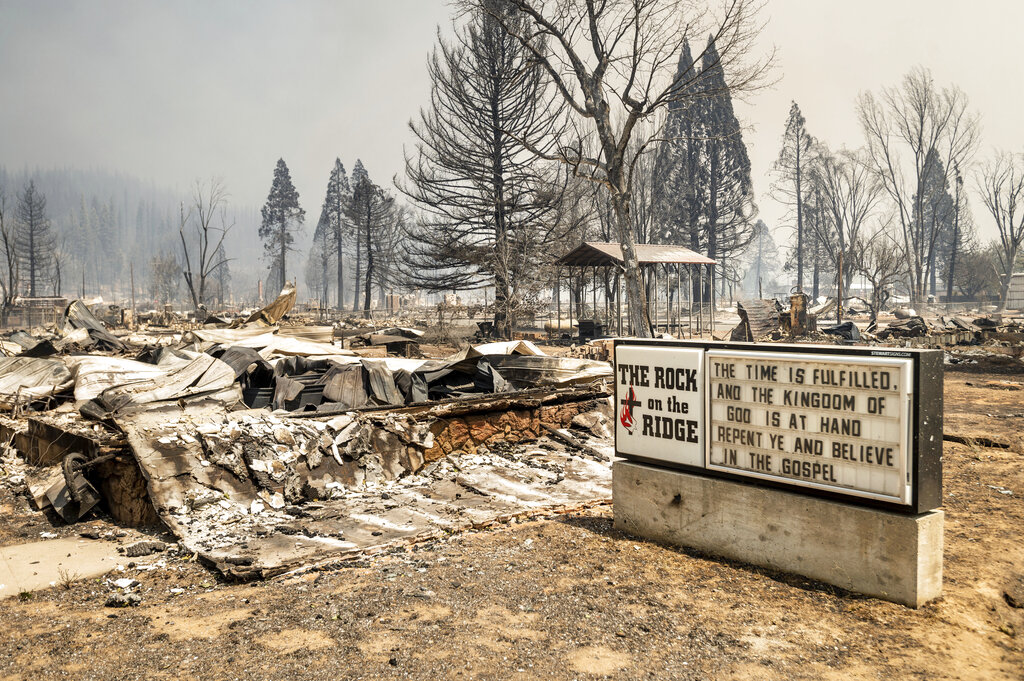
A church marquee stands among buildings destroyed by the Dixie Fire in Greenville on Thursday, Aug. 5, 2021, in Plumas County, Calif. (AP File Photo/Noah Berger)
Then a series of natural disasters hit the industry hard—including hurricanes, wildfires and what are known as “severe convective storms”—thunderstorms with extreme rain and wind that caused billions in damage last year, according to the Insurance Journal. Claims from those disasters have stressed the reserves that insurance companies use to pay claims.
AM Best, a credit rating agency that specializes in the insurance industry, cited weather and cost from legal claims as reasons for placing Church Mutual under review this past spring.
AM Best also downgraded the rating of Brotherhood Mutual, another major church insurer, while a third church insurer, GuideOne, was taken off review after Bain Capital invested $200 million in the company.
In a statement on its website, Church Mutual said it hopes the company’s outlook will improve.
“Church Mutual has been proactively addressing these challenges to better manage the risks throughout its book of business, nationwide,” the company said.
“The company’s leadership team is confident these measures will have a significant, positive impact on profitability in 2024 and beyond.”
Pam Rushing, the chief underwriting officer for Church Mutual, said that the company is still renewing policies and accepting new business in every state. However, the company no longer offers property coverage in Louisiana. Church Mutual did not give details of how many policies have been canceled.
“We do not take nonrenewal decisions lightly and it represents a small percentage of our overall portfolio,” Rushing said in an email. “For us to remain financially strong, viable and best able to serve our mission, we need to mitigate the severe impact catastrophic weather has had—and will continue to have—on our bottom line and our ability to serve customers nationwide.”
Brad Hedberg, executive vice president of The Rockwood Co., a Chicago-based agency, said church insurers are facing pressure from the reinsurers—large companies such as Lloyd’s of London that provide insurance to insurance companies so catastrophic claims don’t overwhelm them.
Those companies are looking to reduce their exposure to certain types of claims—meaning church insurers can’t offer as much coverage as they did in the past.
Hedberg, who works with churches and other ministries, said he spends a lot of time helping clients keep the insurance they already have and reduce their risk of filing claims. That means making sure churches have policies in place for everything from abuse prevention to who gets to drive the church van, as well as being proactive with building maintenance and safety projects.
It also means being strategic in when to file a claim—and when to pay for a loss out of pocket. Churches should only tap their insurance for large losses—not small claims, he added.
“If small claims get filed, your coverage could be nonrenewed or your premium could go through the roof,” he said. “The market is just that bad.”
No good solution
Hundreds of United Methodist churches in the Rio Texas Annual Conference learned they’d lost property insurance in November last year, leaving church officials scrambling.
More than six months later, some churches have found new insurance, often at a steep increase. Others still have none, said Kevin Reed, president of the conference board of trustees.
Reed said the conference had about a month’s notice that its property insurance policy, which local congregations could buy into, was being canceled. That wasn’t enough time to find new coverage before the policy expired. It also left local churches on their own.
“We have not found a good solution,” said Reed. “It continues to be a significant problem for our churches.”
Nathan Creitz, pastor of Calvary Baptist Church in Bay Shore, N.Y., a congregation of about 100 people on Long Island, said in the past, getting insurance hadn’t been a worry. The total annual cost for all the church’s insurance—the church building, a parsonage, liability—was less than $4,000.
“We got lucky,” he said. “We were grandfathered into some really low rates.”
Things changed last summer after Calvary’s insurance carrier dropped the church, deciding not to renew the policy. With the help of a broker, the church found new insurance for about $14,000.
Since most of the costs of running a church, such as paying staff and keeping the lights on, are already fixed, that meant cutting programs. The church also had to put off capital improvements to the building, which ironically are the kinds of things that would make them easier to insure.
“It’s not ideal, but that’s what happened,” Creitz said.
For Ashford Community Church in Houston, finding the funds to cover the increased insurance has also been a challenge, especially post-COVID, when church attendance and giving are down.
Higher insurance costs also mean less money for ministry at the church, which Parks described as a mission-focused congregation.
The church’s 40,000-square-foot facility is currently home to about a dozen congregations, through a partnership called Kingdom City Houston. Parks said he came to the church about a decade ago after hopes of starting a church overseas fell apart. At the time, the church was struggling and was using only a quarter of the space in its building.
Today about 1,200 people worship every weekend in the building—which holds multiple services in its three sanctuaries. Parks said worshippers come from more than 60 countries. The churches each have their pastors but share some back-office staff.
The idea is to show that Christians from different backgrounds can still be united. “We can walk side by side, even if we don’t always see eye to eye,” he said.
Parks said Ashford’s building has been largely untouched by recent storms. After Hurricane Harvey caused massive flooding in 2017, the church hosted volunteers from around the country who helped residents recover.
“It was a good time of serving the community,” he said.
With additional coverage by Calli Keener of the Baptist Standard.
Gaza Christians uninjured but still endangered
July 16, 2024
In spite of “constant danger” from coordinated attacks by the Israeli Defense Forces, Christians sheltered in Gaza churches suffered no injuries in recent days, the former pastor of Gaza Baptist Church reported.
Christian Mission to Gaza provides clean, safe drinking water to civilians in Gaza. (Christian Mission to Gaza)
In a July 11 follow-up email, he said God answered the “fervent prayers” of Christians for the safety of believers in Gaza.
“The last two days have been extremely difficult for the Christian community in Gaza. They have been facing life-threatening situations in many forms, and their lives have been in constant danger. Fear, anxiety and worries have been overwhelming,” Massad wrote.
“However, we praise the Lord for answering your prayers. The night when you began praying for the Christians was particularly harrowing, but by God’s grace, there were no injuries.”
Still, he pointed to difficult conditions for those who are sheltering in church buildings.
“The people have been taking refuge inside the churches and often have to stay in their rooms due to the danger and nearby conflicts. They are relying on whatever food is available in the church and what they have stored in their rooms,” Massad wrote.
“The wider civilian community in Gaza is also enduring tough times, with many having to evacuate from one place to another in search of safety. Sadly, there is no truly safe place in Gaza for civilians at the moment.”
On July 10, the IDF ordered the evacuation of Gaza City, calling it a “dangerous combat zone.” The Israeli military dropped leaflets over Gaza City, urging civilians to take designated routes south.
Civilians line up to receive meals provided by Christian Mission to Gaza. (Christian Mission to Gaza Photo)
Christian Mission to Gaza noted it has launched several new initiatives to provide aid to civilians in Gaza. It provided 1,000 meals to civilians in Khan Younis in southern Gaza, 500 meals in Jabalia in northern Gaza and 700 meals in Gaza City’s Remal neighborhood.
“We have also continued our water project in the middle region to provide clean drinking water for desperate civilians,” Massad wrote. “The project is critical in ensuring that people have access to safe and clean water during these challenging times.”
The same day Massad sent his email, the Baptist World Alliance General Council meeting in Nigeria unanimously approved a resolution urging “an immediate ceasefire in Israel, the West Bank, the Gaza Strip, Lebanon and Yemen, … the immediate return of all hostages (as well as the bodies of dead hostages) by Hamas,” and coordinated humanitarian efforts to prevent further deaths.
“With the significant damage to Gaza Baptist Church, we commit to support the rebuilding of a long-term Baptist presence in Gaza and the preservation of Christian community and witness throughout the Middle East,” the resolution stated.
EDITOR’S NOTE: In a subsequent July 14 email, Christian Mission to Gaza reported the situation in Gaza “has significantly deteriorated” and conditions outside the Baptist church in Gaza City were “catastrophic,” with extensive damage to the surrounding area and limited access to resources for those sheltered in the facility. “Within the church, the situation is dire,” Hanna Massad wrote. “The community is only able to provide one meal every 48 hours due to the scarcity of food.”
Baptist World Alliance embarks on new collaborative era
July 16, 2024
LAGOS, Nigeria—The Baptist World Alliance entered its “collaborative mission era” with the adoption of a new constitution and bylaws.
Dancers perform at Nigerian Baptist Convention’s Baptist International Conference Centre during a special service honoring the Baptist World Alliance. (Photo / Shawna Ashlock)
After decades of “major growth” in the global organization, BWA General Secretary Elijah Brown—re-elected during the annual gathering to his second five-year term—pointed to a new era of shared governance shaped by the BWA’s identity and mission.
The shorter constitution tells who the BWA is and why it exists. The longer bylaws outline how BWA will work and place BWA’s six regions at the center of governance.
The new constitution and bylaws were adopted unanimously, along with a year-long implementation plan scheduled to finish by the conclusion of the July 2025 BWA World Congress in Brisbane, Australia. To facilitate implementation, Nominating Committee and Executive Committee at-large terms were extended one year.
New members
The Baptist World Alliance added 13 member bodies, including 10 from Africa, along with three institutional members. Representatives from the new member bodies and institutions are pictured. (Photo / Eric Black)
Of the 440 participants from 64 countries, 372 were in person and 68 were online. Members of the General Council among them voted to add 13 new member bodies. Ten are in Africa, four of which are the first BWA member bodies from their respective countries:
Evangelical Baptist Church Association of Cape Verde (700 members in six churches).
Baptist Association of Mauritius (151 members in five churches).
Baptist Convention of São Tomé and Príncipe (350 members in three churches).
Federation of Baptist Churches in Congo (1,250 members in 12 churches).
Other new members from Africa are:
Community of Independent Baptist Evangelical Churches of the Democratic Republic of the Congo (22,305 members in 145 churches).
Convention of Evangelical Baptist Churches in Congo, DRC (3,062 members in 15 churches).
Baptist Fellowship Church in Central African Republic (8,493 members in 60 churches).
Communion of Evangelical Baptist Churches in Central Africa, CAR (12,700 members in 67 churches).
National Association Baptist Churches, CAR (50,000 members in 228 churches).
Christian Unity Baptist Churches in Rwanda (12,051 members in 29 churches).
Three institutional members were added: Hungarian Baptist Aid, Buckner International and Baylor University.
Nigeria’s significance
Nigerian Baptist Royal Ambassadors opened the Baptist World Alliance annual gathering with a formal ceremony and honor guard inspection. (Photo / Eric Black)
The Nigerian Baptist Convention, formed in 1914, is the largest member body of BWA, formed in 1905. Additionally, Lagos—with more than 13 million people—is one of the world’s 20 largest cities and is a strategic center of the Baptist movement, Brown noted.
Nigeria has more than 220 million people, Nigerian Baptist Convention President Israel Adelani Akanji said.
“It is said 1 in every 7 Black people in the world is a Nigerian, and 1 in every 4 people in Africa is a Nigerian,” he added.
Nigerian Baptist Royal Ambassadors opened the annual gathering with a formal ceremony and honor guard inspection.
Focused on peacemaking
Baptist World Alliance President Tomás Mackey and BWA General Secretary pray for Central African Republic President Faustin-Archange Touadéra, a deacon in his Baptist church. (Photo / Eric Black)
Brown introduced the theme of the annual gathering—“Ambassadors of Peace”—defining ambassadors as “reconciled reconcilers.” He referred to 1 Peter 3:11—“seek peace and pursue it;” James 3:18—“the fruit of righteousness is sown in peace by those who make peace;” and Matthew 5:9—“Blessed are the peacemakers, for they shall be called children of God.”
Central African Republic President Faustin-Archange Touadéra, a deacon in his Baptist church, participated in the opening welcome and worship, and was recognized and prayed over by annual gathering attendees.
Resolutions adopted
The BWA General Council adopted three resolutions unanimously.
Religious nationalism
The resolution on religious nationalism defines it as idolatry and as “the co-opting of the language, symbols, imagery, sacred texts, or holy figures of the dominant religion to justify wielding legal, political or social power or privilege, and may depict a nation or political party as divinely approved and guided.”
As a threat to religious freedom that “may corrupt or exploit any religion in the pursuit of obtaining or maintaining political power, … Baptist individuals, churches, unions, and institutions” are called on “to find ways to publicly and privately oppose religious nationalism [and Christian nationalism, more specifically—as well as the theology of dominion undergirding it—and] support positive Christian engagement in the public square.”
Peace in the Middle East
The resolution on peace in the Middle East is the ninth such resolution since 1981. It condemns violence against civilians and “all forms of antisemitism and Islamophobia.” It denounces “genocidal rhetoric by any party or country, especially that which utilizes biblical passages.”
The resolution “urges an immediate ceasefire in Israel, the West Bank, the Gaza Strip, Lebanon, and Yemen, … the immediate return of all hostages (as well as the bodies of dead hostages) by Hamas,” and coordinated humanitarian efforts to prevent further deaths.
Furthermore, “a just and lasting peace” should include and be available to both Palestinians and Israelis.
“With the significant damage to Gaza Baptist Church, we commit to support the rebuilding of a long-term Baptist presence in Gaza and the preservation of Christian community and witness throughout the Middle East,” the resolution concludes.
World hunger
A resolution on world hunger acknowledged an estimated 700 million people—“including more than 23 million Baptists—are affected by hunger.”
Their plight is made worse recently by “global systemic issues like poverty, economic injustice, climate change, war, and racial and gender inequality.” To address these issues, “structural and systemic changes are necessary to eliminate hunger and poverty disparities.”
Human rights award
Rev. Mariama Julie Sesay of Sierra Leone received the Denton and Janice Lotz Human Rights Award from the Baptist World Alliance for her work fighting gender-based violence against girls and women. (Photo / Eric Black)
Rev. Mariama Julie Sesay of Sierra Leone received the Denton and Janice Lotz Human Rights Award for her decades of work fighting gender-based violence against girls and women.
As a survivor of female genital mutilation at age 10, from which she almost died, Sesay has made female genital mutilation a center piece of her ministry and advocacy for gender justice and health.
BWA business concluded by commissioning the first missionaries from the All Africa Baptist Fellowship. The Baptist General Association of Virginia is partnering in their support.
UPDATED to include the final attendee count.
Archeologist illuminates Scripture with science
July 16, 2024
WAXAHACHIE—Churches have been guilty of teaching half-truths, a real-life Indiana Jones told First Baptist Church in Waxahachie. But archeology can help clarify the intended meaning of some scriptural texts.
Scott Stripling, provost and professor of biblical archaeology and church history at The Bible Seminary in Katy, directs the Associates for Biblical Research’s excavations—the largest archeological dig in Israel—at the ancient region of Shiloh. Shiloh is where the Ark of the Covenant was kept until David brought it to Jerusalem.
Churches don’t mean to teach incomplete understandings of Scripture, Stripling said. However, the Bible was written in primarily Hebrew and Greek, and now American Christians read it in English. So, sometimes some of the meaning gets lost, he noted.
He highlighted biblical texts to consider alongside the context he has gained through archeological research—and a basic understanding of the flora and fauna of the Holy Land—to understand better what might have been meant in the passages.
A tale of two trees
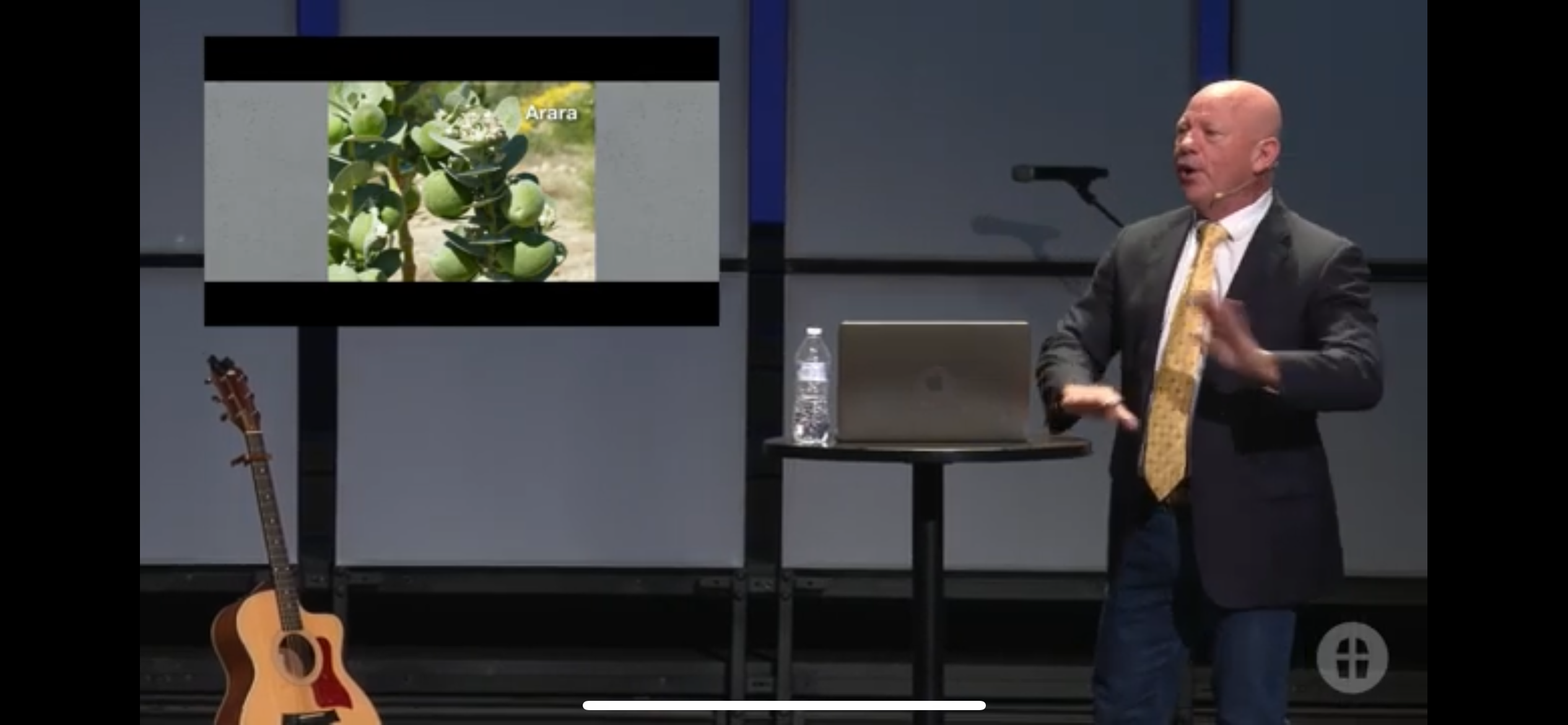
Stripling describes the arara plant in Jeremiah 17:6. (Screen Grab)
Jeremiah 17:6-8 is a tale of two trees, Stripling explained. One, which is not growing with God, is not capable of seeing the good and never will realize it’s thriving even if it is. The other, with God, grows healthy and strong. One is “a tree of death” and the other “a tree of life,” he said.
“And we get to choose from which tree we eat,” he continued.
But English translations of the Bible have a word in verse 6 translated as “bush,” “tree” or “shrub,” when the Hebrew word is “arara.” An arara is not just any bush or shrub, though. It is a specific bush, abundant in the region.
The fruit of the arara looks pretty on the outside, like a cross between a mango and a grapefruit, but when squeezed, it turns to dust and a milky sap of poison, he said. The Bedouin people still use the sap to make their arrows more deadly to hunt hyena, Stripling said.
“Jeremiah wasn’t just saying you’ll be any shrub, or any bush, or any tree, if you turn your heart away from the Lord. You’re going to be this specific shrub, right here, this bush, an arara.”
He explained Jeremiah’s audience would have known what he meant and thought of the arara, which looks delicious, but when squeezed contains nothing but dust and death.
“Your outward appearance has nothing to do with your standing with God,” Stripling continued. Jeremiah makes it clear when “we begin to think it does, we are the ones that have turned our hearts away from the Lord.”
Stripling contrasted the death plant, arara, to the pomegranate, also prolific in the area, which his team has verified played a prominent role through their excavations in the location which they believe to be the Holy of Holies, where the Ark of the Covenant was kept for three centuries.
Scripture speaks of attaching pomegranates to the robes of the priests who entered, and ceramic miniature pomegranate fruits are among the artifacts recovered there.
Only pomegranates, not figs, grapes or dates, were allowed in the Holy of Holies.
Stripling gave some ideas about why that might be, but concluded the pomegranate represented a life-giving tree to Jeremiah’s audience. It represented God’s ability to breathe on a person and “make you a productive member of the kingdom of God. Do we eat from the tree of death or of the tree of life? It all depends on the inclination of our hearts,” Stripling said.
Archeology doesn’t change Scripture in any way. Rather, Stripling stated: “What it does is it illuminates it. It sets it into a context so that we understand it here and now, the way that they understood it then and there.”
Silver coins
First century silver shekel featuring the pagan god Melqor. (Screen Grab)
The archeologist turned to a familiar parable of Jesus, in Luke 15:8-10, about a woman and her 10 silver coins. He pointed out the significance of the coins being silver, a detail often overlooked because the value of the silver coins is not well understood in today’s context.
The 10 silver coins demonstrate she’s a woman of wealth, each coin being worth about two week’s income.
“So, that means she’s got five months of income, on hand, in the bank, so to speak. That’s what financial planners tell you today, you should have at all times in the bank,” in case you run into an unexpected financial challenge.
Bronze coins were ubiquitous. Stripling said 99.5 percent of the coins they find daily in their excavations are bronze. But these silver coins were quite rare, making up, along with gold coins, the other 0.5 percent.
As verse 10 indicates, losing one and finding it again was cause for great celebration.
The point of the parable is this: “You are the coin. You’re the thing of great value that the Son of Man is searching for, because he wants a relationship with you.”
Jesus uses this story—along with the parable of the shepherd leaving 99 sheep to find the one that is lost, before it, and the prodigal son, after it—to demonstrate there is no acceptable amount of “shrinkage” or “lost collateral or inventory” in the business God is running, Stripling said.
Shedding further archeological light on these silver coins, or shekels, Stripling highlighted their high level of purity at 91 percent, when the average purity of silver in the first century was 80 percent.
He explained these coins were the only currency accepted to pay the Temple tax, which is why there were money changers at the Temple.
The problem with these coins being the currency of the Temple, Stripling said, is that on them was the image of the Roman god Melqart. “A pagan, Roman god adorns the only coin accepted in the Jerusalem Temple in the first century in the time of Jesus.”
The religious leaders were willing to overlook the commandment against images because it was 91 percent silver, Stripling said. “No wonder Jesus had a problem with the money changers.”
He cares not if a church “sells tacos in the foyer,” but “if you sacrifice your heartfelt beliefs for economic gain. And that’s what was going on in the first century.”
Stripling also discussed Matthew 19:23 and Luke 7:36-38, challenging common beliefs about the passages with archeological discoveries.
A popular speaker and author, Stripling serves on the board of directors for the Near East Archaeological Society. His books are available on Amazon, and he provided archeological commentary for a forthcoming reprint of the Open Study Bible.
On the Move: Chadwick, Cortés, Marriott
July 16, 2024
Chris Chadwick to First Baptist Church in Hereford as children’s pastor from First Baptist Church in Tulia, where he was youth intern.
Gabriel Cortés to Texas Baptists as Hispanic Education director from Baptist University of the Américas, where he was chief of staff.
Ronny Marriott to First Baptist Church in Richardson as senior pastor from First Baptist Church in Burleson, where he was lead pastor.
Texans on Mission providing relief for Beryl victims
July 16, 2024
HOUSTON—Texans on Mission has deployed two mass feeding units to meet needs in the shadow of the vast power outage caused by Hurricane Beryl in recent days.
The missions organization formerly known as Texas Baptist Men also has three chainsaw teams working to remove trees from homes and cars, as well as to give people access to their houses.
“The power outage is devastating for people, and the scope of this problem is hard to fathom,” said David Wells, Texans on Mission’s disaster relief director. “Because of the absence of power, it becomes very difficult for people to have adequate, healthy food.
“We’ve been asked to prepare 10,000 meals a day in the Houston area, and we are now ramping up to that level. This morning (Wednesday), our volunteers began working at 5 a.m. to serve in the name of Christ. As they cook, they’re praying over the meals, many of which are going to churches to share the gospel”
John Hall, Texans on Mission chief mission officer, said: “We are making sure that under-resourced communities are receiving the meals we are preparing. Right now, many people are suffering. We want to make sure to minister and care for as many people as possible. We’re thankful to partner with the National Baptist Convention of America to make that happen.”
Chainsaw teams are dealing with needs described as Priority 1—where trees have been downed on homes or cars or blocked access to homes. Priority 2 and 3 jobs will be done later.
“Three chainsaw teams in the area quickly deployed after the storm to help remove fallen trees and limbs from homes, cars and driveways,” Wells said. “These volunteers were quick on the scene, and others from throughout the state will be joining them soon because recovery from this storm is going to take a while.”
A Texans on Mission incident management team is being set up at First Baptist Church of Brazoria, along with a mobile shower and laundry unit to serve the chainsaw teams.
“God has blessed Texans on Mission with the equipment that helps our volunteers bring the love of Christ to people in need,” Wells said. “It is great to watch these men and women at work in service to others in the name of Christ.”