Southern Baptist membership down but decline slows

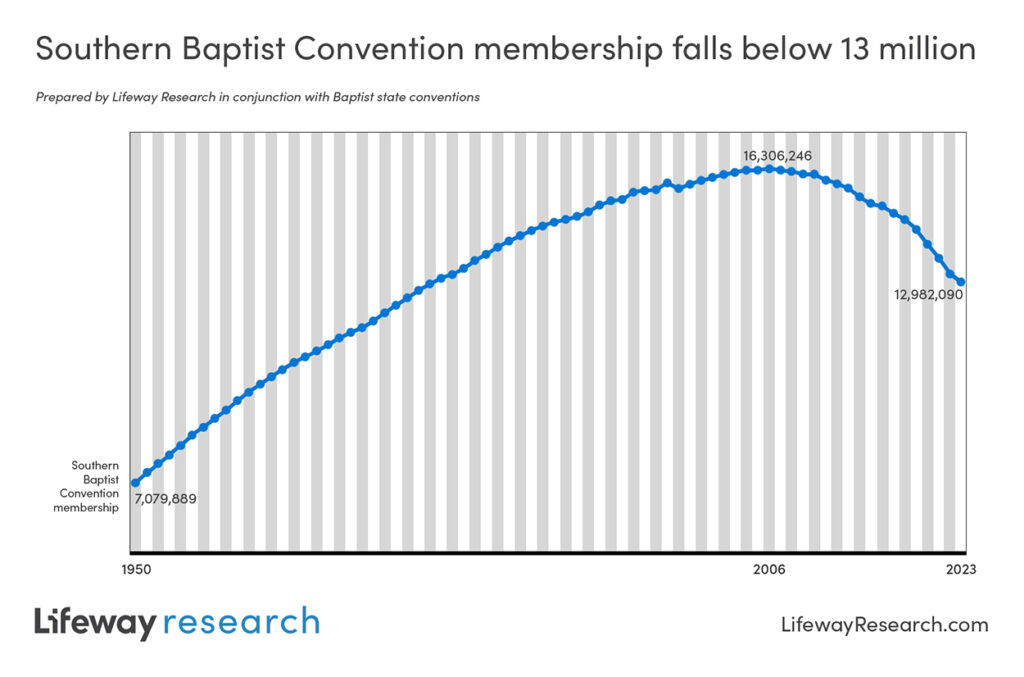
BRENTWOOD, Tenn.—Total membership among congregations affiliated with the Southern Baptist Convention dipped below 13 million for the first time since the 1970s, continuing a 17-year decline in membership.

However, the decline of less than 2 percent was the smallest in recent years.

The Annual Church Profile compiled by Lifeway Christian Resources in cooperation with Baptist state conventions details the annual numerical changes for the Southern Baptist Convention.
Southern Baptist-affiliated congregations experienced increases in baptisms, average weekly worship attendance and average small group attendance. Total baptisms climbed to more than 226,000.

In-person weekly worship service average attendance topped 4 million for the first time in three years, while in-person small group average attendance reached nearly 2.5 million. Average online worship service participation also increased.

“Southern Baptists are a force for good. We are sharing the gospel with more people, gathering for worship and Bible study in increasing numbers, giving billions to support churches serving communities across our country and sending millions to support mission enterprises around the world,” said Jeff Iorg, president-elect of the SBC Executive Committee.

“While we often address our shortcomings, it’s also good to pause and celebrate the global good Southern Baptists are accomplishing.”

Total number of SBC churches decreased

The total number of churches associated with the Southern Baptist Convention decreased by 292, less than one percentage point, to 46,906. The number of church-type missions declined by 170 to 2,474, but the number of additional campuses reported by multisite churches grew by 95 to 680.

Meanwhile, among states that collect financial information, undesignated receipts grew by less than 1 percent to top $10 billion in 2023, and mission expenditures through Southern Baptist avenues increased by more than 9 percent to reach almost $800 million.

“For 2023, 69 percent of Southern Baptist churches reported at least one statistic on the ACP. That is the same percentage as 2022,” said Scott McConnell, executive director of Lifeway Research.

“This represents a massive amount of cooperation among churches and the local associations and state conventions that collected most of the data. But this also means there is more church membership and attendance, baptisms and giving beyond these totals.

“While we celebrate the attendance growth, we continue to see a wide gap compared to what was reported before the pandemic. Our team will be conducting further analysis to determine if this is due to congregations not reporting or people who are not coming back to worship as often.”

The 2023 ACP records the total membership of Southern Baptist-affiliated congregations at 12,982,090, down 241,032 from 2022. The three previous years saw declines of 2.9 percent or more. This past year, membership fell 1.8 percent.

States home to the most Southern Baptists include Texas (2,461,681), Georgia (1,142,325), North Carolina (989,872), Tennessee (849,306) and Florida (768,437).

This year, several state conventions also used the ACP to ask questions about sexual abuse prevention and response. More than half of responding Southern Baptist-affiliated congregations (58 percent) say they require background checks for all staff and those who work with children and students.

Fewer say staff and those working with younger churchgoers have been trained in reporting sexual abuse cases (38 percent) or caring for survivors of sexual abuse (16 percent).

Baptisms increased in 2023

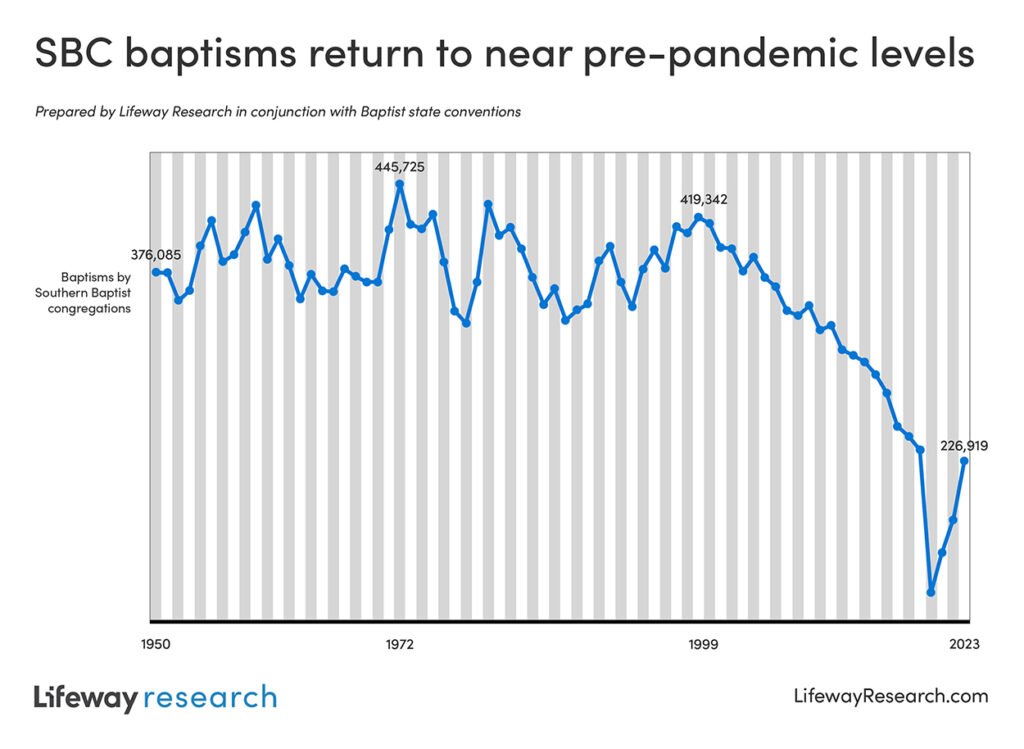
Total baptisms in Southern Baptist-affiliated congregations grew to 226,919 in 2023, an almost 26 percent jump from 2022, placing current numbers close to pre-pandemic levels. While most baptisms happened in the U.S. South, growth happened across the country, as 35 of 41 state conventions experienced year-over-year growth in the total number of baptisms.

This marks the third straight annual baptism increase, which hasn’t happened in more than three decades.

“A linear trendline of baptisms before the pandemic using data from 1999 to 2019 would have predicted fewer baptisms in 2023,” McConnell said. “It is reassuring that the God who has changed the lives of the people represented by these baptism numbers is not limited by trendlines or history. And Southern Baptist congregations welcomed 175,026 other new members which is within half a percent of those joining in 2019.”
States with the most total baptisms reported include Florida (29,063), Texas (22,294), Georgia (21,177), Tennessee (19,639) and North Carolina (15,088).

Except for California, the states with the largest numerical increase from the previous year were traditional Southern Baptist states. Florida (an increase of 7,048), Georgia (6,156), California (5,181), North Carolina (3,763) and Tennessee (3,664) had the five largest jumps from 2022 to 2023.

However, the state conventions with the largest percentage increase over the previous year were all from outside of the South: California (248 percent increase), Colorado (96 percent), Utah-Idaho (89 percent), Alaska (69 percent) and Pennsylvania-South Jersey (61 percent).

Worship attendance rebounding

Average in-person weekly worship service attendance at Southern Baptist-affiliated congregations continues to rebound, topping 4 million in 2023 for the first time since the COVID-19 pandemic. On any given week last year, 4,050,668 individuals attended a congregation affiliated with the Southern Baptist Convention, an increase of 246,178 over 2022 for a more than 6 percent jump.

Five states averaged more than 250,000 worshipers in congregations during 2023: Texas (469,532), Florida (406,142), Georgia (351,850), North Carolina (333,572) and Tennessee (281,981).

The overall growth from 2021 to 2023 marks the first time Southern Baptists have seen consecutive years of worship attendance growth in more than a decade. Though driven in part by the dramatic drops during the pandemic, the current percentage increases are some of the largest since the mid-1990s.

Every state convention except two grew in their in-person worship attendance average. Most states with the largest numerical increases were in the South, including Florida (43,334 increase over 2022), Texas (30,667), North Carolina (22,850), Alabama (22,119) and Tennessee (19,732).

The states with the largest percentage increases, however, came from outside traditional SBC areas, including Colorado (58 percent increase over 2022), Utah-Idaho (52 percent), Alaska (29 percent), Ohio (27 percent) and New York (27 percent). California had both a significant numerical and percentage jump (19,502 and 23 percent).

Additionally, Southern Baptist-affiliated congregations saw more people participate in their in-person small groups. In 2023, small group ministries averaged 2,429,175 people each week, an increase of more than 4 percent over 2022. The back-to-back years of growth marked the first years of consecutive growth since the early 2000s.

Every state convention but seven experienced growth. The largest numerical jumps include Florida (up 22,008), Texas (17,405), Alabama (14,539), Virginia (12,651) and Kentucky (7,835). Some of the highest percentage increases happened in Colorado (46 percent), Utah-Idaho (39 percent), Iowa (37 percent), Michigan (30 percent) and Alaska (29 percent).

“Outreach and discipleship are difficult today. They require time and commitment when our culture offers numerous distractions and alternatives. The pandemic was discouraging as fewer people engaged in these activities,” McConnell said.

“But as people have re-engaged and new people are participating, there is much to celebrate in Southern Baptist churches today while we invite more to join.”


Texas Supreme Court asked to weigh in on Patterson suit

NEW ORLEANS (BP)—The appeal of the dismissal of a civil suit against Southwestern Baptist Theological Seminary and its former president, Paige Patterson, now involves the Texas Supreme Court.

The U.S. Court of Appeals for the Fifth Circuit certified two questions to the Texas Supreme Court on May 3. While agreeing with the District Court for the Eastern District of Texas “in part” in the case’s dismissal, the circuit court asked the state’s high court to weigh in on the following:

  • Can a person who supplies defamatory material to another for publication be liable for defamation?
  • If so, can a defamation plaintiff survive summary judgment by presenting evidence that a defendant was involved in preparing a defamatory publication, without identifying any specific statements made by the defendant?

Those two questions involve two items—a press release from Patterson’s lawyer and a letter submitted by Southwestern Seminary donors to the seminary’s board of trustees.

The plaintiff, a former student identified in the case as Jane Roe, claims Patterson and the seminary failed to protect her from rape by another student and defamed her afterward.

The press release stated Roe “had given … many contradictory statements.” While the circuit court agreed the statement could be construed as defamatory, it said Roe failed to prove damages resulting from that statement, which is why it agrees with the district court’s granting of summary judgment to Patterson and Southwestern.

In the instance of the letter to trustees, the role of Patterson to his then-chief of staff, Scott Colter, comes into question.

The circuit court saw it differently than the district, saying that evidence in the latter’s summary judgment actually “creates a genuine issue over whether Colter was indeed acting as Patterson’s agent and ‘for the accomplishment of the objective of the agency.’” The court pointed to instances such as routing the letter to Patterson’s lawyer for approval and extending appreciation to the group later on behalf of Patterson and his wife Dorothy.

However, the circuit court also said it was “less clear” if Patterson is liable for the statements in the letter to trustees.

There is no “direct authority from the Texas Supreme Court” on liability toward a person who supplies defamatory information to a third party that is then published.

Although there is evidence Colter operated on behalf of Patterson, the circuit court noted, Roe’s argument stopped short of saying Colter actually made the statements, whether through writing them directly in the letter or providing them to others.

“What she seems to argue is that, because Colter helped with the letter, he is responsible for defamatory statements contained therein,” the court stated.

“We are uncertain whether this is enough to assert and maintain a defamation claim under Texas law.”

The suit was originally filed in 2019 before last year’s dismissal. A three-judge panel at the Fifth Circuit of Appeals heard the case April 3.


Panhandle churches help in wildfire recovery

Weeks after firefighters contained the largest wildfire in Texas history, Panhandle churches are ministering to their neighbors as they continue recovery and begin rebuilding.

The Smokehouse Creek Fire, which began Feb. 26, scorched more than 1 million acres. The Windy Deuce Fire and Grape Vine Creek Fire, which started the same day, burned about 180,000 acres. Area ranchers lost more than 7,000 cattle.

The fires did not destroy any church buildings in Top O’ Texas Baptist Association, but some church members were affected, Director of Missions James Greer said.

“People are going into the rebuilding stage now,” he said.

Prefabricated homes and mobile homes have been moved into the area. In some cases, construction of new homes has begun.

‘People are moving on’

“So many people from so many places brought in so much help,” said Bob Bynum, pastor of Locust Grove Baptist Church, near Canadian. “The recovery is going well. … People are moving on with their lives.”

Churches in the association—and some beyond the area—collected about $200,000 to assist families in recovery, Greer said.

About a half-dozen families with ties to First Southern Baptist Church in Fritch received benefits from the associational fund, said Charles Watson, chair of deacons at the congregation.

The church in Fritch housed disaster relief volunteers with Texans on Mission—formerly Texas Baptist Men—in the immediate aftermath of the fire.

“We had about 130 people sleeping in our building, and they set up trailers for laundry and showers here,” Watson said.

Texans on Mission dedicated more than 12,800 volunteer hours, helping to demolish more than 50 damaged structures and clearing 86 sites. Volunteers prepared more than 4,300 meals and washed more than 250 loads of laundry for the community. They distributed 120 Bibles, more than 2,000 bottles of water and about 500 boxes.

The Texans on Mission volunteers logged 723 hours operating heavy equipment and helped direct the delivery of donated hay, livestock feed, salt licks and fuel to farms and ranches.

‘Can finally breathe again’

Recognizing a need at First Southern Baptist Church in Fritch and out of a desire to repay the hospitality they had been shown, Texans on Mission provided the church’s children’s ministry with a playground. Individual volunteers donated funds to purchase playground equipment, and a crew from Paramount Baptist Church in Amarillo installed it.

“They really helped us out,” Watson said.

In recent days, traffic has “tapered off” at the storehouse the church established to provide canned goods, bottled water and cleaning supplies to families affected by the wildfire, he reported.

Rather than continue to keep the storehouse open during prescribed hours each week, it is now made available upon request when a family in need contacts the church.

Watson is providing much of the day-to-day leadership at the church at a time when the congregation is without a pastor or minister of music and youth. The church has enlisted supply preachers, and the congregation is moving ahead and planning summer activities, he noted.

“We’re recuperating,” he said. “I feel like I can finally breathe again.”


Webinar urges compassion in dementia care and ministry

A May 2 webinar urged sensitivity and compassion in ministering to people with dementia and their caregivers.

Hosted by B.H. Carroll Theological Seminary’s Marsh Center, “Ministering to Those with Dementia” featured an international panel of dementia care experts.

While aimed at supporting best practices for chaplains and nursing care providers for individuals with dementia in hospital, care home and community settings, much of the information applied to anyone who provides care or support to people with dementia.

Panelists were Kristiina Juudin, a Finnish nurse and researcher with University of Turku’s Faculty of Medicine, who has studied supporting the spirituality of older people with dementia in the nursing setting; Ben Boland, chaplain and lecturer in the Centre for Aging and Pastoral studies at Charles Sturt University, Queensland, Australia; Julia Burton-Jones, chaplaincy trainer with Anna Chaplaincy of BRF Ministries, London, U.K.; and United States-based Richard Behers, hospice chaplain, clinical pastoral educator and author of Living with Dementia using Multisensory Interventions.

What is dementia?

Dementia is not a single disease, Juudin explained, but a term referring to several memory diseases having in common “a decline in cognition that affects coping with daily activities. Dementia causes dependence on other people” due to progressive cognitive decline.

Dementia is experienced in several diseases, including Lewy Body disease, vascular disease, and, most commonly, Alzheimer’s disease, among others. It has no cure.

Estimates predict up to 151 million people will be living with dementia worldwide by 2050, Juudin said.

Early signs of dementia might include pronounced short-term memory loss, inability to complete daily tasks which were not previously a struggle, confusion, or changes in mood or personality, Juudin explained.

These early symptoms progressively decline into more severe loss of cognitive function at variable rates specific to each individual living with dementia. In more than 20 years as a nurse, Juudin said she has observed improvement in the medications used to treat dementia.

Though these medications may slow dementia’s progression, they do not stop it, Juudin said.

Juudin’s research highlighted barriers in supporting spirituality in dementia care for nurses. These barriers included lack of time to spend with each patient, low competence in conducting spiritual support, doubts about whether spirituality benefits their patients, and the growing dependence on other people making it difficult for people with dementia to express spiritual needs.

“But,” she said, “people with dementia, like others, are looking for answers to existential questions.” So, it is important to provide an environment that supports spirituality.

“Spirituality reminds older people with dementia who they really are,” Juudin said.

It’s important to express to older individuals with dementia they are loved and valuable. Nurses can start with this baseline affirmation and look for ways to connect their patients with religious, artistic, natural and other means of finding purpose and meaning utilized in their lives before dementia, Juudin said.

What is spirituality?

Ben Boland defined spirituality as interest in meaning, hope and purpose. He said research around the world and across generations shows most older people have a high interest in spirituality.

So, “spiritual growth is not simply possible in later life, it’s likely,” Boland quoted Elizabeth MacKinlay as saying.

If older people are interested in spirituality, then the question becomes, “Are Christians interested in older people?” Boland said.

“What proportion of resources … are focused on people under 20 versus resources directed toward people over 80?” Boland asked, pointing out that Scripture commands and calls Christians to love older people, including those living with dementia.

 Addressing the theological side of ministry to older people with dementia, Boland said he has been asked, “‘Does dementia prevent spiritual awakening and spiritual growth?’ No! is the short answer. … Because Christianity is all about God.

“God who is crucified and raised from the dead 2,000 years ago. Now unless you have a TARDIS, or time machine … we cannot go back and change what happened last week—let alone what happened 2,000 years ago. So, how can we start to think that our cognition effects our spirituality?

“Spirituality is bigger than cognition,” Boland said. “All Christians regularly forget God. But God never forgets us.” So, dementia is not a reason to neglect supporting spirituality in older adults.

Boland suggested a “Triple P Model” of dementia care: prayer, presence—simply showing up to be present with those affected by this isolating disease—and pastoral care, or loving people.

Julia Burton-Jones spoke about Anna Chaplaincy, a ministry in the United Kingdom providing “community-based chaplaincy rooted in local churches, offering spiritual care to older people of strong, little or no faith.”

While there is no U.S. equivalent of Anna Chaplains, Burton-Jones made a case for churches to provide community-based chaplains—either lay or professional, but well-trained—“who will enable growing numbers diagnosed with dementia to be nurtured spiritually.”

Prioritizing ministry to this population “allows churches to ‘join the dots’ in ministry among seniors and tells the wider world we care about people with dementia,” Burton-Jones said.

Go find them

Rich Behers closed out the panel discussing the fundamentals of professional documentation for dementia chaplaincy providers. But he also pointed to his work in developing a multisensory approach to spiritual care for dementia patients, particularly in the later stages of their disease.

He recommended chaplains utilize a Patient Interest Survey, completed by the primary caregiver of the person with dementia.

This survey will help the chaplain gain insight into ways to “reach” the person with dementia and should include:

  1. What does the primary caregiver believe is their loved one’s spiritual concern or problem?
  2. What faith community does the person attend?
  3. How did their person’s faith influence his/her life?
  4. What does the caregiver believe the chaplain could do to best serve their person and the caregiver?
  5. What was your loved one’s career?
  6. What hobbies did your loved one enjoy?
  7. What genre of music was your loved one’s favorite?

The chaplain then can take these answers and set about producing the right sounds, scents, scenery and setting to make a connection that will draw out the person with dementia.

He described how using a certain sound—the sounds of a jet engine preparing for take-off—had “awakened” a man who had been a pilot.

“That’s my plane. I have to get to the tarmac. I’ve got a flight to catch,” the man said, opening his eyes and speaking for the first time in months.

Behers said he has all kinds of sounds. The sounds of a hair salon for a hair stylist or the sounds of reeling in a bass for someone who loved to fish might trigger a response, even when people have not spoken for some time.

“Yes, they can be reached,” he said, even in the end stages, with the right protocol.

They need to know they are safe. They need affirmations of personal worth, three to four-word statements such as: “You are loved by God. You are safe.”

They’re still here, Behers said.

And “if they’re still here, then, by God, it’s up to me to go find them. And use the skills and tools that I have to do that and to find them and love them and let them know of the great love that God still has for them.”


Texans on Mission changing Peru one village at a time

SAN MARTIN, Peru—A Texans on Mission team recently brought water and the gospel to a village on Rio Itaya, a tributary of the Amazon River in northern Peru.

“Thank you so much, brothers, for this incredible and kind gesture towards our children, families and community,” said Alexander Tapullima, the community agent. “We are honored and valued.

“Last year, the drought we had was horrible. It was impossible for us to have good water. We had to walk far and find little water. And now this well that is next to our church is a great blessing and help.

“May you be blessed brothers and gentlemen. It helps us a lot to have clean and abundant water for our daily needs and health care.”

Ministering in a remote village in northern Peru required a two-hour van ride, three hours by boat and a 30-minute walk from the river. (Texans on Mission Photo)

Mitch Chapman, director of Texans on Mission Water Impact, said: “We are on a quest to change the world physically and spiritually—one community at a time. One of the things that makes this difficult is that some communities seem almost impossible to reach. It truly is God directing our partners’ every step and their resilience in following this direction that is leading the effort to reach every community.”

The Texans on Mission crew brought the well, hygiene classes, children’s activities and the Jesus film to the village on the Rio Itaya.

“It was a blessing to be in this community and to be able to serve this community and give them the facility of having clean water,” said Keny Ojanama, director of Water Access Peru, with whom Texans on Mission partners.

Getting needed equipment to San Martin presented challenges, Ojanama said. It required a two-hour van ride from the city, three hours by boat and then a 30-minute walk from the river.

After completing the work, the Texans on Mission team found the river level had dropped while they worked, Ojanama said. The team pushed the boats downstream for three hours before being able to continue their homeward journey via the river and van.

Remote places where God already is at work

“It’s the rhythm that we have,” Ojanama said. “We enjoy this. We are encouraged to know that we are only one piece in the puzzle of the Lord and to know that he will continue to complete and do what he has to do in each community.

“We are encouraged to know that we are going to places where he is already doing something.”

Texans on Mission’s Water Impact efforts include providing people with access both to water and spiritual care. Four people in San Martin professed faith in Christ, and two others reconciled with Christ, according to Ojanama’s report.

Thirty-five people participated in hygiene classes in nearby Progresso. These classes are an important tool in bringing health to remote villages.

Volunteers led activities for children. (Texans on Mission Photo)

“There was a good reception in this community,” Ojanama reported. “One of the authorities was with us the whole time and was ready to help us obtain wood for the shell of the protective fence of the well. There was an interest and gratitude from the community, very collaborative.”

Each afternoon, the team hosted sports activities and competitions for children and young people.

They screened Christian films at night and presented the message of salvation after each showing.

The community’s well “inauguration” emphasized ongoing care of the well with schedules for maintenance and distribution of the water.

“They were encouraged to take care of the well and its fence, which is solid,” Ojanama said. And the pastor/leader of the local church holds the keys to the fenced-in well.


Hawkins’ biography introduces Criswell to new generations

For 50 years, W.A. Criswell reigned as pastor of the First Baptist Church in Dallas. In a recently published biography, Criswell: His Life and Times, O.S. Hawkins aims to acquaint a new generation with this man, whom Hawkins held so dearly he regarded him as a father.

The biography, published by B&H Publishing Group, draws on numerous primary sources, including interviews with eyewitnesses to the accounts in the book, Criswell’s oral histories maintained by Baylor University, various dissertations, previous biographies of Criswell, and the more than 4,000 sermons of Criswell available online.

But the new, never-before-published information—including Criswell’s three regrets—came from a lengthy interview Hawkins conducted in 1994, “with the promise that I would not make it known and would not write this book until 20 years after his death,” Hawkins said.

“In many ways, he was a polarizing figure in Baptist life,” said Hawkins, Criswell’s chosen successor to the First Baptist Dallas pastorate and former GuideStone president and CEO.

“I wanted to bring a semblance of balance into both streams of perception, as well as introduce him to new generations of evangelicals and church leaders who may not have known much about him.”

Hawkins said he sees this biography as a natural sequel to his earlier book, In the Name of God: The Colliding Lives, Legends, and Legacies of J. Frank Norris and George W. Truett, rewritten from his dissertation on these “two types of Baptists.”

“Since it is a well-known fact that Criswell grew up in a home where his father was a fierce supporter of Norris and his mother was a devotee of Truett,” when the agreed-upon time frame expired, Hawkins dug in to their impacts on the life of Criswell.

“Criswell lived his entire life with the two warring influences of Norris and Truett fighting for control within the inner recesses of his own heart and mind,” Hawkins said. He asserts Criswell was outwardly Truett, but inwardly, “where it counted,” he was Norris.

The book discusses matters ranging from Criswell’s Panhandle upbringing, in near poverty, to his strained family-life and his wife’s spy-network within the church, to Criswell’s magisterial approach to church leadership.

Hawkins also discusses Criswell’s leadership in producing what critics call a fundamentalist takeover of the Southern Baptist Convention from within, having learned a lesson from Norris’ unsuccessful efforts from without.

Hawkins agreed to answer questions raised by his book by email. The interview has been edited for length and clarity.

How did you come to be close enough to the Criswells to accompany them on the European vacations the book mentions?

I was pastor of First Baptist Church in Fort Lauderdale, Fla., for 15 years (1978-1993). The church there saw rapid and explosive growth that became known through evangelical circles.

During the 1980s, the Criswells came to an antique show in Miami and called to see if we could join them for lunch after they attended our Sunday services. At lunch, I mentioned that I exchanged pulpits with the pastor of Westminster Chapel in London each summer in August.

He mentioned they were vacationing that same time in London that year, so we spent several days together in London that summer.

From that experience, we began to travel each summer together to various places in Europe and the Middle East and developed a true father/son relationship, enjoying time together with our wives.

You write about the warring influences of Norris and Truett on Criswell, describing him as a confluence of two lives into one—that he was Truett on the outside, but Norris on the inside.

You make this observation only a paragraph removed from a lengthy quote of Criswell giving his opinions of his two mentors where he says, “… Norris could do anything with a crowd… he was a gifted man, and knew crowd psychology … how to manipulate people, but oh, underneath Frank Norris, there were personal attributes that were diabolical.”

Did you ever see Criswell display similar ability and willingness to influence—even manipulate—a crowd?

Criswell readily recognized the strengths, as well as the weaknesses, of both Truett and Norris, discarding the worst and seeking to incorporate the best traits of both men.

No one could “rise to the occasion” like Criswell. Whether it was his message on the communist threat the Sunday after the Kennedy assassination [or] his message of the open door when he publicly acknowledged the church’s long history of racial injustice and declared without question its repentance and open-door policy, he challenged people without the tinge of manipulation, but also built on a solid biblical basis. For example, simply listen to his message “Whether We Live or Die” from the SBC Pastor’s Conference, available at wacriswell.com.

What is your perspective on what led to Criswell’s change-of-mind on race relations and abortion?

Dr. Criswell, in the midst of his greatness, possessed the unique ability to own his own mistakes, readily admit them, correct them and move on. As to the race issue, he began his ministry with stellar convictions regarding this—as evidenced by his telling the church he pastored at White Mound if they did not allow him to baptize the Sandoval family simply because of the color of their skin, they could find a new pastor.

What happened was that he inherited a church from George Truett that was deeply imbedded with the stain of white supremacy. … Sadly, he allowed himself to fit into its mold, and a few years later delivered the infamous speech on segregation to the South Carolina legislature. He called it the greatest mistake and most colossal blunder of his life and spent his last decade trying to atone for it, as documented in the book.

What other issues do you think Criswell would view differently today if he were still living?

I feel certain he would weigh in on the women in ministry debate going on today. While he strongly believed that the office of senior pastor was scripturally defined for men only, he built the church with women staff members who labored tirelessly at their assigned ministries. These included the likes of Millie Kohn, Libby Reynolds, Ann Hood, Edith Marie King, June Hunt, Jane Mann and countless others.

Libby Reynolds directed the children’s ministries at [First Baptist Dallas] for decades and was still here upon my own arrival. I have never known anyone who “shepherded” those children and their parents in the tender, yet bold, way she did, leading literally thousands of whole young families to faith in Christ.

Given the way prime actors—Paige Patterson, Paul Pressler—in the conservative resurgence have fallen so far from grace, what do you think his thoughts/feelings would be about the lasting legacy of that movement and/or those men?

Any serious student of Baptist history would, or should, attest to the fact that the SBC was in need of a theological course correction during the 1960s and 1970s. This was always Criswell’s focus. For him, it was never about people or personalities, but about principle.

He lived to see the lasting legacy of the conservative resurgence in the fact that every single professor in all six SBC seminaries unashamedly adheres to the Baptist Faith & Message 2000 and holds to biblical inerrancy. To Criswell, this was the lasting legacy of the conservative movement.

You clearly loved W.A. Criswell. What did you love most about him, and what do you consider to be the most valuable contribution he made to the world?

What I loved most about him was that in the midst of his accomplishments and recognized achievements, all the success of his books and his far-reaching influence, he never lost the wonder of it all. He maintained a childlike faith.

He brought a respectability to fundamental scriptural truth that had been lacking. Known primarily for his pulpit prowess, his greatest strength was his pastoral heart and his love for his people. And they loved him back.


How a praise song became a Christian nationalist theme

WASHINGTON (RNS)—When “How Great Is Our God” first hit the worship charts in the fall of 2004, George W. Bush was in the White House, Barack Obama was a little-known Illinois lawmaker just elected to the U.S. Senate, Donald Trump was a would-be reality TV star and scholars were just starting to pay attention to an uptick in the people known as “nones.”

Chris Tomlin

Twenty years later, the song, co-written by Chris Tomlin, Jesse Reeves and Ed Cash, remains a hit—currently No. 4 on the CCLI worship chart, popular in small groups and stadium worship concerts.  

It’s also become the theme song for Christian nationalists.

Protesters sang “How Great Is Our God” during the Jericho marches that preceded the Jan. 6 attack on the U.S. Capitol, and it has been a staple at Christian nationalism conferences in recent years.

Last week, when MAGA activist and worship leader Sean Feucht stood at the gates of Columbia University to oppose pro-Palestinian protesters and to demand that the school’s president resign, “How Great Is Our God” was on his lips.

“Our hearts will sing how great is our God,” he sang into a bullhorn, with a drummer in the background and a flag bearing the Stars and Stripes alongside a blue and white Star of David waving overhead.

Powerful and popular song

At first listen, “How Great Is Our God” seems an unlikely candidate for a Christian nationalism protest song. There is nothing overtly political or partisan about the lyrics, and the song is sung in churches of all shapes and sizes.

And it remains extraordinarily popular. The song first appeared on the Top 100 list compiled by Christian Copyright Licensing International, which licenses music for use in churches, in October 2004 and has remained there ever since, often among the top 10 songs.

Right or Wrong? Copyright lawLeah Payne, a religious historian and author of God Gave Rock & Roll to You, said “How Great Is Our God” showcases the skill of Tomlin and his co-writers—who fused the power of stadium rock anthems with Christian lyrics, creating songs with infectious hooks that draw a crowd into singing along.

“I don’t think they get enough credit for being skilled at what they do,” she said.

“How Great Is Our God” also harks back to an earlier era of worship music, she said, before megachurches such as Hillsong, Bethel and Elevation dominated the industry. The hit songs churned out by those churches often rely on vocal acrobatics and sophisticated arrangements—filled with white space and instrumentals, which makes them harder to pick up spontaneously.

By contrast, “How Great Is Our God,” at its heart, is a guy with a guitar. The song is so simple and catchy that Tomlin admitted he was a bit embarrassed when he first wrote it. But the chorus had magic to it, giving it the kind of power of a song like “We Shall Overcome,” sung at protests for generations.

“A guy with a guitar—or a woman with a guitar—could just pick it up,” Payne said. “It’s just a well-written pop song.”

Payne said worship songs like “How Great Is Our God” work well at protests, regardless of what the protest is about. For example, she said, “Waymaker,” another hit song, was sung both at Black Lives Matters protests and at anti-vax rallies in 2020.

Open to interpretation and application

The lyrics of a song like “How Great Is Our God” can be vague enough that verses describing the God of the Bible could easily be adapted to mean the God of America or the God of a particular group of people.

“When I think of ‘How Great Is Our God,’ I wonder: Who is the ‘our’?” Payne said.

Matthew D. Taylor, a senior scholar at the Institute for Islamic, Christian and Jewish Studies and author of a forthcoming book about the New Apostolic Reformation, says there’s a reason why activists like Feucht pick popular worship songs to play at their rallies.

If Feucht, a musician and worship leader, sang his own songs, which can be more overtly political, no one would sing along, since they are relatively obscure.

Taylor said in recent years, evangelical worship has become increasingly political, especially as congregations became more polarized in the wake of Trump’s 2016 election. Folks who sing songs like “How Great Is Our God” are more likely to share the same political views than they did when the song was first released in the early 2000s.

The COVID-19 pandemic amped up that polarization, Taylor said, with Feucht and other activists turning worship into a partisan act during pandemic-era lockdowns. Feucht began holding outdoor impromptu worship rallies in places such as Portland and Seattle, near the sites of protests that followed the death of George Floyd.

“We are here as citizens of America and citizens of the kingdom of God,” he said during a 2020 worship protest in Seattle. “And we will not be silenced.”

Worship as a weapon

For Feucht, worship is a weapon that empowers Christians for political action as an act of spiritual warfare, as the one-time congressional candidate put it in a sermon posted on his YouTube channel. Singing a worship song can show your political allegiance and fill the act of singing with political meaning.

Musician Sean Feucht, center right with arm raised, and pastor Russell Johnson, center left, participate in the “United for Israel” march around Columbia University, April 25, in Manhattan, New York. (RNS photo/Fiona André)

“It’s the idea that Christian worship is itself a political act, a partisan act,” said Taylor. “And one that baptizes the agenda of one party or one presidential candidate, and demonizes the agenda of the other party.”

Feucht did not respond to an emailed request for comment.

Ironically, Taylor noted, the same folks who love “How Great Is Our God” would be aghast if protesters began shouting out “Allahu Akbar”—an Arabic phrase that means the same thing for Muslims.

Adam Perez, a musician and assistant professor of worship studies at Belmont University in Nashville, Tenn., said “How Great Is Our God” differs from other popular worship songs because it focuses on praising God, rather than testifying to the worshipper’s faith.

“‘How Great Is Our God’ is more straightforward praise and worship,” he said.

The song also draws clear lines between good and evil, darkness and light, which lends itself to partisan politics. Perez said the songwriters didn’t intend the song to be political, and for many people, it is not. But it still has language that works for partisan goals.

“How Great Is Our God” also has a triumphant tone to it, in that God will overcome any obstacle, and that could include political enemies, Perez said. And that can make it a fit for protests.

“God is going to overcome whatever blocks your way,” he said. “That triumphant proclamation of God is the clear connection in these places.”

Perez, who has studied the theology behind Feucht’s worship protests, said the context also matters. A song like “How Great Is Our God” has a different meaning during a Stop the Steal protest or a God and Country rally than it does at a Sunday morning worship service.

But the simplest explanation may be that lots of Christians love “How Great Is Our God.” So it makes sense that Christian nationalists would love it.

“It’s a really popular song,” Perez said.


SBC Cooperation Group releases recommendations

NASHVILLE (BP)—Four recommendations released May 1 are designed to “prioritize and emphasize the authority of messengers in defining the boundaries of our cooperation while clarifying and refining our structure,” the Southern Baptist Convention Cooperation Group stated.

The group was tasked at last summer’s annual meeting to study the issue of what makes a church “to be in friendly cooperation of faith and practice” with the SBC.

Published 41 days ahead of the 2024 SBC annual meeting June 11-12 in Indianapolis, the recommendations are to be considered a draft, said Chairman Jared Wellman, pastor of Tate Springs Baptist Church in Arlington. They are “subject to necessary edits” he added.

The first three recommendations are directed at the SBC Executive Committee to propose changes to SBC governing documents for consideration at the 2025 annual meeting.

They concern steps for making changes to the Baptist Faith & Message 2000, who should have authority for seating messengers at an annual meeting, and strengthening the tie between entity trustees and the Baptist Faith & Message.

The fourth recommendation is for the Executive Committee to “evaluate” the usefulness, not to mention accuracy, of a public list of Southern Baptist churches and report their findings at the 2025 annual meeting.

Recommendation 1

The first recommendation addresses how edits or amendments may be made to the Baptist Faith and Message. Last summer in New Orleans, an amendment to the Baptist Faith & Message basically rolled through to a vote with little discussion, prompting concerns about how that came to be.

That would not be able to happen under the first recommendation, which asks that such amendments require the same ratification as amendments to the SBC Constitution—a two-thirds vote in two consecutive years.

The Baptist Faith & Message is “significant” in drawing a picture of what it means to be in friendly cooperation, the group said. “The process of amending ‘The Baptist Faith & Message’ should be robust.”

Recommendation 2

The second recommendation is similar to a process already in place, but with a distinct difference. As it is, the Credentials Committee recommends to the Executive Committee churches it considers no longer to be in friendly cooperation. If the Executive Committee agrees, those churches no longer are part of the SBC, but they may appeal the decision at the annual meeting.

“The sole authority for seating messengers” comes from the messenger body, Wellman said in a Spaces discussion on X May 1, co-hosted by SBC President Bart Barber and South Carolina pastor David Sons.

As such, the Credentials Committee, in collaboration with the Executive Committee “as needed,” will present cases that will go before the messengers for a vote.

“We trust the messengers. We champion the messengers,” Wellman said in the discussion. “And we feel like messengers are the ones who ought to have this sole right to make this decision.”

The SBC Cooperation Group also recommended churches seating messengers for the first time be recognized and celebrated at the annual meeting.

“… [T]he health of our convention’s culture would be improved” by that step, the group said in its report.

Recommendation 3

The third recommendation calls for a requirement by the Committee on Nominations to nominate “only those candidates who affirm the convention’s adopted statement of faith” to seats as entity trustees or as standing committee members.

Wellman pointed to the Baptist State Convention of North Carolina as an example when it came to trustee fidelity.

“We were impressed by that model in such a way where we felt like we could mimic it,” he said.

In functionality, he and Barber noted, the current Committee on Nominations followed this model. “In fact, I think it’s fair to say that in recent memory, the Committee on Nominations has already been doing this.”

Wellman agreed, comparing it to Recommendation 1 and the ease with which the Baptist Faith & Message was amended in New Orleans. As it is, a trustee can “theoretically” not affirm the Baptist Faith & Message. A step to strengthen that step can only strengthen the trust between churches and Southern Baptist entities.

Recommendation 4

The fourth recommendation urges steps “to clarify our cooperative unity” by evaluating “the usefulness and accuracy” of a public list of Southern Baptist churches.

In the Spaces discussion, previous cases were brought up where churches were recommended to no longer be in friendly cooperation and, when contacted, were surprised they had any connection to the SBC. The result was confusion that often played out publicly.

Southern Baptists could gain “a clearer picture” of which churches are part of the SBC, whether that is through seating messengers, completing an Annual Church Profile and/or giving through the Cooperative Program.

No more ‘disfellowship’

The report included an addendum as a point of clarification. The language of “disfellowshipping” a church is inaccurate, the group said, because from a biblical standpoint, it suggests that those churches are no longer Christian.

Article XIV of the Baptist Faith and Message encourages cooperation with like-minded churches, even if they aren’t Southern Baptist, the group pointed out.

With regard to Southern Baptist matters, the suggested terminology is “not in friendly cooperation.”

Early in the Cooperation Group’s meetings, the phrase “closely identifies with” received a lot of scrutiny.

Wellman admitted he was “lukewarm” to it and the “ambiguity” it brought. But by December, he had “come to love this phrase,” calling it “not perfect” but “sufficient.”

Women with the title ‘pastor’

There is no mention of the Law Amendment in the recommendations, although Wellman and Barber said it was brought up to them often by others.

That constitutional amendment, up for a second and final vote by messengers this June, pertains to churches giving women the title of pastor.

As it wasn’t mentioned in the motion that messengers approved, Barber said, addressing it directly was deemed to be outside the scope of the group’s assignment.

“That amendment lies directly in the hands of the messengers,” he said.

The report included a statement on Article III of the SBC Constitution, which outlines the composition of the SBC.

The constitution’s language of “closely identifies with” regarding the Baptist Faith and Message “is sufficient,” the group said.

“Overall, our committee is in unanimity in trusting and championing the convention’s messengers,” Wellman wrote in a chairman’s note preceding the report that also called for Southern Baptists to pray and fast with the recommendations’ release.

In addition to Wellman, members of the Cooperation Group are Victor Chayasirisobhon, Jerome Coleman, Tara Dew, Donna Gaines, Matt Henslee, Travis Kerns, Richard Land, Jonathan Leeman, Jason Paredes, Greg Perkins, Jim Richards, Juan Sanchez, Andrew Walker, Trevin Wax and Tony Wolfe.

SBC officers serving in ex officio roles are Bart Barber, president; Kason Branch, second vice president; Don Currence, registration secretary; and Nathan Finn, recording secretary.


Commission names worst religious freedom violators

The U.S. Commission on International Religious Freedom added Azerbaijan to its list of 17 “worst of the worst” violators of freedom of religion or belief in 2023.

In its annual report, released May 1, the commission recommended the U.S. Department of State designate Azerbaijan as a Country of Particular Concern—a category reserved for a nation in which the government has engaged in or tolerated systemic, ongoing and egregious violations of religious freedom.

The report cites a nongovernmental organization that documented 183 individuals who were “wrongly imprisoned in connection with their religious beliefs, activities or activism.”
In an online conference announcing the report’s release, Commissioner Stephen Schneck added, “Authorities [in Azerbaijan] are regularly accused of torturing or threatening sexual violence to elicit false confessions from detainees, with those perpetuating such violence facing no accountability.”

Four members of the commission—Abraham Cooper, Susie Gelman, Mohamed Magid and Nury Turkel—dissented from what they termed the “ill-advised recommendation” to designate Azerbaijan as a Country of Particular Concern.

The dissenting commissioners acknowledged religious freedom violations in Azerbaijan and noted the State Department added the country to its Special Watch List last year for the first time. That second-tier designation is reserved for nations that engage in or tolerate severe violations of religious freedom but not in a “systemic, ongoing and egregious” manner.

The four dissenting commissioners agreed with officials at the State Department that “conditions in Azerbaijan are not at the level of a Country of Particular Concern.”

Other Countries of Particular Concern recommended

In addition to Azerbaijan, the commission again recommended the State Department add four nations—Afghanistan, India, Nigeria and Vietnam—to its Countries of Particular Concern list.

Last year, the commission recommended Vietnam be named as a Country of Particular Concern. It has recommended that status for Afghanistan since 2022, India since 2020 and Nigeria since 2009.

The commission also recommended the State Department continue to identify a dozen nations as Countries of Particular Concern—Burma, China, Cuba, Eritrea, Iran, Nicaragua, North Korea, Pakistan, Russia, Saudi Arabia, Tajikistan and Turkmenistan.

The report singles out China and Russia as “among the world’s worst violators of their people’s religious freedom, as well as among the most active perpetrators of cross-border repression and other malign activities abroad, including in the United States.”

The commission similarly points to India’s “acts of transnational repression” of religious minorities. Its report states India is guilty of “discriminatory nationalist policies” and “perpetual hateful rhetoric,” along with a failure to address violence against Christians, Muslims, Sikhs, Dalits, Jews and indigenous people.

The report notes 687 incidents of violence against Christians in India, as well as the destruction of more than 500 churches and two synagogues in Manipur State, where more than 70,000 were displaced.

Additional offenders cited

The commission recommended the State Department include 11 countries on its Special Watch List—Algeria, Egypt, Indonesia, Iraq, Kazakhstan, Kyrgyzstan, Malaysia, Sri Lanka, Syria, Turkey and Uzbekistan.

It recommended Kyrgyzstan for the first time “due to its deteriorating religious freedom conditions,” particularly noting the government targeted Muslims “who practice a form of Islam that deviates from the state’s preferred interpretation.”

The commission also recommended seven “nonstate actors” as Entities of Particular Concern,” all of which the State Department designated as such in December 2023: Al-Shabaab, Boko Haram, the Houthis, Hay’at Tahrir al-Sham, Islamic State Sahel Province, Islamic State in West Africa Province and Jamaat Nasr al-Islam.

The commission called on Congress to:

  • Request a Governmental Accounting Office report of all U.S. foreign assistance to nations the State Department designates as Countries of Particular Concern or that are on the Special Watch List.
  • Make U.S. security assistance to Countries of Particular Concern and nations on the Special Watch list conditioned on improvements in religious freedom.
  • Permanently reauthorize the Lautenberg Amendment to allow legal U.S. residents to facilitate the resettlement to the United States of persecuted religious minority groups from their countries of residence.
  • Prohibit any person from receiving compensation for lobbying on behalf of foreign governments designated as Countries of Particular Concern or places on the Special Watch List.

Also in its report, the commission recommended the Biden administration impose asset freezes or visa bans on individuals and entities for severe religious freedom violations; advocate for the release of religious prisoners of conscience in multilateral and bilateral meetings with relevant governments; and appoint to the National Security Council a special adviser to the president on international religious freedom.

Frederick A. Davie, vice chair of the U.S. Commission on International Religious Freedom, said U.S. officials can advance freedom of religion by “raising the names of victims persecuted for their faith each time the U.S. government engages with foreign governments.”

Anniversary of International Religious Freedom Act

The release of the commission’s annual report marked the 25th anniversary of enactment of the International Religious Freedom Act.

A quarter-century after the act became law, “many individuals and communities around the world still cannot freely practice their religion or belief,” said Abraham Cooper, chair of the U.S. Commission on International Religious Freedom.

The commission is “disheartened by the deteriorating conditions in many countries,” he added.

“While 25 years has passed since USCIRF was created, it is more important now than ever to ensure that promoting freedom of religion or belief remains a key tenet of U.S. foreign policy,” he said.

“USCIRF’s independence and bipartisanship enables it to unflinchingly identify threats to religious freedom abroad, and despite there being dissent on certain issues included in the annual report, commissioners remain committed to advancing religious freedom for all.”

EDITOR’S NOTE: Paragraphs 5, 6 and 7 were revised slightly after the article initially was posted.


Around the State: Scot McKnight to join HCU faculty

Houston Christian University and Houston Theological Seminary announce Scot McKnight will join the Doctor of Ministry faculty, teaching and supervising students in the program. McKnight brings decades of teaching experience and an active engagement with the church to the study of the New Testament. He has written more than 50 books, including The Jesus Creed: Loving God, Loving Others and volumes in the New International Commentary on the New Testament, NIV Application Commentary and the Story of God Bible Commentary series. In 2023, he completed a fresh translation of the New Testament, The Second Testament–as a sequel to John Goldingay’s The First Testament. Phil Tallon, dean of the School of Christian Thought, said, “Dr. McKnight is one of the nation’s most prominent biblical scholars, who also knows how to communicate to a popular audience. This mixture of scholarship and ministry fits perfectly with our mission to bring biblical studies from the academy to the church.”

Prayer tent at HSU ANDY24 prayer event. (Courtesy photo/HSU)

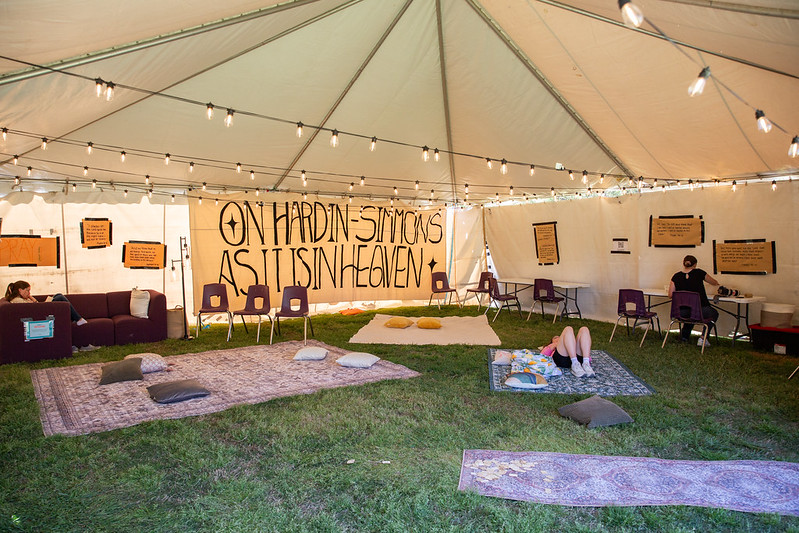
The Baptist Student Ministry at Hardin-Simmons University hosted its second annual ANDY24 earlier this month. During this time, the community came together for 24 hours of prayer. Worship, prayer and speakers were split between Logdson Chapel and a tent on the lawn. From 8 p.m. on April 9 to 8 p.m. on April 10, HSU students, staff and faculty prayed for the campus, Abilene and the world. The BSM also held three chapel services. The tent contained five stations for self-reflection and prayer, ranging from hand-written notes with prayer requests for others to pray over to journaling reflections on prayer to share with others. Guest speakers during chapel were Ryan Eastman from Fellowship of Christian Athletes, Manny Silva, HSU’s BSM director, and Landri Bayless, a current HSU student. During Silva’s chapel service, he cited Matthew 5:23-24 as the most important lesson. “It’s not about the act,” he explained. “God cares about your heart.”

Barrera Scholarship dedication. (Courtesy photo/Wayland)

Wayland Baptist University celebrated five new endowed scholarship dedications that will benefit students. The Barrera Family Endowed Scholarship, the Paulie and Mary Louise Jones Endowed Scholarship, and the Randy and Carol Kaufman Endowed Scholarship were dedicated at Wayland’s board of trustees luncheon, April 25. Joe and Frances Barrera and family are long-time residents of Plainview with a heart for business, ministry and missions. This scholarship is established to assist first-generation students at Wayland who are active in missions and aspire to work in a mission field. Paulie Christian Jones and Mary Louise Jones of Clovis, N.M., were passionate supporters of higher education and Christian service throughout their careers. With this scholarship, the Jones family continues their commitment to Christian higher education, hoping to assist students in need as they pursue their educational goals. Randy and Carol Kaufman are passionate about Christian education. He graduated from Wayland with an accounting degree in 1991 and has been working in his local CPA firm since 1987. He attributes his professional success to the education he received while attending Wayland. Additionally, the previously established Lt. Col. Odis V. and Edith R. Sims Endowed Scholarship and the Dr. Charles and Susie Starnes Endowed Scholarship were dedicated, April 18, at the Pioneers of Excellence donor appreciation dinner. Endowed scholarships at Wayland require a minimum $25,000 gift and are then invested as part of the university’s endowment. Earnings are pulled annually to provide scholarships for students, with the main corpus remaining intact for generations to come.

East Texas Baptist University celebrated the legacy of Dr. David Dykes at the David Dykes Servant Leadership Award & ETBU Scholarship Dinner at the Green Acres Baptist Church Crosswalk Conference Center. (Courtesy photo/ETBU)

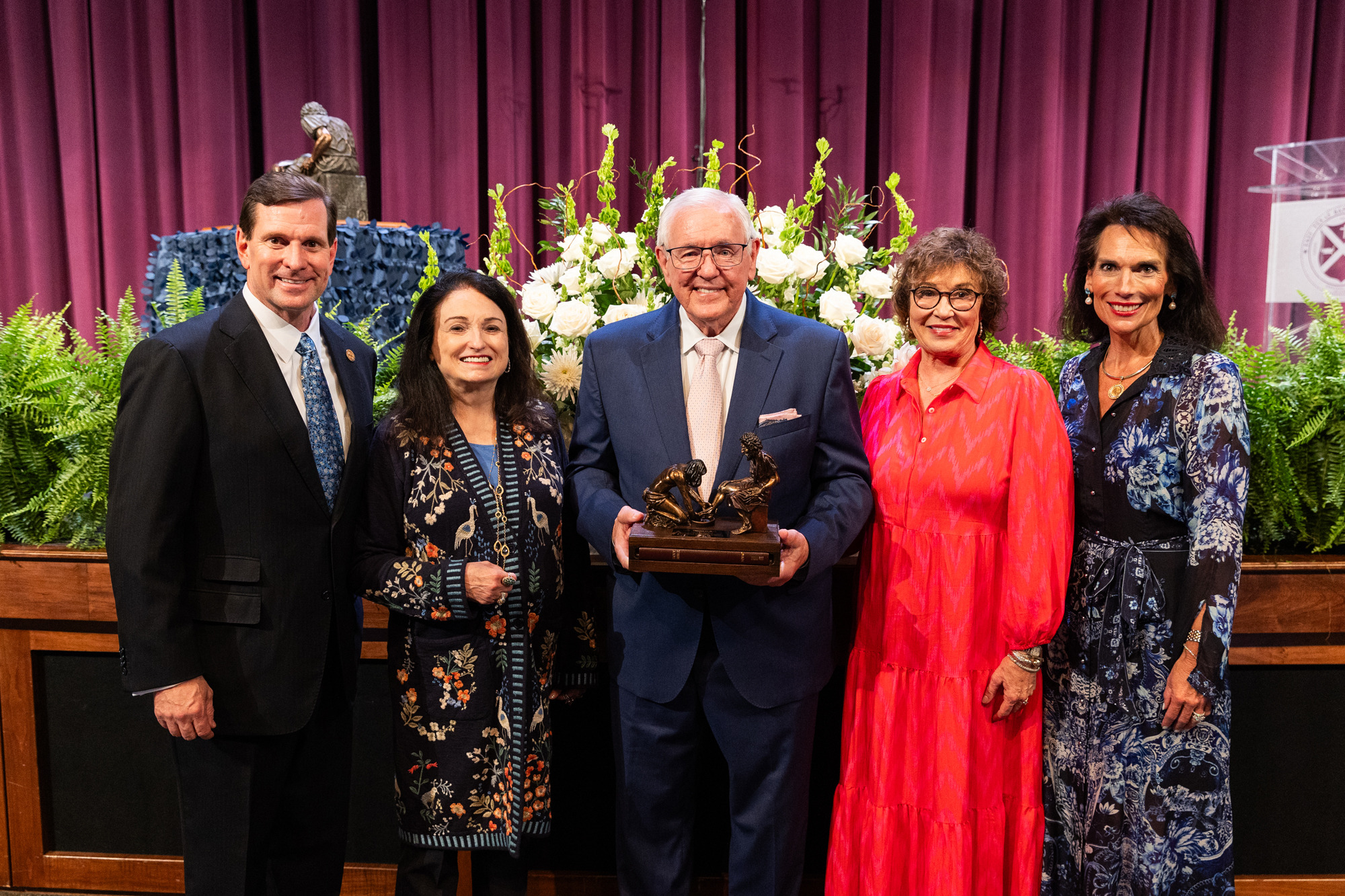
East Texas Baptist University celebrated the legacy of David Dykes at the David Dykes Servant Leadership Award & ETBU Scholarship Dinner, April 23. Guests honored Dykes’ servant leadership and raised funds for scholarships supporting ETBU students. Dykes, senior pastor of Green Acres Baptist Church in Tyler from 1991 to 2021, has long been recognized for his dedication to Christ and servant leadership principles, university leaders noted. Throughout his tenure, he made significant contributions to the Tyler community and beyond, embodying the spirit of faith in action.“Whether at home or abroad, in classrooms with our faculty or in the community with our partners, we are developing devoted Christian servant leaders like Dr. Dykes,” ETBU president Blair Blackburn said. “Through Dr. Dykes’ service on the ETBU board of trustees, his training of Christian ministry students in religion classes, and his biblical teaching at ETBU Chapel Services, Brother David has modeled for our students true spiritual leadership that exemplifies the humble servanthood of Jesus Christ.”

East Texas Baptist University honored 159 graduating seniors with the presentation of their official ETBU Class Ring. (Courtesy photo/ETBU)

East Texas Baptist University honored 159 graduating seniors with the presentation of their official ETBU Class Ring. The Ring Blessing ceremony was held April 24. Inspired by Deuteronomy 6, the class ring allows ETBU alumni to carry and display the love of Christ. “The Ring Blessing ceremony at ETBU is a cherished tradition where graduating seniors receive their class rings, symbolizing their journey at our university,” Vice President for Advancement and Administrative Affairs Scott Bryant said. “We take pride in these students, knowing they will carry the values of faith and excellence forward into the world, representing both the Lord and our institution with honor.” As a gift of appreciation from the university to graduating seniors, the ETBU class ring symbolizes the university’s blessing over students as they commence from ETBU to pursue their career callings.

The University of Mary Hardin-Baylor honored students Isabella Peña, Maggie Spellings, and Michael Alvarado with the Gary and Diane Heavin Servant Leadership Award. (Courtesy photo/UMHB)

The University of Mary Hardin-Baylor honored students Michael Alvarado, Isabella Peña and Maggie Spellings with the Gary and Diane Heavin Servant Leadership Award during the final chapel service this semester. The award recognizes the students’ extraordinary time and energy devoted to ministry and community service during their years of study at UMHB. The award is named for Gary and Diane Heavin of Waco, who established an endowment at UMHB to fund this recognition annually. The honor included a $1,000 cash award for each student, a portion of which could be donated to an organization of their choice. Michael Alvarado is a senior small business and entrepreneurship major from Rockwall. Alvarado is giving a portion of his cash award to Grace Church Salado. Isabella Peña is a senior exercise physiology major with a concentration in strength and conditioning from Waco. Peña plans to donate a portion of her cash award to Unbound Now Waco, a nonprofit organization that serves survivors and resource communities to fight human trafficking. Maggie Spellings is a senior social work major from Round Rock. She is giving a portion of her cash award to Feed My Sheep, Temple-based, nonprofit organization formed to provide nourishment and basic human needs to homeless and needy people of Bell County.


Disaster relief volunteers responding to storm damage

After storms rolled across Texas, Oklahoma and other parts of the country in recent days, Texans on Mission disaster relief teams responded.

The devastating tornado that hit Sulphur, Okla., has attracted much media attention, and Texans on Mission—formerly Texas Baptist Men—is deploying two chainsaw teams, a temporary roof team, man lift and heavy machinery, said Wendell Romans, state chainsaw coordinator.

Texans on Mission chainsaw volunteers work in Fort Worth. (Photo / Russ Dilday / Texans on Mission)

A Collin County team will leave Texas Sunday and begin work Monday. A Denton team will deploy, as well. Romans expects the work to take about two weeks. Texans on Mission is also sending a temporary roof team from Georgetown.

“My guess is this is only the tip of the iceberg, and more teams from Texas will be needed,” Romans said.

Texans on Mission chainsaw volunteers already completed five jobs in the Pittsburg area, and they served in Fort Worth, where lightning split a tree on church property.

Texans on Mission disaster relief volunteers work in Pittsburg. (Texans on Mission Photo)

David Wells, state disaster relief director, said: “We’re always ready to serve because we know God will provide” through our network of support.

“We have the tools we need, the fuel required and a cloud of angels who are praying for protection and guidance for us. That helps us have an impact for Christ everywhere we go,” Wells said.

Meanwhile, multiple Texans on Mission teams are responding in their local areas.

“On Friday, 10 tornadoes hit Texas as part of a wave of storms that swept across the state,” said Mickey Lenamon, executive director/CEO of Texans on Mission. “Within hours, Texans on Mission volunteers had visited the site of every one of them. Thankfully, most of them hit sparsely populated land.”

Four disaster relief teams are deployed in Southeast Texas because of recent flooding in Kirbyville and a tornado in Port Arthur. Texans on Mission already logged more than 700 volunteer work hours, and more crews are heading to Port Arthur this week.

Lenamon sent a thank you note to supporters of Texans on Mission disaster relief.

“This kind of quick response is possible because of your prayer and financial support,” he wrote. “You are there with every team who responds, whether they are serving in Texas or around the world.”


Mexican Baptists in Hidalgo forced from homes

More than 100 Baptists in Hidalgo State, Mexico, were forced to leave their homes in the villages of Coamila and Rancho Nuevo on April 26.

Village leaders cut off electricity, vandalized and blocked access to some homes and their church, and posted guards at the entry points to the villages, Christian Solidarity Worldwide reported.

The 139 displaced individuals—including 75 infants and children whose families are members of Great Commission Fundamental Baptist Church—sought refuge in Huejutla de los Reyes, where they are asking the government to intervene on their behalf.

Evangelicals in Huejutla are providing the displaced families with food and water, evangelicodigital.com reported.

History of violating religious freedom

Rancho Nuevo and Coamila—indigenous Nahuati-speaking communities in Hidalgo—have a history of violating the religious freedom of minority faith groups dating back at least to 2015.

The villages are governed under Mexico’s Law of Uses and Customs, which recognizes the right of indigenous communities to maintain their cultural and traditional local governance.

The law stipulates local authorities must govern in line with rights guaranteed in the Mexican constitution and international conventions. However, the state and federal government does little to protect minority rights in those areas, human rights organizations assert.

Women from Hidalgo were among more than two dozen participants in research CSW—a United Kingdom-based human rights organization—conducted in 2021 focusing on religious freedom violations indigenous religious minority women in Mexico face.

The report that grew out of that research, “Let Her Be Heard,” documented violations including harassment, threats and attacks on property, denial of basic services and forced participation in religious activities of the majority Roman Catholic population.

In December 2022, a Baptist woman was hospitalized after being tied to a tree and beaten, and her pastor was assaulted when he tried to intervene.

Pastor detained, members assaulted

The same pastor—Pastor Regelio Hernández Baltazar of Great Commission Fundamental Baptist Church—most recently was taken into custody by authorities on March 25 and detained for 48 hours, along with two other church leaders.

Several weeks ago, village leaders approved the takeover of five plots of land owned by church members, cutting down trees and destroying crops. Three houses were surrounded, and the homeowners were denied entry.

Some members of the church were attacked physically—including with machetes—and villagers repeatedly tried to break down the pastor’s door at night, evangelicodigital.com reported.

The forcible displacement of the Baptists was “entirely preventable, had the government done its job and upheld the law,” said Scott Brewer, chief executive officer of CSW.

“Freedom of religion or belief is guaranteed to all in Mexico, including those in indigenous communities, and yet the attacks on this right in Rancho Nuevo and Coamila have been egregious and ongoing now for almost a decade,” Brewer said.

“CSW calls on Governor Julio Ramón Menchaca Salazar to work to establish a culture of rule of law where the fundamental rights of all are guaranteed, and where swift action is taken to hold those responsible for the criminal acts committed in association with the violations of these rights to account.”