Book says SBC lacks system of preventing sexual abuse

AUSTIN, Texas (ABP) — A book released in advance of the June 23-24 annual meeting of the Southern Baptist Convention claims the nation’s largest Protestant faith group has more than 100,000 clergy, but no effective system of denominational oversight to protect children from sexual abuse.

This Little Light: Beyond a Baptist Preacher Predator and His Gang is a combination memoir and exposé written by Christa Brown, an anti-clergy-sex-abuse activist.

Brown tells her own story of being sexually abused by a youth minister at the Texas Southern Baptist church of her childhood and how years later as an adult she met a bureaucratic response when trying to warn denominational officials there might be a sexual predator in their midst.

Christa Brown

Brown, who was featured in a 2007 ABC News “20/20” report titled “Preacher Predators,” says her abuse by a perpetrator she has named in the past but to whom she refers pseudonoymously in the book began innocently enough. She says she doesn’t know herself precisely when the relationship began to turn predatory, but over time it escalated as her perpetrator, several years her senior and married, groomed her into going further and further by telling her it was God’s will for them to be together. She says he also criticized her, when she resisted, for her lack of faith.

At other times, she says, he berated her for allowing herself to be used by Satan to tempt him. One day she broke down during a piano lesson with the music minister at the same church, telling him she was afraid she was going to hell.

A few weeks later the alleged perpetrator left her church — moving on to a larger Southern Baptist congregation where he would earn more money — departing to praise for his service as a man of God. She was instructed to apologize to the minister’s wife for “seducing” her husband — which she did — and told it would be best for all concerned if she never talked about it.

Brown says she is lucky compared to many survivors of clergy sex abuse. With counseling, she managed move on to what she described as a strong marriage, a loving husband and a good daughter. But when her daughter was 16, Brown said, she ran across something that reminded her of what was going on with her when she was that age. As a mother she asked herself how she would feel if she found out the same things she experienced at age 16 were being done to her daughter by an adult person of trust.

“This Little Light” tells the story of a survivor of sexual abuse by a Southern Baptist minister and her attempts to change the system.

Brown says she began to realize that what happened to her was not an affair with an older man, but molestation and rape. The Catholic Church’s pedophile priest scandal was in the news, and she got involved with the Survivors Network of those Abused by Priests (SNAP), a support group started by Catholics but open to victims of clergy abuse from all religions.

Due to statutes of limitations, too much time had passed for Brown to file criminal charges, but she says she assumed SBC leaders would want to be made aware there might be a sexual predator working in one of their churches.

At first, she says, she received assurances that there was no record of her alleged perpetrator still being in the ministry and that it was likely word of his past had made it through the system and stopped him from moving from church to church, thus forcing him to leave the ministry.

Later, however, she found him on her own, and learned that not only was he on staff of a prominent Southern Baptist church in Florida, but that he was working with children. She found further he had long connections with some of the highest leaders in the SBC.

Brown wrote 18 Baptist leaders of churches and denominational agencies in four states informing them about substantiated allegations of sexual abuse, but the man remained in ministry. Eventually she went to the media. After the Orlando Sentinel, ignoring threat of a lawsuit, reported his name, he finally resigned the ministry and took a secular job.

Brown says she thought that would be the end of it, but after writing about the experience in a guest opinion article published by the Dallas Morning News, she began receiving e-mails from others with similar stories of silencing victims and passing the buck.

Brown and other SNAP representatives contacted SBC leaders asking for dialogue about the possibility of establishing an independent review board to receive allegations of abuse against ministers, evaluate if they are credible and make findings available to local churches.

A messenger to the SBC annual meeting made a motion to consider such a panel. But after studying it for a year the denomination’s Executive Committee said the idea was not feasible because of the convention’s tradition of autonomy of the local church. Brown calls it a “do-nothing” response.

Brown says the public often views sexual abuse by clergy as a Catholic problem, but it affects all denominations. She says Southern Baptists, with their bottom-up governance in which local churches decide on calling their own ministers with or without input from regional and national bodies, are particularly susceptible to manipulation by sexual predators.

“Other faith groups now have review boards to assess clergy-abuse reports,” she writes. “In fact, that’s how most clergy wind up being removed from ministry. They lose their jobs, not because they’re criminally convicted of abuse, but because a denominational review process concludes that they should no longer be allowed to work in a position of high trust as a minister.”

Brown says Southern Baptists don’t have such a review process, and, also unlike other groups, there is no Baptist policy of even providing a bare-bones counseling stipend for clergy-abuse victims.

Brown says abuse is not only physically, psychologically and emotionally devastating, but — when it involves clergy — is spiritually annihilating. She calls it “soul murder.”

“When faith has been used as a weapon, it becomes almost impossible to use it as a resource for healing,” she says.

Brown says she finds no comfort when people try to console her that her abuse was part of God’s will and her predestined purpose. Without realizing it, she says, they mimic the rhetoric of her abuser. She also says it strikes her as “a very hateful view of God” to imagine he would ordain for children to be raped so they can some day advance his will.

Brown says as a kid she wanted to be like Lottie Moon, a famous missionary to China, but she never imagined she might come to view Southern Baptists themselves as sort of a mission field.

Whether or not Baptist leaders ever “convert,” she says it is still important that abuse survivors’ stories be told.

“Silence perpetuates shame, and it is not our shame to bear,” she concludes. “We give power back to ourselves in speaking our stories, and we refuse to cede power to evil.”

“The evil resides not only in the monstrous acts of the ministers who commit such foul deeds, but perhaps even more so in a denominational system that allows their foul deeds to be so easily ignored.”

Sing Oldham, vice president for convention relations with the SBC Executive Committee, said Southern Baptists agree that sexual abuse is “a horrible sin” causing great harm and that convention leaders encourage and equip local churches to develop policies to safeguard children in their care.

Oldham, who has not seen the book, said regardless of Brown’s assessments of the SBC’s polity or actions, he will be pleased if her book helps raise awareness in churches about prevention of clergy sex abuse.


–Bob Allen is senior writer for Associated Baptist Press.


Changing the world begins at home for South Texas youth group

TILDEN—A dozen teenagers from Tilden Baptist Church who want to help change the world this summer decided to start close to home by rebuilding an elderly neighbor’s front porch.

Twenty youth who attend Tilden Baptist Church—a 30-member congregation in a community of 500 about 90 miles south of San Antonio—will serve this summer with World Changers, a Southern Baptist program to involve young people in hands-on missions service throughout the country.

World Changers (left to right) Cheyenne Cruz, Colt Cruz and Levi Varga from Tilden Baptist Church—along with Youth Leader Terry Varga and his chainsaw—clear brush before replacing the front porch of Charles Goff’s home.

But before they left for their summer assignment in Wyoming, 12 of the teenagers and at least an equal number of adult sponsors spent part of Memorial Day weekend replacing the front porch on the home of Charles Goff, an 83-year-old World War II veteran.

Before they could begin construction, the youth group dismantled the home’s old porch, removed trees and brush, and hauled away four trailer loads of refuse. The teenagers worked from 8:30 a.m. to 5 p.m., and at the end of the day, Goff’s home had a new porch.

“Wow! I didn’t think they could do it,” Goff said as he stood on his new porch.

“They couldn't. Just as God stretched the three fish and five loaves to feed the 5,000, he took the commitment and hard, hot work of these young people and their leaders and multiplied their efforts,” said Jim Furgerson, pastor of Tilden Baptist Church.

“For many, it was the first time they had experienced the church being the church, reaching out to help and in a tangible way expressing Christian love.”

Young people in Tilden first began to catch a vision for serving God during a Disciple Now weekend in the spring led by a youth ministry team from Howard Payne University, he explained. The event drew 26 participants from a school district that has 62 students in junior high and high school.

The small congregation did not have regularly scheduled Wednesday evening activities, but the students initiated a mid-week Bible study that attracted about one-third of the school’s student body.

“God is using Tilden Baptist Church to change the culture in McMullen County, and it’s starting by changing the kids,” he said. “We’re a little town where the kids are turning it upside down.”


Delayed by swine flu scare, Bible Drill finals still draw 81 participants

DALLAS—Even though Texas Baptists’ state Bible Drill finals had to be rescheduled because of a swine flu outbreak, only one student out of 82 possible participants was unable to attend because of the change in date.

The swine flu scare had prompted some school districts around the state to dismiss classes and the University Interscholastic League to cancel or reschedule extracurricular events.

Dickie Dunn, BGCT discipleship specialist, stands with the junior high Bible Drill winners (left to right) Desiree Magnus, who finished in first place, and Kelly Woytkewicz and Mason Whitley, who tied for second place.

“When they shut everything down for two weeks, that’s a big deal,” said Dickie Dunn, Baptist General Convention of Texas discipleship specialist.

Youth were separated into three divisions—junior and senior high school Bible Drill and senior high school speakers.

Drills helped the youth find systematic ways to memorize Scripture, learn Baptist doctrine and become more comfortable with public speaking, Dunn said.

Of the 81 students who competed, 39 made a perfect score. Students learn key passages and how to identify verses.

Ellen Battles, who has worked with Bible Drills for 30 years, said the difficulty level grows as students get older.

“They not only memorize (a verse); they have to find it,” Battles said.

Overall, the number of Bible Drill participants has declined somewhat, which Battles attributed to busy student schedules. But some churches and parents continue to give the program priority.

“It’s a very serious commitment for everyone involved,” Battles said. “These kids are our future leaders of our church.”

The finals also served as an outlet to tell people about Texas Hope 2010, Dunn said. Texas Hope 2010 banners were displayed at regional events, and people gathered at the events were urged to sign them if they wanted to be involved with the statewide effort to share the gospel with every person in Texas by Easter 2010.

Desiree Magnus from West Maine Baptist Church in Alice placed first in the junior high school Bible Drill finals. Mason Whitley from West Maine Baptist in Alice tied with Kelly Woytkewicz from First Baptist Church in Lockhart for second place in the junior high category.

In the senior high school division, John LaGesse from West Maine Baptist in Alice and Branson Thompson from Mount Hebron Baptist Church in Garland tied for first place.

In the speakers’ tournament, Kyle Rainey from Cornerstone Baptist Church in Cleveland placed first and Jamie Lorenz from Prestonwood Baptist Church in Plano took second place honors.


Pastor proposes SBC resolution celebrating Obama’s election

ARLINGTON, Texas (ABP) — A prominent African-American pastor is urging the Southern Baptist Convention to adopt a resolution celebrating the election of President Obama when it meets June 23-24 in Louisville, Ky.

A resolution submitted for consideration by Dwight McKissic, pastor of Cornerstone Baptist Church in Arlington, Texas, acknowledges policy differences with the Democratic president but terms election of America's first African-American president "a tremendous moment in our nation's history."

McKissic's resolution, referred to a committee that will decide whether to bring any or all of it to the convention floor, "celebrates the historic nature of the election of President Barack Hussein Obama as a significant contribution to the ongoing cause of racial reconciliation in the United States."

McKissic

It asks Southern Baptists to pray the president "will use the constitutional authority assigned to his office to promote liberty and justice for all people, including the unborn" and pledges to join hands with Obama to "advance causes of racial justice insofar as those efforts are consistent with biblical principles of life, liberty and the pursuit of happiness."

"I certainly want Southern Baptists to have an opportunity to affirm and celebrate, along with the rest of America, this major milestone in our history," McKissic said in a telephone interview June 4.

McKissic said he doesn't expect any major opposition to the resolution. "Believing that Southern Baptists are good people at heart, I can't think of a good reason that the vast majority would have a problem with this resolution," he said.

During the last eight years the Southern Baptist Convention as a group was among the staunchest supporters of President George W. Bush. Before that it was one of the harshest critics of President Clinton, despite the fact that he, unlike Bush, was a member of a Southern Baptist church.

McKissic, who said on his blog in 2008 that he was supporting Mike Huckabee for president, said his proposed resolution has nothing to do with politics. He said it is consistent with a 1995 SBC resolution pledging to "eradicate racism in all its forms from Southern Baptist life."

Formed in 1845 to defend the rights of Southern Baptists to hold slaves, the SBC marked its 150th anniversary with a resolution apologizing to African-Americans for perpetuating racist structures and repenting of "any racism of which we have been guilty, whether consciously or unconsciously."

Acknowledging "that our own healing is at stake" the 1995 resolution sought forgiveness from African-Americans and pledged to pursue "racial reconciliation in all our relationships, especially with our brothers and sisters in Christ."

McKissic knows from experience that promoting understanding between races can be easier said than done. Soon after his election as a trustee of Southwestern Baptist Theological Seminary in 2005, McKissic said in a sermon in the seminary's chapel that he disagreed with a policy adopted by the SBC International Mission Board to no longer appoint missionaries using a "private prayer language" in their devotional life.

McKissic said in fact that he follows the practice, viewed by some as a form of speaking in tongues, and the first time he experienced it was while he was a student at Southwestern Seminary in 1981.

That sparked months of controversy, during which the seminary's board of trustees adopted a statement, over McKissic's lone dissent, putting the school on record against use of a private prayer language. McKissic wound up resigning from the board, comparing the ordeal to "a 21st-century lynching."

McKissic later apologized for the choice of words, explaining that he was trying to say that the practice is much less controversial and more common in African-American than in conservative white churches, and he did not mean to imply that trustees opposed him because of his race.

McKissic told Associated Baptist Press he views all that as history, but he added he does find it "extremely problematic" that some leaders in the same denomination that did not question whether slaveholders were Christians would today be skeptical about the validity of Barack Obama's profession of faith.

McKissic said a prayer for Obama's salvation was spoken at Southwestern Seminary, and it "was very insulting to the black students."

McKissic's resolution faults Obama for "numerous social, political and economic policies that are in fundamental opposition to the values for which our convention and our churches have stood." It commends the president, however, for including the perspective of Southern Baptists by naming former SBC President Frank Page to the President's Advisory Council on Faith-Based and Community Partnerships. 


–Bob Allen is senior writer for Associated Baptist Press.


Drake prayed for abortion doctor’s death; praying same for Obama

BUENA PARK, Calif. (ABP)—A former Southern Baptist Convention officer called the murder of a controversial abortion provider in Kansas an answer to prayer, and he told a talk show host he also is praying for President Obama to die.

An SBC official insists most Southern Baptist are praying for the president's well-being—not his demise. And the denomination's chief ethicist decried the killing of the doctor.

“I am glad George Tiller is dead,” Wiley Drake, the SBC’s former second vice president, said on his Crusade Radio program. Tiller, one of only a few doctors in America who still performed a controversial late-term “partial-birth” abortion procedure, was gunned down in the foyer of Reformation Lutheran Church in Wichita, Kan., just after the morning worship service began.

Drake, pastor of First Southern Baptist Church in Buena Park, Calif., said he prayed nearly 10 years for the salvation of Tiller, medical director of the Women’s Health Care Services clinic and an outspoken advocate for abortion rights. But about a year ago, Drake said, he switched to what he called “imprecatory prayer.”

“I said to the Lord, ‘Lord I pray back to you the Psalms, where it says that they are to become widowers and their children are to become orphans and so forth.’ And we began calling for those imprecatory prayers, because he had obviously turned his back on God again and again and again,” Drake said.

Later, Drake told Fox News Radio’s Alan Colmes he also is praying “imprecatory prayer” against President Obama.

When Drake was discussing praying for Tiller’s death, he was asked if there were others for whom he was offering “imprecatory prayer.”
Drake hesitated before answering that there are several. “The usurper that is in the White House is one—B. Hussein Obama,” he said.

Later in the interview, Colmes returned to Drake’s answer to make sure he heard him right.

“Are you praying for his death?” Colmes asked.

“Yes,” Drake replied.

“So you’re praying for the death of the president of the United States?”

“Yes.”

Colmes asked Drake if he was concerned that by saying that he might be placed on a Secret Service or FBI watch list, and if he believed it appropriate to talk or pray that way.

“I think it’s appropriate to pray the Word of God,” Drake said. “I’m not saying anything. What I am doing is repeating what God is saying, and if that puts me on somebody’s list, then I’ll just have to be on their list.”

“You would like for the president of the United States to die?” Colmes asked once more.

“If he does not turn to God and does not turn his life around, I am asking God to enforce imprecatory prayers that are throughout the Scripture that would cause him death, that’s correct,” Drake said.

Most of the half-hour interview on “The Alan Colmes Show” is premium programming available by paid subscription, but a five-minute clip appeared as a “top video” on the Fox News Radio website.

Drake said he didn’t pray for Tiller to be murdered—only that God would take his life by some method—but that he “absolutely” believed that God wanted the doctor dead.

Drake also said he did not believe Tiller’s accused killer is a pro-life Christian.

“I’m of the opinion—and now everybody’s going to say ‘There goes Wiley down the conspiracy-theory road,’ I’m of the opinion that somebody in the Obama camp had this guy killed.”

“Who benefits the most from this man killing a doctor?” Drake asked. “We certainly don’t. Pro-life people certainly don’t. It hurts us. It damages us, but Obama will indeed advance it. This will be one of those crises to take advantage of, and he’s already done that.”

Drake said he had no evidence and admitted his opinion for now is “pure speculation.”

The SBC’s top ethicist condemned Tiller’s murder.

“Murdering someone is a grotesque and bizarre way to emphasize one’s commitment to the sanctity of human life. People who truly believe in the sanctity of human life believe in the sanctity of the lives of abortion providers as well as the unborn babies who are aborted,” Richard Land, head of the SBC’s Ethics and Religious Liberty Commission, said in a June 1 Baptist Press release.

“Clearly the killing of abortion providers is unbiblical, unchristian and un-American. Such callous disregard for human beings brutalizes everyone.”

A Southern Baptist Convention spokesman said Drake is is out of the denomination’s mainstream. Roger “Sing” Oldham, vice president for convention relations with the SBC Executive Committee, said he believes most Southern Baptists are committed to praying for the well-being of the president as instructed in Scripture—not for his demise. Drake is not a spokesman for the Southern Baptist Convention and his comments do not reflect the actions, resolutions or positions of the denomination, Oldham said.

 “I think it is a fair statement to say that the vast majority of Southern Baptists are committed to praying for the well-being of the president in accordance with the specific instruction given in 1 Timothy 2:1-3,” Oldham said, quoting: “First of all, then, I urge that petitions, prayers, intercessions, and thanksgivings be made for everyone, for kings and all those who are in authority, so that we may lead a tranquil and quiet life in all godliness and dignity. This is good, and it pleases God our Savior.’”


Religious leaders say time running out for Palestinian Christians

WASHINGTON (ABP) — Religious leaders warned President Obama that continuing strife between Palestinians and Israelis threatens to wipe out a Christian presence in the Holy Land.

Fifty-six representatives of various Protestant and Catholic faiths — including several Baptists –wrote a letter June 4 applauding the president for making peace in the Holy Land a top priority but warning that time is running out for a viable and peaceful two-state solution to conflict between Israelis and Palestinians.

Joy Fenner, former president of the Baptist General Convention of Texas and current president of Woman’s Missionary Union of Texas, is among the Baptists who signed the letter.

While concerned about Jews and Muslims, the leaders said they are particularly worried about the plight of the Palestinian Christian community.

President Obama spoke June 4 in Cairo on America's relationship with Muslim communities around the world. (White House photo by Pete Souza)

"In the birthplace of our faith, one of the world's oldest Christian communities is dwindling rapidly, and with them the possibility of a day when three thriving faith communities live in shared peace in Jerusalem," the letter said.

Unless there is an Israeli-Palestinian peace agreement, the leaders warned "Christians in the Holy Land may cease to exist as a viable community."

The leaders said a "window of opportunity" for a two-state solution establishing peace and security "is rapidly closing" in the Middle East.

"Continued settlement growth and expansion are rapidly diminishing any possibility for the creation of a viable Palestinian state," the letter said. "The targeting of Israeli civilians through ongoing rocket fire and the insistent rejection by some of Israel's right to exist reinforces the destructive status quo. These actions, along with the route of the separation barrier, movement restrictions and continued home demolitions, serve to undermine Palestinians and Israelis alike who seek peace. As hope dims, the threat of violence grows and hardliners are strengthened."

The leaders said the current stalemate demonstrates that Israelis and Palestinians cannot reach a negotiated agreement without America's strong helping hand. They urged the Obama administration "to present proposals that go beyond the mere principle of two states and lay out a just and equitable solution that provides dignity, security and sovereignty for both peoples."

One leader signing the letter was Jimmy Allen, coordinator of the New Baptist Covenant, a movement aimed at uniting Baptists in North America divided by race and denomination on common concerns like poverty and justice.

Other Baptist signers included Joy Fenner, former president of the Baptist General Convention of Texas; David Goatley, executive secretary-treasurer of the Lott Carey Baptist Foreign Mission Convention; Wayne Johnson, general secretary of the National Missionary Baptist Convention of America; Willie Maynard, treasurer of the National Baptist Convention, Inc.; Roy Medley, general secretary of American Baptist Churches USA; Tyrone Pitts, general secretary of the Progressive National Baptist Convention, Inc.; and William Shaw, president of the National Baptist Convention, Inc.

Some of those individuals signed an earlier letter to the president drafted by Christian leaders invited to a two-day summit on growing despair in the Holy Land at The Carter Center in May.

In that letter religious leaders pledged to Obama "to continue to build constituencies that will advocate for a just political settlement to the Israeli-Palestinian conflict" and committed to "an ongoing conversation with you about achieving the solution we can no longer postpone."


–Bob Allen is senior writer for Associated Baptist Press.


Corsicana congregation builds trust one meal at a time

CORSICANA—Shepherd’s pie, chili dogs, chef salads and an array of desserts provide a tangible—and tasty—invitation to hungry people in Corsicana.

Good News Café is a ministry of First Baptist Church that offers a warm, weekly meal for anyone in the community. The church saw organizations offering take-home food for individuals in need, but people wanted to sit down and eat, said Chris Marchbanks, the church’s minister of recreation and community outreach. The church wanted to meet people’s needs in a practical way, he added.

Volunteers at the Good News Café—a ministry of First Baptist Church in Corsicana—serve a hot meal. (PHOTO/John Hall)

Volunteers set up tables in First Baptist’s Family Life Center and decorate them with tablecloths and vases filled with flowers. Food is served on real—not paper—plates.

“We want people to feel special,” Marchbanks said. “We didn’t want it to feel like it was a soup kitchen.”

Good News Café is part of the congregation’s involvement in Texas Hope 2010, a Baptist General Convention of Texas initiative encouraging Christians to pray for people around them, care for those in need and share the gospel with every person in Texas by Easter 2010.

About 17 volunteers from the church and community cook, serve, refill drinks and clean tables for an average of 55 people a week. Since the ministry began less than three months ago, Good News Café has attracted as many as 70 people on one day.

The ministry is open to anyone, and the church hopes to offer food more days a week and possibly provide showers and a laundry service, Marchbanks said.

First Baptist Church is trying to build trust and relationships with people so they will be able to share the love of Christ with them, he explained.

“There’s a sense of community that’s developing from this,” Marchbanks said.

Bob O’Toole has become a significant contributor to this growing sense of community. O’Toole had a bed-and-breakfast in town, and he later helped cook the Wednesday night meals at church. After visiting the Gospel Café in Waco, O’Toole thought a similar ministry would be good for his town.

“This is where we decided to start,” O’Toole said.

Meals run about $2 each, and the church provides all the funds. The church gives the leftover food to other ministries, like the women’s shelter.

“Our desire right now is to love people where they are and in the situation in which they’re in and to try to lead them to Christ through our example and through our work here,” O’Toole said.

There has been a response to this love. People have opened up to the volunteers, and some have asked when the church service takes place.

Mary Anne Unger has enjoyed eating at the café nearly every week. She appreciates the way volunteers live their faith and are not content to just be “talking up a lot.”

David Edwards, pastor of First Baptist Church, said he is excited about the café and about being a part of Texas Hope 2010. He believes the café is a starting place to make an impact in lives throughout Corsicana.

“They’re not just hungry one day a week,” Edwards said. “They’re hungry every day.”

First Baptist and other churches want to build a centralized meeting place that would be serve free, warm meals five days a week. Edwards would like the community to provide the volunteers, finances and human resources so people can have a place to get a meal and know they are loved.

There are churches that “want them to meet the Jesus who will take care not only of their needs now, but also of their eternal needs,” Edwards said.

For more information about Texas Hope 2010, visit www.texashope2010.com.


Obama, in speech to world’s Muslims, touts religious freedom, cooperation

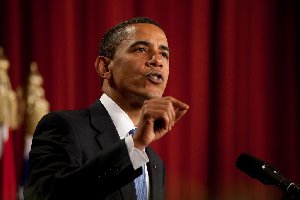
CAIRO, Egypt (ABP) — In a highly anticipated speech to the world’s Muslims he delivered in Egypt June 4, President Obama called on his host government and other Muslim countries to protect the rights of religious minorities in their midst.

He also scolded some Muslim leaders for their anti-Semitism and Holocaust denial; criticized both sides in the Israeli-Palestinian conflict; and dinged leaders who use “the pretense of liberalism” to suppress Muslims’ religious freedom in Western nations.

President Obama speaks at Cairo University in Egypt June 4, 2009. In his speech, he called for a 'new beginning between the United States and Muslims', declaring that 'this cycle of suspicion and discord must end'. (WHITE HOUSE/Chuck Kennedy)

Nonetheless, Obama spent much of the speech calling for greater understanding and cooperation between the world’s Muslims and the United States in the struggle against “violent extremism in all of its forms,” as he termed it.

“It's easier to start wars than to end them. It's easier to blame others than to look inward. It's easier to see what is different about someone than to find the things we share,” he said, speaking to a reported crowd of about 3,000 on the campus of Cairo University. “But we should choose the right path, not just the easy path. There's one rule that lies at the heart of every religion — that we do unto others as we would have them do unto us. This truth transcends nations and peoples — a belief that isn't new; that isn't black or white or brown; that isn't Christian or Muslim or Jew. It's a belief that pulsed in the cradle of civilization, and that still beats in the hearts of billions around the world. It's a faith in other people, and it's what brought me here today.”

Without offering specific policy proposals, the president said he would focus on bringing about a peaceful resolution to the Israeli-Palestinian standoff that results in “a world where Israelis and Palestinians are each secure in a state of their own.”

Obama noted that, although he is a Christian, he has Muslim ancestry on his father’s side, and said he had become more familiar with the faith by observing Muslims first-hand in Africa, Asia and the United States. Therefore, he said, “I consider it part of my responsibility as president of the United States to fight against negative stereotypes of Islam wherever they appear.”

However, he added, “that same principle must apply to Muslim perceptions of America. Just as Muslims do not fit a crude stereotype, America is not the crude stereotype of a self-interested empire. The United States has been one of the greatest sources of progress that the world has ever known. We were born out of revolution against an empire. We were founded upon the ideal that all are created equal, and we have shed blood and struggled for centuries to give meaning to those words — within our borders, and around the world.”

President Obama speaks at Cairo University in Egypt. (WHITE HOUSE/Chuck Kennedy)

Obama discussed what he considered seven areas of significant tension between many of the world’s Muslims and the United States. On religious freedom, he said Islam has a history of tolerance of those of minority faiths living in majority-Muslim lands.

“That is the spirit we need today,” he said. “People in every country should be free to choose and live their faith based upon the persuasion of the mind and the heart and the soul. This tolerance is essential for religion to thrive, but it's being challenged in many different ways.

“Among some Muslims, there's a disturbing tendency to measure one's own faith by the rejection of somebody else's faith. The richness of religious diversity must be upheld — whether it is for Maronites in Lebanon or the Copts in Egypt,” he added, referring to indigenous Christian communities that have faced significant persecution from Muslim majorities in recent years.

But he also criticized the tendency in the West to impose laws and regulations onerous to devout Muslims.

“Likewise, it is important for Western countries to avoid impeding Muslim citizens from practicing religion as they see fit — for instance, by dictating what clothes a Muslim woman should wear. We can't disguise hostility towards any religion behind the pretence of liberalism.”

On the Israeli-Palestinian situation, Obama had stern words for both camps.

Referring to the Holocaust, he said, “Six million Jews were killed — more than the entire Jewish population of Israel today. Denying that fact is baseless, it is ignorant, and it is hateful. Threatening Israel with destruction — or repeating vile stereotypes about Jews — is deeply wrong, and only serves to evoke in the minds of Israelis this most painful of memories while preventing the peace that the people of this region deserve.”

However, he added, “it is also undeniable that the Palestinian people — Muslims and Christians — have suffered in pursuit of a homeland. For more than 60 years they've endured the pain of dislocation. Many wait in refugee camps in the West Bank, Gaza, and neighboring lands for a life of peace and security that they have never been able to lead. They endure the daily humiliations — large and small — that come with occupation. So let there be no doubt: The situation for the Palestinian people is intolerable. And America will not turn our backs on the legitimate Palestinian aspiration for dignity, opportunity, and a state of their own.”

Obama called on Israel to abandon expansion of its settlements in occupied Palestinian lands, and called on Palestinians to abandon violence in all its forms against Israelis.

“America will align our policies with those who pursue peace, and we will say in public what we say in private to Israelis and Palestinians and Arabs. We cannot impose peace. But privately, many Muslims recognize that Israel will not go away. Likewise, many Israelis recognize the need for a Palestinian state. It is time for us to act on what everyone knows to be true.”


–Robert Marus is managing editor and Washington bureau chief for Associated Baptist Press.

Read more:

Text of President Obama's June 4, 2009, speech to the world's Muslims


SBC restructuring unnecessary, Executive Committee chief asserts

NASHVILLE—A proposal to study a restructuring of the Southern Baptist Convention is not needed, SBC Executive Committee President Morris Chapman insists.

Chapman made his feelings known about a proposed Great Commission Resurgence Declaration, issued in late April by SBC President Johnny Hunt, in a lengthy Baptist Press column May 29.

The declaration will be presented at the annual meeting of the Southern Baptist Convention in June. If approved, Hunt will appoint a task force to make recommendations on a Great Commission Resurgence and the structure of the convention.

According to Hunt, the 10 commitments called for in the Great Commission Resurgence document reflect “what we hear from grassroots pastors and grassroots leaders of local churches across America.” Hunt characterized the strongly worded declaration as a needed “shock” for an unhealthy SBC.

Chapman wrote that when he began reading the 10 articles in the Declaration, he “rejoiced in the strong affirmation of our convention’s biblical convictions.”

He noted, however, that he discovered that Article IX and “its commentary stood starkly apart from the other nine articles. It suddenly departed from biblical affirmations in order to address the reorganization of structure and methodology within our denomination.

“The article included several negative characterizations and unsupported judgments of the denomination,” observed Chapman,who has not signed the document. The original version referred to “a bloated bureaucracy” that needs to be streamlined.

Chapman acknowledged the language in Article IX was “revised within 48 hours when several leaders in the convention rightly expressed their concern and indicated they could not sign the document as written.”

The declaration has now been revised a third time that removes the reference to “restructuring” the denomination, Chapman wrote. The statement in the declaration now reads, “our convention must be examined.”

Even so, he added, “changing the language has not made the perceived intent any more acceptable.”

Chapman acknowledged periodic changes are necessary.

“But revival in our churches and appointing a task force to study convention structures are not two parts of one whole. They are two separate objectives that, if sought under the same banner, have the potential to cause both to fail. When the time is right, a successful study can happen, following established processes, as has occurred before. However, to put the two objectives together is like trying to mix oil and water.“

Chapman noted a premise of the Declaration is that Southern Baptists must unite around North American church planting, pioneer missions around the globe, and theological education. That has already been done, he asserted.

“The work of the Program and Structure Study Committee was completed in 1997 under the Covenant for a New Century. At that time, the Southern Baptist Convention was restructured so that 95 percent of all Cooperative Program funds received by the Convention were, and still are, directed to the very three priorities identified by the framers of this Declaration—our two mission boards and our six seminaries.”

Chapman wrote that although he constantly urges state convention executive directors to increase their CP allocations to SBC causes to 50 percent, he “cannot concur that the states are bloated or seeking to retain more and more CP money in the states.

“In fact, just the opposite is true. The slippage in Cooperative Program giving is at the local church level. If our churches still gave the same percentage of CP funds from the churches through the states as they did a decade ago (8.24 percent then; 6.08 percent now), the International Mission Board would have an additional $35 million dollars this year alone, not counting the money it would have received pro rata over the past decade. NAMB and our seminary funding formula would each have received approximately $17 million dollars more this year.

“While our annual dollar amount of Cooperative Program has continued to grow, we have reached a historic low in the percentage of CP funds forwarded by the churches, in spite of a restructuring that took place just over a decade ago and was hailed as the dawn of a new day for evangelism and missions. Reallocating our funds will not solve any perceived problems. But, a genuine revival might!”

While the document has been signed by some SBC agency leaders, Chapman has not signed the document. As of June 2, 3,043 people had signed the Declaration which is posted on the Internet at www.greatcommissionresurgence.com.


Texas Baptist team discovers ongoing needs in Armenia

GYUMRI, Armenia—Three Texas Baptists on a fact-finding mission to Armenia discovered a country lacking resources and medical attention—and a people still devastated by a catastrophe that struck their nation two decades ago.

A 1988 earthquake killed more than 60,000 people, injured 15,000 and left 500,000 homeless in Armenia. Karen Morrow, Cooperative Baptist Fellowship’s strategic coordinator for unreached Middle-Eastern people groups; Linda Fredrikson, children’s minister at Lakeshore Drive Baptist Church in Weatherford; and Warren Hatley, a Dallas surgeon who works in occupational medicine, participated in the exploratory mission to determine how Christians in the United States can respond to Armenia’s needs.     

Warren Hatley assists Jany Haddad in surgery in Gyumri, Armenia.

“It was a vision trip,” Morrow said. “The logistical part was the main thing. We wanted to be able to come back (to the United States) and recruit doctors, nurses and dentists, but we needed to be able to tell them what’s there first.”

The mission team worked through Cooperative Baptist Fellowship and in partnership with the Armenian Christian Medical Association, a grassroots movement founded in 2006 by surgeon Jany Haddad and Executive Director Kristina Ashrafyan.

“CBF has partnered with the Baptist church Haddad is a member of in Syria on several projects over the past six years,” Morrow said. “Dr. Haddad invited us to come and see what God was doing in Armenia … and partner with ACMA to bring in medical personnel to help increase the level of training of Armenian doctors, nurses and dentists.”

Haddad is joined by more than 25 other medical volunteers who donate their equipment, money and time to make trips twice a year to offer free medical services to the Armenian people.

On his most recent trip, Haddad completed 117 outpatient surgeries in five days. The procedures—including hernia repairs, thyroid surgeries and gallbladder removals—were performed free of charge.

The Texas Baptist mission team recognized the opportunity to send in specialized medical professionals to provide advanced training to Armenian doctors and nurses.

“Part of our strategy is not to do the work ourselves, but to help facilitate others to do the work,” Morrow said.  

The Armenian Christian Medical Association and the CBF hope to enlist medical professionals representing different specialties to hold seminars and lectures to help equip Armenians with additional training and knowledge in crisis and trauma management.

“We want people to know that we love Jesus Christ and he calls us to serve in this manner,” Morrow said. ACMA and Haddad “lay the gospel out for patients … and God is blessing their work. It’s a very well-coordinated system that seeks to serve the people.”

armenia Linda

Linda Fredrikson (left), children’s minister from Lakeshore Drive Baptist Church in Weatherford, prays with a patient before surgery in Gyumri, Armenia.

Even though American volunteers can share freely the gospel, they can expect some obstacles, Hatley said.  

“It’s hard to get into Armenia because there are no direct flights,” he said.

Additionally, not all Armenians speak English.

“It was frustrating not being able to communicate directly with the people … but surgery transcends the language barrier … and there were translators to help.”

Despite those minor complications, Hatley said “it was a great opportunity to bless others with the skills you have and use every day.”

The blessings were more than the mission team had expected. In fact, Fredrikson had never even desired to do mission work abroad, but God had different plans for the licensed professional counselor.

“Several months ago, I heard the Lord say: “Get a passport. The world is mine and I am going to show you things. … There is danger, but there is safety in my hands.”

In obedience, Fredrikson traveled with Morrow as a part of a prayer team for a women’s conference. But shortly after the women’s arrival to Turkey, Fredrikson felt led to do more.

In the first 48 hours, without any sleep, she wrote four children’s programs, spoke at a Turkish women’s conference on trauma crisis training, visited an orphanage, answered questions, led a Bible study for 50 people and was interviewed on television.

Even though she felt unprepared, God provided and guided, especially when she and Morrow went to a hospital located at the epicenter of the earthquake in Armenia, Fredrikson said.

“When we got there, they put a doctor’s coat on me and ushered us into the surgery room where Dr. Haddad was performing surgeries,” she said.

“Most of the patients were women. I noticed many of them were terrified … and had tears in their eyes.”

Fredrikson gestured to them to ask if they needed prayer. Even though they didn’t understand English, they agreed and closed their eyes.

“I could see peace come over them as the Holy Spirit was moving,” she said.

The Armenians were thankful for their American visitors. The women were made honorary members of the Armenian Christian Medical Association, which is sanctioned by the Armenian government.

God continued to work in unimaginable ways, Fredrikson said. In a small village church one Sunday, she and Morrow were asked to pray for the people after the service.

At another community, Fredrikson faced social and ethical questions. One woman said: “I am pregnant. I already have eight children and my husband doesn’t want any more. My husband wants to kill it, is that all right?”

Another asked: “When I pray, God gives me visions. Is that OK?” Fredrikson said God provided answers for her to share with the people.

The next day, Fredrikson spoke for a program at the University in Yerevon. Afterwards, one of the professors invited Fredrikson and Morrow to her small, earthquake-damaged house for tea. After seeing the woman’s living conditions, 15 people to one house with open rooms under unfavorable weather conditions, Fredrikson thought, “How do these people survive?” It made her realize how blessed she is.

“I experienced God in more of a real way than I ever have before … and it was the most wonderful experience I’ve ever hard,” she said.

Her prayer on the trip was to have spiritual eyes and ears, which she feels God gave her.

“I believe I was seeing through the eyes of Jesus,” Fredrikson said. “I feel such a connection to the Armenian people. …(God) said to me: ‘Well of course you do. I am in you, and I am in them. You are bonded together through the Spirit.’”   

Volunteers became aware of the sense of impending danger Armenians feel because they live on a fault line and know another earthquake could occur any time.

“It’s a time bomb waiting to happen,” Morrow said. “It’s not a matter of if it will happen; it’s a matter of when.”

Fredrikson, Morrow and Hatley expressed thanks for the evangelism opportunities they had, and they look forward to watching God move in Armenia though medical evangelism in the future.

“We were able to see God at work,” Morrow said. “It came from listening to God’s still small voice, being willing to say ‘yes’ even when we didn’t know what his plan was and then walking in faith.”


Would Jesus sue over WWJD letters?

BECKER, Minn. (RNS)—A Minnesota couple is suing a debt collection agency for putting the initials “WWJD” on its collection letters, arguing that it breaks an anti-harassment law by portraying debtors as hell-bound sinners.

Sara and Mark Neill of Becker, Minn., received three letters from Bullseye Collection Agency, Inc. in 2008 with the letters “WWJD”—an acronym commonly understood to mean “What Would Jesus Do?”—printed in the upper right-hand corner.

The Neills claim the phrase invokes shame or guilt and portrays “the debtor as a sinner who is going to hell,” according to court documents, and thus violates the Fair Debt Collection Practices Act, which outlaws abusive or harassing collection tactics.

Recently, Judge Joan Ericksen of the U.S. District Court for the District of Minnesota denied a motion to dismiss the Neills’ claim.

Mathew Staver of Liberty Counsel, a religious freedom firm based in Orlando, Fla., that is representing Bullseye, said the phrase simply means the company adopts Christian principles.

The “WWJD” is standard on Bullseye letterhead and is “the furthest thing possible from harassment,” he said.

“It’s not like it’s a fish symbol or specific Christian statement; it can be interpreted in a lot of different ways,” Staver said.


Rock band’s gritty gospel, spiritual depth touch hearts

The intersection of faith and culture often looks less like a four-way stop and more like a mix-master. Faith-based messages have made frequent and bold appearances in film, music, art, theater and other forms of creative expression. This invites the labels of “Christian artist” or “artist whose works have spiritual themes”—and at times, “a little of both.”

The rock band U2 falls into the latter category. The band released its 12th album this year, and while many see the group as a strictly secular phenomenon, what fans connect with is actually the band’s “honest quest for spiritual meaning in a world that pays lip service to the spiritual while chasing after the transient,” said author Greg Garrett, professor of English at Baylor University.

Garrett’s latest book, We Get to Carry Each Other: The Gospel According to U2, chronicles the life of the group from their upbringing in war-torn Northern Ireland to their dominance over the music scene in the early 1990s and their current role as spiritual ambassadors to a post-9/11 world.

Conditions are most favorable for faith and culture to mix when the artist focuses first on creating good art, Garrett said.

“If U2 were a bad rock band—most especially a bad Christian rock band—then we would not be talking about them now,” he said. “But because their songs touch people, suggest possibilities they long for, and authentically chart the band’s own struggles and beliefs, they have not only reached a Christian audience, but a worldwide audience who know hope and passion and faith because they have experienced it in U2’s music and performances.”

Authenticity also plays an important role in the merging of faith and culture, Garrett added. Any attempt by churches to exploit a cultural fad simply to pack pews is likely to yield poor results in the long run. Garrett indicates leaders must have genuine interest and support for that particular cultural expression.

A good example he offers is the “U2charist”—communion services in which the hymns are U2 songs and the sermon and offering are oriented toward the One Movement, an advocacy campaign co-founded by U2’s lead singer, Bono.

“If you hold a U2charist or start a movie discussion group … then make sure the people leading it are excited about the work in question—and about the people who may come—and not just about increasing attendance or offerings,” Garrett said.

For many who are not involved in a faith community, cultural expression often serves as the primary means by which those individuals explore their spirituality, he noted.

“Lots of people love U2 who do not love the church, and this can be an eye-opening way for them to recognize that the church stands for positive things in the world, rather than the negative stereotypes so often attached to it,” he said.

Many in the faith community struggle to reconcile faith with culture, especially with groups like U2 who are not affiliated with—and sometimes scoff at—organized religion.

“They (U2) have been understandably reluctant to enter into formal relationship with a faith community over the years,” said Garrett, pointing out the group’s experiences from religious warfare in Ireland and later by a Christian community that told them they couldn’t be both musicians and Christians.

Garrett notes that U2’s work parallels the work of the church in the context of the true definition of “ecclesia.” In that sense, the faith-culture connection can inspire a call to action.

“Certainly our understanding of ecclesia is that Christianity is not lived out in and for ourselves as individuals, but in and for each other,” he said. “I’d argue … that in a sense the band has been an ecclesia for its members, and that in its concerts and work for peace and justice, it replicates the work of worship and the work of righteousness to which the church is called.”