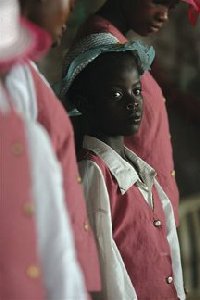
Corsicana congregation builds trust one meal at a time

CORSICANA—Shepherd’s pie, chili dogs, chef salads and an array of desserts provide a tangible—and tasty—invitation to hungry people in Corsicana.

Good News Café is a ministry of First Baptist Church that offers a warm, weekly meal for anyone in the community. The church saw organizations offering take-home food for individuals in need, but people wanted to sit down and eat, said Chris Marchbanks, the church’s minister of recreation and community outreach. The church wanted to meet people’s needs in a practical way, he added.

Volunteers at the Good News Café—a ministry of First Baptist Church in Corsicana—serve a hot meal. (PHOTO/John Hall)

Volunteers set up tables in First Baptist’s Family Life Center and decorate them with tablecloths and vases filled with flowers. Food is served on real—not paper—plates.

“We want people to feel special,” Marchbanks said. “We didn’t want it to feel like it was a soup kitchen.”

Good News Café is part of the congregation’s involvement in Texas Hope 2010, a Baptist General Convention of Texas initiative encouraging Christians to pray for people around them, care for those in need and share the gospel with every person in Texas by Easter 2010.

About 17 volunteers from the church and community cook, serve, refill drinks and clean tables for an average of 55 people a week. Since the ministry began less than three months ago, Good News Café has attracted as many as 70 people on one day.

The ministry is open to anyone, and the church hopes to offer food more days a week and possibly provide showers and a laundry service, Marchbanks said.

First Baptist Church is trying to build trust and relationships with people so they will be able to share the love of Christ with them, he explained.

“There’s a sense of community that’s developing from this,” Marchbanks said.

Bob O’Toole has become a significant contributor to this growing sense of community. O’Toole had a bed-and-breakfast in town, and he later helped cook the Wednesday night meals at church. After visiting the Gospel Café in Waco, O’Toole thought a similar ministry would be good for his town.

“This is where we decided to start,” O’Toole said.

Meals run about $2 each, and the church provides all the funds. The church gives the leftover food to other ministries, like the women’s shelter.

“Our desire right now is to love people where they are and in the situation in which they’re in and to try to lead them to Christ through our example and through our work here,” O’Toole said.

There has been a response to this love. People have opened up to the volunteers, and some have asked when the church service takes place.

Mary Anne Unger has enjoyed eating at the café nearly every week. She appreciates the way volunteers live their faith and are not content to just be “talking up a lot.”

David Edwards, pastor of First Baptist Church, said he is excited about the café and about being a part of Texas Hope 2010. He believes the café is a starting place to make an impact in lives throughout Corsicana.

“They’re not just hungry one day a week,” Edwards said. “They’re hungry every day.”

First Baptist and other churches want to build a centralized meeting place that would be serve free, warm meals five days a week. Edwards would like the community to provide the volunteers, finances and human resources so people can have a place to get a meal and know they are loved.

There are churches that “want them to meet the Jesus who will take care not only of their needs now, but also of their eternal needs,” Edwards said.

For more information about Texas Hope 2010, visit www.texashope2010.com.


Obama, in speech to world’s Muslims, touts religious freedom, cooperation

CAIRO, Egypt (ABP) — In a highly anticipated speech to the world’s Muslims he delivered in Egypt June 4, President Obama called on his host government and other Muslim countries to protect the rights of religious minorities in their midst.

He also scolded some Muslim leaders for their anti-Semitism and Holocaust denial; criticized both sides in the Israeli-Palestinian conflict; and dinged leaders who use “the pretense of liberalism” to suppress Muslims’ religious freedom in Western nations.

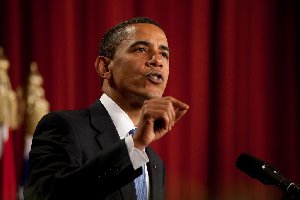
President Obama speaks at Cairo University in Egypt June 4, 2009. In his speech, he called for a 'new beginning between the United States and Muslims', declaring that 'this cycle of suspicion and discord must end'. (WHITE HOUSE/Chuck Kennedy)

Nonetheless, Obama spent much of the speech calling for greater understanding and cooperation between the world’s Muslims and the United States in the struggle against “violent extremism in all of its forms,” as he termed it.

“It's easier to start wars than to end them. It's easier to blame others than to look inward. It's easier to see what is different about someone than to find the things we share,” he said, speaking to a reported crowd of about 3,000 on the campus of Cairo University. “But we should choose the right path, not just the easy path. There's one rule that lies at the heart of every religion — that we do unto others as we would have them do unto us. This truth transcends nations and peoples — a belief that isn't new; that isn't black or white or brown; that isn't Christian or Muslim or Jew. It's a belief that pulsed in the cradle of civilization, and that still beats in the hearts of billions around the world. It's a faith in other people, and it's what brought me here today.”

Without offering specific policy proposals, the president said he would focus on bringing about a peaceful resolution to the Israeli-Palestinian standoff that results in “a world where Israelis and Palestinians are each secure in a state of their own.”

Obama noted that, although he is a Christian, he has Muslim ancestry on his father’s side, and said he had become more familiar with the faith by observing Muslims first-hand in Africa, Asia and the United States. Therefore, he said, “I consider it part of my responsibility as president of the United States to fight against negative stereotypes of Islam wherever they appear.”

However, he added, “that same principle must apply to Muslim perceptions of America. Just as Muslims do not fit a crude stereotype, America is not the crude stereotype of a self-interested empire. The United States has been one of the greatest sources of progress that the world has ever known. We were born out of revolution against an empire. We were founded upon the ideal that all are created equal, and we have shed blood and struggled for centuries to give meaning to those words — within our borders, and around the world.”

President Obama speaks at Cairo University in Egypt. (WHITE HOUSE/Chuck Kennedy)

Obama discussed what he considered seven areas of significant tension between many of the world’s Muslims and the United States. On religious freedom, he said Islam has a history of tolerance of those of minority faiths living in majority-Muslim lands.

“That is the spirit we need today,” he said. “People in every country should be free to choose and live their faith based upon the persuasion of the mind and the heart and the soul. This tolerance is essential for religion to thrive, but it's being challenged in many different ways.

“Among some Muslims, there's a disturbing tendency to measure one's own faith by the rejection of somebody else's faith. The richness of religious diversity must be upheld — whether it is for Maronites in Lebanon or the Copts in Egypt,” he added, referring to indigenous Christian communities that have faced significant persecution from Muslim majorities in recent years.

But he also criticized the tendency in the West to impose laws and regulations onerous to devout Muslims.

“Likewise, it is important for Western countries to avoid impeding Muslim citizens from practicing religion as they see fit — for instance, by dictating what clothes a Muslim woman should wear. We can't disguise hostility towards any religion behind the pretence of liberalism.”

On the Israeli-Palestinian situation, Obama had stern words for both camps.

Referring to the Holocaust, he said, “Six million Jews were killed — more than the entire Jewish population of Israel today. Denying that fact is baseless, it is ignorant, and it is hateful. Threatening Israel with destruction — or repeating vile stereotypes about Jews — is deeply wrong, and only serves to evoke in the minds of Israelis this most painful of memories while preventing the peace that the people of this region deserve.”

However, he added, “it is also undeniable that the Palestinian people — Muslims and Christians — have suffered in pursuit of a homeland. For more than 60 years they've endured the pain of dislocation. Many wait in refugee camps in the West Bank, Gaza, and neighboring lands for a life of peace and security that they have never been able to lead. They endure the daily humiliations — large and small — that come with occupation. So let there be no doubt: The situation for the Palestinian people is intolerable. And America will not turn our backs on the legitimate Palestinian aspiration for dignity, opportunity, and a state of their own.”

Obama called on Israel to abandon expansion of its settlements in occupied Palestinian lands, and called on Palestinians to abandon violence in all its forms against Israelis.

“America will align our policies with those who pursue peace, and we will say in public what we say in private to Israelis and Palestinians and Arabs. We cannot impose peace. But privately, many Muslims recognize that Israel will not go away. Likewise, many Israelis recognize the need for a Palestinian state. It is time for us to act on what everyone knows to be true.”


–Robert Marus is managing editor and Washington bureau chief for Associated Baptist Press.

Read more:

Text of President Obama's June 4, 2009, speech to the world's Muslims


SBC restructuring unnecessary, Executive Committee chief asserts

NASHVILLE—A proposal to study a restructuring of the Southern Baptist Convention is not needed, SBC Executive Committee President Morris Chapman insists.

Chapman made his feelings known about a proposed Great Commission Resurgence Declaration, issued in late April by SBC President Johnny Hunt, in a lengthy Baptist Press column May 29.

The declaration will be presented at the annual meeting of the Southern Baptist Convention in June. If approved, Hunt will appoint a task force to make recommendations on a Great Commission Resurgence and the structure of the convention.

According to Hunt, the 10 commitments called for in the Great Commission Resurgence document reflect “what we hear from grassroots pastors and grassroots leaders of local churches across America.” Hunt characterized the strongly worded declaration as a needed “shock” for an unhealthy SBC.

Chapman wrote that when he began reading the 10 articles in the Declaration, he “rejoiced in the strong affirmation of our convention’s biblical convictions.”

He noted, however, that he discovered that Article IX and “its commentary stood starkly apart from the other nine articles. It suddenly departed from biblical affirmations in order to address the reorganization of structure and methodology within our denomination.

“The article included several negative characterizations and unsupported judgments of the denomination,” observed Chapman,who has not signed the document. The original version referred to “a bloated bureaucracy” that needs to be streamlined.

Chapman acknowledged the language in Article IX was “revised within 48 hours when several leaders in the convention rightly expressed their concern and indicated they could not sign the document as written.”

The declaration has now been revised a third time that removes the reference to “restructuring” the denomination, Chapman wrote. The statement in the declaration now reads, “our convention must be examined.”

Even so, he added, “changing the language has not made the perceived intent any more acceptable.”

Chapman acknowledged periodic changes are necessary.

“But revival in our churches and appointing a task force to study convention structures are not two parts of one whole. They are two separate objectives that, if sought under the same banner, have the potential to cause both to fail. When the time is right, a successful study can happen, following established processes, as has occurred before. However, to put the two objectives together is like trying to mix oil and water.“

Chapman noted a premise of the Declaration is that Southern Baptists must unite around North American church planting, pioneer missions around the globe, and theological education. That has already been done, he asserted.

“The work of the Program and Structure Study Committee was completed in 1997 under the Covenant for a New Century. At that time, the Southern Baptist Convention was restructured so that 95 percent of all Cooperative Program funds received by the Convention were, and still are, directed to the very three priorities identified by the framers of this Declaration—our two mission boards and our six seminaries.”

Chapman wrote that although he constantly urges state convention executive directors to increase their CP allocations to SBC causes to 50 percent, he “cannot concur that the states are bloated or seeking to retain more and more CP money in the states.

“In fact, just the opposite is true. The slippage in Cooperative Program giving is at the local church level. If our churches still gave the same percentage of CP funds from the churches through the states as they did a decade ago (8.24 percent then; 6.08 percent now), the International Mission Board would have an additional $35 million dollars this year alone, not counting the money it would have received pro rata over the past decade. NAMB and our seminary funding formula would each have received approximately $17 million dollars more this year.

“While our annual dollar amount of Cooperative Program has continued to grow, we have reached a historic low in the percentage of CP funds forwarded by the churches, in spite of a restructuring that took place just over a decade ago and was hailed as the dawn of a new day for evangelism and missions. Reallocating our funds will not solve any perceived problems. But, a genuine revival might!”

While the document has been signed by some SBC agency leaders, Chapman has not signed the document. As of June 2, 3,043 people had signed the Declaration which is posted on the Internet at www.greatcommissionresurgence.com.


Texas Baptist team discovers ongoing needs in Armenia

GYUMRI, Armenia—Three Texas Baptists on a fact-finding mission to Armenia discovered a country lacking resources and medical attention—and a people still devastated by a catastrophe that struck their nation two decades ago.

A 1988 earthquake killed more than 60,000 people, injured 15,000 and left 500,000 homeless in Armenia. Karen Morrow, Cooperative Baptist Fellowship’s strategic coordinator for unreached Middle-Eastern people groups; Linda Fredrikson, children’s minister at Lakeshore Drive Baptist Church in Weatherford; and Warren Hatley, a Dallas surgeon who works in occupational medicine, participated in the exploratory mission to determine how Christians in the United States can respond to Armenia’s needs.     

Warren Hatley assists Jany Haddad in surgery in Gyumri, Armenia.

“It was a vision trip,” Morrow said. “The logistical part was the main thing. We wanted to be able to come back (to the United States) and recruit doctors, nurses and dentists, but we needed to be able to tell them what’s there first.”

The mission team worked through Cooperative Baptist Fellowship and in partnership with the Armenian Christian Medical Association, a grassroots movement founded in 2006 by surgeon Jany Haddad and Executive Director Kristina Ashrafyan.

“CBF has partnered with the Baptist church Haddad is a member of in Syria on several projects over the past six years,” Morrow said. “Dr. Haddad invited us to come and see what God was doing in Armenia … and partner with ACMA to bring in medical personnel to help increase the level of training of Armenian doctors, nurses and dentists.”

Haddad is joined by more than 25 other medical volunteers who donate their equipment, money and time to make trips twice a year to offer free medical services to the Armenian people.

On his most recent trip, Haddad completed 117 outpatient surgeries in five days. The procedures—including hernia repairs, thyroid surgeries and gallbladder removals—were performed free of charge.

The Texas Baptist mission team recognized the opportunity to send in specialized medical professionals to provide advanced training to Armenian doctors and nurses.

“Part of our strategy is not to do the work ourselves, but to help facilitate others to do the work,” Morrow said.  

The Armenian Christian Medical Association and the CBF hope to enlist medical professionals representing different specialties to hold seminars and lectures to help equip Armenians with additional training and knowledge in crisis and trauma management.

“We want people to know that we love Jesus Christ and he calls us to serve in this manner,” Morrow said. ACMA and Haddad “lay the gospel out for patients … and God is blessing their work. It’s a very well-coordinated system that seeks to serve the people.”

armenia Linda

Linda Fredrikson (left), children’s minister from Lakeshore Drive Baptist Church in Weatherford, prays with a patient before surgery in Gyumri, Armenia.

Even though American volunteers can share freely the gospel, they can expect some obstacles, Hatley said.  

“It’s hard to get into Armenia because there are no direct flights,” he said.

Additionally, not all Armenians speak English.

“It was frustrating not being able to communicate directly with the people … but surgery transcends the language barrier … and there were translators to help.”

Despite those minor complications, Hatley said “it was a great opportunity to bless others with the skills you have and use every day.”

The blessings were more than the mission team had expected. In fact, Fredrikson had never even desired to do mission work abroad, but God had different plans for the licensed professional counselor.

“Several months ago, I heard the Lord say: “Get a passport. The world is mine and I am going to show you things. … There is danger, but there is safety in my hands.”

In obedience, Fredrikson traveled with Morrow as a part of a prayer team for a women’s conference. But shortly after the women’s arrival to Turkey, Fredrikson felt led to do more.

In the first 48 hours, without any sleep, she wrote four children’s programs, spoke at a Turkish women’s conference on trauma crisis training, visited an orphanage, answered questions, led a Bible study for 50 people and was interviewed on television.

Even though she felt unprepared, God provided and guided, especially when she and Morrow went to a hospital located at the epicenter of the earthquake in Armenia, Fredrikson said.

“When we got there, they put a doctor’s coat on me and ushered us into the surgery room where Dr. Haddad was performing surgeries,” she said.

“Most of the patients were women. I noticed many of them were terrified … and had tears in their eyes.”

Fredrikson gestured to them to ask if they needed prayer. Even though they didn’t understand English, they agreed and closed their eyes.

“I could see peace come over them as the Holy Spirit was moving,” she said.

The Armenians were thankful for their American visitors. The women were made honorary members of the Armenian Christian Medical Association, which is sanctioned by the Armenian government.

God continued to work in unimaginable ways, Fredrikson said. In a small village church one Sunday, she and Morrow were asked to pray for the people after the service.

At another community, Fredrikson faced social and ethical questions. One woman said: “I am pregnant. I already have eight children and my husband doesn’t want any more. My husband wants to kill it, is that all right?”

Another asked: “When I pray, God gives me visions. Is that OK?” Fredrikson said God provided answers for her to share with the people.

The next day, Fredrikson spoke for a program at the University in Yerevon. Afterwards, one of the professors invited Fredrikson and Morrow to her small, earthquake-damaged house for tea. After seeing the woman’s living conditions, 15 people to one house with open rooms under unfavorable weather conditions, Fredrikson thought, “How do these people survive?” It made her realize how blessed she is.

“I experienced God in more of a real way than I ever have before … and it was the most wonderful experience I’ve ever hard,” she said.

Her prayer on the trip was to have spiritual eyes and ears, which she feels God gave her.

“I believe I was seeing through the eyes of Jesus,” Fredrikson said. “I feel such a connection to the Armenian people. …(God) said to me: ‘Well of course you do. I am in you, and I am in them. You are bonded together through the Spirit.’”   

Volunteers became aware of the sense of impending danger Armenians feel because they live on a fault line and know another earthquake could occur any time.

“It’s a time bomb waiting to happen,” Morrow said. “It’s not a matter of if it will happen; it’s a matter of when.”

Fredrikson, Morrow and Hatley expressed thanks for the evangelism opportunities they had, and they look forward to watching God move in Armenia though medical evangelism in the future.

“We were able to see God at work,” Morrow said. “It came from listening to God’s still small voice, being willing to say ‘yes’ even when we didn’t know what his plan was and then walking in faith.”


Would Jesus sue over WWJD letters?

BECKER, Minn. (RNS)—A Minnesota couple is suing a debt collection agency for putting the initials “WWJD” on its collection letters, arguing that it breaks an anti-harassment law by portraying debtors as hell-bound sinners.

Sara and Mark Neill of Becker, Minn., received three letters from Bullseye Collection Agency, Inc. in 2008 with the letters “WWJD”—an acronym commonly understood to mean “What Would Jesus Do?”—printed in the upper right-hand corner.

The Neills claim the phrase invokes shame or guilt and portrays “the debtor as a sinner who is going to hell,” according to court documents, and thus violates the Fair Debt Collection Practices Act, which outlaws abusive or harassing collection tactics.

Recently, Judge Joan Ericksen of the U.S. District Court for the District of Minnesota denied a motion to dismiss the Neills’ claim.

Mathew Staver of Liberty Counsel, a religious freedom firm based in Orlando, Fla., that is representing Bullseye, said the phrase simply means the company adopts Christian principles.

The “WWJD” is standard on Bullseye letterhead and is “the furthest thing possible from harassment,” he said.

“It’s not like it’s a fish symbol or specific Christian statement; it can be interpreted in a lot of different ways,” Staver said.


Rock band’s gritty gospel, spiritual depth touch hearts

The intersection of faith and culture often looks less like a four-way stop and more like a mix-master. Faith-based messages have made frequent and bold appearances in film, music, art, theater and other forms of creative expression. This invites the labels of “Christian artist” or “artist whose works have spiritual themes”—and at times, “a little of both.”

The rock band U2 falls into the latter category. The band released its 12th album this year, and while many see the group as a strictly secular phenomenon, what fans connect with is actually the band’s “honest quest for spiritual meaning in a world that pays lip service to the spiritual while chasing after the transient,” said author Greg Garrett, professor of English at Baylor University.

Garrett’s latest book, We Get to Carry Each Other: The Gospel According to U2, chronicles the life of the group from their upbringing in war-torn Northern Ireland to their dominance over the music scene in the early 1990s and their current role as spiritual ambassadors to a post-9/11 world.

Conditions are most favorable for faith and culture to mix when the artist focuses first on creating good art, Garrett said.

“If U2 were a bad rock band—most especially a bad Christian rock band—then we would not be talking about them now,” he said. “But because their songs touch people, suggest possibilities they long for, and authentically chart the band’s own struggles and beliefs, they have not only reached a Christian audience, but a worldwide audience who know hope and passion and faith because they have experienced it in U2’s music and performances.”

Authenticity also plays an important role in the merging of faith and culture, Garrett added. Any attempt by churches to exploit a cultural fad simply to pack pews is likely to yield poor results in the long run. Garrett indicates leaders must have genuine interest and support for that particular cultural expression.

A good example he offers is the “U2charist”—communion services in which the hymns are U2 songs and the sermon and offering are oriented toward the One Movement, an advocacy campaign co-founded by U2’s lead singer, Bono.

“If you hold a U2charist or start a movie discussion group … then make sure the people leading it are excited about the work in question—and about the people who may come—and not just about increasing attendance or offerings,” Garrett said.

For many who are not involved in a faith community, cultural expression often serves as the primary means by which those individuals explore their spirituality, he noted.

“Lots of people love U2 who do not love the church, and this can be an eye-opening way for them to recognize that the church stands for positive things in the world, rather than the negative stereotypes so often attached to it,” he said.

Many in the faith community struggle to reconcile faith with culture, especially with groups like U2 who are not affiliated with—and sometimes scoff at—organized religion.

“They (U2) have been understandably reluctant to enter into formal relationship with a faith community over the years,” said Garrett, pointing out the group’s experiences from religious warfare in Ireland and later by a Christian community that told them they couldn’t be both musicians and Christians.

Garrett notes that U2’s work parallels the work of the church in the context of the true definition of “ecclesia.” In that sense, the faith-culture connection can inspire a call to action.

“Certainly our understanding of ecclesia is that Christianity is not lived out in and for ourselves as individuals, but in and for each other,” he said. “I’d argue … that in a sense the band has been an ecclesia for its members, and that in its concerts and work for peace and justice, it replicates the work of worship and the work of righteousness to which the church is called.”


Scripture distribution campaign– 19 counties still lack leaders

Texas Baptists across the state have stepped forward to lead efforts to place Scripture in every home in their counties. They’re gathering teams and generating strategies to bring the gospel to every person around them.

But right now, some families won’t have the same opportunity to respond to the presentation their neighbors will receive. No one has volunteered to give it to them.

Leaders have stepped forward in 235 of Texas’ 254 counties, meaning at this point, 19 counties will not be covered with Scripture. Through the Texas Hope 2010 initiative, Texas Baptists are attempting to place Scripture in every home in the state by Easter 2010.

The Baptist General Convention of Texas is looking for individuals who are willing to take the lead in distributing Scripture in the remaining 19 counties, some of which have no BGCT-affiliated church in them.

“While we rejoice for the 235 counties that have an organized plan to distribute the multimedia gospel CDs, hopefully to each home in their county, we are concerned for the 19 counties that yet have not had a county leader step forward,” said Ron Herring, director of the BGCT Congregational Leadership Team.

“Some of these counties are small enough that a church, Sunday school class or concerned Baptist layperson in another area of the state could step forward and provide the funds to cover that county with the gospel message. We are running out of time. The CDs have to be ordered on Sept. 1 for January 2010 delivery. …We are so close, we hate to see portions of our state left out of this great evangelistic opportunity.”

To learn more about taking the lead in a county, e-mail Ron.Herring@bgct.org or call (888) 244-9400. Individuals also can donate to purchase multimedia CDs that will be distributed in a designated county by visiting www.texashope2010.com.


Texas Hope project to blanket Georgetown neighborhood with scripture

As part of Texas Hope 2010, the youth group at First Baptist Church in Georgetown is raising money to put Scripture in the 1,000 homes within a mile of the church’s facilities.

The group is collecting money to put multimedia compact discs that include Scripture and gospel presentations in the homes near the church.

Brett Levy, the church’s youth minister, said he hopes the CDs will help grow God’s kingdom in Georgetown. He would like to see people make professions of faith in Christ as a result of the effort.

“I want to reach people for First Baptist Church,” he said. “But in a broader scope, we just want people to find Jesus.”

First Baptist Church’s work is part of Texas Baptists’ effort to put Scripture in every Texas home. Individuals have stepped forward in 235 of the state’s 254 counties to lead Scripture distribution efforts regionally. For more information about getting involved in the initiative, visit www.texashope2010.com or e-mail Ron.Herring@bgct.org.


Tallowood team helps build church in Mexico

TETULA DEL VULCAN, Mexico—There’s a new lighthouse of hope in Tetula del Vulcan, Mexico.

Tallowood Baptist Church in Houston joined with members of Fork Hill Baptist Church in Heath Springs, S.C., and Carmel Baptist in Charlotte, N.C., to build Primera Iglesia Bautista there.

After five days of work, the new chapel already had become the reference point for that part of the city. From a distance, steam could be seen spewing gently from the volcano that has not erupted for close to 100 years, but a new energy seemed to be brewing.

More than 200 people turned out for the dedication of Primera Iglesia Bautista in Tetela del Vulcan, Mexico. Attendance was so high, not everyone could fit inside the newly constructed building.

“They loved our logo, and it is now painted on the front of their building,” said Eddy Hallock, minister of missions for Tallowood. “This group of faithful Christians has met in a small wooden building with compact dirt floors, whose interior is lined with plastic to prevent water seepage. Frankly, it was sad.”

A teenaged girl told Hallock, “Since I was a little girl, we all dreamed of having a nice building where we could worship the Lord.”

Her dream now has come true.

“It was a beautiful sight to see over 200 people present for their dedication service,” Hallock said. “Many people were outside the new building because there was not enough room on the in-side. Better than the building it-self was the fact that several gave their hearts and lives to the Lord Jesus Christ and believed in him as Savior and Lord. Others re-dedicated their lives to Christ, while some came forward at the service asking for prayer.”

Mission trips where a chapel is built have some very interesting aspects to them, Hallock pointed out. In addition to the almost-instant camraderie among participants, the rapidity with which the building is built commands the attention of the people of the neighborhood, who walk the streets and stop to look at the new construction on a daily basis.

“This is an obvious opportunity to ask people if they have seen it and begin to talk about the Lord Jesus Christ and the difference he can make in our lives,” Hallock said.

It was not just people at the construction site whose lives were changed, however.

“The first day we arrived, I gave a young man who managed our hotel a New Testament. When I came in that afternoon, he was reading it. The same thing happened the next two days. On Friday evening, I asked Jose Rivas from our Hispanic church to go with me to talk to Julio and Delfina. We witnessed to them, and at the end, Jose led them in a prayer to receive Christ as Savior and Lord,” Hallock said.

Missionaries Pam and Pablo Gomes, sent out from Tallowood, have been mentoring Pastor Julian Bello and his wife, Ariceli.

“They talked to me a few years ago about building a possible chapel in this place. God provided the funds through a special gift, and the building was made possible. For less than $14,000, we built a 20- by 40-foot building that housed 166 people on the day of its dedication,” Hallock explained.

The construction of the church made a big impact on the local community, he continued.

“The local people and workers cannot believe Americans, men and women, would build a church for them at no cost,” Hallock said. “The testimony of the Christian life and how it should be lived in action and attitude are evident through our people.”


Arlington church and its partners seek to restore hope to Sierra Leone

ARLINGTON—A Texas-based initiative to bring hope to a people on the other side of the globe began in an elevator.

Gabriel Herrera, Sada Herrera, Sharon Hill and Ron Hill lay hands on missionaries during a commissioning service at First Baptist Church in Arlington.

The first week after Cindy Wiles’ husband, Dennis, became pastor of First Baptist Church in Arlington, she met Alusine Jalloh, a professor at the University of Texas at Arlington and head of the school’s African studies program. Jalloh’s office was in the same building as the church’s office.

When they met, Wiles recognized his name as Fulani because she had worked among Fulani villages five years and knew it as a common name.

“I was more interested due to the fact that God had spoken to me and my husband through a series of events to tell us that his desire was for us to lead First Baptist Church Arlington to adopt the Fulani of West Africa,” she said.

Wiles and Jalloh, who is from Sierra Leone, developed a friendship while First Baptist Church developed ministries to the Fulani in Niger, Senegal, Guinea and New York City.

Now Wiles is launching Project Restore Hope: Sierra Leone. The ministry is a combined effort from all the entities that make up Global Connection Partnership Network, where she serves as executive director. Among the partners in the effort are Buckner International and Baylor University’s Louise Herrington School of Nursing, along with several academic schools at UT-Arlington.

Child being treated for a skin infection in Sierra Leone.

Wiles and three other members of First Baptist Church, all former International Mission Board personnel who served in Sierra Leone, made a trip to the West African nation to see what form the ministry would take.

The trip confirmed for Wiles that Sierra Leone was at once a place in need and a place where Christians could make a difference.

“I was encouraged by the appointments, the encounters we had, particularly with government leaders,” she said. “What I saw was a nation that was willing to acknowledge its insufficiencies that really had already made some major steps to strategically address the problems that existed, not having the resources to implement what they were imagining.

“Another thing that really encouraged me was a migration of displaced Sierra Leoneans, particularly professionals, back to Sierra Leone to address the infrastructure issues that exist there.”

The war created untold numbers of orphans. Project Restore Hope’s plan is not to set up a system for American families to adopt but to equip the people of Sierra Leone to care for the children themselves.

Another facet is that the recently ended war in the nation changed the religious climate.

“From a Christian perspective, the major thing that concerns me is that Islam has become the answer,” Wiles said.

While the population of the nation was 40 percent Islamic prior to the conflict, estimates now range upward of 60 percent Islamic, with the Central Intelligence Agency putting its estimate at 80 percent.

Another consequence of the war is that the population of the capital Freetown has in-creased dramatically, with many people living in ravines or cardboard boxes. Orphans and street children exist in numbers too large to count.

The people also have been left with scars that are more than skin deep, as they have either had acts of violence perpetrated against them or their families or they are the ones who committed acts of violence against others.

The people have been left with scars that are more than skin deep.

“It’s a psychologically and spiritually wounded nation,” Wiles said.

It also is a nation without an infrastructure to deal with those types of issues. There are no social workers, no psychologists and only one psychiatrist for a nation of 6 million people, she said.

“They weren’t prepared to deal with the trauma they’ve been forced to deal with as a nation,” Wiles lamented.

The war created untold numbers of orphans. Project Restore Hope’s plan is not to set up a system for American families to adopt but to equip the people of Sierra Leone to care for the children themselves.

To that end, Jollah and the School of Social Work at the University of Texas at Arlington are creating a curriculum to train people in Sierra Leone as social workers and counselors.

Also, land on the grounds of the Evangelical College of Theology has been given to Global Connection Partnership to begin the construction of an orphan village.

The first step will not be the construction of orphan cottages, however, but a training facility, called House of Hope, for future caregivers to orphans.

After the training, orphan cottages will be built. A medical and dental clinic also is planned for the center, as well as facilities to house volunteers.

Already, First Baptist Church has sent four missionaries to Sierra Leone. Ron and Sharon Hill, who accompanied Wiles on the vision trip last fall, are returning to Sierra Leone. They served as missionaries in West Africa 35 years with the IMB, including five years in Sierra Leone. They were the last missionaries left in Sierra Leone.

“They endured the war with national believers and were finally evacuated off the top of a beach hotel by helicopter just as U.S. troops hit the shore of Freetown, which was under rebel siege,” Wiles said.

Even after the evacuation, Hill stole back into Sierra Leone to encourage the pastors and believers there.

Gabriel and Sada Herrera also will serve in Sierra Leone. He is a dentist, and she is a registered nurse. They will help meet physical needs, but he also will work to develop programs targeting youth.

While more help is needed, Wiles said this isn’t a typical missions situation where something needs to be constructed. Psychologists and other mental and traditional health care workers may be the larger need at the moment, she noted.

For more information, call (817) 276-6494.


SBC needs major overhaul, says writer of Great Commission Resurgence document

WAKE FOREST, N.C. (ABP)—The lead author of a Great Commission Resurgence document circulating among Southern Baptist Convention leaders says a major overhaul of denominational structures must occur if the convention is going to engage younger pastors.

Danny Akin, president of Southeastern Baptist Theological Seminary in Wake Forest, N.C., said the most important article in the document he wrote with SBC President Johnny Hunt is the first, which calls Southern Baptists to commit to the Lordship of Christ first and foremost.

“If we get that one right, everything else will fall into place,” Akin said in an interview.

While the declaration, which began as a sermon by Akin with the same title, contains 10 articles, the one gaining most attention leading up to the upcoming SBC annual meeting in Louisville, Ky., is a call for developing “a more effective convention structure.”

An early version of that article described “a bloated bureaucracy” in the current system with duplicated staff positions at local, state and national levels. Akin said some state convention executive directors who were offended by the characterization “didn’t understand” the comment, which was toned down in subsequent revisions.

“I’m their friend, not their enemy,” he said. “I don’t want to hurt them.”

Denominational executives at all levels need to understand that the “under-40” wave of church leadership has no “blind loyalty” to existing structures and will fund “only what they believe in,” he stressed.

“They don’t believe in the bureaucracies of the SBC,” Akin said. “They’re walking and now beginning to run away from the SBC.”

When churches run into bureaucratic roadblocks that hinder them from funding missions in creative or unique ways, they simply go around them, he observed. Younger ministers no longer care if their mission gifts are counted as part of the Cooperative Program, a unified funding mechanism by which churches simultaneously fund state and national Baptist organizations, he asserted.

Baptists must have confidence their mission gifts are doing more than just feeding a bureaucracy, Akin emphasized.

The Great Commission Resurgence document, posted online, has garnered nearly 3,000 signatures. Akin said he would have been happy with 500.

Hunt, pastor of First Baptist Church in Woodstock, Ga., has announced he will recommend appointment of a study committee at the June 23-24 SBC annual meeting to flesh out the document and make recommendations.

Akin and Hunt will meet June 8 with state-convention executives to try to assure them their only agenda is finding a way to relieve “stagnation” they feel in the convention.


On the Move

Danny Becknell to Clearfork Church in Luling as pastor.

Mark Caswell to First Church in Denton as minister to students from First Church in Anna.

Craig Christina to Shiloh Terrace Church in Dallas as pastor from First Church in Jackson, Tenn.

Kevin Cornelius to First Church in Karnes City as pastor.

Lance Cypert to Faith Temple Church in Poetry as pastor.

Wayne Dishman to First Church in Devine as pastor.

Bobby Fletcher to Grayson Association as director of missions from First Church in Dorchester, where he was pastor.

Frank Flores to Gethsemane Church in Carrizo Springs as pastor from Primera Iglesia in Cotulla, where he was interim pastor.

Justin Holcomb to First Church in Alpharetta, Ga., as student pastor from First Church in Conroe.

Justin Horton has resigned as minister of students at Second Church in Corpus Christi.

Andy Johnson to First Church in Thorp Springs as pastor.

Chris Lovejoy to Georgetown Church in Pottsboro as minister of worship from First Church in Collinsville.

Wayne McCrary has resigned as pastor of Clearfork Church in Luling.

Heath Powers to First Church in Winters as pastor from First Church in Runge.

Marcie Raymond has resigned as music director at First Church in Refugio.

Beau Stringer to First Church in Floydada as minister of students.

Kimberly Stutts to Northside Church in Corsicana as minister of benevolence and missions.

Kay Williams to First Church in Schulenburg as summer youth minister.

Chase Willingham to Northside Church in Corsicana as summer youth intern.

Kelly Wolverton to Adamsville Church in Lampasas as pastor from First Church in Hico.

Robby Wynn has resigned as pastor of Trinity Memorial Church in Marlin.