Student missionaries bring youth camp to South Texas teens

SOUTH PADRE ISLAND—Friendly faces, a common language and a familiar place welcomed Rio Grande Valley youth to a camp where they left changed.

Students had fun playing volleyball on the beach as part of a summer camp at South Padre Island.

Student missionaries with Go Now Missions—the student missions program of the Baptist General Convention of Texas—operated the three-day camp on South Padre Island, designed particularly for youth who never could afford to attend a Christian summer camp before.

The extended weekend focused on caring for young people, sharing the gospel and praying. Students and leaders specifically prayed for local churches and wrote them encouraging letters.

The student missions Valley Project was part of Texas Hope 2010, an initiative encouraging Christians to pray for those around them, care for those in need and share the gospel with every person in Texas by Easter 2010.

About 60 students attended the camp to sing, worship and grow spiritually. Many had never participated in a camp before because of distance and money issues. Speakers encouraged the youth to get past those problems and see what God has planned for them.
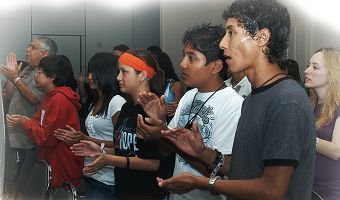
For many of the teenagers who attended the camp on South Padre Island, it was their first time to attend a youth camp.

“We’re just here to tell them someone loves them,” speaker Steve Martinez said. “We want to see a change in their life.”

Before the weekend ended, many already were seeing a change of life.

Leonel Santos, who took about 17 youth from his church to the camp, recognized the need for a camp like this. His students come from broken homes and troubled pasts, and he wanted them to direct their attention to God instead of their own situations, he said.

“They need to leave out the problems they’re having and focus on God,” Santos said.

Students responded well to the camp because it was close to home and led by fellow students, he observed.

Students missionaries and South Texas youth work together on sand sculptures.

The youth weren’t the only ones blessed, Santos added. He is new in his Christian faith and already has seen a change in his own life from working with them.

“These young people are a motivation.” Santos said.

Marilyn Lara also was affected by this weekend. As a recent graduate from high school, she said she was glad to have a camp close to home that helped her get away from the negative influences around her.

“It set the tone for my summer,” Lara said. “I feel really close to the Holy Spirit.”

These kinds of reactions were exactly what the Valley Project team had prayed for. Ali Cepeda, a Valley Project member, said within the first night of the camp, they already were seeing the Holy Spirit move.

Cepeda, like the other project members, used her summer to serve God by helping others. The group saw an immediate effect from their work because they were ministering in their own community, she said.

“You don’t have to go far away to have a God experience,” Cepeda said.

The camp was part of Texas Baptists' Texas Hope 2010 effort.

Fabian Pacheco, another Valley Project member and keyboard player for the praise band, said he is excited about what is to come in the lives of the South Texas teens because he has seen God work in his own life.

He once was in a similar position as the youth at the camp. He had given up on church and was vulnerable. Robert Rueda, the Baptist Student Ministries director at the University of Texas Pan Am, helped disciple him, and Pacheco now is a youth pastor helping those like him.

“The youth are our future,” Pacheco said. “It’s our job to lead them.”

Pacheco said he could see God ministering to the youth during the camp.

“Just to see students surrendering their lives to Christ was such a big blessing to me,” Pacheco said. “It takes a lot for someone to step out.”

Pacheco and the other Valley Project members used volleyball and sand castle-building competitions to develop relationships with the youth and to show them Christianity can be fun.

“There’s nothing I’d rather be doing than serving God,” Pacheco said.

Brenda Sanders, BGCT collegiate student mission consultant, said the team was serving in a much-needed way. All of the Valley Project members could speak Spanish, like the youth.

”They look like them, speak like them and have the background and experience to lead the camp,” Sanders said.

The group not only spoke Spanish. They also sang some songs in Spanish during the worship time.

“It’s their music,” Sanders said. “It’s their heart language. We didn’t import camp.”

 
For more information about Texas Hope 2010, visit www.texashope2010.com. To learn more about the Valley Project and to read the members’ blogs, visit www.valleysummerproject.com.


WMU challenged to ‘change a life, change the world,’ through missions

LOUISVILLE, Ky.—Participants at the 2009 Woman’s Missionary Union missions celebration June 21-22 conducted the mission organization’s business and heard challenges to “change a life” and “change the world.”

Kaye Miller, a member of Immanuel Baptist Church of Little Rock, Ark., was unanimously re-elected president. Rosalie Hunt of Guntersville, Ala., president of Alabama WMU, was elected recording secretary. It is the first time both national WMU officers have been children of missionaries. Miller’s parents were missionaries to Thailand and Hunt’s parents served in China. Hunt later served as a missionary.

Miller, in her presidential address, focused on love.

Gerald and June McNeely, missionaries to Spain for 32 years with the International Mission Board, listen as their granddaughter, Lisa Hoffman Clark, explains how the McNeelys’ involvement in missions influenced her desire to serve in missions. (BP Photo/Jon Blair )

“Even the Southern Baptist Convention theme has love in it—‘Love Loud!’ WMU is in its second year of our emphasis ‘Called to Love.’ So, it seems love is in the air,” she said.

Jesus commands his followers to love him with all their hearts, soul and minds, and then to love their neighbor as themselves, she noted.

“When we offer him our passion, our being and our strength—not with just part of it, but with all of it—he gives us the amazing capacity to see through his eyes, to hear with his ears, to touch with his hands, to think with his mind and to feel with his heart,” Miller said.

She urged WMU to train the next generation to have hearts for missions and be urgent about the Great Commission.

“If a life is changed, then the world can be changed. Change a life. Change the world,” she said. “We are called to love because we are called by love. And love has a name—a name above every name. His name is Jesus.”

WMU Executive Director Wanda Lee reported WMU has helped Liberian women re-open a children’s camp following years of civil war that put some of their ministries on hold. Through Pure Water, Pure Love, WMU has provided water purification systems so Liberian WMU once again can provide Christian camp for boys and girls.

“Our Liberian sisters love you even though they’ve never met you,” Lee said.

WMU celebrated the missions legacy of the Gerald and June McNeely family. The McNeelys, emeritus missionaries to Spain, credited their mothers, both Girls in Action teachers, with inspiring them to share the gospel with others.

The McNeelys’ eldest daughter, Linda Hoffman, and her husband, Rusty, are long-time missions educators at St. Matthews Baptist Church in Louisville, Ky., the WMU annual meeting’s host church.

Their youngest daughter, Marsha Smith, and her husband, David, are Southern Baptist missionaries to North Africa.

The McNeelys’ granddaughter, Lisa Hoffman Clark, is a former missionary Journeyman to North Africa and now a GA teacher. Clark’s eldest child recently joined Missions Friends.

“One leader can change a life,” Hoffman said, noting that Christ’s calling requires some Christians to “pack a bag and a passport,” as her parents and sister did.

At an awards luncheon, Margaret Brown of Mountain Rest, S.C., received the Martha Myers award. Brown, WMU director at Mountain Rest Baptist Church, started the church’s Girls in Action organization and previously served as a GA leader.


‘Get on board, little children’ Train-maker seeks to make VBS special

SHILOH—Vacation Bible School was important to Tom Huffman as a boy, and he wants to make sure it remains that way for children today.

In part, Huffman values the summertime Bible school program because his mother recognized its importance. He saw how hard she worked to prepare to teach in Bible school when he was a child.

He also remembers it as an exciting time for himself.

{youtube}XpRnexyifIs{/youtube}
Tom Huffman explains how he made the locomotive.

“Then, most people didn’t have much money and you didn’t travel, so Bible school was always a release for us—a special time,” he recalled.

Even though today’s children may have more potential for special times, Huffman wants to make sure Vacation Bible School remains in the mix.

With that in mind, he spent 11 days in his barn crafting a locomotive related to “Boomerang Express,” the theme of this year’s curriculum used at First Baptist Church in Shiloh.

When he was finished, he had a nine-foot engine that had three component parts.

“The whole idea was to build a train that could be dismantled easily, moved easily and go from Bible school to Bible school, which was the original idea, so we would use it and maybe someone else could use it as a prop,” Huffman said. “It can easily be moved by two people.”

Tom Huffman of First Baptist Church in Shiloh spent 11 days in his barn crafting a locomotive related to this year’s Vacation Bible School theme, “Boomerang Express.”

Already, it is scheduled to be used at First Baptist Church in Taylor one week and at First Baptist Church in Round Rock the next week.

In addition to the train, Huffman also built the façade of a train station and landscape backdrop. He dubbed the station “Alice Springs,” recalling a stop at that location during a trip to Australia some years ago.

In years past, he has made a grass hut from reed grass and an Arctic cabin complete with fireplace for Bible school.

His wife, Barbara, has an artistic flair and built a paper-mache volcano in front of the doorway of a preschool classroom to make their Vacation Bible School experience fun.

“The prop stuff is fun,” Huffman said. “But I think it’s most important that you make them seem special. This is our primary outreach ministry to kids.”

About 60 children attended the rural church the first day of Vacation Bible School, but the Huffmans were not content with getting them there. They wanted them to leave with a greater knowledge of Scripture.

They led the children in songs that list all 66 books of the Bible. Children who were able to say or sing the books during Bible school received a Bible. More than 120 have received Bibles during Vacation Bible School over the past decade.

Churches who would like to use the train during weeks not already reserved can call Huffman at (512) 856-2149.


Students make worldwide impact through Fort Worth refugee ministry

FORT WORTH—Without leaving their home state, six university students reached people from across the world by working with a Fort Worth ministry that helps refugees assimilate into American culture.

The students, serving with the Baptist General Convention of Texas Go Now Missions program, partnered with the World Relief refugee resettlement agency.

“It’s encouraging to know that you don’t have to go overseas to do mission work,” said Lisa Olsen, the volunteer coordinator at World Relief. “There are people from all over the world that are right here, and there are people who don’t know Christ all around us. With World Relief, it’s like the world comes to you.”

The spirit of helping was so contagious that one of the older refugees helped another girl make a bracelet during an event at the La Dera Palms apartments. Go Now student missionaries have been working with refugees from around the world to make their transition to the United States smoother.

This is the first time Go Now Missions has sent students to work with this evangelical nonprofit organization.

“It has been a beneficial experience for both the students and the refugees,” Olsen said.

Natalie Neesley, a junior from Texas A&M University, said her desire was to communicate a message of comfort to the refugees.

“I hope they will come to realize that they have a heavenly Father that loves them beyond measure,” Neesley said. “And no matter the pain they have experienced and are still dealing with, the Lord is their healer and will restore … their joy.”

Neesley said spending time with the refugees gave her a new challenge.

“This experience taught me to … meet people where they are, and help them from there,” Neesley said. “If they don’t speak English, then try to teach them English with the love of Christ. If they are firm that they are going to stay with the religion they presently have and have no interest in Christianity, then continue to show them love.”

World Relief’s goal is to empower volunteers to serve in their local community and encourage them to grow spiritually.

“It’s not only an opportunity to impact others through helping, but it also affects your individual spiritual walk with the Lord,” Olsen said. “These students have been called to make Christ known to the nations, and from these two weeks, we hope they can realize that they can serve every day, wherever they’re at.”

Students worked with refugees from countries like Burma, Iraq and Cuba.

“I feel like I’ve gone to … (multiple) countries from right here in the United States,” said Amanda Ratheal, a junior from the University of North Texas in Denton.

The students taught English-as-a-Second-Language classes, hosted arts and crafts activities, picked up refugees from the airport, took them to work and spent time teaching them the basics of American culture in their homes.

“We take advantage of many things that we know,” Olsen said. “Like how to operate kitchen appliances, use an American toilet … or hold a pencil.”

Olsen said among the biggest struggles for refugees is learning English, getting a job and making social adjustments.

“That’s where our efforts come into play,” Olsen said. “We assist them in those three, main aspects.”

Despite the language barrier and cultural differences, Ratheal believes refugees and volunteers built relationships.

“Sometimes you’re working with people and the only thing you have in common with them is that you’re both people,” she said. “The experience has opened my eyes to what’s right in front of me.”

Though programs are focused on developing self-sufficiency in America, the volunteers were able to witness to the refugees by communicating God’s love through their actions.

“A big part of evangelism is living out what we say we believe, and this is a good way to do that,” Ratheal said. “It’s sometimes easy to get lost in our own bubble and not recognize the needs of other people, but … if we’re all looking out for each other, our needs as a whole (community) will be better met.”


U.S. laws chill Muslim philanthropy

WASHINGTON (RNS)—Laws meant to eliminate terror financing are targeting Muslims unjustly, interfering with their right to practice Islam and resulting in a decline in charitable giving, the American Civil Liberties Union has charged.

The 166-page report, “Blocking Faith, Freezing Charity,” said the laws undermine security, rather than fight terrorism. The U.S. Treasury Department quickly disputed the ACLU’s findings.

“Government actions are creating a climate of fear that’s chilling American Muslims’ exercise of their religion through charitable giving called Zakat,” said Jennifer Turner, a human rights researcher with the ACLU and the report’s author.

Zakat is one of five mandated “pillars” of the Islamic faith, along with prayer, fasting, pilgrimage and belief in one God. Zakat requires Muslims to donate 2.5 percent of their annual earnings to the poor, although many donate much more.

Many Muslims now are too scared to donate to charities because they are afraid they could be dragged into court or prosecuted for suspected ties to terrorism, the report asserted.

Turner, who spent the past year interviewing some 120 Muslim charity leaders, imams and donors, could not provide hard figures on how much Muslim giving had declined, either as a percentage or in real dollars.

Anti-terrorism laws allow the Treasury Department to designate charitable organizations connected to terror without notice or explanation, Turner said. So far, seven Muslim charitable organizations have been shut down under the new laws, he said.

The Treasury Department rejected the claim that it targeted donors.

“We’re increasing our engagement with the charitable community to help them protect against terrorist abuse of charity and to refine the guidance surrounding charitable giving,” said Natalie Wyeth, a Treasury Department spokeswoman.


Graduation rates at religious schools outpace those at other universities

WASHINGTON (RNS)—Religiously affiliated universities rank the highest nationwide in graduating their students, while hundreds of public and private universities fall far below the low average of graduated students, according to a recent report based on data from the U.S. Department of Education.

From Catholic to Jewish and Baptist to Methodist, religious colleges and universities topped the charts in the American Enterprise Institute survey, which found an average of just 53 percent of entering students at four-year colleges graduate within six years.

Many institutions fared far worse, with graduation rates below 20 and 30 percent for students who entered in the fall of 2001. Religiously affiliated universities, however, rarely appeared in the rock-bottom rankings and held most of the top 10 slots across six categories of admissions selectivity.

Top 10 schools religious 

Among the “competitive” category of schools, which require students to have a C to B- high school grade average for admission, 100 percent of the top 10 schools to graduate their students were of religious orientation. The College of Our Lady of the Elms in Chicopee, Mass., graduated 89 percent of their students; Texas Southern University, by contrast, graduated only 12 percent.

The report ranked colleges based on admissions standards that ranged from “most competitive” to “noncompetitive.” It cited reasons beyond admissions criteria that affected graduation rates, including student demographics and the schools’ institutional mission. The authors, however, did not explicitly mention the colleges’ religious background as factors.

“While student motivation, intent and ability matter greatly, our analysis suggests that the practices of higher education institutions matter, too,” the report said.

Credits the mission statements 

Brian Williams, vice president of enrollment at John Carroll University in Cleveland, said religiously affiliated universities produce more graduates because their “mission statement attracts a certain type of student, as well as a certain type of employee.”

The report focused on the extremes of schools that either fail or succeed at handing out earned degrees. As a disclaimer, the authors repeated that the graduation rates do not always represent the quality of the university per se but possibly the quality of their mission statements.


Baptist Briefs: Draper released from hospital

Former Southern Baptist Convention President Jimmy Draper was released from the hospital June 11 and is continuing his recovery from strep bacterial meningitis. Draper spent six days in the intensive care unit at Baylor Regional Medical Center in Grapevine and two days in progressive care. He was hospitalized when he became unresponsive following a myelogram June 3 at an outpatient clinic in Fort Worth. After a preliminary diagnosis of an allergic chemical reaction, doctors determined strep bacterial meningitis had entered his bloodstream during the procedure. Draper was president of LifeWay Christian Resources of the Southern Baptist Convention from 1991 to 2006 and was the longtime pastor of First Baptist Church in Euless.

Society names interim director. Baptist historian Walter “Buddy” Shurden, minister-at-large at Mercer University, has been named interim executive director of the Baptist History & Heritage Society, effective Aug. 1. Charles Deweese, current executive director, has announced his retirement, and his last workday will be July 31. Pam Durso, current associate executive-treasurer, will leave the society to become executive director of Baptist Women in Ministry on July 1. Shurden served as the society’s president in 1975-1976, served as a member of the editorial board and its executive committee, and received the society’s Distinguished Service Award in 2001. Shurden is the former executive director of the Center for Baptist Studies at Mercer University and Callaway Professor of Christianity and chair of the department of Christianity. The society’s board has asked Durso to serve as interim treasurer.

Florida children’s home leader named to council. Jerry Haag, president of Florida Baptist Children’s Homes, has been named by Florida Gov. Charlie Crist to a three-year term on the state’s Faith-based and Community-based Advisory Council. The council provides annual recommendations to the governor and the state legislature on ways the government and the faith-based community can work together to improve social services for Floridians. Haag, former president of South Texas Children’s Home, is a graduate of Baylor University and earned a doctorate from the University of Texas at Arlington.

Prestonwood pastor diagnosed with cancer. Jack Graham, pastor of Prestonwood Baptist Church in Plano and a former Southern Baptist Convention president, has announced he recently was diagnosed with prostate cancer and is taking a two-month sabbatical. Graham underwent successful surgery May 14 after consulting with doctors, led by personal physician Kenneth Cooper, founder of the Cooper Aerobics Center in Dallas and a longtime Prestonwood member. Graham said physicians have assured him his prognosis is “outstanding.” Prestonwood recently granted Graham a two-month sabbatical in recognition of his 20th anniversary at the church. “It is perfect timing to begin that sabbatical now for the continued healing of my body, soul and spirit,” Graham said.


One the Move: Brent Beasley to Broadway Church in Fort Worth

Brent Beasley to Broadway Church in Fort Worth as pastor from Second Church in Memphis, Tenn.

Mark Bethune has resigned as pastor of First Church in Eden.

Jim Coston to Calvary Church in Waco as pastor from First Church in Trenton, N.J.

Brock DeWald to Alsbury Church in Burleson as minister of music.

Hayden Harris to Mount Carmel Church in Cleburne as minister of youth.

Chris Johnson to First Church in Chalk Bluff as pastor from First Church in Covington, where he was minister of youth.

Lee Kelley to First Church in Oglesby as minister of music.

David Lambert to Mount Carmel Church in Cleburne as minister of music.

Craig Lile to Faith Church in Wichita Falls as pastor from Live Oak Church in Jacksboro.

Seth Northcutt to First Church in Sulphur Springs as college summer intern.

Richard Ramon to Iglesia Comunidad in Burleson as pastor.

Cory Schibler to Pearl Church in Gatesville as pastor.

Kylie Singleton to First Church in Sulphur Springs as children and preschool summer intern.

Ashlee Stricklin to First Church in Sulphur Springs as middle school summer intern.

Brittany Thomas to First Church in Sulphur Springs as children and preschool summer intern.

Trey Turner has resigned as pastor of Canyon Creek Church in Temple to plant churches in Wisconsin.


Around the State

Gabe Orea of Waco will be commissioned as one of the Cooperative Baptist Fellowship’s field personnel July 1, prior to the Fellowship’s 2009 General Assembly. The commissioning service will take place at South Main Baptist Church in Houston. He will work in partnership with the local registered church to build relationships and opportunities to minister with the most neglected and least evangelized in Xiamen, Fujian, China. This ministry will include developing local leadership for sustained ministry.

Students from East Texas Baptist University spent time helping in the Northeast Texas community of Deport. The students joined with youth from Faith Church in Deport to deliver “blessing bags” to every home in the city. Following the deliveries, the students painted a home. Cassy Rains, a nursing major from Benton, La., said delivering the bags was a meaningful experience for her. “What got me was going door to door talking with people. It was emotional and made me think of my own hometown and the hurts and pains that exist,” she said.

Hardin-Simmons University will hold Threshold Camp, a summer enrichment program for gifted children entering kindergarten through 10th grade, July 13-17 and July 20-24. Students will explore world cultures, architecture and human experiences. They will have the opportunity to crack a secret World War II code, use famous soundbites to create a world-changing message, and roll the dice on a life-sized gameboard and solve the problem dictated by the dice. Younger children “travel around the world” in 10 days, study the history of the United States through its monuments, and design and create architectural structures. The fee for younger students is $90 per five-day session and $150 for older students. Students may attend one or both sessions. A limited number of scholarships are available. For more information, call (325) 671-2150.

Dillon International will present a free informational meeting on international adoption at the Buckner Children’s Home campus July 16 from 6 p.m . to 7:30 p.m. A Dillon representative will give an overview of adoption from China, Korea, Haiti, India, and upcoming programs in Ghana and Nepal. New opportunities in Ethiopia and Russia and domestic adoption options for Texas families, available through an affiliation with Buckner International, also will be discussed. For more information and to reserve a spot at the meeting, call (214) 319-3426.

Hunter Baker has been named associate provost at Houston Baptist University. Baker, who came to HBU in 2007, also serves the university as director of strategic planning and as a contributing editor of The City, HBU’s journal featuring leading voices in Christian academia. He teaches courses in American government, constitutional law, public policy, political thought, and law and religion.

The School of Fine Arts at East Texas Baptist University receieved the outstanding organization award for 2009 from the Marshall Regional Arts Council. ETBu and the arts council have jointly sponsored two Christmas concerts featuring the university’s concert choir and symphonic band for a number of years.

Anniversaries

Spring Creek Church in Iredell, 135th, May 24. Matthew Richard is pastor.

Hillcrest Church in Denton, 55th, Aug. 8. Robert Richardson is pastor.

Death

Raymond Hardin Jr., 77, April 26 in Fort Worth, after battling complications from colon cancer surgery. He served as a minister of music 54 years in Texas and Oklahoma churches, including 16 years at Center Point Church in Weatherford and 12 years at Soda Springs Church in Millsap. He is survived by his wife of 52 years, Myrtle; son, Paul; sister, Joyce Qualls; and five grandchildren.

Events

David Smith, pastor of First Church in LaMarque, has received his doctor of ministry degree from Midwestern Seminary.

Comunidad Casa del Alfarero in Houston will honor Pastor Leopoldo Mata for his 23 years of service to the church July 3.

Ordained

Stephen Allen to the ministry at First Church in Cranfills Gap.

Mark Abell, James Manchester, John Sawyer, Ryan Stueber, Heath Thompson, John Whitworth Jr., Kelly Wren and Ronnie Zastrow as deacons at Trinity Church in Kerrville.


Seminary president calls SBC executive’s comments ‘shameful’

LOUISVILLE, Ky.—The president of Southeastern Baptist Theological Seminary called comments in a speech by the Southern Baptist Executive Committee President Morris Chapman “disingenuous” and “shameful.”

Seminary President Danny Akin was addressing a panel discussion hosted by B21 at an Acts 29 church start.

“I wish to apologize to my Calvinist brothers and sisters who are here for the horrible misrepresentation of your position this morning,” said Akin, one of six participants in a panel to discuss with young pastors issues surrounding continuing involvement with the Southern Baptist Convention.

Southeastern Baptist Theological Seminary President Danny Akin.

B21 is a loose network of persons “seeking to be Baptist in the 21st century.” Acts 29 is a network of churches whose foundational documents are clearly Calvinistic. Many member churches are dually aligned with Southern Baptists, as well as supporting Acts 29.

Sojourn Community Church in Louisville hosted the panel discussion, attended by 400 to 500 filling the main meeting space and an overflow room. Most of the participants were the young pastors, leaders and students whose participation in SBC life is coveted by SBC leadership.

Earlier in the morning, Chapman brought his annual address to the 8,450 messengers registered at the time for the annual Southern Baptist Convention meeting in Louisville, Ky. Although he never uttered the word “Calvinism,” he spoke directly both to it and to the “emerging church” in his remarks.

“Man’s system will be inferior to God’s system now and forever,” he said. “The belief that sovereignty alone is at work in salvation is not what has emboldened our witness and elevated our concern for evangelism and missions through the ages. This is not the doctrine that Southern Baptists have embraced in their desire to reach the world for Christ.

“If there is any doctrine of grace that drives men to argue and debate more than it drives them to pursue lost souls and persuade all men to be reconciled to God—then it is no doctrine of our Lord Jesus Christ.

“The sovereignty of God and the responsibility of man both are taught in the Bible. Both are necessary elements in the salvation experience.”

“The time has come,” Chapman said,” to stop talking of ‘What made the SBC great’ or ‘What will make the SBC great again.’ All these questions are in direct competition with the glory of the Lord Jesus Christ.”

He referenced previous controversies over Baptist identity and said, “While the controversy raged and theologians were arguing about Baptist identity, Lottie Moon was boarding a boat to the distant shores of East Asia.”

“The church did not—upon receiving the Spirit of God (at Pentecost)—write a theology text, or form a committee or establish a bureaucracy or construct a building or engage in idle arguments about the extent of the atonement or the nature of election.”

Akin said the next day that he has never heard a Calvinist say that man’s response to the urging of God’s Holy Spirit is not a necessary ingredient for salvation. Calvinist theology has always been present in Southern Baptist life, at varying degrees, he stressed.

The difference between the Calvinist view of salvation and the traditional Baptist view is a matter of emphasis, he said. Both agree God’s sovereignty and man’s response are essential elements of salvation, but each party emphasizes one of those elements.

The B21 meeting was held in Louisville, home of Southern Baptist Theological Seminary, whose president Al Mohler is a Calvinist and has returned Southern to what he believes are its founders Calvinistic roots.

After Akin’s opening apology, frank discussion was more about reasons young pastors should stay within the Southern Baptist framework, and financially support a system they do not fully agree with. Panelists included Akin, Mohler, LifeWay Research President Ed Stetzer, Mark Dever, pastor of Capitol Hill Baptist Church in Washington, D.C., host pastor Daniel Montgomery and David Platt, pastor of The Church at Brook Hills in Birmingham, Ala.

Akin, Mohler and Stetzer are trusted figures among young pastors and, with SBC President Johnny Hunt, have done much to invigorate active discussion among them about reasons to stay involved with the SBC.

Talking about the Great Commission Resurgence which dominated conversation during the convention’s first day, Akin said: “I don’t want Southern Baptists sitting on the sideline watching what God is going to do. I want to be a part of it.”

Mohler told the pastors and students: “Don’t look for too much out of the Southern Baptist Convention. Don’t find your identity here.” He encouraged them to minister in their churches, find their identity in Christ and plug into the SBC for connections and resources.

Mohler said the SBC has done good things, but growing up in SBC churches, attending SBC schools and seminaries and moving on to lead SBC churches and entities “produced a tribal identity rather than a gospel-centered identity.”

While Acts 29 is a “fascinating model” Mohler said, he warned the audience against “developing a tribal identity.”

Mohler said pastors “can find many platforms” and it is “wrong to think of ‘either or’” when picking a partner. While he said he hoped pastors could identify with the SBC and other ministry partners, “there were hints this morning that’s going to be hard.”

His comment was likely in reference to Chapman’s remarks, and to the steady stream of messengers moving to limit SBC involvement with Mark Driscoll, a plain-speaking Seattle pastor whom many young pastors admire.

Although it was obvious as panelists declined the microphone when the question was asked, “Why should we support our state Baptist convention?” eventually Mohler said pastors and churches “forfeit the right to speak into the situation if you don’t support it financially.”

He encouraged them to “make every single contribution you make in terms of mission and ministry support earn that support. Don’t give a dollar you don’t think is well deployed in ministry, and then hold us accountable.”

Akin said it was easier to support the North Carolina Baptist Convention where Southeastern Seminary resides because “it is moving in the right direction” in terms of “incrementally” providing more Cooperative Program dollars for ministry beyond the state.

Stetzer, who has worked for three national Baptist agencies and has “seen the good, the bad and the ugly,” said he is “not impressed with the Southern Baptist Convention. I’m not getting my identity from it.”

“Now is the time to engage and fix that system,” he said. “But don’t be fooled. The voices of division will become more shrill before we come together.”

Platt, whose church is large and fast growing, reminded the audience that even churches “are not spending money that in every way is accomplishing the Great Commission.” He said he knows that even in his own church, money is spent on self-serving items.

Montgomery, pastor of the host church, said his church “owed the structure for the existence of our church,” although he said six weeks after it started, he was already “taking hits” for doing things differently.

“There is a need for the emerging generation to be schooled in gospel humility,” he said. “There is a need for the generation before us for humility to let us fail.”

He said if Stetzer, who “found” and encouraged him to start a church, had not responded with humility to Montgomery’s early failings, “I would have left the relationship.”


SBC resolution commends Obama, critiques policies

LOUISVILLE, Ky.—Southern Baptists both commended President Barack Obama and expressed opposition to some of his policies in a resolution passed June 24 at their annual meeting in Louisville.

A resolution commending Obama for his “evident love for his family” and expressing “pride in our continuing progress toward racial reconciliation signaled by the election of Barack Hussein Obama” as president was one of five resolutions approved by 8,731 messengers.

While the Obama resolution commended him for retaining “many foreign policies that continue to keep our nation safe” it also said Southern Baptists “deplore” his decision to expand federal funding for “destructive human embryo research“; “decry” increased funding for pro-abortion groups; “oppose” any stripping of conscience protections for health care workers unwilling to participate in abortions; and “protest” any effort to “eradicate the symbols of our nation’s historic Judeo-Christian faith from public or private venues.”

The resolutions committee, chaired by Southeastern Baptist Theological Seminary President Danny Akin, considered 26 resolutions during three days of deliberations prior to the annual meeting.

Other resolutions called on Southern Baptists to consider adopting some of the 150 million orphans who “now languish without families” around the world; affirmed biblical positions on marriage and sexual purity; commended Southern Baptist Theological Seminary in Louisville on its 150th anniversary; and expressed appreciation for Southern Seminary personnel and others who worked on all the details to make the annual meeting run smoothly.

In a later press conference, Akin said the Obama resolution “strikes a really good balance” for prayer for the president, affirming him and making plain disagreements with some of his policies.

Richard Land, president of the SBC Ethics & Religious Liberty Commission who served as a staff resource, said, “Race has been the serpent in the garden of America from the very beginning,” first with Native Americans, then with African-Americans. But, he said, since the racial reconciliation resolution passed by the SBC in 1995, the number of black members in Southern Baptist churches has increased 117 percent to almost 800,000.

“It would have been irresponsible not to speak to the election of the first African-American president,” Akin said. “We could affirm his election without affirming his policies where we have strong, strong disagreement.”

Southern Baptists have gone from being virtually an all white denomination “by choice” in 1970 to about 18 percent minority members now, according to Land.

The sexual purity resolution supports “the biblical definition of marriage as the exclusive union of a man and a woman:” rejects any attempt to repeal the Defense of Marriage Act; urges the U.S. Senate not to pass any legislation that would criminalize “deeply held religious beliefs and speech about homosexuality and other unbiblical sexual practices:” and supports the “current military code barring homosexuality in the military.”


Task force approved, but motions focus on controversial pastor

LOUISVILLE, Ky.—A proposal that could reshape the Southern Baptist Convention received overwhelming approval during the 2009 SBC annual meeting. But relationships with a controversial pastor who is influential among many young SBC pastors drew the attention of multiple motions presented July 23 in Louisville.

Messengers authorized SBC President Johnny Hunt to appoint an 18-member Great Commission task force, which he named the following morning.

The motion mandated the task force to research “how Southern Baptists can work more faithfully and effectively in serving Christ through the Great Commission.”

“We are living in one of these turning times (of) unprecedented opportunity,” claimed Al Mohler, president of Southern Baptist Theological Seminary in Louisville, who made the motion to create the Great Commission task force.

The convention must respond to churches’ desire to spread the gospel around the globe and to set loose the younger generation’s passion for missions and ministry, Mohler pleaded.

Also, the time is right for the convention to examine itself in light of its missions mandate, he added. “It is right and fitting for the SBC in every generation to establish a process whereby we ask the hard questions: Is there more we can do? Can we do better?”

Mohler acknowledged some convention leadership resisted the Great Commission proposal but countered: “We have absolutely nothing to fear asking …, ‘Is there more we can do, and can we do even more if we are faithful?’”

Although convention observers questioned whether the Great Commission motion would pass, the vote was so overwhelming, SBC Parliamentarian Barry McCarty said, “Wow!” when messengers raised their ballots in support of the proposal.

The task force proposal was the only one of 31 motions put to a vote. Messengers heard eight motions that directly or indirectly related to a pastor who is not even affiliated with the SBC.

They focused on Mark Driscoll , pastor of 7,000-member Mars Hill Church in Seattle and leader of the Act 29 church-planting movement.

Less than a week prior to the SBC annual meeting, Driscoll was the subject of an exposé in Baptist Press, the convention’s information service. The report focused on his preaching on oral and anal sex, use of profanity and apparent approval of drinking wine.

Of the eight Driscoll-related motions, three were referred to boards of SBC agencies and institutions. They included calls for:

• All SBC entities to monitor and report their “expenditure of funds for any activities related to or cooperative efforts with Mark Driscoll and/or the Acts 29 organization.” The motion was referred to all SBC boards.

• All SBC organizations to “refrain from inviting speakers … who are known for publicly exhibiting unregenerate behavior, including but not limited to speech such as cursing and sexual vulgarity, or who publicly state their support for the consumption or production of alcohol.” This motion also was referred to all SBC boards.

• Trustees of LifeWay Christian Resources to investigate one of their employees, Ed Stetzer, and trustees of Southeastern Baptist Theological Seminary to investigate their president, Danny Akin, and evangelism professor, Alvin Reid. Stetzer has worked with Driscoll in church planting, and Driscoll has preached at Southeastern Seminary. Messengers referred the motion to the boards of LifeWay and Southeastern.

Five Driscoll-related motions were ruled out of order. They included requests that:

• SBC organizations refrain from inviting speakers who are known to be unregenerate and curse, speak vulgarly and support alcohol.

• LifeWay remove books written by Driscoll from its bookstores.

• The SBC “biblically distinguish between consuming alcohol, which is an issue of individual conscience, and being drunk, which is categorically a sin.”

• SBC organizations and affiliated churches “support and partner with other Christian agencies and individuals of like-minded primary theological convictions for the sake of the Great Commission and the glory of God.”

• The Executive Committee invite Driscoll “to address the concerns of his accusers and all other interested parties” when the convention meets next summer.

In addition, the convention referred six other motions to the Executive Committee. They included proposals to:

• Change distribution of SBC world hunger offering receipts to be consistent with Cooperative Program allocations, providing 66 2/3 percent to the International Mission Board and 33 1/3 percent to the North American Mission Board.

• Form a committee to study how to involve more ethnic churches and ethnic church leaders in “serving the needs of the SBC through cooperative partnership on the national level.”

• Consider allowing churches to designate contributions to “particular convention causes” and still consider the money part of the Cooperative Program.

• Revise how funding is allocated to the six SBC seminaries to accommodate enrolment at extension centers away from their main campuses.

• Adopt the U.S. Christian Flag “as a tangible symbol to unify the American believers under one flag to fulfill the Great Commission.”

• Amend Article VI of the SBC Constitution to change how trustees of SBC entities are allocated and selected.

LifeWay Christian Resources received three additional referrals, including requests that the convention’s publishing house:

• Research “more affordable educational alternatives to traditional Christian schools.”

• Mark the 400th anniversary of the King James Version of the Bible in 2011.

• Produce only American-made Vacation Bible School resources.

The Ethics & Religious Liberty Commission also received three referrals. They asked the convention’s public-policy organization to:

• Join with the American Family Association in “calling on the Pepsi-Cola Company to remain neutral in the culture war in our country by refraining from promoting the gay/lesbian lifestyle and agenda.”

• Declare a “Sanctity of Life Year” in the near future.

• Start a petition to “end abortion in America and the funding of Planned Parenthood, along with all other abortion-providing entities.”

The SBC seminaries received a motion calling upon them to publish information regarding the “state conventions or affiliated national conventions from which their ministerial students or master’s-level students originate.”

All SBC entities received a proposal asking them to “submit any action which acts to interpret the Baptist Faith & Message … so that the action may be approved by a majority of the messengers” to SBC annual meetings.

The Order of Business Committee received a motion stipulating that the convention post the American flag, accompanied by an honor guard, at the convention’s annual meetings.

In addition, seven other motions were declared out of order for various reasons. They focused on:

• Prayer for “the safety and welfare of Iranian citizens.”

• Banning “the Holman Christian Standard Bible and any translation that questions the validity of any Scripture passage or verse” from use in convention literature.

• Claims that the world will come to an end May 21, 2011, and the end of the “church age.”

• Banning books by pastors T.D. Jakes and John Hagee, Catholic Bibles, and 90 Minutes in Heaven and The Shack from LifeWay Christian Stores.

• Disallowing use of secular music in any promotional materials produced by the convention.

• Imploring Congress and President Obama “to seek biblical direction with respect to blessing, and not cursing, the nation of Israel.”

• Condemning President Obama for declaring June 2009 as Lesbian, Gay, Bisexual, Transgender Pride Month.