Loveless gospel attracts no one, Southern Baptist pastors are told

LOUISVILLE, Ky.—Until Baptists demonstrate love for each other, the gospel of love they preach will not attract others, speakers told the opening session of the annual Southern Baptist Pastors’ Conference June 21.

Considering the theme “What if?” Mac Brunson, J.D. Greear and Charles Colson imagined a convention of Baptists winsome enough to attract others who currently do not see a loving community worthy of their own life investment.

Brunson, pastor of First Baptist Church, Jacksonville, Fla., told the story of a dog food company that had the best marketing and sales staff, but sales were down because dogs didn’t like the product. He asked fellow pastors gathered at their annual pre-SBC preaching fest why they are not reaching people.

Colson

Chuck Colson, founder of Prison Fellowship based in Lansdowne, Va., speaks during the June 21 evening session of the 2009 Southern Baptist Convention Pastor’s Conference at the Kentucky Exposition Center in Louisville, Ky. (BP Photo)

“They don’t like us,” he said. “And if you’ll walk out of this room and into the hallway and listen to the conversation, you’ll discover we don’t like each other very much either.”

Brunson, former pastor of First Baptist Church in Dallas, pointed to five attitudes that should characterize Christian’s dealings with each other—harmonization, identification, intention, compassion and submission.

It pays to be nice

Baptists have a tendency to “square off” over divisions and seek first to discover differences about each other, rather than areas of agreement, he said.

“Why can’t you find something you can agree on?” he asked. He expressed dismay at some of the discussion over the Great Commission Resurgence proposed by SBC President Johnny Hunt. “My stars, can’t we agree on the Great Commission?”

Christians who do not return evil for evil, nor insult for insult present a positive witness before a watching world, he stressed. Brunson mentioned The Power of Nice: How to Conquer the Business World with Kindness, written by two women who rose to the top of the advertising business by following a simple philosophy: “It pays to be nice.” He suggested Baptists try that tactic.

“If they don’t like us, they won’t listen to us,” he said.

Fervent for religion or Christ?

Greear, pastor of the Summit Church in Durham, N.C., which has grown from 400 to 3,000 under his leadership, asked why people are not being won to Christ in large numbers as they once were.

“What has changed about us? God is the same,” he said. Greear preached from Matthew 23 to explain the difference in people who are “fervent in religion” to those who are fervent for Christ.

“Over time, religion tends to displace the gospel among God’s people,” he said. “Like a virus, it grows up out of the sinful hearts of men and chokes out the gospel.”

Like the Pharisees of Christ’s day, we see negative traits in others but not in ourselves, Greear said.

“Religion makes us horribly ineffective at evangelism” because we tend to win others to church, rather than to Christ, he said.
Jesus said the Pharisees of his day were willing to go around the world for one convert and implied they could not find a convert closer to home. He suggested Baptists ask if they have slipped into the same attitude.

When religion replaces the gospel

He listed several ways to know if religion has misplaced the gospel—religious people are obsessed with recognition; they substitute religious ritual for a love for God and over love of others; they elevate secondary traditions above knowing God; they are more aware of others’ sins than of their own; and “they think we’re always talking about somebody else.”

Implying throughout that Southern Baptists need seriously to consider if they are just religious people instead of people who hunger for the touch of God, Greear said, “Religion emphasizes conformity to a standard, not passion for God.”

Baptists exclude brothers and sisters because they don’t agree in some minor details. “How can you not be ashamed?” he asked. “You are straining at a gnat and swallowing a camel.”

The likelihood that people attending the annual SBC meeting his week will view others as villains is a tragedy, he said. “We’re so consumed by these secondary things we couldn’t see a movement of God if it went right past our face.”
People don’t hear the gospel because they are “turned off by the condescending and self-deluding way we talk” about the sins of others, Greear said. “Gospel people speak with humility.”

He urged Baptists to “repent of the self-righteousness that thinks there is something about us that makes us better than others.”

“God has brought us back from the deadness of liberalism,” he said. “God has brought us too far to trade the deadness of liberalism for the deadness of traditionalism.”

Get ready for restricted liberty

Charles Colson, a frequent speaker at the Pastors’ Conference, which was the first forum where he gave his Christian conversion testimony three decades ago, said America’s current “economic meltdown” can be traced to moral failure of politicians.

America faces a “perfect storm” that he considers more dangerous for America than the problems in the midst of the Great Depression in 1932. He attributes it to the loss of “Protestant work ethic” in favor of an expectation that “this world is to meet every one of my materialistic needs.”

Colson warned that the current perilous times provide “unprecedented opportunities for government to expand,” and that limitations on what pastors can say from the pulpit without threat of losing tax exemption or fear of arrest are forthcoming.

“Are you ready for this?” he asked. “Are you ready to say ‘no’ to Caesar when Caesar says you can’t preach what the Bible says we must preach?”
He referred to “hate speech” legislation that he interprets to mean a preacher could not call homosexual behavior sin, and potential loss of the ability for medical personnel to decline to do abortions.

“As government power expands, inevitably it restricts human freedom,” said Colson, once in President Richard Nixon’s inner circle.

Accentuate the positive

He found positives in recent reports that say 10 percent fewer Americans self-identify as Christians. The same research found an increase to 34 percent in those who self-identify as born again evangelicals, he said.

“One-third of Americans declare Christ is King, yet the culture deteriorates,” he said.

“What would happen if we really started to disciple that one-third of Americans so they had a Christian world view and were sold out to Christ? You’d see a revolution in this country.”

“The most critical thing churches can do is disciple members to know what they believe and why they believe it,” he continued. Referring to the difficult times the United States faces, Colson asked, “What better time to do the best of things, to show people winsomely what we believe?”



Waco farm plants seeds to harvest world

WACO—Fighting hunger around the world is no easy task, but one Waco organization is doing its best to alleviate the problem one seed at a time.

The goal at the World Hunger Relief Farm is to minimize hunger globally. As a nonprofit organization, it provides hands-on training in sustainable agriculture and teaches farming techniques and community development through a holistic approach to Christian mission work.

Darren Croo tends goats at the World Hunger Farm near Waco. (PHOTOS/Crystal Donahue)

“The model is for people to come here and train in a culturally sensitive and agriculturally sound environment so afterwards they can join with existing programs and efforts across different denominations and faiths to teach others,” said Dale Barron, the development director for World Hunger Relief, Inc.

World Hunger Relief Farm partners with organizations around the world, including Cooperative Baptist Fellowship.

“Our historical roots are Southern Baptist, and we value and honor that very highly,” said Neil Rowe Miller, executive director of the farm. “But we also recognize that building the kingdom is bigger than just a Southern Baptist task. So, we’ve opened our doors to other denominations, and it has enriched the community and spiritual environment we have here.”

Melody Kakunim (left) had never left her home in Papau, New Guinea, until she boarded a plane and came to live and work on the World Hunger relief farm alongside interns like Jessie Masquelier (right) from Pennsylvania. (PHOTOS/Crystal Donahue)

The 42-acre farm is run by a five-person staff and is maintained by volunteers and six paid interns. Nearly 350 interns have completed the 12-month training program, and alumni have served in more than 20 different countries.

“The whole idea is to empower people to be in charge of their livelihood and teach them skills here so they can repeat them on their own,” Barron said.

Each intern is responsible for one of the six income-producing areas of the farm—livestock, vegetable production, the fair-trade store, urban gardening, local education and organic pecan production. The goal is for each enterprise to be self-supporting and give operators the hands-on training they need for economic success.

In exchange for a 60- to 80-hour work week, interns receive a $300 monthly stipend and are provided with health insurance, horticulture training and education, along with free housing and food.

The organization stresses the importance of spiritual, physical and educational growth, Barron said. Classroom topics range from soil science and pest control to cross-cultural communications and world religions.

Swathi Malepati, an intern from Pennsylvania, runs the fair-trade store at the World Hunger Relief Farm near Waco. (PHOTOS/Crystal Donahue)

“A lot of our teaching and training is spiritually based,” Barron said. “We begin each day with devotions.”

He said this is an example of “lifestyle-evangelism. People see how we live is in line with biblical principles.”

But the farm isn’t just run by the six interns. Individuals, churches and other organizations serve as volunteers for short-term projects including summer and spring break mission trips.

“There are so many aspects to our organization, and people can contribute and be a part of who we are regardless of their skills and background,” Barron said.

Volunteers have helped by doing carpentry, lighting, mechanical work, gardening, clerical work, cooking and cleaning.

Farm volunteers and employers also seek to impact the local community. More than 3,000 people visited the farm last year, mostly school-aged children. The farm provides interactive tours and educational programs for schools, churches and community groups.

“We address personal spending habits, fair trade practices, nutrition, the importance of resource conservation and how individual behavior affects the environment,” Barron said. “We teach about being good stewards of God’s creation and taking care of the resources he’s given us.”

Barron believes each seed is important in the big picture.

Randy Fish and his 9-year-old son, Jonathan, separate kernels from chaff as a part of their hands-on learning experience this summer at the World Hunger Relief Farm. (PHOTOS/Crystal Donahue)

“Hunger looks differently in the states than it does internationally,” he said. “We know that we have an abundance here. Now it’s learning what we can properly do with that. It’s finding a way to shop and eat and do our regular activities with a conscience.”

The organization hopes visitors and volunteers leave the farm with a bigger perspective of the impact they can make, and get a better picture of what life is like in other countries. To do this, the farm uses technology like food dryers and bird pluckers so participants can practice operating equipment used abroad. The farm is set up to resemble different parts of the world like Africa, Asia and Mexico.

“Nicaragua gave us housing plans on a napkin so we could build the same type of (atmosphere) here,” Barron said.

Housing, including the dormitories, has composting toilets, outdoor showers sourced by rainwater collection and no electricity.

This realistic simulation of the mission field is what brought one volunteer family 1,100 miles from their home in Iowa to the farm.

Randy and Amy Fish have done mission work in Botswana, Africa and Costa Rica. But this summer, they’re spending their time with their two sons working and living on the World Hunger Relief Farm.

“We love the emphasis on local education and urban agriculture,” Amy Fish said. “They really are practicing what they preach, and it’s exciting to be a part of that.”

She believes by working on the farm, each of her sons—9-year-old Jonathan and 8-year-old Nathaniel—will develop a servant’s heart.

“I hope (the boys) will learn from the passion they see in the people around us and be excited about working with those who have less,” Fish said. “You’re going to find people from all walks of life here with something different to contribute, and they’re all compassionate about what they’re doing,”

World Hunger Relief Farm’s ministry has expanded dramatically over the last eight years and Miller hopes it will continue to grow by developing international relationships. But the farm’s top priority is to follow God’s will.

“We try to plan strategically, but we also realize that a big part of the history of God working through his people is giving them surprises and seeing how they respond,” Miller said. “This is key to whether those opportunities bore fruit or sent the people into exile.”


Baptist ministers urge passage of climate-change bill

NASHVILLE, Tenn. (ABP) — A total of 140 moderate Baptist leaders signed a June 18 letter urging passage of a comprehensive energy bill that includes caps on emissions linked to global warming.

Drafted by the Baptist Center for Ethics, a Cooperative Baptist Fellowship partner organization, the letter asks members of Congress to strengthen and pass "The American Clean Energy and Security Act," expected to make its way before Congress in coming weeks.

National, regional and local Baptist church leaders from 26 states and the District of Columbia said the bill sponsored by Reps. Henry Waxman (D-Calif.) and Edward Markey (D-Mass.) "advances practically the moral demands to care for the earth and its poorest inhabitants."

The 932-page act numbered H.R. 2454, also called the Waxman-Markey bill, includes a cap-and-trade global warming reduction plan designed to reduce economy-wide greenhouse gas emissions 17 percent by 2020.

The sponsors say it would create jobs, help end American dependence on foreign oil and combat global warming.

Republicans and some conservative Democrats say the bill is nothing more than an energy tax that would that would drive up costs and hurt the economy. Environmentalist groups say its goals are too modest and it makes too many concessions to energy companies.

Signers of the Baptist letter said they wished the legislation provided more funding for marginalized people most at risk and least responsible for climate change, but they are "determined that the tyranny of moral perfectionism will not block the urgency of moral realism."

Robert Parham, executive director of the Baptist Center for Ethics, endorsed the bill in a May 28 editorial on the BCE website EthicsDaily.com.

"Our faith calls us to care for creation and the poor in the concrete, not in the abstract," Parham wrote. "Protecting the environment protects the marginalized. One realistic step toward protecting both is supporting the House climate bill."

Last year the BCE sent a similar pastoral letter urging passage of climate-change legislation sponsored by Sens. John Warner (R-Va.) and Joseph Lieberman (ID-Conn.) that stalled in the Senate.

National Baptist leaders signing the June 18 letter included Daniel Vestal, executive coordinator of the Cooperative Baptist Fellowship; CBF moderator Jack Glasgow; Roy Medley, general secretary of American Baptist Churches-USA; William Shaw, president of National Baptist Convention USA, Inc.; and David Emmanuel Goatley, executive secretary-treasurer of the Lott Carey Baptist Foreign Mission Convention.

State CBF leaders in Alabama, Georgia, North Carolina and South Carolina signed the letter. So did Molly Marshall, president of Central Baptist Theological Seminary in Shawnee, Kan.; Jim Hill, executive director of the Baptist General Convention of Missouri; and Bruce Prescott, executive director of Mainstream Oklahoma Baptists.

Signers also included Miguel De La Torre, a professor at Iliff School of Theology, who writes regularly for Associated Baptist Press.

The letter comes on the heels of a government report predicting dire economic and quality-of-life consequences from global warming unless greenhouse gas emissions are curbed sharply.

Republicans accused the Obama administration of fear-mongering in order to boost support for the Democratic-sponsored energy bill.


–Bob Allen is senior writer for Associated Baptist Press.


Faith tested twice, Baylor grad overcomes cancer

WACO—When Baylor University senior Stephen Hinson of Spring walked across the Ferrell Center stage recently to receive his diploma, no one should have been surprised if they witnessed him pause and relish the moment.

“It was like, ‘God, thank you for allowing me to return to Baylor and finish,’” he said.

In 2003 and just out of high school, Hinson was diagnosed with cancer, although doctors couldn’t find a mass or anything abnormal in his bloodstream.

Even though he was brought up in a strong Christian home—a Baptist preacher’s kid—Hinson acknowledged his whole world caved in when he heard the word “cancer.”

Stephen Hinson, pictured with his parents, Bill and Kathy Hinson of Houston, found his faith tested by two bouts of cancer. (BAYLOR PHOTO)

“I didn’t know where to turn. I couldn’t find any comfort in anyone else. They can’t do anything, and so that’s when I turned to God. And that’s when I really turned my life around,” Hinson said.

Instead of choosing extreme medical treatments that would target “everything” in his body, he “went the alternative route” and radically changed his diet, with positive results. A year later, he decided to go to college and enrolled at Baylor. He had a great freshman year, he said.

However, during Hinson’s sophomore year, excruciating pain began. Cancer had manifested itself again.

“In September (2005), I woke up with a really bad headache that wouldn’t go away. I tried to wait it out, but day after day, it was the same thing,” Hinson said. “I was realizing what it probably was, but I kept it to myself. Finally, it was too much, and I had a friend take me to the ER in Houston.”

He called his parents, who had moved from Houston to North Carolina. They met their son at M.D. Anderson the following morning, where an MRI showed masses on his brain —lymphoma in the central nervous system.

They consulted with a brain surgeon, and by that night, Hinson underwent brain surgery. Miraculously, he suffered no complications. In fact, walked out of the hospital after only a few days of recovery.

“Any normal person couldn’t tell something was going on,” Hinson said.

But during this second go-round with cancer, Hinson didn’t reach out to God. Instead, he became angry. The cancer, surgery and subsequent treatments forced him to withdraw from Baylor, leaving behind his studies, his friends and his faith.

“When I was diagnosed the second time, you would think that I would have got on my knees and prayed, ‘God, heal me of this,’” he said.

“I was real confused, and it was kind of a dark time. In fact, it got so dark where I just had to say: ‘All right, Stephen—stop. What are you going to do? Are you going to keep continuing down this dark path, or are you going to turn to God again and watch him work in your life?’”

He made it through chemotherapy with a few side effects. The cancer, at that point, wasn’t gone, and although radiation was the next course of treatment, doctors said it would only prevent the cancer from spreading.

“That wasn’t very uplifting, but they told me that if I did not do it, I would start having neurological damage, like to motor functions, so I did radiation for a few weeks and another small round of chemotherapy, and that would be the completion of the treatment,” he said.

As he began radiation in February 2006, Hinson dropped everything and started praying again.

“I remember the first time, I was like: ‘God, bring me back to Baylor. Bring me back to Baylor.’ And soon that darkness started being lifted away. I started spending time, hours a day in the word of God, and little by little that darkness left, and I started praying for healing,” he said.

Hinson’s father, Bill, a former missionary and pastor of Fairmont Central Baptist Church in Pasadena, gave his son a booklet—Healed of Cancer— filled with healing Scriptures.

“I just started believing them, rereading them and memorizing them,” he said.

With his faith restored, Hinson completed his last treatment and faced his final hurdle—a test to see if the cancer was gone.

“I remember being upstairs by myself. I was just praying, ‘God, let the cancer be gone.’ And I remember him speaking to me and to my heart. ‘Stop praying for the cancer to be gone and start rejoicing, because it is.’ So right then, I just started crying,” he recalled.

As he and his parents drove to the hospital, Hinson said he sat in the back seat of the car at peace, looking up at a clear blue sky. Once at the doctor’s office, he heard the good news he was already expecting. The tests showed everything was clear. No cancer remained.

“It was a great time with my parents. They had been through so much. We just gathered around and cried and prayed to thank God. He cured me and allowed me to come back to Baylor. He’s been faithful since I’ve come back. All the tests and checkups have been clear.”

Graduating with a sociology degree and a solid background in science, Hinson has been accepted to Cornell’s master of health administration program. He said his own hospital experiences greatly affected his decision to go into healthcare management.

“I know the patient side of it and the business side dealing with insurance. So, it was something I was familiar with, comfortable with and had a heart for,” he said.

First, however, Hinson will defer for a year to take part in a 12-month discipleship program with Teen Mania Ministries in Tyler, focusing on growing in biblical knowledge, leadership and character.

“It’s a time of abandonment, of one year devoted to God, so I can go strong afterwards,” he said. He will begin his studies at Cornell in fall 2010.

During the time leading up to his Baylor graduation, Hinson was reflective about the difficult road he’s traveled for the past six years. When he returned to Baylor the second time in 2006, he was “a new person physically, mentally and spiritually.” And more thankful, he said, of his blessings than the first time he started at Baylor.

“I didn’t take anything for granted. I was determined to make the following years some of the best of my life,” he said.

As a two-time cancer survivor, Hinson felt called to share his experience with his fellow graduating seniors that they, too, can overcome anything through their faith in Christ.

“We’re going to go through trials. We’re going to hit rock bottom. But I would say the most important thing you can do is have that relationship with Christ. Lean on him. He is the one who’s going to pull you through. Don’t look at circumstances that are before you. Just look ahead and know there’s light at the end of the tunnel.”


For Cizik, it’s suddenly a lot easier being green

WASHINGTON (RNS)—Fellow evangelicals long have criticized Richard Cizik, who resigned under pressure from the National Association of Evangelicals in December, for being a little too green.

Emerging from a self-imposed media blackout, Cizik is back, and he’s wearing the label of converted conservationist even more comfortably now.

“I have become a conservative who, by some people’s definition, has become a liberal,” Cizik said during a meeting on climate change in May. “I am not a liberal. I am a conservative who, of all things, believes that some people should become conservationists.”

Richard Cizik participates in a fireside chat for Interfaith Power and Light in Washington, D.C. (PHOTO/RNS/David Jolkovski)

These days, Cizik said, he has more speaking engagements than when he worked as the NAE’s point man in Washington, and he’s making plans for a new evangelical organization that will address issues as “broad as God’s concerns are broad.”

“I’m just going to create an entity that will enable young evangelicals to be more effective as advocates for change,” said Cizik, who was hired earlier this year as a senior fellow by the Washington-based United Nations Foundation, founded by media mogul Ted Turner.

Cizik, 57, abruptly left the NAE, an evangelical umbrella group, after an interview with National Public Radio in which he signaled support for same-sex civil unions and admitted voting for President Obama in the Virginia primary despite Obama’s support of abortion rights.

At the time, NAE President Leith Anderson said his organization decided Cizik, who had been with the group for more than a quarter century, “cannot continue as a spokesperson for NAE.”

Although he declined to discuss his relationship with NAE, Cizik seems ready to move on and to resume his high-profile role in the nation’s capital. He’s building on his long-term interest in getting evangelicals of all ages involved in issues ranging from the environment to religious persecution.

Anderson, who hopes to announce a successor to Cizik within weeks, said he’s not surprised his colleague of 30 years plans to pursue a wider range of evangelical causes.

“These are his interests and these are his issues,” he said. “The difference is that when he was with NAE, he was connected to a broader constituency, and he’ll speak now as an individual rather than for an organization.”

E. Calvin Beisner, national spokesman for the Cornwall Alliance for the Stewardship of Creation and a frequent Cizik critic, said he welcomes the transition because he believes Cizik went beyond the statements NAE member organizations adopted in a “For the Health of the Nation” document.

That document “said essentially nothing about global warming and yet he continued to make public statements hundreds of times, failing to explicitly express that this was his personal opinion and not representative of NAE,” said Beisner.

Although Cizik is prepared to address issues beyond climate in a future organization, the man who was once photographed appearing to walk on water in the pages of Vanity Fair says “creation care” appears to be what people want him to talk about.

“That is my perceived expertise, but that’s a bit of a misnomer,” he said. “I’m no less concerned about the broader array of issues.”

He's lectured on “Hearing Each Other, Healing the Earth” at an interfaith gathering and appeared alongside House Speaker Nancy Pelosi at an Earth Day news conference to push clean energy legislation.

As Cizik has discovered, there is no such thing as bad publicity, and there’s always a second act in Washington.

“I have more (speaking engagements) now than I had before, maybe in part due to some of the controversy associated with my name,” Cizik said. “It’s also true that some people have told me ‘You’re too controversial, and we’ll invite you next year.’”

In his speeches, Cizik often cites passages from the Bible, from Genesis to Revelation, which depicts God “destroying those who destroy the Earth.”

Eventually, he said, mankind’s mistreatment of the planet will be questioned as much as silence about the rise of Nazism and toleration of slavery. He calls climate change “the civil-rights issue of the 21st century.”

Citing a report from the relief agency Christian Aid of Britain that 1 billion people could be negatively impacted by climate change by mid-century, Cizik said: “If the civil rights campaigns of the late 20th century were aimed at restoring the voting rights of African-Americans, a new kind of civil rights campaign is needed to protect the lives of a billion of our fellow human beings.”

Even so, he acknowledged that he still has an uphill battle in winning over skeptical fellow believers. A LifeWay Research poll shows Protestant pastors are evenly split, at 47 percent each, on whether global warming is “real and man-made” or just a myth.

“It just reveals that there’s a lot of work yet to be done to … convince the unpersuaded,” Cizik responded. “Nobody ever said it was going to be easy.”

But as he continues his work on going green for God, Cizik tells audiences evangelicals will need to build bridges with other faiths, just as they have on other issues. He recalls working with Tibetan Buddhists on religious freedom legislation, with Jews on Sudan’s troubled Darfur region and with Muslims on climate change.

“They’re not giving up their values, their commitment to Scripture or the rest,” he said of “new evangelicals” like himself. “But they do know that they do have to partner with others who don’t share their views in order to save the planet.”


Fourth nominee announced for Hispanic Convention presidency

A fourth nominee—Victor Rodriguez of San Antonio—has emerged in an increasingly crowded field of candidates for president of the Hispanic Baptist Convention of Texas.

The Convencion’s annual meeting will be June 28-29 at Park Cities Baptist Church in Dallas.

Julio Guarneri, pastor of Getsemani Baptist Church in Fort Worth, has announced his plans to nominate Rodriguez, pastor of South San Filadelfia Baptist Church in San Antonio because “he represents the best of leadership in our midst” and “the best of what the Convencion has been about for 100 years.”

“He ministers in the barrio, and his vision includes reaching all Hispanics with the whole gospel, including salvation, education, family care and economic improvement,” Guarneri said.

Rodriguez is “a product of our Hispanic Baptist work in Texas,” he continued. His father, Manuel Rodriguez, served as Convencion president, and the younger Rodriguez served as president of the jóvenes in San Antonio, president of youth camp and president of the Hispanic Baptist state singles camp.  He was educated at Hardin Simmons University and Wayland Baptist University.  

Rodriguez, who is bilingual, “relates to first–generation Hispanics, as well as to second- and third-generation Hispanics” and Anglos, Guarneri noted, predicting he will be “an inclusive and understanding leader for our Convención, leading us into the next century of Hispanic Baptist work of collaboration with all those who are committed to the advancement of the gospel in Texas and beyond.”

If elected, Rodriguez expressed his desire to lead the Convencion in three emphases—equipping ministers for church growth, evangelism and education, particularly involving churches in reserving the drop-out rate among Hispanic youth.

“I see the past 99 years of our Convencion as years of great vision and determination. Now, I believe we are entering a new era—a new stage in the life of the Convencion. I was to see us involve all Hispanics, including the third- and fourth-generation Hispanics,” he said.

Rodriguez has served as a Texas Baptist pastor 24 years. Under his leadership, South San Filadefia Baptist Church has grown from 25 members to more than 900, and in the last five years has baptized an average of 100 people annually. The church sponsors community ministries that touch 1,300 lives on a weekly basis.

Rodriguez and his wife, Olga, have three sons—Victor, Fernando and Manuel.  

Previously announced candicates for Convencion president are Angel Vela, pastor of Iglesia Bautista Westway in El Paso; Teo Cisneros, pastor of Primera Iglesia Bautista in La Grange; and Eli Rodriguez of Dallas, state coordinator for the Hispanic Convocation of the Laity.


With lawn mowed & car washed, no excuse for missing Sunday worship

INGLESIDE—On a typical Sunday, many Americans are washing their cars, mowing their lawns, trimming hedges or performing a variety of other chores.

Pastor James Anaya of Bethel Baptist Church in Ingleside wondered what people would do if they didn’t have to work around the house. His church decided to find out.

For one month, church members spent their Saturdays working on about 400 service opportunities that would free time for people living around them to come to church on Sunday. They helped people with yard work. They washed cars. They even gave cold water to joggers.

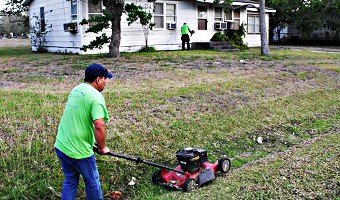
Pastor James Anaya of Bethel Baptist Church in Ingleside mows the lawn for a neighbor. For one month, he and members of the church spent their Saturdays working on chores people had been doing on Sunday and inviting their neighbors to use their newfound free time to attend church. (PHOTO/Courtesy of Bethel Baptist Church in Ingleside)

“We recognize our churches are empty on Sunday,” Anaya said. “But you can drive through any community on Sunday morning and see people washing their cars, cutting their lawns. If we can help them, maybe they won’t have anything to do on Sunday and will come to church.

“If there was someone outside mowing their grass or washing the car, we would stop and help them.”

After members finished with a service project, they distributed information about the church and invited people to worship the next day. If people weren’t interested in attending Bethel, members volunteered to help people find a church that might be more attractive to them. Bethel members wanted to introduce Christ to their community, no matter what church residents ultimately chose to attend.

“The project was about reaching out to people who had not heard the gospel or did not have a church home,” Anaya said.

The church’s ministry focus called Our Mission Now is part of the congregation’s participation in Texas Hope 2010, a Baptist General Convention of Texas initiative to share the hope of Christ with every Texan by Easter 2010. Bethel will continue with ministry projects throughout the Texas Hope 2010 emphasis.

The church’s efforts were partially supported by a BGCT LifeCall Missions grant that is made possible by gifts to the Mary Hill Davis Offering for Texas Missions.

While some of the people the church has helped already have come to Sunday services, Anaya believes the church only is beginning to see the fruit of its labor. The service projects provided an opening for church members to build relationships with their neighbors. Through those friendships, they can pray for their community, care for those around them and share the gospel.

“Church is not just about showing up for church on Sunday,” Anaya said. “It’s about giving back.”

For more information on Texas Hope 2010, www.texashope2010.com.


Jimmy Carter says Palestinians in Gaza treated ‘like animals’

ATLANTA (ABP) — Former President Jimmy Carter is calling Israel's 2-year-old blockade of Gaza an atrocity and saying people there are being treated like animals.

"Tragically, the international community largely ignores the cries for help, while the citizens of Gaza are being treated more like animals than human beings," Carter said in a June 16 speech in Gaza.

Former President Jimmy Carter greets Noam Shalit, father of Israeli soldier Gilad Shalit, held captive for almost three years in Gaza by Hamas. (Carter Center/D. Hakes)

Carter's remarks came during visits to Syria, Israel, the West Bank and Gaza following the Carter Center's observation of Lebanese elections June 7.

Speaking earlier at Cairo University, Carter said Palestinians in Gaza are being "starved to death" and are receiving fewer calories per day than people living in the poorest parts of Africa.

"It's an atrocity what is being perpetrated as punishment on the people in Gaza," Carter said, quoted in the Israeli newspaper Haaretz. "It's a crime…. "I think it is an abomination that this continues to go on."

Israel imposed the blockade two years ago when Hamas, an Islamist party that supports attacks on Israel, gained control over Gaza's government. Fatah, the more moderate of the two main Palestinian parties, retained control of the West Bank territories.

Israel says its aim is to weaken Hamas, but critics say the blockade punishes Gaza's civilians and increases anger toward Israel.

The United Nations said that, months after the end of hostilities, Israeli officials still are allowing nothing more than basic needs like food and medicine into Gaza.

Carter said he saw with his own eyes when a group of Israelis and Americans were stopped while trying to cross into Gaza with children's toys and playground equipment. He said it is his understanding that even crayons and paper are treated as "security hazards" and not allowed to enter Gaza.

Carter called the blockade of Gaza a "siege" and the "starving of 1 1/2 million people of the necessities of life."

"Never before in history has a large community been savaged by bombs and missiles and then deprived of the means to repair itself," Carter said.

Carter is convener of a movement called the New Baptist Covenant launched in 2008 to unify Baptists in North America around common concerns like justice for the poor. In May Carter invited religious leaders to a two-day summit at the Carter Center discussing a "growing sense of despair" in the Holy Land.

However, many strong supporters of Israel — including many conservatives in the United States — have been highly critical of Carter. He came under intense criticism from many Israel backers for his 2007 book, Palestine: Peace Not Apartheid, for comparing Israel's treatment of Palestinians living within its borders to the South African regime that kept that nation racially segregated until the 1980s.

Recently religious leaders, including several Baptists, signed a letter to President Obama warning that continuing strife threatened to wipe out a dwindling Palestinian Christian population in the land of Jesus' birth.

In his speech in Gaza Carter, who brokered the historic 1979 peace treaty between Israel and Egypt, applauded President Obama's commitment to resume talks toward achieving a two-state solution to the Palestinian-Israeli conflict.

"Jerusalem must be shared with everyone who loves it — Christians, Jews, and Muslims," Carter said.

Under pressure from the United States, Israeli Prime Minister Benjamin Netanyahu said for the first time June 14 that he supports a Palestinian state, but he insisted that it be demilitarized, that Jerusalem remain the undivided capital of Israel and that Palestinians must recognize Israel "as the nation of the Jewish people."


–Bob Allen is senior writer for Associated Baptist Press.


Religious leaders call for inquiry into U.S. use of torture

WASHINGTON (ABP) — A group of high-profile religious leaders from various faiths is pushing President Obama to establish a commission of inquiry to investigate alleged United States-sanctioned use of torture since 9/11.

Thirty-three religious leaders met with administration officials after gathering in front of the White House June 11. They presented a letter signed by 50 individuals representing Christian, Jewish, Islamic and Sikh organizations urging the president to establish an independent, non-partisan commission to "uncover the whole truth" about U.S. torture policies and practices.

Lavona Grow holds a protest sign during the National Religious Campaign Against Torture rally outside the White House. (RNS PHOTO/David Jolkovski)

One of Obama's first acts in office was an executive order banning torture in interrogation of suspected terrorists. The president has said he believes use of torture is wrong, but he opposes a special inquiry, believing it would be perceived as retribution against his predecessor that would become a distraction from his policy agenda.

The religious leaders contended that existing institutions are inadequate to guarantee the abolishment of torture, and that an independent commission would be more credible and thorough in establishing safeguards to prevent future twisting or ignoring laws against torture.

"The reality is that our nation is now shackled to a shameful history of torture," the letter said. "As people of faith we know that only the truth can set us free."

"We must therefore, as a nation, be mature and honest enough to examine fully and disclose completely the wrong doing that has been committed," the leaders wrote. "The transparency and openness of a Commission of Inquiry will help to hold us all accountable for the policies and acts of torture carried out in our name. Accountability is essential in a nation of laws."

One of the signers of the letter, David Gushee, president of Evangelicals for Human Rights, wrote an Associated Baptist Press column in March arguing for a "Truth Commission" on the issue of torture. He said it is needed "because we need to know exactly what happened."

"It has been very difficult to have an honest public debate about exactly what our nation has done to those in our custody because we have never been given full information," Gushee, a professor of Christian ethics at Mercer University, said. "We have half-debated what has been only half-revealed. We need to bring what has been done in the shadows into the full light of day, and see how it looks when exposed to that cleansing sunlight."

From a Christian moral perspective, Gushee said, an investigation could move the nation closer to reconciliation.

"Biblically, reconciliation generally involves truth-telling, repentance and forgiveness," he wrote. "Unpacked a bit further, reconciliation includes the wrongdoer's acknowledgment of responsibility, confession of the act as sin, expression of grief for any harm done, serious commitment to a new course of action and request for forgiveness. It sometimes also involves some concrete form of recompense offered to the one harmed by the one who did the harm."

"Once our nation's acts have been exposed to the clear light of day and we see that the facts merit repentance, I dream that we would demonstrate the moral courage to acknowledge responsibility for wrong acts, confess them as sin, express real grief for the harms done, commit ourselves to a new course of action (and solidify that commitment in concrete legislation and executive policies), offer recompense to those whom we have harmed where that is appropriate and ask our victims for forgiveness," he wrote.

In their June 11 letter, faith leaders quoted from Isaiah 11:2, pledging to pray for the president to receive "the spirit of wisdom and understanding, the spirit of counsel and might, the spirit of knowledge and the fear of God."


–Bob Allen is senior writer for Associated Baptist Press.


Christian leaders push president to reform immigration law

Samuel Rodriguez, Noel Castellanos, Vashti McKenzie and Jim Wallis of the group Christians for Comprehensive Immigration Reform said immigration reform must have the same high-level priority as the government’s focus on banks, auto companies and healthcare.

“Whether we came to this country by choice, by chance, by capture, we have to proceed. This is the urgency of the now,” said McKenzie, a bishop in the African Methodist Episcopal Church.

Wallis, Castellanos and McKenzie all hold seats on the White House’s faith advisory council. Rodriguez is president of the National Hispanic Christian Leadership Conference.

Christians for Comprehensive Immigration Reform released a statement asking the president to back legislation that would reduce waiting times for immigrants separated from their families; to provide a process for foreign-born workers and their families already in the U.S. to earn citizenship; to expand legal avenues for workers and families to enter the U.S.; and to examine solutions to the root causes of migration.
Wallis, founder of the progressive evangelical group Sojourners, said immigration enforcement must comply with humanitarian values.

“Those principles will guide the process,” he said.

Wallis added he supports safe sanctuary of immigrants who use houses of worship as asylum from deportation, saying “the church has a history of not waiting for legislation.”

Castellanos, CEO of the Christian Community Development Association agreed: “Christians are going to do whatever it takes to help their neighbor. I think it pushes us to look at what our national laws are.”


At 400 years, theological distinctions define, divide Baptists

ARLINGTON—Some of the same theological disputes that divided Baptists throughout their first 400 years continue to distinguish different branches of the Baptist family tree in the early years of the 21st century, theologian James Leo Garrett said.

And other challenges—ranging from the popularity of dispensationalist doctrine regarding the End Times to a fuzzy understanding of the Trinity—likely will confront Baptists in the near future, he predicted.

“It is of paramount importance in the 21st century that Baptists think theologically as Baptists and in reference to the Baptist heritage,” he insisted.

resolution
Read the resolution on Baptists' 400th anniversary by the BGCT's Baptist Distinctives Council.

See more resources on Baptist History.


Garrett, distinguished professor of theology emeritus at Southwestern Baptist Theological Seminary in Fort Worth and author of Baptist Theology: A Four-Century Study, addressed the B.H. Carroll Theological Institute summer colloquy in Arlington.

In the 17th and 18th centuries, theological questions regarding salvation— specifically election and free will—differentiated distinct brands of Baptists, Garrett asserted. Calvinist Particular Baptists stressed God’s sovereign role in the salvation of the elect, and Arminian General Baptists emphasized the ability of humans to respond freely to God’s grace.

In the 19th and 20th centuries, Baptists divided along liberal and evangelical lines, he added. Doctrinal issues focused on Christ’s divine/human nature, revelation and the Bible, human origins and beliefs related to the Second Coming of Christ.

“Liberal theology, for Baptist and other Protestants, developed in response to the new theological climate—biblical criticism, Darwinian evolution and the Industrial Revolution,” Garrett observed. “Whereas liberals embraced the new climate, evangelicals or conservatives did not.”

Past disputes continue to gain new currency—at least in some Baptist circles, he noted.

“Now in the last quarter-century among Southern Baptists have arisen a neo-Calvinist movement, a neo-Fundamentalist movement and a moderate movement that does not know whether it is left-wing conservative or right-wing liberal,” he quipped.

Looking ahead, Garrett predicted issues surrounding salvation, biblical authority, the doctrine of Christ and human origins likely will resurface among Baptists.

Garrett also identified four theological trends that ran parallel to the Calvinist/Arminian and liberal/evangelical disputes:

Defending distinctives. Early on, Baptists emphasized the beliefs and practices that set them apart from other Christians—particularly believer’s baptism by immersion. Later, between 1850 and the early 1950s, Baptists published reams of literature dealing with “Baptist distinctives.” Many of the individual principles and practices were not unique to Baptists, but the way Baptists combined them made them distinctive.

“One may ask whether the demise of this literature during the last 60 years has been a major factor in the failure of Baptist churches in the United States to teach their members about the Baptist heritage,” Garrett noted.

Facing the future, he observed, “Although some of the Baptist distinctives will continue to be strictly less distinctive of Baptists as other Christian denominations and nondenominational indigenous movements embrace some of them, Baptists may continue to be less than effective in teaching and fleshing out these distinctives amid their own people.”

BaptismAffirming shared beliefs. Baptists have continued to hold basic doctrines shared by all orthodox Christians—particularly other Protestants. The earliest confessions of both the General Baptists and Particular Baptists demonstrated obvious kinship with the Reformed Westminster Confession, Garrett noted.

“Baptists have shared with the heirs of the magisterial Reformation such beliefs as the authority of Scripture over tradition, justification by grace through faith, the priesthood of all believers, predestination, church discipline and either Zwinglian or Calvinist understandings of the Lord’s Supper,” he said.

Garrett predicted Baptists may continue to rediscover their debt both to the early church fathers and to the magisterial Reformers such as Martin Luther, John Calvin and Ulrich Zwingli.

Responding to ecumenism. Baptists differed in their response to the 20th century ecumenical movement. British Baptists, Northern Baptists and most African-American Baptists responded positively to transdenominational church unions such as the World Council of Churches. Southern Baptists and Latin American Baptists—among others—did not, “expressing fear of one world church,” he said.

“Perhaps the question of interdenominational Christian unity will be answered in rather different ways in the 21st century than in the 20th,” he suggested.

Developing a theology of missions. Among Baptists, missiology has interacted with theology as far back as William Carey in the 1790s. Baptist theologians have begun to include chapters on missions in their systematic theology books, and books about the study of missions have included significant theological components.

In recent years, Baptist theology increasingly has grown more contextualized to specific settings—particularly in Latin America, Africa and parts of Asia.

“It is very probable that the interaction of missiology and theology among Baptists will markedly increase,” Garrett predicted.

Looking ahead, Garrett identified seven issues Baptists probably will confront in the near future:

Dispensationalism. This theological system typically divides history into seven distinct periods and asserts God related to humanity in different ways during those “dispensations.” It stresses the role of Israel, views the church age as a parenthesis in God’s redemptive plan and looks forward to the Rapture of the saints and the seven-year Great Tribulation prior to Christ’s Second Coming, followed by a literal 1,000-year reign of Christ on earth.

Dispensationalism gained currency among Baptists in the South first through the influence of Landmark Baptist James R. Graves and later through the publication of the Scofield Reference Bible. In recent years, it was popularized in the Left Behind series of novels.

“I have proposed that we should reckon it one of the incursions into Baptist theology,” Garrett said.

“Although one cannot with certainty posit any cause-effect relationship, it is noteworthy that the era of dispensationalism’s greatest influence on Southern Baptists—that is, the turn of the 21st century—was concurrently the time of the greatest restriction of missionary methods in the history of the International Mission Board.”

A common way of interpreting Scripture. “Can Baptists in various conventions and unions find a common biblical hermeneutic, especially in reference to contemporary social and moral issues?” Garrett asked. He pointed particularly to “issues such as homosexuality, abortion, pornography and cohabitation.”

Deficient doctrine of the Trinity. In their formal confessions of faith, Baptists have affirmed orthodox Christian teachings about the Trinity. But it’s hard to tell from their songs, sermons and Sunday school lessons.

“For many Southern Baptists in the latter 20th century and even to the present, the Trinity has been a doctrine, the denial of which could evoke charges of heresy, but the affirmation of which through preaching, teaching, worship, hymnody, praise songs and piety was woefully deficient,” Garrett said.

baptism kids

Destiny of the unevangelized. Garrett delineated three historic Christian positions on the eternal fate of people who never hear the gospel. Pluralism teaches human beings can be made right with God through various non-Christian religions, as well as through faith in Christ.

Inclusivism teaches salvation comes only through Christ, but it can occur without explicit knowledge of Jesus or individual confession of faith in him.

Exclusivism teaches salvation depends on at least a minimal knowledge of the gospel and individual profession of faith in Jesus Christ as Lord and Savior.

Few Baptists have endorsed pluralism, Garrett said, but Baptist theologians have been divided into camps espousing either inclusivism or exclusivism.

“Clear evangelistic and missionary strategy would seem to call for a clear theological answer to this question,” he said.

Ruling elders and congregational polity. “Perhaps as a consequence of the neo-Calvinism among Southern Baptists or the influence of Dallas Theological Seminary, not a few Southern Baptist churches have adopted ruling elders—sometimes so as to produce major division in the congregation,” Garrett observed.

This has set off conflict between longtime traditional Baptists committed to congregational polity and new Christians or members who have joined a Baptist church from another denomination who are amenable to elder-rule.

While some argue elders essentially serve the same role as church staff, “the critical issue is whether the elders alone make decisions, which, according to congregational polity, are normally to be made by the congregation. … Few seem to realize that this is one of the marks that historically differentiated Baptists from Presbyterians.”

Believer’s baptism by immersion. From their earliest days, Baptists have included proponents of closed communion who allowed only baptized believers—perhaps only from a specific congregation—to take the Lord’s Supper and advocates of open communion, who allowed all professing Christians to join in communion.

Open membership, on the other hand, is strictly a modern development, with its greatest strength in England.

“This is the practice whereby a Baptist church does not require that all its members be baptized on confession of faith by immersion,” he explained.

“Hence, in the membership, may be persons having been baptized as infants or by sprinkling or pouring or having had no baptism at all. … With open membership, there seems to be little rationale for a continuing Baptist denomination.”

At the same time, some British Baptist theologians have begun to favor the term “sacraments” rather than “ordinances” to describe baptism and the Lord’s Supper.

“Moreover, baptism is said to be ‘more than symbol’ in the sense that divine agency and divine grace are involved in Christian baptism, not merely the confession of the faith of the candidate, and conversion is reckoned as incomplete without baptism,” he said.

Doctrinal unity. Throughout their history, Baptists have divided over theological differences, and some Baptist groups have sprung up independently of others, Garrett noted.

“Even so, Baptists must know the Pauline teaching about Christian unity and how Jesus, according to John 17, prayed for the unity of his disciples,” he said.

“Baptists once again have the challenge of repairing or mending their broken unity without forsaking the gospel or losing essential Christian truth.”


TBM provides pure water, living water in Zimbabwe

ZIMBABWE—Texas Baptist Men disaster relief workers Dick Talley and Ron Mathis spent two weeks in Zimbabwe distributing 1,000 water filters in hope of sharing both clean water and “the living water.”

Rural villagers in Zimbabwe haul water great distances, because potable water is in short supply. Texas Baptist Men workers traveled to Zimbabwe to enable Baptists in that southern African nation to share both pure water and living water with their fellow countrymen. (PHOTO/Courtesy of Dick Talley/TBM)

“We know that we cannot take care of the whole country,” said Talley, TBM state disaster relief director. “There are 56 churches there that are a part of the Zimbabwe Baptist Union, and they are partnered with the (neighboring) South African Baptist Union, and (they) invited us to come over and help.”

With the help of funds from the Baptist General Convention of Texas, Texas Baptist Men donated barrel systems, ceramic drip filters, food and medicine to Zimbabwe Baptist churches.

“It’s an excellent tool for evangelism,” Talley said. “It’s our mission to equip churches around the world to meet the need for clean water and to share the gospel.”

The trip was a follow-up to the volunteers’ last mission to Zimbabwe in 2000, when the men first discovered their call to help meet the country’s need for clean water.

“We could have just shipped the filters over there,” Talley said, “But we wanted to stand behind them and to show we care … . Validating the work that people do does much more than we can ever imagine.”

Relentless rain continues to devastate Zimbabwe, contaminating the majority of its water supply. Due to the faulty infrastructure and a failing economy, cholera has spread from Harare, the capital, across the entire country.

“The city’s whole sewer system was over-burdened until the point that it broke, so you see open sewer systems flowing into gardens and trash that is not being picked up,” Talley said. “The people started getting sick because they were exposed to human waste. Because Harare is the central hub of Zimbabwe, people would come into contact with cholera and take the disease back to their village.”

Nearly 10 years ago, Texas Baptist Men, in partnership with a North Carolina disaster relief group, built two water filter systems for rural villages as distribution centers for mass populations. Airlines estimated the cost to fly the units to Mozambique would be $10,000, but Talley said he thought the volunteers could go to southern Africa and build them there for less.

“We flew into Johannesburg and bought kitchen equipment and food, built the units and transported them all for under $7,000,” Talley said.

“One filter was helicopter-dropped in, while the other was taken by trucks … to Harare.”

TBM’s goal is to educate and facilitate in God’s name.

“By equipping leaders, the (people) are going to see that the local church is there to help them, not just TBM,” Talley said. “This allows churches to help their own people.”

Ron Mathis, a Texas Baptist Men disaster relief volunteer, demonstrates the use of a water filter to a pastor from Mozambique who was visiting in Zimbabwe. (PHOTO/Courtesy of Dick Talley/TBM)

In spite of the language barrier, Talley and Mathis were able to train leaders in Africa how to use the equipment.

“I don’t speak Portuguese and they don’t speak English, but through an interpreter, I trained the director of the water department, and she then trained her men who ran the water purifiers,” Talley said:

“When we teach here in the United States, it’s an ordeal. It takes awhile to train our people, so it was a God thing that despite the language barrier, it only took one training for them to get it.”

TBM’s work in Zimbabwe is not done. The partnerships need nearly $10,000 to finish buying barrels and buckets for the remaining Baptist churches.

“We’ve already set up people to do the job,” Talley said. “ They just need the funds to complete it.”

During his recent trip, Talley discovered the water filters built in 2000 still were being used, and the people had built seven more. Mathis believes those units, along with the 1,000 filters they just delivered, have given the churches the “correct tools” to take care of at least 100,000 people.

“When you invest in water purification, it is not a one-time (gift); it keeps giving year after year,” Talley said. “We didn’t just give them clean water to drink; we taught them how to make clean water for themselves. And that was more beneficial.”

This distribution project was a part of TBM’s water ministry that began in 1994 as a way to bring potable water to areas devastated by natural disasters or poverty.

“We are helping the people as Jesus commands us to do, and at the same time, we have the opportunity to build a relationship and introduce them to Jesus,” said Mathis, a layman from Prestonwood Baptist Church in Plano.

“When Jesus walked into a village, he took care of their health needs first, and then their spiritual needs. That’s what we want to do. The work in Zimbabwe is a perfect example of what the water ministry is all about.”