Around the State: HSU’s School of Nursing approved unanimously
July 24, 2024
Hardin-Simmons University is thrilled to announce the Texas Board of Nursing has approved unanimously HSU’s School of Nursing. This milestone is a testament to the dedication of Sandra Welling, founding director, and the collaborative efforts of campus and community partners. Classes will begin at the start of the spring 2025 semester.
Stark College & Seminary is excited to announce the launch of its new Accelerated Bachelor of Arts in Ministry + Master of Divinity Program. This innovative program offers exceptional students the opportunity to earn both degrees in a reduced timeframe, minimizing duration and financial investment while preparing them for careers in ministry. Students in the program complete 96 undergraduate credits in their first three years, followed by 24 graduate-level credits in their final undergraduate year. After earning their B.A. degree, students finish the remaining 49 credit hours of the MDiv program. This structure allows for a smooth transition from undergraduate to graduate studies while offering significant time and cost savings. Graduates of the program will be prepared for various ministerial and nonprofit roles.
Summer and Young Scholars participants. (HPU Photo)
Howard Payne University recently hosted Summer and Young Scholars programs for children entering grades K-6. This year’s theme was “Nature Explorers.” The students engaged in a rotation of classes ranging from art to ecology. Julie Welker, professor of communication and department chair, expressed her appreciation for everyone involved in making this year’s Summer and Young Scholars a success. Guest speakers included Cameron Martin, wildlife biologist for Muse Wildlife Management Area with the Texas Parks and Wildlife Department, and Braston Gray with Andy’s Pest Troopers. Martin presented the Texas Parks and Wildlife “Skins and Skulls” program, and Gray shared a reptile program.
Buckner International promoted Jeff Gentry to executive vice president and chief operating officer and Jan Cothranto vice president and chief financial officer, the role Gentry served in the previous seven years. Both appointments are effective immediately. In his new position, Gentry will oversee operational, financial and shared services functions across Buckner. In addition to Gentry’s current direct reports, he also will supervise Henry Jackson, president of Buckner Children and Family Services; Charlie Wilson, president of Buckner Retirement Services; and Kandyce Ormes-Ripley, associate vice president of Data Analysis and Strategy. “While I’m obviously honored to serve as executive vice president and COO for Buckner, I’m more excited about the opportunity for Jan to move into the position of CFO,” Gentry said. “I know our ministry will benefit from her expanded role and continued excellence.”
Jeffress pledges to rebuild historic sanctuary after fire
July 24, 2024
DALLAS (RNS)—After the fire that all but destroyed the historic chapel at First Baptist Dallas on July 19, senior pastor Robert Jeffress promised congregants the church will rebuild.
“It’s not the building, it’s what that building represents. It represented the bedrock foundation of God’s word that never changes,” said the megachurch’s leader since 2007 at the Kay Bailey Hutchison Convention Center at First Baptist’s Sunday service.
While the fire did not damage the church’s primary modern worship space, the six blocks of the campus remained blocked Sunday morning for first responders. Executive Pastor Ben Lovvorn said Tuesday the church campus will remain closed all week, but teams are currently “making great, great progress” to reopen the worship space for services on Sunday. The cause of the blaze has not yet been determined.
The damage to the historic sanctuary is extensive with a collapsed roof. The church still awaits repair estimates and expects insurance to cover the expense. Jeffress pledged to “rebuild and re-create that sanctuary as a standing symbol of truth.”
The commitment to rebuilding is no surprise. The 134-year-old two-story red brick Victorian chapel symbolizes the church’s relationship with the city and has become a point of pride for congregants and preservationists alike. Jeffress’ commitment echoes previous leaders who have helped the church grow into one of the largest Southern Baptist churches in the country, now boasting 16,000 members.
FBC Dallas history
The church was founded in 1868. Its 11 members initially worshipped in a nearby Mason Hall. According to the state historic marker at the site, an aggressive fundraising campaign “financed by weaving rugs, making hominy, preserves, and cheese to sell at fairs” eventually led them to build a one-room frame structure.
The current chapel opened in 1890 on the same site. It was designed by Albert Ullrich, a Presbyterian architect who lived in Dallas before moving to New York. It was a notable presence in the growing downtown, along with the red brick county courthouse, which opened in 1892. Eventually the chapel expanded to seat up to 3,000 people.
Dallas, like many cities in the mid-20th century, preferred tearing down older buildings to preserving them. But longtime pastors preceding Jeffress, George W. Truett and W.A. Criswell, who each served for 47 years, knew they could expand their downtown footprint while preserving the chapel.
“There is a great work for our church yet to do. Every city needs a strong downtown church to keep the community church-minded. With the future growth of Dallas clearly assured, our church must meet the great challenge and carry on a large ministry to the people, in the name of the Lord Jesus Christ, our divine head.”
Criswell, one of the architects of the Conservative Resurgence within the Southern Baptist Convention, oversaw the church’s massive downtown expansion, now spanning six blocks.
“We are downtown because we choose to be downtown,” said Criswell, a two-time president of the SBC.
Under Criswell’s leadership, the church became one of the largest landowners downtown. While expanding its reach, Criswell orchestrated an ambitious and controversial plan for the denomination as leader of the Conservative Resurgence. He also led an expansion of ministries throughout the region.
Present ministry
A second, glass sanctuary and corporate-style campus opened in 2013. Its $135 million fundraising drive under Jeffress was the largest campaign in Protestant history.
Jeffress is, like his predecessors, an ambitious, controversial pastor and political leader. He is a spiritual adviser to former President Donald Trump and appears regularly on conservative talk shows.
Throughout the years Presidents Woodrow Wilson, Gerald Ford, George H.W. Bush and Trump have visited the church. Gov. Greg Abbott spoke at the church in 2018 during a 150th anniversary celebration.
When talking about the chapel and the church’s decision to stay downtown, Jeffress told The Dallas Morning Newsin 2013 that staying downtown was part of its identity and ministry. This commitment is why, unlike other megachurches, it did not move to the suburbs.
“I believe the downtown area will be a source of ministry,” Jeffress said. “We want to attract the growing number of people living in both Uptown and downtown. But we will continue to draw people from the entire region.”
At Sunday’s service, Jeffress said architects told him any new modern facility “would be an architectural monstrosity.”
Mark Lamster, the News’ architecture critic, agreed. He described the Beck Group’s expansion in 2013 as “more befitting of a commercial office building than a center for divine transcendence.”
But on Sunday, Jeffress defended it. “It was a theological necessity because we were painting a picture to people throughout the community and world that, yes, methods change for sharing the gospel, media changes, but the message never changes. The message remains the same,” he said.
“And having that old Victorian style building right next to a building filled with glass and all the modern technologies is a reminder, was a constant reminder, that the truth of God’s word never, never changes.”
Kamala Harris’ pastor known for civil rights, reparations activism
July 24, 2024
(RNS)—The Rev. Amos Brown, a longtime pastor of Third Baptist Church of San Francisco, was specific when he described Vice President Kamala Harris’ connection to his church.
“She’s an old-timer” at the church, he told Religion News Service in an interview on July 22.
In fact, as he told RNS in 2023, she’s also “a dues-paying member, too.” That might help explain why, when Harris met with Christian, Jewish, Muslim and Sikh leaders in Los Angeles the previous year to discuss abortion rights and other issues, Brown was in attendance.
Or why, when she spoke of him that same year, she praised “my pastor” as a man who also long has been her mentor.
“For two decades now, at least, I have turned to you,” Harris said in remarks at the 2022 Annual Session of the National Baptist Convention, USA. “I have turned to him. And I will say that your wisdom has really guided me and grounded me during some of the most difficult times. And—and you have been a source of inspiration to me always. So, thank you, Rev. Brown, for being all that you are.”
And the long-standing connection between the two might be why Harris turned to Brown again this week, reaching out to him over the phone after President Joe Biden abandoned his reelection bid and endorsed the vice president. She asked for prayer, and Brown happily obliged.
Prayers for Harris
Brown and his wife prayed that Harris “would receive the thing that Micah 6:8 records in the Bible, the fulfillment of what the Lord requires: to do justice, love mercy and walk humbly with her God,” Brown told RNS.
He also prayed Harris would move forward in her campaign “in the spirit of our ancestors.” Brown recited lines from “Lift Every Voice and Sing,” a hymn sometimes referred to as the “Black national anthem:”
“God of our weary years, God of our silent years,
Thou who hast brought us thus far on the way;
Thou who hast by Thy might, Led us into the light,
Keep us forever in the path, we pray.”
Screen shot of Kamala Harris being sworn in as vice president of the United States Jan. 20, 2021.
“That’s what this nation needs,” Brown said, later noting he endorses Harris for president in his personal capacity.
“That’s what this vice president and, hopefully, president, will be elevated to be: To bring this nation out of darkness. The darkness of incivility. The darkness of lying. The darkness of injustice. The darkness of irresponsible behavior—and that goes at all levels, from the local community up to the national government.”
Brown, 83, explained he and Harris also have a shared political history. Harris served as Brown’s campaign manager when he ran for reelection to the San Francisco Board of Supervisors in 1999, and Brown joined his wife in praying over Harris and her husband, Doug Emhoff, immediately before the 2021 inauguration ceremony.
“She was very close to our church family,” Brown said.
History of activism
Brown’s history with Harris extends to her family as well. A Jackson, Miss., native and civil rights activist who was taught by the Rev. Martin Luther King Jr. in a class at Morehouse College in the 1960s, Brown mentioned meeting Harris’ mother, Shyamala Gopalan, along with others who participated in civil rights activism.
He formerly was a leader of Baptist churches in West Chester, Pa., and St. Paul, Minn., and has pastored Third Baptist Church in San Francisco since 1976.
His church, which has been affiliated with the National Baptist Convention, U.S.A., and the American Baptist Churches USA, was the site of a 2023 meeting of California’s Task Force to Study and Develop Reparation Proposals for African Americans shortly before it released its final report.
“Harm has been done to Black folks by this nation,” Brown, the vice chair of the task force, told RNS at the time. “And it’s time for us to respond and not react but respond in a responsible, rational, realistic way that will give us results to bring Black folks from the bottom of the well economically, academically, healthwise.”
The Associated Press/Report for America reported in May the California Senate had sent reparations proposals to the state Assembly, including a measure that would help Black families confirm they were eligible for future state restitution.
Speaking to RNS this week, Brown attributed Third Baptist’s longevity—it was founded in 1852—to its long history of social justice advocacy, or, as he put it, “the fact that we’ve always been focused on the liberating gospel of Jesus Christ of Nazareth, and we have not focused on personalities.”
He added: “That’s why Vice President Harris, early on in her academic and political careers, connected with this church.”
Political activism
At the height of the COVID-19 pandemic, Brown was an opponent of churches reopening too soon.
“We are not going to be rushing back to church,” he said in a phone interview with the AP, noting many denominational leaders had died or been sickened. Freedom of religion is “not the freedom to kill folks, not the freedom to put people in harm’s way. That’s insane,” he said.
In 2020, Brown was among a list of 350 faith leaders who endorsed the Biden/Harris campaign.
Early in the Trump administration, Brown supported Black clergy who declared themselves independent of both the “liberal left” and the “religious right.” He advocated for get-out-the-vote efforts ahead of the next elections when he spoke during a 2018 news conference.
“We’ve got to really vote like hell in this midterm election and in 2020 and get rid of this excuse ‘my one vote won’t count,’” Brown said.
“Every vote counts. We’ve got to get that over to our congregations.”
This week, however, Brown appeared to lob thinly veiled criticism at former President Donald Trump, the 2024 Republican nominee.
Referring to how versions of Christianity’s “golden rule” can be found in multiple religions, Brown asked how someone could refer to immigrants as “evil, cruel” or “rapists”—a reference to descriptions Trump has used.
“Why would you do that to other people?” Brown said.
Community involvement
Earlier in his tenure at Third Baptist, the church created a summer school program, a music academy and an after-school enrichment program with a local synagogue.
Beyond his church, Brown has been involved in national and global events, including the 2001 United Nations Conference on Race and Intolerance in Durban, South Africa, where he represented the NAACP’s national board.
Brown told the San Francisco Chronicle he learned from King, “sitting at his feet at Morehouse,” about “personalism:”
“Every person should be viewed as having dignity regardless of how different they may be. We should respect them.”
Interfaith efforts
In what might seem to be unusual pairings, Brown has joined forces with people outside Black Baptist circles for collaborations.
In 2014, Brown and evangelist Franklin Graham wrote a joint anti-violence opinion column in USA Today in the wake of the police killings of Michael Brown in Ferguson, Mo., and Eric Garner in Staten Island, N.Y.
“None of us is always right—and none is always wrong,” they wrote.
“We believe we could all use a good dose of humility—we must avoid arrogance, even in our convictions.”
Brown, the president of the San Francisco branch of the NAACP, appeared at a news conference marking the 2022 rededication of the Washington, D.C., temple of The Church of Jesus Christ of Latter-day Saints. In 2021, the LDS church and NAACP launched initiatives including scholarships for Black college students. Brown is the namesake of a fellowship that has brought young adults to Ghana with leaders of the NAACP and the LDS church to learn the history of slavery.
“I am humbled by this great example of this faith community uniting in order to heal the breaches in our nation, making bonds and setting the bar higher for us to move away from war, strife, prejudice in a world that so desperately needs people of good will and justice,” Brown said at the news conference.
Brown told the Chronicle in a 2021 interview that the LDS church’s family research enabled him to learn his great-great-grandfather, who was born enslaved, eventually owned 150 acres of land and with two other African American men established a church and a school.
“(I)t’s a blessing to me that even in my genealogical chart there was a meeting of self-determination, of enlightened piety, social justice, and high and noble respect for education,” he told the San Francisco newspaper.
Queen’s attorney petitions for release of materials
July 24, 2024
NEW YORK (BP)—The government press release charging Matt Queen with falsifying records “contained factual allegations that are inaccurate, misrepresented some facts, and cast Mr. Queen in a more negative light,” the pastor and former seminary leader’s attorney said in a letter filed July 22 with the U.S. Southern District Court.
The May 21 press release announcing the charge “went beyond the allegations in the information,” said Sam Schmidt, attorney for Queen, the former Southwestern Baptist Theological Seminary evangelism professor and interim provost.
Material received from the government during discovery since then falls under “Brady material,” or evidence a prosecutor has that is favorable to the accused. A prosecutor is required to disclose such material.
“Counsel should be permitted to correct the inaccurate and misleading public statements made by the government supported by documents,” the letter said.
“As a result of the information and press release, Mr. Queen has been suspended from his position as the Lead Pastor of Friendly Avenue Baptist Church, which he has held since March 1, 2024. His reputation has been damaged, he was required to withdraw at least one contribution to a forthcoming publication, and he has had previously arranged speaking engagements canceled, affecting potential honoraria.”
His counsel said it only seeks “to provide a limited number of documents” to Friendly Avenue’s committee investigating the allegations to determine if Queen can be reinstated as pastor prior to trial. The documented information also would be made available to the press, albeit not to “endanger any person or witness, nor [to impede] any possible investigation.”
Explanation of the meeting
At issue are Queen’s recollections of a meeting about a reported case of abuse involving a seminary student. On Jan. 24, 2023, Southwestern became aware of the police investigation and released a statement.
Schmidt’s letter goes into greater detail on a meeting two days later following chapel services that included Queen, “Employee 1” and “Employee 2” after Employee 1 was contacted by the alleged victim.
“With Employee 2, Mr. Queen met with Employee 1 near the front of the chapel, immediately after the completion of chapel, with people walking by them during the conversation,” the letter said.
“As instructed by the president, Mr. Queen told Employee 1 that if the matter the alleged victim wanted to talk about concerned the alleged sexual abuse, she should tell victim to speak to the Burleson Police Department. If it related to some other unrelated matter concerning the seminary, then Employee 1 should speak to her. If it was about a personal matter, then it was at Employee 1’s discretion whether to speak to her or not.
“After Mr. Queen provided the advice, Employee 1 and Employee 2 discussed the document that Employee 1 had left for Employee 2 the day before. Mr. Queen was present, though his attention was directed to emails in his mobile telephone because the conversation did not involve him.
“In subsequent conversations with many others, including in his interviews with the government, Mr. Queen repeatedly explained that he never heard Employee 2 tell Employee 1 to destroy the document.”
Document in question
The document in question outlined the allegation of abuse. The two employees cited were later identified as Terri Stovall, current dean of women (Employee 1), and Heath Woolman (Employee 2), who served as chief of staff before accepting the lead pastor position at Fruit Cove Baptist Church in St. Johns, Fla.
In interviews with federal investigators, Queen said he did not interpret the conversation as having directed the destruction of the document. His attorney’s letter goes on, however, to say when Stovall—still identified as “Employee 1” in the recently-filed letter—told Queen she had kept contemporaneous notes, Queen falsely responded he had as well.
Later, Queen learned he would have to produce the nonexistent notes to investigators for his upcoming interview. The government’s statement claims, three days after the interview, Queen said he found a notebook in his office of notes from the January meeting and provided that to investigators. Queen would admit in a follow-up meeting he had not written the notes in January but following his initial interview with investigators.
Queen’s frame of mind
His attorney’s letter opens a window into Queen’s frame of mind at that time.
“Having been upset when questioned harshly by the government on May 23, being fearful, being told by one of the seminary’s attorneys to pray and meditate to remember, and believing that the government was correct—as a very religious person he did pray and meditate the night of May 24,” it read.
“Mr. Queen woke up from a dream believing that he remembered more of the conversation, as previously suggested by the government, including Employee 2’s use of the term ‘this needs to go away.’
“On May 25, 2023, Mr. Queen told of his new recollections to the attorney retained by the seminary to represent potential witnesses employed by the seminary, and he was told that this would be reported to the government.
“After being told that the government would want to talk to him again, Mr. Queen shortly thereafter wrote the notes, which accurately reflect his recollections prior to the night of May 24, in his notebook and provided it to both the attorney and Employee 3. On June 1, 2023, the attorney informed the government about Mr. Queen’s new recollections, and we believe he provided them with the notes as well.”
Schmidt’s letter claims some of the information so far withheld includes Brady material, supports Queen’s defense and/or demonstrates the indictment contained “incorrect or misleading statements.”
Chair resigns ERLC board, issues apology
July 24, 2024
WEST PALM BEACH, Fla. (BP)—Southern Baptist pastor Kevin Smith announced Tuesday morning, July 23, he has resigned as chairman and from the board of the Ethics & Religious Liberty Commission. Smith’s resignation comes on the heels of a turbulent 24 hours for the Southern Baptist public policy entity.
The ERLC announced Monday evening, July 22, the board’s executive committee had removed President Brent Leatherwood “in accordance with our bylaws.” However, that decision was rescinded early this morning.
In a statement provided to Baptist Press, Smith said: “After multiple conversations with Executive Committee members of the ERLC, I was convinced in my mind that we had a consensus to remove Brent Leatherwood as the president of the ERLC. It is a delicate matter and, in an effort to deal with it expeditiously, I acted in good faith but without a formal vote of the Executive Committee. This was an error on my part, and I accept full responsibility.”
Smith went on to note: “At this time, the Executive Committee does not wish to move forward with my course of action.”
He confirmed his resignation from the board saying: “I have been a proud participant in Southern Baptist Convention life for 35 years. I love the SBC. I love the ERLC. And I trust the Executive Committee to take the best course of action moving forward. I will look forward to focusing on ministry in my neighborhood church.”
Smith is a pastor at Family Church in West Palm Beach, Fla. He previously served as executive director of the Baptist Convention of Maryland/Delaware and has been on the ERLC board since 2018.
The ERLC trustees are scheduled to meet Sept. 10-11 in Nashville.
Full statement
Smith’s full statement follows:
“It has been my honor to serve as a trustee at the Ethics & Religious Liberty Commission (ERLC) of the Southern Baptist Convention. As to recent events: After multiple conversations with Executive Committee members of the ERLC, I was convinced in my mind that we had a consensus to remove Brent Leatherwood as the president of the ERLC. It is a delicate matter and, in an effort to deal with it expeditiously, I acted in good faith but without a formal vote of the Executive Committee. This was an error on my part, and I accept full responsibility. At this time, the Executive Committee does not wish to move forward with my course of action. Therefore, I am resigning as the Chairman of the ERLC Board of Trustees and as a Trustee. I have been a proud participant in Southern Baptist Convention life for 35 years. I love the SBC. I love the ERLC. And I trust the Executive Committee to take the best course of action moving forward. I will look forward to focusing on ministry in my neighborhood church.”
ERLC reverses course, Brent Leatherwood not fired
July 24, 2024
(RNS)—In a head-scratching turn of events, the executive board of the Southern Baptist Convention’s public policy arm now says its leader has not been fired.
On Monday evening, July 22, the SBC Ethics and Religious Liberty Commission announced Brent Leatherwood, the group’s president, had been fired—a day after he praised President Joe Biden for ending his reelection bid.
Less than 12 hours later, the ERLC’s executive committee issued a new statement on Tuesday, saying Leatherwood would remain in leadership.
“Brent Leatherwood remains the President of the ERLC and has our support moving forward,” the statement read.
The committee also said ERLC board chair Kevin Smith had acted on his own in announcing that Leatherwood was fired. Smith, a former seminary professor and denominational administrator who currently pastors a church in Florida, has resigned as ERLC chair, according to the statement.
“There was not an authorized meeting, vote, or action taken by the Executive Committee,” the executive committee’s statement said.
Smith, who has served on the ERLC board since 2018, was elected chair last fall.
Smith’s error
Smith, pastor of Family Church in West Palm Beach, Fla., did not immediately reply to a request for comment. He told Baptist Press, an official SBC publication, he had spoken with other members of the ERLC executive committee about removing Leatherwood and thought they agreed. He now said he was wrong.
“After multiple conversations with Executive Committee members of the ERLC, I was convinced in my mind that we had a consensus to remove Brent Leatherwood as the president of the ERLC. It is a delicate matter and, in an effort to deal with it expeditiously, I acted in good faith but without a formal vote of the Executive Committee,” he told Baptist Press. “This was an error on my part, and I accept full responsibility.”
The ERLC’s bylaws do allow the executive committee to fire the entity’s leader. The bylaws require 10 days’ notice for special meetings of the board of trustees but do not detail notice requirements for executive committee meetings.
Smith is a former professor at Southern Baptist Theological Seminary in Louisville, Ky., and a former executive director of the Baptist Convention of Maryland/Delaware. Smith told Baptist Press he resigned both as chair and as an ERLC trustee.
ERLC board response
A statement issued by the ERLC board of trustees the evening of July 23, acknowledged the board’s failure “to fulfill [it’s obligation to oversee the ERLC’s ministry assignment] in ways that ensure the stability of this organization.”
The board affirmed its “support for the ERLC staff and their faithfulness in fulfilling their assignment to our churches. This board stands behind the staff and will do everything in its power to ensure that the work of the organization—protecting a culture of life, championing God’s good design for marriage and sexuality, and defending a free church in a free state–continues uninterrupted.”
Referencing “the events of the last 24 hours,” the board stated Smith’s “decision to act” was unilateral and “outside of his authority as board chair.” Furthermore, “the members of the executive board were unaware of the chair’s actions until they received the email” sent by staff.
“While the executive committee recognizes a wide range of opinions on the work of the ERLC, most visible in a recent attempt to abolish the organization at the 2024 SBC annual meeting, the executive committee does not believe that this discontent rises to the level of a dismissible offense,” the statement continued.
The board also defended Leatherwood against accusations of “moral failing,” saying he is found “to be a man of utmost moral and ethical integrity.”
Trustees also wanted to make clear their retraction was “not about responding to pressure from outside organizations. As people who must give an account to God and Southern Baptists for how we have stewarded this commission, we have worked to ensure that every action taken follows the appropriate procedures affirmed by Southern Baptists.”
“Vice chair Tony Beam has assumed the responsibilities of chair of the board. The other members of the executive committee are: Amy Pettway, Anthony Cox, and Nathan Lugbill.
“As a board, our responsibility is to ensure that this commission can execute the task given to it by the messengers of the Southern Baptist Convention. We commit ourselves to that task” and to rebuilding trust in “the executive committee, the trustee board” and the ERLC.
Praise for Leatherwood
Eric Costanzo, pastor of South Tulsa Baptist Church and an ERLC trustee board member, praised Leatherwood after it was announced the ERLC president was not fired.
“Brent deserves countless apologies for this error and all the assumptions that came with it,” Costanzo wrote on X. “He has proven to be a faithful leader and man of integrity time and again.”
The confusion over Leatherwood’s status is the latest crisis for the ERLC—which has been embroiled in seemingly endless controversy since the election of Donald Trump as U.S. president in 2016.
Criticism of ERLC
Several prominent megachurches withheld funding for the group after Leatherwood’s predecessor Russell Moore was critical of Trump, leading to calls for Moore to be fired.
That led to a meeting between Moore and Frank Page, who was then head of the SBC’s Nashville, Tenn.-based Executive Committee, where the two pledged to work together to unite Southern Baptists. Page later resigned in a scandal.
The SBC’s Executive Committee went on to investigate the ERLC in 2020 for allegedly being divisive and causing a shortfall in denominational donations. A 2021 report from the investigation, which was led by Georgia pastor Mike Stone, a fierce critic of Moore, called the ERLC “a significant distraction.”
Moore resigned as ERLC president in May 2021, leaving the commission for a role at evangelical magazine Christianity Today, where he is now editor-in-chief.
Critics such as Florida pastor Tom Ascol, head of a Calvinist group called Founders Ministries, have repeatedly called for the ERLC to be shut down. This summer, Ascol made a motion to that effect at the SBC’s annual meeting. The motion failed.
Criticism of Leatherwood
Leatherwood has been criticized for opposing legislation backed by Ascol and other members of the so-called abortion abolition movement that would have jailed women who have abortions. More recently, Leatherwood criticized the GOP for dropping anti-abortion language from its 2024 platform.
Leatherwood also called for gun law reforms after a shooting in March 2023 at a Nashville Christian school where his children were students.
He did not respond to requests for comment. Leatherwood did post his thanks on social media.
“I deeply appreciate everyone who has reached out, especially our trustees who were absolutely bewildered at what took place yesterday and jumped in to set the record straight,” Leatherwood wrote Tuesday morning on X.
With additional reporting by Baptist Standard Editor Eric Black.
This is a breaking story and will be updated.
In small-town Illinois, a little church says goodbye
July 24, 2024
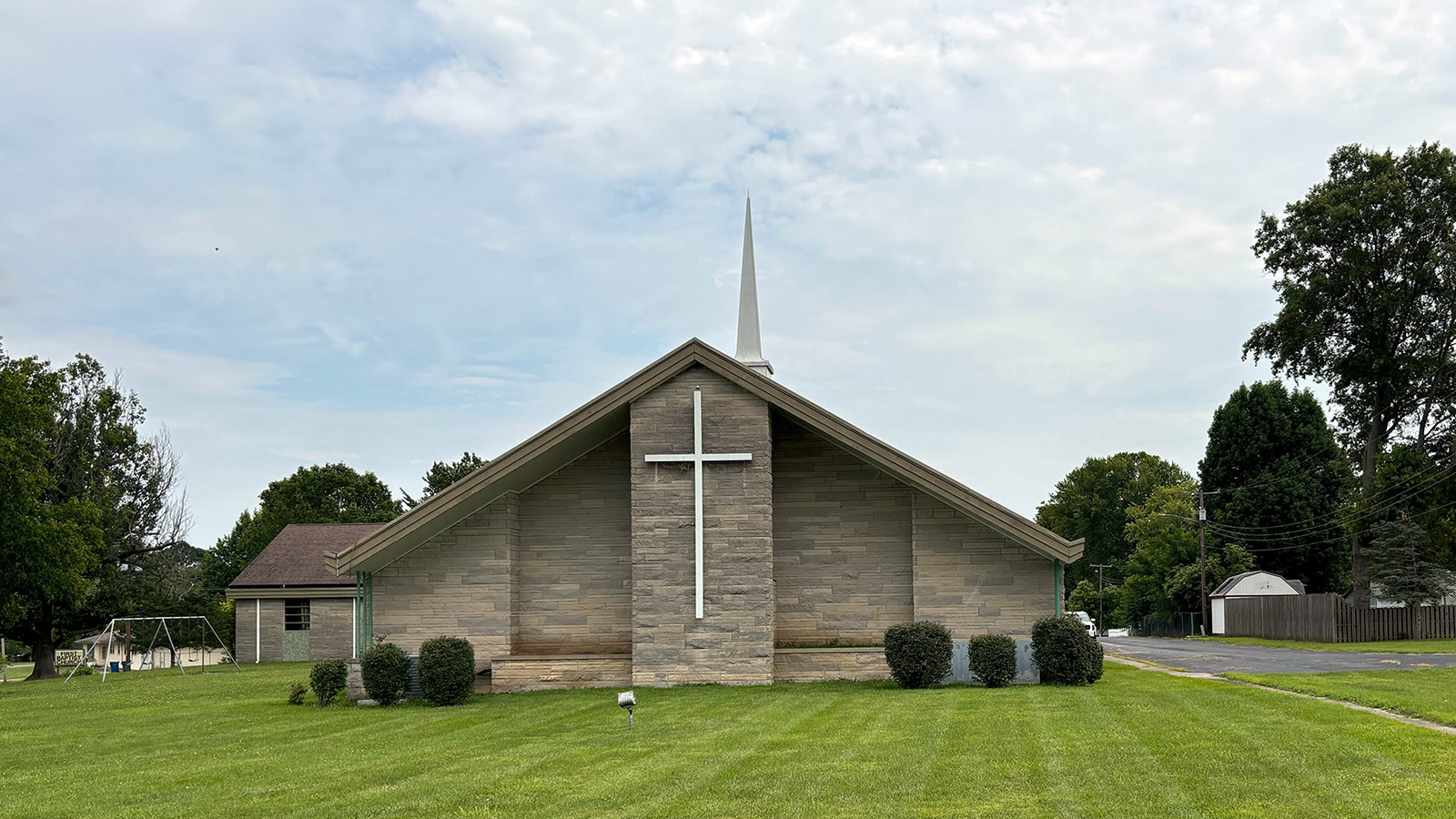
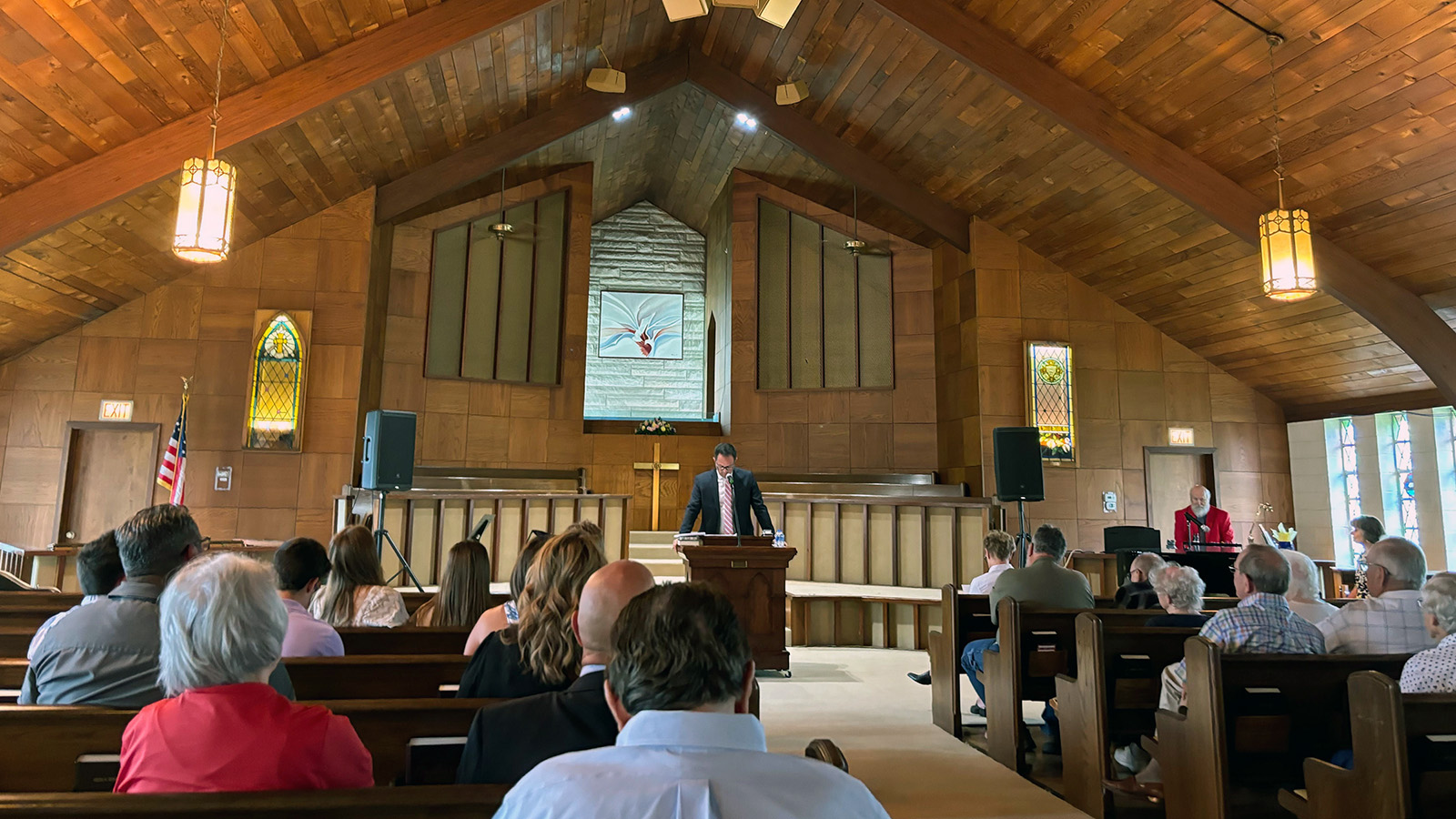
MOUNT VERNON, Ill. (RNS)—First Baptist Church survived a tornado, church schisms and a pair of worldwide pandemics in its more than a century and a half of ministry in this small Southern Illinois town, about an hour east of St. Louis.
For 156 years, church members gathered to sing hymns, study the Bible and lift each other in prayer. They also ate barbecue, laughed, cried, reached out to their neighbors and cared for one another.
But nothing lasts forever.
The building of First Baptist Church in Mount Vernon, Ill., is now owned by Corem Deo Classical School. (RNS photo/Bob Smietana)
“There is a time for everything,” Ryan Burge, pastor of First Baptist, told his congregation on July 21 as they gathered for the church’s final worship service, reading from the book of Ecclesiastes. “A time for birth and a time for death. A time to build up and a time to tear down.”
For First Baptist, time had run out.
“After being a fixture of Mount Vernon for 156 years, First Baptist Church will no longer exist in the very near future,” Burge told the three-dozen or so worshippers. “And we are all deeply grieved for that moment. It will change our lives, in both big and small ways in the days and weeks to come.”
The church’s closing was made official a few minutes later during a brief congregational meeting after the service, when church members voted to close as of Aug. 1. It was a decision that followed years of slow decline.
Years of slow decline
In the late 1990s, the church had about 170 members, down from more than 600 members in the 1960s but still a going concern. By the mid-aughts, when Burge arrived as a 20-something pastor, the church had about 50 members. At closing, there were fewer than 20.
The decline of First Baptist followed a larger pattern among churches in the United States, where the average congregation’s size has shrunk from 137 in 1999 to less than 60 today, according to the Faith Communities Today study. Meanwhile, most people if they attend services go to a larger congregation.
That pattern has played out in Mount Vernon, where small churches like First Baptist have struggled. First Presbyterian Church, for example, shares space with the local Lutheran congregation, while its former building is now a YMCA.
Meanwhile, about a mile south of First Baptist, Central Christian, a non-denominational multi-site congregation, is thriving.
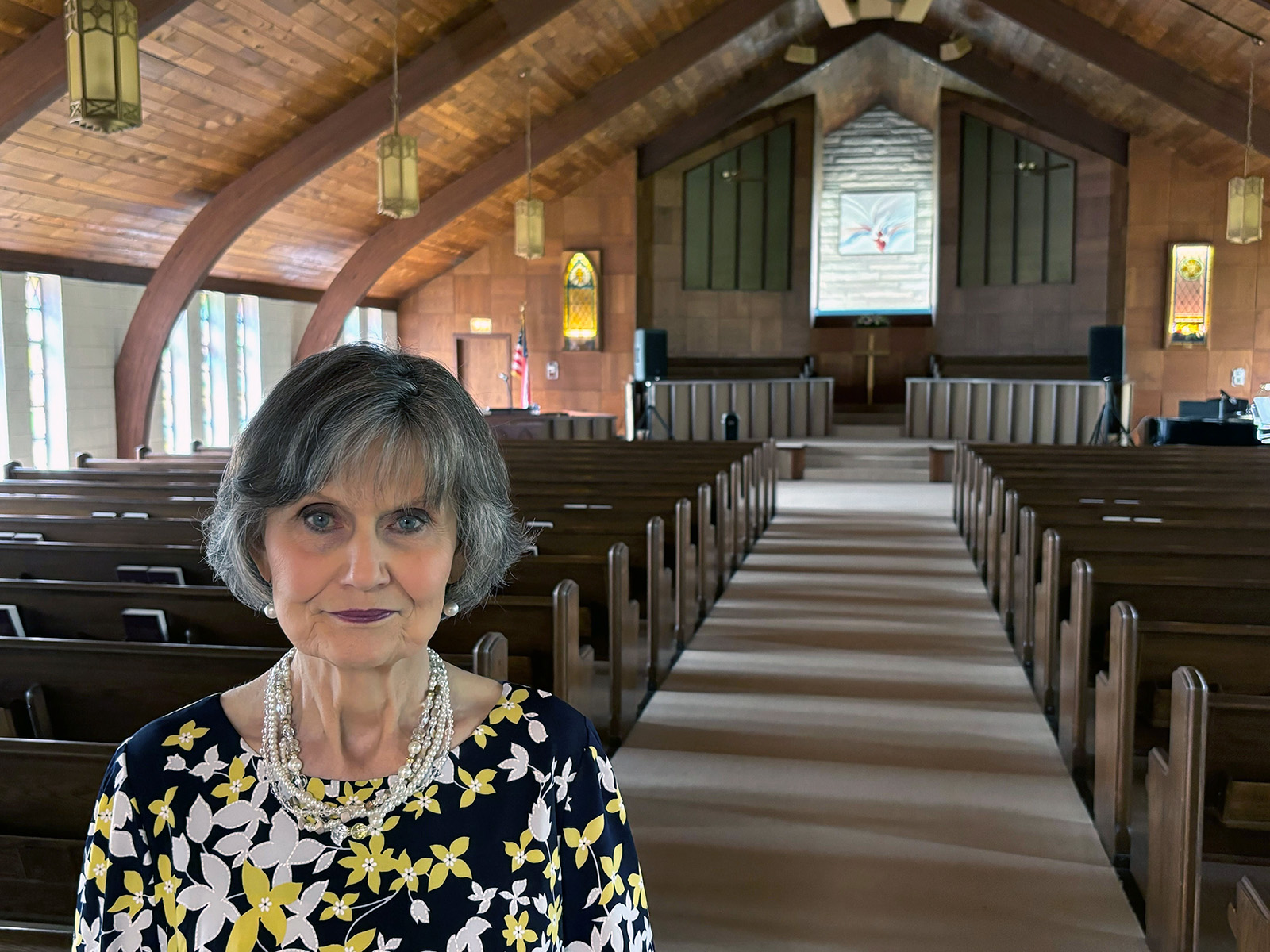
Gail Farnham poses at First Baptist Church, Sunday, July 21, 2024, in Mount Vernon, Ill. (RNS photo/Bob Smietana)
Gail Farnham, who as moderator at First Baptist led the meeting’s vote, said small churches like First Baptist are stuck in a dilemma. They can’t attract people with the same kinds of programs that larger churches offer. As a congregation ages, most of the people they know, if they are interested in going to church, already have a place to worship.
Farnham said she had been preparing for the reality of closing the church for years. In 2017, the church gave its building to a local Christian school, with the caveat that the congregation could still meet in the building for worship. That decision, she said, gave the church a few more years of life. It also ensured the building would still be used for ministry even after First Baptist was closed.
She was pleased to see old friends show up for the church’s last service and the congregation’s last time together.
“I don’t feel sad right now,” said the 80-year-old Farnham, who first came to First Baptist, which is part of the American Baptist Churches USA, with her family when she was about 5 years old. “I just feel like it’s happening the way it should happen.”
Many more churches likely will follow
Tens of thousands of local congregations like First Baptist are likely to close over the next few decades if current trends continue. Their passing will go unnoticed, said Burge, a political science professor at Eastern Illinois University who studies the changing religious landscape.
Burge said that even as the congregation at First Baptist shrank, members were still active in serving their community. From 2008 to 2023, the church provided nearly 55,000 lunches for local schools, with elderly members showing up to volunteer to fill the lunch bags. That dedication renewed his faith, said Burge.
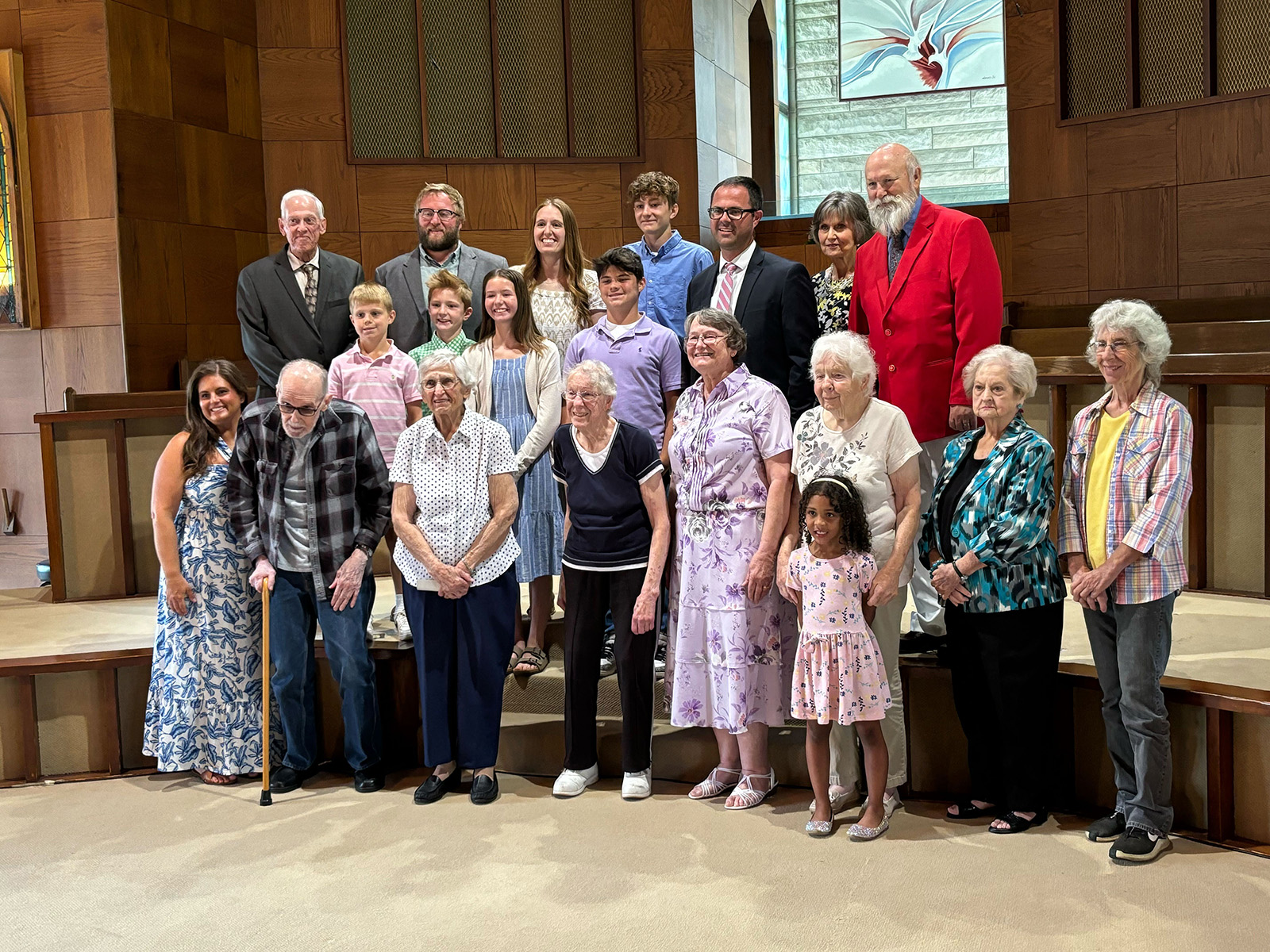
Members of First Baptist Church pose together for a photo after voting to close the church, Sunday, July 21, 2024, in Mount Vernon, Ill. (RNS photo/Bob Smietana)
“When I believed in God the most is when the two dozen people assembled [here] heard about the idea of the Brown Bag Program and did not hesitate to get involved,” he said in his final sermon,“when I saw members who struggled to stand do everything that they could to help pack those bags; when people gave over and above their tithe to make sure that we always had enough items to feed those hungry kids.”
Burge has long championed the importance of organized religion, for both its spiritual and social benefits. Churches, he argues, host food pantries and shelters, volunteer for disaster relief and provide small acts of kindness that make the world less awful. They care for one another when life gets hard.
That’s something he experienced firsthand growing up. His family struggled to make ends meet, and he recalls boxes of groceries showing up on the family’s porch, provided by members of their church who wanted to lend a hand.
Without that care, he wonders if his family would have made it through those hard times.
“That’s what kept me in religion,” he said in an interview the day before the church’s last service. “There are all these small kindnesses I saw for me and my family. I want to do that for other people.”
Pastor Ryan Burge speaks during the final worship service at First Baptist Church, Sunday, July 21, 2024, in Mount Vernon, Ill. (RNS photo/Bob Smietana)
In his last sermon, Burge recounted when a friend told him that First Baptist was lucky to have him as pastor. But his friend was wrong, said Burge, adding that he and his family had received more than they gave in the love and kindness of church members.
He mentioned the church’s kindness, in big and small ways—like the meals that showed up after the birth of his children or the time the church paid his family’s health insurance when he was laid off during budget cuts at the university back in 2016. He was later hired back.
The church didn’t hesitate to help, he said. Burge said that kind of kindness and community can be found at churches around the country—and can’t be easily replaced.
Ministry not wasted
In his sermon, Burge—who came to First Baptist as a 20-something graduate student and has stayed for nearly 18 years—said the church’s ministry was not wasted, and its legacy would live on.
“It was all worth it,” he told the remaining congregants.
Farnham said the church was grateful that Burge had stayed as their pastor. And they are proud of all he has accomplished.
“He is like one of my grandkids,” she said.
Lisa Hayse, who grew up in the church, said the congregation’s legacy will live on in the memories of people who worshipped there and in students at the Corem Deo Classical School, which now owns the building.
“There will still be hymns sung here,” said Hayse, who now teaches kindergarten at Corem Deo. “There will still be singing to praise the Lord in that sanctuary. It won’t stop.”
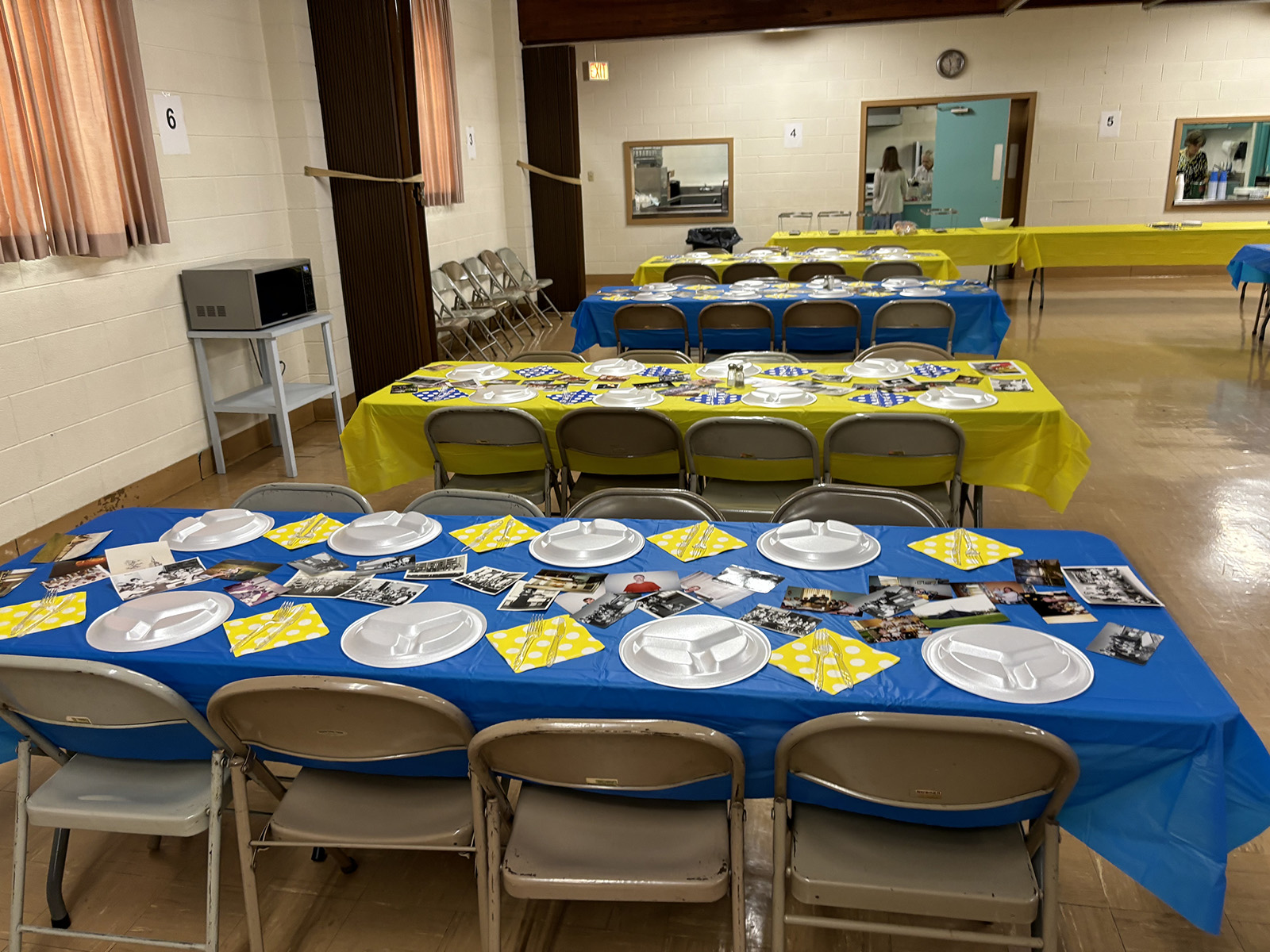
The fellowship hall following the final worship service at First Baptist Church, Sunday, July 21, 2024, in Mount Vernon, Ill. (RNS photo/Bob Smietana)
Standing in the church’s fellowship hall—where church members and friends looked at old photos and memorabilia from the congregation’s history and ate pulled pork, mac and cheese and salad, washed down with lemonade and iced tea—Hayse recalled the days when the church’s pews were packed and Sunday school rooms were filled with the laughter of children.
At Corem Deo, she teaches in the classroom where she learned Bible stories as a preschooler. Hayse said her late father had long hoped the church would once again be filled with children. That hope has been realized, she said.
Though the church is closing, the friendships between church members will remain. Farnham plans to send out updates to church members in the coming months and hopes church members will still find time to meet up.
“We are not done with each other,” she said.
Bounce students adapt to meet needs after storm
July 24, 2024
A Bounce student missions team was prepared to serve in Mora County, N.M., assisting with recovery efforts resulting from the 2022 Hermit’s Peak/Calf Canyon Fire and post-fire floods. However, recent water contamination and flooding steered them to be a different community’s “answered prayer.”
Earlier this month, 100 middle school through college students were redirected to Claremore, Okla., to assist in relief efforts following tornadoes that blew through the community in June.
God opened up another door
Noah Doley, a high school senior at Faith Baptist Church in Wichita Falls, said the most important part of his Bounce experience was being able to adapt to the week’s changes along with his team.
A Bounce team served Claremore, Okla., to assist in relief efforts following tornadoes that blew through the community in June. (Photo / Texas Baptists Communications)
“I think we were all kind of excited that God opened up another door for us,” Doley said. “We were just excited to help out the community of Claremore in any way we could.”
The students helped the community with disaster response tasks such as debris and tree removal.
David Scott, director of Bounce, said the students’ adaptability and hard work was encouraging to see as they served the community.
“The kids have worked really hard and had a really great attitude just stepping in and helping, assisting with the community,” Scott said. “Our approach has always been, ‘We’re going to do whatever the community needs,’ and that’s what they’re doing.”
Missional their entire life
Bounce student missions volunteers worship together in Claremore, Okla. (Photo / Texas Baptists Communications)
Celebrating its 10th year as a ministry of Texas Baptists, Bounce offers student ministry leaders the opportunity to mobilize their middle school, high school and college students to engage in challenging mission service and inspiring times of worship.
Bounce’s strategy always has been to do things that are going to encourage students to be missional beyond the week, Scott said.
“As we like to say, we want them to ‘Bounce’ back home and find opportunities to be missional their entire life,” Scott said. “That’s why we do worship. Through our worship experience, we’re trying to help them understand the value of mission service to cultivate a love for missions and ministry in their life.”
Doing this to show God’s love
Riley Cooper, another high school senior at Faith Baptist Church in Wichita Falls, said her team was OK with all of the changes and were willing to be flexibile because they recognized their work was all for God’s glory and none of their own.
“We don’t think that just because we’re teenagers that we can’t help in all the ways that we could. We’re doing this for God and doing this to show God’s love,” Cooper said.
Bounce offers two types of mission opportunities for students: disaster recovery/community rehab and church planting.
Student disaster recovery/community rehab opportunities allow students to help rebuild communities and reflect Christ in areas impacted by disasters or where homes are in need of rehabilitation through hands-on construction mission projects.
Student church planting opportunities allow students to serve with church plants for significant ministry that not only assists church plants and planters, but also cultivates an appreciation and love for church planting in the lives of participants.
Students also receive training in sharing the gospel, and Scott said his hope is that they would come out of the week able to share with confidence.
Scott extended his gratitude to the Bounce supporters in Oklahoma who helped coordinate service projects for the students and to First Baptist Church of Inola for opening up their facilities to house students that assisted with recovery efforts.
Fire engulfs historic sanctuary at FBC Dallas
July 24, 2024
Editor’s Note: This is a developing story and will be updated as new information becomes available.
DALLAS (BP)—The historic sanctuary at First Baptist Church Dallas burned Friday evening, July 19. The cause of the blaze is not yet known. The Victorian-style, red brick sanctuary building was erected 1890 and is a recognized Texas Historic Landmark.
FBC Dallas Historic Sanctuary (Photo via Baptist Press)
According to media reports, Dallas Fire and Rescue received a call at 6:05 p.m., Friday evening regarding a building on fire in downtown Dallas. Firefighters responded. Within 15 minutes of the first call, a second alarm was requested. Then around 7:30 p.m., the scene was upgraded to a three-alarm fire. A fourth alarm was called in around 8:15 p.m.
The Dallas Morning News reported that “more than 60 units were dispatched to respond to the structure fire.”
The church released a statement on X at 9:34 p.m. saying the primary fire was extinguished but firefighters were still working at the scene.
First Baptist Church Dallas has an indelible history within the Southern Baptist Convention having been pastored by former SBC presidents George W. Truett and W.A. Criswell. Currently led by Robert Jeffress, First Baptist Dallas reported a membership of nearly 16,000 in 2023. The church currently worships in a state-of-the-art facility, which opened in 2013, adjacent to the historic sanctuary.
Jeffress posted on X Friday night asking for prayers for the church saying: “We have experienced a fire in the Historic Sanctuary. To our knowledge, no one is hurt or injured, and we thank God for His protection. He is sovereign even in the most difficult times.”
The historic sanctuary was home to First Baptist Dallas’ contemporary service each week, called the Band-Led Service. There was a special VBS service scheduled for this Sunday, June 21. The church hosted its annual Vacation Bible School this week.
“We are grateful that no life has been lost that we know of even though we just had 2,000 children and volunteers on campus for Vacation Bible School earlier in the day,” Jeffress said in a statement to Baptist Press.
“As tragic as the loss of this old sanctuary is, we are grateful that the church is not bricks and wood but composed of over 16,000 people who are determined more than ever before to reach the world for the gospel of Christ.”
The church campus consists of multiple buildings across a six-block footprint in downtown Dallas. At this time, it is unknown if any other buildings were damaged in the fire.
The congregation held services at Dallas’ Kay Bailey Hutchison Convention Center July 21. In a Facebook post following the service, the church quoted Jeffress from a special address: “We are going to rebuild the sanctuary as a symbol of truth!”
Texans on Mission volunteers at work after Beryl
July 24, 2024
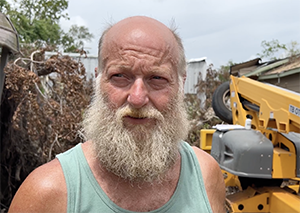
FREEPORT—Ken Anderson “rode out Beryl” in his Jones Creek home south of Houston. “We got hit harder than anybody, I believe. Lots of damage. Thousands of trees down.”
“We need all the help we can get,” said Ken Anderson of the Jones Creek neighborhood in Freeport. (Texans on Mission Photo)
One of those trees uprooted by Hurricane Beryl landed on Anderson’s home.
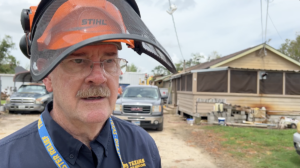
“We’ve got a massive tree that fell on the house and went all the way across,” said Texans on Mission volunteer John Weber.
“Fortunately, it did not destroy the house,” said Weber, leader of the San Antonio team and a member of Shearer Hills Baptist Church.
The team went to work July 15 gradually cutting back the massive tree. Seven members of Anderson’s family, including a baby, are living in the house because of power outages where the others live, Weber said.
Anderson praised the chainsaw team.
“This is a great set of guys,” he said, adding that he couldn’t do the work without them because of a recent heart attack. “I appreciate everything they’re doing here. We need all the help we can get.”
“We feel like we need to deal with people’s spiritual needs and their physical needs. And sometimes, you need to do the physical before you can get to the spiritual,” said Texans on Mission team leader John Weber of San Antonio. (Texans on Mission Photo)
Weber noted people have needs and are unable to do the chainsaw work his team provides.
“We’re trained, and we feel like we need to deal with people’s spiritual needs and their physical needs,” he said. “And sometimes, you need to do the physical before you can get to the spiritual.”
Heat, humidity and mosquitoes dogged all Texans on Mission volunteers working in Brazoria County as they cut up fallen trees, provided temporary roofs, washed laundry and went door-to-door responding to requests for help after the storm.
First Baptist Church in Brazoria is the hub of Texans on Mission ministry south of Houston, which includes some of the hardest-hit areas in a hard-hit region.
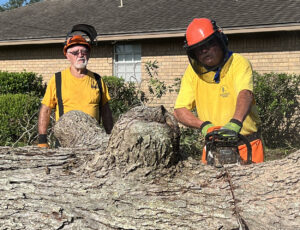
As Anderson indicated, downed trees are everywhere. Texans on Mission chainsaw crews are prioritizing situations where trees are on houses or vehicles or blocking access to homes.
‘Delivering help, hope and healing in Christ’s name’
Texans on Mission chainsaw volunteers from Waco Regional Baptist Association work in Brazoria County after Hurricane Beryl. (Texans on Mission Photo / Ferrell Foster)
Texans on Mission chainsaw units will come and go over the next few weeks. On July 16, 10 teams worked, including ones from Mississippi and Tennessee, part of the broader effort through Southern Baptist disaster relief.
“The damage from Hurricane Beryl is severe and widespread,” said David Wells, disaster relief director for Texans on Mision. “This relief effort is a powerful picture of what it looks like when the body of Christ works together. We are delivering help, hope and healing in Christ’s name.”
The hurricane knocked out electricity to millions, leaving large portions of the region powerless for days. Without refrigeration and air conditioning, residents struggled to get food.
The Texans on Mission state feeding unit stepped up to the challenge. Waking up early in the morning, volunteers cooked more than 60,000 meals for Houstonians. They were distributed to 26 locations across the city, focusing on areas of particular need.
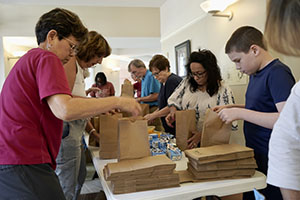
Volunteers at Sugar Land Baptist Church assembled about 3,500 sack lunches. (Texans on Mission Photo / Taryn Johnson)
In conjunction with Texans on Mission, Sugar Land Baptist Church helped meet the needs of preschoolers across the city. The congregation put together roughly 3,500 sack lunches to distribute.
One of the meals was given to a woman who hadn’t eaten in two days. When she lost electricity, all the food in her refrigerator went bad. She’s elderly and doesn’t drive, so she was silently suffering.
“Christ cares about the suffering,” Wells said. “He commands his followers to meet needs and share God’s love with those who are hurting. That’s what the feeding team is doing.”
Report documents religious freedom violations in Nigeria
July 24, 2024
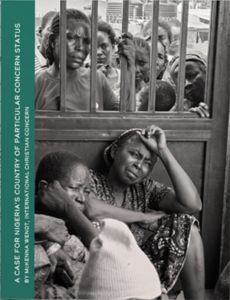
More than 50,000 Christians have been killed in Nigeria over the past two decades, and “the silence from Western nations on this genocide is appalling,” a new report from International Christian Concern asserts.
The report, released in mid-July, is based on open-source research, information collected from ICC field staff and first-hand testimony the organization’s advocacy staff heard during a trip to Nigeria in March.
The report, written by ICC advocacy manager McKenna Wendt, presents documented examples, case studies and other data to support organization’s position calling on the U.S. Department of State to designate Nigeria as a Country of Particular Concern.
That designation is reserved for nations that engage in or tolerate “systemic, ongoing and egregious” violations of religious freedom.
The U.S. Commission on International Religious Freedom has recommended CPC status for Nigeria every year since 2009. The State Department designated Nigeria as a CPC only once, in 2020, but the designation was removed the following year.
“While the State Department has recognized religious tensions in the region, the violence is often attributed to issues of climate change, farmer-herder conflicts, and ethnic divides,” the report states.
“Although these factors are certainly at play, it is a grave misjudgment to downplay the religious components of these conflicts and solely attribute them to secondary issues.”
Religiously motivated violence left unchecked
Because the United States has failed to hold Nigeria accountable, the nation’s government has allowed religiously motivated violence by groups such as Boko Haram, ISIS-West Africa, Fulani militias and armed bandit gangs.
“The unchecked violence and discrimination have led to severe loss of life, particularly Christians, and the conflict continues to undermine the Nigerian government, threaten national security, and cause significant economic loss,” the report states. “It has also weakened the efficacy of U.S. foreign policy tools in regard to promoting international religious freedom.”
Boko Haram has kidnapped Christian girls and young women, subjecting them to beating, torture, rape, starvation, forced marriages and forced conversion to Islam, as well as compelling them to participate in suicide bombings, ICC reports.
Between 2009 and 2014, Boko Haram was responsible for kidnapping at least 22,000 Christians and burning 13,000 churches and 1,500 Christian schools, the report notes.
“Last year, the group was accountable for the deaths of roughly 500 Nigerian Christians, and their violence has continued into 2024,” the report states.
ISIS-West Africa similarly has targeted Christians, publicly executing 11 Christian workers for their faith in 2019 and bombing a Catholic church in 2022, killing 40 worshippers and injuring dozens more, ICC reports.
Victims of the gunmen attack in north central Nigeria receive treatment at Jos University Teaching Hospital in Jos, Nigeria, on Dec. 27, 2023. (AP Photo/Sunday Alamba)
Fulani militia operate primarily in Nigeria’s Middle Belt, targeting Christian communities, churches and their leaders. On Christmas Eve last year, they killed more than 200 Christians in coordinated attacks on 21 predominantly Christian villages.
The ICC report notes specific examples in 2023 of a Catholic priest burned alive, one pastor whose left hand was amputated and another shot in the head, at least 13 women from a predominantly Christian village assaulted and raped, and a farmer beheaded for teaching children in a Christian church.
“The outcry of Nigerian Christians is falling on deaf ears,” the report states. “It is time for the United States to answer their call for help.”
Policy recommendations
The report includes specific policy recommendations for the U.S. government in addition to designating Nigeria as a Country of Particular Concern.
Recommendations include conducting “a comprehensive analysis of U.S. aid distribution in the region to ensure maximum effectiveness of aid disbursement.”
“Financial assistance provided by the U.S. to Nigeria must be contingent upon substantial improvements in religious freedom,” the report states.
Other recommendations include the appointment both of an ambassador to Nigeria “as soon as possible to improve diplomatic relations and to address religious freedom concerns,” and the appointment of a special envoy to Nigeria who would track and report on violence in the country.
The report also calls on the U.S. government to “encourage the Nigerian federal government to pursue police reform and strengthen judicial capacity” to provide better regional security.
‘Work in tandem with local leaders’ efforts’
Wissam al-Saliby, president of the 21Wilberforce human rights and religious freedom organization, said his organization “hopes that U.S. foreign policy supports to the maximum extent possible religious freedom in Nigeria.”
Wissam al-Saliby, president of the 21Wilberforce human rights organization, spoke at The Woodlands First Baptist Church the Sunday before Independence Day. (Screen capture image from YouTube)
While in Nigeria, he and 21Wilberforce Executive Director John Gongwer enjoyed fellowship with Christians there, met with former senior government officials and “held several rounds of conversations with church leaders to understand how we can partner with them,” al-Saliby said.
The latter may be most important in terms of promoting international religious freedom, he noted.
“While most advocates in the West call for the U.S. Dept. of State to once again designate Nigeria as a Country of Particular Concern, we heard from most of our various interlocutors in Nigeria that the CPC designation is more effective when they work in tandem with local leaders’ efforts, and when U.S. foreign policy prioritizes religious freedom and human rights consistently, based on facts and evidence,” al-Saliby said.
“Nigeria is blessed with large, wealthy and influential Christian denominations and conventions. For example, with approximately 9 million members, Nigeria has the largest Baptist convention [in the Baptist World Alliance]. Local leadership from these believers can be a powerful force for change.
“21Wilberforce’s commitment, before my joining as president and even more so now, is to equip local Christians to lead on the research, outreach to their government, and advocacy in support of religious freedom. We have made significant inroads towards this objective and have started plans for our next visit.”
On the Move: Abbott and Weaver
July 24, 2024
Kevin Abbott to Texas Baptists’ Center for Ministerial Health as director of pastoral health networks and as Houston-area representative for Texas Baptists. He most recently was associate director of Union Baptist Association.
Aaron Weaver to a part-time role as executive director of the Baptist History & Heritage Society. He succeeds John Finley, longtime Georgia pastor, in that position. Weaver, who earned his Ph.D. from Baylor University, will continue to serve as communications director for the Cooperative Baptist Fellowship, a position he has held since 2013. He also is an adjunct professor of Baptist history at Emory University’s Candler School of Theology in Atlanta.



 The
The