One woman’s enthusiasm for shoebox project becomes contagious

BAILEYVILLE—Nettie Hyde has it and has given it to everyone she knows. No, not H1N1 flu, but a fever for Operation Christmas Child.

Hyde first heard of Operation Christmas Child in 2003 and promptly packed her first shoebox for a child.
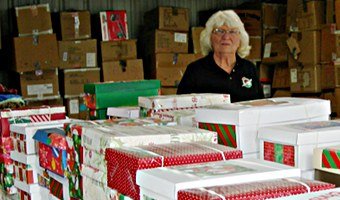
For Nettie Hyde, Operation Christmas Child is a year-round affair. Watch a video about her efforts here.

“After I packed it, I told my husband, ‘Let’s lay hands on this box and pray for the child that’s going to receive it,’” she recalled.

The next year, she and the Woman’s Missionary Union leader for her church, First Baptist Church in Rosebud, attended an Operation Christmas Child rally in Temple, and that was when her enthusiasm for the program became contagious.

“That day, I received my calling, and I hit the ground running. I haven’t stopped since,” Hyde said. “I can’t begin to say what it’s meant to me. I can’t describe how close my walk with God has grown with this.”

At her church in Rosebud, started rallying the troops. In 2004, members of First Baptist in Rosebud packed 121 boxes. The next year, with a whole year for Hyde to stir the masses and with Rosebud named a relay center, the town collected 1,073 boxes.

In 2006, Rosebud collected more boxes as a relay center than it has people—with a population of about 1,500 and 1,614 boxes gathered.

Last year, Hyde packed 501 boxes of the 2,098 collected herself.

This year, she has packed 1,006 boxes, but she has now stopped so she can work more on raising the $7,042 it will take to ship them.

“It’s amazing how God has blessed and is still blessing,” Hyde said.

For her, Operation Christmas Child is a year-round affair.

“I work on it some every day. I don’t feel like my day is complete if I don’t,” she said.

Her personal goal of 1,000 boxes for this year was something she kept to herself.

“I kept feeling like I was to do 1,000 boxes, but I wouldn’t tell anybody because it didn’t seem like reality,” she explained.

The task of raising the money for shipping is a big one, but she has found creative ways to do it. A man who owns a plant nursery in nearby Wilderville has either sold Hyde plants at a heavily discounted rate for her to resale or simply donated plants at no cost to her.

In addition to the plant sales, Hyde convinced her husband to construct a building she has dubbed Nettie’s Thrift Shop. The white building with red and green trim houses things people have given Hyde to sell. Some are handcrafted items such as paintings, and others are of a traditional garage sale variety, but 100 percent of the sales go to Operation Christmas Child.

Hyde also is quick to point out she has help finding the items to fill the boxes. Two women with a knack for finding bargains on small items for the boxes constantly are bringing her what they discover, she said.

All those boxes and the items to fill them have taken over the Hydes’ garage to the degree that no vehicle fits.

The task of wrapping all those boxes has not fallen on Hyde alone. First Baptist Church in Rosebud has Christmas wrapping days so that everyone can have a part in the ministry.

One woman has made hundreds of knit caps to include in the boxes. Others have made numerous bead necklaces and bracelets.

“It takes so many people helping in so many ways,” Hyde said. “I just want people to help in whatever way they feel led.”

The boxes not only have been life-changing for the children who receive them, but also for many of the people in Rosebud. For example, the mayor feels it to be his civic duty to help load the boxes into trucks every year.

But there have also been more eternal changes seen. A few years ago, a 16-year-old girl took two-dozen boxes home to wrap. Along with them was an Operation Christmas Child brochure that told how the boxes would be given to orphans around the world. The girl’s mother was a Muslim from Ghana, and she had seen first-hand the suffering of children in her homeland.

She was moved to help her daughter wrap the boxes. Before taking them back, the girl filled 20 of them, using money she collected at her birthday party in lieu of presents. Her mother filled the others.

That year, First Baptist, Rosebud, sold cookbooks to help finance the shipping of the boxes. On the back page of the cookbook, the girl told the story of her mother’s help and prayed for her mother to find Christ.

In March of this year, her mother accepted Jesus Christ as her Savior. And she has filled 200 boxes herself this year.

Passing on the Operation Christmas Child bug is just what Hyde wants.

“I’m 78, and I won’t be doing this forever. But I hope when I get to heaven that God will let me look down and see people packing shoeboxes, because it has been such a blessing to me,” she said.


Churches show love to poor children through shoebox gifts

TEMPLE—Glinda Harbison has been passionate about Operation Christmas Child since she first heard about it, and that passion has only grown stronger over the years.

Operation Christmas Child is a Samaritan’s Purse ministry that seeks to spread the love of Christ to impoverished children around world through a shoebox full of small gifts at Christmas. Participants are urged to pray over the boxes that the gift might communicate that God loves them.

Lanita Murray (left) and Maye Rea, both from Immanuel Baptist Church in Temple, pack boxes for Operation Christmas Child. (PHOTO/Courtesy of Immanuel Baptist Church of Temple)

Since its inception, 69 million boys and girls in more than 130 countries have had the gospel shared with them in this way, the vast majority of the children living in orphanages.

After hearing Franklin Graham speak about the nascent program at a meeting in Nashville in 1993, Harbison returned to Immanuel Baptist Church in Temple on a mission.

“I had never told one of our pastors, ‘We are going to do this.’ But I went into our prior pastor’s office and said: ‘We’re doing this. I’m not asking permission. We’re doing this,’” she recalled.

That first year, Immanuel’s congregation packed 35 boxes. “I was just beside myself,” said Harbison, who now serves as the church’s hospitality director.

Last year, people within the church brought 774 boxes to send to children around the world.

This is Immanuel’s second year to serve as a collection center for a number of Central Texas relay centers. The relay centers collect boxes from individuals and churches. Immanuel will take the 8,000 boxes it expects to receive from the surrounding churches and see that they are trucked to Denver for preparation for distribution to children around the world.

Most churches will observe Nov. 16-22 as their collection week. Many will bring their boxes to the collection center on Nov. 22, and the boxes will leave for the distribution center on Nov. 23.

“Some of our people are going to follow the boxes to Colorado and go to the distribution center to help out there,” Harbison added. “They’re simply going to finish what they’ve started.”

Volunteers will open the boxes and take out the $7 needed to pay for the shipping of each box. They also will give it a quick look to see if the contents dictate it go to a warm or colder climate. For example, if someone has knitted a wool cap to include, that box will be sent to a child in a cooler climate.

“The integrity of box is never compromised, because we’ve asked people to pray over the contents of that box,” Harbison explained.

Wayne McDonald will be among the volunteers who make the trek to Colorado.

OCC Logo “I’ve been involved with OCC since Immanuel Baptist Church first started doing it,” he said. “It’s a great thing to do. You spread the gospel and spread a little cheer for a little while—maybe longer than a little while.”
Spreading cheer while spreading the gospel was exactly what first attracted Harbison to Operation Christmas Child.

“I loved the idea of giving a gift to a child who has never received a gift,” she said.

She gained a new perspective about the program, however, on April 19, 1995. She was at a children’s conference and was next to a table of children’s workers from Oklahoma City when they learned of the bombing of the Murrah Federal Building.

“I made a commitment that day to myself that our church would continue to be involved with this ministry because we never knew—and we’ll never know—whose hands these boxes go into,” Harbison said.

It occurred to her that a child who might grow up to be a terrorist after being taught to hate Americans might question those teachings through a box filled with love.

“It may change a life for forever. It just hit me that day the importance of these boxes,” Harbison said.

Children who receive the boxes also are given the opportunity to make a profession of faith and then follow through with a 15-week discipleship course.

“It’s not just sending a shoebox,” Harbison explained. Professions of faith were recorded for 750,000 children last year through Operation Christmas Child.

Last year, a man at Immanuel was deeply moved by an Operation Christmas Child video about a Bosnian girl who contemplated stepping on a landmine to end her life, but a pair of tennis shoes in an Operation Christmas Child gave her the hope to keep living, Harbison recalled. Inspired by her story, the man provided 50 pairs of shoes last year. This year, he has given her money to buy 150 pairs of shoes.

“Once you become a part (of Operation Christmas Child), you realize how passionate people can become—not just about a simple shoebox, but the end results of that shoebox,” Harbison said.


Juarez violence points to continuing need for prayer by Texas Baptists

Unabated violence in the border city of Juarez underscores the continuing need for prayer by Texas Baptists, said a Tyler physician who is seeking to mobilize a statewide response.

Various news sources have reported the number of people killed in Ciudad Juarez this year by mid-September had topped 1,600—more than in all of 2008. Many of the homicides have been drive-by shootings and gangland-style killings associated with drug cartels.

And many of those deaths hit close to home for Baptists in Juarez, said Dick Hurst, a medical doctor from First Baptist Church in Tyler who is spearheading a statewide effort to link Texas Baptist congregations to sister churches in Juarez.

“I received an e-mail reporting that nine young people in three of our churches in Juarez were murdered recently,” he said.

Earlier this year, representatives from the Baptist General Convention of Texas, the Cooperative Baptist Fellowship, Buckner International, Baylor University and several churches met to explore ways Texas Baptists can respond to the needs of churches in Juarez.

The group agreed to seek Texas Baptist churches to enter a relationship with each of the 44 Baptist churches in Juarez. They also agreed to look for ways Texas Baptist schools could help the churches in Juarez with leadership development.

So far, between 30 and 40 Texas Baptist churches have agreed to become sister churches with congregations in Juarez, Hurst reported. Some large Sunday school classes also have expressed an interest in developing an ongoing relationship with a small Juarez church, he added.

Pastors in Juarez received an initial box of Texas Hope 2010 multimedia compact discs with gospel presentations and Scripture, made possible by the BGCT, he noted.

One pastor, who only received 30 CDs, noted it would not begin to be enough to distribute on the city’s streets, Hurst said. “So, his church established discipleship groups in homes. They are using the CDS in those groups as people work their way through them over 10 weeks,” he said.

For more information about the sister-church program with Baptists in Juarez, contact Hurst at crbhurst@hotmail.com .


Supreme Court gets technical in arguments on Mojave cross

WASHINGTON (ABP) — Although the case of a lonely cross on federal land in California’s Mojave Desert ultimately could have wide-ranging implications for the separation of church and state, justices on the Supreme Court spent much of the Oct. 7 oral arguments asking attorneys about highly technical and procedural issues.

Justices heard from attorneys for both sides in the Salazar v. Buono case (No. 08-472). While supporters of strong church-state separation had feared that the court might use the case to severely limit the ability of plaintiffs to file lawsuits against the government for promoting religion, justices spent much more time debating whether the case could be decided on the narrower grounds of whether congressional action attempting to preserve the cross was permissible.

Attorney Peter Eliasberg answers questions from reporters at a press conference following oral arguments. Baptist Joint Committee Executive Director Brent Walker stands behind him. (BJC photo)

“The injunction says the government is enjoined from permitting the display of the Latin cross, period. Once this law takes effect and you follow it, you are violating that injunction. You don't need nine proceedings to see that; you’re violating it,” said Justice Steven Breyer, speaking to Solicitor General Elena Kagan, who argued for the cross on behalf of the Obama administration.

The cross — a predecessor of which was first erected as a World War I memorial in 1934 — stands atop Sunrise Rock, next to a road in a remote part of the Mojave National Preserve.

Although several crosses erected by private groups have stood on the spot over the years, the current version was built of painted metal pipes by a local resident in 1998.

The next year the National Park Service, which oversees the land, denied an application to build a Buddhist shrine near the cross.

The agency studied the history of the monument and, determining that it did not qualify as a historic landmark, announced plans to remove it. Congress intervened with a series of amendments to spending bills that effectively preserved the cross.

In 2001 Frank Buono, a Catholic and a retired National Park Service employee who once worked at the preserve, filed suit with the help of the American Civil Liberties Union. They claimed that the cross violated the First Amendment’s ban on government establishment of religion.

A series of federal-court decisions ruled against both the cross and the government’s attempts to preserve it through legislative maneuvers. In 2007, the 9th U.S. Circuit Court of Appeals ruled against one of the congressional actions, which ordered the government to give a tiny parcel of land under the cross to the Veterans of Foreign Wars in exchange for a privately owned plot elsewhere in the park. President Bush's administration appealed the ruling, and Obama’s Justice Department continued to defend the congressional action as valid.

In the Oct. 7 arguments, much of the discussion turned on the procedural validity of Kagan’s assertion that the government action to remedy the constitutional violation was sufficient.

But a few moments of argument did highlight one significant First Amendment controversy in the case: Whether such a monument on public land could serve a secular purpose. In response to an assertion that the cross did not honor non-Christian war dead by Los Angeles attorney Peter Eliasberg, who argued Buono’s side in the case, Justice Antonin Scalia asked, “The cross doesn't honor non-Christians who fought in the war?”

Eliasberg responded, “A cross is the predominant symbol of Christianity and it signifies that Jesus is the son of God and died to redeem mankind for our sins….”

Scalia replied, “It's erected as a war memorial. I assume it is erected in honor of all of the war dead. It's the — the cross is the … most common symbol of the resting place of the dead, and it doesn't seem to me — what would you have them erect? A cross — some conglomerate of a cross, a Star of David, and you know, a Muslim half moon and star?”

“The cross is the most common symbol of the resting place of Christians. I have been in Jewish cemeteries. There is never a cross on a tombstone of a Jew,” Eliasberg retorted, to laughter in the courtroom.

The justices barely discussed one issue that had worried church-state separationists significantly about the case — whether Buono had legal standing to sue the government over the cross in the first case.

In court filings, attorneys for the Obama administration had argued that Buono should not have had the right to challenge the cross because, among other reasons, he is a Christian and presumably is not injured or offended by the sight of the cross.

A friend-of-the-court brief filed by the Baptist Joint Committee for Religious Liberty and the Interfaith Alliance said that argument, if accepted, would lead to gross violations of religious freedom.

The brief argued that Buono had every right, as a Christian, to feel injured by the government’s endorsement of his religion because such an endorsement inherently damages the faith.

“Seeing one’s faith receive preferential government treatment, while aware that no minority faith would receive that treatment, demonstrates the government’s perversion of religion for its own ends,” the brief said. “The government is taking something that should be a symbol of voluntary religious belief and practice and using it in a way that alters its apparent symbolism by making it look like an ‘official’ faith.

“It is not surprising that devout, voluntary adherents of a religion would not want to send the signal to those who do not share in the religion of the majority that they are political outsiders. Where the government endorses one religion over all others, it weakens the sanctity of that religion and its beliefs.”

But Holly Hollman, the BJC’s general counsel and one of the authors of the brief, said she was somewhat relieved by the tenor of the oral arguments in the case.

“There were more questions about the government's ability to raise a standing defense than about Mr. Buono's standing. While certainly not determinative of how the court will rule, there appeared to be less  interest in limiting standing in this case than we feared,” she said.

Hollman added that one way the court could dispose of the case without doing much damage to religious liberty would be to “find that Congress took adequate steps to distance the government from the cross by selling it to a private landowner. I think there will be significant divisions among the members of the court on the specific facts that weigh for and against that conclusion.”


–Robert Marus is managing editor and Washington bureau chief for Associated Baptist Press.

Related items:

Transcript of oral arguments in Salazar v. Buono

Baptist Joint Committee/Interfaith Alliance amicus brief in Salazar v. Buono

Supreme Court agrees to hear case involving cross on federal land (2/23)


Wayland pair make discovery in cancer research

PLAINVIEW—Early findings indicate a pair of Wayland Baptist University summer researchers may have isolated an herbal compound that appears to kill cancer cells.

Kassie Hughes laughs when she recalls the moment her professor, Gary Gray, visited them in the lab to see their final analysis results.

“He jumped for joy, that’s for sure,” said the senior chemistry major at Wayland Baptist University.

“It took them a while to realize what they had done,” Gray said. “You just don’t see something that appears to kill (cancer) cells like this.”

Student summer researchers Asenath Arauza (left) and Kassie Hughes look over results from the HPLC machine after it ran a test on a particular compound in their experiment. (PHOTOS/Wayland Baptist University)

Hughes, a Plainview native, and fellow student Asenath Arauza, a junior chemistry and molecular biology major, were participants in Wayland’s summer research program in chemistry, funded in large part by a grant from the Welch Foundation.

While they haven’t exactly discovered a cure for cancer, what Hughes and Arauza did over the summer months has quite a bit of value both in terms of scientific research and in their own education and edification, Gray noted.

The pair technically started their research in the spring 2009 term after learning in November they were chosen for the program. They spent the spring doing an extensive literature review once they chose a topic from the choices they were presented.

They chose to follow a path started by May 2009 graduate Joanne Jacob, who had experimented with 12 different herbs and their effect on tumor growth in mice. One in particular had significant results in Jacob’s research, and the two coeds decided to further check out Ashwagandha, commonly known as Indian Ginseng and used by many to treat depression, inflammation and neurological disorders.

Using a powdered form of the root, Hughes and Arauza first rinsed it to remove any lipids, then ran a 6-hour process known as a Soxhlet to liquify the extract into a more usable form. Gray likened the process to a drip coffee maker, where heated water—or in this case, methanol—runs through the extract and then back through repeatedly until it is complete.

Using thin-layer chromatography on glass plates, the team was able to separate the extract into various compounds. Through nearly 30 plates—a time-consuming process itself—the duo was able to identify one particular compound that was strong every time. They tested it on 4T1 breast cancer cells grown in Petri dishes to determine how it would affect the cells. The results were astonishing.

“This was really annihilating the breast cancer cells,” noted Arauza, pointing to a chart of the results that showed the cell growth was dramatically reduced compared to even the full extract. “This one was very potent. None of the others were even close.”

The next step was to characterize the isolated compound at Texas Tech University’s lab, utilizing their mass spectrometer, a machine the Wayland lab does not possess, to determine exactly what the size of the molecule is. A larger sample will be needed, however, to get a better reading and study using the Tech equipment.

The girls’ next plan is to repeat their entire research project to get a purer, larger sample and then run the cell culture test again before moving to the next stage, which is to inject the cancer cells in mice, then inject the compound and measure the results. They are excited about the next step, as is their faculty mentor.

“This raises all kinds of interesting questions since this appears to be different than the compounds that are already known,” Gray said. “If this turns out to be a unique plant steroid that just grows naturally and has this effect, this should be pursued. They’ve been eating this root for centuries, so we know it’s not a poison.”


Texas Baptist Men sending relief team to the Philippines

DALLAS—Texas Baptist Men will deploy 10 men to the Philippines Oct. 7 to spend 10 days helping with relief work and teaching local people how to clean up the area in the aftermath of the flooding and landslides that took place in the last week.

Within the last week, the Philippines were hit by typhoons Ketsana and Parma, causing water to rise more than 20 feet in some areas. At one point, 80 percent of Manila sat underwater.

The National Disaster Coordinating Council reports Ketsana caused 246 deaths in the Philippines, as well as 72 in Vietnam and nine in Cambodia. More than 2 million people have been affected by the storm.

“Our mission is to equip and train local people in how to do the cleanup work,” said Dick Talley, Texas Baptist Men director of disaster relief.

The group includes team leader Ernie Rice of Stockdale, Bill Gresso of Garland, Stan Knight of Dallas, Harold Patterson of Scoggins, Russell Schieck of Lubbock, Mike Tello of Elsa, Larry Vawter of Altair, Leo Vega of Odessa, Rey Villanueva of Kenedy and Rand Jenkins of Mansfield.

The Texas Baptist team will join with Baptist Global Response, Kentucky Baptist Men, Oklahoma Baptist Men and the Southern Baptist Convention of Texas to carry out various clean-up activities within the next two weeks.

“Imagine standing in two or three inches of muck and having to dig it out, remove furniture, remove personal belongings, decide what to save and what to throw out and then rinse off and sanitize what is left,” Talley said. “It is quite emotional for those who are going through it.”

The men hope to bring physical, emotional and spiritual help and restoration to the flood victims who are sitting in such a vulnerable state, Talley said.
Texas Baptist Men disaster relief efforts are made possible through donations given to Texas Baptist Men and the Texas Baptist Missions Foundation at the Baptist General Convention of Texas.

To support the Philippine relief efforts through Texas Baptist Men, visit http://www.texasbaptistmen.org/ and click on the donations tab or mail a check marked for disaster response to Texas Baptist Men at 5351 Catron, Dallas, TX 75227.

To give to the efforts through the Texas Baptist Missions Foundation, visit www.bgct.org/give and click on Disaster Response or send a check marked for disaster relief to the Texas Baptist Mission Foundation at 333 N. Washington, Dallas, TX 75246-1798.

For more information about relief work in the Philippines, contact Joe Detterman, volunteer disaster relief director, at (214) 632-8861.


Houston pastor to be nominated for BGCT 2nd vice president

HOUSTON—John Ogletree, founding pastor of First Metropolitan Baptist Church in Houston and former chairman of the Baptist General Convention of Texas Executive Board, will allow his nomination for BGCT second vice president.

Bob Fowler, a Houston attorney who succeeded Ogletree as Executive Board chairman, will make the nomination during the BGCT annual meeting in Houston, Nov. 16-17.

John Ogletree

“John doesn’t have any agenda other than helping to advance the kingdom of God and the cause of Texas Baptists,” Fowler said.

Ogletree, past-president of the Texas Baptist African-American Fellowship and former moderator of Union Baptist Association, has demonstrated through service he is “a man for all Texas Baptists,” Fowler said.

“I would describe him as a comfortable leader who is reflective and affirming of those he seeks to lead,” he continued.

Ogletree’s civic involvement serving on the CyFair Independent School District board and the experience he gained during the more than two decades he was a practicing attorney further demonstrate the breadth of his leadership abilities, Fowler added.

“I want to be part of the continuing effort by the BGCT to relate to all its churches,” Ogletree said. “I believe my background will help me to speak effectively to that diversity.”

He expressed his desire to work as “part of the team” as the BGCT faces “the challenges before us,” pointing specifically to financial constraints caused by the nationwide economic downturn.

Ogletree praised BGCT Executive Director Randel Everett for the Texas Hope 2010 vision that “has rallied us and given us a target.” The threefold emphasis on praying, caring for the hungry and sharing the gospel with every Texan by Easter 2010 is “something churches in every corner of our state can embrace,” he said.

Ogletree was born in Dallas and earned his undergraduate degree at the University of Texas at Arlington before obtaining his doctor of jurisprudence degree from South Texas College of Law in Houston.

He was called into the gospel ministry in 1982 and three years later was ordained at Antioch Missionary Baptist Church of Houston, where he served as minister of Christian development. In 1986, he became founding pastor of First Metropolitan Baptist Church in northwest Houston.

He has been involved with Mission Houston and was instrumental in forming the Redemption Community Development Corporation.

He and his wife, Evelyn, have three sons, Johnny, Joseph and Jordan; one daughter, Lambreni; and six grandchildren.


Former ‘Baptist Hour’ preacher Charles Wellborn dies

GEORGETOWN, Ky. (ABP) — Former "Baptist Hour" radio preacher Charles Wellborn died Oct. 1 at his home in Georgetown, Ky.

Contemporaries described Wellborn, 86, as one of the best preachers they ever heard and the clearest voice of conscience among his generation of Baptists.

Wellborn accepted Christ at age 23 amid the Southern Baptist youth revival movement of the 1940s and 1950s. He began preaching on the "Baptist Hour," a weekly program produced by what was then called the Radio Commission of the Southern Baptist Convention, in 1948 while still a student at Southwestern Baptist Theological Seminary.

Contemporaries described Charles Wellborn, who died Oct. 1 at age 86 as one of the best and most prophetic preachers of his generation.

After graduating from seminary Wellborn served 10 years as pastor of Seventh & James Baptist Church, adjacent to the Baylor University Campus in Waco, Texas. After the congregation voted to open its membership to people of all "races and colors" in 1958, the young pastor received threatening phone calls and a cross was burned on the lawn of the parsonage.

Wellborn left Seventh & James in 1961 to begin doctoral studies at Duke University, where he received his Ph.D. in 1964. He taught at the Baptist-affiliated Baylor — his alma mater — and Campbell College in Buies Creek, N.C., until his marriage ended in divorce, effectively ending his preaching and teaching career in Southern Baptist ranks. He found a niche at Florida State University, first as chaplain to the university, then as professor of religion and finally as dean of FSU's British campus in London before his retirement in 1990.

Influenced by seminary professors including T.B. Maston, Southwestern's legendary professor of Christian ethics, Wellborn continued to speak to Southern Baptists through his writing. Over the years he wrote seven books, two plays and more than 100 articles in scholarly and popular journals.

He was a frequent contributor to Christian Ethics Today, an independent journal started in 1995. In 2003 Smyth & Helwys published a book of Wellborn's essays and sermons collected over 50 years under the title of one of his writings, Grits, Grace, and Goodness.

Wellborn was a member of Faith Baptist Church in Georgetown, Ky. His memorial service is scheduled there at 1 p.m. on Oct. 10. Visitation before the service begins at noon. Burial will be in Texas at Waco Memorial Park. Memorial gifts are suggested to the Charles T. Wellborn Endowed Lecture Series account at Florida State's religion department. 


–Bob Allen is senior writer for Associated Baptist Press.


White House concerned about spreading flu in churches

WASHINGTON (RNS)—The White House and federal health officials have released guidelines recommending that worshippers take precautions against spreading germs to reduce the risk of contracting swine flu.

The guide, released by the White House Office for Faith-based and Neighborhood Partnerships and the Department of Health and Human Services, suggests that houses of worship encourage congregants to wash their hands often, use hand sanitizer, avoid crowded situations and interact without physical contact when possible.

It also urges religious leaders to keep in contact with local health organizations and closely adhere to their recommendations.
Joshua DuBois, the director of the faith-based office, said in a news release that faith leaders have significant power to help spread the word on how to stay healthy.

The National Association of Evangelicals e-mailed its member congregations to suggest preparations for flu season by following the White House guide, which can be found online at www.flu.gov.


Court turns away attempt to force ‘Choose Life’ plates on Illinois

WASHINGTON (ABP) — On the opening day of their 2009-2010 term Oct. 5, the justices of the Supreme Court turned away an anti-abortion group’s attempt to force Illinois to offer special license plates that support the pro-life cause.

The court declined, without comment, to hear arguments in Choose Life Illinois v. White. Choose Life Illinois, Inc., had appealed a decision by the 7th U.S. Circuit Court of Appeals upholding the state’s right to refuse to wade into the abortion controversy in its specialty license-plate offerings.

State officials had refused to offer the plates despite being presented a petition by supporters of the effort — and even though other appeals courts have upheld similar programs elsewhere in the country. So far, according to Choose Life, 24 other states have approved such specialty license plates. Fees for the plates would have gone to support adoption services.

Attorneys for Choose Life sued the state, arguing that Illinois motorists had a First Amendment right to sport the message tags. The high court, however, has repeatedly refused to rule on other similar cases.

The Supreme Court also declined Oct. 5 to hear a case involving the increasingly heated dispute over whether congregations are allowed to keep their buildings when they leave a parent denomination that has ultimate control over the property. The justices also did not comment in their decision to turn away an appeal in Rector of St. James Parish, et al., v. Los Angeles Episcopal Diocese.

Such disputes have been cropping up in state courts in recent years as conservative parishes have begun disassociating themselves from the Episcopal Church USA in a dispute over homosexuality and other doctrinal matters.


–Robert Marus is managing editor and Washington bureau chief for Associated Baptist Press.


Critics question Obama’s commitment to international religious freedom

WASHINGTON (RNS)—When the Dalai Lama came to Washington two years ago, he was feted with the nation's highest civilian honor, the Congressional Gold Medal, as President George W. Bush and a bipartisan delegation looked on.

But as the exiled Tibetan leader returns for another visit to the nation's capital this week, there is a White House-sized hole in his itinerary.

President Obama will not meet with the Dalai Lama, breaking a precedent that dates to President George H.W. Bush in 1991. Obama will not convene with the famed Buddhist monk until after the president returns from a summit in Beijing in November, the administration has said.

dalai lma

Tenzin Gyatso, the fourteenth and current Dalai Lama, is the leader of the exiled Tibetan government in India. He was awarded the Nobel Peace Prize in 1989. (Photo/ Luca Galuzzi – www.galuzzi.it)

The perceived snub has angered human rights advocates, who say it reflects an early pattern in Obama's foreign policy to sideline religious freedom in favor of other issues like trade and climate change.

“Not only does (Obama) risk saying that, he comes very close to saying it outright,” said Thomas Farr, who was director of the State Department's Office of International Religious Freedom from 1999-2003.

“They do seem to be saying that religious freedom is important—but not as important as these other issues, and I think that is a serious error.”

The Chinese government is severely critical of the Dalai Lama, who was awarded the Nobel Peace Prize in 1989, calling him a “splittist” who aims to undermine Beijing's control of Tibet. They also discourage heads of state from meeting with the Dalai Lama, who says he is seeking more autonomy for Tibetans—not a split from China.

Rep. Frank Wolf, R-Va., co-chair of Congress' Human Rights Commission , which held a hearing on China on Sept. 29, called Obama's decision not to meet with the Dalai Lama “an embarrassment.”
    
“Whenever you sell a global religious leader out for an export deal, that's very bad. Economics should not trump human rights. You can do them both together and do them respectfully,” Wolf said in an interview.

Farr, too, said not meeting with the Dalai Lama sends a “very, very bad message” that the U.S. is willing to back down on religious freedom.
    
Though Obama has drawn praise for talking about the importance of religious rights— most notably in a speech in Cairo last June—critics say his policies do not match his rhetoric.

“It got some lines in the Cairo speech, but we haven't seen any pressing on the issue so far,” said Michael Cromartie, a member of the U.S. Commission on Religious Freedom , an independent, bipartisan panel created by Congress in 1998. “Snubbing the Dalai Lama is another indication of that.”
    
In May, the USCIRF issued a stinging rebuke of the Chinese government, saying it “engages in systematic and egregious violations of the freedom of religion or belief.” The report also said that “in Tibetan Buddhist areas, religious freedom conditions may be worse now than at any time since the Commission's inception.”
    
The U.S. State Department has also criticized China, labeling it a “country of particular concern” not only for its treatment of Tibetan Buddhists, but also of Muslim Uighurs, Christian house churches, and Falun Gong practitioners.
    
But Secretary of State Hillary Clinton has seemed to downplay disagreements with China over religious freedom, saying last February such issues “can't interfere” with efforts to broker deals on climate change, security and trade.

Moreover, the White House has begun to engage regimes in Sudan, Myanmar and Cuba that have spotty human rights records; failed to criticize abuses in Iran and Egypt; and left vacant the post of ambassador-at-large for religious freedom.

“If this administration has a considered approach to these issues, we're all waiting to hear it,” said Sophie Richardson, Asia advocacy director for Human Rights Watch. “Until they make their intentions, tactics, and priorities clear, it's very hard not to conclude that these guys are not going to do a great deal on the issue of human rights in China.”

The Obama administration refused repeated request for comment about its policies on religious freedom or the Dalai Lama's visit to Washington.
    
Senior White House Advisor Valerie Jarrett and a State Department official met last month with the Dalai Lama in Dharamsala, India, the seat of the Tibetan government-in-exile. In a statement after the meeting, the Dalai Lama's office said Jarrett “reiterated President Obama's commitment to support the Tibetan people in protecting their distinct religious, linguistic, and cultural heritage and securing respect for their human rights and civil liberties.”
    
Mary Beth Markey, vice president for advocacy at the International Campaign for Tibet , said the Dalai Lama had a role in the decision not to meet with Obama in Washington. For years, she said, presidents have been meeting with the exiled Buddhist leader, but China hasn't budged.

In fact, the situation in Tibet has worsened.

“My true sense is that the decision was based on switching things up,” Markey said. “And if the Chinese appreciate the gesture of postponing or not engaging the Dalai Lama before the president goes to China, maybe that's a better first step.”


Global Baptists responding to Pacific Rim disasters

FALLS CHURCH, Va. (ABP) — Baptist relief agencies worked on several fronts to respond to humanitarian needs created by a series of tsunamis, earthquakes and tropical storms in Southeast Asia and the Pacific islands.

Paul Montacute, director of Baptist World Aid, said Baptists around the world are praying for disaster victims, but prayers alone aren't enough. "We need your financial giving," the head of the relief-and-development arm of the Baptist World Alliance appealed in a news release.

Montacute said New Zealand Baptists are working through links they have with a network of Baptist churches in American Samoa, which is part of the Southern Baptist Convention-affiliated Hawaii Pacific Baptist Convention. At least 169 people in Samoa died in massive destruction caused by an earthquake and tsunami that struck the South Pacific island and other nearby islands Sept. 29.

In the Philippines, which was bracing Oct. 2 for its second major typhoon in less than a week, local churches provided shelter and relief. Record rainfall killed at least 293 people in the country Sept. 26. A second storm, Typhoon Parma, was expected to hit the island's northeast coast Oct. 3, packing winds of up to 120 miles per hour.

A team of three North Carolina volunteers, including one doctor and two EMTs, left for the Philippines Oct. 1 at invitation of Hungarian Baptist Aid. The team plans to work in cooperation with Baptist volunteers from Hungary and the Philippines' Luzon Baptist Convention. Montacute said it will take "many months" for people there to rebuild.

Field personnel of the Cooperative Baptist Fellowship left Oct. 2 for the Indonesian island of Sumatra to deliver supplies and offer help to victims of Sept. 30 and Oct. 1 earthquakes that left more than 1,100 dead. Rescue workers from BWAid also headed toward the region.

Montacute said Baptists in the area are trained and prepared to respond, primarily because of previous experience following the 2004 Indian Ocean tsunami, the deadliest in recorded history.

Local Baptist relief efforts are being supported by a second international BWAid Rescue Team headed for the Indonesian city of Padang from Hungary and Germany. The 12-member team includes technical rescuers, dog handlers and doctors. They will work alongside a second three-member search-and-rescue team from North Carolina Baptist men, also deployed Oct. 1.

Officials expect Indonesia's death toll to rise, as rescuers continue to search for survivors amid rubble.

Montacute and Bela Szilagyi of Hungarian Baptist Aid have taken the lead in coordinating Baptist relief efforts, joining with other Baptist leaders around the world.

Directions for designating donations for Pacific Rim disaster relief are available at the Baptist World Alliance website.


–Bob Allen is senior writer for Associated Baptist Press.