Updated: Corsicana pastor Edwards killed in auto accident

David Edwards, 51, pastor of Corsicana’s First Baptist Church, died Friday, Oct. 9, from injuries suffered in an automobile accident near Hubbard.

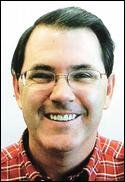
David Edwards

Edwards was involved in a two-car collision about 4:20 p.m. Friday on State Highway 31, about 2.5 miles west of Hubbard, according to the Department of Public Safety. He was pronounced dead at 5:20 p.m. at Hillcrest Hospital in Waco.

Investigators said Edwards was westbound on Highway 31 when his 2001 Explorer was struck head-on by a truck.

The driver of the truck is at Hillcrest Hospital and is said to be in stable condition.

Edwards is survived by his wife, Lyndy; daughters, Emily of Pennsylvania, and Kate Mullaney and her husband Brian; and a son, Evan, who is a sophomore at Corsicana High School.

Edwards and his wife were preparing to adopt two children from Taiwan later this year, a brother and sister. They were scheduled to leave Tuesday for a trip to Taiwan.

Visitation will be from 6 to 8 p.m. Monday, Oct. 12, at Corley Funeral Home, 418 N. 13th Street in Corsicana. A memorial service will be conducted at 2 p.m. Tuesday, Oct. 13, at First Baptist Church, Corsicana. Milton Cunningham will officiate, along with Logan Cummings.


-adapted from a report in the Corsicana Daily Sun


European Baptists ponder future of international seminary

PRAGUE, Czech Republic (ABP) — European Baptist leaders gathered in Prague, Czech Republic, Oct. 1-2 to discuss the future of the cash-strapped International Baptist Theological Seminary.

The seminary is owned and operated by 51 Baptist unions and conventions that make up the European Baptist Federation. The school has been hit hard by a weak dollar diminishing the value of gifts from the United States, rising maintenance and energy costs and a global banking crisis that has eroded endowment funds.

Leaders said finances could force IBTS to sell all or part of its campus in Prague, where it relocated from Ruschlikon, Switzerland, in 1995. The first preference is to remain on the current campus, a 19th-century estate renovated in the 1990s with the labor of hundreds of mission volunteers from the United States. But leaders said that will require significant cost cutting and increasing income, possibly requiring the appointment of a development officer.

If leaders determine the school must move, options are to either seek a more affordable site in Prague or relocate to another EBP partner union, possibly changing the language of instruction and accreditation.

Formed in 1949 to train pastors for southwest Europe, the seminary at Ruschlikon faced a financial crisis in 1991. The then-Foreign Mission Board of the Southern Baptist Convention ceased funding the school, claiming the teaching there was more liberal than what was being tolerated in the increasingly conservative SBC.

Facing rapidly increasing costs of operating in Switzerland, trustees voted to sell the campus and to move to a less-expensive location. With costs in Prague about half those in Switzerland, a sale price of more than $20 million allowed the seminary to move with only a bridge loan pending final payment on the Swiss property.

The relocated seminary took a new name, International Baptist Theological Seminary, along with a new vision. During the days of the Iron Curtain, Baptists in much of Europe were cut off from the rest of the world and denied opportunities for higher education. A new political climate allowed seminaries and Bible schools to reopen, but without a clear understanding of how they would be accredited and recognized as official Baptist institutions.

Long having had a smattering of Baptist students from Eastern Europe and now geographically located at the midpoint between Baptists in Eastern and Western Europe, IBTS in 1997 began focusing efforts on graduate studies and recruiting top graduates from unions and seminaries across Europe and the Middle East. The seminary awarded its first doctorates in 2007 and celebrated its 60th anniversary in 2008-2009.

The SBC defunding of Ruschlikon drew outrage from moderate Southern Baptists, prompting many churches at the time to redirect their mission gifts to the newly formed Cooperative Baptist Fellowship. Many SBC missionaries assigned to Europe switched to the CBF's new global-missions enterprise. Today IBTS is one of 15 seminaries, theology schools and Baptist-studies programs identified as ministry partners of the Atlanta-based CBF.

EBF representatives overwhelmingly affirmed the need for IBTS to continue but said serious issues remain about reducing costs and increasing income.

About 1,200 men and women — most from the United States and many from North Carolina — came to Prague at their own expense to repair dilapidated buildings on the seminary's new campus in 1994 and 1995.

Now, officials say, the cost of looking after historic buildings dating to early 19th century is starting to take its toll. Twelve years after renovation, the seminary now has capital needs to replace worn-out equipment. Utility costs have risen astronomically.

The Czech crown, meanwhile, is a currency of speculation and therefore very strong against the Euro and dollar, dramatically affecting the value of donations from Western Europe and the United States. A recent newsletter described the combination as "really quite critical."

The seminary houses one of the largest English-language theological libraries on the continent of Europe, with about 69,000 volumes. In 2008 IBTS was host to the annual gathering of the Baptist World Alliance.

A fund-raising campaign during the seminary's Diamond Jubilee in the 2008-2009 academic year raised the equivalent of about $75,000 in U.S. currency.


–Bob Allen is senior writer for Associated Baptist Press.


Evangelical group endorses immigration reform

WASHINGTON (RNS)—The National Association of Evangelicals has endorsed comprehensive immigration reform, saying new policies should reflect “biblical grace to the stranger.”

“We seek fair and human treatment for those who are immigrants,” NAE President Leith Anderson told reporters on Capitol Hill, shortly before testifying with other religious leaders at a Senate subcommittee hearing on faith-based perspectives on immigration reform.

The NAE board adopted the resolution as growing numbers of immigrants fill the pews of churches affiliated with his organization, which includes 40 denominations and scores of other evangelical groups, Anderson said.

“Many of the immigrants in America are us,” he said. “That is, the growing edge of evangelical churches and denominations in the United States is the immigrant community.”

The resolution, approved overwhelmingly by voice vote of the NAE board, calls for the government to safeguard national borders, recognize the importance of family reunification and establish an “equitable process toward earned legal status for currently undocumented immigrants.”

Asked for specifics of NAE’s suggestions about undocumented immigrants, Anderson said the process should be a reasonable one that might require, for example, undocumented immigrants to pay back taxes.

“We are not suggesting that those that are already in the United States without documentation are automatically granted either residency or citizenship status,” he said.

Samuel Rodriguez, president of the National Hispanic Christian Leadership Conference, commended the NAE for passing the resolution. He said it demonstrates that the issue is one that concerns not solely Latinos but a wide range of Americans, and represents a “Christian” rather than a political agenda.

“At the end of the day, immigration reform is an issue of justice firmly grounded on biblical truth,” he said.


City Reach 2009 offers hope to Houston

HOUSTON—When the Baptist General Convention of Texas holds its annual meeting in any city, participants hope to leave the community in a better spiritual and physical state than before it came. And the convention’s attempting to do just that through City Reach, a series of evangelistic events geared toward sharing the hope of Christ with the people of Houston through prayer, care and share efforts.

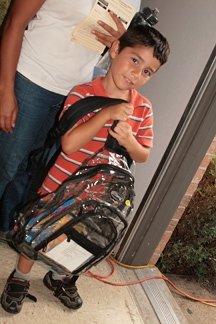
Members of Templo Bautista in South Houston embraced friends and neighbors with a back-to-school fiesta as part of City Reach.

Reach is focused on partnering with Houston churches to host evangelistic endeavors, attempting to reach the 2 million unchurched people in the area with the gospel.

“When we go into the city with a convention of Christians, we need to leave the city better than we found it,” said Jon Randles, BGCT evangelism director.

“One way we do that is to go in and help reach the community for Christ.We basically are trying to help all our churches and leaders realize that if they will be intentional about evangelism, build trusting relationships with the community, then hold a variety of events and bath it in prayer, they will see results.”

To reach out all types of people groups and cultures in Houston, City Reach volunteers are partnering with Street Life Ministries, Bill Glass Champions for Life, Real Life Outreach and Hope House to share the hope of Christ through hurricane relief, a multicultural fair, a medical clinic, block parties and an extreme sports youth rally.

As an early CityReach event designed to meet community needs, Templo Bautista in South Houston sponsored a back-to-school fiesta.

Although the majority of events will take place between a two-week period before Annual Meeting, some efforts began in September with back-to-school outreaches. Through these efforts, 81 people began a relationship with Christ.

“Much of City Reach is based on event evangelism, but they are based on building relationships,” Randles said.

On Nov. 1, Baptists will come together for a prayer rally to energize believers around the city to participate in the City Reach events leading up to annual meeting.

City Reach also will include ministry to school-age children as the youth evangelism team brings Real Encounters Outreach to schools in the area. A team of extreme sports athletes will lead a three-day program in several public schools, inviting students to attend a rally on the last night where the gospel will be shared.

Templo Bautista provided families backpacks filled with school supplies. (PHOTOS/Courtesy Templo Bautista South Houston)

Bill Glass Champions for Life also is helping Texas Baptist minister to those incarcerated in Houston prisons. The organization leads Christian pro athletes into prisons to host an entertaining program while share the gospel in the process. Volunteers partner with the athletes and become counselors for the event. This weekend endeavor is expected to be the largest on in Bill Glass Champions for Life history with goal of working beside several hundred volunteers and churches.

Participants will receive evangelism training on the night before the event and then work alongside the organization to minister in the prisons the following two days. Champions for Life will be taking a similar program into public schools the week before annual meeting in hopes to reach students with the gospel as well.

City Reach will not be able to make an impact on the Houston area unless Baptists from all over Texas become involved in the planned projects, Randles said.

“Most pastors and churches want to reach their communities for Christ but they don’t know how to build relationships or make an impact,” Randles said. “City Reach is teaching them how to do things in the community to share Christ with the lost. It’s about training people in evangelism, walking beside them and then giving them a chance to share how Christ has changed them.”

Volunteers are still needed to help with the array of City Reach projects taking place. Learn more about City Reach events by calling the BGCT Church Evangelism office at (214) 828-5126 click here or sign up to help with one of the projects.


Intercultural Christians in Texas have passion to reach people in homelands

DALLAS—Intercultural Christians know the language and customs to connect with their own people. And the Baptist General Convention of Texas is giving them an opportunity to use their knowledge to share the gospel with a culture they know inside and out.

Sudha Jayaprabhu (left) stands with one of the church planters trained through the funds she received from the Intercultural Strategic Partners. Jayaprabhu was able to spend three months in her native country of India training seven pastors. Through these efforts, 49 villages in the area will hear the gospel this semester. (PHOTOS/BGCT)

Many intercultural Christians in Texas have a passion to reach their own people back in their native lands. The BGCT Intercultural Ministries is helping to make that possible through a new Intercultural Strategic Partners initiative.

After nearly three years of planning, the BGCT Intercultural Ministries office and a board of seven intercultural pastors ministering in Texas formed Intercultural Strategic Partners.

With $65,000 allotted from worldwide church-directed cooperative giving, the BGCT launched the initiative to provide support for the work of indigenous Christians.

“It is high time we start trusting local missionaries and raising indigenous missionaries from local people due to the financial cost and the time,” said Bedilu Yirga, pastor of the Ethiopian Evangelical Baptist Church in Garland and a board member of Intercultural Strategic Partners. “We have an urgent message to share. With indigenous missionaries, you don’t have to spend the time to teach culture.”

Patty Lane, director of BGCT Intercultural Ministries, said Intercultural Strategic Partners is about backing intercultural leaders and letting them use their knowledge, ingenuity and connections to further the gospel in their homelands.

A core group of believers stands by the church planter (center). They became followers of Jesus through the church planters work and will serve as a nucleus for new churches in the area, according to Patty Lane, director of BGCT Intercultural Ministries. (PHOTOS/BGCT)

“It’s really about connections and indigenous strategies,” Lane said. “We are letting the indigenous leaders living here in Texas call the shots. What they go and do matches with what the local group needs. It’s about connectivity. The connections are already there. It’s a matter of seed money and a person who can bless and validate the work there in their home area.”

Since the beginning, Intercultural Strategic Partners has funded seven projects involving church planting, church planter training, orphan relief, medical missions and community development and education in Africa, South East Asia, South Asia and Eastern Europe.

In May, Intercultural Strategic Partners approved funding for Sudha Jayaprabhu, an Indian Christian living in North Texas more than 20 years.

Jayaprabhu spent the summer in her hometown in India encouraging seven national pastors and training them in church planting. Each pastor will minister to seven villages, working to share the gospel by starting core Bible study groups.

Intercultural Strategic Partners funding helped with the training, as well as providing bicycles for the pastors so they can travel from village to village sharing the gospel and encouraging other Christians.

These three people became followers of Jesus through a church planter trained by Sudha Jayaprabhu (not pictured) to be part of a seven-person core group that ministers to 49 villages in their home area of India. Now they are part of a core group that helps one of the church planters share the gospel with villages in their area. (PHOTOS/BGCT)

Yirga and his church also received funds from Intercultural Strategic Partners to help with church planting and community ministries in his home county of Ethiopia. Through Yirga’s connections and networking with ministries and pastors there, he is able to support and train 23 indigenous missionaries for only $60 per person per month.

“It’s very much encouraging, because we are receiving reports from the field,” Yirga said. “It is a blessing to hear that so many people heard the gospel for the first time, and we have people committing their lives to Jesus. We want to be culturally sensitive to the work out there and to engage ethnic churches in mission work and to be good stewards of what we have been given.”

Yutaka Takarada, pastor of the Japanese Baptist Church of North Texas in Dallas and an Intercultural Strategic Partners board member, agrees the new initiative is helping further and improve ministry that is already in place in their home countries.

“Some of the leaders from different countries are already working with the people from their countries, like starting churches or sending missionaries or educating pastors in that country,” Takarada said. “The ISP enlarges the ministry we already have done (in a few places) because we can do more with the financial support of the ISP.”

To receive support from Intercultural Strategic Partners, individuals and churches must complete an application to state their intentions for the funding. Qualified projects must be focused on growing the kingdom of God, be connected to a BGCT-affiliated intercultural church, involve local Christian leadership in an indigenous setting, be within the financial capability of Intercultural Strategic Partners and state an accountability process.

Once the application is submitted, the board meets once a month to discuss the proposed project. The board does not vote on the endeavors but continues discussion until a consensus is made. Lane said this approach has allowed the Holy Spirit to guide the group’s decisions in the best way possible.

“It helps us be more sensitive to God’s leadership and build trust with others in the group,” Lane said. “It’s done more on a relationship basis than a time-efficiency basis. We need to build the relationships and that helps us be effective as a group.”

Current projects deal with intercultural individuals and churches partnering with indigenous believers, churches and missionaries in their home countries. The board would like to see intercultural churches as well as Anglo churches taking advantage of the wisdom and cultural knowledge that each congregation possesses to form cross-cultural ministry projects.

“ISP links cultural knowledge and missional strategy to change the way we think about and do missions,” Lane said. “Creativity in strategy and innovation in networking are proving that even very limited financial resources in the hands of the right people will change the world. I hope that every intercultural church that has a heart and passion to reach their people around the world knows they have a friend at ISP.”

To learn more about Intercultural Strategic Partners, contact the BGCT Intercultural Ministries office at (888) 244-9400.


Linked by breast cancer battle, Wayland employees forge bond

PLAINVIEW—If you ask Beverly Steed or Debbie Parker who has been one of their biggest help during their ongoing struggles with breast cancer and they would likely name each other.

Ironically, the two have never met in person. They work on Wayland Baptist University campuses 460 miles apart. But that didn’t keep Steed and Parker from developing a tight friendship and support system across the state as they encouraged each other on the journey toward wellness.

Beverly Steed works as an assistant to the athletics department at the Laney Center on Wayland Baptist University’s Plainview campus. (PHOTO/Courtesy of Pamra Culp, Rolls of Fun Photography, Lubbock)

Parker, who works as office manager for business and financial aid for Wayland’s San Antonio campus, was diagnosed in August 2008 with breast cancer, discovered in an enlarged lymph node. After a lumpectomy, she started chemotherapy and later underwent a bilateral mastectomy, finding out later there was cancer in the right breast as well.

With the tough road ahead of her, early on in the journey Parker asked for Wayland to include her on the employee newsletter prayer list circulated to all system employees across seven states. Right about that time, Steed was waiting on results of her own biopsy, with breast cancer later diagnosed.

“When I saw the listing for Debbie, I was compelled to write her immediately. I think it was God telling me to write her right then,” recalled Steed, who is the administrative assistant for Wayland athletics.

Steed sent a quick e-mail to Parker, telling her about her own situation and offering her prayers. That was the first of many correspondences between the pair as they have laughed, cried and encouraged each other over the past 16 months. The distance doesn’t seem to deter the friendship. Cards and letters, e-mails and packages travel both directions as part of the sunshine the two try to shed on each other.

Steed recalled an e-mail Parker sent a few days before her surgery that included a prayer for God’s angels to surround the surgeons during the procedure. Steed printed the note, took it with her to the hospital and found immense encouragement from her friend’s words.

Parker and Steed have been able to share information, advice and experiences with each other. Steed’s bilateral mastectomy actually came a month before Parker’s, so she was able to tell her frightened friend what to expect.

On the flip side, Parker had already experienced some of what Steed faced, so she was able to offer her fresh perspective. Though both women say they have supportive friends, family and coworkers in their lives, they noted something special about the bond with a sister who is traveling the path at the same time.

“Throughout this, we’ve sent each other cards and notes, and it just seems like every time I needed to hear words of encouragement, I’d go to the mailbox and there would be a card or an e-mail from Debbie,” Steed said. “It’s like we were holding each other’s hands through this whole thing.”

Debbie Parker works at the San Antonio campus of Wayland Baptist University. (PHOTO/Deanna Spruce, Wayland San Antonio)

“Beverly sent me a book called Cancer and the Lord’s Prayer, and I have ordered a few myself to give to people I know going through the same thing,” Parker said. “It was no accident that we met. God planned that. I really believe that.”

The journey is not completely over for either Steed or Parker. Steed went through chemotherapy first, and her mastectomy uncovered many lymph nodes that were cancerous. She finished up six additional months of chemo at the end of August and is waiting for radiation, although she recently received word that the cancer seems to be in remission.

After her mastectomy—performed five years to the day after her mother underwent the same procedure—Parker went through radiation and is now doing chemo and hormone therapy while waiting for reconstructive surgery. Both remain optimistic, fueled in large part by their friendship and by their strong faith.

“Once you have sat in an office and someone has told you ‘you have cancer,’ you look at life totally different than you ever have before,” Parker said. “Although I was a Christian, God has really changed me in this last year.”

Steed shares that sentiment.

“I didn’t get a personality transplant, but he has changed me. I’m a lot more patient; things that were bothering me ceased to matter anymore… immediately,” Steed said. “I’m not a hero and am very uncomfortable when people say I’m strong or brave, but I just say that God did it.”

Both indicate that experiencing cancer changes one’s perspective on life and what is truly valuable.

“You know the things that are the most important in your life. You just have to trust in the Lord. And, hopefully, you have lots of friends that are praying for you and lifting you up,” Parker said.

The pair also lauded their Wayland family, from student athletes to administrators, for being so supportive during their hardest times. Steed noted she continued to work as much as possible during her cancer journey because of the encouragement she found on the job.

And both say the experience has made them champions for breast health and preventive measures that may lead to early detection and a higher survival rate. They stress the importance of mammograms for women they know, and Steed says she preaches regularly to the female athletes at Wayland the value of self-exams while they are younger.

Steed and Parker believe they one day will be able to meet and share a physical hug to match the emotional ones they’ve shared over the past year. And even though their cancer journey will someday end, they believe their friendship will remain true.

“We probably never would have met otherwise,” Steed said. “Now we can say that we’re friends and have blessed each other on this journey we never wanted to go on.”


Venezuelan spends three months in church-planting effort in Laredo

LAREDO—Since Venezuelan Baptist Patrick Weller began serving as a missionary eight years ago, he’s taught at a mission school in Venezuela, ministered in Germany and planted churches in Argentina. But he never thought the next step in his journey would take him to South Texas.

For three months, Weller labored under the direction of Mario Garcia, River Ministry coordinator and Laredo Baptist Association director of missions, to take part in church planting, lead Vacation Bible Schools and encourage believers in Laredo.

As part of a relationship between the Baptist General Convention of Texas and the Venezuelan Baptist Convention through Texas Partnerships and the River Ministry, Weller served as the first Venezuelan to take part in the evangelistic work happening with Spanish-speaking ministries in Texas.

Patrick Weller of Venezuela worked with Laredo Baptist Association three months in church planting.

In 2008, Texas Partnerships committed to send teams to work with Venezuelan outreach events during the next three years. Venezuelan Baptists also committed to take part in evangelistic efforts in Texas.

Plans for Texas Hope 2010 

“The Venezuelans are serious about the reciprocating nature of our relationship,” said Steve Seaberry, director of the BGCT Texas Partnerships. “We are currently working on plans for Venezuelans to come help with Texas Hope 2010,” the Texas Baptist emphasis to share the gospel with every Texan by Easter 2010.

At a national Venezuelan Baptist meeting, Weller became aware of the convention’s commitment to help in Texas, but he had no desire to leave his ministry in Venezuela at that time.

“There was a national convention in Venezuela, and they said they needed help in Laredo,” Weller said. “It was not in my plans to come here. At the time, I was helping with a church with some missionaries in Venezuela. We prayed together, and I felt that this was from God—an opportunity to help this area.”

Since Weller served as the intercultural mission director and taught classes at a mission training school in Anaco, Venezuela, he needed to find someone to cover his duties while he was away in addition to raising support for the Laredo endeavor.

"God confirmed everything" 

“God confirmed everything,” Weller said. “I felt peace in the decision even though I had a lot of things to do there in Venezuela. God helped me fill up the training in different ways, and I had a few friends in Venezuela and two churches that chose to support me.”

Weller then traveled to Texas in June. Even though he was from a Spanish-speaking country, he had much to learn about the culture, climate and colloquialisms of Laredo once he arrived since the majority of the Spanish-speaking population was of Mexican heritage. But through God’s help, he conquered the learning curve and was able to minister to many people in the area, he said.

“Because I’m from another country, especially another country where people know about our president and the petroleum, God used that to open doors to meet people, to share,” Weller said. “I love opportunities to speak with different people.”

Weller’s main duty was to encourage the seven members of Discipleship Ministry, a Bible study that ministers to Los Presidentes, an area of Laredo without any churches. Through Weller’s leadership and the hard work of the members, the group grew to more than 30 people and is now considered a church plant.

Growth began in outreach to children 

Much of the group’s growth and progress spurred from outreach to the children in the area. Gracie Roath, a member at Discipleship Ministry who opened her home and allowed Weller to stay with her family during his time in Laredo, said she has seen many beneficial changes in the children who attended the Vacation Bible School at their home during the summer.

“We have a lot of changes in the children’s lives as far as they are more loving and more open to discuss their life at home,” Roath said. “They’ve changed in the aspect as some children had issues with anger and depression, and they are now so alive. Even if there isn’t a Bible study going on, the kids want to come over.”

In addition to his work at the church plant, Weller worked with visiting summer mission teams and preached at various Hispanic churches each Sunday and Wednesday.

“He showed us a whole lot about the way of mission work is to be done,” Roath said. “He would go out and minister to people, feeding some families and preaching at some churches. It just motivated us to want to do God’s work.”

Roath and her husband, Donald, assumed the church planting work when Weller returned to Venezuela at the end of August to resume his duties at the mission school. Garcia also shared his hopes that Weller’s time spent in Laredo encouraged him and will help his ministry in Venezuela.

“Whatever experience he had here, he can do there in Venezuela,” Garcia said. “I know Laredo is different. The culture is different, but I hope that his time here three months will encourage him to do this where he is. It takes a lot of effort, a lot of dedication, a lot of time to do what he has done. And I think he learned from those experiences.”


Texans plant one-of-a-kind church in Pacific Northwest

PULLMAN, Wash.—Leaders of Resonate Church in Pullman, Wash., believe church planters should never underestimate the power of genuine relationships, prayer, creativity—and good coffee.

Resonate Church, a congregation in Pullman, Wash., planted by Texas Baptists, offers ministries to students at Washington State University and the University of Idaho. (PHOTOS/Danielle Gallup)

Resonate Church has no permanent building—just three trailers filled with audiovisual systems and dozens of plastic buckets that transport everything needed to set up for worship. Leaders conduct worship in two cities on either side of the Washington/Idaho state line.

Most church business is conducted in a coffee shop. An illusionist, geologist, teacher and musician make up half of the staff, and all of the church’s deacons are under age 35.

Instead of going through a membership class, newcomers to the congregation go through an “ownership” class. And many of those new members are college and graduate students.

Resonate Church in Pullman, Wash., grew out of the vision of Paige and Keith Wieser, graduates of Stephen F. Austin State University in Nacogdoches.

Together with two East Texas Baptist University graduates—Josh Martin and Drew Worsham—and a couple of Washington State University graduates, the small group prayed for and helped to plant the church just two years ago.

In 2008, Resonate launched a second service in Moscow, Idaho. Matthew and April Young from Nacogdoches came aboard staff to shepherd the Moscow site.

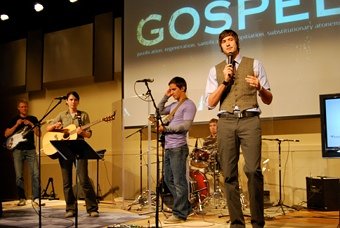
Creative Arts Pastor Drew Worsham (with mic) and Worship Pastor Josh Martin (on guitar)—both graduates of East Texas Baptit University—welcome worshippers to Resonate Church in Pullman, Wash.

The Southern Baptist Convention’s North American Mission Board provides some funding for most of the Resonate staff. Several Texas Baptist churches—primarily Central Baptist in Livingston, First Baptist in Crosby, First Baptist in Nacogdoches and Heights Baptist in Alvin— also support the church’s mission.

Washington is one of the top two unchurched states in the nation, according to the Southern Baptist Convention’s North American Mission Board. More than 19,000 Washington State students live in Pullman, and another 12,000 students live a few miles down the road in Moscow, where they attend the University of Idaho.

This unchurched generation is waiting on God’s love to be demonstrated, Pastor Keith Wieser believes.

Resonate is on mission to reveal the story of Jesus in a powerful and meaningful way to college students—not through systems or programs, but through authentic relationships in an inviting community.

Essentially, Resonate Church relaunches every fall when the school year begins.

Pastor Keith Wieser—a graduate of Stephen F. Austin State University in Nacogdoches—preaches at Resonate Church in Pullman, Wash.

After the church served both campuses for a week by offering barbecues, concerts, magic shows and free breakfasts, about 300 students showed up the first Sunday to find out more about Resonate.

“This is my first time to ever attend a church service,” one girl commented. The experience radically changed her preconceived notions about church, she added.

“Jesus does not have to be made relevant for a new generation and mindset. He already is,” Wieser said. “We seek to find ways to communicate and interpret the unchanging and authoritative truth of the Bible into the mindset of this generation.”

Intentional, compassionate relationships draw people, Resonate members note.

“If you come to Resonate, you can not slip out the backdoor or go unnoticed. People sincerely want to know your name and your story,” Kate-Lynne Logan said.

Resonate small groups meet in homes and are called villages. After enjoying a home- cooked meal, a village provides a safe environment where small-group participants wrestle with difficult questions and engage in spiritual dialogue.

Ten villages meet each week, with specific villages geared toward particular affinity groups such as college freshmen or international students. Resonate desires for 80 percent of the people who attend worship on Sunday to be involved in a village.

“The backbone of Resonate is how village functions,” Wieser said.

In villages, participants can move to a deeper level in their relationship with God and each other, Jessica McFaul noted.

“You get to dig deep into the sermon, meditate on the biblical principles presented on Sunday, and encourage one another to practically live out God’s plan for your life. It is a rare treasure,” she said.

Revealing biblical relevancy, missional living, authentic community and ongoing spiritual discovery are core values of Resonate.

“The reason I carve out time to be involved in Resonate is because it is a God- based community that makes an effort to draw people in and show them what following Christ can look like,” said BrynnWhitman, who has attended the church since its launch two years ago. “The church as a whole exudes love for people and the people who make up the church support, encourage, and inspire me to trust Jesus unreservedly.”


Camp introduces at-risk youth to a world of opportunity

BROADDUS—Telvin never had spent so much time away from city life.

For the 16-year-old Port Arthur resident, both home and the problems that consume him daily seemed erased from reality—if only for a moment.

At-risk youth from Southeast Texas enjoy getting away from the distractions—and negative influences—of home while enjoying activities such as a slip-and-slide at Opportunity Camp, a ministry of Golden Triangle Baptist Association.

Just minutes after his experience on a ropes course, Telvin wore a wide smile as he stood among pine trees during the three-day Opportunity Camp at Pineywoods Encampment in Broaddus.

“Out here you don’t have any bad influences. You don’t have anybody pressuring you,” Telvin said. “You don’t have any weed. You don’t have any beer. You don’t have any of that. You just have freedom and life.”

Opportunity Camp is a weeklong camp Golden Triangle Baptist Association has sponsored more than four decades for at-risk youth. This year’s camp drew 21 boys and 16 girls.

All but three of the boys were on juvenile probation, and almost all of the campers carried a similar story to Telvin’s, having never experienced much time apart from home and the distractions of the streets.

“It’s comforting because you don’t have to worry about a lot of things out here,” said Jannet, 13, of Bridge City. “It’s like a place you’ve always wanted to be, and you just want to stay.”

Along with outdoor activities such as canoeing, fishing, swimming and pickup basketball games, the campers took part in a Christian rap concert, worship services and devotionals.

Seven boys and five girls made professions of faith.

For 17-year-old Willie, that decision came in the waning hours that Tuesday—the final night of the boys’ camp. Willie, who lives in Beaumont, said he had never felt so free.

“It’s like something you see in a movie,” he said.

Getting to that point didn’t come without battles, and Willie’s counselor Mark Beard saw plenty of doubt before promise.

“Tuesday night when we got back to the room he was talking attitude, and I was fixing to just ignore him and let it go,” said Beard, 52 of Nederland. “But I said, ‘No,’ and pulled my chair over in front of him. We got to really talking, and he ended up getting saved.

“He was probably the most excited person I’ve ever had getting saved. He was out the next morning telling his friends he had gotten saved and what a load it was off his shoulders.”

That moment almost never came.

Just weeks before camp was scheduled to start, the Golden Triangle Baptist Association lacked the funds to offer the weeklong camp.

Dion Ainsworth, the association’s director of ministry evangelism, said at that point, having both a boys’ and girls’ camp was not possible financially. But a $5,000 grant from the Mary Hill Davis Offering for Texas Missions, along with other donations, made the camp a reality.
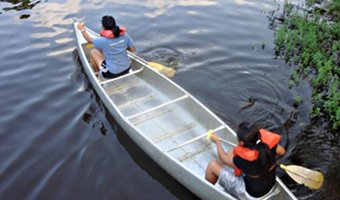
Girls from inner-city neighborhoods in the Beaumont/Orange/Port Arthur area enjoy outdoor activities like canoeing at Opportunity Camp, a ministry of Golden Triangle Baptist Association.

For the first time in the camp’s 45-year history, two former campers stepped into roles as camp counselors this year.

Vy Nguyen is one of those former campers. The 20-year-old Port Arthur resident began attending Opportunity Camp when she was 9, and she accepted Christ her first year at the camp.

Nguyen—who was brought up in a Buddhist home— had no other church outlet or escape from the confusions of life. She became a camp mainstay the next seven years.

She began volunteering as a camp helper in 2006 and was a group counselor for two girls this year.

“Opportunity Camp really got me in touch with God, and I feel like God used that to put people in my life,” Nguyen said. “If I hadn’t gone to Opportunity Camp, I would be so confused, and I don’t know that I’d be a Christian.”

Nguyen has seen both sides of the road, and she feels a connection with the campers.

“The girls that are there, I know where they’re coming from, and I feel like I can talk to them,” she said. “Opportunity Camp is not for everyone, but I feel like I can relate to it. I think it’s very unique, very effective and very personal, and every year I can feel God working. There is always spiritual warfare, but God is victorious every time.”

Tammy Huynh also made the transition from camper to counselor as she attended the camp as a 16 year old in 2007 following an invitation from Nguyen.

Huynh, who is now 18 and also lives in Port Arthur, was raised in a Buddhist family, but it didn’t take long before Christ entered the equation.

“I was just lost and felt like I had nothing to lose,” said Huynh, who made a profession of faith as a camper. “The people around me, counselors and helpers, gave me a positive vibe and I wanted to be like them.

“Camp is like fresh air to me. I love the environment, and I feel very good when I learn that someone has been saved. Volunteering is something I now love to do, and I can still see myself at this camp 10 years from now.”

Most of the camp’s counselors, in fact, have volunteered more than a decade.

Beard is among that group, having been a counselor the past 12 years, and he can’t remember a camp where one of his boys didn’t accept Christ.

“Seeing them accept Christ is the most exciting and most positive thing,” he said, “Also, you see them come in all mean and complaining with attitudes, and by the second day they’re playing and acting like kids.”

What drives Beard is the hope that each teen will see a better way in life—a new path to take.

Cameron, a 15-year-old Beaumont resident, was one of those teens this year. Far removed from his usual environment, Cameron spoke intensely of following the lessons the camp had taught him.

Just one day into a camp of first-time experiences and slightly more than 24 hours away from heading back home, Cameron was determined to cross the bridge from a life of dead ends to one with a new beginning.

“I’m going to change my surroundings, the people I’m around and focus on the prize,” he said. “You can’t keep on doing the same thing, because if you always do what you’ve always done, you’ll always get what you’ve always gotten. If I keep on doing what I’ve been doing I’m going to keep getting what I’ve already got—behind the walls.

“That’s not what I want. I’ve got big dreams and I’m not going to let anybody stop me.”


Jared Ainsworth is a journalism student a Lamar University in Beaumont and a longtime volunteer at Opportunity Camp.


One woman’s enthusiasm for shoebox project becomes contagious

BAILEYVILLE—Nettie Hyde has it and has given it to everyone she knows. No, not H1N1 flu, but a fever for Operation Christmas Child.

Hyde first heard of Operation Christmas Child in 2003 and promptly packed her first shoebox for a child.

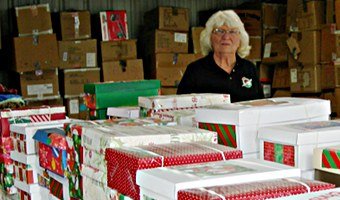
For Nettie Hyde, Operation Christmas Child is a year-round affair. Watch a video about her efforts here.

“After I packed it, I told my husband, ‘Let’s lay hands on this box and pray for the child that’s going to receive it,’” she recalled.

The next year, she and the Woman’s Missionary Union leader for her church, First Baptist Church in Rosebud, attended an Operation Christmas Child rally in Temple, and that was when her enthusiasm for the program became contagious.

“That day, I received my calling, and I hit the ground running. I haven’t stopped since,” Hyde said. “I can’t begin to say what it’s meant to me. I can’t describe how close my walk with God has grown with this.”

At her church in Rosebud, started rallying the troops. In 2004, members of First Baptist in Rosebud packed 121 boxes. The next year, with a whole year for Hyde to stir the masses and with Rosebud named a relay center, the town collected 1,073 boxes.

In 2006, Rosebud collected more boxes as a relay center than it has people—with a population of about 1,500 and 1,614 boxes gathered.

Last year, Hyde packed 501 boxes of the 2,098 collected herself.

This year, she has packed 1,006 boxes, but she has now stopped so she can work more on raising the $7,042 it will take to ship them.

“It’s amazing how God has blessed and is still blessing,” Hyde said.

For her, Operation Christmas Child is a year-round affair.

“I work on it some every day. I don’t feel like my day is complete if I don’t,” she said.

Her personal goal of 1,000 boxes for this year was something she kept to herself.

“I kept feeling like I was to do 1,000 boxes, but I wouldn’t tell anybody because it didn’t seem like reality,” she explained.

The task of raising the money for shipping is a big one, but she has found creative ways to do it. A man who owns a plant nursery in nearby Wilderville has either sold Hyde plants at a heavily discounted rate for her to resale or simply donated plants at no cost to her.

In addition to the plant sales, Hyde convinced her husband to construct a building she has dubbed Nettie’s Thrift Shop. The white building with red and green trim houses things people have given Hyde to sell. Some are handcrafted items such as paintings, and others are of a traditional garage sale variety, but 100 percent of the sales go to Operation Christmas Child.

Hyde also is quick to point out she has help finding the items to fill the boxes. Two women with a knack for finding bargains on small items for the boxes constantly are bringing her what they discover, she said.

All those boxes and the items to fill them have taken over the Hydes’ garage to the degree that no vehicle fits.

The task of wrapping all those boxes has not fallen on Hyde alone. First Baptist Church in Rosebud has Christmas wrapping days so that everyone can have a part in the ministry.

One woman has made hundreds of knit caps to include in the boxes. Others have made numerous bead necklaces and bracelets.

“It takes so many people helping in so many ways,” Hyde said. “I just want people to help in whatever way they feel led.”

The boxes not only have been life-changing for the children who receive them, but also for many of the people in Rosebud. For example, the mayor feels it to be his civic duty to help load the boxes into trucks every year.

But there have also been more eternal changes seen. A few years ago, a 16-year-old girl took two-dozen boxes home to wrap. Along with them was an Operation Christmas Child brochure that told how the boxes would be given to orphans around the world. The girl’s mother was a Muslim from Ghana, and she had seen first-hand the suffering of children in her homeland.

She was moved to help her daughter wrap the boxes. Before taking them back, the girl filled 20 of them, using money she collected at her birthday party in lieu of presents. Her mother filled the others.

That year, First Baptist, Rosebud, sold cookbooks to help finance the shipping of the boxes. On the back page of the cookbook, the girl told the story of her mother’s help and prayed for her mother to find Christ.

In March of this year, her mother accepted Jesus Christ as her Savior. And she has filled 200 boxes herself this year.

Passing on the Operation Christmas Child bug is just what Hyde wants.

“I’m 78, and I won’t be doing this forever. But I hope when I get to heaven that God will let me look down and see people packing shoeboxes, because it has been such a blessing to me,” she said.


Churches show love to poor children through shoebox gifts

TEMPLE—Glinda Harbison has been passionate about Operation Christmas Child since she first heard about it, and that passion has only grown stronger over the years.

Operation Christmas Child is a Samaritan’s Purse ministry that seeks to spread the love of Christ to impoverished children around world through a shoebox full of small gifts at Christmas. Participants are urged to pray over the boxes that the gift might communicate that God loves them.

Lanita Murray (left) and Maye Rea, both from Immanuel Baptist Church in Temple, pack boxes for Operation Christmas Child. (PHOTO/Courtesy of Immanuel Baptist Church of Temple)

Since its inception, 69 million boys and girls in more than 130 countries have had the gospel shared with them in this way, the vast majority of the children living in orphanages.

After hearing Franklin Graham speak about the nascent program at a meeting in Nashville in 1993, Harbison returned to Immanuel Baptist Church in Temple on a mission.

“I had never told one of our pastors, ‘We are going to do this.’ But I went into our prior pastor’s office and said: ‘We’re doing this. I’m not asking permission. We’re doing this,’” she recalled.

That first year, Immanuel’s congregation packed 35 boxes. “I was just beside myself,” said Harbison, who now serves as the church’s hospitality director.

Last year, people within the church brought 774 boxes to send to children around the world.

This is Immanuel’s second year to serve as a collection center for a number of Central Texas relay centers. The relay centers collect boxes from individuals and churches. Immanuel will take the 8,000 boxes it expects to receive from the surrounding churches and see that they are trucked to Denver for preparation for distribution to children around the world.

Most churches will observe Nov. 16-22 as their collection week. Many will bring their boxes to the collection center on Nov. 22, and the boxes will leave for the distribution center on Nov. 23.

“Some of our people are going to follow the boxes to Colorado and go to the distribution center to help out there,” Harbison added. “They’re simply going to finish what they’ve started.”

Volunteers will open the boxes and take out the $7 needed to pay for the shipping of each box. They also will give it a quick look to see if the contents dictate it go to a warm or colder climate. For example, if someone has knitted a wool cap to include, that box will be sent to a child in a cooler climate.

“The integrity of box is never compromised, because we’ve asked people to pray over the contents of that box,” Harbison explained.

Wayne McDonald will be among the volunteers who make the trek to Colorado.

OCC Logo “I’ve been involved with OCC since Immanuel Baptist Church first started doing it,” he said. “It’s a great thing to do. You spread the gospel and spread a little cheer for a little while—maybe longer than a little while.”

Spreading cheer while spreading the gospel was exactly what first attracted Harbison to Operation Christmas Child.

“I loved the idea of giving a gift to a child who has never received a gift,” she said.

She gained a new perspective about the program, however, on April 19, 1995. She was at a children’s conference and was next to a table of children’s workers from Oklahoma City when they learned of the bombing of the Murrah Federal Building.

“I made a commitment that day to myself that our church would continue to be involved with this ministry because we never knew—and we’ll never know—whose hands these boxes go into,” Harbison said.

It occurred to her that a child who might grow up to be a terrorist after being taught to hate Americans might question those teachings through a box filled with love.

“It may change a life for forever. It just hit me that day the importance of these boxes,” Harbison said.

Children who receive the boxes also are given the opportunity to make a profession of faith and then follow through with a 15-week discipleship course.

“It’s not just sending a shoebox,” Harbison explained. Professions of faith were recorded for 750,000 children last year through Operation Christmas Child.

Last year, a man at Immanuel was deeply moved by an Operation Christmas Child video about a Bosnian girl who contemplated stepping on a landmine to end her life, but a pair of tennis shoes in an Operation Christmas Child gave her the hope to keep living, Harbison recalled. Inspired by her story, the man provided 50 pairs of shoes last year. This year, he has given her money to buy 150 pairs of shoes.

“Once you become a part (of Operation Christmas Child), you realize how passionate people can become—not just about a simple shoebox, but the end results of that shoebox,” Harbison said.


Juarez violence points to continuing need for prayer by Texas Baptists

Unabated violence in the border city of Juarez underscores the continuing need for prayer by Texas Baptists, said a Tyler physician who is seeking to mobilize a statewide response.

Various news sources have reported the number of people killed in Ciudad Juarez this year by mid-September had topped 1,600—more than in all of 2008. Many of the homicides have been drive-by shootings and gangland-style killings associated with drug cartels.

And many of those deaths hit close to home for Baptists in Juarez, said Dick Hurst, a medical doctor from First Baptist Church in Tyler who is spearheading a statewide effort to link Texas Baptist congregations to sister churches in Juarez.

“I received an e-mail reporting that nine young people in three of our churches in Juarez were murdered recently,” he said.

Earlier this year, representatives from the Baptist General Convention of Texas, the Cooperative Baptist Fellowship, Buckner International, Baylor University and several churches met to explore ways Texas Baptists can respond to the needs of churches in Juarez.

The group agreed to seek Texas Baptist churches to enter a relationship with each of the 44 Baptist churches in Juarez. They also agreed to look for ways Texas Baptist schools could help the churches in Juarez with leadership development.

So far, between 30 and 40 Texas Baptist churches have agreed to become sister churches with congregations in Juarez, Hurst reported. Some large Sunday school classes also have expressed an interest in developing an ongoing relationship with a small Juarez church, he added.

Pastors in Juarez received an initial box of Texas Hope 2010 multimedia compact discs with gospel presentations and Scripture, made possible by the BGCT, he noted.

One pastor, who only received 30 CDs, noted it would not begin to be enough to distribute on the city’s streets, Hurst said. “So, his church established discipleship groups in homes. They are using the CDS in those groups as people work their way through them over 10 weeks,” he said.

For more information about the sister-church program with Baptists in Juarez, contact Hurst at crbhurst@hotmail.com .