Coaches have potential to teach Christian understanding of life

ABILENE—Christian coaches are in a position to teach far more than Xs and Os, a Hardin-Simmons University professor believes.

Bob Moore, professor of fitness and sports science, considers sports fallow ground for teaching Christian principles.

“Within sport, you have many opportunities in which to help people develop a Christian understanding of who they are, and I think that’s what we all have to strive to do—try to realize why we are on the face of the earth,” he said. “I think through sport, you can teach somebody great lessons about that.

{youtube}ios-TE9hNto&hl=en&fs=1&rel=0{/youtube}
HSU professor Bob Moore explains why sports presents opportunities for "teachable moments."

“There are so many teachable moments within sport that, as coaches, you can try to instill within players characteristics such as self-sacrifice, sportsmanship, work ethic, honor and respect.”

While Moore at one time was a high school basketball coach, now his coaching focuses on three of his five children and their teammates. Two more still are a little young for team sports.

“I think it’s a little easier to form their philosophies during those formative years, but, of course, I think we can help them develop their understanding of who they are as Christians at every level,” Moore said.

A key to making a difference as a Christian coach, however, is for the coach to have his own life in proper perspective, he cautioned.

“First of all, the coach has to make sure they have a proper understanding of their own Christian philosophy, because I believe you can’t give what you don’t have.

“That’s the first step—to be reflective as a coach and determine what your purpose in life is. If you understand that your purpose in life is to help build up the kingdom—which is what Christ called us to do, to help him in doing that—then I think the coach understands he’s simply an instrument for God,” Moore explained.

“At that point, you have a foundation in which to be successful. Once that foundation is in place, you can pass it on to your players either by what you say or how you act,” he said.

Any coach who wants to make an impact on players must closely monitor his own reaction to officials and the other team, and examine how he defines success. Coaches who profess Christianity and then allow themselves to depart from that lifestyle on the court or field confuse the people for whom they are supposed to be setting an example, Moore continued.

“I think you can help your players achieve not only a good sense of who they are as Christians, but also that ultimately you are going to be successful as you teach your players to sacrifice for the good of the team and to understand that each player has a role on the team,” Moore said.

“I want my kids to become better athletes, I want them to become more physically fit, to learn to compete—all the wonderful things I think sports provide you. But I think ultimately, it’s much more important to me that my kids become good people and good Christians.”


Baptist Briefs

Church employees invited to participate in compensation survey. Texas Baptist church employees are invited to participate in the 2010 Southern Baptist Convention Church Compensation Survey, provided through the joint efforts of Baptist state conventions, LifeWay Christian Resources and GuideStone Financial Resources. The survey, which can be accessed at www.LifeWay.com/compensationsurvey, studies the pay and benefits of ministers and employees of Southern Baptist churches. Through the survey, church administrators, personnel and finance committees and minister-search teams have access to an accurate baseline by which they can compare their own church’s salary and benefits with similar churches across the country. Answers to the online survey are kept confidential and are not reported individually. The survey takes, on average, less than 10 minutes to complete. In addition to salary and benefit information, participants in the survey will need to have their church’s average weekly worship or Bible study attendance, resident membership and annual budget. The survey is available through April 30, and results will be released in June.

FamilyNet sold again. FamilyNet, a television and radio network formerly owned by the Southern Baptist North American Mission Board, has been sold once again. Charles Stanley’s In Touch Ministries, which purchased FamilyNet from NAMB in October 2007, has sold the network to ComStar Media Fund, a private firm affiliated with Robert A. Schuller, son of TV preacher Robert Schuller. No purchase price for FamilyNet was disclosed. NAMB received a half-hour of TV and radio programming each week under the sale of Family Net to In Touch Ministries. NAMB will lose that airtime under the new sale.

SBC president undergoes cancer surgery. Southern Baptist Convention President Johnny Hunt underwent successful cancer surgery Jan. 7 at Northside Hospital in Atlanta. An update on the First Baptist Church of Woodstock, Ga., website said Hunt rested well after the operation and was due to be released from the hospital the next day. He was scheduled to visit the doctor for a check-up Jan. 15. Hunt, 57, announced in November he had been diagnosed with prostate cancer. He was elected SBC president in 2008 and re-elected to a customary second term last year.

Truett-McConnell requires faculty to sign SBC statement. Truett-McConnell College’s trustees adopted the 2000 Baptist Faith & Message as the confessional statement for the Georgia Baptist institution and asked President Emir Caner to develop a plan for faculty and administrators to embrace the doctrinal statement. Trustee Bailey Smith, an evangelist and former Southern Baptist Convention president, made the recommendation. “We will be the first Southern Baptist college to require a signature to affirm the Baptist Faith & Message in a public forum,” Caner said. Faculty will have 18 months to sign the document, he announced.


Baptists respond to needs in Haiti after killer quake devastates capital

PORT-AU-PRINCE, Haiti—More than 3 million Haitians were left standing in rubble after a 7.0 magnitude earthquake struck the capital city of Haiti Jan. 12. As thousands were left without clean water and proper food, Texas Baptists launched efforts to bring aid to the Haitians.   

Texas Baptists are helping relief efforts by supporting the work of Texas Baptist Men disaster response, as well as the relief work that will take place in the future by other institutions affiliated with Texas Baptists to bring spiritual and physical restoration to Port-au-Prince.

TBM provided 5,000 water purification systems that were to be loaded on a C-130 military transport plane and flown from Carswell Air Base to Haiti Jan. 14, according to Mickey Lenamon, TBM associate executive director.

Destruction lines the streets of Port-au-Prince, Haiti's capital, after an    earthquake rocked the island nation. (Photo: AFP / Getty Images / Daniel Morel)

To support TBM disaster relief efforts financially, visit texasbaptistmen.org or mail a check directly to Texas Baptist Men, 5352 Catron, Dallas 75227.

Texas Baptist Men received a $10,000 Texas Hope 2010 care grant for disaster relief. The money comes from gifts to the Texas Baptist Offering for World Hunger.

“We’re trying to respond along with the rest of the world to the earthquake in Haiti,” said Joe Haag, who helps coordinate the offering for the Texas Baptist Christian Life Commission. “Texas Baptist Men in their usual way have a role to play in terms of quick response. We’re trying to be a part of helping them fund their response.”

World hunger care grants help support more immediate action for acute needs around the globe. For more information about the hunger offering, visit www.bgct.org/worldhunger. To give to the offering, visit www.bgct.org/give

The Baptist General Convention of Texas also is collecting funds it will distribute through its partners, including Texas Baptist Men and institutions affiliated with Texas Baptists. The gifts will provide long-term disaster relief. To give, visit www.texasbaptists.org/haitiearthquake and click on “give now” or send a check marked for disaster relief to the Texas Baptist Mission Foundation at 333 N. Washington, Dallas 75246-1798.

“At this time, we are gathering donations to be used by Texas Baptist disaster relief to meet the needs of the people who are suffering in Haiti,” said Bill Arnold, president of the Texas Baptists Missions Foundation and BGCT disaster response coordinator.

“These funds will be used to buy food, provide water filters and eventually assist volunteer teams to go to Haiti at the proper time.”

Although Texas Baptists do not anticipate sending relief teams to Haiti in the immediate future due to travel conditions, volunteers may be needed as Baptist missionaries in the country make requests for aid.

Individuals and churches interested in assisting needs can list their skills, resources and desired method of service through Church2Church partnerships by visiting www.texasbaptists.org/ haitirearthquake and clicking on “register now” under the partner label.
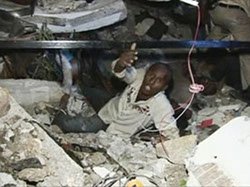
A man calls for help after being trapped at the Port-au-Prince University after a major earthquake struck on January 13th. (Photo Reuters/Reuters TV courtesy www.alertnet.org)

“This is an opportunity for Texas Baptists to minister in the name of Jesus to people who are suffering and who do not have the hope of Christ in their lives,” Arnold said.

“We hope that in addition to meeting human needs that everything done will bring glory to God. In the end, we hope to see that more Haitians have come to know the love of Christ.”

Other groups with Texas ties also are involved in relief work or efforts to raise money for it.

The State of Texas has placed Baptist Child & Family Services on stand-by to support federal response efforts in Haiti. The San Antonio-based agency's resources, which include 300 emergency management and medical personnel in addition to an extensive cache of medical equipment, are prepared to be deployed within 48 hours should BCFS be activated. 

The BCFS role in response efforts would include establishing two 500-bed hospital alternate care facilities in Haiti. These facilities will be completely self-contained and self-sufficient, operating off generator power and manned by a team of medical professionals that include physicians, nurses, pharmacists and paramedics.

An Oklahoma congregation affiliated with the BGCT, NorthHaven Church in Norman, launched efforts to raise relief funds to be distributed through Baptist World Aid.  The group primarily is doing this through a Facebook group and the church website, www.northaven-church. net.

Baptist World Aid has pledged $20,000 in emergency funds for Haiti. BWAid director Paul Montacute said grants of $10,000 each were committed to the Baptist Convention of Haiti, a group of 110 churches and 82,000 members established in 1964, and the Haiti Baptist Mission, a network of 330 churches and schools founded in 1943.

Montacute reported Baptist relief agencies from North America and around the world are considering how best to help. Two representatives of BWAid’s Rescue 24 team of first responders were en route to Haiti from Hungary, where they planned to link up with North Carolina Baptist Men, he said.

Buckner and its international adoption affiliate, Dillon Inter-national, are collecting funds to bring medical relief.

Deniese Dillon, executive director of Dillon International, said donations were being sent to Dillon and Buckner to be forwarded to Gladys Thomas’ Hope Hospital, which has received many casualties from the quakes.

“We’ve worked with Gladys for 25 years,” Dillon said. “Our background has been placing orphan children from her Hope Hospital and Haiti Home for Children with adoptive families.”

Gladys Thomas also serves as director for Dillon’s Haitian adoption programs.

The funds will be used to offset the needs Hope Hospital will meet over the next several weeks.

“Gladys will be bringing people to her hospital, and she’ll be overflowing with victims,” Dillon said. “We’re collecting funds to purchase gasoline for the generators, food and additional medical supplies.”

Haiti street

Officials estimate tens of thousands were killed in the Jan. 12 earthquake.

Dillon noted she had spoken to Thomas Jan. 13 and “learned that the Children’s Village and Hope Hospital are OK. There has been some flooding, and one of the walls on a building collapsed, and many people are gathering in this location, but otherwise all is well. The Village (orphanage) has food, but the children are scared. There will be many people throughout the Haitian community that will continue to come to Hope Hospital looking for care. … It is already very full with earthquake victims.”

To give to Buckner, visit www.buckner.org.

Lance Wallace, director of communications for the Atlanta-based Cooperative Baptist Fellowship, said that group’s response to the earthquake would be long-term recovery and not search and rescue.

Volunteers looking to serve through CBF will receive assignments after the initial emergency phase has passed. Wallace said the quickest way to help is to give money designated Haiti relief.

A Southern Baptist assessment team was working out logistics for a trip into Haiti early the week of Jan. 18, to connect with Haitian Baptist leaders and craft plans for disaster relief efforts.

Serious security concerns could emerge as people become more desperate for food and water in areas where police and military control have not been established, said Jim Brown, U.S. director for Baptist Global Response.

The capital’s main prison also collapsed in the earthquake, raising the prospect of criminals escaping into the city. As a result, near-term attempts to travel to the country would be ill-advised, he said.

The five-member assessment team will evaluate ministry needs like rescue operations, medical services and shelter, as well as logistical concerns like transportation and security, Brown said.

A Florida Baptist disaster relief team is planning its own assessment trip for the weekend, and the two teams will collaborate in their reporting to the national Southern Baptist disaster relief network.

The teams also will report back on long-term strategies to help Haitians rebuild their lives.

“There are two Baptist conventions in Haiti, and the Florida Baptist Convention has historically partnered with one convention, while the International Mission Board has partnered with the other,” Brown said. “We will combine our findings to draft the overall strategy.”

The Southern Baptist assessment team will be composed of representatives from Baptist Global Response, North American Mission Board and disaster relief specialists from Kentucky, Mississippi and South Carolina, Brown said.

Initial funding for the relief effort is coming from the International Mission Board’s disaster relief fund. New contributions toward the relief effort can be made at the Baptist Global Response website, gobgr.org.

Money donated to the relief effort will be used 100 percent for ministry in Haiti, Brown said.

Apart from donating to the disaster relief fund, concerned individuals can help greatly by joining in focused prayer for Haiti’s 9 million people, more than 80 percent of whom live below the poverty line, said David Brown, who with his wife, Jo, directs Baptist Global Response work in the Americas.


Compiled from reports by Texas Baptist Communications, Texas Baptist Men, Associated Baptist Press and Baptist Global Response


Black churches team with hospitals to push better diets

CLEVELAND (RNS)—For Deborah Taylor, keeping her body fit and eating well is a way of honoring God.

So, when Taylor, a financial assistant for University Hospitals Ireland Cancer Center, heard about the hospital’s Body & Soul program for black churches to help their congregations get healthier, she took action.

Soon, Taylor’s congregation, Faith Temple Church of God, launched a healthy-eating initiative and began hosting weekly workout sessions.

“You have so many people in the church who are walking around with diabetes and high blood pressure. Many are obese,” Taylor said.

Sylvia Benford works out with a group of women in the Faith Temple Church of God’s aerobics class at the Fatima Family Center in Cleveland. (RNS PHOTO/Thomas Ondrey/The Plain Dealer)

Across the city, more than 60 black churches have started the program in an effort to combat African-Americans’ higher risk of developing cancer.

The program, supported with $200 grants to individual churches from the American Cancer Society, is based on research findings that healthy eating and other wellness initiatives drive down the risk of cancer, according to Allison Payten, cancer program coordinator for Ireland Cancer Center’s community outreach department.

Research funded by the National Cancer Institute, which followed 15 churches nationwide, found more than a decade ago that church members significantly in-creased their fruit and vegetable consumption through congregation and pastoral support. A cornerstone of the national program is to encourage people to eat five to nine servings of fruits and vegetables a day.

High fruit and vegetable consumption decreases the risk for cancer and a host of other ailments such as high blood pressure, diabetes and stroke—all of which the African-American population is at higher risk of experiencing, according to the study.

In Cleveland, the program is changing lives. LaVita Hatten lost 70 pounds when her church, Freedom Christian Assembly, began a “Biggest Loser” contest. She still makes frequent stops at McDonald’s, but orders the grilled chicken sandwich and a salad instead of a hamburger and fries.

Pastor Milton Bradford at Good Hope Baptist Church lost 20 pounds—even though he admits he occasionally sneaks fried chicken for lunch.

And Sylvia Benford rarely misses her weekly aerobics class organized by Faith Temple Church of God. Now, she doesn’t get winded walking up a flight of stairs.

Their stories are just a sampling of changes happening across the city, Payten said. “Each church is unique.”

The program “empowers members to take charge of their health,” she said.

Good Hope Baptist Church began the Body & Soul program last July. Church members hosted a kickoff where they learned about exercise and how to prepare healthy foods.

Previously, church gatherings meant everyone bringing their specialties, such as fried chicken, potato salad, greens, ham hocks, and macaroni and cheese.

“We always had salad, but most of our meals would be heavy,” said church member Bertha Fuqua.

Fuqua, who had attended one of the hospital’s Body & Soul training sessions and organized the church Body & Soul kickoff, enlisted folks to bring lower-fat alternatives to social gatherings. A personal favorite, she said, is beans flavored with onions and peppers instead of fatback.

Considering “the number of people at our church with diabetes and the number of people who are cancer survivors and the number of children at our church who are overweight—I came out (of the training session) totally convinced and wanted to move forward,” Fuqua said.

Bradford, the Good Hope pastor, began including advice and encouragement in his weekly sermons, giving the congregation witty one-liners to live by, like “We’re not digging our graves with our teeth.”

“We’ve got to avoid that,” Bradford said. “It doesn’t matter how much you are in your faith if you can’t breathe.”

The church’s weekly bulletin includes a health tip or a low-fat recipe. Last summer, members brought in extra vegetables from their gardens to share, and now the church is planning its own “Biggest Loser” contest.

At Freedom Christian Assembly, registered nurse and church health ambassador Simone Ray recalls frequently talking to people about their health before starting the Body & Soul program.

“They would want prayer, but prayer would not work,” she said. “You have to do something physical to get something.”

The program, started at Freedom Christian in 2007, includes getting together for weekly walks and promoting healthy eating. When the church held its “Biggest Loser” contest, more than 20 people signed up, and the winner, Hatten, won $500.

To win, Hatten not only changed what she ordered at McDonald’s, but also began going to the gym twice a day and talking to fitness trainers. She cut back on carbonated drinks and reduced portion sizes, too.

Soon, the 318-pound Hatten was pinning up her clothes to keep them on. She could see her ankles for the first time in years. Now, at 247 pounds, Hatten rarely misses a workout and says she’s still losing weight.

Working with the church, Hatten said, has made a difference.

“It sparked a fire in me,” she said.

Sarah Jane Tribble writes for The Plain Dealer


Around the State

The ninth annual Baylor University Sacred Harp Sing is slated for Feb. 6 in the Great Hall of Truett Theological Seminary. The singing will start at 9:30 a.m. After a lunch break, singing will begin again and conclude at 3 p.m. For more information, call (254) 710-2360.

Dallas Baptist University will hold a preview of the campus Feb. 6 from 8:30 a.m. to 3:30 p.m. DBU will waive the application fee for students who apply during the preview. A similar event will be held Feb. 15. For more information, call (214) 333-5360.

Kevin Kirk has been named assistant vice president for enrollment management at Howard Payne University.

Wayland Baptist University President Paul Armes, right, received a commemorative class ring by Director of Alumni Development Danny Andrews on behalf of the university’s alumni.The ring features the school seal on top and the side panels read “2001” in recognition of the year he came to the school and “Pres” on the other.

Gary Lamm has been named associate vice president for enrollment management at the University of Mary Hardin-Baylor. He previously worked in the UMHB financial aid office 12 years.

Dallas Baptist University awarded degrees to 328 undergraduate, 205 master’s and three doctoral students during winter commencement ceremonies. Marsha Pool, DBU master teacher and professor of mathematics, received an honorary doctor of humanities degree in recognition of more than 40 years of service. She began teaching at the school in 1966.

• Jesse Fletcher’s biography Bill Wallace of China has been re-released. Originally released in 1963, the chronicle of the missionary’s life and death has sold more than 100,000 copies. Fletcher is president emeritus of Hardin-Simmons University.

Who’s Who Among Students in American Universities has selected 14 East Texas Baptist University students for inclusion. They are Leslie Argil-Garcia, Kara Beall, Nicole Assam, Kushal Hada, Elizabeth Briner, Jennifer Shafer, Hannah Rigg, Laura Baskin, Evan Beaton, Alice Gates, Traci Hudson, Jake Keeling, Amber Peery and Phoebe Theimer.

Deaths

Paul Pierce, 56, Nov. 25 in Abilene. At the time of his death, he was pastor of Caps Church in Abilene. He previously served as pastor of Hunt Church in Hunt. He is survived by his wife of 24 years, Beverly; sons, Ethan, Aaron, Dylan and Haydn; brothers, Richard and Steven; and sisters, Dawn Thomas, Mary Kirschbaum, Karen Green and Wanda Burke.

Mike Mahurin, 58, Dec. 14 in Wichita Falls from cancer. He was pastor of Charlie Church in Charlie 15 years until complications from a car accident forced his retirement. Later, the Internet allowed him to continue pastoral counseling. He also taught at Midwestern University. He grew up in Benbrook and was a longtime member of Birchman Church in Fort Worth. He is survived by his wife, Marilyn; sons, Daniel and Aaron; daughter, Sarah Hamman; mother, Sandra Mahur-in; brother, Gene; and sister, Dianna Way.

Rebekah Sue Emanuel, 85, Jan. 3 in Lawton, Okla. Her husband, Bill, was pastor of Shady Grove Church in Greenville and Mayfield Church near Hillsboro while he attended Southwestern Baptist Theological Seminary in the 1940s. In 1950, the couple served as Foreign Mission Board missionaries to Japan. They resigned for two years in the early 1960s to devote themselves to evangelism in the United States and then were re-appointed to the foreign mission field, this time serving in the Philippines before returning to Japan. They retired to Oklahoma in 1985. She was preceded in death by her husband in 2006. She is survived by her daughters, Elizabeth Litster, Marjorie Hatcher and ReBekah Markham; sons, Paul and Jim; 12 grandchildren; and 10 great-grandchildren.

Events

Iglesia Getsemani in Fort Worth will hold a note-burning ceremony Jan. 24 during its 11:10 a.m. service. The church took out a 15-year note to build a 22,000-square-foot worship and education building in 2003, but a gift from charter members Leo and Sulema Jimenez allowed the loan to be repaid early. Julio Guarneri is pastor.

First Church in Devers will hold its 13th annual chili cook-off and gospel sing Jan. 30. Featured singing groups include Crossing Jordan, Hearts of Grace and The Mitsche Family. The chili supper will begin at 5 p.m. and the concert at 6:15 p.m. Admission is free, but an offering will be taken. For more information, call (936) 549-7653. Harry McDaniel is pastor.

Ordained

Marvin Gonzalez to the ministry at Calvary Church in Bryan.

Nathan Hale to the ministry at North Park Church in Abilene.

Bill Adams, Adam Ivy, Ricky Ray and John Weisner as deacons at Calvary Church in Lufkin.


Buckner to send four containers of aid to Haiti

Dallas-based Buckner International is preparing four containers of humanitarian aid to send to Haiti, where a 7.0-magnitude earthquake killed thousands Tuesday evening.

Buckner, through its international adoption affiliate Dillon International, provides adoption services and humanitarian aid in Haiti.

Randy Daniels, vice president of Global Operations for Buckner, said the organization is desperately seeking financial and in-kind donations to help the effort.

“We’re rallying our resources to send a variety of emergency aid items to victims,” Daniels said.  

“Right now, we’re putting together four shipping containers to send new shoes and emergency food items we already have collected in our humanitarian aid center. We need additional new items from the public, including new socks, tents, blankets, toiletries and other personal care items, and new, unopened first aid kits.”

Daniels added that Buckner also needs $5,000 per container to provide the shipping costs of the four containers. The containers will be shipped through Buckner’s contacts in the Dominican Republic before being trucked in to Haiti.

Daniels said donors may give in two ways: For in-kind donations, Buckner is taking deliveries of requested items from 8:30 a.m.- 4:30 p.m. weekdays. In-kind donors are encouraged to contact the Buckner Center of Humanitarian Aid to schedule drop-offs by calling (214) 367-8080. The Buckner Center for Humanitarian Aid is located at 5405 Shoe Drive, Mesquite Texas 75149.

To give financially, donors may call the Buckner Foundation at (214) 758-8050 or online at www.buckner.org .

The containers are being provided by Global Aid Network, another U.S.-based aid organization that has previously collaborated with Buckner to provide shipping containers for Buckner International’s shoe distribution drive, Shoes for Orphan Souls.

Buckner had announced earlier it also was accepting financial donations for Haiti relief through Dillon, to be used for Hope Hospital and Hope Village, a private hospital and orphanage in Haiti that collaborates with Dillon for adoption of orphan children.

For more information about Buckner relief efforts in Haiti, go to www.buckner.org or www.dillonadopt.com .


Haitian Baptist college president describes country ‘in shock’

FALLS CHURCH, Va. (ABP) — A Christian college president in Haiti told Baptist World Alliance officials that the magnitude 7.0 earthquake that hit near the country's capital Jan. 12 "will affect everybody in Haiti."

"The whole country is in shock by this terrible event," Jules Casseus, president of the Northern Haiti Christian University in Limbé, located about 80 miles from Port-au-Prince, told leaders of the Baptist global group based in Falls Church, Va.

"Everybody around the country has a relative in Port-au-Prince," Casseus said. "In our area in the Limbé Valley, we have many cries of people who have lost a relative, a son or a daughter studying in Port-au-Prince."

In an e-mail, one of the few forms of communication coming out of an infrastructure devastated by the earthquake, Casseus said one student at the Baptist university lost his house and a daughter who died in it. Another family in Limbé lost two daughters and the son has a broken leg."

Casseus said even though the university founded by the Baptist Convention of Haiti was mostly outside the disaster zone, it would feel the effects in students from Port-au-Prince who won't be able to return next semester and shortage of fuel needed to run its electric generators and other machinery that is purchased from the nation's capital.

"I believe that it will take years before the country and especially Port-au-Prince to return to normal," Casseus said. He asked Baptists around the world to pray for Haiti "so that we can manage to do the right things in order to meet some of the urgent needs of the Haitian people."


ABC, CBF plan multi-pronged responses to Haitian earthquake

VALLEY FORGE, Pa. (ABP) — American Baptists plan to tap both international relief efforts and local churches with strong ties to the Haitian-American community in responding to human suffering caused by the Jan. 12 earthquake in Haiti.

The Cooperative Baptist Fellowship is also working with American Baptists and other partners on both short-term and long-term recovery efforts.

Officials at American Baptist Churches USA said Jan. 14 that National Ministries would target regions with a strong Haitian presence to identify needs both within Haitian-American churches and in Haitian churches and families with whom those churches have relationships.

That work will be coordinated with work in Haiti under the auspices of American Baptist International Ministries, Church World Service and the North American Baptist Fellowship.

Lemaire Alerte of the Alliance of Haitian Baptist Churches told American Baptist News Service that meetings are being held to determine needs and response strategies for churches in the United States, Puerto Rico and Haiti. He urged prayer for Haitian-American Baptist churches throughout the United States and Puerto Rico, for Haitian Americans waiting for word about loved ones and for first responders as they arrive from around the world to confront a humanitarian crisis.

With 1.3 million members in 5,500 churches, American Baptists are one of America's most diverse Christian denominations. Though historically viewed as predominantly white, American Baptists today claim no racial majority group. The ABCUSA includes Caucasian, black, Hispanic, Asian and American Indian congregations as well as the Baptist Churches of Puerto Rico. There are about 30 predominantly Haitian-American congregations affiliated with American Baptists.

CBF officials announced Jan. 14 the organization would coordinate most of its response through field personnel jointly appointed by CBF and ABCUSA. CBF/ABC missionaries Nancy and Steve James, both medical professionals, were in the United States when the earthquake struck. On Jan. 14 they headed back into Haiti, carrying medical supplies. After arriving, they planned to set up a staging area for channeling relief and supplies.

"We need your prayers for all the suffering ones and for us to know how God might want to use us," Steve James wrote in an e-mail update to CBF leaders.

The Fellowship is not equipped to act as a first responder in disasters, and plans to focus is efforts on making a long-term impact in the affected region, working alongside ministry partners.

The Fellowship has already connected with partners such as Conscience International, which is sending a medical team to Haiti by early next week; Crosslink International, which has already received donations of medical equipment to accompany the first teams to go in to the affected region; and the Virginia Baptist Mission Board, which will help connect Fellowship Baptists with volunteer opportunities in the coming weeks and months. The Fellowship is continuing to connect with other partners.

"As CBF field personnel and partners are listening on the field for needs and resources, CBF churches and individuals will be called on to share their resources, skills sets, and specialized training," said Chris Boltin, the Fellowship's short-term assignments and partnerships manager. 

Those interested in serving in Haiti can list skills and experience on a volunteer-application page at the CBF website. There is also a donation page for financial gifts for Haiti response.


Role of religion in society debated in State Board of Education hearing

AUSTIN—Citizens debated the role of religion in society—and particularly of Christianity in American history—as the Texas State Board of Education held a public hearing Jan. 13 on social studies curriculum for public schools.

More than 130 people signed up in advance to testify before the board, voicing their opinions about proposed language of the Texas Essential Knowledge and Skills, a state-mandated set of learning objective for public-school students.

Those standards not only influence textbooks in Texas, but also have an impact across the nation. Texas is one of the top two buyers of textbooks in the United States, and many publishers craft their books with the Texas market in mind.

Texas capitolIn addition to Texans who expressed their views about how—and if—religion should be handled in public school social studies curriculum, many also expressed concerns about whether significant Hispanic and African-American historical figures would be given due attention.

Several people raised concerns that “founding principles” about limited government may be neglected in favor of “a radical socialist agenda.”

Others testifying before the board urged that the curriculum standards give greater emphasis to Judaism and Holocaust studies, as well as include the Sikh faith in the study of world religions.

A draft of the proposed standards includes references to the Judeo-Christian legal tradition and the expectation that students be able to identify major intellectual, philosophical, political and religious traditions that informed the nation’s founding, including the Judeo-Christian tradition—“especially biblical law.”

One much-debated standard requires students to be able to “explain the significance of religious holidays and observances such as Christmas, Easter, Ramadan, the annual hajj, Yom Kippur, Rosh Hashanah, Diwali and Vaisakhi in various contemporary societies.” An earlier version of the requirement included Easter but not Christmas—an action that prompted the conservative Plano-based Free Market Foundation to launch an online petition “to save Christmas.”

A point of contention for some advocates of church-state separation was the state board’s choice of appointed curriculum reviewers—particularly David Barton and Peter Marshall. Barton has written and lectured about “the myth of separation of church and state.” Marshall has promoted the idea of “recovering the original Pilgrim and Puritan vision of America” as a Bible-based commonwealth.

Barton, founder and president of WallBuilders , holds an undergraduate degree in religious education from Oral Roberts University, and Marshall, a Presbyterian minister and author, earned degrees from Yale University and Princeton Seminary. Neither holds advanced degrees in history or the social sciences.

Derek Davis

Derek Davis
David Barton

David Barton

Several people who testified at the board hearing expressed support for the standards as drafted, saying they emphasize the importance of teaching about religion without promoting a particular religion. But they urged the board to reject amendments that would advance a social and political agenda.

Steven K. Green, law professor and director of the Center for Religion, Law and Democracy at Willamette University in Salem, Ore., noted with alarm efforts to “simplify, sanitize and sanctify” history by giving undue emphasis to Christian influence on the nation’s founding and overstating any influence of Moses’ law on civil law in the United States. The nation’s founders “did not create a Christian nation” based on biblical law, he insisted, but developed a republic based on Enlightenment principles.

Several people who testified stressed the idea of American exceptionalism, contrasting it with teaching multiculturalism. Lela Pittenger, a Republican from Austin who is a candidate for the U.S. Senate, emphasized the importance of focusing less on exceptional historical figures and more on the role of the United States as an exceptional nation.

Jack Kamrath of the American Heritage Education Foundation urged the board to give greater emphasis to the Judeo-Christian foundations of the United States and less attention to multiculturalism and pluralism.

In written testimony submitted to the board of education, Derek Davis, director of the Center for Religious Liberty at the University of Mary Hardin-Baylor , expressed concern “that well-meaning people, lacking adequate understanding of our constitutional history, are seeking to persuade the Texas State Board of Education to violate the religious liberty of Texas public school students by inclusion of inappropriate material in the Texas social studies curriculum.”

Davis, dean of the UMHB College of Humanities, affirmed the notion of including information about American’s religious history in public school curriculum, but he took issue with any effort to give favored status to Christianity.

“As education without some understanding of the profound role of religion in our nation’s history and its contributions to our nation’s success is an incomplete education, and our courts have said as much,” he said.

“What violates the Constitution is presenting material that either prefers Christianity over other faiths or depicts the United States as a Christian nation in some legal sense. Some of the proposal suggested by members of the State Board of Education and their appointees to curriculum panels commit both violations, and therefore infringe the religious liberty of public school students across Texas.”

Effort to undermine the separation of church and state damage the nation’s heritage and its values of fairness and religious equality, Davis added.

“The separation of church and state, which frees religion to be robust and voluntary, is hardly the source of the nation’s problems. In fact, it is the primary reason that religion in America, and foremost Christianity, has flourished for all of our history,” he insisted.

“Religion is vibrant in America precisely because of the separation of church and state, not in spite of it. It is my hope that we will not in the present hour and in these curriculum standards retreat from the founders’ intentions to make religion a key thread in our national tapestry while protecting the diverse faiths of all Americans.”

Marcus McFaul, pastor of Highland Park Baptist Church in Austin, also submitted written testimony, challenging board members not to focus on winning points politically or advancing a social agenda, but rather to concentrate on providing truth to students.

“What is at stake with the Board of Education social studies curriculum is bad history— winning, not learning the truth,” McFaul said. “Hagiography is not the same as history.  Agenda-ed history is not the same as history.”

Curriculum should rightly give due attention to the role and influence of religion in American history, he added, but it should not “advance, promote or seek advantage for any particular religion’s point of view.”

McFaul particularly voiced his objection to any attempt to give privilege to “one voice and no others in the name of Christian America.”

“Religious doctrine and sectarian interpretation of Scripture—or social studies—should not pass from the realm of religion to the realm of the state,” he said. “When that happens, learning loses.”


Florida will lead initial Southern Baptist relief response in Haiti

PORT-AU-PRINCE, Haiti—Southern Baptists are mobilizing to assess disaster relief needs after the largest earthquake in more than 200 years rocked Haiti the evening of Jan. 12.

The initial Southern Baptist disaster relief effort will be led by Florida Baptists, who have had ministry relationships in Haiti for more than 20 years and currently have six staff members who live and work in the country, said Jim Brown, U.S. director for Baptist Global Response. The Southern Baptist International Mission Board does not have long-term personnel stationed in the country.

(RNS Photo)

The North American Mission Board’s disaster relief office is organizing an emergency consultation with state disaster relief directors to coordinate response to the catastrophe, Brown said. Disaster relief teams in Mississippi and Kentucky are on standby for immediate response.

An assessment team is being organized by Baptist Global Response, International Mission Board, North American Mission Board and state convention disaster relief directors to enter the country as soon as possible, Brown said. They will work with Haitian Baptists to identify immediate needs that must be addressed and will draft mid- and long-term plans for an ongoing relief effort.

Initial funding for the relief effort will come from the International Mission Board’s disaster relief fund. Contributions toward the relief effort also can be made at gobgr.org.

The 7.0 magnitude tremor hit 10 miles from the center of Port-au-Prince, a city of 3 million people, at around 5 p.m. Jan. 12, according to news reports.  One source said the quake could be felt more than 200 miles away. The earthquake triggered a tsunami watch for Haiti, the Dominican Republic and Cuba.

Multiple strong aftershocks continued to rock the country after the initial tremor, said David Brown, who with his wife, Jo, directs Baptist Global Response work in the Americas. Reports from inside the country indicate infrastructure and many buildings suffered catastrophic damage. The main airport is closed; power and communications are down and security is a serious concern. Specialized search and rescue teams and military units from several countries are being rushed into Haiti to help secure the situation and begin relief efforts.

Apart from donating to the disaster relief fund, concerned individuals can help greatly by joining in focused prayer for Haiti’s 9 million people, more than 80 percent of whom live below the poverty line, David Brown said.

“Please pray for us as we assess and monitor the situation in Haiti after the 7.0 earthquake and subsequent aftershocks this evening,” Brown said. “The initial information indicates 2 million people in Port-au-Prince are directly affected. Please pray for victims and their families. Pray for wisdom as responses are initiated.”


Baptists prep for immediate, long-term responses to Haiti quake

FALLS CHURCH, Va. (ABP) — Baptist groups in the United States began gearing up Jan. 13 for both immediate and long-term responses to the earthquake that killed thousands in Port-au-Prince, the capital and largest city of the impoverished Caribbean nation of Haiti, the evening before.

Baptist World Aid has pledged $20,000 in emergency funds for earthquake-stricken Haiti, the head of the relief-and-development arm of the Virginia-based Baptist World Alliance said Jan. 13. Meanwhile, the Cooperative Baptist Fellowship, the American Baptist Churches USA, the North American Baptist Fellowship and the Southern Baptist Convention are all gearing up for relief and development work in the aftermath of what may turn out to be one of the Western Hemisphere's deadliest natural disasters.

(Photo: AFP / Getty Images / Daniel Morel)

Both United Nations and Hatian officials reportedly estimated Jan. 13 that the quake — which initial estimates put at 7.0 in magnitude — likely had killed thousands of Haitians. It was reportedly the strongest in the Caribbean in two centuries.

BWAid director Paul Montacute said grants of $10,000 each were committed to the Baptist Convention of Haiti, a group of 110 churches and 82,000 members established in 1964, and the Haiti Baptist Mission, a network of 330 churches and schools founded in 1943.

Montacute said BWAid will be launching an appeal for additional funds. A link on the BWA website directs online donations toward disaster relief.

"We must make a generous response to this massive catastrophe," Montacute said.

Montacute said Baptist relief agencies from North America and around the world are considering how best to help. He said two representatives of BWAid's Rescue 24 team of first responders were en route to Haiti from Hungary, where they planned to link up with North Carolina Baptist Men.

Nancy and Steve James, field personnel jointly appointed to Haiti by the Cooperative Baptist Fellowship and American Baptist Churches USA, were in the United States when the temblor hit. American Baptist International Ministries said the couple were driving from a conference in North Carolina to Florida and planned to catch a Missionary Flights International flight into Haiti on Jan. 14.

The missionaries live about 100 miles from the quake's epicenter, which was just a few miles from the center of Port-au-Prince. A friend watching their house said there did not appear to by any major damage nearby.

That's a far different scene from the teeming capital, where multiple news reports indicated countless major buildings were destroyed. They include poignant symbols for Hatians such as the National Palace — seat of the Haitian presidency — the Haitian Parliament buildings and the city's Roman Catholic cathedral. The Vatican newspaper announced Jan. 13 that among those killed in the quake was Joseph Serge Miot, archbishop of Port-au-Prince.

The Red Cross estimated that 3 million people were affected by the earthquake, roughly one in three Haitians. The Caribbean nation has been afflicted by extreme poverty and political instability for decades, and poor infrastructure and virtually non-existent building standards likely worsened the disaster's impact.

Just over a year ago, Haiti was battered by a series of four destructive hurricanes in three weeks. 

Lance Wallace, director of communications for the Atlanta-based Cooperative Baptist Fellowship, said that group's response to the earthquake would be long-term recovery and not search and rescue. He said volunteers looking to serve through CBF will receive assignments after the initial emergency phase has passed. Wallace said the quickest way to help is to give money designated Haiti relief. 

Haitian-American Baptists were among the hundreds of thousands of Americans with Haitian ties suffering along with the poverty-stricken country.

"There's so little left, I see the name on TV, but it doesn't look like anything that was before," said Nadia Dubuche, a native Haitian who lives in Silver Spring, Md., according to the Washington Post. She said she was up the entire night before, along with other American relatives, trying to reach family members still in Haiti. "We couldn't get through. There was no contact, no electricity."

Dubuche is a member of Eglise Baptiste du Calvaire (Calvary Baptist Church) in Adelphi, Md., one of the largest Haitian congregations in the Washington area. Its pastors did not return calls for comment by press time for this story Jan. 13, but Dubuche said the church had just shipped a truckload of supplies to Haiti and members had been planning a mission trip to the nation to help give out the supplies.

"We had prepared food and clothes for people after a recent hurricane and after a school collapsed. We even sent the truck with the supplies already. We were just preparing to go and help distribute."

U.S. Baptist churches with other connections to Haiti also planned projects. Members of Columbia Baptist Church in the Washington suburb of Falls Church, Va., just voted in November to enter into a hunger-reduction project as partners with the international Christian aid agency World Vision.

Greg Loewer, the church's pastor for missions, said the congregation's "hearts ache" for Haiti's beleaguered people.

"We pray for relief of their suffering, and we pledge to act. We will give sacrificially to provide assistance, in the name of Christ, to Haiti in this critical time and beyond," he said.

"Obviously, the relief, rebuilding, and restoration will need to continue well beyond this initial outpouring of sympathy," Loewer continued. "Haiti's long-term problems are certainly exacerbated by this catastrophic earthquake (and the hurricanes of recent years). Gratefully, our loving Lord hears our prayers and provides mercy and grace to help in such a time of dire need. And his people, in the love and compassion of his Holy Spirit, will reach out with real help in Jesus' name."

Leaders of the North American Baptist Fellowship — composed of all of the North American bodies that are members of the Baptist World Alliance — planned an emergency teleconference Jan. 14 to coordinate relief efforts.


Bob Allen  is senior writer for, and Robert Marus is managing editor and Washington bureau chief of, Associated Baptist Press. This e-mail address is being protected from spam bots, you need JavaScript enabled to view it This e-mail address is being protected from spam bots, you need JavaScript enabled to view it  


Baptists respond to Haiti earthquake

FALLS CHURCH, Va. (ABP) — Baptist World Aid has pledged $20,000 in emergency funds for earthquake-stricken Haiti, the head of the relief-and-development arm of the Baptist World Alliance said Jan. 13.

BWAid director Paul Montacute said grants of $10,000 each were committed to the Baptist Convention of Haiti, a group of 110 churches and 82,000 members established in 1964, and the Haiti Baptist Mission, a network of 330 churches and schools founded in 1943.

Montacute said BWAid will be launching an appeal for additional funds and expected to have more information later in the day.

Nancy and Steve James, field personnel jointly appointed to Haiti by the Cooperative Baptist Fellowship and American Baptist Churches USA, were in the United States when the 7.0 magnitude quake hit on the evening of Jan. 12. American Baptist International Ministries said the couple were driving from a conference in North Carolina to Florida and planned to catch a Missionary Flights International flight into Haiti on Jan. 14.

The James live about 100 miles from the earthquake epicenter near the capital city of Port-au-Prince. A friend watching their house said there did not appear to by any major damage nearby. That's a far different scene from Port-au-Prince, where most government buildings and a hospital were reported destroyed in the worst earthquake to strike Haiti in 200 years.

The Red Cross estimated that 3 million people were affected by the earthquake, roughly one in three Haitians.


–Bob Allen is senior writer for Associated Baptist Press.