WWI changed Truett’s views on war, peace and government

HOUSTON—George W. Truett’s experience preaching to troops in Europe during World War I not only shaped his views about militarism, but also contributed to his growing conviction that only Christ’s church—not any government—offered hope for lasting peace, church historian Kelly Pigott said.

Pigott, university chaplain and assistant professor of theology at Hardin-Simmons University, presented a paper on “George W. Truett: Hawk or Dove?” at the annual meeting of the Texas Baptist Historical Society in Houston.

Truett, Baptist statesman and longtime pastor of First Baptist Church in Dallas, voiced strong support for the war effort when the United States entered what President Woodrow Wilson touted as a struggle to make the world “safe for democracy,” Pigott noted.

Truett

George W. Truett

“He praised the young men in his congregation who served in the military. He pitched Liberty Bonds. He led the church to provide special ministries to the servicemen and women in town. He even introduced a resolution at the Baptist General Convention of Texas meeting in 1917 that called for the convention to fully support the war,” he said.

“And finally, when President Wilson selected Truett along with about 20 other prominent pastors to preach to the troops through the offices of the YMCA, Truett accepted the call.”

Initially, Truett characterized the war with Germany as a “battle between paganism and the highest civilization,” Pigott noted.

“But Truett’s public confidence and cheering for the war belied an inner angst he felt as he hoped for a quick end to the violence and a new world ruled by rational and moral men who would bring to fruition Wilson’s prophecy that this would be a war to end all wars, inaugurating an age safe for democracy,” he said.

Truett’s support for the war rested less in belief about just war theory and more in his faith “in the institution of governments to create a just world where warfare no longer existed,” Pigott observed.

Truett’s presidential appointment to preach six months to the Allied Forces in Europe gave him the opportunity to witness the destruction of war and visit wounded soldiers. He narrowly escaped death himself when he missed boarding a ship, and a U-boat torpedo subsequently sunk that vessel, killing all its passengers.

And the tour of duty changed him, Pigott noted. A close-up look at the horrors of war strengthened Truett’s commitment to doing everything possible to create non-military solutions to international disputes. And the failure of the United States to embrace Wilson’s vision of a League of Nations left him disillusioned with government—as reflected in his famed 1920 religious liberty speech in Washington, D.C.

“Beyond just an opportunity to trump a long cherished Baptist principle, perhaps Truett’s proclamation on the steps of the Capitol was the beginning of a journey of increased suspicion about government,” Pigott suggested.

“In this address, he still clearly saw autocracy and democracy at odds. But now he couched it in religious terms, contrasting Catholic and Baptist polity. And he described the church—not the United States—as a ‘pure democracy.’ He issued a stern warning about what might happen to that purity if the church ever got too cozy with the government.”

Truett apparently retained his postmillennial eschatology, Pigott noted, but without its optimistic assessment of human institutions. He grew increasingly committed to the position that the church and Christian educational institutions—not secular government—would be the only instruments capable of creating a golden age of lasting peace prior to Christ’s return. Christ’s church was “the best hope for humanity,” he concluded.

“At the twilight of his life, Truett was weary of the promises of politics but confident in an institution that he believed even the gates of hell could not prevail against,” Pigott said.

At the Texas Baptist Historical Society meeting, members elected officers for 2009-2010: president, Butch Strickland of Independence; vice president, Don Wilkey of Onalaska; and secretary treasurer, Alan Lefever of Dallas. Mark Bumpus of San Angelo and Kyle Henderson of Athens were named to the organization’s executive committee.

The society presented a church history writing award to Jeff Huckeby of Gatesville for 125 Years Down by the Creek: 1882-2007 Pecan Grove Baptist Church, and to Keith Mack and Herb Weaver for 100 Years of Royal Ambassadors. Two writers of unpublished manuscripts also were honored—Ron Ellison for “Transplanted Tennessean Adoniram Judson Hill’s Only Texas Pastorate, 1879-1884” and Mary Moore for “From a Missionary’s Heart: The Writings of Anne Luther Bagby.”


Goal set at Baylor summit: End food insecurity in Texas by 2015

WACO—Federal, state and local leaders in the fight against hunger gathered for a hunger summit at Baylor University to begin a discussion they hope will spark actions to end food insecurity in Texas by 2015.

By bringing together about 250 government officials, clergy and lay leaders, organizers hoped to break down “silos” in the battle against hunger. If individuals on different levels can cooperate with each other, every Texan can have enough to eat in five years, said Jeremy Everett, one of the event’s coordinators and director of the Texas Hunger Initiative, a partnership between the Baylor School of Social Work and the Texas Baptist Christian Life Commission.

“Basically, what we’ve noticed over the course of time at the Texas Hunger Initiative is that these federal groups, the state groups and often these community-based groups work as silos and they don’t work together,” he said. “It’s our belief that if we’re going to work toward food security in Texas—that we define as three healthy meals a day, seven days a week—we’re going to have to all do it together.”

{youtube}Z5GA3G04kMM&hl=en&fs=1&rel=0{/youtube}
During the Baylor Hunger Summit, Cristina Alvarez talked about how the school lunch program kept her healthy.

To bring people together beyond the event at Baylor University, the Texas Hunger Initiative is looking to launch two initiatives statewide.

First, organizers are looking to create a food policy roundtable of state and federal leaders to assess what resources are available and coordinate efforts to make those resources available locally. The first roundtable meeting is scheduled Jan. 20 in Austin.

The second initiative is an effort to create food-planning associations in each of the state’s 254 counties. These hunger coalitions will bring together pastors, lay leaders, mayors and government officials to plan ways to provide people in need better access to healthy meals.

The Texas Hunger Initiative is part of Texas Hope 2010, a Texas Baptist initiative to pray for vulnerable and spiritually lost people, care for Texans in need and share the gospel with every person in the state by Easter 2010.

The Texas Hunger Initiative recently was selected to receive six $10,000 Texas Hope care grants through the Texas Baptist Offering for World Hunger. The grants will be used to help start and expand summer feeding programs in at least six cities, the first priority of the hunger initiative.

Texas has the highest percentage of hungry children in the nation at 22 percent. About 2.5 million children are on the free lunch program in Texas schools. Of those students, 2 million are not enrolled in summer feeding programs.

Max Finberg, director of faith-based and neighborhood partnership for the U.S. Department of Agriculture, said Texas has much to be proud of, but not these statistics.

“One of the things you can’t be proud of is that you’re the second-hungriest state in the nation,” he said.

The recent economic swoon is exacerbating the problem, said Texas Agriculture Commissioner Todd Staples.

“No American wants to be hungry,” he said. “No American seeks to be hungry. And no American needs to be hungry.”

Texans would do something about the issue if they had a personal connection to the problem and a clear plan to follow, said Camille Miller, president of Texas Health Institute.

“We’ve got to be committed,” she said. “We’ve got to stay with this.”

Leaders said that food insecurity could drop dramatically across the state if people would take advantage of the available federal resources. Harris County residents alone leave $203 million on the table that could be used to provide food for their families simply because they do not sign up. In Bexar County, which includes San Antonio, residents do not use $47.1 million for which they are eligible.

“We have untapped resources that can have an immediate impact,” Staples said.

Summit leaders repeatedly voiced optimism that hunger could be significantly decreased. They noted political leaders at all levels seem intent on attacking the issue. Churches are stepping up to the challenge, as well.

Suzii Paynter, director of the Christian Life Commission, said God appears to be moving in the lives of people in such a way where a dramatic effort can take place to aid people in need.

Paynter described this point in history as being like the second time Jesus laid hands on the blind man in Mark 8. Upon the first touch, the man said he saw people, but they were unclear. Jesus touched the man’s eyes again, clearing his vision completely.

“We’ve heard about hunger,” she said. “We’ve read about it in Scripture. Now, we’re being touched a second time and can do something about it as a sign of the kingdom of God. If the church steps up and starts feeding hungry children, it will be a sign of God’s work.”

Christ’s command to his followers to feed the hungry applies to each of them, Paynter said. All of them have a role to play in fighting hunger. A free handbook on how to start a summer feeding program is available from the website of Texas Impact, an interfaith non-profit group based in Austin (www.texasimpact.org).

“What church doesn’t have a kitchen?” she said. “What church can’t make sandwiches? It’s a universal call.”

For more information on summer feeding programs, call the Christian Life Commission at (888) 244-9400.


Annual meeting draws few for business, many for outreach

HOUSTON—The 2009 Baptist General Convention of Texas annual meeting in Houston attracted the fewest messengers in at least 60 years, but a series of evangelistic events prior to the meeting marked the greatest involvement and the largest number of professions of faith in Christ of any similar event in recent history.

More than 20 City Reach evangelistic events drew 19,000 participants and resulted in 3,000 decisions for Christ, including 1,917 professions of faith. A multisite outreach to prisons throughout Southeast Texas conducted in partnership with Bill Glass Champions for Life involved 14,000 volunteers and produced 2,429 commitments to Christ by offenders, including 1,405 seeking salvation.

Messengers re-elected for a second one-year term David Lowrie, pastor of First Baptist Church in Canyon. Ed Jackson, a layman from First Baptist Church in Garland, was elected first vice president, and John Ogletree, pastor of First Metropolitan Baptist Church in Houston, was elected second vice president.

However, the Houston annual meeting itself drew only 1,493 elected messengers and 626 registered guests, down from 1,891 messengers at the 2008 meeting in Fort Worth and the least number since 1,667 attended the 1949 meeting in El Paso.

While the messenger count for several years in the 1930s and 1940s was not available, the lowest participation on record was 1,445 in 1937.

In contrast, the largest meeting in BGCT history—the 1991 annual meeting in Waco, when the convention was dealing with controversy surrounding a charter change for Baylor University—drew 11,159. Excluding that year, the average number of messengers at annual meetings in the 1990s was 5,941.

After the 2000 annual meeting in Corpus Christi, which drew 6,713 messengers, the numbers dropped to 3,317 in 2001 and 3,327 in 2002. The convention hasn’t reached the 3,000-messenger level since then, and the numbers have declined every year since 2004.

In response, messengers to the 2009 annual meeting approved a motion introduced by Paul Kenley, pastor of Grace Fellowship Church in Lampasas, on behalf of the committee on convention business recommending a committee be created to study changes to the BGCT annual meeting to “enhance interest and participation from a broader spectrum of participating churches.”

The recommendation called for a committee limited to 11 members appointed by convention officers by the end of the 2009 annual meeting, with instructions that the committee report to the 2010 meeting in McAllen.

Members of the study committee are Chairman Kyle Henderson, First Baptist Church, Athens; Paul Kenley, Grace Fellowship, Lampasas; Jesse Rincones, Alliance Baptist Church, Lubbock; Mike McKinney, Dallas County Cowboy Church; Ernest Dagahoy, First Philippine Church, Houston; Oscar Epps, Community Missionary Baptist Church, DeSoto; Dub Oliver, East Texas Baptist University; James Stone, Hardin-Simmons University; Sharon Felton, First Baptist Church, Hamilton; LeAnn Luedeker, Jersey Village Baptist Church, Houston; and Gary Singleton, The Heights Baptist Church, Richard-son.

In other business, messengers to the annual meeting approved a reduced budget for the second consecutive year, adopted recommendations presented by the Future Focus Committee—including creation of a Cooperative Program study committee—and re-elected the convention’s first two-term president in re-cent years.

henderson

Kyle Henderson, pastor of First Baptist Church in Athens, introduces a motion that would put into place a process requiring advance notice of a challenge to the seating of messengers from any church.

They also passed a resolution on sexual ethics. It noted previous statements from 1982 to 2005 and resolved the BGCT “maintain the consistent position of past convention statements and actions which affirm the biblical sexual ethic of fidelity in marriage and celibacy in singleness and also affirm the biblical image of marriage as the union before God between a man and woman.”

A motion to postpone indefinitely a vote on the resolution failed.

The statement reaffirmed a 1992 resolution encouraging all people to uphold a lifestyle of biblical sexual ethics while affirming “the gospel provides forgiveness and restoration for all persons through repentance and faith in Jesus Christ.”

It also reaffirmed the 1998 Executive Board statement that “churches should seek to minister to all persons” and that “the love of God embraces all persons and instructs all Christians to share God’s love with others.”

The resolution marked the only reference to homosexuality at the meeting, in spite of widespread preconvention conversations about an anticipated challenge to messengers from Broadway Baptist Church in Fort Worth. In June, the Southern Baptist Convention severed its longstanding relationship with the congregation over the church’s perceived toleration of homosexual members.

Broadway Baptist leaders determined in the days immediately prior to the annual meeting not to send messengers to the annual meeting “in the best interests” of both the BGCT and the church.

Messengers approved a $44,029,505 budget for 2010. The total budget calls for $38,865,000 from Texas Baptist cooperative giving and $2,135,000 from investment income, with the balance in revenue provided by conference and booth fees, funds from the Southern Baptist North American Mission Board, product sales and other sources. The budget marks a 9.8 percent decrease, after adjustments for organizational realignment that occurred in recent months.

The convention’s Future Focus Committee presented its final report to the annual meeting. The committee, formed in response to a motion at the 2007 annual meeting in Amarillo, offered affirmations reflecting values and vision for the future and submitted a series of findings and recommendations—including some that already have been implemented.

In terms of vision and values, the committee affirmed the BGCT emphasis on evangelism and missions, discipleship and education, and advocacy and care for people in need. It also affirmed congregational autonomy, and it noted “the BGCT is not the ‘state branch’ of any national denominational body.”

The committee also affirmed the convention’s role as a partner and resource for churches, affirmed the Cooperative Program as the primary funding mechanism for convention work and underscored the importance of good stewardship, sound financial practices and accountability.

Findings and recommendations by the committee centered on:

Name change. The committee concluded the formal historic name—Baptist General Convention of Texas—“did not speak to a new generation of Baptists,” and it recommended at last year’s annual meeting the name be changed to “Texas Baptist Convention.” After the motion was referred to the BGCT Executive Board, the group decided to retain the legal name but register and use “Texas Baptists” as the convention’s trademark.

Strategic realignment. After evaluating the BGCT Executive Board staff structure, the committee recognized the need for a simplified structure built around three emphases—evangelism/missions, Christian education/discipleship and advocacy/care. BGCT Executive Director Randel Everett re-aligned staff in May, and the committee endorsed the action. The committee also endorsed “future moves to eliminate duplications within the organization.”

Cooperative Program promotion. The committee found the number of BGCT-related churches giving through the Cooperative Program dropped from 4,942 in 1997 to 3,789 in 2008, and funds received for BGCT ministries declined from more than $44.1 million in 1997 to about $37.9 million in 2008. The committee recommended creating a Cooperative Program study committee to formulate a plan for marketing the unified giving program, and it recommended requiring all ministry partners that receive BGCT funds to acknowledge that in their publicity.

Financial policy changes. The committee discovered the convention “was operating in the recent past on financial initiatives that were not fiscally sound.” It recommended the BGCT adopt a comprehensive budget inclusive of all revenue sources—Cooperative Program, mission offering, investments and other operating funds received for special purposes. The committee called for designated funds to be invested in nonspeculative accounts such as certificates of deposit or money market funds until they reach the appropriate time for expenditure as provided in the designation. The group also recommended the Texas Baptist Missions Foundation increase the endowment to underwrite costs of infrastructure and administrative BGCT operations.

Collaborative relationships. Point-ing to collaboration as “a biblical concept,” the committee instructed the BGCT Executive Board to explore ways affiliated churches can develop collaborative relationships with other BGCT-related churches, institutions and ministry partners inside and outside Texas.

Hispanic work in Texas. Reaching Hispanics offers “one of the keys to reaching Texas in the years ahead,” the committee found, and the committee joined the Hispanic Baptist Convention of Texas in asking the Executive Board to recommend a committee to work with Convencion representatives to write a new unification agreement between the two conventions.

At the recommendation of the Executive Board, messengers to the annual meeting approved the creation of a 12-member commission to work on the unification agreement—Jesse Rincones, Lubbock; Isaac Rodriguez, Tyler; Ruben Chairez, Del Rio; Manuel Rios, San Antonio; Silvia Briones, Houston; Teresa Luna, San Antonio; Rudy Camacho, Fort Worth; Angel Vela, El Paso; Nestor Menjivar, Austin; Moises Perales, North Central Texas; Elisabeth Tamez, East Texas; and Ray Zamora, El Valle.

Mission initiatives. The committee discovered lack of support for the WorldconneX missions network—which subsequently was dissolved in May—and urged that elements of WorldconneX be absorbed into the BGCT organizational structure. The committee also recommended development of a comprehensive missions education program for the BGCT, called for increased cooperation with associations of churches and recommended funding for church starts be a high priority for the BGCT.

Educational partnerships. Grad-uates of BGCT-related colleges and seminaries often have “a woeful ignorance” of the Cooperative Program and the support it provides, the committee found. The group recommended that in order for a school to receive funds for ministry students, it be required to teach about Baptist heritage, the work of the BGCT and the Cooperative Program.

Advocacy/care collaboration. The committee recommended the BGCT Advocacy/Care Center create a meeting place for all institutions that are advocates for the marginalized in Texas.

Messengers to the annual meeting re-elected for a second one-year term David Lowrie, pastor of First Baptist Church in Canyon as president. Ed Jackson, a layman from First Baptist Church in Garland, was elected first vice president, and John Ogletree, pastor of First Metropolitan Baptist Church in Houston, was elected second vice president.

BGCT voting

Messengers approved a motion recommending a committee be created to study changes to the BGCT annual meeting to “enhance interest and participation from a broader spectrum of participating churches.”

In addition to the resolution on sexual ethics, messengers also approved a resolution encouraging “lawmakers and public officials to cooperate in efforts to ensure adequate health care for all members of society.”

Another resolution expressed grief over the tragedy at Fort Hood and the suffering of all people in times of war, noting concern over “the ongoing conflicts in Iraq and Afghanistan, as well as the continued threat of terrorism.”

It called on Texas Baptists to pray for “just and lasting peace for all people,” for national leaders and “for men and women in uniform,” particularly singling out Baptist military chaplains.

Other resolutions emphasized the Baptist commitment to religious liberty and church-state separation, encouraged Texas Baptists to engage in ministry to people affected by substance abuse and called for responsible financial stewardship.

In other business, the convention’s annual meeting:

•Referred to the Executive Board a motion introduced by Kyle Henderson creating a process in advance of the annual meeting to deal with any challenge to the seating of messengers.

Henderson called for amendments to the BGCT bylaws, including the following addition: “Any messenger intending to challenge the seating of another messenger or messengers from a church must have made a good-faith effort to contact the messenger’s church at least 18 days before the BGCT. A statement of the intention to challenge the seating must be presented to the credentials committee at least one week before the BGCT with the inclusion of verification of the good-faith effort to deal directly with the church.”

•Approved a proposal by Dick Hurst, a physician from First Baptist Church in Tyler, calling on the BGCT Executive Board to create an ad hoc study committee to consider how Texas Baptists can create ways to address violence along the Texas/Mexico border. The initial motion dealt specifically with Juarez but was expanded to include the entire border.

•Referred to the Executive Board a motion by Terry Williams of Key Heights Baptist Church in Perryton, stipulating that members of BGCT committees and boards who complete their terms of service be ineligible to serve on another standing committee or board for at least two years.

•Approved a revised relationship agreement with Valley Baptist Health System. The new agreement calls for the BGCT’s primary governance influence to be moved to a subsidiary entity of the health care system—Valley Baptist Hospitals Holdings Inc. At least one-fourth of that board will be Baptist, with the BGCT electing a majority of those individuals. The Valley Baptist Health System board will become self-perpetuating, with one BGCT-elected trustee of the subsidiary board serving as a member.

•Approved a merger of Baptist Memorials Ministries and Baptist Memorials Services, both of San Angelo, into a single entity that will become affiliated with Buckner Retirement Services.

•Amended the agreement between the BGCT and the Baptist Church Loan Corporation. The agreement provides for financial separation between the Baptist Church Loan Corporation and the BGCT. The change enables the corporation to borrow and repay its obligations on its own financial capabilities, and it reduces potential liability of the BGCT.

The Baptist Church Loan Corporation will continue to be run by its board of directors, all of whom must be members of BGCT-affiliated churches. The BGCT has the right to elect one-third of the board. The Baptist Church Loan Corporation will release the BGCT from any and all guarantees of loans—past, present and future.



Stream event caters to Baptists under age 35

HOUSTON—The first group of messengers and visitors to arrive in Houston for the Baptist General Convention of Texas annual meeting of Texas Baptists was a little different than normal. They all were under age 35. 

No caption submitted

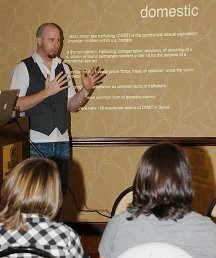
Participants in Stream—a special event added to the meeting schedule to appeal to young Baptists—gathered on the Union Station rooftop overlooking Minute Maid Park and downtown Houston.

“I enjoyed meeting people who all have a heart to live for Christ,” said Emily Prevost, associate director of the BGCT Center for Effective Leadership.

“We just hung around, talked and shared experiences. It set a great tone for Stream workshops and worship. It’s the whole reason why we held this meeting,” she said.

More than 200 Stream participants filled workshops on living missionally, human trafficking, the Texas Hunger Initiative, challenges of church leadership, the arts and worship, and creation care.

“The Stream workshops were created on topics that appeal to, interest and apply to Baptist leaders of our generation,” said Stephen Reeves, legislative counsel with the Texas Baptist Christian Life Commission.

During a break in the annual meeting schedule, several Stream participants who were not registered messengers performed mission service at Houston Food Bank as a part of the Feeding America emphasis.

Brittany Green from First Baptist Church in Marshall came with a group from East Texas Baptist University to earn extra credit for her ministry formation class—and to discover what’s going on in Baptist churches and the BGCT.

{youtube}dCQmUHoKMSg&hl=en&fs=1&rel=0{/youtube}
Patrick Adair, youth minister at First Baptist Church in Waco, talks about what he took away from the Stream events.

“After coming, I realized that the BGCT is about all kinds of ministries going on and the outreach that’s going on,” Green said. “It was also great to see Christian Motorcycle Association recognized, as I’m a member.”

Green attended the human trafficking workshop and learned “where I can be needed as a missionary and a praying Christian and where I can help as a consumer.”

Paul Holt, a messenger from Bethlehem Baptist Church in Flint, attended his first-ever Texas Baptist event.

“I came to network and find new ways of ministry in communication and to help myself and my relationship with God,” Holt said.

“I really enjoyed the event for the younger ministers. I’ve been interested in this, and it’s been a success so far,” said Patrick Adair, youth pastor at First Baptist Church in Waco, who attended the Stream session on the challenges of church leadership. “It was great to speak openly with a representative from BGCT and be heard about helping young ministers succeed.”


Islamic scholars debate whether Muslims should serve in non-Muslim armies

WASHINGTON (RNS)—As investigators seek to uncover what motivated Maj. Nidal M. Hasan to kill 13 fellow soldiers at Fort Hood, one lead they are exploring is his apparent worry that serving in the U.S. Army compromised his Muslim faith.

As his deployment to Afghanistan loomed, Hasan faced the possibility of killing Muslims, or at least abetting an army responsible for killing thousands of fellow Muslims.

Atif Qarni, a Sunni Muslim, and his wife Fatima Pashaei, a Shiite Muslim, sit with their 3-year-old son Zane Qarni, in their home in Manassas, Va. Qarni said he had no qualms about being a Muslim serving in the U.S. military. (RNS PHOTO/Christopher Rossi)

In a presentation to soldiers in 2007, Hasan theorized that Islam prohibits Muslims from serving in a military force attacking Islamic populations, as he perceived the U.S. military to be doing.

To support his argument, he cited a verse from the Quran: “And whoever kills a believer intentionally, his punishment is hell,” according to The Washington Post, which obtained a copy of the presentation.

The solution, Hasan concluded, was for the military to discharge Muslim-American soldiers as conscientious objectors.

In the wake of the Fort Hood shooting, a number of leading Muslim-American soldiers and scholars are debating Hasan’s interpretation of Islamic teachings on serving in non-Muslim armies.

More than 3,500 servicemen and servicewomen identify themselves as Muslim, although the actual number probably is higher, observers say.

No Muslim scholars condoned Hasan’s violent actions, but some say his military arguments have merit. But others say Hasan misread the Quran and the U.S. military’s actions.

A wide variety of fatwas—interpretations of Islamic law—on this issue are available on the Internet, but Islam’s lack of a centralized authority makes it difficult to say which opinions hold the most sway.

For instance, many Muslims in the U.S. military see themselves not as waging war against fellow Muslims, but protecting them from enemies who claim to be Muslim, like the Taliban and al-Qaida.

Muzammil Siddiqi, an imam in Orange County, Calif., and member of the North American Fiqh Council, which issues rulings on issues of concern to Muslims, said Islam in no way prohibits Muslims from serving in the U.S. or other non-Muslim militaries, and they may even participate in war.

“If the war fought by non-Muslims is a just war, then they can participate,” Siddiqi said. This would include wars fought in self-defense, or fighting against oppressors. “Otherwise, fighting is not allowed.”

When asked how he would counsel a Muslim soldier who asked his guidance on whether serving in Afghanistan or Iraq would compromise his faith, Siddiqi said it was a “difficult question” that depends on many factors.

For example, Siddiqi would ask what role the person would have. Would he be a medic, or a gunman? And what toll would the war take on innocent Muslims? “I would ask him to think about it,” said Siddiqi.

Muzammil Siddiqi is chairman of the North American Fiqh Council and director of the Islamic Society of Orange County in Garden Grove, Calif. (RNS PHOTO/Courtesy of Muzammil Siddiqi

Atif Qarni, a Marine reservist from 1996 to 2005, saw active duty in Iraq as a platoon leader in 2003.

“I didn’t have any hesitation,” Qarni said. He regrets Muslim civilian deaths caused by U.S. forces but said the Taliban, al-Qaida and Iraqi insurgents are oppressors who violate Islamic principles; therefore, serving against them is justified.

“Even though they claim to be Muslims, they are enemies to Islamic principles,” said Qarni, now a junior high school history teacher in Northern Virginia. “They’re outside the realm of Islam.”

Qarni met a handful of Muslim soldiers during his tenure and said most think along similar lines.

But one soldier he knew did not want to deploy to Iraq because of concerns about harming Muslims and requested a hearing for a discharge, which was granted, Qarni said.

Ali Jum’ah, a professor of Islamic jurisprudence at Al-Azhar University in Cairo, Egypt, wrote in 2002: “It is not allowed for a Muslim who is currently recruited in the American army to fight against Muslims, neither in Afghanistan nor anywhere else. It is better that those Muslim soldiers exercise their right and excuse for not participating in the war.”

Scholars at Islamonline.net have said Muslim-American soldiers should not fight against other Muslims, but that if they had no choice and risked harming their community by not participating, then they should find a limited way to participate.

“If there is no way but to participate, then a Muslim can join the rear to help in military service.” The scholars added, however: “After striking the balance between the two difficult choices, the American Muslim soldier should reach a final decision by himself. … We cannot give a general fatwa that will suit the situation of all American Muslim soldiers.”


Three ministries honored with Texas Baptist Missions Foundation awards

HOUSTON—The Texas Baptist Missions Foundation celebrated 25 years of service at its annual mission awards luncheon during the Baptist General Convention of Texas annual meeting, honoring a medical clinic, a ministry to urban youth and a church that discovered new avenues of ministry after being devastated by Hurricane Ike.

Casa El Buen Samaritano, a medical clinic located in a predominantly Hispanic community in southwest Houston, received the Adventurer Award, given to a ministry that embarks into new, unchartered areas in presenting the gospel.

Lydia Eckhoff is executive director of Casa El Buen Samaritano.

Barry Landrum, pastor of West University Baptist Church, noted the mission began as an outreach project to a group of undocumented immigrants living just a few miles outside of Houston.

Attempting to reach out to those who could not help themselves, Landrum, Steve Spann and others formed Casa El Buen Samaritano in order to provide needed medical care and also establish an avenue for sharing the love of Christ.

Since its establishment, thousands have received free medical care from hundreds of volunteer doctors. Members of Iglesia Horeb in Houston, a partner church with the ministry, also are available to help through interpreting, sharing the gospel or providing counseling for those who visit the clinic. Iglesia Horeb Pastor Campo Londono noted their work allows them to be a part “of the Great Commission and the Great Commandment.”

“It is a blessing and honor to receive this award,” Eckhoff said. “And we want to thank the (missions foundation) for their support over the years. We hope that this award will provide us a platform that will let other local churches to know about the work we do and partner with us.”

• The Innovator Award for creativity in missions was presented to Street Life Worldwide, a Houston-based ministry to urban youth led by Terrance Levi. The award is given to ministries that explore new and creative ways to present the gospel.

Salvatore Sberna, pastor of Metropolitan Baptist Church in Houston, presented the award and described the ways this ministry penetrates into the hip-hop culture to bring people the hope of Christ.

Street Life Worldwide engages in many typical outreach activities, such as apartment ministries, festivals, revivals and sports ministries, but it does so through hip-hop music and media.

With a special eye to redeem all of creation, including the creative arts, for God, Street Life Worldwide has produced music and short films, and is working on a feature-length film, all told from an urban perspective.

One way these media creations are delivered is the Mobile Multi Media Missions Machine, or “M5,” a large bus outfitted with speakers and screens that travels into neighborhoods to set up block parties.

Funds from the missions foundation helped to purchase the M5. In the last 12 months, Street Life has held 63 events that reached 15,000 people with 9,250 who accepted Christ for salvation.

In accepting the award, Levi pointed to the concept of cultural penetration as a great need for the church in the years to come.

“We have to have a penetration mindset and be willing to do some different things,” Levi stated. “For the church to make the impact we want, we have to be willing to penetrate the culture.”

• Pastor Ray Meador and First Baptist Church in Galveston received the Pioneer Award for service in missions, which recognizes ministries that endure special hardships and persevere in their commitment to the gospel.

Alan Reed, pastor of First Baptist Church in Nacogdoches, presented the award to First Baptist Church. Reed described the ministry of the Galveston congregation after facing the destruction of Hurricane Ike in September 2008, as well as noting God’s provision during that time.

During the past year, First Baptist in Galveston has faced the severe damage its own faciliities sustained, as well as the displacement of many of its members. However, instead of being focused on devastation, the church became a center of ministry to the hurting community.

Working with churches from around Texas, First Baptist provided showers for the homeless and the volunteers.

The church established Grace Mart, which distributed clothing, household items, baby supplies and food to people seeking help. Members also worked to staff Mercy Clinic, providing medical assessments and assistance. Even though the church’s facilities are still months away from restoration, the church has continued to offer freely the love of Christ in visible, meaningful ways, Reed noted.

As Meador accepted the award, he reflected back to a sermon series he began two years prior to the storm that focused on Jeremiah 29:7. In this passage, God calls upon his people to seek the welfare of the city where they live, and in turn, they also will find their welfare. Meador explained how this passage became real to him over the past year.

“The great thing about being where we were,” Meador explained, “was seeing how God used his hand to make us bring about his hope.”


‘Taking sides’ prevalent in Baptist life, Dallas pastor observes

HOUSTON—Since the time of Christ, his followers have been “taking sides,” Dallas pastor George Mason told Texas Baptists. But Christians can ill afford to exclude people Christ has included, he noted.

In the convention sermon delivered at the Baptist General Convention of Texas annual meeting in Houston, Mason pointed to an incident in Mark 9:38-50. John the disciple told Jesus someone who was not one of the chosen 12 was casting out demons in Christ’s name, and John had tried to stop him. But Jesus told John good work should not be hindered, and those who were not against Jesus were for him.

George Mason, pastor of Wilshire Baptist Church in Dallas, warns Texas Baptists about the dangers of taking sides and excluding people.

Texas Baptists need to realize they are not alone; others who are following Christ are a part of what he is doing, as well, said Mason, pastor of Wilshire Baptist Church in Dallas.

That includes Christians of other denominations, as well as Baptists with whom Texas Baptists may not agree at every point, he noted.

“Before there were conventions and Baptists and Christians per se, followers of Jesus were taking sides,” Mason said. “We take sides about whether the gospel is primarily about saving souls or social justice, as if it can’t be both.”

Division arises when Christians take sides, Mason said. Many believers and churches think they have the best method for ministry and look down on others.

“The truth is I am just as guilty of this as any of you,” Mason said. “Many times I think all of you should think like me. You ought to worship like my church worships. You ought to do missions like me. And here’s the worst admission—those I tend to slam are in churches that are successfully using methods I would never use.”

Mason said this division can come out of judgment and competition with others in ministry.

“There are Catholics, Pentecostals, Presbyterians and others who are not in our Baptist realm doing great things for the Lord,” Mason said. “Shouldn’t we call them brothers and sisters anyway?”

Many times Christians treat other believers who are different from them as enemies, seeing they are working against each other, when in fact, they are working for the same cause—to see people come to Christ, Mason said.

“Do you know what friendly fire is?” he asked. “It’s when you are in the midst of battle and you forget whose side you are on. There is too much friendly fire going on between our churches and within our churches.”

Believers need to realize they all are working for the same cause and need to take a childlike approach to division, Mason said.  

“Forget who is the greatest. Keep your eye on the real enemy. Your fight is not with each other but with the evil principalities of the heavenly realms. Bind yourselves for battle against the enemies from hell,” he said.

To avoid taking sides, Christians must look at their own lives and hearts, making sure they first are in a right relationship with God.

“Self-examination while learning from others and serving with others—that is the spirit we need to have,” Mason said. “Jesus wants us to realize that if there is anything in our life that is keeping us from living for God, it has to go before it sends us to hell.”

To live the life that God has for every believer and for every church, people must humble themselves and seek God above all.

“Jesus doesn’t want us to waste our lives, not now, not forever,” Mason said. “But our pride gets in the way of the life he wants for us. … While the rest of the world is caught in the gains of greatness, we must show we are in the realm of self-examination.

“Let’s take sides with him, Texas Baptists, by taking sides with each other and not against each other.”


Love for kindergartners lasts 60 years for former pastor’s wife

DALLAS—Some things have changed a bit since 1949 at Park Cities Baptist Church in Dallas. Then, the church met in a house. Today, its 9,000 members fill a mammoth sancutary in multiple worship services.

One thing hasn’t changed. Martha Howard still can be found teaching her room full of kindergartners—just as she has for 60 years.

The church called her husband, Herbert, as pastor in 1948. Their first year at the church, she taught a Sunday school class for college girls.

The next year, however, there was no one to teach the kindergarten class. Since her oldest daughter was one of the students, she took over.

At age 90, Martha Howard still teaches a kindergarten Sunday school class at Park Cities Baptist Church—as she has for 60 years. (PHOTO/George Henson)

“I was totally hooked,” Howard said.

Her classroom was the garage of the house that served as the church’s only building. There was an oil stain in the middle of garage where a car once parked.

“We just pulled a table over it and put chairs around that, and that was my class,” she recalled.

While it may have been a humble beginning, it has been a rich journey, said Howard, who celebrated her 90th birthday earlier this year.

“I now have taught 60 years the same age group, and they are my love. It’s certainly a thrill to see them grow up and become fine citizens. My graduates are all the way from California to Georgia, and they come back, and I get to see them, and I learn of the wonderful things they are doing.

“It’s so rewarding. I go back to that Scripture where Jesus said, ‘Let all the children come to me, for such is the kingdom of heaven.’ And truly it is the kingdom of heaven when you see them grown men of God and grown women of God with wonderful homes and wonderful careers, practicing Christians and teaching themselves,” she said.

She recalled 25 years ago being invited to attend the ordination of one of her former students, Bill Chamblee, at First Baptist Church in Denton. She recently returned as the church and city of Denton honored him for 25 years of service to youth there.

Howard doesn’t use a current curriculum. Rather, she uses lessons published in the 1950s and 1960s as the basis for her team of teachers because she wants to make sure the children she teaches have a firm foundation.

“My joy through all the years has been that to some boy, some girl, I have taught the lesson and that they know God loves them. We start out with these children teaching them the song ‘Jesus Loves Me’ and (the Bible verse) ‘God is love.’ If they can learn that, we go on from there,” Howard said.

This year, Howard and her team have about 40 students—all learning important truths they can carry with them for a lifetime.

“My children have only been in there since September, and they can already say the Lord’s Prayer, and they can tell me where it is,” she revealed.

“Their responses are so remarkable. They like to tell me things about ‘my grandmother and how she read to me about Jesus’ and ‘this is my Bible’ and then they want to show it to you,” she said.

“And can there be any greater joy than sharing that with a child? No! Never. They’re so endearing, and they are so responsive. I think that is one reason I love it so much.”

{youtube}qnQ0mXD5VTY&hl=en&fs=1&rel=0{/youtube}
Martha Howard still teaches a room full of kindergartners at Park Cities Baptist Church in Dallas—just as she has for 60 years.

Howard is quick to say, however, that she is not alone in molding these children’s minds and hearts. Many of the other teachers who join with her on Sunday mornings also have more than a decade of service—some closer to 20 years. The newest teacher is one of Howard’s graduates who now has college-aged children of her own.

The team makes sure their lesson plans always are in place at least three months in advance, complete with the lesson aim, the focus Bible story and Scripture, and the songs to be sung.

“I have wonderful teachers, and we do it together,” she said. “We are a team. We are a teacher group, and we work together for one cause. We all love the children.”

She maintains it is the children who make it all work, however.

“This is the age group when I feel like they are like little sponges. Everything I teach this age group, they can remember. They can’t read, and that’s a challege, but they want to learn.

“They are old enough by now to know how to behave in Sunday school. They know why we go to Sunday school. They know why we want to be there,” Howard said.

“I teach a tremendous repertoire of Bible stories, and then I test them in preparation for the first grade. ‘Now, is this lesson today from the New Testament or the Old Testament?’ They can tell me. It has become my life to watch their development.”

One thing that helps her watch her students’ development is that so many come back to see her each week—even teenagers now in the youth department.

“Another thing I do that most people don’t anymore is I have a pianist. And we sing and we sing and we sing. And the songs are not just whatever anybody can think of—they are planned to carry out the lesson plan.

“There is one time when we can sing ‘your favorite song,’ but we sing all the songs every child should know. Everything from ‘Jesus Loves Me’ to ‘O, How I Love Jesus,’ ‘Happy Sunday Morning’ and on and on.

“And the little quiet child who is very hesitant at first will sing. He or she learns because all my songs are from Scripture. They’re not just some song,” Howard explained.

“I’m old-timey. I’m old. I have old methods, but it gives me great joy to share it.”

Tommy Sanders, who leads the graduate program for children’s ministry at Dallas Baptist University and worked with Howard almost five years while he was children’s minister at Park Cities, considers himself her fan.

“It’s amazing,” he said. “People come back to make sure their grandchildren are in her class. She’s there every week 30 to 45 minutes early, and her classroom is ready to go when that first child comes into the classroom. She’s the real deal when it comes to preparation and commitment.”

Some wonder why a nonagenarian still is hanging out with 5-year-olds, but Howard is very content to still be in kindergarten.

“A friend, a loving, caring friend, not long ago said: ‘You’re 90. Why don’t you just quit and come over here to the big class?’ And I said, ‘No, I’ll wait until they tell me I’m too old.’

“I don’t expect any commendations, attention or laurels,” she said. “It just happened to be my mission. All joys have been mine in serving children.”


Lowrie: Texas Baptists should share Jesus’ compassion for the lost

HOUSTON—Texas is home to 24 million people—and some troubling statistics about them. But despite the challenges the state faces, Texas Baptists hold the key to meeting many of the dramatic needs, David Lowrie said in his presidential address to the Baptist General Convention of Texas.

“As I think about our Texas Baptist family, it’s my conviction that Jesus wants us to see Texas through his eyes and see what he sees when he looks into the hearts and minds of people,” said Lowrie, pastor of First Baptist Church in Canyon.

BGCT President David Lowrie makes a point about the challenges Texas faces and the hope Texas Baptists can provide. (PHOTO/BGCT)

Lowrie noted the word “compassion” occurs repeatedly in Scripture that records Jesus’ life and ministry. Specifically, Lowrie quoted Matthew 9:36: “When Jesus saw the crowds, he had compassion on them, because they were harassed and helpless, like sheep without a shepherd.”

Statistics demonstrate the urgency for Texas Baptists to act, he observed. One in six Texans lives in poverty; one child in 10 goes to bed hungry each night; and one in three is at risk of hunger because there is not enough food to go around at home.

Educational statistics are equally disturbing, he noted. Only 65 percent of Texas boys and girls graduate from high school, dropping to 56 percent for Hispanic children and 53 percent for African-American children.

The challenge may spark hopelessness—a sense the problems are too big to tackle, Lowrie said. But Texas Baptists have the tools they need if they rely on prayer and trust God to help them work with the kind of compassion the Savior demonstrated. Although the harvest is plentiful—nearly half of all Texans claim no church involvement—there is a solution, he asserted.

“The word ‘compassion’ means to have a feeling deep down in your gut, something that would cause you to cry and hurt and feel,” Lowrie said. “Jesus was moved by the people, but he did not use the word ‘hopeless.’ There is always hope. The hope of Texas is Jesus.”

Lowrie encouraged Texas Baptists to ask for God’s help in meeting the needs of the state, knowing that God may be calling them to do the work as well. The challenges may be too big for anyone individually, but as a collective body, there is power.

“The challenge will not simply be solved by getting on our knees but by getting off our knees and on our feet and getting to work,” Lowrie said. “If you’re waiting for someone else to step up, stop waiting. God has called us all to work together with him.”


No more imprecatory prayers; now Drake wants treason trial for Obama

BUENA PARK, Calif. (ABP) — A former Southern Baptist Convention officer who made headlines in June when he said on national radio that he was praying for Barack Obama to die now says he wants to see the president live long enough to stand trial for treason.

Wiley Drake, pastor of First Southern Baptist Church in Buena Park, Calif., issued a press release Nov. 19 calling for end to "imprecatory prayer" — words of judgment from the Book of Psalms prayed back to God, directed toward Obama.

Wiley Drake

Drake said he is now "calling for all of God's people and prayer warriors to cease the imprecatory prayer, and pray for Mr. Obama's protection until he can be properly tried for treason."

Drake attributed his change of heart to "spiritual counsel" of James David Manning, pastor at ATLAH World Missionary Church in New York, contained in a 16 1/2-minute video recorded Nov. 18. 

"I have asked men everywhere please do you no harm," Manning said in remarks he addressed to "Barack Hussein the long-legged mack daddy Obama." According to the Merriam-Webster online dictionary, "mack daddy" is slang for a slick womanizer or conspicuously successful pimp. 

"I do not want to see anyone attempt, dream about, think about or ever discuss assassinating you," Manning continued. "It is most important to you and to my savior Jesus that you live, and that you live a long life, but that you live that we might be able to bring you to trial. You see if someone does you harm, and you are not able to be brought to trial, then we lose the opportunity of proving our statements that you are not the president of the United States of America. You are not. You are an illegal alien, a usurper."

Manning preached a series of harsh sermons last year against then-candidate Obama that prompted Americans United for the Separation of Church and State to ask the IRS to investigate him for violating rules governing tax-exempt charities against electioneering. He says he was visited by officials from the Department of Homeland Security after a recent video message in which he advised people who strongly oppose Obama to "be ready to die."

Drake, who was second vice president of the Southern Baptist Convention in 2006-2007, said he was also questioned in his home by the Secret Service after he said in a Fox News Radio interview June 2 with Alan Colmes that he was praying for Obama to die.

Leaders of the Southern Baptist Convention criticized Drake's comment and said that most Southern Baptists believe it is their duty to pray for the well-being of government leaders. In June the SBC passed a resolution praising the election of America's first African-American president while criticizing a number of Obama's policies.

Drake, a third-party candidate for vice president from the American Independent Party on the California ballot in the 2008 presidential election, recently lost a round in an ongoing legal battle challenging the legitimacy of Obama's presidency.

U.S. District Judge David Carter dismissed a lawsuit filed by Drake and other plaintiffs Oct. 29, saying the Constitution does not give federal courts, but only Congress, the authority to remove a sitting president.

Drake said his attorney, Gary Kreep of the United States Justice Foundation, filed an appeal in the 9th U.S. Circuit Court of Appeals on Nov. 16.


–Bob Allen is senior writer for Associated Baptist Press.


Churches share Christ by celebrating cultures

HOUSTON—As 10 men and women dressed in brightly colored robes performed a traditional Korean dance to rhythmic drumbeats, more than 500 people participated in an international festival at Houston’s Lansdale Park sponsored by 19 Baptist churches representing the Cambodian, Chinese, Filipino, Korean, Laotian, Malaysian and Vietnamese population in the area.

A Korean dance troupe prepares to perform at an international festival held as part of City Reach, prior to the Baptist General Convention of Texas annual meeting in Houston. (PHOTO/Kaitlin Chapman/Texas Baptist Communications)

The day was a celebration of Asian culture and a chance for the international churches to minister to their own people. They sought to show God’s love for all people and cultures and to build relationships, preparing for more ministry opportunities in the future.

“We are excited that we can come together and work for one cause and that is to share the gospel, to make known the claims of Christ here in Houston,” said Ernest Dagohoy, pastor of First Phillipine Baptist Church in Houston. “It’s just amazing that when we work together that we can do more things together. And the seeds that we plant will come out of this to reach the city of Houston.”

The festival was part of City Reach, a series of more than 20 evangelistic events in the greater Houston area designed to share the gospel with the hurting and hopeless before the Baptist General Convention of Texas annual meeting Nov. 16-17. More than 1,900 people made professions of faith through City Reach efforts. At least 25 people began relationships with Christ during the festival.

“Thirty percent of Houstonians were born outside of the United States,” said Scott Willingham, Texas Baptists’ director of church evangelism and project leader for City Reach Houston.

“These churches are reaching the lost in their community as they came together for the first time to work cooperatively as internationals.”

At an international festival held as part of City Reach, a child attempts to break open a piñata filled with candy.

The event included ethnic food tasting, cultural activities like Chinese calligraphy, artistic displays through colorful native dress and traditional music and dancing by several church groups.

Star Family Ministries offered children’s activities, complete with music and puppet shows, hula-hoop contests, face painting and caricatures by a local artist.

Each person who attended the festival was asked to complete a registration card requesting contact information and ethnicity. The cards were sorted, and the prospects were given to the appropriate international church for follow-up efforts.

Each participant was entered into a drawing for prizes such as a volleyball, bicycle, calculator, vacuum cleaner and a grand prize of a 32-inch flat-screen television.

“We came together because the Bible included all the diversity of different races,” said Ricky Leung, pastor of Chinese Baptist Church in Houston and an organizer for the event.

“I think it is a blessing to come together and serve and show the power of the gospel. It is one body and one people of God. It’s a blessing to be one body.”

The group of churches began planning more than four months ago, asking Willingham and Jason Kym, the coordinator for multi-ethnic people at the Southern Baptist Convention North American Mission Board, to help arrange the endeavor.

“There are many ways to share the gospel with the lost world,” Kym said. “The reason we have international festivals here together (with people) coming from many different ethnic groups is to let other people know who we are and where we come from, rather than just seeing people as different from you and me.”

The effort also was a part of Texas Hope 2010, an effort by Texas Baptists to share the hope of Christ with every Texan by Easter 2010 in ways where each can respond in his or her own way or language.

As one part of the emphasis, Texas Baptists are attempting to place Scripture in all 8.8 million homes in Texas. Volunteers distributed more than 500 multimedia CDs containing the Gospel of John and a downloadable New Testament in more than 300 languages.

“We are just trying to share the gospel through expressing the cultural backgrounds of these churches, presenting the gospel through the Texas Hope CDs and other gospel tracts that are in the appropriate languages and expressing the love of Jesus Christ in this neighborhood,” Willingham said.


Hispanic Fellowship embraces Texas Hope 2010

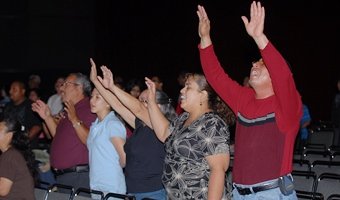
HOUSTON—More than 300 Hispanic Texas Baptists prayed, worshipped and enjoyed fellowship in their heart language of Spanish, celebrating what God has done in and through them during the past year.

The Hispanic Baptist Fellowship met the night before the Baptist General Convention of Texas annual meeting to rejoice in what God is doing in Hispanic churches through Texas Hope 2010 and to rally the group to continue their efforts in reaching the lost through praying, caring and sharing.

Martin Ortega, pastor of Emanuel Baptist Church in Midland, and Rolando Rodriguez, director of Hispanic ministries for the Baptist General Convention of Texas, participate in a Hispanic Baptist Fellowship rally prior to Texas Baptists’ annual meeting.

Texas Hope 2010 is an effort by Texas Baptists to share the hope of Christ with every Texan by Easter 2010 so each person can respond to the gospel in his or her own culture and language. The meeting also was about looking beyond Easter 2010 to find ways to disciple the new believers.

“We are offering a challenge to Hispanic churches in Texas, especially in the Houston area, to start a focus on follow-up for Texas Hope 2010,” said Rolando Rodriguez, director of Texas Baptists’ Hispanic ministries.

To promote the three aspects of Texas Hope 2010, Rodriguez spoke on prayer, Martin Ortega, pastor of Emanuel Baptist Church in Midland, preached on caring and Victor Rodriguez, pastor of South San Filadelfia Baptist Church in San Antonio and president of the Hispanic Baptist Convention of Texas, delivered a message about sharing.

The key to making a difference through prayer comes from 2 Chronicles 7:14, Rodriguez said. If God’s people will humble themselves, pray and seek his face, then God will make a difference in their lives and in Texas, he said.

“We need to pray that our eyes will be opened so we can do the works of God,” Rodriguez said. “What difference are you making because you pray?”

When speaking on care, Ortega noted Mark 1:21-45, insisting Hispanic Baptists must have a complete commitment to proclaiming and living out the mission of Christ—going to the poor, blind and oppressed.

With Jesus, the commitment to caring includes liberation, treatment of the whole person and restoration of life, Ortega said.

Participants in a Hispanic Baptist Fellowship gathering prior to the Baptist General Convention of Texas annual meeting in Houston join in worship. (PHOTOS/Kaitlin Chapman/Texas Baptist Communications)

Rodriguez spoke about the Texas Hope 2010 compact discs that contain the Gospel of John in English and Spanish, as well as an option to download the New Testament in more than 300 languages.

Attendees were en-couraged to purchase 10 CDs each at the end of the meeting to distribute in their cities and to spread the Scripture in a way that others can understand and use it.

The group has held the fellowship meeting the night before the start of Texas Baptists’ annual meeting for the last few years as a way to include the group in the big picture of Texas Baptists’ mission and ministry efforts, Rodriguez said.   

“We wanted to make sure we have a celebration along with BGCT annual meeting to send a message that we are the BGCT,” Lopez said. “We are not just a part, but we are the BGCT.”

The meeting also focused on promoting the centennial celebration of Convencion, the Hispanic Baptist Convention’s annual meeting that will take place in June 2010. BGCT Executive Director Randel Everett told the rally he is looking ahead to next year’s BGCT annual meeting in McAllen as part of the centennial celebration.

“I believe that it is important that we are having annual meeting in McAllen during the centennial year for Convencion,” he said. “I believe that God will pour out his Spirit on this and that great things will happen in the Valley.”