On the Move

Alan Armstrong to First Church in Conroe as student minister from Fielder Road Church in Arlington, where he was junior high pastor.

Jim Bigbee to Center Point Church in Denton as pastor.

Bill Grant to First Church in Waelder as pastor.

Brian Hawkins has resigned as youth minister at Second Church in La Grange.

Michael Moers to First Church in Gonzales as interim youth minister.

Amanda Ratheal to Memorial Church in Denton as interim youth minister.

Johnny Royce has resigned as youth minister at Morse Street Church in Denton.

Wade Smith to Pleasanton Church in Trinity as pastor.

Donn Wisdom to Trinity Church in San Antonio as minister of music from Wieuca Road Church in Atlanta, Ga.


Faith Digest: Sydney bishop dresses down casual clergy

Sydney bishop dresses down casual clergy. An Anglican bishop in Australia’s largest city has dressed down his clergy over their lack of sartorial style. “Why are our clergy the worst dressed people in church?” wrote Bishop Robert Forsyth of South Sydney on a website for the city’s Anglicans. Forsyth, writing in his regular column, “The Grumpy Bishop,” said he is concerned the casual wear of some clergy sends a bad message to “unbelievers and outsiders.” Forsyth says the idea of “Sunday best” does not exist any more. Still, he continued, “There is a way of dressing casual that looks really good … (and) there is a way that looks positively … scruffy.”

Jordan files complaint over Dead Sea Scrolls. Jordan has complained to a United Nations agency after Canada refused to seize the Dead Sea Scrolls at a recent exhibit in Toronto. Jordan asserts the ancient manuscripts, on loan from the Israel Antiquities Authority, were stolen from a museum in East Jerusalem, which Israel seized from Jordan during the Six-Day War of 1967. Some of the earliest biblical and religious writings ever found, the 2,000-year-old scrolls were discovered by a Bedouin shepherd in 1947 in caves overlooking the Dead Sea. Seventeen of the approximately 900 scrolls had been on display in Toronto’s Royal Ontario Museum since June. After Canada declined to seize the scrolls, Jordan announced it had complained to UNESCO—the United Nations Educational, Scientific and Cultural Organization—citing the 1954 Hague Convention for the protection of cultural property in the event of armed conflict.

American faithful disapprove of marriage to atheists. Most Americans accept interracial marriage, but many people of faith say they would be troubled by a family member’s decision to marry an atheist, the Pew Research Center reports. Seven in 10 Americans associated with a religion said they either would be bothered but come to accept such a marriage (43 percent), or they would not ever accept (27 percent) it, the poll found.

Charges of religion-related job bias hits record. Incidents of alleged religion-based workplace discrimination hit record highs in 2009, along with complaints of bias based on disability and national origin, according to the U.S. Equal Opportunity Commission. Charges of religion-related bias in private-sector jobs have increased steadily from fiscal year 1997, when they amounted to 2.1 percent of workplace discrimination complaints, to fiscal year 2009, when they were 3.6 percent. The overall number of charges filed during the most recent fiscal year—93,277—was the second-highest ever. Victims received monetary relief of more than $376 million during the time period studied, which ended Sept. 30, 2009. Of the 3,386 religion-based charges received by the EEOC, 2,958 were resolved. About 60 percent of resolved cases—both overall and specifically religious ones—were found to have “no reasonable cause” based on evidence obtained during an investigation. Those bringing charges still could challenge their employers through private court action.


Wrestling with tough issues of faith and science

AUSTIN—Baylor theology professor Barry Harvey took just two texts to a seminar on science and faith—the Bible and Darwin’s Origin of Species.

“Far too often, (discussing faith and science) generates heat rather than light,” Harvey said, introducing the all-day seminar, “Science and Faith: Breaking Down the Wall,” at First Baptist Church in Austin.

Retired military chaplain Bob Campbell (left) and John George, retired professor of entomology, share testimonies about their experiences interacting with faith and science.

Harvey joined colleagues Phyllis Tippit, lecturer in the Baylor Interdisciplinary Core, and Gerald Cleaver, associate professor of physics at Baylor, as speakers for the Jan. 23 event, sponsored by the Baylor University Center for Ministry Effectiveness and Educational Leadership.

The seminar, featuring three lectures and plenty of participant discussion, addressed the conflict many Christians feel when discussing faith and science—if the conversation happens at all.

“The subject of faith and science is a very sensitive topic for a lot of good Christian people,” said Don Schmeltekopf, director of Baylor’s Center for Ministry Effectiveness and Educational Leadership. “When you start talking about the universe being 13.7 billion years old, many people respond: ‘What are you talking about? I don’t read my Bible that way.’”

“It gets so divisive,” said Shelley Hargrove, a seminar participant and member of First Baptist Church in Austin, commenting on discussions of Christianity and science.

School teachers, retirees, lay leaders, and church staff gathered at the seminar to learn how science and Christian faith complement and edify one another.

Harvey opened the seminar with a lecture titled: “What’s God Got to Do With It? Why Theology and the Physical Sciences Are Not In (Epistemic) Competition.”

“What does it mean to say we know something?” Harvey asked.

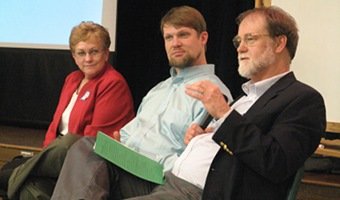
Phyllis Tippit, Gerald Cleaver and Barry Harvey, all from Baylor University, respond to questions during a panel discussion at the seminar, “Science and Faith: Breaking Down the Wall.” (PHOTOS/Carrie Joynton)

Literal interpretations—specifically of biblical texts—invoke contemporary conventions and define what’s important in text, sometimes regardless of the author’s original intent, he explained. With constant reference to God’s ultimate sovereignty, Harvey cautioned against dogmatism and the notion that a specific kind of knowledge can “trump” all others, in either faith or science.

“It is not an insult to say that science cannot answer every question,” he said. “God sustains all things—both the things themselves, and the processes therein.”

Next, the day’s conversation turned to the physical sciences. In his lecture, “Faith and the New Cosmology,” physicist Gerald Cleaver spanned topics ranging from ancient paradigms of creation, to cosmology, string theory and the possibility of multiple universes or “multiverses.” Human knowledge of the universe’s fundamental features has skyrocketed over the past century, Cleaver noted, but knowledge doesn’t equate to understanding.

“Science asks and tries to answer the ‘how’ questions,” Cleaver said. “Transcendent revelation addresses the ‘why’ through Scripture and faith.”

In her lecture, “Does Life Have A History?” Phyllis Tippit used plate tectonics as an illustration of purposeful, constant change in the physical world.

As geologic collision recycles carbon dioxide into the atmosphere, plate tectonics is “part of a system that makes this world a place to live,” Tippit observed.

Using an analogy of God as gardener, Tippit presented her thesis that the theory of evolution supports—rather than contradicts—God’s presence in the universe. Evolution, she said, is simply “organized change through time.”

Participants Jack Woods and Ryan Arnold at the seminar, “Science and Faith: Breaking Down the Wall,” discuss “pressure points” in Christian conversation about faith and science.

“We have a God who works, who shapes … constantly working with his creation. Isn’t that kind of what we see when we look at evolution?” Tippet said.

Roger Paynter, senior pastor of First Baptist Church in Austin, hoped the frank discussion at the seminar about faith and science offered hope for attention to a long-ignored need in churches. Many members of his congregation have been hurt by being told they couldn’t pursue both faith and science, he said.

“I think people are hungry to be treated as if they have a brain,” Paynter said. “It doesn’t threaten our faith, it deepens our faith.”

“Faith and Science: Breaking Down the Wall” wasn’t a one-time event. Through Baylor’s sponsorship, Schmeltekopf hopes to develop it into a series presented in several churches throughout Texas.

His main hurdle will be finding churches receptive to these discussions, he noted.

“There are lots of Baptist churches for which the subject would be too controversial,” he said.

But Schmeltekopf insists the relationship between science and faith is a pertinent and necessary issue for Baptists to consider.

“The church’s witness to the world needs to include our conversation with the scientific community, and not ignore it,” he urged. “We are negligent to ignore this aspect of life. It’s just irresponsible.”

During group discussions prior to the lectures, participants listed major “pressure points” they considered important to the day’s conversation. Some wanted to develop a “common language” and a “framework for conversation” between the disciplines. Others wondered how to hold to the Baptist tenet of scriptural inerrancy while recognizing scientific support for alternate interpretations of the text.

Teachers face special circumstances, many participants noted, as they answer not only to peers, but also parents and administrators, for how they approach topics like evolution in the classroom.

In a panel discussion at the end of the seminar, Harvey offered advice for tempering antagonism.

“We should care what the other person thinks. We should struggle together to find the truth,” Harvey said.

Tippit suggested participants begin conversations in their own congregations by starting book clubs featuring literature that raises controversial—but important—issues in faith and science.

At First Baptist Church in Austin, Paynter promotes having these discussions in Sunday school, in an “environment of permission for people to ask the tough questions, and not have simplistic answers.”

“It takes tremendous grace to be in dialogue,” he said. “You have to be willing to disagree, to learn.”

The next seminar in this series will be held at Wilshire Baptist Church in Dallas, Texas, on April 10. For more information, contact Julie Covington at the Baylor University Center for Ministry Effectiveness and Educational Leadership at (254) 710-4677 or e-mail julie_covington@baylor.edu.


Christians ask: ‘What if we had just one month to live?’

SULPHUR SPRINGS—If Christians knew when they only had one month to live, what passion to make a difference would be engendered?

That is the question 30 Hopkins County congregations are asking themselves during their One Month to Live campaign.

Bruce Welch (right), minister of education at First Baptist Church in Sulphur Springs, and Joel Tiemeyer, pastor of The Way Bible Church and head of the Hopkins County Christian Alliance, spearheaded the drive to involve churches throughout their area in challenging members to ask, “What if we had just one month to live?” (PHOTO/George Henson)

The Hopkins County effort began last May when Brit Fisher, children’s minister at First Baptist Church in Sulphur Springs, saw a television report of a similar campaign in Clinton, Okla., and told Minister of Education Bruce Welch he thought it was something their church should do.

Welch called the First Baptist Church in Clinton and learned it was a citywide campaign. He thought maybe the same approach should be tried in Sulphur Springs.

When he brought the idea to Joel Tiemeyer, pastor of The Way Bible Church in Sulphur Springs and head of the Hopkins County Christian Alliance, it didn’t take much convincing.

“They were already looking for something to do as a communitywide project, and this fit like a hand in a glove,” Welch said. He also approached Rehoboth Baptist Association, drawing in churches from the surrounding communities of Como, Cumby and Dike.

“When Bruce came to us with this idea, it was kind of like an automatic,” Tiemeyer said. “It wasn’t anything you had to think about and pray about because we had been doing that since January—really praying and asking God, ‘What’s the next step for our city to take for all of us as churches to come together?’”

That was the beginning of what Welch and Tiemeyer pray will spark a life change for Christians throughout the county.

“It’s living every day not as if you are about to die, but living every day as you would if knew you only had 30 days left, and when the campaign is done, to live the rest of your life with that purpose, that meaning, that drive to accomplish those things you’ve always wanted to accomplish” for the kingdom of God, Tiemeyer explained.

{youtube}OkeDN0nTp6I&hl=en&fs=1&rel=0{/youtube}
Bruce Welch and Joel Tiemeyer explain how the One Month to Live campaign works.

One of the most exciting things is to see how God brought together 30 diverse churches for a collaborative effort, he added.

“To get 30 churches on board, all doing the same thing, all at the same time—it’s been an amazing process to see how God has worked in that,” Tiemeyer said.

“It’s not only interdenominational; it’s also interracial,” Welch said of the effort. At least seven denominations, and many stripes of Baptists, as well as nondenominational churches such as Tiemeyer’s, are involved in the effort, which has drawn the participation of African-American and Hispanic congregations.

Welch and Tiemeyer visited with pastors of the various congregations and said most saw the potential of the campaign far outweighed any difference they had.

“By the time we got done, they realized we had the same purpose they did—whether Methodist, Baptist, nondenominational, Assembly of God or Church of God—we all have one focus and that’s to win our city to Jesus Christ,” Tiemeyer said.

“And when they realized that’s the heart we came in with, they were like, ‘Yeah, we want to be a part of something that wins our city to Christ,’ because there is no denomination specification to be involved in this or race specification.

“It’s all about one thing—what can we do for the advancement of the kingdom of God. Pastors just fell in love with it.”

Each participating congregation was asked to do at least two things—members place One Month to Live yard signs on their lawns and the each pastor preach on the assigned topic for each of the six Sundays.

Some churches became even more involved, using materials available to go along with the campaign’s emphases. Resources include a daily devotional book, small-group studies, Sunday school materials for all ages and green silicon wristbands that have been good conversation starters leading to even more contacts.

For example, Tiemeyer said when he sees someone in a store he doesn’t know wearing a green armband, he talks to that person about what church they attend to and their church’s participation.

“People are going to be listening to your conversation as they pass by,” he said. “That’s just the nature of people to do so.”

The youth group at First Baptist Church even designed their own T-shirts to promote the event.

And while pastors are asked to preach on the same topic as the other pastors involved in the campaign, they are not all preaching the same canned message.

“We’re not going to tell you what to preach. We’re not going to tell you how to preach it, because far be it from me to come into your church when I don’t know your parishioners to say you’ve got to teach this with this message and this lesson. So, we just said, ‘We’re asking you to preach on these topics however God leads you,’” Tiemeyer explained. “They have absolute freedom on what they are preaching and how they want to present it to their congregation.”

While the campaign kicked off with a rally at the Hopkins County Rodeo Arena Jan. 31, the effort is local-church oriented.

“It’s not coming to a centered event in the middle of the city where you’re not in a church building. But for six weeks, it’s all about inviting people to your church to take this challenge,” Tiemeyer pointed out.

“The goal is, by the time they’ve been there five or six weeks, the body of Christ will have reached out enough to them and loved them enough to stay actively involved become a participant in that church.”

That church-centeredness is key to Welch.

“The cool thing is, it’s not an event. The center of it, the focus of it is what is going on in the churches,” he said. “So, we don’t have to worry about having an event and after the event is over, trying to get those people touched by the event into the church.”

First Baptist Church recently called Mark Bryant as pastor, but for 90 percent of the preparation of the campaign, the church was without a pastor. Welch didn’t see that as any sort of obstacle.

“We had been praying about doing something that affected our city. Just because we don’t have a pastor, the kingdom work goes on. It doesn’t stop,” Welch said.

While his church was without a pastor, other churches in the area had a variety of struggles of their own, and so they were a part of his thoughts and prayers as well.

“God had placed on my heart a concern for the churches of Sulphur Springs, so as he was dealing with me about that, I just saw this maybe as something that could unite the churches and get our focus on the cause of Christ.” Welch said.

“Whether we had a pastor or not really had nothing to do with it. It had everything to do with: ‘This is the opportunity. This is the time. Let’s go.’”


Volunters help Galveston clean up hurricane damage

GALVESTON—A team of Virginia college students used their winter break to make a couple of Galveston homes a bit more livable.

More than a year after Hurricane Ike hit the island city, teams like the one from Broadus Memorial Baptist Church in Mechanicsville, Va., still are needed to help homeowners make the places they live more habitable, said Peter DeWorken of 1 Mission Galveston.

A mission team from Broadus Memorial Baptist Church in Mechanicsville, Va., tackled the renovation of this home that was damaged by Hurricane Ike more than a year ago.

DeWorken’s ministry helps facilitate groups from all over the United States who recognize the great need that still exists in Galveston and want to make a difference. One Mission Galveston not only provides materials and tools needed to do the work, but also feeds and houses mission teams for only $25 a night per person.

Headquartered in a former elementary school centrally located on the island, the ministry provides hot meals, cots and shower and laundry facilities as well as Internet capabilities. While a hotel would provide many of those same functions, it would not provide meals, supplies or tools, or facilitate ministry opportunities, DeWorken pointed out. Also, all the money that comes in addition to expenses is used to buy supplies and other things to continue the ministry for the next group.

In addition to construction teams, other groups provide outreach ministries to the homeless, provide workers for Vacation Bible Schools, work in local food distribution ministry, prayerwalk the city and clean up neighborhoods. There is more than enough work to go around, DeWorken said.

While it has been a more than a year since the hurricane, volunteers still are heeding the call. So far, more than 200 Galveston homes have had teams come to work on them, but some of them need additional attention and many more have yet to be begun, DeWorken said.

Two thousand volunteers were expected to come to the island in January, February and March to minister to the people living in Galveston.

“We’re thrilled about it, and we’re scared to death,” DeWorken said with a broad smile.

Many of the volunteers will be coming from churches throughout Texas, he noted.

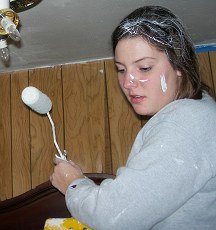
Lindsay Turner paints the ceiling of a home in Galveston.

“Without Texans helping Texans, this ministry wouldn’t be near what it is,” he said.

Still, many will travel from much farther, such as the group of 17 college students and sponsors from Virginia.

The young adults were challenged last spring to pursue a mission opportunity during their Christmas break by Gary Bone, minister of education and senior adults at Broadus Memorial Baptist Church.

Bone, who formerly served as minister of education at Columbus Avenue Baptist Church in Waco, said that after investigating the possibilities, he gave the volunteers a choice between Galveston and Toronto, and they overwhelmingly selected Galveston.

Aaron Hazelgrove, a junior at Virginia Tech, said being in close contact with the family they were helping was one of the best parts of the trip for him.

“They are interesting people, an interesting family,” he said. “It’s fun to work on the house of someone when you have a face to go with it.” The homeowner was so thankful, she made the crew a large batch of brownies, he added.

Emily Gardner, a Virginia Tech student, taped windowpanes before painting. She worked on home repairs in Galveston as part of a mission team from Virginia.

Emily Gardner, another Virginia Tech student who worked on a different house, agreed the people she met made the trip special.

“I have a real heart for missions, and it’s what I plan to do with my life,” she said. “And it has been great to get to know the lady whose house we have been working on and very moving to be able to help her home become a little warmer.”

The house Gardner worked on had a 4-foot by 8-foot hole in the side that allowed the cold and rain to stream into the attic and then sail down a stairway into the rest of the house. The elderly homeowner only had gas heaters to try to fend off the cold.

In addition to covering the opening with a tarp on the inside and outside with plywood in between, the team also replaced 21 windowpanes, removed and replaced water-damaged sheetrock, and painted two rooms in the home.

“I don’t know how I would ever have gotten it done,” homeowner Mary Hall said.

Even her neighbors were thankful the Virginia college students made the trip to help her.

“The lady across the street was so impressed, she brought them a batch of cookies,” Hall said.

For more information about bringing a mission team to Galveston, visit www.onemissiongalveston.org.


Common ground on abortion not impossible, but tough to find

WASHINGTON (RNS)—Thirty-seven years after Roe v. Wade—the contentious Supreme Court decision legalizing abortion—is there any hope for common ground?

Experts say it will be difficult—especially in light of recent health care battles—but not impossible.

Laurie Zoloth, professor of bioethics and religion at Northwestern University, pointed to some projects—such as giving incentives to teen girls to avoid a second pregnancy—that can bring feuding factions together.

A young abortion protester kneels in prayer during a rally before the March for Life. (RNS FILE PHOTO/Jennifer Flowers)

“It’s where people of faith mutually unite around a concern about an actual and specific other—a pregnant woman, a newborn baby—those actual, specific human beings rather than an abstraction,” she said. “Then the projects can really begin to exist.”

Polls indicate Americans are tired of abortion warfare. An October poll by the Pew Forum on Religion & Public Life found 60 percent of respondents said the country needs to find a “middle ground” on abortion.

President Obama, in a closely watched speech at the University of Notre last May called for “common ground” on reducing unintended pregnancies and increasing adoption opportunities.

Shin Inouye, a spokesman for the White House, said the administration is continuing to address those initiatives as Obama nears the end of his first presidential year.

“Various White House offices are working together to develop strategies to reduce unintended and teenage pregnancies, support maternal and child health and reduce the need for abortion,” he said. “The president welcomes a strong debate and healthy discussion on this and other important issues facing the country.”

But debates over abortion as Congress has attempted to overhaul health care have at least temporarily extinguished the hopes for common ground, observers say.

“The fact that abortion was once more used as a way to divide people, not to unite people, was not an encouraging moment for religious unity,” Zoloth said.

Carlton Veazey, president of the Religious Coalition for Reproductive Choice, was among the religious progressives who decried the amendment sponsored by Rep. Bart Stupak, D-Mich.—and heavily supported by U.S. Catholic bishops—that would bar government funding of abortion in the health care bill.

“The Stupak thing and the Catholic bishops really demonstrated how far we’ve come— not very far,” Veazey said.

Richard Doerflinger, the chief spokesman for the U.S. Conference of Catholic Bishops on its anti-abortion public policy, said the health care debate has “sucked the oxygen out of the room,” but polls show the majority of Americans opposed federal funding of abortion.

“In terms of public support, that’s the common ground,” he said. “Now the pro-abortion groups are outside that common ground, but I can’t help that.”

Third Way, a Washington progressive think tank, sees some consensus in health care proposals in Congress that could reduce the need for abortions.

Rachel Laser, director of Third Way’s Culture Program, said the legislation includes education programs for preventing teen pregnancy and home nurse visits to support new low-income parents, reflecting goals of legislation proposed by Rep. Rosa DeLauro, D-Conn., and Tim Ryan, D-Ohio.

Her organization brought a range of religious leaders together in July to support that bill and last year rallied a coalition of evangelicals and progressives who agreed on a common agenda that included abortion reduction.

“The problem is the common-ground abortion movement is going to take time,” said Laser. “When an issue has divided the country for decades … it takes many years to get the numbers that you need” to prevent the kind of fight that has occurred over health care.

Wendy Wright, president of Concerned Women for America, said there may be “small things” in the health care legislation that represent agreement among abortion rights supporters and opponents, but she will continue to oppose any federal policies that would fund abortion or contraception.

“I think we’ll continue to see good language (about reducing abortion) because politicians are recognizing that the majority of Americans are pro-life,” said Wright. “But the real tests are in the policies that are promoted and where money is funneled.”

Richard Land, president of the Southern Baptist Convention’s Ethics & Religious Liberty Commission said there are lines that can and cannot be crossed by people on either side of the abortion debate.

“I think we can find common ground on public funding of nurseries in high schools and community colleges to encourage girls who want to have their babies and not have to sacrifice their schooling,” he said. “We’re not going to have common ground on public funding of abortion.”

Marc Stern, co-executive director of the American Jewish Congress, said the decades-long debate now has the added fuel of constant media attention and the contentious political climate, making it even more likely it will continue for years to come.

“The American public … doesn’t want to ban abortion, neither does it like abortion,” said Stern, who graduated from law school the year the Supreme Court ruled on Roe v. Wade. “You would think that that would give rise to some common ground. It does not. … Starkly stated, firm unbending principles are easy to communicate in a very rapid media environment.”


Specialized Texas Baptist teams enter Haiti to offer relief

DALLAS—Texas Baptists helped a medical team from Baylor Hospital go serve in Haiti and have other small, specialized disaster response groups lined up to do likewise, including a Texas Baptist Men assessment team.

The teams are entering the country on a private jet on loan to Texas Baptists by Mike Roberts, a member of Park Cities Baptist Church in Dallas. The jet has made one trip to Haiti and will make more, dropping volunteers off in Port-Au-Prince.

“We are humbled by the generosity of Texas Baptists,” said Bill Arnold, president of the Texas Baptist Missions Foundation and coordinator of disaster response for the Baptist General Convention of Texas.

“Whether it’s airplanes, time, talent or money, the Texas Baptist family is responding in an incredibly generous way to share the hope of Christ with the people of Haiti. We are continuing to send in medical supplies, water purification equipment and the volunteers to use them.”

Including the team of medical professionals from Baptist Temple in McAllen, nine Baylor Health Care System medical personnel either have been serving in Haiti or are serving now, said Don Sewell, director of the Baylor Health Care System’s new faith-in- action initiatives, which seeks to connect Baylor medical staff with volunteer opportunities.

“Baylor Health Care System realizes the great importance of sharing our personal and material assets with our community and to our world,” he said.

“We’re simply continuing the Christian spirit under which Baylor was established in George Truett’s days, and we’re proud to be part of the Texas Baptist family.”

Trained Texas Baptist Men volunteers left for Haiti on Jan. 27 and with water purification equipment that will provide 75,000 gallons of clean water a day.

TMB filters

Bill Sluder, a TBM volunteer, drives forklift of 5,000 water filters to be sent to Haiti.

Those supplies will be used to provide clean water for a medical clinic and several orphanages, TBM Executive Director Leo Smith said. The children are running out of clean water.

“The orphans are our first priority,” Smith said.

The organization had been waiting for a government plane to take 5,000 water filters to Port-Au-Prince and received that Jan. 26. Each of those water filters, which have been paid for by donations through the Baptist General Convention of Texas, can provide clean water for a family of four for six months.

Financial gifts can be made through Texas Baptists to support disaster response efforts through the convention’s partners, including Texas Baptist Men, at www.texasbaptists.org/give or by sending a check designated disaster response to Texas Baptist Missions Foundation, 333 N. Washington Ave., Dallas 75246.

Texas Baptists also can make donations to support Texas Baptist Men individually at www.texasbaptistmen.org or by sending a check designated disaster relief to Texas Baptist Men, 5351 Catron, Dallas, 75227.

Buckner International has a pair of humanitarian aid shipments scheduled to go to Haiti on Jan. 29. The shipments include medical supplies and cots of the Hope Hospital and Children’s Village in Port-Au-Prince. Nearly 25,000 shoes for orphans is being sent to a Buckner partner church in Florida that will distribute them through agencies in Haiti. Buckner is planning additional humanitarian aid shipments in the future.

To support Buckner’s efforts in Haiti, visit www.buckner.org .

Baptist Child and Family Services’ global division, Children’s Emergency Relief International, has work in progress for long-term recovery efforts in Haiti.

Based on daily briefings from the U.S. Department of Homeland Security and the Texas Division of Emergency Management, “as soon as it is determined that the health and safety of our volunteers will not be compromised and that our efforts will not become a burden to those we seek to help, CERI will lead mission trips to support the rebuilding of impacted orphanages and provide medical care to children in need,” said BCFS President Kevin Dinnin.

To support BCFS’ work in Haiti, visit www.bcfs.net .

Students at Texas Baptist schools, including East Texas Baptist University, Baylor University and Howard Payne University, have participated in a variety of fundraisers to help hurting people in Haiti.


Former Southwest Baptist University student pleads guilty to assault

SPRINGFIELD, Mo. (ABP) — A former football player at Southwest Baptist University pleaded guilty Jan. 25 to second-degree assault in a 2006 beating that left a Bolivar, Mo., man permanently disabled.

Rony Saintil, 27, of Del Ray Beach, Fla., accepted a plea bargain that reduced his charge from first-degree assault, a class A felony punishable by up to 30 years in prison. Under terms of his plea he could still get seven years, but the Bolivar, Mo., Herald-Free Press reported that Saintil's lawyer intended to ask for shock detention. That allows a defendant to receive probation after a short time in a correctional facility, or for a suspended sentence.

Police originally arrested four students attending the school affiliated with the Missouri Baptist Convention in connection with an incident outside a Springfield, Mo., nightclub. Police said a group of men were seen Oct. 13, 2006, kicking and punching 22-year-old Joshua Mincks of Bolivar, where SBU is located, in the head while he was pinned underneath a car. The incident took place in the parking lot outside of Cowboys 2000, a popular night spot for young people. 

Mincks suffered injuries, including a broken jaw. He was in a coma for three days and hospitalized for weeks. The Bolivar newspaper said he has since been classified as permanently disabled.

Because witnesses had fled the scene by the time police arrived, they did not have enough evidence to file charges. The university conducted its own internal investigation and dismissed an undisclosed number of students, citing federal law that says disciplinary action taken against a student is not public information.

Saintil was identified publicly when indictments handed down to him and another man, Henry Warren Patten, by a grand jury impaneled mainly to investigate crimes by gangs, were unsealed with their first court appearance in October of 2007.

Penny Speake, a Greene County, Mo., assistant prosecutor, said Patten's case is still pending with a pre-trial conference coming up soon. She said a third man charged in the incident, Alvin Pope, was recently extradited and his next court date is Feb. 2.

The crime rocked the county-seat town of Bolivar, with a population of about 11,000. Some questioned if the assault was racially motivated — the attackers were black and the victim white. It raised questions on the Southwest Baptist campus both about safety and recruiting standards for the SBU Bearcats football program. 

According to a Google search, Saintil, a 6-foot-5-inch, 215-pound wide receiver, attended Spanish River High School in Boca Raton, Fla. He joined the team at Bethune-Cookman College in Daytona Beach, Fla., in 2001  before transferring to a junior college in Reedley, Calif.  He committed to Temple University in 2004 and was mentioned in a 2005 season preview. After his dismissal from SBU, Santil moved to the University of North Alabama, but he was academically ineligible to play. 
 
Southwest Baptist University football coach Jack Peavey resigned abruptly after just two years in 2007. The university declined to comment on the reasons he was leaving, but Peavey, a former NFL player who now is an assistant at Texas A&M University-Commerce, said in a letter to a Springfield newspaper it was because administrators would not permit him to do what was needed to make SBU competitive. The university is the only private school in the Mid-America Intercollegiate Athletic Association.

Sentencing for Saintil is scheduled for April 23 in Greene County Circuit Court. A jury trial scheduled for him the week of Jan. 25 was canceled.

According to the Bolivar Herald-Free Press, Saintil acknowledged that he took part in the fight but his lawyer said the injuries to Mincks were caused by the actions of several individuals and that nobody knew for sure who caused them.

-30-

Bob Allen is senior writer for Associated Baptist Press.


Missionaries offer comfort to injured quake victims from Haiti

JIMANI, Dominican Republic (BP)—Delores York sits in the hallway of Good Samaritan Clinic just east of the Haiti border in the Dominican Republic. Her feet hurt, and she is exhausted. It’s been a long day for her and other clinic volunteers as earthquake victims fill every room, waiting for treatment.

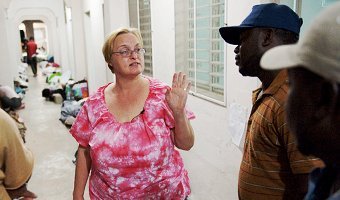
IMB missionary Dawn Goodwin serves as an interpreter at a clinic in Jimani, Dominican Republic. She is one of the few there who speaks Haitian Creole and can translate for medical staff and patients, scattered on mattresses throughout the clinic. (IMB PHOTO)

Suddenly York, an International Mission Board missionary from Abilene who has ministered among Haitians 12 years, is back on her feet. She’s in the lobby holding hands with Claire, a woman about to go into surgery to repair her broken hip. Claire lost her home, looters stole everything she had and she—like so many others—lost loved ones in the 7.0 magnitude earthquake that rocked Haiti.

But the two women can’t stop smiling.

“She’s my sister,” York says proudly. “She’s happy about Jesus saving her life.”

“I have hope in God,” Claire responds. “God will get me through this.”

York and Claire just met at the clinic, but they’ve become fast friends since York speaks Claire’s Creole language. As hundreds of injured Haitians pour into the clinic, York and other IMB missionaries helping there provide a valuable skill as interpreters.

“Hardly anyone here speaks Creole,” said Dawn Goodwin, an IMB missionary from Jefferson City, Tenn. “We’re able to help the doctors understand what exactly is wrong with the patient, so they can give the treatment the patient needs.”

Language barriers only complicate the situation in what looks like a war zone, with patients scattered on mattresses throughout the clinic.

Patients include amputees, those with head wounds, infections and broken bones. They line the hallway as ambulances pull up to unload new patients.

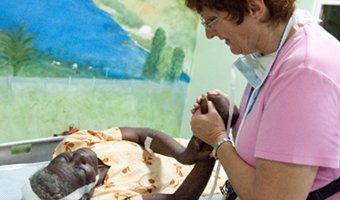
Missionary Delores York of Abilene interprets, consoles and prays with patients at a clinic in Jimani, Dominican Republic, near the Haiti border. In addition to being injured, most patients have lost their homes as well as family and friends. (BP PHOTO)

The only available space for some is a patch of grass and dirt just outside the clinic. Rooms overflow with patients, exhausted doctors and other medical volunteers, some just trying to catch an hour or two of rest.

“It’s been a week since the earthquake—and they’re still coming,” Goodwin said.

Sleep isn’t something Goodwin, York or York’s husband, Sam, from Midwest City, Okla., have seen much of in recent days.

“I just did a 24-hour shift,” Goodwin said. “I haven’t been able to get much sleep, but there aren’t enough translators.”

Interpreting is just part of what the Baptist missionaries are doing. A day at the clinic can include everything from helping lift patients on and off beds to cleaning bathrooms.

The focus, however, remains the patients—most of whom have lost their homes as well as family and friends.

“Everything is gone,” said Junior, who was visiting his wife, a patient at the clinic. They lost their two children in the earthquake. “This is all we have,” he said as he pulled on his shirt.

“We have nowhere to go.”

After being released, many patients are transported to Bethel Baptist Church in Jimani, Dominican Republic, for temporary shelter. But their future remains uncertain.

For now, volunteers do what they can to comfort the hurting and wounded.

Although doctors continue to rotate in, the number of patients is overwhelming. Workers at the clinic estimate they have treated more than 1,000 patients.

Another challenge is the equipment at the clinic. One evening, the X-ray machine was down, forcing doctors to cut open an arm or leg to feel for cracks or breaks in the bone.

While so many stories coming out of Haiti are sad, there also are miracles to report.

A woman and her 22-day-old baby were transported to the clinic after being rescued from the rubble of a building where they had been trapped for three days.

It’s easy to feel helpless and overwhelmed in the midst of crisis, York acknowledged. But she wouldn’t want to be anywhere else.

“For us, the hardest part would be not being here,” she says.


Amarillo church gives entire weekend offering to TBM Haiti relief project

AMARILLO—Paramount Baptist Church in Amarillo gave $63,100 to Texas Baptist Men for disaster relief work following the Jan. 12 earthquake in Haiti. The congregation sent its full weekend offering to Texas Baptist Men despite running $140,000 behind its annual budget.

Pastor Gil Lain said the congregation has been going through a sermon series about living passionately.

“Part of living passionately is doing something drastic,” he explained. So, the congregation decided to take drastic action to make a difference in the lives of Haitians.

About half of the congregation is trained to serve with Texas Baptist Men disaster relief. The church gave to the men’s organization because members knew the money would help people who are hurting, Lain said. TBM is seeking to send 5,000 water filters to Haiti. Each filter will provide clean water for a family of four.

“Even though times are tough, people still have giving hearts,” Lain said. “They want to take of people. I think that’s a picture of Christianity.”

TBM Executive Director Leo Smith said Paramount Baptist Church’s generosity was an answer to prayer. TBM needed $63,000 to pay for the 5,000 filters before the congregation’s gift.

“God met the financial need for water filters for Haiti through the faith and obedience of Paramount Baptist Church in Amarillo that gave TBM their entire Saturday evening and Sunday morning offering, amounting to $63,000,” Smith said.

Gifts to Texas Baptist Men can be made directly to the group at www.texasbaptistmen.org or by sending a check designated disaster relief to 5351 Catron, Dallas, 75227


Baptist World Aid workers say situation in Haiti still desperate

FALLS CHURCH, Va. (ABP) — A Baptist rescue team in Haiti described the situation there as desperate more than two weeks after a massive earthquake the devastated the island nation Jan. 12.

Bela Szilagyi, director of Hungarian Baptist Aid and a leader of a Baptist World Aid Rescue24 team since three days after the quake, told Baptist World Alliance officials Jan. 26 that thousands of people are fleeing Port-au-Prince, a capital city plagued by food and water shortages and long lines at gas stations where fuel has quadrupled in price.

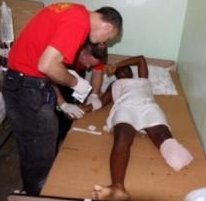
A BWAid Rescue 24 team member treats a woman injured in the Jan. 12 Haiti earthquake. (BWA photo)

Szilagyi said the Rescue24 team, consisting of two Hungarians, five from North Carolina Baptist Men and three Haitians, provided medical treatments for several hundred persons at a community clinic in Pétionville, a suburb of Port-au-Prince.

"Hundreds of people have been waiting for medical care in the hall and even in the parking lot at the clinic," Szilagyi said. Many, he said, had broken limbs and pelvises, fractured skulls and badly injured ankles and feet. "Most of the injuries were already infected because of not having medical care for such a long time," Szilagyi reported.

The Baptist World Alliance continues to make appeals to Baptists around the world to donate funds for Haitian relief, which will be done largely through Baptist groups in the country. Already, more than $150,000 have been pledged or received from Baptists in South Korea, Taiwan, Malaysia, India, Germany, the United Kingdom, Croatia, the Czech Republic, Belgium, South Africa and the United States.

Bethill L'Amerique, right, 16, and sister Bioutelle, 11, center, managed to rescue their mother from concrete rubble. Their father, Baptist pastor Bienne L'Amerique, was killed. Brother Berlau George, 13, was not at home but at his grandmother's house. (BWA photo)

Earlier Szilagyi spoke with family members of Bienne L'Amerique, pastor of Shiloh Baptist Church in Port-au-Prince, one of 150,000 confirmed deaths so far. Government officials said the death toll could reach 300,000.

L'Amerique's 11-year-old daughter, Bioutelle, told Szilagyi she was reading on the first floor when a chasm opened and their two-story home fell into it. Her brother, Bethill, 16, said he was watching television upstairs. He said he was unhurt and helped pull his sister from the rubble. They heard their mother screaming, he said, and managed to pull her free from the concrete rubble.

Bioutelle said her father was in the living room with his mother and a section of the ceiling fell on him when he stood to leave the house. He was buried too deep for the family to reach him and did not speak or move. "My mother is saying that it is possible that he died immediately when the ceiling fell on his head," Bethill reportedly said.


–Bob Allen is senior writer for Associated Baptist Press.


Baylor University, Baylor College of Medicine consider closer ties

More than 40 years after Baylor University in Waco and Baylor College of Medicine in Houston separated, the two institutions have begun talks regarding a strengthened relationship—but not without sparking controversy.

In a Jan. 21 letter to Baylor University faculty, staff and students, Interim President David Garland confirmed the university is “engaged in conversations with the Baylor College of Medicine in Houston and Texas Children’s Hospital regarding a strengthened affiliation.”

Baylor College of Medicine in Houston.

Garland noted the university’s belief the closer relationship with Baylor College of Medicine and Texas Children’s Hospital could help Baylor University’s continued growth and advancement. But, he insisted, no action would be taken that would “put our campus at undue risk,” and no decision would be made until parties involved completed due diligence.

“What is presently being discussed is a strengthened affiliation between the Baylor College of Medicine, Texas Children’s Hospital and Baylor University. Baylor University and the Baylor College of Medicine are not discussing a merger,” he said.

Reportedly, Baylor College of Medicine unsuccessfully had pursued an affiliation with Rice University in Houston.

Controversy regarding proposed closer ties with Baylor University surfaced about the same time Baylor College of Medicine ran into trouble with the National Institutes of Health for failing to disclose a cardiologist’s $34,000 consulting deal with a drug company—an apparent violation of conflict-of-interest policies for physicians conducting NIH-funded research.

Rumors of a merger between the college and Baylor University prompted some students, faculty, staff and alumni of Baylor College of Medicine to create an online petition to register opposition. More than 500 people have signed the statement, based on their belief Baylor University’s religious mission could stifle scientific research at Baylor College of Medicine.

Baylor University’s stated mission is “to educate men and women for worldwide leadership and service by integrating academic excellence and Christian commitment within a caring community.”

“As Baylor University is a religion-affiliated institution that promotes values and teachings from religious beliefs throughout its ranks, we cannot overlook the restrictive influence that this potential merger would have on Baylor College of Medicine, a leading biomedical research-oriented college,” the petition states.

“The religious ideologies that permeate throughout Baylor University’s academic policies may adversely affect both scientific progress and the culture at Baylor College of Medicine, particularly in relation to issues such as evolution, embryonic stem cells and sexual orientation. While we respect everyone’s right to religion in his or her own life, we believe that science and medicine must be separate from religion and urge you to reject any such merger.”

Garland responded: “Baylor University has an ambitious mission and vision that are unique among higher educational institutions. There are some who do not fully understand who and what we are.”

In his letter to faculty, staff and students, Garland sought to correct some of the “misstatements” and misunderstandings about the relationship between the university and Baylor College of Medicine.

“Since it originally affiliated with Baylor University in 1903, the Baylor College of Medicine has been a nonsectarian institution,” he wrote.
However, Baylor College of Medicine is affiliated with faith-based St. Luke’s Episcopal Hospital and Methodist Hospital, as well as Texas Children’s Hospital, DeBakey Veterans Affairs Medical Center, Harris County Hospital District’s Ben Taub General Hospital, the Menninger Clinic, Memorial Hermann-Institute for Rehabilitation and Research and M.D. Anderson Cancer Center.

Michael DeBakey—the cardiac surgeon and medical researcher who pioneered development of the artificial heart—joined the faculty at what was then the Baylor University College of Medicine in 1948, and he later served as president and chancellor of Baylor College of Medicine.

DeBakey and Abner McCall, then president of Baylor University, led in legally separating Baylor College of Medicine from the university in 1969.

“The university did this so that the college could attract broader, nonsectarian financial support and gain access to state and federal funding,” Garland explained.

At the time, the Baptist General Convention of Texas elected all the members of Baylor University’s governing board and set policy for the school—including a prohibition on accepting government funds.

“Baylor University has always been proud of its sectarian identity, but university regents realized its association with the BGCT could be limiting the college’s access to a range of financial resources. What’s more, regents concluded it was unreasonable to expect that the BGCT could continue to assume the financial burden of a growing medical school.”

Even after the university and Baylor College of Medicine separated, they retained some affiliation. Baylor University has appointed 25 percent of the Baylor College of Medicine board since 1969, Garland noted.

The Carnegie Foundation now classifies Baylor University as a research university with high research activity, and the university enrolls more than 500 Ph.D. candidates, he added. Baylor faculty receive $41 million in research grants, and annual research expenditures exceed $16 million.

“Baylor researchers are no longer prohibited from seeking or accepting federal or state funds to support their work,” Garland said. “Baylor’s tenure decisions include an expectation of academic scholarship and research productivity.”