Building Green, Being Green

WASHINGTON (ABP)—It’s not easy building green. But churches that take the call to wise environmental stewardship seriously have a wide variety of options—from simply changing light bulbs to elaborate new construction projects certified as environmentally friendly.

The key, experts in the field of congregations and green design insist, is figuring out what’s appropriate for the church’s ministry context—and then taking advantage of the many resources available to guide the greening process.

Discerning how green to go

For churches considering how to become greener, “Discernment sometimes ends up being a challenge, because so much can be done or should be done,” said Cassandra Carmichael, director of eco-justice programs for the National Council of Churches. “Even if they are just looking at the bottom line and want to do energy-efficiency stuff from a fiscal standpoint, they often have challenges coming up with the capital at the beginning—especially if they’re in a disadvantaged area.”

Most churches face those two challenges when making a decision to become greener—the vast variety of options and then the resources to accomplish their goals, Carmichael said.

“One is that they get so overwhelmed with all they need to do or want to do, they don’t know where to start. We try to help them get past that,” she said. “You get bombarded with all the options that you have to make your church building greener and build a more energy-efficient building.”

Carmichael’s program offers a guide for congregations specifically entering into green-building projects, as well as a separate guide for practical ways that churches can become more environmentally friendly short of a new building project.

Starting simply

The simplest ways to green a church’s facility can make congregations not only better environmental stewards, but also better stewards of their own finances.

“Some of the best low-cost, high-return improvements are compact fluorescent bulbs, LED exit signs, occupancy-sensor controls for lighting, programmable thermostats for heating/ air conditioning, yearly or ‘pre-season’ maintenance or ‘tune-up’ of HVAC systems,” said Jerry Lawson, national manager of the federal Energy Star Small Business and Congregations Network, in an e-mail interview.

“If the church is replacing a piece of equipment anyway, it is incrementally very inexpensive—sometimes no cost increase—to buy Energy Star-labeled products and equipment over non-Energy Star.”

The Energy Star program is an Environmental Protection Agency initiative creating energy-efficiency standards that generally are 20 to 30 percent higher than federal law requires for a variety of consumer products—including household and industrial appliances. Lawson’s network provides resources to congregations and small businesses to improve their energy efficiency. Among them is a guide that shows congregations how to make existing facilities more energy efficient.

The efficiency savings can put to good use, Lawson said.

“Many green efforts—especially energy efficiency—can save (a) significant amount of money that church members have pledged for the mission, only to have it go to pay for utilities,” he said. “Energy savings can be repurposed for the ministry of the congregation, and most congregations can cost effectively reduce energy bills (via increasing efficiency) by 25 to 30 percent.”

And, Lawson added, churches can educate their members to be more effective stewards of energy in their personal lives—which could, itself, have an effect on the church’s bottom line.

“A step further is that the church can help educate members that they can also cut energy costs by about 30 percent in their homes and their businesses, which could help people in their personal finances and enhance their ability to tithe,” he said.

He also noted some steps to increase efficiency could save on costs in ways beyond the simple utility bills.

“Certain green actions, such as replacing inefficient lighting with efficient, can actually save on personnel and maintenance costs due to the much longer life of efficient lighting, and HVAC tune-ups can help the equipment last years longer.”

Beyond increasing energy efficiency

Beyond simple retrofits, greening your church’s facility or building a green-friendly new building or campus becomes more complicated—and requires careful consideration of a church’s ministry context, resources and commitment to go to extraordinary lengths to embrace its call to environmental stewardship.

The 2,500-seat worship center and classroom addition for Crosspoint Community Church in Katy, near Houston, that currently is under construction utilizes sustainable design features. (IMAGE/Courtesy of Merriman Holt Architects)

“As building becomes more driven by sustainable design, it may change the way we define beauty. A beautiful building may be one that looks like it is sensitive to its environment,” said Bill Merriman of Merriman Holt Architects in Houston.

Merriman’s firm recently worked on its first LEED-certified church building project—St. Paul’s United Methodist Church in Houston.

LEED is an acronym for Leadership in Energy and Environmental Design, an initiative of the U.S. Green Building Council. The certification program provides an internationally recognized set of standards for green buildings.

“The church had a great interest in doing a LEED-certified building. It reflected the will of the congregation,” he said, noting the decision was based more on ethical principles than cost savings.

“There was a natural sense that it’s the right thing to do—to be a good steward of the environment God made.”

Green building levels of commitment

Keelan Kaiser is chair of the architecture department at Judson University, an American Baptist school in the Chicago suburb of Elgin, Ill. Judson is the only evangelical Christian school in the United States to offer a fully accredited professional program in architecture. And the program focuses on green design—so much so that it, along with the school’s art and design programs, recently moved into a LEED gold-certified building.

“At Judson, the whole reason we’re interested in environmental stewardship is because buildings consume about 50 percent of the energy in America,” he said.

There are, Kaiser said, four basic steps to creating “a truly green building, and the first is to reduce the loads, or requirements, for energy-consuming equipment.”

That can involve reducing the amount of sun a building built in a climate with hot summers gets to reduce the energy load required to cool the building. Or it could mean maximizing the use of natural light in a facility in order to save on electricity costs.

“The second step is designing very high-efficiency mechanical systems”—such as higher-efficiency heating, cooling and lighting systems—including installing thrifty plumbing systems and water fixtures.

“The third step is providing renewable energy on site,” Kaiser said. That can include solar panels, hydroelectric generators and even windmills. For example, a church in a place like the flat, windy Midwest could place wind turbines atop the tall roof of a sanctuary to take advantage of greater average wind velocities at such heights.

The fourth step in greening a facility, he said, “is to purchase green power off-site—to purchase a portion of your electrical consumption from what’s called green-power sources.”

Many utility systems offer—usually at what Kaiser described as “a slight upcharge”—an option to purchase power that comes from sources greener than coal-burning plants or other high-carbon sources.

Building green wisely

Houston architect Merriman cautioned against “over-promising practical results” in terms of cost savings on utility bills when retrofitting or building a whole new green facility. While energy-efficient heating and air mechanical systems do produce monthly savings in utilities, the initial outlay for a high-performing mechanical system can be costly.

Early on, he recommended, the architect a church enlists when embarking on a green building or renovation program—together with others on the building team—should develop a feasibility study to help the congregation make informed decisions. The team would look at how the building is used and how often particular sections of the facility are utilized each week.

“Communication is all-important so there are no disappointments,” he said.

A life-cycle analysis of any mechanical heating and cooling system also provides vitally important information, he added. If the “payback” on a high-performance system is 15 years, a church might need to reconsider. But if the system paid for itself in terms of utility savings over five or six years, that might be worth consideration.

The unique setting of each church and the composition of its membership also must be considered. For instance, he noted, bicycle racks might be a positive, environmentally friendly addition to some facilities but completely impractical elsewhere.

Efficient use of space

Judson’s Kaiser said churches might make their first step in embarking on a green building plan a re-visioning of how they use their facilities—of how they operate as a congregation.

“Green buildings are the result of green operations,” he said. “You can’t operate a building efficiently if you’re not operating your programs efficiently.”

For example, traditional churches are, simply, inefficient buildings to begin with.

“One of the problems with buildings, of course, is that you want them occupied as much as possible in order to justify its existence, so from a green-building standpoint, a church is a difficult building type,” Kaiser said. “It’s not that you can’t do it, but it’s a building that’s only occupied a small percentage of the day and week.”

The NCC’s Carmichael said some churches have taken their commitment to environmentalism so seriously that they have decided to maximize their facilities’ efficiency by sharing with other congregations—and other alterations to the way they use their space.

“It’s more energy efficient to share a building than having two separate buildings,” she said. She noted one church in Wisconsin that not only shared its building, but also used its space for things like opening gardens to raise produce for the homeless and neighbors to mowing their lawn “with a lawnmower that’s run off of used vegetable oil.”

“They’ve taken the approach of not just the building itself and let’s look at the facility, but they’ve taken it a step further and tried to incorporate those practices into the life of the church.”

Above all, the choices a church makes when it comes to greening its facility come down to its view of its ministry priorities, Energy Star’s Lawson said.

“I believe the most powerful consideration (in greening a church) is the scriptural guidance on stewardship. We are called to be stewards of creation—to prevent pollution and conserve natural resources for future generations,” he said.

“Greening/stewardship efforts can be important and educational ways for the youth group and all members to contribute to the life of the church and community.”


Faith Digest: Graham tops list

Billy Graham tops pastors’ list. Evangelist Billy Graham was named by American pastors as the United States’ most influential living preacher, according to a recent survey by LifeWay Research. The study, conducted last November, interviewed more than 1,000 Protestant pastors by telephone. The participants were asked to “name the top three living Christian preachers that most influence you.” Graham was cited as most influential by 21 percent, followed by pastor and author Charles Swindoll, at 8 percent. Charles Stanley, pastor of First Baptist Church, Atlanta, Ga., and Rick Warren, pastor of Saddleback Church in Lake Forest, Calif., followed closely behind Swindoll with 7 percent of the vote each. The top 10 list also included John Piper, pastor for preaching at Bethlehem Baptist Church in Minneapolis, and Andy Stanley, pastor of North Point Community Church, Buckhead Church, and Browns Bridge Community Church, all in the Atlanta area.

Pope clamps down on annulments. Pope Benedict XVI has urged church judges to limit the number of marriage annulments they grant by encouraging couples to stay together if possible. Benedict made his remarks to members of the Roman Rota, the church panel with the highest authority in marriage cases, at a ceremony marking the start of the judicial year. The pope told the judges that if they “glimpse hope” of a positive reconciliation, they should “induce the spouses to affirm if possible their marriage and reestablish their conjugal cohabitation.” Under canon law, a marriage can be declared null and void for a variety of reasons, including impotence, a previous marriage or a lack of psychological maturity at the time of the union. A Catholic who divorces and remarries must obtain an annulment of the first marriage in order to continue receiving Communion. Most decisions on annulments are made at the diocesan level, and degrees of strictness vary.

Pagans get space at academy. The U.S. Air Force Academy in Colorado will set aside worship space for followers of “Earth-centered” religions such as Wicca and Druidism. A stone circle atop a hill on the base in Colorado Springs likely will be dedicated in a ceremony March 10 and be available to cadets and other service members who live in the area. The base already has worship spaces for Protestants, Catholics, Muslims and Buddhists. The Air Force has been accused of allowing evangelical officers to openly proselytize and pressure cadets of other faiths. In 2005, the Air Force issued new guidelines pledging to “accommodate free exercise of religion and other personal beliefs.”

Catholic Charities offers syringes. Catholic Charities of Albany, N.Y., has launched a new program to provide free syringes to intravenous drug users—an unusual move for a church that preaches abstinence for overcoming drug addiction and stanching the spread of HIV/AIDS. After five years of studying the program, Project Safe Point began in two urban locations Feb. 1 in the Upstate New York diocese. The project will be funded by $170,000 in grants from New York State. While some secular social service agencies maintain syringe-exchange programs, the project is thought to be a first for a Catholic Charities agency.

–Compiled from Religion News Service reports.


Every baptism preaches a sermon to children, researcher insists

BOERNE—Pastors, the children are listening. And watching.

While parents remain the primary influences in bringing children to faith, a new Dallas Baptist University study found pastors have a larger impact than previously believed. Faith is introduced most commonly in conversations between children and parents, but children view pastors as spiritual authorities and intimate friends—even when they’ve never met the minister.

Boys and girls are listening to what the pastor says and what the pastor does.

Children seem to connect with pastors even if they don’t know the pastor’s name, said Tommy Sanders, director of the master of arts in Christian education/childhood ministry program at Dallas Baptist University and leader of the research effort.

“The role of the pastor was pretty significant as well,” he said. “Children looked up to the pastor, what the pastor said.”

With that in mind, the act of baptism and the words said during the ordinance take on heightened importance for children, Sanders’ research found. By seeing others being baptized, children seem to begin to grasp what the act means.

“When boys and girls saw people baptized, … that created a compelling interest for boys and girls to want to become a Christian and be baptized,” Sanders said during the Preschool/Children’s Minister Retreat sponsored by the Baptist General Convention of Texas.

Because children are figuring out what the ordinance means while witnessing it, Sanders believes pastors must be particularly clear in the language they use to describe the act. Symbolic language can lead children to believe the baptismal water literally is washing away people’s sins.

“Boys and girls are listening to what the pastor says and what the pastor does,” he said.

“So, when the pastor is talking about baptism and he may be using phrases or words that are abstract, the children are listening to those and may not be getting the true meaning of those.”

Baptisms and sermons may heighten children’s interest in making a profession of faith and becoming baptized, but Sanders noted family members remain the primary faith influence on children. Young people turn to family members, Sunday school teachers and preschool ministers to process through faith decisions.

Many times, exposure to the gospel takes place through conversations, said Laura Edmonson, minister to children at First Baptist Church in Waxahachie. It happens while talking about how beautiful God made the sky or how God created each person.

Children pick up on those references and often imitate them, Edmonson said. They may not fully grasp the concepts in their early years, but they can learn that God loves them, other people love them and church is a place where people care about them.

Diane Lane, BGCT preschool/children’s ministry specialist, encourages parents to pray with their children before meals and going to bed. Giving a child a Bible and urging them to flip through it can help them develop an interest in faith matters.

When children begin asking questions about faith, they often begin by asking their parents, Lane said, making it important that churches help parents become comfortable responding to questions.

Ideally, parents are working in conjunction with Sunday school teachers and preschool ministers to nurture children’s faith. Through positive experiences with Sunday school and church leaders, children learn to trust them and turn to them when they have questions. Through these interactions, discipleship will take place.

“I think it’s that personal relationship, that personal touch with adults that really makes the difference,” Lane said.

Although Sanders’ research indicates what appears to influence children about faith issues, children’s ministers agree there is no set formula for how to get a child to embrace Christ. It will happen in a variety of ways, Edmonson said.

“When you look at children, view them through the eyes of God as much as you can,” she said. “We are fearfully and wonderfully made in the image of God. As you view a child and you view the potential that they have and you view the challenges that they have, then you need to remember they made each child unique.”

Ultimately, children make professions of faith like adults do, said Tedye Schuehler, minister of preschool education at First Baptist Church in Richardson.

“Children come to faith the same way each of come to faith—that is, coming to a point of understanding of God’s love for them, their need to be close to him and that something separates them from being able to be close to him, which is their sin, and understanding that God demonstrated his love for us by sending Jesus to die on the cross for their sin.”


At church cafe, eat what you want, pay what you can

HIGHLAND PARK, N.J. (RNS)—At A Better World Cafe, it’s not exactly “all you can eat.” It’s more like whatever you can pay.

The church-affiliated restaurant offers customers an innovative new dining option—choose the size of your portion, then pay what you want. People who can afford to pay extra help subsidize those who are less fortunate.

Volunteer Jacquelyn Juricic works the cash register at A Better World Cafe in Highland Park, N.J. The cafe, housed at a church, allows patrons to pay what they can afford for food, and donate extra to cover meals for the poor. )RNS PHOTO/Jennifer Brown/The Star-Ledger)

A Better World Cafe, housed at the Reformed Church of Highland Park, is the fifth restaurant of its kind in the nation, which some are nicknaming “Robin Hood restaurants.” The original socially conscious eatery was opened in Salt Lake City in 2003 by a former acupuncturist; now, advocates of the concept hope it will revolutionize eating out.

“It’s about how we’re going to need to change our systems if we’re going to survive as a planet,” said Tina Weishaus, a board member of the community group Who is My Neighbor, which co-owns the nonprofit cafe with Elijah’s Promise, a soup kitchen and culinary school based in nearby New Brunswick.

Besides the lack of official prices—only suggested fares—the eatery uses mostly food from local farms and no plastic or Styrofoam. It composts all food scraps and acts as a community forum by hosting talks and live performances by local artists.

The “Robin Hood” model aims to end hunger and waste and help bind local communities, said Denise Cerreta, 48, founder of One World Everybody Eats in downtown Salt Lake City. The entrepreneur has been living in Highland Park to launch the new restaurant and is in talks with “50 or 60” East Coast groups interested in copying the model.

The idea has become a movement that’s gained so much steam, Ceretta moved out of her Utah home in August and now is on tour teaching people what she knows.

“I’m down to a suitcase and a cat,” she said.

The Highland Park restaurant opened its doors inside the historic brick church in October. The simple dining room, with communal tables and metal chairs, has attracted roughly 50 to 125 customers a day, head chef Rachel Weston said. Three paid staff and volunteers serve food from 11 a.m. to 3 p.m. weekdays, and organizers are hoping to expand to dinner and weekend service. Advertising has been minimal. There’s no sign for the cafe in the front of the church.

{youtube}XNT2Wujb9bo{/youtube}

Listed each day on a dry-erase board is a menu of roughly a dozen items that change every week or so, with suggested prices. One item, the “complimentary community entree,” is free to everyone.

A person who can’t pay anything is allowed to eat only the “community entree” but can volunteer at the cafe for an hour to get a bigger meal with more choices. Weston said all patrons are encouraged to volunteer—to consider, for example, “What if I came back and baked bread, or played the piano?”

Customer Kathleen Logue, 49, has been unemployed two years. But she still paid $6, more than the suggested combined price of $1.50 for a cup of Moroccan tomato consomme and $3 for a medium slice of roasted-tomato and Swiss cheese quiche.

“There are people worse off than me,” she said.

Highland Park is an ideal town to host the novel restaurant, said Weishaus, with a mixed-income population that includes residents of housing projects as well as Rutgers University professors. The borough also boasts of progressive policies such as promoting fair-trade products at local stores.

The seed of the idea for A Better World Cafe was planted a year ago, said Lisanne Finston, executive director of Elijah’s Promise. She was giving a talk at the church—commenting that the richest nation in the world should not have to have soup kitchens—when someone in the audience mentioned the new dining venture in Salt Lake City.

“It’s an idea whose time has come,” Finston said.


Baylor baseball team discovers match made in heaven, by way of Havana

HAVANA, Cuba—When the players on the Baylor University baseball team learned they would be traveling to Cuba, they didn’t know what to expect. But unlikely as it seemed, athletes from the world’s largest Baptist university and the people they met in the capital of a communist country 90 miles from the Florida keys turned out to be a match made in heaven—by way of Havana.

Head Coach Steve Smith visits with Cuban teenagers. (PHOTOS/Baylor University Athletics)

“Obviously we were excited. We really didn’t know a whole lot of what we were doing when we first heard about it,” team captain Willie Kempf said. “The first thing that came to my mind was that this was going to be an experience that I am never going to forget.”

Working through the details prior to the trip proved problematic. After filling out stacks of paperwork and making sure everyone in the travel party had a valid passport, the team didn’t get final approval for the trip until Jan. 13. The team already had been granted a religious visa by the Cuban government, but the U.S. Department of Treasury and Department of State had to grant a humanitarian license allowing the team to enter Cuba.

“Obviously, for an event of this nature to take place there is a lot of work that went into it over a fairly lengthy time,” head coach Steve Smith said. “This is one of those things where you ask, ‘Is it going to happen?’ And you really don’t want to tell (the players) until you know it is going to happen. Honestly, when I told them about it, I didn’t know it was going to happen, but it got to the point where they had to get passports.”

Dan Evatt signs an autograph. (PHOTOS/Baylor University Athletics)

Fortunately, it did happen. And once the team arrived in Havana, the group was greeted by its host party, the Baptist Convention of Western Cuba. The morning after their arrival, the athletes were driven to a local baseball stadium where they met students from the University of Havana, offering the first of many opportunities to share words about their Christian faith.

In spite of restrictions on religious activity in Cuba, the group learned the government recognizes moral problems among its youth. As a result, it is willing to tolerate religious expression by Christians who can teach values effectively.

Baylor players spent the last two days of the trip renovating the baseball field and basketball court at a neighborhood sports complex. It was a true team effort, as various groups took on projects such as building a new pitcher’s mound, replacing the dirt around home plate and installing a pair of new basketball goals.

Baylor players replace the dirt around home plate. (PHOTOS/Baylor University Athletics)

It wasn’t long before the Baylor contingent got to see the fruits of its labor. The local people organized a Little League game on their new baseball field, and after that game ended, the Baylor players split into teams with Cuban players for a few innings of practice.

The Baylor players left for Cuba unsure what to expect, realized they share many things in common with the Cuban people and returned home feeling even closer to those people because of the words of faith they were able to share during the six-day trip.

“My fondest memory from our trip to Cuba was the second night we were there,” Kempf recalled. “We went as a team to a Texas-style barbecue with some brisket and sausage that we brought with us, and shared fellowship with about 200 Cubans.”

A live band played Christian songs in Spanish, and many of the Baylor athletes attempted to join in on the choruses. When the band played “How Great is our God,” the Baylor students sang along in English while the Cubans sang in Spanish.

Crayton Bare (right) helps repair the pitcher's mound. (PHOTOS/Baylor University Athletics)

“When you consider all of the hoops we had to jump through to get our team down there in the first place and then all of the lives that we were able touch, not to mention how many of our own lives were forever changed, there really is no more appropriate way to explain how it all came together than ‘How Great is Our God,’” Kempf said.

Josh Ludy, a catcher on the Baylor baseball team, noted the apprehension he felt prior to the trip disappeared as he grew to know and love the Cubans. And, he noted, he grew in his own relationship to Christ as a result.

“Coach Smith had said that no matter where you were in your walk with Christ when you left for this trip, your life would be changed forever when you returned. For me personally, and I would imagine for several others on the trip, it strengthened my relationship with Christ more than I could’ve even imagined. I thank mis hermanos de Cuba for everything they helped me gain,” Ludy said.

Shawn Tolleson, a Baylor pitcher, echoed that sentiment, noting the profound impression the Cuban Christians made on him.

Cuban Little Leaguers play on the newly renovated field. (PHOTOS/Baylor University Athletics)

“Besides the physical work that we provided for the Cubans, I believe it was encouraging to the Cuban Christians to fellowship with other Christians of the world. Were we able to further the kingdom? No doubt about it.

“The opportunity to share my testimony to Cuban high school baseball players is an experience I will remember for the rest of my life. … My life has been forever changed by my experiences in Cuba, and I pray every night that Cuba has been forever changed by God’s work through us.”


On the Move

Eric Black to First Church in Covington as pastor.

Dee Blasingame has resigned as pastor of First Church in Bayside.

Nathan Buchanan to First Church in Mineral Wells as pastor, where he was minister of students and recreation.

Ryan Busby to International Church in Abilene as minister of education.

Mack Caffey to First Church in Mathis as interim pastor.

Rey Cantu to Iglesia Nueva Vida in Freeport as pastor.

Steve Fletcher to Willow Springs Church in Alvarado as pastor.

Mike Gilchrist Jr. to South Prong Church in Waxahachie as pastor.

Larry Grimes to Yorktown Church in Corpus Christi as associate pastor.

Rich Klein to First Church in Damon as pastor.

Randy Land to First Church in Carlsbad, N.M., as pastor from First Church in Brownfield.

Gus Martinez to Iglesia La Hermosa in Skidmore as pastor.

Chad Meeks to First Church in Venus as pastor.

Keith Michaelis to First Church in Nixon as pastor from The Crossings Church in Katy, where he was spiritual formations pastor.

Nathan Otto to Velasco Church in Freeport as pastor.

Joel Perritte to Yorktown Church in Corpus Christi as student pastor.

Don Pesnell to Lebanon Church in Cleburne as minister of music.

Ken Petro to First Church of Oyster Creek in Freeport as pastor.

Michael Reed to Calvary Church in Abilene as pastor. He was the Protestant chaplain at Coalinga State Hospital in Coalinga, Calif.

Kyle Tubbs to Trinity Church in Sweetwater as minister of youth from First Church in Eula.

John Turner to Bono Church in Godley as minister of youth.

Ryan White to First Church in Refugio as minister of music and youth.


Around the State

A LifeWay women’s “Going Beyond” weekend will be held Feb. 19-20 at McKinney Church in Fort Worth. Keynote personalities include author and Bible teacher Priscilla Shirer and worship leader Anthony Evans. Shirer will encourage women to go beyond the everyday, ordinary life to a soul-satisfying walk with Christ. The event will be held from 7 p.m. to 9:30 p.m. Friday and from 9 a.m. to 12:30 p.m. Saturday. The cost is $45. To register, call (800) 254-2022.

“The Bridge” worship conference, sponsored by Dallas Baptist University and the Baptist General Convention of Texas, will be held Feb. 26-27 on the DBU campus. The conference is open to ministers and laypeople interested in growing in their understanding of Christian worship and identifying ways worship can unite church members in ministry and fellowship. The two-day conference explores the process of becoming effective bridge-builders in corporate worship by better connecting generations, relationships and styles through meaningful worship experiences. The conference includes both general sessions and break-out workshops. The general sessions will be led by Rick Muchow, pastor of worship at Saddleback Church in Lake Forest, Calif., and Mel Blackaby, pastor of First Church in Jonesboro, Ga. Friday night will include a free concert by Muchow. For more information, call (214) 828-5247.

Howard Payne University recently held its largest Yellow Jacket Monday preview event ever. One hundred forty-seven people came to the campus to see the facilities and meet faculty, staff and students. HPU’s mascot, Buzzsaw, and Assistant Vice President for Enrollment Management Kevin Kirk also taught prospective students and their families how to “sting ’em.”

Wayland Baptist University will hold homecoming festivities Feb. 26-27, incorporating traditional activities along with a new event. An alumni-student dance will be held Friday at 9 p.m., following the traditional banquet held at 6 p.m. in the McClung Center. Other events include homecoming chapel, a baseball doubleheader, a theater presentation, various reunions and awards and an art gallery exhibit. For more information, call (806) 291-3600.

Dillon International will hold a class addressing the needs and adjustments of newly adopted children and their adoptive families Feb 27 from 9:30 a.m. to 4 p.m. on the Buckner Children’s Home campus in Dallas. Participants will hear from adoptive families and explore topics including attachment, grief and loss, the impact of institutionalization on child development, becoming a multiracial family, keeping children connected to their heritage and talking to their child about adoption. The fee for the class—which includes lunch and materials—is $145 per couple or $110 per single adult, and counts as six certified Hague Adoption Education hours. Call (214) 319-3426 for more information.

A free meeting of families interested in serving as host families in Dillon International’s Angels from Abroad program this August will be held March 2 from 6 p.m. to 9 p.m. on the Buckner Children’s Home campus. The program provides older orphans an opportunity to learn about American culture, share their Russian culture and experience living with a family. It also helps raise awareness about the need for adopting older children. The children are ages 6 to 12. For more information, call (214) 319-3426.

East Texas Baptist University will hold at Tiger Day March 6. The preview event is free and open to all prospective students and their families. Participants will have the opportunity to tour the campus, meet faculty and current students, receive admissions and financial aid information, and visit academic departments. Lunch is provided. For more information or to register, call (800) 804-3828.

Southern gospel artists The Kingsmen and The Melody Boys will be the featured performers at Howard Payne University’s annual Singin’ With the Saints concert May 13 at 2 p.m. Tickets are $13 and will go on sale March 1. For more information, call (800) 950-8465.

Tim Crawford, dean of Christian studies at the University of Mary Hardin-Baylor, will present a lecture on the Holocaust March 25 at noon as a part of the university’s ministers’ forum. He will describe the ways Christians responded to this moral and historical crisis and why they responded as they did. The lecture will held in the Shelton Theater of the Mabee Student Center. Participants are encouraged to bring their lunch to the free event.

The Baylor Alumni Association has presented its Price Daniel Distinguished Public Service Award to Sen. Kirk Watson and the Abner V. McCall Religious Liberty award to Melissa Rogers. Watson, a 1981 graduate of the Baylor Law School, was mayor of Austin four years and has served as a state senator since 2007. Rogers, a 1988 graduate of the university, has written numerous book chapters and articles about the religion clauses of the First Amendment and other religious liberty issues. In 2009, President Obama appointed her to the Council on Faith-Based and Neighborhood Partnerships.

ETBU Snow

East Texas Baptist University student Trevor Middleton turns the grass embankment at Ornelas Stadium into a ski run after snow fell Feb. 11. The ETBU campus experienced one to two inches of snow. (PHOTO: ETBU/Jason John Cowart)

Dennis Gable has been named president of the medical staff of Baylor Regional Medical Center at Plano.

Manny Vela, senior vice president and corporate counsel for Valley Baptist Health System in Harlingen, has been named to the Texas Task Force for Children with Special Needs.

Anniversaries

Scott Chadwick, fifth, as pastor of First Church in Hutchins, Feb. 13.

Armando Rodriguez, 1oth, as pastor of Primera Iglesia in Robstown.

First Church in Rosebud, 120th, March 26-28. Friday’s activities will focus on youth and former youth ministers, while Saturday will focus on the music program and former ministers of music. Former pastor Glen Foster will preach Sunday morning, and former minister of music Larry Reeves will lead worship. A catered luncheon will follow the service. For more information or to make lunch reservations, call (254) 583-7563. Carl Jennings Jr. is pastor.

Retiring

Paul Pinyan, as pastor of First Church in Rio Vista. He served the church more than 15 years.

Deaths

Ira Cooke, 86, Jan. 21 in Marshall. He was a retired minister and East Texas Baptist University staff member. After serving as a pastor seven years, he joined the university’s staff in 1968 and served more than 18 years, finishing his service as associate vice president for financial affairs. After retiring, he continued his preaching ministry, was a Mission Service Corps volunteer and served as a chaplain at Marshall Regional Medical Center. He was preceded in death by his wife of 60 years, Madge. He is survived by his son, John, daughters, Catherine Crawford and Dorcas Faulkner; four grandchildren; and eight great-grandchildren.

Graves Francis, 80, Jan. 22 in San Antonio. He was a deacon and Sunday school teacher at First Church in Del Rio after moving there in 1972. He also was a volunteer chaplain at the hospital and taught two Bibles each week at a local prison. He is survived by his wife of 57 years, Zoe; sons, Jeff and Tim; daughter, Anna Riegel; sister, Mary Annette Willard; five grandchildren; and two great-grandchildren.

Robin Mueller, 52, Jan. 23 in Dallas. Her father is pastor of Gambrell Street Church in Fort Worth. She was a member of Park Cities Church in Dallas for many years and recently had joined First Church in Richardson. She is survived by her parents, Clyde and Kaye Glazener; sons, Garrett, Keegan and McKenzie; and brothers, Randy, Rusty, Roger and Rodney Glazener.

George Hine, 88, Jan. 23 in Brownwood. A graduate of Hardin-Simmons University, he also served on the journalism faculty and public relations staff there. He served more than 16 years as assistant vice president for development and publicity and vice president of public relations at Howard Payne University. He also served the school many years as sports information director. He retired after serving seven years at Houston Baptist University as assistant to the president. He was a longtime member of First Church in Early. He was preceded in death by his brother, James; and his sister, Marie Herb. He is survived by his wife of 43 years, Maxine; son, Kevin; and two grandchildren.

Dale Moon, 75, Jan. 29 in McKinney. He served in the U.S. Army 27 years, retiring as a colonel in 1994. A chaplain, he served in numerous stateside posts as well as Vietnam, Korea and Germany. He received the Silver Star for heroism under fire. After retirement, he served congregations in Pickton and Bells as pastor. He is survived by his wife of 53 years, Mary Helen; sons, Mark and Brian; sister, Joan Finch; and five grandchildren.

Goldia Naylor, 100, Jan. 31 in Fort Worth. She came to Southwestern Seminary in 1928 to study voice, and while a student there, met Robert Naylor, whom she married in 1930. She served churches alongside her pastor husband more than 30 years in Arkansas, Oklahoma, South Carolina and Texas. In 1952, they moved to Fort Worth, where he became pastor of Travis Avenue Baptist Church. Six years later, he was chosen as the fifth president of Southwestern, and she served as the school’s first lady 20 years. While there, she had involvement in the design and decoration of the Naylor Student Center, the Goldia and Robert Naylor Children’s Center and the president’s home. After retirement in 1978, they remained in Fort Worth and were involved in ministry in churches and the seminary. She was honored by the seminary in 1977 as a distinguished alumnus. In 1989, she and her husband received the B.H. Carroll Founders Award. In 2001, the Southern Baptist Ministers’ Wives organization recognized her as the Distin-guished Minister’s Wife of the Year. She was preceded in death by her husband of 68 years. She is survived by her sons, Robert Jr. and Richard; daughter, Rebekah Naylor; three grandchildren; and six great-grandchildren.

Events

The Mwangaza Children’s Choir from Uganda will sing at First Church in Irving Feb. 21. The will sing a song in all three morning services and present a full concert at 6 p.m. For more information, call (972) 253-1171. John Durham is pastor.

The Blackwood Gospel Quartet will present a concert at First Church in Marlin March 13 at 5 p.m. Eric Moore is pastor.

Licensed

Marshall Fields and Jeff Brown to the ministry at Adamsville Church in Lampasas.

Ordained

Brett Williams as a deacon at Pilot Grove Church in White-wright.

Robert Allman, David Bartee and Michael McNeal as deacons at First Church in Temple.

Carol Cabaniss, Mary Carver, Susan Elliott, Nathan Farmer and Jill Granberry as deacons at Wilshire Church in Dallas.


Houston Hispanic Evangelism Conference sparks commitments

HOUSTON—In the final worship service at the Hispanic Evangelism Conference in Houston, Christians who had signed commitments the previous year to share the hope of Christ with others through Texas Hope 2010 efforts slowly stood, a few scattered about the room.

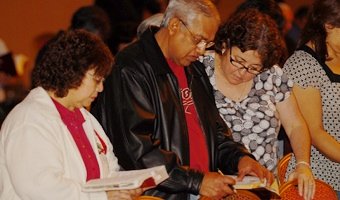
Hispanic Evangelism Conference participants follow along in their Bibles as the Scriptures are read.

Frank Palos, Hispanic evangelism director for the Baptist General Convention of Texas, shared the vision of reaching every Texan with the gospel by Easter 2010 through praying for the lost, caring for the hurting and hungry and sharing the hope of Christ. He challenged more than 1,000 adults to make a commitment to help with the cause, noting the brief time remaining to finish the task.

One by one, every person in the room stood, raising hands in commitment to share the gospel with their families, friends and communities.

This worship service was part of a two-day evangelism conference focused on the issues faced by Hispanics as they attempt to influence and care for their communities and spread the gospel in their spheres of influence.

The conference, breakout sessions and worship experience drew more than 1,200 adults and students, and 56 people made professions of faith in Christ during the event.

More than 200 youth participated in the student track at the Hispanic Evangelism Conference that included worship, breakout sessions and panel discussions about sharing their faith and obstacles they may encounter.

For Hispanic believers to follow through with their commitment to Texas Hope 2010 and see others come to Christ, they must realize that Christ is the light of the world, be willing to be anointed by God’s Spirit and then obey, said Sammy Fuentes, an international Hispanic evangelist based in Corpus Christi.

“Often, we know all these things, but we don’t obey,” Fuentes said. “When believers do this, they will experience God’s anointing in their lives, the Lord will be glorified through people coming to salvation and seeing lives transformed and personal and church growth will take place to impact the community.”

For the church to have a tangible impact, it must utilize every method possible to project God’s message, helping the needs of the people spiritually, physically and psychologically, Fuentes said.

Victor Rodriguez, pastor of South San Filadelphia Baptist Church and president of the Hispanic Baptist Convention of Texas, and Jorge Zapata, Buckner director of border missions, both agreed and taught about church involvement in the community during breakout sessions at the conference.

The worship band from South San Filadelphia Baptist Church in San Antonion led conference attendees in worship during the Hispanic Evangelism Conference.

In his breakout session, Rodriguez asked a pointed question to those who attended: “Would the community miss your church if it left the community?” He stated that the church has to be doing ministry out in the community to make an impact, following the example of Jesus healing, ministering and loving those in the midst of the community, even in the midst of sin.

“The reason many followed Christ is that he accepted people where they are at,” Rodriguez said. “He didn’t approve their sin, but he met them where they were. Jesus’ approach is practical and relevant.”

In addition, Rodriguez said, pastors need to preach a message following Jesus’ example—Christ taught with the needs, hurts and interests of people in mind; he taught the good news; and he told stories and parables to help the crowds understand his message.

To touch the community with the gospel, the church may need to do ministry differently than in the past. In the process of making changes, criticism may come from others inside the church, but changes may need to happen so that the church can reach people for Christ and make disciples, Rodriguez said.

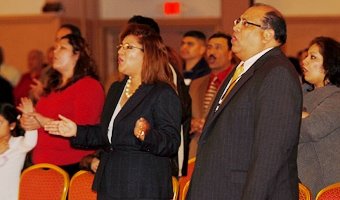
Victor Rodriguez, pastor of South San Filadelphia Baptist Church in San Antonio and president of the Hispanic Baptist Convention of Texas, and his wife, Olga, participate in worship during the Hispanic Evangelism Conference.

Zapata agreed, saying communities and families are changing, so the church needs to be willing to address the problems and struggles now faced by people around them.

Much of Zapata’s session focused on helping Christians understand the types of families that now exist and learn how to share the gospel with the traditional, divorced, remarried, homosexual, foreign, military, adoptive and poor families or units.

“The church needs to be in the ministry of restoration,” Zapata said. “You have to live and walk with (the community) in order to understand them. Out of love, they learn to trust. And out of trust, they begin to let God bring transformation. Our job is to love them.”

But, Zapata stressed, in order to minister to the community and bring restoration to broken lives, Christians first must be willing to let God correct and restore their lives.

“Today we live in a society that if we are going to be relevant to the community and transform the community, we must first be healed and transformed and ministering to each other inside the church,” he said. “We then have to have a vision—to take Christ to the lost community. If we don’t have a vision, we won’t have a passion to go out to the lost community.”

{youtube}b2b5tkHklNc{/youtube}
Sammy Lopez, pastor of Fellowship Church in Houston, challenged students to make a difference.

To bring transformation through the gospel, the people of God must have faith and hope, believing God is the one who can change communities, Zapata said.

Sammy Lopez, pastor of the Fellowship Church in Houston, challenged students to make a difference in their communities by radically following Christ in their everyday lives. (See video at left)

“We serve a radical Christ and a radical God who calls us to a radical life,” Lopez said. “If you are going to serve a radical Jesus, you must live a radical life by living for him, trusting him and obeying him.”

To help students be prepared to answer faith questions, Lopez led a panel discussion including area youth workers. The panel addressed topics such as how to address people when they are open to God but also other ways, when they say they can’t believe in a God who would send people to hell, or when they are atheists who don’t uphold Scripture as a basis for truth.

“When you go home tonight, get into his word and seek him, fall in love with him,” Lopez said. “You need to know the word. There must be personal conviction in your heart when you tell people about Christ, because they are watching you, and they are searching for answers.”


String of suspicious Texas church fires reaches 10

Two Baptist churches within three miles of each other burned Feb. 8, the ninth and 10th in a rash of suspicious church fires in Texas since Jan. 1.

Firefighters from several departments responded to a call about 8:30 p.m. to Dover Baptist Church near Lindale. According to the Tyler Morning Telegraph, flames were breaking through the roof about 20 minutes after the first witnesses spotted the blaze.

A short time later a second fire was reported at Clear Springs Missionary Baptist Church, located on a county road near the Smith-Van Zandt county line. Witnesses told local media the building was destroyed in minutes.

Investigators from the Bureau of Alcohol, Tobacco and Firearms were on the scene at both fires. Earlier in the day the ATF determined that a fire that destroyed the sanctuary of Russell Memorial United Methodist Church in Wills Point, Feb. 4 was set intentionally. The Methodist church was the eighth suspicious church fire in East Texas since Jan. 1. Officials are now also investigating fires in December to see if there is any connection.

According to the Tyler newspaper, Carl Samples, pastor of Dover Baptist Church, said the fire appeared to have been centered at the back of the church near the pulpit area. The church, founded in 1865 with a current membership of about 50, is affiliated with Smith Baptist Association, the Baptist General Convention of Texas and the Southern Baptist Convention.

Earlier fires were said to be started with some kind of accelerant.

The first fire ruled arson occurred New Year's Day at Faith Church in Athens.  Two more Athens churches burned Jan. 12, Lake Athens Baptist Church and Grace Community Church

Tyland Baptist Church in Tyler went down in flames Jan. 16  . The next night Tyler's First Church of Christ, Scientist, burned to the ground.

Arson hit Jan. 20 at Prairie Creek Fellowship in Lindale. A fire that gutted the historic sanctuary of First Baptist Church of Temple Jan. 19 was determined to be arson Jan. 29.

The ATF is offering a $25,000 reward for information leading to the arrest and conviction of the person or persons responsible for the fires. 


–Bob Allen is senior writer for Associated Baptist Press. 

Previous stories:

Church fire forces closing of day care

Fire that destroyed historic Texas church ruled arson

Texas church regroups after historic sanctuary burns


BCFS program shows juveniles perils of peer pressure

GIDDINGS—As seven teenage boys filed out of the van into the parking lot of the Texas Youth Commission lockup in Giddings, they saw just where following the crowd would take them if they continued down a path of crime.

Baptist Child & Family Services’ juvenile justice program is designed to ensure that a life of uniforms and cinderblock cells doesn’t become a reality for these young men.

Treyvon Barnes gained a fresh start with the help of BCFS’ juvenile justice program.

“One aspect of our program is to get these kids outside their neighborhoods, showing them not only where they will end up if they continue on their current path, but we take them to college campuses, allowing them to see the possibility of a bright future if they stay in school and out of trouble,” said Tim Nava, BCFS case manager supervisor.

The young men on the trip, all facing charges of theft, substance abuse, possession, assault or truancy, are getting their lives back on track with the help of BCFS.

Treyvon Barnes was arrested for bodily assault and possession in 2008 and sentenced to participate in BCFS’ program as part of his probation. With the agency’s help, he completed his probation in recent weeks and has completely turned his life around.

Today, Barnes plays the drums in his high school band and is on the basketball team. His future looks bright with plans for college. He speaks openly about the tough trials that come with making bad choices, encouraging his siblings and peers not to make the same mistakes he did.

“It’s really hard to climb your way out once you fall in a hole with school and the law,” said Barnes. “After visiting my cousin who ended up at TYC for gang-related activity, I knew I had to make a drastic change.”

Barnes knows that following the wrong crowd is what got him in trouble in the first place. But thanks to what he learned through the BCFS juvenile justice program, his life is headed a different direction.


Biker chaplains see the parking lot as their church

In a crowded parking lot filled with chrome and horsepower, Jeff Claes finds himself most at home. Weaving through a maze of leather-clad, patch-decorated bikers, he talks with others about motorcycles, rides and miles of open road.

But as a biker chaplain, he seeks more than the next ride. He’s looking for the next opportunity to point people to God.

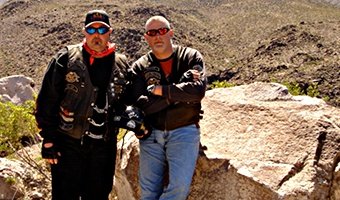
Jeff Claes (left) and Rod Stalling (right) serve as Texas Baptists’ first biker chaplains (PHOTO/Courtesy of Jeff Claes)

As the first two biker chaplains endorsed by Texas Baptists, Claes and his ministry partner Rod Stallings are a spiritual presence in the horde of metal and machinery. The chaplains are sources of comfort, hope and spiritual guidance for the bikers—a largely unchurched subculture.

“When they’re going through stuff, they turn to me and ask ‘Pastor, will you pray with me?’” Claes said. “Basically I’m in a pastoral role with many people due to loose connections and involvement with the local church. I’m constantly trying to point them toward God.”

The duo serves the American Eagle Harley Davidson Owners Group, a North Texas association of about 500 riders. They also pray with people individually and sometimes distribute tracts at events.

“Biker chaplaincy is a ministry of presence,” Stallings said. “Ninety percent of what we do is just being there.”

Claes, who is licensed by First Baptist Church in Carrollton, also has performed weddings and funerals.

“I always say the parking lot is my church and the curb is my pulpit,” Claes said.

Having ridden thousands of miles across the country, Claes and Stallings also understand biker culture and how to create opportunities to share the gospel. Although many bikers claim not to be spiritual, Stallings notes many of them hang items from their motorcycles to keep bad things from happening to them.

Often, bikers also are interested in having their motorcycles “blessed,” Stallings said, allowing the chaplains to pray over the bikers and for the upcoming ride. The blessings invite the chaplains to talk about Jesus.

Together, Claes and Stallings recently created www.bikerchaplain.com, an Internet resource that trains other people to become biker chaplains. About 30 from across the country have participated in the training. The curriculum helps people understand biker culture and how to minister in it effectively.

Bobby Smith, director of chaplaincy relations for the Baptist General Convention of Texas, praised the ministry of Claes and Stallings and looks forward to seeing how God continues to move in people’s lives to share the hope of Christ in biker culture.

“Biker chaplaincy is a very new and exciting opportunity to meet the emotional and spiritual needs of many people who have no other venue to receive a caring, Christian pastoral touch,” Smith said.

“It is so exciting to see how God is working in the lives and ministries of these biker chaplains. It is my privilege to minister to these biker chaplains and help them as they minister to bikers.”

“We feel God’s call to not only be chaplains and serve our community, but provide training to all biker ministry organizations because they don’t have this type of training available to them,” Claes said.

Through chaplaincy, the pair connect with people, Stallings said. By caring about people as Christ would and sharing the gospel when the Holy Spirit prompts, they see lives changed.

Lay ministry of this sort is a glimpse of what effective ministry will look like in the future, Stallings observed.

“We really strive for people understanding that we believe the coming age of ministry is not one of megachurches and all that,” Stallings said. “It’s going to be schmoes like me and my partner pulling off the road into a gas station with our colors on and people asking, ‘What’s that all about?’”


Movie spotlights Darwin’s loss of faith, family crisis

WASHINGTON (RNS)—Heated debate. Loss of faith. Religious discord. Questions about death, the universe, and our place in it. According to a new film, Charles Darwin saw—and wrestled with—all of that and more as the implications of his theory of evolution became clear for society as a whole, but even more so, within his own family.

Creation, a recently released film by director Jon Amiel, introduces Darwin as a 40-something father working on his seminal work, On the Origin of Species, which laid out his theory that would revolutionize society’s understandings of human history.

Paul Bettany and Jennifer Connelly portray Charles and Emma Darwin in the new film, Creation. (RNS PHOTO/Courtesy Liam Daniel/New Market Films)

Darwin (Paul Bettany) is haunted by the recent death of his daughter Annie (Martha West). His grief, along with his gradual loss of faith, creates a gulf between Darwin and his beloved wife Emma (Jennifer Connelly), a devout Christian.

“Two people who adore and respect each other are driven into opposite corners by firstly a desperate loss, the loss of a child,” Amiel said in an interview.

“But we also see that exacerbated by the fact that Charles rails against an uncaring deity that could make such a bad thing happen to such a good person, whereas Emma retreats to the consolation of religion that their child must be in heaven and takes great consolation from that.”

As his relationship with his wife and other children deteriorates, Darwin falls into the grip of a mysterious illness that some now believe may have been psychosomatic, or induced by mental stress. Enduring a potent treatment of laudanum—a medicine derived from opium—and water therapy, he begins to see visions of his departed daughter.

It’s all a lot to deal with when you’re already struggling with a book that you know will upend the social order.

Amiel describes Darwin as “a deeply shy and socially conservative man who finds himself almost unwillingly in possession of this ideological time bomb, and he is deeply unwilling to throw that bomb into the middle of a society he fundamentally respects and endorses.”

The film, based on the book Annie’s Box by Darwin’s great-great grandson Randall Keynes, is the latest salvo in an ongoing debate among Darwin scholars. Was Annie’s death the final fatal blow to Darwin’s Christian faith? Or was he agnostic as the result of dispassionate scientific research?

“I think (Annie’s death) was a very substantial factor,” Amiel said. And yet, “Darwin himself was very clear—and we quote this in the film—that his loss of faith was something that happened over a thousand afternoons. It was more like the slow shifting of continents for him than the sudden snapping of a tree.”

Michael Ruse, director of Florida State University’s history & philosophy of science program, said Annie’s death was less pivotal than the film portrays.

{youtube}fz2oEayPqNM{/youtube}

“I just don’t think the Annie episode was the key issue in Darwin’s religious life. He had become a deist (and) … remained one right through the writing of The Origin, and then became an agnostic because he did not like the idea of eternal punishment for nonbelievers, a group that included his father, whom Darwin thought was the best man he had ever known.”

For his part, Amiel cautioned against inferring too much religious fervor from Darwin’s early seminary studies. Darwin was, he said, “a man who never had a very powerful connection with faith.”

“Darwin went to Cambridge to study divinity, but frankly spent more time talking to … all the other great scientists there, and puttering around in the fens looking for mollusks, than he did studying divinity.”

Darwin had “a respect for (faith), but not a personal connection,” Amiel said. “And I think that connection was weakened substantially by the death of his daughter.”

The film touches on the divide between faith and science, giving the religious side a chance to air its views. However, the heart of the story is the break, and ultimate reconciliation, between Emma and Charles, lovingly depicted by real-life husband and wife Bettany and Connelly.

Ruse, who is not connected with the film, also feels the film overplays the divide between Charles and Emma over their respective beliefs.

Charles Darwin “saw the social value of Christianity and was not about to upset his wife with crude atheism. He was never a crude atheist and always believed in a God right through the writing of The Origin. Unlike (fellow naturalist Thomas) Huxley, Darwin was always first and foremost an English gentleman; he may have lost his faith, but he could not be strident.”

Amiel sees “a parable for all of us” in Charles and Emma, who were able to reconnect despite their strongly divergent beliefs.

“In a sense, without wanting to sound too corny,” Amiel said, “the story of Charles and Emma Darwin really has a lesson to teach us about how love and mutual respect can overcome seemingly unconquerable differences.”