Former BCFS resident returns to counsel children

SAN ANTONIO—Julie Parra could have given up on her dreams at a young age, cursing the hand she was dealt and turning her back on the world. Instead, she determined to make life better for other children and families.

She was removed from her home at the age of 15, along with three siblings, when physical abuse and neglect was discovered. She spent three months in 1999 at Baptist Child & Family Services’ residential campus in San Antonio before being placed in foster care.

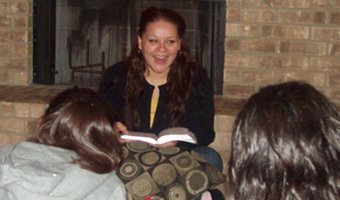
Julie Parra leads a discussion group at the Baptist Child & Family Services residential campus in San Antonio. (BCFS PHOTO)

Despite difficult circumstances, Parra went on to graduate from high school and today is pursuing a bachelor’s degree in psychology with hopes to make a difference in the lives of other struggling children and families.

Parra already has a head start on her life’s passion. She returned to Baptist Child & Family Services in 2007 as a direct care worker, where she supervises and counsels children at the residential campus who struggle with the same feelings of anxiety, loneliness and sadness she once faced.

“Many children say, ‘You just don’t understand what it’s like to be in a shelter or foster care.’ But then they talk to Julie and understand that they, too, have control over what happens to them,” counselor Mike Denning said.

Parra spends her time cooking for the children and teaching youth how to make home-cooked meals. She also leads group discussions, applying a biblical perspective as issues arise.

“I always tell the kids that you can’t change where you’ve been, but you can change where you’re going,” Parra said.

“Julie has had to overcome tremendous challenges in her life and is now giving back to the community by helping numerous children and adults face obstacles in their lives,” Denning said. “The thing that makes her so effective in her role is the fact that she has walked in their shoes and come out the other side with hope and a life that makes a difference.”

To find out more about BCFS’ residential services, please visit www.bcfs.net.


Ranch provides beacon of hope to hungry and hurting

QUEMADO—A nondescript beige building outside town silently bakes in the sun. Rare travelers passing on the highway in front of it seldom notice the structure or the small sign that rests near the road to mark its presence.

But each week, this simple shed becomes a bustling beacon of hope for the hungry and hurting throughout the region. On Wednesdays, droves of Texas and Mexico pastors line up their vans, trucks and cars, waiting their turn to pick up food, blankets and supplies to take back to people in their communities who need it.

More than 300 churches from both sides of the Texas-Mexico border pick up food every two weeks from Cornerstone Children’s Ranch. In a matter of days, the ministry distributes as much as 20,000 pounds of food. Annually, the ministry serves about 40,000 people.

Students from the Texas A&M University Baptist Student Ministry volunteer at Cornerstone Children’s Ranch in Quemado, southeast of Del Rio. (BGCT FILE PHOTOS)

“We’ve got a Band-Aid this big, and we’ve got a boo-boo that’s huge,” said Lori Mercer, who founded and directs the ministry with her husband, Steve.

“The children are hungry. The parents don’t have the wherewithal to do it. I’m constantly looking for quilts and blankets because of the fact that a lot of our families live in pallet palaces consisting of pallets and cardboard. When it rains, the water comes down, the roof leaks and they sit in water.”

The Mercers took an initial leap of faith 11 years ago, feeding one child. Cornerstone Children’s Ranch has developed into a regional food provider for people in need, giving hope to a diverse population that includes the imprisoned, homeless, jobless and impoverished by providing food, blankets and clothes.

The Mercers’ ministry is part of Texas Baptists’ commitment to feed the hungry through Texas Hope 2010, an initiative encouraging believers to pray for others, care for people in need and share the gospel with every Texan by Easter 2010.

Cornerstone Children’s Ranch recently received a $5,000 Texas Hope 2010 Care Grant through the Texas Baptist Offering for World Hunger.

Children touch the Mercers’ heart the most, and a desire to help them drives the ministry. The thought of children going without food visibly shakes Lori.  

“These are not just my children,” Lori Mercer said. “These are your children, too. I ask you, ‘Would you treat your children this way?’ This is what God calls us to do.”

The food helps pastors feed children physically, she added, but it also empowers them to feed children spiritually. They connect with children by helping fill their stomachs. Soon, children are asking the pastors why they are sharing food. Then, pastors share the gospel.

“When you’ve fed the stomach, the mind can start listening to the Scripture, and the heart can be opened,” she said. “Then, the pastors have the opportunity to give the word and win souls to the Lord.”

For more information about the Children’s Ranch, visit www.childrens-relief.org. For more information about the Texas Baptist Offering for World Hunger, visit www.texasbaptists.org/worldhunger. For more information about Texas Hope 2010, visit www.texashope2010.com.


Texas Baptists set record in giving to world hunger offering

DALLAS—Texas Baptists gave a record $901,401 to help the hungry through the Texas Baptist Offering for World Hunger in 2009.

While giving to many causes was down, giving to the hunger offering increased 22 percent last year. More than 600 churches contributed to the offering, an increase of 85 from 2008.

hunger offeringBecause of the generosity of Texas Baptists, it appears the Texas Hope 2010 goal of raising $2 million in two years is attainable, said Suzii Paynter, director of Texas Baptists’ Advocacy and Care Center. Through the Texas Hope 2010 initiative, believers are praying for those around them, caring for those in need and sharing the gospel.

“The Texas Hope 2010 challenge to share the hope of Christ with every person in Texas reminded us that we can’t speak of hope with folks who are hungry,” said Texas Baptists’ Executive Director Randel Everett. “As we feed them, we speak of Christ’s hope. The increased offering is an indication that Texas Baptists are rallying around this ministry opportunity.”

In addition to giving to the offering, churches created and expanded their feeding ministries, providing food for thousands of people who would have had nothing to eat during the economic crunch of 2009, Paynter said. Congregations connected with the hungry, which drove their desire to further help them.

“We have so many churches who have participated in Texas Hope 2010’s prayer, care and share,” she said. “Care is so accessible. Many churches have done something. Having care in front of them has helped give them a heart for the hungry.”

The record giving above the offering’s 2009 goal of $750,000 empowered Texas Baptist leaders to award Texas Hope 2010 Care Grants to hunger ministries across the state, providing immediate assistance at a time of need, such as a $10,000 grant for Texas Baptist Men disaster relief that was awarded in the wake of the recent earthquake in Haiti. The funds helped pay for 5,000 water purification filters that TBM sent into the country.

The care grants supported a variety of hunger ministries, particularly those identified by intercultural churches, the African American Fellowship and Hispanic Baptist Convention of Texas.

“By being able to give these Hope 2010 grants, what a tremendous encouragement that is,” Paynter said. “Like giving these 5,000 water filters for Haiti.”

The hunger offering was bolstered by the identification and recruitment of more than 250 hunger advocates across the state who raised awareness of the need to minister to the hungry.

Online giving to the offering also was introduced in 2009, which allowed people to easily give the cost of a meal each month to the offering.
“When people sign up that way even to give a small amount each month, it really helps the offering,” Paynter said.

Texas Baptists feel confident in giving to the hunger offering, Paynter said. They see the impact it has across the state and in their own backyards. They know the money is being used efficiently in Texas and trust it is being used likewise around the globe.

“When people give to this offering, they know where the money is going,” she said. “They know it’s going to the Amarillo Baptist Association or the San Antonio Baptist Association. They see it. I think that makes a tremendous difference.”

For more information about the Texas Baptist Offering for World Hunger, visit www.texasbaptists.org/worldhunger .


Baylor University slated to receive its largest gift in history

WACO—Baylor University has announced the largest gift in the school’s history—an estate provision estimated at $200 million from an anonymous donor.

The announcement came less than three weeks after Baylor University regents selected Kenneth Starr as the school’s 14th president.

The deferred gift—designated toward medical research in Baylor’s College of Arts and Sciences, School of Social Work and other programs—is the second-largest donation made to a Texas college or university and ranks among the top 20 private gifts made to higher education in the United States according to the most recent data reported by the Chronicle of Higher Education.

A news release from Baylor simply identified the donor as “a Baylor graduate whose family has a history of providing gifts to the university supporting programs that are both innovative and have high potential to significantly advance the field of knowledge and experience in diseases, disorders, care, treatment and other issues associated with aging.”

“The foresight and originality of one of our own graduates will now provide future Baylor students and faculty the opportunity to conduct innovative research and bring that knowledge into the classroom,” Interim President David Garland said.

“This gift advances the mission of Baylor by empowering us to improve our future graduates’ service to the nation’s aging population. We extend our deepest thanks to the donor and applaud the donor’s understanding of the need for leaders who take a holistic approach in addressing issues associated with aging.”

As a provision of the donor’s estate, a foundation will be established at the time of the donor’s death. The foundation will support several university efforts in continuing the donor’s consistent and generous support.

“Aside from representing a remarkable and unprecedented level of generosity, this act of extraordinary kindness, sacrifice and selflessness reminds us of the power of giving to help transform a university and create a sustainable and prosperous future for its programs,” said Starr, who will take office June 1.

“Receiving a planned gift of this magnitude now, during a time of historic economic instability, is especially significant as it demonstrates profound confidence in Baylor University and a shared commitment to achieving the university’s goals far into the future.”

The interdisciplinary nature of the gift enables Baylor to address physical, psychological, social, emotional and spiritual needs and strengths of the aging in a truly holistic approach, university spokesmen noted.

The College of Arts and Sciences’ programs in pre-health, psychology, chemistry, biochemistry, neuroscience and other related areas will be greatly enhanced by this gift, said Lee Nordt, the college’s dean.

“This gift will provide enormous support for significant areas of research in advancing the field of knowledge on the aging process,” Nordt said. “A substantial endowment helps vault Baylor University to top-tier status in this field by providing resources for world-class faculty and scholars; for recruitment of the most talented undergraduate and graduate students; and for exploring the latest research initiatives related to aging.

“By design, this gift will lead to collaborative efforts among departments and across school boundaries, enabling Baylor to become a national leader in the topical field of aging, one of the most important areas of our time.”

The gift also benefits programs in the School of Social Work, which prepares social workers to serve in a diversity of public and private settings, with a special emphasis on working effectively with issues of faith and spirituality and with congregations and faith-based organizations.

“The idea that someone looks at this school that is four years old and believes in the mission and direction enough to give a gift like this is an amazing vote of confidence in our program,” said Diana Garland, dean of the school. “It will enhance our ability to grow and thrive, and to educate generation after generation of social workers who will help to transform the most difficult places in the world.

“This gift enables us to provide leadership in caring for older adults in ways that honor the meaning and purpose in their lives all the way to the end of life, caring for them in ways that honor them as people who have given and continue to give.”


African-American Baptist groups pledge $50 million for Haiti

CHICAGO (ABP) — America's five largest historically African-American Baptist organizations are cooperating to raise $50 million to help rebuild Haiti and provide aid to victims of a Jan. 12 earthquake that devastated the area surrounding the capital of Port-au-Prince.

Called the African-American Baptist Mission Collaboration, the joint effort marks the first time the groups representing 40,000 church congregations and 10 million Christians nationwide have worked together on such a large scale.

"The images coming from Haiti are devastating," T. DeWitt Smith, Jr., president of the Progressive National Baptist Convention, said at a March 2 press conference announcing the initiative in Chicago. "Our vision for Haiti, however, is not limited to the images we've seen. We will work with Haitian partners to rebuild strong homes, churches, schools and clinics."

Smith was joined at the press conference by Lott Carey Baptist Foreign Mission Convention; National Baptist Convention, USA; National Missionary Baptist Convention of America; and National Baptist Convention of America.

"African-American Baptists know what it means to support one another through devastation," said David Emmanuel Goatley, executive secretary-treasurer of Lott Carey Baptist Foreign Mission Convention and the coordinator for the African American Baptist Mission Collaboration. "We know what it means to care for children through extended families.  We are committed to work on behalf of those who are most vulnerable in the aftermath of this tragedy and to labor to help children know safety, security, and nurturing care."

Funds raised for the collaboration — mostly from local churches — will provide assistance for plans including five health care clinics to provide restorative health services and wellness, 50 schools with enhanced learning environments, 500 reconstructed churches to serve as center points for community empowerment and 5,000 homes to house victims left homeless following the earthquake.

The coalition is already working together on weekly deployment of medical professionals to provide critical medical services and care and daily feeding programs in Port-au-Prince and Saint-Marc that provide hundreds of meals a day.

Other components include providing water, energy supplies, cash grants and groceries to families and individuals in need.  In February, 1,000 families who lost homes in Legoane (near the earthquake's epicenter) and communities to the west of Port-au-Prince received a total of $30,000 in cash and grocery grants.

"Providing immediate response to immediate needs has been critical," said Stephen John Thurston, president of the National Baptist Convention of America and senior pastor of the New Covenant Baptist Church. "Having existing working relationships with established churches in the country enabled us to move swiftly to provide food, water, temporary shelter and pastoral care. This is reminiscent of the immediate support that churches gave to people in our own country in the aftermath of hurricane Katrina in 2005."

In addition to the announcement by the five denominational leaders, American Baptist Churches USA announced March 3 that an additional $21,600 in One Great Hour of Sharing funds has been sent to an International Ministries' partner in Haiti. The amount is in addition to the $105,000 already provided to IM's various Christian partners in Haiti.

The latest support is designated specifically to the Convention of Baptists in Haiti for its Feeding the Hungry project, which will provide food to families who have lost a loved one as a result of the earthquake. The project is slated to help these families with daily food provisions for the next three months.

Many children have become orphans, and many widowed women are now single parents. A number of men who did survive have no means of providing food for their families since there are no available employment opportunities.

Among CBH churches, 30 members lost their lives to the earthquake, 306 were severely injured and another 107 people were wounded. Structural damage among the homes of congregational members included the total destruction of 438 houses and the partial destruction of 673.

"This type of assistance is critical for families who are already struggling because of the loss of family members or homes. Said José Norat Rodríguez, IM area director of Iberoamerica and the Caribbean. "We join the leaders and members of CBH in giving thanks to God for this tangible demonstration of love, which is but one expression of our important partnership."


Previous story:

African-American Baptists collaborate to help Haiti


Religious Right spokesman on Texas school board unseated by challenger

DALLAS—The Religious Right suffered a surprise setback in Texas when incumbent Don McLeroy—a creationist and critic of church-state separation—narrowly lost his re-election bid for the powerful State Board of Education to challenger Thomas Ratliff in the March 2 Republican primary.

The board’s role in determining public school standards not only influences textbooks in Texas, but also has an impact across the nation. Texas is one of the top two buyers of textbooks in the United States, and many publishers develop their books with the Texas market in mind.

McLeroy, a dentist from Bryan, lost by fewer than 900 votes. Since no Democrat filed for the race, Ratliff will assume the seat next year. Ratliff, a legislative consultant and lobbyist from Mt. Pleasant, is the son of former Lt. Gov. Bill Ratliff.

McLeroy served as chair of the State Board of Education from July 2007 to May 2009, when Democrats in the Texas Senate blocked his confirmation as chair, accusing him of ignoring the concerns of classroom teachers and advancing a political agenda regarding curriculum standards.

On his campaign website, McLeroy wrote: “Our nation is falling under the sway of the ideas of the far-left; the founding principles of our nation are being neglected and forgotten.  … But here in Texas, the conservatives on the Texas State Board of Education have the far-left in retreat. In the past two years, while I was privileged to chair the board, we won battles in math class, English class, science class and we are now winning in history class.”

McLeroy led efforts to insert language into curriculum standards mandating that teachers instruct students about the strengths and weaknesses of evolutionary theory, and he asserted his personal belief in young-Earth creationism.

More recently, as the board has debated social studies standards, he touted as curriculum review experts self-published author and lecturer David Barton and Presbyterian minister Peter Marshall, both of whom have spoken about “the myth of separation of church and state” and the importance of teaching about America’s Christian heritage.

On his campaign website, Ratliff criticized the practice of assembling curriculum consultants “from around the country” as being politically motivated.

“Some of the SBOE members search far and wide to find ‘experts’ that also support their political agendas.  But we need to ask, ‘Are these the best people to help Texas’ public school children?’ I think we need to spend more time utilizing Texas’ higher education experts and less time trying to find that ‘expert’ out there that also fits a particular political profile,” he wrote.

In recent years, the seven social conservatives on the board consistently voted as a bloc. With a couple of key swing votes, they occasionally won victories on the 15-member board.

Even with McLeroy’s loss, the balance of power on the board remains close. Dallas Republican Geraldine “Tincy” Miller, who was not part of the social conservative voting bloc, lost to teacher George Clayton in a seat that also has no Democratic challenger. Miller held her seat since 1984.

Ken Mercer of San Antonio, a consistent vote with the social conservative bloc, won his bid in spite of a challenge by Tim Tuggey, also of San Antonio. He will face Democrat Rebecca Bell-Metereau, an English professor at Texas State University, in the general election.


Church unity vital, Panhandle-Plains conference speakers stress

PLAINVIEW—Churches need to practice more unity both inside their congregations and in relationship with other Christians, speakers stressed at the Panhandle-Plains Pastors’ and Laymen’s Conference.

Speakers built on the theme of the 89th annual event, “The Same Difference,” with the key Bible verse from 1 Corinthians 12:4-6:  “There are different kinds of gifts, but the same spirit. There are different kinds of service, but the same Lord. There are different kinds of working, but the same God works all of them in all men.”

Free from the law

Fred Meeks, emeritus professor of religion at Wayland Baptist University, led a Bible study in the book of Galatians for the conference, using the overall theme of the characteristics of spiritual formation. Meeks pointed out the forming of Christ within the believer is realized through faith and not the law, which was replaced with a new covenant when Christ died for sin.

“Accepting Christ as Savior means we died to sin, and we participate in his resurrection,” Meeks said. “Our salvation is not based on our behavior that the law requires. We’ve been set free from that law.”

Meeks pointed out various metaphors the Apostle Paul used in his letter to the Galatians.

Faith, he said, loses much of its power when believers renounce the freedom that comes from it or let themselves get seduced by the outside world into legalistic behavior. Faith can, however, be restored by recalling one’s salvation experience.

On a recent drive through his old neighborhood in Dallas, Meeks noted, he happened upon the church building where he made his profession of faith in Christ and later where he received his calling to preach and was ordained. He recalled how he tearfully “had a revival” right there in recalling those precious memories of the faith.

But Paul was not denouncing the law completely, as it is vital to reveal sin in the believer’s life but cannot remove it, Meeks emphasized. Faith makes believers a family and creates a uniformity that should unite and remove all judgment about differences otherwise. Legalism, on the other hand, is a return to the idolatry of paganism, which was tied more to events on the calendar than lasting growth.

The main goal of the church is to see Christ both “born” into people—received upon their salvation—and formed in them as they grow in faith and discipleship, Meeks said.

Some who claim God's name maim his name

Continuing to expand on the theme, Carolyn Porterfield took her message from Philippians 2:1-4, noting that Christians are to have the same love, being like-minded and united by the purpose of glorifying God.

“Our world looks at us. and we often maim God’s name,” said Porterfield, a multicultural consultant for Texas Woman’s Missionary Union. “So often there is little in our actions that bear God’s love. When do we come together and encourage one another?”
           

Porterfield pointed out the Apostle Paul encouraged believers to adopt the character of Christ and his purpose, then walk in a manner worthy of the gospel. Using the illustration of a tuning fork, Porterfield said tuning our hearts to Christ and his heart means all the other parts of our lives will fall in step with his mission.

Many strategy and planning meetings wasted time by debating purpose and mission statements, she asserted, when, “Jesus gave us a mission statement: Go ye into all the world and make disciples of all nations,” and the strategy to do that is found in Acts 1:8.

“We need to embrace the purpose God has for us and be of one spirit. We cannot continue to be effective when we’re in disagreement,” she said. “We are the receivers of God’s grace, mercy and love. We are helpless without him. When we submit to him, he can take our lives and use us in ways we never imagined.”

The workmanship of God; workers on his crew

D. L. Lowrie, pastor emeritus of First Baptist Church in Lubbock, presented a message on the theme, “We are working on the same building,” with text from 1 Corinthians 3:5-17. He described Christians as both the building itself—the workmanship of God formed at salvation and being built up regularly through discipleship—as well as workers on the building—the collective body of believers that grows as Christians share God’s love and message with a hurting world.

“Each of us in our own way is working on the building,” Lowrie said. “We all have our own task to do.”

Lowrie reflected on the glory of the building and noted the sense of wonderment on Paul’s part that Christians are part of the work crew for the structure, which he noted can only be built on the foundation of Jesus and includes “redeemed individuals for God’s indwelling.”

Paul points out that each believer is himself a temple where God dwells for the manifestation of his glory, Lowrie noted. Unlike the Old Testament, where the holiest place of the temple was reserved for God, Lowrie said, the Holy of Holies in modern times is found in the assembly of believers.

The task of building the temple requires cooperation among believers because all have different roles, just as in a construction crew on a literal building, Lowrie said. The task also requires grace, which both qualifies believers for the building job and enables them to do the task, and great care for the appropriate workmanship for God’s building.

The work of believers will be tested down the road to ensure that the proper materials are used in construction, Lowrie concluded.

“Our character will be exposed when Jesus returns, and we need to be using materials that will withstand the fire, the consuming fire of God,” Lowrie said. “It’s not about how long we’ve been building, but how well we’re built and if we can withstand the fire.”


Baptist expert says Establishment Clause applies to foreign policy

WASHINGTON (ABP) — A Baptist church-state specialist voiced concern about a think-tank report urging a new direction for U.S. foreign policy focused on the role religion plays in world affairs.

Writing for the On Faith blog WashingtonPost.com, Brent Walker, executive director of the Baptist Joint Committee for Religious Liberty, agreed with findings of a task force convened by the Chicago Council on Global Affairs that religion is relevant to foreign policy but cautioned it must be handled with care.


Brent Walker

alker, an attorney and ordained Baptist minister, weighed in on a particular question that divided the 32-member task force that presented the 100-page report titled Engaging Religious Communities Abroad: A New Imperative for U.S. Foreign Policy Feb. 23 — whether the constitutionally mandated separation of church and state applies outside of the United States. 

"I think it does," Walker wrote.

In the U.S. the Establishment Clause prohibits certain interaction between the government and religion. For example, the government cannot properly fuse religious and government authority, disburse government funds on the basis of religious criteria, show preference for a particular religion or adjudicate theological controversies.

Because the Supreme Court has never ruled on whether the clause applies equally to foreign policy, the task force recognized both "reasonable arguments" that it imposes "significant limits on the conduct of foreign policy" and "equally reasonable arguments" that those limits are relatively narrow or irrelevant.

The report takes the position that the First Amendment prohibition on establishing religion "does not bar the United States from engaging religious communities abroad in the conduct of foreign policy, though it does impose constraints on the means that the United States may choose to pursue this engagement."

Five members of the task force formally dissented from the assertion, claiming than in the absence of any compelling evidence to the contrary "no administration should impose constraints on American foreign policy that are imagined to derive from the Establishment Clause."

The dissenters said applying limits of the Establishment Clause to foreign policy "will inevitably restrict American flexibility" in advancing vital national interests such as counter-terrorism and the promotion of democracy and civil society abroad.

Five other members of the task force responded to the dissent, labeling wholesale exemption of foreign policy from the Establishment Clause "untenable."

"It is beyond question that all branches of the U.S. government must act in accordance with the Constitution when conducting American foreign policy," the responders stated. "There is no reason to believe that the Establishment Clause is an exception to this requirement."

Walker acknowledged there is room to argue the nuances of how to apply the Establishment Clause to foreign affairs and due to technicalities the courts have never ruled definitively on the issue.

"But to suggest that the Establishment Clause can never apply beyond our borders would be an emasculation of that critical pillar of the First Amendment that ensures religious liberty for all Americans and whose underlying principle of governmental neutrality informs a proper understanding of religious liberty abroad," Walker said.

Walker said he agreed with another On Faith commentator, Interfaith Alliance head Welton Gaddy, that religion is relevant to U.S. foreign policy but "must be handled with special care."

Gaddy, who also is preaching pastor at Northminster (Baptist) Church in Monroe, La., said in his article it is important for the government to understand religion's role in different lands, but "seeking to shape, direct, or influence religion's role anywhere is not the business of the United States government."

"Often when government officials think they understand the power of religion in a situation, they also think they can benefit from the power in achieving their particular goals," Gaddy wrote. "Government understanding religion is good. Government attempting to use religion is problematic beyond measure."


–Bob Allen is senior writer for Associated Baptist Press.

Previous story:

Group says U.S. foreign policy hampered by ignorance about religion


Former Baptist editor Fletcher Allen dies

FRANKLIN, Tenn. (ABP) — A retired denominational journalist who worked three decades at Baptist newspapers in three states died Feb. 27 after a long battle with cancer.

Fletcher Allen, 78, of Franklin, Tenn., worked 17 years as associate editor of the Baptist Courier in South Carolina before being named editor in 1983 of the Maryland Baptist, news journal of the Baptist Convention Maryland/Delaware. The paper was renamed the Baptist True Union during his editorship and now is called Baptist Life

In 1987 Allen became editor of Baptist & Reflector, news journal of the Tennessee Baptist Convention. He held the post just over 10 years before retiring in 1998, ending a career in Baptist journalism that spanned more than 31 years.

In 2008 Allen began treatment after a recurrence of prostate cancer was found to have spread to his bone.

A native of Hartsville, S.C., Allen graduated from Furman University in 1954. He worked six years as news director and alumni editor at the school, which at the time was affiliated with the South Carolina Baptist Convention but severed formal ties with the state's Baptists in 1992.

Allen worked as a reporter and sports editor at the Florence (S.C.) Morning News following Army service in Germany. Before joining the Baptist Courier staff at age 35, he worked briefly in public relations for Sonoco, a manufacturing company that supplies industrial packaging products, based in his hometown.

He was preceded in death by his wife, Betty. He is survived by four daughters, nine grandchildren, a brother and a sister. His funeral service is scheduled at 3 p.m. Sunday, March 8 at ClearView Baptist Church in Franklin, Tenn.

In lieu of flowers the family suggests gifts in Allen's memory to Willow Ridge Church in Lexington, S.C. The memorial will be used to support "Alex's House," an orphanage for Haitian children established by Pastor Bill Howard, Allen's son-in-law.

-30-


Relief launched for quake in Chile described as ‘without parallel’

CONCEPCION, Chile – Southern Baptists have released $50,000 for immediate relief needs in Chile, where the death toll has climbed past 700 in an earthquake disaster described by the country’s president as “without parallel in Chile's history.”

A Southern Baptist assessment team is en route to the country for dialogue with ministry partners about needs and on-the-ground evaluation of the damage caused by the 8.8-magnitude earthquake that struck in the pre-dawn hours Feb. 27.

Chile building

Residents talk about the damage from 8.8-magnitude earthquake struck central Chile early Saturday, Feb. 27. (IMB/Genesis Photos)

"We are confronting an emergency without parallel in Chile's history," Chile President Michelle Bachelet told reporters Feb. 28. At least 708 people died in the quake and an estimated 500,000 homes were destroyed or badly damaged. Some towns on Chile’s coastline were completely destroyed when a tsunami wave swept in after the quake.

More than 2 million people have been affected by the earthquake, Bachelet said. Rescue crews are searching for survivors in the rubble of toppled buildings.

Baptist Global Response has dispatched a four-member assessment team to Chile that is expected to assemble March 2 and start compiling information to help them determine the short-term and long-term response needed from Southern Baptists, said Jim Brown, director of BGR’s U.S. office. The assessment effort is being led by Charles Clark, the International Mission Board’s cluster strategy leader for the area. Also serving on the team are representatives of the Southern Baptist Disaster Relief Network from Texas and South Carolina.

Southern Baptist missionary personnel stationed in Chile began assessing the situation almost immediately after the quake, said Terry Lassiter, the International Mission Board’s strategist for the American Peoples affinity group.

“An initial assessment team made up of missionaries already in Chile has begun evaluating conditions and needs,” Lassiter said. “Other personnel are trying to find routes to return to the country. Pray that they will make it.”

The $50,000 released from the Southern Baptist disaster relief fund will be used to help local Baptist churches meet crisis needs like food, water, blankets and shelter, Brown said. When donations are made to Southern Baptist disaster relief and world hunger funds, 100 percent of each donation goes to meet human needs. Nothing is withheld for administrative costs.

The airport in Santiago was closed in the immediate aftermath of the earthquake but has resumed some degree of service, according to news reports. Roads and bridges in the country, however, have been badly damaged or destroyed, which will complicate transportation of relief supplies and workers.

Southern Baptist personnel who were in the quake zone are struggling emotionally and physically, just like the Chileans around them, Lassiter said.

“Many of our people are physically and emotionally exhausted.  Those who live in high-rise apartment buildings told me they didn’t think they were going to survive,” Lassiter said. “The 90 or so aftershocks that have occurred are continual reminders of the horror everyone felt during the event itself.”


Baptists pledge support for earthquake victims in Chile

ATLANTA (ABP) — As Baptists began to dig in for a long-term response to the Jan. 12 earthquake in Haiti, focus shifted Feb. 27 to another quake that killed hundreds and caused billions of dollars in property damage in Chile. 

By Monday, March 1, the death toll from the massive 8.8-magnitude earthquake reached 700, with workers still searching through rubble for missing persons. Leaders of Baptist organizations in the United States with partners in Chile urged prayer for quake victims while awaiting information about ways to respond to human need.

Chile earthquake

Residents walk through debris after an 8.8-magnitude earthquake struck central Chile early Saturday, Feb. 27. The quake hit 200 miles (325 kilometers) southwest of the capital, Santiago, and the epicenter was just 70 miles (115 kilometers) from Concepcion, Chile’s second-largest city. (IMB/Genesis Photos)

"Baptists around the world are being asked to pray for the people of Chile as they seek to recover from such a devastating earthquake," said Neville Callam, general secretary of the Baptist World Alliance, a global network of Baptist unions and conventions based in Falls Church, Va. "Let us stand by them during these trying times. In due course we will mobilize to come to their assistance."

Paul Montacute, director of Baptist World Aid, said the relief-and-development arm of the BWA is monitoring the situation and stands ready to provide whatever assistance it can.

Raquel Contreras, president of the Union of Evangelical Baptist Churches of Chile and a vice president of the BWA, was traveling in the U.S. when the earthquake hit. She managed to confirm her family was safe but was still making inquiries about the state of the country's Baptists.

Chris Boltin, director of short-term assignments and partnerships manager for the Cooperative Baptist Fellowship, said in a blog that he spoke and prayed with Contreras by phone.

Boltin said he befriended several Chilean Baptists last year when he visited South America as part of five-year mission partnership between the Atlanta-based CBF and Chilean Baptist union that began in 2008.

"All I could do was pray, encourage, and offer my support," Boltin said. "I did not have any answers. Right now I would ask all of us to do the same. Pray and offer a word of encouragement. Pray for our brothers and sisters in Chile. Pray for safety and strength for those who are confronting loss."

The 500-church Baptist union is the larger of two BWA member bodies in Chile. International Ministries of American Baptist Churches USA attempted to contact Mario Ramos, president of the 46-church Convention of Baptist Churches of the Chilean Mission, but was awaiting reply.

Barbara and Dwight Bollock, International Missions personnel assigned to Chile, were not in the country at the time of the earthquake but planned to return March 2.

"Our hearts go out to the people of Chile, especially those in the Santiago area that has borne the brunt of the devastation," Roy Medley, general secretary of American Baptist Churches, said March 1 "As disciples of Jesus we are convinced that their suffering does not go unnoticed by God who on the cross took into himself the suffering of the world."

American Baptist officials will collect relief funds for Chile through normal channels in the One Great Hour of Sharing,  an ecumenical relief offering that collects gifts for humanitarian aid from nine Christian denominations.

Baptist World Aid is accepting donations for Chile earthquake relief by mail and online.

Boltin said CBF leaders were in conversation with both the BWA and Chilean Baptist union about ways to help. "We understand that many of your will want to offer assistance," he said. "As we discover tangible, concrete ways for you and your congregation to assist, we will let you know."


–Bob Allen is senior writer for Associated Baptist Press.


‘A time to be born, a time to die’

Is a church’s death inevitable? Who can give congregations permission to die? Should church members feel guilty for closing their facility’s doors?

Peter Bush, author of In Dying We are Born: The Challenge and the Hope for Congregations, believes every church must “be prepared to die” because each will die in one of two ways. Each church must die to “deeply held understandings of life and the purpose of the congregation” or it will close its doors.

Congregations are organisms, subject to an organism’s lifecycle—birth, development, plateau and aging—and that cycle is inevitable, Bob Dale, author of To Dream Again, Seeds for the Future and Cultivating Perennial Churches, believes.

“Living things don’t live forever, but there are some living things that last a long, long time,” he said.

Les Robinson, vice president of interim ministry resources for the Center for Congregational Health, also sees the cycle of life. “Churches are human institutions. Why shouldn’t they complete the same cycle?” he asked.

Some point out the Bible reveals the pattern, as well. A kernel of wheat must die before it can produce a plant and new seeds, according to John 12:24. The verse usually is interpreted in the light of Jesus’ death. But the verse has broader application, Bush believes.

“We have tended to read that as an individual … but I also think it applies to the corporate body,” Bush said. “The pattern of dying and rising is continual.”

Even churches important to the early Christians faced death, Glenn Akins, associate executive director for the Baptist General Association of Virginia, said. The seven churches in the New Testament book of Revelation no longer exist, he pointed out.

Causes of death

What causes a church to die? Akins believes lack of leadership and denial of decline contribute to a church’s demise. “When multiple people are involved, the church doesn’t have to die. But without adequate leadership, without wise decisions, it will die,” he said.

Change—or failure to keep pace with it—can be the major factor in church deaths.

“Churches are birthed because of a need,” noted Jim Hill, executive director of the Baptist General Convention of Missouri. “On the frontier, churches were birthed as communities sprang up. But some of those communities are gone, and that’s not the fault of the church.”

Communities often change complexion and cultural makeup. Differences in the ways cultural and age groups define the community concept also determine the type of church that will survive.

“Many churches were started with a sense of neighborhood … a geographical community,” Akins said. “The hitch is with all the cultural changes going on, we don’t find it that way anymore. … Those (churches) that are ‘parish-based’ and have never changed their ministry model will not make it.”

Closure or revitalization

What indicators might signal a church should close or rethink its ministry? What questions might congregations ask themselves as they face change?

Churches most frequently use traditional indicators—membership numbers and weekly receipts—to determine success. Congregations should begin to ask hard questions as soon as they recognize decline, Hill insisted.

Robinson agreed that those traditional markers catch churches’ attention. “Money, membership and attendance are usually what get our attention first. Those are the practical things,” he said.

But the more abstract aspects of church life often determine whether a church should close. “We must be very clear about our mission and our vision … who we are at this place, at this time, at this moment in history,” Robinson said.

Clarity of identity is critical, he believes, emphasizing that today’s congregations can’t hang onto the vision they had in the 1950s and ’60s. “We can’t fulfill that,” he said.

“Sometimes churches lose their identity or their clarity. Churches need to ask themselves on a regular basis to keep their identity clear. That doesn’t automatically eliminate the struggle with the practical, but it helps the congregation be able to look at their future.”

A church’s identity can be expressed in its mission, Dale said. A vibrant understanding of mission can help a congregation determine whether it should close or find a new way to move forward.

“One question churches might ask: Is our sense of calling, our sense of mission still alive in this place?” the author said.

Hill also believes congregations must focus on mission first. “Perhaps the most critical questions are: Are there people who need to be reached, and who are not being reached? Can we adapt our ministry to those who are not being reached? Can we build ministry that will help us respond to needs?” he said.

Morale is important as well, Dale noted. Churches often will do what their members “believe they can do,” he said.

Closing with hope

Members and even denominations often view church closure as failure. Baptists do not have a system in place to help churches prepare to close. “We need to do better at helping churches recognize new possibilities or to help them close,” Robinson said.

Celebration can mitigate guilt and help the congregation recognize the church’s contribution to God’s kingdom.

“Find a time of storytelling. Sharing is the way to celebrate, to look at the ministry as having done what God called us to do,” Robinson added. “That’s success, not failure.”

Hill agreed celebration can help heal, especially if it is followed by rebirth. “Celebrate the ministry, conclude it, and then focus on birthing a church where a new one is needed,” he said.

“Bodies die, but the body of Christ doesn’t,” Dale stressed. “It may wane in one place but will rise up in another.”