Southwestern Seminary accreditation warning continued
June 25, 2024
The Southern Association of Colleges and Schools Commission on Colleges has continued its accreditation warning for Southwestern Baptist Theological Seminary.
At its mid-June meeting, the SACS Commission on Colleges board of trustees continued Southwestern Seminary’s warning for another 12 months for “failure to comply” with core requirements in its Principles of Accreditation regarding financial resources and financial responsibility.
Unlike last year’s warning, this year the accrediting agency board did not mention any failure to meet standards regarding the fiduciary responsibility of the seminary’s board of trustees.
Last summer, the accrediting body placed the seminary on warning for failing to comply with its standards regarding the fiduciary responsibility of the board of trustees, as well as the two restated issues regarding finances.
Under SACS Commission on Colleges Principles of Accreditation, an institution is required to have “sound financial resources and a demonstrated, stable financial base to support the mission of the institution and the scope of its programs and services.” The institution also is expected to “manage its financial resources in a responsible manner.”
An educational institution also is expected to have “a governing board of at least five members that: is the legal body with specific authority over the institution; exercises fiduciary oversight of the institution; ensures that both the presiding officer of the board and a majority of other voting members of the board are free of any contractual, employment, personal or familial financial interest in the institution; is not controlled by a minority of board members or by organizations or institutions separate from it; is not presided over by the chief executive officer of the institution.”
‘A positive step forward’
David Dockery
Removing the issue of the trustee board’s fiduciary responsibility from the latest warning represents “a positive step forward for the institution,” President David Dockery stated in a release from the seminary’s communications office.
Dockery acknowledged the seminary has “ongoing work to do” to address the remaining issues.
“Due to the timeline of financial reporting and the need to demonstrate positive trends over multiple fiscal years, it was our expectation that a full review of financial progress would not be possible until June 2025,” Dockery stated.
“We pray for the Lord’s ongoing enablement as we take the next steps, even as we stop to give thanks for this visible marker of progress in our efforts toward institutional stability.”
A financial overview released by the seminary’s board of trustees in June 2023 revealed from 2002 to 2022, annual operating expenses at Southwestern Seminary rose 35 percent, while full-time-enrollment figures dropped 67 percent, resulting in a cumulative $140 million operating deficit.
The seminary ran an operational deficit 19 years during the period from 2002 through 2022, spending an average $6.67 million more than it received in revenue those years.
In his report to the recent 2024 Southern Baptist Convention annual meeting, Dockery said—based on the first 10 months of the annual budget—the seminary’s operational budget this year “will be considerably better than last year and dramatically improved over the previous year.” He also reported the seminary should finish the year with cash reserves and no short-term debt.
Louisiana requires Ten Commandments in classrooms
June 25, 2024
Louisiana Gov. Jeff Landry signed into law a bill mandating the Ten Commandments be displayed in all of the state’s public schools.
The bill requires every public elementary, secondary and postsecondary school in Louisiana to display a specifically Protestant version of the Ten Commandments in every classroom by 2025.
It also says public schools “may also display” the Ten Commandments along with the Mayflower Compact, the Declaration of Independence and the Northwest Ordinance.
“Including the Ten Commandments in the education of our children is part of our state and national history, culture and tradition,” the new law states.
The legislation states lawmakers’ belief “the historic role of the Ten Commandments accords with our nation’s history and faithfully reflects the understanding of the founders of our nation with respect to the necessity of civic morality to a functional self-government.”
The Louisiana law cites the U.S. Supreme Court’s 5-4 ruling in Van Orden v. Perry, which upheld the constitutionality of a Ten Commandments monument outside the Texas capitol.
The court’s majority emphasized the historical significance of the Ten Commandments and stated that “simply having religious content or promoting a message consistent with a religious doctrine does not run afoul of the establishment clause.”
Patrick pledges to push similar bill in Texas
Texas Lt. Gov. Dan Patrick promptly responded to Landry’s signing of the Louisiana law by pledging to pass a similar bill in the Texas Senate once again during the 2025 legislative session.
“Texas WOULD have been and SHOULD have been the first state in the nation to put the 10 Commandments back in our schools. … I will pass the 10 Commandments Bill again out of the Senate next session,” Patrick tweeted.
On a party-line vote last year, the Texas Senate approved a bill that would have required public schools in the state to post the Ten Commandments prominently in every classroom, but the measure died in the Texas House.
On social media, Patrick blamed Texas Speaker of the House Dade Phelan, calling the inaction by the House “inexcusable and unacceptable.”
Both the law approved in Louisiana and that was proposed last year in Texas dictates the wording of the Ten Commandments—a slightly abridged version of Exodus 20:2-17 from the King James Version of the Bible.
Jews, Catholics and Protestants number the commandments differently, and the way they are worded varies. In both the Louisiana and Texas bills, the mandated version followed the Protestant approach.
“It is a sad day for religious freedom when government officials in America take on the role of high priest, selecting favored Scripture passages and mandating their permanent display in public school classrooms,” Hollman said. “Families, not government authorities, are responsible for teaching and guiding children in religious matters.”
Mandating the display of Scripture in public schools is the “kind of government sponsorship of religion” that “weakens respect for government and religion,” Hollman said.
“While the U.S. Supreme Court has shifted its standards for interpreting the First Amendment and weakened the separation of church and state that has served our country well, this legislation appears designed to go even farther,” she said. “It tests our commitment to religious diversity and protection of religious freedom for all.”
Americans United for Separation of Church and State joined the American Civil Liberties Union and the Freedom from Religion Foundation in filing a lawsuit June 24 challenging the Louisiana law on behalf of a group of public school parents.
“Our lawsuit on behalf of Louisiana public school students and families will explain that this law is blatantly unconstitutional,” said Rachel K. Laser, president and CEO of Americans United.
“The law will result in religious coercion of public school students, who are legally required to attend school and are a captive audience for school-sponsored religious messages.
“The law will also send a chilling message to students and families who do not subscribe to the state’s preferred version of the Ten Commandments that they do not belong equally in our public schools. Public schools must remain welcoming and safe for all of our children.”
Surgeon General urges warning labels for social media
June 25, 2024
NASHVILLE (BP)—U.S. Surgeon General Vivek Murthy on June 17 called for warning labels to be placed on social media, saying in a post to X it is “an important contributor” to a youth mental health crisis.
“Congress’ top priority should be making these platforms safer by passing legislation to protect kids’ health, safety and privacy,” he said.
Among those cheering the surgeon general’s actions, there is also some doubt as to its potential impact. Similar steps in the past appear to have been at least somewhat effective when it came to tobacco products. They have appeared less effective in regard to music with questionable lyrics.
“I love that the surgeon general says this, but unless the social media platform is being held legally accountable for the things that take place there, I think it becomes an exercise in futility,” said Chris Martin, director of content for Moody Radio and author of The Wolf in Their Pockets: 13 Ways the Social Internet Threatens the People You Lead.
The result is “warning-labeling” things and getting the same amount of attention that comes with FBI anti-piracy screens at the start of a DVD, he pointed out. That said, such a step could be helpful in a “collective reflection on how social media is negatively affecting all of us, but especially young people.”
Guide for parents
On the same day of the surgeon general’s announcement, Yale Medicine re-issued an updated parent’s guide on how social media affects teens’ mental health.
Among suggestions such as keeping devices out of the bedroom and lines of communication with your child open, parents need to model a responsible relationship with technology.
“It’s central,” Martin said. Just as parents often abdicate their roles as key disciplers of Scripture to the church, he added, they can make the same mistake when it comes to social media and technology.
“In the life of a child, it is the parents above anyone else in overseeing their children’s relationship with social media, the internet and technology,” Martin said. “This requires them to have a relatively healthy relationship themselves. They don’t have to be perfect, but it’s going to be hard to tell your 16-year-old daughter to get off Instagram at the dinner table if the 46-year-old mother is on Facebook at the same time.
“Parents need to lead by example here, or their words are going to ring hollow and hypocritical.”
Source of distraction
The dinner table, of course, isn’t the only place where it’s important to be focused on something other than getting another “like.” Phones at camp have become a point of debate among student ministries, with it becoming more common to ban their presence altogether.
“I’m all for the warning labels,” said Nick Hampton, associate pastor of youth at First Baptist Church in Quitman, Ga. “We don’t allow phones at camp because they are a major distraction.”
Taking it out of the equation, he said, led to one of his students making a profession of faith in Christ at camp recently.
“Part of the reason he gave for hearing from God was that he is usually too distracted by his phone,” Hampton said. “Our students didn’t even ask for their phones back when we got back on the bus to head home. We have to help them say no to social media just like we encourage them to say no to other things.”
Parents can set the example, Martin said, and thereby help children steer clear of the ways social media impacts them specifically.
“It affects them differently in a number of ways,” he said. “They’re still forming their sense of self … with all of these different input sources talking at them. It’s a pressure young people feel that their parents didn’t. There’s a social pressure you feel as a teenager that you don’t feel at 35 or 45.”
Hampton urged parents to consider the long-term dangers of social media.
“We are slowly creating addicts to these micro dopamine hits that they get from doom scrolling online,” he said. “Social media is shortening attention spans and keeping our teenagers from engaging with the world around them. I think parents need to take a hard look at what they are allowing their teenagers to engage in online.”
Obituary: Minette Williams Drumwright Pratt
June 25, 2024
Minette Williams Drumwright Pratt, missions advocate and denominational servant, died June 15. She was 93. She was born Nov. 3, 1930, in Nixon to Tallie Williams and Minnie Musgrave Williams. Shortly thereafter, her family moved to San Antonio where her father was pastor of Northside Baptist Church until he retired. She earned an undergraduate degree in English from Baylor University in 1951. At Baylor, she met and fell in love with Huber L. Drumwright Jr., a young pastor and doctoral student at Southwestern Baptist Theological Seminary. They married shortly after her graduation. While he went on to become pastor of churches in Texas and Oklahoma, she led numerous missions action projects, Bible studies, Bible schools and Woman’s Missionary Union groups. The Drumwrights moved to Fort Worth in 1960 for Huber to become a professor of Greek and New Testament at Southwestern Baptist Theological Seminary. He later became dean of the School of Theology, and she took on the duties of a dean’s spouse while continuing many of her own pursuits. Her passion for missions action flourished through a cutting-edge initiative, the Baptist Center at Broadway Baptist Church in Fort Worth. She designed and led programs for low-income women, battered women, orphans, unwed mothers and women prisoners. She was in great demand as a speaker and served on boards of the Woman’s Missionary Union, Home Mission Board (now North American Mission Board), Baptist General Convention of Texas, Seminary Woman’s Club, Woman’s Club of Fort Worth, Friends of the Fort Worth Library, Lena Pope Children’s Home, Edna Gladney Home and Dorcas House. She attended Southwestern Seminary and later served as president of the Southwestern Seminary Alumni. In 1978, she wrote a seminary extension study guide, Women in the Church. She received the Mrs. J.M. Dawson Award for outstanding contributions to the denomination from the Southern Baptist Convention Ministers’ Wives Conference in 1984. In 1980, the Drumwrights moved to Little Rock, Ark., where he served as executive director of the Baptist General Convention of Arkansas. After 18 months, Huber died of a sudden heart attack when Minette was 50 years old. Shortly thereafter, she was asked to join the leadership team of Keith Parks and Bill O’Brien at the Foreign Mission Board in Richmond, Va. She worked at the FMB 13 years and was the inaugural director of international prayer strategies, through which she designed programs to engage churches and individuals in prayer for foreign missions. She launched a prayer line relaying the latest prayer requests of missionaries, and she traveled the world to speak, teach, preach and lead programs on prayer in places such as Moldova, China and Africa. As she stated, “Although some governments won’t let missionaries in, they can’t keep the effects of prayer out.” She wrote two books—The Life That Prays: Reflections on Prayer as a Strategy and When My Faith Feels Shallow: Pursuing the Depths of God—and a seminary extension study guide, Women in the Church. After retiring, she returned to Fort Worth. She served on the Baylor University board of regents from 1999 to 2008. She fell in love with William (Bill) Pratt, a retired Baptist pastor and psychologist, and they married in 2002. He was a devoted, loving partner to her through her long battle with Alzheimer’s Disease until his death in April of 2024. She is survived by two daughters, Minette (Meme) Drumwright and husband H.W. Perry Jr., and Debra Underwood and husband Max; three grandchildren; and five great-grandchildren; two stepchildren—Martha Pratt Wainwright and husband Larry, and James Pratt and wife Dana; six step-grandchildren; and many step-great-grandchildren. The family requests that donations be made to Baylor University—Drumwright Family Lecture Fund (Honors College), William and Minette Pratt Scholarship Fund (Dianna R. Garland School of Social Work), Louise Herrington School of Nursing—or Broadway Baptist Church in Fort Worth.
More hope, less stress for Gen Zers engaged in Scripture
June 25, 2024
PHILADELPHIA (BP)—Scripture engagement improves hope and lowers stress in Generation Z, a group that otherwise fares worse than any other generation, the American Bible Society said in its latest release from the 2024 State of the Bible.
Gen Zers largely saw their life’s plans interrupted by the COVID pandemic and are stressed and less hopeful—amid an uncertain job market exacerbated by rising living costs and likely college debt—the American Bible Society said in its third chapter of the annual report released June 13.
Range 0-10. (American Bible Society graphic via Baptist Press)
“As a group, these 18 to 27-year-olds are less connected with the church and the Bible than older generations,” said John Farquhar Plake, American Bible Society chief innovation officer and State of the Bible editor-in-chief, upon the release of the findings.
“But what about those in Gen Z who do engage with Scripture?
“Not only do they score higher on the Human Flourishing scale than other young adults who don’t read the Bible,” he said, “but they have the highest score of any generation.”
Additionally, in all generations, those who say they can forgive a person who has wronged them, whether or not that person has apologized, score higher in human flourishing and hopefulness, researchers said.
“Apparently, the ability to forgive is a key component of moving forward with one’s life in a positive way. This is an important insight, and not only for Christians,” researchers wrote.
“People are held back in their own personal progress when they can’t forgive others. They may think they’re getting back at those who hurt them, but they’re only depriving themselves of a forward-moving hope.”
Boomers fare better than other generations in all areas of human flourishing, suffer less stress and are by far more hopeful—findings researchers attributed to the group’s higher levels of Scripture engagement and practicing Christianity, and the group’s ability to thrive.
Since 2020, researchers have used Harvard University’s Human Flourishing Index to track human progress in areas defined by happiness and life satisfaction, mental and physical health, meaning and purpose in life, character and virtue, close social relationships, and financial and material stability.
State of the Bible is based on a nationally representative survey conducted for American Bible Society by NORC (previously the National Opinion Research Center) at the University of Chicago, using the AmeriSpeak panel.
Findings are based on 2,506 online interviews conducted in January 2024 with adults in all 50 states and Washington, D.C.
Additional chapters scheduled for release this year focus on philanthropy, the church in America, finding hope and healing in the Bible, dealing with disappointment, and how the Bible can impact loneliness, among other topics.
Since the oldest members of Gen Z began entering adulthood in 2014, studies have shown a pessimistic generation, struggling with mental health.
Is faith the antidote? For the recent graduates of Texas Baptist colleges highlighted in this series, it seems to be.
Born between 1997 and 2012, Get Z is nearly 70 million young people strong and more diverse than preceding generations—51 percent white, 25 percent Latino, 15 percent Black, 6 percent Asian or Pacific Islander, 5 percent of 2 or more races, and 2 percent Native Alaskan or American Indian, according to the Annie E. Casey Foundation.
But a 2022 Pew Research Center study of U.S. teens ages 13 to 17 showed one area of clear homogeneity—95 percent had access to smartphones, with almost half (46 percent) reporting they were online almost constantly.
Additionally, Annie E. Casey Foundation’s Kids Count Data Center reported 1 in 4 Gen Z, or Zoomers, having spent at least some of their growing up years in poverty.
Voice of America sites the COVID-19 pandemic and its associated interruptions to typical growth opportunities as an important factor in Gen Z students feeling less confident in their ability to engage in the working world.
Key reasons cited by the hiring managers polled included unreasonable salary demands (47 percent), showing up to interviews dressed inappropriately (50 percent) and 53 percent were most put-off by the inability of Gen Z candidates to make eye contact during interviews.
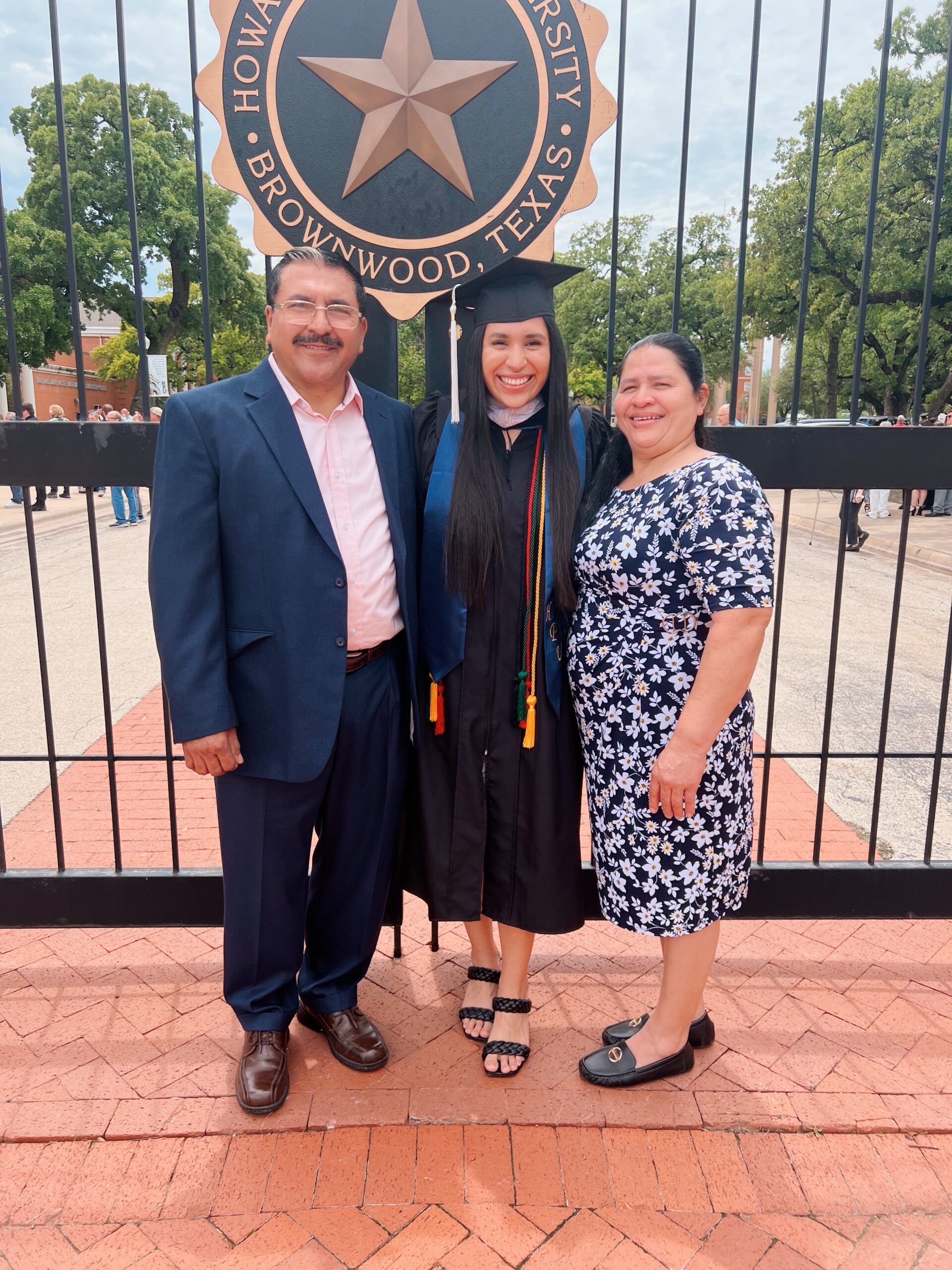
With an eye on these statistics, and an ear to Gen Z, a series of articles highlighting the impact of faith in offsetting negative trends among recent graduates of Texas Baptist universities is underway, starting with Cynthia Montalvo, a 2023 graduate of Howard Payne University.
Montalvo is from Bossier City, La. She grew up in a Hispanic Baptist church from the time her father accepted Christ, when she was around eight years old. Her junior year, she moved to a different church, when her father became its pastor. Both her parents are originally from El Salvador.
College experience
Montalvo at graduation from HPU. (Courtesy Photo)
She heard about Howard Payne from a close friend who was attending HPU and invited her to come for a tour.
She had considered a couple of other schools, but after the tour, Montalvo ended up applying only to Howard Payne and its honors program, the Guy D. Newman Honors Academy.
Montalvo double majored in public policy through the academy, and biomedical science, with a pre-med route.
Her long-term plan is to go to medical school and become a surgeon. And, she always has wanted to be a medical missionary, she said.
In high school she was part of a leadership program that introduced students to a variety of careers through field visits. While she’d always been interested in medicine, meeting a doctor and a nurse through this program solidified she wanted medicine to be her future.
One course at Howard Payne for pre-med students required shadowing a doctor, to see if medicine was really the path they wanted to take, Montalvo said. She was chosen to shadow Jason Davis, a Howard Payne alum and orthopedic doctor in north Dallas.
She said Davis was very supportive of what she wanted to do. Coming off COVID-19 restrictions, their initial conversations were by Zoom.
“He kind of told us his story,” she said. “I think a lot of times pre-med students hear: ‘Oh, that person is a doctor. They’ve always been really smart. They’ve always had the best grades.’ And he kind of was not that. That wasn’t really his story,” Montalvo explained.
He was very encouraging, saying “look, if someone like me can do it, if it’s something you really want to do, you definitely can.”
He agreed to be shadowed by Montalvo.
Davis was a great teacher during the week she shadowed him, Montalvo said, taking extra time to explain the difference between what a good x-ray or a bad x-ray looks like, as well as making the environment fun with his laid-back personality.
Change of plans
When she took her MCAT, the entrance exam for medical school, her scores were lower than she was hoping. She chose to take a gap year or two to focus on improving those scores to make her application stronger. And she reached out to Davis to ask if she could shadow him again.
He agreed and suggested his scribe, who was heading to med school, might be willing to talk to her about what it’s like now, since he’d gone to med school so long ago.
Montalvo connected with the scribe, who let her know her job would be coming available when she moved on to med school in July.
Montalvo said she was thrilled at that prospect because any opportunity to stay in Texas versus returning to Louisiana was welcome.
“Also, in all that, just taking the time and asking the Lord if that’s really something he wanted me to do. Because even when I went to Howard Payne, that was kind of not really a possibility. My parents aren’t super rich, and it is quite expensive to go to … a private school, or any college.
“And so, asking the Lord for guidance. Yes, is this something you want me to do? If it is, then maybe opening the doors of possibility and opportunity is something you want me to push through,” Montalvo said.
Montalvo with her parents. (Courtesy Photo)
The family friends—a pastor family—who had opened their home to Montalvo when she was shadowing Davis, enthusiastically agreed to let her live with them if she got the job.
Then, before she’d even had a chance to apply for the position, she heard from Davis, saying he’d heard about the scribe essentially offering Montalvo the job and thought it was a great idea. She eventually went through the application, interview and hiring process, and everything came together.
Montalvo explained God had used her time at Howard Payne to work in her spiritual life. Before college, she’d been sheltered so much, her faith had not been tested. In college, she began to struggle.
But, her faith in the Lord and dependence on him was strengthened through the ministry of her college pastor, Billy Cash, at Coggin Avenue Baptist Church. He assured her the faith she was feeling uncertain about was real and reliable. He helped her to know: “I have a personal relationship with God. It’s not just that my dad is a pastor.”
Faith in hard times pays off
She said at times she’d really struggled with difficult circumstances her family had faced and why they were having to go through them, but her dependence on God was strengthened in those struggles.
Cash taught her “sometimes you just need to ask for strength and depend on the Lord to take you through it, and he will. And he will guide you and he will give you strength to endure.
“And then when you come out on the other side, you’ve learned so much, your character has been strengthened. You’re a little bit more patient. You’re a little bit more kind, because you understand what it’s like to go through something like that.”
Montalvo said her faith has continued to grow this year as she’s been responsible for making it on her own. She’s continuing to learn to trust God and be obedient to his leading.
Her dad, initially, was unsupportive of her remaining in Texas. He has since come around, but she struggled when there was tension between them. Knowing that she’d asked the Lord, and he’d led her to take this job relieved a lot of anxiety.
At times, she’s found it difficult to tithe, even though she was raised to know its importance, because money is tight. But she has been obedient in that and several times God has provided for her financially when she’d least expected it, when she’d needed it most, she said.
She’s seen the Lord’s hand this year, noting: “When you walk in obedience there is so much in your favor. And your love for the Lord grows more when you follow him out of love.”
Montalvo said she is committed to pursuing med school in the future. In the meantime, she is active in Elim Church in Dallas and trusting in the Lord for continued guidance.
Around the State: ETBU team leads camps in Honduras
June 25, 2024
Student athletes from East Texas Baptist University led sports camps, distributed food to families in need, built chicken coops and competed against a local team during a recent mission trip to Honduras. The trip is the 20th for the ETBU Athletic Department’s Tiger Athletic Mission Experience initiative and the second international mission for the men’s basketball team. Partnering with the International Sports Federation, the student-athletes had the opportunity to show Christ’s love through kindness and sportsmanship. Team members shared devotionals in smaller groups, using translators to bridge language gaps. The Tigers had the chance to serve at the Dump Ministry in partnership with Roatan Mission. Team members prepared and distributed food to local families, witnessing the challenging living conditions firsthand. This humbling experience highlighted the disparity between their own lives and those they were serving, fostering a deep sense of gratitude and compassion. “My mission trip experience to Roatan, Honduras, was life-changing,” ETBU graduate student Jayden Williams said. During the team’s visit to Roatan Rehabilitation, the team assisted with practical tasks, such as constructing chicken coops and moving sand, while sharing personal faith testimonies. The Tigers played the Honduran National Team twice during the trip. After falling short in the first matchup, the Tigers came away with a win.
The Texas Board of Nursing confirmed the HPU nursing program’s 2023 pass rate of 100 percent on the NCLEX-RN. Pictured from left to right are HPU’s 2023 nursing graduates: Delilah Munoz, Madison Draper, Sydney Horton, Veaney Cazares and Bree Cason. (HPU Photo)
The Texas Board of Nursing confirmed Howard Payne University nursing program’s 2023 pass rate of 100 percent on the National Council Licensure Examination, or the NCLEX-RN, at its April 2024 board meeting. The test is a nationwide licensing exam for nurses and provides a measurement of nursing competence. HPU’s Bachelor of Science in Nursing program is one of only six in Texas to achieve a 100-percent pass rate on the exam. The Texas Board of Nursing uses NCLEX-RN exam results in the evaluation process for each nursing program in Texas. The exam results are evaluated each calendar year and are officially published in April the following year. The HPU nursing program received full approval from the Texas Board of Nursing during the April 2024 board meeting. HPU’s BSN program has held national nursing accreditation from the Commission on Collegiate Nursing Education since 2020.
Anniversary
Arcadia Park Baptist Church in Dallas celebrates 100 years of ministry this year. Fred Foster is pastor.
East Asia spiritually vibrant despite religious disaffiliation
June 25, 2024
WASHINGTON (RNS)—In East Asia, people are leaving their religion at rates among the highest in the world, according to a survey released June 17 by Pew Research Center.
But while many East Asians do not identify as members of an organized religion, they continue to hold spiritual beliefs associated with the region’s faiths.
Pew studied more than 10,000 adult participants over four months in Hong Kong, Japan, South Korea, Taiwan and neighboring Vietnam and found significant numbers of adults across the region say they have “no religion,” ranging from 27 percent in Taiwan to 61 percent in Hong Kong.
Among these religiously unaffiliated people, however, at least 4 in 10 believe in God or unseen beings, with a quarter or more saying mountains, rivers or trees have spirits. And half or more leave offerings for deceased ancestors.
“When we measure religion in these societies by what people believe and do, rather than whether they say they have a religion, the region is more religiously vibrant than it might initially seem,” the report said.
The survey also pointed to a remarkable level of mobility in East Asian’s religious identification.
Many people say they have switched from the religious identity they were raised in, either to another religion or to no religion. In Hong Kong and South Korea, 53 percent of adults have changed their religious identity since childhood.
Dominant trend of disaffiliation
The dominant trend is disaffiliation, rather than switching faiths. The percentages of adults in Hong Kong (37 percent) and South Korea (35 percent) who say they were raised in a religion but no longer identify with one are the highest in the world, overshadowing several Western European countries such as Norway (30 percent), the Netherlands (29 percent) and Belgium (28 percent).
“There’s been a lot of study and talk about how Western Europe is secularized,” said Jonathan Evans, senior researcher at Pew and lead author of the report. “But it doesn’t seem that there’s been as much discussion about religious change in people’s lifetimes coming from East Asia.”
“The most common religion in Hong Kong, South Korea and Vietnam is ‘no religion’” (Graphic courtesy of Pew Research Center via RNS)
He added, “It’s been really fascinating to see how East Asia and religious identity fit into a more global understanding.”
While the levels of disaffiliation are high, public attitudes toward proselytizing vary widely. Most adults in Japan (83 percent) and South Korea (77 percent) say it is unacceptable for a person to try to persuade others to join his or her religion.
People in Taiwan and Vietnam are more divided regarding conversion efforts, while the majority of respondents in Hong Kong (67 percent) say it is acceptable to proselytize.
In Hong Kong, 30 percent of adults report being raised without a religion, while 61 percent currently report being religiously unaffiliated, a gain of 31 percentage points.
“People in the region are more likely to engage with the spiritual world than to say religion is very important in their lives” (Graphic courtesy of Pew Research Center via RNS)
On the flip side, 29 percent of Buddhists in South Korea say they were raised Buddhist, but 14 percent identify as currently Buddhist—a 15-point decline.
The Pew team faced cultural and linguistic challenges in collecting data in East Asia. The concept of religion is relatively new in the region, having been imported by scholars only about a century ago.
Asking the right questions
According to the report, frequently used translations of “religion” typically are understood as referring to “organized, hierarchical forms of religion, such as Christianity or new religious movements,” producing results “based on a Judeo-Christian, Eurocentric mindset,” Evans said.
For the new survey, Pew designed questions that would measure beliefs and practices common in Asian societies, which revealed highly active spiritual lives among East Asians.
“Religious disaffiliation in East Asia and Vietnam compared with select countries” (Graphic courtesy of Pew Research Center via RNS)
In Taiwan, only 11 percent of adults say religion is very important to them, while 87 percent believe in karma, 34 percent say they ever practice meditation and 36 percent say they have ever been visited by the spirit of an ancestor.
In another striking example, 92 percent of religiously unaffiliated Vietnamese adults say they have made an offering to ancestors in the past year. Most adults surveyed in all five countries say they believe in God or unseen beings, such as deities or spirits.
Evans explained that while people may identify with a specific religious tradition such as Christianity or Buddhism, the boundaries of ritual and practice often are blurred.
“Someone might classify this as a Buddhist practice, but do we see Christians doing it? Do we see religiously unaffiliated people doing it?” he asked.
“While people might place a label on themselves, that does not necessarily reflect what beliefs and practices they have.”
Paul Pressler, SBC legend accused of abuse, is dead at 94
June 25, 2024
(RNS)—Paul Pressler, a retired Texas judge and one of the most influential evangelicals of the past 50 years, has died.
Pressler, 94, died June 7, but his death largely went unnoticed until Baptist News Global, an independent Baptist news site, reported the news of his funeral on June 15, held at the George H. Lewis and Sons Funeral Home in Houston.
Pressler was one of the chief architects of the “Conservative Resurgence,” also known as the fundamentalist takeover, that changed the course of the Southern Baptist Convention in the 1980s and 1990s, turning it into a decidedly conservative theological denomination with deep ties to the Republican Party.
As a member of the Council for National Policy, a conservative think tank, he helped forge ties between the GOP and the nation’s largest Protestant denomination.
Pressler was nominated to run the Office of Government Ethics under President George H. W. Bush but withdrew when a background investigation found “ethics problems,” the Washington Post reported.
But in recent years, Pressler became known mostly as a symbol of the SBC’s sexual abuse crisis. In 2017, a former Pressler assistant named Gerald Duane Rollins Jr. sued Pressler, claiming the older man abused him for decades.
The suit, which named Pressler, the SBC and other Baptist entities, finally was settled in December, with all the accused denying any wrongdoing.
In January of this year, a lawyer for the SBC, Gene Besen, called Pressler a “monster” who had leveraged his “power and false piety” to sexually abuse young men.
“The man’s actions are of the devil,” Besen told Religion News Service at the time, clarifying that he spoke in his personal capacity and not as a representative of the denomination.
History of concerns
In 2004, the same year Pressler first was elected vice president of the Southern Baptist Convention, his home church warned him in a letter about his habit of naked hot tubbing with young men after a college student complained that Pressler had allegedly groped him, according toThe Texas Tribune.
Months later Pressler agreed to pay $450,000 to settle Rollins’ earlier claim that Pressler had assaulted him in a hotel room. When Pressler stopped making the agreed payments, Rollins sued again, this time alleging sexual abuse.
Some years earlier, at the SBC’s 1996 annual meeting, during the Clinton-era White House scandals, Pressler gave a speech condemning what he saw as a loss of Christian values in the nation.
“Our nation sins when adultery and fornication are no longer a bar for holding high political office andprinciples of biblical morality and purity are no longer promoted,” he said, according to a clip of his speech posted on X, the site formerly known as Twitter.
“We sin when perversion is promoted and not penalized.”
But Pressler largely had faded into the shadows before news of the lawsuits broke. In 2016, he appeared at the SBC’s annual meeting in St. Louis, where he harangued then-SBC President Ronnie Floyd for not letting him speak about a resolution condemning the Confederate battle flag.
The exchange between them was broadcast on a massive screen at the front of the convention center.
“I was deliberately ignored,” Pressler, who opposed the resolution, told Floyd. “I told you last night I was going to speak on this.”
Pressler’s mic eventually was turned off, and he was ruled out of order.
At the recently concluded 2024 SBC annual meeting in Indianapolis, no mention of Pressler’s death was made.
A native of Houston, Pressler attended Phillips Exeter Academy in New Hampshire before earning degrees from Princeton and the University of Texas Law School. He served two years in the Texas Legislature before becoming a district and later appeals court judge.
In 2012, he made national headlines for hosting a meeting of evangelical leaders at his Texas ranch, aimed at finding an alternative to Mitt Romney in that year’s presidential race.
The lawsuit against Pressler inspired a major investigation into abuse in the SBC by the Houston Chronicle and San Antonio Express-News, according to The Texas Tribune.
That “Abuse of Faith” report led the SBC to hold a litany of lament for abuse in 2019 and eventually to authorize a third-party investigation by Guidepost Solutions into how SBC leaders dealt with abuse.
That investigation led to a series of reforms meant to help Southern Baptists deal with the issue of sexual abuse, but the effort has stalled over the past two years. At the SBC’s annual meeting this month, the denomination’s Executive Committee was charged with making those reforms stick.
Accrediting body approves ETBU and Carroll merger
June 25, 2024
The pending merger of East Texas Baptist University and B.H. Carroll Theological Seminary passed another milepost when a major regional institutional accrediting agency granted its approval.
The Southern Association of Colleges and Schools Commission on Colleges board of trustees on June 13 approved the merger and doctoral level status change for ETBU following an on-site review and recommendation of its substantive change committee.
“I applaud the work of ETBU and B.H. Carroll Theological Seminary faculty and staff, who collaborated over the past two years to create this opportunity for the merger and ETBU’s doctoral level status change. We are moving forward in the process of merging operations of Carroll Seminary into the university,” ETBU President J. Blair Blackburn said.
“We are grateful to the East Texas Baptist University board of trustees and B.H. Carroll Theological Seminary President Gene Wilkes and the Carroll board of governors for their leadership and support to advocate and affirm the vision and processes for the consolidation of Carroll Seminary as a part of ETBU.”
In February 2023, the governing bodies of ETBU and what was then the B.H. Carroll Theological Institute approved resolutions authoring an exclusive agreement to merge the administrative and academic operations of B.H. Carroll as part of ETBU.
Under the agreement, the institute became B.H. Carroll Theological Seminary and will be embedded in ETBU.
At that time, B.H. Carroll was accredited to award master’s degrees and doctoral degrees by the Association of Theological Schools and the Association of Biblical Higher Education. ETBU was accredited by the SACS Commission on Colleges to award baccalaureate degrees and master’s degrees.
‘Train men and women called to serve Christ’
Gene Wilkes, president at B.H. Carroll Theological Seminary, applauded the action by the SACS Commission on Colleges board, and he expressed appreciation to Blackburn and ETBU Provost Thomas Sanders.
“This most recent affirmation is one more piece of evidence of God’s favor as we follow him into our shared future. I am grateful to Drs. Blackburn and Sanders for their servant leadership throughout this journey and the partnership they provide for Carroll’s faculty and staff,” Wilkes said.
“The embedding of Carroll Seminary into such a quality university as East Texas Baptist will maximize our mission to train men and women called to serve Christ and his church.”
Last month, Texas Baptists’ Theological Education Council and Institutional Relations Committee endorsed the nine master’s degree programs, the doctor of ministry degree and the three Ph.D. degree programs that will be offered by B.H. Carroll Theological Seminary at ETBU. The doctor of ministry degree and doctor of philosophy degrees offered by B.H. Carroll will mark the first doctoral degrees granted by ETBU.
With the accrediting agency’s approval and the upcoming final votes by the board of the two institutions in July, students pursuing the degrees approved by the council and the Institutional Relations Committee will qualify for ministerial financial assistance through the Baptist General Convention of Texas.
“ETBU welcomes B.H. Carroll Theological Seminary students, faculty, staff, alumni, trustees and donors into the ETBU family. With God’s vision and plans revealed to us, the merger consolidation strengthens Carroll Seminary’s kingdom impact in educating and training theological and ministry leaders for generations to come,” Blackburn said.
“Our investment in graduate theological education and equipping pastors, ministers, missionaries, chaplains, Christian scholars and Christian organizational leaders for the kingdom will have new reach and trajectory, as ETBU expands its theological academic programs as a Level VI institution of higher learning.”
Historic all-sign-language ‘Jesus’ movie hits theaters
June 25, 2024
WASHINGTON (RNS)—Joseph Josselyn remembers being fascinated by the 1977 drama Jesus of Nazareth. But as a Deaf child, he had to rely on closed captions to catch the dialogue.
“I had this thought: I wonder what it would be like if this film was completely in sign language,” Josselyn said in a recent interview over Zoom facilitated by an American Sign Language interpreter.
His career since arguably could be described as a journey to finding out. On June 20, a movie telling the story of Jesus entirely in American Sign Language will become the first all-ASL feature film to debut in theaters, according to Josselyn, the film’s producer.
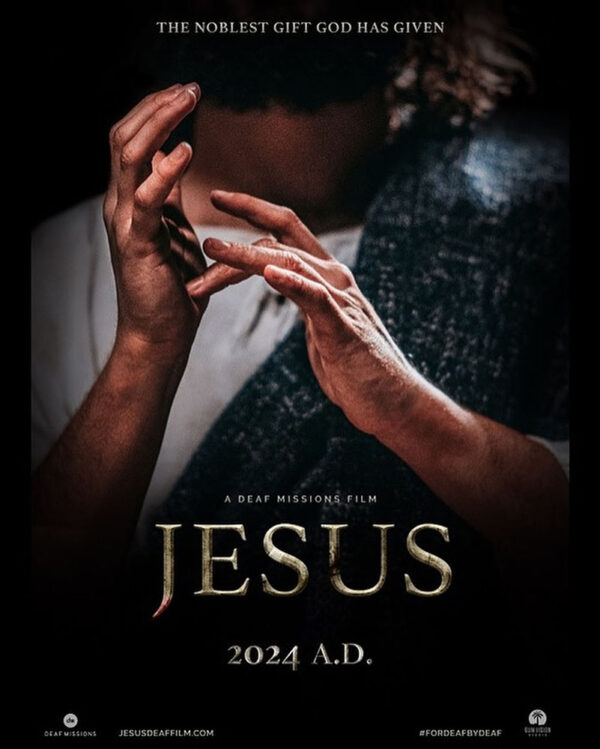
Jesus: A Deaf Missions Film, which carries the tagline “for Deaf, by Deaf,” stars Gideon Firl as the Messiah who, like all of the primary cast, signs his way through the role.
Deaf Missions is an international Christian ministry that serves people in more than 100 countries, with the goal of creating high-quality videos and visual tools in sign language.
Josselyn, who joined in 2006, began with shorter projects before producing the 2018 film The Book of Job, an earlier all-ASL movie with an all-Deaf cast and production team released on video and streaming.
A dream
Joseph Josselyn, left, and Michael Davis. (Photos courtesy of Deaf Missions)
After the Job project, Josselyn returned to his dream of telling the gospel story in an ASL feature. That dream was shared by producer Michael Davis, who joined on in 2022.
Together, the duo pitched the idea to Deaf Missions CEO Chad Entinger, estimating the project would require $4.8 million to fund.
“Our passion was really to see high-quality, Deaf film to be produced. We couldn’t do that with a low budget,” said Josselyn.
The funds secured, Josselyn and Davis had to decide how to frame their adaptation.
Perhaps appropriately for a film about breaking language barriers, they chose to bookend the narrative with Pentecost, a moment described in Acts when the Holy Spirit descends on the disciples so their preaching can be understood by a crowd that speaks many languages.
Peter, whose Pentecost testimony leads to thousands being baptized, serves as the supporting lead in “Jesus,” as he does in the Gospels.
While the plot’s points are familiar to even casual Christians, the film’s use of ASL makes for particularly embodied expression. Every townsperson, priest, Christ follower and zealot is filmed in full view, so their signing remains visible.
“Even hearing people who don’t know sign language will be able to connect, not just through the subtitles, but how expressive it is,” Davis said.
“You listen to a lot with your eyes as well.”
The filming required some adaptations on set. Ryan Schlecht, who portrays Caiaphas in the film, said because he and the other actors couldn’t hear “cut,” Josselyn and the assistant director would throw objects like hats and pillows into the scene to signal when to stop.
The reality
The team also often was communicating primarily through text, rather than via walkie-talkie as on many sets. Though partly filmed in California and Iowa, some of the movie was shot in Bulgaria, and wherever they were they were often in remote locations with poor internet and cell service.
Gideon Firl, center, portrays ‘Jesus in Jesus: A Deaf Missions Film.’ (Photo courtesy of Deaf Missions)
Other scenes in ASL elicited rare questions, such as: How does Jesus sign during his crucifixion?
The cast and crew supernaturally, according to Schlecht, found every solution. “It’s been such a huge blessing to see how God has provided every step of the way, from the cast, from the crew, from the team, from behind the scenes,” he said.
“Trying to get to the finish line was a challenge, but it was a journey of faith that carried us to the end.”
Not all of those working on the film were Christian, though immersion in the drama of the Gospels led at least one cast member to embrace Christianity, Josselyn said. For the Christians on the project, the impact was often profound.
Originally envisioned as a film without sound, the final version of the film includes a soundtrack created by two music producers—one Deaf, the other hearing—as well as background noises and sound effects to create a more immersive experience.
Deaf viewers will be able to hear the music through the vibrations, said Josselyn, and some Deaf audience members can hear some sounds too, Davis added. For nonsigning viewers, there are English subtitles.
Poster for ‘Jesus: A Deaf Missions Film.’ (Courtesy image)
The film’s launch on the big screen was an unexpected development for Davis and Josselyn, who initially expected it to be shown in churches and community centers.
The film will be shown in more than 300 theaters starting next week, making possible an unprecedented cinematic experience.
Despite the barriers encountered during the project, the filmmakers agreed it was worthwhile when they saw audience reactions to the film for the first time in prescreenings this spring.
Audiences were visibly moved—Schlecht added that in 30 years as a Deaf artist working in theater and film production, he’s never seen this level of impact.
“This film is for Deaf, by Deaf. That part is clear. But I just want to encourage the hearing community to come and be a part and watch the film,” said Josselyn.
“We want them to come and share this unique experience, understand our culture just a little better, and celebrate this historical moment in time, of the first ever full feature film about Jesus in sign language.”
Carthage church helps bring Bibles to remote area
June 25, 2024
An East Texas church’s year-end surplus enabled Baptist World Alliance partners to deliver thousands of Bibles to people in a rural area of the Democratic Republic of the Congo.
“We were blessed with surplus funds—not tithes but other gifts” at the end of 2023, said Pastor Monty Pierce of First Baptist Church in Carthage. “We prayed about how God might have us use them.”
In a remote rural area of the Democratic Republic of the Congo where Christians lacked access to Bibles, church leaders were traveling up to 45 miles a week by foot or by motorbike to copy a passage of Scripture to use in worship the next Sunday. (BWA Photo)
Pierce first became acquainted with BWA General Secretary Elijah Brown when Brown was on faculty at nearby East Texas Baptist University in Marshall.
So, he contacted Brown to ask if BWA knew about a need First Baptist in Carthage might help to meet.
“He told me he had just learned about a need in the Democratic Republic of Congo,” Pierce said.
In a remote rural area of the Central African nation where Christians lacked access to Bibles, church leaders were traveling up to 45 miles a week by foot or by motorbike to copy a passage of Scripture to use in worship the next Sunday.
“The area they traveled through was held by rebels who had previously attacked churches and burned Bibles,” Brown explained in a text to Pierce.
Christians in a rural area of the Democratic Republic of Congo receive Bibles. (BWA Photo)
Bibles in the language of the people in that region were available, but transporting and distributing them was cost-prohibitive.
Central Baptist Church in Carthage gave $6,000 for BWA and Congolese Baptists to secure the necessary transportation.
“All together, 36,321 people received a Bible,” Brown wrote in a text to Pierce. “As the leaders distributed the Bibles to people in their churches, they also shared their faith, and 2,364 people gave their life to Christ.
“Thank you so much! Your generosity sent Bibles into rural Congo, equipped pastors, replaced Bibles burned by attacking rebels, and led to over 2,300 salvations. Praise God!”


 Minette Williams Drumwright Pratt, missions advocate and denominational servant, died June 15. She was 93. She was born Nov. 3, 1930, in Nixon to Tallie Williams and Minnie Musgrave Williams. Shortly thereafter, her family moved to San Antonio where her father was pastor of Northside Baptist Church until he retired. She earned an undergraduate degree in English from Baylor University in 1951. At Baylor, she met and fell in love with Huber L. Drumwright Jr., a young pastor and doctoral student at Southwestern Baptist Theological Seminary. They married shortly after her graduation. While he went on to become pastor of churches in Texas and Oklahoma, she led numerous missions action projects, Bible studies, Bible schools and Woman’s Missionary Union groups. The Drumwrights moved to Fort Worth in 1960 for Huber to become a professor of Greek and New Testament at Southwestern Baptist Theological Seminary. He later became dean of the School of Theology, and she took on the duties of a dean’s spouse while continuing many of her own pursuits. Her passion for missions action flourished through a cutting-edge initiative, the Baptist Center at Broadway Baptist Church in Fort Worth. She designed and led programs for low-income women, battered women, orphans, unwed mothers and women prisoners. She was in great demand as a speaker and served on boards of the Woman’s Missionary Union, Home Mission Board (now North American Mission Board), Baptist General Convention of Texas, Seminary Woman’s Club, Woman’s Club of Fort Worth, Friends of the Fort Worth Library, Lena Pope Children’s Home, Edna Gladney Home and Dorcas House. She attended Southwestern Seminary and later served as president of the Southwestern Seminary Alumni. In 1978, she wrote a seminary extension study guide, Women in the Church. She received the Mrs. J.M. Dawson Award for outstanding contributions to the denomination from the Southern Baptist Convention Ministers’ Wives Conference in 1984. In 1980, the Drumwrights moved to Little Rock, Ark., where he served as executive director of the Baptist General Convention of Arkansas. After 18 months, Huber died of a sudden heart attack when Minette was 50 years old. Shortly thereafter, she was asked to join the leadership team of Keith Parks and Bill O’Brien at the Foreign Mission Board in Richmond, Va. She worked at the FMB 13 years and was the inaugural director of international prayer strategies, through which she designed programs to engage churches and individuals in prayer for foreign missions. She launched a prayer line relaying the latest prayer requests of missionaries, and she traveled the world to speak, teach, preach and lead programs on prayer in places such as Moldova, China and Africa. As she stated, “Although some governments won’t let missionaries in, they can’t keep the effects of prayer out.” She wrote two books—The Life That Prays: Reflections on Prayer as a Strategy and When My Faith Feels Shallow: Pursuing the Depths of God—and a seminary extension study guide, Women in the Church. After retiring, she returned to Fort Worth. She served on the Baylor University board of regents from 1999 to 2008. She fell in love with William (Bill) Pratt, a retired Baptist pastor and psychologist, and they married in 2002. He was a devoted, loving partner to her through her long battle with Alzheimer’s Disease until his death in April of 2024. She is survived by two daughters, Minette (Meme) Drumwright and husband H.W. Perry Jr., and Debra Underwood and husband Max; three grandchildren; and five great-grandchildren; two stepchildren—Martha Pratt Wainwright and husband Larry, and James Pratt and wife Dana; six step-grandchildren; and many step-great-grandchildren. The family requests that donations be made to Baylor University—Drumwright Family Lecture Fund (Honors College), William and Minette Pratt Scholarship Fund (Dianna R. Garland School of Social Work), Louise Herrington School of Nursing—or Broadway Baptist Church in Fort Worth.