Missouri convention wants control or assets of remaining litigants

JEFFERSON CITY — Regaining control is the heart of the Missouri Baptist Convention’s ongoing legal action against three formerly affiliated institutions. If control cannot be restored, then the convention would like its “stuff” returned, a Cole County judge learned May 11.

A hearing in Cole County Circuit Court on May 11 was the latest in ongoing legal action between the MBC and three formerly affiliated institutions. In 2000 and 2001, The Baptist Home, Missouri Baptist University, the Missouri Baptist Foundation, Word&Way and Windermere Baptist Conference Center changed their charters to self-elect their trustees. The MBC filed legal action against the five on Aug. 13, 2002, to force them to rescind those changes.

Windermere has won in Cole County and in a subsequent appeal. The MBC has voluntarily dismissed Word&Way from the case, and is moving forward against the remaining three in the Cole County action.

At the May 11 hearing, Judge Paul Wilson heard arguments concerning the convention’s claims and the relief it seeks. The MBC filed a declaratory judgment in 2002, amending it five times through September 2006. The MBC’s petition claims the institutions improperly amended their charters because they did not secure convention approval for those changes.

As its name suggests, a declaratory judgment asks the judge to determine each party’s rights and responsibilities.

However, Foundation attorney Laurence Tucker argued that a declaratory judgment could only be used when no other adequate legal means exists to solve the issue. Tucker argued the case could not be presented as a declaratory judgment since the convention also includes allegations of breach of contract — another legal means to conclude the case.

A declaratory judgment also does not include a remedy for loss. The convention seeks a remedy — rescinding of the corporate charter changes and any actions by the self-elected trustees. The MBC also seeks actual and punitive damages, including the return of some physical assets.

MBC attorney Charles Hatfield argued that seeking a declaratory judgment is the convention’s best option against The Home, the Foundation and MBU because each had given the MBC the right to approve charter changes.

“We want the ability to control these institutions we set up…,” Hatfield said. “No amount of money or no amount of property can secure that.”

In addition to the right to approve amendments, the MBC has a contract with the remaining defendants, which includes each corporate charter and the convention’s governing documents, Hatfield claimed.

Judge Wilson asked Hatfield what remedies the convention would seek, other than the right to control the agencies, if the MBC pursued the case as a breach of contract.

“We want to go back to the relationship we thought we would have…the right to appoint trustees and the stuff in the original articles,” Hatfield responded. “If we can’t get that, there are other claims…. Then we would want the stuff promised — the land, the money.”

The convention viewed Windermere as the “worst-case” legal scenario because its original charter declared the corporation would have no members and no MBC rights were stated. The Foundation was viewed as a “best-case” legal scenario because its old charter included language to allow the MBC to approve charter changes, Hatfield argued.

MBC attorneys argued that under a declaratory judgment, the convention would regain control of the agencies and their assets because the institutions’ actions would be rescinded.

If the court determines the case should be pursued as a breach of contract, the MBC should regain control of the institutions and their assets as restitution, Hatfield argued.

Either way, the MBC feels it has “a serious wrong” and is seeking the best legal remedy, the lawyer added.

TBH attorney Eric Walter pointed out that in a March 2008 ruling, former Cole County Circuit Judge Richard Callahan determined that a contract did not exist between the MBC and Windermere and that any covenant agreement that existed is not enforceable.

Judge Wilson indicated he would not issue any rulings yet. Instead, he will hear arguments on additional motions still active in the case.

Another hearing has been set for 9:30 a.m. June 9 at the Cole County Courthouse in Jefferson City.


Music minister adds to massive collection one hymnal at a time

LEWISVILLE—One of music minister Rob Veal’s latest additions to his hymnal collection arrived from an unexpected source.

A woman sent it to Veal with a note saying her father had clipped an article about Veal’s collection from the Aug. 24, 2001, edition of the United Methodist Reporter and placed it inside the hymnal with a note saying, “When I pass, send the hymn book to him.”

Veal's oldest hymnal is a tiny 1801 edition of Psalms Carefully Suited for Christian Worship, designed to fit easily into a woman’s purse. He also owns a battlefield hymnal from the Civil War.

Veal, associate pastor of worship at Northview Baptist Church in Lewisville, owns 1,434 hymnals and gospel songbooks—and he’s still looking for unique additions to his collection.

Veal started accumulating hymnals and bound collections of gospel songs soon after he began to lead church music at age 16. Some senior adults at church requested songs unfamiliar to him, and he set out hunting for the music.

“I started buying books because the church couldn’t afford them,” he recalled.

His interest in rare books was piqued when he discovered, on sale for $4 at a second-hand bookstore, a 1937 Stamps-Baxter paperback edition of Favorite Radio Songs from KRLD in Dallas, autographed by Virgil Stamps.

In the last 30 years, he has added significantly older and rarer books to his collection, the oldest being a tiny 1801 edition of Psalms Carefully Suited for Christian Worship, designed to fit easily into a woman’s purse. He also owns a battlefield hymnal from the Civil War.

In addition to The Broadman Hymnal from 1940 and copies of the 1926, 1956, 1975 and 1991 editions of The Baptist Hymnal, Veal’s collection also includes several editions of British Baptist hymnals published by the Psalms and Hymns Trust of London and a copy of the 1918 Primitive Baptist Hymn and Tune Book.

But even a casual glance at the collection reveals its eclectic and ecumenical nature—everything from an Amish hymnal in German to an 1846 Universalist hymnal from Boston.

Rob Veal, associate pastor of worship at Northview Baptist Church in Lewisville, owns 1,434 hymnals and gospel songbooks—and he’s still looking for unique additions to his collection. (PHOTOS/Ken Camp)

In addition to a wide variety of hymnals representing many denominations, Veal’s collection also includes many collections of gospel songs from the singing conventions that once were popular throughout the South.

Veal believes preserving the wide range of hymn and gospel song collections is important because the songs tell the story of what has moved the hearts of people over the last 200 years.

“We sing the things that we feel when we encounter God in different ways,” he said.

“History unfolds in the songs we sing.”

Veal continues to add to his collection, and he is willing to pay shipping costs for any unique donations. Contact him at BRobertVeal@aol.com.


Huntsville campus encounters the gospel through a pair of chairs

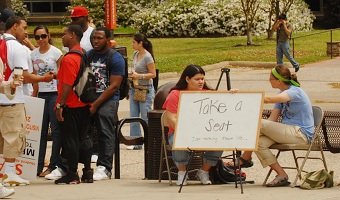
HUNTSVILLE—Each Tuesday during the fall and spring semesters, Lauren Sierra, campus missionary for the Sam Houston State University Baptist Student Ministry, walked to the center of campus where student activities were buzzing, taking with her two metal folding chairs and a white board that read, “Take a seat—questions about life.

As hundreds of students passed by on their way to class, Sierra sat for a few hours, leaving the second chair open for anyone who needed to sit and talk about life. Many students walked by, avoiding eye contact and heading to the other side of the walkway to avoid the chairs. But Sierra sat patiently, believing God would bring the people who needed to hear hope and need a friend to listen.

“One thing I like about the “Take a Seat” method is that they can come sit down if they want,” Sierra said. “I’m not forcing anyone to come sit down with me. One of the first things that I say is that: ‘At any point in this conversation, you are free to get up and go. You won’t offend me. I’m just here to learn about your life and share my life with you.’”

When students sat in the chair, Sierra began asking general questions about their major, what they think the purpose of life is or if they follow a religion, questions that help get a conversation started. Then she listened, looking for ways to share the hope of Christ with each student.

“I’ve had students tell me they are bent towards sin,” Sierra said. “I’ve had students tell me they have a nature of darkness in them. Good thing is that Jesus is the light, so I’m able to share the gospel with them.”

Lauren Sierra (right), campus missionary at the Sam Houston State University BSM, listens to a student who came to talk during the “Take a seat” outreach. (PHOTOS/Kaitlin Chapman/BGCT)

Sierra feels like this ministry and other BSM ministries are reaching the campus because they are fulfilling a need for community many students have. In the process, Sierra brought other BSM students with her to teach them how they, too, can offer a listening ear and a kind and truthful word to other students.

“When we talk about meeting needs, I think one of the biggest needs we need to meet on this campus is community,” Sierra said. “People need someone to talk to, and I’m trying to provide that for them and share the gospel while doing it.”

To continue offering community beyond the outreach effort, the BSM served as host to more than 18 small-group Bible studies around campus.

Chris Stanley, BSM director at Sam Houston State University, and the BSM staff discipled student leaders to guide the small groups of 10 students held on-campus in dorms and activity centers, making the groups open and available to other students.

Many of the small groups are considered seeker groups, where not all the students are Christians. Leaders are sensitive to this and lead discussions relevant to students who are seeking truth about Christ.

“The main goal is to make disciples because that is what we feel like we have been charged to do,” Stanley said. “Our small groups are really for our students to come together, get connected and get some spiritual grounding. Then for those who facilitate the groups, (we encourage them) to look for those in the groups who want to go deeper. Then they draw them aside and talk to them about what that would look like and entail and begin to meet with them weekly to do that very thing. Really, our ultimate goal is to make reproducible disciples.”

Through this process, several students professed faith in Christ.

For instance, freshman Shalyse Thomas became friends with fellow freshman Stacey Monks and invited her to attend a small group. She agreed, and arrived seeking someone to answer her questions about religion.

Monks, who considered herself agnostic, said she was at the point of frustration, not knowing what to believe about religion but had not tried to get her questions answered in the past. Monks said she had heard of Christ before, but had no idea about the relevance of the cross.

Sam Houston State University BSM campus missionary Lauren Sierra sits in the middle of campus encouraging a student. Last fall, Sierra was moved to start an on-campus outreach that would build community on students while sharing the gospel, so she started “Take a seat.” (PHOTOS/Kaitlin Chapman/BGCT)

Soon Thomas and Sierra were spending time weekly with Monks outside of small group, talking through her questions about faith and Christ. At one point when Sierra was sharing the gospel with her, Monks called her crazy for believing the Bible.

“She wanted a logical explanation of the Trinity, which I couldn’t give to her, and I said that it will have to be revealed by God. I do remember telling her: ‘Stacey, God loves you, and I think he is pursuing you. I think you want to believe in him, and I promise if you seek for God, you will find Christ because he is God.’ She looked at me and said, ‘Lauren, you are crazy.’”

Sierra and Thomas patiently continued to spend time with Monks and prayed God would open her eyes to truth.

“In October of last year, I really started to pray for Stacey. She was just really on my heart,” Thomas said. “Then in December, I invited her to small group. It took a month or two of her coming to small group and asking questions to start to see the love Jesus has for her and the love we had for each other here at the BSM.”

Eventually, Monks started reading the Bible on her own, continuing to search for answers to her questions.

“It was definitely a process,” Monks said. “It took me several months just for things to click. It even took me a couple of months to even start reading the Bible on my own. Eventually, I was readying Matthew, and it just clicked. This is truth.”

Monks walked into the BSM one day, and her countenance was different, Sierra said. She could tell Monks had accepted the love and salvation of Christ.

{youtube}m6IP5AtUI20{/youtube}

“I feel worthy now,” Monks said. “Before, there was just always something missing. Since I’ve found the love of Christ, it’s filled that gap. Before, I was depressed. I was lonely. I felt unworthy. Now that Christ is in my life, I have love. I have worthiness. I never feel alone.”

Monks now is being discipled by Thomas, and she is sharing her faith with others, helping them see that Christ also can change their lives.

As God has been transforming BSM students to live intentional, missional lives out of the overflow of their love for Jesus, Stanley said, God is using them to change and influence many lives with the hope of Christ.

“We have seen a life transformation throughout,” Stanley said. “Students who have been dealing with life issues for years and years have seen new life as Christ has broken them and brought about renewal in their life. Accountability and getting into the word has been part of that but also just that aspect of God working and transforming lives. … It has been amazing to see God at work.”


Religious leaders decry proposed Texas textbook standards

AUSTIN, Texas (ABP) — Two Baptist ministers joined about two dozen other religious leaders in a May 12 press conference at the Texas Capitol to decry school textbook standards they say would weaken instruction about religious liberty and the separation of church and state.

Roger Paynter

"Our Founding Fathers understood that the best way to protect religious liberty in America is to keep government out of matters of faith," said Roger Paynter, pastor of Austin's First Baptist Church. "But this state board appears hostile to teaching students about the importance of keeping religion and state separate, a principle long supported in my own Baptist tradition and in other faiths."

The event, one week before the State Board of Education begins final debate on proposed new social studies curriculum standards for Texas public schools, was sponsored by the Texas Faith Network, a coalition of more than 600 mainstream and progressive clergy and project of the Texas Freedom Network Education Fund.

In March board members voted 10-5 along party lines to amend textbook standards to correct what a bloc of social conservatives view as hostility toward Christianity and traditional values.

Proposed changes to the curriculum include downplaying the role of Thomas Jefferson among the founding fathers and requiring teachers to cover "Judeo-Christian" influences on the nation's founding.

Larry Bethune

A group of historians said many of the changes are historically inaccurate and that they would affect textbooks and classrooms far beyond the state's borders. Texas is one of the two largest textbook purchasers, giving publishers incentive to tailor their curriculum with that market in mind.

Republican board members defeated an amendment that would have required students to examine the reasons the founders "protected religious freedom in America by barring government from promoting or disfavoring any particular religion over all others."

Also speaking at the press conference was Larry Bethune, pastor of University Baptist Church in Austin. "We don't want to be the laughing stock of the nation and certainly don't want our children to be taught a very narrow religious agenda," Bethune told television station News 8 Austin.

"We think it's very important that Texas children understand religious liberty and its place as the First Amendment of our Constitution and Bill of Rights," Bethune said.


–Bob Allen is senior writer for Associated Baptist Press.


Book says white churches can learn from blacks

VALLEY FORGE, Pa. (ABP) — After resigning abruptly in 1992 from one of the largest and influential churches in the nation, First Baptist Church in Dallas, and going through a divorce within two years, Joel Gregory's ministry appeared to be over. Through it all, he says, one minister kept calling him.

The late E.K. Bailey, the pastor of Concord Missionary Baptist Church in Dallas, asked Gregory to preach at his International Expository Preaching Conference. Though Gregory didn't know it at the time, it was actually an endorsement of his ministry that led to the white southern preacher being invited into hundreds of African-American churches and conferences.

Joel Gregory

Gregory describes the experience — the first step toward redeeming his ministry that today includes serving as professor of preaching at Baylor University's George W. Truett Theological Seminary — in a new book by Judson Press co-authored with Georgetown College President William Crouch.

In What We Love About the Black Church, Gregory and Crouch say much of America's religious history is marked by white churches taking a patronizing attitude assuming they have the right answers and need to help black churches with money, programs and organization. Based on their own experiences worshipping as white ministers in African-American settings, however, they argue that black churches have much to offer that would greatly enrich white churches if they are willing to learn.

Gregory said in an e-mail interview the most important lesson he learned is that the black church really practices grace. "White Baptists talk grace but to some extent revert to law in assessment of their own lives and the lives of others," he said. "Blacks are willing to take you where they find you, believe in your, pick you up and believe that you can say a good word for Jesus. Every Sunday in every black church I have experienced, now in the hundreds, grace is an active reality."

Crouch, a preacher's kid who grew up watching his father, Henry Crouch — the longtime pastor of Providence Road Baptist Church in Charlotte, N.C., and a founder of the Alliance of Baptists — cope with the ugliness of racism in the South, set a goal of leading Georgetown, a predominantly white college founded in 1787, to become a campus of diversity.

Under his leadership the percentage of students of color at the college has increased from 3 percent in 2005 to 10 percent by the fall of 2009, with a goal of 20 percent by 2015. The school has also launched the Bishop College Alive project, aimed at resurrecting the spirit of a historically black college in Texas that closed its doors in 1988. It marked the first time in American educational history that a predominantly white college has honored the alumni of a historically African-American college.

Crouch said one difference he has noted in visiting white and black churches is hospitality. Visiting a large white Baptist church one Sunday morning, Crouch said he was cordially welcomed by an official greeter but left the service feeling like an outside observer instead of a truly welcomed participant in worship.

William Crouch

He contrasted that with a first-time visit to a large African-American church in Chicago, where he was greeted with a handshake he described as "the lean." That is where right hands grip in a traditional handshake but left hands wrap around the other's back and right shoulders lean in and touch. He later learned is a nearly universal salutation among African-American men.

Upon learning he was a minister the greeter insisted on escorting Crouch to the pastor's office. He was introduced to the pastor, the assistant pastor and the senior deacon and asked by the senior pastor to remain with him in his office while the choir director led the congregation in pre-worship praise and singing and later to sit with him on the pulpit platform. Before the service began, every deacon, even though they didn't know his name, greeted Crouch with "the lean." By the time the service started, he wrote, "I was already a part of the fellowship."

Gregory said black and white churches will move beyond arm's-length cordial relationships only when they start getting involved in one another's lives. "We need more than annual pulpit exchanges," he said. "We need stated bi-cultural programs where black folks and white folks get into one another's homes, have meals and go through a guided discussion book with grace and openness."

He said well-intentioned efforts by whites to interact with blacks in joint worship settings fail to produce meaningful relationships because blacks "are quick readers" of white people's real attitudes toward them.

"The late Rev. Dr. E.K. Bailey told me one time, 'Gregory, we have had to read what white folks are really thinking for 400 years in order to survive. We can tell in an instant if a white person fears us,'" he said.

"That is true," Gregory continued. "We need a pure heart to meet on level ground. We need honesty and conversation. We also need to be able to be serious about stereotypes and at the same time be able to laugh out loud together at the misconceptions that we have of one another. I have seen great healing in such respectful, shared humor at the irony of our misconceptions."

Gregory said he hopes the book will be of equal interest to clergy and laity in both black and white churches. "We need it to be," he said.

"Make no mistake," Gregory said. "Prejudice is evil and serious. We cannot laugh it away. I believe the more time Christian blacks and white can spend with one another in homes, missions and conversations the perceived distances will melt."


–Bob Allen is senior writer for Associated Baptist Press.


Researchers probe whether, why, free will exists

ORLANDO, Fla.—Are people really responsible for all the things they do? Do they have what theologians call God-given “free will” to choose between right and wrong?

Those questions are at the heart of a four-year research project under way at Florida State University that aims to determine whether, and how, free will exists.

Funded by a $4.4 million grant from the John Templeton Foundation, the project will gather together scientists, philosophers and theologians around the question of what factors—free will, genetics, environment, God or something else—lead us to do all the things we do.

“Gathering evidence for it one way or another, it’s quite possible,” said Alfred Mele, a professor of philosophy at Florida State who will lead the project. “Scientists have been looking for evidence for and against free will since the early ’80s.”

The debate however, is much older. For instance: Do humans, through their own freely chosen actions and decisions, determine whether they will go to heaven or hell? Does an omniscient God already know how things will turn out in the end? Does God give humans the free choice to turn away?

In the early 1980s, neuroscientist Benjamin Libet conducted an experiment that found subjects’ brains registered the decision to flex their wrists roughly 300 milliseconds before the subjects themselves became aware of their decision to do it. Libet concluded “conscious free will never is involved in producing a decision, and you can see how there’s a quick road from there to ‘there actually is no free will,”’ Mele said.

The research led some to believe that brain processes traceable to genetic and environmental factors, and not free will, determine our decisions. Others think that while people might not be immediately aware of the decisions our brains make, they still possess the free will to veto these decisions.

But Mele, the author of two books and more than 170 articles on the concept of free will, doesn’t discount the more common definition of free will—one used by the courts in determining guilt and premeditation.

“There really is nothing more to it than sanely, rationally assessing reasons and then deciding on the basis of those reasons, as long as nobody is pushing you around or forcing you,” he said. “In that view of free will, it’s pretty obvious there is free will.”

The “Big Questions in Free Will” research project will devote $3.4 million for projects around the world to explore the concept of free will from scientific, philosophical and theological perspectives.

Scientists will look for evidence proving or disproving whether free will exists. Philosophers and theologians, meanwhile, will seek a better definition of the concept, helping scientists to know precisely what evidence they are looking for, Mele said.

Perhaps it is difficult to reconcile concepts such as fate and destiny with free will, but it is possible for an omniscient God to coexist with the idea of free will, said Kevin Timpe, an associate professor of philosophy at Northwest Nazarene University in Nampa, Idaho.

“There is a difference between knowing what someone is going to do and causing them to do it,” said Timpe, author of Free Will: Sourcehood and Its Alternatives. “I know what my wife is going to order when I take her to certain restaurants just because I know her very well. But I also think my wife is freely choosing to order.”

What if researchers discover free will does not exist? Two studies portend a troubled future, Mele said. One found its subjects cheated more when they believed they were not responsible for their own decisions; another found subjects’ behavior growing more aggressive when their belief in free will was suspended.

Norman Geisler, the author of 70 books including several on free will, said the idea that free will does not exist is incompatible with the Bible and the doctrine of original sin, which refers to the sin inherited from Adam and Eve’s transgressions in the Garden of Eden. If Adam’s decision was not made freely, then that presumably makes God responsible for evil in the world.

“The Bible constantly affirms that man is free, that he can choose his destiny, that he’s morally responsible,” said Geisler, whose books include Chosen But Free. “To say that we are pre-determined is to blame God for our choices. Secondly if all our actions are pre-determined, then why doesn’t God save everyone? Because if he can save everyone apart from their free will and he if really loves everyone, then he would.”


Chilean pastors living in tents as winter approaches

NIPAS, Chile—More than two months after an earthquake rocked Chile, rains have begun and winter soon will arrive, leaving a group of Baptist pastors bracing for the cold in small tents that have become their impromptu homes in the wake of the disaster.

Eliseo Avila (left) is one of 10 Chilean Baptist pastors a Texas Baptist Men team discovered still living in tents near their devastated homes after an earthquake struck Chile. Seeing them broke the heart of Ernie Rice (right), who led the TBM disaster assessment team. (PHOTOS/Courtesy of Ernie Rice)

For Eliseo Avila, pastor of three congregations, it’s simply the latest challenge. He remains jittery, jumping on occasion when sounds spark memories of the earthquake. At times, he struggles to contain his emotions.

Avila is one of 10 Chilean pastors a Texas Baptist Men team discovered still living in tents near their devastated homes. Seeing them broke the heart of Ernie Rice, who led the TBM team.

“They’re approaching their winter, and it’s raining,” said Rice, a member of First Baptist Church in Stockdale. “They’re in a high degree of misery.”

TBM is working on a plan to construct housing for each of the pastors, using Texas volunteer teams to provide labor. But the effort faces obstacles. Lumber cannot be imported, and the factory that produced 80 percent of the area’s steel was severely damaged by the tsunami that resulted after February’s earthquake. TBM leaders are investigating a number of options, including shipping prefabricated homes to Chile and importing steel for roofing.

Rice, a veteran of disaster relief ministry, described the devastation in Chile as “powerful.” One apartment complex broke in two and fell to the ground. The top six floors of a high-rise building collapsed.

Texas Baptist Men discovered 10 Baptist pastors living in tents after an earthquake destroyed their homes.

Numerous churches were affected to varying degrees. Government officials have begun inspecting buildings and identifying necessary repairs before they can be used again.

While the rebuilding efforts understandably have consumed much of the Chilean Baptists’ time and energy, they remain committed to sharing the gospel in their communities, Rice said. They continue to plan a major evangelistic effort in the coming months, hoping to continue building on the ministry that has seen the country’s evangelical presence double to 15 percent in the past decade.

TBM has committed to partnering with the congregations affiliated with the Baptist Union of Chile in their efforts to rebuild pastors’ homes and church facilities and to support evangelism efforts.

Ernie Rice, a veteran of Texas Baptist Men disaster relief ministry, described the devastation caused by an earthquake in Chile as “powerful.” One apartment complex broke in two and fell to the ground. The top six floors of a high-rise building collapsed.

“My heart is with those people who are faithful servants who are fully committed to (Christ) and are suffering,” Rice said. “It’s affecting the ministry. It’s time for us in North America to come to their aid. It’s tough, man. It’s tough. They need our help. They need our resources. They need churches to come alongside them and partner with them in the ministry.”

For more information about volunteering to serve in Chile or providing financial support for the disaster relief efforts there, visit www.texasbaptistmen.org or call (214) 828-5350.

Texas Baptists’ Church2church initiative is working with TBM to help congregations partner with Chilean Baptist congregations. For more information on this ministry, visit www.texasbaptists.org/church2church or call Marla Bearden at (888) 244-9400. 


Memorial cross at center of recent Supreme Court case reportedly stolen

LAS VEGAS (ABP) — A simple metal-pipe cross in the middle of the Mojave Desert that inspired a passionate Supreme Court debate about religious freedom has reportedly been stolen.

The cross — successor to one first erected as a World War I memorial in 1934 — stood atop Sunrise Rock, next to a road in a remote part of California’s Mojave National Preserve. The location is about 70 miles south of Las Vegas and 200 miles northeast of Los Angeles.

Several news agencies — including The Los Angeles Times, The Las Vegas Sun and the Associated Press — reported May 11 that the cross disappeared at some point late May 9 or early May 10.

Although several crosses erected by private groups have stood on the spot over the years, the most recent version was built of painted metal pipes by a local resident in 1998. Federal officials covered it with a plywood box to comply with court orders while the monument’s fate wound its way through the courts.

According to the AP report, National Park Service officials said the crime was discovered May 10 when a service employee was sent to replace the wooden box, which itself had been destroyed by vandals over the weekend prior to the theft.

The employee discovered the cross missing, with the bolts that had connected it to its concrete mount cut.

Motives for the theft, the Park Service said, could range from a protest against the April 28 Supreme Court ruling in the cross’s favor to a case of common thieves seeking scrap metal.

But a conservative religious legal group that argued in favor of the cross declared the theft vandalism and appealed for funds to erect a replacement in a website posting May 11. The Liberty Institute noted, as part of its appeal, that the legal wrangling over the cross isn’t finished.

“While the memorial was temporarily saved by the Supreme Court's ruling April 28, the case isn't over yet,” the statement said. “The court's opinion says that the lower court erred in striking down a congressional act that would transfer the land on which the memorial sits into VFW [Veterans of Foreign Wars] hands, and sends the case back to the lower court so they can correct their ruling.”

The Liberty Institute and the VFW, the American Legion and several other veterans’ organizations are offering a $25,000 reward for information leading to the capture of those responsible for the theft.

Groups that opposed the cross standing on government land denounced the crime. Peter Eliasberg, the American Civil Liberties Union attorney who argued on behalf of the retired National Park Service employee who originally sued to remove the cross from the preserve, told the AP, “We believe in the rule of law and we think the proper way to resolve to any controversy about the cross is through the courts.”

Don Byrd, who blogs for the Baptist Joint Committee for Religious Liberty, said the theft was “just sad.”

He continued, “Think what you will about whether it's appropriate as a national monument, or whether it is constitutional; there's no reason for this kind of vandalism, which hopefully was not driven by the Supreme Court's recent decision….”

In the case, a splintered Supreme Court ruled 5-4 that a lower court should reconsider its ruling against an attempt by Congress to preserve the cross by transferring the land on which it sits to private hands. However, the justices in the majority expressed several different opinions as to why the cross should remain in its spot.

It is not immediately clear whether an effort to erect a replacement for the cross would be legal, given the court rulings on its fate.

-30-

Robert Marus is managing editor and Washington bureau chief for Associated Baptist Press.

Related ABP story:

Church-state separationists mixed over desert-cross decision (4/28/2010)


University to investigate alleged untruths by seminary president

LYNCHBURG, Va. (ABP) — Liberty University will investigate reports that its seminary president has misled the public in his testimony about converting from militant Islam to Christianity, officials of the school in Lynchburg, Va., announced May 10.

Liberty University Provost Ron Godwin is reportedly forming a committee to conduct a formal inquiry into questions surrounding Ergun Caner, president of Liberty Baptist Theological Seminary, that have circulated on blogs and more recently in media outlets including Christianity Today and Associated Baptist Press.

Ergun Caner

"Liberty does not initiate personnel evaluations based upon accusations from Internet blogs," said Chancellor Jerry Falwell Jr., breaking weeks of silence amid criticism from both Christian and Muslim bloggers. "However, In light of the fact that several newspapers have raised questions, we felt it necessary to initiate a formal inquiry."

The author of books including Unveiling Islam: An Insider's Look at Muslim Life and Beliefs, which he co-wrote in 2002 with his brother, Caner has been quoted in Baptist and secular media as an expert on Islam.

But discrepancies in his biographical sketch in recorded in messages preached over the years have caused some to question the credibility of even his basic testimony of converting from a devout Sunni Muslim background illustrating the power of Jesus to save anyone.

James White, director of Alpha and Omega Ministries, a Christian-apologetics organization based in Phoenix, says he became suspicious after Caner claimed to have debated Shabir Ally, president of the Islamic Information and Dawah Centre International in Toronto. White, who has debated Ally in both the United States and United Kingdom, said he contacted Ally, a Muslim apologist who travels around the world to represent Islam. White said Ally informed him he never debated Caner and had no recollection of ever meeting him.

White then was contacted by Mohammad Khan, a 22-year-old Muslim college student, who made a series of videos on his laptop computer in his London bedroom accusing Caner of misrepresenting Islam in order to make Muslims look bad. The videos began appearing on YouTube in April 2009. Most have been removed, citing copyright issues. Even if Caner is a former Muslim, Khan claims, his frequent misuse of Islamic terms and phrases and errors about fundamentals of the faith demonstrate that he knows next-to-nothing about Islam.

Seeing discrepancies in Khan's videos about Caner's testimony, Jason Smathers, a Christian website designer, found legal documents contradicting Caner's claims of growing up in Turkey and being trained as a terrorist. Smathers says Caner actually grew up in Ohio in custody of his Lutheran mother after his parents divorced. Caner's father, a Muslim who remarried, broke off relations with all three sons from his first marriage after they accepted Christ as teenagers.

Other websites showed that Caner changed his online resume after it was pointed out that it misstated he earned a Ph.D. instead of his actual Th.D. and included an honorary D.Min. from an unaccredited school.

Southern Baptist bloggers weighed in after Caner accused the Southern Baptist Convention International Mission Board of using deception in outreach to Muslims in a podcast interview posted on the blog SBC Today.

Some Baptist bloggers accused Caner of giving Christianity a bad name by deliberately misrepresenting his testimony. Others defended him, saying the real motive behind blog attacks against Caner were comments he has made in the past harshly critical of Calvinism.

Caner issued a statement admitting to "pulpit mistakes" but insisting he never intentionally misled anyone. Liberty University revised Caner's online biography to remove references that he was raised in Turkey and has debated leaders of various faiths.

Liberty officials initially sought to downplay the controversy. Elmer Towns, co-founder — along with the late Jerry Falwell — of Liberty University and dean of its School of Religion, told Christianity Today that officials had investigated the discrepancies and were satisfied it was not an "ethical" or "moral" issue.


–Bob Allen is senior writer for Associated Baptist Press.

Previous stories:

Liberty U. backs seminary president amid charges of misrepresentation

Seminary president apologizes for calling IMB head a liar

Seminary president labels mission strategy 'heresy'


Kagan’s views on church-state, social issues largely unknown

WASHINGTON (ABP) — President Obama’s latest Supreme Court nominee has an exceedingly thin paper trail on some of the legal questions most important to people of faith. But one thing is clear if Solicitor General Elena Kagan is confirmed to fill retiring Justice John Paul Stevens’ seat: For the first time in American history, no Protestants will sit on the nation’s highest court.

President Obama meets with Solicitor General Elena Kagan in the Oval Office last month. (White House/Pete Souza)

Obama formally nominated Kagan — who has served for the past year as the government’s chief advocate before the high court — May 10. “Elena is widely regarded as one of the nation’s foremost legal minds,” he said, adding that his nominee is “an acclaimed legal scholar with a rich understanding of constitutional law” who has demonstrated “a lifelong commitment to public service and a firm grasp of the nexus and boundaries between our three branches of government.”

But her unusual record for a modern-day Supreme Court nominee — she would be the first nominee without any prior experience as a judge placed on the court in nearly 40 years — leaves little record to comb for her views on many legal questions.

Among them are issues particularly important to people of faith that are likely to come before the court during her term. Kagan, at age 50, would become the youngest justice, and could conceivably serve for four decades or more.

Her previous experience in academia, in the Obama and Clinton administrations and as a clerk to late Supreme Court Justice Thurgood Marshall only provides a few clues as to her views on thorny questions around church-state separation, abortion rights and gay rights.

Separation of church and state

Most recently, Kagan argued in favor of government efforts to protect a cross on federal land in California’s Mojave Desert. Lower federal courts ruled against display of the cross and Congress’ attempts to protect it, but a splintered Supreme Court recently decided in the cross’s favor.

However, the case may not offer any clue to Kagan’s personal views. Obama’s Justice Department inherited the case from the previous Bush administration. And the solicitor general’s job is to defend laws and government policies from legal attacks — even in cases in which he or she may personally disagree with the government’s legal position.

Another possible hint at Kagan’s church-state views lies in a memo she wrote in 1987, when she was clerking at the high court for Marshall. In a case regarding the Adolescent Family Life Act, Kagan suggested that providing certain funds — such as for discouraging teenage pregnancy — to religious groups under the law would violate the Establishment Clause, the part of the First Amendment that prevents government support for religion.

“It would be difficult for any religious organization to participate in such projects without injecting some kind of religious teaching,” Kagan wrote. “The government is of course right that religious organizations are different and that these differences are sometimes relevant for the purposes of government funding. The government, for example, may give educational subsidies to religious universities, but not to parochial schools. But when the government funding is to be used for projects so close to the central concerns of religion, all religious organizations should be off limits.”

However, during her Senate confirmation hearing for the solicitor general position last year, Kagan retracted the views she had articulated 22 years before.

“I first looked at that memo, thought about [that] memo for the first time in 20 years I suppose just a couple of days ago when it was quoted on a blog post. And I looked at it and I — I thought, ‘That is the dumbest thing I've ever heard,’” she said, in response to a question from Sen. Arlen Specter (D-Pa.).

Sen. Jeff Sessions (R-Ala.) asked her to elaborate further on the memo in written material she provided to the Senate Judiciary Committee. She said she believed her original view “was deeply mistaken” and that it now appears “utterly wrong to me to say that religious organizations generally should be precluded from receiving funds for providing the kinds of services contemplated by the Adolescent Family Life Act.”

Gay rights, abortion

Kagan, who served as dean of Harvard Law School before becoming solicitor general, briefly banned military recruiters from using the school’s main student-recruitment office because of the Pentagon’s policy against allowing gay soldiers and sailors to serve openly in the armed forces.

Her colleagues at many of the nation’s other top-tier law schools took similar actions at the time. She also signed on to a friend-of-the-court brief opposing an effort by Congress to force law schools to accept the recruiters.

“I believe the military's discriminatory employment policy is deeply wrong — both unwise and unjust,” she said in a 2005 memo to Harvard Law students and staff. “And this wrong tears at the fabric of our own community by denying an opportunity to some of our students that other of our students have.

“The importance of the military to our society — and the great service that members of the military provide to all the rest of us — heightens, rather than excuses, this inequity.”

The case made its way to the Supreme Court, which ultimately ruled in favor of the military recruiters. Kagan, along with other law-school deans around the country, changed their policies in response.

Nonetheless, in answers to the Senate Judiciary Committee during her 2009 confirmation hearing, Kagan said she said she would defend the statute forcing the law schools to allow military recruiters on campus. She also said that there was no federal constitutional right to same-sex marriage and that she would argue to uphold federal laws — such as the Defense of Marriage Act — gay-rights activists opposed as long as there was a rational legal basis for doing so.

On abortion, Kagan has said little that is public knowledge. In her confirmation hearing, she allowed only that she would respect court precedent when it came to abortion rights.

Religious conservatives denounce Kagan

Conservative religious groups started denouncing Kagan May 10, presuming that she will rule in favor of abortion rights and gay rights if confirmed to the court. Family Research Council President Tony Perkins issued a statement calling her “a hard-left activist” because of her actions and statements on the military’s ban on openly gay service. The anti-abortion group Operation Rescue called her another in a line of “radical liberal pro-aborts” that Obama has nominated to the federal courts.

Groups that support strong church-state separation, meanwhile, have been cautious in their assessment of the nominee, urging only that the Senate investigate her views on the First Amendment’s religion clauses closely.

The Baptist Joint Committee for Religious Liberty issued a statement saying they will be investigating Kagan’s record more closely and calling on her to protect both halves of the First Amendment’s religion clauses — the Establishment Clause and the Free Exercise clause — equally.

Holly Hollman

“I hope the nominee incorporates Justice Stevens’ appreciation for the Establishment Clause, but with a more robust vision for the protections afforded by the Free Exercise Clause and the First Amendment doctrine that ensures the autonomy of religious organizations,” said BJC General Counsel Holly Hollman.

No more Protestants

If Kagan, who is Jewish, is confirmed to fill Stevens’ seat, it will be the first time in American history that the Supreme Court has not had a single representative from the nation’s largest religious group — Protestant Christians. She will join fellow Jewish justices Ruth Bader Ginsburg and Stephen Breyer and the six Catholic justices.

While the Court was overwhelmingly Protestant for most of American history, many legal scholars have argued that the lack of a Protestant on the court won’t mean it will lack views informed by Protestant theology or history.

“Americans view religion through a lens which dissenting Protestants of the English-speaking world pioneered in the 18th and 19th century,” wrote Razib Khan for a Discover magazine blog shortly after Stevens announced his retirement.

“This means that on the coarse level you can’t tell much about a person when you find out they are Protestant or Catholic,” Khan continued. “Their views range across the full arc of American public opinion and their conception of what their religious tradition entails is going to be strongly inflected by their politics. Social-justice Protestants and Catholics arguably share much more with each other than with their more conservative or traditionalist co-religionists.”


–Robert Marus is managing editor and Washington bureau chief for Associated Baptist Press.

Related ABP stories:

Church-state advocates urge strong successor for Stevens (4/9/2010)

Supreme Court gets technical in arguments on Mojave cross (10/7/2009)


Biomedical ethics in a brave, new world

POSSUM KINGDOM—When Dennis Trammell exhausted treatments available in the United States for his multiple sclerosis and began looking at other options, he excluded from consideration any possible regimens involving embryonic stem cells.

“I didn’t even explore that,” said Trammell, pastor of First Baptist Church at Possum Kingdom Lake, near Graford.

The list of ‘can-do’ options in health care get longer each day; hence, also the ‘ought’ questions and the complexities.

His health problems started in 1999 with decreased vision in one eye, diagnosed as a case of optic neuritis. When similar symptoms occurred in his other eye two years later, he was diagnosed with relapsing-remitting MS. He began a series of conventional treatments, including once-daily injections that helped manage the illness temporarily.

But in July 2008, his illness advanced to secondary progressive MS. Two months later, he went to Costa Rica for stem-cell treatments not available in the United States—but not before he checked on the source of the stem cells.

“I really questioned before agreeing to take part in the treatments what type of stem cells were used,” said Trammell, who serves on the Baptist General Convention of Texas Executive Board. While some countries allow experimental treatments using embryonic stem cells harvested from abortions, Costa Rica did not, he learned.

His treatment involved stem cells harvested from the umbilical cords of full-term births, administered by injection into his spinal cord to repair damage to the brain caused by MS. That was coupled with an intravenous infusion of his own stem cells, harvested through liposuction. The goal, he explained, was to “reset” his immune system.

Dennis Trammell

Dennis Trammell

Results have been mixed, he reported. Initially, he experienced improvement in balance, but it proved short-lived. Use of his left arm has diminished in the last year, he noted. But a lasting benefit of the treatments has been a marked improvement in his energy level.

“I had gotten to the point where a nap was needed on a regular basis. But since the treatment, a daily nap is no longer needed,” he said.

Before he was diagnosed, Trammell already had determined certain boundaries existed in terms of medical treatment that he could not cross in good conscience. Other Christians sometimes fail to consider these kinds of issues until confronted with them in a doctor’s office or hospital waiting room.

“We’re still dealing with the age-old question: ‘Given what can be done, ought we?’ But the list of ‘can-do’ options in health care get longer each day; hence, also the ‘ought’ questions and the complexities of knowing right from wrong, good from bad,” said Tarris Rosell, professor at Central Baptist Theological Seminary, and the Rosemary Flanigan Chair in the Center for Practical Bioethics in Kansas City, Mo.

While subjects like nanotechnology, reproductive cloning, genetic engineering and artificial intelligence capture the imagination of some bioethicists, those are not the issues most people face, said ethicist David Gushee.

“I sometimes wonder whether there isn’t a bit of a science fiction fetish here, in which for some it is just fun and interesting to ponder ethical issues from a future that hasn’t reached us yet. I would prefer to deal with the ethical issues that face us right now,” said Gushee, professor of Christian ethics at Mercer University.

“Very difficult health care decision-making remains a reality that everyone faces at one time or another, and not just at the end of life. My own family’s recent experiences in the health care system remind me that it has its own momentum and practices that are simply taken for granted from within the system,” he said. “As Christians, we do need to have a broader vision that asks questions rather than simply taking for granted the way things are.”

In recent weeks, Gushee’s wife, Jeanie, had an appendectomy, and his sister, Janette, had surgery to remove a brain tumor.

“All the talk of autonomy and informed consent bumps up against the realities of how little laypeople understand what doctors are saying and doing. Time pressures in situations of crisis, situations which also tend to limit our rational capacity as we are overwhelmed by fear and confusion and pain, also make it very difficult to exercise judgment either for ourselves or for someone else,” he said.

“Recently, I faced a situation where the doctor called me in the waiting room from my wife’s surgical suite during her appendectomy to ask me whether she should also take out the gall bladder. I had moments to decide, on the basis of very limited information, whether to authorize this irreversible surgery. I said no. But it was a tough call, and I had very little information, and of course, I had only met that doctor about 48 hours before.

“We need ways to slow down the decision-making process whenever possible, to empower patients and families with better information and more choices, to point us to websites and other sources of broader information.”

Tensions between sanctity-of-life issues and quality-of-life issues move from the realm of academic discussion or public policy debates when they affect people whom an individual Christian knows and loves, said ethicist Bill Tillman.

“Perhaps it is only when we find ourselves, a family member or someone else close to us involved in the bioethical realm that we even realize these tensions or where we might be with them,” said Tillman, who holds the T.B. Maston Chair of Christian Ethics at Hardin-Simmons University’s Logsdon School of Theology.

Patients and family members today face tough questions their parents and grandparents never had to consider one or two generations ago, in part because of a greater emphasis on patient autonomy and patients’ rights, Rosell observed.

“Medical paternalism was the rule and practice for centuries or millennia, while the consensus now is against paternalism in favor of patient autonomy,” he said.

Perhaps “the pendulum may have swung too far” in the direction of patients being called upon to make some life-and-death decisions, Rosell suggested.

“It’s not necessarily a good thing when patients and/or their families demand specific medical interventions, especially when they are not medically indicated and won’t help but might harm,” he said, citing the example of cardio-pulmonary resuscitation being used on the frail elderly or people suffering from the failure of multiple organs. “So, just because I want it does not mean it would be good for me to get it.”

Ministers often find themselves in difficult situations when seeking to provide comfort and spiritual counsel to families or individuals facing difficult medical decisions.

“Likely, conversation about suffering, pain and ‘Where is God in all this?’ will arise,” Tillman observed. “Isn’t it interesting that it takes something we would call an intellectual, theological or physical crisis before we are willing to talk about these things?

“But these are matters to which a minister can be sensitive and perhaps build a relationship which had not been possible before.”

Tillman advises seminary students to set the proper example by considering end-of-life issues personally long before a crisis occurs.

“My advice to the students I have in classes at Logsdon is that they are never too young to put a will together, to have a statement of advanced directives prepared and to be advising their friends, family members and congregants to be doing the same thing,” he said.

“One benefit is they have to think through the matters surrounding their own mortality—all of us will die. Will we leave our life circumstances in such order that someone can pick up where we leave off? Can someone speak on our behalf if we arrive in a context where we cannot? As we recognize we will not be in this life forever—and frankly do not know the circumstances or the when of our death—quite probably those considerations will cause us to think more clearly and deliberately about how we live the moments we have.”

Beginning-of-life issues raise as many questions for some Christians as end-of-life dilemmas, Gushee added.

“Reproductive technologies also have brought us a host of unanticipated consequences, such as genetic screening to sift through extra embryos, ‘octomoms’ for those who feel compelled to implant all the conceived embryos, half a million frozen embryos and the ethical issues these raise, including a steady call for their exploitation in research, custody disputes over frozen embryos, and on it goes,” he said.

While the Religious Right has been most vocal about some of these issues, concern transcends political agendas, he added.

“I hear among my students at McAfee, who are not driven by a conservative political ideology, a kind of healthy sense of caution and sobriety about this endless fiddling with the procreative process,” Gushee said. “One may say it may be that the scientific and technological pride of the 1960s and 1970s is giving way to a more cautious appreciation of the dangers and limits of our interventions in nature.”

Caution and humility likewise should characterize the counsel Christians offer to families who are coping with end-of-life, quality-of-life and beginning-of-life issues, Tillman noted.

“Presence—caring presence—can be priceless,” he said. “I’d say stay away from interpretive generalities. Praying that God’s will be done—and not outlining to the patient and to God what that will is—is always appropriate.”


Survey finds Africa is most religious part of world

WASHINGTON (RNS)—Researchers say they’ve found the most religious place on Earth—between the southern border of the Sahara Desert and the tip of South Africa.

Religion is “very important” to more than three-quarters of the population in 17 of 19 sub-Saharan nations, according to a new survey.

In contrast, in the United States, the world’s most religious industrialized nation, 57 percent of people say religion is very important.

A Talibe boy in Senegal shows off the writing tablet on which he practices writing Arabic passages from the Quran, Islam’s holy book, even though he can’t understand them. The boys, who chant the verses over and over, are turned over to Muslim teachers as small children to learn the Quran and beg alms on the streets. (IMB PHOTO)

“On a continent-wide basis, sub-Saharan Africa comes out as the most religious place on Earth,” said Luis Lugo, director of the Pew Forum on Religion and Public Life.

According to the survey, 98 percent of respondents in Senegal say religion is very important, following by 93 percent in Mali. The lowest percentage was reported in Botswana, 69 percent, which still is a healthy majority.

“That begins to paint a picture of how religious sub-Saharan Africans are,” Lugo said.

The study is part of the Pew-Templeton Global Religious Futures Project. More than 25,000 sub-Saharan Africans responded in face-to-face interviews in more than 60 languages.

While the study confirms that Africans are, indeed, morally conservative and religiously pious, researchers explored a variety of topics, including religious tolerance, polygamy, the role of women in society, and political and economic satisfaction.

Islam and Christianity dominate as the most popular religions in the region—a stark reversal from a century ago when Muslims and Christians were outnumbered by followers of traditional indigenous religions.

The study reports the number of Christians in sub-Saharan Africa grew faster than the number of Muslims, from 7 million in 1900 to 470 million in 2010. One in five of the world’s Christians lives in sub-Saharan Africa.

While a majority of African Muslims are from the northern region of the continent, nearly 234 million live below the Sahara Desert.

Indigenous African beliefs have not disappeared, but they often are incorporated into Islam and Christianity, the report found. A number of sub-Saharan Africans believe in witchcraft, evil spirits, reincarnation and other elements of African spirituality. More than half of the people surveyed in Tanzania, Mali, Senegal and South Africa believe sacrifices to ancestors or spirits can protect them from harm.

According to the Pew survey, most sub-Saharan African Muslims are Sunni. Within Christianity, Catholicism dominates in Guinea Bissau, Rwanda and Cameroon, while Liberia, South Africa, Zambia, Kenya, Nigeria, and Botswana are predominantly Protestant.

Pentecostalism is spreading rapidly and is deeply influential across the region, and also across Christian denominations.

“Casting out of the devil or evil spirits, high degree of apocalyptic expectations, the health-and-wealth `prosperity gospel’ is the new Christian phenomenon of the Pentecostalism in sub-Saharan Africa,” Lugo said.

The 19 countries represented in the survey comprise 75 percent of the population of sub-Saharan Africa. The countries are Botswana, Cameroon, Chad, Djibouti, Democratic Republic of the Congo, Ethiopia, Ghana, Guinea Bissau, Kenya, Liberia, Mali, Mozambique, Nigeria, Rwanda, South Africa, Senegal, Tanzania, Uganda and Zambia.