Churches scramble to meet FCC rules on wireless microphones

WASHINGTON (RNS)—American churches have less than one week to change their wireless microphone equipment or face more than $100,000 in fines.

In January, the Federal Communications Commission mandated that anyone using wireless microphones on the 700 MHz band must stop by June 12 in order to make room for use by police, fire and emergency services.

An unlicensed person or business—including churches—using microphones on frequencies between 698 and 806 MHz must stop or face action by the FCC. Violators could face up to $112,500 in fines or imprisonment for continued violation, according to the FCC. Violations will be handled on a case-by-case basis.

Since December 2008, Shure Inc., a Niles, Ill.-based audio-visual company, has worked with churches to replace their audio equipment.

“It’s like being told that you got to replace your dishwasher even though it’s working just fine,” said Chris Lyons, manager of educational and technical communication at Shure.

“It affects any church that has any number of microphones that work in the 700 MHz band. For the last several years, that has been one of the very popular parts of the band. So, there is a big installed base of wireless life there.”

More than 75 houses of worship have petitioned Congress to pass the Wireless Microphone Users Interference Protection Act. The bill, sponsored by Rep. Bobby

Rush, D-Ill., would allow places like churches, educational facilities, recording studios and museums to register their spots on the television airwaves, or “white spaces,” that their wireless microphones operate on.

Mark Brunner, senior director of global brand management at Shure, said the problem was, in many ways, unanticipated in a rapidly changing technological landscape.

“Licenses were not on the radar of the FCC until they recognized, that in order to share this spectrum with new broadband devices, we’re going to need to know where these mic’s are,” Brunner said. “And if they don’t know where they are, they can’t run air traffic control.”


Student ministers face challenges as age separates them from youth

Age can influence the career direction a youth minister or campus minister takes. Family transitions may lead to a ministry change, or the minister may feel age has separated him or her from students.

“There may be a time when you feel like you can’t relate. … You may think their world is so different than mine,” said Don Mattingly, assistant to the president for strategic initiatives at Mercer University.

Randy Johnson, minister of youth at First Baptist Church in Richardson, enjoys spending time with students in his youth group.

Mattingly started his ministry as a youth pastor. Then he became a denominational worker specializing in youth and collegiate ministries, first at the Baptist Sunday School Board—now LifeWay Church Resources—and then at Baylor University and Samford University.

He believes two major factors influence the direction a youth minister’s career may take—the individual’s age when entering youth work and whether the minister earns a seminary degree.

“The first thing that takes them out (of youth ministry) is when they go into the pastorate,” Mattingly said.

Money often is a major factor in turning to the pastorate, but age also plays a role. As a young, single adult, Mattingly did “everything,” he said. “But when I married, I transitioned to become a person who loved young people but started investing in lay leaders … because God and then my wife had to come first.”

Some youth pastors seek a different ministry when their children reach junior high or high school.

“I see guys going into the pastorate when their own children come into the youth group, partly because of money—their children are getting closer to college—and because of their relationship with their children,” he said.

As a denominational worker, Mattingly has talked with many church leaders who were looking for a youth minister.

Jerry Carmichael

“They all asked about age—the smaller the church, the younger the age they look for. They are looking for an entry-level person,” he said. “The larger churches asked for experience, and so they usually looked at the 25- to 35-year-old range.”

Larger churches also usually can afford to hire a youth minister with a family, and they often insist upon looking only at candidates with a seminary degree. Mattingly believes youth ministers who complete a seminary degree, especially since many churches don’t require it, exhibit “the deep feeling that they want to do it for the rest of their lives.”

Longevity in youth ministry

Passion has kept Randy Johnson in youth ministry 35 years. At nearly 61, Johnson serves at First Baptist Church in Richardson, a post he has filled 25 years.

He sees three reasons for his longevity at the Richardson church. First, the church’s character allows him to stay. “There is a large core of people who value and appreciate the staff. … There is a culture here” that encourages staffers to stay.

Second, the three senior pastors under whom Johnson has served at First Baptist have been willing to work with him.

“They had the mentality that they were not going to ask people to leave. … Some of my peers have been told by new pastors, ‘You don’t fit my vision for youth ministry.’ That’s painful,” he said.

Third, Johnson’s passion for the ministry remains. “I have never lost my passion for what I do. … At times it’s waned, but I get a kick out of my teenagers and in getting adults involved.”

Continuing to learn about teenagers and their world helps him maintain a strong connection. “Taking a real interest in teenagers … being careful to remember they will be adults … is important,” Johnson said. “I’ve tried my best to see the adult in my teenagers. … I’ve worked hard at affirming them.”

Age has taught Johnson a lesson. “It’s not about me,” he said. He has learned to utilize a team of adult volunteers and to develop student leaders.

Age has made him back away from some activities. “I’m fearful to get on the basketball court,” he said, laughing. “I don’t do lock-ins. … I just show up and go home at midnight.”

At every opportunity to speak on college and seminary campuses, he tells youth ministers, “You can do this no matter what your age.”

‘Parents getting younger’

Jerry Carmichael began his ministry career as a youth pastor in Maryville, Mo. But while attending Northwest Missouri State University, he got a taste of student work as an active participant in and as a short-term interim director of the Baptist Student Union.

Now he serves as Baptist Student Ministries director at the University of Missouri’s main campus in Columbia, a post he has held since 1989.

Charmichael believes age is not as much a factor in a long-term ministry with college students as it can be with youth. “Essentially, you work with people who don’t age,” he said, because the director works with a student for only four years. “The only dose of reality is that parents are getting younger all the time.”

For Carmichael, three differences between youth and student ministries stand out. “The first is that you work with young adults who are involved … because they want to be involved,” he said. “And secondly, there is not as much contact with parents.”

He pointed to the short time a student minister has to work with college students as the third difference. “There is a four-year window of opportunity when young adults are determining what they are going to believe and what they are going to do,” he added. “I am passionate about being a Christian witness at this crossroads between freedom and responsibility.”

Age plays a role in reaching college students, he believes. Especially on a large campus, the director has learned to rely on three younger associate staffers. “I felt the Lord gave a clear direction to build the concept of a multiple-staff ministry,” he said.

Although Carmichael has backed away from some activities, “I still get out and do crazy things,” he said. But he focuses on giving students responsibility.

“My philosophy hasn’t changed over the years—and that is to enable and empower young people to step up into leadership, instead of providing it for them,” he said.

Age has an advantage when working with young adults. “Any time you’re closer to the age of the students, I think there’s more of an acceptance of you,” he said. “But I think the opposite is also true—with age comes wisdom.”


Death in a minister’s family means transitions in ministry, identity

LUBBOCK—The death of a minister—or the minister’s spouse—marks a difficult phase in the life of both the church and the pastor’s family.

Wil Tanner, pastor of Pilgrim Baptist Church in Lubbock, still struggles to fill the gap left after the death of his wife, Gaye.

Penny and Jim Akins

“You are ministry partners. … There’s balance, clear communication, a dependency,” Tanner said. “I’m still working through the process of no longer being a team.”

The church and the spouse left behind must deal with the loss of that team concept, the intertwining of gifts and calling when a pastor or his or her mate passes away.

For Tanner, loss of his spouse pointedly reminds him how much he had relied upon her instincts.

“Pastors see everything, but we don’t always recognize what we see or hear. She filled that gap for me,” he said.

“I don’t go outside my box for others’ opinions. I’ve always been dependent on the Lord, but even more so now. I no longer have a confidant. I always knew two heads were better than one, but I didn’t realize there had always been three—me, my wife, the Lord.

“On occasion we take our spouses for granted … then we see he or she was an essential part of the ministry.”

Penny Akins not only deals with the hole left by her husband, Jim’s, death, but also with the loss of ministry identity.

Just walking into First Baptist Church in Winterville, Ga., takes effort for Akins, whose husband served the congregation as senior pastor three and a half years. It took her nearly a month to be able to enter the church facility, and she admits, “I still cry through every service right now.”

And because she viewed her role in her husband’s life as “complementary,” she has hit an identity crisis. Married in 2000, she ministered alongside Jim while he served as the North American Mission Board’s strategic coordinator for the country’s eastern region and then as First Baptist’s pastor.

“At this minute, I don’t know who I am anymore. … I’m just trying to be a helper where I am,” she said. “I don’t know where to park. I don’t know where to sit. … For 10 years, I lived in his shadow.”

Every activity, every item reminds her of her husband and his death on Jan. 31. “I see, feel, smell … him on every wall, in every room,” she said.

In the midst of struggling with personal grief, Tanner, whose wife of 22 years died a year ago, also had to deal with church members’ grief and the leadership holes her death left in the congregation.

Gaye Tanner led a women’s fellowship Bible study each Sunday, sang in the choir, participated in Woman’s Missionary Union and assisted with data input in the office.

“I can’t think of anything she didn’t do,” Tanner said. “You name it, she would step up and do it.”

The Bible study group struggled for a while, and attendance dropped off, he said. They couldn’t remove her personal items.

“Some took her death extremely hard and didn’t want to go back into the room,” he said. “Dealing with leadership holes is an ongoing process.”

Akins also helped church members deal with loss.

“I had a sense of ministering to them. Jim had asked me to be strong for him. … I think that helped them,” she said. “And my coming back … helped to ease the pain of losing Jim for them, too.”

Tanner and Akins agreed church members continue to help them deal with grief.

“They walked with us” for the 10 months the couple dealt with Jim’s brain tumor until his death. Since he died, “the church keeps me in the loop and are trying to help me feel part of it,” Akins said. “They are very sensitive to me. … They love me, and I love them.”

When Gaye Tanner was diagnosed with cancer in November 2007, the couple began to prepare for a ministry transition.

“We determined we needed more time together and began praying and began releasing some ministries and responsibilities to the congregation,” Tanner said.

Tanner and Akins noted that even though their relationships with their congregations have helped, God has been their primary strength.

“You have to have trust and know God is with you, or you will crumble,” Tanner said. “Throughout the day, my life is punctuated by ‘thank you, Lord’ … for his enveloping moments. I’m absolutely dependent on God. I thought I was, but now that I’m alone, I know I am.”


Church and founding pastor either grow together, or somebody moves on

Whether the founding pastor of a church matures with the congregation or moves on once the new work is well established depends on a host of factors, according to three church-growth and church-planting experts.

And either the initial focus on which the church started or the pastor must change for the church to move forward, the three believe.

Paul Atkinson

Most new work begins with a target audience or with a church planter’s passion or vision, noted Paul Atkinson, director of church starting with the Baptist General Convention of Texas.

“There are two types of planters—those who get a vision or a passion for a people group and those who start with a planting style and look for a group,” he said.

Atkinson sees two patterns of length of service, as well—those who plant a church, stay until it’s established and then move on, and those who remain with the congregation for the long term.

“It’s more the rarity that the pastor stays more than 10 years,” he said. “Many times, it’s the guy who comes second who takes it to a new height because he has a different skill set.”

The minister instrumental in getting a new work started can get caught in the “founder’s trap,” said Baptist General Association of Virginia Associate Executive Director Glenn Akins. A church passes through growing stages—birth, infancy, childhood, adolescence and adulthood.

Sometimes the pastor “hits a snag” during the church’s adolescent stage, Akins explained, and often seeks or attempts to leave.

The minister may be ready to retire, may feel he no longer is able to work with the congregation or has the skills needed to move it forward, or wants to move in a different direction. Or the congregation may feel it needs a different skill set, he added.

Larry McSwain

Glenn Akins

Attitudes about ministry objectives, rather than concerns over age, seem to determine whether and how long a pastor and congregation work together.

Should a new work’s initial ministry focus change as the pastor and the founding members age?

Not necessarily.

If the initial ministry is to reach a specific age group—young adults, for example—the target might change. The founding group will age naturally and will be about five to 10 years older than new members reached, noted Larry McSwain, associate dean of the doctor of ministry program and professor of leadership at Mercer University’s McAfee School of Theology.

But each young adult group is different. “This decade’s 18- to 29-year-old group is shaped by different cultural realities than previous decades’ cohorts of the same age,” he added. “This does not mean the focus of the church’s mission should not continue to be on young adults. However, the strategies for doing that will change with each decade’s differing group.”

That’s why churches must constantly evaluate their ministry direction. “Building relationships is more important than setting goals. Thus, evaluation is helpful but must be continuous,” McSwain added. “What is necessary is that evaluation focus on more than numeric goals. … We might have fewer people and be more faithfully fulfilling the mission of God in the world.”

Atkinson noted ongoing evaluation often can show a new work core or church planter opportunities they may have missed. “The target sometimes changes … because God gives them a different group. Maybe they are attracting a different age group or another demographic,” he said.

The pastor either will adapt his ministry and lead the congregation to develop new strategies or will choose to begin another new work. “Church planting is more of an art than a science. … You’ve got to take the available resources and build a church on that,” Atkinson said.

Many church planters choose to begin a new work, allow someone else to take up the reins as leader and then begin another church in a different location. “They learn with the first plant and do better with the second,” he said. “And most repeat the same type of church.”

He related the story of a pastor who started a church among young adults when he was a young adult himself and then resigned to begin another. Now in his early 50s, he recently has begun a third, also among young adults. Reaching that age group is his passion, and he has used a seeker-friendly model.

“The 20-somethings group seems to be who he’s best able to reach, and he has adjusted his style to where the 20-somethings are in 2010,” Atkinson added. “He uses a co-pastor. That’s different than what he has done in the past. He’s staffing any age differences.”

Longevity also requires adaptability. A recent study of 10 churches in the Atlanta, Ga., area indicates the longer a pastor’s tenure, the stronger and larger the church be-comes.

“But to stay in a place longer than 10 years requires adjustments in style, relinquishment of control and development of teams of leaders some pastors do not have the capacity to accomplish. If one cannot, it is best to move on and replicate a church plant in another environment,” McSwain said.

The most important factor, he believes, is God’s plan. “There is a mutual vocation necessary for long-term pastors—a loving and supportive church and a forgiving and patient pastor,” he said.

“When that happens, the church takes on increasingly the personality of the pastor. When these factors are not in place, it is best to follow God’s leadership in another direction for both the pastor and people.”


Churches adapt to change by planting multiple campuses

A couple of years ago, ministry leaders at Pleasant Valley Baptist Church in Liberty, Mo., began to notice how many members were driving from an area near Kansas City International Airport, a nearly 30- minute drive.

Knowing that most people not already connected to the church do not like to drive that far to worship prompted leaders to consider options for reaching the area. The congregation chose to begin a second campus.

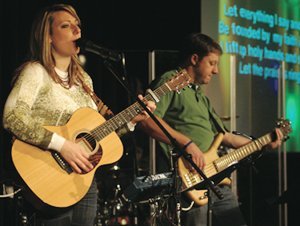
Megan Eastland and Jason Wright lead in worship at the airport-area campus of Pleasant Valley Baptist Church in Liberty, Mo.

“We wanted to create a network to help people reach their friends and relatives who would not drive out,” said Stephen Boster, minister of the airport-area campus.

“Our vision is to connect people with God and others … to unleash the transforming influence of Jesus in the Northland,” Boster said. “It was an opportunity for us to move into a missional mindset … to bring the church out into the community.”

Developed several years ago, the multisite church model still is being used today, especially in urban areas, according to Glenn Akins, Baptist General Association of Virginia associate executive director. Among his responsibilities is assisting with new worship communities, including multisites.

Churches begin a campus in another area for several reasons. Some target a specific geographical area to reach a particular people group or to serve members who live in that area. “Some churches have figured out that they can reach a certain people group well and reach those in other sections of their city,” Akins said.

Bon Air Baptist Church in Richmond, Va., where Akins is a member, has four campuses. Its Buford Road campus is the original church. The church de-veloped a recovery community that is recognized as a leading national model.

“It’s a testimony to the church at large to allow it to mature and grow and to be contextualized,” Akins said.

Bon Air started another site that targets people within a five-mile radius and who use the nearby bypass to get to their offices. Otherwise, most don’t like to drive out of their area. The group meets in a local high school and has become an “area” church, he said.

A fourth site grew out of a previous ministry to a mobile home park. A group of about 10 to 15 Hispanics met in a Sunday school room at the Buford Road site. The church decided to try to combine the two, which now meets in a storefront.

The site offers two worship services, one in Spanish and one in English, with two site pastors, one Hispanic and one Anglo.

Many churches choose to use the multisite approach, rather than the mission/new congregation model, for cost effectiveness and the “synergy of resources that the satellite has access to,” Akins said. And “it builds on a recognized brand.”

A multisite church shares resources—financial, management and personnel—“so each doesn’t have to reinvent the wheel,” Boster said. “We are networked for stewardship of resources, not only for money, curriculum and other resources, but also for ideas and best practices.”

But each site must contextualize resources to meet the needs of its individual congregation. Multisite churches utilize the senior pastor’s sermons on big screen either in delayed broadcast or on DVD. Each individual campus may have a site pastor to oversee administration and take care of pastoral responsibilities.

Although a mission or new congregation is formed to eventually become an independent church, most multisites are not.

“Most multisites remain together because of their shared DNA,” Akins explained. “They are so integrated, so woven together, there is no obvious way to cut them. … There is an intentional interdependency on subsets.”

Akins believes most sites would not wish to be independent because of the cohesion they share. “Why would a McDonald’s franchise want to be independent? Why would a branch want to be independent of Bank of America?” he asked.

While most sites reach a people group or geographic area, governance often is the last issue churches address. Akins pointed out that most business franchises are governed by a document that spells out financial arrangements and other relationships. Every contingency is addressed.

“I haven’t seen one for multisites yet,” Akins said. “There are pieces in place but no document.”

Churches such as Bon Air and Pleasant Valley keep God’s call and purpose in mind and work through issues as they arise.

Pleasant Valley’s airport-area campus is only 15 months old, but leaders believe it has affected both congregations in expanding ministry, growing new leaders, people responding to Christ and be-lievers deepening their relationship with God, Boster said.

“There is no doubt that it is a God-given opportunity for us,” he said.

Church leaders feel God is leading them to expand the concept. “Our goal is to have more churches in the communities. We have a vision for another, but we are bathing it in prayer first,” he added.

Multisite work can be “complex and messy,” Akins acknowledged. “But we’re far more concerned about reaching people and transforming lives.”


God’s provision encourages Howard Payne graduate

BROWNWOOD—Cara Brewer, recent Howard Payne University graduate, was thrilled recently to learn she will receive a full-tuition scholarship to Texas Tech University School of Law this fall. She gratefully acknowledges, however, this is not the first time she has experienced God’s provision for her education.

During her first year at Howard Payne, Brewer applied for a scholarship through the Hatton W. Sumners Foundation. When she learned she had received the $22,000 scholarship, she quickly went home to tell her parents.

She was surprised to learn the scholarship answered a prayer offered by her parents four years before.

Howard Payne University President Bill Ellis greets Cara Brewer during the university’s recent commencement ceremony.

Her father, Shawn Brewer, is pastor of First Baptist Church in Eastland and, when his daughter was a freshman in high school, their church entered into a large building program.

Brewer and his wife, Lauri, prayed fervently over the amount God would have them give toward the program. They felt God asking them to give the money they were planning to set aside for Cara’s education. Not knowing how God would provide, but trusting his sovereignty, the couple pledged their money.

When Cara Brewer came home as a college freshman and told her parents about the scholarship she had been awarded, they started crying and told her about the pledge they had made to God’s work.

The scholarship was the exact amount they had pledged to the building program at their church four years earlier.

“I was so in awe of our faithful God,” Brewer said. “We pray to God who is able to do infinitely more than we can ask or imagine. God used my parents’ faithfulness to help build a gym in Eastland. Through this gym and the basketball program that is held there, young men can learn about God and experience a father figure in their lives. All the while, God had a plan to provide for my education.”

Having seen God’s provision throughout her life, Cara looks with anticipation to what her future holds.

“God is big,” she said. “I can rest assured, knowing he is in control.”


Church transitions from roping events to skateboarding

WAXAHACHIE—It wasn’t too long ago that Brandon Jones was watching men gallop by on horseback with lassos twirling over their heads. Now, he watches as teenagers whir by on their skateboards, building up speed for their next trick.

{youtube}keeApO4VdA4{/youtube}

A year ago, he was minister of missions at Frontier Cowboy Church in Waxahachie. Now, Frontier is a lot less cowboy.

For Jones, it’s really not a big deal.

“Our mission is the Great Commission,” he said. “We feel like Christ told us to go and reach people and make disciples, and that’s what we’re trying to do here.”

Moving from roping events to a skate church targeting teenagers marks a significant transition—one that mirrors a transition taking place in the congregation overall.

The change has not occurred suddenly, Pastor Ken Ansell said, but rather gradually as the congregation has sought to follow God’s leading.

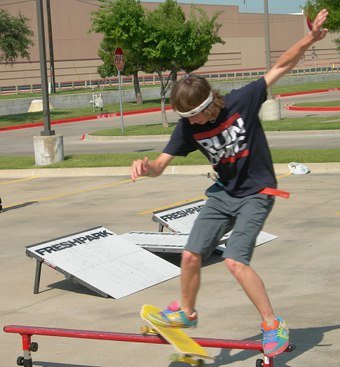
Frontier Church in Waxahachie is offering youth a "skateboard church" on the parking lot of a fast-food restaurant.

The church dropped “Cowboy” from its name and now just calls itself Frontier Church. The church has sold its building on the south side of town and has moved near downtown into a leased building.

The beginning of the changes “didn’t come out of any kind of burning bush experience,” Ansell said.

“The leadership didn’t hold any sort of meeting and plot a new course. It definitely came out of a desire to reach the greatest number of people,” he explained.

While many churches successfully have reached unchurched people who identify with the cowboy culture through rodeo-style events and worship geared toward western heritage, the approach did not work for Frontier Church as well as its leaders had hoped it would.

“The roping events and other things we were doing just weren’t being effective for us. Sure, they would come and rope, but that was it,” Ansell said.

The desire to reach more people started Ansell and the congregation looking for strategies to reach a residential area of Waxahachie that had about 2,500 homes and little church presence.

The church tried to start Bible studies in homes there, but after a while, they fizzled, Jones said.

As Jones and Ansell drove through the community looking for other ways to connect, they noticed a lot of children and teenagers skateboarding, and they decided to use that hobby to try to reach families.

At first, they set up ramps at the church.

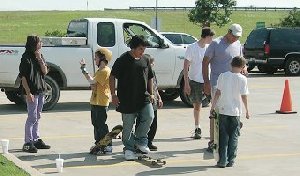
Teenagers gather in a fast-food restaurant parking lot to test their skateboarding skills. Frontier Church in Waxahachie—formerly a cowboy church—uses the approach to attract young people from a neighborhood with little church presence.

“But you could tell as the parents dropped their kids off that they never considered us as a place for them to go to church,” Ansell said.

Not long after that, Jones contacted the manager of a fast-food restaurant who agreed to let the ministry use a portion of its parking lot for a couple of hours each Monday afternoon.

While there have not been any professions of faith yet directly resulting from the “skate church” outreach, Jones has seen attitudes of many youth change over the last several months through the Bible studies that are a part of the afternoon of skating.

“A lot of these kids get to see how God is really relevant to them, and talk about him, and ask questions and get those questions answered,” he said.

While “Cowboy” isn’t part of the name anymore, Ansell said Frontier Church still has a bit of western flavor, just because of who he is and who the people are who attend.

“We’re trying to treat western heritage as definitely part of who we are but not the whole sum of who we are,” he explained.

While Ansell admits the transition sometimes is uncomfortable for many, including him, he feels good about where the church is headed.

“God is definitely leading us on this track,” he said.

Jones had no problem explaining why a church associated with western heritage might start a skate church: “If we limit ourselves to cowboys, we limit God and what he can do through us. There is a whole world of people who need to know Christ.”


Baptist Briefs

CBF moderator-elect nominated. Colleen Burroughs, vice president of the Passport youth-camping ministry, will be nominated as moderator-elect of the Cooperative Baptist Fellowship. If elected, she would lead the organization in 2011-2012, succeeding Christy McMillin-Goodwin, minister of education and missions at Oakland Baptist Church in Rock Hill, S.C. As current moderator-elect, McMillin-Goodwin automatically takes over as moderator at the close of this year’s CBF general assembly June 23-26 in Charlotte, N.C. Born in Africa to missionary parents, Burroughs grew up in Kenya, Malawi, Zimbabwe and Bophuthatswanan—now a part of South Africa. She and her husband, David, started Passport, a nonprofit ministry based in Birmingham, Ala., in 1993 while both were students at Southern Baptist Theological Seminary.

Mercer taps former Southwestern music professor. David Keith, a professor of church music at Southwestern Baptist Theological Seminary 27 years before retiring in 2006, has been named director of the Townsend-McAfee Institute for Graduate Studies in Church Music at Mercer University in Macon, Ga. Keith begins his new job Aug. 1. Keith holds both a master of music and doctor of musical arts degree from Southwestern Seminary. He has taught as an adjunct professor at Belmont University and worked as chorus director for the Fort Worth Symphony Orchestra. He began his teaching career at Howard Payne University in Brownwood.

Ethicist says spill caused by three deadly sins. A Baptist ethicist insists the catastrophic oil spill in the Gulf of Mexico is a moral issue. Robert Parham, executive director of the Baptist Center for Ethics, wrote a June 1 commentary at the Washington Post’s On Faith blog saying the ecological disaster contains elements of three of the seven objectionable vices described since early Christian times as the Seven Deadly Sins. “Traditional Christianity identifies greed, sloth and pride as three deadly sins—sins that manifest themselves in BP’s disaster,” Parham said. The oil company is “driven by corporate greed” and was prideful about its “technological infallibility,” and Americans in general are “driven by sloth or moral indifference,” he asserted.

WMU plans missions celebration. Woman’s Missionary Union will launch its 2010–2012 emphasis, “Unhindered,” during the national WMU missions celebration and annual meeting, June 13–14, at the Orange County Convention Center in Orlando, Fla. Guest speakers include several International Mission Board field representatives; Jennifer Kennedy Dean, author of this year’s WMU emphasis book, Life Unhindered: Five Keys to Walking in Freedom; Douglas Carver, chief of chaplains for the U.S. Army; and Frank Page, vice president for evangelism at the North American Mission Board and nominee for president of the SBC Executive Committee. Additional features include dialogue with missionaries, an interactive resource area and on-site bookstore, the launch of human exploitation as the focus of WMU’s Project HELP for 2010–2012 and opportunities to connect and network with missional leaders from around the country.


Texas Baptist-endorsed chaplains now number greater than 600

The Baptist General Convention of Texas has endorsed more than 600 chaplains, as of the most recent meeting of the endorsement council, said Bobby Smith, chaplaincy relations specialist.

“We are at present endorsing an average of 75 people per year. We are in our eighth year and have endorsed 610 people,” Smith said.

Texas Baptist-endorsed chaplains serve in eight areas—health care, military, restorative justice, business and industry, pastoral counsel, public safety, crisis response and biker ministry. Chaplains in these areas fill ministry needs a church pastor normally cannot, Smith said.

A hospital chaplain, for example, is trained in hospital protocol, etiquette and terminology. He or she knows and is known by the hospital staff and has access to areas of the hospital normally unavailable to non-hospital employees.  

“The chaplain has a better understanding of procedure and can get information for a patient’s family that the pastor wouldn’t be privileged to,” Smith said.

An organization’s chaplain develops relationships and builds trust that would be impossible or impractical for a church pastor to cultivate. Having that trust is necessary before “efficient and effective” pastoral ministry can happen, Smith said.

Naturally, specialized training is required for such an environment-specific ministry. Becoming a vocational chaplain requires years of education and experience, with board certification as the end goal, he explained.

The first step in becoming a certified chaplain is theological education—typically a master of divinity degree.

The next level of training is clinical pastoral education. The would-be chaplain spends one year—for a total of 1,600 hours—learning by doing in the field.

The third step towards certification is endorsement.

“Endorsement is important for a chaplain because it says, ‘This person’s not a lone ranger,’” Smith said. “It shows that they have a theological base for their ministry and do ministry from their faith group’s perspective.”

The final step is certification by a national certification board. A chaplain seeks certification from the board under which his or her ministry falls.

“Certification validates chaplains’ training and shows they are qualified for the job,” Smith said.

“The primary mission of my office is to help people discover their calling for chaplaincy and their responsibility to be pastoral caregivers. Secondly, we support these Christian caregivers in their calling and ministry. And number three is to help them develop those caregiving skills in continuing education settings.”


Musician ministers to teens struggling with cutting

NASHVILLE, Tenn.—As singer/songwriter Lanae’ Hale performs concerts around the country, she shares an intensely personal message with teenagers and young adults about how God helped her to overcome a battle with cutting and depression.

Hale was raised in a Christian home, accepted Christ at an early age and faithfully served in various ministries. Even so, she was afraid to tell anyone about the struggles and insecurities she felt during her teenage years.

{youtube}Vc3C33g-rcA{/youtube}

During her senior year of high school, the load became too much for her to bear when a relationship ended badly with a longtime boyfriend. She began cutting as a way to distract from the emotional pain, she recalled. 

“At the time, I had never heard the term ‘cutting,’” Hale said. “I knew that I had reached a point where I didn’t like who I was, and I was tired of living. I knew you could die if you cut your wrists, so I found a vein and started cutting. When you do that, your body can respond to the physical pain with a rush of endorphins that make you feel good for a while. That’s when the addiction started. It got worse as it went on, and the cuts got deeper. When I didn’t want to deal with emotions, I would just cut them away.”

During her college years, the destructive cycle grew worse as Hale began relying on sleep aids and alcohol to try to ease the effects of cutting herself with thumbtacks, broken glass and knives.

Lanae' Hale

A pivotal turning point came on a night when Hale was planning to commit suicide. As she looked at herself in the mirror while holding a bottle of pills, she realized the need for something greater to heal her brokenness.

“As I poured those pills into my hand, I began to sense that there was something deeper in my soul that wouldn’t let me take them,” Hale said. “I can look back at that moment now and know that it was God.”

After a three-year battle with cutting, Hale entered counseling and recommitted her life to Christ.

“As I was reading the Bible, I came across Psalm 147:3, ‘He heals the brokenhearted and binds up their wounds.’ Through a series of events, I began to see how God was revealing himself to me and calling me back to him. I realized how broken I was outside of Jesus. That was the defining moment when I finally fell on my face and offered the pieces of my life to God. For the first time in my life, I understood what grace was and realized that God spared my life for a reason.”

Now, as Hale writes songs and performs concerts, she shares her painful life experiences and struggles in hopes of connecting people to Christ—particularly young people who struggle with cutting and other addictions.

“A lot of times people are struggling with various issues, but you would never know it because they put up these walls to protect themselves,” Hale said. 

“On the inside, they are really crying out for help. I’ve heard from so many girls struggling with cutting who have come to my concerts and realized that if I can get through this, then they can too. I want to help people realize that Christ is mighty to save. He does offer hope and a way out of addictions.

“When I was struggling, I didn’t think there was hope, but I desperately wanted it. I really want to use the platform that I’ve been given to tell people that there is hope found in Christ, as well as love, grace and forgiveness. It’s something that so many people who are hurting are desperately needing to hear.”


Children’s home extends ministry from South Texas to Haiti

BEEVILLE—South Texas Children’s Home Ministries sent 100 boxes of food and provisions for children and families affected by the earthquake in Haiti.

The children’s home worked with Rudy de la Cruz, pastor of Quisqueyana Baptist Church in Santo Domingo and other partners in the Dominican Republic to deliver the supplies to churches in Haiti.

Rudy de la Cruz, pastor of Quisqueyana Baptist Church in Santo Domingo, delivers supplies from South Texas Children’s Home Ministries to Iglesia Tabernaculo de la Trinidad in Bouque, Haiti, for distribution to children and families affected by an earthquake.

As the Baptist workers traveled through the countryside, they were struck by the desperate situation of the Haitian people.

“It was the middle of the day, the time for preparing their main meal, but there was no smoke from charcoal fires—no smells of food in the air. Just hundreds of people walking, milling around, hopeless, hungry,” De la Cruz said. “They just stood around or moved slowly and aimlessly from place to place, and no one was working. None of the children seemed to be in school, but they didn’t laugh or play. They just stood, with sad eyes, and hunger stamped on their faces.”

The team planned to let Iglesia Tabernaculo de la Trinidad in Bouque, Haiti, quietly distribute food to families in its membership, but when the team arrived, more than 1,000 people had gathered as word had spread food supplies might be available.

To avoid a riot, the bus was parked a few inches from the church door, and the sealed boxes were passed through a window of the bus and taken directly into the church.

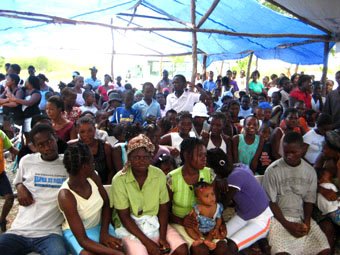
The church provided a safe haven for the supplies, in spite of the damage it sustained in January’s earthquake. Large cracks in the roof and walls have made it unsafe for worship, and the congregation now meets under tarps strung between tree-branch poles.

An earthquake left large cracks in the roof and walls of Iglesia Tabernaculo de la Trinidad in Bouque, Haiti, making the building unsafe for worship, but the congregation continues to gather for worship under tarps strung between tree-branch poles.

After all the boxes were unloaded, the pastor of the Haitian church led a brief worship service and spoke words of encouragement to the gathered crowd. As the crowd disbursed, the team left in the bus so that the pastor could quietly distribute the boxes of food to individual families.

“If the provisions of food from around the world would have been distributed through the churches in Haiti, the churches could have delivered the food to their congregations and communities. The bottleneck that is preventing hungry people from receiving the food could have possibly been alleviated. So much food continues to be stored in huge warehouses and crates, and is even rotting on piers, while so many go hungry,” De la Cruz said.

South Texas Children’s Home Ministries has been involved in international ministry and humanitarian aid for several years, with much of its work centering in the Santo Domingo area of the Dominican Republic.

“We pray that these provisions will be an encouragement to these Haitian Christians and their pastor,” said Joanna Berry, vice president of family counseling and international ministry. “We want them to know that God and his people have not forgotten them in their distressing situation.”


Minister discovers mission field in his own neighborhood

RICHARDSON—John Wills serves as executive pastor of The Heights Baptist Church in Richardson, and for the first time in his ministerial career, he works regular hours.

John Wills participated with several of his neighbors in the Warrior Dash, a 5K obstacle course race.

As the church’s chief operating officer, mentor to staff and pastoral confidant, he could work through the night and never get all his work done. But Wills goes home at the end of business so he not only can spend the evening with his wife, but also with his neighbors.

“The office work can wait until tomorrow,” he said. He sees his neighborhood as a mission field needing his attention. “It’s calling my name.”

Wills notes his attitude toward sharing his faith changed five years ago after he read Radical Reformission by Mark Driscoll.

“I’ve always felt like evangelism was our responsibility,” Wills said, but he never saw himself as the type who would share his faith every day. For years, he stayed so busy at church, ministry in the community had no place in his life.

But Wills became stirred—even “haunted,” in his words—by a statement by the Apostle Paul in 2 Corinthians 5:14: “The love of Christ compels us.”

Wills knew he needed to take action. For two years, Wills implemented relationship-style evangelism.

John Wills and his family offer a party on the patio for their neighbors.

“I already have a strike against me because I’m a preacher,” he noted. Neighbors still wondered how they should behave around him. And Wills recognized relational evangelism demands long-term investments of time and effort. But he also knew Jesus spent time with all kinds of people—devoting much of his attention to people who did not know God. And Wills wanted to follow Christ's example.

He began to view ministry in his neighborhood with intentionality. Neighbors learned that when his door was open, anyone was welcome to stop by unannounced. He and his wife, Kelly, host a “party on the patio’ each Friday. Families bring their children to play, while adults visit.

Wills interacts with neighbors from varied backgrounds. Some believe they have to work their way to heaven. Others are reluctant to give up old habits or lifestyles. He’s sat in on interventions for people struggling with unhealthy dependencies.

John Wills and some of his neighbors celebrate a birthday dinner.

As Wills builds relationships, he looks for the appropriate time to present the gospel. By showing love and spending time, he earns the right to talk about Jesus.

“I’m going to live the story, then I’m going to tell my story, then I’m going to tell his story,” he said.

Usually, he noted, the time comes when neighbors face either a crisis or an opportunity.

“You have to be sensitive to the things of God and walk through doors when he opens them,” he said.

Although Wills talks about relationship evangelism, he considers other styles relevant and useful. Regardless of style, Wills emphasizes, the gospel cannot be cheap. While talking about God’s love, Christians must talk about God’s justice.

“You have a choice. Either you die for your sins or Jesus does,” he said.

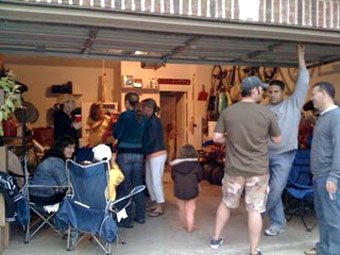
Neighbors hang out in the Wills family garage.

As Wills worked on his personal neighborhood ministry, he started to challenge members of The Heights to do the same. The church’s Engage ministry challenges members to do ministry within their circle of influence. Engage started by challenging families at The Heights to become involved in some kind of relationship-based ministry. The next phase asks people to move one of those relationships into conversations about Jesus, opening doors to share the gospel.

“Pockets of people have really embraced it. Other people are going ‘It’s nice for you but not for me,’” Wills acknowledged. While some remain under the impression that the staff gets paid to do the evangelism, some put forth effort but struggle for results, he added. Even so, church members have launched more than 30 neighborhood ministries in recent months.

Pastor Gary Singleton often challenges The Heights Baptist Church with a question: “If this church left, would anyone know we’re gone?”

Wills accepted the challenge to make sure in his neighborhood, his absence would be noted in the lives of people who need to draw closer to Christ.


Eric Davis is a member of The Heights Baptist Church in Richardson. He will graduate in December from Dallas Theological Seminary with masters’ degrees in Christian education and media/communication.