Around the State

The University of Mary Hardin-Baylor awarded its first doctoral degrees during spring commencement ceremonies. Six students earned doctoral degrees, 21 received master’s degrees and 281 earned baccalaureate degrees. Andy Davis, pastor of First Church in Belton, was awarded an honorary doctorate.

East Texas Baptist University presented degrees to 122 students during spring commencement ceremonies. Baptist General Convention of Texas Executive Director Randel Everett presented the charge to students.

Highland Terrace Church in Greenville held a note-shredding ceremony to mark the retirement of the $1 million loan that financed the construction of an atrium that expanded the worship center. The loan was retired in five years instead of the 10 years contracted. In the photo, Pastor Bobby Atkins and trustee Duane Fulton look on as trustee Jerry Bench does the honors.

Hardin-Simmons University awarded degrees to 291 students during spring commencement ceremonies. Forty-eight students received master’s degrees.

Howard Payne University conferred degrees on 148 students during spring commencement ceremonies, two of those receiving master’s degrees. Charles Johnson, interim pastor of First Church in Brownwood, delivered the charge to students.

Pat Crump, president of Baptist Memorials Ministries, has been named vice president of operations for Buckner Retirement Services. The move is part of an ongoing integration of the work and operations of the two retirement services ministries, which affiliated Jan. 1. He will retain his title and role with Baptist Memorials.

Caia McCullar, Dallas Baptist University professor of music and director of the music education department, has been named the school’s adviser of the year.

James Spivey, senior fellow and professor of church history at the B.H. Carroll Theological Institute, spoke at a May 15 military prayer breakfast at Dallas Baptist University sponsored by the Texas State Guard’s 4th and 19th Civil Affairs Regiments, the 3rd Battalion Maritime Regiment and the 4th Air Wing. Spivey is a retired brigadier general in the U.S. Army who served in the U.S. Armed Forces from 1972 to 2003 and was assistant chief of chaplains. Jerald Garner, minister of music at South Garland Baptist Church and a Baptist General Convention of Texas-endorsed chaplain serving in the Texas State Guard, planned the program, which included a choir and orchestra from South Garland Baptist Church and First United Methodist Church of Rowlett. Other Baptist chaplains participating included Billy Corn, David Fish, Doug Sewell, Don Vardeman and Rick Foster.

Baylor Regional Medical Center at Plano presented a $5,000 donation to the American Cancer Society to help underwrite the society’s Silver Dollar Ball.

Anniversaries

First Church in Kopperl, 135th, May 2. Brian Crain is pastor.

Alliance Church in Lubbock, 40th, May 9. Jessie Rincones is pastor.

View Church in Abilene, 100th, June 12-13. A come-and-go open house Saturday from 2 p.m. to 5 p.m. includes refreshments and tours of the campus. Larry McGraw, assistant dean of Logsdon Seminary and a former interim pastor of the church, will preach Sunday morning. Mark Tolar, a former music minister, will lead worship. Ron Shuffield is pastor.

Walnut Springs Church in Walnut Springs, 125th, June 26-27. A song service will be held at 6 p.m. Saturday. Former pastors have been invited to speak in the Sunday morning service that will be followed by a meal. Jason Sharp is pastor.

Marcus Lawhon, 15th, as pastor of House of Worship in Brenham.

Deaths

Ned Hicks, 68, April 12 in Crosbyton. Having been saved at age 9, he was pastor of his first church at age 12 in Albuquerque, N.M. After a worldwide preaching ministry, he founded Community Bible Chapel in Spur and was pastor there 18 years. He is survived by his brother, Joe Stan.

Ivey Miller, 88, May 6 in Tyler. After attending Decatur Baptist College and Baylor University on basketball scholarships, he attended Southwestern Seminary. Following graduation, he and his wife, Winnie, were appointed by the Foreign Mission Board to Chile, where they served eight years. Upon his return to the United States, he became pastor of First Church in Winnsboro, and then he served as district missionary in Hunt Association. In 1959, he moved to San Antonio to head the Mexican Baptist Children’s Home for 17 years. After retirement, he returned to East Texas, where he served several churches as pastor and was instrumental in starting Bullard Southern Baptist Church in Bullard. As his health declined, he ministered at local restaurants each morning with Bible quotes, his thought for the day or a song. He was preceded in death by his first wife in 1991, as well as his brother, Howard, and sister, Grace Kight. He is survived by his wife of 15 years, Louise; sons, David, Jim; daughters, Marsha Mitchell and Susan Cox; sister, Pauline; five grandchildren; and six great-grandchildren.

Ordained

Jerry Eddy, as a deacon at Greenwood Church in Saltillo.


‘Idaho 10’ member blames UNICEF for group’s arrest

TWIN FALLS, Idaho (ABP) — With the last of 10 Southern Baptist mission volunteers released from a Haitian jail May 17, one of her "Idaho 10" co-laborers is breaking his silence and blames the whole ordeal on meddling by the United Nation's Children Fund, more commonly known as UNICEF.

Paul Thompson, pastor of Eastside Baptist Church in Twin Falls, Idaho, told Baptist Press that things were going smoothly as the U.S. Baptists attempted to work out problems with documentation to allow the group to move 33 children from two earthquake-stricken areas near Port-au-Prince to a temporary orphanage in neighboring Dominican Republic until a group of workers wearing shirts with the UNICEF logo got involved.

Team leader Laura Silsby, finally was allowed to return to Idaho after being convicted of a lesser crime and sentenced to time already served.

Thompson said the widely broadcast video of the Haitian children crying and asking to return home was made right after a UNICEF representative told them in Creole the Baptists were kidnappers who wanted to sell the children into slavery or harvest their organs for the black market.

Thompson called the video "a complete setup" and said it was the beginning of building a case that eventually led to the group's arrest on charges of kidnapping and criminal association. Eight of the 10 were released Feb. 17. A ninth was set free March 8. The last one, team leader Laura Silsby, finally was allowed to return to Idaho after being convicted of a lesser crime and sentenced to time already served.

Silsby's church, Central Valley Baptist Church in Meridian, Idaho, released a statement praising God for her safe return and expressing concern for her welfare and for her family to get back to normal.

The church co-sponsored the "Haitian Orphan Rescue Mission" with New Life Children's Refuge, a ministry started by Silsby to rescue and care for impoverished Haitian and Dominican children, including "opportunities for adoption into a loving Christian family."

Ironically, backlash from the ill-fated mission effectively ended inter-country adoptions from Haiti. Taking advice from UNICEF, Haiti's welfare agency temporarily suspended new adoptions not already being processed, citing concern that vulnerable children could be snatched from the country and sold into slavery, prostitution or illicit adoption.

It also renewed a long-running debate in the complex issue of adoption in an impoverished country where children are often given up by destitute parents. An estimated 300,000 Haitian children have been turned over to more-affluent families who treat them as slaves known in Creole as "restaveks" — literally "stay with" — or to child smugglers who force them into prostitution.

Many are handed over voluntarily by living parents duped into believing they were giving their children an opportunity for a better life. In fact, under Haiti's adoption system a true orphan is less likely to find a home overseas than a child with at least one living parent. Regulations require orphanages to document the ancestry of children before offering them for adoption, a lengthy process much harder than getting living parents to supply needed documentation.

Even before the Jan. 12 earthquake, many children were being funneled out of Haiti through a maze of more than 200 largely unregulated private orphanages across the country. For that reason Marie de la Soudiere, coordinator for UNICEF's separated-children fund told Time magazine in February, "Our answer is 'no' to orphanages."

Diana Garland, dean of Baylor University's School of Social Work, said American society no longer removes children from their homes simply because they are impoverished, "because we know that children need to be raised in families."

"If we really love children, we need to help their families to develop the economic resources and stability to raise their children," Garland said.

Garland said in extreme cases where children are separated from parents, the next best thing is to place them with extended family members they know and love.

"When that fails we resort to foster care while we try to find a permanent family home for the children," she said. "Only in unusual circumstances and usually for short periods of time is an 'orphanage' the best choice for a child."

UNICEF's stated policy is that inter-country adoption in some cases may be the best solution, but the preference is for every child to have the right to know and be cared for by his or her own parents whenever possible. For those who cannot, UNICEF recommends finding an alternative family environment and views institutional care as a temporary measure of last resort.

Despite that, some conservative Christians accuse UNICEF of waging a behind-the-scenes war against adoption by lobbying for policies that reduce or close adoptions in some countries, increasing the amount of time that children are forced to live in orphanages or on the street.

"We have discovered and understand from visiting with people and communicating through reports that there is clearly a problem in Haiti with first-unit evangelical Christian orphanages and UNICEF and their abilities to work together," Thompson said in an interview with Boise television station KTVB.

KTVB received a statement from UNICEF saying Thompson's account is mistaken. "UNICEF played no role in the arrests of the Baptist group and UNICEF staff were not present at the arrests," the statement said. "UNICEF does not have the power to order arrests in Haiti or anywhere else." UNICEF said the workers probably were from a Haitian child-services organization, some of which wear UNICEF logos alongside their own.

The arrest of the 10 Southern Baptists came at a time when interest in international adoption is at an all-time high. That is particularly true in the Southern Baptist Convention, where a number of high-profile leaders have begun to promote adoption as a means to spreading the gospel.

This year's SBC Pastors' Conference just prior to the SBC annual meeting will include launch of a national campaign to raise money to help pastors pay for the cost of adopting a child.

"I have six children — three are biological and three are adopted," Pastors' Conference President Kevin Ezell told Baptist Press. "We just got home with a child from the Philippines six weeks ago, we have a little girl from China, and then we have a little girl from Ethiopia."

"We kind of look like the opening ceremony of the Olympics when we walk in," added Ezell, senior pastor of Highview Baptist Church in Louisville, Ky. "Adoption has changed my life personally. It brings missions home. I live with missions 24 hours a day, seven days a week, 365 days a year. We have had over 120 children in our church adopted and it has helped our church focus on missions so much more."

Conference speakers include Russell Moore, senior vice president for academic administration and dean of the School of Theology at Southern Baptist Theological Seminary. Last year Moore published a book titled Adopted for Life calling on Christians to adopt children as a "Great Commission priority."

UNICEF isn't alone in its view that children separated from parents by war or disaster should not be available for adoption until every effort is made to locate other living relatives.

Save the Children said wanting to help children from Haiti by evacuating them to foster and adoptive homes in other countries is "a natural instinct," but that "long experience tells us that it is almost always in the best interests of a child to remain with their relatives and extended family when possible."


–Bob Allen is senior writer for Associated Baptist Press.


For shy worshippers, church can be totally overwhelming

LOS ANGELES (RNS)—If Jesus were to take a Myers-Briggs personality test, would he rank as an introvert or an extrovert? He was, after all, popular with crowds, but he often retreated to pray in solitude.

As an undergrad, Daniel Perett wrestled with similar questions as a member of the evangelical InterVarsity Christian Fellowship at Middlebury College. He soon discovered his introverted personality clashed with the group’s prayer-and-share ethos.

“The expectation is if you really are having a spiritual experience, the first thing that you’re going to do is share it very publicly,” said Perett, 31, now a graduate student at the University of Notre Dame.

Pastor and author Adam McHugh is the author of the new book, Introverts in the Church. (RNS PHOTO/William Vasta/Claremont McKenna College)

In other words, “If the Holy Spirit were working in your life,” you’d be talking about it— “You would be an extrovert,” he said. But what Perett really needed most was time to process what was happening to him spiritually.

Perett insists evangelical Christianity—with a bigger-is-often-better strain deeply embedded in its DNA—is stacked against introverts like himself. And so, like other introverts, he began to develop coping methods rather than a deeper theology.

Perett started to speak in code. He sprinkled phrases like “God was testing,” rather than “God was absent,” in his testimonials so that his peers would not realize he was actually trying to determine how—if at all—God was present in his life.

“It forces you to put on a spiritual show for everyone else,” he said.

Perett is far from the only Christian whose introverted personality has caused religious obstacles. Writer and pastor Adam McHugh has taken note and recently released a book called Introverts in the Church.

“In my mind at the time, ideal pastors were gregarious, able to move through crowds effortlessly, able to quickly turn strangers into friends,” he writes in the introduction of the book published by InterVarsity Press.

But as an introvert himself, McHugh found the social demands of his job overwhelming, which led him to take a closer look at his specific personality type.

McHugh discovered that although introverts previously had been thought to be in the minority, more recent studies reveal introverts actually make up roughly half of the population. That doesn’t mean, however, that they’re always understood.

By definition, an introvert is someone who is energized by solitude rather than social interaction. An introvert might also love long intimate conversations; they aren’t necessarily shy, but they may very well dislike small talk. In short, introverts like to go deep, and they often like to do it alone.

As writer Jonathan Rauch described introversion for the Atlantic Monthly magazine in 2003, “introverts are people who find other people tiring.”

McHugh, for example, felt absolutely exhausted by all the retreats he was required to attend as an InterVarsity college minister in California. Canadian Jamie Arpin-Ricci says he has endured similar frustrations as a pastor.

Arpin-Ricci, a Mennonite pastor in Winnipeg, Manitoba, said most Christians expect a pastor to be available at all times, which gives introverts like him and McHugh little of the much-needed downtime.

Arpin-Ricci said it’s important not to fall into certain stereotypes—that introverts are antisocial, for example, or extroverts have plentiful but only shallow relationships. His church, the Little Flowers Community, is intentionally community-led, giving him the freedom to hand off certain responsibilities—especially when he feels a more extroverted personality may be better suited to the task.

Donna Katagi, director of spiritual formation at Cerritos (Calif.) Baptist Church, estimates her congregation is made up mostly of introverts who don’t fit neatly into the category of demonstrative Christians that many believe define a truly spiritual person.

Although Katagi says her church engages in typical activities like refreshments after worship, she also says she’s catered her spiritual formation program to meet the needs of her introverted congregation.

Outside of worship, Katagi says she’ll break up members into smaller rather than larger groups to better facilitate discussion.

For his part, McHugh says he has learned to incorporate solitude during the day, and says he remains confident that introverts can make good Christian leaders.

“I had to just figure out my own rhythm,” he said.


Faith Digest: U.S. Catholics vexed at Vatican

U.S. Catholics vexed at vatican. Nearly three-quarters of Catholics in the United States believe the Vatican tried to cover up clergy sex abuse, and a majority says Pope Benedict XVI has handled recent reports of past abuse poorly, according to a new poll, but less than 10 percent have considered leaving the Catholic Church over the issue. The Vatican has been besieged by criticism in recent months that top officials, including the future pope, mishandled cases of clergy sex abuse, allowing abusers to work in parishes with children, or stalling for years before defrocking serial molesters. More than half of U.S. Catholics—58 percent—say the Vatican did a “poor job,” of handing those reports, according to a New York Times/CBS News poll. Less than one in three gave the Vatican good marks on the scandal, and 74 percent said the Vatican tried to cover up the problem in the past. The poll was based on telephone interviews with 412 Catholics conducted April 28-May 2. The margin of error is plus or minus 5 percentage points.

Moral values in decline, most Americans insist. Three-quarters of Americans say the country’s moral values are worsening, blaming a decline in ethical standards, poor parenting, and dishonesty by government and business leaders, Gallup reports. The number of Americans who say the nation’s moral values are in decline grew by 5 percent since last year. Other reasons Americans mentioned were a rise in crime, a breakdown of the two-parent family and a moving away from religion or God. Only 14 percent of respondents believe the country’s moral values are getting better. The findings are based on May 3-6 telephone interviews with 1,029 adults, with a margin of error of plus or minus 4 percentage points.

New president tapped for Calvin Seminary. Church-planting expert Julius Med-enblik, 49, has been nominated to be the president of Calvin Theological Seminary in Grand Rapids, Mich. He is pastor of New Life Christian Reformed Church in New Lenox, Ill., which has grown from four members to more than 700. He also leads the church-planting efforts for the Christian Reformed Church. Medenblik will succeed Cornelius Plantinga Jr. at the end of the 2010-11 school year if the Christian Reformed Church Synod in June approves his appointment. Medenblik currently is chairman of the seminary’s board of trustees.

Lesbian bishop consecrated. The Episcopal Church has consecrated its first lesbian bishop. Episcopal leaders portrayed the consecration of Mary Douglas Glasspool, 56, as a suffragan bishop in Los Angeles as an affirmation of its aim to be “inclusive” regardless of sexual orientation. Archbishop of Canterbury Rowan Williams, spiritual leader of the Anglican Communion, last December called Glasspool’s election “regrettable” and warned it would affect the Episcopal Church’s role in the communion. But Williams did not comment after Glasspool’s consecration, and reaction from the rest of the Anglican Communion was relatively muted compared to the response after the first gay bishop, Gene Robinson of New Hampshire, was consecrated in 2003.


End of ‘Lost’ may prompt more questions than answers

WASHINGTON, D.C. (RNS) — Is it a show about a modern-day shipwreck, featuring misfit castaways trying to survive increasingly bizarre circumstances on an island somewhere in the Pacific Ocean? Or is Lost really a show about faith, redemption, evil, predestination, love, suffering, free will and human understanding of the supernatural?

Either way, when Lost ends its six-season run on Sunday, May 23, what will remain is the debate — especially on thousands of blogs — about the religious themes sprinkled throughout the hit series.

Lost characters

Because of its complicated plot lines and character development, Lost virtually precludes drop-in viewing, giving it a smaller but dedicated fan base of between about 10 and 15 million viewers per episode, according to Nielson ratings.

So, while those 290 million Americans who don't watch "Lost" each week likely care very little about the show's religious symbolism, inferences or foreshadowing, Losties, as they're often called, eat the stuff up.

"By the end of first season, we began to see Lost cultivate a thematic debate about two ways to view the world," said Jeff Jensen, senior writer for Entertainment Weekly whose "Totally Lost" blog is a Losties must-read.

The options? "Either purely naturalistic terms that only science can explain," he said, or "a supernaturalistic view of the world in which we live in a fundamentally spiritual universe that deals with what theologians and philosophers call the ultimate concerns of man — who are we, who made us?"   

In purely rational terms, "Lost" is about a group of people who survive a plane crash on a tropical island, and the struggle to survive and escape. The characters include a woman on the lam for killing her father, an alcoholic surgeon, a torturer, a drug-addicted rock star and a con man, among other tough people to love.

"They are deeply broken people, but you fall in love with them," said Chris Seay, pastor of Ecclesia church in Houston and author of The Gospel According to Lost. "… We want these people to be redeemed and changed for the better."

In the first season, much of the action revolved around flashbacks o the various characters' lives and set a foundation for how their behavior on the island could be redemptive. During that first season, as the writers teased viewers with hints of who was good and who was evil, many bloggers embraced the theory that the island was purgatory.

Each of the characters in the plane crash had died, the theory went, but the series would follow their attempts to escape purgatory by coming to terms with their lives, thereby purifying their souls as a way to gain entrance to the afterlife. That theory was debunked by the show's creators.

"They said the island wasn't purgatory, but it had elements of purgatory," said Tony Rossi, a radio host and producer for The Christophers, a nonprofit Catholic organization, who writes about faith and culture on his blog, "The Intersection."

Rossi said there are some definite Catholic allusions in the series, including one in which a character (Charlie, the drug-addicted rock star) sacrifices his life for the woman he loves and her child while making a sign of the cross as he drowns.

In a more recent episode, Rossi said, a character named Benjamin Linus, who had been set up as the series villain, confesses his sins to another character who was standing in for God, before being accepted by the rest of the characters.

"That looks very much like the Catholic sacrament of reconciliation in which a priest, standing in for God during someone's confession, allows the person to be reconciled to the rest of the community," Rossi said.

Sarah Pulliam Bailey, the online editor at Christianity Today and a Lost fan, said other theological ideas have been referenced by the show's writers. One, she said, is predestination, made famous by the 16th-century theologian John Calvin.

"Are these characters' paths laid out or do they get to choose their paths?" said Bailey. "That been a debate among theologians a long time."   

Jensen, who visited the set of the Lost finale, said the big-picture religious and philosophical themes are only likely to heighten as the series draws to an end. 

"It does seem that Lost believes that the world is fundamentally piritual, that we are not just stuff, we are not just animals," Jensen said. "But I think that it's also saying that no one explanation has ever gotten it right. And they're not about to declare who is correct."


Former SBC president nominated to lead Executive Committee

NASHVILLE, Tenn. (ABP) — Former Southern Baptist Convention President Frank Page is being nominated as president of the SBC Executive Committee, one of three key leadership positions in the nation's second-largest faith group in the process of being filled.

According to Baptist Press, Page, 57, is the unanimous recommendation of a seven-member search committee seeking a successor to Morris Chapman, who retires Sept. 30 after 18 years in the leadership post that oversees operations of the denomination and recommends and disburses its annual budget.

Frank Page

Page, a pastor for 30 years before becoming vice president of evangelization for the North American Mission Board in October 2009, will be presented for election at a meeting of the Executive Committee June 14 in Orlando, Fla., just prior to the SBC annual meeting June 15-16 at the Orange County Convention Center.

If elected, Page, chosen from 16 nominees and six finalists, could face tough choices if the convention approves recommendations of a Great Commission Task Force appointed last year by current convention President Johnny Hunt.

One proposal calls for increasing the Cooperative Program allocation for the International Mission Board from 50 percent to 51 percent while reducing the Executive Committee allocation by 1 percent.

The shift of $2 million would increase the IMB's budget by less than 1 percent, while reducing the Executive Committee's current $6.95 million budget by nearly 30 percent.

Chapman wrote recently expressing "grave concerns" that the report, which also recommends recognizing a new category of "Great Commission Giving" broader than the Cooperative Program, would devalue the unified funding mechanism in use since 1925.

Jerry Rankin, who retires in July after 17 years as president of the International Mission Board, welcomed the "token" step of breaking the "50 percent barrier" for funding of the IMB but said it doesn't go far enough.

Rankin said in a recent blog that he fears Southern Baptists will embrace the spirit of the Great Commission Task Force recommendations but continue trying to do everything the convention is currently doing.

"We must see what truly fulfilling the Great Commission entails," he wrote. "It means sacrificing a lot of what we are currently doing, including the traditional structure and programs with which we are familiar. Are we not willing to give it up and make some changes for the sake of a lost world for which Christ gave His life?"

Page, a member of the Great Commission Task Force bringing the recommendations, said May 18 he could not comment on the subject.

A third key leadership spot, president of the North American Mission Board, has been under interim leadership since Geoff Hammond resigned last August over leadership differences with the agency's board of trustees.

One of the Great Commission Task Force proposals is to "unleash" the North American Mission Board to take a lead role in church-planting and evangelism work now done in conjunction with Baptist state conventions through cooperative agreements. Several state convention executives have said doing away with the cooperative agreements would make it impossible for them to afford staff positions currently jointly funded with NAMB. Some have suggested the state conventions would simply reduce the percentage of Cooperative Program receipts they forward to national causes in order to keep those jobs funded.

Dwight McKissic, a prominent African-American pastor from Texas, said recently he believes one of the three leadership posts at the Executive Committee, IMB or NAMB ought to be filled by a minority to send a message that the SBC is serious about racial reconciliation. Like every current SBC agency head, Page is white. 

Page, SBC president from 2006 to 2008, was considered a dark-horse candidate when he defeated two denominational insiders on a first ballot at the 2006 convention in Greensboro, N.C. He introduced himself to media as an "irenic conservative" and "an inerrantist" who is "just not mad about it."

Observers viewed his election as signaling a desire for a more open leadership process and as a referendum of support for the Cooperative Program. Page's church at the time, First Baptist Church of Taylors, S.C., was a leading CP supporter in the South Carolina Baptist Convention, while his opponents were both pastors of mega-churches with a relatively low percentage of budgets going to the Cooperative Program.

It also marked the first time for a candidacy to gain word-of-mouth momentum in the months leading up to the annual convention largely through the use of Internet blogs.

Page told the Florida Baptist Witness he was humbled by the nomination and hoped he could help unify a Southern Baptist constituency fragmented by various controversies.

A native of North Carolina, Page is a graduate of Gardner-Webb College (now university) who earned the M.Div. at Southwestern Baptist Theological Seminary in 1976. He completed a Ph.D. at Southwestern in 1980 with a dissertation that advocated full inclusion of women in ministry, including ordination as pastors. 

Page claimed to have recanted those views, which he described in 2006 as "rather extreme" and the product of an "immature theologian," shortly after graduating and said he now supports the 2000 Baptist Faith and Message article that says, "While both men and women are gifted for service in the church, the office of pastor is limited to men as qualified by Scripture."


–Bob Allen is senior writer for Associated Baptist Press.


Final U.S. Baptist released from Haiti

PORT-AU-PRINCE, Haiti (ABP) — The last of 10 Americans detained while trying to take 33 children out of Haiti following the Jan. 12 earthquake was released May 17 after a judge found her guilty and sentenced her to time already served in jail.

Laura Silsby, an Idaho businesswoman who led a 10-member mission team from her Southern Baptist church to rescue children left homeless by the earthquake, was jailed Jan. 29 after trying to bring a busload of children into the Dominican Republic without proper paperwork. Silsby originally claimed the children were orphans who lost parents it the earthquake, but it later was revealed that all of the children had at least one living parent who handed them over to the Americans in hope of finding them a better life.

Haiti released eight of the 10 mission volunteers Feb. 17 and a ninth team member on March 8. Judge Bernard Saint-Vil dropped charges of kidnapping and criminal association against the 10 but ordered Silsby to stand trial on a reduced charge of arranging illegal travel.

The Associated Press quoted a Haitian prosecutor as saying Silby was convicted under a 1980 statute restricting movement out of Haiti signed by then-dictator Jean-Claude Duvalier and sentenced to the three months and eight days she had spent behind bars. The prosecution originally recommended a six-month sentence. Her maximum sentence could have been three years.

Silsby, 40, a member of Central Valley Baptist Church in Meridian, Idaho, was expected to fly out of Haiti on May 17.

Previous stories:

Southern Baptist jailed in Haiti to stand trial on reduced charge

Last Baptist held in Haiti faces new charge

Legal expert says remaining Baptist jailed in Haiti likely to be set free

Freed Baptists hope attention will now focus on Haiti's needs

Pastor stays out of division reported among jailed Americans in Haiti

Church seeks forgiveness for mission team detained in Haiti

SBC official says he believes detained missionaries acted in good faith

Baptist group arrested in Haiti denies trafficking charge


Grand jury hears evidence in church-arson cases

TYLER, Texas (ABP) — A grand jury began hearing testimony May 13 in the case of two men suspected of burning down 10 churches in East Texas in January and February, a television station in Tyler, Texas, reported.

Jason Bourque, 19, and Daniel McAllister, 21, were arrested Feb. 21 on a single charge of setting fire to Dover Baptist Church near Lindale, Texas, on Feb. 8. Television station KLTV reported May 13, however, that a grand jury could indict the two men on as many as 12 different arson and attempted-arson charges.

The station cited sources who said the grand jury could hand down four different indictments against McAllister: two arson charges on Feb. 8, the night that firefighters attempted to save both Dover Baptist Church and nearby Clear Spring Missionary Baptist Church, and two charges of attempted arson. Bourque could face a total of eight possible indictments for arson and attempted arson, including the fires on Feb. 8.

Authorities said from the beginning they believed the duo was responsible for nine other church fires in four East Texas communities between Jan. 1 and Feb. 8.

Police have not reported a motive. Their former pastor said the two boys were once active at First Baptist Church in Ben Wheeler, Texas, but drifted away after McAllister's mother died from a heart and attack and a stroke and Bourque's family moved to a different town.

–Bob Allen is senior writer for Associated Baptist Press.


Missouri convention wants control or assets of remaining litigants

JEFFERSON CITY — Regaining control is the heart of the Missouri Baptist Convention’s ongoing legal action against three formerly affiliated institutions. If control cannot be restored, then the convention would like its “stuff” returned, a Cole County judge learned May 11.

A hearing in Cole County Circuit Court on May 11 was the latest in ongoing legal action between the MBC and three formerly affiliated institutions. In 2000 and 2001, The Baptist Home, Missouri Baptist University, the Missouri Baptist Foundation, Word&Way and Windermere Baptist Conference Center changed their charters to self-elect their trustees. The MBC filed legal action against the five on Aug. 13, 2002, to force them to rescind those changes.

Windermere has won in Cole County and in a subsequent appeal. The MBC has voluntarily dismissed Word&Way from the case, and is moving forward against the remaining three in the Cole County action.

At the May 11 hearing, Judge Paul Wilson heard arguments concerning the convention’s claims and the relief it seeks. The MBC filed a declaratory judgment in 2002, amending it five times through September 2006. The MBC’s petition claims the institutions improperly amended their charters because they did not secure convention approval for those changes.

As its name suggests, a declaratory judgment asks the judge to determine each party’s rights and responsibilities.

However, Foundation attorney Laurence Tucker argued that a declaratory judgment could only be used when no other adequate legal means exists to solve the issue. Tucker argued the case could not be presented as a declaratory judgment since the convention also includes allegations of breach of contract — another legal means to conclude the case.

A declaratory judgment also does not include a remedy for loss. The convention seeks a remedy — rescinding of the corporate charter changes and any actions by the self-elected trustees. The MBC also seeks actual and punitive damages, including the return of some physical assets.

MBC attorney Charles Hatfield argued that seeking a declaratory judgment is the convention’s best option against The Home, the Foundation and MBU because each had given the MBC the right to approve charter changes.

“We want the ability to control these institutions we set up…,” Hatfield said. “No amount of money or no amount of property can secure that.”

In addition to the right to approve amendments, the MBC has a contract with the remaining defendants, which includes each corporate charter and the convention’s governing documents, Hatfield claimed.

Judge Wilson asked Hatfield what remedies the convention would seek, other than the right to control the agencies, if the MBC pursued the case as a breach of contract.

“We want to go back to the relationship we thought we would have…the right to appoint trustees and the stuff in the original articles,” Hatfield responded. “If we can’t get that, there are other claims…. Then we would want the stuff promised — the land, the money.”

The convention viewed Windermere as the “worst-case” legal scenario because its original charter declared the corporation would have no members and no MBC rights were stated. The Foundation was viewed as a “best-case” legal scenario because its old charter included language to allow the MBC to approve charter changes, Hatfield argued.

MBC attorneys argued that under a declaratory judgment, the convention would regain control of the agencies and their assets because the institutions’ actions would be rescinded.

If the court determines the case should be pursued as a breach of contract, the MBC should regain control of the institutions and their assets as restitution, Hatfield argued.

Either way, the MBC feels it has “a serious wrong” and is seeking the best legal remedy, the lawyer added.

TBH attorney Eric Walter pointed out that in a March 2008 ruling, former Cole County Circuit Judge Richard Callahan determined that a contract did not exist between the MBC and Windermere and that any covenant agreement that existed is not enforceable.

Judge Wilson indicated he would not issue any rulings yet. Instead, he will hear arguments on additional motions still active in the case.

Another hearing has been set for 9:30 a.m. June 9 at the Cole County Courthouse in Jefferson City.


Music minister adds to massive collection one hymnal at a time

LEWISVILLE—One of music minister Rob Veal’s latest additions to his hymnal collection arrived from an unexpected source.

A woman sent it to Veal with a note saying her father had clipped an article about Veal’s collection from the Aug. 24, 2001, edition of the United Methodist Reporter and placed it inside the hymnal with a note saying, “When I pass, send the hymn book to him.”

Veal's oldest hymnal is a tiny 1801 edition of Psalms Carefully Suited for Christian Worship, designed to fit easily into a woman’s purse. He also owns a battlefield hymnal from the Civil War.

Veal, associate pastor of worship at Northview Baptist Church in Lewisville, owns 1,434 hymnals and gospel songbooks—and he’s still looking for unique additions to his collection.

Veal started accumulating hymnals and bound collections of gospel songs soon after he began to lead church music at age 16. Some senior adults at church requested songs unfamiliar to him, and he set out hunting for the music.

“I started buying books because the church couldn’t afford them,” he recalled.

His interest in rare books was piqued when he discovered, on sale for $4 at a second-hand bookstore, a 1937 Stamps-Baxter paperback edition of Favorite Radio Songs from KRLD in Dallas, autographed by Virgil Stamps.

In the last 30 years, he has added significantly older and rarer books to his collection, the oldest being a tiny 1801 edition of Psalms Carefully Suited for Christian Worship, designed to fit easily into a woman’s purse. He also owns a battlefield hymnal from the Civil War.

In addition to The Broadman Hymnal from 1940 and copies of the 1926, 1956, 1975 and 1991 editions of The Baptist Hymnal, Veal’s collection also includes several editions of British Baptist hymnals published by the Psalms and Hymns Trust of London and a copy of the 1918 Primitive Baptist Hymn and Tune Book.

But even a casual glance at the collection reveals its eclectic and ecumenical nature—everything from an Amish hymnal in German to an 1846 Universalist hymnal from Boston.

Rob Veal, associate pastor of worship at Northview Baptist Church in Lewisville, owns 1,434 hymnals and gospel songbooks—and he’s still looking for unique additions to his collection. (PHOTOS/Ken Camp)

In addition to a wide variety of hymnals representing many denominations, Veal’s collection also includes many collections of gospel songs from the singing conventions that once were popular throughout the South.

Veal believes preserving the wide range of hymn and gospel song collections is important because the songs tell the story of what has moved the hearts of people over the last 200 years.

“We sing the things that we feel when we encounter God in different ways,” he said.

“History unfolds in the songs we sing.”

Veal continues to add to his collection, and he is willing to pay shipping costs for any unique donations. Contact him at BRobertVeal@aol.com.


Huntsville campus encounters the gospel through a pair of chairs

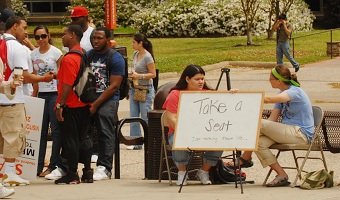
HUNTSVILLE—Each Tuesday during the fall and spring semesters, Lauren Sierra, campus missionary for the Sam Houston State University Baptist Student Ministry, walked to the center of campus where student activities were buzzing, taking with her two metal folding chairs and a white board that read, “Take a seat—questions about life.

As hundreds of students passed by on their way to class, Sierra sat for a few hours, leaving the second chair open for anyone who needed to sit and talk about life. Many students walked by, avoiding eye contact and heading to the other side of the walkway to avoid the chairs. But Sierra sat patiently, believing God would bring the people who needed to hear hope and need a friend to listen.

“One thing I like about the “Take a Seat” method is that they can come sit down if they want,” Sierra said. “I’m not forcing anyone to come sit down with me. One of the first things that I say is that: ‘At any point in this conversation, you are free to get up and go. You won’t offend me. I’m just here to learn about your life and share my life with you.’”

When students sat in the chair, Sierra began asking general questions about their major, what they think the purpose of life is or if they follow a religion, questions that help get a conversation started. Then she listened, looking for ways to share the hope of Christ with each student.

“I’ve had students tell me they are bent towards sin,” Sierra said. “I’ve had students tell me they have a nature of darkness in them. Good thing is that Jesus is the light, so I’m able to share the gospel with them.”

Lauren Sierra (right), campus missionary at the Sam Houston State University BSM, listens to a student who came to talk during the “Take a seat” outreach. (PHOTOS/Kaitlin Chapman/BGCT)

Sierra feels like this ministry and other BSM ministries are reaching the campus because they are fulfilling a need for community many students have. In the process, Sierra brought other BSM students with her to teach them how they, too, can offer a listening ear and a kind and truthful word to other students.

“When we talk about meeting needs, I think one of the biggest needs we need to meet on this campus is community,” Sierra said. “People need someone to talk to, and I’m trying to provide that for them and share the gospel while doing it.”

To continue offering community beyond the outreach effort, the BSM served as host to more than 18 small-group Bible studies around campus.

Chris Stanley, BSM director at Sam Houston State University, and the BSM staff discipled student leaders to guide the small groups of 10 students held on-campus in dorms and activity centers, making the groups open and available to other students.

Many of the small groups are considered seeker groups, where not all the students are Christians. Leaders are sensitive to this and lead discussions relevant to students who are seeking truth about Christ.

“The main goal is to make disciples because that is what we feel like we have been charged to do,” Stanley said. “Our small groups are really for our students to come together, get connected and get some spiritual grounding. Then for those who facilitate the groups, (we encourage them) to look for those in the groups who want to go deeper. Then they draw them aside and talk to them about what that would look like and entail and begin to meet with them weekly to do that very thing. Really, our ultimate goal is to make reproducible disciples.”

Through this process, several students professed faith in Christ.

For instance, freshman Shalyse Thomas became friends with fellow freshman Stacey Monks and invited her to attend a small group. She agreed, and arrived seeking someone to answer her questions about religion.

Monks, who considered herself agnostic, said she was at the point of frustration, not knowing what to believe about religion but had not tried to get her questions answered in the past. Monks said she had heard of Christ before, but had no idea about the relevance of the cross.

Sam Houston State University BSM campus missionary Lauren Sierra sits in the middle of campus encouraging a student. Last fall, Sierra was moved to start an on-campus outreach that would build community on students while sharing the gospel, so she started “Take a seat.” (PHOTOS/Kaitlin Chapman/BGCT)

Soon Thomas and Sierra were spending time weekly with Monks outside of small group, talking through her questions about faith and Christ. At one point when Sierra was sharing the gospel with her, Monks called her crazy for believing the Bible.

“She wanted a logical explanation of the Trinity, which I couldn’t give to her, and I said that it will have to be revealed by God. I do remember telling her: ‘Stacey, God loves you, and I think he is pursuing you. I think you want to believe in him, and I promise if you seek for God, you will find Christ because he is God.’ She looked at me and said, ‘Lauren, you are crazy.’”

Sierra and Thomas patiently continued to spend time with Monks and prayed God would open her eyes to truth.

“In October of last year, I really started to pray for Stacey. She was just really on my heart,” Thomas said. “Then in December, I invited her to small group. It took a month or two of her coming to small group and asking questions to start to see the love Jesus has for her and the love we had for each other here at the BSM.”

Eventually, Monks started reading the Bible on her own, continuing to search for answers to her questions.

“It was definitely a process,” Monks said. “It took me several months just for things to click. It even took me a couple of months to even start reading the Bible on my own. Eventually, I was readying Matthew, and it just clicked. This is truth.”

Monks walked into the BSM one day, and her countenance was different, Sierra said. She could tell Monks had accepted the love and salvation of Christ.

{youtube}m6IP5AtUI20{/youtube}

“I feel worthy now,” Monks said. “Before, there was just always something missing. Since I’ve found the love of Christ, it’s filled that gap. Before, I was depressed. I was lonely. I felt unworthy. Now that Christ is in my life, I have love. I have worthiness. I never feel alone.”

Monks now is being discipled by Thomas, and she is sharing her faith with others, helping them see that Christ also can change their lives.

As God has been transforming BSM students to live intentional, missional lives out of the overflow of their love for Jesus, Stanley said, God is using them to change and influence many lives with the hope of Christ.

“We have seen a life transformation throughout,” Stanley said. “Students who have been dealing with life issues for years and years have seen new life as Christ has broken them and brought about renewal in their life. Accountability and getting into the word has been part of that but also just that aspect of God working and transforming lives. … It has been amazing to see God at work.”


Religious leaders decry proposed Texas textbook standards

AUSTIN, Texas (ABP) — Two Baptist ministers joined about two dozen other religious leaders in a May 12 press conference at the Texas Capitol to decry school textbook standards they say would weaken instruction about religious liberty and the separation of church and state.

Roger Paynter

"Our Founding Fathers understood that the best way to protect religious liberty in America is to keep government out of matters of faith," said Roger Paynter, pastor of Austin's First Baptist Church. "But this state board appears hostile to teaching students about the importance of keeping religion and state separate, a principle long supported in my own Baptist tradition and in other faiths."

The event, one week before the State Board of Education begins final debate on proposed new social studies curriculum standards for Texas public schools, was sponsored by the Texas Faith Network, a coalition of more than 600 mainstream and progressive clergy and project of the Texas Freedom Network Education Fund.

In March board members voted 10-5 along party lines to amend textbook standards to correct what a bloc of social conservatives view as hostility toward Christianity and traditional values.

Proposed changes to the curriculum include downplaying the role of Thomas Jefferson among the founding fathers and requiring teachers to cover "Judeo-Christian" influences on the nation's founding.

Larry Bethune

A group of historians said many of the changes are historically inaccurate and that they would affect textbooks and classrooms far beyond the state's borders. Texas is one of the two largest textbook purchasers, giving publishers incentive to tailor their curriculum with that market in mind.

Republican board members defeated an amendment that would have required students to examine the reasons the founders "protected religious freedom in America by barring government from promoting or disfavoring any particular religion over all others."

Also speaking at the press conference was Larry Bethune, pastor of University Baptist Church in Austin. "We don't want to be the laughing stock of the nation and certainly don't want our children to be taught a very narrow religious agenda," Bethune told television station News 8 Austin.

"We think it's very important that Texas children understand religious liberty and its place as the First Amendment of our Constitution and Bill of Rights," Bethune said.


–Bob Allen is senior writer for Associated Baptist Press.