Baylor football team Bible study yields baptisms

Ten athletes on the Baylor Bears football team publicly expressed their faith commitments to Christ by being baptized in the university athletic facility’s hydrotherapy pool in early November.

Some recently accepted Jesus as Lord and Savior. Others made a past faith commitment to Christ but never had been baptized. Some had been baptized at an early age but wanted to be baptized as believers as a reaffirmation of their faith.

All of the newly baptized believers participate in a Tuesday evening player-led Bible study in the Baylor University football team meeting room.

“We meet at 6:30, share a meal together and then dive into the word [of God], splitting up into small groups,” said safety Michael Allen, one of the small-group leaders who baptized three of his teammates.

Sawyer Robertson, starting quarterback for the Baylor Bears and a small-group Bible study leader, baptizes a teammate. (Baylor Athletics Photo)

Other small-group Bible study leaders are starting quarterback Sawyer Robertson, wide receiver Josh Cameron, outside linebacker Kyler Jordan, safety Jacob Redding, defensive lineman Dylan Shaub, tight end Matthew Klopfenstein and quarterback Walker White.

In addition to the Tuesday evening meetings, some players—particularly new believers—also get together for regular one-to-one discipleship times with their small group leaders and participate in an online group chat, Allen added.

“I’m getting the chance to walk through Proverbs with two of the guys right now,” he said.

At least one-third of players involved in Bible study

Allen and former teammate Garrison Grimes, who later transferred to Brigham Young University, started the Bible study in spring 2024 with about a half-dozen other players.

The group now numbers 35 to 40 on a typical Tuesday evening—at least one-third of the players on the Baylor football team roster.

Landrie Walsh, director of football operations at Baylor, helps secure food for the weekly gatherings, Allen noted.

“One of the biggest ways to incentivize 300-pound linemen is to have food at the Bible study,” he quipped.

The small groups recently completed a character study of Joseph from the book of Genesis, focusing on themes of forgiveness, patience, perspective and leaving a legacy of faith.

While the Bible study is not sponsored by a specific congregation, several players worship together regularly at Harris Creek Baptist Church, and the congregation provided some curriculum initially, Allen noted.

Baptisms mark significant step

“We have baptisms offered at the end of every study every semester,” he said.

Ten athletes on the Baylor Bears football team publicly expressed their faith commitments to Christ by being baptized in the university athletic facility’s hydrotherapy pool in early November. (Baylor Athletics Photo)

Kevin Washington, associate athletics director for mission impact and enrichment at Baylor, presents a devotional about baptism the week before each scheduled baptism, explaining its significance, Allen said.

The 10 most-recent baptisms account for about half of all those performed since the Bible study launched.

Allen maintains contact with some of the players involved in the Bible study who have graduated and moved on to their careers. He specifically noted Treven Ma’ae, now a defensive tackle with the Las Vegas Raiders.

“He got baptized here, and it was kind of his first introduction to Christianity,” Allen said.  “I text him every once in a while, just to see how he’s doing. It’s cool to have relationships that are way beyond football. Those are the things that are going to last.”

Bible study creates connections

The ongoing weekly Bible studies have affected the culture of the Baylor Bears football team positively, Allen said.

“I can’t say enough about the small-group discussions,” he said, particularly for players who live in a culture “where everything is judged by how you perform on a football field.”

The Bible study offers players the opportunity “to dive into our faith and understand that whatever happened that past Saturday does not define us as individuals,” Allen said.

Without minimizing the importance of doing their best in competition, players gain perspective and learn football “isn’t the end-all and be-all,” he said.

“We understand that football is going to end at some point, and very soon for a lot of us. So, it’s who are we going to be—as Christ followers, as men, as husbands and fathers. An opportunity to talk about those things in a group that you’re really, really close with fosters a ton of connection among the team.”

Allen particularly noted a deeper personal and spiritual connection between Robertson and a member of his small group—tight end Michael Trigg.

“I’ve seen their relationship flourish and connect on a deeper level,” he said. “They dive into the word [of God] together every Tuesday evening, and then then go out there [on the gridiron] and have a connection on Saturday.”

Honest and vulnerable discussions

The honesty expressed in the small-group discussions has built trust and developed deeper bonds between teammates, he said.

“We’ve had a lot of guys open up in those small groups. It’s a pretty vulnerable space,” Allen said.

Players come from varied backgrounds, and many did not grow up in strong Christian homes, he noted. They freely discuss their upbringing, as well as “sin struggles” common to young men, he added.

“We’ve all had different walks to faith,” Allen said. “For some guys, this may be the first time they’ve heard a real explanation of the gospel.”

Players also “talk a lot about who we want to be—as men and as leaders,” he added.

Helped clarify calling

Allen, who completed his undergraduate degree in finance and is pursuing a Master of Business Administration degree, said taking a leadership role in the team Bible study has helped him find direction beyond school.
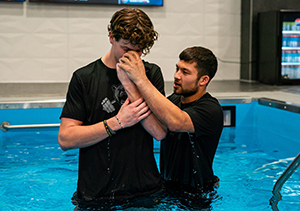
Michael Allen, who was instrumental in launching a Tuesday evening Bible study among players on the Baylor Bears football team, baptizes a teammate. (Baylor Athletics Photo)

“I’m probably not going to use my major, to be completely honest. I’m thinking about going into coaching,” he said. “I see an incredible opportunity for building relationships.

“This is a great ministry opportunity, having the ability to mold people, to see the best in somebody and challenge them to be the best they can be.”

In a sense, that’s what the player-led Bible study does—meeting student-athletes where they are in their faith journey and helping them grow spiritually, Allen said.

“Honestly, through this Bible study, I feel like it has helped clarify my calling to coach,” he said. “That’s what coaching is. It’s servant leadership.”



Judge blocks Ten Commandment classroom displays

A federal judge blocked 14 Texas school districts from displaying a state-prescribed version of the Ten Commandments in public school classrooms, citing constitutional concerns.

In a Nov. 18 action, U.S. District Judge Orlando Garcia granted a preliminary injunction to block the classroom displays in the Arlington, Azle, Comal, Conroe, Fort Worth, Flour Bluff, Frisco, Georgetown, Lovejoy, Mansfield, McAllen, McKinney, Northwest and Rockwall school districts.

With the latest court ruling, the Ten Commandments classroom displays—mandated by S.B. 10, a bill passed in the most recent Texas Legislature—are blocked in more than two-dozen school districts.

In August, U.S. District Court Judge Fred Biery issued a preliminary injunction in Rabbi Mara Nathan, et al, v. Alamo Heights Independent School District, et al, blocking classroom Ten Commandments displays in 11 school districts.

Violation of First Amendment rights asserted

In the case in which Garcia ruled, more than a dozen families of public-school children—Christian, Jewish, Baha’i, Hindu, atheist and agnostic—sought the preliminary injunction. They asserted the classroom displays would violate their rights under the First Amendment to the U.S. Constitution.

Plaintiffs in Cribbs Ringer v. Comal Independent School District asked the court to declare the state-mandated Ten Commandments classroom displays a violation of the Establishment Clause and Free Exercise Clause of the First Amendment.

 “The displays will pressure students, including the minor-child Plantiffs, into religious observance, veneration, and adoption of the state’s favored religious scripture,” the lawsuit stated.

“The displays will also send the harmful and religiously divisive message that students who do not subscribe to the Ten Commandments—or, more precisely, the specific version of the Ten Commandments that SB 10 requires—do not belong in their own school community, pressuring them to refrain from expressing any faith practices or beliefs that are not aligned with the state’s religious preferences.”

In ruling on behalf of the plaintiffs, Garcia cited Stone v. Graham, a 1980 case in which the U.S. Supreme Court said displaying the Ten Commandments on the wall of a public-school classroom, “in the absence of any legitimate educational purpose,” violates the Establishment Clause of the First Amendment.

Garcia agreed with the plaintiffs assertion that “displaying the Ten Commandments on the wall of a public-school classroom as set forth in S.B. 10 violates the Establishment Clause.”

“It plainly serves the public interest to protect First Amendment freedoms,” Garcia wrote.

Paxton sues noncompliant districts

Garcia issued his ruling the same day Texas Attorney General Ken Paxton announced he filed suit against the Round Rock and Leander school districts for refusing to comply with the mandated Ten Commandments displays.

“These rogue ISD officials and board members blatantly disregarded the will of Texas voters who expect the legal and moral heritage of our state to be displayed in accordance with the law,” said Attorney General Paxton.

“Round Rock ISD and Leander ISD chose to defy a clear statutory mandate, and this lawsuit makes clear that no district may ignore Texas law without consequence.”

Previously, Paxton sued the Galveston Independent School District after its board refused to display donated copies of the Ten Commandments in classrooms.

In August, Paxton issued an order to all school districts not enjoined by ongoing lawsuits to display the Ten Commandments in all classrooms.

‘Their goal is political chaos’

Charles Foster Johnson

Charles Foster Johnson, founding executive director of Pastors for Texas Children, expressed little surprise that two federal judges ruled in favor of blocking the state-mandated religious displays.

“Such establishment of religion violates our United States Constitution and God’s moral law,” Johnson said. “The legislature knew from the get-go that this statute would be contested, which is why the extremists filed the bill in the first place. Their goal is political chaos— not moral order or character.

“Texas public school teachers live out lessons of decency and integrity all day long every day for our children. They don’t need loud and loony rightwing legislators telling them how to act in front of our kids. Instead of bloviating about Ten Commandments on classroom walls, Texas legislators would do well simply to keep them.”

SB 10—signed into law by Gov. Greg Abbott on June 21—requires a donated poster or framed copy of the Ten Commandments at least 16 by 20 inches to be displayed in every Texas elementary and secondary school classroom.

The state-approved language of the Ten Commandments as stipulated in S.B. 10 is an abridged version of Exodus 20:2-17 from the King James Version of the Bible.

Parents who have objected to the classroom displays pointed out Jews, Catholics and Protestants number the commandments differently, and their wording varies.

So, they asserted, the required language favors the Protestant approach as the state-sanctioned version.


Muslim civil rights group sues Texas officials

(RNS)—The Council on American-Islamic Relations has sued Texas Gov. Greg Abbott and Attorney General Ken Paxton for labeling the Muslim civil rights group as a foreign terrorist organization.

On Nov. 18, Abbott filed a “proclamation designating the Muslim Brotherhood and CAIR as Foreign Terrorists and Transnational Criminal Organizations under the Texas Penal and Texas Property Codes.”

In doing so, Abbott asserted he could allow the state to shut down CAIR’s Texas chapters and ban them from purchasing land in the state.

The federal lawsuit filed Nov. 20 argues Abbott improperly used his office to target the domestic nonprofit without due process and in violation of federal law.

Attorneys representing the Texas chapters also allege Abbott’s designation is retaliatory, meant to silence CAIR after the group won three lawsuits against the governor in recent months.

“This attempt to punish the nation’s largest Muslim civil rights and advocacy organization simply because Governor Abbott disagrees with its views is not only contrary to the United States Constitution, but finds no support in any Texas law,” lawyers wrote in the suit filed in U.S. District Court for the Western District of Texas.

In recent years, several bills have been proposed in Congress to designate CAIR as a terrorist group, but none have passed. The U.S. State Department, under federal law, alone has the power to designate foreign terrorist organizations.

States do not have the authority to make such a designation at a federal level, and Abbott appears to be the first governor to attempt to do so at a state level.

“Governor Abbott decided to appropriate that power to himself to retaliate against CAIR,” said attorney Charlie Swift of the Muslim Legal Fund of America, one of the groups suing Abbott and Paxton.

Links to Hamas and Muslim Brotherhood alleged

In Abbott’s proclamation, he alleged CAIR had ties to Hamas, which is designated as a terrorist group by the State Department. CAIR denies any such connection.

“Despite all the conspiracy theories, CAIR has always been an American organization,” said Edward Mitchell, CAIR deputy director. “We’ve never been an offshoot, a partner, an agent, a pen pal of any foreign organizations.”

Abbott also claimed CAIR wanted to advance Sharia—Islamic religious law—in the country and called on local district attorneys to investigate alleged Sharia “courts” in Texas.

“The Muslim Brotherhood and CAIR have long made their goals clear: to forcibly impose Sharia law and establish Islam’s ‘mastership of the world,’” Abbott said in a press release.

Mitchell called Abbott’s allegation about Sharia courts “unhinged,” saying private arbitration courts are legally allowed to resolve civil cases.

“No one is trying to impose Islamic law on America,” Mitchell said. “This conspiracy theory is used by anti-Muslim extremists to whip up fear of Muslims, and in Governor Abbott’s case, he is whipping up this fear because he wants to silence Muslims because so many American Muslims have been critical of the Israeli government.”

Abbott’s designation amassed condemnation from elected officials. The Texas Democratic Party called on Abbott to reverse the designation.

In a joint statement signed by 28 Texas Democratic state representatives, state Rep. Salman Bhojani wrote that the governor’s action singles out Muslim Texans and treats them with suspicion.

“​​The governor’s action will only further fuel hostility toward Muslim families, business owners, and educators who strengthen our communities every day,” wrote Bhojani, one of the first Muslims to serve in the Texas Legislature.


Report spotlights persecution in ‘authoritarian triad’

WASHINGTON (BP)—Nicaragua, Cuba and Venezuela form a Latin American “authoritarian triad” where leaders exert religious persecution to maintain governmental control, the U.S. Commission on International Religious Freedom reported Nov. 18.

“In line with the authoritarian governance models of the three regimes, religious entities face persecution for any activity deemed to undermine state power and influence,” the commission wrote in an update on persecution there.

“In all three countries, the ruling party fully controls government functions and violates human rights to subdue opposition.”

Nicaragua and Cuba are the leading aggressors in the region, the commission report said, citing among many transgressions Nicaragua’s July arrest of evangelical Pastor Rudy Palacios Vargas and seven of his friends and family, one of whom died of unknown causes while in custody; and both nations’ weaponization of citizenship in stripping certain religious leaders of such status.

Citizenship revoked

Nicaragua has stripped at least 450 perceived opponents of citizenship since early 2023, the commission said. That includes people affiliated with the evangelical Mountain Gateway ministry based in Texas, several Catholic laypeople and others.

Cuba was inspired by Nicaragua, the commission report said, in passing the 2024 Citizenship Law that allows Cuba to revoke the citizenship of those who engage in acts “contrary to the political, economic, or social interest” of the nation.

In Venezuela, the commission reported governmental threats to religious leaders not deemed supportive of President Nicolas Maduro, whose latest election the international community widely considers fraudulent.

In January, hooded Venezuelan state security members captured Carlos José Correa Barros, a Christian journalist and director of the human rights group Espacio Público, and held him in a hidden location for a week before releasing him after a nine-day confinement, the commission update said.

The commission also noted Maduro’s launch of a refurbishment program called “My Well Equipped Church.” The report described it as “an aggressive strategy to secure evangelical support,” complete with cash stipends to 13,000 pastors.

The move copied Cuba’s mode of cultivating relationships with religious leaders willing to support the government, the commission report noted.

Surveillance, detention and control of messages

Broadly, the three nations persistently harass religious communities through surveillance, threats of imprisonment, arbitrary detentions and arrests, control of religious messages including sermons and public attacks.

The nations enact laws that unjustly restrict the activities and legal status of religious groups; practice favoritism in attempts to control messaging and deny religious freedom to prisoners.

The U.S. State Department in 2022 designated Cuba and Nicaragua Countries of Particular Concern for “engaging in or tolerating systematic, ongoing and egregious violations of religious freedom” under the International Religious Freedom Act of 1998.

The U.S. Commission on International Religious Freedom recommended U.S. governmental responses in its 2025 Annual Report, including sanctions of those culpable in violations.

The 2025 annual report does not address Venezuela, but violations there and in Nicaragua are so widespread many consider them crimes against humanity, the commission said in its update.


Obituary: Charles Horace Roberson

Charles Horace Roberson, Baptist minister and teacher, died Nov. 17 in Houston. He was 93. He was born Dec. 20, 1931, at home in Tenaha to Horace Greeley and Edith Grace Parker Roberson. Roberson graduated as valedictorian at age 16 from Tenaha High School in 1948. He earned a bachelor’s degree in math with a minor in German from Stephen F. Austin State College and later received a Master of Religious Education from Southwestern Baptist Theological Seminary in 1960. He first taught algebra and geometry in Gladewater and Tyler. In 1958, he left his work with Texaco Oil Company in New Orleans after sensing a call to ministry. Roberson began serving in youth ministry at First Baptist Church in Texarkana in 1961. He later was called to First Baptist Church in Lubbock, where he served first as youth director and then, beginning in 1967, as minister of education. In 1976, he joined the staff of Northwest Memorial Baptist Church in Houston—now Houston Northwest Church—as education director and business administrator. In 1981, University Baptist Church in Clear Lake called Roberson as minister of education and associate pastor. He served there until his retirement in 1996. Throughout his ministry, he was known for strengthening local church discipleship through the training of Sunday school leaders and volunteers, a work he considered central to his calling. In retirement, Roberson remained an active member of University Baptist Church until declining health limited his involvement. He was preceded in death by siblings Jack Roberson and Chuck Roberson. Survivors include his wife of 62 years, Vancelle Roberson; son Todd Lindsey Roberson and wife Jill of Georgetown; daughter Carrie Laine Hill and husband J.J. of League City; and five grandchildren.


Obituary: Jorge Sotomayor Contreras

Jorge Sotomayor Contreras, longtime pastor and ministry leader, died Nov. 2 in Harlingen. He was 65. He was born March 6, 1960, in Torreón, Coahuila, Mexico, to Ramón Sotomayor Wisner and María Elena Contreras. He graduated from the Antonio Narro Autonomous Agrarian University as a veterinarian before discerning a call to ministry. In 1995, he left his professional field to serve as a missionary with Adventures in Mission in Matamoros, Tamaulipas. In 1998, he became pastor of Los Vecinos Baptist Church in Harlingen, where he served the congregation and community for 26 years. His ministry included partnership with Summer Medical Institute of Philadelphia, collaboration with Valley Baptist Medical Center in Harlingen and preaching to thousands of young people detained by immigration authorities at the Valley Baptist Mission Center. He also participated in community initiatives with the Harlingen Police Department and was active in the Rio Grande Valley Baptist Association through prayer committees, youth work, pastors’ fellowship and men’s ministry. He served as a chaplain at Valley Baptist Medical Center. He is survived by his wife, Socorro Sotomayor; son Jorge Alberto Sotomayor and his wife Estefany; and six grandchildren.


Texas/Ukraine church partnership launched

Leaders from the Baptist General Convention of Texas and the Ukrainian Baptist Union signed an agreement Nov. 18 establishing church-to-church partnerships between Texas and Ukrainian Baptist churches. The event was hosted by Hardin-Simmons University in Abilene.

Event attendees heard from Nina Tarasovets, a Ukrainian Baptist and student at Hardin-Simmons; Texas Baptist pastors already involved in the partnership; and leaders of the Ukrainian Baptist Union.

Near the conclusion of the event, Ukrainian Baptist Union President Valerii Antoniuk and BGCT Executive Director Julio Guarneri signed a memorandum of understanding between their respective organizations.

The MOU establishes a pathway for pastor-to-pastor and church-to-church partnerships for the purpose of friendship, prayer and shared ministry focused on trauma healing, discipleship, worship and church planting.

Currently, 36 Texas Baptist churches have committed to the partnership. Organizers are looking for 14 more churches by Dec. 15 to round out the 50 churches they would like to pair with 50 churches in Ukraine.

Igor Bandura, vice president for international affairs with the Ukrainian Baptist Union, expressed his hope churches would join the partnership, pointing to Scripture.

“Ask and it will be given to you; seek and you will find; knock and the door will be opened to you,” he said, citing Matthew 7:7.

Also, “If you remain in me and my words remain in you, ask whatever you wish, and it will be done for you” (John 15:7).

Called to partnership

For Brent Gentzel, senior pastor of First Baptist Church in Kaufman, the call to shape a church-to-church partnership between Texas and Ukraine began in spring 2025. His church supported his call, he said.

As with himself, the call is “going to have to begin in you. The very nature of this partnership begins pastor to pastor, and then church to church, and then [out] from there,” Gentzel said.

“We come into this in the deep belief that the local church is the hope of the world,” he added.

God has given Ukrainian Baptists the ministry of suffering, forging strength and resilience in them, Gentzel said. “They’re allowing us into their suffering, and it is a ministry to us.”

Stories of suffering

Nina Tarasovets

“I’m really passionate about serving others,” Nina Tarasovets, HSU senior and student body president, said. Her father is a Baptist pastor in Ukraine, and her mother serves in women’s ministry. Nina serves in preschool ministry at Pioneer Drive Baptist Church in Abilene.

Born and raised in Ukraine, Nina came to Texas for high school in 2019. “My plan was to go home and continue my education there, but my senior year in high school was the year that the war in Ukraine started,” she said.

Unsure where to go, Nina started looking at different universities in Texas. After applying to several, HSU President Eric Bruntmyer called her, saying: “Nina, don’t worry. We’ll take care of you. Come here. You will be a Cowboy.”

In Ukraine, her parents and other Christians became “heavily involved in serving others.”

“Even in dark times, [God] showed so many different miracles about how people were getting saved,” Nina recalled.

“We don’t have all the answers, but we know that God has a plan for this, and he is using this war for something for his plan,” she said.

Pointing out February 2026 will mark four years of war: “People are exhausted. People are tired, but they’re continuing to work every single day,” and the church continues to serve, Nina said.

“Every summer I go home, and I serve on the kids’ ministry team, and I plan and help organize summer camps for those kids who have lost their parents,” she said. Many of those children tell stories of attending their mothers’ funerals, she added.

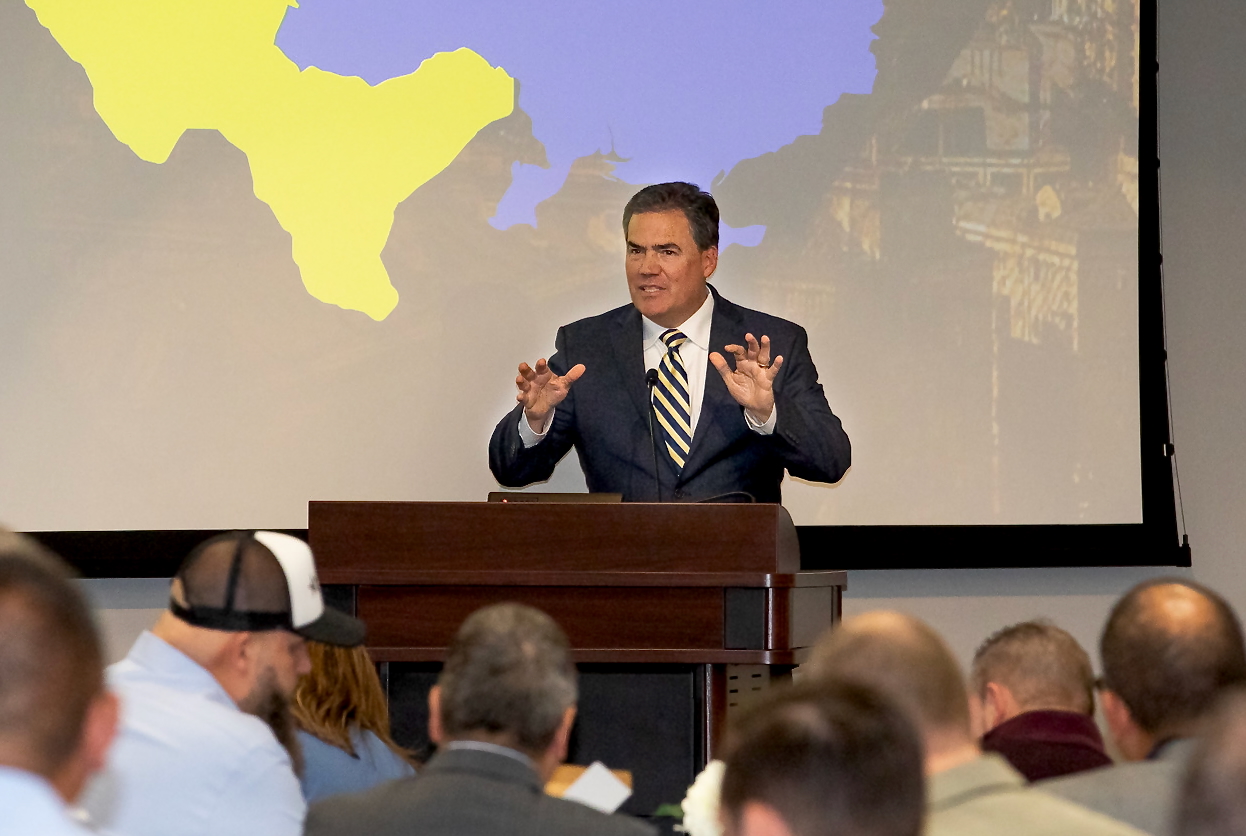
Valerii Antoniuk

“Paul said, ‘Whenever one part of the body hurts, the rest of it hurts,’” Valerii Antoniuk, president of the Ukrainian Baptist Union, said as Tarasovets translated.

“Well, part of the body is hurting, and the other part of the body comes to it. And it’s something that we feel today,” Antoniuk said, pointing to an image of Texas and Ukraine projected on the wall.

Since 2014, he has gone to the front lines many times, he said. “I see a lot of blood. I see a lot of pain.” And he cries a lot, he noted.

“We thank you that you are feeling our pain,” he said. “The closer we get to the coming of Jesus Christ, the more pain we’re going to experience on the Earth, and we will have to react to it,” he continued, holding up the church as the answer.

Characterizing the war, not as political or business, but as spiritual, “today, we are looking right at the devil’s mouth … and it’s not easy,” Antoniuk said.

“We are inviting you to a place that’s not safe,” he said. “And we really want you to be with us.”

Antoniuk reported 320 churches are under Russian occupation, 120 churches are closed, 650 pastors and ministers left Ukraine—along with “thousands and thousands of church members”—and more than 70 churches are destroyed.

Even so, God is blessing the Ukrainian church during the war, Antoniuk said.

“Over the past three years, we have baptized over 10,000 people. We got over 1,000 new deacons and pastors,” he said.

“It’s really weird for me to stay the night here, sleep and not hear the air sirens, missiles flying by. It’s not something that I’m used to anymore,” Antoniuk admitted.

“At night, whenever [my 6-year-old grandson] hears the explosions and missiles flying by and drones and everything exploding, he runs to [me] and says, ‘Let’s pray together,’ and we pray together at night, and our faith becomes stronger.”

Structure of the partnership

Organizers hope to have a prayer team ready in each partnership church by Jan. 1, 2026. The prayer team “is not just pastor-to-pastor, but it needs to be people-to-people,” Gentzel explained, suggesting groups of three-to-five people who will commit to pray with their Ukrainian partners through the duration of the partnership.

Brent Gentzel, senior pastor of First Baptist Church in Kaufman, explaining the vision and structure of a partnership between Texas and Ukrainian Baptist churches, Nov. 18. (HSU photo)

Additionally, Texas churches will be asked to provide some monthly financial support to their Ukrainian partners beginning in January. For safeguarding and accountability, funds will be sent to the BGCT, who in turn will send them to the Ukrainian Baptist Union to disperse to the respective churches.

Churches also are asked to give $10,000 per year for the next three years “to handle general expenses of infrastructure and curriculum and equipment,” among other needs, Gentzel said.

“This isn’t all about money, but the financial piece is going to matter in a time when things are difficult in Ukraine,” Gentzel said. “We don’t want money to keep anybody from doing this, but we are going to need resources to make this go.”

Ukrainian leaders also are seeking a deep connection between partner churches built on Bible study, sermons and devotionals. So, organizers also are working with the Baptist seminary in Odesa, Ukraine, “to write a [seven-week] Great Commission, Great Commandment spiritual growth campaign” to be rolled out in fall 2026.

“Bible studies [and devotionals] would be shared by Zoom between churches,” Gentzel explained, noting they are seeking devotional writers.

The goal is to develop strong relationships now between Texas and Ukrainian churches, so when the war ends, the churches will be able to mobilize quickly to meet the specific ministry needs created by the war. Church partners will contextualize their own mobilization strategies.

For example, some churches in Ukraine aren’t singing in worship because they don’t have anyone to lead them. Partner churches might be able to provide that leadership.

A further goal is to expand partnerships to other churches in Ukraine over time.

Baptists have “led so heroically” during the war “that the Ukrainian nation is aware that the Baptist church has been the spiritual backbone of the country through the battle,” Gentzel said.

“And their importance in the community, in that nation, has risen across these four years in a way” that is even recognized by Ukrainian President Volodymyr Zelenskyy, he added.

Importance of partnership

“Sometimes, I think that we think that evangelism is about some kind of recitation of a gospel presentation, that people have to pray this sinner’s prayer, and then it fixes everything,” Guarneri said.

“But I think the gospel that we have in Jesus is more than just words,” he continued. “The gospel of Jesus is incarnational. It’s about a God who came to our suffering. And when we live out that gospel, we have to be incarnational.”

Being incarnational means “going where the pain is and the hurt is and loving” people there, Guarneri said.

The partnership between Texas and Ukrainian Baptists is not paternalistic, but is “a two-way street,” he said.

“I believe this is a cause worth giving our churches to, and I believe strongly that to whom much is given, much is required. That’s why our church is all in. That’s why we’re ready to go. That’s why we’re figuring it out on the fly,” John Whitten, senior pastor of Pioneer Drive Baptist Church in Abilene, said.

To learn more about this partnership and how to be involved, visit https://www.healingpathmovement.com or email healingpath@fbckaufman.org.


Affordable, sustainable insurance for churches introduced

Texas Baptists leaders highlighted the launch of a new statewide insurance solution during a luncheon presentation of the Texas Baptists Indemnity Program—known as TBIP—and its partnership with KingsCover Insurance.

The event included detailed explanation of how the program aims to meet the growing insurance needs of churches.

The program was created to offer churches a more sustainable and affordable alternative amid rising premiums across the state, Craig Christina, associate executive director of the Baptist General Convention of Texas and president and board chair of TBIP, said.

“Our original vision was caring for BGCT churches in Texas and taking a few hundred the first year and adding more, but God had a much bigger plan,” Christina said.

KingsCover leaders John Uminski, senior vice president of KingsCover, and Michael Conover, head of underwriting, described the structure of the new partnership.

The program launched Nov. 1 and is backed by $12 million in available capital from the BGCT, along with national-level underwriting support through Amherst Specialty Insurance.

This allows the program to scale from its initial vision of serving a few hundred churches to potentially serving congregations nationwide.

KingsCover emphasized the program uses licensed agents who respond to inquiries, rather than earning commissions by soliciting churches.

To date, leaders have promoted the program through 30 to 40 associational meetings.

They also highlighted features such as automatically included pastoral library coverage and a managed-repair claims model designed to provide fast, hassle-free service.

Christina and Ward Hayes, Texas Baptists’ chief financial officer, encouraged churches to begin the application process early, noting quotes typically require declaration pages, loss runs and basic property information.

KingsCover representatives assured pastors both BGCT and Southern Baptists of Texas churches are eligible, and priority will be given to churches currently uninsured or nearing renewal deadlines.

TBIP leadership

The BGCT associate executive director is president and board chair of TBIP, and the BGCT chief financial officer is treasurer and secretary. Currently, this is Craig Christina and Ward Hayes, respectively. Sergio Ramos, Texas Baptists’ director of GC2 network, is vice president.

David Bowman, executive director of the Tarrant Baptist Association in Fort Worth, and Dennis Young, pastor of Missouri City Baptist Church, were elected as directors by the BGCT Executive Board.

Q&A regarding coverage

KingsCover is a full-service brokerage with the capability of providing full coverage for churches, Uminski said when answering a question about coverage options.

“Our first and foremost priority is protecting your church,” Uminski said. “We are concentrated on bringing you a property solution and a general liability solution. That being said, those other things—commercial auto, wind and storm insurance—we can handle that.”

One pastor asked how long a quote for an estimate was good for, and how soon would a church need to reach out to request a quote before their present coverage lapses.

“Ideally, we would like to get you in front of your policy 30 to 45 days in advance prior to renewal. It might take us 15 to 20 days to get all the information we need, and you provide [documentation]. Our quotes are good for 30 days,” Uminski said.

KingsCover representatives added that BGCT affiliated churches outside of Texas are also included in the coverage.

One ministry leader asked about their stand-alone liability versus stand-alone property. KingsCover will not write stand-alone liability, but only stand-alone property.

“We are going to individually underwrite every property, which not every carrier does,” Uminski said.

Churches interested in getting a quote can contact KingsCover Insurance at info@kingscover.com.


Texas Baptist affinity groups celebrate ministry and leadership

EDITOR’S NOTE: The following reports have been edited for inclusion in the Baptist Standard as a single report.

Culp Banquet honors pastor Kenneth Johnson

By Jessica King / Texas Baptists

Members of the African American Fellowship of Texas and others gathered Nov. 16 ahead of the 2025 Texas Baptists annual meeting for the Culp Legacy Sneaker Ball Banquet at the Abilene Convention Center.

The banquet was an occasion for worship, teaching and celebration honoring Kenneth Jackson, pastor of New Light Baptist Church in Lubbock and former African American Fellowship president.

“The kingdom of God is a kingdom of beauty and diversity, and Texas Baptists is richer because of our African American churches,” Julio Guarneri, Texas Baptists executive director, said, expressing his gratitude for African American Ministries and Jackson.

“It is interesting that Paul, at the close of his life, lists the names of people who do not make history, but they do make his story,” Delvin Atchison, senior pastor of Westside Baptist Church in Lewisville and African American Fellowship president, said, referencing 2 Timothy 4:21.

“Pastor Jackson, we’re here tonight, and we can honestly say, ‘We don’t know what history will say about you, but none of our stories would be complete without your story,’” Atchison said.

“We thank you all. Words are just inadequate to express our appreciation for all the kindness, the kind words and the opportunities [you’ve provided] for us,” Jackson said.

Full report available here.

Texas Baptists en Español rally to live out GC2

By Teresa Young / Texas Baptists

“The Great Commission has not been paused, postponed or rewritten. It still calls us to go, to love and to make disciples,” Sergio Ramos, Texas Baptists director of GC2 network, told those gathered at the Abilene Convention Center for the Texas Baptists en Español rally ahead of the 2025 BGCT annual meeting.

“What would it look like if every church, every pastor and every believer lived out the Great Commandment and the Great Commission together in this generation?” Ramos asked.

The need is clear, says Ramos, as many in Texas do not have a personal relationship with Jesus Christ. At the same time, he said, many churches are closing their doors due to low attendance. This great need should compel believers to step out and make an impact for the gospel, he urged.

“Brothers and sisters, the spiritual condition of our state cannot leave us indifferent. We cannot become accustomed to seeing empty sanctuaries and cold hearts,” Ramos said.

“That is why the need for a strong GC2 initiative is vital, because it seeks to serve, strengthen and walk alongside every affiliated church, regardless of size, language or cultural context, in order to fulfill God’s mandates.”

The movement is only sustained by the Holy Spirit’s empowerment and direction, Ramos pointed out.

“The world is changing fast, but the word of God is unchanging. The culture is noisy, but the voice of Jesus is still clear. And the mission remains the same: Love God, love people, make disciples,” Ramos said.

Pastor Robert Cuellar of Primera Iglesia Bautista in San Angelo and former Texas Baptists strategist, was recognized for 31 years of ministry service. Gus Reyes presented Cuellar with the Gary Cook Servant Leadership Award in recognition of his many years of ministry.

Full report available here.

Celebrating 25 years of cowboy churches

By Meredith Poe / Texas Baptists

Cowboy church pastors and ministers from across the state gathered Sunday evening for a rally to celebrate 25 years of the Cowboy Church Movement and kick off the 2025 Texas Baptists annual meeting.

“Thank you, Texas Baptists. Thank you for what you have done in praying for us, supporting us, teaching us, mentoring us,” said Wes Brown, pastor of Cowboy Church of Collin County, alongside a group of other cowboy church pastors.

“Eighteen years ago, we saddled up to start Cowboy Church of Collin County. What we desperately needed was a partner in our mission, and that turned out to be Texas Baptists,” Brown said.

“Their resources, guidance and spiritual encouragement were the foundation on which we built our ministry. They didn’t give us a boost—they equipped us to stand on our own two feet,” Brown continued.

“Too many Christians have conformed to this world, instead of being transformed by the power of God. … If there was ever a time that this world needed the cowboy church, it’s now,” Derek Rodgers, pastor of Cowboy Church of Corsicana, said.

“I grew up rodeoing when there was no such thing as cowboy churches. These pastors would show up around the rodeos when it wasn’t popular to preach … and I saw people would get radically saved by their messages,” Rodgers said, reflecting on the history of cowboy churches in Texas.

Full report available here.


Texas Baptists challenged to live out GC2

In keeping with the theme “Live out GC2,” speakers challenged attendees of the 2025 Baptist General Convention of Texas annual meeting to embody Old and New Testament Scripture as a way of life.

“We live in a world that is in desperate need of the gospel. The problem that we are addressing with GC2 Strong is lostness,” BGCT Executive Director Julio Guarneri said, regarding the emphasis on fulfilling Christ’s Great Commission and Great Commandment.

“It’s been almost 2,000 years since the Lord Jesus gave us the Great Commission, and we still haven’t finished the task.”

“One day, we will give an account to him [Jesus] of our lives and our ministries. I don’t think he’s going to ask us on that day what our average attendance was in worship. I don’t think he’s going to be asking us what the size of our budget was.

“I don’t think he’s going to be impressed by how many buildings we erected in his name,” he continued.

“But I have a pretty good feeling that he is going to ask us: ‘Did you love me with all your heart, with all your strength, and with all your mind? Did you love your neighbor as yourself? Did you take every opportunity to make disciples of all nations?’ I would like Texas Baptists to answer affirmative to all three of those questions on that day,” Guarneri concluded.

Based on an assessment of BGCT churches finding “about 75 percent … are either plateaued or declining when it comes to membership or worship attendance,” Guarneri called for a GC2 awakening.

Guarneri asked his hearers to imagine a future in which Texas Baptist churches are actively living out the Great Commandment and Great Commission.

“How about 2,030 churches praying for the lost on a regular basis … experiencing vibrancy and power in worship … loving God through obedience and surrender to his will … showing love for neighbors through intentional ministries [and making] disciples who make disciples?”

He continued imagining leaders strengthened, pastors growing, churches adopting missionaries, Bible translation projects, and Christian students involved in theological education in a leadership pipeline preparing them to serve in Texas Baptist churches, campus ministries, missions and Baptist institutions.

He also addressed the 20-year downward trend in Cooperative Program giving: “Can we also imagine perhaps in five years increasing our Cooperative Program giving by 20.3 percent? … We could add $5 million to do this kind of ministry.”

Along with GC2 Strong, Guarneri will build three different teams to address needs in the convention: a prayer advisory team, a constitution and bylaw task force, and a Cooperative Program giving study group.

A Psalm 1 person

A Psalm 1 person is a person who loves God, Dennis Wiles said. But, he asked, how would such a person be described? Wiles is senior pastor of First Baptist Church in Arlington.

Dennis Wiles, pastor of First Baptist Church in Arlington (Texas Baptists photo)

“You can recognize a person who loves God by how that person behaves … by what that person believes [and] by who that person becomes,” Wiles explained.

Such a person “refuses the advice of the wicked,” “refuses to stand in the way that sinners take” and “does not sit in the company of mockers,” even though we live among the wicked, sinners and mockers, he proclaimed.

Such a person goes straight to God’s word, meditates on God’s word and saturates in God’s word. “You give God the opportunity to speak to you, shape your mind, heal your heart, guide your path,” Wiles said.

“In our day, there are too many believers guided by their own inclination rather than God’s inspiration,” he added.

A Psalm 1 person is like a tree planted intentionally next to living water, “growing strong and vibrant, flourishing in every season, providing shade … and bearing fruit to the glory of God,” Wiles declared.

“We need to plant some trees in Texas. … I’m talking about some Psalm 1 trees,” Wiles said.

Doing, loving, walking

“Justice is not an idea we applaud but the way we live,” Rolando Aguirre declared, urging believers to make things right and to do justice, not only admire it. Aguirre is associate pastor of teaching and Spanish language ministries at Park Cities Baptist Church in Dallas.

Rolando Aguirre, associate pastor of teaching and Spanish language ministries at Park Cities Baptist Church in Dallas (Texas Baptists photo)

Preaching from Micah 6:8, Aguirre encouraged messengers to love their neighbors by living God’s justice.

“Ask yourself, ‘Where can I make wrong things right today?’” Aguirre said.

“Maybe in a conversation that needs truth? In a hospital room that needs prayer? In a kitchen that needs forgiveness? In a neighborhood that needs presence? Brothers and sisters, there is so much that God can do because there is so much that he can do through us,” he continued.

Likewise, mercy is to be a way of life, Aguirre asserted.

“To love mercy is not to do kindness now and then. It is to delight in covenant love. It is love that holds fast when everything else lets go. Mercy is how truth learns to hold a hand,” he said.

Like Jesus, humility should be practiced by daily walking with God in a rhythm of dependence, Aguirre said.

“The Lord Jesus is Micah 6:8 in flesh and blood. He makes wrong things right. He makes mercy his way, and he walks humbly with the Father. We are not saved by living Micah 6:8, we are freed to live it out,” he concluded.

‘Leading like Jesus’

To lead like Jesus, four things are necessary, Delvin Atchison proclaimed. Atchison is the senior pastor of Westside Baptist Church in Lewisville.

Delvin Atchison, senior pastor of Westside Baptist Church in Lewisville (Texas Baptists photo)

A person must have “the humility to serve,” “the vulnerability to suffer,” “the tenacity to stand” and “the certainty of success,” he declared, preaching from John 13:1-5.

“If we are too big to serve, we are too small to lead,” he said.

“God doesn’t give us the option of only serving the people we like. Love says, ‘I give you the option to hurt me,’” Atchison noted, referencing Jesus washing Judas’ feet while knowing his betrayal was at hand.

“Texas Baptists, the time has come for us to stand up” for what is right and eschew “little understanding” and “fickle convictions,” Atchison declared.

Atchison asserted leaders should have the tenacity to stand, noting it is always the nature of people with little understanding to have fickle convictions.

Humility to serve, vulnerability to suffer and tenacity to stand are possible because of a Christian’s certainty of success, Atchison said.

“You are not fighting for a victory. You are fighting from a place of victory,” he said. “We already know how it’s going to turn out. … When the dust settles, it will be all right.”

Pentecost again 2,000 years later

Pointing to the church at its birth as described in Acts 2, “We believe our mundane can become God’s miraculous. Our simple can become God’s supernatural. Our ordinary can become God’s extraordinary in God’s kingdom,” Elijah Brown proclaimed. Brown is general secretary of the Baptist World Alliance.

Elijah Brown, general secretary of the Baptist World Alliance (Texas Baptists photo)

He pointed to “a church without borders or boundaries that does not give in to the Babylons in this world, but [believes] that the word of God is powerful and alive, even when it is countercultural—such as BWA’s holding to a “biblical definition of marriage as a covenant union between one man and one woman for life,” Brown noted.

Brown recounted stories of Christianity’s exponential growth in Asia and Africa as he asked the Lord to do again today what he did 2,000 years ago at Pentecost.

He laid out five paths, based on Acts 2:41-47, calling for an “unprecedented, collaborative, global mission” to evangelize the world by 2033. The paths are witness, Bible, care, freedom and justice, and neighbor.

By 2033, the Acts 2 Movement’s goal is for Baptists to have:

• shared 450 million personal testimonies,
• engaged 1,159 Bible translations with prayer and support,
• performed 1 billion intentional acts of service,
• gathered 1 million signatures on the Covenant of Religious Freedom, and
• engaged 500,000 neighborhood lay chaplains.

“God, what you did in Acts 2, would you do it again for this 2,000th anniversary, and would you let it begin right here?” Brown prayed.


BGCT messengers praised for civil debate

Among other business, messengers to the 2025 BGCT annual meeting considered one of two motions to examine relationships between the BGCT and its partner education institutions. Discussion on the motion was praised for the civility of debate for and against it.

Praising civil debate

“I was very proud of what happened yesterday,” Ronny Marriott said in his final address as BGCT president, referring to discussion of motions to amend the 2026 BGCT budget. “That is a beautiful moment when we can have disagreements, but we can debate with civility,” he continued.

“I think we as Texas Baptists and Texas Baptist churches have an opportunity to show an unbelieving world how a diverse people can be unified,” Marriott said.

Acknowledging there is always disagreement wherever there is diversity, “Will our disagreement be more prominent than our cooperation?” Marriott asked.

Referring to Isaiah 1:18—“Come now, and let us reason together”—Marriott lamented the world having “lost the ability to debate and to reason with civility.” BGCT messengers demonstrated civil and reasonable debate “the last two days,” Marriott added.

Marriott was alluding to two motions made during miscellaneous business on Nov. 17, one of which was debated and decided prior to his closing address.

Calling Texas Baptists to see health and strength in their diversity, Marriott concluded with the challenge to “show the world the strength of unity amid diversity for the glory of God.”

Motions on institutional relations

The Committee on the Annual Meeting ruled out of order a motion made the previous day by Kody Alvarez, pastor and messenger from Oak Grove Baptist Church in China Spring, a church dually aligned with the Southern Baptists of Texas Convention.

Alvarez’s motion directed the BGCT’s Institutional Relations Committee “to examine all BGCT-affiliated educational institutions for alignment with the GC2 summary of faith” and to make “affirmation of the GC2 summary [as demonstrated by all religion and theology faculty signing it] a condition” for receiving BGCT funds.

The motion was determined to “circumvent the authority of the Executive Board” as provided by Art. 8, Sec. 1(C) of the BGCT constitution. Under this section, the recommendation to discontinue an affiliation or relationship must come from the Executive Board.

A motion by Mike Miller, pastor and messenger from Central Baptist Church in Jacksonville, was determined to be in order and was brought to the messengers for a vote. Miller’s motion called for an examination of Baylor University’s “endorsements of and partnerships and affiliations with any organizations that advocate or affirm the LGBTQ lifestyle and agenda.”

Support for the motion

Speaking in favor of his motion, Miller referred to Baylor officially chartering in April 2022 “an LGBTQ+ student organization” called Prism.

“According to Prism’s constitution,” Miller read, “‘The mission of Prism serves Baylor University and its students through creating a respectful space that embraces diverse sexual identities.”

Miller also referenced Baylor’s affiliation with Baptist Women in Ministry, including sponsoring the organization and its events.

Citing BWIM’s website, Miller said: “BWIM states that it is ‘committed to supporting and advocating for any individual who identifies as a woman,’ [and] they further state that they are ‘committed to celebrating and supporting LGBTQ+ women and open and affirming congregations.’”

Though Baylor has made official statements affirming the biblical understanding of sexuality, “Baylor has chosen to contradict its own Statement on Human Sexuality,” Miller asserted.

Baylor’s statement reads that deviations from the biblical norm of “purity in singleness and fidelity in marriage between a man and a woman … include both heterosexual sex outside of marriage and homosexual behavior.”

Baylor expects its “students will not participate in advocacy groups which promote understandings of sexuality that are contrary to biblical teaching,” Miller said, quoting the same statement. He contended Baylor gives “either tacit or explicit approval to such groups,” calling such approval “a betrayal of the trust” of Texas Baptists.

“Accountability is a good thing. Let’s take a look and make sure that our partner is staying true to who we are,” Miller concluded.

Kody Alvarez also spoke in favor of the motion to examine Baylor: “The goal of accountability is to maintain the relationship. … So, the goal for doing this … would be, Lord willing, to bring clarity and then, hopefully, see them draw back from that progressive push, because the thing about the progressive push, it’s always going to keep pushing.”

“Baylor is not, in fact, seen—regardless of their statements and written documents—to be living by what they claim. This is the perception, whether we like it or not, among a great number of Texans,” Matthew Jones, pastor and messenger from Reliance Baptist Church in Bryan, said as time for debate ran out, speaking in favor of the motion.

Opposition to the motion

Speaking against the motion, Ross Chandler, pastor and messenger from First Baptist Church in Marble Falls, asserted Miller’s motion has “the exact same spirit and motive” as the motion to defund Baptist World Alliance, which failed passage the previous day.

Passing Miller’s motion would result in messengers “going through all of this again next year” after a process leading “right back to this conclusion that Baylor represents Texas Baptist churches,” Chandler concluded.

“Baylor’s position on human sexuality is both biblical and traditional,” Howie Batson, pastor and messenger from First Baptist Church in Amarillo, said.

“Recent decisions by the Baylor administration have demonstrated a clear commitment to uphold biblical boundaries against same-gender sexuality,” Batson added, presumably referring to Baylor rescinding a grant from the Baugh Foundation to fund the study of the “disenfranchisement and exclusion of LGBTQIA+ individuals and women” in churches.

“Baylor seeks to provide a caring community for all students,” Batson continued. “I, for one, appreciate Baylor’s efforts to be true to traditional values, faith and practice,” he concluded.

Decision on the motion

After time ran out for debate, messengers voted on Miller’s motion. A raised-ballot vote was ruled too close to call. After messengers were instructed to stand and raise their ballots to vote for or against the motion, the chair ruled the majority voted against the motion.

Resolutions

Messengers approved a resolution expressing appreciation for the host city Abilene and a second resolution expressing appreciation for BGCT officers and staff.

A third resolution—“On the Pervasive Harm of Pornography in the Digital Age” and the first to address pornography since 1986—passed without discussion.

The resolution addresses the digitization of pornography, including AI, both of which have “fundamentally shifted the capacity and reach” of pornography. Digitization makes pornography more accessible and more easily marketed to and accessible by children and adolescents.

Calling pornography “predatory in nature,” a distorting of God’s design, a dehumanizing and objectifying of people, exploitative, and no respecter of persons, the resolution charges pornography with fueling lust and addiction, “contribut[ing] to relational strife,” and being “increasingly recognized as a public health crisis.”

The resolution laments pornography’s proliferation and “destructive effects.” It calls for Texas Baptists to “commit to leading out in opposing pornography [with] a repentant, biblical, compassionate, prophetic, pastoral, and redemptive response.”

Churches are encouraged “to advocate for state and local policies that meaningfully restrict the access of minors to pornographic websites and digital content, to support age-verification laws and accountability measures, and to collaborate responsibly with public officials, educators, and child-protection agencies for the welfare of children.”

“Pastors, parents, and congregations [are urged] to lovingly provide clear biblical teaching on human sexuality, to equip families with tools to navigate online safety, and to cultivate environments where sin can be confessed without fear of condemnation, in order that healing, repentance, accountability, and restoration may flourish.”

Finally, churches are encouraged “to extend Christlike love, support, and restoration to all who are struggling with pornography.”

The full text of the resolution is available here.

Other business

Bill Arnold was re-elected as secretary of the corporation, and Michael Evans Sr. was re-elected as registration secretary, both by unanimous consent.

As of start of business Nov. 18, 1,136 messengers and 806 guests were registered.

UPDATE: This article was updated Nov. 19 to include the number of registered messengers.


Around the State: Walmart CEO visits UMHB

The University of Mary Hardin-Baylor welcomed Doug McMillon, president and CEO of Walmart, as the featured speaker for the 2025 McLane Lecture early November in the Frank and Sue Mayborn Campus Center arena. McMillon began his career with Walmart in 1984 and rose to the ranks of CEO in 2014. He spoke to the crowd of UMHB students, faculty, staff and special guests about his faith and life in the retail industry.

Wayland Baptist University invites the community to gather on campus for its annual “Lighting Up Wayland” celebration, taking place immediately after Plainview’s community Christmas parade on Dec. 4. Festivities will start at 7:30 p.m. at Gates Hall Circle, located in front of historic Gates Hall on Quincy Street.

Dallas Baptist University is celebrating 60 years in Dallas. The campus came together for Founders’ Day, honoring that vision with a special convocation and community festivities. The celebration continued in Pilgrim Chapel’s Ford Foyer as the campus community came together to enjoy activities such as the International Pepsi Break, T-shirt printing, face painting, specialty DBU Coffeehouse drinks and a cake-cutting ceremony to celebrate the 10th anniversary of Jim and Sally Nation Hall.

Claire Wilkerson, an honors college scholar and theological studies major at Houston Christian University, was selected to participate in the John Jay Institute’s Fellows Program this coming spring. The John Jay Fellows Program is a flagship program centered around America’s founding and provides intellectual, spiritual and professional training for young Christian leaders. Wilkerson is completing her HCU degree through participating in the Scholarship & Christianity in Oxford program this fall, and after graduation will participate in the semester-long, Philadelphia-based cohort of 24 Christian student leaders from across the country.

Albert Reyes, president and CEO of Buckner International, represented Buckner at the White House in mid-November. The event included the signing of an Executive Order for Fostering the Future, an initiative led by the First Lady to provide resources and job opportunities for youth who age out of foster care.