Speaker Johnson defends ICE agents against clergy

WASHINGTON (RNS)—House Speaker Mike Johnson dismissed religious freedom concerns on Wednesday, Oct. 29, about clergy protesting mass deportations being shot with pepper rounds and pepper bullets by Department of Homeland Security agents, saying the agents have conducted themselves in a “measured” manner.

“Religious freedom does not extend and give you the right to get in the face of an ICE officer and assault them, if indeed that was what happened there,” said Johnson, a Southern Baptist, in response to a question from Religion News Service.

“What I’ve seen is a measured approach by the people who are trying to enforce our border laws, our immigration laws, and that was desperately needed and desired and demanded by the American people.”

In recent incidents at a U.S. Immigration and Customs Enforcement agency detention center in Broadview, Ill., and at a Coast Guard station in Oakland, Calif., ICE and Border Patrol personnel have been filmed shooting clergy with pepper balls, pepper rounds or rubber bullets, or faith leaders have reported agents doing so.

In a lawsuit filed in Illinois earlier this month against DHS, a group that includes journalists, clergy and demonstrators argue federal agents have violated the religious freedom of faith-based protesters, among other claims.

A federal judge quickly sided with the plaintiffs and issued a temporary restraining order on Oct. 9 limiting the agents’ ability to use violence against protesters, including “religious practitioners.”

David Black, the pastor of First Presbyterian Church in Chicago who was filmed being shot in the head with pepper balls, is a plaintiff in the suit.

The House speaker was asked about one of the incidents in a press conference earlier this month but claimed no knowledge of the incidents when first questioned about them on Wednesday, before outlining his understanding of the religious freedom issues involved.

He later added, referring to ICE agents: “Thank the Lord that there are people who are willing to do that difficult job or put on the badge and show that kind of courage. We should be on the side of law enforcement.”

The treatment of faith leaders at immigration protests has drawn attention this month after footage of DHS agents shooting Black with a pepper ball was widely shared on social media.

Another clip, filmed last week, shows Jorge Bautista, a United Church of Christ minister, being shot in the face with a pepper round by an agent in Oakland, Calif., who stood only a few feet away, leaving the minister’s face bloodied and covered in pepper dust.

Three other Christian clergy—two United Methodist pastors and another PCUSA—have told RNS they, too, have been shot with pepper balls and rubber bullets while demonstrating at the Broadview detention center.

Other faith leaders also have said they have encountered tear gas fired by agents to disperse demonstrators at that facility.

More than 250 Chicago-area clergy have signed a statement criticizing ICE’s actions in the city and pledging to put their “bodies on the line” to advocate for immigrants, citing their faith.

Cardinal Blase Cupich, the Catholic archbishop of Chicago, issued his own statement last week, declaring “the Church stands with migrants.”

Mainline Christian and Jewish clergy have been among the most vocal opponents of President Donald Trump’s mass deportation effort.

At a service at the Washington National Cathedral after Inauguration Day, the Episcopal bishop of Washington, the Rt. Rev. Mariann Budde, asked Trump in a sermon to “have mercy” on immigrants.

Since then, more than 55 religious organizations, including the leadership of several Christian and Jewish denominations, have filed lawsuits against the president’s administration, most of them challenging aspects of his immigration policies.


On the Move: Clark

Glenn Clark to Tri-County Baptist Association in Cisco as director of missions. He has served churches and ministries in Texas, including Texans on Mission and as pastor of Lakeside Baptist Church in Breckenridge.


Around the State: Film highlights religious freedom repression in Ukraine

(Used by permission)

A documentary highlighting faith, resistance and repression in occupied Ukraine titled No God but Theirs will be featured in a screening on Tuesday, Nov. 4, at First Baptist Church of Plano at 7 p.m. This investigative film gives voice to those who continue to worship in secret and documents how religious freedom has been crushed under occupation. Admission to the film screening is free.

Wayland Baptist University and South Plains College signed a memorandum of understanding creating a direct pathway for South Plains College students with an Associate of Applied Arts in Commercial Music degree to complete a Bachelor of Christian Ministry in Worship Studies degree at Wayland. The agreement allows students to transfer up to 60 credit hours from South Plains College toward the worship studies degree at Wayland. Those credits are applied as 15 hours of general education and 45 hours of music, streamlining the transfer process. Students then complete 64 additional credit hours at Wayland to meet the 124-hour graduation requirement. These include coursework in Bible, theology, ministry, worship methods and applied music. South Plains College students who pursue this pathway become eligible for scholarships, making the worship studies degree a financially accessible next step for graduates of the college’s commercial music program.

Lisa Medlin, assistant professor and chair of the criminal justice department at Howard Payne University, and Ciera Ray, assistant professor of social work and field director, took three Howard Payne students to the Christian Alliance for Orphans Summit 2025 in Houston earlier this month. Monica Prado, a criminal justice major, Jessenia Ureste, a psychology major, and Trinity Smith, an elementary education major, were able to choose from among 200 breakout sessions, including “Smart Phones and Human Flourishing,” “Helping Children Interpret Their History Through Simple Stories,” “Helping Without Hurting” and “Healing from Severe Adversity.”

High school juniors and seniors will have the opportunity to experience campus life firsthand when Wayland Baptist University hosts its Fall 2025 Pioneer Preview on Friday, Nov. 7, at the Plainview campus. The one-day event gives future Pioneers an inside look at academics, athletics, student life and the Christ-centered community at Wayland. The day begins with check-in at 9:30 a.m. in the Pete and Nelda Laney Student Activities Center, followed by a welcome message at 10 a.m. and a Wayland Scavenger Hunt that introduces students to key landmarks across campus. Parents will enjoy a parent and president mixer and tour featuring remarks from university leaders. A lunch session at noon allows students to choose from several breakout topics like faith in college, mental health, first-generation college experiences and student-athlete life.

Loyd Allen, retired professor of church history and spiritual formation at Mercer University, presented three lectures on spiritual formation during the inaugural James Shields Speaker Series at Howard Payne University on Oct. 21 and 22. During the two-day series, Allen detailed the evangelical response to Christian conversion and spiritual formation dating back to the 1500s, with a renewed emphasis that began in the 1960s among Baptists in the United States.

Dallas Baptist University is hosting its Nexus Ministry Leadership Conference on Monday, Feb. 2, 2026, at 8:15 a.m. The conference theme is “Leading from Rest: Caring for Your Soul while Serving.” Barry Jones, senior pastor of Irving Bible Church and author of Dwell: Life with God for the World, is the keynote speaker. Early bird registration is $8 per person, and regular registration will be $15 per person. Group discounts are available for ministries bringing five or more attendees.

The Gary Cook School of Leadership at DBU is inviting everyone to celebrate Reformation Day on Friday, Oct. 31 at 12 p.m. on Zoom. The online event will focus on Martin Luther and his impact on the church and western society after posting his 95 Theses.

Anniversary

First Baptist Church of Cedar Hill celebrated 175 years as a church. Josh Prince joined the ministry team in 2020 as lead pastor.


Americans skeptical about paranormal phenomena

Many homes in the United States may be decorated with images of ghosts and witches for Halloween, but most U.S. adults doubt they actually exist.

Surveys from Gallup and Pew find broad skepticism for psychics, ghosts, astrology and witches.

Ghosts and Gallup

No paranormal phenomena were believed by a majority of Americans, Gallup reports.

U.S. adults were most divided over the existence of some type of physical healing ability, either psychic, spiritual or the power of the human mind. Almost half (48 percent) say they believe in that, while 32 percent don’t believe and 19 percent aren’t sure.

In every other phenomenon, those who don’t believe outnumber those who do.

Almost 2 in 5 (39 percent) believe ghosts or spirits of dead people can come back in certain places and situations, but 42 percent disagree.

Around 3 in 10 (29 percent) accept telepathy or communication between minds without using the traditional five senses. Almost half (48 percent) don’t believe.

About a quarter of Americans accept other beliefs about the paranormal: communicating mentally with someone who has died (27 percent), clairvoyance or the power of the mind to know the past and predict the future (26 percent), astrology or the position of stars and planets can affect people’s lives (25 percent), reincarnation or the rebirth of the soul into a new body after death (24 percent), and witches (24 percent).

Gallup found two distinct groups among Americans—34 percent who generally are open to paranormal, believing in at least three and an average of five phenomena, and 66 percent who are generally skeptical, only believing in one on average.

People who infrequently attend religious services (40 percent) are more likely than weekly churchgoers (22 percent) to be among those open to the paranormal.

Those who attend religious services weekly or almost weekly (78 percent) are the most likely to be among the skeptical group.

Among general skeptics, psychic or spiritual healing has the highest levels of belief (33 percent), which may stem from more Christians and churchgoers being open to the possibility of miraculous healings. No other phenomenon draws acceptance from more than 13 percent of the skeptics.

Paranormal and Pew

Pew Research asked Americans specifically about astrology, tarot cards and fortune tellers. Few U.S. adults consult those. Even among those who do, most see it as entertainment and not legitimate insights.

More than a quarter of Americans (28 percent) consult astrology or a horoscope at least once a year, including 5 percent who do so at least weekly and 7 percent who do so once or twice a month.

Around 1 in 10 (11 percent) use tarot cards at least once a year, including 4 percent who do so at least monthly. Fewer (6 percent) speak with a fortune teller, including 2 percent who do so at least once a month.

Grouping them together, 30 percent of Americans consult at least one of the three at least once a year. Most of that group (17 percent of U.S. adults as a whole) do so once or twice a year, fewer seek them out once or twice a month (8 percent) or at least weekly (6 percent).

Overall, 70 percent of Americans say they do not consult any of them. Even those who use them at least occasionally are twice as likely to say they are doing so just for fun (20 percent) than for helpful insights (10 percent).

Fewer than 1 in 10 U.S. adults (7 percent) say they make major life decisions relying on what they learned from these practices, including 1 percent who do so a lot.

Two groups are outliers in their use of these practices. More than half of Americans who identify as LGBT (54 percent) consult them at least yearly, which is roughly twice the share among U.S. adults overall.

Additionally, around 2 in 5 women under 50 (43 percent) say they believe in astrology, compared to 27 percent of women 50 and older, 20 percent of men under 50 and 16 percent of men 50 and older.

Among religious demographics, around a third of those who are nothing in particular (36 percent), Hispanic Catholics (35 percent) and Black Protestants (34 percent) believe the position of the stars and planets can affect people’s lives.

Meanwhile, atheists (13 percent), Jewish Americans (18 percent), white evangelical Protestants (19 percent) and agnostics (20 percent) are the religious groups least likely to accept astrology.

A rejection of the paranormal brings together two religious groups often at odds. White evangelicals and atheists are the most likely to never consult a horoscope (83 percent and 83 percent), tarot cards (96 percent and 93 percent), or a fortune teller (99 percent and 98 percent).


New York man fired for insisting on Billy Graham Rule

(RNS)—Paul Ostapa, a Southern Baptist, was on the job in 2022 as a heating and air conditioning technician in upstate New York with a couple of colleagues when one of them left, leaving him alone with a female co-worker.

For years, he’d abided by the so-called Billy Graham Rule—vowing never to be alone with a woman who was not his wife.

Not wanting to make a fuss, Ostapa finished his work and left as soon as he could.

When it happened again, Ostapa complained to a dispatcher, saying his bosses previously had agreed to accommodate his beliefs after hiring a female technician.

That led to a report being filed with human resources by the dispatcher—and eventually to Ostapa being fired.

Now he’s suing, alleging his employer, the air-conditioning giant Trane U.S. Inc., violated his civil rights by failing to accommodate his religious beliefs and then fired him because of those beliefs.

Alleged violations of Title VII of the Civil Rights Act

Both the failure to accommodate and his firing, which Ostapa’s attorney described as retaliation, were violations of Title VII of the Civil Rights Act, the complaint alleges.

“There is a direct and causal connection between Paul’s sincerely held religious beliefs, his request for those religious beliefs to be accommodated, and Defendant’s adverse employment actions against Paul,” Ostapa’s lawyer wrote in a mid-October complaint filed in U.S. District Court for the Northern District of New York.

In an email, a spokesperson for Trane said the company was aware of the lawsuit but could not comment about ongoing litigation. According to the complaint, the company has claimed Ostapa was fired for insubordination, rather than religion.

The complaint alleges that for most of the 15 years he’d worked for Trane, he’d had mostly male colleagues as technicians. When he learned a female technician had been hired, he went to his boss, identified as a Mr. Audette in the complaint, and detailed his beliefs and asked for an accommodation.

Avoiding ‘the appearance of evil’

At first, according to the complaint, Mr. Audette allegedly laughed off Ostapa’s concerns, saying the new staffer was a lesbian, and so there would be no worries.

“Paul quickly retorted that his sincerely held religious beliefs based on Scripture must be obeyed irrespective of the woman’s looks or sexual preferences and that they were not contingent on the potential for sinful conduct,” the complaint alleges.

“As Scripture compels Paul to believe, his presence alone with a woman carries with it the appearance of evil from which he is to abstain.”

Kristina Heuser, an attorney for Liberty Counsel, a Christian legal group, said Ostapa worked mainly on commercial projects, rather than residential ones, and his beliefs never had caused a conflict with clients. Heuser said her client had made a verbal arrangement with his supervisor, but nothing had been put in writing.

She also alleged the company jumped the gun in firing Ostapa and should have taken time to learn more about his accommodation request, a claim also made in the complaint.

“They didn’t even engage in the interactive process that they were required to,” Heuer said in a phone interview. “They just said: ‘We don’t want to hear it. We’re not discussing that. And you’re fired.’”

‘Provide reasonable accommodations’

 The Civil Rights Act requires employers to provide reasonable accommodations, but not if doing so creates an undue hardship.

Most legal disputes over religious accommodations, such as the case of a postal worker who objected to working on Sundays for religious reasons, hinge on determining the line between a reasonable accommodation and a hardship. In 2023, the Supreme Court ruled in the postal worker’s favor.

According to the complaint, Ostapa came to the United States from Ukraine in 2001, in part because of concerns about religious liberty.

“His family were devout Christians and fled their home country in pursuit of religious freedom, which they thought they would find here in the United States,” according to the complaint.

The complaint alleges when Ostapa first heard his company had hired a female technician, he went to his supervisor to ask for an accommodation, which initially was granted.

“Paul was one of sixteen technicians in his unit, and the location where he worked employed approximately 25-30 technicians, so assigning another technician to work with the new female technician in his place would not have caused Defendant undue hardship,” according to the complaint.

Seeking to avoid scandal

Named for the famed evangelist who died in 2018, the Billy Graham Rule was part of a code of ethics called the “Modesto Manifesto” designed to avoid scandal. Other rules included being transparent and meticulous when handling money, avoiding criticism of other pastors and refusing to inflate crowd sizes or other details about his ministry.

Though common in evangelical circles and beyond—former Vice President Mike Pence is an adherent—the Billy Graham Rule rarely has been tested in the courts.

In 2019, a sheriff’s deputy in North Carolina sued after being fired for refusing on religious grounds to ride alone with a female colleague, but that suit eventually was settled before going to trial.

In 2013, the Iowa Supreme Court ruled a male dentist had not violated discrimination laws when he fired a female assistant at the urging of his wife. The dentist and his assistant had been texting, which his wife saw as a threat to their marriage, according to the ruling.

As part of their ruling, the Iowa justices said the friendship between the two—and not the gender of the hygienist—was at issue. They also noted the dentist may have treated his assistant badly by firing her, but had not discriminated.

A 2017 poll, taken in the aftermath of a controversy over Pence’s adherence to the Billy Graham Rule, found a quarter of Americans said it was inappropriate to have a work meeting alone with someone of the opposite sex, with more frowning on having meals or drinks together.

The complaint cites the example of Pence and the biblical story of Joseph and Potiphar’s wife, as well as one of the letters of Paul, in detailing Ostapa’s religious belief.

Before filing suit, Ostapa had filed a complaint with the Equal Employment Opportunity Commission, which ended its investigation without ruling on the merits of Ostapa’s claim.

The EEOC did issue Ostapa a right-to-sue letter. Heuser said the delay between Ostapa’s firing and the lawsuit was due to delays in the EEOC process.


Study examines ‘Belonging Under the Bridge’

A yearlong study of Waco’s Church Under the Bridge reveals lessons about how to create a welcoming community where people who never felt accepted in church can find a place where they belong.

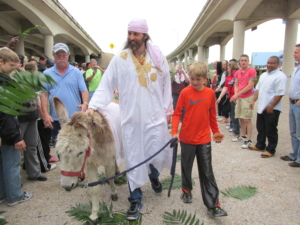
Worshippers from all walks of life participate in a Palm Sunday service at Church Under the Bridge in Waco. (Photo courtesy of Jimmy Dorrell)

When Melody Escobar arrived at Baylor University, she asked a colleague where individuals in Waco with mental, physical or developmental disabilities liked to worship.

Her co-worker pointed her to the congregation that has met regularly for three decades beneath the Interstate 35 overpass at South Fourth St.

After she attended the 2024 Palm Sunday service at Church Under the Bridge and became acquainted with Pastor Jimmy Dorrell, she realized “something really special was going on at the Church Under the Bridge” that deserved serious examination.

Escobar, associate research scientist at the Baylor Collaborative on Faith and Disability, and research assistant Caroline Reed conducted the “Belonging Under the Bridge” study, funded by the Calvin Institute of Christian Worship.

Worshipping community ‘united in diversity’

“For me, the key dimension that emerged in the study was how they are so united in diversity,” Escobar said.

The unhoused, the economically impoverished and people with a variety of disabilities find a sense of belonging at Waco’s Church Under the Bridge. (Photo courtesy of Jimmy Dorrell)

Of the 33 individuals interviewed by researchers, more than 20 percent are unhoused. More than half—55 percent—reported a disability, and more than one-fourth reported a history of substance abuse disorders.

Many members live in extreme poverty and some previously have been incarcerated. However, Church Under the Bridge also counts among its members Baylor students, teachers, medical professionals, ministers and nonprofit workers.

“People spoke of discovering a sanctuary under the bridge—this place where diversity isn’t an obstacle but a driving force of the community,” Escobar said. “And so, there’s this palpable and powerful sense of belonging.”

Worshippers reported an “immediate felt sense that each person is indispensable to their life together,” she said.

“They described a powerful sense of belonging fostered by the embodied presence and celebration of diverse backgrounds, identities and spiritual gifts,” a summary report of the study states.

“United in diversity reflects the church’s theological commitment to honor each person’s inherent dignity and to actualize the compassionate discipleship Jesus prescribes in Matthew 25—frequently referenced by the senior pastor and members alike as a guiding ethos for ministry—encountering Christ in all people.”

Church Under the Bridge’s open-air setting—“worshipping without walls”—contributes to fostering an environment where everyone is welcome, and worshippers encounter God outside conventional spaces, she noted.

Engaged in using spiritual gifts

Dorrell’s approachable “relationship-first style of leadership” creates an atmosphere of genuine acceptance and a sense everyone is “seen and valued,” she said.

“I witnessed him every Sunday welcome people warmly, ask them their name and stop to hear their story,” Escobar said.

Worshippers at Waco’s Church Under the Bridge join hands. (Photo courtesy of Jimmy Dorrell)

Individuals interviewed said they not only felt welcomed to worship, but also to serve and engage meaningfully in the life of the faith community, she reported.

“The spirit of welcome naturally flowed into the church’s commitment to the sense of ministry by all,” Escobar said.

“Everyone is seen as having a gift to contribute. They devote a lot of time to holding sessions on spiritual gifts, nurturing those gifts and getting people connected to meaningful roles.

“The conviction that every person is needed for this ministry is a conviction that shapes all aspects of their life together.”

The study revealed worshippers not only received acceptance and friendship at Church Under the Bridge, but found “family” there through small-group gatherings and shared meals, she said.

Found family, experienced transformation

Members told interviewers “they felt cared for,” were missed when they were absent, and discovered “a sense of stability that many had not experienced before,” Escobar said.

Worshippers at Church Under the Bridge report personal transformation and spiritual rebirth, as symbolized in baptism. (Photo courtesy of Jimmy Dorrell)

“Belonging reflects something biblical—an understanding of community and mutual care,” Escobar said. “Belonging is a desire placed in our heart by God. It’s a reflection of our need for relationship.

“When we turn away from that life together, we lose that sacred opportunity to be shaped by others, to know ourselves more fully, and to experience the transformation God intends for us in our communities.”

The yearlong study revealed participants not only reported spiritual transformation and holistic well-being, but also shifts in their worldview about people different from themselves.

The study concludes with recommendations for the wider church, based on suggestions by participants who were interviewed:

  • Remove physical and social barriers to worship.

“Listening is a real gift,” Escobar said, encouraging church leaders to pay attention to the “lived experience” of people who have felt excluded.

In addition to making practical accommodations for individuals with disabilities, church leaders can remove barriers by raising awareness, educating members and “sharing stories that open people to different ways of thinking about community,” Escobar said.

  • Embrace freedom and flexibility in worship.

Escobar emphasized the importance of “making room for every voice and people of all abilities to participate.”

  • Prioritize authenticity.

“Belonging grows when communities prioritize that genuine connection … putting community over image or presentation so that you have spaces for people to show up as they are,” Escobar said.

“It’s found in simple things—learning names, valuing each person’s story.”

  • Welcome and empower historically excluded people.

“Make every member feel invited and equipped to take part in the life of the church,” Escobar said.

“Church Under the Bridge does that really well—helping people to see that they are gifted and have something to contribute for the vitality of the congregation.

“When those who have been left out are invited into discipleship and given visible and meaningful roles, I think we truly see what it means to be the body of Christ where every person’s presence and contribution matters.”


Samaritan’s Purse to play a larger role in Gaza aid delivery

(RNS)—Franklin Graham confirmed Samaritan’s Purse, the international humanitarian relief organization he heads, is ramping up its role in delivering aid to Gaza as the embattled Gaza Humanitarian Foundation is being shut down.

“I don’t have all the specifics, because these details about the plan are still being developed,” Graham told RNS in an Oct. 25 phone interview from Greensboro, N.C., where the organization’s new Boeing 767 took off for Israel loaded with humanitarian supplies.

Graham said he understood the Gaza Humanitarian Foundation—with which Samaritan’s Purse worked earlier—was being phased out.

“It’s being folded,” said Graham, a longtime supporter of President Trump who has served as one of his evangelical advisers. “They operate with government funding, and I think their government funding has run out. It’s not going to be carried forward.”

The Gaza Humanitarian Foundation, created by Israel and the U.S. to deliver aid in the ravaged Gaza Strip, had come under heavy criticism for its militarized distribution sites, where more than 1,000 Palestinians were killed by Israeli forces as they approached the sites.

Reuters recently reported many European nations were opposed to the Gaza Humanitarian Foundation having any future role in Gaza.

‘Asked to pause operations’

Gaza Humanitarian Foundation spokesperson Chapin Fay responded in an email, “GHF was asked to pause operations during the hostage release phase which is still ongoing.”

The group, which began delivering aid to Gaza in March, ceased operations since the ceasefire deal between Israel and Hamas was signed nearly two weeks ago.

While acknowledging the Gaza Humanitarian Foundation was being paused, Fay did not say the organization is shuttering.

“While the situation remains fluid on the ground, GHF has been instructed to remain ready to re-engage and specifically not to take any actions that would preclude us from resuming operations immediately,” Fay said.

Johnnie Moore, the evangelical PR guru who has served as Gaza Humanitarian Foundation chairman, recently stepped down.

Delicate ceasefire in place

The fragile ceasefire deal—brokered by the United States, Qatari and Egyptian mediators—has been strained by violent flare-ups and tensions over the exchange of deceased Israeli captives.

All the living captives have been returned to Israel, and Israel has released some 2,000 imprisoned Palestinians.

The Gaza Strip remains in ruins after a devastating two-year campaign that damaged or destroyed 90 percent of buildings, razing hospitals, universities, mosques and water and sewage plants. Israel has killed more than 68,000 people, according to the Gaza Health Ministry, and thousands of corpses remain buried under the rubble.

The Gaza ceasefire plan names the United Nations, the Red Crescent and other international institutions as the entities responsible to deliver aid to some 2 million Palestinians.

Immediately following the ceasefire, Israel allowed more aid to enter Gaza, where a global hunger monitor warned in August that famine had taken hold. But that aid has since been restricted in the wake of ongoing clashes.

‘Don’t like to be tethered to incompetence’

Samaritan’s Purse would prefer not to work with the United Nations to deliver aid, Graham said.

Franklin Graham speaks in Israel on Jan. 23, 2024. (Photo courtesy of Samaritan’s Purse)

“If we have to, we can work with anybody,” he said. “But they have such a bureaucratic organization, it just really slows you down. We don’t like to be tethered to incompetence.”

On Saturday, Graham prayed with the aviation team before it took off. The new Boeing 767 airlift, which was carrying 290,000 packets of Ready-to-use Supplementary Food, used to treat acute malnutrition, as well as blankets and solar lights, was due to land at Israel’s Ben Gurion Airport later Saturday.

It was not clear how the supplies would be delivered to Gaza.

In the wake of the Oct. 7, 2023, Hamas attack on Israel that killed 1,200 people, Samaritan’s Purse began assisting Israel’s recovery, as well. It donated 42 ambulances and is building nine community centers and bomb shelters in the north of the country.

Samaritan’s Purse has also deepened its relationships with the Israeli government and is now working with the U.S. State Department to assist Gaza in a larger way.

The faith-based operation, one of the U.S.’s largest humanitarian relief organizations, also benefits from its close ties to U.S. Ambassador to Israel Mike Huckabee, a former Southern Baptist pastor. Graham said Huckabee’s wife, Janet, is a longtime volunteer with Samaritan’s Purse.

Graham confirmed all the aid donated to Gaza was privately funded. However, he said, Samaritan’s Purse would be open to accepting government funds.

It also is considering building an emergency field hospital in Gaza, a service in which it has developed unique expertise. In the past, it has erected temporary hospitals in Ukraine, Sudan and Myanmar, among other hotspots.


U.S. missionary reportedly kidnapped in Niger

NIAMEY, Niger (BP)—An evangelical Christian missionary from the United States was kidnapped late Oct. 21 in Niamey, Niger, less than 100 yards from the presidential palace, CBS News reported.

Several news outlets, including Crosswalk and the Long War Journal, identified the missionary as Kevin Rideout of Serving in Mission International.

Rideout was taken from his home by three unidentified, armed men suspected to be jihadists, according to news reports.

Baptist Press requested comments from SIM’s U.S. office in North Carolina, but had not received a reply by deadline.

Embassy issued security alert

The U.S. Embassy in Niger issued a country wide security alert Oct. 22 in response to the kidnapping.

“American citizens remain at a heightened risk of kidnapping throughout Niger, including in the capital city,” the embassy alerted Americans there.

“Due to heightened concern about the threat of kidnapping, the Embassy has modified its security posture to require armored vehicles for all travel of Embassy personnel and family members, restricted movements of Embassy personnel and family members, and instituted a mandatory curfew and routine accountability. All restaurants and open-air markets are off-limits to U.S. Embassy personnel and family members.”

The U.S. State Department issued a statement regarding the kidnapping, but did not name the victim.

The State Department is “aware of reports of the kidnapping of a U.S. citizen in Niamey, Niger. Since we were alerted of the situation, our Embassy officials have been working with local authorities,” the Associated Press quoted a department spokesperson.

“It is a top priority for the Trump Administration to look after the safety of every American, and we are seeing efforts from across the U.S. government to support the recovery and safe return of this U.S. citizen.”

Tony Lynn, a North American Mission Board Send Network catalyst who formerly served in Niger, requested prayer for Rideout and his family in a Facebook post.

“Missionary kidnapped this week in a country we called home, with our children, for years,” Lynn posted with a Rideout family photo. “Pray w/ us for his rescue/release. He is a pilot w/ SIM International.”

Persecution increased since military coup

Christian persecution has increased in Niger since the July 2023 military coup by Gen. Abdourahamane Tiani, head of the presidential guard unit.

The coup interrupted the work of a Southern Baptist mission team from Harmony Hill Baptist Church in Lufkin, which returned safely home that August.

Coup instigators, calling themselves the National Council for the Safeguarding of the Country, closed Niger’s borders and airspace and enacted a curfew, preventing the team from returning July 30 as originally planned. The team sheltered in place while leaders in the United States and abroad worked to get them home.

Persecution watchdog group Open Doors ranks Niger as the 28th most dangerous country for Christians globally in its 2025 World Watch List. The jihadist group al-Sunnah wa Jama’ah is a major driver of the persecution, Open Doors said of the country where Christians number about 69,200, comprising an estimated 0.2 percent of the population. Islam is the majority religion there.

“The presence of radical Islamist groups has led to frequent attacks and kidnappings, significantly limiting the freedom and safety of Christians,” Open Doors wrote. “It’s also led to a rise in attacks on Christian property, such as churches, schools and health-care centers.”


Matt Queen joins church staff in Irving

IRVING, Texas (BP)—Matt Queen, the former interim Southwestern Baptist Theological Seminary provost who pleaded guilty a year ago to making a false statement to federal investigators, has joined the staff of Plymouth Park Baptist Church in Irving as associate pastor.

Exterior view of the Plymouth Park Baptist Church facility in Irving. (Facebook Post via BP)

Plymouth Park Church pointed to Queen’s “three decades of experience in a variety of roles and contexts as a leading voice in evangelism” and called him “a passionate evangelist and author” of several books.

Queen’s case came about through the Department of Justice’s investigation into allegations of mishandling claims of sexual abuse in the Southern Baptist Convention. He ultimately received a judgment of time served with one year of supervised release and six months of home confinement, alongside paying a $2,000 fine and $100 special assessment.

Supervised release required Queen to participate in outpatient mental health treatment and continued usage of prescribed medications.

Queen’s plea centered around falsified notes investigators said he provided in the spring of 2023 following a report of sexual abuse by a student at Texas Baptist College, Southwestern’s undergraduate arm.

Plymouth Park Pastor Matt Henslee told The Roys Report news outlet that while he did recommend Queen, a longtime friend, for the position, he was not part of the hiring process.

The church’s trustees and legal counsel “perused every single page of those court documents,” Henslee told The Roys Report. Church leaders also interviewed Queen for two and a half hours.

Queen was the only individual publicly indicted in the Department of Justice investigation launched in August 2022 and concluded in March of this year. No sexual abuse-related charges were filed as a result of the investigation.


Ministry offers trauma healing to women in Ukraine

More than 1,000 women in Ukraine recently attended conferences, workshops and seminars designed to offer Christ-centered trauma healing.

Leonid Regheta, pastor of River of Life Church in Plano, facilitated the events in Kyiv, Odesa and Kharkiv in his role as Eastern European missions director for Hope International Ministries, with support from Texans on Mission and several Texas Baptist churches.

“We were able to see how God moved. There were a lot of tears. There were a lot of prayers. There were a lot of hugs. There were a lot of testimonies,” said Leo Regheta, Eastern European missions director for Hope International Ministries. (Photo courtesy of Leonid Regheta)

While wailing sirens warned Ukrainians of approaching drone missiles and cities experienced rolling blackouts, women gathered from around the war-torn country looking for emotional, psychological and spiritual peace.

“We had a strong prayer team here in the U.S., as well as locally in every place we went to. Sometimes, we had a conference or seminar going on as the prayer teams were uplifting us and asking God for protection,” Regheta said.

“We were able to see how God moved. There were a lot of tears. There were a lot of prayers. There were a lot of hugs. There were a lot of testimonies.”

One woman told Regheta she attended hoping to receive some help in coping, but she never expected the “breakthrough” she experienced.

Over the last three and a half years, Hope International has conducted 10 conferences in countries with large concentrations of Ukrainians—Poland, Germany, Latvia, Italy and Belgium, as well as in Ukraine.

Park Cities Baptist Church in Dallas and LakePointe Church in Rockwall were among the first congregations to provide start-up financial support for Hope International’s trauma healing ministry in Ukraine, Regheta noted.

The trauma healing events follow a “culturally nuanced and accepted format,” while also incorporating “best practices” from outside of Ukraine, Regheta said.

Encouraging long-term ministry locally

Rather than bringing in large teams from the United States, Hope International works with local Christian mental health professionals—as well as local churches and pastors—to support their work.

“One of our main approaches to ministry is to encourage long-term, sustainable, efficient ministry locally,” Regheta said.

As part of that emphasis on supporting local churches, Hope International has worked in partnership with the Baptist Union of Ukraine to offer summer retreats for pastors and their families the past two years.

At the same time, while trauma healing events sometimes are scheduled in churches, they often meet in a “neutral site” such as a civic center, making them more accessible and inviting to non-Christian participants.

Mental health professionals who lead sessions follow a “Christ-centered, biblically based approach,” he noted.

Prayer constitutes a significant part of the trauma healing events in Ukraine. While non-Christians are not compelled to receive prayer, “many of them do,” said Leo Regheta, Eastern European missions director for Hope International Ministries. (Photo courtesy of Leonid Regheta)

“We understand true healing comes from Jesus,” Regheta said. “New life comes from him.”

He recalled one woman who told him she felt like she was “in the Sahara Desert,” because it seemed as if everything in her experience had become dry and lifeless.

“Sometimes resurrection needs to happen—emotional, spiritual resurrection,” he said. “And that is something only Jesus can provide.”

Prayer constitutes a significant part of the events. While non-Christians are not compelled to receive prayer, “many of them do,” Regheta said.

He recalled praying with some women who lost a husband in the war and others who had a son who was killed. The trauma of living in a nation at war and suffering loss drives some people to seek God, while it drives others to become angry with God or doubt his goodness, he said.

“We come with Jesus to invite others to become closer to him,” Regheta said.

Hope Trauma Healing Center opens in Kharkiv

In addition to participating in the three events in Kyiv, Odesa and Kharkiv, Regheta joined in the formal opening of the Hope Trauma Healing Center in Kharkiv on Oct. 7.

Leo Regheta, pastor of River of Life Church in Plano and Eastern European missions director for Hope International Ministries, joined in the formal opening of the Hope Trauma Healing Center in Kharkiv on Oct. 7. (Photo courtesy of Leonid Regheta)

“We realize there are only so many trips per year we can make. So, why not pray and work on establishing something on the ground locally that will be manned by local psychiatrists, psychologists, trauma healing therapists and Christian volunteers,” Regheta said.

The center, built in partnership with Kharkiv’s mayor and with financial support from Texans on Mission, will provide consistent, localized mental health support to people dealing with trauma.

“It takes time to walk alongside somebody. It takes intentional effort to help them deal with their emotions, with their feelings, with their devastation, with their grief. And it takes time for all that to be processed,” Regheta said.

Rand Jenkins, chief strategy officer for Texans on Mission, sees involvement in trauma healing in Ukraine as part of the mission organization’s decades-long commitment to disaster relief and recovery.

“Texans on Mission is supporting trauma healing work in Ukraine because we recognize that true recovery after war goes beyond physical rebuilding—it requires tending to the mind and soul,” he said.

“In Ukraine, where families are still reeling from the psychological scars of invasion, displacement and loss, we understand that trauma doesn’t fade on its own. It fractures relationships, silences hope and paralyzes communities.”

‘Restoring dignity, rebuilding relationships, rekindling faith’

Texans on Mission works with Hope International Ministries because the two groups share a common commitment to working with pastors and churches in the communities being served.

“These leaders speak the language, understand the cultural context, and carry the trust of their people,” Jenkins said.

Rather than “parachuting in solutions,” Texans on Mission and Hope International are “equipping local ministers with trauma-informed care tools so they can walk alongside their congregations with compassion and competence,” Jenkins said.

“Healing trauma isn’t just about counseling. It’s about restoring dignity, rebuilding relationships and rekindling faith amidst brokenness. By empowering local leaders, we are helping to plant sustainable, Spirit-led recovery that will outlive any short-term aid program.”

Jenkins views the work in Ukraine as “a quiet but powerful witness—that even in the darkest valleys, the church can be a place of refuge, restoration and resurrection.”

Regheta expressed appreciation for the support Texas Baptist churches, ministries and individuals have provided. He requested their continued prayers as Hope International seeks to bring comfort to hurting people in Ukraine.

“Pray for the reality of God’s presence in the midst of war, in the midst of grief, in the midst of tragedy and in the midst of trauma,” he said. “We don’t just want to talk about Jesus. We want Jesus to manifest himself in the midst of what we do.

“We’re trying to do what we can. But we’d rather let Jesus speak through us.”


Call to ban foreign entities from targeting churches

Texas Baptists’ Christian Life Commission is urging church leaders to sign a letter to U.S. Attorney General Pamela Bondi calling on the Department of Justice to prohibit foreign governments from using tracking technologies to send targeted messages to worshippers in U.S. churches without their consent.

On Sept. 27, Show Faith by Works—an organization acting as an agent of Israel’s Ministry of Foreign Affairs—filed disclosures with the Justice Department as required by the Foreign Agents Registration Act.

The disclosures revealed the organization’s intent to use geolocation and geofencing technology to send targeted messages to the mobile devices of individuals on the property of 465 churches—including more than 200 in Texas—without their knowledge and consent.

‘Crosses a line that should concern all Americans’

“We recognize the importance of diplomatic relations and the legitimate interests of allied nations. However, the surreptitious targeting of American worshipers on the grounds of their churches crosses a line that should concern all Americans who value religious freedom and privacy,” the letter to Bondi from Texas Baptists states.

John Litzler

John Litzler, CLC director of public policy and general counsel for the Baptist General Convention of Texas, noted most smartphone apps request user permission before accessing a user’s geographic location.

“Because of privacy rights, users typically have a choice whether to deny access to their location, always grant access to their location, or grant access to their location only while using the application. In these instances there is a knowing and voluntary decision by the user,” Litzler explained.

“If I allow a restaurant to know my location, for example, I may be able to place mobile orders and receive an occasional free chicken sandwich.

“In contrast, the targeting described in this filing would be done without the knowledge or consent of pastors and congregants.”

The letter to Bondi raises five key issues:

  • Violations of religious liberty, freedom of association and free assembly.

Houses of worship historically have been “protected spaces where Americans gather freely to practice their faith without government surveillance or foreign interference,” the letter states.

“Allowing government-sanctioned foreign surveillance and influence operations within church sanctuaries fundamentally undermines this separation by entangling houses of worship with state-approved foreign political campaigns.”

Targeting individuals in places of worship also can have a “chilling effect” on the freedom to assemble and freely exercise faith, the letter notes.

“Allowing a foreign government access to geolocation data to every phone located on a church premises is akin to requiring the churches to turn over their membership lists,” the letter states.

  • Violations of property and privacy.

Most of the places of worship listed in the filing are the private property of the faith communities that assemble there, the letter notes.

“Property rights are built on the principle that property owners should have the right to exclude others from their property,” the letter states.

“Geofencing, without the knowledge or consent of the property owner, circumvents these ownership rights by tracking individuals’ whereabouts everywhere on church property from the prayer room to the bathroom.”

  • Lack of informed consent.

Individual worshippers “have no knowledge they are being targeted and are provided no ability to opt out,” the letter states.

  • Violation of religious autonomy.

Houses of worship and their leaders “should have the right to determine what outside influences, particularly from foreign governments, are permitted to communicate with their congregations on church property,” the letter states.

  • Sets a dangerous precedent.

“Allowing agents of foreign governments to use surveillance technology to target faith communities sets a troubling precedent that could be exploited by any foreign actor, whether allied or adversarial to the United States,” the letter states.

‘Potential for gross violations’ of civil rights

Two years ago, Calvary Chapel in San Jose, Calif., sued Santa Clara County for geofencing its premises to track congregants who attended worship services during a COVID-19 pandemic “shelter-in-place” order.

The claims in that lawsuit “demonstrate the potential for gross violations of Americans’ civil rights when foreign or domestic governments are allowed to use this technology to track church attendees,” Litzler said.

“If a local, state or federal government entity tried to compel churches to turn over their membership lists, Christians would rightly be concerned about infringement on our rights of religious freedom and freedom of association,” he said.

“By setting a geofence around a church and collecting information about who enters that area each Sunday, foreign actors will gain enough information about church attendees that it’s tantamount to turning over a membership list to them.”

The letter from Texas Baptists to Bondi asks the Department of Justice to:

  • Prohibit agents of foreign governments from using geolocation, geofencing or similar tracking technologies “to target individuals at houses of worship in the United States without their consent.”
  • Establish an opt-in requirement that would allow foreign governments and their agents to use tracking technologies only at places of worship that have “explicitly and voluntarily consented in writing.” It would require full disclosure of “the foreign entity involved and the nature of the messaging to be delivered.”

“Houses of worship should remain sanctuaries free from uninvited foreign government surveillance and influence,” the letter to Bondi states.

“We ask that you act swiftly to protect the integrity of our religious institutions and the rights of all Americans to worship freely according to their conscience.”

Church leaders can sign the letter by clicking here.


Growing number believe religion gaining influence in U.S.

(RNS)—After years of decline, a growing number of Americans believe religion’s influence is on its way back, a new study from Pew Research Center suggests.

The report, published Oct. 20, found about a third of Americans (31 percent) said religion is gaining influence in the country—up from 18 percent a year ago.

“While this remains a minority view, it is increasingly held by adults across several demographic groups—with gains of at least 10 percentage points among Democrats and Republicans, adults in every age category and in most large religious groups,” the report described.

Jewish Americans (44 percent) were most likely to say religion’s influence is on the rise, followed by white evangelicals (36 percent) and atheists (38 percent).

Black Protestants (26 percent), Catholics (27 percent) and those with no particular religion (27 percent) were less likely to agree.

The idea that the influence of religion is declining in American culture has paralleled the rise of so-called nones, or those who have no religious affiliation. In 2007, 16 percent of Americans claimed no religion, according to Pew. That number continued to climb until leveling off at about 30 percent in recent years.

In 2002, 52 percent of Americans said religion’s influence was declining. That number reached 80 percent last year before dropping to 68 percent this year.

Positive view of religion on the rise

The report, based on data from Pew’s American Trends Panel collected in February and May, also found a growing number of Americans (59 percent) said they have a net-positive view of religion’s role in society, up from 49 percent in 2022. Twenty percent have a net negative view, while 21 percent indicated an unclear or neutral view.

President Donald Trump made returning religion to power in American life a key part of his campaign to return to the White House. Republicans and those who lean Republican were most likely (78 percent) to claim a positive view of religion in society. Democrats and those who lean Democratic were much less likely (40 percent) to say it had a positive impact.

Individuals ages 65 and older were more likely (71 percent) to indicate a positive view of religion in society than those younger than 30 (46 percent).

Atheists (6 percent) and agnostics (11 percent) were the least likely to say they have a positive view of religion in public life.

White evangelicals (92 percent) and Black Protestants (75 percent) were most likely, among faith groups. Jews (36 percent) and those with no particular religion (33 percent) were somewhere in between.

Overall, positive views of religion were on the uptick.

“The share of Americans expressing positive views of religion in 2024 and 2025 are up significantly from 2022 and 2019, indicating an overall shift toward more positive views about religion’s role in American life over the past five years or so,” researchers wrote.

Majority say their religious views at odds with culture

For the study, researchers asked Americans a number of questions about the intersection of religion and society, including whether being patriotic was an essential part of their faith and if they saw a conflict between their faith and broader culture.

Researchers found 58 percent of Americans say their religious views are at odds with mainstream culture—including 21 percent who said they feel great conflict—up from 42 percent in 2020.

White evangelicals (80 percent), Jews (62 percent) and atheists (61 percent) reported the highest level of conflict. Agnostics (48 percent) and those with no particular faith (37 percent) reported the lowest conflict.

While Americans see patriotism as important, few saw it as an important part of their faith.

“Among U.S. Jews, 22 percent say loving your country is essential to Jewish identity, while 32 percent say it is important but not essential. And 46 percent say loving your country is not important to being Jewish,” according to the report.

Researchers found similar attitudes among Christians and the unaffiliated. Twenty-nine percent of Christians overall said being patriotic was essential to their faith, while 47 percent said it was important but not essential. Sixteen percent of the unaffiliated said loving your country was essential to being a good person, while 43 percent said it was important.

“Republican Christians are somewhat more likely than Democratic Christians to say loving your country is essential to being Christian (33 percent vs. 23 percent),” researchers wrote. “Still, far fewer than half of Christians in both parties say loving their country is core to their religion.”

What is viewed as essential?

For Christians, traits like being honest (86 percent), treating people with kindness (85 percent), believing in God (85 percent), having a personal relationship with Jesus (75 percent) and helping others in need (66 percent) were seen as essential by respondents.

Attending religious services (28 percent) was seen as least essential, followed by continuing family traditions (29 percent) or being part of a community (33 percent).

Overall, Americans said they were open-minded about religion. About half (48 percent) said many faiths may be true, while just over a quarter (26 percent) said only one faith is true. But a similar number (24 percent) said there is little (18 percent) or no truth (6 percent) in any religion.

Atheists and evangelicals were most at odds over the truth claims of religion. Eighty-seven percent of atheists said there was little or no truth in religion—as opposed to 4 percent of evangelicals. While 38 percent of Republicans said only one religion is true, only 16 percent of Democrats agreed.

For the report, Pew relied on findings from a survey of 9,544 Americans conducted Feb. 9-13 and a survey of 8,937 Americans conducted May 5-11. Both groups were drawn from Pew’s American Trends Panel.