DBU tennis teams share gospel in England

DALLAS—The Dallas Baptist University Men and Women’s Patriot tennis teams taught tennis lessons, volunteered in church-sponsored ministries and shared their faith during an international mission trip to the Tees Valley of northern England.

The Champions for Christ trip was the fourth trip in DBU’s Global Sports Mission Initiative, created to allow DBU student-athletes the opportunity to experience other cultures by living and serving abroad. In recent years, DBU has sent teams to Guatemala, Peru and South Korea on athletic-related mission trips.

The Patriot tennis players were divided into three groups, each assigned to a different church in the Tees Valley. The DBU student-athletes stayed in homes of church members where they had the opportunity to experience the English culture.

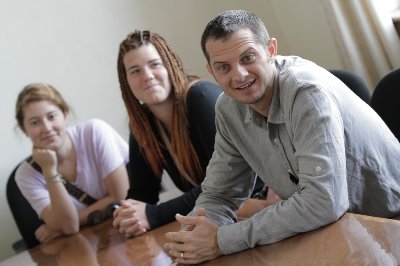
Dallas Baptist University tennis coach Jennifer Curran (2nd from left) and students (left to right) Lexi Yeado, a sophomore from Elk River, Minn.; Hannah Innes, a sophomore from Melbourne, Australia; and Richard Abel, a junior from Corsicana; lead a classroom activity in England. (PHOTO/ Courtesy DBU)

“Many of the student-athletes shared how they were humbled, challenged, encouraged and changed. They were stretched and forced out of their comfort zones as they faced opportunities to verbally share their faith, to pray out loud in a group and to give of themselves sacrificially. Several students had very real conversations with youth and adults about what it means to be saved, who Jesus is and how they can have a relationship with him,” said Christy Gandy, DBU assistant director of spiritual life.

“Some were burdened for the lost, convicted of their selfishness and moved to someday return to the people of England. It was a week of planting seeds. We were all challenged to return to America with a goal of being intentional in the way we live our lives and to seek out those who need the hope of Christ.”

Each day, the student-athletes worked with the local churches in their ministries and volunteered in schools, teaching tennis lessons and talking about their Christian faith.

They also spent time building relationships with the youth groups at each church. Those efforts included taking part in a community-wide all-night youth outreach and sharing their testimonies with children, youth and adults, as well as seeking to support and encourage the churches and community leaders.

Tennis clinics offered the teams many opportunities to share their athletic knowledge and prowess and—most importantly—their testimonies of God’s grace and love.

“Traveling to England to spread the word and news of Jesus was an honor and an eye-opening experience for all of us. Many of the youth (in England) have never been to church and have no idea who Jesus is and what he can do for each of their lives,” said Cathy Ray, DBU senior woman’s administrator.

Aside from their ministry efforts, the Patriots enjoyed Sunday morning worship various churches. One church met on the beach of the North Sea for a baptism service.

“What an amazing experience my teammates and I had to travel across the world and spread the word of God to others. Between teaching tennis in the schools, hanging out at the park and working with the youth in the church, I feel like the people of the Tees Valley were not the only ones who learned something. It was each of us,” senior Bronson Vaughan said.

Head Tennis Coach Jennifer Curran called the experience “an incredible opportunity” for the student-athletes.

“We had the chance to go into the public schools and present the story of the Good Samaritan. We would sing songs about being kind to your neighbor and loving God with all your heart, mind, soul and strength. With this simple story, we were able to discuss God’s love and tell them that he cares for each of them,” she said. “In our attempt to be a blessing to them, they blessed all of us so much. No one came home the same person.”


Rick Warren hospitalized with eye injury

LAKE FOREST, Calif. (ABP) — Southern Baptist mega-church pastor and Purpose Driven Life author Rick Warren was recovering at home July 22 after being hospitalized overnight with eye injuries he suffered while gardening.

A spokesperson for Warren said the 56-year-old pastor, who relaxes by horticulture and gardening, was pruning shrubs Monday at his home. His plants include firestick, a succulent with a sap that can cause skin irritation and temporary blindness if it comes into contact with the skin or eyes.

Rick Warren

Rick Warren

Kristin Cole of A. Larry Ross Communications said Warren was wearing gloves, but still got some sap on his hands when he removed his gloves that was transferred to his eyes.

Warren sent out a Twitter message Tuesday morning that circulated quickly: "My eyes were severely burned by a toxic poison. Hospitalized Mon[day]. Excruciating pain. Now home. Pray my sight loss is restored."

Cole said the pain was so severe that when Warren's wife, Kay, came outside to check on him, he could not tell her what happened to him. She called 911, and he was taken by ambulance to Mission Hospital in Mission Viejo, Calif., near his home.

He was treated by an eye specialist, kept overnight and fitted with protective contact lenses like those used with patients following LASIK surgery.

"He didn't fully lose eyesight," Cole said. "He had some temporary vision loss because there was some damage to the cornea."

"While there is still discomfort, the doctor expects a full 100-percent recovery," she said.

Cole said Warren has been on a writing schedule working on fall curriculum for Saddleback Community Church and is not part on a preaching schedule, so he will have some time to recover.

Warren tweeted again Tuesday assuring followers "I a NOT blind" and thanking them for their prayers. "May God use this pain for His Glory," Warren wrote, citing Romans 8:28.


–Bob Allen is senior writer for Associated Baptist Press.


Columbaria bring members of church family home for final rest

DALLAS—Churches became disconnected from death in the last century, but some congregations are seeking to correct that problem.

Historically, cemeteries often were adjacent to the church, and the end of life was just as apparent as the living of it. But in the 20th century, particularly as people moved from rural areas to the cities and suburbs, cemeteries became far-removed from church grounds.

Pastor George Mason (center) leads the dedication service for the columbarium at Wilshire Baptist Church in Dallas.

In recent years, some congregations have sought to recapture the sense of the church as the final resting place of its members’ remains. But because land is expensive and in short supply, churches are turning to columbaria—places to inurn the remains of those who have died and had their bodies cremated. Niches are sold to hold urns containing the ashes.

The need seems to be increasing. According to the state Funeral Service Commission, Texas had more than 50,000 cremations in 2009, up from 38,000 only two years before.

Wilshire Baptist Church in Dallas dedicated its columbarium June 13. At the dedication, three urns of three members were placed in the resting places, including two Texas Baptist statesmen—Ed Laux, who served many years with the Baptist General Convention of Texas, and Phil Strickland, who was head of the Texas Christian Life Commission.

Wilshire is not the only Texas Baptist church with a columbarium. Woodland Baptist Church in San Antonio and Riverbend Church in Austin have inurnment facilities that pre-date Wilshire’s.

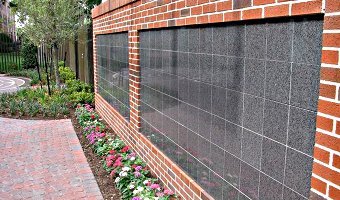
Most columbaria have distinctive features, unique to a specific congregation. Wilshire’s columbarium is a garden space that includes a water fountain, terrazzo path, landscaping and a prayer labyrinth. The circular labyrinth is an ancient tool for Christian prayer by which individuals walk the serpentine path as they pray.

Nearly 300 niches for inurnment are included in Wilshire’s columbarium, as well as a separate wall of remembrance where the names of those buried elsewhere may be inscribed.

In addition to niches for the inurnment of the remains of church members, the columbarium at Wilshire Baptist Church in Dallas also features a wall of remembrance, where members who are interred elsewhere can be memorialized.

A large disc at the entrance to the columbarium bears an engraved quotation from Psalm 90: “Lord, you have been our dwelling place in all generations. … So teach us to number our days, that we may gain a heart of wisdom.”

At the dedication service, Pastor George Mason explained that the church is a natural place to help people think about both life and death. By walking among the remembrances of those who have gone before, believers today may be inspired to right living.

The price for a half-niche in Wilshire’s columbarium is $1,500, and a whole niche for two urns can be secured for $3,000—significantly less than the fees for traditional burials, Associate Pastor Mark Wingfield noted.

The columbarium at Woodland Baptist Church contains 60 niches and is situated near a place where children play and where foot traffic is somewhat heavy, said Mary Lynn Lewis, the head of the church’s columbarium ministry team.

Initially, she said, some people were afraid they would not want to walk by the columbarium, but in the two years since its dedication, that fear has faded.

“It’s been well accepted. Some people now walk by and say, ‘There’s our future home or our future apartment.’ And that’s the goal of this ministry for us—bringing our loved ones back to the church where they belong,” she said.

Niches in Woodland’s columbarium initially sold for $1,000, but that has price has increased to $1,500. More than half of the niches already either are filled or reserved, and the church soon will consider expanding the columbarium’s size. It was designed with expansion in mind.

The columbarium at Wilshire Baptist Church in Dallas includes a prayer labyrinth—an ancient tool for Christian prayer by which individuals walk the serpentine path as they pray.

Lewis, a hospital chaplain, noted she is glad to work on the team, because she has seen the need to deal well with the end of life.

Alan Wright, a hospice chaplain at Baylor Medical Center and a Wilshire member, reflected on the message of the columbarium in a recent blog posting.

“I am more proud than ever about being a member of Wilshire knowing that people within our church made the decision to include such a space,” he wrote.

“The church in general, especially the Baptist wing of it, needs more columbaria. I hope we’ve started a trend. We non-Catholics like our churches pristine, void of such reminders.

“I can confidently say from my experience as a chaplain in a hospital, the church has done a disservice to its people by too often choosing what is spiritually palpable over what we so need help spiritually digesting—that we are temporary. Facing this alone can be quite frightening. Together, however, this knowledge makes us stronger and more committed.”


Cowboy church rounds up strays in Brenham

BRENHAM—Although the Cowboy Church of Brenham opened its doors fewer than six months ago, it has been on Steve Westbrook’s mind a long time.

At its first service in January, Cowboy Church up Brenham initially set up 125 chairs and expected about 100 people to come. The church had to set up nearly 200 additional chairs to accommodate the crowd. (PHOTOS/Courtesy of Cowboy Church of Brenham)

“I went to my first cowboy church service about five or six years ago,” said Westbrook, worship pastor of the church and executive director of the Sheriff’s Association of Texas. “God started working on me. After I left there I said: ‘You know, we could use something like this in Brenham. There are people not being reached who could be reached by a cowboy church.’”

Westbrook was a member at First Baptist Church of Brenham at the time. He had been a deacon more than 20 years and was active in the music program.

“I was content and happy with my role in First Baptist,” Westbrook said. “I thought: ‘What I’m doing here is good. Why should I step out and do something different?’ Finally, last summer God said, ‘Look, if somebody’s going to make a move on this thing, you’ve got to take the first step.’ So I did.”

He spoke with Steven Ponder, senior pastor at First Baptist Church. They prayed together, talked about strategies and contacted the Baptist General Convention of Texas to get help with planning. Texas Baptists’ help provide funding for church starts through the Cooperative Program and gifts to the Mary Hill Davis Offering for Texas Missions.

Worship Pastor Steve Westbrook (center) had been a deacon more than 20 years and was active in the music program at First Baptist Church of Brenham when he believed God gave him a burden for reaching people in the western-heritage culture. (PHOTOS/Courtesy of Cowboy Church of Brenham)

“Texas Baptists and First Baptist Church of Brenham have done a lot for us,” Westbrook said. “The funding they gave helped us get started by covering everything from advertising to getting our website built and up and going.”

On the Sunday of their Jan. 10 launch, Cowboy Church set up 125 chairs and expected about 100 people to come.

“Fortunately, we had additional chairs stacked in the back of the building, because our first Sunday we had 321 people show up,” Westbrook said. “We were just in awe.”

Experienced church planters told Westbrook attendance often drops by up to 50 percent in services following a new church plant’s launch. That hasn’t been the case for Cowboy Church of Brenham.

“The next Sunday we had 280,” Westbrook said. “We’ve averaged around 300, with the exception of Easter. On Easter Sunday we had 460 people. We had all the chairs we could find, but we had people standing and people outside watching and listening through the open doors.”

Cowboy Church of Brenham sends first-time visitors home with a small loaf of homemade bread. (PHOTOS/Courtesy of Cowboy Church of Brenham)

In addition to serving as the worship pastor, Westbrook handles all administrative duties for the church. He works as a volunteer. The only paid staff member is teaching pastor Jack Meeker.

“Whatever we need as far as any counseling or visitations, we all kind of do that— myself, Jack, and two lay pastors,” Westbrook said.

Most cowboy churches operate with few paid staff, instead relying on church members’ involvement in ministry teams.

Cowboy churches have spread and multiplied rapidly since the movement began in 1999. Five years ago, there were between 30 and 40 cowboy churches affiliated with the BGCT. Today, there are 175.

The Texas Fellowship of Cowboy Churches was started in 2005 to connect Texas Baptists’ cowboy churches. When western-heritage churches outside Texas wanted to connect with the movement, Texas Baptists helped start the American Fellowship of Cowboy Churches.

“The goal by the end of 2018 is to have 400 cowboy churches inside Texas and 200 outside Texas related to the AFCC,” said Charles Higgs, director of Texas Baptists’ western-heritage ministry.

About 20 percent of the 25 million people in Texas relate to western-heritage culture, Higgs said. Many factors keep these people from feeling comfortable in traditional churches, from the music to style of dress. Cowboy churches have built bridges for this unreached group by integrating culture and church.

“At cowboy churches, we’ve lowered some barriers to attract unchurched people,” Higgs said. “We don’t have an altar call. We go through the plan of salvation, and if they pray the prayer, they fill out a card and put it in the feed bucket or the boot. Same with the offering. We don’t pass an offering plate, but if people want to give money to the church they can put it in a boot or bucket at the back.”

Cowboy Church of Brenham is one of 175 BGCT congregations that focus on reaching people involved in the western-heritage culture.

A lack of giving hasn’t been an issue for cowboy churches. Westbrook said they tell their congregation how to give, and if they want to give tithes and offerings, it’s between them and God.

Cowboys churches affiliated with the BGCT contributed about $400,000 to Texas Baptist causes last year, Higgs noted.

Other characteristics of cowboy churches are easy-to-understand sermons with relevant illustrations, western culture-related church events and more accessible music—either popular country tunes with rewritten lyrics or countrified hymns.

These efforts to reach a formerly unchurched population have proved that the fields are ripe for the harvest.

“The average Texas Baptist church baptizes 10 people per year,” Higgs said. “Western-heritage churches baptize 26 per year. Eighty percent of our baptisms are adults. Eighty percent of those adults are men.”

Cowboy church activities revolve around the arena, with events like team roping, barrel racing, ranch rodeos or play days for families with children.

“We’re event-driven,” Higgs said. “That’s how we do outreach.”

What sets cowboy churches apart the most, though, is a welcoming and nonjudgmental atmosphere. Cowboy Church of Brenham sends first-time visitors home with a small loaf of homemade bread.

“What people like about the church is yes, they like the music, they like the sermons because the sermons are down to earth and not long, but the thing they really like is the feeling they get when they come that other people care about them,” Westbrook said.

Cowboy Church of Brenham meets at the Washington County fairgrounds. For more information, visit their website.  To find a cowboy church, visit the Texas Fellowship of Cowboy Churches website.


‘Love your neighbor’ more than a memory verse for children’s home residents

BEEVILLE—Six small communities lie within a 20-mile radius of South Texas Children’s Home Ministries in the rural, brushy ranchland of northern Bee County. As Becky Moore, student ministries director at the children’s home, began planning for the summer, she could not stop thinking about those towns.

Mary Ella Steele of Pettus shows her appreciation children from South Texas Children’s Home Ministries—(clockwise left to right) Madyson, Raelin, Josh, Elena, Demetri and Eli—after receiving their handmade gifts. Volunteers also painted her home, repaired her roof, trimmed her trees and mowed her lawn.

“We always take some of our kids at the home on mission trips within the U.S. or internationally,” Moore said. “But you can’t take everyone. I started thinking how neat it would be to stay close enough to home for our whole campus to be involved.”

By the time Mission North Bee County was launched, six towns, seven churches, one Texas Baptist state offering, one local Baptist association, many area businesses, community members and the entire children’s home campus were on board.

The intense, weeklong event included free physical labor for local homeowners in need, a communitywide Vacation Bible School and youth rallies every evening.

Organizers selected as ministry projects the homes of three widows and two families, as well as a local ministry building that needed painting.

“I was working long days for my new job when the kids told me someone had stopped by saying we had been selected to receive help with whatever we needed around our house and yard,” said Leticia Burrez of Tuleta, a single mother with two daughters. “I couldn’t believe it. I was in awe.”

Children’s home residents and staff were eager to begin meeting some of their neighbors, Moore said.

South Texas Children’s Home Ministries caseworker Jake Kelley gives Odell a playful ride.

“We want the kids at the home to know that they all have something to give,” she said. “A lot can happen when a lot of people come together. Sometimes it is less about preaching to someone and more about showing them love and that you care.”

Zach, 14, had only been at the children’s home for a couple of days when the mission project started.

“I didn’t really know what was going on,” he said. “But I liked working. I got to silver-coat a lady’s roof and put a layer of shingles up. It was a good feeling. We would have never known she was in need without this project.”

First Baptist Church of Pettus opened its facility for the community Vacation Bible School.

“When Becky Moore first called me, I really liked the idea of working together with other churches,” youth pastor Michael Gleason said. “That’s what we are supposed to do.”

First Baptist Church in Pettus youth formed one of the work crews, and First Baptist Church of Beeville youth also joined the effort.

Todd Roberson, president and chief executive officer of South Texas Children’s Home Ministries, served on a crew that painted Mary Ella Steele’s home. The crew repaired her roof, trimmed her trees, and mowed and edged her yard.

Determined to serve a neighbor in need, students and staff from South Texas Children’s Home Ministries clear debris from a yard in Tuleta, while other volunteers hung new sheetrock and painted the home’s living room and hallway.

At other sites, crew members built a porch, a pump house, and handrails for wheelchair ramps. Others hung drywall and then taped and floated the sheetrock, worked on general clean-up projects and pulled weeds around the Pettus park and post office.

Multiple partners—across denominational lines—came together to make Mission North Bee County a success, Roberson said.

“First Methodist Church in Pettus opened its fellowship hall and kitchen to feed the work crews each day, and First Christian Church in Pettus as well as the First Baptist Churches of Normanna, Pawnee and Tuleta joined them in furnishing the meals,” he said.

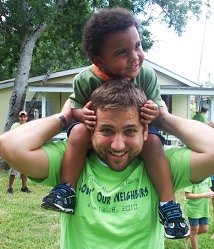
“The motto on our bright lime-green t-shirts said, ‘Lovin’ our Neighbors and Servin’ Together,’ and that is what truly happened. The communities in this area have supported the children’s home for years, and it was a neat opportunity to give back to these neighbors who are right in our own backyard.”

Madyson proudly displays her handiwork as she learns about helping others at South Texas Children’s Home Ministries.

Start-up funds for Mission North Bee County were made possible by gifts to the Mary Hill Davis Offering for Texas Missions . The Blanco Baptist Association also made a significant donation. Area businesses chipped in and also discounted some of the materials needed for projects.

“Sometimes people may not think that other people care about them,” said 16-year-old Alex, who lives at the children’s home. “This was such a good way to show a lot of people the love of Jesus.”

While the older youth worked in the community, younger children made cookies, cards, placemats and terra cotta planters with their handprints on them to give to homeowners in the area, along with plenty of hugs.

“What the young people and others did for the people of this community definitely made an impact both spiritually, through their witness for Christ, and physically with the actual work they did for others,” said Bee County Judge David Silva, bivocational pastor of First Baptist Church in Pettus.

“I wish so much that my husband could still be around to see this,” said Carrie Brown of Pawnee, a widow who lives alone, in spite of failing eyesight. “There are still honorable people in this world, and all of these workers are definitely honorable.”

Ultimately, 329 people participated, contributing 2,470 man-hours, and completing eight major projects. And as a result, two people prayed to receive Christ as Savior.

Mike Perkins, a houseparent at the children’s home, served as construction supervisor for the entire Mission North Bee county effort.

“We will probably not know the full impact of what was done for Christ during Mission North Bee County until we get to heaven,” Perkins said. “But God multiplied our gifts. People are still talking in the community about seeing all the kids along the highway, the park and working at people’s homes. They couldn’t believe kids would spend their time doing things like that.”


Baylor students learn about new models for orphan care in Africa

KITALE, Kenya (ABP) — A Kenyan girl sits with her baby doll in hand, smile on her face, changing the doll’s clothes and doing its hair. Minutes later, she places the baby doll into the arms of another child — with no protests of possession, no sense of selfishness.

Sara Elliot, one of the Baylor School of Social Work students who recently traveled to Kenya to learn about caring for orphans, talks with one of the children she met there. (Baylor Photography)

Faith-based organizations working in Africa are turning to the unselfish arms of family as an alternative to orphanages, believing families offer a more effective way to aid the millions of orphans on the continent, many of whom have lost parents to AIDS.

Baylor University professor Jon Singletary recently led a team of students who traveled to Kenya on a “mission of learning” to see the difference these families are making.

“What children need is genuine family, not made-up families,” Singletary, who teaches in Baylor’s School of Social Work, said. “With almost 150 million kids [worldwide] classified as orphans — meaning they’ve lost one or both parents — the most common response is, if you see an orphan, then you assume that child needs an orphanage.”

'Kinship-care' model

“Orphanages are really, tragically outdated,” he added. “The more natural model throughout Africa is what we call ‘kinship care.’ It’s foster care by families. Families taking on nephews and nieces, or grandchildren, or brothers and sisters.”

Since 2002, Buckner International has worked in Kenya to place 150 orphans into kinship-care homes.

A dozen students joined Singletary in visiting homes in Nairobi and the agricultural town of Kitale to learn how men and women were opening their arms to motherless and fatherless young ones.

Professor Jon Singletary and two of his Baylor University School of Social Work students visit with elementary-school children in Kenya during a recent trip there to study care solutions for the country’s millions of orphans. (Baylor Photography)

“It is not uncommon in this culture for a young child to be cared for by a grandmother or auntie if their biological parents perished because of AIDS or other calamities,” said Phil Brinkmeyer, regional director for Buckner Kenya. “Kinship care helps provide extra assistance to the extended family to care for a relative’s child.”

In 2006 (the latest year for which statistics are available) the United Nations estimated there were 2.3 million orphans in Kenya alone due to HIV/AIDS, tuberculosis and malaria. Kinship care is helping with the overwhelming need.

One foster father in his 50s wanted his niece, who lost her parents, to have a stable home. So he built a new one, brick by brick. “He felt like the mud house that they had wasn’t what he wanted to raise his new family in,” Singletary said.

While creating a welcoming home for his expanded family, the man continued to maintain a farm. “His family had been on this farm for two or three generations,” Singletary said. “And [he] saw [his niece] as the next generation. This was a daughter he didn’t anticipate having. So, when her parents died of HIV, he wanted to make that kind of difference for her.”

Partnering with kinship-care families

Buckner and similar groups partner with Africans using the kinship model by providing new parents with food supplements, school fees and health care.

Some of the recipients have displayed an entrepreneurial spirit. Ann, a foster mother in Kitale, convinced her fellow villagers to use some of the money Buckner was giving them for food supplements to create what they called a “merry-go-'round.”

Baylor School of Social Work professor Jon Singletary (center) plays with children during his recent Kenya trip. (Baylor Photography)

“She suggested taking some of the money they were spending on food, and let the villagers pool it together,” Singletary said. “Each month a different family can have that to start a small business or strengthen the business they already have.”

Ann converted one of her huts into a mushroom farm where she could grow food to sell. Another portion of her merry-go-'round money went to making liquid soap that offers valuable antibacterial properties hard to come by in rural Kenya.

“She’s caring for these children, but she’s this entrepreneur who’s able to inspire several other families that she’s working with. She’s just a foster mom, but she’s so much more than that. She truly is a leader," Singletary said.

A mission to learn

The School of Social Work has offered this mission trip opportunity to Baylor students since 2005 as a way to learn from people like Ann.

“We go as God’s ears,” Singletary said, “to hear what Christians in Africa are able to do through the ways that God has empowered them, gifted them. And we come back with a message to share of what we’ve learned over there rather than going over there to share a message.”

A need for faith was one of the lessons learned by Sara Elliot, a social-work graduate student from Tennessee.

“Just to see the joy and contentment they had in life made you re-evaluate yourself and how you get so upset over a flat tire or whatever,” Elliot said. “It just made you think about how thankful you should be. Their faith was just unreal because that’s all they had to cling to. They had nothing else. Seeing their faith was definitely a refreshing experience.”

The simple lives of the Kenyan orphans also had an impact on Sarah Stoner, a social work student from Waco.

Kenyan students listening to Baylor University professor Jon Singletary during a recent trip there. (Baylor Photography)

“They’re just so happy for everything they have,” she said, “even though it is ‘so much less’ than most American children enjoy.” Stoner hopes to return to Africa to work alongside kindship-care families.

“They have so much I can learn from,” she said.

Singletary hopes further mission trips, along with an ongoing relationship with Buckner’s Kenya ministries, will increase American Christians’ knowledge of how the open-armed approach to orphan care can, over time, improve the quality of life for younger generations in crisis.


Kristine Davis, a first-year journalism graduate student at Baylor University, is a summer intern for Associated Baptist Press.


African-American Baptists urged to be living testimony in languishing world

HOUSTON—Preachers at the annual African American Fellowship Conference challenged their peers to be a “living testimony in a languishing world” by accepting the challenge to share the hope of Christ with people who are spiritually lost without it.

African American conference

Participants at the African American Fellowship Conference in Houston worship during one of the event’s plenary sessions. (PHOTOS/John Hall/Texas Baptist Communications)

Fellowship President Michael Bell, pastor of Greater St. Stephen First Baptist Church in Fort Worth, said many Christians have settled for living a faith that is comfortable instead of a life passionately following God.

“The problem with being comfortable in our world is it might keep us from realizing the destiny, the life God has for us,” Bell said as he preached from Deuteronomy 1:5.

“Our God is not a stagnant God. Life is not meant to continue the way it has always been. Life is meant to become the way it was meant to be.”

Comparing them to the Israelites who were content to settle east of the Jordan River, Bell urged complacent Christians to “break camp” and embark on a journey with God.

“As long as we stay there, we will never enter the promised land,” he said.

Jerry Dailey

Jerry Dailey, pastor of Macedonia Missionary Baptist Church in San Antonio, told the African American Fellowship Conference a Spirit-filled life of service requires persistence and perseverance. (PHOTOS/John Hall/Texas Baptist Communications)

Pastors—and the congregations in which they minister—need to face the reality that ministers are more like Spider-Man than Superman, said Kevin Cosby, pastor of St. Stephen Baptist Church in Louisville, Ky.

Cosby preached from Acts 14. It describes how Paul healed a crippled man, and a crowd of pagans treated him as if he and his fellow apostle Barnabas were gods. Paul protested, telling them, “We, too, are only men, human like you.”

“Every preacher ought to profess the Pauline confession,” Cosby said. “It identifies who the pastor is: We are men who have struggles—the same struggles as you, … the same frailties as you, … the same human condition as you.

“Paul says, ‘Don’t venerate us. We are the channel of the miracle, not the source of the miracle.”

Unlike Superman, a being from another planet, Cosby insisted pastors are more like Spider-Man, who acquired his powers from an outside source. Effective ministers gain their power from the Holy Spirit.

“Superman is from another planet, Krypton,” Cosby said. “Like Spider-Man, the pastor is from here. Superman is alien and has supernatural power. Spider-Man is human, but he acquired power.”

Following God’s call and living a life empowered by the Holy Spirit requires persistence and perseverance, said Jerry Dailey, pastor of Macedonia Missionary Baptist Church in San Antonio.

Essential steps in the journey, Dailey said, are to believe the gospel of Christ, admit the need for him, relentlessly pursue him, expect Christ to hear pleas for help, tell Jesus what is desired and commit to follow Christ.

Frank Thomas

Trying times force people to come face to face with God, Frank Thomas, pastor of Mississippi Boulevard Christian Church in Memphis, Tenn., told the African American Fellowship Conference in Houston. (PHOTOS/John Hall/Texas Baptist Communications)

If individuals will follow this rubric, Dailey said, they will see God’s faithfulness and direction. It recently helped carry the pastor through a dark period when his 2-year-old nephew drowned in a pool, as did Dailey’s sister-in-law who jumped in the water in an attempt to save her son.

“Everybody needs somebody,” Dailey said. “And all of us need the Lord.”

Frank Thomas, pastor of Mississippi Boulevard Christian Church in Memphis, Tenn., said times of trial force people to come face to face with God. Simple answers and clichés no longer suffice.

In front of God, people wrestle for true answers like Jacob grappled with an angel. The things of the world—technology, medicine, psychology and manmade religion—cannot provide help, but God can.

“We behold the face of God when the answers are stripped away,” Thomas said, preaching from Genesis 32:22-30.

Thomas echoed Dailey, encouraging Christians to hold steadfast to the fact that Jesus is God, and he can and will make a difference in lives.

“You can ask God for a blessing and trust that it’s on the way,” he said. “That’s hope.”

When God proves himself faithful, that encourages his followers to testify about him more readily, said H.K. Thomas, pastor of New Mount Olive Baptist Church in Littlefield.

Societal pressures seek to squelch a person’s willingness to share about God, God is so good, Christians are compelled to tell others about him, he insisted.

“If God has been good to you, you’ll tell somebody,” he said. “If God has blessed you, you need to tell someone.”

In business matters, the fellowship elected: Bell, president; Michael Evans, pastor of Bethlehem Baptist Church in Mansfield, vice president; Joseph Parker, pastor of David Chapel Missionary Baptist Church in Austin, secretary; Byron Stevenson, pastor The Bend Church in Sugar Land, assistant secretary; Marvin Delaney, pastor of South Park Baptist Church in Houston, treasurer; and Elmo Johnson, pastor of Rose of Sharon Missionary Baptist Church in Houston, assistant treasurer.

With additional reporting by Editor Marv Knox


Small-church leaders urged to answer the Hope 1:8 challenge

BELTON—Small-membership churches and their leaders have a key role to play in spreading the gospel—beginning at home and extending around the globe, speakers told a statewide gathering.

Baptist General Convention of Texas Executive Director Randel Everett and seminary professor Joel Gregory addressed the 24th annual meeting of the Texas Baptist Bivocational and Smaller Membership Ministers and Spouses Association , July 9-11 at the University of Mary Hardin-Baylor .

Officers of the Texas Baptist Bivocational/Smaller Membership Church Ministers and Wives Asociation are (Back Row, left to right) Richard Ray, 2nd Vice Pres. (FBC, Wink); Tony Tawater, President (Lone Willow Baptist, Cleburne); Danny Rogers, Treasurer (Field Street Baptist, Cleburne) Front Row: (L-R) Rosalind Ray, 2nd Vice Pres. (Fairy Baptist, Fairy) and Ellen Goodson, Secretary, (Highland Baptist, Denton).

Everett challenged the group to participate in a new Hope 1:8 initiative, based on the mandate given to Christians in Acts 1:8 to be witnesses for Christ “in Jerusalem and in all Judea and Samaria and to the end of the earth.”

Hope 1:8 follows the Texas Hope 2010 initiative, which sought to encourage Christians to pray for the state, feed the hungry and spread the hope of Christ with the spiritually lost.

“If you look at Acts 1:8 and we think about Texas Hope 2010 that we’ve come from, we are challenging our churches that we all are involved in to develop our own Hope 1:8 strategy,” Everett said.

“I pray that you’ll go back and you’ll be able to say through your church: ‘What is my Jerusalem? What is my Judea? What is my Samaria? …’ We want to be the ministry partner to really help you reach Texas.”

Members and leaders of bivocational and small churches will be an integral part of making Hope 1:8 successful, Everett stressed.

“It’s something that you can’t do by yourself,” he said. “No church really, regardless of the size can reach Texas by itself. But collectively, we come together and work with other Christ-followers from unions and fellowships to try to reach our state for Christ.”

The first key to being an Acts 1:8 church is being Spirit-empowered, Everett said. The second key is being indigenous by connecting with specific groups. The third key is being a holistic church that meets both the physical and spiritual needs of the lost. The final key is the involvement of the entire church—not just the church’s ministers.

Gregory, professor of preaching at Baylor University’s Truett Theological Seminary , encouraged pastors to learn lessons from John the Baptist, whom he called “the first Christian preacher.”

John the Baptist would tell ministers that “the act of proclaiming and bearing witness to the Lord Jesus Christ is the most important thing going on,” Gregory insisted.

Next, he would urge modern-day gospel messengers to “preach with a specificity that creates something of a crisis,” causing the audience to ask, “What must we do?”

“If this Acts 1:8 priority is to become the case, we need to discover a kind of preaching that means, ‘What must I do?’ And that means preaching to the culture, not being trapped in the culture,” Gregory said.

Gregory also suggested ministers recognize the role they were given through the example John the Baptist set.

“In these days of Acts 1:8 emphasis, he would leave a memo saying, ‘Understand that your role is a preparatory role,’” Gregory said.

Gregory likened ministers to bulldozers that clear the path and prepare the way for Christ to reach the people of Texas. Like John the Baptist, who denied he was the long-awaited Messiah, ministers must recognize they are not the ultimate authority. Jesus is.

“One of the challenges of our day is to get rid of every pulpit prima donna and every diva because you can’t preach Jesus and try to compete with him in his own house,” Gregory said. “We have to make some disclaimers about who we are not before we can say who he is.”

Gregory concluded with a final suggestion from John the Baptist: “Wait for the assessment of your ministry from Jesus.”

Ordination, congregation and education are not accurate measures for the quality of a preacher, according to Gregory. Jesus is the only one who can assess the success of a preacher.

During the annual meeting, the association re-elected officers—Tony Tawater, pastor of Lone Willow Baptist Church in Cleburne, as president; Rosalind Ray, pastor’s wife from Fairy Baptist Church in Fairy, as first vice president; Richard Ray, pastor of First Baptist Church in Wink, as second vice president; Ellen Goodson of Memorial Baptist Church in Denton as secretary; and Danny Rogers of Field Street Baptist Church in Cleburne as treasurer.


ABP celebrates 20th birthday marked by growing pains

NASHVILLE, Tenn. (ABP) — July 17 marked the 20th birthday of Associated Baptist Press, an independent news service created by and for Baptists interested in a free press during a tumultuous time within the Southern Baptist Convention.

W.C. Fields (right) and Patricia Ayres, both longtime friends of ABP, mingle with ABP Executive Director David Wilkinson.

On July 17, 1990, the SBC Executive Committee voted in executive session to fire the two top editors of Baptist Press. The committee chairman said it was because members believed coverage was biased against conservatives that over the course of a decade had gained majorities on most of the convention's boards of trustees.

Upon learning he had lost his job as news editor, Dan Martin, 51, told a crowd of about 200 supporters at the Executive Committee headquarters in Nashville, Tenn., that leaders of the denomination wanted to replace the journalists at the convention's official news service with "their own minister of information."

"They want someone who will be a 'spin doctor,' who's going to put the spin on stories the way they want them," Martin predicted.

R.G. Puckett, editor of Biblical Recorder, news journal of the Baptist State Convention of North Carolina, called it "a day to live in Baptist infamy." He wrote about it on its anniversary every year until his retirement in 1998.

"Never in my many years in Baptist life have I witnessed something so unchristian and non-Baptistic," Puckett recalled.

Jeff Mobley, a Nashville attorney and member of the city's First Baptist Church, followed the firings with announcement of a new autonomous news service "guided by the highest tenet of professional journalism and the standard of Christian ethics."

Mobley, who at the time had been practicing law for fewer than 10 years, said he was asked out of the blue to help a new Baptist entity that needed to be incorporated in Tennessee. He met with a small group of Baptist state paper editors and others who had set into motion weeks earlier the idea for an alternative Baptist press.

David Wilkinson blows out candles on a birthday cake celebrating the news services 20th anniversary at a reception during the recent CBF General Assembly in Charlotte.

"I can't tell you why, but they decided that I would read the Declaration of Independence on behalf of the organization there in the auditorium of the Executive Committee building," said Mobley, who joined the founding board of directors as legal counsel and was elected as chair in 1994.

Editors defend 'free religious press'

The Southern Baptist Press Association, an organization of Baptists newspapers in state conventions affiliated with the SBC that 44 years earlier had been instrumental in establishing Baptist Press, immediately endorsed the concept.

A month before, at the Southern Baptist Convention annual meeting in New Orleans, Martin and his boss, Baptist Press director Al Shackleford, were told their services would no longer be required. The men were advised to resign quietly — with severance benefits — or be fired. They chose to announce the threat June 26, 1990, in an article in Baptist Press.

The Executive Committee announced a special called meeting — the first in a quarter-century — to "consider the termination" of the editors. The state paper editors convened an emergency meeting July 6-7 in Dallas, where they adopted a resolution decrying the attempt "to suppress a free religious press."

Later a smaller group met informally to discuss the need for an alternative to Baptist Press. Bob Terry, at the time editor of Missouri's Word and Way and now at the Alabama Baptist, secured Floyd Craig, who owned a communications and marketing business with his wife, Anne, to begin producing Associated Baptist Press issues beginning that fall.

Craig said he was interested because of his longtime friendship with and admiration of W.C. Fields, the longtime director of Baptist Press who built a reputation among the secular journalists establishing the Southern Baptist news service as the nation's best in modeling openness, integrity and professional journalism.

"It really was a no-brainer for us to deal with ABP," Craig recalled. "It was a moment that the integrity of BP was destroyed after years."

A news service is born

The inaugural issue, dated Sept. 26, 1990, announced that the first issue of ABP was being sent to about 50 outlets mostly by fax. Craig, a veteran communicator who had worked for the SBC Christian Life Commission from 1967 to 1979 and for the governor of North Carolina before moving back to Nashville to start his own business, selected Martin as interim news director.

"For 10 years I have had the best journalism job in the Southern Baptist Convention," Martin said after being fired July 17 by Baptist Press. "Even if I had known the outcome, I would have come, because it has been a wonderful ride."

The emotional high was short-lived. By December Craig wrote directors reporting that the results of his fund-raising efforts fell short of the amount he had billed them for hourly fees. That set off a discussion that eventually ended ABP's relationship with Craig and Associates.

"Several of the board members felt the bills we submitted were excessive," said Anne Craig, who worked alongside her husband as ABP's copy editor.

"Nobody believes you when you say it took 'X hours' to do so-and-so," Floyd Craig added.

Directors began looking for a full-time executive editor. They removed "interim" from Martin's news director title, leading him to believe he was being considered for the job.

Even though he had violated their gag order, the Executive Committee gave Martin six months of severance pay, anyway. It was about to run out, so Martin needed a job. After being told he was told he had been too political and vocal in the SBC controversy to be editor, Martin wrote a letter to directors describing the experience as more painful than his firing the previous summer from Baptist Press.

The Warner years

The board turned to Greg Warner, electing the 36-year-old associate editor of the Florida Baptist Witness and award-winning writer as ABP's first full-time employee effective May 1, 1991.

"I am excited about the future of ABP with a journalist such as Greg Warner on board, Charles Overby, the news organization's founding board chair, said at the time. "I am impressed by his ability and attitude."

Under Warner, ABP achieved financial stability, expanded staff and earned a good reputation among secular journalists following the SBC controversy, one of the top religion stories of the 1990s.

Warner left the job in 2008, when chronic back problems forced him into disability retirement at age 53. Last fall the organization honored Warner by naming him first recipient of a lifetime achievement award established in his name.

Changing times, changing audience

"ABP's board of directors has tried over the past 10 years to find the appropriate outlet for its objective news coverage of Baptists," said Dan Lattimore, the current chair of the ABP board. "The state Baptist papers had been the initial users of our content. However, most state Baptist papers have become controlled by fundamentalists of their conventions. It has become a much less viable outlet for ABP."

Desiring to expand a reader base beyond its original audience of Baptist and secular newspapers, ABP launched FaithWorks, a lifestyle magazine aimed at young Christians in 1998.

While "a good quality product," Lattimore said ABP lacked resources to market and distribute the magazine widely enough to make it financially feasible. Directors suspended publication in 2004.

Present and future

In 2007 Associated Baptist Press entered into a strategic partnership three historic Baptist state newspapers in an initiative called New Voice Media. Currently the partners — ABP, the Baptist Standard of Texas, Religious Herald in Virginia and Word and Way in Missouri — collaborate on news coverage and design.

Long-term goals include a state-of-the-art multi-media platform including web, print and other media — an "online gathering place for historic and progressive Baptists and other global Christians to share ideas."

"With the increasing use of electronic media by our constituents, we feel this will provide the best outlet for the future," Lattimore said.

In 2008 ABP hired David Wilkinson, a veteran Baptist communicator of 30 years, as executive director, separating the administration and day-to-day news operation that had been combined in Warner's job.

Looking back

Floyd Craig said his original vision for ABP was that it would be a much larger and more influential organization than it has become, on par with Baptist Press during the W.C. Fields era as the news service of record for the secular press. With so many secular newspapers downsizing or eliminating their own religion reporting, however, Craig said a reputable Baptist news service is needed as much today as ever.

"I guess the story is sort of the day the world came tumbling down and they fired [the Baptist Press editors], there were people who rose up and did the right thing and carried on," said Anne Craig. "That was the intent."


–Bob Allen is senior writer for Associated Baptist Press.


Evangelicals pray for people economically affected by Gulf oil spill

WASHINGTON (ABP) — The National Association of Evangelicals and Evangelical Environmental Network set aside Sunday, July 18, as a "National Day of Prayer for the Gulf."

Mitch Hescox, president and CEO of the Evangelical Environmental Network, said he realized a national day of prayer was needed after traveling to the Gulf area a few weeks ago and visiting with fisherman concerned about their future.

"Real people, everyday people, will continue to be ravaged in the aftermath of Deep Water Horizon," Hescox said. "We realize that the oil spew may be ending, but the affects will last for decades."

"Today is a beginning, a new day in prayer, thanksgiving and hope for this human caused disaster," he continued. "The beginning starts where it should start by seeking God in prayer in the National Day of Prayer for the Gulf. This day focuses on how, we the American church, came together with God’s children in the Gulf and His creation that is desperately groaning."

"The BP Oil Spill is a slow onset disaster," the National Association of Evangelicals said in a statement on its website. "As oil continues to spew into the Gulf, the ocean currents spread poisons over a larger and larger area. Oil has invaded the marshes destroying entire ecosystems of living organisms. Even attempts to clean up the mess have created new problems. Those hired for the cleanup are being subjected to health hazards. The dispersants used to break up the oil are themselves toxic and may be causing long-term damage to the ocean life — fish, shrimp, oysters, and crabs — on which coastal residents depend for food and livelihood."

"As Christians, we are compelled to respond to those hurting from the disaster, and our first response is prayer," the statement continued. "The NAE asks its churches to observe July 18, 2010 as the National Day of Prayer for the Gulf by setting aside time in their weekend services to pray for the people of the Gulf, the Lord's intervention and deliverance, and the impacts of the oil spill on God's creation."

Hescox also announced "The 100,0002 Initiative," a goal to connect 100,000 churches with 100,000 hurting Gulf families. He said a game plan for matching up congregations and families would be forthcoming.

In the meantime, Hescox suggested that Christians with vacations planned for the Gulf not cancel or change their plans. "We encourage you to have a sacrificial vacation in the Gulf to support your brothers and sisters," he said. "They need you."


Bob Allen is senior writer for Associated Baptist Press.


Tons of food go to refugees from border violence

RIO GRANDE CITY—What does 48 tons of food look like? To volunteers and families at the Starr County fairgrounds recently, it looked like 4,000 fewer hungry people.

On two consecutive Saturdays, Feeding His Children Ministries International, Harvest Fellowship Ministries and their partners distributed 96,000 pounds of food to people displaced by violence near the Texas-Mexico border.

Phillip Brandon, founder of Feeding His Children Ministries, organized the event and coordinated it with Bob Georgia, founder of Harvest Fellowship Ministries.

Feeding His Children Ministries International, Harvest Fellowship Ministries and other partners distributed 96,000 pounds of food at the Starr County fairgrounds in Rio Grande City to people displaced by violence near the Texas-Mexico border. (PHOTOS/Courtesy of Phillip Brandon)

The food distribution was in response to a call for help Brandon received.

“We had a pioneer family from Rio Grande City that called and said, ‘We have so many people that are fleeing from the violence,’” Brandon said. “I said, ‘If you’re going to get food, we’re going to share the gospel with people.’ They said that was fine, so I drove up and started looking for places to have the event.”

Brandon recruited the help of local people to secure permission to use the Starr County fairgrounds. At the event, volunteers passed out tickets to families as they arrived. Families filled out their tickets, and other volunteers determined how much food to distribute based on the household’s size.

They had a good turnout both weekends—460 families the first Saturday and 550 the second, Brandon said.

“That converts to over 4,000 people,” he said. “We sent another 100 families some food into Mexico.”

Brandon asked Raul Hernandez, a longtime friend and member of Yorktown Baptist Church in Corpus Christi, for help at the event. Hernandez and others from the church collected food donations and volunteered their time at the first weekend event.

Hundreds line up to receive food in Rio Grande City. (PHOTOS/Courtesy of Phillip Brandon)

“We took sugar and cooking oil to supplement a lot of canned goods” supplied by Feeding His Children and Harvest Fellowship, Hernandez said. “We took enough for about 700 families that we were able to provide for.”

Brandon received a truckload of donated yogurt that weighed in at about 36,000 pounds. Wal-Mart donated the transportation that delivered the yogurt to the site.  Rick Caywood Ministries Chihuahuan Connection also helped make the food distribution possible by donating transportation services to deliver food to Rio Grande City from FHC’s warehouse space in McAllen.

First Baptist Church in Weslaco served by organizing a worship service at the first Saturday event.

“We did the service that included praising, prayer time and the sermon,” said Guillermo Lopez, pastor at First Baptist in Weslaco. “My estimation was that we had at least 300 people in the service. At the end of the service when we made the altar call, we estimated that around 70 were saved and gave their lives to Jesus.”

The following Saturday, Pastor Jose Cuevas of Escobares Baptist Church in Escobares delivered a message.

“We had 61” professions of faith that day, Brandon said. “There were 60 during the event and then a 14-year-old boy that one of the team leaders for my organization led to the Lord afterward.”

This event was not the first of its kind for Brandon and his organization, but it was his first to organize in the United States. He said he often does similar events in Mexico.

“We’re funded by the Lord,” he said. “There’s really no rhyme nor reason to where the funding comes from. Individuals give. Different churches give. The food is donated by different entities. It’s not donated by any one group, but nonprofits and many sources send food.”

For more information about Feeding His Children Ministries International, e-mail Phillip Brandon at feedinghischildren@yahoo.com


Planting churches that take root takes right processes, people

Christ’s Great Commission—to share the gospel with people of every language, nationality and culture—calls Christians to find ways to penetrate unreached areas.

Planting new churches in places where none exists, or in specific cultural contexts, can result in changed lives and the expansion of God’s kingdom.

Planting as process

The sheer number of possible interest, age, language and specialized groups means the potential for thousands of models that could be used when starting a new congregation. That’s why the Baptist General Convention of Texas uses a process with specific expectations but with enough flexibility to adapt to each new work’s context.

“The philosophy that drives church planting is that churches start churches. We have truly gone back to that philosophy,” said Paul Atkinson, Texas Baptists’ director of church starting.

That approach requires every individual who wants to plant a church to find a congregation—not a network or a group of churches—but a church willing to sponsor it. Networks and groups of churches can partner with the new start, but the church planter must have one primary sponsor.

Atkinson sees two types of church planters—those who have a vision or a passion for a particular people group and those who have a planting style and look for a group to reach with that style. Regardless of approach, each planter is required to find his or her primary sponsor before beginning a new work with BGCT assistance.

“It’s kind of his first test. If he can’t find one, he’s not going to be able to lead laypeople … and the church is not going to make it,” Atkinson said. “Who we’re really partnering with is the sponsor church. It’s the hardest line we hold.”

The primary sponsor signs a church-planting covenant and is the one responsible for that church start, Atkinson said. A sponsor representative also must attend each strategic planning session.

The sponsor must sign off on all major transitions, such as when a church calls a pastor or other staff member. In the case of a planter of a different nationality, the sponsoring church must hold the immigration papers and is responsible to know the planter’s legal status.

Planting as individuals

The Baptist General Convention of Missouri also stresses the churches-starting-churches process but generally sees more individuals who feel called to begin a new congregation.

“I think churches starting churches is the healthiest way—a church or a cluster of churches starting another church,” noted Owen Taylor, BGCM church planting team leader.

Sometimes a group of people who live in an unchurched area will see the need and feel led to plant a church there, he added.

“But we’re seeing more individuals who say, ‘I want to be a church planter,’” Taylor said. “Even if a church starts the new church, … it still comes down to seeing an individual who acts and who is the leader.”

Planting as matrix

The Baptist General Association of Virginia relies on a matrix or combination of approaches to plant new churches, depending upon context. “Church planting is a means to an end—to impact spiritual lostness,” explained Wayne Faison with Virginia Baptists.

“It is the most effective evangelism strategy in whatever expression,” he added. “Our idea is: What is its (the specific approach’s) effect on spiritual lostness.”

The team works with the church planter and the new work’s partners to understand the area’s needs and the underlying passion for a specific new start.

“We try not to think of it as church planting … but more as launching,” Faison said. “It is not for us to come in as a mothering church … but to figure out how can we get the dream to become reality … launching it out and expanding it.”

The term “church planting” conjures up agricultural images to which many people might not relate, Faison said. While everyone involved in starting a new church understands the hard work involved, his team prefers to use “church launching.”

“We think of it in terms of the Fourth of July,” he added.

The Virginia Baptist convention provides coaching for every planter, association or church that wants to start a new work and assessments of church planters and spouses. The team recruits church starters for unreached areas of the state and provides a variety of training.

Planting as partnership

The Cooperative Baptist Fellowship focuses on partnership—with a state CBF body, a local church and a core group with an identified leader. “We believe that church planting is part of a missional expression of what it means to be church,” said Bo Prosser, coordinator for congregational formation.

“It takes all of us to nurture and grow a new work. We partner with these groups, sharing mentoring roles, sharing responsibilities for support and pooling our resources.”

Partnership encourages churches to participate in God’s mission, CBF’s understanding of being “missional.”

“We believe God calls churches to start churches. We believe CBF’s role is to partner with churches to help them catch this vision,” Prosser added.

Planting as discipleship

The Southern Baptist Convention’s North American Mission Board offers materials and assistance to set up church planting centers in areas or regions to help create “environments where multiple disciples are intentionally selected, developed and sent to make disciples which results in new churches,” according to its website, Church Planting Village.

NAMB stresses building relationships and generally works through its state conventions and NAMB-appointed missionaries for its church planting efforts.

Its process may evolve as changes are implemented under recommendations made by the SBC’s Great Commission Resurgence task force and adopted at the convention’s annual meeting in June. One of those changes may allow the convention’s International Mission Board to minister to international people groups residing in the United States.