Fear not, Jesus said– but some Christians still do

Perfect love, wrote the Apostle John, casts out fear.

For Christians, that simple maxim would seem to be an easy formula for stress-free living. But 2,000 years after those words were written, many disciples of Christ still find their lives dominated by fear—and worse, many Christian leaders believe, their response to it often is indistinguishable from that of the society in which they live.

“What shocks me … is that many Christians have bought into fear as a thoughtful reaction to terrorism, to immigration, to heath care and to many other important issues,” Drew Smith, an ordained Baptist minister who is director of international programs at Henderson State University in Arkadelphia, Ark., recently blogged.

Bill Shiell, pastor of First Baptist Church in Knoxville, Tenn., observed many Christians “are informed primarily by forwarded e-mails and relentlessly repetitive information, rather than the good news of Christ.”

“The phrase ‘do not be afraid’ is used 365 times in the Bible for a reason,” said Shiell, former pastor of Southland Baptist Church in San Angelo. “The faithful are often the most susceptible to fear.”

On the face of it, fear might appear a rational American—and Christian—response to the unsettling first decade of the 21st century. The worst economic slump since the Great Depression has left thousands without jobs and depleted retirement funds. American invulnerability was shattered by the terrorist attacks of 9/11. Immigration seems resistant to resolution and exacerbates both economic and security worries.

Passionate opposition to the proposed Islamic center near Ground Zero is just one of the most visible reactions to such concerns.

“Today’s world is reactive and irrational,” said Bob Dale, a Richmond, Va., church consultant and retired associate executive director of the Virginia Baptist Mission Board. “Threats seem more random, sinister and senseless than before. Our fears get amped up by news shouters, stock market jitters, political craziness and self-declared preachers.”

“Two wars, a failing economy, mortgage crisis, unemployment nightmares and the decline of all denominations in the United States have left us wondering: What are we to do?” said Derik Hamby, pastor of Randolph Memorial Baptist Church in Madison Heights, Va. “I’m not surprised when people are so afraid and rally around angry voices and express themselves in less than peaceful ways.”

But that response is at odds with the gospel, said George Mason, pastor of Wilshire Baptist Church in Dallas.

“Jesus told us we are the light of the world. For too many, that means that we exist to expose all that is evil and wrong so that people will be rightly afraid. But all through the Bible, any time an angel or an apostle shows up with a word from God, it begins with the command, ‘Fear not’ or, ‘Be not afraid.’ If we are to take that seriously, our faith shouldn’t succumb so quickly to fear and certainly shouldn’t inspire it,” Mason said.

“On the contrary, to be the light of the world should be more like living in such a way that those who dwell in the darkness of doubt and fear will see an alternative way forward based on faith that the future is safely in the hands of God.”

A variety of causes provoke fear, some church leaders agree. But the causes circle around a handful of themes.


Contrasting worldviews

Many Christians, equally drawing inspiration from Scripture, evaluate the world and its unpredictability in conflicting ways, Mason noted.

There are “those who begin with creation as good and think of everything unwinding out of control from sin’s entrance into the world,” he said. “And (there are) those who—like me—see creation itself as the first act of God ordering life out of chaos.”

The first group fears chaos is trumping an ordered creation and struggles to hold the rising turmoil at bay, Mason observed. The second group believes God has not yet finished the work of his new creation, and Christians are to live as signs of that ultimate victory.

“The first group tends to use fear as a warning that things will spiral out of control if we don’t exercise faith, which means fighting chaos by ordering the world in a way that reflects the values of the Garden of Eden,” he said.

“The second group sees fear as counterproductive to the good news of the kingdom of God that Jesus preached and called us to. If the latter is so, then we don’t have to fear, because we have nothing to worry about in the end. What did the resurrection prove, if not that the powers of chaos revealed in the cross are defeated once and for all?”


Confronting “the other”

The unknown—and the uncertainty it engenders—is a significant source of fear, said Chuck Warnock, pastor of Chatham (Va.) Baptist Church.

“Fear, whether it is based in fact or fantasy, divides people,” said Warnock. “Many of the fearful political reactions we see today characterize ‘others’ as those not like ‘us’—immigrants, Muslims and even our own president. Fear builds a wall between ‘us’ and ‘them,’ barricading itself behind our own need for security and stability.”

In contrast to the Cold War, today’s enemies are shadowy and hard to define, and consequently more frightening, Dale observed.

“Our poorly defined world pits us against many unknowns—‘thems.’ Those threats without a name leave us jumpy. Our raw nerves cause us to overreact. Anything—or anyone—unfamiliar is suspected and blamed. ‘Alien’ persons or beliefs are fair game for our anger.”

Scripture offers models for living without fear of “the other,” Hamby said.

“I realize there are those who find a message within our history and text that adds to the fear, but we should instead turn to the overwhelming tradition of peace found within those same sources,” he said. “We should not be afraid to encourage our people within and our community without. We need to get to know our faith neighbors and let our churches get to know their neighbors as well. It’s easy to fear those we do not know. It’s time for preachers and rabbis and imams to sit down and talk. It’s time for Sunday school classes to talk about healing and hope and not fear and failure.”


Loss of control

When chaos seems to gain the upper hand, the prospect of losing control over events provokes gut-wrenching fear, said Winn Collier, pastor of All Souls, a Baptist congregation in Charlottesville, Va.

“When we believe that our power, our authority, our place at the center of the table is threatened, then we launch into maintaining—at least our sense of—control,” Collier said.

“When those who have an opposing sexual ethic, political narrative or religious commitment seem to be gaining ground, our fangs come out.”

But God doesn’t ask Christians to retain cultural or political control, Collier said.

“In fact, Jesus, Paul and the early church were all marked by their refusal to play political games,” he said. “If we truly believe that the kingdom of God rules, then we have little angst when any of our human kingdoms begin to crumble. Conversely, if we have angst over crumbling human kingdoms, we might ask ourselves if we truly believe in the kingdom of God.

The real question, Collier insisted, isn’t how to handle fear. It’s how to believe and obey God.

“We live in an anxious world, and the only way I can see to speak against that anxiety is to declare that there is One who reigns over the world.”


Unsettling change

The toppling of the status quo, and especially cultural assumptions, is unnerving and fear-provoking, Warnock said.

“Fear is often based on preserving what is ‘ours’ by depriving someone else of the same rights and privileges,” he said. “In the United States, we see this playing out in the sons and daughters of immigrant ancestors who now are fearful that their lifestyle is threatened by a new generation of immigrants from Africa, Mexico and the Middle East.

“Christians must acknowledge that one of the hallmarks of Old Testament hospitality was welcoming the stranger,” he said. “Jesus answered the question, ‘Who is my neighbor?’ by giving us the story of the Good Samaritan, who was a member of a despised group during the first century. Jesus’ conversation with the woman at the well is another example of bridging the cultural and social divide, which many in Jesus’ day were afraid threatened their own lives.”

“We have nothing to protect,” Collier said. “The gospel is our only allegiance—and it doesn’t need our protection. And our dishonest or anger-laced response to others actually makes the gospel within us impotent.

“If we believe Jesus is King, then no other king, no other religion, no other political or historical reality, has any power of us,” he added. “We truly have nothing to fear. If we are living in fear, it means we do not truly believe God.”

Fears won’t be easily assuaged, Christian leaders agree, but attempts to quell them are critical.

“The only distinction the Bible makes in fear is ‘fear-of-the-Lord’—awe and respect of God that shapes our lives—and unhealthy fear,” Shiell said. “And the only antidote to unhealthy fear is love because ‘perfect love casts out fear.’”


Interview: Kenneth Starr on Baylor’s BGCT ties, religious identity

WACO—Baylor University will inaugurate Kenneth Starr as its 14th president Sept. 17.

Before he arrived in Waco June 1, Starr was dean of the law school at Pepperdine University in California. Previously, he had been an attorney, U.S. circuit court judge, U.S. solicitor general and independent counsel for investigations during the Clinton administration.

A native Texan, he was raised in the Churches of Christ and was a longtime adult member of McLean Bible Church in northern Virginia. When he moved to Waco, he joined Columbus Avenue Baptist Church.

Leading up to his inauguration, Starr visited with Baptist Standard Editor Marv Knox about Baylor, his administration and the future of the Texas Baptist university.

You can listem to an audio stream of the actual interview here.

Texas Baptists have a long history with Baylor and still elect 25 percent of its regents. So, what is your ideal for the relationship between Baylor and the Baptist General Convention of Texas? And how do you see strengthening and maintaining that relationship?

We treasure the relationship. Obviously, the BGCT continues to be supportive in a very direct and tangible way of our work here at Baylor. And so one of my early pleasures was coming to know the senior leadership and a number of the members of the staff of the BGCT. I continue to treasure that as well as finding areas of mutual concern, such as the future of higher education in the Hispanic community.
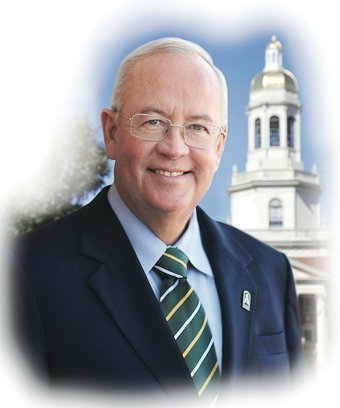
Baylor University President Kenneth Starr

I know the BGCT is focusing on the demographics of Texas and therefore the demographics of the changing church, and we at Baylor want to be a part of that conversation, working collaboratively as we try to be very intentional in furthering these areas of mutual interest and concern.

Also, one of the things I believe is important is the work of Baptist life through such institutions as Buckner in providing opportunities for worldwide service. So many of our students—69 percent—come from non-Baptist backgrounds. The strength of Baptist life includes the ability to tap into this vast reservoir as opportunities for service, and I use Buckner as a specific example. One need not start an orphanage in another country. If one is called to do that, it is wonderful, but there are already so many existing opportunities for service, which our students already avail themselves of, literally around the world. And that’s one of the great strengths of connectional community that is Baptist life.

So, I lift that up as a new member of the Baptist community and someone who comes out of the nondenominational world as being a very powerful strength and therefore attraction of being integrally involved in Baptist life. Baylor needs to lift that up. It’s one of the things I lifted up to the BGCT leadership and the Buckner leadership is that I view the earliest days on campus as an opportunity for this largest Baptist university in the world to educate everyone—but especially the almost 70 percent of the student body—as to the vibrancy of Baptist life.


When you moved to Waco, you made good on a promise to join a Texas Baptist church—Columbus Avenue. What are the commonalities and differences between the church where you are a member now and your previous congregation in Northern Virginia, which was so important in your life?

Right, McLean Bible. Theologically, none. And in terms of the form of worship, Columbus Avenue has two services—one a more traditional service, which is pretty common, and then the second service is with a praise team and more focused on the college community. We enjoy that second service. I mean I love a traditional service. And so, other than the obvious changes of the set and so forth, the music and, frankly, even the style of preaching of Brian Dunks, the senior pastor of Columbus Avenue, is very similar to what I am accustomed to at McLean Bible Church.


You were very involved in ministries of the congregation before. Have you had a chance to see how you will be able to plug in at the local-church level? I know you will be traveling.

That remains to be seen. I have been away about 50 percent of the time, plus it was over the summer. That remains to be seen.


When you became president of the world’s largest Baptist university, you were the first president who didn’t have a Baptist background. What does your election say about the future of Baylor and the future of its religious identity?

I’m not sure I’m the best one qualified to opine on that. It is a fact that 70 percent of our entering students come overwhelmingly from Christian households but not necessarily from Baptist congregations. Baylor has long been a very welcoming place for everyone. So, I suppose there is some indication that Baylor welcomes to the senior leadership those who were not previously in denominational life.

But it is important, and I reflected prayerfully on this, for the president of Baylor to be very intentionally involved in Baptist life, including, most fundamentally, being an active member of a Baptist church. So, I treasure that. I honor that. When I would travel, I would frequently find myself attending a Baptist church. First Baptist Church of Whatever … First Baptist Church of Orlando. First Baptist Church of Richmond. And I could keep going. I’ve always felt very theologically and in terms of the style of worship comfortable in the Baptist community. So, it was not, for me, a large step—theologically or in forms of worship.

I certainly have always embraced the free-church tradition and what has been much more developed theologically in Baptist life—soul competency. There have been more centuries of reflection about these fundamental theological dimensions of our lives—individual conscience, freedom of religion, soul competency. The great traditions of the free church have been more carefully thought out in Baptist life than they have in the denomination in which I grew up, the Churches of Christ. It’s not that there has not been an intellectual tradition of theological reflection. But it has been richer and deeper in Baptist life.

I am a student—I still have much, much to learn—of the American founding. And I have long appreciated the role of Baptist pastor John Leland in helping shape the views of James Madison. And the fact Baptist pastors would find themselves tossed into jail in Virginia was a great source of outrage to the somewhat religiously challenged, theologically challenged (Thomas) Jefferson but also to Mr. Madison. They did not like the fact there was orthodoxy that was enforced through the arm of the state quite apart from religious exactments and so forth. And so the “Memorial and Remonstrance” that Mr. Jefferson and Mr. Madison championed in Virginia is all tied to Baptist life in Virginia, and that’s part of Baptist history on which I grew up as a young lawyer and student of the constitution. And so these things have been very precious to me.


Does your study of history and of constitutional law synchronize with that aspect of the Baptist heritage?

Well, Mr. Jefferson’s famous letter to the Danbury Baptists, which used the separation of church and state metaphor, was responsive to the concern that was very powerful at the time of the continuing establishments, soft though they were by that time, of state religions. And Massachusetts, of course, eradicated its establishment only in 1833. Of course, it was Massachusetts that essentially drove Roger Williams (founder of the first Baptist church in America) into Providence Plantation. All of this is the air that I breathe as a student of our constitutional history and the history of freedom in America.


There’s been a difference among the “Baylor family,” not so much about whether Baylor would remain a Christian university, but particularly given the leadership of the regents and some of the other parts of the Baylor constituency regarding what kind of Christian university Baylor will be. How will you lead Baylor in light of those somewhat similar and somewhat competing ideologies?

I’m still listening and learning, and I still have a lot to learn. But one proposal that I’m currently very enthusiastic about is the creation of—and no final decision has been made—the Institute for Baptist Studies.

To me, being new to Baptist life, it seems vitally important for Baylor deeply to honor (the Baptist tradition) in a living way. Not simply to have a Founder’s Day ceremony or whatever … . But how can we be purposeful and intentional now? Our (Truett Theological) Seminary is a shining example of a commitment to having true excellence in the training of the pastors of tomorrow. So, I love being with the Truett family, learning from the Truett family, finding out how I can encourage them. I’m not burdened with theological training, and I long since learned to have an attitude and respect and deference, not blind deference, to those who have. I look to the leadership of (Dean) David Garland when he returns, and the acting dean: “You guide me. How I can encourage? What do we need to do to build our relationships with Baptist life, and make sure we are honoring it scrupulously and deepening that?”

I do not have a 10-point plan of action at this stage.


Do you feel Baylor can be a university of which both groups from the ends of that spectrum can be proud simultaneously?

I would think so. I personally, new that I am, see no impediment or obstacle to that as we see by virtue of the fact that the children of multigenerational Baylor families, deeply committed to their Baptist church, are very comfortable here, as are folks from nondenominational Christianity or other denominations.

I think that’s true of the faculty as well.


What are the strengths and most important goals of Baylor 2012 (the university’s 10-year master plan)? And if you see any, what are its weaknesses?

A number of core convictions and foundational assumptions have emerged out of these many years of conversation that long preceded the conversations that gave rise to 2012. And, happily, as we’re beginning the process of looking at our next strategic plan—and that process has begun—we need to know where to begin. Where do we begin?

Well, we begin happily—and here there seems to be a very powerful sense of consensus within our community—with those core convictions, with those foundational assumptions. Then, from a very practical sense, from the unifying academic themes that flow out of the foundational assumptions and the core convictions. And the unifying academic themes—there are six—begin with “Because we believe … .” That is an extraordinary achievement for a university, for any university. It’s a towering achievement for a national research university to honor both the discovery dimension of the intellectual life as a scholarly community but also that honors deeply the tradition of caring for the eternal welfare of each and every student and manifested, therefore, by the tradition of great teaching.
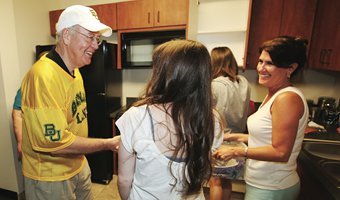
Wearing his Baylor Line jersey, Baylor University President Ken Starr welcomes new students to the Waco campus. (PHOTO/Robert Rogers/Baylor University)

So, we seem to be at a point in Baylor University’s history where there is consensus on the following: One, great teaching is absolutely non-negotiable. For one to be a tenured member of this faculty, one must be a great teacher. Secondly there must be a balance, so that discovery—which we are called upon to do by the Parable of the Talents, we are to use our intellectual gifts to understand more fully God’s world, and to seek out a deeper understanding of truth. And that includes, of course, ways of research that help a hurting world. Thus, part of the research activity that makes the entire Baylor community extraordinarily proud is our work in biology and biochemistry that’s working to heal people. That’s working to help poor people in remote villages of Africa and Asia to live a better life. It’s living out the gospel life. It’s healing the sick. It’s attending to the needs of the needy. This is the kind of academic inquiry that we honor and cherish.

And it’s always been a part Baylor life. Research has always been there. Long before I was alive, research was going on—and this I know—at Baylor University. It’s a question of balance—as long as we don’t in any way compromise the commitment to great teaching and caring about the students.

So, that may have been a concern that I believe experience teaches us that our culture of great teaching and mentoring and caring holistically about the student, including the student’s spiritual welfare. We’re not going to compromise that. That is non-negotiable—the caring about the student. If you talk to students, as I now do daily, that is one of the reasons they were drawn to this place and why they so love this place. Beginning on Day One with Welcome Week when they move in, they are welcomed with the great spirit of hospitality that—if not uniquely, certainly strongly—characterizes the Baylor experience. And none of that has been the slightest bit compromised by the very spirited conversations that have gone on in the past. Great commitment to caring about that individual student as soon as she arrives on campus.


So, is the principle of integrating faith and learning or faith and intellectual excellence achievable for Baylor?

It’s time for us to find new ways of expressing a commitment to academic excellence within a Christian community. Even the term “integration of faith and learning” actually comes out of the Reformed tradition. I’m not unfamiliar with some of these traditions by virtue of my involvement in Christian education. It is important for us to enlarge the conversation and to ensure everybody is invited to the metaphorical round table. There have got to be different ways and different disciplines of serving the Master—of being a person who is in the kingdom, seeking to further and foster the purposes of the kingdom. Sometimes, nomenclature can get in the way.

I would like, as best we can, to enjoy what has been true for many, many months now—including under the inspired leadership of (Interim President) David Garland—a sense of community, the achievement of a living embodiment of the Baylor stated mission of a caring community that cares about everyone. That doesn’t mean everybody’s going to agree, even on particular methodology and the like. But we have agreement on the basics. And that is, here’s our mission: We’re a Christian university. We honor our Baptist heritage. We create a caring community. And we seek academic excellence and excellence in all things in that context.


All of this has been part of the discussion, in part, between the university and its administration and the Baylor Alumni Association. Do you see pathways for restoring that relationship between the university and that one very active part of the Baylor family?

I have a very warm relationship with the president of the BAA, Emily Tinsley. I know a number of the members of the board. At the same time, there are great challenges in terms of rallying all of our alumni around the university. The single biggest challenge is improving the extent of alumni participation in financial support of the university.

I was chatting with our new Cherry Professor, who hails from Williams College, and he expressed shock that the percentage of alumni giving—not dollars, but percentage—at Baylor University is below double digits, 6.8 percent. He expressed shock: “If there’s such love for this institution, what’s happening?” And I said, “Well, I’m looking into that.”

It couldn’t be my initial priority. I had the Big XII and just getting to know folks and thinking about getting a strategic planning process under way, welcoming the students.

But right now for the fall, very high on my agenda is thinking through: “Why is that? Why is the percentage of alumni giving at 6.8 percent?” As I travel around for send-off parties, … we hug on the students and say, “You’ve got to go to Line Camp and go to Independence and get your Line Camp jersey” and emphasize and trumpet the great traditions of Baylor University. People are all excited. And the parents all (say): “My grandparents went there. I went there.” And then I come back and see what’s going on here: Six point eight percent giving.

So, that’s very high on my agenda: How can we all, in a spirit of unity and loving the institution—whatever different views might be—find ways we can come alongside the university?

One of the reasons I feel so strongly about that is that we have had this extraordinary growth of programs and the like, but frankly on the backs of the students by raising tuition. And we can’t keep that up. … That I knew when I came in on June 1, when I looked at the (financial) model: This must stop. This being this kind of tuition increases. We may not be able to do it for a year or two years, but we’ve got to find a totally different model of financing higher education here at Baylor University.

And you know who’s going to help us do that? The alumni—144,000 alumni. So, we’ve got to find that way to bring everybody in to really engaging. I’m very excited about that, and look forward to everybody growing together and staying focused on what we need to stay focused on to build the university.


Ironically, did the Big XII crisis—which happened your first day on the job—give you hope because everybody in the Baylor family was pulling in the same direction?

Amen, and hearty amen again. That was, to draw from Mr. Churchill, “Our finest hour.” If there were any swords, they had all been beaten into plowshares. And then this mighty army of alumni and friends, thanks to social networking, … . They were there. And so when we called upon the mighty Baylor Nation, small in number, to rise up, it was Gideon’s army. The nation rose up, and it was a joy to behold. … We had war rooms for this mighty battle.

But this is part of, it seems to me, why Baylor is unique. We are the only private institution, the largest Baptist university in the world, in the Big XII. We kept talking about the student athletes. Why are we talking about what (women’s basketball) Coach Kim Mulkey called “the almighty dollar,” when we should be talking about the student athletes and their well-being? Do we want them taking red-eyes from Washington state and Oregon to come back to Central Texas to attend class? And will they be in any condition to be the student we want them to be? Are they going to be falling asleep in chapel because they were on a red-eye two nights before and haven’t been able to recover?

That’s what (Athletic Director) Ian McCaw, our board of regents, all the university’s servant leaders, our coaches were talking about—student athletes. So, others may have been talking about other things. “Judge not that you be not judged.” We were talking about student athletes.

We know who we are. We know what’s important to us. And because we are Baylor, we talked about the student athletes. That resonated. It was a moral voice; call it a sermon. It was a moral voice that resonated with the Baylor Nation, but more than that, it started resonating with the people of Texas, including the legislators.


When you were selected, some people were somewhat alarmed because of your background in politics, and others pointed to the diversity you brought to Pepperdine. What will you do at Baylor in terms of campus culture, as well as administrative actions and faculty appointments to encourage diversity—political, philosophical as well as theological viewpoints?

First, what’s the role that I am to play? I view the role as that of an encourager. As I shared with the advisory committee and the search committee, my model in terms of servant leadership is (the New Testament missionary) Barnabas. He was not the head of a nonprofit, but he was an encourager. He was a “son of encouragement.” … So, you tell me, how can I encourage? How can I help?

Well, one of the ways I can encourage is to be energetically engaged. So, I think you will find that at every turn, that as I tried at Pepperdine, I will be energetically engaged in building. I am always trying to do something that is constructive.

That’s one of the reasons that if someone wants to engage me in theological debate, I’ll say: “I’m ill-equipped to even enter the conversation. Let’s talk about building Baylor.” If someone says, “Well, what about this issue that’s going to come up at the X convention?” I’ll say: “I’m sure it will be a lively and productive debate. Let’s talk about Baylor and building Baylor.”

And so I hope something I can bring is the experience I’ve had in higher education. While I’ve had this life in the law, I’ve always been involved in higher education. I’ve served on boards of trustees of American University, of Shenandoah University. I’ve served on boards of visitors of different institutions that have permitted me to come into the company of the leadership of the universities themselves. I’ve been privileged and blessed to have mentors over the years who are renowned presidents of different universities. So I bring an energetic commitment to encouragement, and that’s what I would like to be on the epitaph: “He may not have been very smart. He may not have had a Ph.D. He may not have been a cradle Baptist. But he sure was out there encouraging us at every turn.”

That’s what I tried to do at Pepperdine University, and that’s what I’m trying to do now—making sure that I am energetically engaged to be encouraged and thereby to build.


Hurricanes’ damage, rebuilding left lasting mark

BEAUMONT—Five years ago, a Category 3 hurricane made landfall along the Gulf Coast, displacing thousands of people and causing billions of dollars in property damage. But many outside the region fail to recall the disaster, because it occurred less than a month after an even larger catastrophe.

Hurricane Rita hit Southeast Texas Sept. 23, 2005—three and a half weeks after Hurricane Katrina struck south Louisiana and the levees failed in New Orleans.

Sabine Pass bore much of the brunt of Hurricane Rita when it hit Southeast Texas five years ago. (FILE PHOTOS)

“Our association was still housing and helping Katrina evacuees when we had to evacuate because of Rita,” Dion Ainsworth, director of ministry and evangelism in Golden Triangle Baptist Association, recalled.

Hurricane Rita was one in a series of calamities that tested the faith and resilience of area churches. Hurricane Ike in 2008 and ongoing economic struggles in the region also offered significant challenges, Ainsworth noted.

“A lot of people became burned out and overwhelmed by it all,” he said, noting the continuing cycle of relief, recovery and re-building followed by an-other disaster—and the ever-present threat of an-other hurricane—took an emotional toll on Christians in the area.

“We’ve seen some pastors leave, at least in part because they did not want to endure another hurricane,” Ainsworth said.

Some churches lost members—particularly senior adults whose children insisted they move upstate, away from the threat of hurricanes, he noted. Due at least in part to losses from Rita and Ike, more than one congregation found itself unable to provide full salary for its pastor. Bivocational ministers now serve several of those churches.

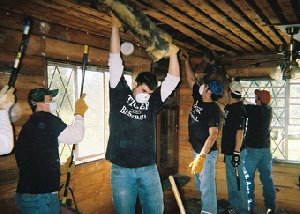
East Texas Baptist University Tiger baseball team members, (left to right) Trevor Stagner of White Oak, Lane Ellzey of Kountze, Michael Ross of Tyler, Hunter Howard of Lake Dallas and Joey Cross of Celina, tear down a ceiling in a home damaged by Hurricane Rita in Sabine Pass. Like other groups from around the state, the ETBU baseball team and the Pi Sigma fraternity spent time in Southeast Texas assisting in recovery efforts after Hurricane Rita. (PHOTO/Courtesy of ETBU)

On the positive side, Ainsworth pointed to the cooperation among churches that grew out of relief, recovery and rebuilding efforts, as well as the birth of the Nehemiah’s Vision ministry and the hands-on involvement it helped facilitate.

After Hurricane Rita, some areas went without electricity six weeks. But power was restored at Woodland Baptist Church in Beaumont within about a week, enabling the church to be used by incoming disaster relief teams. Similarly, Westgate Memorial and Calvary Baptist churches in Beaumont housed multiple teams.

“Our church was not hit hard, but a quarter of a mile away, the steeple fell off a church, leaving a hole big enough to drive a bus through,” Pastor Jim Sliger of Woodland Baptist said.

He recalled becoming disoriented in his own neighborhood at night when he returned after the hurricane.

“It looked like the end of a Godzilla movie,” he said.

But the presence of Texas Baptist Men disaster relief volunteers and other Christians who served the area provided a calming influence, Sliger noted.

“The people in our community asked who these people were, and they couldn’t believe some of them had come so far to help—at no expense to the people here,” he said. “To see them extend a helping hand was so beautiful.”

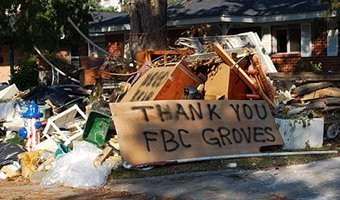
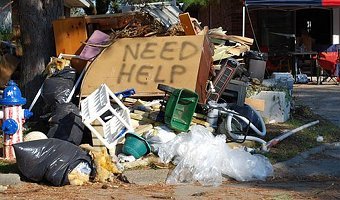
Residents of Bridge City who spraypainted “Need Help” on piles of trash outside their homes found much-appreciated assistance from Mid-county Kindness, an areawide initiative launched by First Baptist Church of Groves. (PHOTO/Courtesy of First Baptist Church of Groves)

Three years later, when Hurricane Ike devastated Bridge City, churches on the opposite side of the flood-swollen Neches River offered a helping hand to a neighboring community.

“We had some wind damage here, but nothing extensive. But across the bridge, 95 percent of the homes were flooded,” Pastor Joe Worley of First Baptist Church in Groves recalled.

Churches sent small teams to Bridge City to assist with immediate relief and some early recovery efforts.

After one workday, a layman at First Baptist in Groves approached Worley with the idea of a more concentrated mobilized response—a one-day effort to involve residents of Nederland, Port Neches and Groves in hands-on service to the people of Bridge City.

“It went from his vision to execution in 13 days,” Worley said.

Organizers spun their “Mid-county Kindness” event off the traditional “Mid-county Madness” football rivalry between Port Neches-Groves High School and Nederland High School.

Some Bridge City residents publicly expressed their appreciation to their neighbors across the river who helped them as part of Mid-county Kindness, an initiative birthed in the heart of a layman at First Baptist Church of Groves. (PHOTO/Courtesy of First Baptist Church of Groves)

The game—scheduled for a Saturday that year—became the platform to promote a Sun-day of service the next day.

“Fans on both sides of the stadium wore Bridge City red that night,” Worley said.

Those red T-shirts became the uniform to help Bridge City residents recognize volunteers the next day.

“A lot of churches scheduled early services on Sunday, and then people left to work a six-hour time slot in Bridge City,” he said.

Volunteers from First Baptist Church in Groves provided maps, directions and general oversight to the project, but organizers tried to simplify the operation as much as possible.

“We tried to cut through the red tape,” Worley said.

“The process for requesting help was simple. We told people to gather up their trash—everybody had plenty of trash—put it in front of their houses and spray paint on it, ‘Need help.’”

The daylong effort involved churches across denominational lines, local businesses and other community groups.

“We even had a group of Buddhist businessmen who showed up, and we put them to work,” Worley said.

Volunteers made an estimated $1 million impact on the community.

“But there’s no way to measure the full impact,” Worley added, recalling the spirit of cooperation created.

“It was a God thing.”


House of Hope provides safe harbor for shipwrecked lives

TRINITY—Pastor Jim Parrish’s church and its ministry to women both offer the same thing, and they put it right on the sign out front—hope.

People at Burning Hope Baptist Church know all too well their need for a better way, Parrish said.

“What we are is a New Testament church that has grasped what the Bible says—‘go into the hedges and byways.’ That’s what we do, and that’s why we are a hedges and byways people,” he said. “We’re basically a safe harbor for wrecked ships.”

Lisa Stewart (left), administrator of House of Hope in Trinity, and her assistant, Rebecca Dowers, understand first hand the importance of providing a place of refuge where women with substance abuse issues can find support in a Christ-centered context

Parrish retired from the Texas Department of Criminal Justice after 22 years and still works part-time for the prison system in Huntsville two days a week. His wife, Anita, has worked extensively in restorative justice ministries.

“One of the things I saw in working in the prison system is that when (inmates) get out, they need some place to go. They need someone to turn to and come around them as a support system,” Parrish said.

Burning Hope has tried to offer that support. The church operates a soup kitchen twice a week. It began Third Cross, a Christ-centered 12-step program that ministers to people with various addictions.

Burning Hope also launched the local Loaves and Fishes food pantry, but that now is a communitywide program supported by several churches.

“We didn’t want to be a traditional church. We wanted to be a ministry that included a church,” Parrish said of his congregation that numbers about 140 each Sunday morning.

“Then about four years ago, God said, ‘What about women?’” he said. That question marked the beginning of House of Hope, Burning Hope’s ministry to women whose lives have gone off track.

Parrish approached a Methodist layman in Trinity who owned a shell of a house. Parrish told the man if he would let the church use the house, members would finish the inside.

Now women flock to the home to get their lives together—spiritually and otherwise. They live together, study the Bible together, pray together and serve together. They also receive health care, clothing and food.

Lisa Stewart became the ministry’s administrator in January 2008, soon after she was released from a rehabilitation center herself, recovering from alcoholism. In the beginning, the ministry used the house for group meetings and classes, but women were referred to other long-term recovery centers.

Now the classes continue, but women also live there. They also attend Third Cross meetings, and faith-based counseling is available to them.

“All our classes are centered around Christ and the love and grace and mercy that he has for us,” Stewart said.

Rebecca Dowers, assistant house administrator, likewise came to House of Hope after battling an addiction and several years living on the streets.

She came to the house in Trinity after four months of sobriety from her crack cocaine addiction, on referral from the Good Shepherd Mission in Huntsville.

Both women agreed—the support women receive from their relationship with Christ and from the church sets House of Hope apart from secular programs.

“Addiction is a symptom of something else that is wrong,” Dowers said. “This program is about taking the word of God and showing people how to live and have a better way of life. It teaches them how to protect themselves from the things they were led into and that they were trapped in—to deliver them from that lifestyle and to show them a better way.”

That includes showing each woman that God has a purpose for her life, she continued.

“So, we want to focus not on just the emotional issues of each individual woman, but also the path God has for that woman and help her get on that path before she leaves this house,” Dowers said.

Both Stewart and Dowers said they had grown up in church, but they had not realized God’s care for them.

“A lot of times, people who are going through addictions and are living that way have some misunderstandings about God. They’ve had a lot of people tell them about God’s love but not show them God’s love,” Dowers said.

Every woman who has participated in the House of Hope ministry has made a profession of faith in Christ, she reported.

While the small house in the rural community does not have excess resources, “God always provides—sometimes the day before we need it,” Dowers said.

She envisions a day where more people will be helped—both men and women.

“We don’t want to change the home environment, but we know more people have needs. And as God blesses the ministry, we will build more houses. And we’ll have many houses instead of one,” Dowers said.

“I believe that Jesus Christ is the answer for drug and alcohol addiction. … I believe if we can work as God leads us to help the individuals we come into contact with that this will be a revival.

“This is not a simple program. This is practice. We’re practicing what God has given us. We’re reaching out and helping those that no one wants.”

The House of Hope ministry follows the example Christ gave, Dowers said.

“In Luke, he said: ‘I did not come for the healthy. I came for the sick. I did not come for the religious, but those who know they are a sinner,’” she said.

“There was not one person that I knew living on that street who didn’t know that they needed a change, but they had lost all hope in trying to find it.

“The message they had been given was not the message that I have received. The one I have received has changed my life, and he’s changed Lisa’s life. And one person at a time, it’s growing.”

The other women at the house have found that same message of hope.

Another Lisa now living in the house was homeless on the streets of Houston more than six years before coming to House of Hope a little more than two months ago. That time of sobriety is the longest she’s had—without be-ing incarcerated—in more than 38 years, she said.

“From the min-ute I got here, I’ve felt a sense of belonging. It’s called House of Hope, and this is my family now. This is my home,” she said.

How long she will stay at the house is not predetermined. The program lasts six to nine months, but a timetable is not the deciding factor.

“We don’t want them to leave because they’ve finished their six or nine months,” Dowers said.

“We don’t want them to leave this house until they’re in a good situation and we know that God has gone before them. We’re not rushing them out the door.

“When someone comes here, they’re here because God brought them here. This is his house. He decides when they leave.”


Does gay debate mirror church dispute on slavery?

WASHINGTON (RNS)—One group of Christians confidently proclaims that a plain reading of the Bible is a slam-dunk in their favor. The other side appeals to Scripture’s grand narrative toward freedom and inclusive love.

The argument boils over and ripples through the wider culture.

The search for middle ground proves futile. Denominations break apart.

Sound familiar? It could be 2010—or the mid-19th century.

Abolitionists and slavery supporters, seen here in an 1856 political cartoon mediated by former President Millard Fillmore, both appealed to the Bible for justification. Many see inexact parallels between the fight over slavery and modern church fights over homosexuality. (IMAGE/RNS/Courtesy Library of Congress)

As churches and denominations in the United States slog through divisive and long-running arguments over homosexuality, many Protestant progressives have sought to claim the historical and moral high ground by aligning their cause with abolitionism.

“I think almost everybody who makes the liberal argument about homosexuality makes the connection with abolition and slavery,” said Jeffrey Krehbiel, a Washington, D.C., pastor in the Presbyterian Church (USA) who supports gay rights.

Abolitionists, he said, “were the first to make the argument that the plain reading of the text maybe isn’t the most fruitful way to read the Bible.”

But while there are striking parallels between the slavery and homosexuality debates, historians caution that important differences emerge upon close examination.

In both eras, cultural trends forced Christians to question practices that long had been taken for granted, said Mark Noll, a professor of American religious history at the University of Notre Dame and author of The Civil War as a Theological Crisis.

Likewise, the Bible, and how to interpret it, has played a central role both then and now, Noll said.

In the 19th century, even some Northern abolitionists concluded the Bible condoned slavery.

Many, therefore, sought other sources of morality and methods of biblical interpretation; conservatives countered that such appeals undermined the power of the sacred text.

As conflict heated up, Noll writes in his book, slavery’s defenders increasingly saw “doubts about biblical defense of slavery as doubts about the authority of the Bible itself.”

As with slavery, few Christians are neutral on homosexuality.

“Like the situation in the 1830s and ’40s, once a certain kind of heat is generated, it becomes really hard to talk through these various kinds of debating strategies and implications,” Noll said.

Methodists, Presbyterians, Baptists—and to some extent, Episcopalians—all split over slavery, mainly along the Mason-Dixon Line. Some reunited decades later. Baptists re-main apart to this day.

Likewise, in the last few years, a number of mainline Protestant congregations have parted with their denominations over homosexuality, although in far fewer numbers than during mid-19th century splits.

But the exodus may not be over. For example, conservative Presbyterians and United Methodists have threatened to leave en masse if their denominations decides to allow gay clergy and same-sex marriages.

“The parallels to the contemporary debate are fairly striking,” said Mark Valeri, a professor of church history at Union Presbyterian Seminary in Richmond, Va.

“You have a long-simmering moral dispute that heats up an ecclesiastical and political question, which results in a division.

“And the question is, when the division creates branches, how courts adjudicate those disputes.”

But there are key differences between the disputes over slavery and homosexuality, some historians say.

For instance, many conservatives say that it is not simply the gay issue that is driving them out the door, but a long liberal trend in mainline denominations that stretches back 30 years or more.

Second, Scripture shows only a grudging tolerance of slavery, a far cry from its ringing endorsement of heterosexual unions, argues Robert Gagnon, an associate professor of New Testament at Pittsburgh Theological Seminary.

“What kind of legitimate analogy can be made between the two? In my opinion, absolutely none. It’s just night and day,” he said.

Moreover, what seem like similar clashes over biblical interpretation can mask the role of self-interest in the debates.

Southern plantation owners—and the pastors they built churches for—had a huge financial stake in the slavery debate, said Charles Irons, an assistant professor of church history at North Carolina’s Elon University.

Today, it is not easy to see where the financial—or political—advantage lies in supporting or opposing gay rights, he said.

There’s one final—and significant— difference. Noll notes the theological crisis over slavery ultimately was decided politically by generals and armies.

Almost everyone agrees the homosexuality debate more likely will be settled by judges and lawmakers.


Faith, fear clash in middle Tennessee over proposed mosque

MURFREESBORO, Tenn. (ABP)—Mike Smith, pastor of First Baptist Church in Murfreesboro, Tenn., received an anonymous letter this summer asking him to warn his congregation that a proposed new mosque near the city was part of “a long-range plan to destroy Western civilization as we know it.”

Hundreds gathered to sound off on a proposed Islamic Center in Murfreesboro, Tenn.

Since he didn’t know who sent the letter, he decided to respond publicly in his personal blog.

“I’ve never had much use for anonymous letters, but this one got under my skin,” he said in part. “To tell the truth, the letter saddened me. It’s not every day I find so much fear and miscomprehension packed into one page of type!”

Fear and faith have divided residents of this rapidly growing community 30 miles southeast of Nashville—previously best-known for its role in Civil War history and as home to Middle Tennessee State University—since the Islamic Center of Murfreesboro bought roughly 15 acres of land last November to build a mega-church-style mosque facility just outside the city limits.

Permitted under a state law enacted in 2009 to make it easier to build churches without interference by local zoning boards, the action set off a wave of protests from citizens voicing concerns ranging from traffic and environmental impact to where a relatively small Muslim community expects to receive funding for a 53,000-square-foot complex that eventually would include a new mosque, multipurpose and educational facilities, gym and athletic fields.

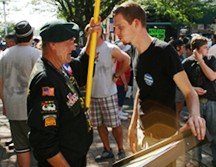
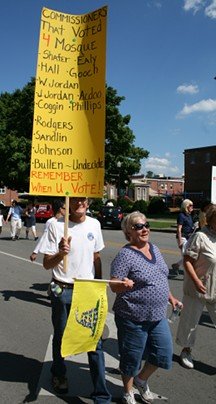
Supporters and opponents of a proposed mosque in Murfreesboro, Tenn., face off. (PHOTOS/Bob Allen)

“To go from a small operation to a massive complex, it certainly gives one rise to question where the funds for such an operation occurred,” said Dusty Ray, the pastor of the independent Heartland Baptist Church. “From the numbers that they say that they have, it makes one wonder what the actual intent is, and because of the history involved and the thousands of years that we have to study on this, we do certainly, I think, have reason to be concerned.”

Since a similar controversy arose in New York City over construction of the so-called Ground Zero Mosque, Murfreesboro’s mosque controversy has received national attention. In mid-August, televangelist Pat Robertson weighed in on The 700 Club.

“I don’t think we should interfere with the free worship of God by any group, but ladies and gentlemen, this isn’t just religious,” Robertson said. “It just isn’t. You mark my word, if they start bringing thousands and thousands of Muslims into that relatively rural area, next thing you know, they are going to be taking over the city council. Then they are going to be having an ordinance that calls for public prayer five times a day. Then they are going to be having ordinances that there have to be facilities for foot-washing in all the public restrooms and all the airport facilities.

“Before long, they are going to demand, demand, demand, and little by little, the citizens of Murfreesboro or whatever little town it is are going to be cowed by these people—not to mention their ability to bribe folks. I don’t know whether anybody’s getting a payoff, but it’s entirely possible.”

Controversy over issues like building the Islamic Center bring out a range of opinions, many based on fear.

Another segment on the same program interviewed opponents of the Murfreesboro mosque.

“It does seem to be part of a larger strategy to build large mosques in rural areas and create Islamic communities, large Islamic communities, in rural areas for some larger purpose,” said Rebecca Bynum, publisher for New English Review and formerly news editor and board member of Jihad Watch.

Laurie Cardoza Moore, president of the pro-Israel group Proclaiming Justice to the Nations, offered an explanation of what makes Murfreesboro attractive to Muslims.

“We have the Bible book publishers,” she said. “You have Christian book publishers. You have Christian music headquartered here. So, this is where the gospel message goes out.”

Later Moore was interviewed on Comedy Central’s Daily Show.

“This has nothing to do with religion,” she said of the mosque controversy. “It’s about stopping the advancement of radical Islam in the United States of America.”

Muslims “believe that Jews and the Christians are the infidels and they are, according to the Quranic teachings, supposed to be killed,” she said.

Moore went on to claim that “Islam is a political system of global domination,” that 30 percent of Muslims are terrorists and there are already 35 training camps in America.

“We know we’ve got a huge terrorist network here in Tennessee,” she said. “The Nashville Islamic center appears to be the mother ship.”

While heated, most of the debate so far has been civil, but there have been acts of violence.

In January, someone vandalized a sign at the future mosque site by spray painting it with “Not Welcome.” The Islamic Center of Murfreesboro labeled it an “effort to gain publicity and sway public opinion towards stereotyping views against Muslims.”

A second sign vandalism occurred in June, when someone slashed the sign reading “Future Site of Islamic Center of Murfreesboro” in two.

Early Aug. 28, four pieces of heavy construction equipment on the site were doused with accelerant and set ablaze. Federal officials are investigating the suspicious fire as a possible hate crime.

“It’s still a little mind-boggling,” Camie Ayash, a stay-at-home mom and the mosque’s spokesperson, told Time magazine. “It seems like the community is very accepting of us as individuals; when I take my kids to school, I don’t run into any prejudice because I cover my hair, but the concept of Islam overall makes people nervous because of 9/11.”

Smith, the pastor of First Baptist Church, reminded his congregation their Muslim neighbors are U.S. citizens entitled to freedom of religion, and Christians should treat all people, including those of other faith traditions, with respect.

“Our nation is at war with terrorists, wherever they may be found. We are not at war with a religion,” Smith wrote.

“Christianity is not at war with any other religion. Instead, we are called to minister to others through prayer, worship, teaching and good works. We should trust God with the world and seek only to be faithful in the tasks God has given us.”


Living in the midst of fear challenging but possible

RICHMOND, Va.—Peaceful living in a fear-provoking environment is challenging, even—maybe especially—for Christians. The unpredictable 21st century isn’t likely to settle down any time soon.

Church leaders suggested several ways Christians can confront fear.


Evaluate information wisely

Verify statements such as mass-distributed e-mails and confront the senders if they aren’t true, said Derik Hamby, pastor of Randolph Memorial Baptist Church in Madison Heights, Va.

“False e-mails are forwarded with no fact checking. When you receive one, don’t just delete it. Look up the story, and if it is false, share in love that it is. When unkind comments are made, look for teachable moments to address the group targeted,” Hamby said.

“Take a sabbath from technology,” said Bill Shiell, pastor of First Baptist Church in Knoxville, Tenn. “Watching the Weather Channel all day only makes you afraid of storms. Not every ‘breaking news’ story is newsworthy. Read Snopes.com (a fact-checking website) before forwarding e-mails.”


Counter the culture

“Start a conspiracy of kindness,” Shiell said. “For every rumor you hear about a politician, public figure, minister or church member, do something kind for someone else secretively. Spread rumors about how great someone is.”


Maintain spiritual disciplines

“The tried and true spiritual practices of prayer, worship, Bible reading, hymn singing and giving away our possessions in tithes and offerings remind us that our faith is good news after all,” said George Mason, pastor of Wilshire Baptist Church in Dallas. “We will only experience freedom from fear when we are exercising our faith in the face of it. We can’t say we believe and then pull back our hearts and gifts in acts of self-preservation.”

Shiell encouraged increased church involvement. “One of the greatest witnesses and testimonies we demonstrate to the world is by going to church, giving generously and living obediently,” he said. “Our behavior counteracts all fears.”


Be transparent

Being open about fears can reduce their power, Hamby said.

“Talk about specific fears in open forums where people can talk about them,” he said. “Encourage folks to name ‘the elephant in the room’ and why they are afraid. … Name the fear. Put it out there. Make it a visible prayer concern.”

When changes in congregations provoke fear, take time to address it, Shiell suggested.

“Slow down those votes for change,” he said. “Most churches’ vote for change could be addressed with more time. Because people are living in fear, they get more upset about unnecessary things, especially at church. Allow more time for people to process things before votes.”


Confront the fear

Find a group that church members fear—such as another religion or ethnicity—and plan an activity with them, said Chuck Warnock, pastor of Chatham (Va.) Baptist Church.

“Carefully planned visits to local mosques or cultural centers can help others learn customs and practices that in the end are not so foreign from our own,” said Warnock. “Befriending Hispanic agricultural workers or offering English-as-a-Second-Language classes at church are ways to help, as well as to get to know those whom we fear.”

Shiell agreed, adding: “Following Jesus’ model with the woman at the well or with Zaccheus the tax collector, churches can build a relationship with someone their community is afraid of. Volunteer at a public school, and usually you can find an opportunity to learn more about the poor, minorities, immigrants, homosexuals, Muslims, sinners and saints.”


Speak out

Sometimes bolder measures are called for, Warnock said.

“Christians must lend their voices to rea-sonable conversations about differences in a pluralistic society because that is the right and ethical thing to do,” he said. “Love is a powerful force that can bridge great cultural divides, heal ancient wounds and bind people together with hope for the future.”


Be patient

“We need to show pity to people who are afraid,” Shiell said. “Sin creates unhealthy fear, and we are dealing with so many who do not know any other way to react. Patience and pity cause us to love the fear-monger. Most people spreading conspiracy theories are just crying out for attention and something to hold onto that gives them significance. You can replace all that with a listening ear.”


Trust God

“Remember that God has not been sur- prised by one world or local event yet,” said Shiell. “I learned that from my ninth grade Sunday school teacher.”


ETBU students bless adopted hometown through service projects

MARSHALL—First-time freshmen and transfer students at East Texas Baptist University volunteered their time for a community project day before they began attending classes.

The new students, who were joined by student leaders, went to two local elementary schools, two city parks and Texas Heritage Camp to provide the elbow grease for painting and general clean-up.

Incoming freshman at East Texas Baptist University scrape the swing set at Bath Miller Park in preparation to give the equipment a fresh coat of bright yellow paint. Before classes started for the fall semester, first-time freshman and transfer students devoted a Saturday morning to community projects in the Marshall area.

“We worked so hard today that our brushes are falling apart,” said ETBU Dean of Students Magen Bunyard, who supervised a group of about 30 volunteers at J.H. Moore Elementary. The day of community service was sponsored by the office of student affairs, Baptist Student Ministry and the Great Commission Center.

While at J.H. Moore Elementary, the new residents of Marshall braved the hot East Texas sun, scraping off the old paint on playground equipment to make way for fresh, bright paint. Students also gave a new coat of paint, using many colors, to spruce up a large map of the United States painted on the concrete of an outside play area.

“I chose to paint Alaska because I thought it might be cooler than painting Texas,” said Miss ETBU 2010 Andrea Dodd with a chuckle. Temperatures reached the 90s by midmorning as students worked.

Another group of ETBU students did similar work at Robert E. Lee Elementary under the watchful eye of a local resident. Inez Field was sitting on her front porch watching the students paint.

“I went to school at Lee,” said the lifetime resident of Marshall, who is 87 years old. “It is great that these college students want to help the students at Lee. I believe the elementary kids will look up to these college kids when they come back to help when school starts.”

ETBU has been invited by the principal of Robert E. Lee Elementary to come back to the campus during the school year. “We are very grateful for what the students are doing for the campus today,” Principal Matt Calvert said, as he watched ETBU students paint to improve the look of a swing set. “Since ETBU is so close to our campus, we want to see the students come back and just form relationships with our kids.”

“I see the ETBU students not only helping with homework but doing something as simple as eating lunch with a student, kicking a soccer ball, throwing a football or just reading a book. Anything like that, just to be with our kids, to show them that somebody else cares,” said the new principal and ETBU alum.

Shelby Robinson, a freshman elementary education major from Magnolia, had no problem giving up her Saturday morning.

East Texas Baptist University freshman Shelby Robinson of Magnolia puts a fresh coat of paint on playground equipment at Robert E. Lee Elementary during a community service.

“I grew up doing community service projects in my hometown with my high school,” she said while painting a swing set at Robert E. Lee Elementary. “I want to come back and help later because I like helping people in the community, showing them God’s love through service.”

“For me, community service is just part of being a Christian,” said Thomas Jacobs, a freshman education major from McKinney who wants to be a coach. “We need to show the world that we are not just talk, but we are also walking the walk.”

During the upcoming school year, ETBU will serve alongside Second Baptist Church to minister to the neighborhood that surrounds Robert E. Lee Elementary. The school is within a short walking distance of Second Baptist and just blocks away from the western edge of the ETBU campus.

The presence in the neighborhood will be called ETBU Cares. A block party at Lions Park, which is a Marshall city facility located very near Robert E. Lee Elementary, will be held Sept. 18.

The block party—featuring hot dogs, inflatables, crafts for kids and games—will serve as the kickoff for the cooperative partnership between ETBU, Robert E. Lee Elementary and Second Baptist Church.

“The block party we hope will help us initiate relationships and find ministry needs in the neighborhood,” said ETBU Baptist Student Ministry Director Mark Yates. “We hope to have a sustainable presence and a continual presence that will be significant.”


Christian counselors say they encounter discrimination over views on homosexuality

WASHINGTON (RNS)—When are religious views on homosexuality an issue of religious and academic freedom, and when are they discrimination? That’s a question raised by counselors and educators across the country.

Recently, a federal judge ruled against Jennifer Keeton, a student at Augusta State University who was ordered to either undergo “diversity sensitivity” training after she expressed conservative Christian views on the issue of homosexuality or leave the school’s counseling program. Her attorneys announced they are appealing the case.

Julea Ward was dismissed from Eastern Michigan University after she declined to counsel a patient in a homosexual relationship as part of her counseling degree program. (PHOTO/RNS/Courtesy of Gene Parunak/Alliance Defense Fund)

In March, a federal judge supported the Centers for Disease Control and Prevention in its dismissal of a Georgia counselor who ended a session with a lesbian client and referred her to another counselor because of her religious views.

And in Maine last year, a school counselor received complaints for appearing in a TV ad that opposed the state’s gay-marriage law.

As homosexuality becomes more acceptable in American society, some Christian counselors say they are being persecuted for their views as the pendulum, in their eyes, swings too far toward political correctness.

Professional groups, meanwhile, say counselors are duty-bound to be able to handle any number of cases, including those that present situations that might conflict with the counselor’s personal religious beliefs.

Julea Ward, a conservative Christian student at Eastern Michigan University, was a few credits away from finishing her master’s degree in counseling in 2009 when she was assigned a student who previously had been counseled about a homosexual relationship.

“She went to her supervisor and said, ‘I may not be the best person for this particular client,’” said Jeremy Tedesco, Ward’s attorney, who has advised his client not to speak publicly about the case.

Ward later was brought up on disciplinary charges and eventually was dismissed from Eastern Michigan for violating the American Counseling Association’s Code of Ethics and demonstrating an unwillingness to change her behavior.

On July 26, a federal judge upheld the school’s dismissal of Ward.

Her case will be appealed, said Tedesco, an attorney with the conservative legal firm Alliance Defense Fund, which has taken up at least four similar cases in the last year alone.

Tedesco thinks the appeal could take the case all the way to the Supreme Court, bringing the issue to further prominence.

“The judge here definitely got it wrong, in our opinion,” he said. “In my view, we’re going to see a trend of more universities doing this.”

Ward’s case and other similar ones have left some professionals wondering whether Christian views opposing homosexuality are compatible with the counseling profession and whether such views are protected under the auspices of religious freedom.

The question of how much students and professors should be allowed to express religious views that frown on homosexual behavior remains unresolved, but cases like Ward’s and others seem to indicate little tolerance for personal religious views within academia.

Students in psychology and counseling programs are subject to the American Counseling Association Code of Ethics instead of university rules that may allow greater room for academic freedom.

Ward’s legal team says the professional codes are unconstitutional and should not be a basis for discipline, especially at public universities.

“It’s a big difference between teaching a code of ethics and enforcing them,” said Tedesco. “Those kind of policies can’t withstand constitutional scrutiny.”

University administrators disagree, saying they have to abide by professional standards if they want their students’ degrees to be taken seriously in the workforce.

“We have to go through accreditation standards,” said Walter Kraft, Eastern Michigan’s vice president for communications. “We have to honor whatever guidelines might exist.”

Psychology and counseling professionals agree it sometimes is ap-propriate for them to deny their services, as Ward did—when there is a conflict of interest, a close relationship, or unchangeable bias. In practice, they say counselors and psychologists need to be as open-minded as possible, given the myriad of personalities they encounter.


Prescription for spiritual caregivers: ‘Physician, heal thyself’

DURHAM, N.C. (ABP) —Many clergy are caring for others but not taking adequate care of themselves, a recent study by Duke University revealed.

A survey of United Methodist ministers in North Carolina found them significantly more obese than their socio-economic peers in the general population. Ministers also suffered higher rates for chronic diseases like high blood pressure, asthma and diabetes.

"The condition of your body must be attended to … a little more …" —Charles Spurgeon

The lead author of the study, Rae Jean Proeschold-Bell of the Duke University Center for Health Policy, said mortality rates for clergy are lower than their nonclergy peers due to lower rates of sexually transmitted disease, accidents and suicide.

That creates a false impression that the restraint clergy exercise in other areas of their lives will carry over into things like diet and exercise, she observed.

Proeschold-Bell described “an urgent need” for health interventions in the United Methodist Church and possibly among other clergy to curb obesity and chronic disease.

“Churches and other religious institutions have often been viewed as structures in which to enact health interventions,” she wrote. “However, this study’s findings indicate that it is critical to improve the health of clergy themselves.”

Clergy are not immune from depression and anxiety, Proeschold-Bell said.

Because congregants put them on a pedestal and assume they have strong enough spiritual resources to handle it, many ministers are reluctant to admit feeling strain. That only adds to feelings of stress and isolation, she said.

Clergy-related issues participants indicated as having the greatest impact on their health included the ability to set boundaries, the perception that the minister is on call 24 hours a day, church health, itinerancy and financial strain.

Participants reported feeling overwhelmed by pastoral needs from congregants and community members and struggling to set boundaries in order to protect their time for self-care practices like exercise and family time.

Barriers to protecting their personal time included the ministers’ “own servant orientation” and expectations by the congregation that they be constantly available. Several noted the expectation of constant availability made it particularly difficult to take vacations.

Other barriers included the tendency of pastors “to put everyone else’s needs before their own and to have unrealistically high expectations for themselves.”

Participants also said unhealthy church dynamics had a large effect on their health.

Several common church situations—such as a small number of congregants opposing even small changes suggested by the pastor, feuding cliques of church members that polarize issues along group lines and one or more congregants who use intimidation or abusive tactics to oppose the pastor—all had significant impact on clergy stress.

One strength of the study, the first of its kind to compare the health of ministers with people of similar demographics in the general population, was the sample, researchers said.

All currently serving United Methodist clergy in North Carolina were offered participation, and 95 percent completed the survey.

Several participants discussed the importance of taking a Sabbath or spiritual retreat. Some mentioned “religious coping” with stress, such as one minister who reported realizing he was working too hard and “just putting my trust in the Lord and really believing that it’s his ministry, not mine.”

One “interesting but not surprising” finding was that participants repeatedly included spiritual well-being in their definition of good health.

Researchers said peer support is one way for ministers to learn ways of handling the unique demands and stresses of their profession. It is more likely to be effective if it occurs in a way that allows pastors to make themselves vulnerable to each other and ensures confidentiality, especially with pastors who hope to move later to a larger church.


Books challenge consumer-driven church model

WASHINGTON (RNS)—Two new books challenge Christians to restore their faith to its true mission and forsake a consumerist mentality some churches adapt in a bid to meet members’ needs.

“Churches can better shape the faithful by recovering a sense that the life of faith is supposed to be a challenging experience,” said veteran journalist G. Jeffrey MacDonald. “I think that this may start with a new consumer ethic for this new religious marketplace.”

Jeffrey MacDonald takes on the consumerist gospel in his recent book, Thieves in the Temple.

Stephen Reese challenges Christians to explore what is required for an active and grounded faith.

MacDonald, an ordained clergyman and Religion News Service correspondent, takes on the consumerist gospel in his recent book, Thieves in the Temple: The Christian Church and the Selling of the American Soul. He criticizes the easy gospel doled out by some congregations, arguing that faith loses its flavor when watered down.

MacDonald says churches should remember the words and lives of people like Dietrich Bonhoeffer and Martin Luther King Jr., two 20th century martyrs who died when their public Christian activism challenged the status quo.

“American history would have been completely different if Martin Luther King had stayed inside his comfort zone,” he said. “He put himself at ultimate risk and paid the ultimate price.”

University of Texas journalism professor Stephen Reese approaches the challenge from a more personal perspective but reaches similar conclusions in his new book, Hope for the Thinking Christian.

Reese, who’s active in Austin’s Oak Hill United Methodist Church and is the author of several academic books, pushes readers to explore what’s required for modern believers to discover an active, grounded faith.

“I wanted to emphasize the everyday-life aspects in the book,” Reese said. “I wanted to get beyond the notion that you have to have a serious personal life crash in order to have a testimony. … I think we have all faced the spiritual drama of everyday life. What it means to be a father, a husband, a teacher, a friend—multiple situations.”

The rapid pace of modern life, combined with people’s constant connection to technology, limits essential time to withdraw and be still, Reese said.

“The difference between work and home is no longer there,” he said. “We’re so distracted in our world with demands on our time. There are difficulties in pulling away from work to have some kind of Sabbath moment. That’s probably more challenging than ever before.”

Since the book’s publication, Reese often finds himself speaking and reflecting on the “traditional division between the intellect and the life of the heart.” He sees a lingering uneasiness within academia over such a conversation, despite “more acceptance now of faith in the public square.”

Both the Reese book and MacDonald’s highlight the world’s need for hope, and lay the responsibility for developing an intentional spirituality—ingrained in both Christian and congregation—at the feet of the faithful.

MacDonald worries that churches, pressed to please a fickle clientele, are failing their principle mission to edify, noting the nation’s greatest social movements—from 19th century abolitionists to 20th century women’s liberationists—achieved their goals with roots in the church.

“What we’re talking about here is whether churches in America will be capable of producing a pro-phetic voice in the present or in the future,” he said. “The muscles that the church has at its disposal to shape people who know the heart of God and can bear witness in a prophetic way … are being eviscerated by consumerism.”


BCFS, Laredo hospital offer young colonia residents a ‘healthy start’

LAREDO—As part of its “Healthy Start” initiative in colonias along the Rio Grande, Baptist Child & Family Services has entered into a partnership with Doctors Hospital of Laredo to provide medical services through the agency’s comprehensive mobile medical unit.

“BCFS and Doctors Hospital share a common philosophy in our work with Laredo’s most at-risk families: ‘It’s a mission, not a job,’” said Cindi Garcia, executive director of BCFS’ community-based services.

Mothers and children are seen daily by nurses aboard BCFS’ mobile unit.

“Together, our two organizations will make a difference in the lives of the children and families we serve, treating them with the compassion, respect and encouragement they need and deserve.”

Since 2001, BCFS’ Healthy Start program has led efforts to decrease disparities in access to maternal and child healthcare by providing community-based medical care and case management services to residents in colonias—unincorporated communities along the border that generally lack basic services.

According to the U.S. Department of Health and Human Services, premature birth, low birth weight and shorter gestation periods account for more than 60 percent of infant deaths in the country.

High rates of infant mortality especially are prevalent in communities with large minority populations, high rates of unemployment and poverty, and limited access to safe housing and medical providers. Thanks to the BCFS Healthy Start program, more women in Webb County are receiving prenatal care than ever before.

“This partnership helps expand health care where it’s needed in the community,” said Elmo Lopez, chief executive officer of Doctors Hospital.

Women who are pregnant or have a child under age 2 years and who reside in one of Webb County’s colonias are eligible for services free of charge. Services provided include prenatal and postpartum care via the mobile unit; health education and parenting education; laboratory services; pharmacy services; and outpatient case management services to address the medical, social, financial, educational, legal, housing, parenting and employment needs of the families served.

Additionally, BCFS’ partnership with Doctors Hospital will support services such as pregnancy testing, prenatal care, heart Doppler, routine blood-pressure and weight checks, sexually transmitted disease tests, high-risk pregnancy testing, medications, inoculations, referrals and arrangements for sonograms and hospitalizations for childbirth, and postpartum referrals to a pediatrician.