Poverty moves into suburbia; creates ministry opportunities

Suburban churches don’t need to leave the state, travel to colonias along the Rio Grande or drive into the inner city to meet the needs of the poor. A recent study shows they may not even have to leave their own neighborhoods.

For the first time in U.S. history, the majority of poor people now live in the suburbs, a recent Brookings Institute study revealed. Although poverty remains more concentrated in inner-city areas, there are more poor people spread across suburbia.

Poverty is not exclusive to inner-city areas or remote colonias, but also has grown increasingly prevalent in suburbs, as well as and small towns. Members of First Baptist Church in Decatur staffed a summer feeding program that provided for children who receive free or reduced meals during the school year. (BGCT FILE PHOTO)

Ferrell Foster, associate director of Texas Baptists’ advocacy/care team, is encouraged by the prospect of financially secure Christians living closer to the poor. It increases chances for the economic classes to interact, increasing the likelihood of Christians understanding the plight of people in poverty and responding to needs.

“One of the things that has happened in the past 40 years is people with means have moved away from people without means,” he said. “Hopefully, we can now get a mix in the cities and in the suburbs.”

But some question whether suburban Christians will see poor people living closer to them as an opportunity for ministry or as a threat to their lifestyles. Some believers and non-believers view an increase in nearby poverty levels as a danger to their home values, quality of local schools and public safety.

Gaynor Yancey, associate dean of the Baylor University School of Social Work, believes many Christians will respond like people outside the faith—making decisions based on fear and perceived economic implications like the generation that abandoned the inner city decades before.

Yancey prays she’s wrong about her forecast, but she believes it is realistic.

“I think their culture will take (Christians) away,” she said. “I think their economic status will take them away.”

Yancey praised people who chose to live intentionally for Christ—no matter who lives near them. Regardless of people’s income, these Christians seek to show the love of Christ by meeting needs and sharing the gospel. Poor people have a variety of needs, and Christians can help meet them, she emphasized.

Steve Corbett, co-author of When Helping Hurts: How to Alleviate Poverty Without Hurting the Poor and Yourself, agreed, saying helping the poor is a matter of living out Christ’s call upon people’s lives.

While acknowledging the significant challenges of economic poverty, Corbett reminds people that everyone is impoverished in one way or another. “We’re all poor, because we’re all broken,” he said.

Joel Kotkin, distinguished presidential fellow in urban futures at Chapman University in Orange, Calif., said meeting needs is one way churches can add value to their communities.

If faith groups become known for taking care of people, and if people find help through church-based efforts, the poor will have a positive view of Christianity and find some relief from economic pressure.

The No Need Among You conference in Waco, Oct. 28-30, will focus on how churches can be involved in community development ef-forts that help people long-term.

For more information about the No Need Among You Conference, visit www.texasbaptists.org/noneedamongyou or call (888) 244-9400.


Population shifts present challenges for rural churches

Rural churches in America face a host of challenges as they seek to continue ministry in their communities.

The continued population shift from rural areas to urban centers can drain rural churches, noted Chuck Warnock, an expert in community collaboration and pastor of Chatham (Va.) Baptist Church. That shift contributes to an aging membership and a lack of young people in rural churches and declining attendance.

Loss of members leads to other problems—reduced offerings and tighter budgets. A shortage of money and resources often means a church cannot provide a variety in programs and activities, said Gary Farley, director of missions of Pickens Baptist Association in Alabama. From 1984 to 1996, Farley served in the rural church program for the Southern Baptist Convention’s Home Mission Board.

As congregations shrink, remaining members face a leadership crunch as well, Nashville, Tenn.-based freelance ministry developer and coach Julia Kuhn Wallace believes. Many rural areas face rapid turnover in clergy, even in denominations that appoint ministers to specific congregations.

“Younger clergy are less likely to stay to help turn a church around,” she said.

Farley agreed rural churches often have difficulty keeping a minister. They also find it increasingly difficult to find competent part-time or bivocational pastors, noted Fran Schnarre, director of educational ministries for Missouri School of Religion’s Center for Rural Ministry.

As the number of worshippers decreases, a leadership crisis also may develop because fewer people are available to develop and train as church leaders.

Societal change also contributes to the strain on rural churches. While change has affected each generation, the pace of change today strikes many churches as insurmountable, said Wallace, a member of the Rural Church Network of the U.S. and Canada.

That pace, Wallace believes, has contributed to a disconnect between the church and its community, particularly in rural areas.

A decline in membership does not necessarily indicate the same decline in population but may signal a population change the church has failed to notice.

“The population becomes underserved by or invisible to church members,” she said.

Wallace cited the example of a church whose members recognized young families had moved into their area and wanted to host a Vacation Bible School for them.

They recruited teachers, purchased materials and advertised for a Monday-Friday, 9 a.m. to noon event. But no one came.

Disconcerted, church members discovered that, in most homes, both parents worked, and most children were placed in daycare. If they had offered an evening event, the church might have been packed.

Today’s challenges for rural congregations can lead to what Schnarre believes is the greatest challenge of all—loss of vision.

“They often have a hard time developing a vision for what God has for them in this time and place,” she said.

Depending upon the study, estimates of the number of American churches range from 350,000 to 400,000. Of that number, about 90 percent average 300 or less, with the median averaging 75 to 90 on Sunday morning.

About half of this country’s church members attend those churches, and many are in rural areas.

Despite the challenges, “rural small churches are still the backbone of religious life in America,” Warnock believes.


Rural churches measure growth differently, pastors say

Brand New Church in northern Arkansas and Fairy Baptist Church in Central Texas bear little resemblance to each other.

Pastor Shannon O’Dell leads a multi-campus, contemporary-style church in rural Arkansas that draws about 2,000 worshippers in-person from throughout the region and another 1,500 to its Internet-based “iCampus.” Pastor Bob Ray has served 45 years at Fairy Baptist Church, and the average number of worshippers on Sunday morning roughly equals his years of service.


Children and youth workers line up outside a bus during Vacation Bible School at Fairy Baptist Church. The congregation—the only church for 10 miles in any direction—picks up children from throughout the surrounding area for the annual event, as well as other activities.

O’Dell insists church members should “stand under” the pastor’s leadership, allow elders to make major administrative decisions and not get “bogged down in bureaucratic democracy.” Ray leads, but Fairy Baptist Church makes its decisions in regularly scheduled business meetings where every member can voice ideas and vote his or her convictions.

Brand New Church and Fairy Baptist Church follow different worship styles and appeal to different kinds of people.

Even so, O’Dell and Ray agree on some things. Both feel called to long-term service in a rural church. They agree with a basic precept of church growth: Everything that is alive grows. And they agree when it comes to rural churches, growth may need to be redefined—or at least put into perspective.

“Growth doesn’t mean you go from 31 to 2,000; it may mean going from 31 to 66,” O’Dell writes in Transforming Church in Rural America: Breaking All the Rurals.

Pastors serving in rural communities must not settle for less than excellence, but they also should not surrender to the “bigger is better” mentality, O’Dell insists.

“If a guy has 10,000 people coming to a church in a city of millions, he’s just barely scratching the surface. But if you’re in a town of a couple thousand and you have a dozen or so servant-leaders? Man, I’m telling you, God can use that team to reach the vast majority of your community and county,” O’Dell writes.

From the time O’Dell arrived at Southside Baptist Church in South Lead Hill, Ark., about eight years ago and through its growth and transition into Brand New Church, he noted, the congregation learned how to “produce excellence on a barbwire budget” by equipping laity for service.


Shannon O’Dell, pastor of Brand New Church in rural northern Arkansas, insists pastors serving rural communities should not surrender to a “bigger is better” mentality.

Brand New Church committed to “raise up leaders” from its own membership who would prove their dedication by working for free before they ever would be considered as paid staff.

“We have more than 35 on staff, but the majority are not paid,” he explained. “We believe in the equipping of the saints. Sometimes, people are robbed because positions are filled with paid staff.”

When economic setbacks forced budget cutbacks at Brand New Church, nine paid staff had to be laid off. “Six of those staff are still with us, some of them serving in the same roles as volunteers,” O’Dell noted.

Because most staff serve as volunteers and work at jobs in the communities where they live, they have opportunities to reach people in ways a full-time minister on a church staff never could, O’Dell insisted.

“Some of the most effective ministers I know are bivocational,” he said.

Fairy Baptist Church didn’t have a full-time pastor on the field until Ray retired a few years ago. For more than four decades, he served bivocationally—working most of that time in secular employment and for several years with the Baptist General Convention of Texas.

“It took 10 years before our church folks really believed we would stay here,” Ray said.

“In 1975 when I graduated from seminary, the church expected me to leave. But when the pulpit committees came and we turned them down, that’s when the people here really began to let us pastor them—to let us into their lives.

“That’s when they let us lead, because they didn’t expect us to walk away and leave it all in their hands. It’s when we earned their trust.”

As trust grew, Ray led the church to expand its vision.

“People won’t come to a church that is dying,” he said. “We’re growing, but it’s kingdom growth.”

Fairy Baptist Church invests in lives for the benefit of God’s work in this world without regard as to whether it benefits the local congregation, he explained.

“We’re very rural. Ours is the only church for 10 miles in any direction,” Ray said. He acknowledges limited potential for great numerical growth when the largest town in the county has a population less than 3,000, and that’s half an hour away from Fairy.

Nevertheless, Fairy Baptist Church commits much of its energy and resources to reaching children and youth who probably never will be adult leaders of that congregation.

“People say young people are the future of the church. Our young people are the future of some church, but it’s not necessarily here,” Ray said. “We don’t necessarily want them to stay here. … We want them to get a good education and go where they can make a good living and make a good life for themselves.”

Fairy Baptist Church seeks growth on two tracks, he explained—congregational growth by reaching retirees who move to rural Hamilton County and kingdom growth through children and youth.

Ray acknowledges the church developed its vision gradually over decades of change both in the church and in the community it serves. When he arrived 45 years ago, 100 percent of the church members made a living from agriculture and related businesses. Now, only a few are full-time farmers and ranchers.

As the church has grown to accept the changing reality of its tiny community, it also has grown in its sense of purpose.

“Our church spends a lot of money on youth and children because we see it as missions. … Our people don’t ask what our church has to gain. That’s not even an issue. We’re looking at kingdom returns on our investment,” he said. “Now it’s part of our DNA.”


Ethnically changing suburbs may require different strategies

SUGAR LAND—When The Fort Bend Church was preparing for its launch service in a school six years ago, a church member asked Pastor Byron Stevenson a simple question: “How many chairs should we put out?”

Stevenson didn’t know how many people to expect.

For the first time in U.S. history, most ethnic minorities live in suburbs, according to a recent Brookings Institute report. Texas Baptists are responding by helping start suburban churches that reflect those areas’ ethnic diversity. (BGCT FILE PHOTO)

“We just said however many chairs the school has, we’ll put all those out and see what God does,” Stevenson said, reflecting upon that day.

They weren’t enough to handle what God did.

Members scurried for additional seating as about 600 people worshipped together that first Sunday, packing out the school. Within a few weeks, about 200 people had committed to being part of the church, laying the groundwork for what is now a 2,600-member predominantly African-American congregation outside Houston.

“We can grow more,” Stevenson said. “In the next five years, I’m expecting us to double in size, if not before then. It’s a suburb that’s fast growing. Fort Bend County is still a largely untapped church community.”

From Stevenson’s perspective—and many other leaders agree—The Fort Bend Church represents a sign of the opportunities for congregations as suburban America diversifies ethnically. For the first time in the country’s history, most ethnic minorities live in suburbs, according to a recent Brookings Institute report.

Texas metro areas Dallas-Fort Worth, Houston, Austin and San Antonio lag slightly behind the national movement, but they are trending in that direction. Although this shift may challenge some congregations to change their models of ministry, it also opens avenues through which Christians can minister to their new neighbors.

“People from around the world continue to come Texas,” said Paul Atkinson, who leads Texas Baptists’ church starting efforts. “That means the mission field here is expanding, and Texas Baptists must be intentional about reaching people for Christ—whether that be launching a ministry, redesigning an outreach effort or starting a church.”

The ethnic population of suburbs has been on the rise for some time, but it has crested above 50 percent in recent years, noted Joel Kotkin, distinguished presidential fellow in urban futures with Chapman University in Orange, Calif., and author of The Next Hundred Million: America in 2050. People, regardless of ethnic background, are drawn to the suburbs for similar reasons—cheaper housing, more land and better schools for their children.

Growth in suburban population comes not primarily from people moving out from the cities—although there is some of that—but from immigrants who enter the United States and settle in suburbs, Kotkin said. They are drawn to enclaves of culturally similar people, he noted.

“As soon as the refugees get established, then they’re going to try to find connections to people of their culture,” said Patty Lane, director of intercultural ministries for the Baptist General Convention of Texas. “If there have been waves of people in their culture, they’re already going to be living in the suburbs. People may stay in the cities for six months, but they’re going to move out.”

While suburban diversification presents opportunities, it also may prove to challenge some congregations, numerous sources noted.

Churches will have to be intentional about reaching out to everyone who lives in their communities. That may mean adjusting outreach strategies, creating new ministries and ceasing old efforts.

Russell Diwa, pastor of Biblical Community Church in Richardson, said diversity is like an odd-shaped present beneath a Christmas tree. People are leery of it because they fear the uncertain. But if they embrace it, they will discover the gift that is there.

“People are scared to open the gift because it is unknown,” Diwa said.

Several years ago, Crestview Baptist Church in Georgetown began seeing an influx of Hispanics into its area. The church decided to serve the lower-income, increasingly Hispanic neighborhood located behind the church campus, as well as the larger Georgetown area.

Crestview expanded efforts to cultivate relationships with people in that neighborhood through the years, and now about 100 people from there participate in worship services weekly.

Christ calls his followers to reach out to everyone, Crestview Pastor Dan Wool-dridge said, not simply people who are similar culturally or ethnically.

Ethnic diversity may push some churches to change the way they do evangelism, but the church must respond to that challenge with a renewed commitment to sharing the gospel, he said.

“I think it always stretches you a little bit,” Wooldridge said. “There’s a certain amount of desire for homogenous congregations that people naturally have. There’s a risk involved. I think it’s a risk you have to take. I’ve always said if you will reach whoever you can, God will take care of the rest.”

Kotkin believes there will be more of these types of congregations in the future.

The neighborhood church that mirrors its community will become more normative, he said. There, people will find relationships and help—particularly for younger families and older individuals.

By providing services to a neighborhood, congregations are lightening the financial burden for people in a time when it already is difficult to achieve the American dream.


Mormons catch a glimpse of life in the big leagues

SALT LAKE CITY (RNS)—Mormons have been making headlines across the nation—from HBO’s Big Love to California’s Proposition 8, from American Idol wannabe David Archuleta to Twilight author Stephenie Meyer, from Senate Majority Leader Harry Reid to conservative icon Glenn Beck.

Church spokesman Michael Otterson writes essays for The Washington Post, and Mormonism is included in a new book, American Grace: How Religion Divides and Unites Us. Two more universities are poised to launch “Mormon Studies” courses.

It’s all given the Church of Jesus Christ of Latter-day Saints a glimpse of playing in religion’s big leagues.

Indeed, says Mormon blogger Jana Riess in Cincinnati, Mormonism is becoming part of the “mainstream national conversation in a way that it wasn’t 10 years ago.”

Such visibility could partially explain why the church-owned Deseret News laid off nearly half its Salt Lake City staff and plans to tap a stable of “correspondents” as it charts a new future beyond Utah’s Wasatch Mountains.

The more prominent profile also may have helped propel its flagship school, Brigham Young University, to bolt from the Mountain West Conference and sign a football broadcasting deal with ESPN, with a promise to fill stadiums across the country with true-blue BYU fans.

Taken together, these moves suggest to American religion scholar Jan Shipps that Mormon leaders are saying to themselves, “The world is changing, and we are going to change with it.”

The church is looking to a stage “that is much grander than the Intermountain West,” said Shipps, an eminent non-Mormon historian of Mormonism. “And especially grander than Utah.”

BYU journalism professor Joel Campbell said: “We have arrived. We are now well-known enough that we can do our own thing.” And, the former Deseret News columnist quips, “We are even big enough to be mocked.”

But is Mormonism big enough and secure enough to rise on the respectability ladder? Will far-flung readers flock to a revamped church-owned newspaper? Can BYU football score the same kind of national cachet as Notre Dame?

Clark Gilbert, CEO of the Deseret News, is confident the 160-year-old paper can lead the country’s journalistic revolution and increase the church’s status at the same time.

“We are not just a local paper; we have national reach and influence,” Gilbert recently told Doug Fabrizio, host of KUER’s RadioWest. “People read us all over the world. People care about us and our values. (They) will be motivated to contribute their voice because they share our values.”

Brigham Young launched the paper in 1850 to report the news from a Mormon perspective. Since then, the Mormon Diaspora has looked to the paper for coverage of their spiritual home away from home.

“I think Mormons who have never lived in Utah often have a very intense desire to be part of Mormon culture, which they perceive as emanating from Utah,” said Kristine Haglund, editor of Dialogue: A Journal of Mormon Thought, in an e-mail from Boston.

She wonders, however, about the paper’s decision to write about national issues from a Mormon point of view.

“It’s not clear to me that there’s anything particularly Mormon about most Mormons’ Fox News-branded conservatism,” Haglund said. “The Deseret News may be aiming for the forehead of the national giant with a very small slingshot and some smallish rocks of Mormon tribalism.”

Kaimi Wenger, a Mormon lawyer and blogger in Southern California, said the desire for increased exposure conflicts with the church’s need for a “correlated message.”

“Our insecurities are actually exacerbated by the national platform,” Wenger said. “Mormons want to be taken seriously and accepted on their own terms, while, at the same time, they want tight message control so they can avoid difficult, complicated and possibly derailing conversations about polygamy and other touchy subjects.”

Likewise, Steve Evans, a Mormon lawyer in Seattle who founded the popular blog bycommonconsent.com in 2004, had his doubts. He gets most Mormon news directly from the church’s website, and sees many Deseret News articles as merely “devotional.”

“I would love to see a journalistic institution that actually did investigative journalism, that is, timely and impactful explorations on the church, not just puff pieces,” he said. “The Deseret News would like to do that, but I don’t know that they can.”

On the other hand, BYU’s jump—to Notre Dame-like independence in football and the West Coast Conference in other sports—has provided endless online fodder.

“I’m not sure BYU’s move is a deliberate part of any strategy to get a national presence for the church,” said David Campbell, a Mormon and a political scientist at Notre Dame. “It’s already not just a Utah-based church.”

It also remains to be seen whether Cougar games can attract the promised audience on ESPN, Campbell said. “Notre Dame does have a national constituency, and that is based on people’s tie to the school’s mystique.”

No matter why BYU and the News made the expansion moves, the Mormon church never can go back to being a little parochial enterprise, said Utah State University historian Philip Barlow, especially when universities are treating Mormonism as a serious course of study.

“We are important enough to invite this kind of scrutiny,” he said, “and rooted enough to endure it.”


Peggy Fletcher Stack writes for The Salt Lake Tribune.


When does human life begin? In Missouri, it’s legally at conception

ST. LOUIS (RNS)—The question has perplexed philosophers, theologians and scientists for thousands of years: At what point does human life begin?

Missouri lawmakers have declared their answer. By withholding both his signature and his veto, Democratic Gov. Jay Nixon signaled he agreed and recently allowed the legislative answer to become state law.

“The life of each human being begins at conception,” according to Senate Bill 793, which adds new regulations to the state’s 24-hour informed consent law for abortions. “Abortion will terminate the life of a separate, unique, living human being.”


The bill makes Missouri the second state to adopt such language after a similar provision became law in South Dakota in 2005 and then survived a legal challenge in federal court in 2008.

Abortion providers will be required to include the language from the bill prominently on brochures that will be required for every woman seeking the procedure—even if they don’t believe the theology the words represent.

“Those are not sentiments that all the world’s religions, or all the people in the state, believe in,” said Paula Gianino, president and CEO of Planned Parenthood of the St. Louis Region and Southwest Missouri.

But supporters of the new law say they see no conflict between religion and the law’s definition of life.

State Sen. Jim Lembke, a Republican and one of the bill’s sponsors, said the language on the new brochures “is not a religious statement. It’s a scientific statement.”

Those with differing beliefs “will have to take all the information given to them and make an informed decision,” Lembke said.

The sentiment expressed in the first of the new brochures’ two sentences—that life begins at conception—has been part of Missouri law nearly a quarter century. Scientists agree that when a sperm and egg unite, a living organism results.

But for philosophers and theologians, things get more complicated with the second sentence about abortion ending the life of a “separate, unique, living human being.”

“The distinction is between human life where you’re talking about an organism as opposed to a human life in a moral sense,” said Bonnie Steinbock, professor of philosophy at the State University of New York at Albany. “Those are two different debates that go back to Aquinas and the issue of ensoulment.”

Aquinas—and Augustine before him—wrestled with concepts first introduced by Aristotle in the fourth century B.C. Aristotle believed a soul could only inhabit a fetus when that fetus began to look human, a timetable he set at 40 days for men and 90 days for women.

The 40-day notion prevailed in the Roman Catholic Church until the 19th century, when Pope Pius IX removed the distinction between souled and unensouled fetuses from church doctrine.

Since then, the Catholic Church has conceded that man can never know empirically when an embryo gains its soul. Pope John Paul II said “the mere probability that a human person is involved would suffice to justify an absolutely clear prohibition of any intervention aimed at killing a human embryo.”

Protestant denominations have a variety of positions on life’s beginnings, although more conservative evangelical churches largely embrace the Vatican’s views.

But other faith traditions disagree and have for centuries.

“The Talmud says that from the moment of fertilization until 40 days, the embryo has a status of being nearly liquid,” said Rabbi Yehiel Poupko, Judaic scholar at the Jewish Federation of Metropolitan Chicago. “The question for Jewish law is not when does life begin, but when is the embryo entitled to the justice and compassion of society?”

Islamic law closely follows Jewish law, though different streams within Islam have various views, said Abdulaziz Sachedina, a professor of Islamic studies at the University of Virginia and author of Islamic Biomedical Ethics.

Most Sunni Muslims “believe that life begins at the turn of the first trimester,” Sachedina said.

Hindus believe in reincarnation, so the concept that life beginning “at conception” creates theological problems. “Life cannot begin at conception when our lives have not ended in the first place,” said Cromwell Crawford, a retired professor at the University of Hawaii and author of Hindu Bioethics for the Twenty-First Century.

Critics, including Kate Lovelady of the Ethical Society of St. Louis, say the new law imposes one narrow religious view on others. “A lot of our members don’t believe life begins at conception—that it’s much more complicated than that.”

As polarizing as the abortion debate is, many pro-life and pro-choice advocates agree in principle on the subject of religious doctrine incorporated into government health warnings.

“We shouldn’t be crafting legislation based on differing faith systems,” said Lembke, the bill’s co-sponsor. “I’d much rather use our Constitution.”


Tim Townsend writes for the St. Louis Post-Dispatch in St. Louis, Mo.


Galveston church returns to sanctuary two years after Hurricane Ike

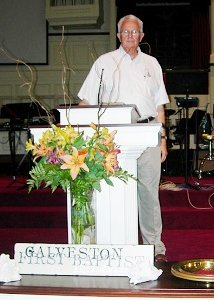
GALVESTON—Worshippers once again gathered in the sanctuary of First Baptist Church in Galveston Sept. 12—two years after Hurricane Ike struck Galveston Island.

While many of the faces are the same, Pastor Ray Meador says it is a different church.


Pastor Ray Meador shows where the water filled the facility at First Baptist Church in relation to previous storms that flooded the church building.

“We buried old First Baptist Church, Galveston,” he said. “The first time we met after the hurricane was at a funeral home in Texas City. That was the funeral for old First Baptist Church.”

Minister of Music Jay Carnes, 43, was a member of the church’s cradle roll. He agreed the church he grew up in is not the same one that meets now.

“The storm did more for me and more for the church than anything else could have,” he said. “The storm reminded us that the church is so much more than the building.

“That’s not to take away from the excitement of being back in the building. I’m as excited as anybody, but we’ve learned what the church is,” said Carnes, who has served bivocationally the last dozen years. After the storm, the church initially met at the funeral home Carnes operates.

“It’s a new church. The storm brought so many good things. God had to bring us to our knees to see it,” he continued.


Pastor Ray Meador returned to the pulpit in the sanctuary of First Baptist Church in Galveston on Sept. 12—two years after Hurricane Ike devastated the church’s facility. (PHOTOS/George Henson)

The celebration of the church moving back into its sanctuary began when about 250 people from around the country came to a Saturday “thank you” lunch. Invited guests included people who had worked at the church as volunteers or sent money to help with the recovery.

“It was a good day,” Meador said. “The Lord blessed. It was just a time to say thank you to so many people who had blessed us.”

The crowd was so large the meal had to be served in the newly refurbished sanctuary, which Meador admitted worried some who thought the carpet might be damaged by spills.

“This is God’s house; this is God’s tool; this is God’s instrument. … We don’t worship the carpet. We didn’t even think we were going to get carpet, but God gave us carpet.”

While a meal in the sanctuary won’t happen often, Meador said, it was only possible because the storm destroyed the fixed seating that had been in place before it hit. Seawater rusted out the theater seats that had been in the sanctuary, and the estimated cost to refurbish them was $150,000. Instead, the church bought folding chairs for about $5,000.

As soon as possible after the storm, the church started meeting back on the island in the church’s chapel, which seats about 120. When the congregation outgrew that facility, worshippers moved to the fellowship hall, which seats about 200.

As that meeting space neared capacity, renovation allowed the church to move back to the sanctuary, which has about 325 chairs in it. Before the storm, it had seating for about 650.


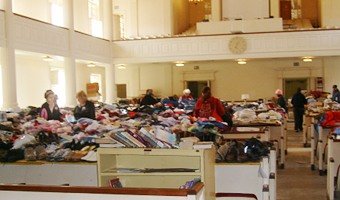
Volunteers placed plywood across the top of the seats in the sanctuary at First Baptist Church in Galveston, and clothing and other items were spread across them so people whose homes were damaged by Hurricane Ike could take whatever they needed.

“I remember the first time we met back here after the hurricane. We met in the chapel. There were two people who introduced themselves, and they’d both been members for 30 years, but didn’t know each other because they’d come in and gone out different doors,” Meador said.

While the numbers in attendance roughly equal what they were before the storm, Meador senses a difference in spirit.

“Right now, there’s a closeness, a commonality about it, a concern for missions. They’ve seen missions work in their lives. Churches gave sacrificially so we could do what we’ve been able to do. It’s something more than I can understand,” Meador said.

Since the storm, the church has exceeded each of its mission offering goals. In the past, the church set goals rather arbitrarily, Meador said. “Sometimes we got it; sometimes we didn’t. Now, people are more concerned. I think God has touched us, and I pray it stays the same way.”


Faith Digest

United States ties for fifth place in global giving. The United States tied with Switzerland for fifth place in a worldwide giving index by the British-based Charities Aid Foundation that measures charitable behavior across the globe. The ranking was based on the United States’ showing in three categories—60 percent of Americans gave to an organization; 39 percent volunteered for a group; and 65 percent were willing to aid a stranger. Australia and New Zealand were ranked as the most charitable countries, followed by Ireland and Canada. Burundi and Madagascar tied for last place. The report was based on data from Gallup’s World Poll, taken in 153 countries and representing about 95 percent of the global population.

Report finds spike in U.S. poverty levels. The number of people in poverty in America increased to its highest recorded point last year, and the poverty rate rose to its highest level since 1994, new statistics show. The Census Bureau released data that showed a significant annual increase in poverty, rising 1.1 percentage points to 14.3 percent in 2009. A total of 43.6 million live in poverty—the highest since recording began in 1959—and up from 39.8 million in 2008. As result of the ongoing financial crisis, social service programs—including faith-based providers—are faced with the challenge of increased needs from individuals and working families, budget cuts and a decrease in individual donations.

IHOP sues IHOP. The International House of Pancakes has sued the International House of Prayer, a Missouri church, for trademark infringement. The restaurant chain—which uses the website IHOP.com—claims the Kansas City church—whose website is IHOP.org—intentionally is misleading customers. The restaurant chain, which started in 1958, has used the IHOP acronym since 1973. Both the church and the restaurant claim around-the-clock operations. Many of the almost 1,500 restaurants in the United States, Canada and Mexico are open 24 hours a day, seven days a week, serving breakfast and a plethora of pancakes. According to the church’s website, it seeks to “combine 24/7 prayers for justice with 24/7 works of justice.” Its “24/7 prayer room” has a schedule of 12 two-hour worship meetings each day. The church declined to discuss the suit beyond a brief statement: “We are aware of the lawsuit. We are reviewing the situation. At this time, we have no comment.”

Calvin College withdraws band’s invitation. Calvin College has canceled a scheduled Oct. 15 concert by the Canadian indie rock band New Pornographers after the band’s name prompted complaints from the local community. Ken Heffner, director of student activities at the Christian Reformed Church-affiliated school, said complaints had poured into the school since the show was announced in August, but wouldn’t say specifically the source of most of them. The band’s name often is interpreted as a reference to preacher Jimmy Swaggart’s insistence that rock music is “the new pornography,” but frontman A.C. Newman has said he took it from a Japanese film called The Pornographers, a dark comedy.


Civil discourse endangered in U.S., noted Yale law professor insists

WACO—Democracy depends on something in short supply today in the United States—civil discourse involving people who disagree, author and legal expert Stephen Carter said.

Carter, professor at Yale Law School and author of The Culture of Disbelief, delivered the keynote address at the inauguration of Ken Starr as Baylor University’s 14th president, Sept. 17 in Waco.

“I worry deeply that we are losing the ability to debate” in meaningful ways, Carter said. Democracy demands that citizens “do the hard work of actually sitting, talking and working things out,” he insisted.

“The great symbol of the collapse of dialogue is the bumper sticker,” Carter said, bemoaning the tendency to “reduce complex ideas to slogans and applause lines.”

Americans should hold convictions deeply and vigorously defend their beliefs, but they should not dismiss people who have opposing views as bringing nothing valuable to the conversation.

“The more we express life that way, the less democratic we will be,” he said.

Too many activists of all political persuasions focus only on winning and getting their way, rather than engaging people with whom they disagree in a dialogue characterized by mutual respect, he insisted.

Carter pointed to the positive example of Supreme Court Justice Thurgood Marshall, for whom he worked as a law clerk. In Marshall’s later years, Carter worked with him on an oral history project, recording Marshall’s recollections from his years as a civil rights attorney.

Carter noted Marshall’s tendency to speak even of the most ardent segregationists with some fondness, because he recognized their essential humanity. That perspective enabled him to negotiate groundbreaking advances in civil rights, because even his opponents knew he not see them as enemies, and they were able to find some common ground.

“We need to see people with whom we disagree as fully human and equally beloved by God,” Carter said.


Little by little, San Antonio pastor builds home for his family

SAN ANTONIO—One nail at a time, Pastor David Cavazos’ home nears completion.

Cavazos, pastor of Iglesia Bautista Oriente in San Antonio, has been building a house for his family since August 2009. Since he learned the construction trades from his father, he not only has handled the carpentry, but also has done the plumbing and electrical work.

Cavazos and his family lived in a 950-square-foot apartment in Baptist University of the Américas student housing—tight quarters for a family of seven with a small baby.

With the occasional help of volunteers, David Cavazos, pastor of Iglesia Bautista Oriente in San Antonio, has been building a house for his family since August 2009. (PHOTOS/Courtesy of David Cavazos)

“We had a newborn, and we felt embarrassed from time to time with our neighbors because they would hear our little one cry at night. Thank God they were such a nice family and understood our situation,” he said.

Cavazos’ older children began asking if the family would have to move after their father completed his studies. They had grown to like San Antonio and did not want to be uprooted.

Cavazos previously had served Connell Baptist Church in Fort Worth two years as a church planter and then had moved to La Blanca, near the Rio Grande, so his wife could help take care of a family situation. From there, the family moved to San Antonio, where Cavazos could further his education.

Once they secured land, Cavazos began to build a house, starting with setting the pier-and-beam foundation. The family moved in during April, but the house was far from completed. Only two rooms had sheetrock. There were no interior doors and no water heater.

“We had to bring in water to take a shower,” Cavazos said.

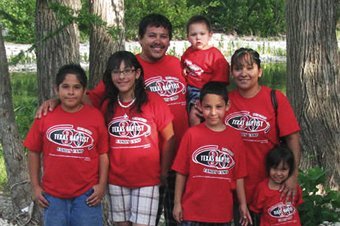
David and Dora Cavazos and their five children lived in a small student apartment at the Baptist University of the Américas until Cavazos built a house for his family.

Bit by bit, the family added a little more. Baptist General Convention of Texas funds enabled them to buy interior doors and two windows.

In recent weeks, a small group led by Pastor Baldemar Borrego of Iglesia Bautista Neuva Esperanza in Wichita Falls helped Cavazos hang drywall someone had left for him at South San Filadelfia Baptist Church in San Antonio.

“I never found out where it came from. They just told us it was there, and I could come and get it,” he said.

The 1,500-square-foot house still has uncovered plywood for flooring. It also needs doorknobs, interior paint and cabinets. The exterior needs siding.

“Right now, I just paint the outside over and over to keep the rain from hurting the wood,” Cavazos said.

Anyone interested in helping with the building project can contact Cavazos at cavazos313@yahoo.com


Baptist Briefs: Maggie Lee legacy lives on

Maggie Lee legacy lives on. The second annual “Maggie Lee for Good” day is scheduled Oct. 29—an emphasis on enlisting people to do at least one act of kindness on what would have marked Maggie Lee Henson’s 14th birthday. She died following traumatic brain injuries caused when a church bus from First Baptist Church in Shreveport flipped on the way to youth camp in July 2009. Last October, more than 18,000 people pledged to do a good deed to honor her memory. For examples of last year’s activities, visit www.maggieleeforgood.org or on facebook at http://www.facebook.com/ home.php?#!/group.php?gid=125146363170.

No decision yet on IMB president. The International Mission Board still is searching for “God’s man” to fill the board’s presidency, said Chairman Jimmy Pritchard, pastor of First Baptist Church in Forney, during the trustee board’s Sept. 14-15 meeting in Tampa, Fla.

Baptist AIDS workers released in Zimbabwe. Four American Baptist mission volunteers were released Sept. 13 on $200 bond after spending three nights in jail on suspicion of dispensing AIDS medication without a license in Zimbabwe. The health workers—a doctor, two nurses and a community volunteer—are part of an AIDS ministry sponsored by Allen Temple Baptist Church in Oakland, Calif. The volunteers, who were working with two licensed Zimbabwean doctors who also were arrested, deny doing anything wrong. They say it is the first time they have gotten in trouble in 10 years of work in Zimbabwe. Team members face fines and deportations if convicted. Members were ordered to surrender their passports and appear in court Sept. 27, but lawyers hoped to get the hearing moved up so they could return to the United States sooner.

Pen pals wanted. The Universal Pen Pal Project is seeking Christian young people in grades 7 to 12 who will become pen pals of foreign students who want to practice their English skills during the 2010-2011 school year. The project also is seeking to build its database of foreign students who want an American pen pal. The program—formerly known as Christian Corresponders—is in its 18th year. For more information, contact Kellie Ziesemer at (513) 732-2111 or universalpenpalproject@yahoo.com.

Churches participate in Scripture-listening initiative. More than 500 churches affiliated with the Cooperative Baptist Fellowship have participated in the “You’ve Got the Time” Bible-listening program this year and contributed more than $185,000 to support the translation and distribution of Scripture around the world. As part of an ongoing partnership with the Faith Comes By Hearing audio-Bible ministry, members of participating congregations committed to listen to recordings of the New Testament each day for 40 days. Churches also were encouraged to collect an offering to support ongoing efforts to translate the New Testament into languages such as Kambaata in Ethiopia; Chin Tiddim and Karen Pwo Eastern and Western in Myanmar; and Arabic Saudi for Saudi Arabia. Faith Comes By Hearing offers 528 audio Scripture recordings in 473 languages.


UMHB students help with flood relief

BELTON—After Tropical Storm Hermine dumped rain on Central Texas, students from the University of Mary Hardin-Baylor helped business and home owners in the area clean up in the storm’s aftermath.

UMHB Student Body President Tommy Wilson and Shawn Shannon, Baptist Student Ministry director at UMHB, coordinated two days of volunteer work involving students in cleanup efforts.

University of Mary Hardin-Baylor women’s head basketball coach Kim Kirkpatrick-Thornton and several UMHB students assist by sorting cloths at the flood-damaged Scott & White Hospice Thrift Store in Belton. (PHOTOS/Jennifer Jones/UMHB)

“We’re giving a lot of help as far as cleaning and repairing, and we’re also building relationships,” Wilson said. “Some believe that UMHB and Belton are two different entities. To me, being a part of one means being a part of the other. This demonstrates in a physical way that we want to be a part of the community. … We’re fellow Beltonians.”

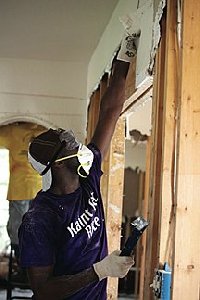
University of Mary Hardin-Baylor senior Christian studies major Edwin Robinson assists with pulling off sheetrock at a flood-damaged home in Salado.

More than 30 students and faculty members turned out for the first day of volunteer service. Some were sent to businesses in downtown Belton, some helped at the First Assembly of God Church in Belton, and others went to First Baptist Church of Salado to assist homeowners in that community.

Freshman Bethany Jenkins heard about the damage and wanted to help in any way she could.

“I really felt God calling me and telling me to serve not only those that are in other countries, but also those that are in our own backyard,” she said. “I’m really glad we’re able to help out.”

Local businesses and homeowners also were happy to have the extra hands for all the work needed.

The Scott & White Hospice Thrift Store in Belton flooded with about 48 inches of water. Even as cleanup was taking place at the store, donations already were arriving, staff member Amy Mesecke said.

“You feel overwhelmed when you have so much to do. We have two trailers full of donations, so it’s great to have the extra help to keep us going,” Mesecke said. “We have volunteers that come on a regular basis, but this in the first time we’ve had such a large group come out and help at one time.”


It definitely lifts your spirits.”