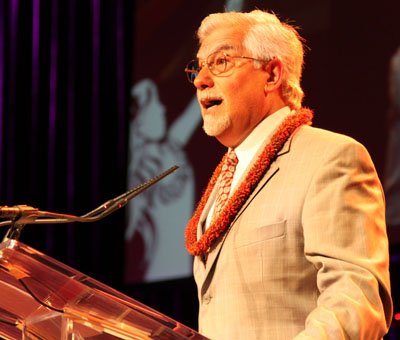
BWA confirms John Upton as president for next 5 years

HONOLULU — The Baptist World Alliance has elected John Upton, a denominational executive with experience on the mission field and in the pastorate, as its new president.

Upton will continue as executive director of the Baptist General Association of Virginia, a post he has held since 2001. Previously, he was a missionary to Taiwan and a pastor in Virginia.

The BWA General Council nominated Upton for the presidency when it met in Ede, the Netherlands, a year ago. Delegates to the 20th Baptist World Congress confirmed that nomination July 31 in Honolulu. His term will last until the summer of 2015.

“I believe in the Baptist World Alliance,” Upton told BWA delegates moments after his election.
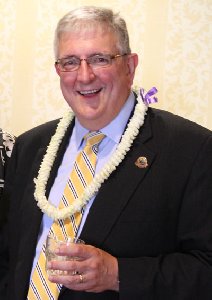
 

John Upton was elected president of the BWA at the 20th Baptist World Congress in Honolulu. (Photo by Rand Jenkins)

“I believe in the way we elevate the name of Christ, serve in the name of Christ, listen to the Spirit of God, and build up the body of Christ in all its many languages, cultures and customs. I believe in who we are.”

The best symbol for the BWA is “the way we praise God together,” Upton said. “It’s what captures who we are.”

That symbol may seem too ordinary and too benign, but it is powerful, he contended. He cited a litany of other ministries, activities and projects BWA members undertake together, but the symbol of praise rises above the rest.

“We spend so much time in praise when we’re together,” he observed. “Why do we do this? Does God need it? It’s in our DNA. When we praise God, we touch the heart of God.”

Praise symbolizes the BWA because it is subversive, he maintained. “It is a cry for radical freedom under God. To live in praise is to say those (worldly) powers are limited” in their control over God’s work among God’s people all over the world. That’s why Baptists stand for justice and redemption—because they believe it will only come through the power of God.

“Gathering to praise God is not just a nice thing to do. It’s the only thing to do,” Upton said.

The new president pledged to the delegates: “I will commit to serve you with dignity, respect, inclusiveness and, yes, praise these next five years as we are in step with the Spirit.”

In a news conference after the election, BWA General Secretary Neville Callam endorsed Upton’s election “without any doubt.”

“He’s eminently suited to be the president of BWA,” Callam said of Upton, noting the BWA staff in Falls Church, Va., is joyful because of the election.

Upton has led Virginia Baptists to the “cutting edge of mission and witness,” and Upton likewise succeeded as a missionary and pastor, Callam said. He praised Upton’s involvement in BWA across many years. Upton has served on the BWA’s Executive Committee and General Council and Program Committee this year, as well as on other BWA groups and the Executive Committee of the North American Baptist Fellowship, BWA’s regional affiliate in Canada and the United States.

Upton is an excellent cross-cultural communicator, Callam added, noting he will represent the BWA well before governments and other religious bodies, will provide clear vision and will help unite the worldwide Baptist organization.

“The search committee found its ideal candidate” in Upton, he said.

Upton succeeded David Coffey of the United Kingdom, who served as BWA president since the 19th Baptist World Congress in Birmingham, England, in 2005.

BWA delegates also elected Daniel Carro of Argentina as first vice president.
The selected a slate of vice presidents from across the world — Joel Sierra, Mexico;
Regina Claas, Germany; Nabil Costa, Lebanon; Harry Gardner, Canada; William Epps, United States; Olu Menjay, Liberia; Paul Msiza, South Africa; Victor Samuel Gonzalez, Cuba; Burchell Taylor, Jamaica; John Kok, Malaysia; Ross Clifford, Australia.

The newly elected BWA treasurer is Caroline Fossen of the United States.


Focus group explores ethics of tourism

HONOLULU — Baptists meeting in one of the world’s most popular tourist destinations were reminded July 29 that beneath the glitz and glitter of the tourism industry lie moral issues that call for a Christian response.

Presenters at a breakout session on the ethics of tourism during the 20th World Congress of the Baptist World Alliance in Honolulu focused on a trio of ethical concerns that are especially urgent in developing nations that increasingly depend on international tourism: environmental degradation from large-scale developments and related industries; unfair employment practices for persons in host countries; and marginalization and devaluation of host cultures.

Deonie Duncan, a Baptist minister in Jamaica, and Rod Benson, an ethicist and public theologian with the Tinsley Institute at Moring College in Australia, emphasized that Christians must discern how best to respond to issues that are complex and varied. Although tourism is a modern practice that was unknown to the biblical writers, both speakers noted that the Scripture — especially the accounts of the life and teachings of Jesus — provides a framework for addressing the moral challenges associated with the tourism industry.

Employment practices

Duncan’s first ministry assignment after graduating from seminary in 2004 was in a district that included Ocho Rios, one of Jamaica’s most popular tourist attractions.  “Not that many years ago Ocho Rios was a quiet fishing village,” she said. “Now most people in the area are employed by the tourism industry and its various subsidiaries.”

As she interacted with a cross-section of persons working in tourism-related jobs, Duncan began to see some of the downsides to the economic benefits of the industry.  “By and large, employees report increased earnings,” she said, “but it comes at a cost.”

Employees often are required to work long hours and extended periods, including weekends and holidays, and without commensurate remuneration, Duncan said.  Unscrupulous employers exploit low-wage-earners by hiding behind the ubiquitous “and other duties as assigned” clause in many position descriptions, she said. 

Despite repercussions affecting the health and well-being of employees and their families, workers are reluctant to complain, Duncan added, for fear of missing a promotion or, worse, losing their jobs and leaving their families in dire straits.  Changes in management can exacerbate the problem, she said, as a new employer renegotiates or abrogates workers’ agreements made by the previous owner. 
 
Preservation of host cultures

“Does tourism really constitute national development if it does damage to host cultures?” Duncan asked. Too often, she said, genuine representations of indigenous cultures are supplanted by contrived images preferred by tourists — and the hospitality industry. Images presented to guests at exclusive hotels or “all-inclusive” resorts, she said, may be a far cry from the ways people live only a few miles away.

For their part, she added, workers in the tourism industry often suffer the negative impact of contrasting their status and cultural heritage with the wealth and power of international guests from developed countries.

Benson encouraged Christians to peer beneath the veneer of high-sounding verbiage from industry leaders. “Tourism bodies have developed excellent marketing resources and excellent lobbies,” he said. “It is not in their best interests to be seen to be abrogating the rights and responsibilities of employees” or devaluing host cultures, he said.

Christians, he said, need to recognize the tensions that often exist between ethics and commerce.

Both speakers noted that governments in developing countries are tempted to give priority to revenue from the tourism industry over the rights and benefits of citizens who work in the industry. “The wealth generated by the tourism industry often does not trickle down to local citizens,” added Duncan.

Ecological impact

Duncan bemoaned the long-term environmental degradation that she said is often exchanged for the short-term economic gain of large-scale developments by the tourism industry.

She listed a variety of environmental problems associated with overdevelopment in Jamaica, including damage to coastlines and reefs, air pollution, destruction of natural watersheds, poor waste management and the inordinate consumption of water, electricity and seafood.

Duncan suggested “three Christian affirmations” as a framework for evaluating the real value of tourism for national development:

  • Affirm that all human beings have value as persons created in the image of God.  Christians, she said, should advocate for practices in the tourism industry that do not undermine the personhood of people or place material wealth above other human values.
  • Affirm the differentness of each person and the uniqueness of each culture as divine gifts.  Christians should steadfastly resist notions of superior versus inferior cultures, she said.
  • Affirm that the environment is a gift of God for which humankind are stewards.  Proper Christian stewardship, she said, calls for a shared commitment to ecological preservation.

–David Wilkinson is executive director of Associated Baptist Press.


Women combat poverty, abuse by walking in the Spirit

HONOLULU — As women from every corner of the world gathered in their native dress with festive country displays in celebration of God’s movement among all peoples during the Baptist World Alliance Women’s Leadership Conference, the sea of colorful garb soon contrasted with the harsh reality of the state of women in the world today.


The Baptist Women of Latin America (back row) prays over members of the Baptist Women’s Union of Africa. (Photo by Kaitlin Chapman)

As the women participated in continental union ministry presentations, Bible studies, worship and fellowship, they learned about the 27 million women who will be trafficked into the sex trade in their lifetime and the other 1.5 billion who will be abused.

Many women were shocked to learn these atrocities were happening in their own cities. But no matter what view they had of abuse and poverty at the beginning of the conference, these 750 women who gathered at Waikiki Beach July 24-27 left motivated to take the gospel and rehabilitation to prostitutes, abused women and the impoverished caught captive in every corner of the world.

Patsy Davis, executive director for the BWA Women’s Department, said the goal of the gathering was to celebrate the steps these Baptist women have already taken to restore lives of the abused and impoverished but also to rally them on, allowing God to do more through them.

“Our theme of poverty and abuse really hit home with these women,” Davis said. “There were many who were ready to go do something about this. Some came up to me and said, ‘We live in some of these places where this really happens and we had no idea.’ They left with a passion to do something about poverty and abuse. And I think we will see a huge difference in the world because of that.”

The conference focused on combating abuse and poverty to coincide with the United Nations millennial goals focusing on ending poverty by 2015, though the Baptist women are striving to end these issues by walking in the Spirit, Davis said.


Amelia Gavidi (center), president of the Fiji Baptist Women’s Fellowship, and other fellowship members present a monologue on joining with other Baptist unions in combatting abuse. (Photo by Kaitlin Chapman)

“This year, the UN was focusing on stopping violence against women and we wanted to do our part,” Davis said.

During the general sessions, each of the seven continental unions involved with the BWA Women’s Department, painted a picture of women in their region of the world while sharing ways they are bringing hope to the abused and poor.

Ameila Gavidi, president of the Fiji Baptist Women’s Fellow­ship, presented a monologue about a woman she encountered who was rejected by her family, then turning to a life of crime, hurt and imprisonment because of the lack of love in her life.

Through the interaction of the Fiji fellowship, the woman gained hope through a relationship with Christ. This happened through Lydia’s Sewing Project, a rehabilitation effort started by the fellowship to teach released prisoners a trade like sewing but also to show them the love of Christ.

“We go not only to help the women, but the main thing we do is share the love of Jesus with them,” Gavidi said. “Most of these women have never experienced love. They come from a low place. [They are]squatters in a low-level lifestyle where their mothers and fathers don’t even care for them. And none of them know Christ. The word is that no one cares for me so they get involved in wrong areas. And instead of getting them involved in a better place, they get involved in a worse place. As Christians, what are we going to do about it?”

The lives they have seen changed have come through the Fiji Baptist women stepping out and having obedient faith, one way to walk in the Spirit, Gavidi said.

“I believe that the Lord does not want us just to talk,” Gavidi said. “We have to step out and physically do what God is telling us. That is faith. If I just know the Word of God and I just sit there, that is not faith. We as born again believers should do it in faith. Whatever we do, we need to do in faith.”


Korean women in traditional garb perform at the Women's Conference. (Photo by Kaitlin Chapman)

Many other international Baptist unions shared how they are approaching women caught in human trafficking, prostitution and abuse, but stated that some much more intervention based in the love of Christ needs to happen for these women. 

Though much of the conference was about rallying women for the cause of abuse and poverty, it was also a time for the women who diligently lead ministries back in their homeland to experience a time of spiritual renewal as other women passionate about Christ lead Bible studies for them and ministered to their hearts.

“I’m a teacher. I’m preaching, but here at this conference, I can sit and hear from others,” said Ponzi Anne Nzuzi, the president of the Baptist Women’s Fellowship in the Democratic Republic of Congo. “This is a good time for me so I become like a baby and I am taking enough food for my life. I believe that when I am back at my home, I will be strong again.”

Though Nzuzi said she appreciates the time of renewal, she also stated she and others, though living in a country where poverty and political conflict touches many in her congregation, they must follow the Spirit and continue to serve the abused and needy.

“Suffering is there,” she said. “Poverty is there, but we cannot block our hand and never do something. We have to do something.”

In addition to the focus on abuse and poverty, the women elected new leadership to direct the BWA Women’s Department for the next five years. Raquel Contreras, president of the Baptist union of Chile, was elected president, and Donna Groover, director of human resources and finance at Columbus Baptist Church in Falls Church, Va., was re-elected as secretary treasurer for a second term. Both women were honored at a celebratory tea held at the closing of the conference.

“Oh, am I excited,” Davis said in regards to the new leadership. “I’ve known Raquel a long time, and she knows the organization. She knows the women, and she’ll be an amazing leader. And Donna is a very special, gifted lady. We are excited to have her for a second term. Even though we don’t have much money, somehow she always makes it work.”

Before the end of the conference, each union was paired with another to serve as prayer partners for the next five years. This partner union, as well as the conference theme of walking in the Spirit, will become an emphasis during the annual Baptist Wom­en’s World Day of Prayer held Nov. 1. This day is a way for women around the world to gather and jointly pray for issues in the world today and take an offering to support the ministry of the BWA Women’s Depart­ment and their continental unions.

“My hope and desire is that they take what they learned and share it on the local level,” Davis said. “From the Amazing Place, an interactive maze sharing about the Women’s Department and giving prayer opportunities for the women, I hope they learned how to creatively share the information. And hope that the next time we see stats about women that they will be lower. Rea­listically, we won’t get to zero, but I hope they get lower because of what the women will be doing.”

An offering was collected to support BWA ministries and for some scholarships to attend the meeting. A total of $14,759 was given by the women, many of whom gave sacrificially from the little that they have.

The Women’s Department also commissioned two books. Coming Together is a history of the Women’s Department of the BWA. The second, I’m a Woman … Created in the Image of God is an English translation of a Spanish book written in the 1960s.

For more information on the BWA Women’s Department or to view presentations made at the conference and re­sources for the Baptist Women’s World Day of Prayer, visit www.bwawd.org.The women’s conference presentations will be available online after Aug. 3 when the BWA staff returns from the Congress.

Kaitlin Chapman is a newswriter for the Baptist General Convention of Texas.


If Jesus needed the Spirit, then so do Christians today, says U.S. pastor

HONOLULU — Today’s Christians need the Holy Spirit’s guidance, just like Jesus did 2,000 years ago, a U.S. pastor told participants at the Baptist World Congress.

Julie Pennington-Russell joined 26 other Bible scholars to teach Scripture lessons in eight languages during the Baptist World Alliance’s gathering in Honolulu July 28-Aug. 1.

The lessons mirrored the conference theme, “Hear the Spirit,” and focused on Jesus’ first sermon, recorded in Luke 4.

The Holy Spirit continually accompanied Jesus as he launched his earthly ministry, observed Pennington-Russell, pastor of First Baptist Church of Decatur in metropolitan Atlanta.

At Jesus’ baptism, “the Spirit descended as a dove,” she said, noting the Spirit’s presence signaled divine favor upon Jesus.

Then, the Spirit led Jesus to a desert retreat, where Satan tempted him and tested his identity to be the kind of Messiah who would confront the sins of the world, rather than yield to human expectations for a religio-political leader.

Next, the Spirit led Jesus to his home region of Galilee, where Jesus performed the first of his miracles, or “signs,” as the Gospel of John calls them.

In the town of Cana in Galilee, Jesus attended a wedding, where he turned ordinary water into extraordinary wine. “Jesus points to the wine jugs, which represent joy and abundance,” she said. “This is Jesus letting us know the kingdom is full of joy. This is a major launching point in the ministry of Jesus. People are taking notice of him.”

When he preached his first sermon, in his hometown of Nazareth, he read from the prophet Isaiah: “The Spirit of the Lord is on me … .”

“The folks in Nazareth didn’t know Jesus as the Messiah, but as the carpenter—the one who fixed their doors …,” Pennington-Russell said. “They remembered him when he used to hang out at Sonic with the synagogue youth group.”

But in his hometown, among the people who attended his own synagogue, Jesus claimed the prophet’s description as his own, she reported. To them, Jesus said: “This is my sacred task. This is God’s agenda. This is what I’m about to do: Preaching good news, freeing prisoners, opening blind eyes, releasing the oppressed and proclaiming God’s blessing for everybody.”
In announcing his job description, Jesus talks about the Spirit, she observed.

“Why?” she asked. “Why do we need the Holy Spirit at the church where I am pastor? Why couldn’t we appoint the appropriate committee … for writing up the agenda for 2010 and present it to the church for a vote?

“Why couldn’t we do that? We have plenty of smart, capable people who can get the show on the road. There’s only one reason: Without the Holy Spirit, we can’t do it.”

Pennington-Russell cited four reasons Christians need the Holy Spirit’s power and involvement in their lives:

• “It’s our nature to lean toward self-centeredness,” she said. “We say, ‘I can do this.’ … Self-preservation is such a powerful impulse, and we don’t act on it only individually. We dress it up and bring it to church. … Most people who claim the name of Jesus operate almost exclusively by preference.”

Fortunately, some people “come alive” in their faith, Pennington-Russell said, crediting the transformation to one source: “It’s the Spirit of God.”

• “Without the Spirit of God, we often make the mistake of believing if we do enough, we can haul in the kingdom of God, and won’t God be grateful?” she insisted.

Of course, rolling up sleeves and getting to work is a benefit, and Christians should do good deeds, she agreed.

“But inevitably when we’re working hard, cancer, divorce, abuse and war still will come,” she added. “All our efforts can’t heal some hurts and can’t right some wrongs. A supernatural force is needed; that force is God.

“Jesus never told us to try harder. He told us to surrender more. We need the Spirit to do that.”

• Without the Spirit, Christians try to shrink their ministries down to human size, she claimed, recalling her frustration following a three-hour church staff meeting that focused on whether to raise the price of the Wednesday-night meal by a quarter.

“Jesus didn’t die for this,” she asserted. “This crisis became a catalytic moment. … Other people in our church felt the same way. We didn’t know exactly what to do, but we turned it over to God.”

The Holy Spirit gave them the freedom to re-think what their church should be and do, she recalled.

“Apart from the Holy Spirit, we’ll never get past church-as-usual and get hold of God’s agenda for the world,” she said.

• Without the Spirit, Christians naturally try to escape the poor and outcast—those who are gathered up in God’s agenda, she said.

“Why all this talk about the Spirit?” she asked. “Well, without the Spirit, we resist God’s agenda. We really do.”

–Marv Knox is editor of the Baptist Standard.


Faithful preachers proclaim without fear, Jamaican Baptist insists

HONOLULU — Preaching should be dangerous business, because faithful preachers dare to deliver a message from God — regardless of the consequences, Karl Johnson, general secretary of the Jamaica Baptist Union, told the Baptist World Congress.

Addressing the 20th Congress of the Baptist World Alliance, July 29 in Honolulu, 
Johnson emphasized proclamation as the primary means of sharing the gospel with the world.

“There can be no real and viable substitute for it,” he said.

Johnson pointed to the example of the 8th century prophet Amos in the Old Testament as a messenger from God who understood proclamation as a vocation grounded on irrepressible divine compulsion and confronted by inescapable tension.


Preaching is a dangerous occupation, said Jamaican Baptist leader Karl Johnson. (Photo by Rand Jenkins)

Preachers called by God feel compelled to obediently serve as the “mouthpiece” for God, he said.

“This carries with it an awesome responsibility — a responsibility never to project or present anything or anyone else, save God and God’s message,” Johnson said.

“Preaching, then, is a dangerous occupation. Proclamation is a frightening engagement, as we stand in the name of — and on behalf of — the God of this universe, who chooses to use us as his intermediaries, to speak his word.”

Communication skills, preaching technique and homiletical tools matter, but not as much as the message itself, he stressed.

“I proclaim to you … that it’s not more aids that we need. We do not need more oratory. We do not need more lyrical gimmicks,” Johnson said. “We need more messengers of God, bearers of the word of God, conduits of the truth, of the counsels of Almighty God — persons who will proclaim, ‘Thus says the Lord.’”

Preachers must understand not only the message God has given them, but also possess a proper understanding of God.

“Such is the awesomeness of this task that we need always to be wary of persons who are overly glib and overly confident in the handling of this truth, for the weight of it rests heavily on us,” he said. “We dare not misrepresent God.”

Certain occupational hazards come with the territory of proclaiming God’s message, Johnson insisted. Like Amos, whom some discounted because of his place of origin and lack of formal training, modern preachers also may be dismissed based on factors of class, race, gender, politics or educational background, he said.

“We who stand in the name of God in Christ Jesus will always face tension in a world that is still upside-down concerning matters of equality and notions of superiority. Whatever the source of the tension, let us stand firm in the conviction that we are here, not so much because we think that being here brings with it a sense of actualization, but because we go where God sends us, do what God bids us do and say what God tells us say,” Johnson said.

“And remember this — the strength of our authority does not reside in any sponsor or any who supports us. The force of our message does not depend on the Ivy League, rarified atmosphere of any institution. Our authority comes from God’s call on our lives, and God’s message is never inferior.”

Preachers run the risk of getting into trouble when they faithfully proclaim the message God gives them, Johnson said. The church today needs preachers who “will not consider their bank balance or examine their own welfare before determining what to preach,” he said. “We need preachers who will not stop to assess their future before deciding whether they should obey God in what they say.”

Faithful proclamation walks a fine line, attending to contextual relevance without surrendering to parochialism, Johnson concluded. The true preacher called by God maintains a global vision.

“Our message is therefore never culture-bound, even though it must have cultural relevance and sensitivity,” he said. “Our message must never be exhausted only by local concerns. … Let our message challenge the structures of imprisonment, bondage and evil, which are manifesting themselves in sinful ways and acts of rebellion all across this world.

“Let us speak truth to power. Let us proclaim truth to systems that nourish inequity and injustice, racism and poverty. And let us say with clarity and conviction, without fear or favor, ‘Thus saith the Lord, Let God’s people go.’

“And if they ask us — in fact, when they ask us — From where have we come? Who are we? Tell them, ‘We are they who have heard the Lord speaking to us.” Tell them: Our Lord has spoken. We can only but proclaim.’”

–Ken Camp is managing editor of the Texas Baptist Standard.


World Baptists honor Lotz for human rights advocacy

HONOLULU — To be true to their heritage and principles, Baptists must continue the fight for religious liberty for all people, insisted Denton Lotz, who received the Baptist World Alliance’s Human Rights Award July 30 in Honolulu.

Lotz, the Alliance’s retired general secretary, accepted the award on behalf of his predecessors and BWA presidents.

Lotz has been a persistent human rights campaigner, reported Emmanuel McCall of the United States, a BWA vice president.

“Denton has been a visionary leader who led the BWA to commit a decade, beginning in 2000, to combating racism and advocating for human rights,” McCall said.

Denton Lotz (center), who received the BWA's Human Rights Award July 30, joined former recipients of the award at a press conference.

Lotz helped draft proclamations and covenants that bound Christians and others to speak on behalf of persecuted people all over the globe, McCall added, noting Lotz has confronted ambassadors and other government leaders, pleading for freedom for religious minorities.

“God has blessed [the BWA] because we have been faithful to the word and united,” Lotz said of Baptists’ advocacy for human rights. “Where there is unity, there is strength.”

He cited 20th century Baptist theologian E.Y. Mullins, who maintained: “Where religious liberty is denied, all liberties are denied.”

“Baptists have stood for religious liberty” through the generations and across borders, he said, listing a litany of religious freedom advocates.

The battle continues, Lotz added. He pointed out the U.S. government denied travel visas to hundreds of world Baptists who wished to attend the BWA meeting in Hawaii.

In addition, the 21st century already has shaped up to be one of the bloodiest ever, he said, citing “senseless wars and … the persecution of people the world over because of their Christian faith,” he said.

“With Moses, we must say, ‘Let my people go,’” he urged. “We call for religious freedom for all people, but we call for freedom in the name of Jesus Christ. … He is the source of all freedom.”

Baptists desire religious freedom for people of any faith, he said, noting the persecution of Muslims, Hindus, Buddhists and Christians.

“But we point to Jesus, who says, ‘If the Son has made you free, you are free indeed.’ ”

Marv Knox is editor of the Texas Baptist Standard.


Longtime mission leader Avery Willis dies

BELLA VISTA, Ark. (ABP) — Avery Willis, a former Southern Baptist missionary and administrator best known as developer of the MasterLife discipleship materials used around the world, died July 30, nearly eight months after being diagnosed with a rare form of leukemia. He was 76.

According to a journal at the Caring Bridge website, Willis had been in remission before becoming hospitalized with pneumonia in early July. Doctors determined his leukemia had returned and he was too weakened to survive treatment.

Avery and Shirley Willis

He was discharged from the hospital Thursday, July 29, and died at home early in the morning of July 30, according to a posting by Willis' son, Randy.

Willis retired in 2004 as senior vice president of the International Mission Board of the Southern Baptist Convention. After retiring he worked as executive director of the International Orality Network, a partnership of mission organizations using oral methods to evangelize and disciple the roughly 70 percent of the world's population that is functionally illiterate.

In lieu of flowers, the family suggests donations be made to the Lottie Moon Christmas Offering or the International Orality Network.

An Arkansas native, Willis served as a missionary in Indonesia for 14 years before returning to the United States in 1978. While serving as president of the Indonesia Baptist Seminary, he created an intensive small-group discipleship study process named MasterLife.

During 15 years he worked as head of adult-discipleship programs for what is now known as LifeWay Christian Resources of the SBC, MasterLife became a staple of Sunday-night and midweek study groups in Southern Baptist churches. It also was translated into 50 languages and used in 100 countries around the world.

In 2008 Willis was one of six candidates nominated as president of the Southern Baptist Convention.


–Bob Allen is senior writer for Associated Baptist Press.


Christians commanded to love their Muslim neighbors, panelists insist

HONOLULU — A West Texas missions professor who served more than two decades in Indonesia and an Arab Baptist educator from Lebanon emphasized the need to reach out in love to Muslims.

Robert Sellers, missions professor at Hardin-Simmons University’s Logsdon School of Theology in Abilene, Texas, and Nabil Costa, executive director of the Lebanese Society for Educational and Social Development, led a focus group discussion of Christian-Muslim relations, held during the Baptist World Congress in Honolulu.

Christians and Muslims are part of the same extended family, related through a common belief in the God of Abraham, Sellers said.

“Muslims are our religious siblings, for we are all descendants of Abraham, Sarah and Hagar,” Sellers said. “We worship the same God — the God of Abraham, the Creator God, the God of the Hebrew Bible and the New Testament.”

{youtube}lBQG_PNMjUA{/youtube}
A video welcome to the Baptist World Congress meeting in Honolulu.

Sellers noted with alarm the misconceptions and broken relationships between Muslims and Christians — particularly Christians from the United States.

“As an American, I am troubled by how Christians and Muslims perceive one another in a world where some people attach religious meanings to my nation’s domestic or international policies and actions,” he said. “As a Christian, I am concerned that followers of the two largest of the world’s living religions — Christianity and Islam — learn to relate peacefully and productively.

“And as an American and a Christian, I am alarmed by the growing marginalization of Muslims in the United States — and especially disturbed that American Christians do not defend our Muslim neighbors more courageously.”
 
In the United States, some media have fed the stereotyping and blatant misrepresentations of Islam, creating a climate of fear that stigmatizes Muslims in general, Sellers said.

“Popular American columnists and talk-show hosts use rhetoric that is, at best, one-sided or, at worst, malicious and shameful,” he said.

Unfortunately, he observed, some Christians have been complicit in demonizing Muslims by spreading rums, innuendo and fear through harsh words or forwarded e-mails.

But, he added, Christians who respond with tolerance or neutrality toward Muslims are just as ineffective as those who react with fear and stereotypes. Tolerance means indulging someone else’s different beliefs, he noted. 

“Jesus would not have us merely tolerate our Muslim neighbors, much less treat them with indifference, as if they do not matter to God, whose beloved creation and precious little ones they also are,” Sellers said.

Christians should reach out with compassion and friendship to Muslims, following the example of Jesus who crossed barriers in his day to extend love to people who were feared, stereotyped or even violently oppressed, he said.

The Sermon on the Mount and the parable of the Good Samaritan dictate how Christians are to respond to Muslims, said Costa, who works with Arab Baptist Theological Seminary and Beirut Baptist School.

“If they are our enemies, Jesus said we are to love them. If they are our neighbors, Jesus said we are to love them. So, either we love them as enemies or love them as neighbors. That’s our only choice,” he said.

Two periods of early Islamic history characterize opposing approaches by Muslims—the Mecca period of peaceful coexistence with Jews and Christians and the Medina period of military engagement, he observed.

While radical Muslims lay claim to the Medina model to justify their acts of aggression, many moderate Muslims seek to live in peace with followers of other faiths.

“We cannot look at all Muslims and expect them to be the same,” Costa said.

Nevertheless, too many people in the West allow their perception of Muslims to be colored by sensational news reports about the Middle East, he noted.

“Media in this country is not the friend of grace,” he said. “They like stories of Islam to be as scary as possible.”

As an Arab Christian, Costa acknowledged he once held hard feelings toward Muslims. But during war in Lebanon, he recognized his Christian responsibilities to minister to refugees without regard to whether they were Christian or Muslim. He experienced a change of heart toward Muslims because of that.

 “They are our neighbors. We need to live with them. They are our neighbors. We need to love them,” Costa said.

Education and community development have become effective avenues for building relationships with Muslims, he noted. Acts of mercy — practiced with a humble spirit — should become a way of life for Christians.

“Never underestimate the power of humility,” he said. “Much conflict emerges from human arrogance.”

–Ken Camp is managing editor of the Texas Baptist Standard.


North American Baptists examine series of ‘shifts’

HONOLULU — Baptists from across Canada and the United States examined seven key “shifts” July 29 that have impacted the North American Baptist Fellowship.

The NABF includes Baptists from the two predominantly English-speaking nations in North America. It held its annual meeting during the 20th Baptist World Congress in Honolulu.

Baptists on the continent would do well to study shifts impacting their ministries and churches, NABF General Secretary George Bullard explained.

The shifts include:

• A shift in the earth — the January earthquake in Haiti. Five predominantly African-American Baptist groups — the National Baptist Convention of America; National Baptist Convention, USA; Progressive National Baptist Convention; National Missionary Baptist Convention of America; and Lott Carey Baptist Foreign Mission Convention — have banded together to support relief efforts in Haiti, reported NABF President David Goatley, who also is executive secretary-treasurer of the Lott Carey organization.

Hawaiian dancers performing during the Baptist World Congress.

The five groups made a $500,000 gift to Habitat for Humanity in Haiti this spring, and they hope to donate another $500,000 in September, Goatley said.

Dean Miller, the NABF’s disaster relief coordinator and disaster relief worker with the Baptist General Association of Virginia, said the fellowship is coordinating resources to help the partner conventions meet needs in the wake of the quake. “It’s exciting to stand together,” he said.

• Shifts along the Gulf of Mexico — hurricanes Katrina and Rita and the BP oil spill. The National Baptist Convention of America has responded to all the disasters, noted Sam Tolbert, general secretary of the convention and pastor of Greater Saint Mary Missionary Baptist Church in Lake Charles, La.
 
“We could not respond adequately alone,” Tolbert said, noting his convention also teamed up with the Lott Carey organization.
 
Important ministries have included mental health counseling to help people in the region cope with the stresses of physical disaster and economic calamity, as well as “community resilience” ministries, such as job-skills training.

• The shift of missional involvements — response to the changing context of ministry. In a transitional urban community, First Baptist Church of Decatur, Ga., has switched from giving money for mission work in other places to direct involvement in local ministry, said the church’s pastor, Julie Pennington-Russell.

“We’ve seen … a robust desire for people to be up to their necks in hands-on ministry,” she said, noting the church is striving to move 100 percent of its membership “out of the stands, on the field and into the game.”

Operation Insasmuch is an organization that helps churches involve their members in community ministries, noted its founder, David Crocker.

Its model of ministry designed to involve from 50 percent to 75 percent of a church’s members in hands-on ministry, and then to “move them down the funnel to lifestyle ministry,” Crocker reported. The organization has worked with 1,600 churches in 17 states, Canada and the United Kingdom.

• A shift in the Baptist World Alliance. “We’re at a unique time in BWA life,” Bullard noted. “The new president [John Upton from Virginia] is from North America. And events in North America — the economy and changes in denominational life — are felt worldwide.

“North America is going to have a huge responsibility in the dialog about how we’re going to be resourcing this family called the BWA,” Bullard said.

The BWA has experienced staff leadership change and constitutional changes in the past five years, and now is the time to build on those changes, he added. He pointed to the need to include young leaders, develop community and achieve significant diversity within the organization.

• A shift in denominational leadership. Canadian Baptist Ministries has experienced a generational shift in leadership, said Gary Nelson, who recently stepped down as the organization’s general secretary and was replaced by a young leader, Sam Chase.

“Canada is a time-lapsed camera of what is happening in the United States,” Nelson said. “We worship in 42 languages. Our largest churches are multicultural, and we’ve been struggling with secularism.”

However, new leadership has emerged “to help us be the kind of churches we need in Canada,” he said.

The BWA’s Emerging Leaders Network has recruited and encouraged young leaders from around the world, said the network’s coordinator, Chris Liebrum of the Baptist General Convention of Texas.

The network was the brainchild of BWA President David Coffey and has involved about 40 to 50 participants, beginning three years ago. “It’s been a deliberate process of cultivating leaders for the next generation,” Liebrum said.

• A shift in the future of North American Baptist organizations. The North American Baptist Conference, which historically has been composed of Baptists of German heritage, now includes large African-American and Chinese congregations, Executive Director Rob McCleland said.

Also, the Internet has allowed the conference’s pastors to locate and relate easily with pastors from other denominations, he said, noting cross-pollination with those groups “has caused our organizational identity to begin to wane.”

In recent years, the conference has flattened its organizational structure, shared leadership and convinced regional ministers to own responsibility for the larger organization instead of only the churches in their areas, he said.

Now, the conference is focusing on seeking young leadership for the future, he added.

• A shift in telling the North American Baptist story. A thread that ties all of the other shifts together is the challenge of communication, observed David Wilkinson, executive director of Associated Baptist Press.

“Telling the Baptist story, the gospel story, the Jesus story is essential,” he said. “But we’ve got a lot of catching up to do.”

Baptists need to “embrace the wonderful tool God has given us in communication, including emerging technology,” he said.

As an illustration, he cited New Voice Media, a partnership of news organizations that collaborate to communicate the Baptist story, both to Baptists and to others. The partners include ABP as well as three state Baptist newspapers — the Baptist Standard of Texas, the Religious Herald of Virginia and Word & Way of Missouri.

The next North American Baptist Fellowship gathering will be held Jan. 10-11, 2011, in Birmingham, Ala., Bullard said.

–Marv Knox is editor of the Texas Baptist Standard.


Faith & Fitness: Exercise good, but only in moderation

NEW YORK (ABP) — The sixth chapter of First Corinthians describes the body as “a temple of the Holy Spirit.” For many Christians that means what they do with their body matters to God, including physical fitness. A few, however, caution that too much focus on “temple care” can become a sin.

In his book Counterfeit Gods: The Empty Promises of Money, Sex, and Power and the Only Hope that Matters, author Tim Keller defines an idol as “anything more important to you than God, anything that absorbs your heart and imagination more than God, anything you seek to give you what only God can give.”

That includes even things normally thought of as good, like exercise.

While it’s easy to think about idols as statues in a temple somewhere, Keller, pastor of Redeemer Presbyterian in New York City, says idols are everywhere. “Anything can serve as a counterfeit god, especially the good things in life,” he says.

Keller defines a counterfeit god as “anything so central and essential to your life that, should you lose it, your life would feel hardly worth living.”

Pastor Mike Higgins of Redemption Fellowship, a conservative African-Amer-ican church in Fayette County, Ga., aligned with the Presbyterian Church in America, says he has dealt with idols of exercise and physical appearance many years.

The problem began for Higgins when he felt shame after failing an Army physical fitness test in the late 1970s. “I have been running ever since,” he wrote in a recent blog. He never failed another test and usually scored the maximum, but it never was good enough, and he never enjoyed it.

“A lot of my marathon training was motivated out of the fear of dropping out of a race, and so I found myself overdoing it and only by God’s grace not seriously injuring myself,” he said. “I still work out consistently; however, as a result of understanding how my heart functions, I am not controlled by physical fitness—although it is very tempting.”

M.S. Bhatia, a psychiatrist in India, says about 1 percent of the population suffers what he calls “exercise addiction.” Among athletes like elite runners, competitive weightlifters, endurance athletes and obsessive gym-goers, he believes the percentage is even higher.

In an article in the Delhi Psychiatry Journal, Bhatia described the compulsion as physical activity that “significantly interferes with important activities, occurs at inappropriate times or in inappropriate settings or when the individual continues to exercise despite injury or other medical complications.”

Scientific studies have shown that when taken to extremes, physical activity can develop into addictive-like behavior. Committed runners often report feelings of euphoria nicknamed “runner’s high.” Over time they increase the distance to achieve feelings of well-being, similar to increasing tolerance related to substance abuse. Like addiction, exercise compulsion can cause difficulties in social interaction and when suppressed, elicit feelings like depression, irritability and anxiety.

In a study published last August in the American Psychological Association journal Behavioral Neuroscience, Tufts University professor Robin Kanarek found similarities in rat studies between withdrawal from excessive running and morphine.

Doctors in recent years have recognized a new eating disorder called “exercise bulimia.” Bulimia nervosa is an illness where people binge by eating very large amounts of food and then use inappropriate means to rid their bodies of the food by vomiting, laxatives or water pills in order to prevent gaining weight.

“Individuals are overly concerned with weight and body image,” Debra Wood, a registered nurse with Baptist Health Systems in Jackson, Miss., said in an article on the group’s website. “In some, excessive exercise or fasting may replace or supplement purging.”

Experts say exercise bulimia particularly is threatening because it is so hard to diagnose.

“You can’t tell from the behavior necessarily whether this is an exercise bulimic or a regular exerciser,” Dr. Charles Murkofsky with the Program for Managing Eating Disorders told CNN in 1996. “You really need to know what a person is thinking and what is motivating them.”

One problem is that doctors constantly preach exercise is good, because it lowers the risk of certain diseases and improves cardiovascular health. “They’ve been told all their lives that exercise is good for them, and they’re doing a lot of it, so that must be even better,” nutritionist Sondra Kronberg told CNN.

Heidi Fingar, a former fitness instructor turned wellness and lifestyle coach in Hilton Head, S.C., describes her own struggle with exercise bulimia in a new book, God is in Your Full-Length Mirror.

In a recent story in the Beaufort Gazette, Fingar recalled binging on gallons of ice cream, and then exercising up to 15 hours a week to compensate. At the height of her addiction, she was up and running at 5 a.m., teaching two to three exercise classes a day and running triathlons and half marathons.

That was until she decided to turn her desire for a Hollywood figure over to God. By cutting back to moderate exercise and improving her diet, she says she is now smaller than when she constantly dieted, fasted and over-trained.

“My message is that God has the answers for every struggle that life throws us, including the struggle with food,” Fingar said of the book.

The key is getting into a relationship with God and learning what causes you to overeat, she said.

“If you don’t change a person’s attitudes and beliefs, you won’t change for good,” Fingar said. “The last thing we have got to triumph over in order to lead clean lives, to live before God, is overeating. I look at overeating as the final frontier.”


Preach good news, proclaim freedom, seminary president urges Baptists

HONOLULU — Preach Christ’s good news and proclaim freedom, seminary president Pablo Deiros challenged participants at the 20th Baptist World Congress in Honolulu July 29.

“As Baptists, we need to realize the proclamation of the good news is the central task of the church,” stressed Deiros, president of International Baptist Theological Seminary in Buenos Aires, Argentina. “There is no church without this proclamation. And there is no other mission for the church than to proclaim Jesus as Lord in the power of the Holy Spirit.”

Christians take their mandate from the testimony of Jesus recorded in the fourth chapter of the Gospel of Luke, Deiros said, quoting, “The Spirit of the Lord is on me because he has anointed me to preach good news, … he has sent me to proclaim freedom.”

Seminary president Pablo Deiros to preach good news and proclaim freedom. (Photo by Peter Traynham)

“Preaching good news is the most sublime of all ministries,” he asserted. “It was the highest priority of the apostles, as it was in our Lord’s own ministry.

“The proclamation of reconciliation [to God] should be the fundamental task in the ministry of every Christian who wants to serve with integrity. We are called to be ‘preachers of good news.’”

Preaching is supremely important for the church and the measure by which it is tested, Deiros said. “This task is not just one of many other religious activities of the church, but it is the criterion for all its activities.”

The authority for preaching comes directly from God, he added. For example, the apostles considered their preaching to have come directly from Jesus.

“As witnesses today around the world, we need to recover this confidence,” he insisted. “We need to grow in the conviction that we are not representing ourselves before the world, but we are facing the world in the name of Christ the Lord and with his authority and power.”

That power is doubled, because “it comes from the Holy Spirit, and it manifests itself through the Word of God.”

The source of that power is not mechanical repetition of the Bible, but the Holy Spirit, who inspired the Bible and inspires proclamation today, he said.

“Facing an unbelieving, agnostic and relativistic world, we need to cling not to the power of our eloquence or rhetorical resources, but to the power of the Word we proclaim,” he explained. “It is time for us to take this truth seriously and to stand firm before the world and the church with a message that is not the expression of our invectiveness or ingenuity, but ‘is the power of God for the salvation of everyone who believes.’”

As Christians follow Jesus, they must not only preach, but also proclaim freedom, Deiros added.

“In a world sunk in dungeons of darkness, with chains binding minds, hearts and hands, we are given the unique task of proclaiming freedom,” he said. “We are the announcers of a gospel that is light to quench any dark thoughts, it is love to heal any broken heart, and it is power to release any bondage of sin.”

In order to proclaim freedom, however, Christians themselves must be free, he noted. That extends beyond basic salvation to embrace sanctification—committing their lives to become more and more like Christ.

Deiros confessed that was not always true for him. “I used to serve the Lord in the power of the flesh and with increasing bindings entangling my life and ministry,” he acknowledged, noting he considered leaving the ministry. “I knew I was saved, but my sins did not allow me to grow in Christ and to be filled with the Holy Spirit to serve him with power and authority.”

But on an Easter afternoon, with his sins parading before his eyes, Deiros repented and pleaded with God for forgiveness. That experience freed him to announce God’s plan for freedom to others, he said.

Beyond proclaiming freedom, Christians must be agents of freedom, he added. That means seeking justice and freedom for others.

“In the name of Jesus and with the power of his Holy Spirit, we have to go to the world and proclaim and work out freedom in the midst of social injustice, political oppression, economic corruption, religious confusion and cultural relativism,” he said. “Our proclamation of freedom should target both the liberation of individual sinners from sin and the liberation of human society from injustice and oppression.”

Ultimately, Christians who proclaim freedom will point people back to Jesus Christ, he insisted.

“There is no true freedom outside Jesus Christ,” he said. “He is the Liberator, the Redeemer of all humankind. The only hope of freedom to our world is in him.”

Marv Knox is editor of Texas’ Baptist Standard.


Vietnamese churches join Baptist World Alliance

HONOLULU — Some of the globe’s most persecuted Christians found an international home when the Baptist World Alliance admitted the Baptist Churches in Vietnam into the global organization.

The BWA’s General Council voted full membership July 28 to the Vietnamese organization, as well as to Baptists from Zambia and the District of Columbia in the United States, as delegates gathered in Honolulu for the 20th Baptist World Congress.

“This is a historic moment and a fruitful moment,” BWA President David Coffey said as General Council members prepared to vote on the Vietnamese Baptists. He reflected on the persecution and struggles faced by Christians in Vietnam during the latter part of the 20th century.

He pointed to a 2006 human rights visit — conducted by representatives of the BWA and Texas Baptists — as a pivotal event in securing government recognition for Vietnamese Baptists.

They trace their heritage to the work of Southern Baptist missionaries in their country, reported Alistair Brown, chairman of the BWA’s membership committee.

“Their formal founding was in 1988,” said Brown, a British Baptist who now is president of Northern Baptist Theological Seminary in Lombard, Ill., a Chicago suburb. “Those were very difficult years, when open witnessing was illegal in Vietnam.”

The Baptist Churches in Vietnam received government recognition in 2008. The organization includes 509 churches with about 30,000 members.

“This day represents a new chapter of Baptist work in Vietnam,” noted Bonny Resu, general secretary of the Asia Pacific Baptist Federation, one of the BWA’s six regional fellowships.

Admission into the BWA marks a historic and emotional milestone for Vietnamese Baptists, stressed Giam Nguyen, general secretary of the Baptist Churches in Vietnam, in an interview.

The General Council also affirmed admission of the Baptist Fellowship of Zambia and the District of Columbia Baptist Convention.

The Zambian fellowship was founded in 1995 and affiliates with about 1,500 congregations, making it the largest Baptist group in the African nation, Brown said. The Baptist Convention of Zambia, an older but smaller organization, endorsed the Fellowship’s BWA membership – an important component in the process of affiliating with the BWA, which aims to avoid rivalry among Baptist groups in each country.

The District of Columbia convention dates to 1877 and covers the entire district, the United States’ capital, plus parts of neighboring Maryland and Virginia.

The D.C. convention includes 112 churches and 34 mission congregations and numbers 66,000 members. It affiliates with multiple other Baptist groups, including the Alliance of Baptists, American Baptist Churches in the USA, Cooperative Baptist Fellowship, Progressive National Baptist Convention and Southern Baptist Convention.

Coffey, whose term as BWA president ends with the Baptist World Congress in Honolulu, presided over his last General Council session.

He recounted visiting the naval memorial at Pearl Harbor, where thousands of U.S. naval personnel lost their lives in a surprise attack by the Japanese air force that launched World War II.

A map at the memorial “put Honolulu at the center of the universe,” Coffey reported, noting, “This was appropriate for a monument at Pearl Harbor, but I was not used to seeing the world that way.”

He compared this surprising perspective to participation in the BWA. “We see the world from a different perspective,” he said of the experience brought about by attending the Congress with fellow Baptists from all over the planet.

Through the lens of the BWA, he has seen remarkable changes, Coffey said. He noted particularly the contrast between a 1986 trip to the U.S.S.R to plead on behalf of persecuted Baptists in Siberia, when Soviet officials were dismissive, and a return trip this year, when government leaders praised Baptists for their work on behalf of their fellow Russians.

“What a difference 24 years make,” he marveled. “We’ve seen enormous changes in our world and among Baptists, but our God is the same yesterday, today and tomorrow.”

Coffey’s successor, President-elect John Upton, also presided at a General Council session.

He compared the BWA to the origin of the Harlequin clowns of Europe. The original Harlequin was a poor boy who could not attend a ball because he could not afford a costume. His friends all realized they could donate pieces of their costumes, which they took to him, even though they were embarrassed by the hodgepodge of scraps.

The friends arrived at the ball in their finery but lamented the absence of Harlequin. Late in the evening, he showed up wearing the most beautiful and colorful costume, which his mother sewed from the fragments of his friends’ costumes.

“His friends ran to Harlequin and told him how glad they were Harlequin came to the ball,” Upton reported. “But he said, ‘I’m the gladdest of all, because I’m clothed in the love of my friends.’ ”

The story is a metaphor for BWA, Upton said. “We’re all different, with different colors, shapes and languages. Maybe God wants to use each of us to make that unusual thing called BWA. Bring your own distinctive colors, talent, style and heritage.

“A miracle is going to happen, and it will look like dancing. You know who will be the one dancing? It will be Jesus, clothed in the love of his children.”

Among other business, General Council members:

• Learned the BWA had received a clean audit for 2009, according to Richard Smith of Virginia, chairman of the budget committee.

• Received a 2011 budget, previously approved by the BWA Executive Committee, of $2,342,000. That amount is flat compared to the 2010 budget, Smith reported.

“This is a difficult time,” Smith said, referencing the downturns of the global economy and its impact upon Baptists. “We appreciate the staff for working to maintain expenditures within receipts.”

• Re-elected the BWA ministry directors — Raimundo Barreto of Brazil, freedom and justice; Emmett Dunn of Liberia, youth department and conferences; Paul Montacute of the United Kingdom, Baptist World Aid; and Fausto Vasconcelos of Brazil, mission, evangelism and theological reflection.

• Elected regional secretaries — George Bullard, North American Baptist Fellowship; Everton Jackson, Caribbean Baptist Fellowship; Harrison Olan’g, All Africa Baptist Fellowship; Tony Peck, European Baptist Federation; Alberto Prokopchuk, Union of Baptists in Latin America; and Bonny Resu, Asia Pacific Baptist Federation. Jackson is new in his assignment; the others have been serving.

• Filled vacancies on multiple committees and commissions.

• Learned the BWA theme for the next five years will be “In Step With the Spirit.”

• Heard the BWA Executive Committee selected Durban, South Africa, to host the 21st Baptist World Congress in July 2015, and the 2011 BWA Annual Gathering will be in Kuala Lumpur, Malaysia.

–Marv Knox is editor of Texas’ Baptist Standard.