Outside financial monitoring less common in Bible Belt companies

WASHINGTON (RNS)—Companies in the Bible Belt are less likely to be sued for accounting fraud or to practice aggressive financial reporting, a study indicates.

Research by Mays Business School at Texas A&M University found companies headquartered in counties with high levels of churchgoing tend to use religion as a self-regulating mechanism in the absence of more formal external monitoring.

The study is not the first to examine fraud in the context of religion, but the A&M researchers are the first to use Gallup data in their analysis.

Gallup surveys show the top Bible Belt states where residents indicated religion is important in their daily lives are Mississippi (86 percent), Alabama (84 percent) and Tennessee (79 percent). Texas came in 13th with 72 percent.

The financial study examined shareholder lawsuits related to accounting malfeasance and other crimes. Overall, the study found a 49 percent decrease in the odds that a firm headquartered in a “religious” county will be sued for wrongful accounting.

The study is a measure of an overall accounting approach among firms of various sizes in the Bible Belt, not a means for predicting mega-frauds such as those at Enron Corp., which was based in Texas.

“We would view them more as anomalies,” researcher Nathan Sharp said. “What we focused on was smaller, systemic aggressive accounting occurring as almost a part of doing business.”

The study focused on how companies in areas of high levels of religion approached accounting.

“On average, when you hold everything constant, accounting practices are less aggressive in areas with high religiosity,” he said.

Sharp noted he is not sure to what degree investors will use the study’s findings when it comes to deciding where to risk their money.

The study also found Bible Belt firms scored lower on measures of corporate social responsibility, including support for the community and diversity initiatives.

But researchers believe corporate leaders in religious counties likely feel that role is best filled by religious groups and support those efforts through a church or organization rather than through the company.


Texas Tidbits

U.S. News honors Texas Baptist schools. Baylor University ranked in the top tier—No. 79 out of 262 schools—in the annual U.S. News and World Report list of top national universities. In that category, Baylor ranked third in the Big 12 and fifth in Texas universities. Among individual programs ranked by the magazine, Baylor’s undergraduate engineering program moved up to No. 11 among schools which only offer bachelor’s or master’s degrees in the field, while the entrepreneurship program ranked No. 15. The Hankamer School of Business ranked as the No. 57 undergraduate business program in the country. In the western division of the regional universities category, the University of Mary Hardin-Baylor ranked No. 30, Hardin-Simmons University ranked No. 32, Houston Baptist University ranked No. 50, Dallas Baptist University ranked No. 51, and Wayland Baptist University ranked No. 62. Howard Payne University ranked No. 2 among regional schools in the magazine’s “Best Colleges, Best Values” category. 

Baylor, HSU named ‘best in the west.’ Baylor University in Waco and Hardin-Simmons University in Abilene were among the 120 colleges and universities named by The Princeton Review in the “best of the west” section of its website, “2011 Best Colleges: Region by Region.” In addition to 120 schools in 15 western states, The Princeton Review also designated 218 colleges in the Northeast, 152 in the Midwest and 133 in the Southeast as best in their locales. Collectively, the 623 schools named regional bests constitute about 25 percent of the nation’s 2,500 four-year colleges. For this project, The Princeton Review asks students to rate their own schools on several issues—from the accessibility of their professors to quality of the campus food—and answer questions about themselves, their fellow students and campus life. Baylor University also ranked No. 10 nationally in the “most religious students” category.

HSU, UMHB named ‘military-friendly’ schools. G.I. Jobs magazine has named Hardin-Simmons University and the University of Mary Hardin-Baylor to its list of military-friendly schools. The designation means the two Texas Baptist universities rank among the top 15 percent of schools across the nation in doing the most to embrace America’s veterans and military personnel as students. Criteria for making the list include efforts by universities to recruit and retain military and veteran students. The designation also takes into account a school’s ability to be flexible if military personnel are called to active duty.

Correction: A name was omitted from the list of Texans tapped for service on committees and commissions of the Baptist World Alliance published in the Aug. 16 Baptist Standard print edition. Thomas Sanders, director of the childhood ministry program at Dallas Baptist University and member of Park Cities Baptist Church in Dallas, was elected to serve on the Commission on Theological Education and Leadership Formation.


On the Move

Brian Arnold to Hillcrest Church in Cedar Hill as associate minister of music and worship.

Jeremy Beggs to Central Church in Italy as youth minister.

Jim Benson to Hillcrest Church in San Angelo as pastor.

Dale Ray Cruz to Weidner Road Church in San Antonio as pastor.

Milton Cunningham to Searsville Church in Valley Mills as interim pastor.

Major Dalton has resigned as pastor of Living Proof Church in Grandview.

Will Flora to First Church in Kyle as minister of music and youth.

Bailey Harris to First Church in Gladewater as pastor from Old First Orange Church in Orange.

Chris Hydock to Oakcrest Church in Midlothian as children and discipleship minister.

Jess McCabe to Boots-N-Saddle Cowboy Church in Gatesville in pastor.

Jim McCurley to First Church in Haskell as pastor.

Michael Phillips to First Church in Wimberley as pastor.

Jim Poe to Oplin Church in Clyde as pastor.

James Pool has resigned as pastor of Tabernacle Church in Ennis.

Matt Richard to Eastwood Church in Gatesville as pastor from Spring Creek Church in Meridian.

Ron Shuffield has resigned as pastor of View Church in Abilene.

Jeff Warren to Park Cities Church in Dallas as pastor from First Church in McKinney.


Faith Digest

Jordan too polluted for baptisms? Concerns about pollution and water quality have prompted an environmental advocacy group to call for banning baptisms in the lower Jordan River, where the Bible says Jesus was baptized by John the Baptist. Israeli authorities insist tests done on the water of the lower Jordan River show the popular site for baptismal ceremonies at Qasr el Yahud on the West Bank meets health ministry standards. But Gidon Bromberg, the Israeli director of EcoPeace/Friends of the Earth Middle East, said the ceremonies should not take place until pollutants are removed from the water. His group says the river suffers from “severe mismanagement,” including diversion of 98 percent of its fresh water to Israel, Syria and Jordan, as well as discharge of untreated sewage and agricultural run-off.

Want quality health care? Check into a church-run hospital. Church-run health care systems in the United States are more efficient and provide higher quality care than their secular counterparts, according to a new Thomson Reuters study. The study looked at 255 health care systems and found that church-owned systems are “significantly more likely to provide higher quality care and efficiency” than both investor-owned and secular nonprofit health systems. “Our data suggest that the leadership teams … of health systems owned by churches may be the most active in aligning quality goals and monitoring achievement across the system,” the report stated. The performance measures included mortality rates, the number of medical complications, readmission rates, lengths of stay, profitability and other factors.

Prayer binds black couples. The adage “couples who pray together stay together” may be true, especially for African-Americans, a new study shows. The survey of religion, race and relationships found African-Americans attend church more as couples compared to members of other racial and ethnic groups. Four in 10 African-American respondents said they attended services regularly as a couple, according to a study published in the August issue of the Journal of Marriage and Family. In comparison, 31 percent of Mexicans or Mexican-Americans, and 29 percent of whites, said they regularly shared a pew. In addition to worshipping together, African-Americans were found to be more likely than non-Hispanic whites to participate in prayer and Scripture studies at home. “Without prayer, black couples would be doing significantly worse than white couples,” said W. Bradford Wilcox, a co-author of the study and the director of the National Marriage Project at the University of Virginia. “The vitality of African-Americans’ religious lives gives them an advantage over other Americans when it comes to relationships.” The study, based on responses to the 2006 National Survey of Religion and Family Life, does have limitations, scholars cautioned. For example, the responses to the survey came from one partner’s report on the quality of their relationship and the extent of their religious involvement.

Compiled from Religion News Service


Around the State

Jim Denison, president of the Center for Informed Faith, will speak at the Sept. 2 fall convocation of Hardin-Simmons University. The formal event will begin at 9:30 a.m. in Behrens Auditorium.

James Baker, former U.S. secretary of state and secretary of the treasury, will speak at the University of Mary Hardin-Baylor Sept. 9 at 11 a.m. in the Mayborn Campus Center. He will speak on leadership. The event is free and open to the public.

The Texas A&I Baptist Student Union Council from 1961 to 1963 gathered for a reunion recently. From the camarderie developed during their time of service, the group has gathered every eight to 10 years to reflect and catch up. Glen Herrington, BSU director during the period, prepared a DVD to help commemorate their years of service.

Dillon International will present a free adoption information meeting from 6 p.m. to 7:30 p.m. Sept. 23 at the Buckner Children’s Home campus in Dallas. A representative will give an overview of adoption from China, Korea, Haiti, India, Hong Kong and Ghana. A domestic adoption program for Texas families and adoption programs in Russia, Ethiopia and Honduras, available through an affiliation with Buckner, also will be discussed. For information or to make a reservation to attend the meeting, call (214) 319-3426.

B.H. Carroll Theological Institute is enrolling students for a new degree plan—a master of arts in counseling. The new term will begin Sept. 30. Heading the counseling program is Scott Floyd, a licensed counselor and marriage and family therapist. He has years of experience teaching in seminary, and he has been minister of counseling at Travis Avenue Church in Fort Worth the last 15 years. He also will lead Carroll’s doctoral degree program in counseling that has been in place since 2005.

Baptist Child & Family Services has promoted Gayle Davis to associate executive director for teen and youth services in San Antonio. The role focuses on transitional living and restorative justice for young adults. Davis has been with BCFS seven years.

Blair Prevost has been named director of student activities at East Texas Baptist University. He had been director of Baptist Student Ministries at Texas Christian University.

Anniversaries

Shane Kinnison, fifth, as pastor of First Church in Waxahachie, Aug. 1.

First Church in Everman, 140th, Aug. 7-8. James Tucker is pastor.

Richard Cody, 10th, as associate pastor for education and discipleship at Hillcrest Church in Cedar Hill, Aug. 13.

Tiffany Wright, 10th, as minister of care ministries at Wilshire Church in Dallas, Aug. 15.

Richards Church in Richards, 100th, Sept. 12. Joe Saffle is pastor.

Sagamore Church in Fort Worth, 100th, Oct. 9-10. Returning for the event will be former pastors Jim Bryant and Gary Miller and music leaders Gerald Ray and Monty Nichols. Saturday will feature an open house of the church’s new facility at 2301 Dottie Lynn Parkway and a noon luncheon. A silent auction of church memorabilia will be held Saturday evening. For more information, call (817) 861-5511. Billy Taylor is pastor.

Deaths

Sidney Waterhouse, Aug. 10 in San Angelo. He was a graduate of Hardin-Simmons University and Southern Seminary. He was pastor of churches in Georgia, and he was chaplain for Veteran Administration hospitals and the U.S. Air Force. He is survived by his wife of 62 years, Hazel; daughter, Linda McKeown; son, David; and one granddaughter.

Bryan Ross, 86, Aug. 11 in San Angelo. A World War II veteran, he served with a field artillary battalion in France, Belguim, Holland and Germany. A graduate of Hardin-Simmons University and Southwestern Seminary, he was pastor of Prairie View Church in Anson, West Fork Church in Azle, Enterprise Church in White-wright, Pleasant Valley Church in Post, Westview Church in Slaton, Lake View Church in San Angelo and Tennyson Church in Ten-nyson. He also served as director of missions for Big Spring-San Angelo Area 21 years. In addition, he was president of Heart of Texas Encampment and president of District 16 of the Baptist General Convention of Texas. He preached evangelistic crusades in Mexico, Japan, Hong Kong and Brazil. He was preceded in death by his brother, John; and sisters, Evelyn Kirk, Wynona Troup and Mary Ross. He is survived by his wife of 62 years, Alice; sons, Richard, John and Glen; brother, Winston; sister Rutha Van Dusen; and one grandson.

Bardin Nelson, 88, Aug. 15 in College Station. He was the founding pastor of University Church in Baton Rouge, La. In 1950, he became a professor at Texas A&M University, where he taught 32 years. He was a member of the Baptist Standard board of directors four years. He was a deacon and served several terms as deacon chair at First Church in College Station, where he was a member 30 years. Subsequently, he served as a deacon at Parkway Church in College Station, a church he helped establish, for another 30 years. He was preceded in death by his wife of 39 years, Barbara, in 1979. He is survived by his wife, Windy; sons, Bardin Jr., Howard and Jonathan; stepson, Ira Montgomery; stepdaughter, Christie Morales; brothers, William Ray and Hugh; five grandchildren; six step-grandchildren; and four great-grandchildren.

Events

Williams Trace Church in Sugar Land has changed its name to Sugar Land Baptist Church, effective Aug. 22. After the church changed locations, the name became problematic for visitors who continued to look for it on the street that had given the church its initial moniker. Phil Lineberger is pastor.

Woodlawn Church in Austin broke ground on an 11,000-square-foot worship center scheduled for completion in 12 months Aug. 29. The $3.6 million facility will seat more than 600. David Ritsema is pastor.

First Church in Galveston will hold a rededication celebration Sept. 11 and 12 to mark the completion of a two-year journey to rebuild the sanctuary after Hurricane Ike. Saturday will include a 11:30 a.m. meal and a 1 p.m. time of praise and thanksgiving. A lunch also will follow Sunday’s service. The Saturday lunch is $7 per person. Ray Meador is pastor.

Hebron Church in Tyler will dedicate a historical marker Sept. 18 at 10 a.m. The church was established in 1835 and became a member of the Baptist association in 1859. Doug Haning is pastor.

Ordained

Glen Dry, to the ministry at Northside Church in Victoria, Aug. 15.

Matt Richard, to the ministry at Spring Creek Church in Meridian.

Wayne Eaton, Johnny Hamrick, Rod Monroe and Bill Roark as deacons at Tuscola Church in Tuscola.


New funding sources emerge for the Texas State BSM

SAN MARCOS—When the Texas State University Baptist Student Ministry discovered it was losing $15,000 from Bluebonnet Baptist Association due to a redirecting of association priorities, BSM Director Abe Jaquez was convinced God would provide the funding needed for the ministry to continue if that was his will.

He did exactly that, Jaquez noted.

At the beginning of 2010, God provided funding connections with churches in the area, as well as through an additional association, Gonzalez Baptist Association, agreeing to provide monthly support for the BSM, he reported. Through the new connections, the BSM gained more than the funds it initially lost.

Abe Jaquez, Baptist Student Ministry director at Texas State University, prays with students. (PHOTO/Courtesy of Texas State University BSM)

“The bottom line is that the Lord has provided,” Jaquez said. “The money that was lost from the Bluebonnet Association has been recovered due to the increase of the giving from the existing churches, from new ones and from the Gonzalez Association.”

When Jaquez learned about the possibilities of the funding change, he believed God laid on his heart a command to approach the neighboring Gonzalez Baptist Association. Jaquez met with Tommy Wilson, the association’s director of missions, and shared his vision of forming a partnership with the association.

“My vision is that we would become a cohesive partner in how we can reach out, bless the churches in that association, and in turn, they come part of this mission field called Texas State,” Jaquez said.

“I hope I can convey to them the need of prayer, discipleship and evangelism on this campus. I hope that they see the need to be a part of this, not just being part of the BSM, but being part of the front lines of prayer and action on this campus to reach this campus for Christ.

“If we are just looking for money, that is pretty shallow. But if we can convey to them and involve them in this ministry call on this campus, I think we have a chance to be a part of something deeper.”

Wilson and Jaquez met with the leaders of the association, sharing the vision to form a partnership to reach Texas State students with the love of Christ. The leadership unanimously agreed to his offer, committing to support the BSM with $500 a month and through any other endeavors possible.

“Right now, the Lord is blessing our association to no end, and we have been able to do tremendous things to bless people around the world,” Wilson said. “Our leadership and executive board are always looking for ways to continue to bless people. I have always been jealous of these DOMs who have college campuses in their associations and of hearing what God is doing there. When Abe came to me, I saw that as an opportunity to expand the association’s ministry.”

Because many of the congregations in Gonzalez Association are small-membership rural churches, Jaquez saw the partnership as a way that the BSM students could encourage the churches and help meet some of their needs. During the spring semester, students directly got involved on more than five occasions with the churches by sharing testimonies in churches, leading worship and hosting Disciple Now weekends.

“Several of our small country-type churches have made use of them with some of the students leading Disciple Now youth weekends this spring,” Wilson said. “To have these college kids be able to come in on a weekend basis or do a weekend service has been a blessing to the little churches.”

In the future, Wilson hopes to see the partnership strengthen with the BSM, eventually seeing the two groups participating in mission endeavors together in Texas and overseas.

In addition to the funding from Gonzalez Baptist Association, many churches that supported the BSM financially through Bluebonnet Baptist Association now have agreed to provide monthly funding directly from their individual church budgets.

Churches providing direct funding are Calvary Baptist Church in San Marcos, First Baptist Church in Canyon Lake, First Baptist Church in Lockhart, First Baptist Church in Luling, First Baptist Church in New Braunfels, First Baptist Church in Seguin, First Baptist Church in Wimberley, Lytton Springs Baptist Church in Dale, Martindale Baptist Church in Martindale, McMahan Baptist Church in Dale, McNeil Baptist Church in Luling, Mineral Springs Baptist Church in Lockhart and Oakwood Baptist Church in New Braunfels.

Additional churches also have joined the effort of supporting the BSM.  First Baptist Church in San Marcos, Calvary Baptist in Weimar, the Fellowship at Plum Creek in Kyle, McQueeney Baptist Church in McQueeney, New Hope Baptist Church in San Marcos, Westover Baptist Church in San Marcos and Alamo City Christian Fellowship in San Antonio also joined the cause so students will have a place to encounter Christ on the Texas State campus.

Through the new funding structure, Baptist General Convention of Texas Collegiate Ministry Director Bruce McGowan said that the churches’ role is heightened as they are connected more directly to the BSM and the local campus, giving them more opportunities to support and participate in direct ministry at the school.

“We want churches to see the BSM director as their missionary,” McGowan said. “They aren’t just supporting the missionary, but they, too, are being missionaries from their church to reach the campus. It heightens the roles and responsibility of the church. The BSM director is opening the door and making connections on the campus, but the BSM can’t lead ministry on its own.”

Although the Texas State BSM budget was funded for 2010, Jaquez said, he still is seeking additional funding because the need to grow ministry on the campus is vast. Just as God provided for the funding needs for 2010, Jaquez remains confident God will provide for additional ministry in his timing.


Former drug, alcohol abuser finds freedom in Christ

FORT WORTH—Seated behind his office desk wearing a neat haircut, a polo shirt, pressed slacks and a smile, few would ever suspect what Zack went through for more than eight years.

“From age 19 to about 26 or 27, I had what my dad likes to call my ‘stupid years.’ It’s like I was making up for lost time from having been on the straight and narrow for so much of my upbringing,” said Zack, who asked that his last name be withheld to protect his parents’ privacy.

Zack

He grew up in a loving home. He never got in trouble in high school. His father was a classically trained concert pianist, and music lessons were a big part of Zack’s early life.

“My parents were good about developing me, enriching me and giving me lots of opportunities in different dimensions of my life. But after high school, a curiosity that wasn’t surrendered to God led me to experiment with drugs. I led a pretty sheltered life up to that point.”

At age 23, after a couple of wasted semesters at Texas Wesleyan University and four years using drugs, his parents urged him to set goals and accomplish something with his life. Zack enlisted in the Air Force, where drugs no longer were an option. He switched to alcohol, which was, in his words, “a whole different animal.”

A year and a half and a slew of drunken bad choices later, Zack was court-martialed and discharged. He returned home to live with his family and wrestle with what had become a serious addiction.

“They told me I couldn’t drink and live there. I understood, I agreed and promised and I really didn’t want to do it anymore. But I was utterly incapable of not drinking. It was almost like I was possessed—like someone was controlling my body. I have numerous recollections of a bottle to my lips and tears streaming my eyes at the same time,” he said.

Perpetually drunk for nearly two years, he could see his behavior tearing at his parents’ hearts and marriage. He contemplated suicide. His parents kicked him out and he found the Fort Worth Salvation Army’s Adult Rehabilitation Center in December 2004 at age 26.

He relapsed during his first visit home and was kicked out of the center for a month. During that time, he lived in a seedy hotel in a dangerous neighborhood and went on a month long bender.

“My mom would come to the hotel to bring me food,” he said. “My friends would come by and bring me a couple bucks here and there. My mom knew I was going to use it to drink. She didn’t want me to walk in that area more than she didn’t want me to drink. So she would drive me,” Zack said.

When Zack reentered the rehab center, God showed up during a chapel service.

“The pastor was doing his thing, speaking the word, and I felt this conviction. I suddenly understood the depth of how I’d violated the law of God. The cross, for the first time, wasn’t superfluous or meaningless. It became the most passionate expression of love I’d ever contemplated. Tears were streaming down my face and the best way I can describe the sensation is waves of liquid love washing over me.”

Everything changed after that. After completing the six-month program, relapsing, and completing the program once more, Zack has been sober for almost five years.

“God has completely freed me from the bondage of alcohol. There’s not a vestige. Not a trace. I’ve found that if my motives are pure and my heart is completely surrendered into his hands, God will protect me from that bondage,” he said.

He has lived in the New Life Center, a program of Cornerstone Assistance Network in Fort Worth, more than four years. The center’s focus is facilitating education for men who seek it. Rent and utilities are heavily subsidized, allowing men to work part time jobs while attending classes and living independently. Cornerstone Assistance Network is a multi-faceted community ministry that receives support from the Texas Baptist Offering for World Hunger.

In 2008, Zack graduated from Tarrant County College’s honors program with an associate’s degree in arts and humanities.

That fall, he entered the social work program at Texas Christian University on a full scholarship—the same university where his dad studied under renowned pianist Lili Kraus 27 years earlier. He graduated from the honors program in May with a 4.0 grade point average. Later, at his mother’s urging, he learned that he ranked first in his class of 1,156 students.

“I cannot verbalize sufficiently how much it is my heart for God to get all the credit for that. God was really faithful and I told him at the outset that I would give him full credit for anything I accomplished in my scholastic pursuits. It was just a really cool experience—especially to go from being homeless and nearly suicidal to receiving a full ride to a private university.”

Zack’s relationship with his parents has been completely and miraculously restored. He said the work God is doing in his life has even inspired a revival in his family—religion wasn’t a big part of their lives before.

He currently works as an intake case manager at the Cornerstone Assistance Network in Fort Worth. He has been accepted to Southwestern Baptist Theological Seminary for the fall, but he is looking for a second job to finance his education.

“I’m waiting for God to open those doors financially and looking for another job to supplement the one I have at Cornerstone,” Zack said. “Right now is a time of earning for me. I need to save $3,000 for the first semester’s tuition. God paid for what amounted to a $120,000 education at TCU. If he can do that, how much more can he pay for seminary?”


Seminary president says evolution ‘incompatible’ with Christian faith

LOUISVILLE, Ky. (ABP) — A Southern Baptist seminary president says evolution and Christianity are not compatible.

"The theory of evolution is incompatible with the Gospel of Jesus Christ even as it is in direct conflict with any faithful reading of the Scriptures," Albert Mohler, president of Southern Baptist Theological Seminary in Louisville, Ky., wrote in his blog.

Mohler's Aug. 25 blog posting was an open letter response to an Aug. 21 Huffington Post article that accused him of making false statements about Charles Darwin, the English naturalist who originated the concept of natural selection to explain the diversity of life.

Mohler

Karl Giberson, vice president of the BioLogos Foundation, a Christian group formed to promote harmony between science and faith, reacted in the Huffington Post to comments critical of Darwin by Mohler delivered June 19 at an annual conference of Ligonier Ministries, founded by Calvinist theologian and pastor R.C. Sproul.

Giberson first questioned Mohler's critique of Darwin in an open letter July 6 on the BioLogos website. After waiting two months for a response, Giberson concluded in the Huffington Post article that Mohler "does not seem to care about the truth and seems quite content to simply make stuff up when it serves his purpose."

In his June speech, Mohler argued for the "exegetical and theological necessity" of affirming the universe is no more than several thousand years old and was created in seven 24-hour days as recorded in Genesis.

Mohler said Scriptures like Romans 8 attribute death, pain and disaster to the fall of Adam recorded in Genesis 3.

"We end up with enormous problems if we try to interpret a historical fall and understand a historical fall in an old earth rendering," Mohler said. "This is most clear when it comes to Adam's sin."

"Was it true that, as Paul argues, when sin came, death came?" Mohler asked. "Well just keep in mind that if the earth is indeed old, and we infer that it is old because of the scientific data, the scientific data is also there to claim that long before the emergence of Adam — if indeed there is the recognition of a historical Adam — and certainly long before there was the possibility of Adam's sin, there were all the effects of sin that are biblically attributed to the fall and not to anything before the fall. And we're not only talking about death, we're talking about death by the millions and billions."

Giberson, author of Saving Darwin: How to Be a Christian and Believe in Evolution, objected primarily in the Huffington Post article to Mohler's suggestion that evolution was "invented" to prop up Darwin's worldview rather than to explain observations in the natural world. He called it a "common misrepresentation" that evangelicals use to discredit evolution.

In his earlier blog post, however, Giberson questioned statements in Mohler's address including: "We need to recognize that disaster ensues when the book of nature or general revelation is used in some way to trump scripture and special revelation."

"I am taking you to mean that we should not let information from outside the Bible change our minds about what is inside the Bible," Giberson wrote.

"The example in your talk would suggest that information from geological records, radioactive dating, cosmic expansion and so on — all of which suggests that the universe is billions of years old — should not persuade us to set aside the natural reading of Genesis which suggests that the earth is young," he wrote. "Is this a fair statement of your position?"

Giberson observed that the "natural reading" of Psalm 93 is that the earth is fixed and cannot be moved. "Indeed this was thrown at Galileo and got him in trouble for proposing an 'unbiblical' astronomy."

He said "natural" readings of other Bible passages also suggest that slavery is OK and the moon is a light similar to the sun and "not just a big rock."

"Is there not a long list of examples where general revelation has forced us to set aside special revelation?" Giberson asked in his open letter to Mohler.

Mohler conceded in his blog to one statement that "appears to misrepresent to some degree Darwin's intellectual shifts before and during his experience on the Beagle" but otherwise proclaimed that "I stand by my address in full." He said he plans to address some of the issues raised by Giberson in the coming months.

"If your intention in Saving Darwin is to show 'how to be a Christian and believe in evolution,' what you have actually succeeded in doing is to show how much doctrine Christianity has to surrender in order to accommodate itself to evolution," Mohler admonished Giberson.

"In doing this, you and your colleagues at BioLogos are actually doing us all a great service. You are showing us what the acceptance of evolution actually costs, in terms of theological concessions."


–Bob Allen is senior writer for Associated Baptist Press.


DeLoach, Jackson to be nominated for BGCT 2nd vice president

Texas Baptists will choose between a veteran missions educator and a retired layman who has been active in denominational life when they elect the next second vice president of the Baptist General Convention of Texas.

Sylvia DeLoach

While Sylvia Jones DeLoach of Richardson and Ed Jackson of Garland each have served as denominational workers, neither currently works on a church staff, and both say they would be able to bring a layperson’s perspective to the second vice president’s position. Officers will be elected at the BGCT annual meeting Nov. 8-10 in McAllen.

Levi Price, former pastor of First Baptist Church in El Paso and retired professor at Baylor University’s Truett Theological Seminary, will nominate DeLoach, a longtime children’s minister who served on the national Woman’s Missionary Union staff.

Greg Ammons, pastor of First Baptist Church in Garland, will nominate Jackson, the incumbent first vice president, to serve a term as second vice president.

Price characterized DeLoach as a “winsome person,” as well as a visionary missions leader, skilled communicator and effective administrator who has served God by serving Baptists nearly her entire life.

“She dedicated her life to serve the Lord in and through the ministry of the churches of Texas. In all her work, both in Texas and with the national WMU, she has stayed with this basic commitment.  She is wonderfully prepared for an opportunity for service such as this is,” he said.

Pointing to her work as a WMU Missions Innovator, Price said DeLoach understands the importance of being at the cutting edge of missions innovation, and he noted she particularly will support Texas Baptists’ Acts 1:8 emphasis on sharing the gospel locally, regionally and around the world.

“I personally believe she will be a good voice on the council of Texas Baptist officers,” he said.

Ed Jackson

DeLoach noted “the thread of Texas Baptist influence” has been woven through her life. Her father, Vidal Jones, served as a minister of music and education at churches in Dallas, Palestine, Nacogdoches, Vernon, Waco and El Paso during her childhood.

“My two sisters and two brothers and I became the Singing Jones Children and continued to sing together for many years in my dad’s work,” she recalled, chuckling as she recalled how even as an adult, she has been identified as “one of the Singing Jones Children.”

As a fifth grader at church camp, she recalled making a public commitment and telling the camp pastor, “I want to do something special for God with my life.”

That led her to pursue a degree from what was then called East Texas Baptist College in Marshall and later from Southwestern Baptist Theological Seminary in Fort Worth.

After five years as a public schoolteacher and more than 10 years as a stay-at-home mother, she joined the staff of First Baptist Church in Richardson, where she and her family were—and still are—members. She served from 1979 to 1992 as children’s minister at the church.

From 1993 to 2005, she served as a consultant with national WMU—initially as a children’s consultant and later in the Missions Innovator program.

“God has opened a lot of doors for me throughout my adult life, enabling me to honor that simple commitment I made as a fifth grader,” DeLoach said.
Having benefited from Texas Baptist influence throughout her life, she expressed the desire to give back to the BGCT if elected to office—particularly in helping Texas Baptists focus on missions.

“I would pour my heart and mind into being an encourager, supporter and motivator,” she said.

While she served previously on a church staff and with a denominational agency, DeLoach said: “I am a church member now, and as a layperson, I would hope that I could rally other lay people. I also would hope to let the people in the pew know the important part they play in influencing lives, often without even knowing it.”

DeLoach and her husband, Elliott, have two children and four grandchildren.

Ammons pointed to Jackson’s service as first vice president throughout the past year, along with his ongoing involvement as a layman at First Baptist Church in Garland, as reason for giving him a continuing role in Texas Baptist leadership.

“Ed Jackson has served us well as first vice president, bringing to the position the perspective of a layman and successful businessman,” he said. “He knows Baptist life very well, and he knows our institutions.”

While serving on committees at the Baptist Building, Ammons said he observed firsthand Jackson’s active role as an officer and Texas Baptist leader.
“I have seen his influence,” he said. “I’d like to see him continue to make his influence felt.”

Jackson said he agreed to be allow his nomination for second vice president after Jerry Carlisle, pastor of First Baptist Church in Plano, whom he identified as “a good friend,” was announced as a candidate for first vice president.

“At this time in Texas Baptist life, I think there is a need for continuity,” Jackson said, noting both the president and first vice president will be new to the office.

David Lowrie, pastor of First Baptist Church in El Paso, completes his second one-year term as president in November. Victor Rodriguez, pastor of South San Filadelfia Baptist Church in San Antonio, is the only announced candidate for president.

Given the financial challenges Texas Baptists face, Jackson emphasized the benefit of having someone with a background in business and financial matters on the officers’ council.

“I also would really love to be able to help Texas Baptists focus on celebrating the centennial of Convencion, joining the Hispanic Baptist Convention in this year of celebration,” he said. “It’s a time to look back on what we have done and what we have yet to do. The future of Texas Baptists is Hispanic.”
Jackson grew up in Cisco and was baptized at First Baptist Church there. He served as an officer in the U.S. Navy during the Korean War. He attended Texas Tech University and graduated from the University of Oklahoma.

During his career in electronics industry, Jackson took a leave of absence to serve the BGCT as volunteer assistant director of the Mission Service Corps program. After he retired in 1997, he served as special assistant to the BGCT executive director, working as a consultant in the Continuous Quality Improvement program.

Jackson was the founding chairman of Hope Clinic, a Christian health care provider that serves the uninsured and underserved working poor in Garland.  Other community involvement includes current service with the Garland Housing Finance Corporation, the Garland Chamber of Commerce and the Salvation Army advisory board.

He and his wife, Re, have three children and five grandchildren.


Lumberton youth pens prize-winning essay

Nathan Webb, a senior at Lumberton High School, won the grand prize in this year’s Religious Liberty Essay Scholarship Contest, sponsored by the Religious Liberty Council of the Baptist Joint Committee.

He is the son of Bob and Dianne Webb and attends First Baptist Church of Loeb.


His essay was written as a reflection on the 50th anniversary of John F. Kennedy’s landmark 1960 speech about the relationship between his religion and his politics and the separation of church and state.

His essay was selected as the best from entries submitted by high school juniors and seniors from 17 states.

Webb will receive a $1,000 scholarship and a trip to Washington, D.C., in conjunction with the Baptist Joint Committee board meeting in October.

His essay will appear in a forthcoming issue of Report from the Capital, the Baptist Joint Committee’s monthly newsletter.


Working up an appetite: Churches feed hungry in San Antonio

SAN ANTONIO—Baptist church participation in San Antonio Food Bank’s summer feeding program showed a marked increase this year, and local hunger relief advocates insist it’s a good thing.

Trinity Baptist Church in San Antonio hosted summer feeding at its off-campus TriPoint location. Volunteers from Trinity Baptist fed an average of 25 neighborhood children each day during the three weeks they participated. (PHOTO/Courtesy of Trinity Baptist Church)

Texas has the highest rate of childhood hunger and food insecurity in the United States at 22.1 percent. Many children rely on breakfasts and lunches provided by schools through the National School Lunch Program. When school is out, they often go without eating.

To help provide summer meals, the U.S. Department of Agriculture developed the Summer Food Service Program. For the program to work, sites must volunteer to host meals, and sponsors are needed to provide and deliver meals, coordinate with sites and oversee administrative aspects of the program. The food bank sponsors summer feeding for San Antonio.

In 2009, San Antonio had 88 feeding sites, and only three were Baptist churches. For Steve Payne, community ministries consultant for the San Antonio Baptist Association, that number wasn’t nearly high enough.

Earlier this year, Payne started advertising and recruiting, hoping to increase church participation. A church’s eligibility as a site is determined by the nearest elementary school, Payne said. If more than 50 percent of the students participate in the free or reduced-cost school lunch program, a summer feeding site can be established nearby.

“I looked at the churches that I knew would qualify and called them, e-mailed them and left messages,” Payne said.

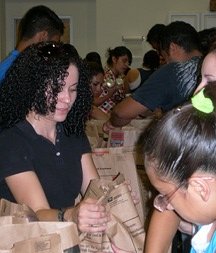
Jackie Ramirez from Primera Iglesia Bautista in Boerne and other youth spend an afternoon sorting canned goods at the San Antonio Food Bank during the Hispanic Baptist Convention of Texas.

His efforts paid off. About 40 churches went through the association’s feeding site training program, and half decided to serve as feeding sites.

“Getting volunteers is probably the hardest part—especially if you have a small church in an area with great need,” Payne said. “I think hearing stories of what the other churches did this summer will excite more churches to do it next year.”

Trinity Baptist Church hosted summer feeding for the first time this year at its off-campus TriPoint location. Mary Osborne coordinated the feeding program for the church, calling it “a great success.”

Eric Hernandez (left) from West Side Baptist Church in Seguin and Israel Villalobos from Ash Creek Baptist Church in Azle volunteer at the San Antonio Food Bank during an afternoon break at the Hispanic Baptist Convention of Texas.

“Every volunteer that comes is put to work and most of them return to help again. There’s always something for someone to do,” Osborne said. “We’ve had church volunteers, college students and even some high school students get involved. It’s been a great opportunity for lots of different groups and ages to participate.”

Trinity Baptist fed an average of 25 neighborhood children each day during the three weeks they participated. They also provided activities for the children, including arts and crafts, music, board games and relay races.

“Their moms bring them, so we’ve had the opportunity to tell them about our Mom-to-Mom group that meets, and also our Sunday school classes and choir program. We’re really developing a good relationship with neighborhood moms and dads,” Osborne said.

The church plans to serve as a feeding site again next summer.

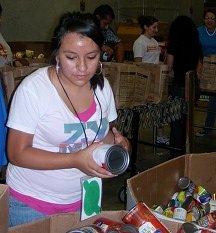
Becci Ruiz (right) from Getsemani Baptist Church in Elsa and other youth attending the Hispanic Baptist Convention of Texas spend an afternoon sorting canned goods at the San Antonio Food Bank.

Sammy Gaitan (left) and Rafael Sepulveda, both from Primera Iglesia Bautista in Diboll, join other youth from the Hispanic Baptist Convention of Texas in volunteering at the San Antonio Food Bank. (PHOTOS/Ken Camp)

Baptist Temple is one of the three churches that participated in summer feeding in 2009. Pastor Jorge Zayasbazan said they learned a lot from their first year and made changes for 2010. This year, the church added programming for the children between the end of breakfast and the beginning of lunch.

“Last year, we did no religious teaching whatsoever,” Zayasbazan said. “Last year we did a feeding site, but we didn’t know how to do programming. We fed local kids lunch three days a week for five or six weeks, but we didn’t have many kids come.”

With the addition of activities, they drew an average of 30 children each day. Different weeks had themes, such as music or karate. The church had mission teams come from other parts of the state to serve food and lead programming.

Most churches the association contacted responded enthusiastically to the idea, Payne said.

“Summer feeding is a great program and basically a great opportunity for our churches to witness to kids in the neighborhood and just care for our kids,” Payne said. “It’s also an opportunity for a church to adopt their neighborhood. A lot of our churches are commuter churches. Here’s an opportunity for a church to get settled there and work there. It’s something we can continue to grow every year.”


Students, families minister during Kenya mission trip

The first time Ashley Ratcliffe traveled to Kenya in 2005, she accompanied her grandmother, who taught a class for Wayland Baptist University’s Kenya degree program there. That trip awakened in her a desire to return to Africa, this time with a bigger purpose.

She got her wish recently as she participated in a Wayland Mission Center three-week project in Kenya.

Ratcliffe, a junior secondary education major from Lubbock, served on the education team, charged with working at the Christ-Like Academy in Limuru.

Ashley Ratcliffe of Lubbock feeds children at the Christ-Like Academy during a mission trip to Kenya. Ratcliffe was part of the education team that worked with the school in various capacities.

Her group worked with the small Christian school started in January 2009, serving lunch daily and helping the four teachers with their duties. The group also led a Vacation Bible School one week and brought new clothes in extra suitcases for the students, who range in age from 6 to 12.

Linus Kirimi is vice principal of Kenya Baptist Theological College, which partners with Wayland to offer degrees to ministry students. He and his wife, Liz, Wayland on-site program coordinator at the college, started the Christian school where Ratcliffe served.

“I had always wanted to go back to Kenya, and I liked working with children in the schools,” said Ratcliffe, who said she’s long felt a call to missions and wants to be a teacher.

The visiting Americans were also able to attend the graduation ceremonies at the theological college, where 30 students earned degrees from Wayland. The event lasted four hours—quite a change from the Plainview campus version of around 90 minutes. Ratcliffe attributed the difference to the celebratory nature of the event.

“It’s really a big deal for people there to get a college degree, so they really have a big time,” she said.

The education team also included Courtney Warren, an incoming freshman at Wayland and the daughter of WBU assistant professor of management Kelly Warren, who traveled with the group to teach a leadership class.

Her brother, Cameron, a junior media specialist major at Wayland, and mother, Sheri, also made the trip, making it the first international excursion for the family of four. While Cameron took the class his father taught at Kenya Baptist Theological College, his mother and sister served at the Christ-Like Academy.

Courtney Warren, a pre-nursing major, and Ratcliffe also worked with a medical team as they set up a clinic in Masailand, treating minor medical issues for about 800 people.

Warren noted the experience made her realize how much Americans take for granted as Africans travel from far away just to receive ordinary non-prescription pain medication and treatment for minor medical cases that are so easily treated in the United States.

Courtney Warren of Plainview, an entering freshman pre-nursing major at Wayland Baptist University, visits with a Masailand woman named Emily and her baby Charity at a home while on mission to Kenya recently.

A construction team built desks for the teachers at the school and put a tin roof over the kitchen area in order to free up more classroom space. Discipleship and evangelism teams also were able to make many visits and share the gospel, with great results.

“The Kenya trip was quite successful, and quite a few persons professed faith in Jesus for the first time,” said Rick Shaw, director of the Wayland Mission Center and the Kenya program and the trip leader.

In addition to their other assignments, the Wayland group traveled to Kakamega in western Kenya, where they visited a church led by a Wayland-Kenya graduate and ate dinner at the home of the deputy mayor.

African church services made the biggest impression on Courtney Warren.

“They were free in their worship services and it is a lot different than ours. It taught me a lot about worship,” she said.

Her family left Africa moved by the warm and welcoming nature of Kenyans, even when they had little to share with the visiting Americans.

“The thing that impressed me the most was how friendly and hospitable the Kenyan people are. In the slum areas, they welcomed us in and would fix tea for us and apologize that they didn’t have food to give us,” Sheri Warren said. “They have so little and yet they’d offer their best to us.”

Warren, a first-grade teacher in Kress, also marveled at how few resources the teachers have at the school and how large the classes are. One teacher had 37 children, and yet the students are well behaved and attentive.

“They have benches to sit on and her homemade posters but nothing else to work with. It amazes me that they are able to sit there and pay attention all that time,” she noted, also surprised by the education system in general. “They promote according to ability, not age, so there are some older than others but on the same learning level. I was amazed by the whole thing.”

Warren found the mission trip rewarding in all aspects, and she “can’t wait to go back over there,” even though she initially was anxious because there were so many unknowns and things to do in preparation. Her daughter agreed, noting that she’d “go back tomorrow” if possible.

Religious education and English major Bradley Sell, a senior from Clarendon, spent his three-week stint on the construction team but got the added bonus of preaching twice on the trip, with the help of a translator.

While Sell said he feels a call to ministry with students, he believed the trip was ordained by God to open his eyes to his work around the world. And although he originally planned to go on a mission trip to Kosovo and Macedonia, other conflicting events left Kenya the next opportunity for overseas mission work.

“It was good for me, because we have several Kenyan students who go to my church. So, it was good to know more about their culture,” he said. “Over the past year, the Lord has been working on me and making me realize I know nothing outside the Bible Belt. I think he wanted me to experience (Kenya) to help in my ministry here in the future. …

“I was really affected by how universal the need for the gospel is. The people there who knew the Lord were so joyful, even though they didn’t have a lot of material things or even food. Those without the Lord were not joyful, even if they had more. It put things in perspective for me. The people were very giving, and it was neat to see that. It’s also made me see the urgency of sending people out everywhere and how big the world really is, yet how small it is at the same time.”