Around the State: BWA approves two new Texas Baptist institutional members

Todd Still, dean of Baylor University’s Truett Theological Seminary and Elijah Brown, BWA general secretary, at 2024 BWA annual gathering in Lagos, Nigeria. (Photo: Merritt Johnston / BWA)

The Baptist World Alliance General Council approved Buckner International and Baylor University as new institutional members of BWA. Albert Reyes, CEO of Buckner International remarked: “For Buckner International to be an active member of the Baptist World Alliance affirms our international presence and connection to the global Baptist family. We can serve and connect to Baptist conventions and congregations in 128 countries, add value to their ministry, deliver expertise on serving vulnerable children, orphans and families, and equip them to serve their communities well.” Baylor President Linda A. Livingstone also commented on Baylor’s membership in BWA, saying: “Baylor is the largest Baptist university in the world, and we are thrilled to join the Baptist World Alliance as a member partner. We believe this relationship will help us continue to fulfill our mission to educate men and women for worldwide leadership and service. The Baylor board of regents recently approved expansion of our longstanding university motto by adding Pro Mundo to Pro Ecclesia, Pro Texana—codifying the influence our students, faculty and alumni have across the globe. We are ‘For the Church, For Texas’ and now ‘For the World.’ We look forward to collaborating and having the ability with the Baptist World Alliance to impact the world for Christ in even more significant ways in the future.”
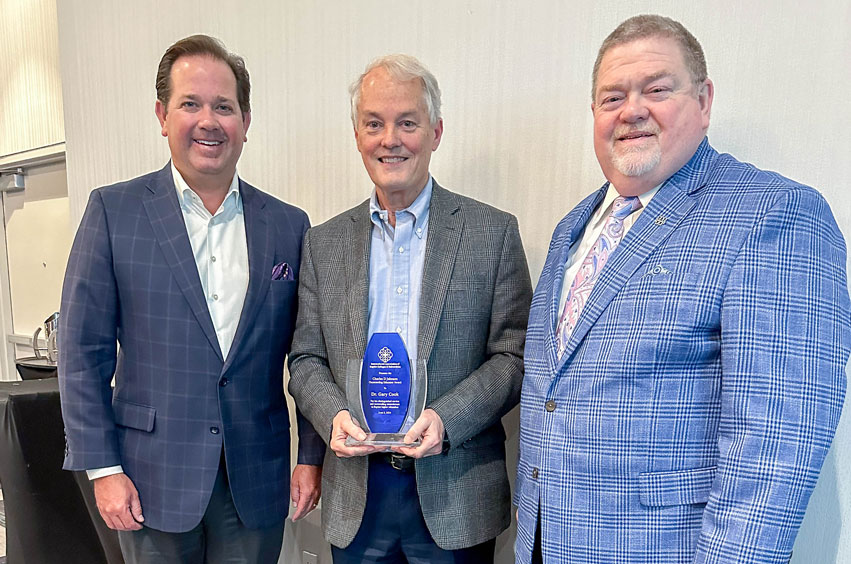
Pictured left to right: Adam C. Wright, Gary Cook and Bobby Hall. (DBU Photo)

Dallas Baptist University Chancellor Gary Cook received the Charles D. Johnson Award from the International Association of Baptist Colleges and Universities. The International Association of Baptist Colleges and Universities is a voluntary organization comprised of colleges, universities, and seminaries that embrace their Baptist roots, heritage and relationships. Members include 40 schools with more than 75,000 students in 16 states and three countries. DBU President Adam C. Wright and Cook traveled to Knoxville, Tenn., for this year’s annual meeting, where Cook received the award for his significant contribution to Baptist-related higher education. Cook is the 22nd recipient since the first award was presented in 1983. Bobby Hall, former president of Wayland Baptist University (retired in June 2024) and board member of the association, presented Cook with the award. “Dr. Gary Cook is a servant leader who believes in the power of Christian higher education to change lives and shape culture,” Hall said. “By his accomplishments at DBU and in the entire Baptist higher education landscape, it is clear that Dr. Cook is a true leader.” Cook arrived on the DBU campus in 1988 when he was named president. He served as DBU’s president for 28 years, until he was named chancellor in 2016.

Summer camp fun. (Wayland Photo)

God is working in the lives of students attending summer camps on Wayland Baptist University’s Plainview campus, according to Donnie Brown, director of spiritual life. Leadership Camp for youth from area churches was held June 23-26, and Top of Texas Kids Camp took place June 26-29. The final camp, 806 Youth Camp, runs July 8-12. Brown said God worked in the lives of 60 junior high and high school students who attended Leadership Camp. The Top of Texas Kids’ Camp brought 265 kids and sponsors to the campus for three days.

Founders Hall Topping Off Ceremony Attendees: l-r, Sandy Mooney, Garry Blackmon, Stewart Morris, Jr., Lisa Morris Simon ’76, Chris Hammons, John Tyler, Sharon Saunders and Charles Bacarisse. (Houston Christian University Photo)

Houston Christian University hosted a special Topping Off Ceremony for Founders Hall II on June 28. The event signified completion of the structural phase of the final building in the Morris Family Center for Law & Liberty complex. On behalf of HCU President Robert Sloan, Sandy Mooney, HCU chief financial officer/chief operating officer, welcomed special guests and a selection of HCU administrators, board members, faculty and staff, along with members of the construction teams. Special thanks were extended to Lisa Morris Simon and Stewart Morris, Jr. for their past and continued support and commitment to the university. HCU board of trustees Chair Garry Blackmon offered a dedicatory prayer to bless the occasion. Blackmon also expressed appreciation for the life and legacy of HCU’s Founding Father, the late Stewart Morris Sr. and members of his family. Following celebratory remarks, attendees were invited to sign the final structural beam—topped with an evergreen tree in accordance with a Scandinavian tradition dating back to 700 A.D.—to complete the building’s frame. Founders Hall II, the second ancillary building in the Law & Liberty Complex, will house academic classrooms and faculty offices to provide additional space to support HCU’s Institutional Strategic Plan (“Husky 2030”). The building is slated to open in early 2025.

Joseph Burcham in engineering lab with his model. (HPU Photo)

As a Brownwood native, Joseph Burcham didn’t have to travel far for a college education at Howard Payne University. But his road to graduation as an engineering science major led to an innovative way to light rural interstate highways. “My project is a system-based design harvesting mechanical electrical power from roadways,” Burcham said. “It’s an embedded system, designed to go inside roadways. As cars drive down the streets, they’ll rotate the system and create a current that will charge a battery pack. At night, when the photo sensor goes off, it’ll illuminate the streetlights.” Burcham, who graduated from HPU in May, collaborated on the project with Martin Mintchev, professor of engineering and chair of HPU’s division of engineering. Burcham enjoyed the project’s extensive development process. “We went through Google patents, searching all the databases to make sure there wasn’t a patent out there for it,” he said. “Then we made a miniature model, or prototype, to make sure it’s actually feasible, and then we made it bigger and made it look nice.”

Anniversary

George W. Truett Theological Seminary is celebrating 30 years of theological education. All are invited to attend Truett’s 30th anniversary celebration on Tuesday, Aug. 27. During this event, the Truett community will reflect upon the seminary’s history, enjoy worship and fellowship and consider a future marked by growth and development in an effort to prepare well the next generation of pastors and ministry leaders.



Advocate dispels myths about persecuted believers

Fruitfulness, faithfulness and vision characterize the persecuted church in many parts of the globe, an advocate for international religious freedom told a Houston-area Baptist church.

Wissam al-Saliby, president of the 21Wilberforce human rights organization, spoke at The Woodlands First Baptist Church the Sunday before Independence Day.

Wissam al-Saliby, former advocacy officer and director of the Geneva Office of the World Evangelical Alliance, is the new president of 21Wilberforce. (Photo courtesy of 21Wilberforce)

Al-saliby sought to dispel some misconceptions about persecuted believers globally.

“More often than not, the persecuted church is persecuted because it is flourishing,” he said.

In many cases around the world, Christians are persecuted because God has blessed their ministry, and it is “bearing fruit,” he noted.

Furthermore, persecuted believers often make the deliberate decision to stand against forces that discriminate against religious minorities.

“The persecuted are not helpless victims,” al-Saliby said. “They have agency.”

Often, persecuted believers make the conscious and prayerful choice to “push back” against restrictions on the free exercise of faith, he said.

“God is calling them to speak truth and justice against injustice,” he said.

Al-saliby recounted a conversation with the pastor of the Baghdad Baptist Church, who described how he is “building bridges” by systematically visiting leaders of other religious communities in Iraq.

“I am so grateful to hear this—that they are answering God’s calling to be peacemakers despite the persecution,” he said.

Al-saliby described the extreme danger some religious minorities globally face because they practice their faith.

“In Pakistan, India and Nigeria, there are attacks by mobs and armed groups claiming lives every year,” he said.

However, he noted, believers in those nations are peacefully resisting through legal channels. In India, for example, Christian leaders have appealed to the nation’s Supreme Court, detailing instances of violence against religious minorities and calling on the court to act.

“So in these countries, the persecuted Christians and the leaders of the Christians are imitating the Apostle Paul, saying, ‘We are taking our case to Caesar,’” al-Saliby said.

Coming alongside the persecuted church

Christians in the United States and other advocates for religious freedom have a role to play in supporting persecuted believers, he emphasized.

“As the church journeys to Caesar’s palace like Paul did, 21Wilberforce comes alongside the churches and the Christian leaders,” al-Saliby said. “We listen to them, understand their priorities, and understand how we can partner, serve and equip them.”

He encouraged Christians in the United States to pattern their behavior after the Philippian Christians who supported and encouraged Paul when he was in prison.

“How can we steward the wealth, the influence and the freedom we have been blessed with for the sake of those suffering persecution and imprisonment and [who are] threatened by violence?” he asked.

He challenged Christians in the United States and elsewhere to “partner with the persecuted” through prayer and financial support, by equipping and training leaders, and by “leveraging grassroots political influence.”

Al-Saliby called on the church in the West to pray for the perseverance of persecuted believers.

He also encouraged American Christians to pray for God to “visit the persecutors” and change their hearts, just as the Lord appeared to Saul of Tarsus on the road to Damascus and transformed him into the Apostle Paul.

“This is the ultimate victory against persecution,” he said.


SBC leaders respond to RNC’s potential public policy shift

MILWAUKEE (BP)—A release of the Republican National Convention’s platform reveals a potential shift in the party’s focus on a federal abortion ban—a change that drew reaction from some Southern Baptists.

The announcement came hours after the RNC’s platform committee met on Monday morning.

Shifting the burden to state lawmakers

“We proudly stand for families and life. We believe that the 14th Amendment to the Constitution of the United States guarantees that no person can be denied life or liberty without due process and that the states are, therefore, free to pass laws protecting those rights,” according to a document released on The Hill.

The language clearly places the onus on state legislatures two years after the Supreme Court’s reversal of Roe v. Wade.

“After 51 years, because of us, that power has been given to the states and to a vote of the people,” the platform states. “We will oppose late term abortion while supporting mothers and policies that advance prenatal care, access to birth control, and IVF [fertility treatments],” according to the released document.

But one evangelical seminary professor disagrees with the committee’s logic.

“Since 1984, the GOP platform has always included robust language in defense of the sanctity of human life for the unborn. It’s important that at least one major political party recognize what is clear from both Scripture and the witness of science: human life is sacred from the moment of conception and should be protected into law,” said Daniel Darling, director of Land Center for Cultural Engagement at Southwestern Baptist Theological Seminary.

The platform will face a final confirmation vote by the platform committee on July 9 before being presented to delegates at the Republican Party’s convention July 15-18.

“Unlike the party’s platform passed in 2016, the text does not include a 20-week federal limit on abortions or call for states to pass the Human Life Amendment, which proposes to amend the Constitution to say that life begins at conception,” Politico reported.

“The text instead says that states are ‘free to pass laws protecting’ the rights granted in the 14th Amendment.”

Call to ‘stand for life’

In an op-ed  article released by Religion News Service, Ethics & Religious Liberty Commission President Brent Leatherwood said: “The platform of a political party should set forth the objectives of that body. As the Republican National Committee meets, instead of jettisoning or diminishing the platform’s firm pro-life stance, its members should unabashedly advance liberty and stand for life, label abortion evil, advocating for laws that acknowledge it for the sin that it is, and embrace proposals that free men and women from the destruction it leaves in its wake.”

Brent Leatherwood

Leatherwood urged leaders of both political parties July 3 to “to prioritize pro-life policy in their parties’ soon-to-be-released platforms.

“Now more than ever is the time to advocate for a robust vision for life. Policymakers should craft proposals that reflect this nation’s founding ideals and ensure freedom for those who truly have no voice,” he wrote in the op-ed article.

“This true culture of life would usher in an era when pre-born lives are saved, vulnerable mothers are shielded from the predatory abortion industry, and fledgling families are supported at both the federal and state level.”

Earlier this summer, Southern Baptists voted for a resolution “to reaffirm the unconditional value and right to life of every human being, including those in an embryonic stage, and to only utilize reproductive technologies consistent with that affirmation especially in the number of embryos generated in the IVF process.”

“Since the fall of Roe, many Republicans have not been prepared for this moment, unable to articulate a consistent pro-life ethic,” Darling told Baptist Press.

“There has been considerable pressure to jettison the pro-life cause because of perceived electoral challenges. Evangelicals recognize the challenge that we face: it will take a lot of persuasion to bring the culture along with us. We must be prudent in choosing the right battles in order to save as many unborn babies as we can.”

He noted candidates who champion pro-life policy have been rewarded by voters.

“In the half-century of pro-life activism, candidates who stand up for the unborn have won at both the local and national level, including the presidency,” he said.

Darling said it is a “mistake that the Republican Party has tried to soften this 40-year-old language.”

“Candidates would be wise to ignore this language and stick to their pro-life convictions,” he said.


‘Ladies of Camp Builders’ create special quilts

What do googly eyes, fuzzy yarns, zippers without openings and little stuffed animals poking out of pockets have in common? They are just a few of the items one would find garnishing fidget quilts designed by women in sewing rooms at Christian campgrounds.

Volunteer Twila Shue displays a fidget quilt. (Photo / Leah Reynolds / Texans on Mission)

Like many fidget toys that have become popular over recent years, a fidget quilt gives someone a tangible tool to occupy his or her hands and mind. The quilts, however, are designed with specific people in mind: nursing home residents and children with special needs.

Each month the volunteers, known as the “ladies of Camp Builders,” accompany their husbands to projects organized by Texans on Mission Camp Builders.

In the sewing room, the women tackle various projects, from curtains for the camp dorms to baby blankets and hats for pregnancy centers, as well as the fidget quilts.

Heights Baptist Church in Alvin has received numerous fidget quilts donated by the ladies of Camp Builders to go in its specially fabricated sensory room and in its sanctuary “buddy bags.”

“The quilts bring joy to the boys and girls. It helps them feel included. It helps them feel special,” said Julie Hernandez, Heights’ disability ministry director. “It helps meet their needs and meet them where they are, whether it’s in the sanctuary or in the sensory room.”

Fidget quilts produced by the wives of Texans on Mission Camp Builders provide a tangible tool for nursing home residents and children with special needs to occupy their hands and minds. (Photo / Leah Reynolds / Texans on Mission)

Every quilt is unique, said Beverly Quinn, coordinator for the ladies of Camp Builders, making it a fun project for people with great imaginations. While some quilts are colorful with buttons and small stuffed animals, others boast a more nostalgic pattern.

“Of all the projects we do, the fidget quilts are the most fun to make, because you get to be creative,” Quinn said.

In nursing homes, fidget quilts give residents in memory care an avenue to exercise their minds and their fingers.

Volunteers (left to right) Beverly Quinn, Ruth Kitts and Candy Nance display some of the handiwork produced by the “Ladies of Camp Builders.” (Photo / Leah Reynolds / Texans on Mission)

“At one nursing home, a lady who rarely ever sits down sat and played with the fidget quilt,” Quinn said.

After retirement, volunteer Nancy Morgan and her husband Gary joined the Camp Builders team in 2017. She especially enjoys using her creativity to make fidget quilts, dresses, skirts and shorts.

“We get to be creative, and we know that they’re going to bless little children,” she said.

Sewing experience is not required to join the ladies of Camp Builders, Morgan said, acknowledging she had little time for sewing in her 42 years as a nurse. Anyone who has a willing heart can help, whether it’s with simple sewing tasks or supportive tasks such as cutting and measuring.

“It’s just fun to be together with a group of women and have fellowship together,” she explained. “And the goal is to further the kingdom of God.”


Camp Builders wives sewing for God’s kingdom

Sounds of roaring electric saws and clanging hammers reverberate outdoors across Christian campgrounds courtesy of hardworking Texans on Mission Camp Builders volunteers.

Indoors, different sounds are heard. They are the whirs of sewing machines, snips of scissors and laughter from a group of friends serving God in a remarkable way.

Volunteers (left to right) Joan Tucker and Beverly Quinn display some of the items created by the wives of Texans on Mission Camp Builders. (Photo / Leah Reynolds / Texans on Mission)

The “ladies of Camp Builders” are wives who accompany their husbands on monthly Camp Builders projects. While their spouses unload construction tools from the Texans on Mission trailer, the women unload sewing equipment and bins upon bins of donated fabric and supplies.

When the sun rises each morning—after a hearty breakfast and devotional time together— volunteers head to their projects, eager to use their time and talents to make an eternal impact for God’s kingdom.

A sewing room is set up in an available space—often in a cabin’s common space or an old storage room. In the sewing room, the ladies tackle as many projects as possible. The priority lies in what the camp needs, which can include curtains for cabins, seat cushions, food covers and even bean bags for cornhole games.

The women make skirts and shorts for various ministries; quilts and baby hats for pregnancy centers; and fidget quilts for children with special needs and nursing home residents, among many other projects.

Veteran sewer 88-year-old Joan Tucker finds great joy in embroidering special designs for her quilts, bringing a personal touch to each pattern. She and her husband Earl have volunteered for 20 years.

“When we started, we were one of the youngest couples. Now, we’re one of the oldest,” Tucker said with a chuckle.

When it comes to retirement, Tucker said, “You have to stay busy, or else you’ll just sit in a rocking chair until you fade away.”

When volunteer Nancy Morgan retired from 42 years of nursing in 2017, she yearned to serve others behind the scenes.

Volunteer Candy Nance serves with the wives of Texans on Mission Camp Builders. (Photo / Leah Reynolds / Texans on Mission)

“It’s fun to sew together with a group of women and have fellowship together, but the end goal is to further the kingdom of God,” Morgan said, noting that the ladies pray over every completed item before it’s sent to its final destination.

While some volunteers join the crew with a prior knowledge of sewing and needlework, many have little to no experience, yet all find a task to do.

“We have plenty of places for people to work,” said Beverly Quinn, coordinator for the ladies of Camp Builders. “There are always things to cut out. There’s always something to do for the people who don’t sew.”

In 2023 and 2024, Texans on Mission Camp Builders had more camps requesting help than they had seen for many years. Quinn said the work can be busy, but it’s time well-spent with good friends and for a great cause.

“This gives the ladies a purpose,” Quinn said. “We not only have fun together, but we pray together. I enjoy not only knowing we’re making a difference in lives here and abroad, but that we all become family.”


Prayers urged as fighting intensifies in Gaza

A Palestinian Baptist reported three Christians in Gaza have been injured in recent days, and the people were “terrified” but still reluctant to evacuate after the Israeli Defense Forces issued a warning.

Hanna Massad, former pastor of Gaza Baptist Church and founding president of Christian Mission to Gaza, sent an “urgent prayer request” email July 7.

“The people in the churches in Gaza are terrified and scared,” Massad wrote. “The IDF issued a warning around 5 p.m. Gaza time, urging everyone in the area to evacuate. This typically indicates that the area may be targeted soon.

“Despite the warning, the people in the churches have chosen to stay. The explosions are very close, and the noise is extremely loud,” Massad wrote.

The Times of Israel reported the IDF on Sunday called for the evacuation of the Tuffah, Daraj and Old City neighborhoods of Gaza City. In an updated announcement Monday, the IDF urged civilians in the Sabra, Rimal, Tel al-Hawa and Daraj to evacuate and move to a designated “humanitarian zone.”

The Palestinian Ministry of Health reported an Israeli assault Saturday on central Gaza killed at least 16 people and injured 50 others at a United Nations Relief and Work Agency school sheltering displaced people.

According to Al JaZeera, the Ministry of Health on Monday reported Israeli attacks across Gaza resulted in at least 40 deaths in one day, bringing the total number of fatalities in Gaza to 38,193 since Oct. 7, 2023, with 87,903 wounded.

In an email to supporters of his ministry, Massad wrote, “Please pray for continued protection for all, for God to raise peacemakers in the region to take action, and for this nightmare to end.”


Religion in schools legislation spurs conflict between faiths

WASHINGTON (RNS)—When Louisiana Gov. Jeff Landry was asked to defend his support for a new state law requiring public schools to display a version of the Ten Commandments in public classrooms, he made sure to touch on the bill’s obvious religious connections.

Bigstock Image

“This country was founded on Judeo-Christian principles, and every time we steer away from that, we have problems in our nation,” Landry, a Catholic, said during an interview with Fox News.

But just a few days later, Christian ministers—along with an array of religious leaders and parents of various faiths—filed a lawsuit against the new statute, backed by the Americans United for the Separation of Church and State, the Freedom From Religion Foundation and offices of the ACLU.

“As a minister, this law is a gross intrusion of civil authority into matters of faith,” Jeff Sims, a Presbyterian Church (U.S.A.) minister and plaintiff in the case, said in a press conference about the lawsuit. “It interferes with the administration of God’s word, co-ops the word for the state’s own purposes, or claims God’s authority for the state.”

The back-and-forth is part of a broader fight raging across the country, with conservative state lawmakers—often backed by conservative Christians—pushing faith-focused laws and running into opposition from other religious people and their secular allies.

At least 19 states consider bills to advance religion

Over the past two years, at least 19 states have considered legislation advancing religion, including bills promoting the display or discussion of the Ten Commandments in schools and those allowing for school chaplains.

Oklahoma State Superintendent of Public Instruction Ryan Walters issued a directive June 27 requiring all schools to incorporate the Bible and the Ten Commandments into the curriculum, effective immediately. (Screen capture image from YouTube)

Three states—Louisiana, Utah and Arizona—passed Ten Commandments legislation, although Arizona’s governor vetoed the bill, and Utah’s Legislature walked back their initial proposal, with lawmakers ultimately only adding the decalogue to a list of historic documents that can be discussed in class.

In addition, Louisiana recently joined two other states—Texas and Florida—that passed laws allowing for chaplains in public school.

At least one state has achieved similar aims by circumventing the legislative process altogether. Oklahoma Superintendent of Public Education Ryan Walters issued a directive requiring schools to “incorporate the Bible, which includes the Ten Commandments, as an instructional support,” and has said teachers who fail to teach students about the Scripture could risk losing their license.

“We’re proud to be the first state to put the Bible back in school classrooms,” Walters said in an interview with News Nation.

Some faith leaders push back

Religious leaders in the state were quick to push back against the directive, however, with one pastor from the more socially liberal United Church of Christ denomination posting, “Public schools are not Sunday schools,” according to KFOR.

Rachel Laser, head of Americans United, told KFOR her group is mulling a legal challenge like the one they helped file in Louisiana, while Jewish leaders, Muslim leaders and a local Methodist bishop spoke out.

“United Methodists believe that the state should not attempt to control the church, nor should the church seek to dominate the state,” United Methodist Church Bishop James Nunn told KOCO in a statement. “We endorse public policies that do not create unconstitutional entanglements between church and state.”

While there are some differences, many of the bills share common traits or even language. Most of the bills advocating for displaying the Ten Commandments use a translation of the decalogue derived from the King James Version of the Bible, a translation that is not embraced by all Christians, much less Jewish Americans or those of other faiths.

In fact, the text is slightly different from the KJV and has a particular history. It is the version compiled by the Fraternal Order of Eagles used to help promote the 1956 movie “The Ten Commandments.”

The same version was also used on a Ten Commandments monument that sits outside the Texas State Capitol. Despite a legal challenge, the U.S. Supreme Court ruled in 2005 that the monument is allowed to stand because of its “passive” nature.

Bills pushing school chaplains also share common traits, likely a byproduct of the religious groups behind them. According to The New York Times, the National Association of Christian Lawmakers—a group formed in 2020—worked with lawmakers in Florida, Louisiana and Texas to pass chaplains bills.

Opposition on religious grounds

The Texas bill was also spurred by a group of activists affiliated with the National School Chaplain Association, a group run by former drug smuggling pirate Rocky Malloy.

As debate over the Texas chaplains bill heated up last year, one Democratic lawmaker in particular—Rep. James Talarico, a Presbyterian seminarian—emerged as someone who opposed the bill on both legal and religious grounds.

During debate on the House floor, he expressed concerns that NSCA’s parent organization, Mission Generation, appeared to have advocated for proselytizing to children in schools.

“I see this as part of a troubling trend across the country of Christian nationalists attempting to take over our democracy and attempting to take over my religion—both of which I find deeply offensive,” Talarico told Religion News Service in an interview last year, referring to the chaplains bill and efforts to pass a Ten Commandments bill in Texas.

Republican lawmakers did not amend the chaplains bill to bar proselytizing or impose credentialing requirements for chaplains, leaving it up to individual school districts to outline parameters themselves.

The National School Chaplain Association is referenced by name in the text of Pennsylvania’s school chaplains bill, which was introduced in April. It defines a “certified school chaplain” as “an individual certified by the National School Chaplain Association or other similar organization.” The NSCA was also mentioned in committee discussions in Nebraska.

Where the chaplains bills have become law, criticism has been a constant—especially from religious groups. In March, a coalition of religious organizations signed a letter condemning efforts to install public school chaplains as “greatly flawed” and as threatening “the well-being, education, and religious freedom of our students.”

Signers of the letter included entire Christian denominations, such as the Alliance of Baptists, Cooperative Baptist Fellowship, United Church of Christ as well as other religious groups such as the Union for Reform Judaism and the Unitarian Universalist Association. Religious advocacy groups, such as the Muslim Public Affairs Council, Hindus for Human Rights, The Sikh Coalition and Baptist Joint Committee for Religious Liberty, also signed the letter.

In Texas, as school boards across the state gathered in recent months to vote on whether to allow chaplains in their regions, faith leaders regularly appeared to voice disapproval, and more than 100 chaplains signed a petition arguing religious counselors in public classrooms would be “harmful” to students.

In their letter, chaplains decried the absence of standards or training requirements for school chaplains in the bill aside from background checks. They pointed to military chaplains or those who work in health care as a point of comparison, noting requirements like extensive training and instruction on how to work across multiple faiths—conditions absent from the Texas law.

“Because of our training and experience, we know that chaplains are not a replacement for school counselors or safety measures in our public schools, and we urge you to reject this flawed policy option: It is harmful to our public schools and the students and families they serve,” the letter reads.

Proponents count on support from Supreme Court

Proponents of the new slate of faith-focused bills appear confident the courts will back them—especially the current conservative-leaning U.S. Supreme Court.

Louisiana Gov. Jeff Landry declared at a GOP fundraiser that he “can’t wait to be sued” over the state’s Ten Commandments bill.

Walters of Oklahoma—who has accused President Joe Biden, a Catholic, of wanting to destroy “our Christian faith”—told PBS he was unconcerned about legal challenges to his Bible directive because justices appointed by Donald Trump would back him.

“If we get sued and we get challenged, we will be victorious, because the Supreme Court justices (Trump) appointed actually are originalists that look at the Constitution and not what some left-wing professor said about the Constitution,” he said.

Whether or not justices would actually support the laws is unclear. Opponents of the laws point to ample Supreme Court precedent suggesting the statutes violate the constitutional prohibition against establishing a state religion.

However, at least two members of the Supreme Court—Justices Clarence Thomas and Neil Gorsuch—declared in a 2020 concurring opinion they believe the establishment clause only applies to the federal government, not the states.

While their viewpoint is considered fringe by many scholars, it remains to be seen if others on the court, such as Justice Amy Coney Barrett, agree.

And while some of the education bills have died in committee, such as in Nebraska, others have helped spur related legislation. Lawmakers in Indiana, for instance, dropped the chaplains bill as part of a compromise legislation that allows students to leave school for religious instruction if they request it.

But religious opponents to such laws say they are prepared to combat them. In the press conference with those suing Louisiana over its Ten Commandments law, Joshua Herlands, a Jewish parent and one of the plaintiffs in the case, laid plain what he feels the debate is ultimately about.

“The displays distort the Jewish significance of the Ten Commandments in several places and send the troubling message to students—including my kids—that they may be lesser in the eyes of the government because they do not necessarily follow this particular version, or any version, for that matter, of the religious text,” Herlands said. “The state is dividing children along religious lines.”


Baptists called to be peacemakers in challenging times

LAGOS, Nigeria—“You can’t share what you don’t have,” Bob Garrett reminded attendees of the 10th Baptist International Conference on Theological Education, citing the Apostle Paul’s reference to “the peace that passes all understanding” (Philippians 4:7).

Baptists from around the world discussed peace and peacemaking during the three-day conference ahead of the 2024 Baptist World Alliance annual gathering in Lagos, Nigeria.

The conference featured panel discussions, papers and responses by Baptists from the United States, Jamaica, Rwanda, Nigeria, Israel, Germany, Ukraine and elsewhere.

“Theological education is an essential part of discipleship” and developing flourishing communities of faith, Elijah Brown, general secretary of Baptist World Alliance, told attendees.

Bob Garrett is a retired professor of missions at Dallas Baptist University. (Photo / Eric Black)

Garrett, retired professor of missions at Dallas Baptist University, called peace a gift from God that “stands overwatch” over followers of Jesus in all circumstances.

He recounted a conversation with a church member in Kentucky during the early days of his pastoral ministry. The man knew people considered him unintelligent and sometimes took advantage of him.

“If they can live with what they’re doing to me, I can live without what they took,” the man told Garrett.

Embodying the Hebrew concept shalom—translated as “peace” or “wholeness”—is exhibited in one’s willingness to “turn the other cheek” (Matthew 5:39), Garrett said, or as Pastor Johnathan Hemmings of Jamaica put it, “to break the cycle of violence is to take violence on oneself.”

Presenters and table discussions made clear peacemaking involves more than turning the other cheek.

Peace, justice and unity

For example, Rula Khoury Mansour, a Palestinian-Israeli Christian, attorney and associate professor of reconciliation theology and Christian ethics at Nazareth Evangelical College in Nazareth, Israel, described the ritualized Middle Eastern process of sulha—translated “peace” or “reconciliation.”

Rula Khoury Mansour is a Palestinian-Israeli Christian, attorney and associate professor of reconciliation theology and Christian ethics at Nazareth Evangelical College in Nazareth, Israel. (Photo / Eric Black)

Sulha involves a set of communal rituals and ceremonies: venting, or lamentation, by the victim’s family; pleas by representatives of the offender for forgiveness to restore the offender’s honor; public signing of peace agreements; a handshake, declaration of forgiveness and a ceremonial meal; and “a ‘heavy silence’ [of humility in which] the offender’s family admits wrongdoing and offers compensation, while the victim’s family forgives.”

In contrast to Western understandings of personhood, African and Middle Eastern cultures see one’s identity as wrapped up in one’s community. Therefore, reconciliation involves the whole community.

The church is a community of fellowship with rituals and practices through which “unity, forgiveness, healing and reconciliation” can be fostered, Mansour proposed.

Pressed for peace

President Israel Adelani Akanji of the Nigerian Baptist Convention and Elijah Brown addressed reporters from several Nigerian media outlets at a press conference during the Baptist International Conference on Theological Education.

Baptist World Alliance General Secretary Elijah Brown and President Israel Adelani Akanji of the Nigeria Baptist Convention spoke to reporters during the Baptist International Conference on Theological Education. (Photo / Eric Black)

“Security is the work of everyone,” not just security agents, Akanji said in response to questions about insecurity in Nigeria, particularly in the northern states. “It is not in the hands of the church to handle security. … It is part of the government’s responsibilities.

“So, ours is to continue to pray, to continue to sensitize the government, to continue to speak to the government. This occasion also is another occasion through which we are speaking to our government to ensure that we have security of life and property.”

Responding to questions about hunger, poverty, government corruption and how Baptists will make a positive difference in these situations, Brown noted the only miracle recorded in all four Gospels is the feeding of the 5,000.

“Feeding people is fundamental to understanding the ministry of Jesus, and people of the King work to feed the people of the world,” he continued.

Though Jesus led through service, “we’ve seen far too many leaders who embrace leadership as a means for consumption, that which they can consume and ways in which they can consume others. But we believe that power should be exercised in the form of righteousness, peace and joy” and grace, Brown said. Such grace emphasizes the people who are suffering, he said.

Lessons from Western decline

Speaking to questions about the decline of Christianity in places like the United States, Brown urged Nigerian Christians to learn three lessons from that decline: (1) “Hold on to your passion for evangelism,” (2) “hold to discipleship of all ages,” and (3) “work proactively to create churches of safety, respect and security for all people.”

“I urge every Nigerian church, as well as every faith institution across this country, to adopt and implement immediately policies and practices that will end domestic violence, child abuse and sexual abuse,” Brown said.

“Domestic violence, child abuse and sexual abuse is a sin. It is not a cultural issue. It is wrong, and I ask every faith institution to be at the forefront of creating communities of safety that welcomes every person into that community with policies and practices that will seek to eradicate domestic violence, child abuse and sexual abuse.”

Humanitarian action and development

Ernest Adu-Gyamfi of Ghana was chair of the National Peace Council governing board in Ghana. (Photo / Eric Black)

The BWA International Humanitarian Action and Development Intensive Course ran concurrently with the theological education conference. Participants completing the course had the opportunity to earn a non-degree certificate from Baylor University’s Truett Theological Seminary’s certificate program in conjunction with Buckner International and BWA Aid.

Ernest Adu-Gyamfi of Ghana was honored as an ambassador of peace in recognition of his leadership promoting political and civil peace in Ghana at the local, university and national levels.

As chair of Ghana’s National Peace Council governing board, he led in the development of the Presidential Candidate’s Peace Pact “signed by all aspiring presidential candidates to accept the outcome of the elections without pursuit of violence and to seek any desired redress within the court of law.”

CORRECTION: Nigerian Baptist Convention President Israel Adelani Akanji’s name was corrected in the article and photo caption.


Faith and Gen Z: Lauren Beal

Gen Z continues to present as a generation touched by hopelessness and limited opportunity as they launch into adulthood. However, some graduates of Texas Baptist universities offer a different take.

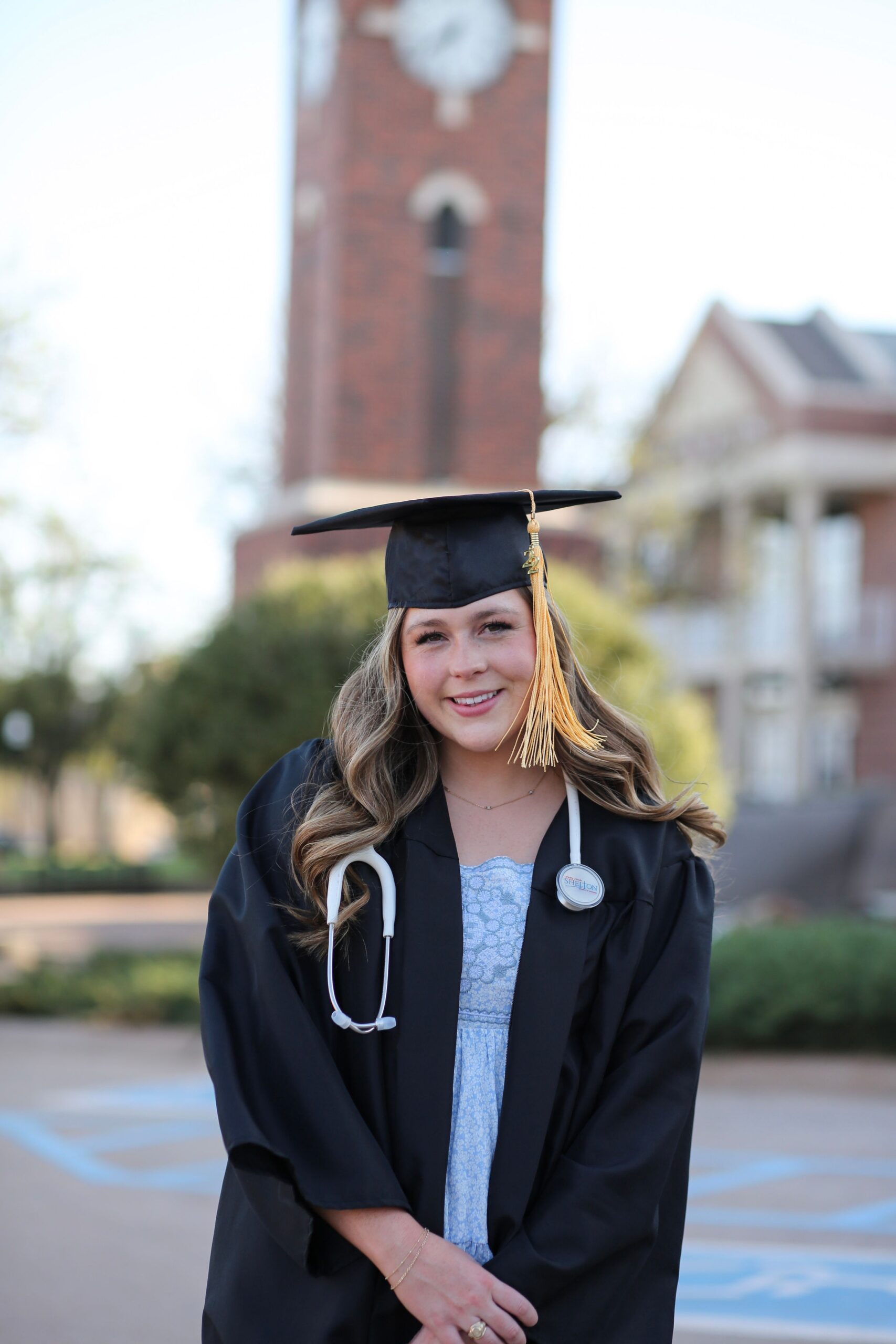
Lauren Beal graduated from Hardin-Simmons University in 2022 with a bachelor’s degree in nursing.

Beal grew up in Midland, where she attended First Baptist Church and came to faith in Christ at a young age. Beal knew all the Bible stories, and when she was around 8 or 9 and all her friends and her sister were making commitments, she did, too.

“It was a real, sweet, childlike faith,” Beal said.

But in high school Beal felt challenged by a teacher who questioned students about why they went to church. She wasn’t happy with her answer that she went because her family did and it was expected of her. So, she determined to change it.

She made it her goal to work on making her faith more uniquely her own, wrestling through the rest of high school with making sure her faith was for her, not for anyone else. Her faith became about wanting to know and love God more.

Beal said she never really considered any other colleges other than Hardin-Simmons. Her sister attended HSU and had a great experience. So, she convinced her younger sister to go there, too.

Called to be a nurse

Beal’s nursing school graduation day. (Courtesy Photo)

Beal currently works as a labor and delivery nurse at Hendrick Hospital in Abilene. She learned about this job while she was in nursing school doing clinical study at Hendrick Medical Center, when she was able to spend a couple of clinical days with labor and delivery.

“Your last semester of nursing school, you do something called a preceptorship, where like a month, you follow a nurse around. And I got paired with a nurse on my [current] unit,” Beal explained. She loved it. So, she applied, and they accepted her, she said.

She said she always wanted to do something in the medical field, viewing it as her calling.

“If I had to change my major, I think I would have been a little lost, because that was the only thing that really made sense for me,” Beal said.

Her faith has helped her face uncertainty, because she has total reliance that God is good, and “God’s will is going to play out no matter what happens.”

“I feel like that was kind of a hard lesson for me to learn. And over the last several years, I’ve learned that in uncertainty, the only thing I can do is just lean on God,” Beal explained.

Beal feels blessed she hasn’t experienced a lot of anxiety or depression, as many of her generation have, but she acknowledged nursing school was hard. At times, she experienced self-doubt about passing and grades.

But, she learned to rely on “the joy we have in the Lord, and just kind of leaning into that, even though you may be anxious about where you’re going,” or if she was going to pass nursing school or not. In those times, she relied on God as her greatest comforter.

At Hardin-Simmons, Beal said she learned about the importance of community in growing faith. She learned the value of being discipled and discipling others.

“That is just where I’ve seen my faith being challenged, people holding me accountable, and also getting to pour into others,” Beal said.

Her church in college emphasized community and growing together. They “poured into discipleship, home groups, and not doing faith alone,” Beal continued, saying: “I think that is the biggest way that I can nurture my faith, help it grow, is just to not do it alone.”

Being able to rely on people she trusts and looks to for wisdom to help her faith grow also is important, Beal said.

Hardin-Simmons isn’t an exceptionally large campus, Beal explained, but coming from a small private school in Midland, it was still eye-opening to encounter so many new ideas at college, having been quite sheltered where she came from.

Growing together in faith

She said finding a church home she trusted to preach truth was pivotal her freshman year in making the adjustment.

Lauren Beal, right, and friends. (Courtesy Photo)

She feels lucky to be employed by a Baptist hospital where she can feel comfortable openly talking about faith at work.

“With labor and delivery, I feel like it’s most of the time happy, good, smiles and birthday parties,” Beal said. “But there’s some really hard, hard times on labor and delivery.”

So, “getting to sit and pray with my patients [provides support], because there’s only so much you can say.

“So, finding that the next thing you should say is to sit down and pray with them has been a great tool for me, as a nurse,” Beal said.

Beal was involved in Baptist Student Ministry at Hardin-Simmons, but she feels her biggest growth in college took place through her home group at the church she attended. She was introduced to the church through a church fair on campus, she said.

For Beal, the best thing about HSU was the people. She said she met so many great people who are lifelong friends. She joined a social club, “which is kind of like a sorority.” And she met all her current best friends in college.

“There’s just good people there,” she continued.

One person she is especially thankful to have met there is her husband Daniel. They love HSU and find it “really sweet and special” that they met there, she said.

He is a youth pastor at Beltway Baptist Church, at its north campus. She acknowledged youth ministers tend to move around a little bit, but it is their hope to stay in Abilene for as long as they are able.

For more on Texas Baptist Gen Zs, check out Cynthia Montalvo and Sarah Potts’ stories.


California Baptists cut staff, citing giving shortfall

(RNS)—The California Southern Baptist announced it had cut six staff jobs, citing an ongoing decline in giving.

Donations to the state’s Cooperative Program, which funds national, international and state-specific ministries, fell short by $170,000 in the current fiscal year. That 7 percent shortfall is part of an ongoing decline in giving, according to Baptist Press.

State Baptist officials have drawn on reserves to cover shortfalls over the past three years. The staff cuts, including four layoffs and two voluntary retirements, mean the state convention will not need to draw on reserves—as long as giving does not decline.

“The stewardship that God has given me as the executive director in assuring we continue to have a healthy and sustainable future is a heavy burden,” Pete Ramirez, the state convention’s executive director said, according to Baptist Press.

Giving overall to the Southern Baptist Convention Cooperative Program is down just under 2 percent in the current fiscal year. The SBC’s annual budget called for $148 million in donations to be given to national and international causes, but actual giving to date is $145.4 million, according to a recent report posted by the SBC’s Executive Committee.

The SBC Cooperative Program, which turns 100 years old in 2025, is one of the nation’s most successful religious charitable programs, having raised more than $20 billion since its inception. Those funds pay for overseas missions, new church starts, seminary education, disaster relief and other programs.

Cooperative Program giving declines

But giving to the program has declined in recent decades. Southern Baptist churches give less than 5 percent of their income to the Cooperative Program, down from 10 percent in the 1980s. And less than 60 percent of SBC churches give to the program, down from three-quarters in the early 2000s.

The denomination also has lost more than 3 million members since 2006 and has faced a sexual abuse crisis and debates over the role of women in church leadership. The denomination’s Executive Committee also spent several years dealing with leadership turmoil before electing a new permanent leader this spring.

In 2023, the SBC expelled Saddleback Church in Southern California, one of its largest congregations, after the church ordained several women as pastors. At the time, Saddleback was giving $100,000 annually to the Cooperative Program.

It’s unclear whether Saddleback remains a member of the California Baptist Convention, or if the congregation still gives to the convention. In either case, the shortfalls in California predate Saddleback’s removal from the SBC.

It’s also unclear if other states also are experiencing Cooperative Program shortfalls. Most of those conventions will hold their annual meetings in the fall. A 2023 report from Baptist Press found Colorado, Minnesota-Wisconsin and New Mexico conventions also reduced their giving to the program.

The recent Executive Committee report showed giving remained down in Colorado. However, Mike Proud, that state’s executive director, said that is not the case.

“[Cooperative Progam] giving is actually up in Colorado there may be some delays related to getting that money to the [Executive Committee],” he told RNS in an email. “But our giving through June of 2024 is actually up by 2 percent over last year.”


Challenges to abortion bans on religious freedom grounds falter

WASHINGTON (RNS)—Soon after the U.S. Supreme Court overturned Roe v. Wade two years ago, a novel legal strategy emerged for challenging new state abortion bans. It argued near-total bans infringe on religious freedom by imposing a Christian understanding of when life begins.

In recent days, that strategy took a beating in the courts.

Kentucky judge says women lack standing

On June 28, a Kentucky judge dismissed a lawsuit brought by three Jewish mothers who argued the state’s near-total abortion ban violated their religious freedom.

Among their claims, the women argued the abortion ban violated Kentucky’s Religious Freedom Restoration Act, which states the government “shall not substantially burden a person’s freedom of religion.” They asserted their Jewish faith allows for abortion and in some cases requires it.

Jefferson County Circuit Judge Brian Edwards said the group of women lacked standing to bring the case because they were not pregnant and therefore suffered no injury by the law.

When life begins not necessarily a religious belief

In another case earlier in June, a Missouri judge rejected a clergy-led effort to halt the state’s near-total abortion ban. A coalition of 14 Christian, Jewish and Unitarian leaders argued some religions require access to an abortion and said a Missouri law imposes the beliefs of one religious tradition on others—a direct attack on freedom of religion.

St. Louis Circuit Court Judge Jason Sengheiser wrote: “While the determination that life begins at conception may run counter to some religious beliefs, it is not itself necessarily a religious belief.”

But advocates argue the religious freedom argument is not yet dead.

In both the Missouri and Kentucky cases, appeals are planned.

“We are in the middle of a long, drawn-out twilight struggle, and the steps that we’re taking are the first steps in a very long journey,” said Ben Potash, one of the lawyers who filed the Kentucky complaint and is now working on an appeal.

Kentucky Jewish women need IVF

In Kentucky, Potash pointed out, the judge didn’t even rule on the merits of the case, dismissing it on the basis of standing, or whether the plaintiffs had cause to bring suit in court. The judge found the alleged injuries in the women’s case were hypothetical.

Potash said the appeal will argue the three Jewish women’s standing is not hypothetical. All three women require in-vitro fertilization to become pregnant. However, they are afraid of beginning the procedure without greater clarity about what the law will permit them to do with excess frozen embryos, or whether they would be required to continue carrying implanted embryos that are determined to be not viable. The three women argued having more children is a religious obligation.

“This ruling ignores critical issues central to our case, which impact many individuals and families across our state,” the three women—Lisa Sobel, Jessica Kalb and Sarah Baron—said.

“Our lawsuit seeks clarity on Kentucky’s complex and conflicting anti-abortion laws, spanning over 80 pages and written over the past 50 years. These laws affect families using assistive reproductive technologies like IVF, creating legal uncertainties that are emotionally and financially burdensome.”

Religious freedom argument still relatively new

In the Missouri case, the judge acknowledged the difficulty of settling the question of whether “life begins at conception” is a religious belief.

That creates an opening for appealing the case. Rachel Laser, president and CEO of Americans United for Separation of Church and State, which brought the case on behalf of 14 Missouri clergy, said the religious freedom argument is still relatively new.

“We are pioneers when it comes to making this argument today before courts,” said Laser. “Don’t forget that for nearly 50 years, the right to abortion was settled law under the right to privacy, so we didn’t need to make these arguments at the same time, even though they were also true.”

There was one bright spot in the religious freedom arguments. In April, an Indiana Court of Appeals unanimously affirmed a challenge brought by Hoosier Jews for Choice, four anonymous women who allege the state’s abortion ban infringes on their religious beliefs and therefore violates Indiana’s Religious Freedom Restoration Act.

The court sent a preliminary injunction back to a trial court for a narrower take.

“We have a long road ahead, and we’re going to stay the course in Kentucky along with Indiana, Missouri, Florida and anyone else who wants to join us,” said Potash. “We are going to continue to fight until we win.”


Judge rules against Paxton in Annunciation House case

EL PASO (RNS)—An El Paso district court judge ruled Attorney General Ken Paxton violated the U.S. Constitution’s Fourth Amendment, which protects against unreasonable government searches and seizures, in his targeting of Annunciation House, a network of nonprofit Catholic migrant shelters.

Migrant parents talk at the Annunciation House in El Paso in this June 26, 2018, file photo. (AP Photo/Matt York)

“The record before this Court makes clear that the Texas Attorney General’s use of the request to examine documents from Annunciation House was a pretext to justify its harassment of Annunciation House employees and the persons seeking refuge,” the judge, Francisco Dominguez, wrote.

El Paso-based Annunciation House filed suit and sought a restraining order against the attorney general’s office shortly after the office visited Annunciation House on Feb. 7 and demanded documents from the nonprofit, including identifying information about its clients. In response, Paxton filed his own lawsuit attempting to shut the shelters down.

The Associated Press reported Paxton also has targeted other nonprofits that support migrants, filing suit against Catholic Charities of the Rio Grande Valley to seek its testimony.

Immigrants enter the Catholic Charities RGV Humanitarian Respite Center in this 2019 file photo. (Delcia Lopez/The Monitor via AP)

Catholic Charities of the Rio Grande Valley is led by Sister Norma Pimentel, the 2018 winner of the University of Notre Dame’s Laetare Medal and one of Time magazine’s 100 Most Influential People of 2020.

In a Feb. 20 press release announcing the lawsuit against Annunciation House, Paxton’s office said it had “reviewed significant public record information strongly suggesting Annunciation House is engaged in legal violations such as facilitating illegal entry to the United States, alien harboring, human smuggling, and operating a stash house.”

Paxton’s legal strategy follows years of accusations against Catholic Charities. In 2022, Texas Republican U.S. Rep. Lance Gooden sent a letter to the national headquarters of Catholic Charities requesting significant background about the nonprofit’s work with migrants.

“It is irresponsible for Catholic Charities to fuel illegal immigration by encouraging, transporting, and harboring aliens to come to, enter, or reside in the United States,” the congressman wrote.

Paxton’s office did not respond to an email from Religion News Service inquiring whether the ruling in the Annunciation House case would impact the attorney general’s legal strategy regarding Catholic Charities of the Rio Grande Valley.

Judge denies attempt to shut down Annunciation House

Dominguez’s first ruling allows Annunciation House to ask the court to review any further subpoenas from Paxton.

In a second ruling, Dominguez denied Paxton’s attempt to shut down Annunciation House. The ruling stated the attorney general’s legal strategy “violates the Texas Religious Freedom Restoration Act by substantially burdening Annunciation House’s free exercise of religion and failing to use the ‘least restrictive means’ of securing compliance with the law.”

El Paso Bishop Mark Seitz repeatedly had drawn attention to the case as a violation of religious liberty. In the wake of the ruling, Seitz called the decision “an important moment for religious freedom and a recognition of the important role that faith communities play in helping our nation lead with compassion and humanity in meeting the challenges of migration at the border.

“We look forward to continuing to work with our federal and state partners in identifying solutions to our broken system of immigration, working for reform and addressing the growing humanitarian crisis of deaths at the border,” Seitz wrote.

Dominguez, a Democrat, wrote that Paxton, a Republican, is “the top law enforcement officer in the State of Texas,” and, as such, “has a duty to uphold all laws, not just selectively interpret or misuse those that can be manipulated to advance his own personal beliefs or political agenda.”

Dylan Corbett, executive director of the Hope Border Institute, a Catholic organization supporting migrants in the border area around El Paso and Ciudad Juárez, wrote on X, formerly Twitter: “When Paxton attacked Annunciation House, he attacked a resilient and strong El Paso border community, religious freedom and humanitarian aid.”

Paxton “may appeal, but he’s ultimately on the losing side of faith, love and compassion,” Corbett wrote.