Cowboy Church board removes Nolen from leadership post

The board of directors of the Texas/American Fellowship of Cowboy Churches voted unanimously in mid-September to terminate Executive Director Ron Nolen, who had led the organization since September 2006.
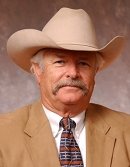
Ron Nolen

In a letter to pastors, the officers of the fellowship—President Greg Spears, pastor of Milam County Cowboy Church in Rockdale; Vice President Mike Moss, pastor of Bull Creek Cowboy Church in Lone Oak; and Secretary Ray Lane, pastor of Triple Cross Cowboy Church in Granbury—gave several reasons for Nolen’s dismissal but declined to release them for publication.

“Every effort has been made to follow the biblical process laid out in the Scriptures for accountability with the hope of reconciliation and restoration,” the letter to pastors stated. “Unfortunately, those attempts have failed. The board had to act quickly, precisely, decisively and appropriately to protect the integrity of the organization.”

The letter stated the fellowship is healthy and committed to moving forward with God’s direction, “following the model and values that we teach in our schools and practice in our churches.”

“We are committed to transparency, accountability, teamwork and consensus building. Most importantly, we look forward to the great things God has in store for the Texas and American Fellowship of Cowboy Churches as we seek to share the good news of Christ with honesty, integrity and accountability before God and each other.”

The letter also stated: “The board has a great love and respect for Ron Nolen and his family, and we will continue to reach out to Ron and pray for him and his family. We are certain that you also have great respect and admiration for Ron and his work in this movement. It is for the sake of unity in our churches we must make you aware of this decision and ask you to join us in prayer for Ron, his family, the board and our organization as a whole.”

Nolen was placed on sabbatical by the board in August. Jeff Bishop was named interim executive director. He has served as director of summer camps for the TFCC/AFCC the last three years and recently resigned as pastor of Cross Trails Cowboy Church in Fairlie to start a new cowboy church in Bandera.

Efforts to reach Nolen for comment were unsuccessful.

Nolen retired from the Baptist General Convention of Texas staff to head the TFCC in 2006. He had been a church starter and then director of western heritage ministries before taking on the new responsibility.

He had led in founding Cowboy Church of Ellis County, the first cowboy church to be affiliated with the BGCT, in 2000 and assisted in establishing many others. When he took over the TFCC reins, it had 73 churches. More than 140 now are affiliated with the TFCC and another 36 with the American Fellowship of Cowboy Churches, which was begun in November 2007.

Under Nolen’s leadership, the TFCC/AFCC has developed a system of coaching for new pastors, a summer program of camps for preteens and youth and has held 26 church planting schools in Texas and mini-schools in Alabama, Kansas and Louisiana to train people in starting and doing cowboy church.

Editor’s Note: Ron Nolen contacted the Baptist Standard Nov. 4, 2011, and indicated he did not respond prior to publication of this article because he did not receive a notice that Managing Editor Ken Camp was attempting to contact him.

Nolen said he resigned the day before the board of directors of the Texas/American Fellowship of Cowboy Churches voted to fire him.

Although leaders of the organizations did not state reasons for Nolen’s termination, he told the Baptist Standard it was due to a “personal issue.” He stated “certainly” he did nothing illegal.

Since his termination, Nolen has met regularly with a group of men who comprise an “accountability group,” he said, adding he and his wife have participated in marriage counseling.

Nolen is involved in starting a Western-heritage church in Santa Fe, N.M. The  Albuquerque Journal has published an article on the young congregation.


Family services agency, hospital team up for mobile medical partnership

SAN ANTONIO—Baptist Health System and Baptist Child & Family Services have launched a mobile medical partnership organizers say is focused on “driving health forward” in the San Antonio area.

Participating in an official ribbon-cutting to kick off the “Driving Health Forward” initiative are Baptist Child & Family Services President Kevin Dinnin, Baptist Health System President Graham Reeve, Fernando Guerra, director of health for the Metropolitan Health District, and George Gaston, vice president of ministry at Baptist Health System.

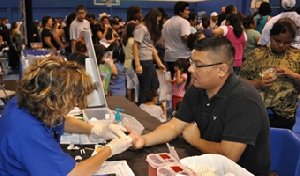
Conducted via a state-of-the-art mobile medical unit, the program will offer cholesterol, glucose, blood pressure and body mass index screenings, as well as provide risk assessments for heart disease, stroke and diabetes.

Screenings will be open to the public for free or at low cost.

“For decades, Baptist Health System has demonstrated its commitment to caring for our community by building hospitals around the city, near where people live and work,” Baptist Health System President Graham Reeve said.

“Now, by expanding our relationship with BCFS, we are able to improve access to health care by actually taking screenings and care into neighborhoods. We want to eliminate barriers to good health.”

According to the Texas Diabetes Institute, more than 73,000 people in San Antonio suffer from diabetes.

The disease is the sixth-leading cause of death in Texas and the fourth-leading cause of death in Bexar County. Chronic heart disease, peripheral vascular disease, cerebrovascular disease and renal failure also are found in high numbers across the county.

“Early detection and education regarding how to control these common health issues are paramount. For any number of reasons, hundreds of thousands of people throughout our city are suffering from diseases both known and unknown,” said BCFS President Kevin Dinnin.

Health screenings will be part of the mission of the mobile unti.

“Our goal is to end this trend by offering easily accessible screenings and raising awareness of available resources for healthy living.”

Screenings will be offered at high-volume commercial locations such as shopping malls, community centers and housing projects, as well as at community health and wellness fairs, senior centers, corporate wellness events, churches and school events.

If a serious condition is detected during the screening, the individual will be referred to his or her physician for follow-up medical care. Educational materials will be provided so residents can reduce their risk of developing chronic disease.

“Taking affordable health care screenings … directly into neighborhoods can have quite an impact on the health and well-being of our community,” said Fernando Guerra, director of health for the Metropolitan Health District. “The greater understanding individuals have of their health status, the more willing they may be to change it.”


Mayberry Bible study asks: ‘What Would Andy Do?’

HUNTSVILLE, Ala. (RNS)—Say a group of immigrants wants to build a mosque in Mayberry, right next to All Saints Church. A Bible study guide asks, “WWAD: What Would Andy Do?”

The question of a mosque, of course, never surfaced in the beloved Andy Griffith Show that chronicled life in the bucolic town of Mayberry, untouched by the battles of civil rights and war that festered in the 1960s.

Tucked somewhere into the cool green hills of North Carolina, Sheriff Andy Taylor mediated minor feuds in the largely homogeneous hamlet, guided his son, reined in the excitable Deputy Barney Fife and set an example for common-sense leadership that still in-spires today.

Deputy Sheriff Barney Fife (Don Knotts) joins Opie Taylor (Ron Howard) and his dad, Sheriff Andy Taylor (Andy Griffith) in an iconic scene from the 1960s Andy Griffith Show. The friendship and compassion among characters of the beloved sit-com offer enduring lessons for Christians, according to a newly re-issued book by author Joey Fann. (RNS PHOTO/The Huntsville Times)

Joey Fann, a software engineer from Huntsville, Ala., who has written The Way Back to Mayberry, a popular study guide for small groups in churches, wonders what the calm lawman of Mayberry would make of America’s current collective agitation.

“What impressed me first about the series is the friendships between the characters and the compassion Andy has for everyone,” Fann said. “There are a lot of values in that, even 50 years later.”

Fann’s book has been re-issued in time for the show’s 50th anniversary. At 44, Fann is too young to have seen the show until it went into re-runs. The show lived on long past its run from 1960 to 1968, and Fann thinks the gentle unfolding of those basic values— which Fann also finds in his Christian faith—are why.

“Andy Griffith insisted that each show have a moral,” Fann said. “And religion is portrayed the way it fits into the life of people of faith: Just as part of everyday affairs and conversation. It’s a secular show, but you know these are church-going, God-fearing people.”

Fann began to analyze Barney’s antics and Andy’s tender shepherding of Mayberry while he was a student at Churches of Christ-affiliated David Lipscomb University in Nashville. It’s also when he fell in love with Mayberry.

Those conversations grew into a mid-week small-group class he taught and still leads from time to time at Twickenham Church of Christ in Huntsville.

The class received national attention and spawned his website, BarneyFife.com, where he and others share lessons and conversations about the show.

In 1999, an editor from B&H Publishing in Nashville contacted Fann to see if he’d consider writing a book. “I’m a software engineer, not a writer,” Fann told the editor.

But he picked out 30 of the episodes that had stuck with him and wrote essays on each, much as he would start a discussion for one of his group meetings at church. Each short essay begins with a Bible verse he sees illustrated by the episode.

The show is reaching a new generation in his home. Fann’s 4-year-old daughter, Josey, loves to watch the episodes with her father. Fann encourages other families to discover—or rediscover—the show to learn from the time-tested example of a town where everything was, in a loving kind of way, black and white.

“Any time you are talking about The Andy Griffith Show, you are going to have a good time,” Fann said. “Being a friend, being compassionate to people not like you, taking responsibility, being a good dad—I think we all need a little Mayberry in our hearts.”


Irving church plants seeds of faith around the world

IRVING—Desiring to make a global impact for Christ, First Baptist Church in Irving recently sent mission teams to Bangladesh, India, North Korea, Uganda, Honduras, Nicaragua and China, as well as St. Louis and Houston. 

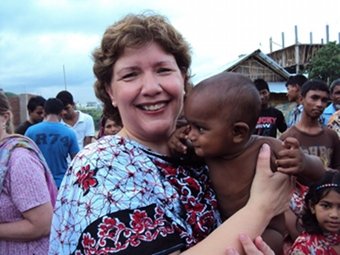
Janet James from First Baptist Church in Irving holds a baby in Bangladesh.

“It has been a strong year of taking the gospel to the ends of the earth,” said Pastor John Durham, who served on several of the mission trips.

While sharing the gospel in Mongolia, First Baptist partnered with LifeQwest Inter-national, an outreach of Change the World Ministries. Jerry and Susan Smith, members of Bear Creek Baptist Church in Katy, founded the ministry specifically to help abandoned street children by meeting both their physical and spiritual needs.

“There is such a powerful ministry happening there, and we were honored to partner with them in that frontier nation,” Durham said. 

“We were able to help with some work projects, including pouring concrete for sidewalks for the orphans, filling potholes on their property, painting some of their buildings, gardening and organizing their medical supplies. 

Durham walked 30 minutes each way and crossed two rivers to purchase goats and sheep for the orphanage. He had been given money to purchase the livestock from GiveAnAnimal.com, an organization started by Cody Caudill, a member of First Baptist in Irving who currently serves as a naval officer. 

Pastor John Durham of First Baptist Church in Irving picks out some calves for the orphanage funded by GiveAnAnimal.com, an organization created by a member of the Irving congregation.

“Every time I go to Mongolia, I come home so humbled,” said Susan Etter, who returned to Mongolia after a trip two years ago. “Our team truly believes that when we travel halfway around the world to work with these missionaries, our job while there is to do whatever they need for us to do—no questions asked. We are there to serve.”

In February, First Baptist in Irving plans to host four young men from Mongolia who are a part of The Mustangs, a mentorship program with LifeQwest Ministries. The church hopes to collect donated American Airlines miles for their trip. Following their experience in Texas, all four men will return to Mongolia and continue ministering to others in their homeland.

First Baptist also sent a women’s team to Bangladesh. This was a dream fulfilled for Missions Coordinator Allison James, who joined the church staff in 2009 after serving in Bangladesh two years.

“I thoroughly enjoyed being able to interact with the girls at the Light of Hope Center and teaching them about Queen Esther. The girls at this center are some of the poorest children in the world,” James said.

John Durham, pastor of First Baptist Church in Irving, is joined by four young men who will be traveling to Texas in February from the Mustangs, a mentorship program with LifeQwest Ministries. First Baptist in Irving hopes to raise 280,000 donated American Airlines miles for their trip.

“Yet they have hope, because they have heard God’s word and realize it’s the truth.  Not every child can say this, and these girls are truly blessed through this center. It was encouraging and uplifting to spend time with them, loving on them and laughing with them.”

This summer, members of the middle school ministry served in Houston. Students participated in a variety of service projects, including serving at a food pantry, ministering to the homeless, reaching out to children at a low-income apartment complex and leading a Vacation Bible School.

“Our students provided this overwhelming wave of love, especially to the children,” Student Pastor Jay Miller said.

“Several students had the opportunity to share their faith and talk to the kids about why we were there. They told the kids that they were on a mission for Jesus Christ. The kids at this apartment complex really connected with our students. As we left, a lot of them were really tearful, wanting them to come back.

“I’m already thinking about next year, planning the trip and wanting to go back to that same apartment complex and continue building relationships there.”

Pastor John Durham from First Baptist Church in Irving makes a new friend in Honduras.

While volunteering at the Houston Food Bank, the middle school students worked in an assembly line and bagged enough rice to feed 40,000 people.

“It was really neat to see our students’ eyes light up, because they couldn’t believe how much they did in one morning,” Miller said. 

Soon after the middle school students returned home, the church’s high school ministry traveled to St. Louis, where they rounded up children for LifeWay’s Saddle Ridge Ranch Vacation Bible School.

As the group canvassed neighborhoods and distributed fliers, they were surprised to find that even older teen-agers asked about attending. 

“I’ve never seen a VBS where so many older teens were present,” sponsor Samantha Go-lightly said. 

“These teenagers in St. Louis came each day and wanted to hear. There were a lot of wonderful people that did great things for the Lord on this trip and utilized their gifts, talents and resources. … Having more than 100 kids come to VBS and the number of parents at family night was amazing. 

“These mission trips were amazing experiences, and I would do it again in a heartbeat. I want to take every opportunity that I can to help this next generation, and it’s all worth it. There are so many hurting kids out there who need Jesus. I hope that others would catch the fire and just burn for Christ. 

“The passion and enthusiasm at First Irving is contagious. I’m so thankful that we’re part of a body that is missions-minded, because that speaks volumes.  It’s not a church willing to just sit there and soak it up.”


HSU honors veteran River Ministry leader, dedicates exhibit

ABILENE—Hardin-Simmons University honored Texas Baptist River Ministry leader Elmin Howell and his wife, Betty, as missions pioneers and dedicated an on-campus River Ministry exhibit as a tool to educate the next generation of missions workers.

Howell, who led Baptist General Convention of Texas missions programs along both sides of the Texas/Mexico border for nearly three decades, received the Jesse C. Fletcher Award for distinguished missions service from the university.

Elmin Howell (2nd from right), who led Texas Baptist River Ministry nearly 30 years, visits with (left to right) Bruce Stovall, pastor of Friendship Baptist Church in Albany, Bernard Bolton of Shreveport, La., and John Garner of Franklin, Tenn., at the dedication of a River Ministry exhibit on the Hardin-Simmons University campus. (PHOTO/Paul S. Howell)

“River Ministry is one of the greatest state mission efforts ever attempted by Baptists,” HSU President Lanny Hall said. “It has been blessed by God’s hand.”

During Howell’s tenure, River Ministry started 63 health-care clinics that touched the lives of 500,000 people along the border, helped start more than 600 churches, drilled more than 100 water wells, launched multiple agricultural and community-development projects and involved more than 5,000 churches in hands-on missions, Hall noted.

Howell—a 1952 graduate of Hardin-Simmons—donated documents and memorabilia from his years of River Ministry service to his alma mater with the understanding the collection would be used in missions education.

The university produced a video and created an exhibit in its Connally Missions Center to display the collection. It includes maps, photos, paintings, handcrafts and other items displayed in the O’Brien Room, named in honor of the late Dellanna O’Brien, veteran missionary and Woman’s Mission Union leader. Her husband, Bill, was Howell’s roommate at Hardin-Simmons.

Wayne Shuffield, director of the BGCT evangelism and missions center, noted the area along the Texas/Mexico border is home to 6.5 million people, and the population has grown by about 1 million every 10 years since 1980.

“Visionaries like Elmin Howell could see that early on and see that Texas Baptists needed to reach out and take the gospel of Jesus Christ to them,” Shuffield said.

When Jeane Law, former president of Texas WMU, was growing up in Alabama, all she recalled knowing about the Rio Grande was what she learned from Gene Autry western movies.

Her awareness about the Rio Grande changed drastically in 1967 when Hurricane Beulah brought the needs of people along the Texas/Mexico border to the attention of Texas Baptists.

Concern for the plight of people affected by the hurricane, combined with an already-approved line item in the Mary Hill Davis Offering for Texas Missions for a “Rio Grande Mission Thrust,” gave birth to River Ministry.

“Texas may have been freed from Mexico in 1836, but the two reconnected in 1967,” said Law, a member of First Baptist Church in Lubbock.

In the years that followed, she noted, River Ministry became an integral part of the Texas WMU Week of Prayer for State Missions and the Mary Hill Davis Offering.

John Wilson, a former school superintendent who now serves at Baylor University, remembered when he was a 13-year-old boy and Howell became activities director at First Baptist Church in Beaumont.

“No one other than my own mother and dad had a greater influence on my life than Elmin Howell. He has been a mentor, coach and friend to me,” Wilson said.

Similarly, Ivan Smith recalled his teenaged years in Shreveport, La., when Howell served on a church staff.

“Elmin had a way of getting the job done,” Smith said. “People could not tell Elmin Howell ‘no.’ He was so led by God, you were afraid not to do as he suggested.”


Definitions of “evangelical” vary

The National Association of Evangelicals has a seven-point statement of faith.
Members affirm they believe:

• The Bible is the inspired, the only infallible, authoritative word of God.
• There is one God, eternally existent in three persons—Father, Son and Holy Spirit.

• In the deity of the Lord Jesus Christ, in his virgin birth, in his sinless life, in his miracles, in his vicarious and atoning death through his shed blood, in his bodily resurrection, in his ascension to the right hand of the Father, and in his personal return in power and glory.
• For the salvation of lost and sinful people, regeneration by the Holy Spirit is absolutely essential.
• In the present ministry of the Holy Spirit by whose indwelling the Christian is enabled to live a godly life.
• In the resurrection of both the saved and the lost—they that are saved unto the resurrection of life and they that are lost unto the resurrection of damnation.
• In the spiritual unity of believers in our Lord Jesus Christ.

Source: www.nae.net

Christian researcher George Barna defines evangelicals according to nine questions.
By Barna’s criteria, an evangelical is someone who:

• Has made a personal commitment to Jesus Christ that is still important in his or her life today.
• Believes he or she will go to heaven based on confession of sin and acceptance of Jesus Christ as Savior.
• Believes faith is very important in his or her life today.
• Believes he or she has a personal responsibility to share religious beliefs about Christ with non-Christians.
• Believes Satan exists.
• Believes eternal life is possible only through grace, not works.
• Believes Jesus Christ lived a sinless life on earth.
• Asserts the Bible is accurate in all it teaches.
• Describes God as the all-knowing, all-powerful, perfect Deity who created the universe and still rules it today.

Source: www.barna.org


Moderate Baptists uneasy about evangelical baggage

Are Cooperative Baptist Fellowship and Mainstream Baptists evangelicals? The answer is yes and no.

Formed in reaction to the Southern Baptist Convention’s shift to the far right in the late 1980s and early 1990s, both the CBF and Mainstream focus on what they perceive as historic Baptist principles—a personal experience and relationship with Jesus Christ, priesthood of the believer and the responsibility to share the gospel. In that sense, they are evangelical.

Are Cooperative Baptist Fellowship and Mainstream Baptists evangelicals? The answer is yes and no.But when the word “evangelical” becomes synonymous with a political movement, the CBF and Mainstream distance themselves.

Jimmy Allen

Daniel Vestal, the Fellowship’s national coordinator, believes most individuals and churches that identify with the CBF would consider themselves as evangelicals. “I think they would … because of their desire to share (the gospel). Missions and evangelism are at the heart of who Baptists have been historically,” he said.

“Cooperative Baptist Fellowship was focusing on the gospel before it became a hot-button word,” Vestal added. “Sharing the Good News is in our DNA. … In our heart, it is who we want to be. … We are both evangelical and ecumenical—committed to sharing the Good News and committed to the body of Christ beyond our tradition.”

Mainstream Baptists, too, sharply distinguish between the traditional spiritual definition of evangelicalism and its link to a political movement. “We are born-again Christians. In so far as evangelicals are born-again Christians, then yes, we are evangelicals,” noted Bruce Prescott, executive director of Mainstream Oklahoma Baptists.

“But as part of a political movement, then no, at least this individual Mainstream Baptist is not in anyway shape or form part of the Religious Right.”

Mainstream Baptists are evangelical because they are “concerned about euangelion,” concerned with sharing the gospel and having a personal relationship with Christ, Prescott emphasized.

Because they are “strong advocates” of the separation of church and state—a long-held Baptist stance—Mainstream Baptists “are not part of any secular political movement.”

Public confusion over the word’s meaning has created a problem in clearly communicating the stand the two entities take—serving Christ and advancing the kingdom through historic Baptist principles.

“When a word changes from a description of a concept to a brand, it becomes difficult to find a substitute term,” noted New Baptist Covenant Coordinator Jimmy Allen. A former SBC president, Allen is considered as the last moderate to hold that post.

He and Vestal were instrumental in forming the CBF as a separate entity, calling moderate Baptists together in the Consultation of Concerned Baptists in August 1990.

Evangelicalism used in its traditional sense “describes a historic commonality of believers who have rejected hierarchies and ritualistic religion for experiential religion, biblical authority, congregationalism and urgent missional outreach,” Allen said.

He believes the National Association of Evangelicals, a network of about 40 denominations that bills itself as “the gold standard of evangelical belief,” has co-opted the word.

Under the association, “the word has become a brand of its own,” Allen added. “It now stands for an ultra-conservative, fundamentalist-leaning fellowship.”


Ellis Association’s mission in Honduras takes to the airwaves

WAXAHACHIE —Ellis Baptist Association’s ministry to the Lencas of Honduras gets dialed up a notch when its radio station goes on the air Nov. 1.

In August, Director of Missions Larry Johnson traveled to Honduras to add acoustic panels and foam to the station’s studios.

In preparation for the Nov. 1 airdate, the station secured a frequency, erected a tower and attached it to a transmitter. More than four miles of copper wire had to be placed in the ground in 120 spokes of 210 feet to form the ground plane for the station.

Eddie Martinez of Waxahachie baptizes a new Christian during a trip to Honduras sponsored by Ellis Baptist Association. (PHOTO/Courtesy of Ellis Baptist Association)

The signal will extend beyond Honduras into northern El Salvador and western Guatemala.

The station will support an effort to create a church planting movement in Honduras among the Lenca people, Johnson said.

House churches started among the Lencas had been nearly doubling in number until this year when it slowed.

“We haven’t been successful in getting third- and fourth-generation church starts,” Johnson explained. “When you get to those fourth-generation churches, you have a church-planting movement. We don’t have a movement yet, but we’re praying that will come.”

Johnson expects the radio station to play a key part in energizing the effort.

“There are places you literally cannot drive. There are places you cannot take a four-wheel-drive vehicle. You might be able to get some places with a mountain bike, but some places you can only get to by mule,” Johnson said.

The radio station will bring the message of the gospel to out-of-the-way villages and also help to communicate with village leaders.

The ministry has not been inactive while waiting for the station to come online, however. Last year, a dam broke and wiped out a village, Nuevo Zuptal. The government gave the villagers a new place to rebuild but mandated that everyone relocated and help build the new homes.

“Because of that, they didn’t have a way of making any income,” Johnson pointed out. So for eight months, the association supplied the funds for food for the village.

On Johnson’s August trip, the team assembled 38 water filtration systems. He purchased 60 purification filters from Texas Baptist Men after reports from the association’s missionary, Armando Murillo, that water from the river was unsafe for drinking.

“When we finished putting them together, you could tell they were still a little bit skeptical about whether this was really valuable or not,” Johnson said.

“But when I took the bucket that we had first put together and showed them the difference—and it was brown, brackish water in the top bucket, and it was absolutely clear water in the bottom—they were convinced. They were excited.”

Already, a few Christians live in Nuevo Zuptal, Johnson said, and he believes a house church will be functioning there soon.

The day after the Ellis Baptist Association team worked on the water purification project, 30 of the 40 house church leaders gathered for training.

From the beginning, the plan has been to reach the Lenca through house churches, and the radio station will facilitate that effort, Johnson said.

“We knew the direction we were going was house churches. We knew we had to do gospel saturation, and radio is our method for doing that,” he said.

The effort in Honduras also has been good for the Ellis County churches, he added. As many has 80 people have made the trip to Honduras, and The Avenue Church in Waxahachie has made numerous trips. Even those who haven’t traveled to Honduras have benefited, Johnson said.

“They really feel their association is doing something—that it’s making a difference and that we’re trying to fulfill the Great Commission by following the Lord’s leadership.”


Congregations struggle to become diverse, retain diversity

WACO—More than a half-century after Martin Luther King declared 11 a.m. on Sunday the most segregated hour in America, nine in 10 congregations still have a single racial group that accounts for more than 80 percent of their membership, said Kevin Dougherty, assistant professor of sociology at Baylor University.

Furthermore, congregations that manage to attract worshippers of other races have difficulty keeping them, according to research by Dougherty and Christopher P. Scheitle, senior research assistant at Pennsylvania State University. They jointly wrote “Race, Diversity, and Membership Duration in Religious Congregations,” published in a recent issue of the academic journal, Sociological Inquiry.

Nine in 10 congregations still have a single racial group that accounts for more than 80 percent of their membership, according to a new survey.

“Socially, we’ve become much more integrated in schools, the military and businesses. But in the places where we worship, segregation still seems to be the norm,” Dougherty said.

“It’s not just an issue of attraction, of getting them into the door, but of retention. Can we keep them? Our research indicates that we’ve not been able to.”

In learning whether—and why—minority members leave congregations faster than majority members, Dougherty and Scheitle studied data from the U.S. Congregational Life Survey of 2001, a study of more than 100,000 worshippers in more than 400 congregations representing more than 50 faith groups.

One theory is that the more groups an organization tries to serve, the less effective it is at serving any specific group. Specialist organizations tend to do better than generalist organizations, and congregations are no different, according to that theory.

A Korean church that tries to add other ethnic groups still is likely to serve its traditional majority better, whether it comes to the type of food served at a potluck, the type of ministries it offers or the use of the Korean language, Dougherty said.

The decision is not necessarily conscious or malicious, but simply a matter of habit and the greater visibility of the majority, according to the article.

“People choose churches where they feel comfortable,” Dougherty said. “Maybe they get challenged there, but they’re going for the comfort.”

But diversity comes with a cost, usually to both minorities and majorities, he said.

In trying to fit in, minority members may feel they are abandoning part of their identity. A 2003 study of a Filipino congregation showed non-Filipino members tended to have fewer friends within the congregation and felt like outsiders. Such feelings may lead to lower attendance and eventually leaving.

“It doesn’t matter whether you’re a white member of a Latino church or a black attending a white church or what the specific groups are,” Dougherty said. “If you’re the under-represented group, do you call it ‘my church’? That feeling of ‘us’ is the key.”

Power is another issue. Minority members may feel they are tokens. Scheitle and Dougherty find that until minority members represent 40 percent of a congregation, they are at a higher risk of leaving.

“That’s when we expect retention, when minority members say, ‘There’s enough of me that I see we have some say,’” Dougherty said. Conversely, once the minority is more than 40 percent, some majority members start to leave.

“Animosity can grow,” Dougherty said. “There may be a feeling of ‘They’re taking our church away from us’ or ‘They’re not doing things our way.’ Churches want diversity—but usually the people who want it most are the ones it costs the least. They aren’t the ones sacrificing culture, heritage and customs.”

Usually, the first members of a minority group to join a congregation are a special type of person, Dougherty explained.

“Those people are called ‘boundary spanners.’ They’re willing to tolerate risk. They’re the pioneers. They pave the way for others from their ethnic group to follow,” he said.

Researchers identified some characteristics of congregations that have been successful in becoming diverse:

• Racially diverse leaders.

• Racially inclusive worship.

Diverse congregations “tend to be more expressive, with more clapping, more raising of the hands, more verbal affirmation,” Dougherty said.

“If you look at congregations of blacks and whites, you’ll see more ‘Amens’ and clapping, but not as much as in a black church. The services likely will last longer, but not last as long as at a black church. Out of diversity comes something that is different for both.”

• Opportunities for member interaction.

Dougherty sees small groups as helpful for diversity. “Small groups are a powerful way to forge relationships,” he said. In previous research, he found small groups are a common feature of racially mixed congregations.


DBU grad wants to play ball for the glory of God

JACKSON, Tenn.—Brandon Bantz is not out to make a name for himself in professional baseball. He wants to be a hit for another reason.

Brandon Bantz, a 2009 Dallas Baptist University graduate, was a catcher this season for the West Tenn Diamond Jaxx in Jackson, Tenn., the Seattle Mariners’ affiliate in the Class AA Southern League.

“I try to make God’s name famous through my play on the field. I am playing for the glory of God and not my own. I would love to be in the big leagues to have that platform to reach people for Christ. But my goal is to draw as close to God as I can, so I can follow his will—wherever it is,” Bantz said.

“Whether that is baseball in the big leagues or another avenue in life, my goal is to become more and more like Christ every day.”

Drafted in the 30th round by the Seattle Mariners in 2009, Bantz was a catcher this season for the West Tenn Diamond Jaxx in Jackson, Tenn., the Mariners’ affiliate in the Class AA Southern League.

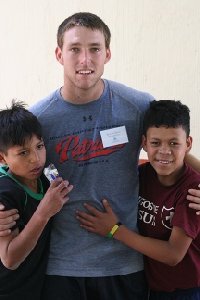
As a student athlete at Dallas Baptist University, Brandon Bantz participated in a mission trip to Guatemala in 2007.

In 24 games with the Jaxx, who earned the wild-card berth for the playoffs, Bantz had 19 hits, including a home run, triple and six doubles while batting .241. He also played for Clinton, Iowa, in the Class A Midwest League in 2010. He leaves in November for Australia to play in a Mariners’ winter league.

A native of Mansfield and a 2009 graduate of Dallas Baptist University, Bantz led the Patriots to the 2008 regionals at College Station.

He grew up around the game. Both his mother, Melinda, and father, Ronnie, who retired as an Arlington policeman, worked for the Texas Rangers.

What sets Bantz apart from most players in pro baseball is the reason he plays.

“For the man of God I am trying to become, my faith gives me focus and is why I play. It puts the game in the right place. My faith gives me perspective. Baseball isn’t everything in my life. This game doesn’t define me. It helps me deal with the very thing this game brings,” he said.

“My relationship with God has become no longer a head knowledge. It’s a heart knowledge. It’s an action. My faith has become real, alive. There is a joy in my life that I never had before. Now I have a passion and spirit that a walk with God brings.”

That wasn’t always the case.

Immorality caused him to hit rock bottom he said. He struggled with loneliness; the divorce of his parents when he was in high school; the death of his grandfather, Norman Bantz, a Disciples of Christ pastor for 40 years in Mineral Wells; and the death of his best friend, Austin Phillips. After pitching on a Thursday, Phillips died of spinal meningitis on a Saturday. He was 19.

Bantz has learned how difficult a Christian walk is in baseball. “Your flesh always arises,” he said. Women, nightlife and the game itself bring temptations. If I depend on me, I would fall.”

He tries to rise above temptations through Scripture memorization, writing out prayers, listening to Christian music—especially Christian rap—and reading daily from the Bible he received from DBU when the Patriots went to the 2008 regional finals.

“The game has taught me how prideful I am and how essential the word of God is to my life. It impacts your faith. My strength is through God. If you are not grounded in the knowledge of the word of God, you will never make it. You will sink,” he said.

“I have meaning and purpose for my life. I understand where I am going and who I am going to become.”

Bantz, 23, became a Christian at a church camp when he was in the eighth grade. He attended thinking it was a sports camp.

For six years, he has been a volunteer youth minister at Stonegate Church in Midlothian .

While playing for the Everett AquaSox in Everett, Wash., he won the Ellis Award for the most community service among players in the Mariners’ minor league organization.

“Love on people was all I did,” he said. He led baseball camps, read to children at libraries and visited children in hospitals.

While Bantz wants his teammates to think of him as a “good teammate” and a hard worker, he would want them to say,  “Above all, he exemplified Jesus.”

His role model and mentor is Dan Heefner, DBU head baseball coach. Bantz helps with the Patriots during off-season.

Bantz has invested himself spiritually into DBU players said Heefner, a member of Matthew Road Baptist Church in Grand Prairie.

“I see him pouring his life into others and thinking about them before he thinks of himself. He has got a vision for living to the glory of God and not self, and that is his goal and his platform for being a professional baseball player. He genuinely loves the Lord. He’s humble. He has an incredible faith. God is sovereign over his life. He trusts him.”

An “outstanding catcher” with aggressive defense, Heener noted, Bantz was captain on the field because of his position.

“He did a great job handling our pitchers,” said Heefner, who also saw Bantz grow off the field while at DBU. “He was a guy who led by example as well as in words.”

Bantz cultivates his different view of baseball.

“I don’t look at baseball as baseball. I look at it as my ministry,” said Bantz. “I don’t look at baseball as a long season. I look at it as another day to go about my ministry.”


LifeWay background-check service finds hundreds of felonies

NASHVILLE, Tenn. (ABP) — Discounted criminal-background checks offered by LifeWay Christian Resources found more than 600 felony offenses in checks for the 900-plus churches and organizations that have purchased the service in its first two years.

Since contracting with backgroundchecks.com in 2008, the Southern Baptist Convention's publishing arm has sold 11,277 background checks that start at $10 for base-level check of a national criminal and sex-offender search.

About 40 percent returned a "hit" for criminal activity, but most of those were for minor traffic and non-traffic infractions such as jaywalking. One in five, however, returned records of a misdemeanor or felony (2,320 searches) and one-fourth of those were felonies.

"Churches need to exercise due diligence by running background checks," said Jennie Taylor, marketing coordinator in LifeWay's direct-marketing department.

While necessary in today's world, Taylor said, background checks have limits.

"Background checks do not predict the future or expose harmful behaviors from individuals who have never been caught," Taylor said. "But checks can help organizations learn of volunteers or employees who have documented criminal pasts."

A document on preventing child sexual abuse from the Centers for Disease Control calls criminal background checks "an important tool in screening and selection" of employees and volunteers, but says they are only one component in creating a safe environment for organizations working with youth.

The CDC suggests written applications, personal interviews and reference checks for adults seeking access to young people. They also recommend letting applicants know up-front that the organization is serious about protecting youth in order to deter individuals at risk of abusing youth from applying for staff or volunteer positions.

Other CDC safeguards include establishing guidelines to distinguish appropriate from inappropriate behaviors and maintaining proper ratios of employees and volunteers to youth to minimize one-on-one interaction, such as having at least two adults present at all times.

Policies should address not only interactions between adults and youth, but also situations where unsupervised youth can physically or sexually abuse one another. They should include supervision and monitoring of activity and account for safe environments by using spaces that are open and visible to people and controlling access to know who is present at all times. Monitoring devices can include cameras, but there must be staff infrastructure to monitor them.

While the ultimate goal is to prevent abuse from occurring, the CDC said organizations should also communicate clearly what it and its employees/volunteers should do if policies are violated or if child sexual abuse occurs. The government also recommends training about sexual-abuse prevention to give people information and skills to help them prevent and respond to reports of abuse.

Taylor told the Associated Press LifeWay's partnership with backgroundchecks.com grew partly out of a call three years ago for more protections against child sex abuse in the Southern Baptist Convention.

Wade Burleson, pastor of Emmanuel Baptist Church in Enid, Okla., brought a motion at the convention's annual meeting in 2007 asking the SBC Executive Committee to study the establishment of a national registry of "clergy and staff who have been credibly accused of, personally confessed to, or legally been convicted of sexual harassment or abuse."

After studying the matter, the Executive Committee recommended against establishing a database, saying the convention lacked the authority to require churches to report incidents of abuse.

The Executive Committee delivered a report saying that "churches are strongly encouraged to recognize the threat of harm as real, to avail themselves of such information and to aggressively undertake adequate steps at the local level to prevent harm and protect victims."

Officials also added links to the Executive Committee website directed to resources for prevention of sexual abuse, including a link to a national database of sex offenders maintained by the U.S. Justice Department.

LifeWay said in an editor's note that the statistics reported in the press release are not derived from a representative sample, but reflect more than 900 clients who purchased background checks without regard to organizational type, denomination, region, demographic make-up or other determining factors.

That means all the customers are not SBC churches. But if they were, that number would account for about 2 percent of the most recent count of 45,010 Southern Baptist churches with a combined membership totaling 16.1 million.


Bob Allen is senior writer for Associated Baptist Press.


On the Move

Roddy Arnold has resigned as pastor at First Church in Pottsboro.

John Bell to Faith Church in Wichita Falls as minister of music from First Church in Bridgeport.

Jon Burton to Calvary Church in Abilene as student minister.

Scott Dickison to Wilshire Church in Dallas as pastoral resident.

Colin Errington to First Church in Meridian as pastor from Grace Church in Fort Worth, where he was associate pastor.

Ryan Fontenot to Mount Gilead Church in Keller as pastor from Trinity Bible Church in Willow Park, where he was director of church planting.

James Hassell to Agape Church in Fort Worth as pastor from First Church in Tulia.

Malcom Johnson to Elmwood Church in Abilene as interim pastor.

Donald McConnaughhay to Pidcoke Church in Gatesville as pastor.

Ben Mullen has resigned as pastor of First Church in Hebron in Carrollton.

Derek Nease to View Church in Abilene as music minister.

Ed Nelson to Trinity Church in San Antonio as church administrator from First Church in Keller.

Kenneth Reiter to Live Oak Church in Jacksboro as pastor from Pioneer Valley Church in Valley View.

Toni Sidler has resigned as children’s minister at First Church in Justin to become events coordinator at Camp Copass.

Beau Stringer to The Woods Church in Tyler as student minister from First Church in Floydada.

Garrett Vickrey to Wilshire Church in Dallas as pastoral resident from Myers Park Church in Charlotte, N.C., where he was minister to youth.