Georgia Baptists oust second church with woman pastor

ALBANY, Ga. (ABP) – For the second year in a row, the Georgia Baptist Convention has withdrawn fellowship from one of its most historic member churches for calling a woman as pastor.

Geogia Baptists have declared a second church led by a woman not a "cooperating" church.

Meeting Nov. 15-16 at Sherwood Baptist Church in Albany, Ga., more than 1,000 GBC messengers endorsed a March vote by the convention’s executive committee declaring that Druid Hills Baptist Church in Atlanta is not a “cooperating church” under the denomination’s articles of faith.

The convention overwhelmingly accepted a recommendation by its executive committee stating “that Druid Hills Baptist Church in Atlanta is not a cooperating church as defined in Article 2, Section 1 of the constitution, because a woman is serving as co-pastor and that Druid Hills Baptist Church of Atlanta be excluded from the convention and all rights and privileges thereof.”

That article defines cooperation in terms of fidelity to the 2000 version of the Southern Baptist Convention's Baptist Faith and Message statement, which says in part, “While men and women are gifted for service within the church, the office of pastor is limited to men as qualified by Scripture.”

Mimi Walker, co-pastor of Druid Hills with her husband, Graham, who teaches at McAfee School of Theology, has been listed as a pastor in the state convention's annual record book since 2003. Last year convention leaders viewed that as “a matter of concern,” said executive committee member Tom Rush, prompting a meeting between leaders of the convention and congregation. After the meeting, the executive committee approved a recommendation by its administrative committee to withdraw fellowship from Druid Hills.

'Selective creedal application'

Carey Charles, a deacon and fourth-generation member at Druid Hills, described the church’s goal to messengers as “first and foremost missional.”

“When Baptist churches are closing their doors inside the I-285 perimeter [the freeway that surrounds the central part of the Atlanta area] today at a historically rapid pace, and that [what was] once 166 Baptist churches are now down to a mere 39, we at Druid Hills Baptist have deliberately chosen to stay and bear a testimony as stated in our core values — to love God, to share Christ, to serve others and grow in faith,” Charles said.

Georgia Baptists visit exhibits at annual meeting.

“In staying, we recognize that we must ask tough questions, missional questions; not something that unifies only our church, but also that unifies our church in our neighborhood, city and world immediately surrounding us,” he said. “Therefore we chose the Walkers, both of whom have been recognized as partners in mission by the International Mission Board of the Southern Baptist Convention for 12 years of service in the Philippines, who deeply share our passion for what is now a growing mission field inside Atlanta.”

Michael Ruffin, pastor of First Baptist Church in Fitzgerald, Ga., urged messengers to consider “selective creedal application” of the confession of faith.

“So far as I can tell, we are applying no other provision of or line in the Baptist Faith and Message statement in the way as the line about the office of pastor being reserved for men,” Ruffin said. “If an autonomous Georgia Baptist Church calls a woman as a pastor, they will now automatically be deemed a non-cooperating church.”

“There are many, many, many more provisions in the Baptist Faith and Message,” Ruffin warned. “I don’t want the GBC to become even more creedal in its application of the Baptist Faith and Message than it has on this one score. We really should consider the arbitrariness of such an application. I think we also ought to consider the possibility that if we get serious about holding every Georgia Baptist Convention church accountable to every line in the Baptist Faith and Message as we are this one, we’ll soon have no churches left.”

Executive committee chairman Fred Evers, pastor of Northside Baptist Church in Tifton, Ga., defended the recommendation.

“We are acting on what we believe are biblically held convictions,” he said. “We certainly affirm the right of any church to call whom they will as pastor. We certainly want to affirm the great contribution of faithful women who serve across our state in our churches in proper, biblical roles. We certainly affirm the great contribution that Druid Hills Baptist Church has made in the history of our Georgia Baptist Convention. However, we have, as a convention, clearly defined what constitutes a fully cooperating church in the Georgia Baptist Convention.”

Historic congregation

Following the vote, the convention will no longer receive funds from the church and will not allow messengers from the congregation to the annual meeting. That ends a historic relationship dating back to the congregation's founding in 1914. Louis Newton, who served as Druid Hills' pastor for four decades — including a stint as president of the Southern Baptist Convention — is one of the most recognizable names in Georgia Baptist history. He wrote daily columns for two of the state's largest newspapers and was often called "Mr. Baptist."

Last year Georgia Baptists took similar action against First Baptist Church in Decatur, Ga., a long-time leading church in the convention until it called Julie Pennington-Russell as pastor in 2007.

“The Georgia Baptist Convention has never been opposed to women serving in ministry positions other than pastor,” Robert White, the convention’s executive director, said in a statement. “Women are serving as gifted leaders in churches all across our state.


Bob Allen is senior writer for Associated Baptist Press.

Related ABP content:

Opinion: Church-autonomy inquiries from a naïve Baptist (3/18/2010)

Georgia Baptists target second church with woman pastor (3/18/2010)

Opinion: Georgia Baptists, the Bible and women pastors (11/24/2009)

Opinion: Does the SBC respect local-church autonomy or not? (11/20/2009)

Georgia Baptists cut ties with church led by woman pastor (11/16/2009)

In historic move, First Baptist Decatur calls woman as senior pastor (6/18/2007)


Palestinian-American Christian says eschatology can distort justice

KELLER—End times theology that equates the modern state of Israel with the Israel of biblical prophecy has caused some evangelical Christians to let eschatology trump ethics when it comes to the Middle East, a Palestinian-American Christian told a general session at the Global Faith Forum at NorthWood Church in Keller.

Henry Mikhail, a Jerusalem-born Arab who now serves on a peace and justice work group of the Reformed Church of America’s General Synod Council, rejected the notion that support for the Palestinian people makes a person anti-Israel.

Global Forum panel

Bob Roberts (left), pastor of NorthWood Church in Keller, talks with (left to right) Prince Turki Al-Faisal of Saudi Arabia, Ambassador Le Cong Phung of Vietnam and Henry Mikhail, a Palestinian-American Christian. (Photo: Ken Camp)

“What I am against—and what most Palestinian evangelical Arabs are against—is not Israel itself, but unjust and oppressive Israeli policies,” Mikhail said.

Belief that God has a prophetic role for the modern national of Israel has caused some evangelicals to turn a blind eye to the suffering of Palestinians, he said.

“Because of American evangelicals’ embrace of the current state as the Israel of prophecy, they have supported policies that are harsh and oppressive—even against Christians, which is very ironic,” he said.

“Because of support from American evangelicals,Israel has been given a blank check—has been blindly supported and backed, right or wrong. And I believe that’s been unfortunate and unfair.”

Audio IncludedListen to an audio clip of Henry Mikhail.

Ethnic lineage and nationality do not matter to God, Mikhail insisted. The biblical promises of God to Israel belong to those who have entered into a faith relationship with him, he said.

In a breakout session at the Global Faith Forum, Mikhail joined Mark Braverman, Jewish-American author of Fatal Embrace: Christians, Jews and the Search for Peace in the Holy Land, and Sami Awad, founding director of Holy Land Trust, a Palestinian organization devoted to nonviolent initiatives in the Middle East.

Citing their own family stories, all three speakers insisted Christians, Jews and Muslims lived peaceably as neighbors in Jerusalem until 1948 when the Palestinians were expelled and the modern nation of Israel came into being.

“They lived in peace and respected each other. The only difference was when and where they went to pray,” Awad said.

Braverman insisted as a Jew, he wants “to save Israel from itself.”  And, he insisted, Jesus of Nazareth offers the model for confronting the conflict.

“As a Palestinian Jew, living under Roman occupation, he taught compassion and love for one’s enemy,” Braverman said.


Love of God communicated best in multi-ethnic churches, pastor insists

KELLER—Churches in the United States are 10 times more segregated than the neighborhoods in which they are located and 20 times more homogenous than the nearest public schools, the pastor of a multi-ethnic church in Arkansas told the Global Faith Forum .

“An increasingly diverse and cynical society will not find our message of God’s love credible when it is preached from the pulpits of segregated churches,” Mark DeYmaz, pastor of Mosaic Church of Central Arkansas in Little Rock, told the multifaith gathering at NorthWood Church in Keller.

Mark DeYmaz

Mark DeYmaz

When churches get serious about reaching their communities, it forces members to ask practical questions that may make them uncomfortable, DeYmaz noted.

“Why are all the dolls in the church nursery white? Why are all the pictures of Jesus white?” he asked.

Churches in culturally diverse urban settings need to develop a multi-ethnic vision because “it is biblical and right,” DeYmaz emphasized. “It is not a matter of political correctness but spiritual correctness.”

A truly multi-ethnic church presents an irresistible picture of God’s love the spiritually lost find compelling, he continued.

Chapter 17 of John’s Gospel records the prayer of Jesus that the world—not God—might see the oneness of Christ’s followers. So, DeYmaz rejected the rationale that God sees all the universal church—Anglo congregations here, Hispanic congregations there, African-American congregations elsewhere—as one.

“That only works if we are trying to evangelize God,” he said. “It’s not God who needs to see the unity and diversity of the church. It’s the lost.”

Urban ministry means reaching across ethnic, racial, socio-economic and religious barriers, speakers at the Global Faith emphasized.

Ray Bakke, author of The Urban Christian and chancellor of Bakke Graduate University, described his personal experience of moving to inner-city Chicago in the mid-1960s.

“I discovered my church had fled the city. The white evangelical church took the Bible and ran,” he said.

Bakke told how he began to visit every ethnic neighborhood in the city, visit with parish priests and read ethnic literature.

“In the process, I began to love my city, and I learned to read the Scriptures in a new way,” he said, noting the word “city” appears 1,250 times in the Bible, and 142 cities are mentioned specifically.

“The Bible begins in a garden but ends in a city,” he said.


Civility should rule in global public square, social critic asserts

KELLER—In an increasingly connected world where “religion is furiously alive,” the matter of how people of faith can live with their deep differences assumes growing importance, social critic and author Os Guinness told the Global Faith Forum at NorthWood Church in Keller.

Os Guinness

Os Guinness

Three of the key issues related to globalism directly deal with religion, Guinness observed:

• Will Islam modernize peacefully and become a force for peace?

• Which faith will replace Marxism in China?

• Will the Judeo-Christian West sever or recover its roots?

The Internet has created an emerging global public square for the exchange of ideas, said Guinness, senior fellow with the EastWest Institute in New York. Attempts to create a sacred public square where one religion is preferred or even established or a naked public square stripped bare of any public reference to religion both are “unjust and unworkable,” he insisted.

Instead, he called for a civil public square where people of deep faith engage public life. Civility involves treating with respect people who hold different views, but it does not mean jettisoning one’s one beliefs, he stressed.

“It’s different than the kind of interfaith dialogue that seeks a unity underneath everything that is not there. There is no lowest common denominator,” he emphasized.

“The right to believe anything does not mean that anything people believe is right,” Guinness said.

In place of “a sloppy form of intolerance and indifference to truth,” he called for a robust conversation that respects the freedom of conscience of believers.

Eboo Patel, founding executive director of Interfaith Youth Core in Chicago, challenged people of faith not to allow hateful extremists to become the dominant voices of religion.

“We forfeit the most precious thing in all the world to those who would build barriers and bombs,” he said.

Patel, a Muslim-American, encouraged “positive, mutually enriching conversations about religion.”

The Global Faith Forum, Nov. 11-13 in Keller, included presentations by Prince Turki Al-Faisal of Saudi Arabia; Ambassador Le Cong Phung of Vietnam; Henry Mikhail, a Palestinian-American Christian; and John Esposito, professor of religion and international affairs and of Islamic studies at Georgetown University.

People of faith need new platforms for multifaith understanding built on mutual respect, rather than compromising deeply held beliefs, said Bob Roberts, founding pastor of NorthWood Church and organizer of the Global Faith Forum.

“God expects us to get along. There is not enough peace between people of different faiths,” said Roberts. “I want everyone to be able to express their faith.”

As an evangelical—a second-generation Baptist minister—Roberts made clear his own views about orthodox Christian doctrine, including the nature of Christ and the importance of sharing the gospel.

But he described his church’s journey in working with communists in Vietnam, Muslims in Afghanistan and Palestinian Christians in the Middle East as moving from fear of those who are different to loving people with all their differences.

Meeting needs by building schools, staffing clinics and creating micro-enterprises to lift people out of poverty offer opportunities for Christians to share God’s love and possibly introduce some people to faith in Christ. But if people of other faiths—or no faith— never become Christians, followers of Christ still can love them, Roberts stressed.

Christians engage in acts of mercy “not to convert others but because we are converted,” he said.


U.S. is feeling charitable, just not through churches

WASHINGTON (RNS)—Americans are being more generous to religious charities, but why are they skimping on their giving to churches?

A new report from Empty Tomb, an Illinois-based Christian research organization, contains an analysis that found from 2007 to 2008, Protestant churches saw a decrease of $20.02 in per-member annual charitable gifts.

Meanwhile, Empty Tomb’s analysis of federal data found annual average contributions to the category of “church, religious organizations,” which includes charities like World Vision and Salvation Army, increased by $41.59.

John and Sylvia Ronsvalle direct Empty Tomb, a Champaign, Ill.-based research firm that tracks church giving and financial statistics. (RNS PHOTO)

Sylvia Ronsvalle, executive vice president of Empty Tomb, said the good news/bad news difference is stark: Giving to religious charities is up, but giving to churches is down.

One reason? Churches spend more money on congregational finances and less on missions beyond the church walls, which is unappealing to people who want to support specific causes with a tangible, visible benefit.

“People overall give to vision, and this is just what we’ve observed, that you see that kind of outpouring when there is a specific need,” said Ronsvalle, who co-wrote the 20th edition of the State of Church Giving through 2008 with her husband, John.

For example, The Salvation Army’s iconic Red Kettle Campaign, which provides food, toys and clothing to the needy during Christmas, reached a new record in charitable gifts in 2008 that was up 10 percent from the year before.

Israel Gaither, the national commander of The Salvation Army, attributed the increase in charity to Americans’ willingness to serve during a time of great need, aided by increased use of user-friendly technology like cashless kettles, the iPhone and the Online Red Kettle.

According to the Empty Tomb report, U.S. churches devote more than 85 percent of their spending on “congregational finances” such as salaries, utility bills and brick-and-mortar maintenance. Religious charities, meanwhile, can focus on serving people outside their institutions.

The report’s hefty subtitle calls out churches on their lack of charity: “Kudos to Wycliffe Bible Translators and World Vision for Global At-Scale Goals, But Will Denominations Resist Jesus Christ and Not Spend $1 to $26 Per Member to Reach the Unreached When Jesus Says, ‘You Feed Them?’”

Christian Smith, the director of the Center for the Study of Religion and Society at the University of Notre Dame, said the main reasons Christians hold back on their generosity are bad personal financial habits, distrust of where the money is going and a lack of teaching from the pulpit.

Churches trying to serve and survive in difficult economic times should not obsess about finances, Smith said, but he conceded that the financial bottom line is a daily reality for congregations.

“Obviously, churches are more than financial,” he said. “They are more than about just money, but it takes resources to hire people and put programs into action and to serve the community.”

Conrad Braaten, pastor of the Washington’s Lutheran Church of the Reformation, said his Capitol Hill congregation continues to support outreach ministries—a food pantry, a GED and job-training program, and repairing houses of low-income homeowners—despite difficult financial times.

Even though the church has seen a decline in giving, he said it has continued charity work by “tightening the belt” on operating expenses.

“That’s why the church exists,” he said. “When we’re focused in upon ourselves, we’ve lost our reason for being.”

Ronsvalle worries about the long-term implications for philanthropy since churches are where most people learn how to be generous. A U.S. Bureau of Labor Statistics survey found 92 percent of charitable giving from people under the age of 25 went to church or religious charities.

“Religion,” Ronsvalle said, “serves as the seedbed of philanthropic giving in America.”


Wayland graduate from Japan recalls experiences

PLAINVIEW—Several characteristics set Yoshiko Shiga Burke apart from most students at Wayland Baptist University when she arrived in 1960. For one thing, she was from Japan, and even though Wayland’s international student population was growing, few Asian students attended.

Yoshiko Shiga Burke (center), accompanied by her husband, Billy (right), share her experiences while a student at Wayland Baptist University with Wayland President Paul Armes while on a recent visit to the campus. Yoshiko Burke graduated in 1963 and has run an English preschool in Japan since then.

For another, her enrollment in college at all—much less in the United States—was an anomaly for Japanese women at that time.

But even as a young woman, Burke pressed against the flow and raised the bar for others. Not only did she attend college overseas, she became a Christian and has spent her adult life making a difference in the lives of children as the owner of a preschool in Ashiya, Japan.

Burke visited the Wayland campus recently with her husband, Billy. They returned to the United States for the reunion of his Texas Tech football team from the 1950s. While on campus, she saw many changes since her days as a student 50 years ago, spoke briefly at a faculty-staff chapel service and met Wayland President Paul Armes.

All testified to her life-changing experiences as a teenager in Kyoto, a student in Plainview and a wife, mother and teacher in Japan. Burke became a Christian at age 16 through the influence of American missionaries who shared the gospel and expressed deep regret for the lives lost during the Hiroshima bombing of World War II. She was baptized in a nearby river and joined her family as believers.

The missionaries soon put out the call for someone to help them translate their message into Japan-ese and travel with them to other parts of the nation. In return, the student was of-fered the opportunity to learn English at the classes they taught and gain experience in the language. Burke jumped at the chance and, as a teenager, moved with the two missionaries to begin four years of service as translator and student.

“For nearly two years, I would hear them talking, and it would mean nothing,” she recalled, noting the language barrier. “Then one day, it began to make sense, and I could understand English.”

Mikage International Preschool founder and principal Yoshiko Burke (second from right, back row) enjoys spending time with teachers and students at the English preschool.

Some of the missionaries’ friends, who lived in Florida, decided the Japanese young woman needed to attend an American college. They arranged for her to enroll in Toccoa Falls Bible College, where she studied two years before transferring to Wayland on a music scholarship for the international choir and to study English and Bible. Her goal was to become an English teacher.

Burke finished her WBU degree in May 1963 and returned home to Japan, where she married her husband two months later. He was an English teacher at a Canadian academy in Japan, and Burke joined the faculty as a kindergarten teacher. The next year, she followed her passion and opened a Christian preschool in English—first in a Shinto shrine and later in a rented home she adapted for her purposes.

Mikage International Pre-school grew to about 45 children, caring for toddlers as young as 18 months up to age 6 and included an after-school program and English Club. Then in January 1995, an earthquake shook Japan, destroyed the school building and killed two teachers on site.

Burke felt she might retire and perhaps return to the United States. But God was not finished with the Burkes’ work with Japanese children.

She soon sold the furnishings from the old school building and opened her home to the four students remaining with the school to rebuild her business. She currently is renting another home for the school, which now has 30 children enrolled and six teachers. She serves as the principal and oversees the entire operation.

After her husband’s retirement, the couple decided to draw from his savings and build an international school for students to attend during their elementary years after they aged out of the Mikage Preschool. Missionaries helped build the facility, and classes began in 2003.

Billy Burke is headmaster for Ashiya International School, which offers private Christian education for children from kindergarten through sixth grade, focusing on a strong bilingual curriculum in English and Japanese. Their son, Jay, is principal. Their daughter, Emi Burke Millard, lives in Houston with her husband and three children.

In this decades-old photo, Yoshiko Shiga Burke is a young girl (far right) in a family of eight children and one of the first Christian families in their village. Her mother converted to Christianity as the result of a missionary effort before she married.

Both facilities are English schools, a rarity at the time they started and a draw for prominent families and those from other countries who want their children to be fluent in the language of commerce. The Burkes plan to merge the two schools into one entity in April.

Even after all these years, Burke said, the work with children is rewarding.

“I love to see them grow and see them pray and be thankful for things,” she said. “Children teach parents a lot too. We just plant the seed and watch them grow.”

Her husband said it’s evident she has a gift.

“God gave her a charisma with children. They can be running crazy, and when she comes in, they just settle down for her,” he said.

The couple has been involved in starting an international church in Kobe, where people from 12 nations worship. They also often send Japanese nationals on short-term mission trips to their daughter’s church in Houston to work with Japanese people in that area.

Alhough it has been 47 years since Burke crossed the Wayland stage to receive her diploma, she recalls fondly many experiences from those three years on campus. Memories of singing with the international choir and traveling to various locations remain vivid.

On one trip, she recalled, a black South American student was told he could eat in the kitchen while the rest of the choir ate in the restaurant. The choir’s director refused and told the entire choir to get back on the bus.

Burke also recalled getting food from home while at Wayland. The shipments often included home-canned vegetables with a strong smell. Since the girls in the dorms would complain of the odor, Burke and her sister, Emiko, often would eat their treats from home in the bathrooms so the smell would be carried away through the exhaust vents.

While she may be past retirement age by many standards, Burke is not looking to quit her work any time soon, even though she turns 76 this December.

“God is still using us, so as long as I live, we’ll be doing this,” she said with a smile.


Hope invigorates, new president tells BGCT

MCALLEN—God is calling Texas Baptists to meet the challenges before them to claim and spread the hope that God provides, Victor Rodriguez said during the Baptist General Convention of Texas annual meeting sermon.

Rodriguez, pastor of South San Filadelfia Baptist Church in San Antonio and newly elected BGCT president, noted many challenges face Texas Baptists. Financial times are tough for many families and churches. Participation in the convention’s annual meeting is in decline.

Rather than admiring trophies of past accomplishments, Texas Baptists need to press on to finish the race set before them, Victor Rodriguez, newly elected BGCT president, told the annual meeting in McAllen in the convention sermon.

In such a climate, it is easy for individuals to become discouraged about the ministry of Texas Baptists, Rodriguez admitted. People point to past glories, remembering how God used Texas Baptists and their churches and wondering if it will happen again.

Rodriguez asked Texas Baptists to be like the Chilean miners who recently were trapped underground 69 days. They initially saw no possible way past the obstacles that surrounded them, but they believed freedom once again could be possible. They trusted in hope.

Hope invigorated the miners, Rodriguez said. And it can invigorate believers.  

“It gives life to churches” he said. “It gives life to conventions.”

In order to see the possibilities to which God is calling Texas Baptists, Rodriguez urged them to change the way they look at the world. Baptists must look for where God is calling them to serve and what he is calling them to do.

That viewpoint has helped fuel growth of South San Filadelfia Baptist Church, Rodriguez noted. Church members seek opportunities to share their faith. For the past several years, the congregation has baptized more than 100 people annually.

“All honor to God, because we have crazy people who are willing to look at things differently,” he said.

Rodriguez pushed Texas Baptists to examine their individual relationships with Christ and encouraged them to fall in love with God. From there, they will follow God’s call upon their lives. “Can we do better in giving? Can we do better in witnessing? Can we do better in baptizing? Can we do better in church starting?”

Ultimately, Texas Baptists’ hope for the future lies in God, Rodriguez said. Christ remains the good news every person needs to embrace. God is calling Texas Baptists to share that good news.

“The word of God is still the answer for the lost world,” he said.

“And God is not through with us.”


Texas Baptists choose morning of missions activity

MCALLEN—More than 200 participants at the Baptist General Convention of Texas annual meeting ventured out of the McAllen Convention Center to pray for people in need, care for the hungry and share the hope of Christ.

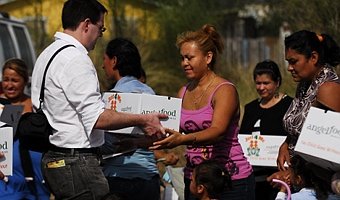
Texas Baptists work with the Angel Food project in McAllen to provide food to needy children, as well as distribute gospel CDs, during a morning of missions scheduled during the BGCT annual meeting. (PHOTOS/Kaitlin Warrington/BGCT)

Convention planners offered local missions opportunities during the meeting to allow visitors and messengers from around the state to participate in sharing the gospel in the Valley and explore new ministry partnerships.

“In coming to the Valley, it was very important that we send a positive message to this part of the state, that we are here to make a difference and to partner with them to reach this area with the hope of Christ,” said BGCT President David Lowrie.

“Since we are focusing on Hope 1:8, we hope our churches would become more active in the Valley. We hope this would be a good time to go out and build some relationships so that we can continue in the future.”

One of the largest efforts of the morning was No Child Goes Without, a partnership with Angel Food Ministries to feed about 1,700 children for a month through food boxes. BGCT Community Care ministries gathered $24,000 through donations to fund the food box project.

A group of convention participants and local organizers traveled to Calvary Baptist Church in McAllen, where pallet loaders, SUVs and trailers were abuzz as boxes of nonperishable foods were stuffed with multimedia gospel compact discs and packed for delivery.

Texas Baptists take time during the Baptist General Convention of Texas annual meeting in McAllen to build bookshelves and sort books as part of the Books for the Border project. (PHOTOS/Eric Guel/BGCT)

Texas Baptists pack food for needy families as part of the Angel Food project in McAllen, part of a morning of missions held during the BGCT annual meeting. (PHOTOS/Teresa Young)

“There’s Beanie Weenies, granola bars, cereal bowls and shelf-stable milk,” said Pamela Barnett, one of Angel Food Ministries’ territory managers for Texas. “What you’re doing will make a lasting impact. We’re not just giving a box of food to some children. We’re giving the love of Christ to them.”

Volunteers began by praying over the boxes, as well as the churches who minister to the elementary schools served by the No Child Goes Without effort. Then the 1,750 boxes were loaded into vehicles so 11 Rio Grande Valley churches could distribute them to 12 low-income schools and colonias. The distribution to school children is the first of its kind for Angel Food Ministries, a nationwide entity that hopes to launch the effort across the country in December.

Jacob West, pastor of the First Baptist Church in Stamford, came out to work for the morning with his wife, Emily.

“I think since I come from a county with so much poverty, I can just imagine the need here on the border,” he said.

Texas Baptists join together in praying on-site for missions in the McAllen area and for an end to violence along the border. (PHOTOS/Robert Rogers/Baylor University)

Loading boxes with CDs wasn’t the only thing Jeannette Lawrence accomplished Tuesday morning. Lawrence, a member of Trinity Baptist Church in San Antonio, said she also gained a vision about taking the No Child Goes Without effort back home with her. Her church already packs Angel Food boxes monthly for families, but she sees this as a great next step.

“I’ve worked with kids my whole life, and I hate to see them go hungry,” said Lawrence, a retired school counselor. “I think this is a great ministry.”

Another group of 25 people gathered cloth-ing donations and 200 of the Angel Food boxes and delivered them to the Indian Hills colonia near Mercedes, an area filled with shanties—many having tarp roofs, broken windows and dirt floors. Volunteers walked up and down the streets inviting the families to gather for free food and clothing.

Two Christian clowns from Hereford made balloon animals for children, telling Bible stor-ies about their creations in the process. Others led children’s songs in Spanish, further engaging the children in the colonia.

While the two feeding outreach events were taking place, other groups built bookcases for LiteracyConnexus’ Books for the Border minis-try, prayer-walked at the Hidalgo International Bridge to Mexico and participated in ministry vision trips to colonias through Buckner International and River Ministry.

{youtube}5IsUew4JFGI{/youtube}

“For me personally, at least in our event, I met people I wouldn’t have met otherwise,” Lowrie said. “By doing work together, I think we built some relationships that we can build on in the future. It strengthens our bond of Baptists. We had people from East Texas, the Metroplex, McAllen and all other parts of the state, and it was almost like a mission trip experience that was captured in a few hours.”

Those who weren’t able to participate in the projects away from the convention center had an opportunity to participate in an Acts 1:8 prayer experience as well as visit a missions fair to see ways they can get connected with Valley ministries, Church2Church partnerships and outreach projects through Texas Baptists’ efforts around the world.

“As far as those who participated in the mission projects, I gather that it changed a lot of perceptions of the significant need here, and it put a face to the need,” Lowrie said.

“It’s one thing to talk about statistics, but when you drive through a colonia and stand on the international bridge and pray for the people here, it changes the way you see the need here.”

As Texas Baptists from other parts of the state experienced a little of what life is like for many in the Valley, Steve Martinez, pastor of the Church of Acts in Elsa, said he hopes they were affected by what they saw and won’t leave the Valley the same, now having a desire to partner with ministries in the region.

“We just want people from up north to see what’s going on here,” Martinez said.  “We want them to have an opportunity to see the need. Many churches want to go to Mexico to help, but there is such a need here in the colonias. Here in South Texas, so many people need Jesus.”


Libel suit by South Texas church starter dismissed

A libel case brought against the Baptist Standard, the Baptist General Convention of Texas and other parties by church-starter Otto Arango has been settled.

Judge Bobby Flores of the 139th Judicial District Court in Hidalgo County dismissed the suit after mediation.

Arango claimed defamation based on a 2006 independent investigation by the BGCT and articles reporting on it. The investigation concluded 98 percent of the 258 churches Arango and his colleagues started in South Texas—for which they received more than $1.3 million in BGCT funds—no longer existed, and some were “phantom” churches that never existed.

Otto Arango

In his suit, Arango claimed more than $3 million in damages. The Baptist Standard’s portion of the settlement totaled $9,500. Settlement amounts involving other parties were confidential.

“We have said all along the Baptist Standard’s coverage of the BGCT investigation into church-starting practices in the Valley was accurate, thorough and fair,” Editor Marv Knox said.

“We stand behind all our stories about this investigation. We have denied and continue to deny any liability to Dr. Arango.”

The Standard filed a motion for summary judgment that included deposition testimony by Arango confirming that the Standard accurately reported on the BGCT investigation and its aftermath. Arango opposed the motion, contending that readers were left with a misleading impression that he was under investigation for criminal activity. The court denied the motion by the Standard and ordered the case to mediation.

In the final settlement, Arango and his attorneys released all claims against the Standard and agreed to dismiss the suit.

“While the Standard would have preferred not to spend any more of our insurance company’s funds, we concur with our attorney and insurance representative that this settlement is a sound business decision,” Knox said. The settlement costs were less than anticipated expenses from the next round of legal expenses, which would have been an appeal to have the case dismissed on summary judgment.

“We were happy to save the insurance company some money,” he said. “We also were relieved to remove this distraction, so we can focus more of our attention on telling the story of God’s work across Texas and around the world.”


Foster care group home offers refuge in perilous city

Experts argue about rankings of the world’s most dangerous cities, but most analysts agree Juarez, Mexico, must be included high on the list. Dozens of people are murdered each month due to gang violence and warfare. More than 1,700 people have been killed so far this year.

Children at a foster group home in Juarez play volleyball outside the home. The group home has started reaching out to help their neighbors, hosting Vacation Bible School and programs and sharing the hope of Jesus Christ. (PHOTO/ Juan Carlos Millan)

Current circumstances prevent American mission teams from traveling safely into the city, but they haven’t prevented the children and staff at the Buckner International foster group home from reaching out, said Buckner Mexico Director Juan Carlos Milan.

“The children in this region have witnessed horrific things that no child should ever have to see,” he said. “But we are doing everything we can to keep them safe and helping them live a normal life.”

The 12 children and staff members wanted to serve their community and share the message of hope through Jesus Christ. So, they hosted the first Vacation Bible School for the community this summer. More than 100 children and 30 adults attended, and eight people came to faith in Christ.

The home’s director said they chose to reach out for several reasons.

“Undoubtedly, we wanted to fulfill the Great Commission. We wanted to bring children and adults to the feet of Jesus, and we wanted the people in the community to know that we love Jesus,” he explained.

“And lastly, we accepted the challenge to demonstrate that we can do all things in the name of Jesus Christ, even when it seems impossible.”

At the conclusion of the Vacation Bible School, every participant wrote an encouraging note favoring peace for the city and placed their note inside a helium-filled balloon.

“We prayed that God would guide these balloons to fall into the hands of those that needed to read the written thought,” Milan said.

“We hope that God in his mercy will do his will in our city, as well as in each of our lives.”


Young Christians seek community among the poor

GRESHAM, Ore. (RNS)—In the two years since David Knepprath and Josh Guisinger moved into the rough-and-tumble Barberry Village complex, about a dozen young Christian men and women have made Barberry Village their home.

Their goal: Create a sense of community in a chaotic neighborhood overrun with drugs, prostitution and gangs.

Their work mirrors, in some ways, the “new monasticism” movement, in which Christians move into urban or rural areas to work with the poor.

David Knepprath (left) and Tyrone Wing (right) live at the rough-and-tumble Barberry Village in Gresham, Ore., as part what they call “intentional living” among the poor. (RNS Photo)

It’s not an easy way to live. Some neighbors have been suspicious. Safety is an ongoing concern. And some of these urban missionaries have burned out on a project that can be a 24-hour-a-day burden.

Yet they’ve been so successful that other complex owners have asked them to replicate their efforts. Congregations have volunteered their services. A woman from Virginia is moving to the Portland area so she can do similar work in another neighborhood.

Now, at least once a month, churches cook meals for the residents at Barberry Village. In early August, children were invited to a three-day Bible camp.

Guisinger and Knepprath and their friends also helped people move. They’ve thrown birthday parties for neighbors. And they cleaned up one woman’s flooded apartment.

Police officers still are dispatched to Barberry Village on a regular basis, sometimes more than once a day. But many neighbors say the complex is safer, friendlier and better for children. A former manager called the young men and women a “godsend.”

“I hope they continue to do this,” said Eugenia Swartout, who lives at the complex with her family. “It gives us some safety and security knowing there are kind people out here and not just bad guys.”

In the beginning, it was just a group of guys sitting around and talking about their faith. Knepprath and Guisinger were buddies in their early 20s, looking to create a ministry that went beyond church walls.

They didn’t want to dabble, though. They wanted to dive in, 24/7.

With guidance from a nonprofit called Compassion Connect, they moved with friends into an apartment, putting two sets of bunk beds in one room and using the other two bedrooms as an office and a closet.

Still, they remained outsiders who could live in almost any neighborhood they chose. They had to strike a delicate balance; they didn’t want to come on too strong and alienate their neighbors.

David Knepprath, center, sings with other members of the Clear Creek Community Church and residents at the Barberry Village apartments in Gresham. Two years ago, Knepprath and three friends moved into the low-income apartment complex so they could work with their new neighbors. (Benjamin Brink/The Oregonian)

So, while they were open about their Christianity, they didn’t plunge into conversations about their faith. Nor did they move in acting as if they could solve the social ills at Barberry Village.

“Our perspective from the start was that we’re not here with all the solutions, or even thinking we know all the problems,” said Knepprath, who has since moved out but remains active in the ministry.

Guisinger hasn’t been bothered by the crime. He previously worked in street ministry and, when he was a kid, his parents invited in strangers who needed help. Living among the poor, however, was something he’d never experienced.

“I wondered if I would be able to relate,” he said. “I grew up in a wealthy family. I never lacked a meal or insurance or anything like that.”

Knepprath lived at the complex after he got married but moved recently to be closer to his job. Guisinger and his friend Jared Simons now have two new roommates. Even after nearly two years, Guisinger has no plans to move.

Instead of staying holed up in their apartments, neighbors now go outside and get to know one another. They invite each other over for dinner. It’s more like a neighborhood than an anonymous apartment complex.

Jesse Danner, a former heroin and cocaine addict who’s been clean for three years, arrived in April 2009 with his wife and their children.

He was worried about moving into the complex, given its reputation. But he met Knepprath and Guisinger when they invited his family for a community meal. Later, Danner’s wife started going to church and was baptized on a camping trip. Now Danner goes to church, too.

One day last October, Knepprath came over and asked Danner for some help with a computer. They walked across the parking lot to a friend’s place. But Knepprath didn’t really need help.

“They actually threw a birthday party for me,” Danner said. “It’s the only one I’ve ever had.”


CERI campaign aims to help small businesses in Sri Lanka  

Children’s Emergency Relief International launched a GlobalGiving fund-raising campaign to help foster parents and orphaned adolescents in Sri Lanka start or expand a small business.

With the help of supporters, CERI is able to empower Sri Lankan foster parents to break the cycle of dependency by establishing successful businesses. (PHOTO/CERI)

The economic development program is designed to break these families’ cycle of dependency on charitable aid. 

GlobalGiving is an international fund-raising network that matches nonprofit organizations with an extensive group of private and corporate givers who want to help charities sustain and grow their work around the world.

Since 2004, CERI’s foster care program has placed 180 Sri Lankan children, or-phaned by a 26-year civil war and the 2004 tsunami, in loving homes. CERI caseworkers assist children with homework, provide basic medical care and life skills training, and organize educationally enriching after-school activities.

To help indigent foster families gain financial independence, CERI also launched a revolving microloan program that provides start-up capital for Sri Lankan entrepreneurs and artisans.

CERI officials hope the partnership with GlobalGiving will expand the income-gen-erating initiatives to benefit a larger number of CERI-supported foster families in eastern and southern Sri Lanka. 

The fundraiser for Sri Lanka is CERI’s second appeal for donations though Global-Giving. Recently, the agency collected $12,000 to provide new winter boots and socks to orphans in Moldova.   

For more information on the fund-raising initiative, go to www.globalgiving.org.