Challenge for churches: How to care for caregivers

As churches minister to the most elderly and infirm among members, some also seek ways to serve their caregivers—often family members—who often labor around the clock.

Members of the "Classic 55-plus" ministry at First Baptist Church in Allen assemble layettes as a service project for a local organization, Real Options for Women. (PHOTO/Courtesy of First Baptist Church in Allen)

Frank Fain, director of educational services for The Baptist Home system for older adults in Missouri, offered these tips.

• Provide a support group—a place for caregivers to express their feelings and to talk about their needs.

• Provide counseling or direct caregivers to available counseling, if needed. Sometimes people need help to deal with the emotional, mental and physical toll caring for loved ones can take.

• Teach families, deacons, caregivers and others who minister with older adults how to communicate effectively with the elderly and to treat them with respect.

• Offer educational events for caregivers. Draw from local experts at your state’s department on aging, hospice, hospital or government agencies.

• Develop a caregiver section in the church media center. Many Baptist state conventions have an adult consultant or specialist or can point the church to resources.

The Baptist General Convention of Texas is developing resources and soon will have a website in place specifically for caregivers.

Care facilities—such as The Baptist Home in Missouri and Buckner Retirement Services in Texas—also can suggest resources. Find out what local resources are available as well.

• Develop a caregiver respite ministry to give individuals a break to shop, run errands or relax. Also consider providing res-pite on Sunday mornings to allow caregivers to worship.

• Partner with local hospice organizations. Perhaps staff members would be willing to be hospice chaplains. Find out what needs other older adults in your group could help meet.

• Take the Lord’s Supper to the homebound and their caregivers.

• Include caregiver ministry as part of care for the homebound. First Baptist Church in Allen provides Keep in Touch ministry to make sure homebound members receive weekly contact from the church. The ministry assists caregivers by helping meet some of the homebound members’ needs.


Belmont adds sexual orientation to anti-discrimination policy

NASHVILLE, Tenn. (ABP) – Belmont University trustees voted to add sexual orientation to the historically Baptist school’s anti-discrimination policy.

In December, Belmont parted ways with a successful women’s soccer coach after she told her team that she and her same-sex partner were expecting a baby. The move gained national attention in sporting news and prompted discussions among campus groups about whether the private, Christian university discriminates against gays.

President Bob Fisher said the addition of sexual orientation to the school’s policy against discrimination simply puts into writing what was already being practiced. During his 11 years as president, Fisher said sexual orientation “has not been considered in student admissions nor in hiring, promotion, salary or dismissal decisions.”

Fisher said the trustees also added a preamble to the policy stating that “Belmont is a Christian community, and the university’s faculty, administration and staff uphold Jesus as the Christ and as the measure of all things.”

The policy, which also covers non-discrimination on the basis of race, sex, color, national or ethnic origin, age, disability or military service, still retains, under federal law, the university’s right to “discriminate on the basis of religion in order to fulfill its purposes.”

For more than 50 years Belmont was affiliated with the Tennessee Baptist Convention. Those ties ended in 2007, with settlement of a lawsuit over whether trustees had the right to elect their own successors instead of those selected by the convention.

Randy Davis, executive director of the state convention, told Baptist Press that Belmont had walked away from its “Christian heritage and roots.”

Lisa Howe, the former soccer coach who reportedly stepped down in mutual agreement with the administration, told local media she is pleased with the new anti-discrimination policy, but she is pursuing several job leads and doesn’t plan to reapply at Belmont.

Previous ABP stories:

Fallout continues over departure of gay soccer coach

Belmont center of gay-rights dispute


No single size or shape fits ministry to all older adults

Pretend for a moment a congregation has called you as youth minister and includes all individuals from 3 to 30 years old as your group. What is your reaction?

James and Una Grubbs sort and package Christmas cards for The Baptist Home Auxiliary to sell at homecoming. They reside in the assisted living section of The Baptist Home at Chillicothe, Mo. (PHOTO/Courtesy of The Baptist Home)

Most people wouldn’t expect a youth worker to deal with such a broad range of ages, citing physical, emotional and mental differences. Even so, congregations often expect a minister for older adults to effectively bridge a 30-year, 40-year and even 50-year gap among its members.

What images do the words “senior adult” evoke? An 80-year-old, gray-haired woman who enjoys a monthly potluck lunch and a guest speaker? A crotchety old fellow who complains about the music or the young people or the building project? Or an active and engaged retiree who is seeking meaning in his or her last chapter of life?

Church and denominational leaders are beginning to understand older adults cannot be categorized as a single unit, and a one-size-fits-all ministry will not meet needs.

“As we get older, our differences increase,” declares Amy Hanson in her book Baby Boomers & Beyond: Tapping the Ministry Talents & Passions of Adults Over Fifty. “The bottom line is that we can’t fool ourselves into thinking a potluck luncheon will appeal to everybody who is older—and the reality is, it probably never did.”

The overall U.S. population continues to age, partly because the most populous generation—Baby Boomers—are aging and because of lower birth rates among the generation that followed. Church ministries must change to meet needs across generations

Many congregations include three generations, according to Frank Fain, director of educational services for The Baptist Home, a three-campus system for older Baptists in Missouri.

The civic or hero generation comprises individuals 86 and older. Sometimes referred to as the “slow-go” or “no-go” group, they often receive pastoral care. The adaptor or silent generation, often called the “artist cohort,” includes ages 66-86. About 42 million strong, the “go” group likes to take trips and do activities together. Baby Boomers, also called the “idealist cohort,” is the “too-busy-to-go” group.

“The church has to realize it is dealing with a broad age group with many different needs. They may have someone who is 100 and a 55-year-old who just lost his job,” Fain said. “They must recognize that they must minister to all.”

Hanson points out age can be measured four ways—chronological, functional, psychological and social—and encourages churches to steer away from basing all its ministry to adults along chronological age.

First Baptist Church of Huntsville, Ala., takes a four-pronged approach, said Mark Seanor, minister to experienced adults. Ministry to the first three groups is based on retirement.

Their “builders” group is composed of those who are almost retired and who are either building toward retirement or who may not retire. The “explorers” are those who have just retired and who want their experience to continue to have significance. The “pillars” are retired and are beginning to face more physical changes. The ministry’s fourth group includes the homebound and their caregivers.

Programming and ministry with and to each group center on members’ needs and desires and provides ways for each to use their skills and gifts.

James Craver, associate pastor at First Baptist Church in Allen, concentrates on providing opportunities for members of the 55-plus ministry to use their life experiences, regardless of age.

“About 90 percent of our group is under 80. They’re still active and don’t consider themselves seniors,” he said. “We have a 92-year-old who sees senior adults as those in the nursing home.”

The church provides day and evening activities and events. “We center more on thinking patterns rather than age,” Craver said.

That includes service opportunities. When a member suggests possible ministries or projects, he asks the individual to pray about it. If the member still feels strongly, then he or she is in charge and finds help.

The church’s 55-plus ministry conducts full worship services in area care facilities.

The Worship Together ministry began four years ago when one facility’s administrator noticed residents who wanted to attend church but couldn’t sit for long periods. She asked if the Allen church would provide worship.

The ministry began with four volunteers and one care home. Now nearly 100 church members, including youth, serve in four facilities.

“You cannot do senior adult ministry even like you did it five years ago,” Craver said.


Rosa Parks enshrined in stone

WASHINGTON (RNS)—Six feet above the vaulted entranceway to Washington National Cathedral, the rough contours of Rosa Parks’ face are taking shape.

Using a motorized hammer and chiseling tools that date back centuries, stone carver Sean Callahan is working patiently on a new bust of the civil rights heroine.

Stone carver Sean Callahan measures a plaster cast of a Rosa Parks sculpture that will be carved into the “Human Rights Porch” at Washington National Cathedral. (RNS PHOTO/Courtesy Craig W. Stapert/Washington National Cathedral)

“I have to be aware of the significance of it,” he said. “It puts pressure on me to get it right. I have to pay respect to her in that sense.”

Across the Human Rights “porch” in the cathedral’s narthex, Parks soon will be joined by another famous woman, Mother Teresa.

Callahan, a 45-year-old Catholic, was not alive when Parks made history by staying seated on a segregated bus and helping spark the civil rights movement; but he remembers hearing about Teresa, the Nobel Peace Prize-winning nun, when he was growing up.

Starting with Parks, Callahan is using a pointing machine, whose brass arms adjust as he measures a plaster model that acts as an exact guide for the carving, chiseled from a block of stone in the narthex.

“It’s kind of like a three-dimensional connecting the dots,” Callahan said.

He carefully places the machine within 1/16th of an inch of the model before shifting the device to his stone canvas nearby.

“If you mismeasure this, then everything’s off,” he explained.

The delicate details of Parks’ face will surface from what at first looks like a mass of dots and parallel chiseled lines. The dots indicate how far down he must chisel each part of the stone to develop the contours of the finished bust.

Eventually, he will have to leave the machine behind and do the final work by eye, which, he says, is the toughest part.

“Portraits are particularly difficult because everyone recognizes them,” he said. “If you’re doing something like a hand or a gargoyle, it’s not as critical. But it’s an indefinable thing to make the face come alive. It’s hard to explain, but that’s just something that takes patience and practice to get the hang of.”

Callahan, who worked as an apprentice under stone carvers at the cathedral in the 1980s, has done restoration work on the White House exterior and gargoyles in private gardens. The cathedral hired him six years ago.

As he stands amid temporary scaffolding, a carving of first lady Eleanor Roosevelt peeks over his shoulder.

Others already enshrined in the “human rights” portal include slain Salvadoran Archbishop Oscar Romero and Bishop John Walker, the first black Episcopal bishop of Washington.

“The people selected to appear in the iconography of the Human Rights Porch were chosen because of their extraordinary actions and contributions to the cause of human rights, social justice and the welfare of their fellow human beings,” said Samuel T. Lloyd III, dean of the cathedral.

Callahan’s work began a week before the country marked the birthday of Martin Luther King Jr., with whom Parks worked closely. The sculptures of Parks and Mother Teresa, based on clay models by North Carolina sculptor Chas Fagan, are due to be completed by Easter.

“That quiet strength is, I think, the common denominator,” Fagan said of the two women he sculpted. “Rosa Parks definitely showed it with her actions and through her own life, and the same with Mother Teresa.”

Fagan, 45, who crafted the sculpture of President Ronald Reagan that stands in the U.S. Capitol Rotunda, worked with cathedral craftsmen to complete the model so the faces of the women fit artistically within the cathedral’s architecture. While he could “fix my mistakes” as he sculpted, he said, there’s “no wiggle room” when Callahan gets to the carving stage.

With these figures, the landmark cathedral that was officially finished in 1990 is educating worshippers just like the cathedrals of old, Fagan said.

“Now that the structural stuff is complete, there’s a chance to do what all the other cathedrals did in their own time,” he said. “Just fill all the niches and teach through the art.”


Gus Reyes tapped by National Hispanic Christian Leadership Conference

The National Hispanic Christian Leadership Conference, also known as The Hispanic National Association of Evangelicals, appointed Gus Reyes as chairman of its educational directive.

Reyes serves as the director of Hispanic Education Initiative/Affinity Ministries with the Baptist General Convention of Texas. He will continue ministering that role.

Gus Reyes

“It is one of my passions in life to develop strategies to encourage Hispanic students to reach their educational goals,” Reyes said. “These strategies impact and integrate relationships between students, parents, pastors and church as well as community leaders,” explained Reyes, author of 100 Stories of Hope.

“This resource encourages students to trust God for help in overcoming educational obstacles.”

Research indicates Hispanic students make up 38.6 percent of college dropouts in the United States, although they represent only 15.1 percent of the total population. In addition, just one Hispanic high school dropout in 10 has a General Educational Development credential, widely regarded as the best “second chance” pathway to college and vocational training for adults who have not graduated from high school.

More than 40 percent of Hispanics ages 20 and older in the United States do not have a high school diploma.

“The most urgent challenge for the American educational system has a Hispanic face. Hispanics are the largest and most rapidly growing ethnic minority in the country, but academically they are lagging dangerously behind,” explained Samuel Rodriguez, president of the National Hispanic Christian Leadership Conference.


Religious persecution more prevalent, more severe in Muslim countries

WASHINGTON (RNS)—The New Year’s Day massacre at a Coptic church in Egypt. Christian converts facing the death penalty in Afghanistan. Swastikas painted on a Jewish synagogue in Venezuela.

As the headlines deliver fresh stories of the persecution of the faithful, two recent reports by watchdog groups and a new book take a fresh look at the persistence of religious intolerance worldwide, with Muslim-majority nations facing particular criticism.

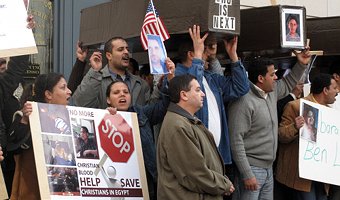
More than 1,000 Coptic Christians demonstrated in downtown Nashville against the shooting deaths of six Coptic Christians and other instances in Egypt of violence and persecution against their ancient Christian community. (PHOTO/Baptist Press/Art Toalston)

“Religious persecution is not only more prevalent among Muslim-majority countries, but it also generally occurs at more severe levels,” Roger Finke and Brian J. Grim write in their new book, The Price of Freedom Denied, published by Cambridge University Press.

Finke and Grim drew on annual reports by the U.S. State Department to conclude that religious persecution plagues all regions of the globe.

Studying 143 countries, they found:

• In 86 percent of countries, people were physically abused or removed from their homes based on their religion.

• High levels of government restrictions on religion were found in 78 percent of Muslim-majority nations, compared to 10 percent of Christian-majority nations and 43 percent of other nations.

But nothing inherent in Islam makes Muslim-majority countries poor guardians of religious freedom, Finke said, and Muslims themselves often are victims of religious intolerance.

“As Westerners, we view Muslims as targeting us or other Christians. But when you look within these countries, much of the persecution is Muslim on Muslim,” said Finke, a sociologist of religion at Penn State.

“It’s a battle over what type of Shariah law should be enacted, or who holds the reins of power in government.”

Open Doors, a California-based evangelical group that defends Christian rights globally, also cites Muslim-majority nations as particularly hostile in its recent list of the most dangerous countries in which to practice Christianity.

While North Korea tops the list for the ninth consecutive year in the Open Doors report, eight of the top 10 offenders are Muslim-majority nations. North Korea is followed by Iran, Afghanistan, Saudi Arabia, Somalia, Maldives, Yemen, Iraq, Uzbekistan and Laos.

Open Doors President Carl Moeller said he particularly is concerned about increasing violence against Christians in Iraq and Afghanistan. Iraq broke into the top 10 for the first time, up from No. 17, and showed the most dramatic deterioration for Christians.

“These are countries we sought to bring freedom to, and they don’t enjoy the most basic freedom we have in our country—religious freedom,” said Moeller, whose group devised a 50-question survey to rank countries.

A new report focusing on the most vulnerable religious communities in the world was released by the non-denominational First Freedom Center. In “Minority Religious Communities At Risk,” the Richmond, Va.-based group identifies groups threatened with extinction within a decade.

They are, according to First Freedom, Orthodox Christians in Turkey, Jehovah’s Witnesses in Eritrea, Jews in Arab lands, Jews in Venezuela, Nazarene Chris-tians in Somalia, Masalit Muslims in Sudan and Sabian Mandeans (a Christian sect) in Iraq.

Relying on the State Department’s religious freedom reports and other sources, First Freedom, like Open Doors, calls attention to the growing violence against religious minorities in Iraq and Afghanistan.

The group’s president, former Ambassador Randolph Bell, said the report bolsters his view that protecting religious freedom must be integral to U.S. peacekeeping operations.

“Whenever we try to stabilize situations in countries like Afghanistan, Iraq, Somalia or Nigeria, if we do not take into account the rights of religious minorities, peace will not last,” Bell said.


News Elsewhere:

Copts say Egypt regime change trumps Islamist fears (02/02/11)

An Egyptian Coptic Orthodox church source said the church will advise Copts not take part in the latest protests, but will not stop those who insist on taking to the streets.

Unrest in Egypt: Terry Mattingly wonders why media haven't mentioned the Copts in reference to the latest protests in Egypt.


Backpack ministry shows Midland children: ‘Crestview Cares’

MIDLAND—Crestview Baptist Church, through a community collaboration with Buckner International, has adopted Jane Long Elementary School for a new feeding program it calls “Crestview Cares.”

“Teachers were noticing that on Monday mornings, some students would eat their school breakfast, but the next day they would stick it in their clothes or backpack,” said Nita Capell, volunteer coordinator for Crestview Cares.

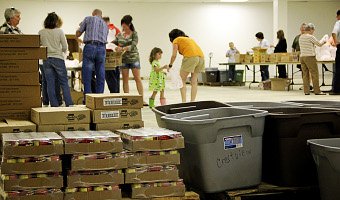
During the first week of the feeding program, 60 of Crestview Baptist’s first- through sixth-grade students worked to fill bags. Volunteers worked quickly by forming an assembly line to fill bags with enough food to last food-insecure elementary students through the weekend.

“The teachers told them: ‘No, you can’t do that. You have to eat it at school.’ Students would explain, ‘I’m going to take it to my brother, because he doesn’t have anything to eat.’”

Capell buys food from the West Texas Food Bank in Odessa and grocery stores using funds collected from local organizations and individuals. Church members fill bags with food every-other week. On Fridays during recess, teachers discreetly put them in students’ backpacks.

“I was shocked to find out that there are food-insecure kids in Midland,” said Byron Smith, director of community ministries for Buckner and missions pastor at Crestview.

Smith observed a backpack feeding program started by the Odessa Junior League last year and applied that knowledge at Jane Long Elementary.

“I wanted to get a model to present to the other churches here in Midland, so that they can take on an elementary school themselves,” Smith said.

The program is having the domino effect he hoped it would. One month after Crestview Cares launched, First United Methodist started its own feeding program at another elementary school.

Crestview’s program kicked off last September. They currently feed 118 students, up from 71 the first week. Smith said the children love to get ravioli, spaghetti and miniature boxes of cereal.

Volunteers at Crestview Baptist Church in Midland spend every other Wednesday night filling sacks with food to drop off at Jane Long Elementary.

“Everything that we give them is something they can open up and eat immediately,” Smith said. “The food does not require heat or any cooking, because we realize that some of these children go home to a house without electricity or gas or any way to cook.”

“We try to give them two things for breakfast, two for lunch and two things for supper. It’s not a large amount, but it’s something that can tide them over until they get back to school on Monday and have breakfast and lunch.”

Teachers have shared students’ feedback with volunteer staff. One student said: “I can’t wait till Friday to get my food. It feels good to get food every day.”

Another said he liked the food and wished he had more to share with his brothers and sisters. One teacher reported three of her four students who receive bags of food already have shown improvement in the classroom.

“We just try to take care of our own,” Capell said. “The Lord just put us there where we could be used, and that’s what it’s all about.”


To learn more about Crestview Cares, contact Byron Smith at (432) 681-8200. To help support feeding programs for children through Buckner, call Buckner Foundation at (214) 758-8050.


Former WMU president Christine Gregory dies

BIRMINGHAM, Ala. (BP)–Christine Gregory, national Woman's Missionary Union president from 1975–1981, died Jan. 22, in Danville, Va. She was 89.

She served on the 1980s Southern Baptist Peace Committee that studied the controversy between conservatives and moderates. She also served as vice president of the Baptist World Alliance and as first vice president of the SBC.

Christine Gregory

"Christine was always a source of encouragement and support for the work of WMU both past and present, as well as to me personally as I have visited and communicated with her throughout my years of service," said Wanda S. Lee, executive director/treasurer of national WMU. "WMU has been blessed throughout its history with strong, missions-focused national leaders. Christine was no exception as she followed in that path, leading WMU through times of expansion. She leaves a great legacy for today's leaders in WMU to follow."

As WMU president, Gregory served alongside Carolyn Weatherford Crumpler, executive secretary of national WMU (1974–1989).

"She became my best friend," Crumpler said. "We traveled to so many places … she was so down-to-earth, comfortable with all people, and always ready to make them feel comfortable with her. Christine's husband and sons were never neglected as she traveled. She was an example to all women, and we are grateful for her life and ministry."

Crumpler described her friendship with Gregory and her many contributions to WMU as "a blessing."

"She led with a positive approach, and faced any opposition that came her way with determination and a smile," Crumpler added.

Born to Willis L. Burton and Bessie Hollingsworth on Apr. 15, 1921, Christine Burton (Gregory) described herself as plain, even ordinary. But what others noted was her extraordinary devotion to missions.

In her childhood home of Greenville, S.C., Gregory enjoyed piano and voice lessons, but she also witnessed her family give to those in need. She grew up observing her mother setting aside money in a sugar bowl for missionary offerings, carrying food in a basket to the needy in their community, and reading Royal Service (now Missions Mosaic) magazine for missions involvement.

On her 12th birthday, her father gave her a Bible. Later, while attending Girls' Auxiliary (now Girls in Action) at church, she wrote in her Bible that she was "committed to doing whatever God wished about service in missions" — a commitment she honored.

When Gregory went off to Winthrop College in Rock Hill, S.C., she became president of the school's Baptist Student Union. After college, she worked as a teacher in Cowpens, S.C., for one year, and following that, became promotional secretary for First Baptist Church of Greer, S.C. Her responsibilities included maintaining the financial records of the church, the educational program and the youth program.

For four years she taught seventh grade at Greenville Junior High, and on Aug. 20, 1948, she married Clemson graduate A. Harrison Gregory when he returned from World War II. The couple moved to Danville, Va., where Gregory's husband had accepted a position at the Dan River textile company.

At age 38 with three young sons, she became WMU president of First Baptist, Danville. In 1961, she became associational WMU director, and in 1968, she served as missions action chairman for Virginia. When the then mother of teenagers became concerned that she was doing too much, her husband reassured her. With that extra boost, it was not long before Gregory was elected as president of Virginia WMU, and therefore served on the executive board of national WMU (1971–1975).

Gregory was elected as president of national WMU and served from 1975–1981. During her tenure, she not only maintained her focus on order and organization, but she also selected missionaries and leaders who would provide a variety of perspectives for the WMU organization and publications.

After she retired, she was elected as first vice-president of the Southern Baptist Convention (SBC), the first woman to hold that particular office, and the third woman ever to hold a convention office, according to WMU. In 1982, she was nominated to Southeastern Baptist Theological Seminary's board of trustees and also became adviser to Averett College in Danville. The school had awarded her an honorary doctorate in 1976.

From 1981–1983, she served on the SBC Annuity Board to help study its church pension plan. She described her service on this committee as a "most significant" opportunity because the board was able to provide secretarial and janitorial workers in churches with fair pensions. Also in 1983, she was awarded another honorary doctorate, but this time by the University of Richmond.

In 1987, Gregory authored the book "I Can Be a Mirror: My Role in Mission Action and Personal Witnessing." She was an active member of First Baptist Church in Danville until her death.

Gregory was preceded in death by her husband and is survived by three sons: Harrison Burton Gregory of Marietta, Ga.; Eugene Allen Gregory of Casonova, Va.; and Joel Patrick Gregory of Danville, Va.


On the Move

Justin Bindel to First Church in Wichita Falls as minister to senior high students.

Josh Graff has resigned as youth minister at First Church in Nixon to enter the U.S. Navy’s chaplaincy program.

Chase Hinson to Handley Church in Fort Worth as pastor.

Robert McGee to First Church in Kenedy as minister of music and education.

Sam Midgett to First Church in Wichita Falls as minister to sixth grade and junior high students from First Church in Longview, where he was minister to students.

Norma Rodriquez to First Church in Smithville as children’s director.

K.J. Ross to First Church in Runge as youth minister.

Brandon Self to First Church in Wichita Falls as contemporary praise and worship leader, where he had been interim.

Brad Williams to First Church in Smithville as church administrator and education director.

David Williams to First Church in?Paducah as pastor from Seventh Street Church in Ballinger.


Faith Digest

Moral climate poor, Americans say. Three out of four Americans grade the country’s moral climate at a “C” or below, according to a recent poll. The Public Religion Research Institute/Religion News Service poll found Americans older than 65 (46 percent) are more likely than adults under 35 (25 percent) to grade the country’s moral climate with a “D” or an “F.” The poll found that half of Americans rate the country’s moral climate as the same as other industrialized nations; 22 percent thought it was better; and 24 percent thought it was worse. The PRRI/RNS Religion News Poll was based on telephone interviews of 1,006 U.S. adults between Jan. 13 and 16. The poll has a margin of error of plus or minus 3 percentage points.

British YWCA drops Christian affiliation. The British branch of the YWCA has dropped “Christian” from its official name because it “no longer stood for what we are or what we do,” the women’s charity has announced. After 155 years, the Young Women’s Christian Association will now be known as Platform 51, the charity said in an announcement carried on its website. The organization said its new name “more accurately represents what we are or what we do—51 percent of people are female, and girls and women use us as a platform to have their say.” According to the Daily Mail newspaper in London, the name change underscores a growing rift between the charity’s members in England and Wales and the global YWCA. The newspaper quoted YWCA spokeswoman Sylvie Jacquat at the organization’s headquarters in Geneva as saying none of the YWCA’s other 124 branches around the world are contemplating a similar change.

Religious leaders praise new Cuba policy. Faith leaders with long-term ties to Cuban organizations hailed a change in White House policy that reduces limits on religious travel to the island nation. The White House announced Jan. 14 President Obama had directed changes that include permitting religious organizations to sponsor trips through a general license. The administration also will create a general license that permits remittances to religious institutions in Cuba that support religious activities. Michael Kinnamon, general secretary of the National Council of Churches, called the change “an important first step toward more just and open relations between the U.S. and Cuba.”

–Compiled from Religion News Service


Around the State

Dallas Baptist University will hold a preview day Feb. 5 from 8:30 a.m. to 3:30 p.m. Prospective students will eat breakfast with current students, tour the campus and hear from several faculty members. DBU will waive the application fee for students who apply that day. Parents will participate in information seminars on financial aid, campus life, parent services and the application process. For more information, call (214) 333-5360.

The new Ornelas Student Center on the campus of East Texas Baptist University was ready for students on the first day of classes of the spring semester. The dedication ceremony for the two-story, 31,852-square-foot building, built on the former site of Merle Bruce Hall, was held Jan. 21.

• Bell Association and the University of Mary Hardin-Baylor church relations department are sponsoring a seminar related to the 2011 Winter Bible Study, “A Study in Galatians: Truth and Grace” Feb. 15. The seminar will be repeated Feb. 19 so bivocational pastors may attend. UMHB Christian studies professor Tony Martin will offer a study of Galatians from 9 a.m. until 10:30 a.m. John Witte, retired pastor and professor at UMHB, will explain how to preach and teach Galatians from 10:30 a.m. until noon. Both sessions will be in the Bell Association office on the UMHB campus. Lunch will be served on Tuesday and breakfast on Saturday for $5 per meal. Books will be available for purchase. Make reservations at bba9129@ sbcglobal.net or (254) 939-0761.

• The University of Mary Hardin-Baylor will feature Joshilyn Jackson during the annual Writers’ Festival set for Feb. 17-19 in the Brindley Auditorium of the York Science Center. The literary festival is open to the public. Registration and admission fees are based on events attended. Jackson will present the George Nixon Memorial Lecture Feb. 17 in Brindley Auditorium at 7 p.m. Jackson is a novelist who has been on the New York Times Best Seller list. To register, request information or apply for the master classes, contact Jessica Hooten by e-mail at jhooten@umhb.edu or call (254) 295-4692.

• Carol Nave, Houston Baptist University organ performance alumna and Indiana University doctoral candidate, will be the featured organist at a March 4 organ recital at HBU. The 30-minute recital will begin at noon.

Alto Frio Encampment’s spring senior adult camp will be held April 18-21. James Semple will be the preacher, D.L. Lowrie the Bible study leader, and Dale Durham and Ginger McKay will lead the music. For information on cost and lodging options, call (830) 232-5271.

Jesse Burleson has been named head football coach at Hardin-Simmons University. He has been offensive line coach at HSU the last five seasons and assistant head coach since 2008.

The San Marcos Baptist Academy barn, an 80-year-old campus landmark, will be restored through a grant from the Texas Pioneer Foundation. The barn houses animals used in the school’s 4-H program and the school’s equestrian program. Fred Markham (right), president of the Texas Pioneer Foundation, joined 4-H/Equestrian Director Tricia Raimondi and SMBA students.

• The Howard Payne University Model United Nations team participated in the National Model U.N. Europe 2010 Conference in Olomouc, Czech Republic. The 12 HPU students represented Austria and The Netherlands during the simulation of the United Nations. Students participating in the conference included Josh Rice, Joshua Muse, Shawn Hodge, Kathryn Burns, Kathryn Barrackman, Scott Perkins, Matt Peisker, Liz Rodgers, Callie Ellis, Zachariah Lundy, Brittany Luns-ford and Nick Rayburn. Sponsors of trip included HPU faculty members Justin Murphy, dean of the School of Humanities, professor of history and director of the Douglas MacArthur Academy of Freedom; Matthew McNiece, chair of the department of history and associate professor of political science; and Jennifer McNiece, assistant professor of political science.

Anniversaries

Russell Polson Jr., fifth, as pastor of Rayburn Park-way Church in Bronson, Jan. 1.

C.P. Floyd, 10th, as pastor of East Cisco Church in Cisco, Jan. 2.

Second Church in La Grange, 25th, Jan. 16. Ellis McKinzie is pastor.

Keith Brister, 15th, as pastor of First Church in Duncanville, Feb. 1.

Stan Ortner, 30th, as pastor of First Church in Bremond.

Deaths

Billy Chambers, 77, Oct. 27 in Fort Worth. He was a graduate of Baylor University and Southwestern Baptist Theological Seminary. He was pastor of Oran Church in Graford and First Church in Ranger, as well as churches in California, Ohio, Michigan and Wisconsin. He is survived by his wife of 56 years, Louise; sons, Joseph and Mark; daughter, Carol Black; and six grandchildren.

Troy Martin, 83, Jan. 12 in Gholson. He retired from the Owen-Illinois Glass Plant after 42 years. He was a charter member and past chief of the Gholson Volunteer Fire Department. He was a deacon and longtime member of First Church in Gholson. His particular passion was Royal Ambassadors. He began the program at Gholson and attended every local RA meet and state congress from 1975 until 1999. He also was instrumental in building the church’s parsonage and sanctuary. He served as Training Union and Sunday school director. He was preceded in death by his wife of 52 years, Gwen; and brother, Travis. He is survived by his sons, Jeffrey and Russell; sister, Dardanilla Gummelt; five grandchildren; and seven great-grandchildren.

Don Zackary, 66, Jan. 15 in Dallas. He worked at Dallas Baptist University as director of financial aid since 2002. He was a member of First Church in Keller. He was preceded in death by his son, Jeffrey. He is survived by his wife of 45 years, Lynda; daughter, Christy Storska; and three grandchildren.

Roy Lee Williams Jr., 90, Jan. 17 in Abilene. A Hardin-Simmons University graduate, during World War II, he was a chaplain’s assistant. After the war’s end, he enrolled at Southwestern Baptist Theological Seminary and served as minister of education, music and youth at Diamond Hill Church in Fort Worth. He was minister of education and music at First Church in Arlington from 1949 to 1953 before becoming minister of education at First Church in Wichita Falls and then First Church in Houston, where he served until 1964. From 1964 until 1988, he was director of church services for Union Association, and served the association as interim executive director in 1989. In retirement, he preached and ministered in several Houston-area churches and was a volunteer chaplain at M.D. Anderson Cancer Center in Houston. In 1998, he moved back to Abilene, where he was a member of First Baptist Church. He is survived by his wife of 70 years, Mary Lou; sons, Marvin and Hollis; brother, Stanley; five grandchildren; and four great-grandchildren.

Jeff Matthies, 38, Jan. 22 in Fredericksburg. He was featured in a 2006 Baptist Standard story concerning his need for a double lung transplant due to cystic fibrosis. His father, Alan, is a chaplain at Hill Country Memorial Hospital in Fred-ericksburg and formerly was a chaplain at Baylor Medical Center in Dallas. He is survived by his wife, Kari; son, Andrew; parents, Alan and Pam; grandfather, Herschell Matthies; and brother, Jimmy.

Bob Jenkins, 83, Jan. 23 in Dallas. A graduate of Baylor University and Southwestern Baptist Theological Seminary, he was pastor of Whitehall Church in Gatesville, Arcadia Park Church in Dallas, First Church in Cooper, Temple Church in Amarillo, First Church in Levelland and Hampton Place Church in Dallas. He was director of missions for Smith Association from 1982 to 1995. While serving in that capacity, he led volunteers on mission trips to Brazil, Mexico, Kenya, Tanzania, Australia, Estonia, Czech Republic and Georgia Republic. He also was active in prison ministry. He is survived by his wife of 60 years, Florine; sons Byron and Glenn; daughters, Vivian Powell and Robin Mojica; and six grandchildren.

Earl Johnston, 95, Jan. 24 in San Antonio. He was pastor of Alamo Heights Church in San Antonio, Palm Heights Church in San Antonio and First Church in Los Fresnos. He also was associate pastor at Baptist Temple in San Antonio and minister of pastoral care of First Church in San Antonio. His wife, Mauriece, was Texas Woman’s Missionary Union President from 1972 to 1976 and from 1980 to 1984. He is survived by his wife of 72 years; son, James; two granddaughters; and four great-grandsons.

Events

First Church in Blanco held a reception marking the 100th birthday of H.B. Ramsour, second president of what now is Baptist University of the Americas, Jan. 11. Ramsour assumed leadership of the school in 1960 and led the conversion of ownership to the Baptist General Convention of Texas from San Antonio Assoc-iation in 1962. He also helped the school acquire additional land and erect several buildings before his retirement in 1976.

Licensed

Clayton Rogers to the ministry at Union Valley Church in Nixon.

Ordained

Dave Stone to the ministry at Central Church in Luling.

Rickey Loyd, Scott Sarine and Chip Vaughn as deacons at First Church in Sulphur Springs.

Gary Knight as a deacon at First Church in Belton.



India’s Supreme Court changes ruling after protest by Christians

FALLS CHURCH, Va. (ABP) — India's Supreme Court amended a ruling upholding a life-in-prison sentence for two men convicted of murdering a Baptist missionary and his two young sons 12 years ago by removing language that critics said appeared to condone vigilante violence intended to "teach a lesson" against proselytizing among the nation's tribal poor.

On Jan. 21 the Supreme Court upheld life sentences for Dara Singh and Mahendra Hembram. They were convicted of burning Staines, 58, and his sons Philip, 9, and Timothy, 7, alive while they slept in a van outside a church in Koenjhar district of Orissa, eastern India, on Jan. 22, 1999.

Declining to reinstate the death penalty for one of the killers, the 76-page judgment stated that "there is no justification for people committing conversions on the premise that one religion is better than the other."

In a paragraph explaining why they declined to reinstate a death penalty awarded by a jury in 2003 but commuted to life sentences two years later, the justices opined:

"In the case in hand, though Graham Staines and his two minor sons were burnt to death while they were sleeping inside a station wagon at Manoharpur, the intention was to teach a lesson to Graham Staines about his religious activities, namely, converting poor tribals to Christianity."

The language prompted protest among Indian Christians, who claimed it "de-legitimized" their constitutional right to profess, practice and propagate their faith. One group wrote an open letter Jan. 25 objecting to "gratuitous observations" and language "that seems to acknowledge vigilante action of criminals like Dara Singh who take upon themselves ‘to teach lessons’ to persons serving lepers and the poor."

Bowing to the pressure, the court changed its reasoning to the fact that 12 years has passed since the act was committed and that it could find no reason to enhance the sentence "in view of the factual position discussed in earlier paragraphs" of the ruling.

Staines moved to India from Australia in 1965 and for 34 years ran a leprosy home in the Mayurbhanj district about 900 miles southeast of New Delhi. Fanatic Hindu groups accused Staines of using the home as a cover for proselytizing, but independent investigations following the murders did not turn up any evidence that was true.

Church groups blamed growing intolerance against Christians in Orissa, the same state where violence against Christians broke out again in 2008. Neville Callam, general secretary of the Baptist World Alliance, condemned those attacks and pledged to "respond meaningfully to the needs and concerns of those who have suffered and will make the appropriate representations to make the case for respect for religious freedom in India."

In 1999, then BWA General Secretary Denton Lotz attributed the Staines' slayings to "religious intolerance and fanaticism, not only in India, but worldwide."

"Baptist Christians need to be in the forefront of defending religious freedom, but more than this, we must teach our own people the need for tolerance and respect for one another's cultures and traditions," Lotz said. "We must discuss with leaders of various religions the need for dignity respect and peaceful coexistence."

A BWA spokesman did not respond to a request for comment in time to be included in this story.


–Bob Allen is senior writer for Associated Baptist Press.