Wayland graduate forms bonds in the Balkans

PLAINVIEW—Melanie Vasquez faced a big dilemma in December.

She was set to leave the Balkans and return home to Hobbs, N.M., and Plainview, where she attended Wayland Baptist University. She graduated in May 2010 and continued helping with student ministry in nearby Tulia.

Melanie Vasquez (right) spends time with her friend, Marita, who helps with the English classes and also helps Vasquez brush up on her foreign languages in the process.

Her plan all along was to stay six months, then return to the States. But something wasn’t right. She had unfinished business to do, even though her funding to stay overseas was not guaranteed.

Questions loomed: Should she pack her belongings into storage, come home and hope to return for them later? Or should she leave everything in place and trust that she’d be coming back after a holiday visit with relatives and friends?

Vasquez chose the latter, trusting God to work the details out for her to return to the nation that quickly is becoming her second home.

“I just feel like it’s not over for me here,” she said. “About the third month here, I knew there was so much more to do and what that might mean. I began thinking, ‘How can I leave the people that have become my family and not let them have the opportunity to know me better?’ I just knew I had to come back until it was finished.”

Once she returns, Vasquez will help run a community center and teaching English there. She also hopes to start a master’s degree through Wayland’s Virtual Campus, focusing on education and English as a Second Language.
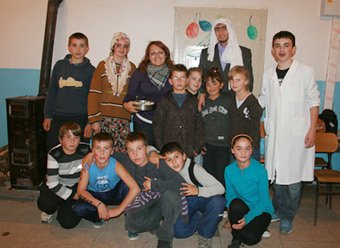
Wayland graduate Melanie Vasquez of Hobbs, N.M., (back row, third from left) joins a group of Balkan children at a Halloween party held at a community center where she works.

Her work in the Balkans has not been much different than when she first visited several years earlier while on a Wayland-sponsored trip. The focus always has been on building relationships, sharing cultures and providing help and hope for the people there.

“I’ve always known that God loves all people, but not everyone has the chance to know and understand his call for them,” said Vasquez. “When an opportunity came my way, I took it.”

That first opportunity was to Mexico. Then, she visited the Balkans the next summer. Her world was transformed, and she knew where she wanted to go the next time a trip was scheduled. In fact, she was so sure of the seeds being planted there that she opted to spend not only her summer there, but also the following fall semester of 2009.

“I fell in love with the people there and just felt like there was a need there for English education, a need for hope and for the people to see something different and know something different,” she said. “The people need to see that it’s a bigger world.”

After returning to Wayland, she completed her last semester of college and headed back to the Balkans just a few weeks after earning her degree. Her intent was to stay another six months, then return to the High Plains to work and do community development.

A group of Balkan women knitted these bags to provide additional income for their families with help from Melanie Vasquez and an outside organization she hopes will market the handcrafts in America and around the world.

But something told her things weren’t finished, and she plans to head back in February to pick up where she left off. First Baptist Church in Tulia has funded her effort in full, having helped significantly for the last trip, and she’s using her home visit to make some connections that will help an effort she began in the European nation before she left.

In an effort to provide economic development and enrichment for the women, Vasquez started a group that knit various products including doilies and handbags, using brightly colored yarns and knitted floral decorations as well.

Since most women in the Balkans do not work outside the home, many families rely on the husband’s salary alone to survive and it often means financial hardships. By using a skill they already possess—Vasquez said most of the women know how to knit quite well and often create things for themselves—she hoped to find connections with vendors who could sell those handcrafts internationally and provide additional income for the families.

 “Other people like Americans don’t normally do these things. They’d rather buy them instead, and to know they are handmade from these ladies on the other side of the world is great,” Vasquez said. “We are hoping that we can show the women that they do have a skill that can help provide for their families.

“This also helps with their self-esteem as they see the team effort and how it will help them all. I tell them that God loves all people, and he expects us to help each other out. No one is above anyone else in the group.”

While the effort has taken time to get under way, Vasquez is confident that a vendor will emerge to help the women sell their wares.

“The challenge is to help them sustain that help for themselves over the long term. If we’re going to make a difference, we want to make one that lasts,” she said. “I’m a problem solver, but I’m learning that I can’t solve everything, and that’s been hard.”

The work, the classes and the other tasks she’s been called upon to do have all opened doors for Vasquez to do her favorite thing—get to know people and a culture so different than her own.

“I’ve made some really good friends and had some great conversations about religion and my own culture. I’ve been able to share my culture and my religion in lots of different ways,” she said. “I’ve always been a people person and get along with everybody. It felt much the same there. They’re just people like me, and I’m interested in knowing about them too. I connect with the people and enjoy just sitting and having coffee with people.”

Through the community center’s programs—which include a coffee house, open-microphone nights, English classes and community development resources for families—Vasquez said the doors are open wide to meeting even more people and forming relationships.

“It’s weird. … It’s like home now. My home is here, but it is there, too. I cannot even fathom not being there and doing what I’m doing,” she said. “It’s always been hard to come back, because America is so different than most cultures. America is such a rich country compared to others, and other countries follow us.”


Kentucky Baptists cut jobs, freeze salaries

LOUISVILLE, Ky. (ABP) — The Kentucky Baptist Convention announced job cuts Jan. 31 intended to free up more money for national and international ministries of the Southern Baptist Convention.

Five full-time jobs and 19 part-time jobs are being eliminated. Employees staying on the job will not receive a pay raise next year.

The reductions, which go into effect Sept. 1, are part of a Great Commission Task Force report approved by Kentucky Baptists at their 2010 annual meeting. The report called for splitting allocations of the Cooperative Program unified funding plan evenly between state and national causes within 10 years.

Currently 62 percent of CP gifts are retained by the 2,400-church state convention to fund ministries of the Kentucky Baptist Convention mission board and agencies, while 38 percent are forwarded to the SBC.

Three of the five full-time jobs being eliminated are vacant. The other two will be vacated by retirements scheduled Aug. 31. The 19 part-time jobs being cut are a mixture of filled and unfilled positions. Seven other part-time contract positions will be reduced.

"We regret having to give up these positions and the ministry that takes place through them," said Bill Mackey, executive director of the state convention. "But we will do our best to meet these ministry needs through effective and faithful volunteers and assignments to current personnel."

Mackey retires in May. A search committee currently is seeking his replacement.


Morris Ashcraft, longtime Baptist educator, dies

EVANSTON, Ill. (ABP) — Morris Ashcraft, a longtime seminary professor and administrator who after retiring helped establish a free-standing seminary for moderates disenfranchised by the "conservative resurgence" in the Southern Baptist Convention, died Jan. 29 after a long illness. He was 88.

An Arkansas native, Ashcraft taught five years at Southern Baptist Theological Seminary and 22 years at Midwestern Baptist Theological Seminary before moving to Southeastern Baptist Theological Seminary as a professor and dean in 1981.

Seven years later he resigned his deanship, along with seminary President Randall Lolley and six other administrators, to protest policies adopted by a new conservative majority on the board of trustees intended to ensure the hiring of only professors who affirmed biblical inerrancy.

"It is my belief that too many leaders in the SBC have capitulated to the pressure and agreed with it," Ashcraft said in a statement on Nov. 17, 1987. Ashcraft said his intention in resigning was to say "a clear 'No'" to a movement started in 1979 to purge so-called liberals from the denomination's institutions.

"I will not be party to some of the actions now taking place and injuring persons, nor will I hold the coats of those who do," he concluded.

In 1984 Ashcraft told a group of Baptist educators that Southern Baptist college and seminary degrees offered "ideal preparation" for ministry in Southern Baptist churches. Concerned about the impact of changes at Southeastern Seminary on pulpits in the Carolinas and Virginia, the Alliance of Baptists, a group formed out of the SBC controversy in 1987, decided in 1989 to launch an alternative seminary.

A board of trustees turned to Ashcraft to serve as acting president of Baptist Theological Seminary at Richmond, which opened in the fall of 1991. Tasked primarily with raising start-up funds and processing documents needed to get the school accredited, Ashcraft held the post for one year, until the election of the school's first permanent president.

Today BTSR is one of 15 theology schools in partnership with the Cooperative Baptist Fellowship.

Funeral services are scheduled at 2 p.m. on Saturday, Feb. 5, at First Baptist Church of Raleigh, N.C., where Ashcraft was a member for nearly 30 years. Pastor Christopher Chapman, Associate Pastor Mike Morris and Lolley will officiate.

Burial will be private at Seminary Cemetery in Wake Forest, N.C. In lieu of flowers, the family requests memorial gifts in his honor to the maintenance endowment fund of Raleigh's First Baptist Church.

Ashcraft is survived by his wife of nearly 66 years, a son and daughter and four grandchildren. Late in life he moved to Evanston, Ill, because of illness. He died with his wife, Bernice. at his side.


CBF announces layoffs

ATLANTA (ABP) — The Cooperative Baptist Fellowship announced deep staff cuts Jan. 28, citing lingering financial woes.

According to a news release, 13 positions have been eliminated and one reclassified. Two of the jobs will move to contract positions.

The layoffs will reduce the size of the Atlanta-based Fellowship's staff to 42 full-time positions. That includes three field coordinators in Virginia, Tennessee and Texas that are shared with state CBF organizations and one job shared with the CBF Foundation.


Daniel Vestal

"These have been among the most difficult decisions I've had to make during my tenure at the Cooperative Baptist Fellowship," said Daniel Vestal, the Fellowship's executive coordinator since 1996. "In spite of our previous efforts, with the downturn in the economy and the ongoing financial challenges of the churches and individuals that make up this Fellowship, we had to address the shortfall by reducing the size of our staff."

Vestal declined to discuss specifics of the staff cuts until after he reports the details to the CBF Coordinating Council at the group's next scheduled meeting Feb. 24-25.

The downsizing follows two straight years of contingency spending to cope with budget shortfalls. In 2009 the Fellowship averted layoffs by cutting staff salaries by 1 percent, reducing contributions to employee retirement plans and scaling back funding for CBF partner organizations by 30 percent.

Last summer the CBF adopted a budget of $14.5 million for 2010-2011, down from $16.1 million the previous year. Four months into the current fiscal year, revenue was running 20 percent below that budget.

None of the lost jobs involved CBF missionaries, although field personnel are operating with reduced budgets. Last June Vestal said that unless giving increases to the Fellowship's Global Missions Offering, sooner or later missionaries would have to be recalled.

The Fellowship has not had funds to employ new missionaries since 2008, but has continued to commission field personnel through the AsYouGo affiliate program, in which missionaries are self-supporting but work alongside paid missionaries.

"My heart goes out to the faithful servants of this Fellowship who are now faced with difficult transitions," said CBF Moderator Christy McMillin-Goodwin "They will be in our prayers as they follow God's call to their next phase of ministry."

"All of the CBF staff will need our prayers in the days ahead as we work even more diligently to serve as the presence of Christ around the world," said Goodwin, associate minister for education and missions at Oakland Baptist Church in Rock Hill, S.C. "I am confident we will emerge from these difficult days a stronger Fellowship."

Vestal said staff in the Fellowship's Atlanta Resource Center would reorganize in order to continue to function effectively. "Despite these developments, I remain hopeful about CBF's future," Vestal said.

This year marks the 20th anniversary of the CBF, a group of individuals and churches that formed out of the Southern Baptist Convention inerrancy controversy in the 1980s and 1990s. Today about 1,900 churches are affiliated with the group, according to the Fellowship's website.

A 14-member task force appointed last year is currently involved in a two-year study of CBF staffing and funding.


Previous ABP stories:

CBF cuts spending by 20 percent (2/20/2009)

CBF adjusts to budget shortfall (7/1/2009)

CBF adopts $16.1 million budget, but continues reduced spending (7/3/2009)

CBF Coordinating Council recommends reduced budget (2/19/2010)

CBF leader seeks to rally churches to make up mission offering shortfall (5/28/2010)

Vestal says CBF will have to recall missionaries unless funding improves (6/23/2010)

CBF to evaluate structure, funding in two-year study (6/25/2010)

Vestal says CBF will have to recall missionaries unless funding improves (6/23/2010)

CBF 2012 task force begins with listening sessions (10/18/2010)


Churches seek to minister to Boomers

Jan. 1 not only marked the beginning of a new year, but also saw the first Baby Boomers turn 65 years old. And congregations face the evolving challenge of finding ways to minister with and to them.

Boomers—born between 1946 and 1964—comprise the largest generation in U.S. history at 78 million strong, and they don’t approach growing older in the same way their parents did.

“Boomers were a generation of change,” noted Mark Seanor, minister to experienced adults at First Baptist Church of Huntsville, Ala. “They don’t want what their parents do in ministry.”

Many Boomers want to keep working past retirement, but in areas of interest and to make a difference. They want to stay young and are searching for productive and meaningful purpose, notes Amy Hanson in Baby Boomers & Beyond: Tapping the Ministry Talents & Passions of Adults Over Fifty.

Boomers often are characterized as people on a personal quest who seek self-actualization and self-discovery throughout life, explained Frank Fain, director of educational services for The Baptist Home system for older adults in Missouri.

Norma Abbott from First Baptist Church in Browning, Mo., shows off a string catfish she caught at Lake Mary.

As older adults, members of this generation are more energetic, healthier and still want to change the world, Fain added. “They want their life to matter. … Older Boomers in particular … don’t want to serve the institution not just for the institution’s sake. They want to serve … to make a difference in the world.”

The differences between Boomers and the generation before them mean churches should rethink the way older adult ministry is done—beginning with the name. Boomers don’t want to be called senior adults, and churches have responded by using terms such as second half, 55-plus, older adult and emerging adult ministry. Some churches are shifting from a SAM—senior adult ministry—focus to BAM—Boomer adult ministry.

But Boomer ministry must be more than simply a name change. Churches must recognize Boomers are distinctively different, Fain said.

Ruth Ann Short, an emeritus missionary to Nigeria, was featured in the Missouri Department of Transportation’s “No MOre Trash” publicity campaign last year. She participates in the Adopt-a-Highway project while she logs an average of 10,000 steps per day. As she picks up trash, she prays for the households and businesses along the roads and for litterbugs.

Boomers still are the “me generation,” Keith Lowry, adult consultant for the Baptist General Convention of Texas, said. “Effective ministry will have to deal with that, but (it) also takes advantage of the tremendous gifts and talents they bring.”

Churches may find they need to divide older adults for some activities and projects. “I realized Boomers are not going to consider themselves as senior adults … and I stopped fighting to merge them,” explained Melissa Fallen, associate pastor for senior adults and pastoral care at Huguenot Road Baptist Church in Richmond, Va.

“I see an opportunity for the church … to help Boomers … make this time meaningful,” she added.

If the church doesn’t, Boomers likely will look elsewhere for meaning. “They want to be involved in specific causes,” noted Ken Kessler of the Baptist General Association of Virginia. “The key word to me is ‘engage.’ Engage them instead of just having them sit back.

“The church has to take the opportunity … to engage them in meaningful ministry … or they are going to flee and find meaningful places to serve.”

As congregations minister to Boomers, they should start by talking with them and with all older adult groups.

Steve Whisler became senior adult minister at Second Baptist Church in Springfield, Mo., last August. He admits he still is formulating how to tackle the Boomer issue without older members feeling abandoned. He believes conversation is the place to start.

Alan Fowler and Dwayne Gibson of Richmond, Va., work on a shed renovated into a clubhouse for ministry partners in Charlotte, N.C.

“Get to know and be known among the senior adult population,” he said. “We did a survey just to see what service people were interested in, and we’re using the survey results as one more listening tool.”

He has talked with nearly every Bible study class teacher and director to understand needs and to hear others’ opinions. “I didn’t know where to begin until I listened and assessed,” he said. “You can’t come in with a plan. How do you know what to do until you listen and assess?”

Education is another key. Educate the church about older adult needs and desires. Help emerging and older adults understand one another.

Allow Boomers to determine their ministry. “It must be grassroots,” Fain explained. “Boomers are saying, ‘This ministry is for us and is going to be done by us.’”

Mark Seanor in Alabama added churches need to develop awareness among members and leaders about the Boomers and their differences. Even though some Boomers have been included in older adult ministry for 10 years—the oldest turned 55 in 2001—“There is still a long way to go,” he said.

The ministry needs to become a priority, Seanor added. “You need to listen to them and work with them and develop ministry from within.”

A conference to address the uniqueness of Boomer ministry will be held at Baylor University next fall.


Carpenter’s Helpers gladly bear crosses

WIMBERLEY—It may be wood, paint and rebar to some, but to the Carpenter’s Helpers of Wimberley, the crosses they make are statements of faith.

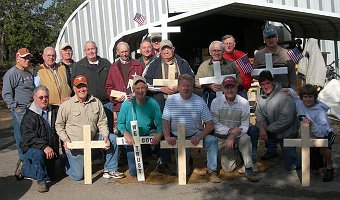
Al Maness from First Baptist Church in Wimberley serves with the Carpenter’s Helpers in making crosses. (PHOTOS/George Henson)

The Carpenter’s Helpers, primarily comprised of men from First Baptist Church in Wimberley but including a few Lutheran, Methodist and Church of Christ men as well, first heard of a church in Michigan that built crosses for members to place in their yards.

Ron Modawell brought the idea to the group. They made seven crosses that day.

“We prayed over those crosses and asked God’s blessing to be upon them, wherever they might end up,” Modawell said.

They have constructed more than 1,000 crosses that now stretch far beyond the confines of Wimberley.

Their crosses can be seen throughout the Hill Country, as well as in Dallas, Corpus Christi, Victoria and even in Georgia and Missouri.

The men meet most Monday mornings for prayer and then work four or five hours to make about 100 crosses.

Larry Edwards from First Baptist Church in Wimberley uses a router on a cross. (PHOTOS/George Henson)

 “No sooner do we get them built than we have requests from people who would like to have them,” Modawell said.

Builders make the crosses from 8-foot untreated pine 2 x 4s that are trimmed for length and routered on the edges.

After notching the boards, they assemble the two pieces. Two screws secure the arms to the upright. A hole is drilled in the bottom for a rebar base and a hole in the side for the installation of an American flag. Then they sand and paint the crosses.

A few larger crosses have been made for people whose properties line highways, and a few varnished crosses have been made for businesses to place indoors.

Eagle Mountain Flag of Wimberley has donated all the flags for the project. Ace Hardware donated many gallons of paint and brushes, and McCoy’s Lumber has given the men a discounted price on lumber that the store has not donated to the project outright, said Maurice Armstrong, one of the group’s volunteers.

The Carpenter’s Helpers from First Baptist Church in Wimberley have built more than 1,000 crosses that can be spotted throughout the Texas Hill Country and beyond. (PHOTOS/George Henson)

While not everyone attends each week, about 35 people participate at least part of the time in making the crosses, said Jack Burkland, on whose property the crosses are constructed. Women from the church help with some of the painting.

The group also constructed a website, www.makeacross.com, to help others. The website not only lists step-by-step instructions, but also provides tips gained from the group’s experience.

“It’s really been a blessing for all us men to be able to be a part of this,” Modawell said.

“This is a ministry that God is blessing, and we just want to keep on as long as he’ll use us to bring honor and glory to his name.”

{youtube}nvi2353dZjQ{/youtube}
Ron Modawell of the Carpenter’s Helpers from First Baptist Church in Wimberley explains why they build crosses.


BGCT receives, displays ‘one of top 5 artifacts from American Christianity’

DALLAS—The Texas Baptist Historical Collection is displaying iconic preacher George Whitefield’s elevated pulpit, one of the top five artifacts of American Christianity and a key tool that helped unite the colonies as well as lay the foundation of the revolution against England, in the estimation of Alan Lefever, director of the collection.

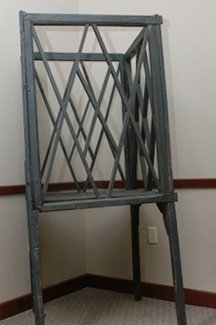
Alan Lefever, director of the Texas Baptist Historical Collection, tells a group from Wilshire Baptist Church in Dallas about the traveling pulpit once used by George Whitefield, one of the key preachers in the First Great Awakening.

Whitefield was one of the key preachers in the First Great Awakening, a spiritual revival that swept across the colonies and Britain in the 1730s and 1740s. He traveled the colonies with this pulpit and preached in open areas to crowds as large as 30,000 people. Some historians call Whitefield the colonies’ first celebrity.

As Whitefield traveled, newspapers covered his speaking engagements extensively, sharing information with each other about where he had been and where he was going. That exchange of knowledge helped create an information network that brought the colonies together and changed the way the way they thought of themselves, Lefever said.

Whitefield’s preaching also helped encourage the notion of a personal faith, one in which individuals were free and responsible for making their own decisions about God. This idea flourished throughout the history of the nation, he said.

“When you look at the pulpit, you’re not just looking at a piece of furniture that had to do with the spreading of the gospel, which is significant in and of itself. You’re looking at a piece of furniture that helped with the formation of the United States of America,” said Lefever, who recently received the piece when the American Tract Society gave its archives to the historical collection.

This pulpit has been called one of the top five artifacts of American Christianity and a key tool that helped unite the colonies, as well as lay the foundation of the revolution against England.

“Before Whitefield, the colonies all saw themselves as independents who answered to Britain. After Whitefield, they began to see each as together. They began coming together and seeing themselves as a group who had something to offer.”

The pulpit is being displayed in the historical collection’s offices temporarily, but eventually will be moved to the Dallas offices of the Baptist General Convention of Texas. The display coincides with the launch of the convention’s Hope 1:8 efforts that encourage churches to share the Christian message locally, across the state, throughout the nation and around the world.

Lefever said the pulpit serves as an inspiration to Texas Baptists, reminding them God has moved in mighty ways in the past to bring large numbers of people to him. During the First Great Awakening, roughly one-sixth of the colonies’ population made of profession of faith in Christ. Such spiritual expansion can happen again as a result of Texas Baptists being willing to live out God’s calling in their lives, he said.

“As we talk about Hope 1:8 and try to share the gospel with all these people in Texas, sometimes we think this is such a daunting task,” Lefever said. “This pulpit is a reminder it’s been done before. One short, balding man sharing the gospel tied together the colonies. Imagine what God can do if a host of Texas Baptists are willing to be obedient like George Whitefield.”

Individuals and groups wanting to see the pulpit and the rest of the historical collection must make an appointment. Church groups already are calling to see the pulpit.

The historical collection’s offices are open, and the pulpit will be on display Monday-Friday, 9 a.m.-5 p.m., and there is no charge to see the pulpit. To schedule an appointment, call the historical collection at (972) 331-2235.


Texas Baptist Men executive director announces retirement

DALLAS—After seven years as Texas Baptist Men executive director and more than four decades holding various leadership posts in the missions organization, Leo Smith has announced plans to retire effective Feb. 28.

Smith, 72, has informed members of the TBM board of his decision but also told them he will be available to serve in some capacity at their discretion during a transitional period as they seek a new staff leader.

Texas Baptist Men Executive Director Leo Smith reported on missions progress to the TBM rally in McAllen, held in conjunction with the 2010 Baptist General Convention of Texas annual meeting. Smith has announced his retirement from the TBM executive post.

“God has blessed Texas Baptist Men, and it is time for fresh leadership to take the organization to greater heights,” he said. “God is not through with Texas Baptist Men.”

Smith first became involved with the missions organization before it even was Texas Baptist Men—working with the Royal Ambassadors program for boys in the mid-1960s through the Baptist General Convention of Texas Brotherhood Department.

A couple of years later, Texas Baptist Men became a self-governing organization. In the decades that followed, Smith was a vice president of various TBM programs on numerous occasions, served on multiple committees and was elected TBM president in 2001.

When Jim Furgerson stepped down as TBM executive director the following year, Smith served as acting interim for several months before the board officially named him interim executive director in November 2002. He was elected executive director in February 2004.

When Smith became executive director, TBM had a $900,000 annual budget, based entirely on funding from the Baptist General Convention of Texas. TBM now administers $3.2 million annually, including disaster relief funds, even though funding through the BGCT Cooperative Program has dropped to less than $500,000 a year.

“We’ve tried to be a good partner with the BGCT, and the BGCT has been a good partner with us,” Smith said. That partnership in doing God’s work transcends financial support, he observed.

“It’s not about money. It’s about obedience. I’ve learned that when you obey, God provides,” he said.

During a tense time in Baptist life, Smith sought to help TBM walk a tightrope between two state conventions. While the BGCT no longer provides the bulk of TBM’s annual budget, the missions organization maintains its historic affiliation with the BGCT and works closely with its leaders.

TBM receives no financial support from the Southern Baptists of Texas Convention. However, much of its money and manpower comes from SBTC-affiliated churches.

Nationally and internationally, TBM works closely with the Southern Baptist North American Mission Board in disaster relief and continues its close relationship with the Southern Baptist International Mission Board.

At the same time, TBM works on projects with the Baptist World Alliance—the international body from which the Southern Baptist Convention withdrew in 2004—and the Cooperative Baptist Fellowship.

“The most gratifying thing personally has been seeing the activity of God every day,” he said.

Seven years ago, TBM had eight full-time staff. Now, in addition to 10 full-time staff, there are four who work part-time and seven who serve on a volunteer basis.

Two programs—Victim Relief Ministries and Inmate Discipler Fellowship—that were birthed by TBM have become independent, but still affiliated, ministries.

While TBM is approaching the 10,000 mark in its roster of trained disaster relief volunteers, water purification has become the fastest-growing ministry—and the one Smith believes holds the greatest potential for international missions service.

“The water-purification ministry is growing by leaps and bounds. Pure water is a need that’s present every day. Disaster relief is seasonal,” he said.

Even so, during Smith’s time as executive director, TBM has expanded its missions equipping center in east Dallas to house a continually growing fleet of disaster relief vehicles and equipment.

Born in Ysleta, near El Paso, Smith became a Christian and surrendered to the gospel ministry at Baptist Temple in San Antonio. He earned a degree from the University of Corpus Christi and served more than 49 years as a pastor—the last 25 at Highlands Baptist Church in LaMarque. He and his wife of 51 years, Cordelia, have five children and nine grandchildren.

While Smith looks forward to spending more time with family in retirement, he insists his enthusiasm for TBM and his belief in the organization’s future remains greater than ever.

“I’m getting to the point where I’m growing weary in what I’m doing, but I’m not weary of what I’m doing,” he said. “This has been the most fun I’ve ever had in my life.”


What makes ministry to older adults more effective?

Ministry to older adults must take many forms, depending upon the make-up of the group a church is trying to reach. As the U.S. population ages, congregations will have even more opportunities to engage older adults.

Richard Martin, newly retired, organizes books as part of a free one-day clinic for the community in Richmond, Va. (PHOTO/Courtesy of Huguenot Road Baptist Church in Richmond, Va.)

While their programs will have different looks and flavors, experts suggest congregations can adopt some common attitudes that help make ministry to older adults vibrant and meaningful:

• Recognize a one-size-fits-all program will not meet the needs and desires of a broad age range. Many congregations have older adults from 55 years old through 100 or beyond. Churches may need to offer two or even three groups to provide a place for everyone.

• Let the ministry develop from the grassroots, but provide a coordinating team or committee and trained leaders.

• Eliminate the word “senior” from ministry and staff titles. Experienced adults, 55-plus ministry, emerging adults, “second half” ministry, encore and other names are gaining popularity.

• Know your people. Talk with them and listen to them. Pray with them. Minister with and for them, rather than to them. Get to know them and let them get to know you.

•Balance the ministry. Some-times ministry to older adults focuses on fellowship. While they need and want fellowship, many—particularly younger members—want service opportunities as well. Take advantage of each individual’s talents, skills and gifts.

•Offer educational opportunities through small groups, special events and short-term seminars. Many older adults, especially younger ones, often focus on health, family, financial and retirement issues.

•Consider ministry by life stages, rather than by chronological age. Many experts and congregations are recognizing several factors determine an older adult’s needs and concerns. Not everyone reaches the same stage at the same time. Perhaps they married later in life. Many are juggling the needs of aging parents and children. Others are facing health issues.

• Remember that graying hair doesn’t mean an individual is a Christian. According to several studies, about half the Boomer generation claims to attend a church or synagogue.

“The Boomers are the most educated generation,” noted Frank Fain, director of educational services for The Baptist Home system for older adults in Missouri. “They want to learn, and that may be the most effective way to outreach.”

James Craver, associate pastor at First Baptist Church in Allen, has a passion for evangelism among 55-plus adults.

He provides an evangelism seminar a couple of times each year and encourages ministry participants to pray for and minister to five non-Christians.


Challenge for churches: How to care for caregivers

As churches minister to the most elderly and infirm among members, some also seek ways to serve their caregivers—often family members—who often labor around the clock.

Members of the "Classic 55-plus" ministry at First Baptist Church in Allen assemble layettes as a service project for a local organization, Real Options for Women. (PHOTO/Courtesy of First Baptist Church in Allen)

Frank Fain, director of educational services for The Baptist Home system for older adults in Missouri, offered these tips.

• Provide a support group—a place for caregivers to express their feelings and to talk about their needs.

• Provide counseling or direct caregivers to available counseling, if needed. Sometimes people need help to deal with the emotional, mental and physical toll caring for loved ones can take.

• Teach families, deacons, caregivers and others who minister with older adults how to communicate effectively with the elderly and to treat them with respect.

• Offer educational events for caregivers. Draw from local experts at your state’s department on aging, hospice, hospital or government agencies.

• Develop a caregiver section in the church media center. Many Baptist state conventions have an adult consultant or specialist or can point the church to resources.

The Baptist General Convention of Texas is developing resources and soon will have a website in place specifically for caregivers.

Care facilities—such as The Baptist Home in Missouri and Buckner Retirement Services in Texas—also can suggest resources. Find out what local resources are available as well.

• Develop a caregiver respite ministry to give individuals a break to shop, run errands or relax. Also consider providing res-pite on Sunday mornings to allow caregivers to worship.

• Partner with local hospice organizations. Perhaps staff members would be willing to be hospice chaplains. Find out what needs other older adults in your group could help meet.

• Take the Lord’s Supper to the homebound and their caregivers.

• Include caregiver ministry as part of care for the homebound. First Baptist Church in Allen provides Keep in Touch ministry to make sure homebound members receive weekly contact from the church. The ministry assists caregivers by helping meet some of the homebound members’ needs.


Belmont adds sexual orientation to anti-discrimination policy

NASHVILLE, Tenn. (ABP) – Belmont University trustees voted to add sexual orientation to the historically Baptist school’s anti-discrimination policy.

In December, Belmont parted ways with a successful women’s soccer coach after she told her team that she and her same-sex partner were expecting a baby. The move gained national attention in sporting news and prompted discussions among campus groups about whether the private, Christian university discriminates against gays.

President Bob Fisher said the addition of sexual orientation to the school’s policy against discrimination simply puts into writing what was already being practiced. During his 11 years as president, Fisher said sexual orientation “has not been considered in student admissions nor in hiring, promotion, salary or dismissal decisions.”

Fisher said the trustees also added a preamble to the policy stating that “Belmont is a Christian community, and the university’s faculty, administration and staff uphold Jesus as the Christ and as the measure of all things.”

The policy, which also covers non-discrimination on the basis of race, sex, color, national or ethnic origin, age, disability or military service, still retains, under federal law, the university’s right to “discriminate on the basis of religion in order to fulfill its purposes.”

For more than 50 years Belmont was affiliated with the Tennessee Baptist Convention. Those ties ended in 2007, with settlement of a lawsuit over whether trustees had the right to elect their own successors instead of those selected by the convention.

Randy Davis, executive director of the state convention, told Baptist Press that Belmont had walked away from its “Christian heritage and roots.”

Lisa Howe, the former soccer coach who reportedly stepped down in mutual agreement with the administration, told local media she is pleased with the new anti-discrimination policy, but she is pursuing several job leads and doesn’t plan to reapply at Belmont.

Previous ABP stories:

Fallout continues over departure of gay soccer coach

Belmont center of gay-rights dispute


No single size or shape fits ministry to all older adults

Pretend for a moment a congregation has called you as youth minister and includes all individuals from 3 to 30 years old as your group. What is your reaction?

James and Una Grubbs sort and package Christmas cards for The Baptist Home Auxiliary to sell at homecoming. They reside in the assisted living section of The Baptist Home at Chillicothe, Mo. (PHOTO/Courtesy of The Baptist Home)

Most people wouldn’t expect a youth worker to deal with such a broad range of ages, citing physical, emotional and mental differences. Even so, congregations often expect a minister for older adults to effectively bridge a 30-year, 40-year and even 50-year gap among its members.

What images do the words “senior adult” evoke? An 80-year-old, gray-haired woman who enjoys a monthly potluck lunch and a guest speaker? A crotchety old fellow who complains about the music or the young people or the building project? Or an active and engaged retiree who is seeking meaning in his or her last chapter of life?

Church and denominational leaders are beginning to understand older adults cannot be categorized as a single unit, and a one-size-fits-all ministry will not meet needs.

“As we get older, our differences increase,” declares Amy Hanson in her book Baby Boomers & Beyond: Tapping the Ministry Talents & Passions of Adults Over Fifty. “The bottom line is that we can’t fool ourselves into thinking a potluck luncheon will appeal to everybody who is older—and the reality is, it probably never did.”

The overall U.S. population continues to age, partly because the most populous generation—Baby Boomers—are aging and because of lower birth rates among the generation that followed. Church ministries must change to meet needs across generations

Many congregations include three generations, according to Frank Fain, director of educational services for The Baptist Home, a three-campus system for older Baptists in Missouri.

The civic or hero generation comprises individuals 86 and older. Sometimes referred to as the “slow-go” or “no-go” group, they often receive pastoral care. The adaptor or silent generation, often called the “artist cohort,” includes ages 66-86. About 42 million strong, the “go” group likes to take trips and do activities together. Baby Boomers, also called the “idealist cohort,” is the “too-busy-to-go” group.

“The church has to realize it is dealing with a broad age group with many different needs. They may have someone who is 100 and a 55-year-old who just lost his job,” Fain said. “They must recognize that they must minister to all.”

Hanson points out age can be measured four ways—chronological, functional, psychological and social—and encourages churches to steer away from basing all its ministry to adults along chronological age.

First Baptist Church of Huntsville, Ala., takes a four-pronged approach, said Mark Seanor, minister to experienced adults. Ministry to the first three groups is based on retirement.

Their “builders” group is composed of those who are almost retired and who are either building toward retirement or who may not retire. The “explorers” are those who have just retired and who want their experience to continue to have significance. The “pillars” are retired and are beginning to face more physical changes. The ministry’s fourth group includes the homebound and their caregivers.

Programming and ministry with and to each group center on members’ needs and desires and provides ways for each to use their skills and gifts.

James Craver, associate pastor at First Baptist Church in Allen, concentrates on providing opportunities for members of the 55-plus ministry to use their life experiences, regardless of age.

“About 90 percent of our group is under 80. They’re still active and don’t consider themselves seniors,” he said. “We have a 92-year-old who sees senior adults as those in the nursing home.”

The church provides day and evening activities and events. “We center more on thinking patterns rather than age,” Craver said.

That includes service opportunities. When a member suggests possible ministries or projects, he asks the individual to pray about it. If the member still feels strongly, then he or she is in charge and finds help.

The church’s 55-plus ministry conducts full worship services in area care facilities.

The Worship Together ministry began four years ago when one facility’s administrator noticed residents who wanted to attend church but couldn’t sit for long periods. She asked if the Allen church would provide worship.

The ministry began with four volunteers and one care home. Now nearly 100 church members, including youth, serve in four facilities.

“You cannot do senior adult ministry even like you did it five years ago,” Craver said.