Church arsonists receive additional life sentences

ATHENS, Texas (ABP) — Two men already sentenced to life in prison for setting five east Texas churches on fire in 2010 pleaded guilty to more arsons Feb. 8.

Jason Bourque and Daniel McAllister were sentenced to life in prison for three church fires in Henderson County, Texas. Their plea agreements allow them to serve their sentences concurrently with previous life sentences imposed for five church arsons in neighboring Smith County Jan. 10.

The men, suspected of setting fire to 10 East Texas churches between Jan. 1 and Feb. 8 last year, still face charges for two church fires in Van Zandt County. They are scheduled to appear in court there Feb. 11 and are expected to enter similar pleas.

Bourque, 22, and McAllister, 20, were arrested Feb. 21 after a multi-force investigation involving state, local and federal officials.

No one was hurt in the fires. Their motive for the crimes is unknown.

Previous story:

Church arsonists get maximum penalty


Buckner Romania to be self-sustaining organization

TARGU MURES, Romania —Twelve years after it established a nongovernmental organization in Romania to help that country’s overburdened orphanage system, Buckner International announced it is withdrawing financial support from Fundatia Buckner Romania and setting it on a course of self-sustainability.

Phyllis Carrier, a long-term volunteer with Buckner, holds a baby in Tarneveni, Romania. The Carriers were among the volunteers who helped establish the Buckner Child Development Center in Tarneveni, Romania to help gypsy children. (PHOTO/Courtesy of Phyllis Carrier)

Buckner International President Albert L. Reyes said the transition is part of Buckner’s long-term plan for establishing self-sustainability among its international nongovernmental organizations as time, resources and support allow.

Buckner began work in Romania in 1996 after Romanian officials sought Buckner’s child care and social services expertise to help overcome mounting problems in the country’s orphanages. Buckner established Fundatia Buckner—Buckner Found-ation Romania—in 1998 and began offering mission teams to conduct evangelistic camps in orphanages in the Targu Mures region.

Phil Brinkmeyer, Buckner regional director for Guatemala, Honduras and Russia, said Buckner has provided a variety of ministries over its 12-year tenure in Romania. “We began initially by providing humanitarian aid directly to the remnants of a communist orphanage system—one that was, in essence, providing first aid to those in need but was putting a band-aid on a broken system.”

About 90 to 95 percent of children in Romania’s child welfare system are gypsy children, according to Buckner vice president Randy Daniels. The work of Buckner Romania has included education programs, foster care, humanitarian aid, and mission trips since 1996. (PHOTO/Russ Dilday/Buckner International)

Since 1998, Buckner has offered large-scale humanitarian aid, orphanage renovations and emergency relief to Romanian orphanages, developed a relationship with Child Protective Services in Targu Mures for emergency relief and aid coordination, a transitional living home for children who have aged out of care, sent hundreds of volunteers to minister to children and, along with CPS, initiated a domestic program to encourage Romanians to report child abuse.

Also, Buckner instituted an evangelistic follow-up program using Romanian staff to provide weekly visits to orphans, a “grandmother” program to provide infants with basic nurturing and a foster care program along with Pathway to Joy Ministry in Oradea.

Since 2000, Buckner’s Shoes for Orphan Souls drive has shipped almost 84,000 pairs of shoes to children in Romania

But Buckner’s contributions went beyond programs and aid, said Randy Daniels, Buckner vice president for global initiatives, and eventually led to changes in the country’s orphanage and social services systems, long regarded as among the poorest-performing in the world.

Phil Brinkmeyer, regional director for Buckner in Russia, Guatemala and Honduras, poses with children on the opening day of the new Buckner Child Development Center in Tarneveni in 2007. (PHOTO/Buckner)

Through its NGO, Buckner “modeled foster care at Pathway to Joy in Oradea and we helped Romania in its transition from an orphanage-based child care system to a foster care-based system by helping Romanian officials acknowledge the value of foster care,” Daniels said.

While Buckner has set its Romanian NGO on a course of self-sustainability, it won’t be alone, Brinkmeyer said.

Buckner will continue to share its expertise in social services, and the NGO will receive support from another U.S.-based nonprofit partner—Another Child Foundation, created by Tim Oloffson, a former Buckner missions volunteer, he explained.

For more information about Another Child Foundation, go to www.anotherchild.org.


Initial picks for faith-based panel light on Baptists

WASHINGTON (ABP) — Barack Obama's first dozen appointees to the next President's Advisory Council on Faith-Based and Neighborhood Partnerships were heavy on mainline Protestants but light on Baptists.

Three of the names announced Feb. 4 are leaders of member communions belonging to the National Council of Churches.

They include Katharine Jefferts Schori, the first female head of the Episcopal Church, who voted to approve the consecration of the church's first openly gay bishop in 2003, prompting division in the worldwide Anglican communion.

Others include Mark Hanson, presiding bishop of the Evangelical Lutheran Church in America who presided over a controversial vote in 2008 where the denomination lifted its ban on openly gay and lesbian clergy in committed relationships, and H.E. Archbishop Demetrios of the Greek Orthodox Archdiocese of America.

Another well-known appointee is Lynn Hybels, co-founder and advocate for global engagement at the Willow Creek Community Church, a Chicago-area mega-church led by her husband, Senior Pastor Bill Hybels.

Appointee Leith Anderson, the president of the National Association of Evangelicals, is senior pastor of Wooddale Church in Edenton, Minn., an interdenominational evangelical church with ties to the Baptist General Conference. Anderson's parishioners include former Gov. Tim Pawlenty, who is expected to run for president in 2012.

The last advisory council, which completed its work a year ago, included three high-profile Baptist leaders. Frank Page, former president of the Southern Baptist Convention who now leads the SBC Executive Committee, served on that panel. So did Otis Moss Jr., pastor emeritus of Olivet Institutional Baptist Church in Cleveland, and William Shaw, past president of the National Baptist Convention, USA, Inc.

The past council's chair, Melissa Rogers, is an attorney who formerly worked at the Baptist Joint Committee for Religious Liberty and now teaches at Wake Forest University Divinity School.

Obama is expected to announce 13 more appointments later, bringing the panel's eventual membership to a total of 25.

"Last year we were able to make significant progress, especially in our recommendations on reforming the office of Faith-based and Neighborhood Partnerships, most of which the president incorporated into his recent executive order," said Brent Walker, executive director of the Baptist Joint Committee. "I trust this advisory council will build on that good work and carry the projects forward."

Previous stories:

Q and A: Melissa Rogers on Obama faith-based council report

Faith-based panel narrowly recommends separate 501(c)(3) entities for churches


Court rejects ‘birther’ challenge by former SBC officer

SAN FRANCISCO (ABP) — The California Supreme Court has declined to hear a challenge to Barack Obama's election as president filed by plaintiffs including a former officer of the Southern Baptist Convention.

Justices declined to review an October ruling by California's Third District Court of Appeals dismissing a lawsuit by former diplomat Alan Keyes and Wiley Drake, a Southern Baptist pastor who served as second vice president of the SBC in 2006-07, alleging that Obama does not qualify to be president because he is not a natural-born citizen.

Drake, pastor of First Southern Baptist Church in Buena Park, Calif., ran for vice president of the United States as Keyes' running mate on the American Independent ticket in California in the 2008 election. After the election Drake and Keyes filed a lawsuit, along with party official Markham Robinson, claiming election officials should not have allowed Obama's name on the ballot without verifying that he met eligibility requirements to hold office.

The lawsuit is one of a number of so-called "birther" lawsuits against Obama's election filed by individuals or groups who disbelieve the president's claim that he was born in Hawaii to an American mother, thus establishing his citizenship.

The appeals court ruled that it is the role of political parties and Congress — not elected officials — to determine the eligibility of a presidential candidate. In his appeal, attorney Gary Kreep of the United States Justice Foundation argued that while the U.S. Constitution lays out eligibility requirements for the president there are no federal laws dealing with who is to make determination of eligibility. California law, Kreep argued, requires the secretary of state to verify candidates for every elected office except president.

The state Supreme Court rejected the appeal without comment. Kreep said he plans to appeal the case to the U.S. Supreme Court.

Drake, Keyes and Robinson are also plaintiffs in a similar complaint in federal courts now pending before the 9th U.S. Circuit Court of Appeals.


Wayland students promote economic development in Kenya

KENYA – A year ago, sophomore Leigh Castillo didn’t know much about business— and certainly not about starting up a new business from scratch. Today, she’s president of Wayland Baptist University’s Students in Free Enterprise team that recently returned from Kenya, where they helped train small-business owners.
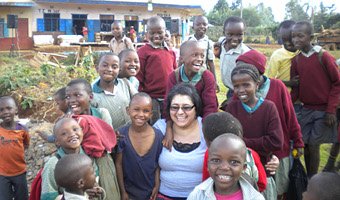
Students in Free Enterprise President Leigh Castillo (center), a sophomore English education major at Wayland Baptist University, is surrounded by happy Kenyan children during an evening crusade in Kiandu, outside Nyeri.

Castillo, a single mother who aspires to teach English in secondary schools, finds it all pretty overwhelming. But with the experiences she has received at Wayland—including the opportunity to travel to three continents in one year—she is convinced God is blessing her plans to pursue her educational goals.

Castillo considers the three-week trip to Kenya a chance to pass on those blessings and share important information with nationals who are seeking to sustain their families through small-business ventures.

Kelly Warren, associate professor of management at Wayland, traveled to Kenya last summer. While he was there, he met a Kenyan who wanted his countrymen to learn about business practices and sustainability—a task Warren believed the Student in Free Enterprise team could fufill. Since the university already had planned a January trip to Kenya through the Wayland Mission Center, it seemed a natural fit.

“We had to work quickly to get our fundraising together for the trip,” Castillo noted, adding Warren first approached the group at the start of the fall term. “Since we already knew each other, it didn’t take us long to work out how we’d work together, so that helped.”

The group first spent a few days at Wayland’s Kenya campus at Brackenhurst near Limuru, for orientation. Gilbert Werema, a Kenyan national and associate professor of marketing at Wayland, told the students what would benefit the businesspeople the most, and he also provided important cultural background information.

“We worked with church and community leaders there and taught basic business principles such as communication, choosing a microenterprise, planning and finances, marketing and recordkeeping,” said Castillo, noting that each team member handled a different aspect of the presentation.
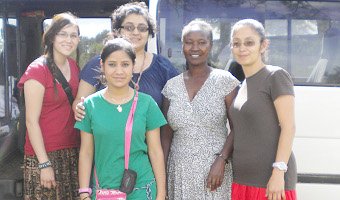
Wayland Students in Free Enterprise team members (left to right) Estella Rodriguez, Leigh Castillo, Maria Carrillo and Hopie DeLeon meet with Sarai, a Kenyan woman who hosted the group in her home outside Eldoret during a recent trip to present business seminars.

“The people there don’t have any formal business training. They just decide to grow something or create something. But they don’t know anything about recordkeeping or talking to suppliers or other considerations that would help them sustain themselves. Marketing was a big thing for them.”

The team then spent three days each in Nyeri and Eldoret before traveling to the larger city of Mumbasa for two days. The Nyeri seminars drew the largest crowd, with about 100 attending. Castillo said that area had a lot of agricultural businesses represented, as did Eldoret, and Mumbasa featured more retail businesses and landlords. About 50 people attended the seminar in Eldoret and another 25 in Mumbasa.

In addition to helping with the business seminars, Warren joined several Texas pastors in providing leadership training for area churches and held some pastors’ meetings. The Texas team also led an evangelistic crusade in the cities in the evenings.

On the third day, the business owners had a chance to question the student group and help with business plans. The seminar groups were divided by trade for the business plan segment since they shared many aspects.

The American students found the Kenyans quite receptive to the information shared, although Castillo admitted they were apprehensive about how helpful they would be and how the Kenyans would regard young students with business information.

“They really grasped a lot of the concepts we shared and understood what they needed to do to be sustainable,” she said. “On our last week as we were leaving, one of the tour guides shared that the people in Nyeri had another meeting to talk more about the information we left with them.”

Castillo noted that the needs of business owners in each Kenyan city varied, but they were able to address those needs in the short time they had there. In Nyeri, they needed unique marketable ideas so they didn’t have too much competition.

In Eldoret, business leaders needed help preventing overproduction that led to a lack of supply and demand.

And in Mumbasa, owners were troubled by credit issues with fellow businesses.

Even though the Wayland student group was not participating in a traditional mission trip, Castillo said, she believes the team was able to minister through practical advice that ultimately will build the economy in Kenya.

“My pastor talks about how the Lord wants to empower you to prosper, and if we were able to sow that seed into their lives and help empower them, that was good,” she said. “The Lord has given us all an idea and something to manage, and he wants us to manage it correctly so he can increase us more, whether with health, with more business or more friends. A lot of times we tied in the Bible with the concepts we were presenting as well.”

The Wayland students also organized a Students in Free Enterprise chapter in Brackenhurst, recruiting about 20 members. Those students started brainstorming ideas for projects they can do to better their own communities. One idea was a clean-up day to combat the trend of trash around the city; another involved literacy training to combat the high illiteracy rate in Kenya.

Castillo is encouraged by the efforts on all ends, especially as a big proponent of education. She joined the Students in Free Enterprise team last spring after being encouraged to bring her communications and presentation skills from her role on the Wayland Ethics Match team. She enjoyed the wide range of projects and was encouraged that she didn’t have to be a business major to join the group. Advisers told her the team likes to open itself to majors from other disciplines because they all bring unique talents and experiences to the group.

Castillo, an English education major, was grateful for the chance to visit Kenya, especially after being able to attend a mission trip and study trip to Ecuador last summer with the School of Education. She believes these overseas experiences will benefit her greatly as a future educator. Eventually she would like to pursue a master’s degree and a doctorate in English and wants to teach at the college level.

Seeing the determination, hard work and perseverance of the Kenyan business owners was encouraging to Castillo, who is a full-time student, part-time worker in the WBU business office and mother to Bella Jace Moreno, 9.

Castillo noted a Kenyan woman named Sarai, who was a self-taught entrepreneur, provided much encouragement and a good example for the students while hosting them in her home near Eldoret.


At prayer breakfast, Obama discusses personal faith

WASHINGTON (RNS)—President Obama spoke at length Feb. 3 about the daily contours of his Christian faith, brushing off the skeptics who question the authenticity of his beliefs.

“My Christian faith … has been a sustaining force for me over these last few years, all the more so when Michelle and I hear our faith questioned from time to time,” Obama told thousands of political leaders, diplomats and religious officials at the National Prayer
Breakfast.
“We are reminded that ultimately what matters is not what other people say about us but whether we are being true to our conscience and true to our God.”

The president’s remarks come in the wake of polls that showed Americans harbor persistent questions about Obama’s faith, with one in four thinking he is a Muslim, and 43 percent unable to say which faith he follows.

Thursday’s speech reflects a renewed emphasis on faith in the president’s public remarks, as when he spoke at Christmas of the birth of Christ being “a story that’s dear to Michelle and me as Christians,” and said the Christmas story “guides my Christian faith.”

As the son of parents who largely shunned organized religion, Obama said, he was influenced by clergy of the civil rights movement, including the late Martin Luther King Jr. and leaders of the Jewish, Muslim and Hindu faiths.

As a community organizer working with churches on Chicago’s South Side, Obama said, “I came to know Jesus Christ for myself and embrace him as my Lord and Savior.”
Obama said he is supported by the prayers of well-known religious leaders and countless unknown grass-roots supporters. He has prayed in the Oval Office with “pastor friends” like megachurch leaders Joel Hunter of Florida and Bishop T.D. Jakes of Dallas, and enjoys “consistent respite and fellowship” in the chapel at the Camp David presidential retreat.

He said his children’s godmother has organized prayer circles across the nation to pray for him.

“Once I started running for president and she heard what they were saying about me on cable, she felt the need to pray harder,” he said.

“By the time I was elected president, she says, `I just couldn’t keep up on my own. I was having to pray eight, nine times a day just for you.’ So she enlisted help from around the country.”

Obama said he prays in the morning for “strength to do right” and at bedtime, “I wait on the Lord and I ask him to forgive me my sins.”

He also joked that his prayers have shaped his life as a father and husband.

“Lord, give me patience as I watch Malia go to her first dance, where there will be boys,” he said of his older daughter. “Lord, have that skirt get longer as she travels to that dance.”

Obama was greeted outside the Washington Hilton by a small group of protesters who claim that some members of the evangelical organization that sponsors the annual breakfast support harsh anti-gay laws in Uganda.

Obama did not mention the controversy, as he did at last year’s breakfast when he condemned as “odious” proposed legislation in Uganda to impose the death penalty on HIV-positive gays and lesbians.

The bill, which has not been voted on, was drafted by a Ugandan lawmaker with ties to The Family, the evangelical organization that sponsors the breakfast. On Jan. 26, prominent gay-rights activist David Kato was murdered in his Kampala home after he and other “known homos” were displayed on the front pages of a Ugandan newspaper.

“It is an absolute affront to my faith to say they stand for Christianity and then to stand for hate and bigotry as well,” said one of the protesters, Joey Heath, a second-year student at Wesley Theological Seminary in Washington.

Watch a video of Obama's remarks here.

Richard Yeakley contributed to this report.


Researcher finds civil rights songs on flip side of gospel records

WACO—A surprisingly large number of lesser known “B” sides on vintage records of gospel songs championed civil rights, suggesting Christian artists were interested in bettering the here and now as well as proclaiming hope for the hereafter—even though doing so might have been risky for them, according to a Baylor University researcher.

Robert Darden, an associate professor of journalism at Baylor and a former gospel editor for Billboard magazine, has discovered the flip side of many class gospel records included civil rights songs. (PHOTO/Robert Rogers/Baylor University)

The recent discovery “tells us that the gospel community was much more involved in the civil rights movement than we previously thought—outside of Mahalia Jackson and Dorothy Love Coates, who we knew were very involved,” said Robert Darden, an associate professor of journalism at Baylor and a former gospel editor for Billboard magazine.

In 2005, Darden began a search-and-rescue mission for gospel music on old 78s, 45s and LPs and in various taped formats to be preserved digitally and cataloged at Baylor. Darden—author of People Get Ready! A New History of Black Gospel Music—was concerned that while contemporary gospel was thriving, early gospel by lesser-known artists during the 1940s to the 1970s, the “Golden Age of Gospel Music,” might be lost forever. He now oversees Baylor’s Black Gospel Music Restoration Project.

“The reason we haven’t known about the ‘B’ sides before is that more than third of what we’ve received is not in the lone book that tries to catalog all gospel music,” Darden said. “When we’ve known about a song, it is almost always the hit or ‘A’ side.”

The songs related to civil rights may have escaped notice because few scholars are studying gospel music’s impact on that issue, as well as the fact many of the artists are lesser known or even unknown, other than by a small circle of friends, family members and church members, he said.

The spirited “Where is Freedom?” by The Friendly Four begins with a rousing appeal: “Here’s a freedom song for all you freedom fighters out there everywhere. And when you sing, remember the wonderful ones who lost their dedicated lives for this precious purpose and won’t be allowed to see it through. Now sing—Sing, every one of you!”

{youtube}IX5BN9iMrmQ{/youtube}

The lyrics speak of civil rights marches and demonstrations in Atlanta, Tennessee, Birmingham and Chicago, of violence and snapping police dogs, of integration and equal rights.

The All-Star Gospel Singers recorded “I Believe Martin Luther King Made It Home.” And the somber “Tribute to Dr. Martin Luther King” by Franklin Fondel speaks of the civil rights leader whose “voice was his weapon that opened barred doors. … He’s free now forever, like all men should be, regardless of color, religion or creed.”

One of the well-known individuals who sang of civil rights was Della Reese, a gospel singer before she became a pop singer and star of TV’s “Touched by an Angel.” She sang “Simple Song of Freedom.”

–For more information about the project, visit www.baylor.edu/lib/gospel.


Baptist author produces novel in American Sign Language

Missouri Baptist author George Joslin of Springfield has produced what may be the first American Sign Language-only novel.

ASL novel on DVD

Titled A Deaf Man's Gospel, the novel is only available in American Sign Language (ASL) on DVD, rather than in print format. According to Joslin, his novel may be the first created just for the Deaf in ASL.

"Many stories have been recorded, but not a full-length novel like this," Joslin explained. "Many things have been translated into ASL from English, but this was created in ASL."

The biblical fiction starts with the story of the deaf man Jesus healed in Mark 7:31-35, and adding some incidents from the other gospels.

"The fiction is that the deaf man Jesus healed, named Benjamin, is added to the gospel stories. The book portrays the observations and experiences of this deaf man," he added.

"This is a book created by a deaf man — me, presented in ASL by a deaf man — Tim Bender — for deaf people. We have added voice to the DVD so hearing friends and family can enjoy this book along with the deaf," Joslin said.

The idea formed when Joslin began to ask himself questions as he read the biblical account: Who was this deaf man? Who brought him to Jesus? What was it like to be deaf at the time Jesus was on earth? What happened to this man after he was healed?

The Bible does not provide the man's name, his hometown or the names of those who brought him to Jesus. Because the work is fiction, Joslin chose to name him Benjamin and placed him in Capernaum, near the place where Jesus healed him. Joslin decided Nicodemus and his brother, Abner, Benjamin's father, could have led Benjamin to the Lord.

The author based his assumptions about Benjamin's life on what is common in the Deaf community today and what is known about the way of life in Jesus' time. In the book, Joslin suggests the man met many of the people portrayed in the New Testament, and that he became a follower of Jesus.

Binder serves as pastor of a church for the Deaf in Louisville, Ky. Buddy Burgess, a hearing man and pastor of a Virginia Baptist Deaf church in Richmond, Va., did the voiceover.

Other Baptists also were part of the project. Southern Baptist evangelist Howard Baldwin of Multi-Media Evangelism Inc. handled technical aspects. Let's Sign, owned by Edith Booth of Jackson, Miss., is the distributor.

Joslin is the author of two other novels, A Life After Deafness and A Terp on the Line, and numerous non-fiction books on teaching American Sign Language and interpreting for the Deaf. Individuals interested in the two-DVD A Deaf Man's Gospel may contact Joslin at gjoslin@mchsi.com .


Executive director search committee begins work

DALLAS—The Baptist General Convention of Texas executive director search committee met for the first time Jan. 24.

Members prayed for God to guide them to the person he is calling to lead the convention's executive board staff, began outlining the values that will guide the search and brainstormed ways to seek input from the diverse Texas Baptist family.

Ron Lyles, the committee’s chairman and pastor of South Main Baptist Church in Pasadena, reported he was pleased with the first meeting. The committee is encouraging Texas Baptists to pray for the search process, particularly in worship services Feb. 27.

“We had an excellent first meeting as we were reminded of our task within the context of God’s empowerment and purpose,” he said.

“We began to build a trustful relationship with each other and prayed for each other. We are unified in our desire to seek God’s direction and are committed to doing that in a confident but humble manner. We are determined not to feel anxious or hurried in our deliberation and decision, but we will be diligent in our work.”

The committee also elected David Lowrie, pastor of First Baptist Church in El Paso, as its vice chairman.


Former drug smuggler discovers hope and new life in Christ

DEL RIO—Cold water swirls around Julio Gonzales’ legs as he stands in the baptistry. He laughs quickly, nervously—and who can blame him? It isn’t everyday a person stands at the intersection of two disparate lives—the one he seeks to leave behind and the new one he feels God calling him to live.

He prays he will find the freedom that has eluded him for 16 years.

Bearing the unmistakable marks of a hard life, former drug smuggler Julio Gonzales talks to young people during a seminar at First Baptist Church in Del Rio, urging them to avoid the kind of bad choices he made that led to time in prison. (PHOTO/John Hall/BGCT)

Gonzales, 32, has spent the last half of his life in and out of the criminal system, including four stints in prison on charges that include conspiracy to murder and smuggling drugs. He carries the outer scars—a plethora of tattoos on his arms, back, chest, face and head—and inner burdens of a hard life.

He is four months from being off parole and out of the criminal justice system for the first time since he was a teenager. He credits his progress to the support of several people, including Jeff Johnson, pastor of First Baptist Church, and Moises Reyes, the church’s missions pastor, who reached out to him with a caring spirit and the hope of Christ. Through a relationship with God, Gonzales sees an opportunity to change his life and be a better father to his 9-year-old daughter.

“It’s a new start, doing something different,” he said in an interview before he was baptized during the Texas Baptist River Ministry Conference at First Baptist Church Jan. 28. “God’s going to pull me and my family through.”

He knows starting anew won’t be easy. He’s reminded of it nearly every day. Federal authorities have given him permission to live across the border from Del Rio in Acuña, so he can care for his wife and daughter. Life there is harder than any other he’s experienced, he said—a significant statement from a man who was stabbed seven times.

Gonzales hasn’t found steady employment since he was released from prison 19 months ago, and has supported his family by picking up occasional day jobs. The water to his home was turned off a couple of weeks ago because he couldn’t pay for it. He recently received the electric bill and cannot afford to pay it. His family is “lucky” to have balogna and milk in his refrigerator, he said.

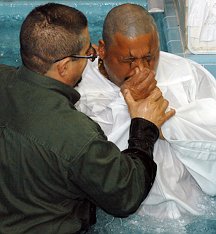
Julio Gonzales, an ex-convict and former drug smuggler, is baptized at First Baptist Church in Del Rio by missions pastor Moises Reyes. (PHOTO/John Hall/BGCT)

Gonzales faces constant temptation to turn back to his old lifestyle to earn money. He recognizes opportunities to make quick money smuggling drugs, but he knows that’s not the lifestyle God is calling him to lead. God will provide for his family, Gonzales said, not drugs or other criminal activities.

“The money’s good, but you don’t live in peace,” he said. “There’s no peace. Now I’m happy with myself.”

Andrea Huffman, First Baptist Church’s community minister, is working with Gonzales to help him put his skills to use in micro-enterprise to provide self-sustaining income. 

Overcoming temptation marks just one aspect of Gonzales’ new faith. In many ways, he’s like so many other new Christians who struggle to discover what having a relationship with God means in daily life.

“I still have a lot to work on. I ain’t no angel,” said Gonzales, who has the phrase “forgive me for my crazy life” tattooed above his eyebrows and on his collarbone.

Johnson helps encourage Gonzales in his relationship with God, calling him twice a week to see how he is doing and how the church can help.

“Julio coming to know Christ is a classic example of planting, watering, and God giving the increase,” Johnson said. “From the prison ministry, mission partnerships, advocacy/care, prayer walking to personal evangelism—all God used. We are happy to be part of God’s plan for Julio.”

Despite the temptation that surrounds him, Gonzales believes he’s going to make it—to get off probation and be a better father. He can’t make up for years lost in prison, but can do the best he can to be the man God is calling him to be, he noted. He’s not sure where that will lead, but he hopes God will call him to help young people avoid the pitfalls in which he fell. He’s already trying to help the young men who live around him.

“I know I’m going to make it,” he said. “It’s tough, but I’m going to make it.”


Wayland graduate forms bonds in the Balkans

PLAINVIEW—Melanie Vasquez faced a big dilemma in December.

She was set to leave the Balkans and return home to Hobbs, N.M., and Plainview, where she attended Wayland Baptist University. She graduated in May 2010 and continued helping with student ministry in nearby Tulia.

Melanie Vasquez (right) spends time with her friend, Marita, who helps with the English classes and also helps Vasquez brush up on her foreign languages in the process.

Her plan all along was to stay six months, then return to the States. But something wasn’t right. She had unfinished business to do, even though her funding to stay overseas was not guaranteed.

Questions loomed: Should she pack her belongings into storage, come home and hope to return for them later? Or should she leave everything in place and trust that she’d be coming back after a holiday visit with relatives and friends?

Vasquez chose the latter, trusting God to work the details out for her to return to the nation that quickly is becoming her second home.

“I just feel like it’s not over for me here,” she said. “About the third month here, I knew there was so much more to do and what that might mean. I began thinking, ‘How can I leave the people that have become my family and not let them have the opportunity to know me better?’ I just knew I had to come back until it was finished.”

Once she returns, Vasquez will help run a community center and teaching English there. She also hopes to start a master’s degree through Wayland’s Virtual Campus, focusing on education and English as a Second Language.

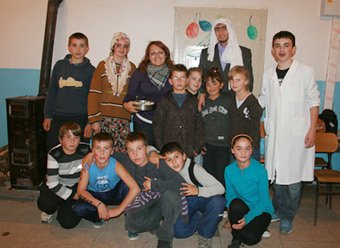
Wayland graduate Melanie Vasquez of Hobbs, N.M., (back row, third from left) joins a group of Balkan children at a Halloween party held at a community center where she works.

Her work in the Balkans has not been much different than when she first visited several years earlier while on a Wayland-sponsored trip. The focus always has been on building relationships, sharing cultures and providing help and hope for the people there.

“I’ve always known that God loves all people, but not everyone has the chance to know and understand his call for them,” said Vasquez. “When an opportunity came my way, I took it.”

That first opportunity was to Mexico. Then, she visited the Balkans the next summer. Her world was transformed, and she knew where she wanted to go the next time a trip was scheduled. In fact, she was so sure of the seeds being planted there that she opted to spend not only her summer there, but also the following fall semester of 2009.

“I fell in love with the people there and just felt like there was a need there for English education, a need for hope and for the people to see something different and know something different,” she said. “The people need to see that it’s a bigger world.”

After returning to Wayland, she completed her last semester of college and headed back to the Balkans just a few weeks after earning her degree. Her intent was to stay another six months, then return to the High Plains to work and do community development.

A group of Balkan women knitted these bags to provide additional income for their families with help from Melanie Vasquez and an outside organization she hopes will market the handcrafts in America and around the world.

But something told her things weren’t finished, and she plans to head back in February to pick up where she left off. First Baptist Church in Tulia has funded her effort in full, having helped significantly for the last trip, and she’s using her home visit to make some connections that will help an effort she began in the European nation before she left.

In an effort to provide economic development and enrichment for the women, Vasquez started a group that knit various products including doilies and handbags, using brightly colored yarns and knitted floral decorations as well.

Since most women in the Balkans do not work outside the home, many families rely on the husband’s salary alone to survive and it often means financial hardships. By using a skill they already possess—Vasquez said most of the women know how to knit quite well and often create things for themselves—she hoped to find connections with vendors who could sell those handcrafts internationally and provide additional income for the families.

 “Other people like Americans don’t normally do these things. They’d rather buy them instead, and to know they are handmade from these ladies on the other side of the world is great,” Vasquez said. “We are hoping that we can show the women that they do have a skill that can help provide for their families.

“This also helps with their self-esteem as they see the team effort and how it will help them all. I tell them that God loves all people, and he expects us to help each other out. No one is above anyone else in the group.”

While the effort has taken time to get under way, Vasquez is confident that a vendor will emerge to help the women sell their wares.

“The challenge is to help them sustain that help for themselves over the long term. If we’re going to make a difference, we want to make one that lasts,” she said. “I’m a problem solver, but I’m learning that I can’t solve everything, and that’s been hard.”

The work, the classes and the other tasks she’s been called upon to do have all opened doors for Vasquez to do her favorite thing—get to know people and a culture so different than her own.

“I’ve made some really good friends and had some great conversations about religion and my own culture. I’ve been able to share my culture and my religion in lots of different ways,” she said. “I’ve always been a people person and get along with everybody. It felt much the same there. They’re just people like me, and I’m interested in knowing about them too. I connect with the people and enjoy just sitting and having coffee with people.”

Through the community center’s programs—which include a coffee house, open-microphone nights, English classes and community development resources for families—Vasquez said the doors are open wide to meeting even more people and forming relationships.

“It’s weird. … It’s like home now. My home is here, but it is there, too. I cannot even fathom not being there and doing what I’m doing,” she said. “It’s always been hard to come back, because America is so different than most cultures. America is such a rich country compared to others, and other countries follow us.”


Kentucky Baptists cut jobs, freeze salaries

LOUISVILLE, Ky. (ABP) — The Kentucky Baptist Convention announced job cuts Jan. 31 intended to free up more money for national and international ministries of the Southern Baptist Convention.

Five full-time jobs and 19 part-time jobs are being eliminated. Employees staying on the job will not receive a pay raise next year.

The reductions, which go into effect Sept. 1, are part of a Great Commission Task Force report approved by Kentucky Baptists at their 2010 annual meeting. The report called for splitting allocations of the Cooperative Program unified funding plan evenly between state and national causes within 10 years.

Currently 62 percent of CP gifts are retained by the 2,400-church state convention to fund ministries of the Kentucky Baptist Convention mission board and agencies, while 38 percent are forwarded to the SBC.

Three of the five full-time jobs being eliminated are vacant. The other two will be vacated by retirements scheduled Aug. 31. The 19 part-time jobs being cut are a mixture of filled and unfilled positions. Seven other part-time contract positions will be reduced.

"We regret having to give up these positions and the ministry that takes place through them," said Bill Mackey, executive director of the state convention. "But we will do our best to meet these ministry needs through effective and faithful volunteers and assignments to current personnel."

Mackey retires in May. A search committee currently is seeking his replacement.