HPU to fight hunger through Empty Bowls project

BROWNWOOD—Howard Payne University students, faculty and staff members joined together to paint bowls for the upcoming Empty Bowls event sponsored by Good Samaritan Ministries. Ann Smith, chair of HPU’s art department, hosted the bowl-painting activity and provided instruction for volunteers.

Katie Curry, part-time youth ministry graduate program assistant, and Howard Payne University senior Molly Gore paint bowls for the Empty Bowls project on March 31. (Photo by Hannah Pippen/Howard Payne University)

Empty Bowls will be held March 31, 11 a.m. to 7 p.m., at the Brownwood Depot. Soup donated from area restaurants will be served in the hand-painted bowls. A silent auction also will be held throughout the day along with live music.

The cost is $10 per person. Ninety percent of the proceeds will go for local needs, while 10 percent will go to help address international hunger needs through Heifer International.

“Community involvement is so important to the effectiveness of this event because, not only does it raise money to provide food for the hungry people in our community, it brings awareness that we are living among those people. Awareness can lead people to act, and we’re hoping that Empty Bowls will encourage our community by showing that we can do something to help,” said Katie Curry, part-time youth ministry graduate program assistant at HPU, who is assisting in the planning of Empty Bowls.

This is the second Empty Bowls event to be held in Brownwood. Empty Bowls is a grassroots project of The Imagine/Render Group, a nonprofit organization dedicated to positive and lasting social change through the arts, education and projects that build community.


Three Hispanic evangelism conferences draw 3,400 participants

SAN ANTONIO—Evangelist Herman Rios urged people to give their lives to Christ. And that’s what they did at a Hispanic Evangelism Conference at South San Filadelfia Baptist Church in San Antonio.

Evangelist Herman Rios talks to participants at the Hispanic Evangelism Conference in San Antonio during the commitment time of the service. (PHOTO/John Hall/Texas Baptist Communications)

Event organizers recorded more than 250 decisions for Christ—including 147 professions of faith and 11 who felt called to vocational ministry—during Texas Baptists’ three Hispanic Evangelism Conferences, one each in Houston, El Paso and San Antonio during February.

“God’s still at work,” said Johnnie Musquiz, pastor of Primera Iglesia Bautista in Houston. “It’s a thrill for a church to see.”

The Hispanic Evangelism Conference, sponsored by the Baptist General Convention of Texas, has expanded in recent years from a single event in Houston. Organizers added a second conference in San Antonio three years ago. This year marked the first Hispanic Evangelism Conference in El Paso.

“There’s inspiration and training brought to their backyard,” said Hispanic Evangelism Director Frank Palos. “Economic constraints have made it difficult for people to get out of where they are. So, we’re coming to them, bringing much-needed evangelism training.”

Despite having to cancel one day of the Houston event due to bad weather, about 3,400 people attended the three events. Conference participants also gave $3,145 to missions through local ministries and the Texas Baptist Cooperative Program.

BGCT President Victor Rodriguez, pastor of South San Filadelfia Baptist Church, noted the conference in San Antonio reminded him of one- and two-week-long church revivals that took place when he was a child. Volunteers from South San Filadelfia Baptist Church, San Antonio Baptist Association and the BGCT eagerly prepared, excited to see how God would work. Volunteers were prepared to begin follow up with those who made spiritual decisions.

“Evangelism is still alive and well. That’s the core. That’s what’s going to move our churches, our convention,” he said.


CrossBridge sees itself as a lighthouse in darkness

CORPUS CHRISTI—At sundown, a ragtag group of Christians gathers in a small apartment in one of Corpus Christi’s roughest neighborhoods.

During one of CrossBridge Fellowship’s home team meetings, Adam Reyna and other church members pray.

They include a couple who met in a drug deal that didn’t work out, a security consultant who for reasons he can’t completely explain cares for this part of town that many people are trying to forget exists, a recovering alcoholic who is now a television clown and a pastor of a church no one believed would work.

Around a small table, they study the Bible, cry a little and laugh a lot in a meeting that feels more like a family reunion than an official gathering. And there’s always room for someone new. This night, the apartment door remains open, light piercing the surrounding darkness and inviting people to join them.

This group comprises one of the “home teams”—an off-campus small-group Bible study—for CrossBridge Fellowship. Second Baptist Church of Corpus Christi sponsors the church-start, with the help of gifts through the Baptist General Convention of Texas Cooperative Program and the Mary Hill Davis Offering for Texas Missions .

The church is anchored in a region of Corpus Christi that places roughly 1,600 calls to the police each month, member Jimmy Rodriguez said. Nationally, one in every 164 people is a victim of a violent crime such as murder, rape or armed robbery. Here, it’s one in every 32 people.

J.J. Pena flips through his new Bible from CrossBridge Fellowship in Corpus Christi. Pena and his family are involved in the church’s after-school program.

A memorial rests on a fence a short walk from the church, marking the place a young gang member lost his life while many people in the community looked on. Tennis shoes hang from a nearby power line, denoting a place where drugs are sold. Even the church hasn’t been immune from crime. The first week the church met, more than $15,000 in music equipment was stolen.

Many families here are broken, said Pastor Mario Quezada, who recalls people telling him he was stupid for attempting to start a church in the area. Some teens live alone because their parents are incarcerated. Some residents are addicted to drugs, alcohol or both. Financial pressures squeeze residents tightly. Gangs recruit children as young as 8 years old.

“This isn’t a good neighborhood in the least,” home team leader Hector Pena confessed. “To me … that’s how I see it. It’s a lighthouse. People are out to sea. This (church) is calling them home.”

CrossBridge gives people a choice—lives of drugs, dependency and struggles or the embrace of people who care about others, members said. Many have struggled with dependency in the past and face a variety of hardships now, meaning they welcome others without judgment. The congregation provides a refuge for wayward pilgrims.

“In this neighborhood, if you don’t have family, you go find family out there—either in the gangs or at CrossBridge Fellowship. I’m so glad we’re here,” said Crystal Womack, who met her husband, Lawrence, when he was selling drugs on the street.

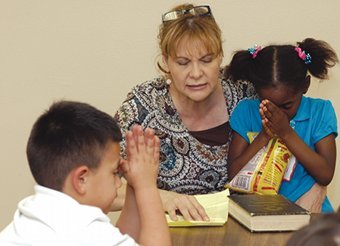
Shirley Graham, a volunteer from CrossBridge Fellowship’s sponsor church, Second Baptist Church in Corpus Christi, prays with children during the after-school program.

In an effort to engage all people in the neighborhood, the church attempts to eliminate barriers between it and the community. The church partners with the food bank to distribute food twice a month to as many as 200 people. It has partnered with its sponsor congregation, Second Baptist Church, to hand out about 300 backpacks full of school supplies to area children. It has provided shoes for more than 30 children.

Each week, the church conducts an after-school program that draws dozens of children from the apartments across the street from the congregation. Students eagerly hop off the school bus and into the arms of Quezada, Pena and other volunteers, including some from Second Baptist Church, which is committed to helping CrossBridge beyond finances.

Students enjoy a snack provided by the Woman’s Missionary Union of Second Baptist Church, participate in a Bible study and play on the community “park”—the church playground.

God is working through the ministry to provide beacons of light in the community. About 80 people attend worship services at the church each week. And Quezada added, “People get baptized nearly every month.”

This night, as the group was wrapping up, a woman walked through the open door. She saw the light and hoped it was a church meeting.

She had wrestled with drugs and alcohol and recently suffered a relapse. Struggling, she hoped to find someone who would pray for her.

She discovered a group of people who understood exactly where she was, because they’d been there, too. They visited with her for a short while, then circled around her and prayed for her. Afterward, a few of the women in the home team pulled her to the side and began visiting with her more.

“Home teams are really a big blessing,” said Adam Reyna, a recovering alcoholic. “The last home team, we talked about ‘Jesus with skin on.’ This is a church with walls down.”


BTSR considering Chowan merger

MURFREESBORO, N.C. (ABP) —Cash-strapped Baptist Theological Seminary at Richmond is considering a merger with Chowan University, a 162-year-old North Carolina Baptist school 99 miles south of the seminary’s Richmond, Va., campus, in hopes of solving lingering financial problems made worse by a bad economy.

Chris White, president of Chowan University, said a subcommittee of Chowan’s board of trustees is “doing due diligence” investigating the possibility of a merger with BTSR, which he said is in “serious financial difficulty.”

BTSR’s trustees meet March 21-22, when White anticipates either a formal request to or a decision from BTSR not to request merger. Chowan’s next regularly scheduled board meeting is April 7. A decision can be made that day because due diligence will be completed, White said.

Ron Crawford, president of the Richmond seminary, didn’t confirm or deny the report. But since last fall, he said, a trustee committee has been exploring a variety of options to secure the school’s future.

“Last October, our trustees looked hard at our business plan in light of our future,” he said. “They asked a committee to study possibilities and make a recommendation at the March meeting of the full board of trustees.”

Those possibilities include “partnering” with other institutions, Crawford said. But he added: “We’re still in the process of seeing what the best options are. It’s a little premature to say we have focused on one option, and that’s the only one we’re looking at.”

“We have a very fine and very financially healthy university,” said White, age 67 and president of Chowan for eight years. He said BTSR is financially “a very sick seminary, and we must make sure we don’t hurt the mother by taking on the baby.”

BTSR is $7 million in debt, White said, a figure confirmed by the seminary’s finance office. Most of the debt was incurred in the purchase and renovation of BTSR’s campus, which originally housed the Presbyterian School of Christian Education, now affiliated with Union Theological Seminary.

Even though “the big elephant in the room is money,” White said, the financial picture is just one element of difficulty in merging two schools. White said it might be difficult to merge the two cultures of an old, rural university and a young, metro divinity school, even though “we are of like mind theologically.”

BTSR receives significant funding from both the Cooperative Baptist Fellowship and the Baptist General Association of Virginia. It’s not clear how or if a merger would affect those revenue streams.


Some foreign aid helps, other kinds do more harm than good, experts assert

Even though the Green Bay Packers won this year’s Super Bowl 31-25, up to 100,000 individuals in developing countries are wearing new T-shirts erroneously labeling the losing Pittsburgh Steelers as NFL champions.

For marketing purposes, the NFL preprinted memorabilia for sale at the final gun of the Feb. 6 contest regardless of which team prevailed. Afterward, the league announced a $2 million in-kind gift of the misprinted Steeler apparel to World Vision, a Christian relief organization synonymous with helping children worldwide by addressing the root causes of extreme poverty.

A gesture most Americans likely celebrated as win-win brought quick condemnation from experts labeling it “bad aid,” well-intentioned acts that wind up doing more harm than good.

Bags of food sitting stacked in a warehouse in Ethiopia are reminders that not all aid is “good” aid if the donations are not handled and distributed properly. Wise advocates for the poor insist not only on greater allocations for foreign aid, but also on more efficient and effective administration to make sure it really reduces poverty, some experts insist. (PHOTO/Alan Bjerga/Bloomberg via Getty Images )

Critics said the NFL got a big tax write-off, but since the Steelers weren’t really champs, the retail value of the T-shirts was next to nothing. That prompted an ongoing argument about the narrow equation between whether “gift-in-kind” items like used clothing help the poor or hurt them by competing with local industries and giving away items that could be produced locally for less money than it costs to collect, process and ship them overseas.

World Vision responded that opinions about such gifts—discussed among experts by the acronym GIK—range from absolute opposition to belief that any product sent with good intentions is helpful. World Vision claims a middle-ground it calls a “nuanced conditional strategic use of product in appropriate contexts.”

Laura Seay, an assistant professor at Morehouse College who attended First Baptist Church in Austin while earning her doctorate at the University of Texas, maintains some GIK contributions are good and even necessary for sustainable development. Examples are antiretroviral drugs for treatment of HIV/AIDS and technical items for digging wells. They only work, however, if they are highly targeted and valued by the recipient.

Cheaper items that are readily available and affordable anywhere in the world are at best wasteful and at worst hurt the very people they are intended to help, experts say.

Garth Frazer, an associate professor of economics at the University of Toronto, argued in a widely read article that one major reason many African countries haven’t developed their own major textile industries is the influx of used clothing donations by consumers in industrialized nations.

Success stories over the last 30 years in East Asian countries like Taiwan, Korea, Singapore, Hong Kong and more recently China began with production and exporting of textiles and apparel, Frazer said. As their economies grew, those countries moved to manufacturing higher-ticket items like electronics and automobiles.

By contrast, African economies have stagnated, with many countries unable to step onto even the bottom rung of the manufacturing sophistication ladder by producing and exporting their own textiles and apparel. That is despite Africa’s low unskilled wage levels and abundant supplies of cotton.

Used-clothing donations to charities have increased dramatically over the last 20 years, Frazer said. What many people don’t know, he added, is that thrift shops are able to sell only a portion of what they collect. The rest is sold to exporters who ship it to developing countries at a very low cost.

About 16 percent of containers in ships with U.S. exports bound for Africa in 1995 were filled with used clothing. That flood of imports had a “significant negative impact” on textile and apparel production sectors in sub-Saharan Africa, Frazer said. He calculated a 39 percent annual decline in apparel production and roughly half the annual decline in apparel employment attributed to cast-off clothing.

Eric Raikes, a graduate student at the University of Toronto, wrote a blog arguing why he thinks the NFL/World Vision T-shirt giveaway was a bad idea.

“First, it creates a dependency on aid,” he wrote. “Second, seeing economic production as a possible alternative to aid, it stifles local economic development in favor of cheaply imported goods.”

Beyond that, Raikes argued that shipping 100,000 shirts to developing countries is a bad use of resources. Studies show that on their own, in-kind donations like clothing and food instead of money are reasonably efficient forms of aid, but when you factor in the cost of administration and delivery, they are not cost-effective.

Finally, Raikes said his type of marketing “entrenches ideas of naked Africans who are oh-so-grateful for your shirts” and promotes Western people as “saviors” or “white knights” while encouraging wasteful consumption—people only give away old shirts after they buy new ones.

Seay, who writes regularly about third-world economies in a blog titled Texas in Africa, said the T-shirt giveaway was not only “bad aid” but also “unnecessary aid.”

“There aren’t any places in the world where T-shirts are not available at a market price determined by the local economy and affordable to local consumers,” she wrote.

Both the NFL and World Vision get benefits—the NFL for taxes and World Vision for its bottom line—she said, “and don’t owe anyone an explanation of whether the T-shirts actually do anyone any good.”

Finally, Seay said, there is an “opportunity cost” to shipping clothing items to people who don’t want them but have other serious unmet needs.


Fighting hunger makes economic and political sense, Christian activist says

DALLAS—Despite deep divisions in U.S. society, Christians can lead the way toward bipartisan solutions to the pain of poverty, insisted one of the world’s top hunger fighters.

“Church people—whose congregations often span the political spectrum—have the moral imperative to push for bipartisan efforts to eliminate poverty and hunger,” David Beckmann, president of Bread for the World and 2010 recipient of the World Food Prize, said in an interview.

A Samburu woman in Kenya shares her meal with a child. Meeting the needs of hungry children and poor people makes political and economic sense, according to David Beckmann of Bread for the World. (BP FILE PHOTO/Sydney A. James)

Bread for the World is a multidenominational Christian organization that urges politicians to make decisions that will alleviate hunger in the United States and around the world. Beckmann, an ordained Lutheran minister and former missionary, has led the organization since 1991.

He outlined a two-part strategy for convincing lawmakers to preserve federal programs that protect poor people—illustrate the needs, but also demonstrate how meeting those needs makes economic and political sense.

“Right now, there are huge pressures to cut programs for poor people in the name of deficit reduction,” he acknowledged.

For example, the House of Representatives is proposing a 10 percent reduction in the Women, Infants and Children—WIC—program that provides supplemental food for low-income women and children up to age 5, he said.

But that expense reduction equals bad economics, he added. The federal General Accounting Office has demonstrated WIC saves more than it costs by reducing the amount of Medicaid spent on premature babies whose mothers were undernourished during pregnancy. And long-term, even moderate undernourishment of small children reduces their productivity later in life.

“It just doesn’t make economic sense to cut assistance to pregnant mothers and small children,” he said.

Globally, food prices are higher than they have been in decades, and they’re expected to increase because of rising fuel costs, Beckmann reported, adding he is proud the United States has led the world in investing in poor farmers, yielding improved nutrition.

Nevertheless, the House budget proposes to cut overseas agriculture support by 30 percent, meaning 19 million people worldwide will lose their dietary assistance, he said.
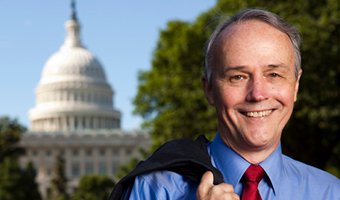
David Beckmann, president of Bread for the World and 2010 recipient of the World Food Prize, insists Christians have a moral imperative to use political influence to eliminate hunger and fight poverty. (PHOTO/Courtesy of Bread for the World)

That doesn’t make economic sense, either, especially for fiscal conservatives, he noted. For every $1 the U.S. government spends on global hunger, other governments and groups contribute $10, leading to a “surge in investment in poor farmers.” But the budget cuts could undercut U.S. leadership in hunger reduction and cause other nations to curtail their support, he warned. And that will lead to worsened conditions for the world’s farmers, resulting in even greater need.

These aren’t simply the concerns of bleeding-heart liberals, but also of clear-eyed conservatives, Beckmann said.

“Both (political) parties can agree on steps that will make aid programs for needy people work better,” he stressed. “Bread for the World is serious about using tax dollars well. … We can get bipartisan agreement to use tax dollars more effectively in foreign aid.”

In fact, Bread has led the charge in demanding accountability from aid programs, he said. During the past three years, the organization has pushed for greater transparency in the programs, demanded tighter measures of effectiveness and insisted the programs “make things work better for people in need.”

The time is right for Christians to promote bipartisan support for antihunger programs, Beckmann noted. “Despite political polarities, Americans are more sensitive to poor people than they were 15 years ago. This especially is true with the economic recession. We’ve all been touched, and just about everyone has a close friend or family member who has lost a job.”

So, Christians should demand their lawmakers find other ways to reduce the federal deficit rather than shave away programs designed to help the poor and hurting, he said. Those programs that respond to people in need—both domestic and international—comprise only 15 percent of the budget.

“There are other ways to reduce the deficit: Grow the economy. Go after the other 85 percent of the budget. And close tax loopholes,” Beckmann suggested.

“Ask yourself: ‘What would Jesus cut?’ He wouldn’t cut WIC. The Bible doesn’t say that specifically. But the Bible says God does support the poor. We do not need to make hungry people hungrier.”

“Bread for the World is grounded in Jesus and deeply connected to the church,” he reported. “We’re grateful for the longstanding support of Texas Baptists, as well as Lutherans, Presbyterians, Catholics, various African-American denominations, such as the African Methodist Episcopal Church, and other groups.”

This spring, Bread is providing Christians with an opportunity to call for support for the world’s poor and hungry through its annual Offering of Letters. For more information about the project, see the editorial on page 5 of this issue.



‘Bad advocacy’ can do more harm than good, Baptist scholar insists

ATLANTA (ABP)—Celebrity-driven campaigns like Save Darfur and Invisible Children are popular, but in some cases, they do more harm than good, according to a Baptist scholar who specializes in African politics, conflict and international affairs.

“Advocacy needs to be intelligent,” said Laura Seay, an assistant professor at Morehouse College. “When you present information that isn’t accurately descriptive of the dynamics of the situation, advocacy groups can sometimes do more harm than good.”


Activists rallied in Chicago at a rally and prayer vigil for Sudan. The Sudan issue has gained traction in American churches. But scholar Laura Seay warns that oversimplifying conflicts is probably the most common mistake American advocacy groups make.

Seay, who attended First Baptist Church in Austin while earning her doctorate at the University of Texas, insists superficial understandings of complex situations can lead to bad advocacy or “badvocacy,” a catch-all phrase to describe advocacy that begins with good intentions but either accomplishes nothing or makes the problem even worse.

Seay, who did field work for her doctorate in the Democratic Republic of Congo, cites that country’s civil war as a prime example. Armed militia in eastern DRC that control minerals used to manufacture cell phones routinely deploy rape as a weapon of war. Advocacy groups like the Enough Project urge Westerners to boycott certain electronic products in order to break the supply chain and thereby discourage atrocities.

The problem, Seay inisted, is no evidence directly links sexual violence and mineral trade.

“The act of buying a cell phone does not cause war in the Congo, and it’s downright misleading to suggest otherwise,” she writes on her blog titled Texas in Africa. “Why? Because it implies that if we could just stop the conflict mineral trade, the situation would markedly improve.”

Bad advocacy leads to bad policy—and to celebrities traipsing around pontificating on issues they don’t understand, Seay said. If advocacy doesn’t help to solve crises and does little or nothing to improve the lives of those who are suffering, Seay contends, it isn’t “better than nothing.”

She cites several reasons why she believes so much Africa-based advocacy in the United States is off-base:

Oversimplification of the issue. Oversimplifying conflicts is probably the most common mistake American advocacy groups make, Seay contends. Americans tend to seek a single external source of evil for all of the world’s problems. Most instinctively try to narrow complex conflicts down to make them understandable to normal people. It’s a lot easier, for example, to call the war in Congo a “resource war” than to explain it as a series of ongoing local conflicts over land, ethnicity, resources and governance with local, national, regional and international dimensions. “That doesn’t really fit on a T-shirt,” she said.

Western-conceived solutions. Most peacekeeping missions, peace-building efforts and conflict resolution plans are conceived in New York, Washington and Brussels, often by people who never or rarely visited the countries they purport to help. Seay said that is why “these so-called solutions rarely work.” She advocates looking to local leaders to find answers whenever possible.

“Civil society leaders are well aware of their communities’ problems, and they usually have ideas as to how to solve those problems, or at the very least to mitigate the effects of violent conflict on civilian populations,” she advised. “They speak the languages, know the cultures and can mediate among the key players in local sociopolitical dynamics.”

That doesn’t mean there is no room for Western assistance, Seay said. “It does mean, however, that advocates on this side of the Atlantic should be asking intelligent victims of war what they think would help rather than insisting that the experts know best.”

Focus on celebrities and trendiness rather than intelligent analysis. Seay says this is Save Darfur’s problem. Everybody opposes genocide, but when people who are trained as actors and musicians start traipsing around war zones without having done any homework independent of the organization supporting their visits, they give a narrative that isn’t exactly representative of the facts.

“So, Darfur in the popular imagination becomes not a civil war over changing land usability and land tenure rights with people doing horrible things on both sides, but rather becomes the nasty Arab government going after innocent black Darfuris,” she says. “The reality, of course, is closer to the former description than the latter, but I don’t expect Mia Farrow to know that.”

Focus on the advocates rather than those they purport to help. Seay confesses to cultural heresy by disagreeing with talk show sensation Oprah Winfrey about Invisible Children, a grassroots movement that started with a documentary film about children kidnapped and turned into child soldiers in Uganda.

“Most of their advocacy isn’t actually focused on Ugandan children, but rather on how their supporters feel about Ugandan children and the problem of the use of child soldiers,” Seay writes. “Good advocacy isn’t about the advocates; it’s about the people who need others to stand up on their behalf.”

Insistence that “we have to do something.” The human impulse to protect others generally is good, Seay said, but that doesn’t always mean that the “something” in question should be done. Westerners too often get involved in conflicts they don’t really understand, and bad things happen.

The white man’s/woman’s burden. “Young people get excited about truly appalling situations and, like generations of missionaries and colonists before them, they decide they’re going to ‘Save Africa,’” Seay said. “This generally leads to discussions of being ‘a voice for the voiceless.’

“Here’s the problem with that: Africans aren’t voiceless. In 11 years of experience on the continent, I’ve never met a citizen of an African state who didn’t have opinions on his or her country and its state of affairs. There’s a big difference between claiming to speak for someone and standing alongside those who want to change their own communities. Africa-focused advocacy could use a lot more of the latter.”


Baptist leaders denounce Muslim hearing

ATLANTA (ABP) — Leaders of three national Baptist organizations signed a statement released March 10 critical of the hearings by the U.S. House of Representatives' Committee on Homeland Security on the subject of radicalization within the American Muslim community.

Cooperative Baptist Fellowship Executive Coordinator Daniel Vestal and Roy Medley, general secretary of American Baptist Churches USA, signed as steering committee members of Shoulder-to-Shoulder, a campaign of faith-based organizations and religious denominations to promote tolerance and fight anti-Muslim bigotry.

Carroll Baltimore, president of the Progressive National Baptist Convention, signed on as an additional signatory. Other Baptists on the list included Welton Gaddy, president of the Interfaith Alliance and minister for preaching and worship at Northminster (Baptist) Church in Monroe, La., and Jim Wallis of Sojourners, a member of First Baptist Church in Washington.

Thursday's hearing, chaired by U.S. Rep. Peter King, R-N.Y., was titled "The Extent of Radicalization in the American Muslim Community and that Community's Response."

Faith leaders responded with a campaign that included a news conference and meetings with members of Congress from both parties as well as White House officials.

"We gather together to affirm that we stand united with all Americans in urging our elected representatives to act — not against a single, unfairly maligned group, but against all forms of violence and extremism that endanger our security," the statement read in part. "As spiritual leaders and people of faith, we call on the United States Congress, elected officials at every level of government, and all American citizens not to perpetuate damaging false witness against our neighbors. Instead, we encourage all communities of faith and people of good will throughout this country, to stand shoulder-to-shoulder in communities of growing awareness, trust and hope."

Vestal said he was glad to sign the statement and "stand shoulder-to-shoulder" with other faith groups in support of the Muslim community.

"As Baptists who hold to the principle of religious freedom, we have an obligation to stand with other people of faith when the government unfairly singles them out for scrutiny or misrepresentation," Vestal said.


–Bob Allen is senior writer for Associated Baptist Press. Lance Wallace of CBF communications contributed to this report.


Texas Tidbits

Buckner collaboration aids single-parent families. Buckner International has teamed up with Star of Hope Mission to provide a transitional program for single-parent families in Houston, focusing particularly on homeless families. Buckner Family Place of Houston residents will be enrolled in academic or vocational programs, receive housing and child-care assistance, and have access to counseling and case-management services.

ETBU has new address. East Texas Baptist University has a new street address, but the campus has not relocated. The Marshall City Commission recently approved a resolution changing Barney Carter Street to Tiger Drive, making One Tiger Drive the new physical address for ETBU.

HBU nursing school receives gift. Houston Baptist University’s School of Nursing and Allied Health received a $300,000 lead gift from Bruce and Mary Ann Belin that will enable the school to move forward with plans to modernize and enhance its nursing program and facilities. Once complete, the Mary Ann Belin Nursing and Allied Health Simulation Lab will allow the HBU School of Nursing to accommodate additional students by doubling both classroom capacity and lab space. The proposed expansion also will make room for new equipment, including a fully simulative training environment featuring a nursing station, computer desks, sinks, beds and an IV simulator.

Grant aids BCFS youth program. Baptist Child & Family Services will launch a three-year education and job-training program for drop-outs in the Kerrville area, thanks to a more than $881,000 grant from the U.S. Department of Labor. Youth eligible for services are Kerr County residents, ages 16 to 24, who dropped out of school, are transitioning out of the Texas foster care or juvenile justice systems, or who are from low-income homes. Students will spend half their day in school and the other half working on construction projects through Habitat for Humanity, building homes for low-income families. 

Utley commentaries available online. Bible commentaries and study aids written by Bob Utley, retired professor of religion at East Texas Baptist University, are now available in an open access collection at http://site.ebrary.com/lib/etbu. Created by the university’s librarians, the new site includes materials in English and Russian, with additional languages to be added in the upcoming weeks.

Senior saint summit set at UMHB. Pastor Andy Davis from First Baptist Church in Belton will preach and Pastor Ronnie Hood from Canyon Creek Baptist Church in Temple will lead the Bible study at the Senior Adult Summit, May 16-19 at the University of Mary Hardin-Baylor in Belton. “A Blast from the Past” is the summit theme. The Central Texas Master Singers and the choir and orchestra from First Baptist Church in Belton will perform concerts during the event for adults age 55 and older. The choir from Crestview Baptist Church in Georgetown also will participate. For more information, contact wmuske@umhb.edu.


On the Move

Patrick Adair to First Church in Matador as pastor from First Church in Waco, where he was youth minister.

Mike Bishop to Lakeway Church in The Colony as interim pastor.

Jason Buchanan has resigned as worship leader at Lakeway Church in The Colony.

Mark Carson has resigned as minister of education at First Church in New Braunfels.

JayR Dunn to First Church in Hale Center as youth minister.

Jerry Fleming has resigned as minister of music at First Church in Wills Point. He is available for interims.

Jason Gray to Elmcrest Church in Abilene as pastor.

Cameron Lynch to First Church in Matador as youth minister.

Jeff Moore has resigned as youth minister at Towne North Church in Denton.

Andy Narramore to East Texas Baptist Encampment as executive director.

Tim Robinson has resigned as pastor at Lakeway Church in The Colony.

Darla Smith to First Church in Justin as children’s minister.

Trent Steger to First Church in Silverton as youth minister.

Michael Sturgeon has resigned as pastor of the Church at Friendship in Hockley.


Faith Digest

Views on homosexuality bar foster couple. Two judges in England banned a Christian couple from foster care because they oppose homosexuality—a stance the judges said has no place in the laws of Britain. Owen and Eunice Johns, of Derby, England, already have fostered 15 children, but the High Court in London ruled the Pentecostal couple no longer can continue the practice because their anti-gay views are legally wrong. Lord Justice James Lawrence Munby and Justice Jack Beeston said under 21st-century British law, the rights of homosexuals “should take precedence” over the rights of religious faiths. The two judges decreed Britain had evolved into a “largely secular,” multicultural society whose laws “do not include Christianity.”

FBI sued over mosque surveillance. The American Civil Liberties Union and the Council of American-Islamic Relations filed a lawsuit in Los Angeles, charging the FBI targeted Muslims for surveillance based solely on their religious affiliation and thereby violated their constitutional rights. The lawsuit says the FBI’s Los Angeles office paid Craig Monteilh of Irvine, Calif., to “indiscriminately collect” phone numbers, e-mail addresses and other personal information on Muslims in Southern California. Monteilh worked undercover 14 months between 2006 and 2007, doing most of his surveillance at the Islamic Center of Irvine but also targeting other Southern California mosques, according to the suit. The FBI denied allegations it was guilty of religious profiling. “The FBI investigates allegations of crimes, not constitutionally protected activities, including the exercise of religious freedom,” the agency said in a public statement. “The FBI does not investigate houses of worship or religious groups but individuals who are alleged to be a threat to national security or involved in criminal activity.”

German bishops offer cash to abuse victims. Germany’s Roman Catholic Church is offering cash payments of up to 5,000 euros ($6,925 in American currency) to victims of child sexual abuse in a yet unknown number of cases, some dating back decades. The bishops’ offer includes higher payments for victims of especially serious crimes. Other funds will be made available to pay for psychotherapy and couples counseling for victims. Additionally, a 500,000-euro prevention fund will be created, the bishops said.

Islam topped news coverage. Islam was the most frequent topic of religion news coverage in 2010, as the media doubled the amount of time and space devoted to religion compared to 2009. An analysis by the Pew Forum on Religion & Public Life found more than 40 percent of religion coverage centered on three issues—plans to build an Islamic cultural center near Ground Zero, a Florida pastor’s threat to burn the Quran and commemorations of the anniversary of the 9/11 terrorist attacks. The study, in conjunction with the Pew Research Center’s Project for Excellence in Journalism, marked the first time since 2007 that neither the Catholic Church nor religion and politics ranked as the No. 1 news story.

–Compiled from Religion News Service


Baptist Briefs

Alliance members not necessarily out of SBC. Membership in a group that welcomes and affirms gays does not automatically disqualify a church from participation in the Southern Baptist Convention, the SBC Executive Committee decided at its most recent meeting. In 2009, the convention expelled Broadway Baptist Church in Fort Worth after investigating the congregation and learning it allows homosexual members to serve on committees. Last year, a messenger at the annual meeting made a motion—subsequently referred to the Executive Committee—to take similar action against churches that affiliate with the Alliance of Baptists, an organization that has adopted statements supporting gay marriage and welcomes members regardless of sexual identity. SBC leaders said it would be unwise to disqualify a church simply because the Alliance claims it as a member. Should questions arise about a particular church’s qualifications, they will continue to be handled on a case-by-case basis.

Committee nixes biennial SBC schedule. The Southern Baptist Convention Executive Committee has recommended against changing from an annual meeting to holding its convention every other year. Responding to a motion from last summer’s convention, the Executive Committee said the change would save several hundred thousands of dollars in years the convention doesn’t meet, but it would create numerous constitutional problems. For instance, SBC bylaws require annual ministry and financial reports. If there were an advantage to meeting every other year, convention officials said the earliest it could be accomplished is 2015, because contracts have been signed until then for annual meetings.

Funding cut for SBC Executive Committee. The Executive Committee of the Southern Baptist Convention will ask messengers at this year’s annual meeting to reduce its own share of the Cooperative Program unified budget by two-tenths of a percent. It marks the first step of a seven-year process proposed by the agency’s new CEO to move toward a level of 2.4 percent Cooperative Program allocation for administration. Frank Page, president of the administrative body that carries on work of the nation’s second-largest faith group between annual meetings, urged committee members to support his vision for modeling “a Christ-like selflessness” to build trust in a formerly growing denomination now in numerical and fiscal decline. Page, who has been on the job five months, already reduced staff by 19 percent. In 2011-2012, the Executive Committee is proposing a new SBC operating budget reduced from the current 3.4 percent Cooperative Program allocation it has received since assuming responsibility for stewardship education and promotion in 2007 to a 3.2 percent level.

Luncheon set for ministers’ wives. The Southern Baptist Convention Ministers’ Wives Luncheon will be at noon, June 14, in the convention center’s north ballroom in Phoenix, Ariz. Lisa Harper, author of nine books and a speaker on the Women of Faith conference tour, will be the keynote speaker. Tickets are $20 at the door or $15 if secured in advance from LifeWay Women’s Events at (800) 254-2022 or at www.lifeway.com. For more information, call (700) 794-2982 or e-mail sandy.beeter@jfbc.org.