India’s Supreme Court changes ruling after protest by Christians

FALLS CHURCH, Va. (ABP) — India's Supreme Court amended a ruling upholding a life-in-prison sentence for two men convicted of murdering a Baptist missionary and his two young sons 12 years ago by removing language that critics said appeared to condone vigilante violence intended to "teach a lesson" against proselytizing among the nation's tribal poor.

On Jan. 21 the Supreme Court upheld life sentences for Dara Singh and Mahendra Hembram. They were convicted of burning Staines, 58, and his sons Philip, 9, and Timothy, 7, alive while they slept in a van outside a church in Koenjhar district of Orissa, eastern India, on Jan. 22, 1999.

Declining to reinstate the death penalty for one of the killers, the 76-page judgment stated that "there is no justification for people committing conversions on the premise that one religion is better than the other."

In a paragraph explaining why they declined to reinstate a death penalty awarded by a jury in 2003 but commuted to life sentences two years later, the justices opined:

"In the case in hand, though Graham Staines and his two minor sons were burnt to death while they were sleeping inside a station wagon at Manoharpur, the intention was to teach a lesson to Graham Staines about his religious activities, namely, converting poor tribals to Christianity."

The language prompted protest among Indian Christians, who claimed it "de-legitimized" their constitutional right to profess, practice and propagate their faith. One group wrote an open letter Jan. 25 objecting to "gratuitous observations" and language "that seems to acknowledge vigilante action of criminals like Dara Singh who take upon themselves ‘to teach lessons’ to persons serving lepers and the poor."

Bowing to the pressure, the court changed its reasoning to the fact that 12 years has passed since the act was committed and that it could find no reason to enhance the sentence "in view of the factual position discussed in earlier paragraphs" of the ruling.

Staines moved to India from Australia in 1965 and for 34 years ran a leprosy home in the Mayurbhanj district about 900 miles southeast of New Delhi. Fanatic Hindu groups accused Staines of using the home as a cover for proselytizing, but independent investigations following the murders did not turn up any evidence that was true.

Church groups blamed growing intolerance against Christians in Orissa, the same state where violence against Christians broke out again in 2008. Neville Callam, general secretary of the Baptist World Alliance, condemned those attacks and pledged to "respond meaningfully to the needs and concerns of those who have suffered and will make the appropriate representations to make the case for respect for religious freedom in India."

In 1999, then BWA General Secretary Denton Lotz attributed the Staines' slayings to "religious intolerance and fanaticism, not only in India, but worldwide."

"Baptist Christians need to be in the forefront of defending religious freedom, but more than this, we must teach our own people the need for tolerance and respect for one another's cultures and traditions," Lotz said. "We must discuss with leaders of various religions the need for dignity respect and peaceful coexistence."

A BWA spokesman did not respond to a request for comment in time to be included in this story.


–Bob Allen is senior writer for Associated Baptist Press.


Association may consider selling to settle property dispute (Revised)

FORT WORTH—If Southwestern Baptist Theological Seminary wants to buy a disputed piece of property from Tarrant Baptist Association for fair market value, the association may consider selling, according to a motion the association’s executive board unanimously approved Jan. 24. Otherwise, the matter will need to be submitted to a three-member arbitration panel.

Southwestern Seminary notified Tarrant Baptist Association before Christmas it had six months to vacate its offices on the edge of the seminary campus. The seminary asserted the association was in violation of its affiliation agreement—in part because of perceived toleration of homosexuality by some member church or churches.

Southwestern mapBut while Tarrant Association Moderator Al Meredith contends the seminary lacks authority to take unilateral action, he expressed hope the situation can be resolved—either by the seminary purchasing the property from the association or by submitting the dispute to an arbitration panel.

Meredith, pastor of Wedgwood Baptist Church in Fort Worth, repeatedly underscored his desire that the association’s longtime fraternal relationship with the seminary be maintained.

Southwestern Seminary officials did not respond to e-mail or phone calls requesting a response for this article.

The association office received a registered letter from Southwestern Seminary Dec. 10. The letter stated the association was in violation of its 1997 affiliation agreement, and it directed the association to vacate its property on James Avenue within six months. It also stated title on the property should revert back to the seminary.

In 1982, the seminary provided Tarrant Baptist Association land and the funds to build its office building, granting a 99-year lease on the property, Meredith explained. At that time, the seminary and association entered into an affiliation agreement stipulating the property would not be used for commercial activity, and the association and seminary would commit to remaining in theological harmony, he said.

In 1997, the property agreement was renegotiated, and Tarrant Baptist Association received the deed to the property, he said. “The affiliation agreement remained intact,” Meredith added.

According to the agreement, if any disagreement should arise between the association and the seminary, the matter should be resolved a three-member arbitration panel with one seminary representative, one associational representative and one party mutually agreed upon by both parties, he noted.

On Dec. 20, three associational representatives—Moderator-elect Meredith, Moderator Bobby Bridges and Leadership Development Director Becky Biser—met with Seminary President Paige Patterson and some of his staff to discuss the situation.

“We had a lengthy and amicable discussion,” Meredith said in an interview.

He noted during the discussion, Patterson commented that had learned information he did not have when the original Dec. 10 letter was delivered. He agreed to consider the matter further and discuss it with the seminary’s attorneys.

However, a letter from Southwestern Seminary he received Jan. 18 indicated the seminary planned to pursue its claim on the property.

Tarrant Baptist Association’s executive board subsequently met a few days later and unanimously approved a motion authorizing the board’s executive committee to consider selling if the seminary wants to purchase the property from the association for fair market value and if the committee considers a sale in the association’s best interests. If not, the issue should be submitted to a three-person arbitration panel.

In a Dec. 21 letter to pastors in the association, Meredith noted specific areas in which the seminary claimed the association was not in compliance with its affiliation agreement:

• Toleration of homosexuality. While the 2000 Baptist Faith & Message takes a clear position against homosexual behavior, the seminary contends the association has a church or churches that do not comply with the statement of faith on that matter. “They feel this places them in a contradictory situation,” Meredith’s letter stated.

The Southern Baptist Convention cuts its historic ties with Broadway Baptist Church in Fort Worth in 2009 over its perceived acceptance of homosexual members. Last year, Broadway also withdrew its affiliation from the Baptist General Convention of Texas rather than face a challenge

• Placement. The seminary asserted it had asked for—and had not received—assistance from the association office in helping students and faculty gain access to empty pulpits in the association.

Meredith also noted the seminary expressed the need for additional office space or a welcome center that could be housed in the offices Tarrant Association occupies.

“We hold the deed. We believe the property to be ours,” Meredith said in an interview. “If the seminary needs the building, … we would be willing to talk about selling it to them for a fair market value.”

Meredith acknowledged he was disappointed by the seminary’s response. Even so, he insisted he and other associational leaders would continue praying for a win/win situation.

“If Tarrant Baptist Association wins and Southwestern Seminary loses, the kingdom of God loses. If Southwestern wins and the association loses, the kingdom loses. The matters of the kingdom are greater than either the seminary or the association. My prayer is that we do nothing to bring reproach on the name of Christ,” he said.

“Tarrant Baptist Association has enjoyed a longstanding fraternal relationship with Southwestern Baptist Theological Seminary, and we want that to continue.”

Editor’s note:
This article has been revised based on additional information.
The headline and first paragraph previously read:

Association invites seminary to make offer to buy disputed property
    
FORT WORTH—Tarrant Baptist Association’s executive board met Jan. 24 and unanimously approved a motion asking Southwestern Baptist Theological Seminary either to purchase a disputed piece property from the association at fair market value or submit the matter to a three-person arbitration panel.

The revised copy states:

Association may consider selling if seminary wants to buy disputed property
 
If Southwestern Baptist Theological Seminary wants to buy a disputed piece of property from Tarrant Baptist Association for fair market value, the association may consider selling, according to a motion the association's executive board unanimously approved Jan. 24. Otherwise, the matter will need to be submitted to a three-member arbitration panel.

The rest of the story remains unchanged, except for the 10th paragraph from the end, where the matter is restated as part of the chronology of events.

Previously, it said:
Tarrant Baptist Association’s executive board subsequently met a few days later and unanimously approved a motion asking the seminary either to purchase the property from the association at fair market value or submit the matter to a three-person arbitration panel.

It has been revised to read:
 
Tarrant Baptist Association’s executive board subsequently met a few days later and unanimously approved a motion authorizing the board's executive committee to consider selling if the seminary wants to purchase the property from the association for fair market value and if the committee considers a sale in the association's best interests. If not, the issue should be submitted to a three-person arbitration panel.

–This article is a revision of an earlier story posted here .


Texas Tidbits

Wayland research receives first patent. Wayland Baptist University’s School of Math and Sciences received final patent approval just before the end of 2010 for research in photo-catalytic water purification—the first patent for the university. The process to remove pollutants from water resulted from student summer research projects in the Wayland chemistry department, originally submitted for patent consideration in 2008. While the original researchers have moved on to advanced study and other positions, the research and future applications remain with Wayland.

Baylor Nursing School receives grant for scholarships. Baylor University’s Louise Herrington School of Nursing has been selected for a grant from the Helene Fuld Health Trust that will provide scholarship funds for undergraduate nursing students. The grant—$600,000 over three years—will establish and maintain an endowed scholarship fund for current and future students enrolled in the program.

CLC chief honored. Capitol Inside named Texas Baptist Christian Life Commission Director Suzii Paynter Austin’s top lobbyist for causes. Paynter, who finished second in the rankings two years ago, leads the commission’s advocacy efforts in Austin. The commission has taken the lead for decades in fighting the expansion of gambling across the state. Despite the repeated efforts of throngs of pro-gambling lobbyists, the CLC and its coalition partners continue pointing to the economic and moral shortfall of expanding gambling across the state. Working with other groups, the CLC also is fighting to close a loophole that prevents payday lenders from charging exorbitantly high interest rates. The CLC also has pushed for efforts to care for children, especially hungry children across the state.

Scholarship endowed at UMHB. Members of the John Harold Shannon family dedicated an endowed scholarship in his memory at the University of Mary Hardin-Baylor.  Shannon was a member of First Baptist Church in Killeen, where he was a Bible study teacher, Sunday school superintendent and chairman of the deacons. His widow, Pat Shannon, is a 1953 UMHB graduate and trustee of the university.

Southeast Texas strategist named. The Baptist General Convention of Texas has enlisted Bruce Peterson to serve as congregational strategist in Southeast Texas. Peterson served as pastor of South Park Baptist Church in Alvin from 1991 to 2009. Prior to that, he served as associate pastor at First Baptist Church in Corpus Christi from 1983 to 1991. He served as interim pastor of First Baptist Church in Dickinson from Nov. 2009 to June 2010. Peterson has served in numerous roles for the Gulf Coast Baptist Association and ministered in a variety of ways through chaplaincy, including with the Alvin Police Department and following the 2005 Texas City BP explosion. 


Association invites seminary to make offer to buy disputed property

Editor's Note: This story has been updated and revised here.

FORT WORTH—Tarrant Baptist Association’s executive board met Jan. 24 and unanimously approved a motion asking Southwestern Baptist Theological Seminary either to purchase a disputed piece property from the association at fair market value or submit the matter to a three-person arbitration panel.

Southwestern Seminary notified Tarrant Baptist Association before Christmas it had six months to vacate its offices on the edge of the seminary campus. The seminary asserted the association was in violation of its affiliation agreement—in part because of perceived toleration of homosexuality by some member church or churches.

Southwestern SeminaryBut while Tarrant Association Moderator Al Meredith contends the seminary lacks authority to take unilateral action, he expressed hope the situation can be resolved—either by the seminary purchasing the property from the association or by submitting the dispute to an arbitration panel.

Meredith, pastor of Wedgwood Baptist Church in Fort Worth, repeatedly underscored his desire that the association’s longtime fraternal relationship with the seminary be maintained.

Southwestern Seminary officials did not respond to e-mail or phone calls requesting a response for this article.

The association office received a registered letter from Southwestern Seminary Dec. 10. The letter stated the association was in violation of its 1997 affiliation agreement, and it directed the association to vacate its property on James Avenue within six months. It also stated title on the property should revert back to the seminary.

In 1982, the seminary provided Tarrant Baptist Association land and the funds to build its office building, granting a 99-year lease on the property, Meredith explained. At that time, the seminary and association entered into an affiliation agreement stipulating the property would not be used for commercial activity, and the association and seminary would commit to remaining in theological harmony, he said.

In 1997, the property agreement was renegotiated, and Tarrant Baptist Association received the deed to the property, he said. “The affiliation agreement remained intact,” Meredith added.

According to the agreement, if any disagreement should arise between the association and the seminary, the matter should be resolved a three-member arbitration panel with one seminary representative, one associational representative and one party mutually agreed upon by both parties, he noted.

On Dec. 20, three associational representatives—Moderator-elect Meredith, Moderator Bobby Bridges and Leadership Development Director Becky Biser—met with Seminary President Paige Patterson and some of his staff to discuss the situation.

“We had a lengthy and amicable discussion,” Meredith said in an interview.

He noted during the discussion, Patterson commented that had learned information he did not have when the original Dec. 10 letter was delivered. He agreed to consider the matter further and discuss it with the seminary’s attorneys.

However, a letter from Southwestern Seminary he received Jan. 18 indicated the seminary planned to pursue its claim on the property.

Tarrant Baptist Association’s executive board subsequently met a few days later and unanimously approved a motion asking the seminary either to purchase the property from the association at fair market value or submit the matter to a three-person arbitration panel.

In a Dec. 21 letter to pastors in the association, Meredith noted specific areas in which the seminary claimed the association was not in compliance with its affiliation agreement:

• Toleration of homosexuality. While the 2000 Baptist Faith & Message takes a clear position against homosexual behavior, the seminary contends the association has a church or churches that do not comply with the statement of faith on that matter. “They feel this places them in a contradictory situation,” Meredith’s letter stated.

The Southern Baptist Convention cuts its historic ties with Broadway Baptist Church in Fort Worth in 2009 over its perceived acceptance of homosexual members. Last year, Broadway also withdrew its affiliation from the Baptist General Convention of Texas rather than face a challenge

• Placement. The seminary asserted it had asked for—and had not received—assistance from the association office in helping students and faculty gain access to empty pulpits in the association.

Meredith also noted the seminary expressed the need for additional office space or a welcome center that could be housed in the offices Tarrant Association occupies.

“We hold the deed. We believe the property to be ours,” Meredith said in an interview. “If the seminary needs the building, … we would be willing to talk about selling it to them for a fair market value.”

Meredith acknowledged he was disappointed by the seminary’s response. Even so, he insisted he and other associational leaders would continue praying for a win/win situation.

“If Tarrant Baptist Association wins and Southwestern Seminary loses, the kingdom of God loses. If Southwestern wins and the association loses, the kingdom loses. The matters of the kingdom are greater than either the seminary or the association. My prayer is that we do nothing to bring reproach on the name of Christ,” he said.

“Tarrant Baptist Association has enjoyed a longstanding fraternal relationship with Southwestern Baptist Theological Seminary, and we want that to continue.”


Wiley Drake considering run for SBC president

BUENA PARK, Calif. (ABP) — A former Southern Baptist Convention vice president criticized by denominational leaders two years ago for controversial comments concerning Barack Obama is considering allowing his nomination for SBC president in 2011.

Wiley Drake

Wiley Drake, pastor of First Southern Baptist Church in Buena Park, Calif., elected as the convention's second vice president in 2006, sent out a press release Jan. 24 seeking "prayer and counsel" about the following question: "Should I allow my nomination for the position of president of The Southern Baptist Convention in June 2011, and make a run for this position?"

"In my opinion we have left our traditional biblical positions and become a large group being led by a small group of leaders who are out of touch with what the average Southern Baptist desires for our ministry under the leadership of the Holy Ghost," Drake explained.

In a telephone interview Jan. 25, Drake said he sees things going on today in convention life that are "sort of a repeat" of the situation that existed prior to the "conservative resurgence" grassroots movement that redirected the denomination beginning in 1979.

Drake said he also sees parallels in the Tea Party movement in secular politics. "People are just saying, 'We're tired of you guys up there running things and not asking us, and even if you do ask us, you are not paying any attention.'"

Drake said he has heard similar things from fellow pastors. "I'm hearing people say, 'I'm not going to convention any more. Nobody listens. They just ramrod it. They run it through.' That concerns me, because I'm a convention kind of guy."

For many years, Drake was a fixture at SBC annual meetings with his perennial motions made from floor microphones during business sessions, including a resolution calling for a boycott of the Disney Co. in the 1990s. Messengers rewarded him at the 2006 annual meeting in Greensboro, N.C., by electing him among four nominees to the office of second vice president.

Drake was outspoken during his one-year term in the office, but he became even more controversial in 2009 when he said on Fox New Radio that he was praying for Obama to die. The comment was in response to a question by host Alan Colmes about Drake's use of "imprecatory prayer," directing certain Psalms containing prayers for divine judgment on enemies back to God. 

Drake, who ran as Alan Keyes' vice presidential running mate on the American Independent Party ticket on the California ballot in the 2008 presidential election, has a pending lawsuit challenging the legitimacy of Obama's presidency. The suit, now under appeal to the California Supreme Court, says Obama's election should be voided because he does not meet the constitutional requirement that the president be "a natural born citizen" of the United States.

Drake is among a minority commonly referred to as "birthers" who believe Obama was born outside the U.S. and that documents recording his birth in Hawaii are fake.

After his comments about Obama's death, one SBC official described Drake as out of the denomination's mainstream. A resolution at the 2009 convention applauded the election of America's first African-American president, while opposing many of President Obama's policies. The resolution did not mention Drake by name, but the chairman of the resolutions committee said one reason for recommending it was "irresponsible" statements by "some Southern Baptists."

Drake later lifted his call for imprecatory prayer against Obama. Recently he issued a similar edict against Fred Phelps, founder of the controversial anti-gay Westboro Baptist Church in Topeka, Kan., for being "an embarrassment to Bible-believing, pro-life and pro-family Christians, especially for those who are proud to be called Baptist."

Drake, 67, has kept a low profile in denominational life the last two years. "It had to do with the fact that I was being criticized, that I was always outspoken and nobody was listening to Wiley," he said. "Why should I invest money? Why should I invest time to go to a state or national meeting when nobody was listening?"

If he were to be elected as SBC president, Drake pledged to travel around the country holding "town hall" church meetings to find out what people desire and to use the input to "lead our denomination back to the Baptist Faith and Message."

Drake said he has been praying and fasting for about a month and believes the Lord is leading him to allow his nomination, but that he sent out his press release seeking prayer and counsel because: "I don't want it to be a Wiley thing. I want it to be a God thing."

"I believe God wants me to do it, but I want to hear from the family," he said. "I am honestly seeking not only prayer but counsel."

Either way, Drake said it is time for him to get re-involved in Baptist life.

"I'll be back in the swing of things, whether I run or not," he said. "I'm going to do what I can to bring Southern Baptists back to all the things that we used to do."

"I am back in the battle," Drake said. "I am going to fight. I figure if I could fight from the top down it would be easier, but if not I will fight from the bottom up."

Previous ABP stories:

Drake, former SBC officer, says he's praying for Obama to die

African-American pastor says SBC leaders should repudiate Drake

SBC spokesman disavows statements by former second VP

SBC praises Obama's election, criticizes policies, in resolution

Drake won't repeat as SBC 2nd VP but won't rule out higher office

Reform-minded Wiley Drake won’t accept traditional obscurity of SBC's 2nd VP


Application of ethical principles changing, biomedical ethicist insists

WACO—At least three factors increasingly will shape applied biomedical ethics in the 21st century—globalization, transformative new scientific advances and recognition of human limitation and finitude, according to Baruch Brody, director of the Center for Medical Ethics and Public Policy at Baylor College of Medicine .

“I believe ethical principles are universally true and hold for all people at all times. I reject any form of ethical relativism. However, the application of these universal principles changes,” said Brody, who serves both as a biomedical ethic professor at Baylor College of Medicine and as a professor of humanities in the philosophy department at Rice University.

Brody spoke Jan. 19 at Baylor University in Waco at a presidential symposium—one in a series marking the first year of Ken Starr’s time as president of the Baptist-affiliated school.

Global communication, international commerce and ease of travel affect how ethical decisions about scientific research and medical treatment are made, he observed. Distribution of resources, limits placed on research by one nation but not by other countries and conflicting cultural standards all present challenges—as well as the simple question of which country bears the cost of research and development.

“How do we share God’s single world with others who are equally his children?” he asked.

Scientific advances growing out of a fuller understanding of human genetic composition also present ethical questions, whether regarding early diagnosis and treatment of disease at the cellular level or related to the potential for regenerative medicine, where natural biological processes are used to replace damaged tissue, he noted.

“If we are stewards of our bodies, what are the moral obligations to test” for a genetic disposition toward specific diseases, such as Huntington’s and Alzheimer’s, he asked. “What is the physician’s responsibility? Should patients have to opt out of genetic testing? Or should they have to opt in?”

Finally, life-altering scientific advances underscore the need for humility—“recognition of human limitations and our inevitable finitude,” Brody said.

For example, as medical science offers the potential to extend life, people must wrestle with questions about what gives life meaning, he said. Likewise, they must count the cost.

“New medical advances almost always carry with them greater medical expenditures,” he said. “On the one hand, we value human life and want it prolonged and improved. On the other hand, we do not have an infinite pool of resources.”

While ethical people recognize the preciousness of human life as a moral value, they also seek to balance it with other values, he noted.

“As we hold to unchanging universally valid principles, factors such as these may cause us to adopt a more nuanced understanding and application of our values,” Brody said.


Dallas-area pastors serve inner-city community on MLK holiday

DALLAS—About 20 Dallas-area pastors used the Martin Luther King Jr. holiday to minister to an inner-city neighborhood.

Michelle Woody, a parent of a child in the Jack and Jill program which also provided volunteers, gives direction to Tammy Disch, Dallas Baptist Association accountant, and Wanda Hall, DBA executive assistant, as they prepare to hand out hats and gloves. They participated in a day of community service on the Martin Luther King Jr. holiday. (PHOTOS/Courtesy of Dallas Baptist Association)

“They came out to serve hot chili to neighbors in the community around Cornerstone Baptist Church,” said Jana Jackson, director of family and community services for Dallas Baptist Association.

Several volunteer groups worked with Cornerstone Baptist in the neighborhood near Fair Park, southeast of downtown Dallas.

Pastors from throughout the association played an important part in distributing more than 2,000 bowls of chili, as well as hats and gloves, Jackson reported.

“We wanted to give our pastors a chance to serve in something that relatively easy. They didn’t have to do a lot a preparation—just show up ready to work,” Jackson said.

The event also offered pastors the opportunity to serve without bearing the responsibility of leadership, she continued.

“A lot of times at their churches, they have to be in charge. But here, they could bring their families if they wanted and just relax and enjoy serving,” Jackson explained.

The event marked the second year for the pastors to serve the community near Cornerstone and to watch the Dallas parade commemorating King’s birthday.

Pastors helped distribute 2,000 bowls of chili during a Martin Luther King holiday mission emphasis in inner-city Dallas. (PHOTOS/Courtesy of Dallas Baptist Association)

Pastor Sammy Tabufor at Agape Baptist Christian Fellowship in Garland helped serve during a Martin Luther King Jr. day of service involving Dallas-area pastors. (PHOTOS/Courtesy of Dallas Baptist Association)


Outdoor baptism draws others seeking Christ

HOUSTON—When members of The Walk Church in Houston set up the baptistery for an outdoor service, they were excited by the prospect of celebrating what God had done in changing the lives of three people.

It turns out they were setting up to celebrate much more. Those three people were simply where God started.

Pastor Jesse Shelton of The Walk Church in Houston had been scheduled to baptize three people in an outdoor service, but by the time he had shared the gospel with those who gathered around, more than 40 were baptized.

Following the baptism of the three people who were scheduled to go through the ordinance, Pastor Jesse Shelton shared the gospel with the crowd who had gathered to see what was happening. A person came forward asking to be baptized as well. Then another. And another. And another.

Some came alone—others, in groups of two and three. But they kept coming. Each confessed Christ as Lord. And each was baptized in his name.  

“It just kept going and going and going,” Shelton said.

The procession of people seeking Christ simply continued, Shelton said. People wanted a relationship with God. In the end, so many people were baptized that the church ran out of the 40 certificates it brought to give to those who were baptized.

“People just started coming,” Shelton said. “And they wouldn’t stop coming. We were out there until 11 p.m.”

The outpouring of people dedicating themselves to following Christ is the result of God moving in one of Houston’s toughest neighborhoods, Shelton said. Known as “The Hole” because “when you go in you never leave,” the area leads the city in violent crime rate, high school drop-out rate and teen pregnancy rate.

Christians began trying to start The Walk Church about one year ago, going door-to-door sharing the gospel, Shelton said. It was tough work, as many people were not initially open to the gospel, but Shelton and other Christians continued trying to minister in the area.

Residents became used to their presence and began opening up to them. In the process, Shelton built relationships and shared the gospel.

A small core group started The Walk Church with the aid of the Baptist General Convention of Texas. Texas Baptists facilitate church starts with the help of funding through the Cooperative Program and gifts through the Mary Hill Davis Offering for Texas Missions.

Lives were changing, Shelton said. Drug dealers quit selling. They committed themselves to Christ.

When their neighbors saw the changes, they became interested in hearing the gospel. Those living testimonies carried the hope of Christ throughout the neighborhood.

“That’s the biggest sermon,” Shelton said. “That’s more powerful than any words we can share.”

When Shelton stood next to the baptistery and gave people an opportunity to be baptized, individuals were overjoyed to take advantage of the opportunity. So, they came forward—all 40-something of them.

“It’s really been beautiful,” Shelton said. “People are being changed through repentance.”


Baptists work for peace, relief amid ethnic violence in India

FALLS CHURCH, Va. (ABP) — Baptist leaders called for global prayer for peacemaking efforts and for churches and communities affected by ethnic strife in northeast India.

According to the Baptist World Alliance, the Garo Baptist Convention mobilized relief efforts to temporary camps set up for an estimated 50,000 people displaced by fighting between two tribal groups that began Jan. 1.

"Many villages have been torched and people left homeless," reported Wanne Garrey of the Garo Baptist Convention. She said church leaders were "trying their best to calm down the situation."

At least 10 people have died and an estimated 2,000 houses burned in serious conflict between the Garo and Rabha communities in the border area of Meghalaya and Assam states in northeast India.

Meghalaya is one of three Indian states with a Christian majority. More than 70 percent of inhabitants are practicing Christians. That includes a sizeable Baptist community. The Garo Baptist Convention has more than 2,500 churches and nearly 250,000 baptized members. Baptist history in the area dates to the work of American Baptist missionaries that began in 1836.

Rettair Momin, general secretary of the Garo Baptist Convention, sent out an urgent prayer request for the situation Jan. 6.

Atungo Shitri, secretary of the Justice and Peace Department of the Council of Baptist Churches in North East India, immediately organized a delegation to visit the affected area.

"We are going to meet with the Deputy Commissioner and the Superintendent of Police, and appeal to them to provide adequate security to affected villages," Shitri said in a Jan. 7 e-mail to Benjamin Chan of American Baptist Churches USA International Ministries. "If the situation allows, we will also visit the two communities and offer relief assistance and peaceful solution."

Debbie Mulneix, International Ministries' liaison to churches of India and Nepal, was reported safe as she traveled in Assam.

According to Indian media, about 12,500 people have returned to their villages after spending more than a week in relief camps. A curfew in the area was lifted Jan. 19. 


Tireless retirees help burned-out church rise from ashes

ATHENS—One year after Lake Athens Baptist Church lost its building to arson—and the same week two young men received life sentences for burning a string of East Texas churches—more than 30 Texas Baptist Men Retiree Builders started work rebuilding the church’s facility.

Bill Campbell, a member of Lake Athens Baptist Church and a volunteer with Texas Baptist Men Retiree builders for 20 years, operates a saw on the construction site at his home church. (PHOTO/Ken Camp)

Lake Athens Baptist Church, near Athens, was one of 10 churches in three counties burned during a five-week period in early 2010. Jason Robert Borque, 22, and Daniel George McAllister, 20, confessed to five fires in the Tyler area and were considered suspects in the remaining arsons—including the burning of Lake Athens Baptist Church.

“I’ll never forget that night,” Pastor John Green said. “There were eight fire departments working on it. One truck had a spotlight on the church, shining on the steeple. Sometimes, it was almost blocked out by the smoke, but it always came back into sight. And I knew our church would come back.”

While the memory of the fire remains, members of the church likewise never will forget the day one year later when a team of volunteers in 32 RVs rolled into the church’s parking lot to help rebuild the facility.

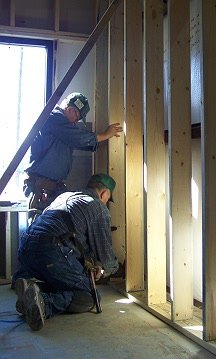
With a nailgun in hand, Marshall Rathbun, a volunteer from First Baptist Church in Center, works on the interior walls of Lake Athens Baptist Church. (PHOTO/Ken Camp)

“We had insurance, but thanks to these folks, we’re able to build a 16,000-square-foot building for the cost of a 10,500-square-foot building,” said R.B. Richardson, a charter member of Lake Athens Baptist Church.

With the foundation, steel frame, exterior walls and roof already in place, the TBM Retiree Builders focused on the building’s interior.

While the men worked on the construction project, their wives held a morning Bible study open to anyone in the community, and each afternoon, they worked on a craft project that will benefit children in remote mountain villages in Mexico.

“These volunteers are a breath of fresh air,” Green said. “Without their help, we would have had to go into debt to build that kind of facility. As it is, our new sanctuary will seat 100 more than before.”

Steve Jackson (standing) from Calvary Baptist Church in Midlothian and Charles Tompkins (kneeling) from First Baptist Church in Hallettsville work on framing out a room inside the new facility of Lake Athens Baptist Church. (PHOTO/Ken Camp)

Members of Lake Athens Baptist Church already knew firsthand about the TBM Retiree Builders’ capabilities. The group had worked on the church’s previous facility, and one of its members, Bill Campbell, has served with the builders about 20 years.

After the Retiree Builders complete two weeks in Athens, a volunteer building team from Green Acres Baptist Church in Tyler will complete any necessary interior finishing work.

Texas Baptist Men launched the Retiree Builders program in mid-1979. In addition to the church builders, other TBM construction groups specialize in cabinet building or projects at Baptist encampments. One Spanish-speaking team works with Hispanic churches, and TBM plans to launch a crew specializing in construction for cowboy churches.

Volunteers travel at their own expense and are housed in their own recreational vehicles. Retiree Builders complete 10 to 12 projects a year.

Average age of the volunteers on the Athens project is about 73—the youngest is about 60, and the oldest is 90, said Ron Beard, state project coordinator for the Retiree Builders.

Bill Pigott, state director of TBM Retiree Builders, notes economic downturns have taken a toll on the missions action program. About 200 couples are considered active with the group, and another 100 serve on occasional projects—down considerably from a high of about 400 couples 20 years ago.

“There’s no question we’re getting hit by the economy and delayed retirement,” Pigott said. “It also seems like there’s a different mindset among some people who reach retirement age now. So many feel like they’ve already done their part.”

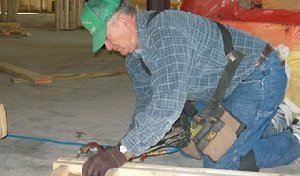
Charles Tompkins from First Baptist Church in Hallettsville works on framing out a room inside the new facility of Lake Athens Baptist Church. (PHOTO/Ken Camp)

If fuel costs continue to escalate, that could force some retirees on fixed incomes to limit their travel, as well, he added.

“Some of these folks spend everything they make from their Social Security check doing what we do,” Pigott said.

Even so, the group remains committed to its mission. After two weeks in Athens, some of the volunteers will begin work on a project at Mount Lebanon Retreat Center near Dallas, and others will travel to Camp Zephyr in South Texas.

Steve Jackson from Calvary Baptist Church in Midlothian drives nails on a TBM Retiree Builders project at Lake Athens Baptist Church. (PHOTO/Ken Camp)

“Our motive always is to share Christ with people. If all we have done is build, we’ve fallen short. We are called to be a witness,” Pigott said.

The witness of the volunteer builders—serving joyfully at personal sacrifice—left its mark on Lake Athens Baptist Church, as did the challenge of the last year, the church’s pastor noted.

“We are a stronger church because of it,” Green said. “Our people have responded in a very positive manner. And people in the community have taken notice of what’s going on here, asking us, ‘How is your church coming along?’

“I believe that up from the ashes, God is going to raise a mighty force of giving people, loving people to be his witnesses.”


Go here for more information on Texas Baptist Men Retiree Builders, or call Bill Pigott at (214) 707-4379.


Iron sharpens iron: Mentoring offers support

While a seminary degree can be an important component of a pastor’s toolbox, relationships with other pastors can be just as important—if not more so, according to some Texas Baptists who work with students preparing for vocational ministry.

Tim Skaggs (left), pastor of Coggin Avenue Baptist Church in Brownwood, has mentored three Howard Payne University ministry students—(left to right) Chase Woodhouse, Paul Deetz and Evan Henson. (PHOTO/George Henson)

But the mentoring relationship need not wait for graduation, and its genesis may be better suited before that first full-time position has been attained, they insist.

“It provides them with a support system,” said Don Williford, interim dean of Logsdon Seminary at Hardin-Simmons University in Abilene.

“They know there are people they can call when they face situations they have uncertainty about.”

For instance, when a pastor or staff member considers a change in ministry location, it can be comforting to have the voice of experience whispering in one’s ear, he noted.

Williford lacked that type of interaction when he was a student at Southwestern Baptist Theological Seminary years ago, he noted.

“When I had struggles in the local church, I had little to fall back on,” he said.

“My time in seminary prepared me well for doctrinal issues and those sorts of things, but for those things that pop up from time to time, I was largely on my own,” he recalled.

Mentoring constitutes a key part of the program at Baylor University’s Truett Theological Seminary, amounting to 12 hours of the degree program, said Robert Creech, director of pastoral ministries for the seminary.

Students choose a mentor in the field of ministry they plan to pursue, and they spend a full semester working with that person. The program presents a list of ministry competencies each student is to engage in during the semester.

The student not only meets weekly with his mentor, but also meets monthly with a lay committee.

{youtube}-gTQSG9ooEY{/youtube}

In addition, each student has about 2,000 pages of books and articles to read and respond to during the semester as part of the mentoring experience.

In each of his classes, Creech said, he stresses the importance of every minister finding a mentor during the first three months on the field when he or she secures a first full-time position.

The program at Truett helps them become accustomed to that type of relationship, he said.

“Having that kind of relationship provides a confidence that I can do this, and I’m not in it all by myself. I have people I can fall back on,” Creech said.

Often, a reverse-mentoring takes place as an added benefit, because the mentor is exposed to new ways ideas and perspectives, said Tim Skaggs, pastor of Coggin Avenue Baptist Church in Brownwood, who has mentored three Howard Payne University ministry students.

“It’s challenged my own way of thinking,” he said. “It’s forced me to evaluate why do I have a quiet time, why do I preach the way I preach, and in general, why do I do the things I do,” he said.

Skaggs tries to maintain a two-prong approach. On the one hand, he tries to cover some of the nuts-and-bolts of ministry—how to manage staff, how to run a staff meeting, how to make a hospital visit, how to relate to deacons, and how to conduct a baptism and the Lord’s Supper.

He tries to convey there is more than one way to do all those things, but how they are done will reveal the pastor’s personality—for good or ill.

The other part of the equation is more personal.

“I ultimately want to impress upon them the importance of the family. The church is not the top of your ministry list—your family is. If you win your community for Christ but lose your family, you’ve lost,” he said.

Skaggs also tries to impress upon the young ministers the importance of taking care of their own spiritual conditions and the value of spiritual rest.

Creech echoed that concern.

“There is so much to ministry that isn’t head knowledge. And one thing these mentoring relationships provide is an opportunity to wade out into deeper waters, but to know that you are safe, you have support,” he said.


Seminary gives association six months to vacate property (Updated)

FORT WORTH—Southwestern Baptist Theological Seminary notified Tarrant Baptist Association before Christmas it had six months to vacate its offices on the edge of the seminary campus. The seminary asserted the association was in violation of its affiliation agreement—in part because of perceived toleration of homosexuality by a member church or churches.

Tarrant Association Moderator Al Meredith contends the seminary lacks authority to take unilateral action, but he expressed hope the situation can be resolved and the association’s longtime fraternal relationship with the seminary be maintained.

However, a letter from Southwestern Seminary he received Jan. 18 indicated the seminary planned to pursue its claim on the property. Directors of the Tarrant Baptist Association executive board will discuss their response as part of a regularly scheduled Jan. 24 meeting, Meredith said.

Southwestern SeminaryThe association office received an initial  registered letter from Southwestern Seminary Dec. 10. The letter stated the association was in violation of its 1997 affiliation agreement, and it directed the association to vacate its property on James Avenue within six months. It also stated title on the property should revert back to the seminary.

In 1982, the seminary provided Tarrant Baptist Association land and the funds to build its office building, granting a 99-year lease on the property, Meredith explained. At that time, the seminary and association entered into an affiliation agreement stipulating the property would not be used for commercial activity, and the association and seminary would commit to remaining in theological harmony, he said.

In 1997, the property agreement was renegotiated, and Tarrant Baptist Association received the deed to the property, he said. “The affiliation agreement remained intact,” Meredith added.

According to the agreement, if any disagreement should arise between the association and the seminary, the matter should be resolved a three-member arbitration panel with one seminary representative, one associational representative and one party mutually agreed upon by both parties, he noted.

On Dec. 20, three associational representatives—Moderator-elect Meredith, Moderator Bobby Bridges and Leadership Development Director Becky Biser—met with Seminary President Paige Patterson and some of his staff to discuss the situation.

“We had a lengthy and amicable discussion,” Meredith said in an interview.

He noted during the discussion, Patterson commented that had learned information he did not have when the original Dec. 10 letter was delivered. He agreed to consider the matter further and discuss it with the seminary’s attorneys. However, the letter Meredith received Jan. 18 indicated the seminary would continue its original plan.

Patterson was not available for comment for this article.

In a Dec. 21 letter to pastors in the association, Meredith noted specific areas in which the seminary claimed the association was not in compliance with its affiliation agreement:

Toleration of homosexuality. While the 2000 Baptist Faith & Message takes a clear position against homosexual behavior, the seminary contends the association has a church or churches that do not comply with the statement of faith on that matter. “They feel this places them in a contradictory situation,” Meredith’s letter stated.

The Southern Baptist Convention cuts its historic ties with Broadway Baptist Church in Fort Worth in 2009 over its perceived acceptance of homosexual members. Last year, Broadway also withdrew its affiliation from the Baptist General Convention of Texas rather than face a challenge

Placement. The seminary asserted it had asked for—and had not received—assistance from the association office in helping students and faculty gain access to empty pulpits in the association.

Meredith’s letter also noted the seminary expressed the need for additional office space or a welcome center that could be housed in the offices Tarrant Association occupies.

"We hold the deed. We believe the property to be ours," Meredith said in an interview. "If the seminary needs the building, I'm sure we would be willing to talk about selling it to them for a fair market value."

Meredith acknowledged he was disappointed by the seminary's response. Even so, he insisted he and other associational leaders would continue praying for a win/win situation.

“If Tarrant Baptist Association wins and Southwestern Seminary loses, the kingdom of God loses. If Southwestern wins and the association loses, the kingdom loses. The matters of the kingdom are greater than either the seminary or the association. My prayer is that we do nothing to bring reproach on the name of Christ,” he said.  

“Tarrant Baptist Association has enjoyed a longstanding fraternal relationship with Southwestern Baptist Theological Seminary, and we want that to continue.”