What would Niebuhr do? Theologian’s legacy debated

PRINCETON, N.J. (RNS)—What happens when the contested legacy of America’s most famous 20th-century theologian meets the harsh political realities of the 21st? You end up with questions like whether Reinhold Niebuhr would support water-boarding.

It’s impossible to know what Niebuhr—arguably the preeminent public intellectual and American theologian from the 1940s to 1960s—would have said about the practice of torture by the United States in post-9/11 Iraq and Afghanistan.

Public officials and pundits from both the left and right lay claim to the legacy of noted 20th century theologian Reinhold Niebuhr and his concepts about Christian realism.

But such questions are hardly a surprise at a time when everyone from President Obama to Secretary of State Hillary Clinton to New York Times conservative columnist David Brooks see themselves as Niebuhr’s acolytes.

Nor are they a surprise when academics come together, as they did recently at Princeton University, and debate the long-term legacy of a figure claimed by both the political left and right, by religious and nonreligious alike.

A man who died in 1971 but has been heralded in recent years as “the man of the hour” deserves his praise, speakers agreed, but also has his limits.

Shaun Casey, who advised Obama on religious outreach during the 2008 campaign, believes the pragmatic Niebuhr who’s become so popular since 9/11 is often viewed as a straightforward disciple of “real-politick” rather than a Christian theologian who wrestled with questions of transcendence.

The richness of Niebuhr’s worldview—one that acknowledges the tragedy and limits of humanity while embracing a call for social justice—has been lost in the contemporary world, said Casey, who is writing a book on those he calls “Niebuhr’s children.”

“Today, you’re either Glenn Beck or Dennis Kucinich,” said Casey, an ethicist at Wesley Theological Seminary who spoke at the Princeton event, titled “The Niebuhrian Moment, Then and Now: Religion, Democracy and Political Realism.”

Gary Dorrien, who teaches at New York’s Union Theological Seminary, where Niebuhr held court more than three decades, said the problem in interpreting Niebuhr is that he “seemed to revel in dispiriting proclamations, such as, ‘The possibilities of evil grow with the possibilities of good.’”

What often is overlooked, Dorrien said, is that Niebuhr was “a passionate type who took his own Christ-following passion for justice for granted. For him, the love ethic was always the point, the motive and the end.”

Niebuhr’s contributions to modern Christian thought include a sense of “irony and paradox,” Dorrien said, as well as a well-honed sense of the “complex ambiguities inherent in all human choices.”

In other words, Niebuhr didn’t see a world that was easy to fit into a ready-made box.

The trouble with Niebuhr’s famed “Christian realism,” however, is that “it dropped the ball on economic justice after World War II. It left progressive Christianity without enough to say or do in its own language, in its own way, and for its own reasons,” Dorrien said.

Given Obama’s own professed embrace of Niebuhr, it was inevitable that the president’s record would be viewed through several “Niebuhrian” lenses.

Although Princeton scholar Jeffrey Stout couldn’t attend the conference, his paper delivered at the event was sharply critical of Obama and the president’s embrace of the politically pragmatic Niebuhr. Stout said Obama “isn’t a principled opponent of anything.”

“The current president came to national attention as a candidate enunciating principles of justice for the conduct of warfare, statecraft, the domestic economy and political change,” Stout said in his paper. “As soon as he described himself to an interviewer as a Niebuhrian, we should have known that the principles were nothing more than mushy sentiments to be thrown overboard at the first sign of rough weather.”

Stout later added that he’s studied Niebuhr and voted for Obama, but it’s more complex than that. “It’s time to start thinking seriously,” he said, “about what they leave out.”

Cornel West, a noted African-American religious philosopher who teaches at Princeton, reveres Niebuhr but acknowledged the many ways Niebuhr’s thought has been used to undergird political and religious conformity.

West, who has been critical of Obama on a number of issues, said Stout was “expressing something that’s being felt more and more. He’s onto something.”

But West said while he has been disappointed in Obama, “I also know what he’s up against. I want to protect him, respect him and correct him.”

There was little consensus on a Niebuhrian approach to modern dilemmas like water-boarding. Niebuhr was at once a moralist, a patriot and a pragmatist. Harvard Historian K. Healan Gaston said there’s little value in trying to speculate on what Niebuhr might say about specific current issues.

“Although Niebuhr’s way of thinking remains intensely relevant to the challenges we face, there are a wide range of discernibly Niebuhrian positions one might take on almost any contemporary issue,” she said.

“As an historian, I tend to regard Niebuhr as a creature of his own historical context who can inspire useful reflections on today’s issues—but should not be ventriloquized in relation to any of them.”



Missouri Baptists join support for Texas world hunger offering projects

DALLAS—Missouri Baptists soon will help Texas Baptists feed the hungry across the state and around the world by supporting the same hunger projects.

Churchnet, a ministry of the Baptist General Convention of Missouri, will encourage affiliated congregations to support the same hunger projects Texas Baptists do through the Texas Baptist Offering for World Hunger.

Engaging in the offering is part of Churchnet’s five-year emphasis called Share Hope, which encourages churches and their members to share their faith, minister in their communities and advocate on behalf of the poor, said Churchnet Executive Director Jim Hill.

“We want to help our churches make their members aware of hunger needs in their communities, our state and nation and around the world,” Hill said.

“We also want to help them understand the opportunities we have to address these needs as we partner with our Texas friends and Baptists from around the world through Baptist World Aid. We want to encourage Baptists to respond generously to the world hunger needs.”

The Texas Baptist Christian Life Commission, which facilitates and promotes the offering, recently voted to allow the Missouri convention to participate in the hunger offering. Although individuals outside Texas have given to the hunger offering, Churchnet is the first group outside Texas to participate in it.

“Missouri Baptists have decided to support the projects of the hunger offering, and the Christian Life Commission is excited to have this new partner in combating hunger,” said Ferrell Foster, associate director of Texas Baptists’ Advocacy/Care Center and coordinator of the offering. “Texas Baptists already were supporting some Missouri projects. Now Missourians will be supporting Texas projects.”

Hill prays that by partnering with Texas Baptists, hungry people will be fed, individuals who have yet to embrace the gospel will begin a relationship with Christ, and God’s kingdom will expand.

“Our partnership with Texas Baptists has been a great encouragement to Missouri Baptists,” Hill said. “Because Churchnet is a small, new network of Baptists, it is sometimes difficult for us to provide quality resources for our churches. Our partnership with Texas Baptists in the promotion of our world hunger offering has allowed us to provide our churches more resources as they promote the need in their congregations. The partnership has allowed us to be a part of a significant effort to make a real difference as we minister to the hungry in our world.

“We are grateful for our Texas Baptist brothers and sisters as we serve Christ together.”

In its last meeting, the CLC also made one other change to the offering. Historically, offering funds have been divided 25 percent to Texas projects, 15 percent to projects elsewhere in the United States and 60 percent to international projects. In February, the CLC changed those percentages to 25 percent Texas projects and 75 percent projects outside the state, without distinction between national and international recipients.

“As churches look to their own Jerusalem, Judea, Samaria and the far reaches of the globe, they are making more and more direct international connections,” Foster said. “As a result, we are having more requests to fund international anti-poverty efforts of our churches. The CLC wants to honor those requests by supporting them as much as possible through the offering.”

For more information about the Texas Baptist Offering for World Hunger, visit www.texasbaptists.org/ worldhunger.


Devastating fire results in new lives, new home for Calvert couple

CALVERT—Bobby Samford believes the fire that destroyed his house resulted in his receiving a new home—now and for eternity.

Charles Cole, director of missions for FIRM Baptist Area, and Pastor John Sell of Trinity Baptist Church in Calvert install the steps to a new home volunteers built.

“Really and truly, I’d have to say the house burning was the best thing that ever happened to us,” he said. “It doesn’t make any sense, but God moves in strange ways.”

His marriage was in danger of failing, and he was abusing alcohol prior to the fire that claimed his house a little more than three years ago, Samford said.

Samford and his wife, Nellie, were on a list of 10 people for whom Sybil Smitherman—an “evangelism warrior” as her pastor Ralph Powers described her—regularly prayed would come to faith in Christ.

Smitherman invited the Samfords for dinner one night after the fire, and she invited her pastor to the same meal. Tony Moye, then pastor of First Baptist in Calvert, presented the plan of salvation, and the Samfords accepted readily.

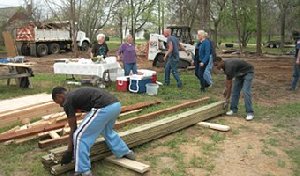
Volunteers William Luster (left) and Cory Chopp from Chapel Hill Baptist Church in Franklin move lumber at a building site.

“Since my house has burned, my life has done a 180-degree turn,” Samford acknowledged. “I can’t put it into words, but what the Lord has done for me is just wonderful.”

After the Samfords made professions of faith in Christ, they became involved at First Baptist Church in Calvert, where Powers now is pastor.

“He’s a tough guy, but he and his wife have such a sweet spirit. All they want to do is talk about Jesus. And guess who’s bringing the most people to church?” Powers said.

Smitherman provided the Samfords a $10,000 loan to help rebuild their home—a loan she forgave before her death. However, that amount was not enough to begin the project. So, the family has been living in a small trailer since the fire.

Reagan Reeves, associate director of missions for FIRM Baptist Area, holds decking in place while Pastor John Sell of Trinity Baptist Church in Calvert nails it to the frame of a new home built by volunteers.

Members at First Baptist Church discussed the possibility of trying to help the family, but at an estimated cost of $80,000 to repair the house, the project never got off the ground.

When the Samfords joined the FIRM Baptist Area’s mission trip last year to minister to Mescalero Indians in New Mexico, people in other local churches learned their story.

Bob Meeker from First Baptist Church in Thorndale got the ball rolling when the group returned to Texas, Powers recalled.

“Bob Meeker started spreading the need all over the association, and we had a project, but we still didn’t have any money,” Powers reported.

Building a new house proved to be considerably less expensive that repairing the 120-year-old home that burned, and materials for a new home were estimated to cost $30,000. An anonymous donor offered $20,000 at simple interest so the Samfords could repay the loan in about four years.

The project has blessed far more people than the Samfords, however, Powers said.

Members of First Baptist Church in Calvert provide a meal for volunteer builders from throughout the area.

“The beautiful thing is how it has impacted our community. We’ve had lots of people come by this project. We’ve had people hand us money. We’ve had people come by to be a part of the building,” he said.

FIRM Area Director of Missions Charles Cole noted one man stopped to ask about the type of siding used. When told, he responded that another type of siding was better quality and more attractive. Cole agreed, but the budget wouldn’t handle the expense of the better siding.

“He said, ‘If you’ll use it, I’ll pay for half,’” Cole related. “He’s not a member of any of our churches, but it gave him a chance to be part of something in his community.”

The project also has benefited churches in the four associations that comprise FIRM Baptist Area, Cole said.

“So many of our churches talk about missions, give to missions, but they don’t do missions, or if they do, they go far off. Here, we see what the local church can do in its own community,” he said.

Powers agreed.

“The short and sweet of this is that Bobby and Nellie could never have done this on their own, and not one church could do it. But all the churches in combination with each other—the 84 churches of FIRM Baptist Area—were able to do this,” Powers said.

“They were able to provide the labor and skills … to do this at no charge, but just out of love and fellowship. It’s a blessing for that to happen.”


Texas Tidbits: New Baylor VP

Haag new Baylor development VP. Baylor University President Ken Starr has appointed Jerry Haag vice president for university development, effective April 18. Haag has served since 2007 as president of Florida Baptist Children’s Homes, where he helped lead efforts that expanded the number of ministry sites from nine to 17 locations, launched an international child-care ministry and established numerous partnerships with churches and nonprofit organizations. From 2000 to 2007, Haag served as president of South Texas Children’s Home in Beeville. He also has taught at the university level and served on a church staff. Haag earned both an undergraduate degree and a master of business administration degree from Baylor, and he earned a doctorate in finance and real estate from the University of Texas at Arlington. He and his wife, Christi, have two sons, Ben and Brady. They are members of First Baptist Church at the Mall in Lakeland, Fla.

Miracle Farm names new executive director. Alex Hamilton has been named executive director of Miracle Farm, a residential boys’ ranch ministry near Brenham. He succeeds Jack Meeker, who retired Jan. 1 after more than 13 years as Miracle Farm’s executive director. Hamilton previously served as campus- life supervisor at Texas Baptist Children’s Home in Round Rock. Both the children’s home and Miracle Farm are part of Children At Heart Ministries. Hamilton has 14 years experience working with at-risk youth and their families and has supervised the residential campus-life program at the Round Rock children’s home since 2009. He is a licensed child care administrator, a licensed child placing agency administrator and a licensed professional counselor. A Dallas native who grew up in Round Rock, he graduated from Howard Payne University and earned a master of arts in family psychology degree from Hardin-Simmons University. He and his wife, Cyndi, have two children—Lexie, 9, and Eli, 8.

Baylor offers Bible exhibit & conference. Baylor University will mark the 400th anniversary of the King James Version of the Bible with an exhibit of rare Bibles and manuscripts, as well as a conference featuring internationally recognized scholars. More than 100 items—including a Dead Sea Scroll and an illustrated Gutenberg Bible—will be exhibited in the Hankamer Treasure Room at Baylor’s Armstrong Browning Library. Hours for the free exhibit are 9 a.m. to 5 p.m. April 7-8, and 10 a.m. to 2 p.m. April 9. Baylor’s Institute for the Studies of Religion will sponsor the conference, “The King James Bible and the World It Made, 1611-2011,” April 7-9 at Truett Theological Seminary. Speakers include Mark Noll from the University of Notre Dame, David Bebbington from the University of Stirling in Scotland and Robert Alter from the University of California at Berkeley. Cost is $175 for general registration and $75 for students. Deadline for registration is March 31. For more information on the conference, call (254) 710-7555, e-mail KJV400@baylor.edu or visit www.isreligion.org/events/400-years-of-the-king-james-bible/.


On the Move

Robbie Boyd has resigned as minister of education and spiritual formation at First Church in Snyder. He is available as interim pastor or education minister at (325) 574-0286.

Kelsey Coleman has resigned as pastor of First Church in Midway.

Amy Cornish to Cross Pointe Church in Texarkana as children’s minister.

Jack Faulkner to Greenvine Church in Burton as pastor.

Robb Havens to Church at Sheppard in Wichita Falls as campus pastor.

Ben Prater to Church at Sheppard in Wichita Falls as praise & worship leader.

Jennifer Stuhan to Church at Sheppard in Wichita Falls as director of preschool and children’s ministry.

Danny Quintanilla has resigned a strategist working in the Houston area with the Baptist General Convention of Texas. He is available for supply or interim work and can be reached at broq51@gmail.com.


Faith Digest: Airline apologizes

Airline apologizes to Orthodox Jews. Alaska Airlines issued an apology for misinterpreting the devotional behavior of three Orthodox Jewish men on a flight from Mexico City to Los Angeles. The men had strapped on tefillin—black leather bindings and boxes worn on arms and heads during ritual prayer by some Jews—and were praying in Hebrew, ignoring requests from crew to remain seated during turbulence. Two of them visited the restroom while the third seemed to be “standing guard” in the aisle during the flight, which appeared suspicious, according to the airline’s statement. Flight attendants locked down the cockpit and radioed a security alert to the airport, where emergency personnel and law enforcement met the plane. The three men were questioned and released with no charges filed. Alaska Airlines will incorporate Orthodox Jewish practices into its diversity training and work with the Jewish Federation of Greater Seattle to avoid such misunderstandings in the future, officials said.

Adventists see rapid growth. With Saturday worship services and vegetarian lifestyles, Seventh-day Adventism owns a distinctive niche outside the Christian mainstream. But being different is turning out to be more of an asset than a liability for the Seventh-day Adventist Church, the fastest-growing Christian denomination in North America. Newly released data show Seventh-day Adventism growing by 2.5 percent in North America. Adventists are even growing 75 percent faster than Mormons (1.4 percent), who prioritize numeric growth. But despite its roots in North America, the Seventh-day Adventist Church is growing twice as fast overseas. North America is home to just 1.1 million of the world’s 16 million Adventists.

Museum restores Jefferson’s Bible. A Smithsonian museum is restoring the “Jefferson Bible,” a unique volume the third president cut and pasted himself, omitting supernatural elements from portions of the New Testament. Thomas Jefferson assembled the book, The Life and Morals of Jesus of Nazareth, in 1820 when he retired after two terms as president. Conservators at the Smithsonian’s National Museum of American History will repair the fragile book’s torn pages. The project, paid for by private and federal funds, will cost about $225,000. The Smithsonian’s librarian purchased the book from Jefferson’s great-granddaughter for $400 in 1895, said museum spokeswoman Valeska Hilbig.

Religious violence linked to Antichrist. Violence committed in God’s name is a tool of the Antichrist, Pope Benedict XVI writes in a new book on the life and teachings of Jesus. “Violence does not build up the kingdom of God, the kingdom of humanity,” Benedict writes. “On the contrary, it is a favorite instrument of the Antichrist, however idealistic its religious motivation may be. It serves not humanity, but inhumanity.” The passage appears in Jesus of Nazareth—Holy Week: From the Entrance into Jerusalem to the Resurrection, published in eight languages, with an initial printing of 1.2 million copies.


Around the State

Men from churches in the Abilene area will share their faith in prisons in Abilene, Colorado City, Haskell and Snyder April 14-16 as part of a Weekend of Champions event. David Cason, pastor of Broadview Church in Abilene, is chairman of the effort.

Steve Wyrick, professor of Christian studies, will discuss “The Archaeology of Egypt” at an April 14 noon ministers’ forum at the University of Mary Hardin-Baylor.

Two mission teams from Adamsville Baptist Church served in mid-March in Laredo-area colonias. Pastor Kelly Wolverton planned a gardening project in consultation with Mario Garcia, River Ministry coordinator for the area. The Adamsville group delivered a tractor and other farm equipment, gardening tools, seeds, piping for water, two puppies and about two-dozen chickens. A second team from the church built bunk beds for children in the colonias.

Deborah McCollister, professor of English at Dallas Baptist University, is teaching world literature and writing classes at LCC International University in Lithuania this school year as a Fulbright scholar. She has taught at DBU 10 years.

Krista Piferrer has been promoted to executive vice president of external affairs of Baptist Child & Family Services. She will oversee government relations, media communications, public relations and donor development. She has been vice president of communications since 2008.

Anniversaries

Liberty Church in Bridge City, 20th, April 9-10. Saturday will be a family fun day with games, hot dogs and special music at 4 p.m. Rusty Walton will preach Sunday morning, and a meal will follow the service. William Collier is pastor.

Retiring

Don Howren as minister of music at First Church in Texarkana after 30 years of ministry there.

Deaths

Emmett Johnson, 82, Jan. 31 in Birmingham, Ala. He was the first administrator of High Plains Baptist Hospital in Amarillo, where he served 12 years. He retired from Baptist Health System in Alabama in 1994 after 19 years as chief executive officer. He was preceded in death by his twin brother, Rufus. He is survived by his wife of 60 years, Anna Belle; daughter, Gay Lynn Johnson; son, Galen; brother, Johnny; and one granddaughter.

Dot Dietrich, 82, Feb. 28 in Tulsa, Okla. She and her husband, Vernon, served more than 30 years as missionaries to Thailand with the Southern Baptist Foreign Mission Board. Prior to their move to Oklahoma six years ago, they lived in Spring. She is survived by her husband of 59 years; daughters, Pat King, Debbi Faith and Melinda King; son, David; brother, A.C. Rolen; sister, Betty Eli; and four grandchildren.


Texas Baptist disaster response team scheduled to go to Japan

DALLAS—Two veteran Texas Baptist Men disaster relief volunteers, a Japanese Dallas pastor and a videographer are slated to leave for Japan March 24 to assist the disaster response effort there and look for places where Texas Baptists can serve.

This initial Texas Baptist team to Japan originally was scheduled to leave March 19, but disaster response leaders decided to postpone the trip due to the unstable nuclear plants in the disaster area.

BGCT Japan Relief“Although there is still some concern about the power plant in northern Japan, we believe there is an urgent need to at least get our team into Tokyo, which is 150 miles from the Fukushima facility,” said Chris Liebrum, coordinator of disaster response for the Baptist General Convention of Texas. “In Tokyo, they will be able to meet with the leadership of the Japanese Baptist convention and begin to discover ways that Texas Baptist can support and serve them in the recovery."

Members of the team are Texas Baptist Men disaster relief veterans John LaNoue and Gary Smith and Yutaka Takarada, pastor of Japanese Baptist Church of North Texas, accompanied by BGCT videographer Rex Campbell.

The team’s planned departure is the most recent action taken by Texas Baptists in helping victims of the March 11 earthquake and subsequent tsunami.

The BGCT has sent $25,000 to the Japan Baptist Convention to help with the response effort, and Texas Baptist Men has sent $5,000 to help pay for fuel costs. The convention is in the process of sending requested Geiger counters and potassium iodide pills to the Japan Baptist Convention. Both the convention and Texas Baptist Men regularly are visiting with Japanese Baptist  and Baptist World Aid leaders, Southern Baptist representatives in the region and Cooperative Baptist Fellowship officials.

For updates on the situation, visit www.texasbaptists.org/disaster . To give to Texas Baptists disaster response, visit www.texasbaptists.org/give . One hundred percent of donations will support disaster response efforts.


Rescue workers, Japanese Baptists describe dire situation

WASHINGTON—A Baptist World Aid disaster response team who visited Japan, described the challenge of getting food for people who had evacuated their homes in the wake of an earthquake and tsunami and the threat of nuclear radiation as "almost Mission Impossible."

The BWA Rescue24 team — including rescue, medical and humanitarian relief specialists from Hungary and North Carolina — reported seeing houses that were completely washed away, cars and trucks lying upside-down, and railway wagons and boats carried to farmlands and gardens.
 

BWAID

Baptist World Aid team delivered supplies for relief centers in Sendai, Japan.

Bela Szilagyi,leader of the Rescue24 team, said the city of Sendai "was calm and the spirit of the people was shaken but firm."
 
The Baptist World Aid rescuers saw cars lined up in one- to two- kilometer long queues, in addition to dozens of persons standing with fuel balloons waiting for three to four hours for fuel.

"More than 450,000 people had to leave their homes in the whole northeast region due to the earthquake, tsunami and the nuclear explosions," Szilagyi reported.
 
They visited the Katahira evacuation center where approximately 400 persons were in the gymnasium and classrooms of a primary school. The team observed a need for food, water and electricity. Baptist World Aid Rescue24 helped to provide instant noodles, but indicated that "it was almost Mission Impossible to procure food for the evacuees. All the stores we saw were closed in Sendai, a city with a population of 1 million."
 
There are four Baptist World Alliance member bodies in Japan — the Japan Baptist Conference, the Japan Baptist Convention, the Japan Baptist Union, and the Okinawa Baptist Convention with a total membership of more than 42,000 in more than 450 churches.
 
Makoto Kato, executive secretary of the Japan Baptist Convention wrote that "we are deeply worried about the safety of those thousands whose lives have been disrupted and are suffering from the shock, the cold, the wetness, and the lack of shelter and food." He explained that "even the cities and towns in this region that did not experience much direct damage from the earthquake have still lost electrical power, gas, and water supply, causing a miserable situation for people during this cold weather."
 
"Japan Baptist brothers and sisters are anxious to provide relief supplies and relief work to help the thousands of victims," he continued, but "the vastness of the provinces that have been damaged is overwhelming, compounded by the disruption in transportation, including trains, planes, ships, and roadways. We are anxiously waiting for a means to travel to the stricken area."
 
The Japan Baptist Convention was holding a mission workshop  when the earthquake occurred, Kato noted. 

"During the closing worship, we experienced the tremors of the huge earthquake," he said. "With transportation down, most of the workshop participants and leaders were unable to travel to their homes, but were able to spend the night in the warm, safe JBC building."

The morning after the quake, "we gathered to have an urgent prayer meeting for the victims of this disaster," he recalled. "One by one, the participants were able to return to their respective cities."
 
Kato asked Baptists everywhere to "pray for the efforts to rescue the many isolated people who are suffering in the freezing cold, waiting to be saved from the debris wrought by the earthquakes, aftershocks, tsunami, and fires." He asked for prayer that "the Lord will provide his peace, comfort and hope for the thousands of persons experiencing grief, despair and emotional pain," and that God will provide a means for dedicated Baptist men and women to serve in the disaster area.
 
Makoto Tanno, general secretary of the Japan Baptist Union expressed gratitude for the concern and support from Baptists around the world. "We thank you for your prayer and concern for the earthquake attack in Japan," he wrote to Baptist World Alliance General Secretary Neville Callam. "It is very encouraging for us to receive a message from you. … We need your help and prayer."
 
About half of the 14 Japan Baptist Union churches along the coast were destroyed or badly damaged, and numerous Baptist church members have been unaccounted for. Japan Baptist Convention was able to make contact with only two of its four churches that are in Sendai.
 
Baptists from around the world have expressed support for Japan. Joel Dorsinville, coordinator for disaster relief for the Haiti Baptist Convention told Baptists in Japan that "the trial of the Japanese people is bringing back to us sad memories of January 12, 2010, (date of the massive earthquake in Haiti) but at the same time it is reminding us of the worldwide solidarity of the great Baptist family through Baptist World Alliance."

Dorsinville told Japanese Baptists that "we are praying that our Baptist brothers and sisters in Japan may be assured of the solidarity in prayers of their brothers and sisters in Haiti."
 
Regina Claas, general secretary of the Union of Evangelical Free Churches (Baptists) in Germany, wrote: "I want to express my sincere sympathy to you – our fellow Christians in Japan. The German Baptists are deeply shocked about the disaster that has struck your country." Claas, a vice president of the BWA, said, "We are also ready to assist you in whatever way possible, through the network of the Baptist World Alliance. As Christians we are a worldwide community standing strong for each other — connected to the Lord who is in control over every situation."


Missionaries grapple with leaving Japan

TOKYO (RNS)— Across Japan and back home in the United States, missions leaders are grappling with whether personnel should stay put or move away, either to other parts of Japan or out of the country entirely.

The Southern Baptist Convention International Mission Board moved its representatives in eastern Japan to a region southwest of Tokyo.

“The safety and security of our personnel is very important,” board spokeswoman Wendy Norvelle said. “We are also mindful of the Japanese people and want to minister to them in any way we can.”

Wolfgang Langhans, a Tokyo-based field director for missionaries, called the week after an earthquake and tsunami hit Japan “the busiest and most stressful week of my life.” But when those twin crises created a third—the threat of dangerous radiation leaks from a damaged nuclear plant—the balancing act between living out a missionary calling and keeping safe became particularly difficult.

“That was and still is a great concern,” said Langhans, a German Baptist who works for the group OMF International, which has some 100 missionaries in Japan.
“We constantly inquire about the latest news and advice and have prepared evacuation places in the west of Tokyo should radiation danger reach Tokyo,” he said in a March 18 e-mail between rolling power blackouts.

His organization left evacuation decisions up to individual staffers. So far, seven had decided to leave Japan.

The Lutheran Church-Missouri Synod has relocated three missionaries from Tokyo to Kobe, in southern Japan. Two others in the western city of Niigata are not being moved. “The move is more of a precautionary measure as the situation has worsened given the nuclear crisis,” spokeswoman Vicki Biggs said.

Other groups had determined they were far enough from the nuclear complex to continue their work. Several Catholic orders, for example, are staying put.

The three-pronged crisis in Japan is prompting unusual challenges for missionaries, said Todd Johnson, director of the Center for the Study of Global Christianity at Gordon-Conwell Theological Seminary.

“Missionaries in general, who are tied very closely to local situations, are often the last people to leave or to evacuate,” he said.

“Tsunamis and earthquakes and even war or pestilence—they historically have been the very last people to go because this is their home, so to speak, where they work. But radiation is just a completely different thing.”

Johnson’s center estimates that there are about 8,000 missionaries, or 63 for every 1 million people, in Japan. That compares to Singapore, with about 218 per million, and India with about seven per million.

Marvin Newell, executive director of CrossGlobal Link, a Wheaton, Ill.-based network of mission agencies, said staffers who choose to stay in a potentially dangerous situation often are required to sign a release form.

“The litigation that could follow in something like this is a very big concern, and that’s why missions are trying to be as prudent as possible,” said Newell, who could not recall in 32 years of mission work a previous need for contingency plans in Japan.


Slain Arlington pastor’s ‘whole life really was newsworthy,’ friends insist

ARLINGTON—Family and friends of Pastor Clint Dobson choose not to dwell on the circumstances of his death. Instead, they celebrate a life well-lived and remember a man whose actions demonstrated an unswerving love for God and people.

Dobson, 29, was killed, and robbers at NorthPointe Baptist Church beat his 67-year-old ministry assistant, Judy Elliott, March 3. Her condition has not been released at her family’s request.

Clint Dobson

Robert Creech, Dobson’s pastor at University Baptist Church in Clear Lake from the time he was 4 years old until he left for Baylor University, remembered Dobson as a little red-haired boy “who looked like he stepped right out of a 1960’s sitcom. He was just a good young kid.”

“It was sad,” Creech said, “that his life only became newsworthy when he was murdered, because his whole life really was newsworthy.”

Jeff Waldo, minister of missions at University Baptist Church, recalled Dobson’s return to the Houston area to work as a missions intern for the church engaged in apartment ministry. He remembered how he saw Dobson mature spiritually.

“It was a time to see a little red-headed boy was growing into a handsome young man with ministry skills to relate to a variety of people—young, old, rich, poor, those who were well and those who were sick,” Waldo said.

A summer internship living among the poor produced a great burden for the poor in his heart, he said.

“He was embodying incarnational ministry and gaining his own voice, as well as insights that could not be gained from books or classes,” Waldo said.

“Clint Dobson’s life was lived well. Whatever he did, he gave his all and his best. He exemplified the best with his example. His brilliance was always cloaked in his friendliness, and what time he lived, he got it right. He loved people, he loved God and was able to communicate God’s love with clarity.

“Clint had a big heart, but the truth is, he had the ability to get into the hearts of others—getting into our hearts, into my heart.”

Daniel Goodman, a friend since they both were in elementary school, said Dobson was full of life and fun. The two talked almost daily on the telephone, he noted.

“To Clint’s friends, he was thoughtful, curious, caring and intelligent. Clint was without a doubt the most fun-loving person that I knew, and hanging out with him was even more fun than talking with him on the phone,” Goodman said.

“It didn’t matter what you were doing with Clint. He could get very into it, and it was fun, as a result.

Dobson’s roommate at Baylor’s Truett Theological Seminary, Brady Herbert, knew a man devoted to God and ministry.

“He had an unmatched heart and mind for God,” Herbert said. “He had that rare combination of a love for truth and a love for people.

“Clint had a sharp, sharp mind. He naturally had a mind for comprehension and could navigate serious and deep theological concepts seemingly with ease. When he came across the tough questions our world offers us, he had the courage and integrity to say, ‘I don’t know.’

“Quite simply, Clint was someone who loved God with all his mind. But he didn’t leave it there. He’d not allow his love for Scripture to stay in his mind—it sunk deep into his heart and out into his hands and into his feet. He had a heart that was even bigger than his impressive mind.

“He made thousands upon thousands of sacrifices for those around him because of the love that compelled him through Jesus Christ.”

At a memorial service for Dobson, Herbert and every other speaker spoke of Dobson’s love for people in general and of his devotion to wife, Laura, in particular.

“But Clint had one passion that stood above the rest of all those things he loved and that was Jesus Christ,” he said. “Clint’s live was lived to love Jesus and make him known to all he came into contact with.”

A video of Dobson's "celebration of life" service can be viewed here.


Critics complain about Calvin’s influence on SBC Pastors’ Conference

LAS VEGAS (ABP) — The president for the 2011 Southern Baptist Pastors’ Conference defended a program he’s put together for June 12-13 in Phoenix, Ariz., saying critics who find it outside the convention’s mainstream hold too narrow a worldview.

“The Kingdom of God is bigger than Southern Baptists,” said Vance Pitman, 2011 Pastors’ Conference president and pastor of Hope Baptist Church in Las Vegas, a church plant in partnership with First Baptist Church, Woodstock, Ga., and the North American Mission Board of the Southern Baptist Convention.

Vance Pitman

“The main intent of our conference is to communicate the big picture of the Kingdom of God,” Pitman said in a telephone interview March 18. “God is alive and at work all over the world. We as the Southern Baptist Convention are one very small part of that.”

The Pastors’ Conference has long been a barometer for Southern Baptist theological weather patterns and a launching pad to the SBC presidency for its leaders. Consequently, although it is not an official organization of the SBC, its direction is closely monitored.

Negative reaction has included placement on the worship team of Jamar Jones, executive director of music and fine arts at the Potter’s House Church of Dallas. That is because he is on the ministerial staff of T.D. Jakes, who critics claim holds to the heresy of “modalism.”

Modalism, a non-Trinitarian view that Father, Son and Holy Spirit are three different aspects, or modes, of one God rather than three distinct, co-equal and co-eternal persons, was first condemned as heresy in the fourth century but is held by some Pentecostal and Apostolic churches today.

Dwight McKissic, an African-American pastor in Arlington, Texas and former trustee of Southwestern Baptist Theological Seminary who advocates greater inclusion of minorities in convention life, said that even though he doesn’t think Jakes is a heretic that the pastor was the real target and Jones “a casualty of not so friendly fire from fellow Kingdom soldiers.”

Jones, a boyhood friend of Pitman’s worship arts pastor, withdrew to avoid controversy, a move that McKissic called “tragic, sinful and shameful” because Southern Baptists “missed an opportunity to bridge an obvious racial divide and to fellowship with a Kingdom saint who is not of the SBC fold.”

People Pitman trusts tell him “Jakes is not a modalist.” Besides, Pitman said, his books are for sale in SBC bookstores. “How ridiculous is it that we can sell his books but his music guy can’t play piano at our meeting?” he asked.

Others have protested inclusion of speakers who are prominently recognized as Calvinists and the fact that the Pastors’ Conference is heavily subsidized by the SBC operating budget.

While Calvinism is now the de facto systematic theology of Southern Baptists’ oldest seminary, and the favored perspective of an increasing number of young pastors, the majority of Southern Baptists reject the “particular” nature of Calvinism that says Jesus died only for those “elected” for salvation before the dawn of creation and not the “whosoever will” that Baptists traditionally hold dear.

Included among speakers is Acts 29 Vice President Darrin Patrick. Acts 29 is a church planting network linked to the “emergent church,” a movement that presents the gospel in culturally relevant ways that critics call theological compromise. Mark Driscoll, pastor of Mars Hill Baptist Church in Seattle and Acts 29’s founder and leader, was the target of eight negative motions at the 2009 Southern Baptist Convention meeting in Louisville, Ky.

Also on the docket is John Piper, pastor of Bethlehem Baptist Church in Minneapolis, not affiliated with the Minnesota-Wisconsin Baptist State Convention or the Southern Baptist Convention. His writings have been a strong influence among young Calvinists.

“We are wandering in a wilderness in our current SBC life,” said blog writer Ron Hale. “Our leaders are hyper on Piper; LifeWay materials encourage our people to visit Mark Driscoll’s website to download his sermons … and we have a couple of ACTS29 guys preaching.”

Pitman termed accusations that he has put together a “Calvinist” conference “beyond my wildest imagination.” He pointed out the lineup includes well known non-Calvinist preachers like former SBC President Johnny Hunt and nationally prominent pastor Rick Warren.

“The vein that unites all of them is that they are all practitioners,” Pitman said. “They are all engaging nations and planting churches.”

Pitman, exasperated at what he feels is unmerited criticism for a conference lineup that will inspire pastors and give them an encouraging view of God’s work in the world, agrees it is important for believers “to be defenders of the faith.”

There is a difference, however, “in being discerning and in having a judgmental spirit.”

Other questions have been raised related to conference expenses. While the public image is that the independent organization pays its own way, and offerings are collected each session to “cover” conference expenses, in fact the SBC heavily subsidizes the meeting, first held in 1935.

The Pastors’ Conference reimburses the SBC $38,000 — as it has since 1992 — to reimburse expenses for additional use of the meeting hall, shuttle buses, audio visual expenses and security. In 2012 that amount will increase to $50,000.

SBC Executive Committee records show that the SBC operating budget covered $141,549 of Pastors’ Conference related expenses in 2010, in addition to the $38,000 reimbursement received from the conference participants. 

Pitman says in a series of video presentations at www.sbcpc.net that this year’s “expenses” already are covered by sponsors. All offerings received at the meeting will be dedicated to translate the “Jesus” film for evangelistic use in the Arabian Peninsula and to start pastor’s conferences on two other continents, reaching and training pastors in as many as 20 countries.

“Diamond level sponsorships” costing $10,000 each are listed at the website. They include through March 21 the North American Mission Board, Crossway and LifeWay, three SBC entities. Others are LOGOS Bible Software, Maranatha Tours, Dayspring International, Ministry Partners Investment Co., CCL Associates real estate development and investment, Life Action Ministries ConnectionPower.com, Institute for Creation Research and ImpactStewardship Resources.


Norman Jameson is reporting and coordinating special projects for ABP on an interim basis. He is former editor of the North Carolina Biblical Recorder.