When to celebrate Easter

Among the many controversies in the Early Church over the complex question as to how to settle the date of Easter (the Christian “Passover” or “Pasch”) were:

1) Whether Easter should be observed after the Jewish manner, on a fixed day of the lunar month (14 Nisan) or always on its following Sunday. The former practice was the ancient tradition in Asia Minor (Quartodecimanism).

2) The divergences arising from the Antiochene and Alexandrian (North African) methods of determining the “Paschal Moon,” the Antiochenes being content to accept the Jewish reckoning, whereas at Alexandria an independent calculation was made. According to Alexandrian practice, Easter was always settled after the vernal equinox. The decision at the first Ecumenical Council of Nicea in 325 favored the Alexandrian position, except for a small group of schismatics who did not accept the decision.

In these days, the two major theological schools, one in Alexandria and the other in Antioch, vied for prominence, theological orthodoxy, and increasing influence, which observers may note from studying the first four Ecumenical Councils of Nicea-325, I Constantinople-381, Ephesus-431 and Chalcedon-451. Eventually, this region followed Constantinople’s growing influence and direction rather than Rome’s, and resulted in a split that took place in 1054 between the Western and Eastern halves of the Christian world – a split that still exists today between the Eastern (Orthodox traditions) and Western (primarily Roman Catholic tradition) halves.

In the first four centuries, Rome developed its own ecclesiastical traditions and influence and indeed, until the 4th Ecumenical Council in 451, Rome and the Alexandrian and Antiochian schools were somewhat independent of each other. In fact, virtually no Roman pastors or theologians attended the first two of Ecumenical Councils above, and not many attended the third. Rome doesn’t even count the Ecumenical Councils in exactly the same way as ther Eastern churches do. So, it is no surprise that Easter and dating were calculated differently as well. This was just one of the places where their practices were varied.

3) Differences in the 4th and 5th centuries between the Roman and Alexandrian methods of computation, through the use of divergent “paschal cycles.” The Alexandrians favored the long and accepted Anatolian 19-year cycle, whereas Rome used an older 84-year cycle.

Furthermore, while the Alexandrians allowed Easter to be kept on the 15th of the month if a Sunday, it was never observed at Rome before the 16th century; also, the latest date for observing Easter at Alexandria was 25 April, but at Rome, the 21st was the latest date. We learn from Ambrose that Easter in 387 was observed in Gaul (France) on 21 March, in Italy on 18 April, and in Alexandria on 25 April.

From the 5th century, Rome increasingly followed the Alexandrian computation, which was adopted in the West by Dionysius Exiguus in 525; but as late as 455 there had been seven days’ difference between the Alexandrian and the Roman Easter.

In Great Britain, Scotland, Wales, and Ireland, one of the differences between practices of the “Celtic Christians” and those of Rome, who came into the regions as missionaries, was the dating of Easter for the same reasons as described above. The Celtic Church celebrated Easter on a different day than did the Western Church. Instead of using the same calculation tables as the European Church, the Celts used an ancient set of tables (Celtic-84), first established by Jerome and not updated until the 6th and 7th centuries. In fact, Bede tells us in his Ecclesiastical History, based upon eye-witnesses who actually attended the Council of Whitby in 664, that as late as 651 Queen Eanfleda, who followed the Roman rule, was keeping Palm Sunday and fasting on the same day that her husband, King Oswy of Northumbria, was celebrating Easter. In three separate councils, the most important of which was the Council of Whitby in 664, portions of the Celtic Church exchanged the Western tables for their own calculations in order to conform to the same Easter Day celebrations as the West. Abbot Theodore did the same for all of England in 669. By 716, Iona finally did the same, the last stronghold for the older pattern.

4) Until the time of Charlemagne, leader of the Holy Roman Empire (c. 742-814), considerable uncertainty existed in Gaul (France) owing to the adoption of Victorius of Acquitaine’s Paschal Tables (drawn up on Rome in 457 but never much used in the city) with their cycles of 532 years.

Why did all of this matter?  And why all the disputes?  Because the Feast of the Resurrection of Christ was the greatest and oldest feasts of the Christian Church, with all of its accompanying liturgy that prepared the believer, through Lent, Passiontide, Holy Week, and Paschaltide (following the Resurrection), with prayers, special services, and masses. Some parts of the Church practiced baptisms just at Easter each year, and kept watches through the night until the breaking of dawn and the baptism service. Some kept similar vigils through the long night before Easter morning. Some illuminated their churches or towns to celebrate the Resurrection. Some celebrated the first service of Easter on the Saturday night-Sunday morning, and others waited until the morning of Easter to start the joyous bell-pealing.

Today, we can hardly imagine the difficulty of traveling pastors, laypersons, and shared leaders to conduct seamless ministry among the varied expressions of the Church calendars, not to mention the languages of Greek and Latin, in which the two sides conducted ministry. So . . . it was considered extremely important, particularly as written forms of liturgy were shared among the churches, to unify the Church so that liturgies, celebrations, and discipleship training, could be conducted with one heart, mind and calendar.

Unfortunately, this confusion over Easter’s observance is but one of the carryovers of a severed Church. 

 —Karen Bullock, professor of Christian heritage at the B.H. Carroll Theological Institute. Her response pulls together material from multiple sources, with particular reliance on the Oxford Dictionary of the Christian Church, F. L. Cross and E. A. Livingstone, editors.


Baptist Briefs

D.C. convention elects executive director. Ricky Creech, a former Southern Baptist church-and-community missionary and associational director of missions and more recently on the staff of a Georgia United Methodist church, was elected executive director of the District of Columbia Baptist Convention. The unanimous candidate of the search committee, Creech was endorsed by the convention’s executive committee, but the full board voted 35-28 with one abstention to call him. With 153 churches, the D.C. convention is unique in its affiliation with three denominational bodies, plus the Cooperative Baptist Fellowship—American Baptist Churches USA, the Southern Baptist Convention and the Progressive National Baptist Convention. Creech, 47, is a graduate of Furman University and Southern Baptist Theological Seminary. He succeeds Jeffrey Haggray, who resigned in 2009 to become pastor of First Baptist Church in Washington.

Registration open for SBC children’s programs. Registration is open for families to enroll their children in preschool childcare and the children’s conference in conjunction with the Southern Baptist Convention annual meeting in Phoenix. Childcare for newborns through 3-year-olds will be available June 12-15. There is a nonrefundable registration fee of $10 per child for preschool care, in addition to $5 per-child session fees for the convention. To register, visit www.sbcannualmeeting.net. The deadline for preschool childcare registration is June 1 and is limited to 150 children per session. Children ages 4 to 12 can participate in the children’s conference at the SBC annual meeting. The cost for children ages 4-6 is $50 per child for the four days of the children’s conference, Sunday evening through Wednesday, $45 per child registered Monday through Wednesday and $40 per child for Tuesday through Wednesday. Specific information about the Fuge camp for grades 6 through 12, yet to be released, will be posted at www.sbcannualmeeting.net. Questions about the children’s conference program can be phoned to Children’s Conferences International at (317) 447-8213 or (586) 879-8421 or e-mailed to info@childrensconferences.com. The deadline for enrollment is June 1 and is limited to 400 children.

Church historian Gaustad dies. Prolific author, influential historian and lifelong Baptist Edwin Gaustad died March 25 in Santa Fe, N.M. He was 87. Gaustad, professor emeritus of history and religious studies at the University of California, Riverside, was one of America’s leading experts on America’s colonial period, particularly in areas of religious liberty, pluralism and dissent. His books include A Religious History of America, Dissent in American Religion, Baptist Piety: Last Will and Testament of Obadiah Holmes, Faith of the Founders and Liberty of Conscience: Roger Williams in America. Gaustad was born in Iowa but grew up Houston. After military service, he graduated from Baylor University and completed his graduate work at Brown University. His teaching career took him from Shorter College in Rome, Ga., to the University of Redlands in California and finally to the University of California, Riverside, where he remained until retiring in 1989. Gaustad was married for 63 years to Helen Virginia Morgan, who died in 2009. Survivors include three children, four grandchildren and one great grandchild.


Beach Reach takes gospel to spring revelers

SOUTH PADRE ISLAND —Well past midnight, a 15-passenger van with the Angelo State University Baptist Student Ministry team pulled up in front of one of the most popular bars on South Padre Island, where thousands of students party each night during spring break.

A spring breaker rejoices after being baptized in the Gulf of Mexico.Sixty-six students were baptized in the Gulf the last day of Beach Reach—44 of whom came to faith in Christ directly as a result of the Beach Reach witness. (PHOTO/Kaitin Warrington/Texas Baptist Communications)

A security guard flagged down the van and explained that Mandy, a 17-year-old girl, needed a ride since her friends had ditched her because she wouldn’t try ecstasy with them. Mandy, confused and hurt by the situation, wanted to get away from the party scene.

Once on the van, the ASU group started chatting with her, trying to calm her down and assure her they were there to help. They discovered she was a Christian but had slipped away from following Jesus. By the time the group had driven to her hotel, Mandy had prayed for a renewed focus on Christ.

“God did amazing things in Mandy’s life,” said Garrett Day, a junior at ASU. “She has changed and is now following the Lord. … I definitely saw change in her life and brokenness. Now she is just beginning to explore who God is and his word.”

Mandy’s turn toward God is just one example of the life-changing and intentional ministry that takes place during Beach Reach, a weeklong mission trip to the spring breakers at South Padre Island.

Student prays in preparation for ministry during Beach Reach.

Young men from the Rio Grande Valley enjoy pancakes in front of one of the most popular bars on South Padre Island. The Texas Baptist Men Disaster Relief Team from First Baptist Church in Plains cooked more than 2,300 pancakes a night for spring breakers and to give the beach reachers a gathering place to begin conversations with the crowd. 

But in this situation, Mandy was not the only person changed. Two of the ASU Beach Reachers originally were reluctant to be a part of the van ministry that night, but they soon saw how God was molding and shaping them in the midst of interacting with Mandy. 

“The two girls had similar backgrounds and situations as Mandy’s,” said Lee Floyd, Baptist Student Ministry director at Angelo State University. “And both really didn’t want to be on the van that night, but they both began to realize why they were there—to connect with Mandy and minister to her.”

Although the island could be a place of hedonistic indulgence during spring break, Buddy Young, director of Beach Reach and the Baptist Student Ministry at West Texas A&M University, said this is exactly where Christian students need to be spending their time away from school—bringing light to a dark place.

A cross dominates this part of the South Padre beach.

“Jesus was called a friend of sinners, and if we don’t have friends who are sinners, we aren’t following Christ,” Young said. “These people will not come to your church until the church comes to them.”

The goal of the week is to place Christian college students in a setting where they can interact with their peers who don’t know Christ and give them intentional ways to meet the students where they are to share the gospel with them.

This year was the largest gathering in the 31 years of Beach Reach, as more than 700 students and leaders from 35 universities and collegiate church groups traveled from Colorado, Oklahoma and across Texas to participate in the outreach effort.

“It isn’t a fluff trip,” Floyd said. “It’s not about going out and hanging out at the beach. It’s an intentional effort to reach lost people with the gospel with a frontline setting. There is real intentionality and purpose. It’s about impacting people’s lives and seeing them changing before your eyes because the power of the gospel.”

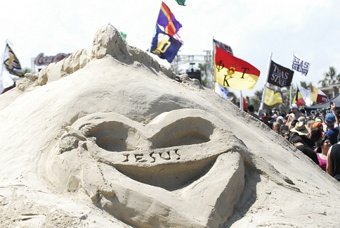
To provide a gathering place on Coca Cola Beach, the location of most of the Spring Break festivities, and to give Beach Reachers a conversation starter, a sand artist from New York creates a sculpture of Jesus or a biblical setting each day during Beach Reach. 

In addition to the 700 students, another 100 volunteers—Winter Texans, Texas Baptist Men disaster relief teams and members of Island Baptist Church—helped with the effort to provide meals for the group and to run outreach efforts such as midnight pancakes outside a bar and morning pancakes at Island Baptist Church.

“Without the partnership with the disaster relief teams, the city of South Padre, the churches involved, this would not happen,” Young said. “It is truly the body of Christ working together for the sake of the gospel.”

Through the outreach efforts and strong teamwork, the group saw 44 people begin relationships with Christ during Beach Reach and 66 baptized in the Gulf of Mexico on the last day of the trip.

Some of those baptized were Beach Reachers wanting to take the next step in their walks with the Lord and be baptized.

Student had opportunities to discuss their faith with revelers at South Padre Island.

The group also picked up 12,100 spring breakers for van rides during the week and gave away more than 16,000 pancakes at the two ministry stations.

From free pancake dinners served midnight to 3 a.m., to handing out sunscreen on the beach, to offering free van rides around the clock to spring breakers headed to the beach or a bar, each outreach effort was a way to show the love of Christ to the 50,000 students who come from all around the United States to the island.

The only time ministry was not taking place was each evening from 5 to 8:30 p.m., when all 700 Beach Reachers gathered at Island Baptist Church for dinner and a time of worship at the island convention center.

Beach Reachers who were out ministering were able to send prayer requests back to a prayer room via Twitter, a social networking micro-blogging tool. In the past, prayer requests were shared through text messages, but in an effort to allow people beyond the island to get involved, the group used Twitter to share prayer requests. By the end of the week, more than 3,400 Beach Reach-related prayer requests had been posted.


Huckabee defends praise for controversial historian

WASHINGTON (ABP) – Former and possible future presidential candidate Mike Huckabee went on Comedy Central’s Daily Show to defend his praise for David Barton, a leading advocate for the view that America was founded as a Christian nation using what critics call revisionist history.

Speaking after Barton at the recent “Rediscover God in America” conference in Iowa, Huckabee said he doesn’t know of a more effective communicator than the founder and president of WallBuilders, a pro-family organization that promotes “America’s forgotten history and heroes,” with particular attention to “the moral, religious and constitutional foundation on which America was built.”

“I just wish that every single young person in America would be able to be under his tutelage and understand something about who we really are as a nation,” said Huckabee, a Fox News personality who is leading polls among possible GOP presidential contenders in 2012.

“I almost wish there would be like a simultaneous telecast, and all Americans would be forced — forced at gunpoint no less — to listen to every David Barton message,” Huckabee joked. “And I think our country would be better for it.”

Pressed April 6 on his admiration for Barton by Daily Show host Jon Stewart, Huckabee said he thinks Barton “is very much a historian” whose objective is “to bring some balance to the idea that the founders had no spiritual direction at all.”

During the interview the former Arkansas governor and ordained Baptist minister gave his own views on the phrase “separation of church and state.”

“Separation of church and state was a phrase that didn’t appear until a letter Thomas Jefferson wrote in 1804,” he said. “It was written to the Danbury Baptist Association in Connecticut, and it was the polar opposite of how many people have interpreted it.”

“They have interpreted it to say that it was essentially a doctrine that the church wasn’t to involve itself in the affairs of state,” Huckabee said. “Actually it was the opposite. It was that the government would not pick out a particular church and establish it as a state church.”

Brent Walker of the Baptist Joint Committee for Religious Liberty said Huckabee was partly right about the letter, which actually was written in 1802, in that Jefferson applied his “wall of separation”to the federal government and not individuals, but wrong in saying that was the first time the metaphor appeared

Walker said Roger Williams, founder of the first Baptist church established on American soil and a religious-liberty advocate in colonial America, used it 150 years earlier when he referred to “a hedge or wall of separation between the garden of the church and the wilderness of the world.”

“Williams and Jefferson understood the benefits to both the church and state of keeping those two entities separate and distinct,” Walker said.

Walker also disputed Huckabee’s assertion that Jefferson’s letter was the “polar opposite” of what church-state separationists believe today. The letter was the president’s response to an earlier letter from the Danbury Baptists complaining that their religious privileges under Connecticut’s established church were enjoyed “as favors granted, and not as inalienable rights.” The Baptists described themselves as “uniformly on the side of religious liberty and that “no man ought to suffer in name, person or effects on account of his religious opinions.”

In an unedited version of the interview on the Daily Show website, Huckabee, a former pastor and past president of the Arkansas Baptist State Convention, also explained what Barton meant by his quoted comment “Jesus did not like the minimum wage.”
 
“I know what he’s basing it on because I’ve heard him talk about it,” Huckabee said. “The parable that Jesus told about the three workers — one that went in the middle of the day, one that went earlier in the day and one that went late in the day — and at the end of the day they all got the same wages.”

“And one was saying, ‘Wait a minute I worked all day,’ and the master said, ‘It is not for you to decide what I pay, because you agreed to the wage for the whole day and the other one agreed for the wage for half the day and the other agreed to a wage that was only for a small part of the day.”

“I think what David was saying is there is not a hard and fast policy, but there is in principle, which is if you agree to work for someone for a wage, then what someone else gets paid is really not the issue,” Huckabee said. “It is did you agree to work for that wage?”

“If you did, then you agree to work for it,” he continued. “I mean, there are people who get paid a lot more money than I do, and some don’t get paid as much.”


Texas Tidbits: CLC conference focuses on hunger

CLC conference focuses on hunger. The annual Christian Life Commission conference will be held from 1 p.m. to 8 p.m., May 24 at Dallas Baptist University. The CLC event is one part of a two-day event sponsored by Bread for the World and Dallas Baptist University to bring together evangelical leaders from across the United States to reflect on childhood hunger. Register online for the CLC conference at www.bread.org/dallas, by clicking on “For Speakers” and then selecting “Christian Life Commission (Tuesday only).” Albert Reyes, president of Buckner International, will be the Tuesday afternoon keynote speaker.  Other speakers include Carol Adelman, director of the Center for Global Prosperity; David Beckmann, president of Bread for the World; Kuki Rokhum, national coordinator fo the Micah Challenge in India; Nicholas Wolterstorff with the University of Virginia; and Scott Todd of Compassion International. For more information,  contact marilyn.davis@texasbaptists.org or call (214) 828-5194.

Account established for Petty family. Friends of John Petty, recently deceased pastor of Trinity Baptist Church in Kerrville, have established accounts to benefit his surviving family. Contributions designated to the “Kelly Petty Special Account” can be sent to Bank of the Hills, P.O. Box 2002, Kerrville 78029-2002. For more information, call (830) 895-2265. Trinity Baptist Church also has set up an account to help with the Petty children’s educational needs. Make checks payable to Trinity Baptist Church, designated for the “Petty Children’s Education Fund,” and mail to 800 Jackson Rd., Kerrville 78028. For more information, call (830) 895-0100. Additional information about fundraising events and a link to a Paypal account to help the Petty family are posted on www.pettyfamilyfriends.com.

Foundation awards grant for scholarships. Baptist Health Foundation of San Antonio has awarded a $177,500 scholarship grant for spring semester students at Baptist Health System School of Health Professions. The grant will assist 238 students enrolled in nursing and allied health educational programs at the school. “Baptist Health Foundation of San Antonio is pleased to provide these important funds to assist our future generations of health care professionals with their education expenses,” said Frank Elston, president of Baptist Health Foundation of San Antonio. The foundation funds not-for-profit health care services throughout Bexar County and contiguous counties in South Texas and health care-related scholarships at institutions selected by the foundation trustees.

Gibson named TBM interim leader. The Texas Baptist Men board of directors has named Don Gibson, TBM church renewal consultant, as interim executive director. Leo Smith recently retired after seven years as executive director and four decades in leadership with the missions organization. The TBM personnel committee is serving as a search committee to find the next executive director.

Wayland trustees OK $61.5 million budget. Wayland Baptist University’s board of trustees approved a $61.5 million budget for the system’s 14 campuses—an 11.9 percent increase. Trustees also authorized a tuition increase. Undergraduate courses on the Plainview campus will increase 4.8 percent, and graduate tuition will rise 3.5 percent. Virtual campus tuition will increase about 4.5 percent. On Wayland’s 13 external campuses, tuition will increase slightly more than 4 percent. Tuition at the School of Nursing increases 3.7 percent for the current undergraduate courses, and initial tuition for the proposed master’s degree in nursing—pending approval by Wayland’s accrediting body—will be set at $359 per hour.

New STARRY director appointed. Richard Singleton has been named executive director of STARRY, Round Rock-based counseling, foster care, emergency shelter and homeless/runaway youth program affiliated with Children at Heart Ministries, effective April 21. Singleton, a licensed professional counselor, has been director of counseling services for STARRY since 2008, a position he will continue to hold. He previously was a counselor and case manager for STARRY. He succeeds Jillian Tappan, who is relocating with her family to the Fort Worth area. A native of Tatum, Singleton earned an undergraduate degree the University of Texas at Arlington and masters of arts degrees in marriage and family counseling and in Christian education from Southwestern Baptist Theological Seminary. He and his wife, Stacey, are the parents of Braden, 7, and Lydia, 12.


Faith Digest: Thou shalt not eat potluck?

Thou shalt not eat potluck? Young adults who regularly attend religious activities are 50 percent more likely to become obese when they reach middle age than their nonreligious peers, a new study shows. Based on their findings, researchers at Northwestern University’s medical school think congregations should be a focus in the fight to prevent obesity. The research marks the first time a longitudinal study of obesity has been linked to religious involvement, the university said. The study, which tracked 2,433 people 18 years, compared men and women who attended a religious activity at least once a week to those with less participation. It found adults ages 20 to 32 with normal weight who were frequent attenders were 50 percent more likely to be obese in middle age. The researchers noted their findings do not indicate that people with significant religious involvement are likely to have worse health overall than nonreligious people. For example, religious people, who often smoke less than nonreligious people, generally live longer.

Protection sought for religious employees. A coalition of religious and civil liberty groups is pushing the Equal Employment Opportunity Commission to stop employers from segregating “visibly religious employees from customers and the general public.” In a letter submitted to the EEOC, the groups asked the agency to “exercise its regulatory authority” and enforce Title VII of the Civil Rights Act of 1964, which prohibits discrimination based on religion. The organizations are concerned adherence to religious dress can cause segregation for employees, citing examples of a Muslim woman in a headscarf or a Sikh man in a turban, where courts ruled for employers who segregated those employees for their attire. The 25 co-signers, including the Interfaith Alliance, the Muslim Public Affairs Council and the Baptist Joint Committee for Religious Liberty, presented three ways for the EEOC to be more aggressive in enforcement. The EEOC must enhance training on the guidelines for “inappropriate segregation” already in place; make enforcement a priority; and clarify that it is never appropriate to separate religious employees from customers to save a “corporate image,” the letter said.

Gay-friendly training for military chaplains begins. The Armed Forces have begun training chaplains for the repeal of the ban on openly gay military members, saying those who are unable to follow the forthcoming policy can seek a voluntary departure. President Obama signed a law repealing Don’t Ask/Don’t Tell last December, but the new policy will not take effect until 60 days after Obama and military leaders are assured that it will not harm military readiness. Lt. Col. Carleton Birch, a spokesman for the Army chief of chaplains, said about half of the military service’s 2,900 chaplains had received the training, which started in February and is likely to conclude this month. Only one Army chaplain has left the service over the pending repeal of Don’t Ask/Don’t Tell, Birch said. But Elaine Donnelly, president of the Center for Military Readiness, an independent group that strongly opposes gays serving openly in the military, predicts more departures when the policy is lifted.

–Compiled from Religion News Service


Around the State

The University of Mary Hardin-Baylor’s 72nd annual Easter pageant will be held April 20 at 12:30 p.m., 3 p.m. and 5:30 p.m. There is no charge. For more information, call (254) 295-5150.

Jim Denison, DBU adjunct professor and theologian-in-residence for the Baptist General Convention of Texas, will deliver the message at an Easter Eve service, 6 p.m., April 23, in the Patty and Bo Pilgrim Chapel at Dallas Baptist University. For more information or reservations, call (214) 333-5139.

Marie Jester, former first lady of Wayland Baptist University, was the featured speaker for the eighth annual McCoy Lecture series at Wayland, held April 6.

East Texas Baptist University crowned Cassy Rains, a junior nursing major from Benton, La., as Miss ETBU 2011. One of 13 contestants, she represented the Baptist Student Ministry.

San Marcos Baptist Academy Principal Robert Bryant re-cently was elected president of the Accreditation Commission of the Texas Association of Baptist Schools. Bryant has served for the past two years as secretary of the accreditation commission. He has been principal at the academy since 2001.

Anniversaries

• First Baptist Church in Elkhart, 125th, April 16-17.  Saturday evening events include a dessert fellowship and time of testimonies, and former Pastor Murray Mathis will preach on Sunday morning. Dinner-on-the-grounds will follow the Sunday worship service. Bill Gernenz is pastor.

• Purmela Church in Purmela, 125th, May 1. A meal will follow the morning service. A celebration service will be held at 2 p.m. Joshua Breslaw is pastor.

Events

• First Church in Waco will hold a workshop to train new certified Body Recall teachers the week of May 22. For more information, call (254) 752-3000.

• Church at Friendship in Hockley will host the Battle of the Bands Praise Explosion May 7. Doors open at 4 p.m., and music begins at 5 p.m. Admission is $5 and benefits the Guatemala Mission 2011. Registration deadline for bands is April 23.

Ordained

• Gene Byrd, Wendell Johnson, Paul Hurd, Scott Robbins and Jim Redman as deacons at Coastal Oaks Church in Rockport.

Revivals

• First Church, Darrouzett; April 17-20; evangelist, Robert Barge; music, Jeff Gore; pastor, Gary McDonald.

• First Church, Madisonville; April 20-24; evangelist, Don Cass; music, Glenn Jones; pastor, Troy Brooks.


Texas Baptists delivers kerosene, food to Japanese churches

SENDAI, Japan—The first Texas Baptist disaster response team to arrive in Japan after the March 11 earthquake delivered a load of kerosene and food to three churches in one of the major cities affected by the earthquake and subsequent tsunami.

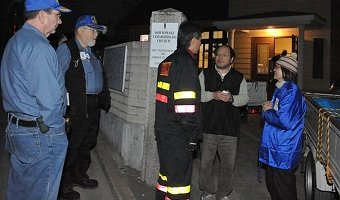
John LaNoue (2nd from right) and Gary Smith (right) pray with rescue workers in Japan.

Yukata Takarada, pastor of Japanese Baptist Church of North Texas in Dallas and a Texas Baptist disaster response team member, said the supplies should provide great help for families suffering in the region.

“As we came here, we realized that to get gas, you must wait in a long line,” Takarada said. “The same for kerosene. After consulting with (Japan Baptist Convention) leaders, it was determined that taking kerosene and some easily prepared food to the people in the Sendai area would meet an immediate need. It was received with great joy.”

The advance team—Takarada and Texas Baptist Men veteran disaster relief leaders Gary Smith and John LaNoue, together with Texas Baptist videographer Rex Campbell—spent a week in Japan assisting leaders of the Japan Baptist Convention in the relief effort there. The Texas and Japanese Baptist leaders discussed ways the faith groups can work together in the relief effort.

Debris from the tsunami that struck northern Japan March 11. (TBM Photo)

In addition to providing kerosene and food, the Texas team also brought Geiger counters with them to help people know their level of radiation exposure.

The Texas team witnessed the tremendous damage done by the earthquake and tsunami. Team members saw a car that was pushed through the wall of a school, as well as buildings turned into rubble. Much of the debris remains untouched, and in many places, a strong stench remains.

“We had a successful time of going to some of the churches in the Japan Baptist Convention and helped them see the possibilities,” Smith said. “They don’t have a lot of experience dealing with this sort of thing.”

The team heard numerous stories of harrowing heroics and tragic death. One woman told the story of her parents’ death from the perspective of people who watched it happen from on top of a hill. The people on the hill called to her parents and tried to warn them, but her parents could not drive fast enough out of the tsunami’s path. One of her parents has been found dead, and the other is presumed to have died.

Texas Baptist Men John LaNoue (center) and Gary Smith (right) visit with Japan Baptist Convention leaders to discover ways Texas Baptists can help meet needs after disasters hit the island nation. (TBM Photos)

The Texans met an 81-year-old pastor who is trying to revitalize a church that has dwindled down to one member. Despite its size, the pastor remains confident God will grow the congregation.

The team also met a pastor who was inside his house when the earthquake struck. His family rushed outside, but his son was too afraid to move. Instead, he crouched beneath a table, trembling in fear.

The pastor ran back into the shaking building, held his hand and used his body to protect his son from anything that might fall. Both the pastor and his son survived, an image that reminded Takarada of Christ’s love for humanity.

Gary Smith with Texas Baptist Men prepares to deliver supplies to churches in Japan.

“This father’s love reminds me of the love of God demonstrated toward us. He himself gave up his life in order to deliver us from the final judgment,” Takarada wrote. “Because Jesus voluntarily came down to this troublesome world knowing that people would reject him, because he willingly gave up his life to die on the cross on behalf of us sinners, we now have peace in God. And no matter what might trouble our hearts, we don’t worry for tomorrow.

“Even today, Jesus is with us holding our hands, saying, ‘Son, I am with you always.’ My prayer is that people who are in trouble out of this tragic event come to know that Jesus is searching for them and calling them out saying, ‘Where are you?’ If anyone says: ‘I am here, Jesus. I am scared,’ then I am very sure that Jesus will approach those who are crying out to him and stretch his hand out and hold his hand and say, ‘Do not be troubled, my son, because I am here with you, and I will never leave you nor forsake you.’”

Gary Smith (left) and John LaNoue of Texas Baptist Men meet with officials outside a Baptist church in Japan.

While the team was overseas, Texas Baptist Men stateside loaded 2,000 water filters on a crate filled with medical supplies shipped by Baylor Health Care System to aid people affected by the Japan disasters.

The supplies are being sent to the University of Tokyo Institute of Medicine and the Japan Baptist Convention for distribution, said Don Sewell, director of Baylor’s Faith in Action Initiative. Estimated arrival date is May 2.

The water filters will be able to filter out dirt and all but 0.2 microns of radiation from the water, making it drinkable again.

“Many people cannot get water over there right now,” said Dick Talley, Texas Baptist Men state disaster relief coordinator. “There is even a shortage of bottled water, and in many areas, the water is completely contaminated. If we can get these filters in the hands of the churches there in Japan and let them distribute them to the people who need water, then we will be able to help a lot of people over there.”

When the disaster relief team was in Japan, LaNoue and Smith trained some of the convention leaders how to use the filters so that they would be ready to teach others once the filters arrive. Through providing water filters, Texas Baptist Men hope that the Japanese people not only will be able to have clean water, but also realize that Jesus can clean their hearts, Talley said.

“The dirt in the water is like the sin in our lives, and Jesus is our filter, ” Talley said. “If you take that sin, Jesus can filter it out. When people understand that the filter is just like him, that water filter becomes a tool to lead people to the Lord.”

With additional reporting by Kaitlin Warrington and Ken Camp


Rogers operates on thin ridge of faith and politics

WINSTON-SALEM, N.C. (ABP) — A career invested in helping Baptists and others navigate the narrow edge where government and religion press against each other with mutual respect and reciprocal wariness has garnered Melissa Rogers the Religious Freedom Award from Associated Baptist Press.

Receiving the ABP award is “a great honor, one that is tremendously humbling,” Rogers said. “I say many times that some people in their lifetimes can claim to be the originators of terrific ideas. Others get the opportunity to be introduced to great ideas and to live with them, study them and lift them up.”

Associated Baptist Press will present Rogers with the award at a recognition banquet May 1 at Ardmore Baptist Church in Winston-Salem, N.C. Tickets are available online . R.G. Puckett, editor emeritus of the North Carolina Baptist Biblical Recorder will receive the Greg Warner Lifetime Achievement Award in Religious Journalism at the same event.

Melissa Rogers

Rogers directs the Wake Forest University School of Divinity Center for Religion and Public Affairs and is a nonresident senior fellow within the Governance Program of The Brookings Institution. She also teaches courses on church-state relations and Christianity and public policy within the divinity school.
 
Rogers previously served as executive director of the Pew Forum on Religion and Public Life in Washington, D.C., and was general counsel of the Baptist Joint Committee for Religious Liberty, where she was instrumental in helping to enact the Religious Land Use and Institutionalized Persons Act.

Rogers has co-authored a case book on religion and law for Baylor University Press, Religious Freedom and the Supreme Court. In 2009, President Barack Obama appointed her chair of the first Advisory Council on Faith-based and Neighborhood Partnerships. 

ABP’s board established the Religious Freedom Award in 1994 to honor individuals who advance the principles and practice of religious freedom, particularly in the field of journalism. Rogers is the 13th recipient.

She is a “go to” resource for journalists and politicians dealing with public policy issues that involve religion, or vice versa. Current “front burner” issues involve government partnerships with non-profit agencies, including religious non-profits, to provide services.

She also is studying issues around the rights of health care professionals to decline to provide certain services to which they have a religious or moral objection.

“Melissa Rogers is an amazing resource person for religious groups across the nation with her particular expertise in religious freedom and church/state relationships,” said Bill Leonard, a noted Baptist historian who teaches with her at Wake Forest University School of Divinity.

“Her work on the monumental study Religious Freedom and the Supreme Court is an illustration of her solid academic contribution; her work on President Obama’s church/state advisory committee gives evidence of her skills as a bridge builder to various political and religious coalitions; and her teaching opportunities at Wake Forest University have enhanced graduate education for divinity school students significantly.”

Last year Rogers’ Wake Forest Center for Religion and Public Affairs released a publication entitled, Religious Expression in American Public Life: A Joint Statement of Current Law at The Brookings Institution. The statement summarizes the law on various points of religious expression in American public life. Does the law allow, for instance, prayers before sporting events or public meetings? Does it allow churches to meet on public property or schools to conduct religion education classes or religious symbols to be displayed in government buildings?

There is so much misinformation about the law in these areas and about what does and does not constitute conflicts of interest between religion and public affairs that Rogers led production of this document that details, “what the law actually says, not what people say it says,” she said.

A changing Supreme Court and “a steady relaxation of the rules that apply to religious institutions and activities” receiving government funding is also an issue Rogers is watching “to see where the court moves in the future and see if the rules continued to be softened.”

“Religious issues” do not begin and end with those involving Christian churches. Many Americans struggle with the presence and place of Islam in America and the debate over construction of a mosque near the site in New York City where Muslim extremists brought down the towers “brought that to the fore,” Rogers said.

People in other parts of the country debate the place or prohibition of sharia law in local jurisdictions. “We want to have one standard for the free exercise of all faiths,” Rogers said. “One of the concerns is that we see in some instances people calling for a singling out of Islam for different treatment and sometimes the government even acquiescing in that.”

Rogers asks as she works in the context of faith, religion, government and public policy, “How do we maintain that seamless system for all people of all faiths in religion?

“I think we have to renew our dedication to these issues with each generation,” she said. “Time will tell whether we did a good job with this or not. “

In the ongoing discussion of religion in public life, Rogers confesses discouragement when some claim “that to defend the freedom of others to practice their religion is defending the truth claims of the other faiths.”

“That’s not so,” she said. “Rather it is defending their liberty to practice their faith, which is basic in American history and constitutional law.”

Early Baptists, she said, like Roger Williams and John Leland, defended the faiths of people that were quite different from their own.

Rogers relishes living with the great ideas of religious freedom and holding up the ideal of church and state separation, ideals voiced and validated by early Baptists.

 “I view any chance that any award someone might give me is not affirmation of me personally, so much as affirmation of the continued power of the Baptist ideal of church state separation and religious liberty,” she said. 

Rogers is married to Stan Fendley and they have two sons, Adam and Carter. She is a graduate of Baylor University and the University of Pennsylvania Law School.


Land says jury out on whether war in Libya ‘just’

NASHVILLE, Tenn. (ABP) – Southern Baptists’ top public-policy expert said April 2 that whether or not President Obama’s action in Libya meets moral standards for a “just” war depends in part on approval by Congress.

Richard Land

Richard Land, head of the Southern Baptist Convention’s Ethics and Religious Liberty Commission, said on his weekly radio program that military action underway against Libyan leader Muammar Qaddafi would appear to meet many of the “just war” criteria used by Christians for centuries that recognize war is sometimes a necessary evil that can be moral if carefully waged to prevent a greater evil.

But Land said the president thus far is “way off the reservation” in at least one regard. In order for a war to be morally just, he said, it must be fought with legitimate authority.

“The use of military force is only the prerogative of governments,” Land said. “Romans 13:1-4 give the divinely ordained civil magistrate a monopoly on the use of state-sanctioned lethal force: internally the police and externally military force. Consequently only the duly constituted civil authority can legitimize military action.”

“However helpful, however nice or comforting the United Nations Security Council vote may be, the only duly constituted authority for the United States military forces is the government of the United States,” Land continued, “and the authorizing vehicle is either a declaration of war or a special joint resolution of the U.S. Congress.”

Land said Obama is “way out of line” for not going to Congress to ask for support for the use of military action in Libya. If he fails do so within either 60 or 90 days, Land said Obama will have broken the law under the War Powers Act enacted in 1973.

“I think the War Powers Act is a good idea, in that it gives the president the ability to react immediately to a situation,” Land said. “I personally think that the president’s intervention in Libya militarily came pretty late. He allowed Qaddafi’s army to make some advances they probably shouldn’t have been allowed to make and kill people that they shouldn’t have been allowed to kill.”

Land said the problem lies in what the president didn’t do. He said Obama should have at least said in his speech the previous Monday, “Now I am going to the Congress and I am asking the Congress for authorization to support what we have done and what we are doing.”

“I believe that given the proper answers to questions that the Congress would probably support the president,” Land said. “But his not going to them shows a lack of respect for the Congress. It shows a lack of respect for the law, and with every passing day that goes by that he does not go to the Congress, he is arguing that a Security Council resolution by the United Nations is sufficient. It is not. Once he has gone beyond the War Powers Act’s limitations, he is breaking the law, and he is weakening the sovereignty of the United States.”

“It is the elected officials of the United States — not the president alone, not the Security Council and the president alone — that decide when and if and under what circumstances American combat troops can be brought into a situation where they are put in harm’s way for more than a very short period of time,” Land said.

Land said he believes taking out Qaddafi constitutes a “just cause” for war. “If the president had not intervened, we would have been forced to watch incidents of mass murder,” Land said.

Land said other requirements are harder to gauge without knowing the likelihood of bringing Qaddafi to justice and replacing him with a western-style democracy instead of another dictator.

“Could it be justifiable by just-war criteria? Yes it could be,” Land said. “Will it be? It depends upon whether the president seeks the approval of Congress and gets it and it depends on the outcome.”

–Bob Allen is senior writer for Associated Baptist Press. 

Previous story:

Baptist ethicist says US role in Libya fails 'just war' test


New Baptist Covenant gathering slated for November

ATLANTA (ABP) — Three years after the Celebration of a New Baptist Covenant drew 15,000 persons from various Baptist groups to Atlanta, a second major event is being planned for mid-November with large church-based gatherings to be held across the nation.

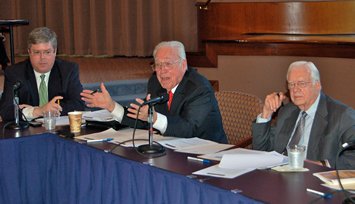
From left, David Key, Jimmy Allen and Jimmy Carter discuss early planning for a New Baptist Covenant celebration in November.

The major sessions will originate at the Atlanta gathering and be beamed to the various locations. Hosts in each location may provide additional programming and will coordinate ministry opportunities to close out the event.

“This will be quite a different format than before,” former President Jimmy Carter told a group of about 25 Baptist leaders he invited to the Carter Center April 4 to hear a report on the first-stage planning and to offer suggestions.

Carter said holding the meetings in churches in various cities will reduce overall costs and permit more people to be involved than the single large gathering held in Atlanta in 2008. All participants, he said, will be “bound electronically and through the Spirit of Christ.”

Longtime Baptist leader Jimmy Allen, who spearheaded the planning of the earlier event, will do so this time along with David Key, director of the Baptist studies program at Emory University’s Candler School of Theology. Emory is providing office space for the planning and Mercer University is managing the finances.

Allen and Philadelphia pastor William Shaw, former president of the National Baptist Convention Inc., will co-chair the event with Carter serving as convener.

Organizers admitted that the time frame is short for planning such a major event and requested help in securing host churches in various cities and contributions to cover costs. Currently, San Antonio, Texas, is the only confirmed site other than Atlanta. Details about the locations and finalized program will be released later.

Shared programming via satellite from the Atlanta site is scheduled to begin on Thursday evening Nov. 17 and conclude on Friday evening Nov. 18. Two prominent African-American Baptist preachers, National Baptist Convention of America president Stephen Thurston and Progressive National Baptist Convention president Carroll Baltimore, will speak. Additional program personalities and plans will be forthcoming.

Saturday, Nov. 19, will be devoted to ministry in various settings where participants gather. The overall theme of the meeting will again be tied to Jesus’ call in Luke 4:18-19 to “proclaim the release of the captives, and the recovery of sight for the blind, to set at liberty those who are oppressed.”

Allen said the Saturday ministry events at the conclusion of New Baptist Covenant II should be groundwork for ongoing ministries and not something “just for a day.”

Carter said the 2008 meeting broke down racial barriers and brought Baptists from different backgrounds together. “This will give us a chance to build on these past successes,” he said.


–John Pierce is executive editor of Baptists Today .


Willimon: Christians called to ‘faithful presence,’ not conquest

WACO—Christians who want to change the world should make sure their actions are done not only in the name of Jesus, but also in the way of Jesus, pastoral theologian Will Willimon told a conference at Baylor University’s Truett Theological Seminary.

Will Willimon

“The cross is the sign of how God changes the world—not by power and might, but by suffering, sacrificial, nonviolent love,” said Willimon, bishop for the North Alabama Conference of the United Methodist Church.

“Are Christians Called to Change the World?” was the theme of the symposium, cosponsored by Baylor’s Center for Ministry Effectiveness and Educational Leadership and by Truett Seminary’s Kyle Lake Center for Effective Preaching.

Willimon and speakers who followed him responded to an assertion by James Davison Hunter in his recent book, To Change the World, that culture may resist the frontal assaults of those who seek to impose their will on others, but it can be transformed by the “faithful presence” of committed believers.

The attractive call to be a part of “a world-changing enterprise” cuts across denominational lines, Willimon noted, but Hunter offers a corrective word. Rather than embracing language of “conquest and domination,” Christians should focus less on winning culture wars and more on bearing faithful witness, Hunter maintains.

“Are Christians called to change to world? Unequivocally, yes. This is, sometimes. Well, sort of,” Willimon said.

In a sinful, fallen world, even the best intentions of religious people fall short, he noted.

“In a sense, transforming the world is Jesus’ job. We’ve got a bad record. Some of the worst stuff we’ve done has been in the name of changing the world,” Willimon said.

Christians should be good citizens and make their views known in the political sphere, he said, but they should not confuse the nations of this world with the kingdom of God.

“We are called to witness that God, not nations, rule the world,” he said.

The main way Christians change the world may be through faithful witness expressed in love and humility in the context of local churches, Willimon urged. If Christians are going to seek to transform the world, let it be done God’s way, as revealed in the life and ministry of Jesus.

“Jesus is the face of God,” he said. “Jesus is how God looks and talks and acts.”

Living out the calling of faithful presence can be challenging for pastors who try to communicate a gospel message to church members who interpret every word through the filter of their own political and economic biases or personal agendas, said George Mason, pastor of Wilshire Baptist Church in Dallas, one of three panelists who responded to Willimon.

“We always wrestle with people who would want to co-opt the church,” he said.

Love for God and love for neighbor—not conquest and domination—should guide individual Christians and churches, said Diana Garland, dean of the Baylor School of Social Work.

“We are transformed by caring for neighbors,” she said. “It is the living of love that changes us. Sometimes, God uses us to transform. But it’s almost never something our pea-brains would have figured out on our own.”

Perhaps rather than viewing transformation in terms of conquest and domination, Christians should “embrace the language of resurrection,” said Chris Seay, pastor of Ecclesia Church in Houston.

“‘Faithful presence’ sounds a bit boring to me,” Seay confessed, unless it means joining in God’s creative work of restoring what is broken.

But if faithful presence means embracing the way of Christ—the way of the self-sacrificial love that leads to resurrection—that becomes a worthy challenge, he said: “To go on an adventure to experience faithful presence so radical it often will be painful.”