Springfield faith leaders stand with embattled migrants

SPRINGFIELD, Ohio (RNS)—“Jesus said that he is the way, the truth and the life. Jesus is with us in truth. And the truth is that Haitians are not eating pets in Springfield,” said Pastor Carl Ruby, gripping the pulpit of Central Christian Church in Springfield, Ohio.

Moments later, the 60-person congregation rose to its feet, applauding the five Haitian community leaders visiting on Sept.15.

“We love you,” Ruby said to them. “We are glad you’re here.”

Earlier in the week, the small church hadn’t been certain they would be worshipping on Sunday. Bomb threats and the presence of hate groups had the city on edge. But the board voted to meet, and Ruby took the opportunity to appeal to both President Biden and former President Trump.

“I call on our former president, President Trump, out of the goodness of his heart, out of the divine spark of God’s image that lives in every human being, to let people know that he was misinformed about what’s happening in our community, and to ask hate groups who are here to leave,” Ruby said.

He also called on President Biden to provide additional resources to support the expanding city, which has seen an influx of as many as 20,000 Haitian migrants in the past decade.

Bomb threats and verbal attacks

The appeal came after the midwestern city was thrust into the national spotlight during the most recent presidential debate, when former President Trump claimed Haitian migrants are “eating the pets of the people that live there.”

Since then, the debunked pet-eating line has become a “memeified” punchline. But for community members, effects of the remark have been no joke.

On Sept. 12, two schools, Springfield City Hall and Clark County offices closed in the wake of bomb threats. On Saturday, two Springfield hospitals closed due to bomb threats.

Flyers claiming to be from the Trinity White Knights of the Ku Klux Klan—a Kentucky offshoot of the white supremacist group—reportedly were distributed in Springfield.

“Foreigners & Haitians Out,” the flyers read, according to a photo obtained by RNS. “Join us and stand against forced immigration.”

Catholic Charities Southwestern Ohio, which provides legal and case management services in Springfield but does not resettle migrants there, has faced verbal and written attacks, chief executive Tony Stieritz told America Magazine.

“My daughter asked me, ‘What’s going on dad?’” said Harold Herard, an engineer and member of the Haitian Community Help & Support Center who visited Ruby’s church on Sunday. “I tried to explain to her the situation, but I don’t want to put her in a situation of feeling fear about school.”

On Sunday, patrons and cashiers at a Dunkin’ Donuts in the south end of the city traded rumors about Haitians being arrested and consuming pets.

Churches say, ‘I am with you in the difficulties’

But later that afternoon, a different narrative unfolded just around the corner, where about 60 Haitians met at First Evangelical Haitian Church of Springfield for a weekly English-Speakers-of-Other-Languages course. Normally, the classes are stretched to find English-speaking conversation partners. But this week, about 30 volunteers—many from local churches—participated.

“I am with you in the difficulties,” the Haitian students practiced speaking in English. “Mwen avèk ou nan difikilte yo,” the English-speakers learned to respond in Haitian Creole.

At the end of the event, the English speakers distributed flowers and baked goods, while Haitian leaders thanked them for their solidarity.

“We are in amazement at how so much good is coming out of such difficulty,” said Heidi Earlywine, an English teacher and advocate who co-coordinates the ESOL classes.

Despite the welcoming atmosphere, some Haitian ESOL students voiced concerns about the level of scrutiny they’ve faced in Springfield this week, saying the toxic atmosphere had pushed them to consider relocating out of state.

Viles Dorsainvil, president of Springfield’s Haitian Community Help and Support Center and a former Moravian pastor, said he’s also heard Haitians debating whether to leave Springfield. But he hopes people stay a few more weeks before deciding.

“We have so many good leaders working with us,” Dorsainvil said. “And we do our best in our nonprofit to work through this situation with the community. I think that if we just take our time, we will navigate this together. But the tension is here. The fear is here.”

Skilled workers bring ‘tremendous gifts’

Once a bustling manufacturing town that produced farm equipment and other machinery, Springfield faced race riots in the early 20th century, and struggled with closing factories and a declining population at the tail end of the century.

Then, about a decade ago, the city launched a successful effort to bring in several businesses and companies that created thousands of new jobs. Haitian migrants facing political turmoil and gang violence in their home country began to arrive, filling job shortages and opening churches, shops and cafes.

“First Baptist Church is one part of a larger faith community and group of public service agencies that believe in the tremendous gifts that come along with the increase in population,” said Pastor Adam Banks, who pointed out the benefit of welcoming skilled Haitian professionals, including educators and health care specialists. “As a city that has seen its population decline for decades, this increase provides a great deal of hope.”

Countering rumors that resettlement organizations have been “bussing in” migrants, Herard said Haitians have arrived organically after hearing about jobs from other Haitians in the area.

The vast majority are here legally, many as recipients of Temporary Protected Status due to conditions in Haiti. Springfield’s Haitian population has swelled to between 12,000 and 20,000 in recent years, city officials estimate.

Influx of residents a boon but carries costs

Some longtime Springfield residents called the “pet-eating” rhetoric a distraction from the very real strains on local health, education and government resources facing the city.

The influx of residents has, according to many business owners, landlords and city officials, been a boon for the declining city, but it has also come with costs. Schools and hospitals are struggling to keep up with the growing population and the need for translation services and ESOL classes. Housing costs have risen, and the sudden increase in new drivers has prompted safety concerns.

In August 2023, tensions between Haitians and longtime Springfield residents ruptured when 11-year-old Aiden Clark was killed in an accident caused by a Haitian migrant who crashed into a school bus. Clark’s parents have since asked that their family’s tragedy not be used to stoke hatred or be exploited for political gain.

City Council meetings were suddenly flooded with concerned residents, and Haitians became the targets of beatings and robberies. First Evangelical Haitian Church of Springfield was reportedly broken into.

But the fractures were subsiding when, this summer, Republican vice presidential nominee and Ohio Senator J.D. Vance cited Springfield as a failure of Biden’s immigration strategy.

“It really kind of quieted down until our local leaders reached out to J.D. Vance for help getting financial assistance,” said Ruby. “And instead of providing financial assistance, he politicized it.”

Herard said Springfield’s Haitian community is most in need of better translation services, as well as mental health support, particularly in the wake of last week’s debate. For now, many of Springfield’s churches are giving support by way of English classes, correcting misinformation, and displaying solidarity.

At the end of Central Christian Church’s Sunday service, congregants shuffled to the front of the sanctuary where they took Communion elements and bundles of small fliers intended for distribution.

“Mwen byen kontan ou la. Kris la renmen ou e mwen menm tou,” the fliers said in Haitian Creole. “I’m glad you are here. Christ loves you, and so do I.”

To Herard, the service was a welcome respite.

“It was a tough week,” he said. “Fear. Confusion. But today, we feel free.”



Christian nationalists likely to support authoritarianism

WASHINGTON (RNS)—Americans who hold Christian nationalist views are also likely to express support for forms of authoritarianism, according to a new report from the Public Religion Research Institute.

The report points to a possible link between those who advocate for a Christian nation and people who agree with statements such as the need to “smash the perversions eating away at our moral fiber and traditional beliefs.”

Melissa Deckman, CEO of PRRI, framed the study as an effort to connect recent research on Christian nationalism with longstanding efforts to assess authoritarianism.

“While most Americans do not espouse authoritarian views, our study demonstrates that such views are disproportionately held by Christian nationalists, who we know in our past research have been more prone to accept political violence and more likely to hold antidemocratic attitudes than other Americans,” Deckman said.

The survey included questions from PRRI’s ongoing study of Christian nationalism, which tracks support for the ideology by rating people on a scale of Adherents, Sympathizers, Skeptics or Rejecters.

Respondents also were asked whether they agree with statements such as, “What our country really needs is a strong, determined leader who will crush evil, and take us back to our true path,” and whether they think children should exhibit traits such as obedience and curiosity.

Measuring authoritarian leanings

Such questions were based on two well-known rubrics to measure authoritarian leanings: the Right-Wing Authoritarianism Scale, developed in 1950 by a group of scholars at the University of California, Berkeley, and the Child-Rearing Authoritarianism Scale, which social scientists use to measure similar trends with child-rearing preferences as a framework.

Researchers found striking connections in the responses. A large majority of Christian nationalism supporters (namely, Adherents and Sympathizers) also scored high on both the Right-Wing Authoritarianism Scale (74 percent) and Child-Rearing Authoritarianism Scale (61 percent)—significantly more than Christian nationalism Skeptics and Rejecters (30 percent and 31 percent, respectively).

In addition, about half (51 percent) of those who scored high on the Right-Wing Authoritarianism Scale also qualified as Christian nationalism supporters. The reverse was true among those with low Right-Wing Authoritarianism Scale scores: only 7 percent could be classified as Christian nationalism supporters.

And while few Americans overall (34 percent) agreed the U.S. needs a “strong leader who is willing to break some rules,” the statement was supported by majorities of both Christian nationalism supporters (55 percent) and those who score high on the Right-Wing Authoritarianism Scale (59 percent).

Patriots or insurrectionists?

PRRI also asked questions about current events, such as whether respondents agreed that those who were convicted of crimes for participating in the Jan. 6 insurrection are “patriots” who are “being held hostage by the government,” or that Donald Trump should do “whatever it takes to be president” if he is not declared the winner outright in November.

Trump supporters—some holding Bibles and religious banners— gather outside the Capitol, Wednesday, Jan. 6, 2021, in Washington. (AP Photo/John Minchillo)

Few Americans overall agreed with either statement (23 percent and 14 percent, respectively), but support was noticeably higher among supporters of Christian nationalism (44 percent and 28 percent) and those who scored high on the Right-Wing Authoritarianism Scale (38 percent and 24 percent).

Researchers also asked respondents whether they were supporters of “7 Mountains” theology, a belief system popular in some conservative circles that calls on Christians to seek control over the seven “mountains” of society, including politics.

Most Christian nationalist Sympathizers and Adherents (57 percent) said they backed the sentiment, as did significant percentages of those who scored high or very high on the Right-Wing Authoritarianism Scale (43 percent) or the Child-Rearing Authoritarianism Scale (35 percent).

The theology found its greatest support among white evangelical Protestants in the survey (48 percent), followed by around 4 in 10 Black Protestants (42 percent) and Hispanic Protestants (42 percent).

“Our new survey shows, too, a close intertwining of apocalyptic and dominionist views among Americans who support authoritarianism. In short, authoritarianism in America is not wholly secular, but has important religious dimensions,” Deckman said.

Supporters of Christian nationalism were also highly likely (84 percent) to agree that “the final battle between good and evil is upon us, and Christians should stand firm with the full armor of God,” as were those who scored high or very high on the Right-Wing Authoritarianism Scale (70 percent) and the Child-Rearing Authoritarianism Scale (61 percent).

While no group exhibited majority support for the idea that “American patriots may have to resort to violence in order to save our country” (only 16 percent of Americans overall agreed), the idea was most popular among Christian nationalism supporters.

The survey revealed 33 percent of Adherents and Sympathizers saying they agreed, while 28 percent of those who scored high on the Right-Wing Authoritarianism Scale and 21 percent who scored high on the Child-Rearing Authoritarianism Scale agreed.


Tillie Burgin’s vision: ‘Take the church to the people’

ARLINGTON—For 38 years, Mission Arlington has existed to meet the needs of its community and “take church to the people,” founder and director of Mission Arlington Tillie Burgin explained.

Born in Arlington Aug. 24, 1936, Burgin recently celebrated her 88th birthday. But according to the Mission Arlington/Mission Metroplex Facebook page, she “still arrives early 7 days a week, and leaves late, passionate about serving her Lord and this precious community.”

Burgin does not see Mission Arlington as an organization. Instead, she said, “It is a way of life.” Other times she described it as “a church” or “a family.”

Burgin explained the idea for Mission Arlington grew out of a question she asked herself that she just couldn’t shake, “If you can do missions in Korea, why can’t you do it here?”

How it began

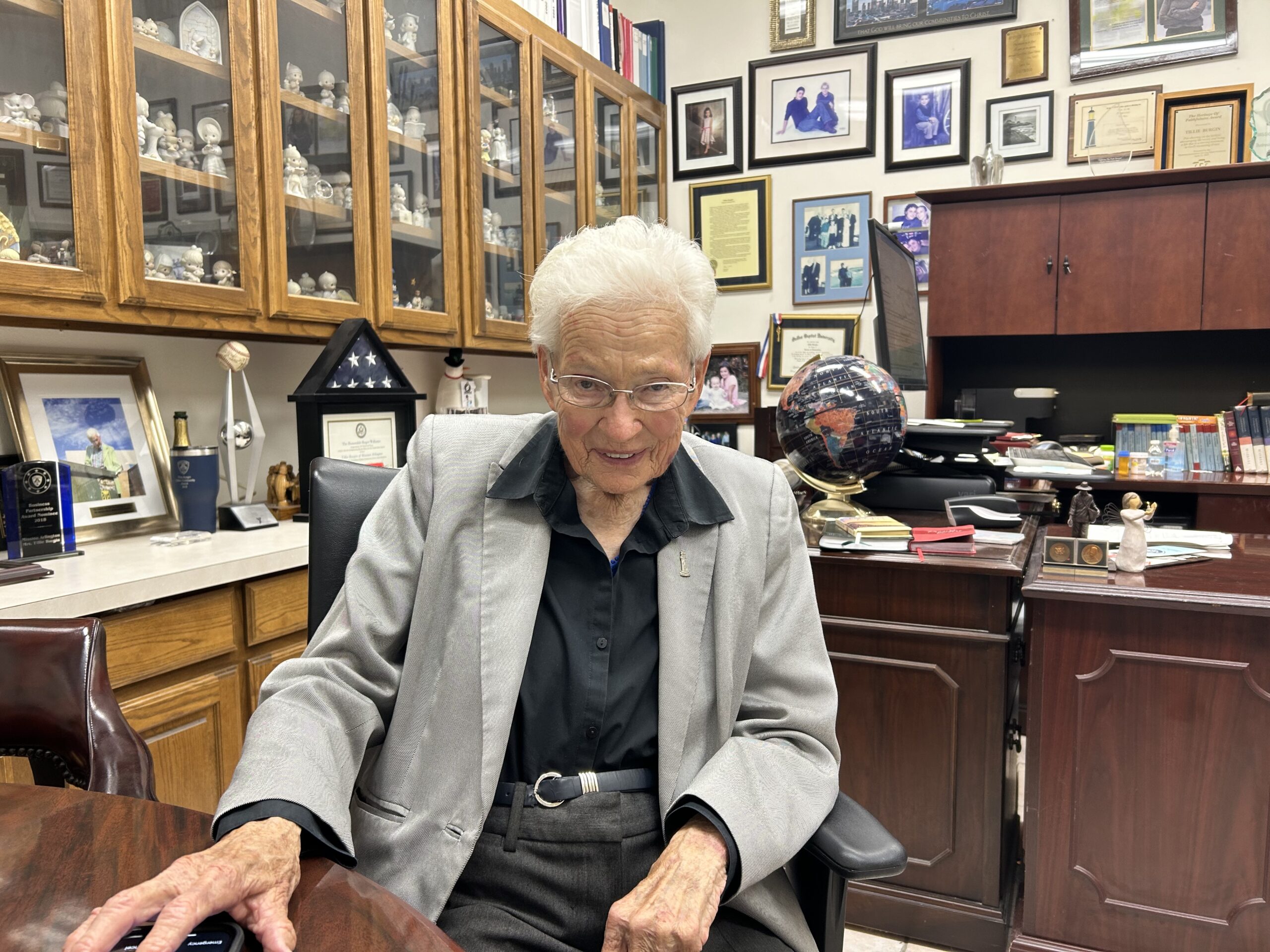
Tillie Burgin in her office. The extensive collection of Precious Moments figurines behind her that people have given Burgin over the years are free to children who come and express an interest. (Photo / Calli Keener)

The history link on Mission Arlington’s website, explains the question goes back to before she and her late husband, Robert, served as missionaries with the Southern Baptist Convention Foreign Mission Board (now International Mission Board), teaching in South Korea.

Her father operated a gas station in Arlington, just around the corner from Mission Arlington. He was Methodist, but as he generally worked on Sundays, he rarely was in church.

He lived out his faith in serving his customers, but he was not on board with Tillie taking her two sons to move with her husband oversees.

He was the one who first posed the question, the mission’s history account explains. He saw no need for his daughter to head to South Korea. There was plenty to be done to care for people right in the family’s hometown of Arlington.

Burgin and her family went anyway. She said: “We didn’t fit then, either.” They were the first missionaries appointed through the Foreign Mission Board to serve as teachers, she explained.

Citing God’s hand in the process, Burgin said IMB hiring personnel told her they would not have considered the Burgins’ application to serve, had a request for teachers in South Korea not just come across the desk the day they received it.

Plans for medical growth

In May, Texas Baptists presented Mission Arlington/Mission Metroplex with $125,000 to expand their health clinic.

Burgin hopes the expanded clinic will make new types of care possible, but “the infrastructure has got to be strong, and that takes resources.”

Mission Arlington leaders are praying about how best to expand the clinic, Burgin said. They have had optometry equipment donated, but do not currently have an optometrist who can use it.

Hearing aid people come, but it’s only every six months. People are grateful when they can hear again after years of not being able to, but vision and hearing treatment are areas where they’d like to see an increase in their ability to provide care, Burgin said.

The clinic has an orthopedic doctor who regularly serves at Mission Arlington every Monday. She said no one goes through his office without hearing the gospel. “It could be me, and I’m going to hear it,” she laughed.

The holistic care Mission Arlington provides is a draw to interns and doctors, Burgin explained. Providers want to serve where they not only can treat a wound but can care for a whole person.

The health care providers are glad to serve knowing their patients’ nutritional and other needs also can be addressed through the mission’s other ministries, Burgin said. It just takes time, prayer and preparation to discern which expansions they are able to support best.

Mission Arlington clinic looks to expand services. (Photo / Calli Keener)

The clinic is always open six days a week and one evening.

Burgin told a story about a young man who came in for help wearing a hoodie in the heat of the summer. Under the hoodie, he had a large growth down to his shoulder that he didn’t want to show. It was interfering with his ability to have a job.

The doctor he saw through Mission Arlington’s clinic was able to remove the growth. With it gone, the young man was able to go back to school, complete school and find employment.

“People find themselves in that kind of trouble, and we always want to be that place for them,” their “home” health clinic. Burgin said.

Burgin explained she prayed about the vision God gave her about doing missions in Arlington for seven years, until she met a lady who needed help with her electricity bill.

“Standing in her apartment, I said: ‘Can we start a Bible study in your apartment? And we’ll get your electricity turned on.’” And the ministry has grown since then, Burgin explained.

There were more people outside the walls of the church than there were inside, Burgin explained. And she knew from their service in Korea that “hanging out” where the people were could lead to ministry opportunities, but she said: “I never had a vision for this. God had the vision, and he just said: ‘Come along.’”

‘God’s Timing. God’s ways.’

The lobby of Mission Arlington, where people ‘triage’ to discuss needs while they watch Billy Graham. (Photo / Calli Keener)

“You can’t explain it,” she added. “All you have to do is experience it—God’s timing, God’s ways.”

Burgin said God had protected them from “so many things she’d wanted to do” with Mission Arlington. And many times, they’d figured they’d “done all they could do,” then God would use the ministry in a new way.

For instance, they were given multiple pallets of bottled water a few weeks ago. She said they set it to the side.

“I said, ‘Something’s going to happen, if we’ve got all this water,’” she recalled.

On Sept. 4, they took 12 to 15 pallets of water to Grand Prairie to help when the city’s water was deemed unsafe due to a foaming agent.

“We are not an organization. It is a way of life,” Burgin said.

They’re still doing things the way they always have, she said—praying about the next ministry, giving people opportunities to serve and give back when they have been served, keeping John 3:16 front and center, taking church to the people.

“And our definition of church is what we do almost 24 hours a day, seven days a week,” she continued.

Then her cell phone rang.

“Excuse me. Let me answer this,” she said.

The young woman on the other end, frantic because she couldn’t get her car started, said she didn’t know if she should call.

“Always call me, OK? Yeah, we’ll send somebody to you,” she said.

Burgin said she tells them: “Always call. And that’s kind of what we do.”

“Whatever it takes,” she said, “that’s what we need to do” to follow God’s calling.


Seminary alumni share memories of Wedgwood tragedy

FORT WORTH (BP)—On Sept. 15, 1999, Southwestern Baptist Theological Seminary alumnus Jay Fannin was helping at a youth event he had organized at Wedgwood Baptist Church in Fort Worth, where he had been named the youth minister 20 months previously.

But that time of prayer and worship that was attended by 14 area church youth groups quickly turned into a tragedy when an armed man walked into the sanctuary and began shooting.

Eight people were killed and seven injured in the Wedgwood shooting, reportedly motivated by anti-Christian hate. Among the victims were teenagers attending the See You at the Pole prayer event, church members and seminary students and alumni.

Victims included alumna Sydney Browning, 36; students Shawn Brown, 23, and Susan “Kim” Jones, 23, who was about to start her first semester; Kristi Beckel, 14, daughter of alumnus Robert Beckel; and teens Cassandra Griffin, 14, Joseph Ennis, 14, and Justin Ray, 17.

Alumni Jeff Laster and Kevin Galey, staff counselor at Wedgwood, were injured.

‘Hearing noise and yelling and screaming’

Chris Shirley, dean of the Jack D. Terry School of Educational Ministries at Southwestern Seminary, was on staff at Wedgwood overseeing the adult education and singles ministries. He recalls that Wednesday night when he suddenly heard screaming coming from outside his teachers’ meeting.

“Things were happening all around church,” Shirley said of what started as a normal Wednesday night. His 10- and 4-year-old children were in their normal classes, and his wife was at the youth event.

“We started hearing noise and yelling and screaming. … And about the time we got up to figure out what was going on there, somebody came into the room where we were and told us what was happening and that we needed to get out.”

Jeff Laster, who at the time was preparing to graduate with a diploma in Christian education and served at Wedgwood as the facilities manager, was the first to encounter shooter Larry Ashbrook when he entered the church building.

Laster approached him to welcome him to the church and asked him not to smoke in the building, his hand stretched out to shake hands with him, when Ashbrook pulled a weapon and shot Laster in the abdomen and the arm.

Even while Laster saw the shooter move past him and begin firing at others, he recalls thinking: “I’ve been shot. I may die from this.” But almost simultaneously, he said he felt a sudden warmth and peace and believes God told him, “You’re not going to die.”

After shooting others in the lobby area, including Browning, who Laster said was one of his best friends, Ashbrook entered the sanctuary.

Initially thought it was an ill-advised prank

Fannin said he had been running the PowerPoint for the band that evening from the sound booth located in the balcony, as the regular teen A/V worker had not come that night.

When he heard the popping from the gunfire, Fannin said his first thought was that he was going to need to confront a student pulling an ill-advised prank. Columbine was still fresh in his memory.

But when he reached the hallway outside of the sanctuary and smelled the smoke and saw blood, he realized it was a real event.

The next minutes were filled with confusion, as Fannin said the shooter continued shooting, students tried to run away, and rumors of a second shooter and a hostage situation spread. Fannin led a couple leaders, including Brown, toward an office with the goal of calling 911, and sent someone to warn people in the nursery and other areas of the church.

Fannin said Brown would not enter the office but remained outside the door. Witness reports say Brown tried to speak with and stop the shooter, but within moments, Fannin heard the shots that killed Brown.

When he made his way back to the sanctuary, Fannin was relieved to see his wife run out. Her first words were ones Fannin believes God gave her: “Jay, this wasn’t your fault.”

Entering the sanctuary less than a minute before the police did, Fannin finally saw the result of the event. He saw parents trying to remove their injured children and students trying to carry out a friend who had been killed. He checked on other students who had been killed.

Rejuvenated by unity and prayer

Once outside the church building, gathering with the teenagers in a place that now holds a memorial of the event, Fannin said the magnitude of what happened finally struck him.

“All the kids came up and just surrounded me,” Fannin said. “And kind of in that moment, everything just kind of hit. … We all went to the ground and some guy, to this day, I don’t know who he is, began praying over me.”

Rejuvenated by that moment of unity and prayer, Fannin turned his focus to helping those around him.

Tears still come to Shirley’s eyes, even 25 years later, when he remembers how he felt evacuating the building and going to an elementary school across the street, and the relief he felt when he found his wife and children. He began to look for how he could serve the people around him.

“I was just kind of there for pastoral care during that period of time—talking to people, helping people, you know, trying to relay messages and things to people, and just be whatever help I could,” Shirley said.

That same night, Shirley and others in his singles ministry visited Laster, who was a member of the singles community, at the hospital. Laster remained in the hospital a month, delaying his graduation until the next semester. His doctors later told him they were surprised he survived.

Kenneth S. Hemphill, Southwestern president at the time of the shooting, came to the church the night it happened.

“Distraught parents searched for their children,” Hemphill wrote in an article he penned for a special edition of the Southwestern News printed not long after the shooting. “I stumbled through the scene as if watching from a distance. Soon, I would learn how deeply Southwestern had been affected.”

Support through the healing process

Southwestern provided support during the healing process, hosting the funeral for alumna Browning, holding a chapel service to pray for those impacted, and providing counseling to Wedgwood staff and members.

In weeks following the shooting, Dan Crawford, who was a member of Wedgwood and Southwestern faculty at the time and is today the senior professor emeritus of evangelism and missions, was commissioned by the church to write the story of what had happened.

Crawford interviewed about 100 people who witnessed or were directly impacted by the shooting and used those interviews to write the book, Night of Tragedy, Dawning of Light.

By the 20th anniversary of the shooting, he wrote a follow-up book, The Light Shines On, relating the story of the healing that followed as told by 46 people he interviewed, saying it was “their testimony of God’s grace over the 20 years since the shooting.”

The impact of the event continues for each of those involved, though in a variety of ways.

“I still can remember that the biggest lesson I learned through it was the influence of the body of Christ, the realness of the body of Christ,” Shirley said, adding over the months and even years that followed, the unity of the church strengthened as they healed together.

Wedgwood Baptist Church received messages of encouragement from around the world, such as this poster depicting an angel and a Bible verse, which now is framed and hangs on the wall of Chris Shirley’s office at Southwestern Seminary. (BP Photo)

The global church also united behind them as Wedgwood received messages of encouragement and prayers from people from every continent except Antarctica. The walls of their hallways soon were covered with those messages and other gifts. One such gift, a poster with an angelic image and a Bible verse, is framed and hangs on the wall of Shirley’s office today.

Laster went on to graduate from Southwestern and continues to serve on staff at Wedgwood, now as the associate pastor for administration and missions.

“God brought me through it,” Laster said, though he adds the shooting still has a physical impact on his body. But while his role in the event has become a part of his testimony, Laster said it did not change the fact that God had a calling for him, which had led him to quit a job and move to Fort Worth to attend seminary.

“People come up and say, ‘Well, God has a plan for you now.’ God had a plan for me before. God wasn’t waiting until I got shot to have a plan for me,” Laster said, adding this experience led him to further believe in God’s sovereignty over every circumstance.

Fannin, who ended up serving as youth minister at Wedgwood 22 years and now is pastor at Shady Oaks Baptist Church in Hurst, also said the tragedy has created opportunities for him around the nation, as he speaks with police officers, churches and radio and television stations. Recently, he said he spoke with pastors and youth ministers in Georgia after a recent shooting at a school there to share with them a message of hope and healing.

“God is so good,” Fannin said. “I look back at the shooting honestly with a lot more appreciation for who God is and how he gets us through things and … that he works all things for good, even though it doesn’t seem like that’s possible.”


Chicago pastor emphasizes importance of resilience

WACO—Simultaneously leading two Chicago churches as pastor demands resilience rooted in biblical truth, Charlie Dates told participants at a Baylor University leadership conference.

Dates, senior pastor of both Salem Baptist Church and Progressive Baptist Church in Chicago, offered leadership lessons at the “Leadership for the Long Haul Conference,” sponsored by the Program for the Future Church at Baylor’s Truett Theological Seminary.

A resilient church leader must be a genuine servant who practices humility, Dates observed.

“I’ve come to see that servanthood has to be my identity, not my strategy,” he said.

The opening verses of the Old Testament book of Joshua identify Moses as “the servant of the Lord” and Joshua as “the servant of Moses,” he noted.

“It’s as if Joshua has to prove his person as a servant before he is called upon to be a leader,” Dates said.

People typically care little about the leadership courses a pastor has taken or the books on leadership he has read, he observed. But they care deeply when he shows up to provide comfort in their times of loss or bereavement.

“I’m learning that you’ve got to take the posture of a servant that kind of lets go of the cultural norms of greatness. … When it’s all said and done, only God is great,” Dates said.

Joshua’s call from God came when Moses died. While the man of God died, the mission of God continued, he noted.

“One of the pillars that helps us overcome our sense of inadequacy—my sense of inadequacy—is that while one major leader leaves, God has not left, and the work must continue forward,” Dates said.

Need ‘a prevailing commitment to truth’

A resilient leader must have “a prevailing commitment to truth,” he added.

God spoke to Joshua, and Joshua delivered that revealed truth to the people of Israel.

“There’s such a temptation to leave truth these days—to appeal to crowds,” Dates said. “I’m coming to discover that since we have a speaking God, I must speak for God the things God already has spoken.”

The opening chapter of Genesis reveals the power that is unleashed when God speaks, he noted. God spoke into being all of creation.

“There’s never been a moment in your life when God spoke and nothing happened,” Dates said. “When God speaks, things happen.”

When God spoke to Joshua, he offered assurance: “As I was with Moses, so I will be with you; I will not fail you or forsake you.”

Resilience in pastoral leadership is made possible by “the undying, almost indefatigable realization that God is with me, even when I feel like I am by myself,” Dates said.

“Any leader who has ever been worth her or his salt has done so because God was with them.”


Conference focuses on leadership for the long haul

WACO—True leaders not only build trust, but also draw upon trust to bring about transformation, author Tod Bolsinger told church and nonprofit leaders during a conference at Baylor University.

“There is no transformation without trust,” Bolsinger told participants at the “Leadership for the Long Haul” conference, sponsored by the Program for the Future Church at Baylor’s Truett Theological Seminary.

However, if leaders want to produce transformation, they cannot just build a big “trust account” for the sake of securing their own positions, he emphasized.

“Leadership is engaging a community of people toward their own transformation so that they can accomplish a shared mission,” said Bolsinger, author of Canoeing the Mountains: Christian Leadership in Uncharted Territory. “Transformation requires us to take risks.”

Invest trust in transformation

Adaptive leaders who guide their people through changing circumstances understand they must “invest trust in transformation,” he insisted.

“Pay attention to the pain points,” author Tod Bolsinger told church leaders during a conference at Baylor University. (Photo / Ken Camp)

Effective leaders build trust with an eye toward transformation, putting together teams who help identify the unique gifts of the organization and determine how those gifts can be used to meet the needs of the world beyond the organization, he stressed.

“Pay attention to the pain points,” Bolsinger urged.

Recently, Bolsinger worked with leaders at Baylor to develop the university’s new strategic plan, “Baylor in Deeds,” focusing on the question: “What does the world need Baylor for?”

The strategic planning team led 93 listening sessions with 2,300 participants, received and tabulated 310 listening group surveys, received 114 white papers from 521 individuals who offered proposals, and conducted 71 external interviews.

Bolsinger echoed advice he learned from a conversation with venture capitalists in Silicon Valley: “Nobody cares if your institution survives. They only care if your institution cares about them.”

Charting a leadership journey

Linda Livingstone began service as Baylor’s 15th president in June 2017 during what she candidly described as “a dark time” in the school’s history, after an “institutional failure” to respond appropriately to sexual assault and sexual misconduct by student athletes. (Photo / Ken Camp)

He pointed to the recent history of Baylor University as a case study in transformational leadership, building on President Linda Livingstone’s presentation about her “leadership journey” at Baylor.

Livingstone began service as Baylor’s 15th president in June 2017 during what she candidly described as “a dark time” in the school’s history, after an “institutional failure” to respond appropriately to sexual assault and sexual misconduct by student athletes.

“Baylor lost a tremendous amount of trust,” she said.

Pointing out there was “no honeymoon” period when she arrived, Livingstone immediately went to work to regain trust with alumni, students and potential students, parents and donors.

She and the board of regents chair held listening sessions with the “Baylor family” to allow them to be heard.

“We learned from our mistakes and made significant changes,” she said.

Those efforts bore fruit. In 2022 and 2023, national surveys revealed Baylor was among the nation’s Top 10 Most Trusted Universities, scoring the highest marks in Texas and in the Big 12 Conference.

“God’s love can redeem and heal broken trust,” Livingstone said. “God is working in ways we may not even realize.”

Focus on a future anchored in hope

Baylor University President Linda Livingstone described her “leadership journey” to participants at the “Leading for the Long Haul” conference, sponsored by the Program for the Future Church at Baylor’s Truett Theological Seminary. (Photo / Ken Camp)

Rather than simply build a trust account for its own sake, Bolsinger noted, Livingstone invested trust in transformation by focusing on the future.

Under her leadership, the university developed its “Illuminate” strategic plan, set an ambitious fund-raising goal and cast a vision to see Baylor become “a preeminent Christian research university.”

“As a leader, you must anchor yourself in hope during challenging times,” Livingstone said.

Baylor attained Research 1 status in December 2021—three years earlier than expected—and surpassed the $1.1 billion giving goal for its Give Light philanthropic campaign, raising a record $1.5 billion.

At the same time Baylor was navigating the trust-rebuilding process following the sexual abuse scandal, the university also had to “pivot and change” due to the COVID-19 global pandemic, she noted.

Effective leaders and the teams they build must “be nimble and flexible,” communicate honestly and transparently, rely on experts for the best information available at a given time, and “signal hope for the future,” Livingstone said.

“Don’t shy away from difficult situations, even when you don’t feel prepared,” she urged. “Each experience prepares you for the next challenge. Recognize God has placed you in a position of leadership for such a time as this.”


‘The devil is in the world again,’ events in Europe reveal  

“The devil is in the world again” Constanze Stelzenmüller quoted a German Catholic cardinal friend of hers as stating at the Munich Security Conference in 2022, days before the Russian invasion of Ukraine.

While standing in line behind him for coffee, Stelzenmüller said, “The landscape appears to be growing grimmer and grimmer, isn’t it, Your Eminence?”

Stelzenmüller, director of the Center on the United States and Europe and the Fritz Stern Chair on Germany and Trans-Atlantic relations at Brookings Institution, said his observation continues to seem, in her mind, “an apt description” of what is happening in Europe.

Stelzenmüller—along with Fiona Hill, senior fellow of foreign policy at Brookings’ Center on the United States and Europe, and David J. Kramer, executive director of the George W. Bush Institute—participated in a panel discussion entitled “American Foreign Policy toward Ukraine, Russia and NATO beyond 2024,” Sept. 12, at Dallas Baptist University.

DBU’s Institute for Global Engagement, in cooperation with the World Affairs Council of Dallas/Fort Worth, hosted the discussion, moderated by Rudolph Bush of the Dallas Morning News.

Bush framed the conversation by briefly recalling the events of the war in Ukraine—beginning with Russia’s invasion of the Crimean Peninsula in Southeast Ukraine in early 2014 and continuing to the present—describing the current war in the region as having settled into “a conflict of attrition.”

In light of complex situations at home and abroad and uncertainty about “what the international consequences might be” of the ongoing conflict, Bush asked Hill: “Why must the West be engaged in the war in Ukraine?”

A clear right and wrong

Hill said what is happening in Ukraine daily has “taken us back decades—to the kind of decades that we thought we would never be in again.” Hill pointed out this is the largest war in Europe since World War II, despite NATO having been “set up precisely to prevent or deter” such conflicts on the European continent

Referencing Putin’s interview with Tucker Carlson, Hill explained Putin would like to take Europe back even further, to the 9th or 10th century, because he believes Russia has a historical claim to Ukraine.

Hill appealed to America’s own history as a reason to be engaged in Ukraine. During the War of 1812, the United States might have found itself “back under the tyranny, at that point, of the British king” within decades of having attained its independence, if not for France coming to its assistance.

“Putin is basically trying to reverse Ukraine independence,” Hill said. So, Ukraine is in the same place as the United States in 1812, fighting to reclaim independence it has held for 30 years, she explained.

“And if Putin gets away with that, the consequences, not just for Europe but for other countries, are really quite profound.”

Stelzenmüller conceded the question of why countries aligned with democracy ought to care about Ukraine is a reasonable one—particularly for people in the Global South, whose conflicts have received less attention. But, she claimed, “it’s very rare in international affairs that the question of right and wrong is as clear as it is in this case.”

“Putin attacked a country that had done absolutely nothing to provoke him.” Russia has been slaughtering Ukrainian soldiers. People are being tortured and killed and their children sent off for forced adoptions in Russia. That’s not just immoral, “it’s very clearly illegal” under international law, she stated.

Furthermore, this is the first war in modern history where legal, forensic-quality evidence of war crimes is being collected “in real time,” Stelzenmüller explained.

While the West could be criticized as having double-standards, failure to support the right to self-defense of Ukraine, when there is such a clear case of right and wrong as this, undermines “any pretense at upholding international law.”

“This is also about the security of Europe,” and it represents “an American first order of strategic interest,” because Putin has made it clear that beyond Ukraine, he wants to make Europe “a sphere of influence in Russia,” she said.

Putin wants American forces to withdraw from Europe—which, she contended, is not in America’s best interests.

Grave stakes

Kramer said nothing short of the future of NATO and America’s standing in the eyes of the world to prevent future aggressions is at stake in Ukraine.

Kramer explained Putin has no intention of stopping with Ukraine, should he be allowed to succeed there. From Ukraine, he’d possibly advance to Moldova, Georgia and the Baltic States, which are NATO members.

If the United States and its allies failed to come to the defense of the Baltic States, “that would be the end of NATO, because NATO members live under Article 5, which considers an attack on one as an attack on all,” he said.

The world is watching how the United States responds. “If we want to help prevent Beijing from attacking Taipei, the way to do it is to help Ukraine,” Kramer said. Doing so will make communist leaders “think twice.”

“It’ll send a signal to the Iranians, to all the bad actors out there,” Kramer explained. There is an opportunity to help prevent future wars by helping Ukraine, he insisted.

Hill talked about the unique character of Putin, who has been in power in Russia for 25 years—contrasting him to George Washington, who knew when it was time to go and had no interest in becoming the king of America.

Putin, by contrast, tells his own “pseudo-history” where he is at the center, sitting on his throne like the modern Russian czar he aspires to be, Hill said. He has continued plotting, and his No. 1 goal is his own preservation.

“We’re living out somebody else’s fever dream,” Hill explained, in attempt to make some sense of the madness of Putin’s actions and his endgame.

Stelzenmüller discussed the European response to the invasion of Ukraine, noting it did not come as a complete surprise, and Europe “had been steeling itself” in anticipation.

She described a “hybrid war” Russia is waging in Europe outside of Ukraine through propaganda and intense spreading of disinformation at a level not seen since the Cold War.

Germany has experienced Russian attacks on the rail system and an assassination attempt made on the CEO of a major German defense contractor. Attacks have been carried out against internet services. Russian ships are in the North Sea threatening pipelines. Russian mercenaries are sowing chaos in Syria and Africa, Stelzenmüller explained.

She said initially German services were quiet about who was behind the attacks, but not anymore. Now they openly name Russia to rally the people.

The panelists pointed to a significant increase in financial participation among NATO—two-thirds of members will be at or exceeding the required 2 percent by the end of the year—and Finland joining NATO after the invasion as evidence Europe is taking their responsibility and the situation seriously.

They emphasized Putin’s ability to find and exploit weaknesses and the many ways he is using his propaganda machine to sow chaos. Behind his back, in Russia, he is called “the moth,” because it is the Russian harbinger of death and destruction, Hill stated.

Hill pointed to the vulnerability of Mexico, where Russian travelers are not required to have visas. And, she said, the Spanish language outlet in Latin America is the most highly resourced arm of Russia’s propaganda network.

The panelists brought up the toll Putin’s military exploits have taken on his people and his resources. He does not have unlimited troops or military apparatus. And, the Ukrainians have far exceeded any expectation of how long they could hold up under Russian aggression.

Yet, Kramer insisted, and the European-background panelists agreed, it is in the best interest of the United States, and indeed the whole world, to stick with the stalwart people of Ukraine until Russia is defeated.

DBU’s Institute for Global Engagement is a Christian, non-partisan think tank dedicated to addressing issues in the public square with biblical distinctiveness. The mission of the IGE is to be a moral and spiritual catalyst for cultural renewal. The IGE invites a wide range of voices to graciously discuss and contextualize civic and global issues.


Haitian pastors decry claim immigrants stealing, eating pets

MIAMI (BP)—The U.S. Republican presidential ticket’s unfounded claims that Haitian immigrants are stealing and eating pets in Ohio are alarming, harmful rhetoric that “fuels xenophobia and perpetuates damaging stereotypes,” a group of Southern Baptist pastors and other Christian leaders advocating for Haitians globally told Baptist Press.

“We must reject inflammatory remarks,” the Haitian Christian Leaders Coalition told Baptist Press Sept. 12, “and uphold the dignity and respect every human being deserves, including Haitian immigrants.

“This nation was built by the hard work of immigrants, and Haitians have played a significant part in shaping its identity.”

Keny Felix, an HCLC vice president who is also president of the Southern Baptist Convention National Haitian Fellowship of about 500 Haitian churches, lamented the accusations lodged against Haitian immigrants in Springfield, Ohio, by Republican Vice-Presidential Candidate J.D. Vance, and repeated by Republican Presidential Candidate Donald Trump on the global stage in reference to all immigrants in Springfield during the Sept. 10 U.S. presidential debate.

The Haitian Christian Leaders Coalition objects in particular to Vance’s Sept. 9th X post, “Reports now show that people have had their pets abducted and eaten by people who shouldn’t be in this country,” and his post that Haitians were “draining social services” in Springfield.

And HCLC objects to Trump’s debate response to moderators’ inquiry about immigration: “In Springfield, they’re eating the dogs, the people that came in, they’re eating the cats … the pets of the people that live there.”

False claims

Both Springfield Mayor Rob Rue and Springfield police have said there have been no reports of such crimes in the city, with the Springfield News-Sun reporting Sept. 9 that Springfield police had “received no reports related to pets being stolen and eaten.”

“We were shocked and dismayed by the statements of Donald Trump,” Felix told Baptist Press, amplifying a Haitian Christian Leaders Coalition prepared statement. “We know that words have consequences. Words that are disparaging against any group, let alone a group that is already suffering … is not reflective of who we are as a people.”

Spreading such disinformation can “lead to significant harm” to Haitians in Springfield, Felix said, and is “problematic. It comes down to common sense. But I think it’s all reflective of this trend of, whether we call it racism, or whether we call it xenophobia. It’s dangerous.”

Disappointment

Messengers to the 2023 SBC annual meeting adopted a Bible-based Resolution on Wisely Engaging Immigration, and Felix said it is disturbing evangelicals are not calling out Trump’s and Vance’s behavior, just as evangelicals critique the leaders’ stances on abortion and other policies.

“For me, the disappointing factor is that evangelicals are not calling out the behavior that is not consistent with what we call evangelical life,” Felix said, “which is love your neighbor as you love yourself. And so when we fail to do that, it puts us in a challenging position then to share the gospel—we often say the ospel of love and grace—when we support someone who spews the opposite through their words.”

Trump’s and Vance’s words are reminiscent of statements that were made to denigrate Felix and his peers on middle school playgrounds, he said.

“But to hear this from a national debate stage, which is pretty much a job interview for a role that we recognize as the presidency of the United States, the commander in chief, the leader of the free world,” Felix said, “and to talk in those terms without any regard, it’s very hurtful. It’s very sad.”

Felix and other Haitian Christian Leaders Coalition leaders planned to establish contacts with Springfield community leaders and Haitian civic leaders from across the United States, hopefully in advance of visiting Springfield to collaborate on ways to support the Haitian community there.

Haitian community

Bomb threats forced the mass closure of Springfield government buildings and schools Sept. 12, and additional closures of some Springfield schools and other public buildings Sept. 13.

An estimated 12,000 to 15,000 immigrants are living legally in Clark County, Ohio, many of them with Temporary Protected Status, ABC News reported, based on information from government officials.

Low living costs and work opportunities attract migrants to the area, ABC reported, but it wasn’t clear what percentage of the immigrants were from Haiti. The county’s population of about 135,000 includes about 60,000 in Springfield.

Condemnation and advocacy

David Eugene, pastor of Haitian Evangelical Baptist Church in Miami, is president of the Haitian Christian Leaders Coalition, a nonprofit incorporated in April that describes itself as representing thousands of Haitian Christian churches worldwide, advocating for social justice, economic development and civic engagement.

Felix is also senior pastor of Bethel Evangelical Baptist Church in Miami, and is joined as vice president by Jackson Voltaire, pastor of the multisite Grace Connection Baptist Church in the Miami area.

“Our condemnation of these baseless accusations is rooted in our commitment to defend human dignity,” HCLC said in its statement, “not as political ammunition for any party. We uphold justice for all Haitians and urge the public to recognize the Haitian community’s valuable contributions.”

HCLC pointed out Haitians in the United States “play crucial roles as business owners, healthcare workers, educators, and public officials.

“Their efforts not only boost local economies but also strengthen the nation through civic engagement and leadership. These contributions deserve recognition and respect, not defamation through harmful, unfounded accusations.”


Texas again ranks second nationally in food insecurity

For the second consecutive year, Texas had the second-highest rate of household food insecurity in the nation, a study from the U.S. Department of Agriculture revealed.

Food insecurity increased both at the state and national level last year, Household Food Security in the United States in 2023 reported.

A household is considered food-insecure if its members at some time during the year lack the resources to acquire adequate food for everyone in the home.

The USDA reported 18 million households—about 47 million people, including 13 million children—in the United States were food-insecure at some point in 2023.

The report from the USDA Economic Research Service showed the prevalence of food insecurity in Texas was 16.9 percent last year, second only to Arkansas at 18.9 percent. The rate of food insecurity in Texas increased 1.4 percent from the previous year.

In addition to Texas and Arkansas, the other states where the prevalence of food insecurity was higher than the national average were Kentucky, Louisiana, Mississippi, Oklahoma and South Carolina.

Texas has failed to prioritize food security

Texas ranks among the worst states in terms of hunger because “addressing food security among our low-income population has not been a comprehensive priority of the state,” said Jeremy Everett, founding executive director of the Baylor Collaborative on Hunger and Poverty.

Jeremy Everett

And it historically has not been a priority for most elected officials because Texas citizens largely have failed to see it that way, he added.

So, children and elderly individuals “go to bed hungry,” and available hunger-reduction programs are not utilized to their full capacity, he said.

Texas Health and Human Services Commission personnel are working hard to process SNAP (Supplemental Nutrition Assistance Program) applications, but the agency has been understaffed and inadequately resourced since the COVID-19 pandemic, he noted. As a result, applicants often face long waiting periods before they are approved for food assistance.

In Texas, more than 1 household in 6 is food-insecure, which means 1.8 million families—about 5.1 million individuals—are at risk for hunger.

“These staggering numbers reflect the growing need food banks are seeing in communities across our state,” said Cecilia Cole, CEO of Feeding Texas, the state association of food banks.

“We have the tools and resources to end hunger, but our vision of a hunger-free Texas can only be realized through policy change and collective action from the public, private and charitable food sectors. Food banks alone cannot end hunger.”

Hunger relief ministries see the need

The statistics confirm the observations of people who serve with ministries across the state that receive funds from the Texas Baptist Hunger Offering.

“The new USDA report on the staggering food insecurity rates in Texas affirms the sounding alarm that the Texas Baptist Hunger Offering has been responding to from hunger relief ministries across the state,” said Irene Gallegos, director of hunger and care ministries with Texas Baptists’ Christian Life Commission.

“In recent visits to Hunger Offering-supported ministries in Decatur, Edinburg, Palestine and Abilene, the resounding echo among ministry leaders is the limited food in area food banks and the new faces accessing food resources.

“I hear hunger relief heroes across the state sharing that the face of poverty is changing and families with employment simply do not earn enough wages to pay for basic household expenses.”

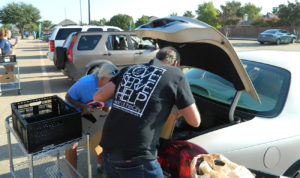
Volunteers with Heart of the City’s Farmers Market Food Pantry provide a drive-through grocery distribution at New Beginnings Church in Lewisville. (File Photo / Ken Camp)

She pointed to some ministries that receive Texas Baptist Hunger Offering funds—specifically Azle Community Caring Center, Heart of the City in Lewisville and Brother Bill’s Helping Hands in Dallas—that serve more than 800 families a week.

“Another Hunger Offering-supported ministry—The Mustard Seed Cafe in El Paso—once served an average of 50 meals daily and made space accommodations to now serve 400 to 500 meals daily,” Gallegos said.

The offering strategically partners with ministries in some South Texas counties that have significantly high food-insecurity rates, such as Cameron County at 21.9 percent and Hidalgo County at 22.9 percent, she added.

Fighting hunger an ‘essential element’ of faith

Christians should take the lead in meeting needs and fighting hunger, Everett insisted.

“I don’t think we always realize that alleviating hunger is an essential element of our faith expression as Christians,” he said.

Too often, Christians see it as an optional “extra credit” activity rather than as a central component of their faith, he asserted.

“We should see hunger as a litmus test issue, because it is a symptom of other broken systems,” Everett said.

Christians can advocate for public policy initiatives that address issues of hunger and poverty, he said. He pointed particularly to the need for Congress to pass a bipartisan Farm Bill package that strengthens SNAP and international food aid programs.

Individual Christians can promote summer meal programs in their communities and urge local schools to participate in breakfast programs and after-school nutrition programs, he added.

Churches also can play an important role locally by participating in coalitions of nonprofit organizations, social service agencies and businesses to build hunger-free communities.

So far, the Baylor Collaborative on Hunger and Poverty has helped to form hunger-free community coalitions in 27 Texas counties.

“That’s significant, but we have 254 counties in Texas,” Everett said. “We have a long way to go.”

For more information about food insecurity and the Texas Baptist Hunger Offering, access the “What is Good?” podcast here.


ERLC board affirms staff, seeks to ‘listen to churches’

The staff of the Southern Baptist Convention’s Ethics & Religious Liberty Commission heard an official word of affirmation Sept. 11 with the release of a statement approved by the agency’s board of trustees in a two-hour executive session the day before during the annual meeting in Nashville.

The statement affirms the work of ERLC president Brent Leatherwood and the 17 other staff members, noting the importance of “bringing light and hope to the public square.”

The statement also emphasizes how ERLC’s role is to keep the churches informed about the pressing moral issues and urges staff “to be cautious when addressing controversial political issues by allowing [Leatherwood’s advocacy assessment filter] to serve as the guide in choosing the wording of the response.”

Leatherwood explained during the Sept. 10 afternoon plenary session of the meeting how he and the team have used the framework outlined in the advocacy assessment since the beginning of his time in the president’s seat.

Both Leatherwood and interim trustee chair Tony Beam of South Carolina acknowledged the concern about ERLC being the focus of a vote for shutting down the entity during the SBC annual meeting in June.

While the motion failed to receive the mandated two-thirds vote of messengers for approval to then go before the 2025 messengers for the final confirmation vote, the fact that the motion was made has ERLC board and staff evaluating policies and procedures.

The board seeks “to support the team at the ERLC, as well as listen to our churches, as together we navigate a turbulent political climate,” Beam said in a statement. “We pray that the [public release of both the advocacy assessment and the affirmation and encouragement statement, which were] affirmed by the trustees, will assist and encourage the ERLC president and staff in speaking clearly and boldly to the issues of the day.

“[We also pray the statements] inform the churches in a transparent way, how the ERLC makes decisions about how they address the issues.”

In other business

During the Sept. 11 morning plenary session of the board meeting, a second executive session was held for roughly 45 minutes.

The result was two motions approved by trustees:

  • “The trustees acknowledge that Brent Leatherwood’s salary has been presented to the full board by the executive committee [of the ERLC] and reviewed by the trustees as stated in the bylaws.”
  • “That we affirm the ERLC’s existing conflict of interest policy and encourage trustees and staff to follow this policy. We also encourage trustees and staff to report violations of this policy. Trustees who violate the conflict of interest are subject to board censure and staff are subject to disciplinary action.”

No context was provided related to the conflict of interest motion, but some board members have been the subject of media reports and social media discussions in recent years related to allegedly “leaking” material and forcing discussions beyond the trustee board meetings. The conflict of interest/standard of conduct policy is in Article VII of the ERLC bylaws.

Trustees also elected new officers and subcommittee chairs: Scott Foshie of Illinois, chair; Amy Pettway of Florida, vice chair; and Anthony Cox of Arizona, secretary; Heather Sells of Virginia, communications chair; Matthew Morgan of Mississippi, administration and finance chair; and Mitch Kimbrell of Vermont, research and public policy chair.

Trustees approved two new temporary trustees to fill the vacancies on the board:

Jon Nelson, lead pastor of Soma Community Church in Jefferson City, Mo., will take the at-large seat left vacant with the resignation of Kevin Smith of Florida, who was serving as board chair until the July confusion related to Leatherwood’s position.

Todd Brooks, pastor of Smith Rock Community Church in Terrebonne, Ore., will take the Northwest seat left vacant by Michael Lerma, who needed to resign following the recent death of his wife.

Nelson, who previously served on the SBC’s Abuse Reform Implementation Task Force, and Brooks are allowed to serve until the next slate of new trustee nominations are presented to SBC messengers during the 2025 annual meeting.

In response to a motion referred to the ERLC from the SBC annual meeting, the board affirmed it will continue serving churches in the area of sexual abuse reform efforts.

“Sexual abuse is an affront to the cause of Christ, especially when it takes place within the church,” board members stated. “The ERLC will continue to serve churches regarding this issue and call on them and others to take this grave issue seriously as we care for victims of abuse and provide a witness to a watching world that the Lord calls us to this ministry of reconciliation.”

With the disbanding of the implementation task force in June, the $250,000 allotted for its work comes back to ERLC and will be used for future sexual abuse reform efforts conducted by the commission.


Conclave NextGen returns to San Antonio in October

Conclave NextGen conference will return to First Baptist Church in San Antonio Oct. 7-8 for two days of worship, breakout sessions, training and networking with NextGen, family ministers and church leaders.

Cory Liebrum, youth and family ministry specialist at Texas Baptists, said Conclave is a gathering for ministry leaders to feel fed and ministered to without interruption.

“We want Conclave to be a place where they can come, and they can worship. They can fellowship. They can find community with other people, and they don’t have to worry about [anything],” Liebrum said.

“It’s their time to be fed because they feed people in their churches all year round. So, for two days, if we can give them that, then that’s the goal.”

Jennifer Howington, childhood ministry specialist at Texas Baptists, said the desire for Conclave is for NextGen ministers to come together to learn and grow in their ministry area.

“We’ve heard of silos in ministry, and we tend to, as children’s ministers, work with just children and student ministers … But we’re seeing the value of integrating those ministries together, and we’re trying to model that on the convention level.

“That happens through Conclave to say, ‘Come together as a team, we’re learning and growing together as a team,’” Howington said. “It just creates that synergy that they can take home with them and implement in their churches.”

Howington advised first-time attendees to “come expecting to find community, because you will.”

Connecting with others in ministry

Attendees will have the opportunity to attend four main worship sessions and four breakout sessions.

These sessions will include content and resources for preschool, children, students and college ministers—sponsored by the Texas Baptist Student Ministry. Attendees can treat their sessions as a track within each of these areas or go to whichever breakout interests them.

There also will be a “Pastor’s Track” for senior church leaders to learn from and form community with others who are dealing with matters unique to their role.

“We’re very intentional about the keynotes and the breakout session topics because we want full representation of all age-graded ministries, and we want there to be something for everybody, but also generalized topics that apply to everybody as well,” Howington said.

“We put a lot of thought into who we invite to be those leaders, and so far, it’s gone well, and we’ve had such a great response.”

Diverse keynote speakers

The four main sessions feature keynote messages from Ed Newton, lead pastor of Community Bible Church in San Antonio; Mike Satterfield, founder of Field of Grace Ministries in Arlington; and Justin Whitmel Earley, writer and speaker from Richmond, Va.

Liebrum said the diversity of keynotes is the “secret sauce” of the conference as they try to match the unique needs of attendees. He said he especially is excited to have Earley address one of the primary motivations behind the conference—community and the importance of connecting with others in ministry.

“Right now, what we see across the state is a lot of ministers and pastors that feel really isolated and don’t feel connected,” Liebrum said.

“For us, [Conclave is] two days where you can get connected, and you don’t have to be youth minister those two days. You don’t have to be children’s pastor those two days. You can just be you and connect with other people. So, I’m excited about Justin coming to be a part of that.”

To fit the needs of individual attendees, Conclave provides an “On Your Own” group for the conference. The “On Your Own” group is designed for attendees who didn’t come with a church group to have an opportunity to connect and build relationships.

Conclave also is hosting approximately 80 exhibitors, showcasing their ministries and what resources they have to offer.

Building momentum 

In addition to breakout sessions, Conclave will hold luncheons on Monday for youth ministers and Tuesday for children’s ministers to advance those connections. Luncheon attendees will share a meal and hear from a speaker in their ministry area.

Howington said she was encouraged by the increased attendance of preschool and children’s ministers at last year’s Conclave and looks forward to building on that momentum this year.

“We had a lot of momentum coming out of last year,” she continued. “Last year was the year we really pushed to have preschool and children’s ministers come with their student ministers and pastors, and we saw the fruit of that.”

Register here for the 2024 Conclave NextGen conference.


Ukraine seminary leader urges prayer for transformation

NASHVILLE (BP)—“Pray for the transformation of our nation,” Ukrainian Baptist Theological Seminary President Yaroslav “Slavik” Pyzh implored Southern Baptists at the Ethics & Religious Liberty Commission’s trustee meeting Sept. 10 in Nashville.

“Next time you mention Ukraine to God, please pray that our people will love God and respect the law,” Pyzh asked.

He presented the lingering war as an evil that has given uncommon opportunity to spread the gospel, even as he prays for peace and victory.

Although Ukraine’s population is not precisely known, the number of Protestant believers has doubled since Russia launched its latest attack on Ukraine in February 2022, Pyzh said. Hope has countered the death and hopelessness the war has wrought.

As he searched for a reason for the war, “my answer that God gave me is that war is an opportunity to transform the nation,” he told ERLC trustees.

Seminary increasingly affected by war

Ukrainian Baptist Theological Seminary in Lviv, about one hour from the Polish border, increasingly is affected by the war that began on Ukraine’s eastern border with Russia, he reported.

Within the past week, a Russian missile struck a neighborhood near the seminary, damaging windows and exterior walls of a dormitory housing 20 female seminary students.

“It was less than 100 yards away from our school,” Pyzh said. “One of our dormitories lost all the doors and all the windows, and 20 ladies that were staying there, it scared life out of them. So, we had to let them go because they couldn’t study after that.

“That’s what Russia is doing,” he said, speculating whether it was a targeted attack on the seminary and its spread of the gospel.

“But one thing that I know for sure,” he said. “When Russia comes to Ukraine, Baptist (religious expression and outreach) does not exist anymore.”

Ukraine’s victory is crucial, as defeat will mean the end of Christianity in the nation.

“Whatever you can do as a country,” he said, “and whatever you can do as a church is critically important to us. … There’s no room for church there (in Russia). There’s no room for Christians there.

“Whatever you can do in order to help us, it’s not only helping the country, but it’s helping us as believers to proclaim God there,” he said. “So, every effort you put there has a whole lot more meaning than you can think of.”

Ministry continues in wartime

Seminary students planted about 55 churches in the 18 months spanning January 2023 to June 2024, Pyzh said.

The war has closed some 500 churches, destroying some church buildings and displacing members. In response, the seminary and Baptist leaders in Ukraine including the All-Ukrainian Union of Churches of Evangelical Christians-Baptists, have worked to minister to internally displaced people and offer them the gospel. Many have come to Christ, leaders have said.

Concurrently in partnership with Southern Baptist Send Relief and others, Ukrainian Baptist Theological Seminary has opened 18 WeCare Centers, providing humanitarian, spiritual, educational and counseling support, legal aid, medical care, childcare, home repairs, generators and other supplies.

Combined, such centers typically serve between 20,000 and 25,000 individuals a month, Pyzh said.

But even as many are coming to Christ, others are rejecting him, Pyzh said, with the number of atheists also doubling during the war and major growth among 18- to 25-year-olds.

“I understand why these young people are calling themselves atheists,” he said, “because they cannot make sense out of that reality” of war.

Ukrainian Baptist Theological Seminary continues to thrive during the war, he said, enrolling 700 new students this year, exceeding an anticipated 500.