SBC may tighten faith statement amendment process

NASHVILLE (BP)—The Baptist Faith and Message soon could be more difficult to amend. That’s a good thing, said the Southern Baptist Convention messenger whose motion this summer in Indianapolis helped initiate the change.

“We have enough division in our denomination without the instability of our foundational confessional document,” said Chelsea McReynolds, the pastor’s wife and women’s ministry leader at Chandler (Okla.) Southern Baptist Church.

“If it is too easy to amend, our core doctrines could shift based on temporary trends or majority whims. Such fluidity could cause confusion among church members and undermine the theological foundations built by our forefathers.”

SBC messengers in Dallas next June will receive a recommendation from the convention’s Executive Committee to give the first of two required approvals to stiffen requirements for amending the Baptist Faith and Message, Southern Baptists’ confession of faith.

The Executive Committee voted Sept. 17 to recommend that messengers amend the SBC Constitution to require two-thirds votes at two consecutive SBC annual meetings to amend the Baptist Faith and Message—the same requirement that exists for amending the SBC constitution.

Triggered by two actions at 2024 SBC

Two actions at the 2024 SBC annual meeting in Indianapolis spurred the Executive Committee to consider Baptist Faith and Message amendments.

One was McReynolds’ motion that the convention require a two-thirds majority for all Baptist Faith and Message alterations. The other was a recommendation from the convention’s ad hoc Cooperation Group that “edits or amendments to The Baptist Faith & Message follow the same process as amendments to the Constitution (two-thirds vote, two consecutive years).”

Southern Baptists began discussing the process for Baptist Faith and Message amendments following a 2023 edit to the confession of faith that some viewed as hasty.

Last year, messenger Jared Cornutt, pastor of North Shelby Baptist Church in Birmingham, Ala., moved that the terms “elder” and “overseer” be listed as synonyms for pastor in Article 6.

The Committee on Order of Business believed the motion’s wording required that they schedule it for debate during that meeting. They did, and messengers voted to amend the Baptist Faith and Message as Cornutt suggested during the meeting’s final session on Wednesday afternoon.

Quick action could create complications

The quick amendment to a foundational document led many, including Cornutt, to raise questions.

“Amending our confession from the floor on a Wednesday afternoon, when our messengers are experiencing ‘delegate fatigue syndrome’ (credit to parliamentarian Al Gage), is like doing surgery on the dining room table with a pocketknife and a flashlight,” Cornutt wrote in a BP column.

“You might get the bullet out (or in this case, the benign tumor), but you’re taking a lot of risks along the way. And why take those risks when you have a team of experienced surgeons and a sterile operating room next door?”

Al Mohler, president of the Southern Baptist Theological Seminary, said the amendment helped clarify what Southern Baptists believe about the office of pastor, but he thought sudden changes to the Baptist Faith and Message could have a negative impact on SBC entities.

The entities include Baptist Faith and Message language in some employees’ contracts, he said, and need time to change legal and business documents.

A quick change could have “charter implications” as “SBC entities are fully accountable to the Baptist Faith and Message,” Mohler said.

Yet tightening the requirements for Baptist Faith and Message amendments is not just a matter of denominational polity, McReynolds said. It also affects local churches.

“Local church constitutions also utilize the BF&M to communicate their beliefs and as part of their governing documents,” she said. “Every change to the BF&M essentially requires each of our churches to personally accept or deny the change.

“There is already an issue in which edition of the BF&M one most closely aligns with. It is not unifying to further complicate the document over a foundationally insignificant change.”

The proposal for Baptist Faith and Message amendments will come before messengers during the Executive Committee report at the SBC annual meeting in Dallas, June 10-11, 2025.


China has no religious freedom, commission says

WASHINGTON (BP)—China has tightened its control of religion, creating such crimes as genocide, mass arrests and enforced disappearances, the U.S. Commission on International Religious Freedom said in a Sept. 23 fact sheet, days after China released long-imprisoned American Protestant pastor David Lin.

“Sinicization, or the complete subordination of religious groups to the CCP’s (Chinese Communist Party’s) political agenda and Marxist vision for religion, has become the core driving principle of the government’s management of religious affairs,” the commission said in its fact sheet.

“Through regulations and state-controlled religious organizations, authorities incorporate CCP ideology into every facet of religious life for Buddhists, Catholic and Protestant Christians, Muslims, and Taoists.

“Enforcement of such sinicization policies has consistently resulted in systematic, ongoing and egregious violations of religious freedom and related human rights, including genocide, crimes against humanity, mass incarceration, enforced disappearances, and the destruction of cultural and religious heritage.”

Lin, who had worked as a house church pastor in Beijing, had been imprisoned since 2006 on charges of contract fraud based on his efforts to raise money to build a church, the commission said in 2019.

Originally sentenced to life in prison, he was due for release in 2030 after commutation and a reduction in his sentence. The 68-year-old has returned to the United States and reunited with his family, U.S. State Department spokesperson Matthew Miller said in a Sept. 16 press briefing.

USCIRF Chair Stephen Schneck
commended the U.S. government for securing Lin’s release, in a post on X, emphasizing Lin was “simply living out his religious beliefs and supporting house church communities.”

Continued advocacy needed for religious prisoners

Commissioner Maureen Ferguson encouraged continued advocacy for the religious prisoners who remain in China, mentioning Protestant house church leaders, underground Catholics, Muslim Uyghurs, Tibetan Buddhists, Falun Gong practitioners and many others, and linking to a list of 521 prisoners.

Bob Fu

Bob Fu, founder and president of Midland-based China Aid, who also advocated for Lin’s release, also said Lin’s freedom in no way signifies a relaxation in China’s sinicization.

“China continues to imprison many Christians who are discriminated against simply for practicing their faith. These individuals are denied the freedom to choose their beliefs and endure constant surveillance, raids, arrests, and other coercive measures,” Fu wrote Sept. 24 at ChinaAid.org.

“The authorities’ actions are politically motivated, but for the persecuted, it is a matter of their faith.”

Miller named at least two Americans—Mark Swidan and Kai Li—who remain unjustly imprisoned in China on false charges unrelated to religion. But perhaps 200 to 300 Americans remain imprisoned there, Fu wrote.

‘All-encompassing scope of sinicization’

In its report, the U.S. Commission on International Religious Freedom pointed to several February amendments to the Xinjiang Uyghur Autonomous Region Religious Affairs Regulations as an example of China’s “all-encompassing scope of sinicization on religious life.”

Those amendments, among other regulations, require religions to “practice the core values of socialism,” to interpret religious teachings in line with “traditional Chinese culture” and China’s contemporary requirements for “development and progress,” and require religious schools to cultivate “patriotic religious talents” and interpret religious doctrine in line with CCP thought and policies.

Even the architectural style of churches and other houses of worship is controlled. They are required to “reflect Chinese characteristics and style in terms of architecture, sculptures, paintings, and decorations.”

Grassroots government members have the authority to report to government authorities and religious affairs bureaus transgressions including “illegal religious organizations, illegal preachers, illegal religious activities, or the use of religion to interfere in grassroots public affairs.”

Protestants, Catholics and remaining officially recognized religions—Buddhists, Muslims and Taoists—must register with the government and submit to intrusive supervision, USCIRF wrote.

In “Five-Year Sinicization Work Plans” effective through 2027, the five religious groups are guided in patriotism, loyalty to the CCP and China’s political system, and conformity of religious doctrines, sermons, rituals and architectural styles of houses of worship in line with the CCP’s ideological requirements, USCIRF said.

“Sinicization entrenches the CCP’s control and its vision for the modern Chinese state into every aspect of religious life by forcing groups from the five officially recognized religions to conform their beliefs, activities, expression, attire, leadership, language, houses of worship and more to CCP ideology,” USCIRF wrote.

“The government creates policies and regulatory measures to sinicize religion and authorizes state-controlled religious organizations to oversee their implementation.”

While exact numbers are difficult, USCIRF said, the U.S. government estimated in 2021 that 5 percent of China’s 1.4 billion people was Christian. Buddhist comprised the largest chunk at 18 percent, followed by 2 percent Muslim and a mix of adherents of Taoism, Falun Gong, folk religious practices and the nonreligious.

China is included in the State Department’s 2023 List of Countries of Particular Concern, indicating China engaged in or tolerated “particularly severe violations of religious freedom” under the International Religious Freedom Act of 1998.


Around the State: ETBU hosts hymn sing

East Texas Baptist University hosted its 14th annual Great East Texas Hymn Sing on Sept. 20. The event brought together hundreds of participants—including students, faculty, staff, alumni, community members, and churches from across East Texas and neighboring states—for an afternoon of worship, fellowship and a shared celebration of Christian faith. Several ETBU alumni, faculty and staff led portions of the worship service, including David Berryhill and Sara Burt. The event was accompanied by piano and organ performances by university organist Cathey DeRousse and assistant professor of music Jonathan Kaan. The ETBU Hilltop Singers, led by director of choral activities and associate professor of music Pat Antinone, also contributed to the celebration.

HPU will receive a $3 million grant to support Hispanic and under-served students at the university. (Photo / HPU)

Howard Payne University will receive a $3 million grant from the U.S. Department of Education over the next five years as a part of the Developing Hispanic-Serving Institutions program. This grant, the largest in university history, will be used to assist Hispanic and under-served students through a variety of programs. The DHSI program is an initiative focused on creating environments that support students and families of Hispanic backgrounds, built on four pillars: bridge, success, connection and completion. The HPU program, named “Centro de Exito” or Center for Student Success, will impact all areas of the HPU campus, including enrollment, academics, career services and more. Funds from the grant will be used to support the new Center for Student Success at HPU, which includes academic coaching, peer tutoring, learning assistance services, academic testing, academic advising and mentoring. Programs will be targeted to support Hispanic and under-served students through the center, with emphasis on first and second-year experiences. Additionally, HPU will develop a Summer Bridge Program to assist incoming students with tools to succeed before they begin college. Career service programs will be developed for undergraduate and graduate students. Funds also will be used for faculty and staff professional development, software updates and campus renovations. HPU was named a Hispanic Serving Institution by the U.S. Department of Education in 2022.

HCU enrolled a record 4,276 students for the fall 2024 semester, the highest total enrollment in the university’s history. (HCU Photo / Michael A. Tims)

Houston Christian University enrolled a record 4,276 students for the fall 2024 semester, the highest total enrollment in the university’s history. According to census data, the total included 701 freshmen and 186 transfer students, the largest transfer class in the last six years. James Steen, vice president of enrollment management and marketing, noted that not only did HCU experience the largest number of on-campus undergraduates, HCU’s Pampell Global Campus enrolled a record 1,234 online students for the fall semester. “Much of this growth was due in part to our donor-funded Grace Hopper Scholarship that fills gaps in student tuition for engineering majors and a remarkable 43 percent increase in our veteran population, as well as a significant increase in new incoming transfers year over year,” Steen said. The positive enrollment figures reflect the impact of new and expanded enrollment strategies and plans for new facilities, programs and infrastructure to support growth goals in alignment with HCU’s Institutional Strategic Plan 2030.

Baylor University again has attained elite Honor Roll status as one of the best colleges in the nation to work for, according to the Great Colleges to Work For program. Based on faculty and staff responses to a related annual survey, Baylor was recognized in eight categories, including its first-ever recognition in the Diversity, Inclusion & Belonging category. The category is reserved for organizations that are demonstrating an institutionalized commitment to belonging, as reported through the experiences of faculty and staff. Baylor has been on the Honor Roll 13 times in the last 15 years, receiving top recognition from one of the largest and most respected workplace recognition programs in the country. The results are based on a survey of 216 colleges and universities. Baylor is among only 42 institutions that earned Honor Roll status, the program’s highest award for recognition in the most categories. Baylor is included in the large university category with 10,000 or more students. Survey results are based on a two-part assessment process: an institution questionnaire that captures employment data and workplace policies, and a survey administered to faculty, administrators and professional support staff. The primary factor in deciding whether an institution received recognition was the employee feedback.

Wayland Baptist University student Annalicia Hernandez of Lockney (left) worked four jobs during the summer to support her education and help others. (Wayland Photo)

Wayland Baptist University student Annalicia Hernandez of Lockney worked four jobs during the summer to support her education and help others. A sophomore majoring in middle school mathematics education, Hernandez took on diverse roles. She managed The Beach House, a snow cone shop in Lockney. She also worked with Wayland’s Student Success team. She served as a children’s worker at Plainview First Assembly, where she initially volunteered and later was offered a paid position. She continues to be employed by the church, working with children, organizing activities and camps with a nurturing Christian environment. As a volunteer, she participated in a mission trip to Alaska with a group from Wayland in June. She helped conduct a sports camp for children, exemplifying her dedication to service and community outreach. In August, she volunteered with Koinonia, the university’s new student orientation program. When Wayland needed to open a residence hall early for Summer Bridge program participants, she took on the role of resident assistant, supporting and guiding new freshmen.

University of Mary Hardin-Baylor had 225 students participate in this year’s Ring Ceremony, with more than 1,000 guests in attendance during Family Weekend. (UMHB Photo)

University of Mary Hardin-Baylor had 225 students participate in this year’s Ring Ceremony, with more than 1,000 guests in attendance during Family Weekend. Seniors graduating in December or the following May are invited to participate. The official school ring was custom designed in 1995. Its intricate design incorporates many of the university’s rich traditional symbols: The Living Flame symbolizes UMHB’s enduring commitment to education. The Crusader represents the spirit of the university in its quest for excellence. The Luther Memorial arches memorialize the first building on the Belton campus. The W.W. Walton Chapel symbolizes the university’s strong Christian heritage and continued desire to reach out to the world for Christ. Students wear the ring with the school’s name facing them. Upon graduation, the ring is turned around with the name facing outward, symbolizing the graduate’s readiness to face the world. University President Randy O’Rear presented the rings, and Melanie McCarthy, class of 1998, was the alumni guest speaker. McCarthy shared her perspective on what it means to be a Mary Hardin-Baylor graduate and how special it is to be a part of the UMHB family.

The T.B. Maston Foundation is receiving scholarship applications for the 2025 to 2026 academic year, Executive Director David Morgan announced. The Maston Foundation provides a $5,000 scholarship annually to a graduate student whose study focuses on Christian ethics. Eligible candidates are Doctor of Philosophy students whose dissertations deal with ethical implications and Doctor of Ministry students whose projects include an ethical focus. By awarding scholarships to doctoral-level students, the Maston Foundation seeks to encourage ongoing leadership and scholarship in the field of Christian ethics. Maston’s former students, colleagues and friends have presented 34 scholarships in his name since 1982. Scholarship application packets include an application form, application transcripts, a CV/resumé, letters of recommendation, a dissertation/thesis abstract and an essay. Access the online application, here. The Maston Foundation perpetuates the teaching and legacy of its namesake—a renowned professor of Christian ethics and Baptist champion of racial justice in the 20th century—and challenges Baptists to live out an authentic Christlike ethic. In addition to its annual scholarship, the foundation conducts retreats—including its annual Young Maston Scholars retreat for undergraduate students.

Anniversaries

Meadowbrook Baptist Church in Robinson will celebrate 65 years on Sept. 27. Cary Killough is pastor.


Board takes steps to create church insurance program

The Baptist General Convention of Texas Executive Board voted to take initial steps to create a Texas Baptist insurance program to enable churches to secure affordable property and casualty, liability and similar insurance coverage.

At its Sept. 23-24 meeting, the board authorized the BGCT to create a corporation to make church insurance available and provide the initial capitalization of an insurance reserve, pending executive committee approval of a feasibility study and approval by messengers to Texas Baptists’ annual meeting.

Since several major insurance carriers have left the Texas market, many churches either have been unable to renew their policies or have been saddled with steep premium and deductible increases.

Texas Baptists already are conducting a feasibility study to explore the possibility of forming a captive insurance pool for partnering churches—a practice some schools and nonprofit organizations already have adopted.

The insurance pool would be administered through a new corporation under BGCT control, and it would function like a co-op.

Keith Warren, executive pastor of North Side Baptist Church in Weatherford. (Courtesy photo)

The baseline premiums are expected to be about 30 percent less than similar insurance on the open market, said Keith Warren, chair of the board’s administrative support committee and executive pastor of North Side Baptist Church in Weatherford. The corporation is expected to be self-sustaining.

Legal requirements demand capitalization of at least 25 percent of the first year’s premiums—projected at between $1.5 million and $5 million, depending on anticipated initial participation.

The Executive Board also elected new officers for the next year—Heath Kirkwood, pastor of First Baptist Church of Lorena, as chair and Suzie Liner, a retired physician and member of First Baptist Church in Lubbock, as vice chair.

Sexual Abuse Task Force presents report

Janice Bloom, incumbent vice chair of the Executive Board and member of First Baptist Church in Garland, reported on the work of Texas Baptists’ Sexual Abuse Task Force, formed in May 2023.

The task force looked at preventative measures and best practices for how churches can respond to sexual abuse, she said. The revised section on Texas Baptists’ website devoted to sexual abuse response will go live on Monday, Sept. 30, with resources in English and Spanish.

In addition to making available a variety of training materials through MinistrySafe, the proposed 2025 BGCT budget includes funds to provide any Texas Baptist church dealing with a sexual abuse issue one hour of consultation with a MinistrySafe attorney.

Other recommendations included developing resources to help churches implement a comprehensive church safety team; develop a model policy for dealing with sex offenders who wish to attend church; develop a code of conduct for staff, board members, volunteers and others related to Texas Baptists; amend the BGCT bylaws to provide disciplinary measures for any Executive Board member who violates the code of conduct; and review the personnel policy manual to address sexual abuse prevention.

Steve Bezner, pastor of Houston Northwest Church, made a motion to create an implementation task force to ensure the recommendations from the Sexual Abuse Task Force are followed. The implementation task force will be appointed by the new chair and vice chair of the Executive Board.

Board recommends $36.7 million Texas budget

The Executive Board also voted to recommend a $36.7 million total Texas budget for 2025, an increase from the $35.29 million budget adopted for 2024. The proposed budget will be presented for approval to messengers at the BGCT annual meeting, Nov. 10-12 in Waco.

The total budget includes a $35.16 million net Texas Baptist budget, up from the $33.79 million in the 2024 budget. It depends on close to $27.8 million in Texas Cooperative Program giving from churches and an anticipated $7.36 million in investment income. It also projects about $1.5 million in additional revenue from conference and booth fees, product sales and other sources.

The board recommended undesignated receipts from affiliated churches continue to be divided 79 percent for the BGCT and 21 percent for worldwide causes.

An anticipated $1.1 million in worldwide missions initiatives and partnerships will be allocated in the same manner as the previous year: $340,000 for missions mobilization, $200,000 for River Ministry and Mexico missions, $100,000 for Texas Partnerships, $55,000 for the Baptist World Alliance, $5,000 for the North American Baptist Fellowship, $50,000 for intercultural international initiatives, $200,000 for Go Now Missions, $100,000 for GC2 initiatives, $20,000 for the Hispanic Education Task Force and $30,000 for chaplaincy.

At the recommendation of the Missions Funding Council, the board voted to increase the maximum amount of church starting funds available to any newly approved church plant from $75,000 to $125,000.

Bringing institution into alignment

In other business, the board adopted restated articles of incorporation for Valley Baptist Missions and Education Center, pending final approval by messengers to the BGCT annual meeting.

The changes bring the center into alignment with the requirements of the BGCT Constitution and Bylaws concerning affiliated institutions, stipulating it is a “no member” nonprofit corporation.

Revisions clarify the existence of Valley Baptist Missions and Education Center as a separate 501(c)(3) from the BGCT, and minimize the potential legal liability possibly incurred by the BGCT on behalf of the center.

The board voted to secure the accounting firm of Batts, Morrison, Wales and Lee to conduct the financial audit, and it approved personnel policy revisions regarding fair employment practices, time away from work and family medical leave.

The board also voted to appoint Bill Arnold, retired founding president of the Texas Baptist Missions Foundation, as interim secretary of the corporation until the BGCT annual meeting, filling the vacancy created by the death of Bernie Spooner.

The board authorized executive leadership to review and adjust staff benefits, tapping unused budget funds for compensation increases.

The board filled vacancies on councils and commissions, electing:

  • Felicia Omoni from African Evangelical Baptist Church in Grand Prairie to the Affinity Ministries Council.
  • George Will Bearden from First Baptist Church in San Antonio; James Robert Pipkin from Calvary Baptist Church in Emporia, Va.; Rochelle Binion from Invitation Church in Sioux Falls, S.D.; and Sara Hester from First Baptist Church in Oneonta, Ala., to the Chaplaincy Endorsement Council.
  • Alice Ward from Westside Baptist Church in Lewisville, Emmanuel Roldan from Primera Iglesia Bautista in Waco, Kalie Lowrie from First Baptist Church in Brownwood, Chad Chaddick from First Baptist Church in San Marcos and Darrin Moore from Truevine Missionary Baptist Church in Spring to the Christian Life Commission.
  • Amy Wilkins from Valley Ranch Baptist Church in Coppell, Justin Hamby from First Baptist Church in Lubbock, Sarah Sensenig from Trinity Baptist Church in San Antonio and Todd Atkins from Salem Institutional Baptist Church in Dallas to the GC2 Press Advisory Council.
  • Jose Gamez from Iglesia Bautista Alfa in Dallas, Enrique Soto from El Buen Pastor in Dallas, Pablo Juarez from First Baptist Church in Kaufman, David Reyes from Fielder Church in Arlington, Joe Rangel from Alamo Heights Baptist Church in San Antonio and Olivia Gomez from Calvary Baptist Church in McAllen to the Hispanic Education Initiative Council.
  • Jill Axton from Indiana Avenue Baptist Church in Lubbock, Gene Potts from First McKinney Baptist Church in McKinney, Larry Post from Sugar Land Baptist Church in Sugar Land and Stacy Leonard from First Baptist Church in Garland to the Institutions Audit Council.
  • Jim Newman from First Baptist Church in Frisco, Jason Davidson from The Heights Baptist Church in Richardson, Janice Bloom from First Baptist Church in Garland, Merritt Johnston from First Baptist Church in Brenham, Ben Raimer from First Baptist Church in Galveston, Pat Hyde from First Baptist Church in Kenedy, Sheri Price from First Baptist Church in Amarillo and David Paul from Sugar Land Baptist Church in Sugar Land to the Texas Baptist Missions Foundation Council.
  • Fernando Rojas from Azle Avenue Baptist Church in Fort Worth to the Missions Funding Council.
  • Dan Upchurch from Sunset Canyon Baptist Church in Dripping Springs and Van Christian from First Baptist Church in Comanche to the Theological Education Council.


Gen Z’s life in ‘Digital Babylon’ presents opportunities

Barna and Impact 360 concluded a series of Gen Z reports Sept. 12 with Leading Gen Z, a simulcast highlighting their final set of conclusions, based on more than a decade of research.

Presenters David Kinnaman, CEO of Barna, and Jonathan Morrow, director of cultural engagement and student discipleship for the Impact 360 Institute, took turns illuminating their findings, offering insights into discipleship opportunities for this generation.

Describing himself as “a geek, for Christ’s sake,” Kinnaman pointed out Gen Z is the first generation to have grown up with digital tools all around them.

He characterized that atmosphere as “digital Babylon, where access to ideas, alienation from specific ways of thinking about life and tradition, and skepticism of authority sort of define them.”

Kinnaman noted how much of a challenge “digital Babylon” presents in impacting Gen Z for Jesus. It has changed the landscape of what people immerse themselves in and the ways they think about what it means to be human and live a life of meaning, he observed.

Living in digital Babylon

“We’re living in a world, aren’t we, where the Google search bar is sort of like our best friend, our adviser, our educator, our counselor,” he said.

“It really is remarkable how these digital devices, these smartphones, social media—it’s really close to what we could invent if we were trying to invent the Holy Spirit—our ever-present help in time of trouble and lost directions. And maybe you need a good friend, right?”

But looking at what the data shows about this generation immersed in the digital world offers an opportunity to understand what the world looks like to them, Kinnaman said.

Christianity has never faced a time like this, Kinnaman suggested, with these kinds of challenges and complexities.

He also pointed to the nuances, “in terms of the persuasiveness of what it means to be Christian and how do we actually help this generation—how do we help ourselves—learn to be rooted and built-up in Christ in this current digital Babylon.”

Discussing the “inner world” of Gen Z, Kinnaman explained this generation is characterized by anxiety and ambition.

They want to accomplish great things and see the world. If they are Christians, they “want to see the church restore its credibility in the world, and they’re ambitious to do that,” he said.

“But the flip side of this is this level of anxiety and this hum … sort of like static electricity that is always in our heads about all the things we haven’t done yet and haven’t accomplished.”

Knowing Gen Z is experiencing anxiety around their ambition offers leaders who work with them an opportunity. Leaders can help them develop a good “theology of ambition” that recognizes it’s God’s work, and not one’s own, that allows people to accomplish all that God has called them to do, Kinnaman explained.

Struggling to transition to adulthood

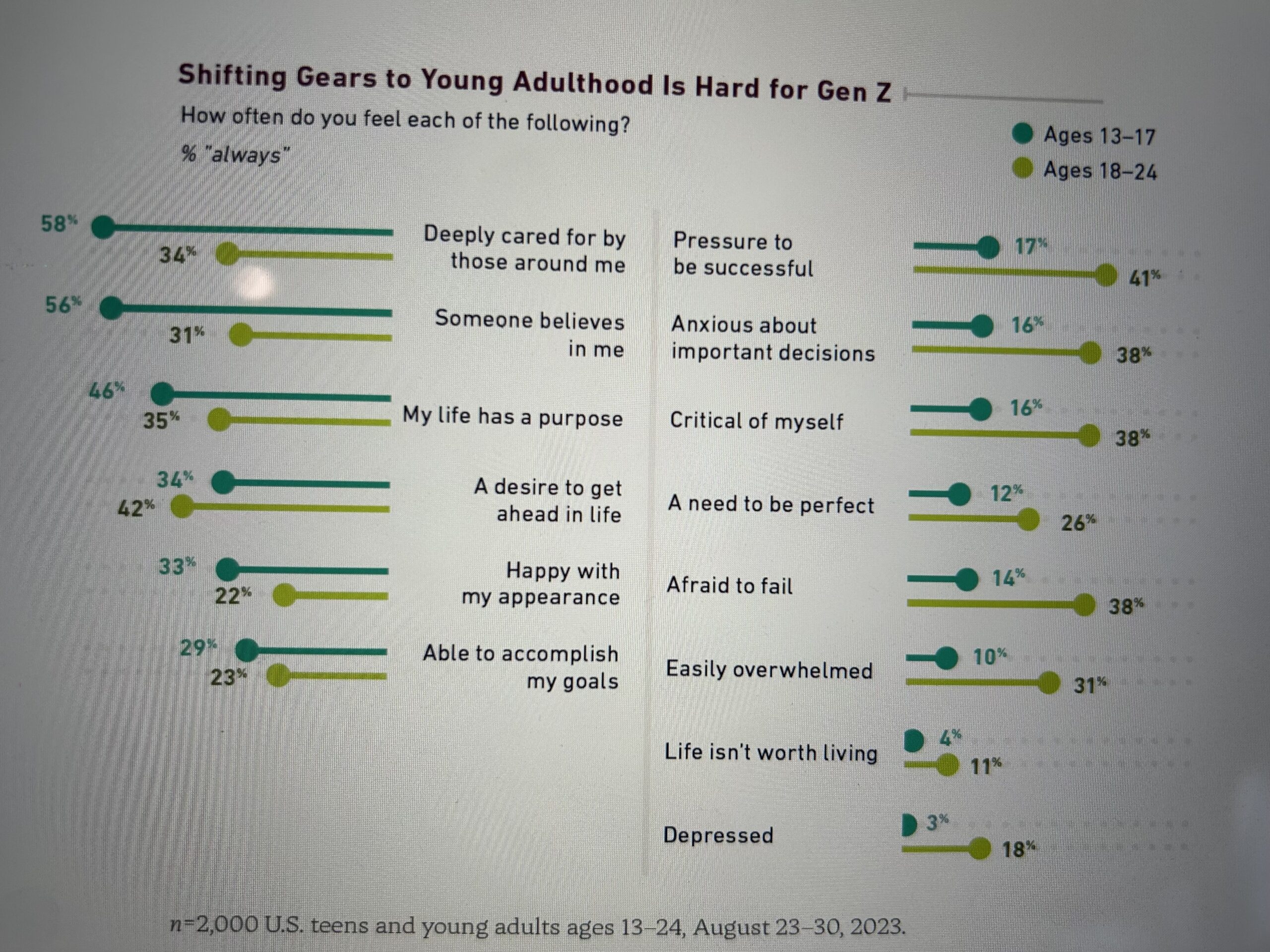
Graph showing shift between adulthood and teen years is hard for Gen Z. (Screenshot)

The data Kinnaman discussed breaks survey participants into two groups, those 13 to 17 years old and those 18 to 24 years old.

Looking at the transition from teen to young adult shows an opportunity for churches to meet a need, Kinnaman noted. There is a significant gap between what teens and young adults in Gen Z reported in terms of how deeply cared for they felt—58 percent of those aged 13 to 17 compared with 34 percent of those aged 18 to 24 reported always feeling deeply cared for by those around them.

Likewise, 56 percent of teens reported always feeling “someone believes in me,” compared with only 31 percent of young adults.

Additionally, young adults were more likely than teens to report negative feelings—reporting always feeling: pressure to be successful (41 percent to 17 percent); anxiety about important decisions (38 percent to 16 percent); self-critical (38 percent to 16 percent); and afraid to fail (38 percent to 14 percent).

In light of the continuing trend to delay marriage and having children—which might help offset some of the reported negative feelings—these gaps offer churches a considerable opportunity to support Gen Z in transitioning to adulthood, Kinnaman suggested.

While the gaps may partly reflect young adults are simply perceiving these “heartbreaking indicators of mental health and challenges” more when they leave childhood, they still need a strong support system, which churches can provide, Kinnaman noted.

Not all bad news

Kinnaman highlighted one positive post-pandemic development. Gen Z has a better understanding of mental health and broader vocabulary and willingness to talk about it. But the data around the mental health issues they face still shows Gen Z is struggling.

Four percent of teens and 11 percent of young adults reported always feeling like life isn’t worth living. Suicide isn’t new, Kinnaman pointed out, but what is new is the access (to Google) and “the alienation from the community of faith and those that can love us.”

What’s new is the increased skepticism toward authority—“the digital Babylon markers,” he continued.

“In digital Babylon, where it’s like: ‘Man, I’m feeling really lonely,’ and you’re going to pull up your phone. And you’re going to go: ‘What do I do?’—search bar—to deal with the loneliness that I’m feeling.”

These are real people dealing with real existential crises reflected in the numbers—young people who would benefit from Christians coming alongside them as they sort through the complex transitions they’re thinking about and experiencing.

That reality presents a “fields-are-white-unto-the-harvest” level of opportunity for Christians who work with Gen Z students and young adults, Kinnaman declared.

Barna and Impact 360’s reports contain many more findings about Gen Z, with suggestions for how the openness of this generation can be a catalyst in reaching them for Jesus. The researchers expressed optimism about the generation, noting quite a few characteristics of Gen Z they considered to be quite positive.


Disability and Church: Building a culture of belonging

WACO—Commit to “one next move” toward building a culture of belonging for individuals impacted by disability, program director of the Baylor Collaborative on Faith and Disability Jason Le Shana challenged attendees of a faith and disability workshop at Baylor University, Sept. 17.

Le Shana pointed out society often neglects people with disabilities and “doesn’t reflect God’s heart” for individuals impacted by disability. But “we believe that the church is called to be the body of Christ in the world,” he said.

Because “when certain parts of the body are neglected, that’s not good for the body in general,” it’s important for church members to think about what gets in the way of movement—in this area of people with disabilities being invited fully into the life of the church.

Churches need to consider what it might look like for disabled people “to be embedded at that DNA, normalized cultural level of church life,” Le Shana suggested.

He defined church culture as an often unspoken or unstated pattern of shared basic assumptions that exist within the group and imperceptibly govern the way members of the group behave. Changing church culture is difficult, Le Shana conceded, but committing to one next move is a good place to start.

Joni & Friends

Daniel Moreno, ministry relations manager for Joni & Friends Texas, discusses five stages of belonging and cultural change. (Photo / Calli Keener)

Daniel Moreno, ministry relations manager for Joni & Friends Texas, explained the organization advocates for the disabled community within the walls of the church because they believe disabled ministry isn’t just an option, but a command, found in Luke 14:21-23.

Joni & Friends has a vision of a world where every person with a disability finds hope, dignity, and their place in the body of Christ. In his role, Moreno works with churches in Texas, empowering them to evangelize, disciple and serve people living with disability—which Moreno suggested comprise “the largest unreached people group in the U.S.”

Moreno said social and physical boundaries exist to including disabled people in church, but these barriers are not new.

For an example of the longstanding nature of disability disenfranchisement, Moreno turned to the story of Bartimaeus in Mark 10:46-52. The followers of Jesus’ rebuke of Bartimaeus, a blind man, highlights an uncomfortable truth—“the people of God often are the biggest barrier to people impacted by disability to enter the doors of the church,” Moreno said.

But, Jesus told his followers to call Bartimaeus to him. When he was healed, Bartimaeus chose to follow Jesus—whose Messiahship he recognized—“with the very people that rebuked him.”

Moreno encouraged churches to think about where the church and its individual ministries fall within five stages of cultural change, when it comes to meeting the needs of the disabled community: unawareness, evaluation, care, friendship and contribution.

The first stage, unawareness of what disabled people and their families experience and need, is addressed by seeking information and becoming knowledgeable about disability ministry considerations.

When a church has become aware of a need to change in order to meet the needs of its disabled members, it’s at the evaluation stage and needs training in how to make the right changes for their church.

From evaluation, the church moves to the care stage, when time together—abled and disabled—is beginning to happen.

Then the church moves into the friendship stage, where individuals with disabilities are beginning to be seen as part of the fabric of the church and are missed when they aren’t there.

Finally, the church reaches the fifth stage of cultural change—contribution—where individuals impacted by disability are given the opportunity to participate in the body, serving as equal, valued members.

When people come to church, they expect to be discipled. Church is about making disciples. Moreno insisted families impacted by disability have the same right to expect church to aid in “fostering a gospel-centered heart” in them and/or their children, regardless of abilities.

People impacted by disability aren’t excluded from the Great Commission, he explained, neither in being recipients of the message, nor in participating in its fulfillment. The gospel and the Great Commission are for everyone.

How is it, then, that the church continues to exclude people with disabilities, Le Shana asked—because: “Change is hard.”

However, “it’s not all bad news,” Le Shana said, there is scholarship on how to do this. He challenged attendees to consider committing to “one next move” they could make in their churches to help build a culture of belonging.

It starts with one

Jason Le Shana, program director of the Baylor Collaborative on Faith and Disability, discusses the power of ‘one next move’ to create change. (Photo / Calli Keener)

Citing the book, It Starts with One, by J. Stewart Black and Hal Gregerson, Le Shana asserted the main reason change is so hard is “as humans, we tend to pursue feelings of competence and success.”

Humans don’t like to feel like failures. Change requires a willingness to live in and with incompetence until the new way of doing things is mastered, according to the book. And people are not naturally going to want to do that, Le Shana said.

Churches tend to measure success in terms of the three “Bs”—budgets, buildings and bodies. If things seem to be going well in those areas, churches can fall into a trap—thinking they’ve figured out how to do the right thing and do it well.

Then they discover there’s something wrong with the right thing.

Le Shana gave examples of a church that’s been known for its loud, spirited worship music learning the worship is painful to families in the church dealing with sensory processing challenges or a church good at quiet, contemplative liturgical-style worship struggling to welcome a visiting person prone to verbalizations and movements.

In each case, the church must decide whether to keep doing the thing well that they’ve been doing—which has become the “wrong” thing because it’s a barrier to participation—or move forward toward a new “right thing,” which at least at first, they can expect to do poorly, Le Shana continued.

To move forward “requires us to face our own collective incompetence,” so change is hard. But, organizational change literature points to a key in fostering change: the power of simple movements. Not grand strategies, but simple movements, or behaviors, is where change starts, Le Shana said.

“Don’t underestimate the power of simple actions undertaken faithfully over time” to effect change in church culture. And, he challenged, consider what movement “God might be calling you to.”


Faith leaders key to providing access to mental health care

(RNS)—When it comes to mental health, “too blessed to be stressed” isn’t an altogether helpful catchphrase, according to the American Psychiatric Association.

“You can be blessed, and you can be stressed. That’s OK,” said Amy Porfiri, managing director of the American Psychiatric Association Foundation. “We want to hopefully avoid that type of messaging, that it’s a moral failing, that mental health is a spiritual failing.”

For over a decade, the American Psychiatric Association has worked to reduce the stigma around mental health in religious contexts. But while awareness around mental wellness is at an “all-time high,” according to Rawle Andrews, executive director of the APA Foundation, “we still have a lag when it comes to actually accessing care, or giving ourselves permission to access care,” he said.

That “lag” is reflected in a new American Psychiatric Association poll released Sept. 16, which suggests there could be a disconnect between faith communities and the people they serve when it comes to mental health.

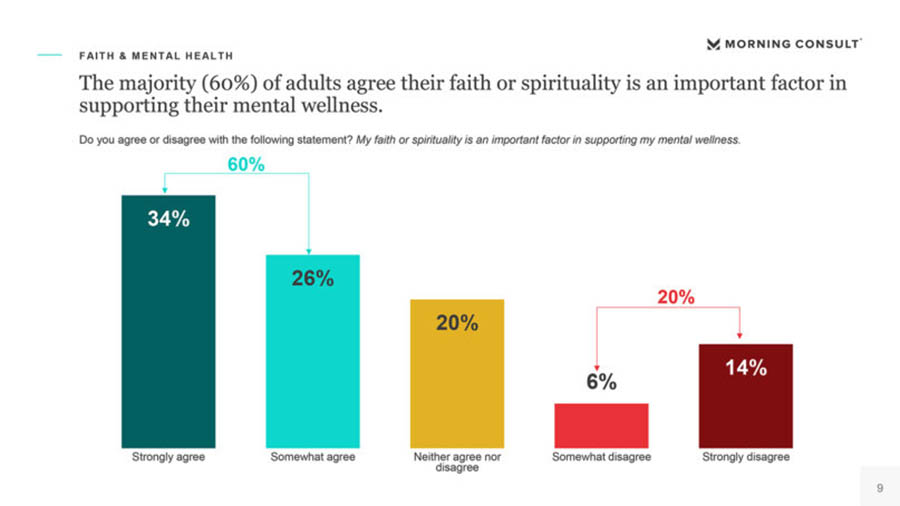
A survey of over 2,000 participants conducted by Morning Consult on behalf of the American Psychiatric Association found while 60 percent of U.S. adults say their faith or spirituality is an important factor in supporting their mental wellness, only 52 percent of those who belong to a religious community agree that their faith community “discusses mental health openly and without stigma.”

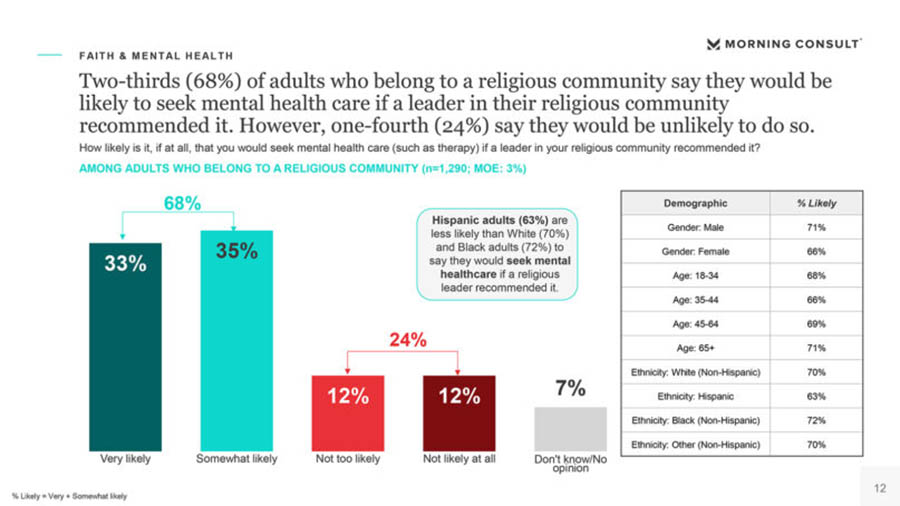
When it comes to addressing that gap, findings indicate faith leaders are key. Of survey participants who belong to a religious community, 57 percent said they’d be likely to reach out to a faith leader if they were struggling with their mental health, and 68 percent said they’d be likely to seek mental health care if a religious leader in their community recommended it.

“Our faith leaders have almost become a … first responder when it comes to getting people connected to care,” said Andrews.

Porfiri noted that, anecdotally, parishioners experiencing mental health struggles are often more comfortable turning to a faith leader than making an appointment with a therapist.

How and when to make referrals

But faith leaders don’t always receive training on mental health.

“What we learned is that our faith leaders oftentimes feel very ill-equipped,” she said.

Enter the second edition of the American Psychiatric Association Foundation’s Mental Health: A Guide for Faith Leaders. First published in 2015, the guide includes what Porfiri called a “mental health 101” section and recommendations for how and when faith leaders should make a referral to a mental health professional.

For instance, the guide teaches faith leaders to consider making referrals for congregants experiencing family dysfunction or prolonged grief or whose emotional and behavioral problems don’t meaningfully improve after six to eight sessions.

When making referrals, the guide suggests having a list of qualified professionals on hand and differentiating between clinical care and spiritual support. The guide also lists steps for responding when someone resists clinical treatment.

“I don’t think anything we do with a faith guide is going to make a clinician out of a faith leader, but it certainly will make them turn what we like to say difficult conversations into comfortable or courageous conversations around faith and mental health,” Andrews said.

Compassion fatigue and burnout

In light of more recent concerns about clergy burnout, the updated guide makes clear that faith leaders aren’t solely responsible for congregants’ mental health. A new section includes different models for how faith communities can link congregants with clinical services, from embedded or affiliated mental health clinics to simply having a current set of mental health resources on hand.

The guide also includes suggestions for dealing with clergy compassion fatigue and burnout, including keeping tabs on symptoms, from emotional numbness to increased irritability and chronic fatigue, and taking steps to delegate tasks, schedule sabbaticals and build supportive relationships with people outside of work.

“We have to start seeing our faith leaders as human beings as well,” said Andrews. “They can’t just be 24/7, 365. That has to be part of the message.”


SBC to create sexual abuse response department

NASHVILLE (BP)—Southern Baptist Convention Executive Committee trustees on Sept. 17 approved a recommendation to create a department within the Executive Committee to assist churches in the area of sexual abuse prevention and response.

Messengers voted at the 2024 SBC annual meeting in June for the Executive Committee to find a permanent home for sexual abuse prevention and response efforts in the SBC.

Executive Committee President and CEO Jeff Iorg began conversations with leaders in the Abuse Reform Implementation Task Force shortly after being nominated to his position. By the time of his election in May, those talks had been taking place for weeks.

“We have had two task forces that have done difficult and hard work,” he told the Executive Committee. “But it’s time to stop talking about what we’re going to do and take an initial, strategic step of action that puts into place an administrative response to this issue.”

As Iorg began his role, he said, the implementation task force decided to recommend to the SBC that the Executive Committee take the lead in identifying the best place within the Southern Baptist structure to address ongoing sexual abuse prevention and response. The real work for that goal began after messengers approved the recommendation.

Leaders considered placing the responsibility with an existing SBC entity or creating a new entity, Iorg said. The decision to create a new department in the Executive Committee was determined to be the best option “to get us proactively started on implementing sexual abuse prevention and response across our denomination work,” Iorg said.

Send Relief gift to provide initial funds

Initial funding for the new department will be drawn from the remaining funds given by Send Relief in 2022 to go toward implementing sexual abuse reforms in the SBC. SBC Executive Committee CFO Mike Bianchi said about $1.8 million remains of the initial $3 million.

Iorg said an immediate step would be hiring a national director of sexual abuse prevention, who would recommend additional staff for the ministry.

Trustee Brian Cloys asked during open discussion why the role wasn’t given to the Ethics & Religious Liberty Commission, saying the entity seemed to be better suited for the role within its ministry assignment.

Iorg responded that prior to his becoming president, the Abuse Reform Implementation Task Force had held discussions with the ERLC. Both determined, Iorg said, “that it was not the most workable solution at the time.”

After becoming Executive Committee president, Iorg continued conversations with the ERLC on the matter.

“They are very open to helping us with this process and want to be a team member with us,” he told trustees. Currently, though, the Executive Committee is better suited for the role, he said.

Iorg went on to say, however, that different conditions in the future wouldn’t necessarily prevent the ERLC from taking on a more active role.

Cloys also asked about any connection between the announcement regarding the new department and the Abuse Response Commission, a new organization announced at February’s Executive Committee meeting.

“That organization was not authorized by the Southern Baptist Convention, doesn’t belong to the Southern Baptist Convention and therefore we cannot give any responsibility to it as the Executive Committee,” Iorg said. “It can only take its own responsibility in making its own decisions.

“That’s not to criticize them, but to draw a distinction. [The Abuse Response Committee] does not belong to us, so we have no comment or directive that can be given by the Executive Committee of ARC.”

Some flexibility will be necessary, he said.

“This is not the final step by any means, but it is the first step,” Iorg said. “If we conclude as the months and years go by that this needs to be moved to another entity, it can be done. If we conclude it needs a separate entity, that can also be done.

“Things can still evolve out of this initial decision. But this decision starts us on a path—a concrete, specific action and is a workable solution, or at least the beginning point of one.”


SBC legal expenses surpass $12M in three years

NASHVILLE (BP)—The Southern Baptist Convention Executive Committee reported it has spent more than $12.1 million on the 2021-2022 Guidepost Solutions investigation into its handling of sexual abuse claims and subsequent legal expenses dating back to 2021.

To cover expenses and operating costs moving forward, the Executive Committee voted in executive session at its September meeting to authorize President Jeff Iorg to execute a loan secured by the SBC Executive Committee building and place the Nashville building on the market.

The release of the detailed financial information was the result of a motion adopted by messengers at this summer’s SBC annual meeting.

Executive Committee Finance Committee Chair Adam Wyatt told Baptist Press the funds to cover legal expenses have been taken from the Executive Committee’s reserve funds to “protect Cooperative Program dollars” even though the original motion adopted by messengers at the 2021 SBC annual meeting approved the use of Cooperative Program dollars for the review.

The numbers show the Executive Committee has “done everything in our power to take the burden on ourselves to protect the Cooperative Program and the work of the convention and its entities,” Wyatt said. “And it is our effort of trying to just be as transparent and clear about where we really are.”

The expense breakdown given to the Executive Committee shows:

  • The total cost of the Guidepost Investigation was $3.1million.
  • $2 million was paid directly to Guidepost to conduct the investigation.
  • Legal and task force expenses totaled $1.1 million.
  • The Executive Committee has paid $3.1 million to indemnify Guidepost.
  • The cost of the abuse tipline hosted by Guidepost has been $861,000. This expense has been reimbursed by Send Relief.

Other legal expenses include:

  • Litigation and case management: $2.4 million
  • U.S. Department of Justice investigation: $2 million
  • General counsel: $571,000
  • Post investigation legal support: $131,000

Messengers to the 2021 SBC annual meeting in Nashville approved a motion calling for an independent, third-party investigation into alleged mishandling of sexual abuse claims by the Executive Committee over a period of 20 years.

The motion also called for the creation of a Sexual Abuse Task Force to oversee the third-party investigation and bring recommendations to the 2022 SBC annual meeting.

That task force retained Guidepost to conduct the investigation, and the contract signed included a clause indemnifying Guidepost of any legal expenses resulting from its investigation.

The report from the investigation was released in May 2022. An investigation of the SBC by the Department of Justice was announced in July 2022.

Two men named in the Guidepost report later sued both Guidepost and the SBC for defamation—former Georgia pastor and SBC president Johnny Hunt and former Southern Baptist Theological Seminary professor David Sills.

The Hunt suit in particular has made up the lion’s share of litigation expenditures thus far, Wyatt told Executive Committee members Tuesday.

One of the recommendations of the Sexual Abuse Task Force at the 2022 SBC annual meeting was the formation of the Abuse Response Implementation Task Force. The implementation task force functioned from September 2022 until the 2024 SBC annual meeting in Indianapolis.

In its final report to messengers this past June, the Abuse Response Implementation Task Force recommended the Executive Committee find a permanent home for sexual abuse response and prevention in the SBC.

The Executive Committee took first steps toward that end Sept. 17 by adopting a recommendation from its officers to form a new department within the Executive Committee.

Seeking to be ‘fully transparent’

SBC Executive Committee CFO Mike Bianchi told Baptist Press the Executive Committee is striving to be “fully transparent of how we got here, and we want to be equally transparent of where we’re going.”

“We want to bring all the partners, all the entirety of the SBC into that discussion of where we’re going,” Bianchi said.

Chairman Philip Robertson reported Executive Committee members acted during an executive session to help cover the entity’s expenses and operating costs.

The Southern Baptist Convention Executive Committee building in Nashville, Tenn. (Baptist Press Photo)

“To meet the EC’s operational and legal expenses, the Executive Committee has authorized the president to execute a loan secured by the building and place the SBC building on the market,” Robertson said.

The Executive Committee discussed the potential sale of the SBC building in Nashville during its September 2023 meeting.

At the 2017 SBC annual meeting, messengers authorized the Executive Committee to “continue studying the advisability of a sale of the SBC Building, and to sell the property upon such terms and conditions, and at such a time, if any, as the Executive Committee may hereafter approve.”

The building is home to the Executive Committee, the Ethics & Religious Liberty Commission, SBC Seminary Extension, the Southern Baptist Historical Library and Archives and the Southern Baptist Foundation.

Proceeds would be divided among them:

  • The Executive Committee holds a 56 percent interest.
  • The Ethics & Religious Liberty Commission holds a 14 percent interest.
  • The Council of Seminary Presidents holds a 26 percent interest. This is composed of a 10 percent interest for Seminary Extension Education and 16 percent for the Southern Baptist Historical Library and Archives.
  • The Southern Baptist Foundation holds a 4 percent interest.

The Executive Committee’s next scheduled meeting is Feb. 19-20, 2025, in Nashville.


Around the State: Shoes for Orphan Souls turns 25

Dallas-based nonprofit, Buckner International, celebrated the 25th anniversary of its largest humanitarian aid project, Buckner Shoes for Orphan Souls, Sept. 14. The celebration event featured speakers, live music, family activities, a reception, a presentation of a proclamation by Gov. Greg Abbott and an immersive shoeless experience. The event drew around 140 people including Buckner leadership, representatives from local churches, businesses, volunteers and members of the community at large. Speakers included Albert Reyes, president and CEO of Buckner International; Shawn Spurrier, director of Buckner Shoes for Orphan Souls; Ron Harris, former KCBI general manager; and Natasha Potts, who received a pair of boots from a volunteer on a Buckner mission trip when she was living in a Russian orphanage at age 12. Beginning in 1999, Buckner Shoes for Orphan Souls held its first community shoe drives in Dallas. Since then, Buckner has hosted more than 20,000 shoe drives across the country. Over the last 25 years, 5 million shoes have been collected by individuals, organizations and churches for Buckner Shoes for Orphan Souls. All shoes and socks are sorted at the Buckner Humanitarian Aid Center in Dallas and then shipped out to vulnerable children domestically and in 86 countries around the globe.

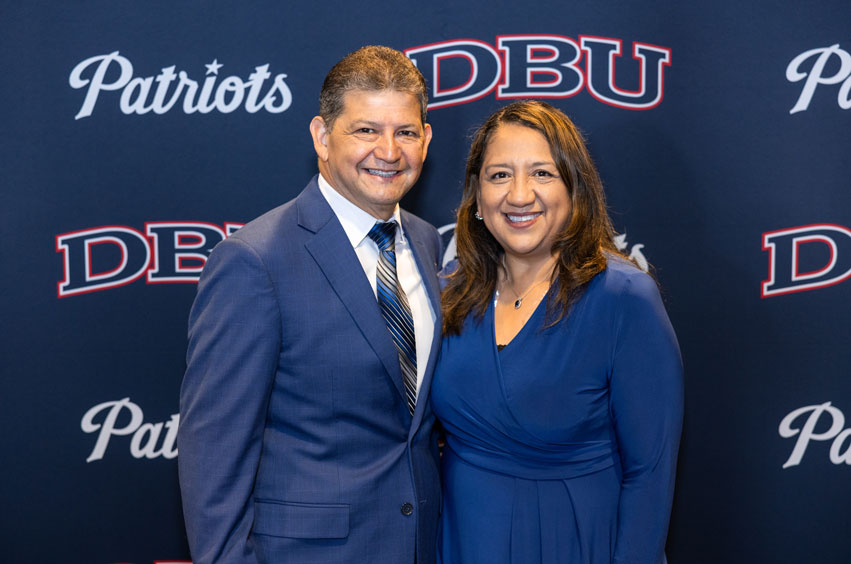
Rolando and Angie Rodriguez pose at the reception honoring his 35 years of service with Texas Baptists held at DBU, Sept. 16. (DBU Photo)

On Sept. 16, Dallas Baptist University hosted a special ceremony to celebrate Rolando Rodriguez for 35 years of faithful service to the kingdom of God. Organized by Gus Reyes and Julio Guarneri, the ceremony honored Rodriguez in the presence of his close friends and family. Rodriguez currently serves as senior director of Texas Baptists en Español. He completed two graduate degrees at DBU: a Master of Arts in Christian Education in 2005 and a Master of Arts in Global Leadership in 2017. He and his wife, Angie, have three children.

Baylor University’s Truett Theological Seminary, in its 30th anniversary year, has recorded a record-breaking enrollment for the fall semester. Truett Seminary enrolled 409 students this term, a 4 percent increase over last year’s fall enrollment of 392. This marks the third consecutive year of enrollment growth for Truett. The previous enrollment record for the seminary was 406 students during the fall of 2008. The incoming class is 41 percent female and 40 percent Asian, Black and Latino or Latina. Additionally, 22 percent of Truett’s student body is now enrolled at one of the seminary’s extension campuses located in Houston or San Antonio or in an online degree program. Non-Baptiststudents are enrolling at Truett Seminary in increasing numbers, with more than half the entering class of 100 from a denomination other than Baptist. Truett’s current student body is comprised of 54 percent Baptists, 15 percent Methodists and 13 percent nondenominational, with the other 18 percent of students coming from 23 other Christian communions.

The Center for Student Success will now offer academic coaching to students. (HPU Photo)

Howard Payne University began implementation of its 2024-2029 Quality Enhancement Plan with the start of the fall 2024 semester. Titled “Game Plan for Academic Achievement – GPA+: Academic Coaching for Jacket Success,” the plan is designed to help students build the skills they need to succeed in the classroom through HPU’s newly certified academic coaches. It was developed as part of the institution’s reaccreditation process with the Southern Association of Colleges and Schools Commission on Colleges. The goal of the Quality Enhancement Plan is to help the most academically at-risk students be equipped to succeed by supporting GPA improvements, term-to-term student retention and persistence to graduation rates. HPU expects adopting an “academic coaching” model to increase the effectiveness of the university’s Center for Student Success. To offer academic coaching to students, three HPU staff members earned a certification as academic coaches from the Association of Coaching and Tutoring Professionals. The academic coaches are Wendy McNeeley, assistant vice president for student success; Jennifer McNiece, academic coach; and Mary Agboola, coordinator of graduate studies and special projects in academic affairs.

Students from East Texas Baptist University’s Teague School of Nursing recently were honored with a Polly Cargill Nursing Scholarship. (ETBU Photo)

Students from East Texas Baptist University’s Teague School of Nursing recently were honored with a Polly Cargill Nursing Scholarship, provided by Jerry and Jack Cargill in partnership with ETBU. A total of 31 local nursing students were recognized during a Sept. 11 ceremony, with ETBU accounting for 22 of the recipients. The Cargill brothers created the Polly Cargill Nursing Scholarship in memory of their mother, Polly Cargill, to honor the exceptional nursing care she received at Good Shepherd Marshall Hospital. The scholarship aims to empower students in East Texas to become skilled, compassionate nurses while honoring Polly Cargill’s legacy. The ETBU nursing students honored were Emma Bevel, Hannah Blaha, Baylie Colston, Hayley Davis, Paige Grissom, Bryanne Izaguirre, Sarah Jones, Jessica Kuhlman, Julia Lamb, Abigail Lucas, Joseph Maique, Melissa Martinez-Chavez, Kaitlyn Moore, Abryana Odom, Avery Reid, Angela Sanchez, Kennedy Tucker, Christian Walbridge, Elizabeth Watkins, Hannah Wrinkle, Elizabeth Wynne and Ashlyn Wynne.

In celebration of Hispanic Heritage Month, the University of Mary Hardin-Baylor’s 9th annual Latino Fest is scheduled for Sept. 19. (UMHB Photo)

In celebration of Hispanic Heritage Month, the University of Mary Hardin-Baylor’s 9th annual Latino Fest is scheduled for Sept. 19. The Fiesta en la Calle event is hosted by UMHB’s Kingdom Diversity Office and Hispanic Student Association. This year’s event will celebrate the university’s recent designation as a Hispanic-Serving Institution—a milestone indicating the institution has reached 25 percent Hispanic enrollment. The designation provides programs and initiatives to students annually, bringing together more than 700 participants from across the United States and Puerto Rico for workshops, networking opportunities and professional development. The Fiesta en la Calle will include dancing, food vendors, games, face painting and photo opportunities. The event will also feature special performances by Guzman Ballet Folklorico and Mariachi Arriago de America. “This event celebrates the diversity of UMHB’s student body,’ said Karla Gonzalez, UMHB Spanish professor and HSA sponsor. “It honors the Hispanic culture and history so our students can proudly embrace their heritage.”

HCU has received approval from the Southern Association of Colleges and Schools Commission on Colleges for a new online master’s degree in Data Science. (HCU/Carnegie Photo)

Houston Christian University has received approval from the Southern Association of Colleges and Schools Commission on Colleges for a new online master’s degree program in Data Science. The new degree program, slated to launch in Spring 2025, is designed to provide students with a comprehensive understanding of data analysis, machine learning, statistical modeling and more. Through a combination of rigorous coursework and hands-on experience, students will develop the expertise to extract valuable insights from complex datasets and drive informed decision-making in various industries. The curriculum of the program covers a wide range of topics, including data visualization and storytelling, predictive analytics and modeling, big data technologies and platforms, ethical and legal considerations in data science and advanced programming languages. Students will have access to state-of-the-art facilities and resources, including dedicated laboratories equipped with cutting-edge software and tools. They can engage with industry professionals through internships, guest lectures and networking events.

Bobby McCloud (Wayland Photo)

Bobby McCloud has been named Wayland Baptist University’s executive director of international program operations.He will focus primarily on further developing a program to bring international graduate students to Wayland campuses. The program already has brought students to Wayland’s San Antonio campus, and there are plans to implement the program at the university’s Phoenix, Ariz., campus, as well as another extension campus. Wayland President Donna Hedgepath said the program has the potential to help Wayland tremendously increase the university’s student population across campuses. A 2019 Wayland graduate with a Master of Business Administration degree, McCloud earned a Doctor of Education degree from University of Wyoming in 2023. Bringing years of operational and management experience, along with a financial services background, McCloud joined Wayland in 2015. He has served as director of development at Wayland’s Lubbock campus.

One of the biggest issues churches across Texas face currently is finding affordable property and liability insurance. As major carriers are exiting the Texas market, churches either have experienced policy nonrenewal or steep premium and deductible increases. The Baptist General Convention of Texas is exploring ways to help address the insurance crisis churches are facing. One solution Texas Baptists are investigating is forming a captive insurance pool for BGCT partner churches. Because of the unique nature of churches and nonprofits, often commercial insurance policies are not able to provide the kinds of coverage churches need at an affordable rate. The practice of forming captive insurance pools has proven beneficial for schools and other nonprofits. Texas Baptists still are in the exploratory phase of considering this option, and program approval would be subject to both Executive Board recommendation and an annual meeting vote. But if a captive insurance pool is deemed viable and approved as noted, startup would not be before the second quarter of 2025, at the earliest. Any church interested in participating in a survey should contact the local associational director of missions. Texas Baptists would like at least 25 percent of partnering churches to provide data for consideration. Churches that already are insured with a carrier but might be interested in this potential option are encouraged to participate in the survey. The more churches who can provide survey answers, the better for data building and insight.

Retirement:

Janelle O’Connell, dean of the College of Health Professions and professor of physical therapy, will retire from Hardin-Simmons University in May 2025 after 30 years. O’Connell joined Hardin-Simmons University as a founding member of the physical therapy department and was named program director in 1999.

Anniversaries:

Wayland Baptist University in San Antonio will celebrate 40 years of providing Christian education in San Antonio on Sept. 18.

Pioneer Drive Baptist Church in Abilene celebrates its 70th anniversary Sept. 22. John Whitten is senior pastor.

CORRECTION: The date Buckner International celebrated the 25th anniversary of Buckner Shoes for Orphan Souls was corrected from Sept. 21 to Sept. 14.


Views about Latino voters’ faith often distorted

WASHINGTON (RNS)—There are more Latino voters in the United States than ever. As reporters and pundits seek to understand this important voting bloc, they’re digging into the faith of Hispanic communities.

But as this election cycle brings yet another flurry of trend pieces about Latino evangelicals, some narratives distort the big picture of Latino faith. Others are just myths.

Consider the facts about Latino voters and their faith:

The share of U.S. Latino adults who are evangelical has been relatively steady in the last decade.

Many trend pieces about Latino voters claim that there has been a significant spike in the Latino evangelical population. However, that narrative doesn’t bear out in the polling.

In 2022, Pew Research Center found 15 percent of U.S. Latino adults were evangelical, the same percentage that was evangelical in 2012. In the years in between, that statistic has dropped to 14 percent or been as high as 19 percent.

The Public Religion Research Institute found in 2013 Hispanic Protestants, a category that also includes nonevangelicals such as mainline Christians, made up 3 percent of Americans. In 2023, those numbers grew to 4 percent.

The small growth PRRI has tracked comes as the overall number of U.S. Latinos is growing, as is the share of the U.S. population they represent. In 2022, Latinos made up nearly 1 in 5 Americans, up from 16 percent in 2010.

This growth does not translate to a significantly expanding Latino evangelical population, yet this misunderstanding persists.

A segment on MSNBC’s “Morning Joe” on Sept. 5 broadcast that narrative, with journalist Paola Ramos saying, “You even have some scholars like Mark Mulder from Calvin University that predict that by 2030, over 50 percent of Latinos will identify as evangelical.”

In an email, Mulder told RNS Ramos had misquoted a prediction he and others made in a 2017 book that included all Latino Protestants, a larger category.

Asked whether he stood by that prediction in 2024, Mulder pointed out the book had been written in 2015, almost a decade ago.

“Right now, no, that does not seem plausible,” he wrote.

A December 2023 poll by PRRI also found Hispanic Protestants’ net gain in membership is relatively small. Only 1.4 percent of the U.S. population has become Hispanic Protestant after growing up with a different childhood religion, but 0.9 percent of those raised Hispanic Protestants have left the faith.

In polling released in August, PRRI found younger Latino adults in both the 18-to-29 and 30-to-49 age cohorts were more likely to be Protestant than older generations, a trend that has held over the last decade.

But while evangelical Protestants have almost always outnumbered nonevangelical Protestants by more than 2-to-1 overall, that gap has been smaller in the 18-to-29 age cohort over the years, with relatively higher representation of nonevangelical Protestants. PRRI pollsters caution that it can be difficult to draw certain conclusions when sample sizes are small.

Eli Valentín, an ordained Pentecostal and founder of the think tank Institute for Latino Politics and Policy, said although Latino evangelical political engagement is currently peaking, this group’s involvement in the religious right began during George W. Bush’s presidency.

While many Latino evangelical traditions began after white evangelical proselytization, the groups had more distance between them in political engagement and worship traditions until recently, said Valentín, a Democratic strategist. Still, Latino evangelical Protestants remain politically diverse.

In 2022, Pew found half of Latino evangelicals identify as Republicans or lean that way, and 44 percent identify as Democrats or lean that way, making the group more conservative than Catholic or religiously unaffiliated Latinos.

A poll from The 19th and SurveyMonkey conducted Aug. 26 to Sept. 4 and released Sept. 10 found 63 percent of Hispanic Protestants would vote for Donald Trump if the election were held today, and 29 percent would vote for Kamala Harris.

More Hispanic Protestants than the national average (36 percent) said inflation and the cost of living was the issue that mattered most to them, with 44 percent identifying that as a priority. And while only 6 percent identified abortion as their top issue, 57 percent of Hispanic Protestants said abortion should be illegal in most or all cases.

Religiously unaffiliated Latinos are seeing the largest growth of any faith category among Latinos.

In 2022, 30 percent of U.S. Latino adults were religiously unaffiliated, up from 10 percent in 2010, according to Pew polling. But the trend pieces haven’t followed. Almost half (49 percent) of U.S. Latinos ages 18 to 29 are religiously unaffiliated, while older generations tend to affiliate with religion.

This group leans significantly Democratic, with 66 percent identifying with the party or leaning that way and 24 percent identifying with Republicans.

In The 19th’s Sept. 10 poll, 59 percent of Hispanics who said their religion was “nothing in particular” indicated they would support Harris if the election were held today, and 28 percent said they would support Trump. Three percent indicated support for a third candidate, and 10 percent were undecided.

Atheist and agnostic Hispanics, who make up only about 5 percent of Hispanics polled, more heavily favored Harris, with 68 percent support. Less than a quarter (22 percent) said they would support Trump, and 4 percent said they would support a third candidate, with 5 percent remaining undecided.

Both groups have high support for abortion rights, even as fewer than 1 in 10 in each group cited it as their top issue. Eighty-seven percent of Hispanics whose religion is “nothing in particular” think abortion should be legal in most or all cases, and 94 percent of Hispanic atheists or agnostics say the same.

Like other groups, a plurality of Hispanics whose religion is “nothing in particular” say inflation and the cost of living is the top issue (39 percent), and 32 percent of Hispanic atheists and agnostics agree.

Catholics are still the largest religious group among Latinos.

Even as Catholicism experiences a strong trend of disaffiliation, 43 percent of U.S. Latino adults are Catholic, according to Pew data from 2022.

More U.S. Latinos leave the Catholic ChurchPRRI found in 2023 that 11.6 percent of the general U.S. population are Hispanic Catholics. In the general U.S. population, 3.7 percent are former Hispanic Catholics and 0.4 percent are Hispanic Catholic converts.
While white Catholics are more likely to be Republican, Latino Catholics are more likely to be Democratic. In 2020, Latino Catholics backed Joe Biden over Trump by a 35-point margin.

In a 2023 Pew poll, 60 percent of Latino Catholics said they were Democrats or leaned Democratic, while 35 percent said they were Republicans or leaned Republican.

In the 19th’s Sept. 10 poll, a third of Hispanic Catholics (33 percent) said they would vote for Trump if the election were held today, while about half (52 percent) indicated they would support Harris. About 1 in 10 (11 percent) are undecided, and another 2 percent plan to vote for a third candidate.

Like other groups, 40 percent of Hispanic Catholics said inflation and the cost of living is the most important issue.

While only 1 in 20 (5 percent) cited abortion as their top issue, 70 percent of Hispanic Catholics said it should be legal in all or most cases, despite U.S. Catholic bishops’ teaching that the “threat of abortion” should be Catholic voters’ “preeminent priority.” About a quarter (28 percent) said it should be illegal in most or all cases.

A birds-eye view of the data shows the Latino evangelical population is not significantly growing. Instead, religious disaffiliation is chipping away at the Catholic base. The impacts of these trends on this year’s election remain to be seen.

“When it comes to Latino voters, the faith component, the religious component is still underexplored,” Valentín said.


SBC a cooperative ‘force for good,’ Jeff Iorg asserts

NASHVILLE (BP)—The Southern Baptist Convention is a diverse, cooperative “force for good” that is poised to move forward on mission, Jeff Iorg said at his installation as the eighth president of the SBC Executive Committee Sept. 16 in Nashville.

Whether in Christian youth education and discipleship, church planting and development, pastoral and ministerial preparation, evangelism, national and international missions, women’s ministry or financial giving, Southern Baptists have excelled through cooperation, Iorg said.

“Southern Baptists, cooperation around God’s mission is a convictional mindset worth preserving,” Iorg said. “My willingness to serve as president of the Executive Committee rests on God’s call, my gratitude to Southern Baptists and my bedrock conviction that Southern Baptists are a force for good.”

He described himself and his wife Ann as “a product of Southern Baptists at their best,” who accepted his leadership role at the Executive Committee in appreciation for all Southern Baptists have done for the two of them.

“Southern Baptists are a compassionate, devoted, sacrificial people who obey the Great Commission in the spirit of the Great Commandment. We are on mission to share the Gospel with every person and express God’s love in every context,” Iorg said at his installation at the September Executive Committee meeting.

“We believe the Bible is truth—and while we argue often over how to interpret the Bible, we are uncompromising in our commitment to it as our absolute authority.”

Iorg pointed to a Southern Baptist “force for good” that:

  • Operates the largest missions sending agency, with more than 3,500 international missionaries deployed.
  • Operates the largest domestic church planting movement with a network of nearly 47,000 churches.
  • Gave $10 billion in tithes and offerings in fiscal 2023, with more than $457 million of that forwarded to the Cooperative Program to support national and international missions.
  • Operates the largest seminary system in the United States with 22,000 students preparing for ministry leadership at six SBC seminaries and their five colleges.
  • Has 270,000 students enrolled in more than 50 Southern Baptist affiliated colleges and universities.
  • On a typical Sunday, has more than 4 million people gathered in churches for worship and 2.5 million for Bible study.
  • Celebrated more than 3,500 confessions of faith in Christ among 114,000 teenagers and children at Lifeway Christian Resources summer camps in 2024, with 1,500 of them expressing a call to ministry.

In 2023, Southern Baptists responded to disasters through the strength of 32,000 volunteers, and supported those in need globally by giving more than $43 million to Send Relief, the SBC’s international compassion ministry arm.

Through entities, state conventions and partners, Southern Baptists provide such services as residential care for children, adoption facilitation, collegiate ministries and financial aid to widows.

Work on shortcomings, pursue God’s mission

Iorg implored Southern Baptists to reject the “debilitating myth” that they must be perfect in order to persuasively spread the gospel, but must instead work on our shortcomings while pursuing God’s mission.

“Spiritual maturation and missional advance are parallel, not sequential, experiences,” he said. “Our gospel integrity rests on humbly and honestly acknowledging our sins, not eliminating them before we can share the gospel with others.

“Unbelievers are willing to receive a clear witness about Jesus from authentic, imperfect believers. When our attitude is right, unbelievers are far less judgmental of us than our critics claim.”

He defended cooperation as “the best way for thousands of autonomous churches to work toward the common good of sharing the gospel with the entire world,” despite the process “being under attack from both external critics and internal detractors.”

Continue to cooperate, he encouraged, because it works, because the Bible says we can do more collectively than by ourselves, because it expresses unity and because while our churches are autonomous, they are not independent.

“While other denominations strain to preserve loyalty through top-down control, experience doctrinal error when power is vested in a heretical few, demand financial support through assessments, and struggle to produce leaders loyal to their movement,” Iorg said, “our cooperative efforts have excelled and expanded for more than 175 years.

“We cooperate because cooperation works—producing supernatural spiritual results which reflect God’s grace, power and favor on our movement.”

Servanthood emphasized

Texas pastor Burtis Williams prays during the installation service of Jeff Iorg as president of the SBC Executive Committee Sept. 16, 2024 in Nashville. Williams led Iorg to faith in Jesus Christ at a county fair when Iorg was a teenager.(BP Photo)

Servanthood was the focus of the installation that included many who have been impactful in Iorg’s ministry, including Burtis Williams, who led Iorg to Christ at a county fair 50 years ago in Texas—and 25 years later led Iorg’s mother to Christ.

Victor Chayasirisobhon, associational missions strategist for the Orange County Baptist Association, spoke of Iorg’s commitment to service. David Johnson, executive director and state missionary of the Arizona Missionary Network of Southern Baptists, testified of Iorg’s commitment to partnerships.

Neal Hughes, who led the search committee that recommended Iorg as Executive Committee president, shared the selection committee’s journey to Iorg as the candidate for the post.