BaptistWay offers mp3, Kindle Bible study resources

DALLAS—BaptistWay Press, the publishing arm of the Baptist General Convention of Texas, has launched digital resources in an effort to meet Christians’ changing Bible study habits.

BaptistWay recently started offering its Bible studies in a format downloadable to an Amazon Kindle e-reader or Kindle e-reader application on a smart phone, computer or tablet. BaptistWay also is offering Bible study materials as downloadable audio files that can be listened to on digital music devices such as iPods for people on the go.

BaptistWay Publisher Ross West said digital offerings enable teachers, leaders, class members and other Christians to carry the Bible studies more easily. By putting the resources online, individuals also can use the curriculum to study the Bible easily during daily lunch breaks, exercise routines and quiet times.

“With the growing popularity of e-readers, we felt we needed to begin providing Kindle editions of our BaptistWay Bible studies,” West said.

“We’re eager to find out how our BaptistWay readers respond. We feel sure that many people will appreciate having our materials readily accessible on their Kindles—including their Kindle apps on PCs, Macs, iPads, iPhones, Blackberries and Android phones.”

For more information about the downloadable mp3 audio files, visit www.baptistwaypress.com. To access the BaptistWay library on a Kindle, search for “BaptistWay.”


Around the State

A symposium on restorative justice will be held May 7 from 9 a.m. to noon at Baylor University’s Mayborn Museum. The event will focus on how to address crime and justice issues by partnering faith-based communities with social services. A boxed lunch will be served to registered participants of this free event. The symposium is co-sponsored by Baylor’s Institute for Studies of Religion, the Center for Ministry Effectiveness and Educational Leadership, the Restorative Justice Ministries Network of Texas and Waco Regional Baptist Association. For more information or registration details, call (254) 753-2408.

Jesus, portrayed by Mark Miller, turns the water into wine during the 72nd annual University of Mary Hardin-Baylor outdoor Easter pageant, presented on the Belton campus.

Dillon International will hold an adoption information meeting May 9 at 6 p.m. at the Buckner Children’s Home campus in Dallas. A Dillon representative will give an overview of adoption from China, Korea, Haiti, India, Japan and Hong Kong, plus new opportunities in Ghana. A domestic adoption program for Texas families and adoption programs in Russia, Ethiopia and Honduras, available through an affiliation with Buckner International, also will be discussed. For more information, call (214) 319-3426.

The Baptist History and Heritage Society will hold its annual conference May 19-21 at Dallas Baptist University. This year’s theme is “Baptists and Education.” A Friday evening session has been opened to the public. Stephen Stookey, church history professor at DBU, will address the challenges of educating the 21st century public to historic Baptist principles of religious liberty and separation of church and state. His speech will begin at 7:30 p.m.

Jerry Dailey, pastor of Macedonia Church in San Antonio and a trustee of Baptist University of the Américas, has been inducted into the International Hall of Honor in the Martin Luther King Jr. International Chapel at Morehouse College in Atlanta, Ga. The hall is designed to recognize people who have made significant contributions to the civil and human rights nonviolence movement internationally.

Ray and Mona Lawson of Marshall were honored with the 2011 Sam B. Hall Jr. Civic Service Award by East Texas Baptist University for their long history of service to the community.

Joseph Parker Jr., pastor of David Chapel Missionary Church in Austin, is the recipient of Interfaith Action of Central Texas’ Hope Award, for his work as a community leader and social activist. The award will be given April 26 at the University of Texas Alumni Center. He also serves on the Baptist General Convention of Texas Executive Board and as a board member of the Baptist Standard.

J.L. Cole, professor of social work at Hardin-Simmons University, received the lifetime achievement award from the National Association of Social Workers. Cole has taught HSU students since 1976.

• The Howard Payne University social work advisory board presented Dick Williams with its Spirit of Social Work Award. Williams has served 27 years within hospice care and currently works with Lighthouse Hospice in Brownwood. He also was a pastor more than 30 years.

Baptist Child & Family Services Program Director Jesus Reynoso de Córdova has been elected to serve on the National Healthy Start Association board of directors. The mission of the NHSA is to promote the development of community-based maternal and child health programs, particularly those ad-dressing infant mortality, low birth weight and racial disparities in perinatal outcomes. As the program director for BCFS’ Healthy Start program, Reynoso de Córdova oversees delivery of medical care to hundreds of colonia residents living along the Texas-Mexico border.

East Texas Baptist University’s newspaper, The ETBU Compass, received awards for ad design, news photo, page 1 design, and picture story at a contest sponsored by the Texas Intercollegiate Press Association.

The University of Mary Hardin-Baylor has named Brent Harris associate vice president for information technology.

East Texas Baptist University’s campus student newspaper, The ETBU Compass, received several awards in a competition sponsored by the Texas Intercollegiate Press Association, including for this photo.

Anniversaries

Donald Hintze, 10th, as director of missions for Gulf Coast Association, March 1.

Mike Couch, 30th, as minister of administration at First Church in Big Spring, March 1.

Allen Reed, 30th, as pastor of First Church in Nacogdoches, March 1.

Bob Rowe, fifth, as pastor of Ambrose Church in Sherman, April 16.

Aaron Clayton, fifth, as college minister at Hillcrest Church in Cedar Hill, April 24.

Emeterio Ramirez, fifth, as pastor of La Roca Mission in Sherman.

Steve Ponder, 20th, as pastor of First Church in Brenham, May 27.

Terry Horton, 15th, as pastor of First Church in Hallettsville.

Retiring

Lee Fuller, pastor of Wylie Church in Abilene, May 29. His 35 years of ministry also included serving churches in Kermit, Ralls, Fritch, Bonham and Denison. He is moving to Weatherford, where he will be available for supply or interim work. He can be contacted at sugartee49@hotmail.com.

Larry Perkins, director of church development and growth for Golden Triangle Baptist Association, May 31. He served the association nine years. He also served as associate pastor for church growth at Calvary Church in Beaumont and Eastside Church in Marietta, Ga.

Deaths

David Elliott, 79, March 15 in Highlands. A Baptist minister 60 years before his health failed, he was pastor of Henry Prairie Church in Franklin, First Church in Lovelady, Grangerland Church in Grangerland, First Church in Van Vleck, First Church in Hull, and Second Church in High-lands. He is survived by his wife of 57 years, Betty Ruth; sons, David and Warren; daughter, Jeanene Ikes; brothers, Bob and Bill; three grandchildren; and six great-grandchildren.

Irene Hogue, 98, April 4 in Lubbock. A member of Second Church in Lamesa since 1968, she taught Sunday school 76 years. She also took mission trips to Alaska 15 years, and travelled to countries around the world. A schoolteacher, she taught at Klondike 35 years. She and her husband, Carl, provided funds to benefit the Baptist Standard and the Baptist General Convention of Texas through three charitable remainder trust funds. She was preceded in death by her husband of 32 years in 1975.

Ron Howell, 79, April 12 in Arlington. A longtime member of the Hardin-Simmons University Presidents Club and a member of the HSU board of trustees for several terms, he was an advocate of education. In addition to his HSU involvement, he also was heavily involved with the University of Texas at Arlington. In 1994, he was chosen by the State Board of Education for one of its first Heroes of Children awards. He was a member of Fielder Road Church in Arlington. He was preceded in death by he first wife of 44 years, Ann, in 1998. He is survived by his wife, Sherry; daughter Alice Browder; sons, Ronald Jr. and Brian; stepdaughters, Marsha Wolfe and Lisa Harry; seven grandchildren and six step-grandchildren.

Events

The worship band Dutton will celebrate the release of their album “Welcome Home” with a concert in The Brick youth room at The Heights Church in Richardson April 28 at 7:30 p.m. Tickets are $5, and all proceeds go t0 build water wells in Uganda as part of the World Vision Area Development Center.

Adamsville Church in Adamsville held a service to kick off a five-year partnership with Hispanic congregations to engage in River Ministry. Participating in the service were guest pastors Hector Almanza of Iglesia Santa Fe in Santa Fe and Lorenzo Ortiz of Eben-Ezer Church in Laredo; Mario Garcia, River Ministry coordinator; and Kelly Wolverton, pastor of Adamsville Church. The theme for the day was “We Need Each Other.”

Ordained

Josh Burton to the ministry at First Church in Pottsboro.

Gene Byrd, Wendell Johnson, Paul Hurd, Scott Robbins and Jim Redman as deacons at Coastal Oaks Church in Rockport.



On the Move

Jack Broadwater to Elm Grove Church in Waelder as pastor.

Mack Caffey has resigned as interim pastor at Bethel Church in Ingleside.

Mitch Geisel to Marcelina Church in Floresville as pastor from Pearsall Road Church in San Antonio, where he was music minister.

Ed Gentry to Lake View Church in Mathis as pastor.

Les Griffin to Caprock Plains Area as director of missions from First Church in Crosbyton, where he was pastor.

Michael Hermanson has resigned as pastor of First Church in Tioga.

Ralph Howell to First Church in Mathis as music director.

Jorge Munoz has resigned as pastor or Primera Iglesia in Luling.

Roland Ouellette to Bethel Church in Whitewright as pastor.

Rupert Robbins has resigned as associate pastor at First Church in Duncanville.

Jerry Rogers to First Church in Pottsboro as minister of music.

Charles Sneed to Country Chapel in Denison as pastor.

Jim Spurgeon to Oak Hills Church in Kempner as pastor.

Joe Srygly to First Church in Jefferson as interim pastor.

Mark Stough has resigned as minister of education at The Country Church in Marion.

Shea Sumlin to The Village Church in Flower Mound as campus pastor.

Grady Summers has resigned as pastor at First Church in Lytle.

• bto Staples Church in Staples as pastor.

John Turner to New Prospect Church in Nemo as pastor.


Supreme Court sides with Texas in case involving prisoner’s rights

WASHINGTON (ABP) – The United States Supreme Court ruled a federal law protecting the religious liberty of prison inmates does not entitle a prisoner to monetary damages if that right is denied.

Brent Walker of the Baptist Joint Committee for Religious Liberty criticized the 6-2 decision as a “pinched view” of the clear intent of Congress when it passed the Religious Land Use and Institutionalized Persons Act of 2000.

The Baptist Joint Committee, which 11 years ago led a coalition that championed the federal law designed to protect the religious freedom of prisoners and in zoning and landmark laws, filed a brief in the case supporting Texas inmate Harvey Sossaman, who due to disciplinary confinement was not permitted to leave his cell to attend worship services.

The BJC brief, filed with other groups including the American Civil Liberties Union, Americans United for Separation of Church and State and the Interfaith Alliance, argued that a part of the law empowering prisoners to seek “appropriate relief” meant both injunctive and monetary remedies.

Writing for the Supreme Court majority, however, Associate Justice Clarence Thomas ruled that lacking an “unequivocal declaration” in the law that states were intended to be subject to monetary damages, by the simple act of accepting federal funds Texas did not waive its “sovereign immunity,” a legal doctrine that says a government cannot be sued without its own consent.

Justice Sonia Sotomayor, joined by Justice Stephen Breyer, filed a dissenting opinion saying that excluding a legal right to damages “severely undermines the broad protections of religious exercise” intended by Congress.

Justice Elena Kagan did not participate in the case, Sossaman v. Texas.

The RLUIPA was a second attempt by Congress to protect religious rights of prisoners. The Religious Freedom Restoration Act, adopted in 1993 to prevent laws that substantially burden a person’s right to religious exercise, was ruled unconstitutional in 1997 when the Supreme Court declared Congress had a right to enforce the law at the federal level but not upon the states.

Sossaman was among several prisoners denied permission to attend religious services but allowed to leave their cells for other purposes, such as educational classes and to use the library. He was also among prisoners denied permission to use the prison chapel for religious services, even though inmates were allowed to use it for non-religious purposes.

Sossaman sued the state of Texas for violating the federal law barring governments from imposing “a substantial burden on the religious exercise of a person residing in or confined to an institution” unless the burden is “the least restrictive means” of furthering “a compelling governmental interest.”

A district court dismissed the lawsuit, citing the state’s sovereign immunity. The Fifth U.S. Circuit Court of Appeals upheld the decision, finding that Texas did not waive its sovereign immunity in exchange for federal funds.

In its friend-of-the-court brief, the Baptist Joint Committee and seven other organizations said monetary relief is “essential to RLUIPA’s purpose of deterring pervasive and unjustified burdens on religious exercise.”

“We are disappointed in the majority’s pinched view of what was a clear congressional intent to provide prisoners broad protection for religious liberty and a robust remedy for its violation, including monetary damages,” said Walker, executive director of the Washington-based BJC.


Wildfires destroy church facility; TBM serves affected region

POSSUM KINGDOM LAKE—Wildfires that rampage across much of Texas destroyed most of the facilities of First Baptist Church of Possum Kingdom Lake.

Aside from a family life center, two barely standing walls were all that remained of the facility at First Baptist Church of Possum Kingdom Lake after wildfires swept through the area. (PHOTO/Chris Liebrum/BGCT)

More than 90 wildfires have broken out across the state, torching about 1 million acres. On April 15, fire sweeping through the area around Possum Kingdom Lake incinerated the nursery, office, kitchen and sanctuary of First Baptist Church.

The church burned as Pastor Dennis Trammell was returning home from a vacation. The first call he received reporting impending danger was about 3 p.m. when a church member feared the church parsonage might be lost to flames, Trammell said.

About 7 p.m., he received another call saying the danger had abated and everything was all right. About an hour and a half later, when he was within a few miles of the church, his phone rang again, and the report sounded dismal. The church was in flames.

“They had personnel there. They had equipment there. They were putting water on it, but it still caught,” Trammell reported.

Firefighters saved the parsonage, as well as the family life center, where the congregation met for worship two days later.

Chris Liebrum, who leads disaster response for the Baptist General Convention of Texas, was with the congregation that day. Seeing as many as 100 people meet for church that Sunday in the midst of the fires showed the congregation’s strong commitment to following God, he said.

More than 90 wildfires have broken out across the state, torching more than 1 million acres.

But in the middle of the service, the fire marshal evacuated the city—an evacuation order that came too late for some, Trammell said.

“It got really hairy, and some people were left behind at the church,” he said. “I drove through some heavy, heavy smoke, and really couldn’t see the stripes on the road. The people behind me decided they weren’t going to drive through that smoke not knowing what they were driving into. Looking back, I shouldn’t have driven through it either.”

The people who chose to remain at the church stayed there about 90 minutes more until firefighters were able to open an alternate route of escape.

“Texas Baptists will stand with First Baptist Church as they rebuild,” Liebrum said. “We are in the process of sending emergency relief funds to the pastor and the church. The convention’s architecture team will be walking alongside the congregation throughout the recovery process.”

Texas Baptist Men disaster relief emergency food-service units have prepared more than 3,000 meals for people affected by the wildfires in Aspermont and Fort Davis. The group also has been asked to send a feeding unit to Possum Kingdom Lake.  Fire clean-up units also are serving in Fort Davis.

“We’re trying to show the presence of God to the victims of the fires,” said Dick Talley, who leads TBM disaster relief efforts. “That can be through feeding or helping them clean out their property, find personal belongings—whatever it takes to help those individuals affected by the fires.”

While the Possum Kingdom Lake church had fire insurance, Trammell remains uncertain if it will be enough to cover rebuilding costs.

“Our insurance papers were inside a fireproof safe in the church that wasn’t fireproof, so we don’t know exactly how the insurance papers read,” he said.

An insurance adjuster was supposed to come to make an assessment April 19, but the area still was under an evacuation order. How long that order will last was unknown, which made planning difficult for the Possum Kingdom church.

“If they were to tell us that the order would last at least through Monday, we could start making plans. But when we don’t know when it will be lifted, that makes it very difficult,” Trammell said. Adding to that difficulty, about half the members of the congregation also were ordered to evacuate their homes, including Trammell.

Numerous churches and individuals have offered chairs, hymnals and replacement volumes for his library that was totally incinerated, but so far, he has been reluctant to accept those offers due to the uncertainty of the situation.

“I haven taken anyone up on their books because I’m living out of my van right now,” he explained.

First Baptist Church in Eastland temporarily housed nine people who were evacuated as a result of the wildfires. One church member lost her home.

Despite the circumstances, the congregation remains strong, said Pastor Shawn Brewer.

 “You’re concerned because the fire guys are working so hard,” he said. “With the weather and the lack of rain, it’s seems to be very frustrating to them. But our community is very, very supportive.”

 To contribute financially to relief and recovery efforts, give online to Texas Baptist Men disaster relief at www.texasbaptistmen.org or to the Baptist General Convention of Texas disaster reponse at  www.texasbaptists.org/give .

With additional reporting by Baptist Standard staff writer George Henson


Texas WMU builds bookcases for the Borderlands

GEORGETOWN—Members of Woman’s Missionary Union of Texas may have been surprised to discover their annual meeting conducted against a background roar of electric drills and sanders. But when the sawdust settled, 70 bookcases stood ready to benefit impoverished children, thanks to their efforts.

At the Woman’s Missionary Union of Texas Annual Meeting in Georgetown, Jo Hans of San Antonio, who turned 90 April 21, participated in building bookshelves to promote literacy among low-income families along the Rio Grande. (PHOTO/Literacy Connexus)

As part of Texas WMU’s Unhindered 101 campaign, members joined Books for the Border, a project of Literacy Connexus, to provide print-deprived homes with books and bookcases. Unhindered 101 challenges women to move beyond church walls to meet needs and share Christ. For many, taking up hammer and drill in a stand against illiteracy was a first step in accepting the challenge.

“We didn’t know how it would go over,” WMU Executive Director Sandra Wisdom-Martin said. Women arrived dressed for a conference, not a construction site. Considering many participants lacked familiarity with carpentry tools, it was impossible to predict how the project would be received.

“But, it turned out to be a good partnership,” Wisdom-Martin concluded.

During three conference breakout sessions, women flooded the Books for the Border workstation. Most were surprised at how quickly and simply the bookcases came together, and several groups opted to stick around to build a second and sometimes third unit.

“An exciting thing about this ministry is its appeal to all ages and backgrounds,” Literacy Connexus Executive Director Lester Meriwether said.

Jo Hans of San Antonio, who turned 90 April 21, can attest to that. She built her first bookcase on the first day of the annual meeting and returned the second day for a second opportunity. But Hans noted she found no challenge operating power tools. World War II, she worked on B-17 bombers as a member of an all-women repair crew.

Her steady hands today can probably be attributed to the service she regularly provides at home. “I’m very involved with WMU in my church,” she said. “We make teddy bears from scratch for the Ronald McDonald House and other organizations, and it is my job to paint the eyes and noses.”

In addition to building bookcases, WMU members donated 2,000 children’s books to be distributed through Books for the Border projects. The new and gently used books will go toward beginning home libraries, which include a Bible, a health literacy book and an assortment of children’s books.

Books for the Border has provided more than 700 bookcases and beginning home libraries to families in the past three years. The goal is to improve educational outcomes for children and adults, as a first step in seeking long-term solutions to rural poverty in Texas.

WMU members made progress toward this goal by sending bookcases and books in three directions. First Baptist Church of Athens picked up one-third of the bookcases for delivery to colonias near Laredo, where they will be distributed at family reading fairs. The second group stayed in Georgetown for a mission action project with the Boys and Girls Club. The final third went home with annual meeting participants as starting points for Books for the Border projects in their own churches.

The bookcase project was a joint effort of WMU through the Mary Hill Davis Offering for Texas Missions, Literacy Connexus, and Texas Baptist Men, who paid for the lumber. McCoy’s Building Supply of Georgetown supported the event by pre-cutting the lumber.

But the key players were the WMU members themselves, who embraced the Books for the Border vision, took up their power tools and proudly wore sawdust as evidence of their unhindered service.

“Next year,” said Janie Salazar as she prepared to head home to Littlefield, “we can do better. Next year I’m bringing my nail gun.”


Ground Zero cross on the move again

NEW YORK (RNS)—The Cross at Ground Zero was one of thousands of I-beams used to construct the iron skeletons of the World Trade Center towers. This one fell from the fiery, apocalyptic heavens during the 9/11 terror attacks and stuck upright in the ground, in a field of similar but smaller crosses.

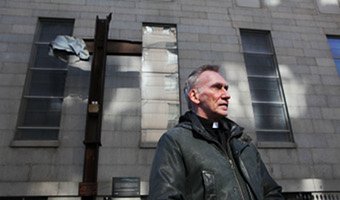
A cross formed from a falling steel I-beam at the former World Trade Center towers was placed outside St. Peter’s Catholic Church in lower Manhattan where Kevin Madigan kept watch over it until its pending move to the National September 11 Memorial & Museum. (RNS PHOTO/John Munson/The Star-Ledger)

The iconic cross rose higher than the others above the twisted steel, concrete slabs and human remains. When the smoke subsided and the dust and ashes settled, it emerged as a beacon—a sacred symbol of, at once, survival and remembrance.

Almost immediately, rescue workers and firefighters scratched out memorial messages on the 20-foot cross. A shrine was created; services were held.

It later was blessed and draped with a sheet-metal shroud from the wreckage, then hoisted atop a concrete stanchion from the destroyed plaza at the corner of Church and Liberty Streets. The cross stayed there until October 2006, when it was moved for preliminary construction work at the site.

“It was headed to a warehouse in Long Island, but the firefighters and construction workers objected, so we offered to put it here,” said Kevin Madigan, pastor at nearby St. Peter’s Church, the city’s oldest Catholic parish.

Soon, the cross will move again, to the National September 11 Memorial & Museum at Ground Zero.

“The way I understand it, the cross will stand in an apse, which will be built around it,” Madigan said. “So, the cross has to be in place before construction (of the apse) begins.”

The church will not be without a 9/11 cross for long. Sculptor Jon Krawczyk is making a replacement, a stainless steel “9/11 Memorial Cross.”

“It will be highly polished, so people will be able to see themselves in it and hopefully reflect on their lives, and lives lost in the terror attack,” Krawczyk said from his studio in Malibu, Calif.

Krawczyk’s 9/11 cross will have three pieces of metal saved from the World Trade Center debris.

“That metal will be used where Christ’s hands and feet would have been nailed,” he said. “Those pieces will stand out because they are rusted.”

The vertical beam of the cross will be 14 feet high, and the horizontal beam will be 11 feet wide. It’s the largest cross Krawczyk has made.

“It’s as big an honor as there possibly can be,” Krawczyk said. “I’m overwhelmed by the significance. To memorialize the sacrifice of the people and the loss of life in art, well, I’m not sure I can put it into words.”


Keep gospel central in preaching, and ethics flows naturally, pastor insists

BROWNWOOD—Preaching on ethics in the local church should focus on the gospel first and foremost, George Mason, pastor of Wilshire Baptist Church in Dallas, told an ethics conference at Howard Payne University.

“I suppose the first thing I ought to say to you is that I don’t believe you ought to preach on ethics in the local church,” Mason said, whose assigned topic was “Preaching on Ethics in the Local Church.”

George Mason

“I don’t mean you ought not to preach on anything that has ethical content, because then you wouldn’t be able to preach on anything at all, since everything has ethical content. I don’t mean, of course, that you ought to preach unethically, although I do believe that there’s some of that going on these days. I mean that the subject of preaching in not ethics per se. It’s the gospel.”

When ministers preach the good news of Jesus Christ, it inevitably will “touch on so many sore spots and funny bones in personal, social, political, economic, environmental, aesthetic and even athletic life that just preaching the gospel itself will be an ethical act,” he insisted.

The gospel must remain primary, Mason emphasized.

“The problem you see in deciding to preach now and again on ethics is that it tends to turn preaching into moralizing which gets the cart of doing good in front of the horse of grace that draws that cart along. Or two, that in the name of having a prophetic ministry, you fail to have a priestly one. That is, you get all up in arms, say, about nuclear arms and you end up having no arms left to comfort those who already feel bombarded by life,” he cautioned.

“Or three, you end up trivializing the Christian faith by making it seem that it fits somewhere on the op-ed pages or somewhere on cable TV between Glenn Beck and Keith Olbermann.”

Mason encouraged ministers to “strive more to be a faithful pastor than a lone prophet.” Most biblical prophets were not looking for the role, he noted.

“The true prophets seem to have the burden of truth in their bellies, and they couldn’t hold it in. They were most of them reluctant to take on the role, and most of them were proven to be real prophets only after they died,” Mason pointed out.

“Our job in preaching is to proclaim the gospel as best we can, not to build our own resume as a prophet of our time. If what we say proves prophetic, fine and good. Our duty as preachers is to speak what we feel in our bones is true and do it with a view toward building up the body of Christ, which is the church.”

As far as the church’s ability to speak to the secular world, it must get its own house in order first, he maintained.

“We have only the moral authority to speak to others in the measure that we are holding ourselves accountable,” Mason insisted.

“If we say we favor adoption over abortion, but then we create such a climate in our congregations that a young woman who gets pregnant feels she has to hide her pregnancy lest she be shamed or ostracized by the community, how is that consistent with the gospel? How is that ethical?”

Mason rejected the distinction between a personal gospel a social gospel, saying: “The gospel of our Lord Jesus Christ is concerned with the whole person. When people were hungry, Jesus didn’t say, ‘Is that political or social?’ He said, ‘I feed you,’ because the good news to a hungry person is bread.”

Christians should neglect sharing either bread for living or the Bread of Life, he stressed.

“Both are important, and that means we can never choose one over the other and get the full sense of (Christ’s) meaning,” Mason said.

Christians also must guard against going to extremes and making ministry merely a humanitarian project.

“It is not enough to get everyone a place at the table who feels equally honored to be there. It also is necessary for them to understand that it is the Lord’s table. That is to say, it is not merely bread and wine that we are sharing together, but it is the body and blood of Christ. Personal as well as social,” he said.

Mason urged ministers to be careful about preaching messages on ethical issues.

“Sermons are not white papers on abortion or homosexuality or health care or the wars in Iraq and Afghanistan or prayer in public schools. When people come to church, they are entitled to hear the good news of Jesus Christ from someone deeply acquainted with that subject. Along the way, in expounding on the gospel, there will be many opportunities to speak on ethical issues that the gospel touches on, but the gospel ought to come front and center, not something tacked on at invitation time after opining so brilliantly on an ethical subject,” he emphasized.


Musicians’ new project aimed at bringing the gospel to southern Sudan

HOUSTON—For the husband-and-wife duo Dave and Jess Ray, music has become more than melody and lyric. It’s an expression of lives committed to obedience and sacrifice for God’s glory.

At the beginning of their marriage, the Rays both were immersed in the Christian music industry in Nashville, Tenn. Dave Ray performed with the Christian band Better Days Ahead, and his wife handled tour publicity for recording artists such as Jars of Clay, David Crowder Band and Charlie Hall. 

Jess and Dave Ray, worship leaders at Tallowood Baptist Church in Houston, want to use their gift of music as a tool to share the gospel with unreached people groups around the world.  They are donating 100 percent of the gross proceeds from their newest album, Music For the Radio, to purchase handheld radios that will help bring the gospel to southern Sudan.

However, in 2006, the couple felt God calling them to begin leading worship together at Tallowood Baptist Church in Houston. During this time, the Rays also sensed God placing a new desire on their hearts—to use their gift of music as a tool to share the gospel with unreached people groups around the world.

While on a mission trip to southern Sudan in 2008 with the Christian relief organization Aid Sudan, the Rays felt deeply burdened by the lack of resources available to share the gospel. They learned the literacy rate of most areas in Sudan was less than one percent.

The Rays also were deeply moved by meeting a woman named Asinita, who lost most of her possessions except for six chickens due to a tribal raid. As a gesture of gratitude of hospitality, Asinita insisted on giving the visiting mission team one of her chickens.

“It was an incredibly kind and sacrificial act,” Dave Ray said. “It also left this really haunting question with us: ‘What would it cost me to give up one sixth of everything I own?’ We can never repay Asinita for that gift, but what we can do is live in obedience and sacrifice. So that was sort of the birth of this desire that whatever we do in our ministry needs to be done in a sacrificial way.”

After returning to Houston, the Rays were even more compelled to find ways to share the gospel with the Sudanese. This prompted them to partner their music ministry with Aid Sudan, whose latest project includes a radio station network enabling solar-powered, fixed-tuned handheld radios to transmit the gospel from hut to hut. 

For $20, a handheld radio can be manufactured, transported and distributed to southern Sudan. These radios are designed to last up to 12 years, and an estimated 12 to 15 peole listen to each radio. In addition to sharing the gospel, the radio station broadcasts health and hygiene training, as well as local and international news. 

By combining their musical platform with these efforts, the Rays will be donating 100 percent of gross proceeds from their newest album, Music For the Radio, to purchase these radios and bring the gospel to southern Sudan. During their upcoming concerts, including CD release party at Tallowood Baptist Church May 15, they will share the vision behind this project. 

 “The heart cry of the entire album is to encourage followers of Christ to share what they’ve been given, which is the gospel,” Jess Ray said. “For this particular project, God has placed on our hearts the southern Sudanese and their need for the gospel.

“The title track is really all about taking the song of God, which is the salvation of Christ and just singing that out for all to hear. That’s a song that we want to sing as loud and to as many people as possible. Our hope is that through this project, the gospel of Christ will be placed in southern Sudan.

“Taking that mission trip deepened our hearts and deepened our burden for this area. It seemed like a natural fit to come home and create an album that would help serve those people. For us, it kind of felt like a natural way to use our music as a tool in ministry to share the story of southern Sudan.”

Her husband agreed, adding: “Part of what makes this so exciting for us is to give people a tangible way to become involved in something that could truly have an historic impact, especially since southern Sudan becomes the world’s newest nation on July 9. This radio station project has the opportunity to present the gospel to millions of people and change lives for eternity.”


Did archaeologists cover up discovery of nails from Jesus’ cross?

JERUSALEM (RNS)—An Israeli-Canadian journalist believes he may have tracked down two of the iron nails used to crucify Jesus to the cross—or at least objects that could be the long-lost relics.

While researching a segment for the History Channel series Secrets of Christianity, host and producer Simcha Jacobovici learned something that startled him: In 1990, Israeli archeologists excavating a 2,000-year-old burial cave discovered two nails crafted by the Romans, but they kept the discovery quiet.

Journalist Simcha Jacobovici holds one of the nails that he believes may have been used in the crucifixion of Jesus. The nails reportedly were found in a tomb believed to be the burial site of Caiaphas, the Jewish high priest who handed Jesus over to the Romans for crucifixion. (RNS PHOTO/Courtesy Associated Producers Ltd.)

They did, however, publicize the discovery of two ossuaries—stone burial boxes filled with human bones—with the inscriptions “Caiaphas” and “Joseph son of Caiaphas.” The latter intricately carved ossuary toured the world and now is prominently displayed in the Israel Museum in Jerusalem. According to the Gospels, Caiaphas was the Jewish high priest who handed Jesus over to the Romans for crucifixion.

“There’s a general scholarly consensus that the tomb where the nails were found likely belonged to Caiaphas. Nails at that time were a dime a dozen, but finding one in a tomb is exceedingly rare,” Jacobovici said outside the high stone walls of the Old City, where Jesus spent his final days.

When Jacobovici found a brief reference to the nails in the official archeologists’ report, “my jaw dropped,” he said. “It would be as if, 2,000 years from now, archaeologists uncovered the cave of Muhammad Ali but neglected to mention the pair of boxing gloves found there. Sure, boxing gloves are common, but perhaps those particular gloves had special significance to the boxer?”

Jacobovici also hosts the Naked Archaeologist series on History International and collaborated with filmmaker James Cameron on the controversial 2007 documentary, The Lost Tomb of Jesus.

In the segment “Nails of the Cross,” which airs on the History Channel, Jacobovici attempts to discover why the researchers felt the nails were unimportant.

“Everything else is so meticulous, yet there are no photos or drawings or measurements of the nails. When I inquired at the Israel Antiquities Authority, I was told they had gone missing.”

“Caiaphas is known for one thing only—the trial and Crucifixion of Jesus,” Jacobovici said. “He may have felt compelled to take these nails with him to his grave.”

There also was the belief among some ancient Jews that nails had healing powers “and were a ticket to the afterlife. Other items found in the tomb show that this was a superstitious guy,” he added.

The history detective searched the IAA’s vast warehouses and then tried to find the location of the long-sealed tomb, which now lies beneath a public park. Finally, on a hunch, Jacobovici approached Israel Hershkovitz, a forensic anthropologist at Tel Aviv University, who also is expert on crucifixions.

“When I asked Hershkovitz if he’d received two nails about 20 years ago, he knew exactly what I was talking about and located them within minutes,” Jacobovici recalled.

Hershkovitz could not say where the nails had been found because the original packaging lacked the information. He could not be reached for comment.

While Hershkovitz knows for certain the nails came from the IAA, there’s no conclusive link that they came from the Caiaphas tomb. And Israeli archaeologists seem as reluctant to comment this time around as they were back in 1990.

When the anthropologist showed Jacobovici an ancient heel bone impaled with a nail—the only such crucifixion specimen ever unearthed—“I realized that the Caiaphas nails were similar, though shorter. The tips appeared purposely bent to keep them from falling off the wood.”

Jacobovici asked Hershkovitz whether the nails could have been used to crucify a person’s hands to a cross. Hershkovitz said “yes.”

The limestone residue on one of the nails clinched it for Jacobovici, “because one of the nails was found in the ossuary, the other on the ground” of the burial cave, where it would be exposed to limestone.

Gabriel Barkay, a professor of archaeology at Bar-Ilan University, called Jacobovici’s investigation “very challenging, very interesting, very intriguing, but it’s a TV show and not a scholarly study. There’s no proof whatsoever that they originate in the tomb of Caiaphas. It’s all conjecture.”

Nails were used for “many purposes,” Barkay noted, “from fixing iron gates to wooden doors and coffins.”

Ronny Reich, a Haifa University archeologist who deciphered the writing in the Caiaphas cave, believes the cave “belongs to a member of the Caiaphas family, but we have no evidence it belongs to the high priest.”

Jacobovici, however, is certain his research will withstand scrutiny, even if it seems largely circumstantial at first glance.

“Skepticism is good. As with the Shroud of Turin, you can’t be 100 percent certain, but believers don’t need 100 percent certainty. They need a solid ‘could be,’ and that’s what we’re offering.”


Soul Surfer rides the wave of real Christian films

WASHINGTON (RNS)—The beautiful teenage girl floats across the surface of a crystal-blue ocean like a dream, her sun-bleached blonde tresses flowing behind her, unpolluted joy painted across her face.

She’s running late, lost in the reverie of surfing her native Hawaii’s epic waves. On the white-sand beach in the distance, her brother calls to her to come ashore.

Bethany Hamilton, who lost her arm in a 2003 shark attack at age 14, is the subject of a new Christian film, Soul Surfer. (PHOTO/Courtesy Lovell-Fairchild Communications)

As the new film Soul Surfer opens, the angelic surfer, Bethany Hamilton (played by AnnaSophia Robb), rushes ashore, grabs a white sundress and hustles up the beach to a large white tent where a crowd is gathered in chairs.

The scene looks like it could be a wedding, but it’s actually a regular Sunday morning worship service at Calvary Chapel in Kauai. Bethany, her hair a wet tangle around her shoulders, joins her family for worship.

Churchgoing is a rare event in cinema. Usually, it’s the backdrop for a wedding, funeral or christening. More commonly, a church scene is used to show some kind of inherent pathology in the characters’ psyche or impending evil. (See The Exorcist.)

Even more commonly, religious life is depicted as a last resort in times of trauma—a kind of Hail Mary prayer, a deathbed confession, a futile search for answers to impossible questions about loss, tragedy and pain.

Soul Surfer, based on the real-life story of the world-class surfer who lost her arm in a 2003 shark attack at age 14, has plenty of trauma and the ensuing grappling with loss. But the religious life of the Hamilton family is portrayed as a normal part of their everyday lives.

And that is part of what makes the Soul Surfer story ring so wonderfully authentic.

After Hamilton loses her arm, she awakens in the hospital with her father Tom (Dennis Quaid) quietly reading the Bible at her bedside. When she asks her father if she’ll ever surf again, he knows she will. She can do all things “… through him who gives me strength,” she says, finishing the quote from Philippians.

To be sure, Soul Surfer is not without moments of defeat. When Hamilton enters her first post-accident surfing contest, she fails and gives up. She even gives her surfboards away.

In real life, Hamilton says that didn’t happen. Instead, she says, she never gave up and relied on her Christian faith to carry her through. Perhaps filmmakers believed the truth was simply too far-fetched for audiences to accept.

In the film, a despondent Hamilton turns to her youth group leader, Sarah Hill (played by country music star Carrie Underwood) at the seaside church pavilion and asks that most difficult of questions: Why would God let this happen?

“I don’t know,” Hill answers. This is usually where people, in films and in real life, try to give a well-intentioned answer that nonetheless always falls short of providing any real solace.

The youth director consoles her young disciple, saying that she’s sure something good will come of the girl’s unfathomable loss. She quotes from Jeremiah: “For I know the plans I have for you, declares the Lord, plans to prosper you and not to harm you, plans to give you hope and a future.”

When Hamilton asks her father a similar question in the film—Now what is she going to do?—he answers, “Whatever comes next.”

What actually came next, before her triumphant return to competitive surfing, was a trip to tsunami-stricken Thailand where Hamilton volunteered with the international relief group World Vision. Out of her own pain, she reached out to help others, even teaching a young orphaned boy how to surf.

By transcending her own grief, digging deep in the well of her soul to find the strength to help others, the film shows Hamilton finding the courage to conquer her own fears, doubts and frustrations.

Soul Surfer succeeds where many other Christian-themed films fail. It strikes a satisfying balance between powerful storytelling and overreaching message-giving.

The Hamilton clan’s faith comes across as authentic and, in another uncommon feat, appealing. While some have criticized the film for not being explicitly “Christian” enough, its just-shy-of-understated approach to portraying real religious life on film allows Soul Surfer to speak the language of faith without beating the audience over the head with a Bible.

Hamilton’s real-life story is beyond inspirational. Today, at 21, she’s one of the top women surfers in the world. And on film, her story doesn’t lose any of its power—or faith.

The real-life Hamilton did all of the one-armed surfing scenes in the film herself. In the film’s final scene, after an astounding performance at a surf contest, reporters ask whether, if she had to do it all over again, she would choose again to go surfing the day the shark took her arm.

Her faithful answer is breathtaking.

“I’ve had the chance to embrace more people with one arm than I ever could with two,” she says. It’s an answer the real-life Bethany has offered many times.

Sometimes, it seems, the truth is harder to believe than fiction.


Texas WMU seeks ‘unhindered’ pursuit of Christ

GEORGETOWN—God is calling his followers to run ‘unhindered’ in the race marked for each of them, Woman’s Missionary Union of Texas leaders said during the organization’s annual meeting, April 9-10 at First Baptist Church in Georgetown.

Newly elected Texas WMU officers are (right to left) President Gloria Mills of First Baptist Church in Henderson; First Vice President Merle Cross of First Baptist Church in Gilmer; Second Vice President Irma Alvarado of First Baptist Church in Donna; Third Vice President Lynette McBride of Central Baptist Church in Hillsboro; and Recording Secretary Barbara Helms of First Baptist Church in Clarendon. (BGCT PHOTO)

Often, people are saddled with anger, grief and discouragement, said featured speaker Veronica Ellison, who experienced these trials after her pastor father was killed in a car accident caused by a drunk driver. She was able to let go of those feelings by turning to her faith. There, she sensed God calling her to embark on the journey he has marked for her as in Hebrews 12. 

“He wants us to be free,” she said. “He wants us to shed those heavy things.”

That race can be a long and sometimes difficult one, Ellison noted. But God wants his followers to run a marathon, having the endurance to trust God to pull them through obstacles.

Keo Chan, who serves as a Southern Baptist Convention North American Mission Board missionary with her husband, Henry, knows too well how long and difficult that race can be. When she was a young child in Laos, Communist leaders threw her father into a work camp, leaving Chan, her mother and siblings to fend for themselves.

Her father escaped the camp by swimming across the Mekong River into Thailand, but he could not return to his homeland. Chan and her family did not know where he went, but they feared they never would see him again.

After six years waiting, Chan’s mother decided she would lead her family to Thailand in search of her husband. They walked three nights and then crossed the Mekong River.

“My God, I know, totally closed the eyes of the soldiers,” Chan said, describing how God protected her family.

Chan’s family searched a Thai refugee camp for their patriarch to no avail. Eventually, they encountered one of his friends, who explained the father had moved to another refugee camp and then onto the United States where he was attempting to save money to reunite his family.

Veronica Ellison, keynote speaker at the Texas WMU Annual Meeting in Georgetown, described how God released her from anger, grief and disappointment after a drunk driver killed her father. (BGCT PHOTO)

In 1981, after years of separation, the family came back together in Amarillo. When Chan arrived, her father was waiting for her with his arms outstretched and tears rolling down his face.

Nora Lozano, associate professor of theological studies at Baptist University of the Americas, said having the endurance to run the marathon of faith requires unwavering focus upon God. For contemporary Christians to remain strong in their faith, they must cling to God and rely on him to strengthen, guide and carry them.

“Today is our time to take the torch and run the race with our eyes fixed on Jesus,” she said.

Texas WMU ran that race during the annual meeting by donating about 2,000 books for children in need along the Texas-Mexico border and building about 70 bookshelves through a joint effort with Literacy ConneXus. Meeting participants also gave more than $3,906 for mission efforts through WMU.

Texas WMU supports 70 sites for Christian Women’s Job Corps and Christian Men’s Job Corps, where people can attain job and life skills, as well as hear and embrace the hope of Christ.

Texas WMU is planning an event for parents of current missionaries and is examining a potential partnership between Chilean Baptists and Hispanic WMU of Texas.

Each year, women gather for the Sisters Who Care retreat, an event designed to strengthen the faith of African-American women. Texas WMU also has continued expanding its resources for Asian congregations that speak a variety of languages.

These efforts continue Texas WMU’s commitment to sharing the gospel throughout the state and around the globe, said Sandra Wisdom-Martin, executive director-treasurer of Texas WMU. The organization continues focusing on praying and financially supporting missions and is increasing its hands-on missions opportunities.  This year, it has several mission trips planned and is partnering with Buckner International to build a home in the Rio Grande Valley.

In business, meeting participants overwhelming elected a slate of officers. They are President Gloria Mills of First Baptist Church in Henderson; First Vice President Merle Cross of First Baptist Church in Gilmer; Second Vice President Irma Alvarado of First Baptist Church in Donna; Third Vice President Lynette McBride of Central Baptist Church in Hillsboro; and Recording Secretary Barbara Helms of First Baptist Church in Clarendon.

“We should be telling … (God’s) story as we go, everywhere we go,” Widsom-Martin said. “That’s what we’re about.”

“You have a story. God was at work in your life before you were even born. Be ready to share that story.”

Carolyn Porterfield, Texas WMU multicultural consultant, said she believes it is critical for Texas Baptists to remain committed to the cause of Christ. About 11 million people across the state have no connection to a church. The state’s population is increasingly diverse, creating an environment where Texans can make an impact on the world by sharing the gospel with their neighbors.

“Now is not the time to stop running our race to make Christ known,” Porterfield said.