Willimon: Christians called to ‘faithful presence,’ not conquest

WACO—Christians who want to change the world should make sure their actions are done not only in the name of Jesus, but also in the way of Jesus, pastoral theologian Will Willimon told a conference at Baylor University’s Truett Theological Seminary.

Will Willimon

“The cross is the sign of how God changes the world—not by power and might, but by suffering, sacrificial, nonviolent love,” said Willimon, bishop for the North Alabama Conference of the United Methodist Church.

“Are Christians Called to Change the World?” was the theme of the symposium, cosponsored by Baylor’s Center for Ministry Effectiveness and Educational Leadership and by Truett Seminary’s Kyle Lake Center for Effective Preaching.

Willimon and speakers who followed him responded to an assertion by James Davison Hunter in his recent book, To Change the World, that culture may resist the frontal assaults of those who seek to impose their will on others, but it can be transformed by the “faithful presence” of committed believers.

The attractive call to be a part of “a world-changing enterprise” cuts across denominational lines, Willimon noted, but Hunter offers a corrective word. Rather than embracing language of “conquest and domination,” Christians should focus less on winning culture wars and more on bearing faithful witness, Hunter maintains.

“Are Christians called to change to world? Unequivocally, yes. This is, sometimes. Well, sort of,” Willimon said.

In a sinful, fallen world, even the best intentions of religious people fall short, he noted.

“In a sense, transforming the world is Jesus’ job. We’ve got a bad record. Some of the worst stuff we’ve done has been in the name of changing the world,” Willimon said.

Christians should be good citizens and make their views known in the political sphere, he said, but they should not confuse the nations of this world with the kingdom of God.

“We are called to witness that God, not nations, rule the world,” he said.

The main way Christians change the world may be through faithful witness expressed in love and humility in the context of local churches, Willimon urged. If Christians are going to seek to transform the world, let it be done God’s way, as revealed in the life and ministry of Jesus.

“Jesus is the face of God,” he said. “Jesus is how God looks and talks and acts.”

Living out the calling of faithful presence can be challenging for pastors who try to communicate a gospel message to church members who interpret every word through the filter of their own political and economic biases or personal agendas, said George Mason, pastor of Wilshire Baptist Church in Dallas, one of three panelists who responded to Willimon.

“We always wrestle with people who would want to co-opt the church,” he said.

Love for God and love for neighbor—not conquest and domination—should guide individual Christians and churches, said Diana Garland, dean of the Baylor School of Social Work.

“We are transformed by caring for neighbors,” she said. “It is the living of love that changes us. Sometimes, God uses us to transform. But it’s almost never something our pea-brains would have figured out on our own.”

Perhaps rather than viewing transformation in terms of conquest and domination, Christians should “embrace the language of resurrection,” said Chris Seay, pastor of Ecclesia Church in Houston.

“‘Faithful presence’ sounds a bit boring to me,” Seay confessed, unless it means joining in God’s creative work of restoring what is broken.

But if faithful presence means embracing the way of Christ—the way of the self-sacrificial love that leads to resurrection—that becomes a worthy challenge, he said: “To go on an adventure to experience faithful presence so radical it often will be painful.”


Supreme Court upholds tax credits for scholarships to religious schools

WASHINGTON (ABP) – The U.S. Supreme Court ruled 5-4 against Arizona taxpayers who claimed that a state law allowing tax credits to fund scholarships for students who attend private schools violates the separation of church and state.

“This is a disappointing decision,” said Hollyn Hollman, general counsel for the Baptist Joint Committee for Religious Liberty. “A state legislature should not be able to avoid a legal challenge by simply using an alternative tax mechanism.”

Arizona’s tax code includes a program that allows individuals to direct up to $500 of their state income tax bill to a state tuition organization that awards scholarships primarily to religious schools. The taxpayers contended that indirect use of public funds to support religious institutions violates the First Amendment’s ban on state-sponsored religion.

The Supreme Court never got around to the Establishment Clause argument, however, deciding that the plaintiffs lacked legal standing to sue in federal court.

Writing for the majority, Justice Anthony Kennedy said that in order to make an Establishment Clause claim plaintiffs must demonstrate direct harm, such as mandatory prayer in a public school or a tax benefit conditioned on religious affiliation, and not just “conjectural” or “hypothetical” harm.

The Arizonans had hoped to prevail under a narrow exception to a general rule that being a taxpayer alone is not enough for standing established in Flast v. Cohen, a 1968 Supreme Court decision that a taxpayer can under some circumstances sue the government to prevent an unconstitutional use of taxpayer dollars.

The majority decided that the ruling applied only to expenditures of tax funds and not to tax credits.

“Few exercises of the judicial power are more likely to undermine public confidence in the neutrality and integrity of the Judiciary than one which casts the Court in the role of a Council of Revision, conferring on itself the power to invalidate laws at the behest of anyone who disagrees with them,” Kennedy wrote.  “In an era of frequent litigation, class actions, sweeping injunctions with prospective effect and continuing jurisdiction to enforce judicial remedies, courts must be more careful to insist on the formal rules of standing, not less so.”

The Baptist Joint Committee, which joined a brief by Americans United for Separation of Church and State asking the court to protect the rights of taxpayers to bring the suit, said standing is increasingly cited in court decisions regarding the establishment of religion.

The Supreme Court ruling in Arizona Christian School Tuition Organization v. Winn overturned a finding by the 9th U.S. Circuit Court of Appeals that the challengers had legal standing to sue and restored a district court’s ruling that they did not.

Hollman said the decision “denies citizens the right to fight for strong protections against a governmental establishment of religion.”

Joining Kennedy in the majority were Chief Justice John Roberts and Justices Antonin Scalia, Clarence Thomas and Samuel Alito. Justices Ruth Bader Ginsburg, Stephen Breyer and Sonia Sotomayor joined in a dissenting opinion written by Justice Elena Kagan.

“[A]ssume a state wishes to subsidize the ownership of crucifixes,” Kagan wrote. “It could purchase the religious symbols in bulk and distribute them to all takers. Or it could mail a reimbursement check to any individual who buys her own and submits a receipt for the purchase. Or it could authorize that person to claim a tax credit equal to the price she paid.”

“Now, really — do taxpayers have less reason to complain if the state selects the last of these three options?” she continued. “The Court today says they do, but that is wrong. The effect of each form of subsidy is the same.”


TSA, airlines tread carefully on religious expression

WASHINGTON (RNS)—Air travelers want to feel safe, and federal security officials want to make sure they actually are safe. If only it were that simple.

Misunderstandings over religious expression have led to recent incidents that prompted apologies from airlines. Recently, agents with the Transportation Security Administration removed a Muslim woman in a headscarf from a Southwest Airlines flight after airline staff deemed her suspicious. Crew members thought the woman said “It’s a go” into her cell phone, when she actually said, “I have to go” because the plane was about to take off.

Heavy security at U.S. airports has become routine, but some Muslims and Orthodox Jews say full-body scanners violate religious laws on modesty. And some religious minorities accuse airlines of ethnic profiling. (RNS FILE PHOTO/Andrew Mills/The Star-Ledger)

That same day, Orthodox Jews triggered a security alert on an Alaska Airlines flight when they strapped on tefillin, or ritual straps for the arms and forehead, and began to pray in a foreign language.

Such incidents highlight an ongoing challenge for airlines and the TSA to allow for religious expression while also taking prudent security measures. The domain puts personnel in the sometimes-uncomfortable position of assessing a delicate question: When does a prayer, a garment or religious paraphernalia constitute a threat?

“We are sensitive to travelers’ concerns,” TSA spokeswoman Sari Koshetz said. “But security is not optional.”

Muslim and Sikh groups say it’s an ongoing problem—almost always directed against religious minorities—that hasn’t improved much since the 9/11 terrorist attacks prompted widespread security crackdowns.

Muslim women in headscarves and Sikh men in turbans are routinely subjected to extra pat-downs at security checkpoints, advocates say, thus stoking fears among already-tense fellow passengers.

“Imagine you’re walking through the airport and you see this group of people, all fitting this certain profile, who are all pulled aside,” said Ameena Mirza Qazi, deputy executive director of the California chapter of the Council on American-Islamic Relations, a Muslim civil rights group. “It feeds into pervasive biases that people have.”

Even before they clear security, several religious groups chafe at full-body scanners that they consider immodest; the 18-member Fiqh Council of North America last year issued a fatwa (religious edict) that said the scanners violate Islamic law.

TSA takes steps to allow for religious needs, Koshetz explained—allowing travelers to forgo a full-body scan, for example, and instead receive a thorough pat-down by a person of the same gender. Those who wear head coverings or loose-fitting clothing may undergo additional screening, she said, and in some cases need to remove headwear to show “the head area is free of a detectable threat item.”

The TSA neither condones nor practices religious profiling, she said.

Some religious minorities have welcomed TSA’s accommodations. Orthodox Jews, for instance, dropped complaints about new screening procedures last year after TSA announced the option of same-gender pat-downs. The Hindu American Foundation likewise has no pending concerns or requests to modify TSA procedures, according to Managing Director Suhag Shukla.

Others, however, feel they’re being unfairly targeted. Sikhs have been working with TSA for years to craft screening procedures that respect turban wearers, according to Amardeep Singh, program director for the Sikh Coalition. Yet Sikhs continue to endure stigmatizing turban pat-downs, Singh said, even though scanners can purportedly see through fabric.

“We’re still trying to get from (TSA) the reasons why the turbans require this extra scrutiny,” Singh said. “It sends the wrong message to the other passengers. It singles us out in a way that builds into the discrimination that the community already feels as a result of our religious appearance.”

Some are more concerned with the practices of airlines than the TSA. The Orthodox Union, which represents Orthodox Jews, is developing initiatives to educate airlines about Jewish observances, including the use of tefillin and prayer shawls. Alaska Airlines is developing new training materials in consultation with the Jewish Federation of Greater Seattle.

“The plane is controlled by a more idiosyncratic sense of what’s going on, and there’s no TSA policy” to heed, said Michael Broyde, project director at the Center for the Study of Law and Religion at Emory University. “There’s a lack of common sense on many sides” on which types of religious expression should be permitted during flight.

The Council on American-Islamic Relations also sees the need for improvement in the wider airline industry. The organization has seen a recent increase in complaints from Muslims and other religious minorities who say they’ve been “ejected from aircrafts for no reason at all,” Qazi said.

The airline industry says staffers often have had training to make them aware of various groups’ religious customs and practices.

“Airlines deeply understand, respect and are very sensitive to their customers and employees who comprise varied cultures and religions and have specialized training for their employees in this regard,” said Victoria Day, spokeswoman for the Air Transport Association.

As policies get fine-tuned, TSA and airlines say they’re committed to the principle of religious freedom, both in airports and at 30,000 feet. But legal experts caution that claims of religious freedom face limits and don’t ever trump security considerations.

“There’s no notion in our society that religion entitles you to opt out of reasonable security measures,” Broyde said.


Families celebrate adoption & diversity at Heritage Day

HOUSTON—Texas adoptive families recently took on the role of world travelers, trekking through adventures in six countries. But, as participants in a Heritage Day celebration hosted by Dillon International and Buckner International, the families completed their worldwide tour without leaving the campus of Tallowood Baptist Church in Houston.

Performers from the Ari Rang Korean Folk Dance Group entertain families attending Heritage Day at Tallowood Baptist Church in Houston. The group used music, dance and costumes to help the audience gain a better understanding of Korean history.

“The event was a wonderful opportunity for adoptive families to join together to celebrate our children and a beautiful way to build a family,” said Elisabeth Brodt, the adoptive mother of a son from Vietnam and a daughter from South Korea.

“We are a Vietnamese-Korean-American family. It is very important to my husband and me that we let our children know where they came from. They came to us via beautiful countries, and we want to celebrate that.”

Families at the Heritage Day event experienced entertainment, activities and exhibits highlighting the traditions of Russia, China, Vietnam, South Korea, Ethiopia and Columbia and enjoyed performances by the Ethiopian Christian Fellowship Church choir, the Ari Rang Korean Folk Dance Group and Texas Magician “Cardini” Carter Blackburn.

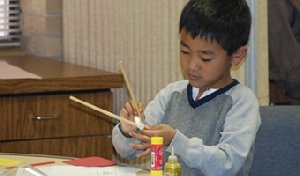
Aidan Layman, 6, makes chopstick helpers at the 2011 Heritage Day event held at Houston’s Tallowood Baptist Church. The annual gathering gave Aidan, the son of Aaron Layman and Jackie deMontmollin of Katy, the opportunity to explore his Korean heritage and learn more about the cultures of Russia, China, Vietnam and Columbia.

A member of the Ethiopian Fellowship Church Choir kicks off the 2011 Heritage Day celebration in Houston with joyful praise music.

“We have many couples in the church who have built their family through adoption. So, we have had a longtime passion and compassion for their needs. Heritage Day gave the church a way to refer parents and prospective parents to groups and individuals who may be able to help in forming and raising families,” Larry Heslip, minister of education and administration at Tallowood Baptist Church. “The church has been to orphanages in China, Israel, Central America and other international locations on mission projects, but this was a way to bring those loving ministries home to Tallowood.”

Catherine Pullin (right) learns more about her Russian heritage while participating in a craft activity with her younger sister Hannah (center) and best friend, Lindsey Duong. .

“In addition to being a tremendous amount of fun, activities like Heritage Day play a vital role in building the self-esteem of internationally adopted children by giving them a positive appreciation for the heritage of their birth country and allowing them to connect with other families that look like theirs,” said Debbie Wynne, director of Dillon International’s Texas office and Buckner Adoption and Maternity Services.

Heritage Day also provided Tallowood—whose membership includes 25 nationalities—an occasion to connect with other Christian ministries that serve the Korean, Hispanic, Chinese, Vietnamese and Ethiopian members of ethnically diverse Houston, said Myra Pullin, the mother of two adult children adopted domestically as well as a 3-year-old daughter from Vietnam and a 9-year-old daughter from Russia.

“It was a wonderful multicultural event which gave us a glimpse of what heaven will be like,” Pullin said.


DBU students running with a mission in mind

DALLAS—Chris Holloway, Baptist Student Ministry director at Dallas Baptist University, loves running and loves missions. Recently, he recognized a way to combine both his passions.

A team of runners from Dallas Baptist University participated in Fort Worth’s Cowtown Marathon to raise money for Baptist Student Ministry summer missions. (PHOTOS/ Kalianne Reed/DBU)

Having participated in several past mission trips with the BSM at DBU, Holloway knew creative fund-raising is essential to success. He also knew Fort Worth’s Cowtown Marathon was approaching.

So, Holloway started thinking about the possibilities. At first, he hoped he could convince 10 students to run the Half Marathon (13.1 miles) portion and raise some support along the way. He figured if each student could enlist 10 people to sponsor them, paying around $1 per mile, each student could raise around $130. The original goal was $1,300—a lofty goal, in his estimation, since the BSM had not attempted anything like it in recent years.

But to his surprise, students kept signing up to run and add their support, and soon DBU faculty and staff added their names, as well. In all, 38 runners from DBU wanted to participate.

Hoping their “13 for 13” plan would still work, each runner began seeking sponsors who would pay $1 for each of the 13 miles.

“During this whole process, the Lord showed us that he is not bound by our goals,” Holloway explained. “And we found that people were more generous and gave more than we expected.”

In the end, 38 people raised $5,743 to help DBU students participate in summer mission trips.

“It was an amazing experience knowing that I was involved in an event that would be supporting the spread of the gospel,” said Lauren Moore, DBU alumna and resident director of the Crowley Complex.

“Having competitively run during high school, running had been about me in the past, but training for this event refocused my purpose in it—to do everything for (Christ), not myself.”

What started out as a small idea resulted in big lessons learned for DBU students, faculty and staff who were involved.

“I didn’t really feel like I was doing anything special to help at first,” DBU senior Jeremy Stalford said. “Usually, it’s hard to feel like I’m helping if I’m not the one actually going. But when race day came and I learned how much money we’d raised, I really felt like we’d accomplished something pretty big.”

BSM leaders hope next year they will be able to provide even more money for student missionaries. And Holloway said he has learned that his own plans cannot outdo God’s work, even on his best day.


Does God punish through natural disasters? Most Americans say, ‘No’

WASHINGTON (RNS)—We may never know why bad things happen to good people, but most Americans—except evangelicals—reject the idea that natural disasters are divine punishment, a test of faith or some other sign from God, according to a recent poll.

Public Religion Research Institute, in partnership with Religion News Service, conducted the poll one week after a March 11 earthquake triggered a devastating tsunami and nuclear crisis in Japan.

When Hurricane Katrina swept through New Orleans in 2005, it triggered a flurry of questions about whether God sent the natural disaster as a message—or as divine retribution. The recent earthquake and tsunami in Japan spawned similar discussion. (RNS FILE PHOTO/Ted Jackson)

Nearly six in 10 evangelicals believe God can use natural disasters to send messages— nearly twice the number of Catholics (31 percent) or mainline Protestants (34 percent). Evangelicals (53 percent) also are more than twice as likely as the one in five Catholics or mainline Protestants to believe God punishes nations for the sins of some citizens.

The poll found a majority (56 percent) of Americans believe God is in control of the earth, but the idea of God employing nature to dispense judgment (38 percent of all Americans) or God punishing entire nations for the sins of a few (29 percent) has less support.

From Noah’s flood to 21st-century disasters like Hurricane Katrina and the 2010 earthquake in Haiti, some people blame incomprehensible calamities on human sinfulness.

Such interpretations often offend victims, however. Public outcry prompted Tokyo Gov. Shintaro Ishihara to apologize for calling the disaster a “divine punishment” for Japanese egoism.

“It’s interesting that most Americans believe in a personal God and that God is in control of everything that happens in the world … but then resist drawing a straight line from those beliefs to God’s direct role or judgment in natural disasters,” noted Robert P. Jones, CEO of Public Religion Research Institute.

The poll found most racial and ethnic minority Christians (61percent) believe natural disasters are God’s way of testing faith—an idea that resonates with African-Americans’ history of surviving slavery and racial discrimination.

Japan’s population is predominantly Shinto or Buddhist—religions that view nature as a force beyond our control or understanding—but the poll could not get a representative sample of those groups in the United States.

In other findings:

• Most white evangelicals (84 percent) and minority Christians (76 percent) believe God is in control of everything that happens in the world, compared to slimmer majorities of white mainline Protestants (55 percent) and Catholics (52 percent).

• Nearly half of Americans (44 percent) say the increased severity of recent natural disasters is evidence of biblical “end times,” but a larger share (58 percent) believe it is evidence of climate change. The only religious group more likely to see natural disasters as evidence of “end times” (67 percent) than climate change (52 percent) is white evangelicals.

• Across political and religious lines, roughly eight in 10 Americans say government relief aid to Japan is very important (42 percent) or somewhat important (41 percent), despite our current economic problems.

“After one of these disasters, people turn to their clergy and their theologians and they look for answers, and there are no great answers,” said Gary Stern, author of Can God Intervene? How Religion Explains Natural Disasters.

“But almost every group believes you have to help people who are suffering.”

The question of God’s role in, and humans’ response to, disasters long has vexed the world’s major religious traditions, Stern said, even as answers often remain elusive.

Prompted by the 2004 tsunami that devastated Southeast Asia, Stern interviewed dozens of American ministers, priests, imams, rabbis, monks, professors and nonbelievers about their theories. They offered disparate views, sometimes at the same time—forces of nature are impersonal; God is all-knowing but not all-powerful; nature is destructive because of original sin or collective karma; victims are sinners; suffering helps test our faith and purify us.

“The evangelical world is definitely focused on original sin and on the general sinfulness of our world … and it won’t end until Christ returns,” Stern said. “In the mainline world, their theology is not well-suited to why God allows these things to happen, so their emphasis is on looking for God in the rescue efforts. And Catholics feel that suffering makes us holy, and there are mysteries that we can’t answer in this life, and we’ll find the answers in the next life.”

But among evangelicals, there’s a wide gulf between the fundamentalist perspective that sees disasters as proof of God’s wrath and the moderate view that sees “a distinction between an earthquake as part of God’s plan and God causing that earthquake,” said R. Douglas Geivett, a religion professor at Biola University in California.

“There are a lot of things that I wouldn’t cause to happen to my children to teach them certain lessons, but I might allow them to happen, so they might learn the lesson,” said Geivett, a former president of the Evangelical Philosophical Society.

“This is tragic, but if you ask (why God allows) earthquakes, you have to ask it anytime that people die. We would have to be prophets of God to know that.”

The PRRI/RNS Religion News Poll was based on telephone interviews of 1,008 U.S. adults between March 17 and 20. The poll has a margin of error of plus or minus 3 percentage points.


‘Of Gods and Men’ traces murder and martyrdom

WASHINGTON (RNS)—James Martin has seen a lot of religious movies in his life. But the Jesuit priest and author says a new film has sprung to the top of his list.

Of Gods and Men tells the story of Christian monks in Algeria who risk their lives for their Muslim neighbors. (RNS PHOTO/Courtesy of Sony Classics)

Martin calls Of Gods and Men, a film based on the kidnapping and murder of seven Algerian monks in 1996, “the greatest movie on faith that I have ever seen.”

That’s high praise from a priest whose cultural acumen has led to a regular gig as chaplain-in-chief to The Colbert Show, and a stint as theological adviser to an off-Broadway play.

But movie buffs don’t have to take Martin’s word for it. Of Gods and Men garnered top prizes at the Cannes Film Festival in France, and it was named the best foreign language film of 2010 by the National Board of Review of Motion Pictures.

In the film, Catholic monks decide to remain in their monastery in violence-torn Algeria and serve their Muslim neighbors, despite strong incentives to flee the country—not least their personal safety.

“It’s the best explication of what martyrdom means I have seen in a film,” Martin said. “An average person can find themselves understanding why these monks would give their lives. To convince the viewer of the validity of martyrdom in one movie is miraculous.”

The film’s French title is Des hommes et des dieux, and it has subtitles in English. It stars Lambert Wilson, perhaps best known to American audiences for his performances in the Matrix trilogy.

The pace of the movie is intended to draw the audience into the lives of the monks, with long periods of unbroken silence and significant amounts time dedicated to the monks’ distinctive liturgical chants.

Of Gods and Men, a new film based on the kidnapping and murder of seven Algerian monks in 1996, is a poweful depiction of how members of religious communities are called to live.

Henri Quinson, a French monk, served as an adviser to Of Gods and Men and translated the book The Monks of Tibhirine, by John Kiser, on which the film was loosely based.

Director Xavier Beauvois tried to make the film as true to monastic life and the culture of Algeria as possible, Quinson said. “It is part of the exotic feel to the movie, in fast-paced America,” Quinson said.

To help produce this feel, the movie is about 15 percent liturgical chants, Quinson said.

Although the monks decided as a group to stay and serve in Algeria, the film focuses on the individual choices made by each monk that led to the unified decision.

The monks voted on whether to stay or leave about every six months, said Quinson, who knew four of the monks personally and had been given one monk’s prayer book before he left for Algeria.

The film also focuses on the relationship between the Catholic monks and the Muslim neighbors whom they served.

“It was touching how the citizens were not at peace with the missionaries leaving, and said, ‘We are the birds on the branch; you are the branches,”’ Quinson said.

For Martin, the depiction of how members of religious communities are called to live was powerful.

“It made me think about the way I live my life in a religious order, and I wonder if I could be as faithful they were,” he said. “I spent the next day thinking about the movie, and the next prayer session praying it about it. That doesn’t usually happen.”

Quinson said he was surprised by the film’s popularity and accolades. His only goal, he said, was to “maybe make a beautiful movie.”

“The greatest gift I wish to pass on is an experience of God,” Quinson said.


Wayland Anchorage student group on a roll to benefit shelter

ANCHORAGE—Wayland Baptist University’s Anchorage campus and its student chapter of the Society of Human Resource Management recently collected 4,650 rolls of toilet paper for a homeless shelter.

Students called their campaign “The Great Alaska IditaRoll Drive”—inspired by the annual Iditarod dog sledding event. They delivered their collection to the center the day before the Iditarod ended.

Bonnie Dorman, president of the student organization, noted the group previously helped the shelter and the 500 clients its serves by packing boxes filled with toiletries, hats, gloves and other items.

Representatives from Wayland Baptist University’s Anchorage campus and its student chapter of the Society of Human Resource Management—(left to right) Lynnette Kelly, treasurer; Chanise Morgan, secretary; Dave Rambow, faculty adviser; Bonnie Dorman, president; and Eric Ash, executive director for the campus—examine rolls of toilet paper collected. (PHOTOS/Wayland Baptist University)

When the group delivered those boxes last December, center director Jim Crockett mentioned how fast the shelter goes through toilet paper—about 72 rolls each day. The students decided to tackle a project to meet that need, originally setting a goal of 1,150 rolls to match the mileage of the Iditarod race.

“We started on Jan. 24 and within a few weeks had already passed that goal, so we kept it going once the spring term started,” Dorman said. “People had so much fun with this. It was really the community coming together and everyone working on it. Students went out and collected from people they knew, and the faculty really got involved too.”

The group used the event to educate people about the shelter and the plight of the homeless in Anchorage, Dorman said, and people really seemed to be touched.

“What came out of this is how humble it made people and how we take such simple things for granted,” she said. The Society of Human Resource Management at Wayland’s Anchorage campus—which gives three scholarships to the general student body each year and is active in service projects—started in 2007 and has about 12 members.

Eddie Campoamor, assistant executive director for the campus, said he believed the drive made an impact on many.

“I truly did not expect this drive to touch so many people in such a personal way. Perhaps it is because donating toilet paper is so easy and yet, at the same time, it is something so necessary for all,” he said.


Irving church stays focused on missions over spring break

IRVING—Instead of hitting the beach or other vacation spots during spring break, volunteers from First Baptist Church in Irving hit the streets of south Irving on a mission for Jesus.

Through a variety of service projects, sports camps and casual conversations, team members built relationships and found ways to share Christ’s love throughout their community.

The group worked at the Baptist Benevolent Ministries of Irving, cleaned at the Salvation Army, served widows, played games with residents at a retirement home and painted houses for single mothers.

By partnering with City of Irving Code Enforcement and the nonprofit organization Keep Irving Beautiful, volunteers from First Baptist Church spruced up the city by picking up trash in the Trinity River bottom and local parks, as well as trimming trees.

“What has driven the vision for Mission South Irving is a desire to see the people in our neighborhood the same way we see people when we travel on mission trips elsewhere, as Christ sees them, and to look for opportunities to share the gospel in our everyday surroundings,” said Jason Hatch, college and men’s minister at First Baptist Church and coordinator of the weeklong missions endeavor.

“We wanted to look at how missional living could become a lifestyle and not just a one-week trip. We began to look at what it would look like to really share the gospel with south Irving, loving them, serving them and making sure that the city would know that First Baptist Irving is here to help meet their needs.

“I hope the community sees that First Baptist Irving loves them and wants to serve them—whether it’s cleaning up the parks, painting houses or helping the homeless. Not just that we talk about love, but that we really do love them and the reason behind our love is Jesus.”

Fifth-grader Maison Stanphill enjoyed helping with Mission South Irving service projects during spring break. (PHOTOS/Courtesy of First Baptist Church in Irving)

Volunteers representing various ages participated in projects. Students on spring break insisted they didn’t regret trading sleep for service.

“I’ve been on mission trips a lot but have never done anything like this one before— where I can witness to the guy at McDonald’s and share Jesus with him,” said Jonathan Hoogendoorn, a student from Dallas Baptist University.

“I’ve already taken away so much from this week about how to live a missional lifestyle. I’m excited to look for opportunities to reach out and share Christ with those around me. I hope that people will see Jesus clearly as he is, in his pureness and holiness, as a result of us reaching out and serving others.”

“I have never done anything like this before, but I can’t wait to do it again,” fifth-grader Maison Stanphill said. “I loved being able to help people, and I hope that these projects will help the people we met to love Jesus as well.”

Chris Baik trims trees, while Brad Ledbetter mows a yard during Mission South Irving. (PHOTOS/Courtesy of First Baptist Church in Irving)

Janelle Hartsfield and women’s minister Michelle Stanphill were among the volunteers serving the community by picking up trash in the Trinity River bottom and local parks. (PHOTOS/Courtesy of First Baptist Church in Irving)

Throughout the week, volunteers communicated the gospel message, and many saw God touch hearts and begin to change lives.

“When it gets down to it, it’s all about Jesus,” Jeff Phillips said. “I’ve had the opportunity to share the gospel six or seven times just in the last day and half. We’re really trying to discern, inquire and find out where their relationship with Jesus is.”

One of the team members, Janelle Hartsfield, used involvement in Mission South Irving to teach her 5-year-old daughter about the importance of serving others and living for Christ.

“This was my daughter’s first experience to do anything mission-minded, so I’ve been trying to teach her this week why we’re doing things like picking up trash out of a park,” Hartsfield said.

“I told her that we’re called to serve people and to love them, and this is a way we can serve others by cleaning up a park for them. … It’s not always pretty or it’s not necessarily fun, but it’s about looking outside of yourself and not being selfish or self-centered. It’s about looking outside the box at how you can help people around you. That’s so important for her to learn at an early age.”

Ella Hartsfield, age 5, helps clean up area parks as part of Mission South Irving. (PHOTOS/Courtesy of First Baptist Church in Irving)

During basketball camps at the church campus during each afternoon, children were taught how to improve their skills and also presented with the gospel message.

“The sports camps gave the kids a unique way of looking at God’s word and applying it to their life,” Brad Ledbetter said. “We were able to use the game of basketball and little things about sports to point the kids to truths in Scripture and life.

“By far, I think the coolest thing about the focus of this week is just trying to be purposeful with everything that we do. Whether it’s painting a house, leading a basketball camp for kids, or going out and sharing the gospel. We’re trying to be purposeful in what our goal is, and that’s hopefully going to translate over into the way we live our life—not only through our actions, but through our words as well and trying to be more purposeful with our words.

“That’s an area that a lot of Christians will shy away from. They’ll serve others, but they never want to open their mouth to share about Christ. We need to be intentional about sharing Christ with others and looking for opportunities to open our mouths about who we worship and who we follow. We need to give people a name, not just an action to follow.

“Our goal is that this won’t just be a week of focusing on missions and serving others, but that this will become a lifestyle for us. For me, it’s a challenge because I’m very protective of my schedule. I have my personal time and time for work, and I kind of break my life up into smaller parts. But if I can be willing to be obedient, allow the Lord to interrupt my schedule, take the time to love people and not always be in a rush to get where I’m going, I think the journey in life is what makes it all worth it anyway. I think this whole week is kind of pointing to that and the experiences that we so often take for granted that are opportunities to share the gospel every day.”

During sports camps offered as part of Mission South Irving, Brad Ledbetter used basketball to point children to truths in Scripture and life. (PHOTOS/Courtesy of First Baptist Church in Irving)

Several team members also had opportunities to minister to the homeless throughout the week.

The experience not only provided beneficial services and met needs throughout the community, but it also reminded the team about the importance of looking for opportunities to share their faith on a regular basis.

“I hope that the team realizes that it’s easy to share the gospel,” Missions Director Allison James said. “It’s made for sharing, and we should be doing it all the time. I hope that we all begin to do it more often as a result of this experience. I also hope that they realize that there are so many different ways to help in our city.”

As a result of this experience, team members were reminded of the tremendous need to view their schools, workplace and community as their mission field.

“Often, churches pay a lot of attention to going overseas or outside of the U.S. to do mission trips,” Tim Stamps said. “We know that this is our mission field every day, but to focus an entire week effort and hitting our Jerusalem is a neat experience. We’re excited to be able to do this and to remind ourselves that Irving is our mission field, not just Honduras or Mongolia.”

His wife, Elisa, added: “When we were walking around, we also used that time to pray for the neighborhood—that God would open up hearts and use this time to be a time of harvest, that people would be willing to listen, and if they didn’t receive Christ this week at least the door would be opened. That’s why it’s important to get out there and reach the community.”

While serving as a bilingual translator, college ministry associate Jonathan Galvan was presented with many opportunities to minister throughout the week.

“The whole point of the experience is for people to realize the importance of taking on a missional lifestyle and to realize that missions isn’t something you need to travel far away to do. It begins at home. Every day there are opportunities to share Christ with our neighbors, but most people live their lives completely oblivious to those around them.

“To truly make a difference and impact people for Christ, we need to be intentional and try to learn the waitress’ name at the restaurant, the bank teller that we always go to, and try to build relationships with our neighbors. If we do that, think of the difference they would see and how many people would be reached for Christ.”


Court accepts Drake’s ‘birther’ appeal

PASADENA, Calif. (ABP) — Nearly two-and-a-half years into his term, a federal appeals court has agreed to hear oral arguments in a case alleging that Barack Obama is not eligible to serve as president of the United States.

"Praise the Lord Jesus," plaintiff Wiley Drake, pastor of First Southern Baptist Church in Buena Park, Calif., commented on word that the Ninth U.S. Circuit Court of Appeals had scheduled a hearing on his case May 2.

Drake, who served as second vice president of the Southern Baptist Convention in 2006-2007, was a third-party candidate for vice president of the U.S. in the 2008 election. He appeared on the California ballot alongside American Independent Party nominee Alan Keyes.

Keyes and Drake garnered 39,620 votes, 0.3 percent of total ballots, ahead of a Green Party ticket and behind Libertarian Bob Barr and Peace and Freedom nominee Ralph Nader. The state was carried by Democrats Obama and Joe Biden over Republicans John McCain and Sarah Palin 61 percent to 37 percent.

On Jan. 20, 2009, the day that Obama took the oath of office and assumed the presidency, a lawsuit filed by numerous plaintiffs, including Drake and Keyes, asked a federal judge to invalidate Obama's election claiming he failed to present clear evidence that he met a constitutional requirement that the president must be a "natural born citizen" of the United States.

U.S. District Judge David Carter dismissed that suit in October 2009, saying that failure to file the case until after Obama took office made it a matter not of determining a candidate's eligibility but instead removal of a sitting president, a power that the Constitution gives to Congress but not to the courts.

The case is one of several lawsuits filed by groups and individuals pejoratively called "birthers," who say that contrary to the President's Hawaii birth certificate, there is evidence that he was actually born in Kenya, making him ineligible for office.

Billionaire Donald Trump, who says he is considering running for president, recently entered the fray, saying in several media interviews that he has doubts about Obama's nativity.

Drake's lawyer, Gary Kreep of the United States Justice Foundation, said in a media interview posted on the foundation's website that he does not consider himself a "birther" but rather a "constitutionalist" and that if convinced about Obama's eligibility he would drop the issue.

Kreep said even more than halfway into Obama's first term, he believes eligibility still matters.

"If Mr. Obama is not eligible to serve as president, everything that he has done as president is null and void," Kreep said. "Since only a validly sitting president can nominate someone to the Supreme Court, can sign the Obama care bill, can nominate judges all over the country, U.S. attorneys — all the actions that the president can do, all that he is required to do by law, without a valid president, none of those actions are valid."

In February the California Supreme Court declined to review dismissal of a separate lawsuit in the state court system claiming that election officials should have verified Obama's eligibility before putting his name on the ballot. The high court agreed with an appellate ruling that determining eligibility for the office of president is the responsibility of political parties and Congress, not elected officials.


Pinson to deliver Maston Lectures at Hardin-Simmons University

Bill Pinson, executive director emeritus of the Baptist General Convention of Texas and a student and colleague of pioneering Baptist ethicist T.B. Maston, will speak at the lecture series named in Maston’s honor at Hardin-Simmons University’s Logsdon Seminary in Abilene.

“T.B. Maston: An ethical life, an ethical teacher” is the theme of the April 11-12 event on the Hardin-Simmons campus.

Pinson will deliver the first lecture at 7 p.m., April 11, in the Logsdon Chapel and the second at 9:30 a.m., April 12, in Hardin-Simmons University’s Behrens Auditorium during the weekly university chapel service. Both lectures are free and open to the public.

Pinson served from 1983 to 2000 as executive director of the BGCT Executive Board, the longest tenure of anyone in that position.

Pinson, who completed his undergraduate degree at the University of North Texas and did graduate studies at the University of Edinburgh, earned his doctorate in Christian ethics at Southwestern Baptist Theological Seminary under Maston’s direction. He served as a professor of ethics at the seminary from 1963 to 1975. He later was pastor of First Baptist Church in Wichita Falls and president of Golden Gate Baptist Theological Seminary.

In conjunction with the Maston Lectures, an auxiliary workshop on “Ministerial Ethics: Formation and Application” will be offered at 1 p.m., April 11, in the Logsdon Chapel. Suzii Paynter, director of the Texas Baptist Christian Life Commission, and Phil Christopher, pastor of First Baptist Church in Abilene, will lead the workshop, sponsored by the Texas Cooperative Baptist Fellowship.


Small groups crucial, but not cure-all

Establishing small groups within a large church—heralded by some as a remedy to the drawbacks of burgeoning congregation size—is “good medicine,” but not a cure-all, according to a national study by Baylor University sociologists.

Small groups established in a big church—or even a mid-sized congregation—can be good vehicles to steer newcomers into the church at large.

“Simply having a small-group program in a church is no guarantee of success,” said Kevin Dougherty, an assistant professor in Baylor’s department of sociology and co-author of the article “A Place to Belong: Small Group Involvement in Religious Congregations,” published in the March issue of the journal Sociology of Religion.

What matters is that the groups meet regularly, members trust one another enough to divulge matters they would not tell to a stranger, and they tackle tough issues in one another’s lives, Dougherty said. He and Andrew Whitehead, a Baylor graduate student in sociology, conducted the study.

Members of small groups—whether in small churches or megachurches with 2,000 or more members—are more likely to attend worship, tithe and volunteer, Dougherty said.

“Highly committed members make a church strong, whether big or small,” he said.

A growing number of Americans attend large congregations. Nearly a third of worshippers attend congregations with a weekly attendance of 1,000 or more, although fewer than 3 percent of the country’s congregations are that size. Past research by Dougherty and others shows that people in large congregations typically attend less, give less financially and feel less belonging than people in smaller congregations.

Dougherty and Whitehead tested the effectiveness of small groups at raising levels of participation and belonging. They studied the role of Bible study and prayer groups, using national data obtained from the 2001 U.S. Congregational Life Survey, with 78,474 respondents in 401 congregations, as well as data from a survey of 1,014 participants within an unidentified megachurch referred to in the study as Central Texas Megachurch. The church began in 1999 with an emphasis on cell groups. Today the church has more than 100 cell groups and attracts more than 3,000 worshippers weekly.

Study findings support the importance of small groups.

“Any type of small group will benefit a church, whether it’s a Sunday school, a service group or a basketball league, because of the belonging and commitment they foster,” Dougherty said. “But small Bible study and prayer groups are better at promoting discipleship and spiritual growth.”

Almost 90 percent of the nondenominational Central Texas church’s participants are in a small group, with groups typically consisting of eight to 15 members, usually in the same life stage. They gather in homes to sing, discuss, pray and receive instruction. “Small groups are the center of the church—not just one of many programs,” Dougherty said.

Frequency of attendance is more important for successful small groups than is length of attendance, he said, and “small size and regular interaction help foster trust. When people trust one another, they open themselves to deeper inspection and reflection. Great possibilities for change result.”

At The Heights Baptist Church in Richardson, with about 3,000 weekly worshippers, many small groups have been started by worshippers who said they wanted to “go deeper,” said Chris Havard, pastor of spiritual growth and formation.

He suggested topics they explore—such as prayer and building mates’ self-esteem—and accompanying questions, Bible passages and books. “It’s not tons of work, but it’s practical,” he said.

At Calvary Baptist Church in Waco, with about 200 worshippers, “life groups” that began several years ago “just exploded,” said Kessa Payne, who served on an interim basis in Calvary’s small-group ministry.

“Once the first group had been around for eight months, they started new ones, from four groups to a peak of 27 groups,” Payne said. “Part of the philosophy is that you don’t lead a group until you’ve been part of one. Another part is ‘No one ever leads alone.’”

They share meals and life stories and choose what they wish to study. Members are more apt to be involved on Sunday mornings and serve one another and the community—a low-income, high-crime neighborhood—during the week by mentoring youths or tending a community garden, she said.

Small groups risk crossing the line from intimacy to cliquishness. By constantly adding new members, “you can’t go very deep, because it takes time to build relationships and trust,” Havard said. “But a closed group, while it’s good for intimacy, lends itself to being inward-based. We want them to serve and think outside themselves.”

At First Baptist Church in Richmond, Va., with about 1,200 worshippers, church members are trying a “microchurch” approach as well as traditional worship and Bible study and small groups. Pastor Jim Somerville encourages “a very flexible, loose format,” said Steve Booth, associate pastor for Christian formation. Sermons are telecast and streamed live, and some members meet in homes to view and discuss sermon clips, sing or incorporate other activities.

While many churches have opened multiple campuses, the microchurches “are an answer to multisites instead of opening full-blown campuses,” Booth said. “It’s an open form of small groups. Our philosophy is that not everyone is ready for (more structured) small groups.”

The best way to get people into small groups is by personal invitation, Dougherty said, while the challenge is to help new members find a group.

“For growing churches, this can occur by regularly forming new groups,” he said. “A second approach is to limit the time period for which groups meet. For example, groups might exist for one year and then be expected to split or multiply or be reconfigured in some other way.

“In congregations where people are empowered to form groups around shared interests, there should never be a shortage of groups to join. And more groups mean more active members, if done right.”