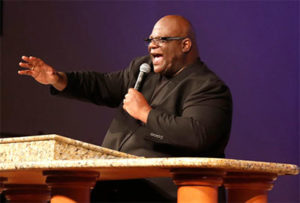
Conclave NextGen returns to San Antonio in October
September 11, 2024
Conclave NextGen conference will return to First Baptist Church in San Antonio Oct. 7-8 for two days of worship, breakout sessions, training and networking with NextGen, family ministers and church leaders.
Cory Liebrum, youth and family ministry specialist at Texas Baptists, said Conclave is a gathering for ministry leaders to feel fed and ministered to without interruption.
“We want Conclave to be a place where they can come, and they can worship. They can fellowship. They can find community with other people, and they don’t have to worry about [anything],” Liebrum said.
“It’s their time to be fed because they feed people in their churches all year round. So, for two days, if we can give them that, then that’s the goal.”
Jennifer Howington, childhood ministry specialist at Texas Baptists, said the desire for Conclave is for NextGen ministers to come together to learn and grow in their ministry area.
“We’ve heard of silos in ministry, and we tend to, as children’s ministers, work with just children and student ministers … But we’re seeing the value of integrating those ministries together, and we’re trying to model that on the convention level.
“That happens through Conclave to say, ‘Come together as a team, we’re learning and growing together as a team,’” Howington said. “It just creates that synergy that they can take home with them and implement in their churches.”
Howington advised first-time attendees to “come expecting to find community, because you will.”
Connecting with others in ministry
Attendees will have the opportunity to attend four main worship sessions and four breakout sessions.
These sessions will include content and resources for preschool, children, students and college ministers—sponsored by the Texas Baptist Student Ministry. Attendees can treat their sessions as a track within each of these areas or go to whichever breakout interests them.
There also will be a “Pastor’s Track” for senior church leaders to learn from and form community with others who are dealing with matters unique to their role.
“We’re very intentional about the keynotes and the breakout session topics because we want full representation of all age-graded ministries, and we want there to be something for everybody, but also generalized topics that apply to everybody as well,” Howington said.
“We put a lot of thought into who we invite to be those leaders, and so far, it’s gone well, and we’ve had such a great response.”
Diverse keynote speakers
The four main sessions feature keynote messages from Ed Newton, lead pastor of Community Bible Church in San Antonio; Mike Satterfield, founder of Field of Grace Ministries in Arlington; and Justin Whitmel Earley, writer and speaker from Richmond, Va.
Liebrum said the diversity of keynotes is the “secret sauce” of the conference as they try to match the unique needs of attendees. He said he especially is excited to have Earley address one of the primary motivations behind the conference—community and the importance of connecting with others in ministry.
“Right now, what we see across the state is a lot of ministers and pastors that feel really isolated and don’t feel connected,” Liebrum said.
“For us, [Conclave is] two days where you can get connected, and you don’t have to be youth minister those two days. You don’t have to be children’s pastor those two days. You can just be you and connect with other people. So, I’m excited about Justin coming to be a part of that.”
To fit the needs of individual attendees, Conclave provides an “On Your Own” group for the conference. The “On Your Own” group is designed for attendees who didn’t come with a church group to have an opportunity to connect and build relationships.
Conclave also is hosting approximately 80 exhibitors, showcasing their ministries and what resources they have to offer.
Building momentum
In addition to breakout sessions, Conclave will hold luncheons on Monday for youth ministers and Tuesday for children’s ministers to advance those connections. Luncheon attendees will share a meal and hear from a speaker in their ministry area.
Howington said she was encouraged by the increased attendance of preschool and children’s ministers at last year’s Conclave and looks forward to building on that momentum this year.
“We had a lot of momentum coming out of last year,” she continued. “Last year was the year we really pushed to have preschool and children’s ministers come with their student ministers and pastors, and we saw the fruit of that.”
Register here for the 2024 Conclave NextGen conference.
Ukraine seminary leader urges prayer for transformation
September 11, 2024
NASHVILLE (BP)—“Pray for the transformation of our nation,” Ukrainian Baptist Theological Seminary President Yaroslav “Slavik” Pyzh implored Southern Baptists at the Ethics & Religious Liberty Commission’s trustee meeting Sept. 10 in Nashville.
“Next time you mention Ukraine to God, please pray that our people will love God and respect the law,” Pyzh asked.
He presented the lingering war as an evil that has given uncommon opportunity to spread the gospel, even as he prays for peace and victory.
Although Ukraine’s population is not precisely known, the number of Protestant believers has doubled since Russia launched its latest attack on Ukraine in February 2022, Pyzh said. Hope has countered the death and hopelessness the war has wrought.
As he searched for a reason for the war, “my answer that God gave me is that war is an opportunity to transform the nation,” he told ERLC trustees.
Seminary increasingly affected by war
Ukrainian Baptist Theological Seminary in Lviv, about one hour from the Polish border, increasingly is affected by the war that began on Ukraine’s eastern border with Russia, he reported.
Within the past week, a Russian missile struck a neighborhood near the seminary, damaging windows and exterior walls of a dormitory housing 20 female seminary students.
“It was less than 100 yards away from our school,” Pyzh said. “One of our dormitories lost all the doors and all the windows, and 20 ladies that were staying there, it scared life out of them. So, we had to let them go because they couldn’t study after that.
“That’s what Russia is doing,” he said, speculating whether it was a targeted attack on the seminary and its spread of the gospel.
“But one thing that I know for sure,” he said. “When Russia comes to Ukraine, Baptist (religious expression and outreach) does not exist anymore.”
Ukraine’s victory is crucial, as defeat will mean the end of Christianity in the nation.
“Whatever you can do as a country,” he said, “and whatever you can do as a church is critically important to us. … There’s no room for church there (in Russia). There’s no room for Christians there.
“Whatever you can do in order to help us, it’s not only helping the country, but it’s helping us as believers to proclaim God there,” he said. “So, every effort you put there has a whole lot more meaning than you can think of.”
Ministry continues in wartime
Seminary students planted about 55 churches in the 18 months spanning January 2023 to June 2024, Pyzh said.
The war has closed some 500 churches, destroying some church buildings and displacing members. In response, the seminary and Baptist leaders in Ukraine including the All-Ukrainian Union of Churches of Evangelical Christians-Baptists, have worked to minister to internally displaced people and offer them the gospel. Many have come to Christ, leaders have said.
Concurrently in partnership with Southern Baptist Send Relief and others, Ukrainian Baptist Theological Seminary has opened 18 WeCare Centers, providing humanitarian, spiritual, educational and counseling support, legal aid, medical care, childcare, home repairs, generators and other supplies.
Combined, such centers typically serve between 20,000 and 25,000 individuals a month, Pyzh said.
But even as many are coming to Christ, others are rejecting him, Pyzh said, with the number of atheists also doubling during the war and major growth among 18- to 25-year-olds.
“I understand why these young people are calling themselves atheists,” he said, “because they cannot make sense out of that reality” of war.
Ukrainian Baptist Theological Seminary continues to thrive during the war, he said, enrolling 700 new students this year, exceeding an anticipated 500.
Around the State: HSU sees enrollment increase
September 11, 2024
Total enrollment for Hardin-Simmons University’s 2024-2025 academic year has increased to 1,665 students. This year, HSU saw an 8.5 percent increase in first-time freshmen. This growth, along with steady retention rates, has contributed to a 6 percent rise in students living on campus. The newly opened Prichard Hall, a suite-style residence hall with private bedrooms, has proven to be a popular option, reaching nearly full capacity of 163 students in its first year. Seventy students will join HSU’s new nursing program to launch in Spring 2025. HSU’s engineering program, now entering its second year, has nearly doubled its enrollment. Additionally, the College of Arts and Media, which moved into its own distinct college in Spring 2024, has seen enrollment grow by 48 percent in just a few months.
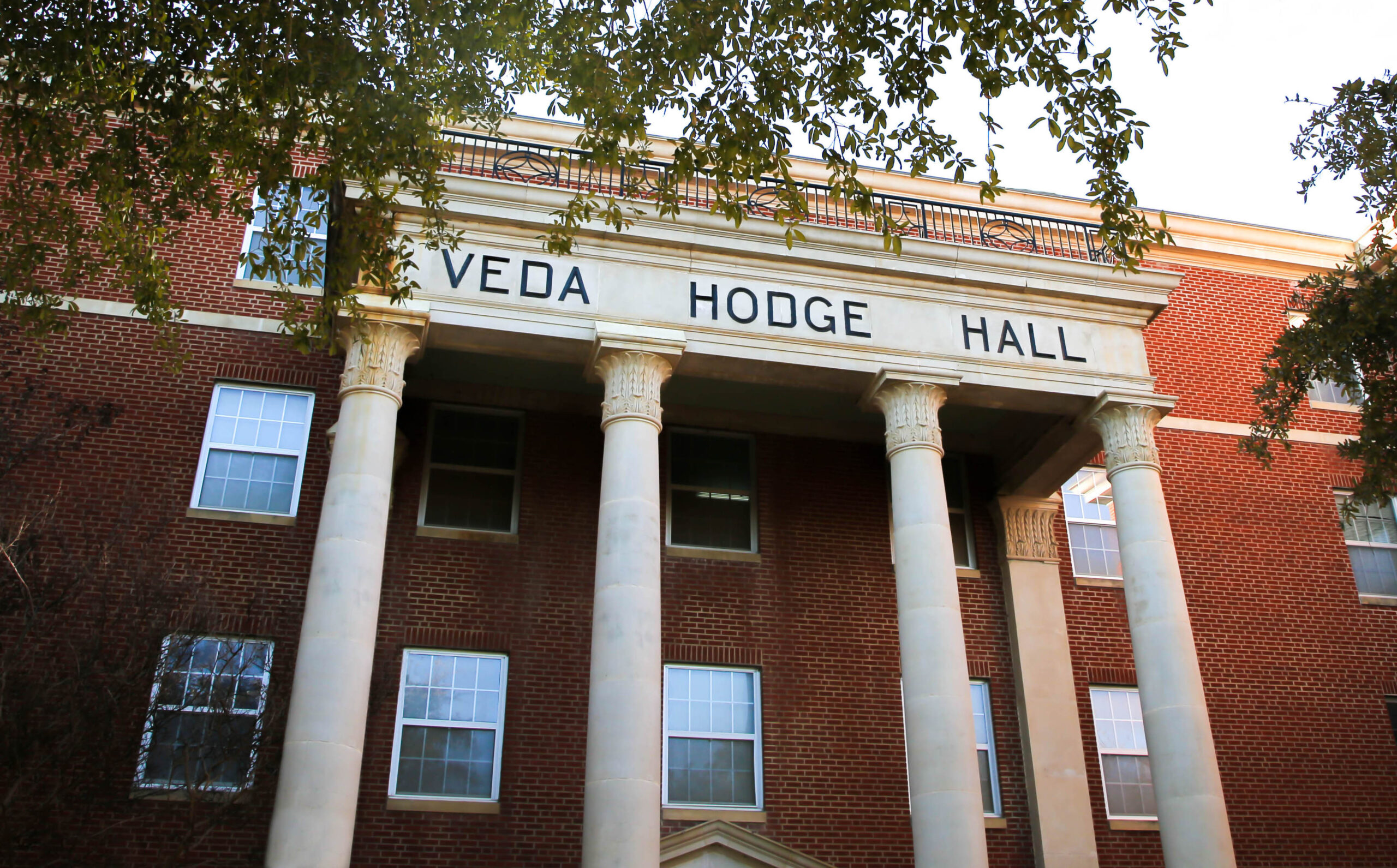
Renovations are underway inside Veda Hodge Hall at Howard Payne University. (HPU Photo)
Howard Payne University recently began renovations on Veda Hodge Hall, the female residence hall on campus. The renovation project is estimated to cost $4 million. This year, $2 million in renovations will improve the east wing of the building. Female residents will occupy the west wing of the building while the renovations take place. Then, the remaining $2 million of the project will complete on the east side of the building during the 2025-2026 academic year. Veda Hodge Hall was built in 1955 and has been in continuous use on the campus for 69 years. Over the past five years, more than $16 million has been invested in renovations across campus and to athletic facilities.
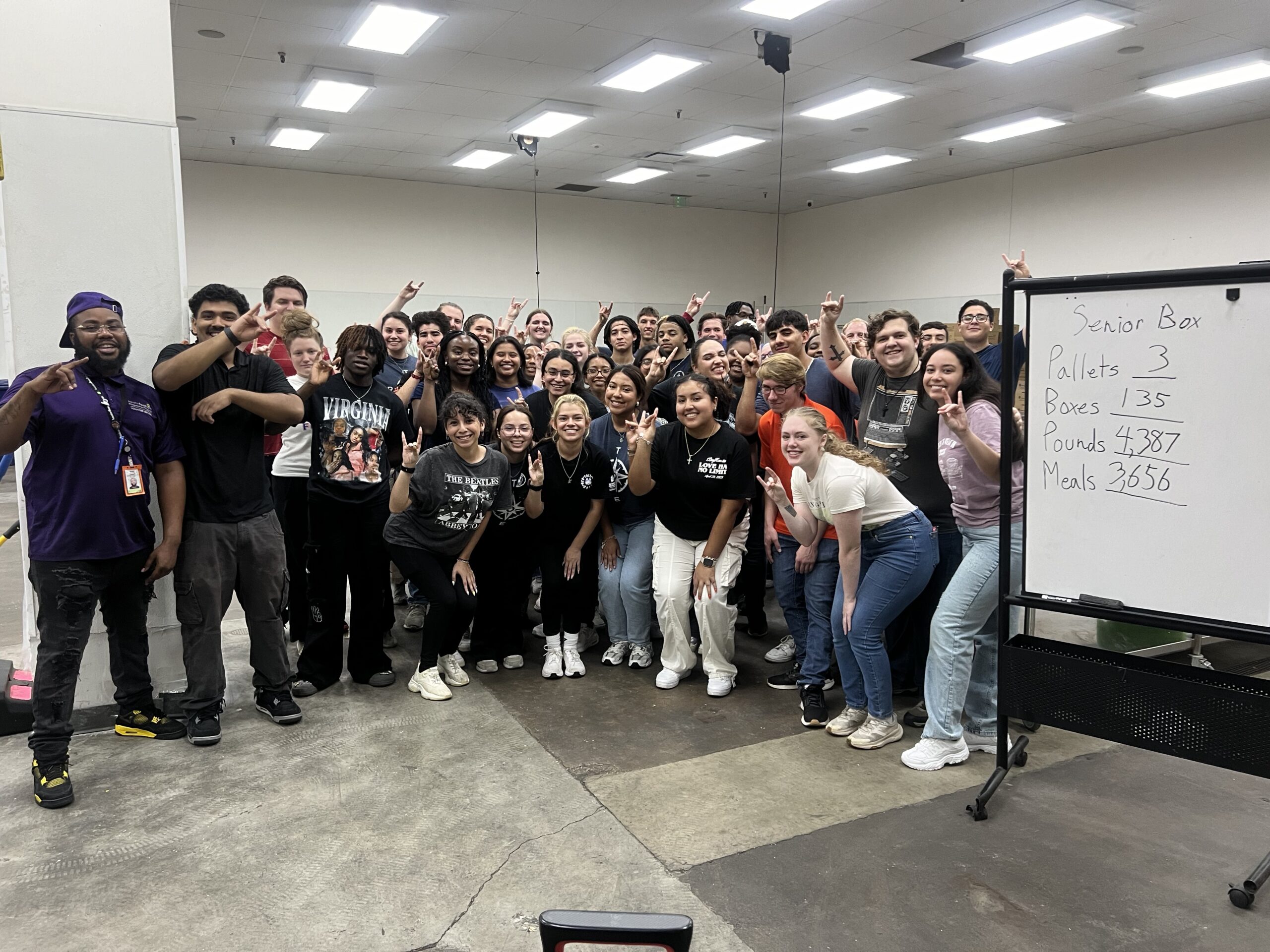
HCU Residence Life leaders met for training before the new semester. (HCU Photo)
As the start of the new semester approached, Residence Life leadership at Houston Christian University spent two weeks training resident assistants for their work and ministry. RAs learned about conflict management and resolution strategies as well as policies to be well-equipped to fulfill their duties. Beyond standard policies and procedures, RAs received training focused on their role as front-line disciple-makers, including training on how to share the gospel. “At HCU, we want to equip all of our student leaders by preparing them to share the gospel, so we prioritize training them,” said Nathan Mahand, HCU’s Baptist Student Ministries director. This year, HCU’s RAs also volunteered at the Houston Food Bank and helped box over 3,500 meals. Resident Director Jacob Elliot emphasized the importance of incorporating community service into training.
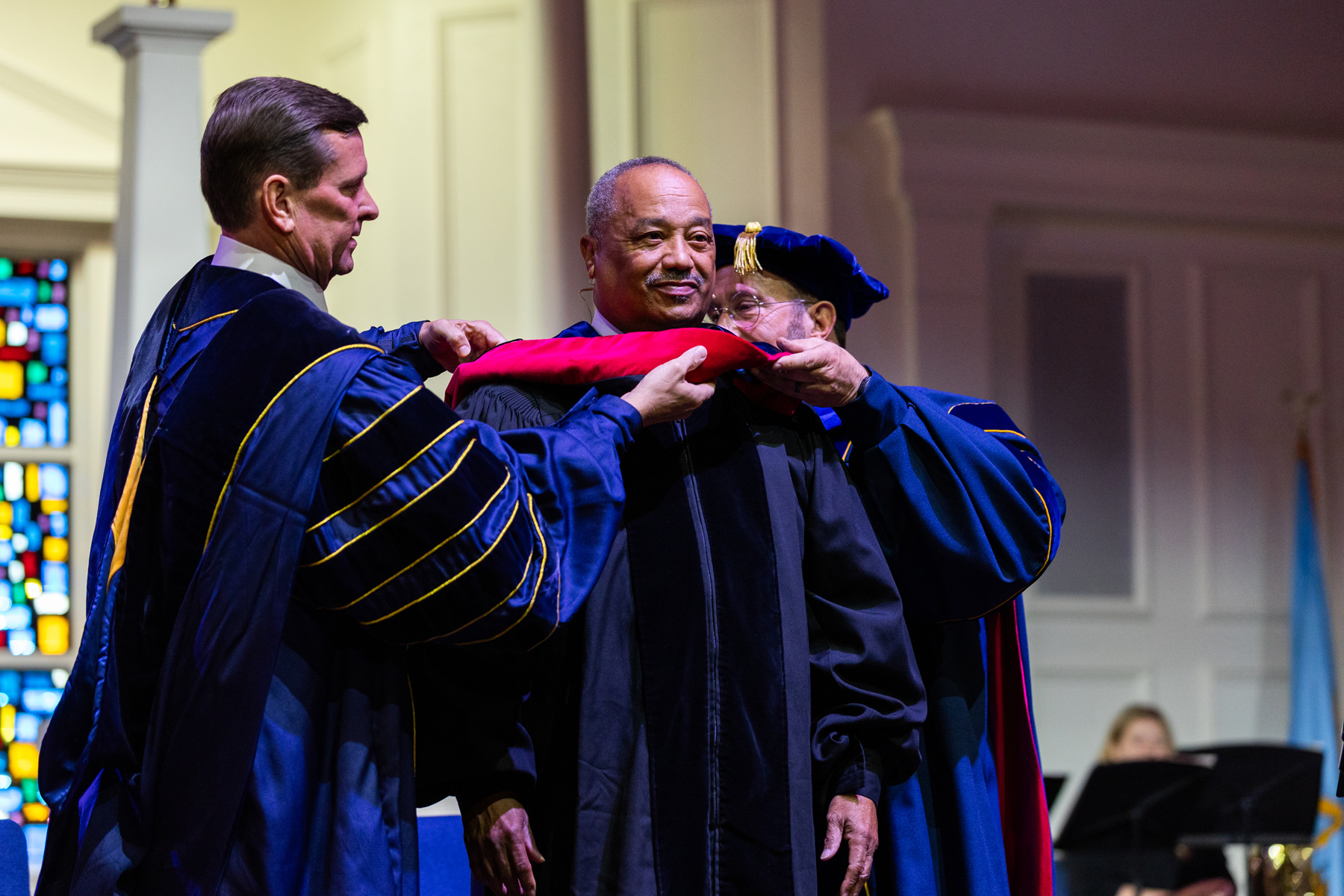
ETBU honored Fred Luter’s contributions to the cause of Christ by awarding him an Honorary Doctorate of Divinity. (ETBU Photo)
East Texas Baptist University held its annual convocation chapel service on Sept. 9, welcoming students, faculty and staff to Baker Chapel for a time of worship, prayer and dedication to officially launch the 2024-2025 academic year. The convocation featured a message from Fred Luter Jr., the first African American president of the Southern Baptist Convention and the senior pastor of Franklin Avenue Baptist Church in New Orleans, La. During the service, ETBU honored Luter’s contributions to the cause of Christ by awarding him an Honorary Doctorate of Divinity degree. Convocation also included the annual dedication of ETBU’s undergraduate classes and concluded with the official pronouncement of the 2024-25 academic year by university President J. Blair Blackburn.
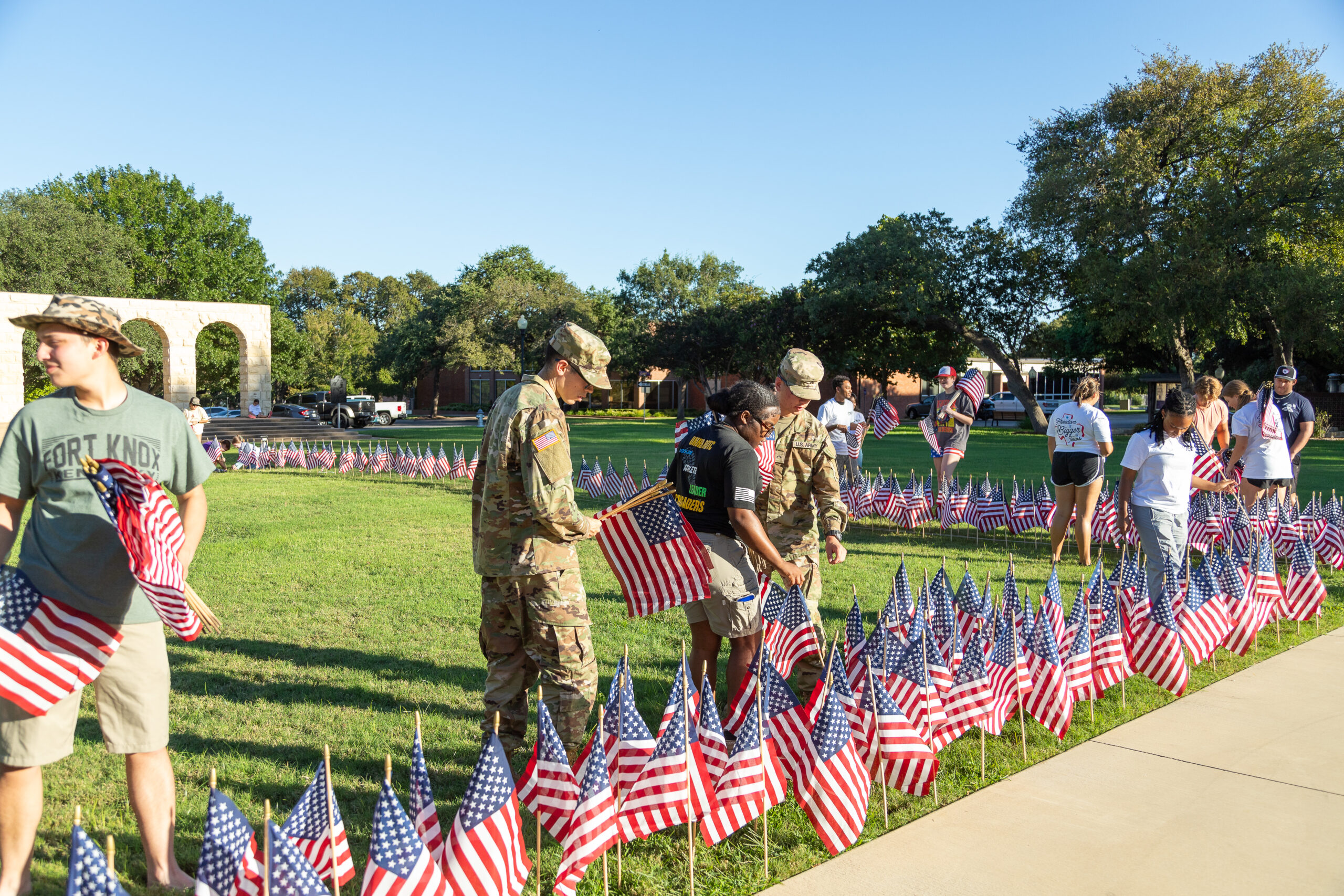
Volunteers plant flags to commemorate 9/11. (UMHB Photo)
The University of Mary Hardin-Baylor’s chapter of Young Conservatives of Texas planned to plant 2,977 American flags at Luther Memorial on the UMHB campus to honor the lives lost on Sept. 11, 2001. “While the majority of students here now did not witness the tragic events of 9/11, we still honor those who lost their lives on that day,” said Cassidy Schnoor, chairman of Young Conservatives of Texas at UMHB. “Our generation needs to learn about that day and continue our commitment to freedom.” This memorial is open to the public, and the community is invited to join in remembering those who perished and in paying tribute to the heroes who emerged.
The Mitchell Family Foundation Award inducted three Dallas Baptist University students into the Texas Business Hall of Fame for entrepreneurial endeavors and business brilliance. Jaret V. Grayson of Mobile, Ala. Grayson started Lone Star Sports, a marketing agency that helps high school and college athletes with exposure to recruitment and NIL opportunities, after one of his social media posts went viral in 2021. He has amassed over 200k followers across TikTok and Instagram in the last three years. Grayson graduated from DBU with a Bachelor of Business Studies in August 2024. Micah Harkless of Washington. Micah is the founder of two marketing agencies—Monastery Media and ParlorLens. Monastery Media is a referral-based agency that seeks to help companies drive growth, establish digital integrity and develop supercharged sales strategies. ParlorLens is tailored to tattoo artists and parlors, where they help increase bookings, provide professional creative media services, manage scheduling, and create engaging websites that encourage sales. Micah will graduate from DBU with a B.B.A. in entrepreneurship in 2025. Christopher Castle is a current graduate student at DBU pursuing an M.B.A. in marketing. Christopher served in the U.S. Air Force more than 20 years, focusing on repairing aircraft, which earned him several medals for his service and expertise. Christopher earned his bachelor’s degree from Embry-Riddle Aeronautical University and a Master of Divinity from Southwestern Baptist Theological Seminary. After retiring from the Air Force in 2022, Christopher combined his business knowledge with his passion for motors, classic cars and getting his hands dirty. He founded Built with Faith Motorsports to mentor others while creating a business from restoring classic cars.
Children learning at San Antonio Baptist Temple’s ELC. (Courtesy Photo)
Often praised as among the best child care centers in San Antonio, Baptist Temple Early Learning Center has raised their level of care. They recently received a Four-Star Texas Rising Star program rating (the highest) from the Texas Workforce Commission. This means they have been recognized as being above and beyond the strict minimum standards for licensed childcare facilities. “We are aiming for best practices,” said Baptist Temple Executive Pastor Jonathan Clark. “These include additional training for teachers and staff, optimizing the environment for children, and a focus on teacher/child interactions.” Director Corchelle Mabry and her staff performed well as they prepared for the evaluation. Mabry has only been director for a little more than a year, but she brought a clear vision of building on past successes to improve the ELC image as more learning center than daycare. Her 36 years of experience in childhood education suit her to the task. Generations have been served by the Early Learning Center. It is not unusual for someone who received care from ELC to return with their own children and find their teachers still here. Faith lessons are also part of the teaching, with age-appropriate lessons that focus on God as Father, creator and Lord of all and chapel services every Wednesday in each classroom. The ELC was established in 1970 to meet the growing need for child care in the community, as moms were entering the workforce in increasing numbers. In 2012, the ELC began accepting vouchers from Child Care Services. These scholarships are available to help working parents who make less than a living wage and those who are searching for work or attending school. This allowed the ELC to increase its level of service to the community. They also began accepting infants and offering after-school care, in response to community needs. The ELC continually expands its scope to fill unmet needs. Grants from the Charity Ball Association, the Baptist Mission Foundation, Baptist Health Foundation, HEB Tournament of Champions, fundraisers, local businesses and individual donors helped them build an accessible playground where children with disabilities and typical abilities can play together. It was the first of its kind in the Southside of San Antonio. Perhaps the biggest challenge came during the COVID-19 pandemic. The ELC retooled and retrained and remained open to serve the needs of parents who were essential workers. In the aftermath of COVID, many childcare centers failed to reopen, and it became difficult to find childcare workers. Grants from the Small Business Administration, the United Way and others helped them stay open and fill the gap.
Anniversaries
Pioneer Drive Baptist Church in Abilene celebrates its 70th anniversary Sept. 22. John Whitten is senior pastor.
Bob Ray celebrated 59 years of serving Fairy Baptist Church as their pastor, Sept. 8. Ray accepted the call to pastor his first and only church in 1965 and has remained faithful to this calling as he continues to serve Christ.
Obituary: William “Bill” Horan
September 11, 2024
William “Bill” Horan of Mesquite, a former employee of the Southern Baptist Convention’s Annuity Board and GuideStone, died Aug. 27. He was 71. He was born Dec. 20, 1952, in Greenville to William A. Horan Jr. and Mary Crabb Horan. He enjoyed being in the high school band and singing in church choirs. He was involved in the Baptist Student Union at East Texas State University as the leader of the prayer committee, where he met Deborah Miller. They married in 1980, sharing 44 years of marriage together. He was involved many years in the Bible Memory Association, now Scripture Memory Fellowship. He enjoyed working as a programmer and database administrator at the SBC Annuity Board and GuideStone. He served many years in church ministry, serving as a choir member and deacon, and teaching a variety of age groups. He is survived by his wife Deborah; by his sisters, Mary Sue Horan and Barbara Horan; and by extended family. Memorial gifts in his honor can be made to Texans on Mission or Scripture Memory Fellowship.
The report’s authors, Daniel A. Cox and Kelsey Eyre Hammond noted: “Over the last two decades, which witnessed an explosion of religious disaffiliation, it was men more than women who were abandoning their faith commitments.
“In fact, for as long as we’ve conducted polls on religion, men have consistently demonstrated lower levels of religious engagement. But something has changed.”
The study authors explained their recent survey reflected a reversal from this long-standing norm. Details on how the survey was conducted or what questions were asked were not included in the report, only noting the survey of 5,459 U.S. adults was conducted by the Survey Center on American Life in 2023.
Evidence of a flip
The authors said the survey they conducted showed 57 percent of people who disaffiliated among Baby Boomers were men and 43 percent were women—whereas 54 percent of Gen Z adults who left their formative religion are women, while 46 percent are men.
Additionally, research released jointly Sept. 10, by Barna and Gen Z-focused Impact 360, noted nearly half of Gen Z (49 percent) say they personally made a commitment to Jesus Christ that is still important in their life today. Two in five (38 percent) say they have not, and 14 percent are not sure.
However, the report stated when grouped by age (young adult and teen) and sex, “we see that young adult female Gen Z are the least likely to say yes (44 percent), compared with young adult male Gen Z (51 percent), and teens both male (52 percent) and female (50 percent).”
So, Gen Z females—whether young adult or teen—are less likely than Gen Z males to report a personal commitment to Jesus, according to the Barna/Impact 360 report, adding support to growing evidence that young women may be becoming less religious than young men.
Barna/Impact 360 data shows Gen Z women have surpassed Gen Z men in disaffiliation. (Simulcast Screengrab)
In a simulcast on Sept. 12, Barna CEO David Kinnaman highlighted data from the report confirming the shift explicity. Gen Z women are the most likely to identify as “nones”—38 percent of Gen Z women identify with no faith compared with 32 percent of Gen Z males.
Hammond and Cox stated their concern that while many conservative churches’ memberships have held steady despite the rise of the “nones,” or people who report no affiliation to any religion, those successes may not hold with the current generation of young women.
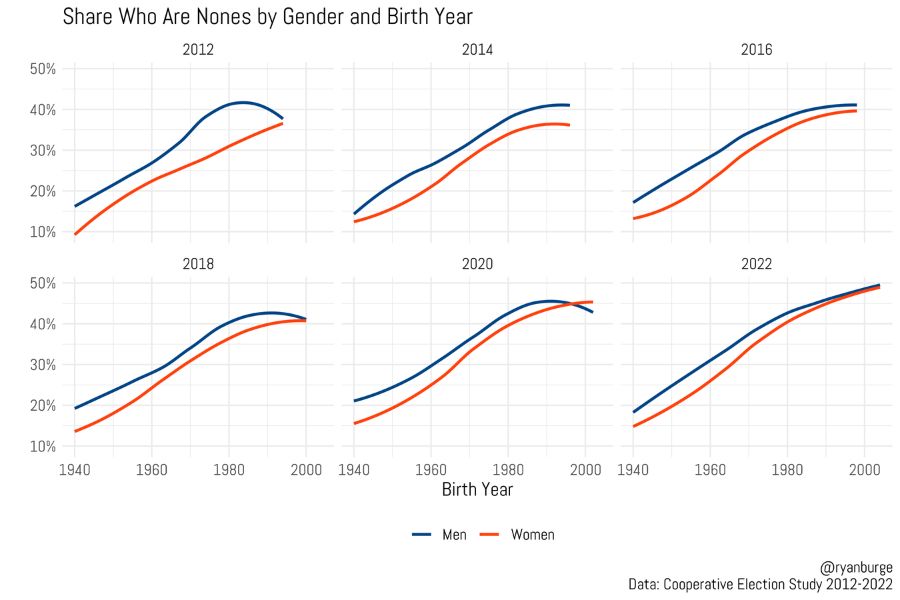
(Chart courtesy of Ryan Burge, used with permission.)
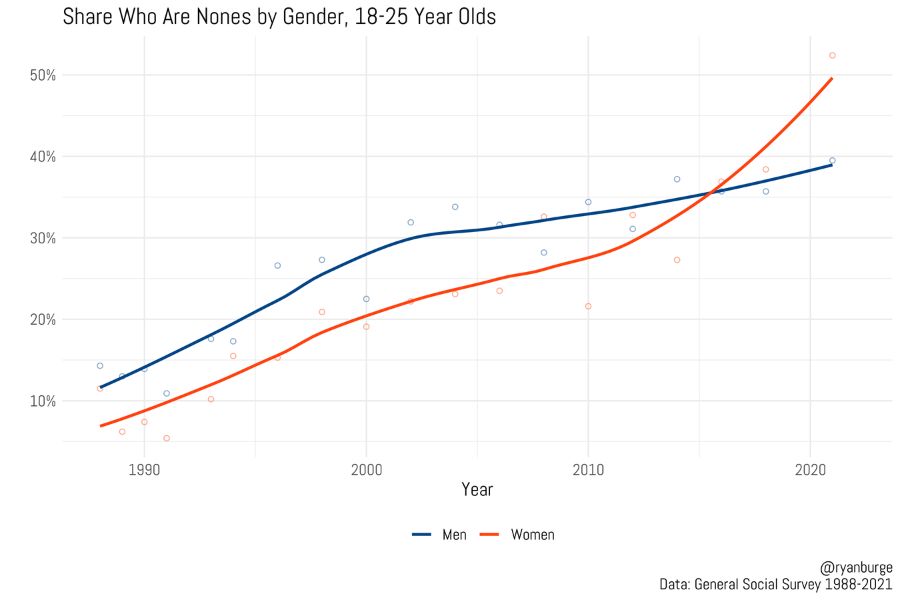
Ryan Burge, an American Baptist and a political scientist regarded as a premier statistician of religious life in the United States, also noted in June of 2023 that something was going on with women. When he analyzed data from the Cooperative Election Study, a pattern emerged suggesting young women were losing their religion in ways not previously seen.
In charting by birth year, for prior generations who reported religious identities of “atheist, agnostic or nothing in particular,” the lines ran parallel, with men slightly more likely than women to identify as nones.
(Chart courtesy of Ryan Burge, used with permission)
But, “among those born around 2000, the gap has essentially disappeared. Women are just as likely to be nones as men. This same general trend is evident in the last three election years of data. It’s hard to believe that it’s just noise when it’s so replicable,” Burge noted.
Contributing factors
Cox and Hammond suggested in their analysis of the Survey Center on American Life findings that “feminism, gender and a cultural mismatch” are at the heart of the reversal.
“Sixty-one percent of Gen Z women identify as feminist, far greater than women from previous generations,” the report stated.
“Younger women are more concerned about the unequal treatment of women in American society and are more suspicious of institutions that uphold traditional social arrangements,” Cox and Hammond contended.
“Nearly two-thirds (65 percent) of young women said they do not believe that churches treat men and women equally,” the report continued, pointing to the Southern Baptist Convention’s strong stance against women serving in equal positions to men in the church.
The analysis also noted a “cultural misalignment between more traditional churches and places of worship and young women who have grown increasingly liberal since 2015.” Cox and Hammond cited the 2022 General Social Survey showing 54 percent of young women believe abortion should be available with no restrictions as evidence of this liberal shift.
Additionally, in March Gallup reported young women are more likely than men to hold LGBTQ+ identities.
Almost three in 10 Gen Z women, (28.5 percent) identify as LGBTQ+, compared with 10.6 percent of Gen Z men. Among millennials, 12.4 percent of women and 5.4 percent of men have an LGBTQ+ identification, the Gallup report stated.
A Public Religion Research Institute report in March found 47 percent of young people who left their childhood religion said “negative treatment of gay and lesbian people” was an important factor in their disaffiliation.
Texas considerations
Todd Still (Baylor Photo)
In Texas, Todd Still, dean of Baylor University’s Truett Theological Seminary, said a shift in young women becoming less religious is not something he’s seen verified at the seminary, yet. In fact, he said women already come close (60 percent male to 40 percent female at last count) and next year even may equal men in enrollment.
He acknowledged that “going where you’re wanted” may play a role in the rising number of women at Truett. Some of the women at Truett otherwise might have attended one of the SBC seminaries, but recent SBC stances related to women may have persuaded them to seek theological education at Truett where they know they will be treated more equally.
Despite strong female enrollment, Still said, if additional research does bear out the Survey Center on American Life’s claims that disaffiliation among young women has overtaken that of young men and Gen Z women are disaffiliating with the churches of their childhood, “this does signal, or should signal, concern for churches.
“Because as they [Hammond and Cox] rightly note, frequently, the involvement of women—at least historically—has been greater, the sacrifice has been greater, attendance, obviously, has been higher. If these are early results, it’s disconcerting.”
Jill Hudson (TXBWIM Photo)
Jill Hudson, executive director of Texas Baptist Women in Ministry, an organization that supports women serving in vocational ministry in Texas, also was unaware of reports women may have overtaken men in claiming no specific religious identity.
However, she said in her work with women in Texas, she has seen young women who previously held strong religious convictions reach a place of disaffiliation.
Hudson said when young women graduate from seminary and begin seeking employment in Texas Baptist churches, they often are met with disappointment.
Believing they’ve discerned God’s call to ministry accurately, done what they’ve needed to do to get hired [earn a Master of Divinity degree], and then being unable to find a church who will hire them can lead to a crisis of faith, Hudson explained.
She said it’s extremely discouraging to these women to apply for positions at churches that claim to support women in ministry, only to have it turn out the church, in reality, only meant children’s minister, not whatever the position was to which they applied.
These new graduates learn they have choices—leave Texas, switch denominations or take a ministerial role not in line with what they believe to be what God is calling and has equipped them to do—none of which are choices they want to make, she continued.
These young women are “deeply Baptist,” Hudson said, until the reality of what it’s like to be a woman seeking to serve in vocational ministry in Texas unmoors them. Sometimes, that means losing faith not only in the church and Baptist life, but in themselves and/or in God, because they cannot bridge the mismatch between their internal faith and the cultural reality.
Hudson said she is available to work with churches on matters related to women in ministry and on having difficult conversations that may help stem the outflow of Gen Z women from the faith.
Dedication to women in ministry reaffirmed
Still concluded: “At Truett Seminary, we work intentionally and tirelessly to equip God-called men and women for gospel ministry and to resource and connect our students and graduates, both women and men, with ministry opportunities that align with their callings.
“We are aware of and sympathetic toward any number of the unique challenges women in ministry face, and we strive to facilitate meaningful ministry placements for them in various and sundry ways, not least through our Office of Ministry Connections.
“Simultaneously, our seminary intentionally seeks to serve churches as they search for ministry candidates, including women.
“In fact, in any given year, our Ministry Connections team will consult with more than 400 churches and nonprofits in an effort to assist our students, alumni and friends to find meaningful places of service in and alongside Christ’s church.
“While we do not always succeed, our annual, effective placement rate of both our men and women graduates historically falls between 90 and 95 percent.”
Editors note: Paragraph 9 and the accompanying graph were added after the story initially was posted.
Report urges changes to promote global religious freedom
September 11, 2024
Naming the worst violators of international religious freedom has been a good way to condemn bad behavior but has been far less effective at bringing about changes in policy by foreign nations, a report from the U.S. Commission on Religious Freedom concluded.
Under the International Religious Freedom Act of 1998, the U.S. Department of State is empowered to name a nation as a Country of Particular Concern if it engages in or tolerates “systemic, ongoing and egregious” violations of religious freedom.
The U.S. Commission on International Religious Freedom makes annual recommendations to the State Department about nations it believes should be given the CPC designation. The commission also recommends nations it thinks should be added to the Special Watch List, a second-tier designation for countries where there is evidence of religious freedom violations.
“After 25 years of implementation of IRFA and more than 160 CPC designations, further adjustments could be made to ensure the act is optimized as a tool of U.S. foreign policy to condemn violations of religious freedom and to promote the fundamental right to freedom of religion for all people,” the report states.
In developing the document, the commission reviewed more than 260 annual reports and interviewed a dozen former or current officials, researchers and religious freedom advocates.
The report notes the State Department has issued 19 sets of CPC designations, naming 17 different nations as CPCs 164 times.
Only in Vietnam was a binding agreement secured and only in Uzbekistan was a binding agreement pursued following the CPC designations, the report noted. Only on three occasions—all in Eritrea—were new sanctions enforced directly because of a CPC designation.
‘Failed to produce genuine change’
“Too often, the application of IRFA has failed to produce genuine change to advance religious freedom,” the report states. “The repeated use of sanctions waivers backed by vague justifications and the repurposed application of preexisting sanctions dilute the effectiveness of the CPC designation.
“The indefinite suspension of sanctions or other punitive measures for religious freedom violators, whether due to inertia or competing policy priorities, impedes accountability for religious freedom violators.
“When waivers must be issued, as the act permits, the State Department should provide clear justification and timelines.”
Knox Thames
Knox Thames, an international human rights lawyer who served as a U.S. Department of State envoy for religious minorities, agreed with the committee’s assessment that the Country of Particular Concern designation has not been used “to its fullest potential.”
“The United States is a global leader in promoting religious freedom worldwide. No other country compares to our efforts. However, good isn’t good enough considering the pandemic of persecution sweeping the world,” Thames said.
“Using sanctions more effectively would create diplomatic consequences for misdeeds, forcing persecuting governments to reconsider their harmful actions and hopefully reform. Taking no action is clearly not working.”
Thames, a career diplomat and author of Ending Persecution: Charting the Path to Global Religious Freedom, asserts in his book the United States should practice “consequential diplomacy”—making sure oppressors of religious freedom know they will suffer penalties if they persist in repression and persecution, while continuing to engage them in sustained dialogue.
Recommendations the commission offered to the State Department included:
Developing a clear action plan for engagement with any country designated as a CPC, including benchmarks and timelines for improvement.
Strengthening the evidence-collection process and streamlining the imposition of targeted sanctions against specific violators.
Mainstreaming religious freedom into U.S. foreign policy by ensuring it is included in public diplomacy, educational and cultural affairs, and promotion of democracy and human rights.
The commission recommended that Congress update the list of required actions for CPC designation to include more modern targeted sanctions and hold regular hearings on the implementation of the International Religious Freedom Act.
Evangelical leaders pledge allegiance to Jesus alone
September 11, 2024
More than 350 evangelical leaders—including some Texas Baptists—have endorsed a “Confession of Evangelical Conviction,” affirming allegiance to Jesus Christ and his gospel alone, “apart from any partisan agenda.”
In a Sept. 9 online news conference, some initial signers of the confession announced a call to prayer for renewal and revival involving churches and denominations representing up to 4 million worshippers.
“No political ideology or earthly authority can claim the authority that belongs to Christ,” the confession states.
Several participants in the online press conference noted the confession “wouldn’t have been controversial” just a few years ago. But today, some evangelicals view its statements of faith through the filter of their political identity rather than their Christian identity, they asserted.
‘Growing sense of political idolatry’
Skye Jethani, co-host of The Holy Post podcast, identified himself as one of the original drafters of the confession. He noted it was inspired in part by the Barmen Declaration, a 1934 theological document adopted by the Confessing Church in Nazi Germany.
In response to “a growing sense of political idolatry,” Jethani said he and others wanted to offer a statement calling Christians to “realign allegiance” exclusively to Christ.
“Our worship belongs to him alone, because our true hope is not in any party, leader, movement, or nation, but in the promise of Christ’s return when he will renew the world and reign over all things,” the Confession of Evangelical Conviction states.
Texas Baptists who have endorsed the statement—released Sept. 5—include Steve Bezner, senior pastor of Houston Northwest Church; John Ogletree, senior pastor of First Metropolitan Church in Houston; Dwight McKissic, senior pastor of Cornerstone Baptist Church in Arlington; and Beth Allison Barr, Baylor University professor and author of The Making of Biblical Womanhood: How the Subjugation of Women Became Gospel Truth.
Others who have signed the confession include Russell Moore, editor in chief of Christianity Today; Karen Swallow Prior, author of The Evangelical Imagination and professor of English at evangelical institutions more than 25 years;Kristin Du Mez, professor at Calvin University and author of Jesus and John Wayne; Gabriel Salguero, president of the National Latino Evangelical Coalition; and Richard Mouw, former president of Fuller Theological Seminary.
Phil Vischer, co-creator of VeggieTales, not only endorsed the statement, but also created an animated video—Parables of Puddingham: Knight of Terror—encouraging people to “vote with love, not fear.” The cartoon is among several resources released in conjunction with the confession, including a Bible study and worship album.
“We reject the false teaching that anyone other than Jesus Christ has been anointed by God as our Savior, or that a Christian’s loyalty should belong to any political party,” the confession states. “We reject any message that promotes devotion to a human leader or that wraps divine worship around partisanship.”
Lead with love, not fear and anger
The statement rejects the “false security promised by political idolatry and its messengers,” insisting Christians are called to lead with love rather than fear and anger.
“We reject the stoking of fears and the use of threats as an illegitimate form of godly motivation, and we repudiate the use of violence to achieve political goals as incongruent with the way of Christ,” the confession states.
The statement affirms the need to submit to the truth of Scripture and “speaking the truth in love.”
“We reject the misuse of holy Scripture to sanction a single political agenda, provoke hatred, or sow social divisions, and we believe that using God’s name to promote misinformation or lies for personal or political gain is bearing his name in vain,” the confession states.
The statement rejects division within the church along partisan, ethnical or national lines, it affirms the church’s prophetic mission, and it underscores the value of every person as created in God’s image.
The confession also affirms character matters both in political and spiritual leaders, and it warns against serving “the false gods of power, wealth, and strength rather than the true God.”
“When any leader claims to have God’s approval, whether in the Church or in politics, we will not confuse effectiveness for faithfulness, but carefully discern who is truly from God,” the confession states.
“We reject the lie that a leader’s power, popularity, or political effectiveness is confirmation of God’s favor, or that Christians are permitted to ignore the teachings of Christ to protect themselves with worldly power.”
Greenway suit against seminary resolved without payment
September 11, 2024
Former Southwestern Baptist Theological Seminary President Adam W. Greenway dropped his defamation lawsuit against his former employer without any financial settlement.
Southwestern Seminary released a statement Sept. 9 announcing the matter was resolved.
“We are grateful to have this resolution between Southwestern Seminary and its ninth president, Dr. Adam W. Greenway. No monetary consideration was paid as part of this resolution,” the joint statement from the seminary and Greenway said.
“The trustees and Dr. Greenway are looking forward to putting this matter behind us and moving on to focus our energies and efforts on following God’s plans for the next chapters of our respective lives and ministries. We pray that God will richly bless the Greenway family as well as Southwestern Seminary in the years ahead.”
In a separate statement, Southwestern Seminary said: “When Adam Greenway approached the seminary on the eve of his deposition and offered to drop his lawsuit with no monetary consideration in return, it was clear this was the best decision for Southwestern Seminary.
“We believe the manner of this resolution not only vindicates the seminary, it further demonstrates the allegations made in the lawsuit were without merit. Grateful for the favor God has bestowed on the seminary since the fall of 2022, we are now eager to re-focus our full energies and resources on carrying out the mission of Southwestern Seminary.”
The Baptist Standard contacted Greenway to ask for any additional comment in light of the separate statement from the seminary. Greenway initially said he was still considering the best way to respond publicly and was not yet prepared to do so on the record.
The next morning, he provided the following statement: “Late last week, I directed my legal counsel to extend an olive branch to legal counsel for Southwestern Seminary, motivated by my steadfast desire to achieve an amicable resolution to our ongoing dispute, whereby the Seminary would fulfill its original commitment to take responsibility for issuing a joint statement acknowledging our separation, with malice toward none and with charity toward all.
“While I am grateful that such a joint statement has now been issued, I disagree strongly with the Seminary’s characterizations of the motivations behind or the meaning of the settlement. Scripture counsels us that we are to ‘if possible, as far as it depends on you, live at peace with everyone’ (Romans 12:18, CSB). I am content to let the joint statement speak for itself. I look forward to putting this chapter of my life behind me and focusing on the hope and the future that our Lord has for me and my family.”
Lawsuit alleged ‘defamatory campaign’
Greenway, who was forced out as president of Southwestern Seminary in September 2022, filed suit against the seminary and the past chair of its trustee board in March 2024.
His lawsuit alleged the seminary administration and then-chairman Danny Roberts “began a defamatory campaign against Dr. Greenway that included both specific false statements, along with publication of a narrative that created a substantially false and defamatory impression.”
“The defamation of Dr. Greenway has been widely publicized, resulting in severe damage to his reputation and rendering him unemployable in the professional capacity for which he is qualified,” the lawsuit stated.
Most of the statements concerned alleged financial mismanagement and excessive spending by Greenway, particularly regarding the restoration of the on-campus president’s home.
Greenway’s suit asserted his predecessor—Paige Patterson—left the house “in a state of disrepair and unfit for habitation or use.” The suit said the Pattersons removed “the majority of furnishings and décor,” and that mold was visible growing on the home’s interior walls.
The suit called for a judgment awarding compensation for actual damages, exemplary damages, past and future economic loss, attorney fees, statutory and civil penalties and “all other proper relief.”
EDITOR’S NOTE: The article originally was posted on Sept. 9, and it noted an attempt to secure additional comments from Adam Greenway. That response was received the following morning and was added as the 8th and 9th paragraphs. The 7th paragraph was reworded slightly to reflect it.
Obituary: Frances Ann Wilson
September 11, 2024
Frances Ann “Fran” Wilson, former seminary administrator, died Sept. 4. She was 79. She was born Aug. 25, 1945, in Laurel, Miss., to Franklin Maurice and Bertie Maurice Dawkins. She graduated from Monahans High School in 1963 and married John Ed Wilson Aug. 21, 1965. She served 21 years as an administrator to the dean at Southwestern Baptist Theological Seminary and 13 years at B.H. Carroll Theological Institute, now B.H. Carroll Theological Seminary. She served in the deacon ministry at Gambrell Street Baptist Church in Fort Worth, where she and John Ed joined in 1981. She also served on the hospitality team at Stevenson Oaks, a senior living community in Fort Worth. She is survived by her husband of 59 years, John Ed; son, Todd and spouse Shelley; son, Tyson; grandchildren: Ben, Ethan, Leeah, Donovon, Naia and Sapphire; brother, Enoch Dawkins and spouse Frances; sister, Lu Price and spouse Levi; long-time best friend, Beverly Bristow; and numerous nieces and nephews. A memorial service will be held at Gambrell Street Baptist Church in Fort Worth on Sept. 11 at 10 a.m., with a reception at the church prior to the service from 9:15 to 9:50 a.m. In lieu of flowers, donations can be made in her memory to Gambrell Street Baptist Church, 1616 W. Gambrell St., Fort Worth, TX 76115.
Trump shifts on abortion, some evangelicals still supportive
September 11, 2024
WASHINGTON (RNS)—Former President Donald Trump’s shifting rhetoric on abortion has unsettled some conservative faith-based activists.
Some evangelical Christian leaders especially have fretted over the Republican presidential candidate’s recent remarks on Florida’s proposed abortion amendment and allowing federal funding for IVF procedures that some say are tantamount to abortion.
But even amid the backlash, several of Trump’s long-term evangelical supporters are insisting the former president, who still publicly takes credit for nominating the conservative justices who helped overturn Roe v. Wade in 2022, remains the best candidate for their cause.
Trump has distanced himself from hardline abortion stances since at least September 2023, when he riled anti-abortion activists by calling Florida’s six-week abortion ban a “terrible thing and a terrible mistake.”
But last month, he called Florida’s current limit on abortion to the first six weeks of pregnancy “too short” and, when asked about a ballot initiative in the state that would enshrine abortion access, said, “I am going to be voting that we need more than six weeks.”
Some warn Trump he will lose support of base
The comments drew swift blowback from anti-abortion activists such as Jeanne Mancini, head of the March for Life, an annual anti-abortion event in Washington where Trump spoke in 2020. In a pair of posts on X on Aug. 30, Mancini responded to Trump’s remarks without mentioning him by name.
“Any politician that would consider voting affirmatively for such a measure will undoubtedly lose the support of pro-life Americans,” she wrote.
“We must not lose sight of the fact that the human rights issue of abortion takes the lives of the unborn and deeply harms women both mentally and physically. The reality is that the tragedy of abortion cannot be reduced to politics alone, much less sacrificed for what is perceived to be politically expedient.”
Trump’s campaign insisted he did not say precisely how he would vote, and the candidate himself eventually clarified to Fox News that he would not support the ballot initiative.
But the back-and-forth came the same week Trump announced plans to federally subsidize in-vitro fertilization, a procedure opposed by some anti-abortion activists because it often involves the disposal of embryos.
In June, an effort to protect IVF access failed in the U.S. Senate after most Republicans, including Trump’s running mate, Ohio Sen. JD Vance, voted against it. About the same time, the Southern Baptist Convention, at its annual meeting, voted in support of a measure calling for more government regulation of the process.
Al Mohler, the president of Southern Baptist Theological Seminary, who in June called IVF “immoral,” warned Trump in an editorial this week that he risks alienating his anti-abortion base.
“(Trump) needs to remember that he cannot win without strong—very strong—pro-life support,” Mohler wrote in World Magazine, an evangelical Christian publication. “The other side is not impressed with his equivocations on the issue, even as his base is endangered by any confusion.”
Lila Rose, head of the influential anti-abortion group Live Action, blasted the Trump campaign on social media on Aug. 29, saying: “Given the current situation, we have two pro-abortion tickets. A Trump win is not a pro-life win right now.”
In an interview with Politico Magazine, Rose refused to say whether she would vote for Trump, saying only, “I am going to see how the next few weeks unfold,” and urging her supporters to put pressure on his campaign.
Trump has suggested his shift on the issue is a result of raw politics. Since the 2022 Dobbs decision, which overturned Roe and allowed states to make their own abortion policy, abortion-related ballot initiatives have gone the way of abortion rights activists—even in red states such as Kansas and Ohio. Trump blamed the Republican Party’s anti-abortion stance for its middling results in the 2022 midterm elections.
With 10 more abortion-related ballot initiatives in November—including in swing states like Arizona—the issue has the potential to fracture the Republican coalition.
White evangelicals strongly oppose abortion
White evangelicals, who have long heavily supported the GOP and who alone make up 30 percent of the party according to a Public Religion Research Institute survey, are disproportionately opposed to abortion, with 72 percent who believe the practice should be illegal in all or most cases, according to a separate PRRI survey conducted in March.
Nationwide, 64 percent of Americans told PRRI abortion should be legal in all or most cases—including 62 percent of white Catholics and 57 percent of Hispanic Catholics, despite official opposition from the Catholic Church.
When it comes to IVF, 70 percent of Americans say IVF access is a good thing, according to an April poll from Pew Research, with majorities of every major religious group saying the same—including 63 percent of white evangelicals.
In July, the RNC published a new platform that omitted the rationale for a federal abortion ban for the first time in decades, likely reflecting Trump’s misgivings about the political liability of the party’s traditional position.
Abby Johnson, who runs the anti-abortion group And Then There Were None, suggested in a statement sent to Religion News Service that activists have been pushing Trump and his campaign behind the scenes to change course.
“President Trump’s comments surrounding life issues have been troubling for many in the pro-life movement,” Johnson said. “That is why many of us have been working behind the scenes with him and his campaign team, hoping to change the course he is on. We have already seen some course correction and we hope to see much more.”
Former Vice President Mike Pence, a conservative Christian, was also critical of Trump and told the National Review: “The Trump-Pence administration stood for life without apology for four years. The former President’s use of the language of the Left, pledging that his administration would be ‘great for women and their reproductive rights’ should be concerning for millions of pro-life Americans.”
Some evangelical supporters rally around Trump
But despite the criticism, some of Trump’s longtime religious supporters continue to rally around him. Franklin Graham, the son of the famous evangelist Billy Graham who has called abortion “a genocide of the unborn,” insisted Trump’s past actions were more important than his campaign rhetoric.
“I don’t just consider a candidate’s words, I look at their actions and what they have done,” Graham told RNS in a statement. “Former President Donald Trump has a four-year track record of appointing judges who protect life.
“While his position on abortion may not be as absolute as some would hope, it doesn’t change the fact that he has been the most pro-life president in my lifetime and is the only pro-life presidential candidate on the ballot this election.”
Ralph Reed, who has spent decades organizing evangelicals as head of the Faith and Freedom Coalition, said he does not see evangelicals abandoning Trump because of his abortion stances.
Saying he was “never concerned” Trump would support the ballot initiative in Florida, Reed suggested conservative voters will back Trump because the alternative—voting for Vice President Kamala Harris, the Democratic presidential nominee—is simply untenable.
He contrasted Trump’s record on the issue with that of Harris, whose campaign has placed her support for abortion rights front and center.
Harris has tied abortion access to personal freedom—the campaign’s slogan—as has her running mate Minnesota Gov. Tim Walz, who has sung the praises of IVF on the stump while connecting it to his own family’s fertility struggles—though they had not, he had to clarify, turned to IVF, but rather used a less invasive procedure.
Citing Harris’ support for policies such as legislation that would restore abortion access nationwide, Reed called her “the most radical pro-abortion nominee for president in the modern political era.” Her positions, he argued, are so “extreme” that she is ultimately “unacceptable to voters of faith.”
“For all these reasons, evangelicals will turn out in record numbers in November and vote overwhelmingly for Trump,” Reed predicted.
China ends adoptions impacting hundreds of U.S. families
September 11, 2024
BEIJING (BP)—The Chinese government officially ended its international adoption program, Foreign Ministry Spokesperson Mao Ning announced Sept. 5.
That announcement ended hopes for hundreds of U.S. families who were matched with children before the COVID-19 pandemic but had adoptions put on hold in 2020.
Karla Thrasher, senior director of international adoptions at Lifeline Children’s Services based in Birmingham, Ala., said the announcement was shocking to the adoption agency and to the 48 families it serves who were matched with Chinese orphans before the pandemic.
“They were definitely in shock. This came very suddenly,” Thrasher told Baptist Press. “We actually had thought things were moving in a more positive direction over the past couple of weeks, and then received this email out of the blue regarding China no longer carrying out the foreign adoptions.”
Lifeline was serving more than 100 matched families when China suspended adoptions in 2020, Thrasher said, but the number dwindled due to various family circumstances.
The remaining 48 families waited with anticipation and suffered a range of emotions including anger, sadness and disbelief at the news, Thrasher said.
“Some of them were just a couple of pieces of paperwork away from traveling to meet their children and finalizing their adoption,” Thrasher said. “That’s how close many of these families were.”
Some of the children had participated in Lifeline’s hosting program.
“Several of these families had actually met their children and spent time with them through a program that we have where we host children here in the United States,” Thrasher said.
“So, several of these children had been a part of that hosting program where they had come to the U.S., actually spent time in the family’s home. So these families knew these children.”
China’s announcement ends a 30-year program, with exceptions for international residents adopting blood relatives or stepchildren, Ming said in her announcement during a press briefing. The program officially ended Aug. 28.
China adoptions were robust prior to COVID
Before China suspended the program during the COVID pandemic, 202 U.S. adoptions were finalized from China in fiscal 2020, which spans October 2019 through September 2020, according to the U.S. State Department’s Annual Report on Intercountry Adoption.
China was a robust country for adoptions by U.S. parents in the years it remained a destination, generating 819 adoptions in 2019, 1,475 in 2018 and 2,036 10 years prior in 2008, the State Department reported.
After the suspension in 2020, no additional adoptions were seen from China until 2023, when 16 adoptions were finalized, the State Department reported.
Those adoptions included families who already were approved for travel to China, a final stage in the adoption process. Some of those families were served by Lifeline, Thrasher said.
“Those are families that when the suspension happened in January 2020 due to COVID, they were at the very last step of the process,” Thrasher said.
“They had a document called travel approval, and China honored that document and allowed those families to travel last year.
“Even yesterday, amidst all of the sadness, the Lord reminded us of those families that did get to travel and those children that did have homes. It’s important to celebrate that as well.”
Lifeline Children’s Services, the largest evangelical adoption organization in the United States, will pray with and for the 48 families as they grieve and process their loss, and work with them as they consider their options, Thrasher said.
The children left behind in China face lives in orphanages with limited medical care, limited education and limited opportunities. They will age out of orphan care at 16 with no resources and few options, she said, other than low wage work. Some may be relegated to lives of begging or crime.
She encouraged Southern Baptists to pray for the children left behind, for the families grieving the loss and still hoping to adopt children, and for adoption agencies working to place children with families across the nation.
National Baptists choose Boise Kimber as president
September 11, 2024
BALTIMORE (RNS)—After an unusual election that gave voters the choice on the ballot of a name or a “no,” members of the National Baptist Convention, USA, lined up behind a new president, Pastor Boise Kimber of First Calvary Baptist Church in New Haven, Conn.
Kimber, who ran unopposed but needed the approval of the historically Black denomination’s delegates, received 1,774 “yes” votes, or 69 percent of the votes cast, on Sept. 5, while 79 votes, or 31 percent, were cast as “no” votes.
“Oh, how marvelous God is,” said Kimber, after outgoing convention President Jerry Young invited him to greet those attending the final session of the annual meeting. “My brothers and sisters in Christ, I greet you in the name of him who orders our steps. What God has done no persons can put asunder.”
In the months ahead of the convention’s annual session, which concluded shortly after the election results were announced, officials determined Kimber had received the necessary 100 endorsements from member churches and other National Baptist entities to qualify to run for president.
Four other men who had hoped to be on the ballot were told they did not qualify: Pastor Tellis Chapman of Detroit, Pastor Claybon Lea of the San Francisco area, Pastor Alvin Love of the Chicago area and Pastor James B. Sampson of Florida.
Pastor Thomas Morris Sr., chairman of the convention’s election supervisory commission, said in an earlier interview many of the other candidates’ endorsements were voided, because they came from churches that have been unable to afford their required annual registration with the denomination due to lack of funds, consolidation or closure.
Disqualified candidates critiqued the election process
In May, the disqualified challengers released a video in which they urged supporters to help them “fight for the soul of our convention.” They hoped sufficient “no” votes would cause the election process to restart.
In August, Sampson wrote about his continuing concerns in a Facebook post that said, in part, “There is no way that any candidate selected under these circumstances can legitimately govern this august body.”
But shortly after the election results were announced, the latest posting on Sampson’s Facebook account seemed to offer a different tone: “God have spoken, let the National Baptist Convention USA inc, Constituency say Amen. Lord Bless and keep ‘President Boise Kimber.’”
Pastor Dwight McKissic of Cornerstone Baptist Church in Arlington preaches during worship services on June 7, 2020. (AP File Photo/LM Otero)
Pastor Dwight McKissic of Cornerstone Baptist Church in Arlington, whose congregation has been dually aligned with the Southern Baptist Convention, was a newly appointed officer along with Kimber in 2020.
The day before the election, McKissic expressed his support for a “no” voting, saying in a Facebook post that cited lyrics from the hymn “Great Is Thy Faithfulness”: “A ‘No’ vote immediately fuses ‘strength for today’ and ‘bright hope for tomorrow’ into the fabric and fellowship of our great convention.”
McKissic, who declined further comment, told RNS after the election that he sent Kimber a text with his congratulations.
“You prayed and worked hard for this,” he told Kimber. “God granted it to you. May God crown your time in office with phenomenal & Kingdom success. Blessings on you, and the National Baptist Convention.”
Support framed as generational change
On the day before the election, some attendees at the gathering voiced support for Kimber as a generational change.
Dwight and Derik Jones, senior pastor and pastor, respectively, of First Baptist Church of South Richmond, Va., expressed concern about how the convention will draw in more members of younger generations.
“We’re hopeful that this election will kind of be the dawn of a new day for the convention in terms of it being serious about meeting the needs of the church in 2024,” the younger pastor said.
“The church, particularly the post-pandemic church, is going through so many gyrations and changes that it needs a leadership that is able to adapt and to lead the convention,” added his father, who said he planned to vote for Kimber. “Many churches are dying, and if the church is dying, the convention can’t live.”
Both Young, the outgoing denominational president, and Pastor Breonus Mitchell Sr., board chair, said the denomination’s election processes need to be changed in the future.
Mitchell said the current bylaws contain “so much ambiguity,” pointing to one church that had joined and paid for its registration in 2023 but was not able to have voting delegates at the session.
Young, in his final address, acknowledged the “unusual” election but said its strangeness did not mean anyone had done wrong.
“There is absolutely no question that there are some problems with the process,” he said. “But hear me: You can’t get in the middle of the process and then decide it ought to change.”
After Thomas announced the election results on behalf of the elections commission, Young said the decision was final.
“Their report here tonight says clearly that the body has spoken,” he said, drawing some applause. “And when the body speaks, that settles the matter. Within the context of Baptist polity, there is no appellate system.”
Shortly before calling the meeting to a close, Young noted he hopes to achieve the transfer of authority over the denomination in less than the 30-day maximum stated in the convention’s constitution.
He also contrasted his plans for a “smooth transition” with the last national U.S. election.
“I can promise you this: There will be no insurrection on our part,” Young said, drawing some laughter and applause. “And you can bet on this: We’re not going to storm the headquarters.”

 William “Bill” Horan of Mesquite, a former employee of the Southern Baptist Convention’s Annuity Board and GuideStone, died Aug. 27. He was 71. He was born Dec. 20, 1952, in Greenville to William A. Horan Jr. and Mary Crabb Horan. He enjoyed being in the high school band and singing in church choirs. He was involved in the Baptist Student Union at East Texas State University as the leader of the prayer committee, where he met Deborah Miller. They married in 1980, sharing 44 years of marriage together. He was involved many years in the Bible Memory Association, now Scripture Memory Fellowship. He enjoyed working as a programmer and database administrator at the SBC Annuity Board and GuideStone. He served many years in church ministry, serving as a choir member and deacon, and teaching a variety of age groups. He is survived by his wife Deborah; by his sisters, Mary Sue Horan and Barbara Horan; and by extended family. Memorial gifts in his honor can be made to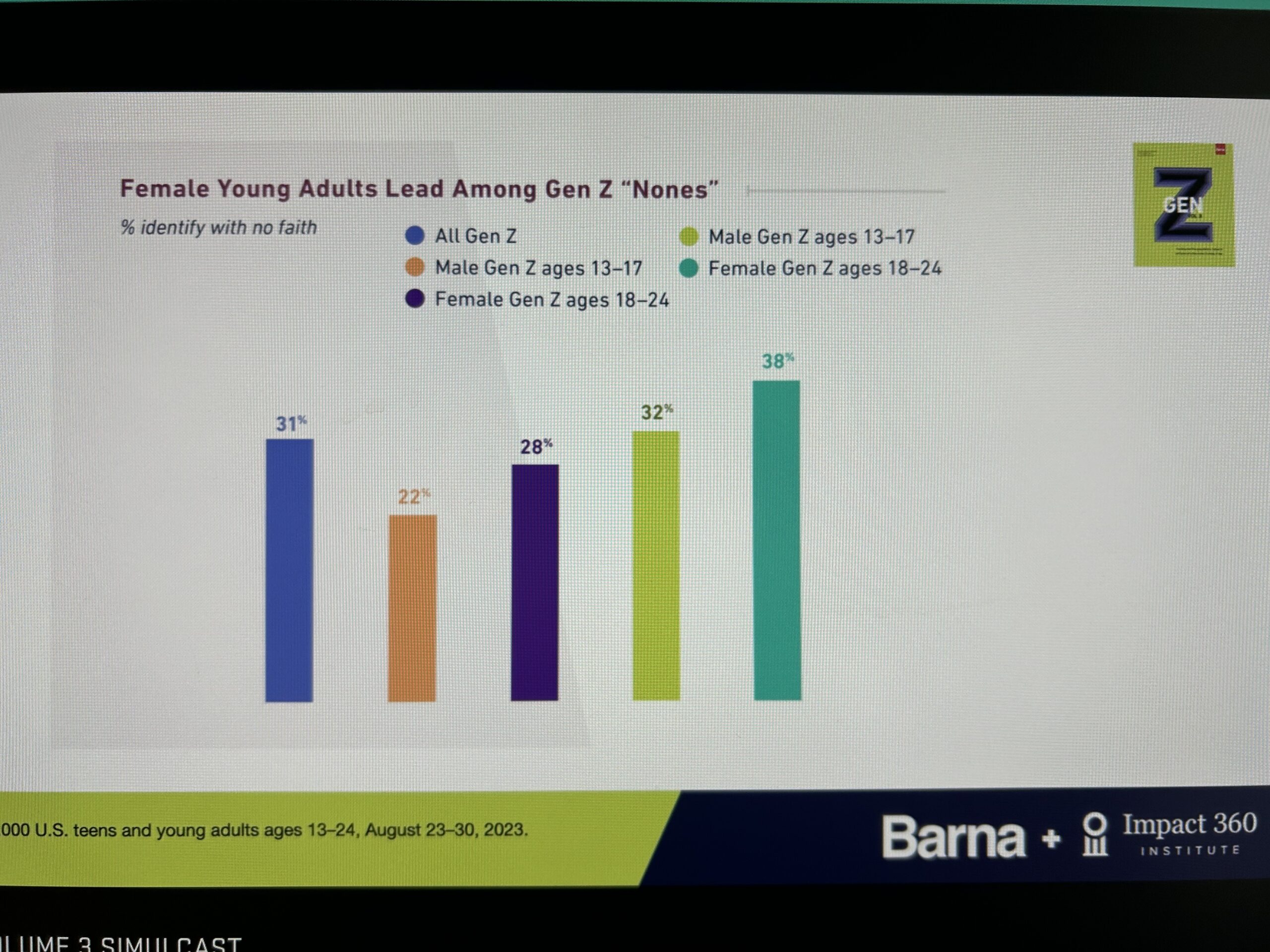



 “No political ideology or earthly authority can claim the authority that belongs to Christ,” the confession states.
 Phil Vischer, co-creator of VeggieTales, not only endorsed the statement, but also created an animated video—
 The statement rejects the “false security promised by political idolatry and its messengers,” insisting Christians are called to lead with love rather than fear and anger.
 Frances Ann “Fran” Wilson, former seminary administrator, died Sept. 4. She was 79. She was born Aug. 25, 1945, in Laurel, Miss., to Franklin Maurice and Bertie Maurice Dawkins. She graduated from Monahans High School in 1963 and married John Ed Wilson Aug. 21, 1965. She served 21 years as an administrator to the dean at Southwestern Baptist Theological Seminary and 13 years at B.H. Carroll Theological Institute, now B.H. Carroll Theological Seminary. She served in the deacon ministry at Gambrell Street Baptist Church in Fort Worth, where she and John Ed joined in 1981. She also served on the hospitality team at Stevenson Oaks, a senior living community in Fort Worth. She is survived by her husband of 59 years, John Ed; son, Todd and spouse Shelley; son, Tyson; grandchildren: Ben, Ethan, Leeah, Donovon, Naia and Sapphire; brother, Enoch Dawkins and spouse Frances; sister, Lu Price and spouse Levi; long-time best friend, Beverly Bristow; and numerous nieces and nephews. A memorial service will be held at Gambrell Street Baptist Church in Fort Worth on Sept. 11 at 10 a.m., with a reception at the church prior to the service from 9:15 to 9:50 a.m. In lieu of flowers, donations can be made in her memory to Gambrell Street Baptist Church, 1616 W. Gambrell St., Fort Worth, TX 76115.