Wellness responsibility of both minister and church

HERNDON, Va. (ABP)—Most congregations know healthier clergy lead to healthier churches, but few consider how clergy wellness and congregational busy-ness are related, said Larry Golemon, an ordained Presbyterian minister and former research manager at the Alban Institute.

“Clergy wellness can be understood by the term ‘shalom,’ a state of well-being intended for God’s creation,” Golemon writes in the Alban Institute’s Congregational Resource Guide.

Gwen Halaas, director of the Center for Interprofessional Education at the University of Minnesota, writes, “God wonderfully creates us as physical, emotional, social, intellectual, vocational and spiritual beings.”

From that perspective, Golemon adds that “wellness is nurtured by keeping the right balance between these God-given dimensions for all congregation members; and clergy are expected—fairly or not—to do an exemplary job of this.”

Assuming their clergy have unusual spiritual resources that give them an edge in staying healthy, Golemon said, many congregations pile expectations on clergy. He maintains churches need to accept their ministers are human, just like anyone else, and need the same kinds of support and resources for personal and professional well-being as other members of the faith community. Some experts believe they need even more.

Studies show many clergy suffer enough personal, familial and occupational stress to put their health and vocation in jeopardy, Golemon said. Those pressures include problems in a family or marriage, a bad vocational match, relational and emotional deficiencies and time demands and emotional pressure of the ministry.

Other factors for ministers are boundary intrusions on clergy families, the stress of high expectations against the limitations of congregational life and the relative isolation and lack of interpersonal resources compared to other helping professions.

That points to the need “for more active work by clergy to engage in spiritual renewal and self-care,” Goleman said. But congregations also have a role in helping to “shape realistic expectations and evaluations of the work” that pastors do.

Research inks clergy burnout to family problems, poor communication with congregations, financial responsibility and clergy sexual abuse.

Clergy wellness also involves personal support of the minister’s commitments outside of congregational life, such as family, time with clergy colleagues and their own self-renewal. Goleman quotes one pastor who told him, “I have two therapists: Harley and Davidson,” and his rather straight-laced congregation relishes the outlet and image.

In addition to things like planning and honoring vacations, days off and time for personal study or recreation, Goleman says clergy and churches can do several things to promote wellness of both minister and congregation.

Using Halaas’ definition, he outlines the following strategies for:

Spiritual well-being. “Examples of spiritual practices that congregations and clergy can pursue together or support in one another include meditation and prayer, regular Scripture and theological study, meaningful corporate worship, sabbatical and study time and Sabbath-keeping—the time set aside for rest, renewal and spiritual enjoyment.” Intentional spiritual practices and relationships “are a source of pastoral resilience through times of stress and trial,” Golemon said.

Emotional well-being. “One of the best ways to cultivate emotional health and healthy relationships in the work setting is for congregations to be holistic and collaborative in clergy/staff evaluation and professional support.” One model advocates “mutual ministry” that a pastor shares with the congregation by evaluating the professional ministry alongside that of key lay leaders. Such systems, Golemon says, “foster mutual accountability and shared work ethics in the church.” Other safeguards for healthy relationships include “coaching of conflict” when it arises, emphasizing “healthy forms of communication and responsive decision-making by clergy, staff and laity.”

Vocational well-being. “There are many approaches for clergy to strengthen their vocational health, and for congregations to support them. They might consider preaching and sharing more about their own vocations, as a way to inspire and reflect with congregants about pastoral and the religious calling.” Pastors also can seek peer groups to reflect on the meaning of their work and support one another in study. Developing a leadership style that fits is essential to vocational health. Golemon says clergy also should expect their sense of vocation to change over time, in various “seasons of ministry.”

Intellectual well-being. “Intellectual well-being can be strengthened in so many ways through clergy practice and congregational life that it is harder to pinpoint. Clearly resources around continuing education and life-long learning is helpful here, as clergy—like other service professions—need time to update their skills, knowledge and self-reflection on their work.”

Financial well-being. “Congregations can be most supportive in two ways: first by paying their clergy and staff well and by offering financial services to clergy, like tax advice and financial planning—often available from members.”


Ministry rebuilds damaged ministries

RICHMOND, Va. (ABP)—Clergy wellness means different things at different stages of a ministry, and ministers who come to Ministering to Ministers Foundation are at a point of personal or professional crisis.

The Richmond, Va.,-based organization provides weeklong “wellness retreats” for ministers who either have been involuntarily terminated or whose ministry is on the brink due to conflict with their congregation.

Charles Chandler began Ministering to Ministers after he was asked to leave the church he had served as pastor for five years.

Charles Chandler, who started the ministry after his own involuntary separation from a pastorate, said 978 individuals have gone through the retreats since Ministering to Ministers began in 1994.

For every minister that comes to a retreat, Chandler estimated, 10 others reach out to the ministry in some fashion, meaning he has worked with between 9,000 and 10,000 ministers in crisis.

Ministers are notorious for neglecting self-care, he said, and when conflict arises, it is the first thing to go.

“A trend I’m seeing at the retreats is when they get under attack, there is sort of a built-in concept somewhere that you deal with it by working harder,” Chandler said.

The most common charge against ministers under fire is they are “not effective,” so they respond by increasing their activity, he said. Studies show, however, that pastors who work more than 60 hours a week are less attentive than those who work fewer hours, setting up a vicious cycle.

“There’s a point of diminishing return,” he said.

Part of the retreat experience is reminding wounded ministers of the importance of self-care. That includes exercise, nutrition, work ethic and sense of humor. When someone loses the ability to laugh, Chandler said, it indicates a lost emotion that professionals consider a danger sign.

Chandler started Ministering to Ministers shortly after he was asked to leave a Baptist church where he had been pastor for five years. In the aftermath, he felt Baptists lacked adequate services to help him through the crisis, and he set out to do something about it.

Chandler gathered a group of fellow ministers who had experienced involuntary separation from their congregations, along with interested laity, to discuss the needs of ministers. That discussion led to formation of Ministering to Ministers.

While the organization offers a variety of services, the most visible is its wellness retreats—week-long events where ministers and their spouses going through a church-minister crisis begin the process of emotional and spiritual healing.

Retreats begin with couples telling the story of their crisis. During the week, they learn how to cope with anger, techniques in conflict resolution and ways to improve physical well-being. They also are encouraged to participate in an ongoing support group and receive practical tips in understanding and marketing their skills.

“You can’t really explain the retreats,” he said. “It’s synergy. The sum is greater than the parts.”

Chandler acknowledged not every ministerial firing is unmerited—bad matches do exist—but they should be handled in ways that cause minimum damage to both the minister and the church.

Any time a minister is involuntarily separated from his or her church, Chandler said, “both church and minister are damaged, and the joy of the gospel is dampened.”

He summarizes the foundation’s purpose by the acronym CARE:

• Communicating ways to improve church-ministers relations through building strong initial foundations, healthy dispute resolutions and mediation.

• Advocating for church-minister covenants that outline procedures in the event of separation. These covenants are adopted by ministers and churches as tenures begin.

• Reclaiming spiritual and emotional support for ministers and their spouses who experience involuntary separation.

• Equipping, by seeking to discover agencies and/or programs available to ministry recipients for career assessment and job placement possibilities, along with possible sources for emergency funds to assist those without adequate compensation during their crisis.

External factors like the economy add to already existing stresses between churches and ministers, Chandler added.

“There’s no question but that the volume of calls increased greatly with the meltdown of 2008,” he said. The same thing happened with another drop-down in the spring of 2010.

“I think that’s pretty well documented,” he said.


Texas Baptists conduct medical clinics in two villages in Senegal

The language of love in action communicates around the globe, an 11-member Texas Baptist team recently discovered as they shared the hope of Christ in two Senegalese villages.

In a trip facilitated by Texas Baptists’ Office of African-American Ministries, the team served in villages in South Senegal alongside Southern Baptist Convention International Mission Board Missionary Bertha Vaughns, who formerly led the Texas Southern University Baptist Student Ministry.

Charlie Singleton from the Texas Baptist Office of African-American Ministries works at a human needs project in Senegal. (PHOTO/Courtesy of BGCT Office of African-American Ministries)

The group conducted two medical clinics in villages that had never before had easy access to any medical care. The team served more than 200 people, providing donated medicine as they could and shared the gospel with the use of French audio players.

Avis Reynolds, a member of Fellowship Missionary Baptist Church in Texas City, said the doctor leading the clinic treated a variety of issues, including aches, pains and rashes. In one case, he had to give a patient a cortisone shot.

“She got up and started praising (God) she could walk without pain,” Reynolds said. “It was just an amazing experience.”

Baba Diop, Passe village chief, examines gifts from Texas Baptists.

At a school in one of the villages where the Texans served, the team noticed the institution lacked any shade where students could rest or play out of the sun. Touched by the need, the group gave enough money to provide roughly 100 shade trees and a green space on the campus.

The Texans also built relationships with students at the school, visiting with the ones who are learning English. Trip participants distributed more than 200 flying discs with Scripture to the students.

Despite the condition of the 1,000-year-old village—little electricity or modern transportation and housing in thatched roof huts—students remained upbeat and determined, Reynolds said. They worked hard to learn English, understanding how important it is to improving their living conditions. Young people dreamed of being teachers and even a correspondent for a major news network.

In response to the teams’ efforts, students at the school created an environmental club to learn about cultivating and caring for the green space. The young people who are learning English asked their new American friends to be their pen pals and conversation partners via letters and Internet video conferencing.

Texas Baptist missions volunteer Avis Reynolds, a member of Fellowship Missionary Baptist Church in Texas City, enjoys time with nationals in Senegal.

“It was just awesome to see God work,” said Charlie Singleton, director of Texas Baptists’ Office of African-American Ministries.

Singleton said the trip is part of an effort to get more African-American congregations involved in international mission work. He hopes every African-American Texas Baptist church will have a Hope 1:8 vision, based on Acts 1:8’s directive to share the hope of Christ locally, statewide and around the globe.

As a result of the Senegal trip, several participants have volunteered to return to serve in the area again. Singleton believes seeing God’s work globally encourages people to get involved in it.

“We’re really trying to get more African-American churches involved in missions,” he said. “Some are already involved, but we’re trying to expose more to missions.”


SMBA renames main road Robert Fanning Drive

San Marcos Baptist Academy honored Robert Fanning, who served on the school’s board of trustees longer than any other individual, by naming the main road through the school campus “Robert Fanning Drive.”

Many current and former trustees, students and staff, as well as friends and family of Fanning, attended the dedication ceremony.

Students and staff of San Marcos Baptist Academy gather around and Robert Fanning following the official opening of Robert Fanning Drive on the academy campus. Fanning served the school longer than any other individual on the board of trustees, from 1962-2002. (Photo by Don Anders/SMBA)

Taking part in the ceremony were Academy President John Garrison, President Emeritus Jack Byrom, board of trustees Chairman Jimmie Scott, retired Baylor University Chaplain Milton Cunningham, and two representatives of the student body, Tiara Hansen and Zachary Middleton.

After the ceremony, Fanning cut a ribbon by the newly installed street sign to officially open Robert Fanning Drive.

A practicing attorney for more than 50 years, Fanning is chairman emeritus and the founding shareholder of Fanning Harper Martinson Brandt & Kutchin in Dallas. He earned his bachelor’s degree at Baylor University in 1953 and his law degree from Southern Methodist University School of Law in 1959. He was awarded an honorary doctorate in humanities from Dallas Baptist University in 1997.

In 1961, Fanning was named to the board of trustees at San Marcos Baptist Academy. Twice appointed as chairman of the board, he continued to serve until 2002. In 1970 and again in 2003, Fanning received the Exemplary Service Medal, one of the academy’s most distinguished honors. He is the only individual to receive this award twice.

Fanning has served on numerous other boards, including the Council for Institutional Development at Baylor Univer-sity; the Dallas Baptist University Foundation; the Texas Baptist Christian Life Commission; and the Annuity Board of the Southern Baptist Convention.

A military veteran, he served as a prosecutor in the U.S. Air Force, Judge Advocate General’s Office, Fifth Air Force, Japan. Fanning has had a distinguished career as a trial lawyer and is licensed by the Supreme Court of the United States.

Fanning and his wife, Margaret, have two sons, Barry and Marc.


10 practices for ministerial health

The Evangelical Lutheran Church in America lists 10 best practices for ministerial health and wellness:

• Love God with all your heart, soul, mind and strength.

• Love your neighbor as you love yourself — be an example of self-care as well as caring for others.

• Remember the Sabbath and keep it holy — be intentional about time for rest and renewal within your week, church year and life in ministry.

•Honor your body as a gift from God and temple of the Holy Spirit. Feed it healthy foods and build your physical and emotional endurance with regular physical activity.

• Honor your mother, father, siblings, spouse and/or children with your love, respect and time.

• Reflect your faith and use your gifts in your vocation.

• Develop healthy habits to keep your wholeness wheel in balance and to be fit for a ministry of service.

• Equip yourself to use your gifts effectively to proclaim and live out the gospel in the world.

• Practice and seek forgiveness.

• Pray daily.


Leaving Eden drives home gospel message

After challenging listeners to see the world as God sees it with his hit song “Give Me Your Eyes,” singer/songwriter Brandon Heath’s next project found its genesis in Genesis.

Since 2008, Brandon Heath (second from right) has hosted an annual benefit concert, “Love Your Neighbor,” which gathers musicians for a night of music and supports needs within the Nashville community. The 2010 benefit concert, which raised more than $61,000 to help rebuild a church in Nashville that had been damaged by flooding, included performers Mike Donehey of Tenth Avenue North, Jason Ingram, Britt Nicole, TobyMac, Heath and Amy Grant.

A season of soul-searching and reflection inspired the vision behind Heath’s most recent album, Leaving Eden, which focuses on themes of redemption, restoration and relationship with God.

“The title track states the obvious pain in the world by just reading the news headlines but turns towards reconciliation despite the hate and frightening things that happen in life,” Heath explained. “I want to celebrate the goodness in the world, and that’s what the rest of the songs on the project talk about. I feel like I have a choice to protect what little innocence is still left in my life, because I think that’s what attaches me to God.

“Even though we’re leaving Eden, there is another destination—heaven. We have a choice. We can walk towards hope, or we can walk towards hopelessness. For me, I really want to walk towards heaven. I want to go home.”

Heath was inspired to write the song “Your Love” as a testament of God’s unfailing and immense love for his children.

{youtube}LQCdJ-C3Jio{/youtube}

“I want people to know that they are absolutely loved by God and that he really wants us to know his love and grace so we can love other people more,” Heath said. “As I was writing this song, I was thinking about a guy that I met one time who has climbed many mountains and has even peaked Mount Everest, but he doesn’t know God, and I keep wondering what he’s searching for. If he would only realize what he’s missing, he would find true fulfillment by resting in God’s unconditional love.

“I think that the longer I get to know the character of Jesus, the more compassion I personally have for others. It is one thing to have compassion and quite another to act on it. Most times, it starts with the people around you.”

Since 2008, Heath has hosted an annual benefit concert, “Love Your Neighbor,” which gathers musicians for a night of music and supports needs within the Nashville community.

The first event raised $20,000 for tornado victims in Tennessee, and all funds collected went directly to the Macon County disaster relief fund administered by Bledsoe Baptist Association. In 2009, the event supported a local high school student who needed critical eye surgery to prevent blindness. The teenager recently had lost his father and was without health insurance coverage. Enough proceeds were collected to create a standing fund for a future need within his high school.

In 2010, the event raised more than $61,000 to help rebuild a church in Nashville that had been damaged by flooding.

By taking a public platform and merging it with his heart for community, Heath also has been involved in raising awareness for a variety of missions organizations such as Young Life, Blood:Water Mission, International Justice Mission, Food for the Hungry, Restore International and other human rights groups.

“Hopefully, people are not only connecting to the music but also to the message behind it,” Heath said. “I want people to realize that if they will place their faith in Christ, they will be delivered from their old life, given a new lease on life and a fresh start to lead the kind of life that God wants his children to lead—with our lives glorifying him.”


Texas Baptists to provide van for Japan tsunami relief effort

DALLAS—Texas Baptists are providing a van for the Japan Baptist Convention to transport people and supplies in the area affected by the tsunami.

The Baptist General Convention of Texas has wired money to the Japan convention for the van and hopes to provide funds for the Japan convention to purchase as many as five additional vans they need for relief efforts. The Japanese Baptist Church in North Texas in Dallas also has raised enough money to pay for a van for the Japan Baptist Convention.

A Texas Baptist relief team returned in late March from asessing needs in the devastated region around Sendai, Japan.

“Unlike most churches and individuals in the United States, many Japanese do not own personal or church vehicles,” said Chris Liebrum, who leads Texas Baptists’ disaster response.

“Most people use the advanced mass transit systems. However, current conditions require that the Japan Baptist Convention have the ability to not only be more flexible with their transportation but to have vehicles that they can use to haul supplies such as food and cooking equipment to the areas around Sendai. Japanese leaders also need these type of vehicles to transport relief workers both from their country and others who will come to Japan to help with the relief.”

To give funds to provide vans in Japan, visit www.texasbaptists.org/give. Money given to the Texas Baptist Disaster Relief offering will go to purchase these vehicles.  If additional money is given beyond what is required, those funds will be used for other disaster response needs.

The decision to purchase the van is the latest effort in Texas Baptists’ work with the Japan Baptist Convention following the tsunami. The BGCT already wired $25,000 to Japanese Baptists, Texas Baptist Men sent an assessment team to Japan, and Yutaka Takarada, pastor of Japanese Baptist Church of North Texas, plans to return to Japan to talk with Japanese Baptists about relief efforts.

Meanwhile, Texas Baptist Men disaster relief volunteers continue to distribute water and other provisions to victims of wildfires in West Texas and provide chain-saw units to clear debris following tornadoes in Alabama. To support TBM disaster relief ministry financially, visit www.texasbaptistmen.org.


‘How shall they hear without a preacher?’

CEDAR HILL—The Bible says faith comes through hearing, and now Billy Fuller is ready to lead others to faith, because he can hear again.

Fuller, interim minister of outreach at Colonial Hills Baptist Church in Cedar Hill, was a pastor until deafness caused him to leave the pulpit. But after a cochlear implant, he considers himself ready to lead a congregation again.


Billy Fuller (left), interim minister of outreach at Colonial Hills Baptist Church in Cedar Hill, received the gift of restored hearing thanks to cochlear implants—a process aided by John Ayers, a layman at Colonial Hills who received cochlear implants several years ago. (PHOTO/George Henson)

Efforts by a layman John Ayers, a layman at Colonial Hills, help bring about the restoration of Fuller’s hearing. The two men met when Fuller, who was visiting his mother, noticed Ayers’ cochlear implants.

“He tapped me on the shoulder and said: ‘I see you have cochlear implants. How do those work for you?’” Ayers recalled. He said the question always makes him laugh, because if they did not work, he would not hear the question.

Even after Fuller returned to Oklahoma where he was living, Ayers tried to help him find resources for a cochlear implant, but it did not work out. When Fuller returned to Texas to live with his mother, Ayers renewed efforts.

A state rehabilitation agency helped Fuller gain funding, because an implant costs more than $30,000 per ear. The process took about a year, but at last he could hear.

People need cochlear implants when the 33,000 hairs inside the cochlea stop functioning, Ayers explained. While the eardrum and the small bones inside the ear can be repaired, the cochlea cannot.

Ayers knows, because he began to lose some hearing by age 25 and by age 50 was “really struggling,” he said. He lost all hearing in 2004. He spent one month in bed with vertigo and nausea that accompanied his hearing loss.

He first had an implant for his left ear and, a few years later, his right.

“There are flaws, and there are faults. They are not perfect,” Ayers said of cochlear implants. “But praise God, I catch a whole lot that I wouldn’t.”

The implants send digital impulses to the brain, which is not the brain’s natural way of hearing sounds, he explained. Humans are designed to hear through auditory or percussion methods. So, the brain has to learn to hear in a different manner.

Also, while the human ears are synchronized, cochlear implants are not. They also are not directional. While a person with implants can hear things, he doesn’t know where the sound originated.

Even with their faults, Ayers praises God daily for giving people minds to design the cochlear implants, because without them, he could not hear anything.

Ayers serves Colonial Hills as a deacon and Sunday school director. He also speaks to senior adult groups about hearing loss.

“I do it to bring people out of the closet of deafness. People pretend they hear and you’re in a conversation with them, and they’ll grin and say ‘Uh huh’—they weren’t hearing a thing. They’re just being polite.

“I’m trying to draw them out and say, ‘Everyone doesn’t need a cochlear implant, but there are a bunch of very good devices that can help you,” he explained.

Ayers has done so well with his implants, five universities around the country fly him in for research studies. He also counsels people about cochlear implants online.

Fuller is glad Ayers is such an advocate, because it helped move him closer to where he wants to be—back in the pulpit. Fuller was pastor of First Baptist Church in Graford when he first began to notice a loss of hearing in his right ear about 23 years ago. Tinnitus and dizziness soon followed. A trip to the doctor confirmed he was losing his hearing.

As pastor of a small church, he didn’t have insurance that would cover improving his hearing, so he compensated.

When Fuller moved to Bethel Baptist Church in Weatherford to be pastor there, he also led the music. To help him hear the piano, he moved it to the side from which he could still hear well. Then he began to lose hearing in that ear, as well.

“We tried the hearing aids, and louder was plenty loud, but the understanding of words began to leave,” he said. “Finally, it got to the point where I could not communicate. I couldn’t understand people.

“Preaching wasn’t a problem. Now many times I would be in the pulpit and just have to hang on because the earth began to move,” Fuller said, describing the vertigo that would come on. The vertigo also made it difficult to drive.

“But it was just me, so I did it anyway, and I’ve jumped the curb many times,” he confessed.

The only thing that would halt it was to lay flat on his nose in a dark room for an hour or more, “but you can’t do that and drive,” he said.

“Those things became normal for me, and I worked my way through it, but it got to the point where I could not hear prayer requests, and that’s a major function, at least of the churches where I’ve been pastor,” Fuller said.

“One of the last straws was when a little girl walked the aisle to receive Christ as her Savior. … I couldn’t hear her. That’s heartbreaking, and I realized these people need a hearing pastor,” he said.

He then went to Oklahoma to try to start a deaf church, but it never got off the ground, so he began working at Wal-mart, “mopping 15 miles of floor every night.” He did that until he returned to Texas—and to hearing.

“Now I can hear. I can communicate—I always could talk, but communication goes both ways, and now I can communicate.”


Billy Graham returns home from hospital

ASHEVILLE, N.C. (RNS)— Evangelist Billy Graham returned home May 15 after a five-day hospital stay for pneumonia.

Graham, 92, has regained strength after treatment with antibiotics, according to his doctors at Mission Hospital in Asheville, N.C.

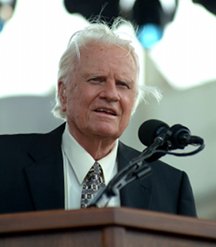
Billy Graham

“He has responded very well to treatment, with progressive improvement since his admission,” said Lucian Rice, Graham’s primary care physician.

“We expect continuing recuperation at home with very gradual recovery, returning to normal activities over several weeks. I’m delighted that he has come back this fast.”

Graham issued a statement noting he appreciated the care by the staff at the hospital close to his home, as well as the prayers of well-wishers.

“I am deeply touched by the prayers and best wishes of so many people for me, and I look forward to returning home and resuming my normal activities soon,” he said.

The mostly homebound Graham has suffered from age-related ailments, including hearing loss and macular degeneration, in recent years.

From his home, he regularly studies the Bible with his pastor and family members and has worked on writing projects, including a first-person look at aging.


Faith Digest

Reliance on God and treatment linked. Cancer patients who consider the length of their lives to be “in God’s hands” are more willing than others to spend money on treatments that might extend their lives, a new study shows. Michelle Martin, an assistant professor at the University of Alabama, based her research on findings of a National Cancer Institute study of 4,214 patients with colorectal and lung cancer. The study, reported in a recent issue of the journal Cancer, also found African-Americans were more willing to spend all their resources to extend their life than members of other racial and ethnic groups.

Impure holy water? A BBC investigation has claimed holy drinking water from Mecca is contaminated with arsenic and is being sold illegally to Muslims at shops in Britain. The BBC report said its investigation uncovered Zamzam water has been found bottled in large quantities at Islamic bookshops in London and the airport city of Luton, and tests turned up high levels of arsenic and nitrates. Zamzam water comes from a well near the Islamic holy city of Mecca and is considered sacred by Muslim pilgrims. Pilgrims are allowed to bring back small amounts from Saudi Arabia, but the water cannot be exported for commercial use.

Minority of atheist scientists ‘spiritual.’ More than 20 percent of atheist scientists consider themselves to be “spiritual,” according to a Rice University study. The findings, to be published in the June issue of the journal Sociology of Religion, are based on in-depth interviews with 275 natural and social scientists from 21 of the nation’s top research universities. Elaine Howard Ecklund, lead author of the study and an assistant professor of sociology at the Houston university, and her team found that these “spiritual atheists” viewed not believing in God “as an act of strength, which for them makes spirituality more congruent with science than religion.” They viewed spirituality as congruent with science but not with religion because a religious commitment requires acceptance of an absolute “absence of empirical evidence.”

Plans for interfaith school shelved. A seminary affiliated with American Baptist Churches USA and the United Church of Christ has scrapped plans to partner with a Unitarian Universalist school to create a new model of reli-gious higher education. Andover Newton Theological School near Boston and Meadville Lombard Theological School in Chicago canceled plans to create a multifaith institution. Although the schools’ different religious identities were a key aspect of the negotiations, presidents of both schools said other matters—from finances to accreditation issues—prompted a halt to their talks. “We’re tied to the real world of institutions and constituencies and fiduciary responsibility,” said Lee Barker, president of Meadville Lombard. “But in no way in my mind does that undermine the vision of what we were trying to do.” The two schools still plan to offer joint programs for their doctorate of ministry students, including a preaching class in June at Andover Newton.

–Compiled from Religion News Service

Editor's Note:  In the next-to-last sentence of the last item as originally posted, Lee Barker was incorrectly identified as president of Andover Newton. The article has been corrected to note Barker is president of Meadville Lombard.  Nancy Nienhuis, dean of students and vice president for strategic initiatives at Andover Newton Theological Student added: "Andover Newton is moving ahead with its plans to create a multifaith model for seminary education; we just won’t be doing so with Meadville Lombard. Our current work with the Hebrew College Rabbinical School continues to be a part of this vision, as do new initiatives with other schools that will further broaden our multifaith focus."


Baptist Briefs

Baylor elects first non-Baptist regents. The Baylor University board of regents approved a $428.6 million operating budget for 2011-2012 and elected new members of the governing board—including the first two non-Baptist regents in the school’s history. Clifton Robinson, a member of Central Christian Church in Waco, and Kenneth Carlile, a member of First United Methodist Church in Marshall, joined the board of regents. Other new regents are Jay Allison of Frisco, Jerry Kay Clements of Spicewood and Mark McCollum of Houston. Milton Hixson of Austin, elected by the Baptist General Convention of Texas last November, also joined the board. Neal T. “Buddy” Jones of Austin was elected chair, and Robert Beauchamp of Houston was elected vice-chair. The officers will serve one-year terms, effective June 1. Regents also approved the establishment of the Robbins Institute for Health Policy and Leadership in Baylor’s Hankamer School of Business.

Logsdon dean named. Don Williford has been named dean of the Logsdon Seminary and School of Theology at Hardin-Simmons University, effective June 1. Williford began his service at Hardin-Simmons in 1992 as director of church relations and assistant professor of New Testament. He was named a full professor in 1999. In addition to his teaching responsibilities, he has served as president of the HSU faculty, accreditation liaison, associate vice president of academic affairs, associate provost, interim vice president for academic affairs and interim dean. Before joining HSU, he served in full-time vocational ministry more than 20 years. Robert Ellis has been named associate dean for academics of Logsdon Seminary and liaison to the Association of Theological Schools. Ellis is the Phillips Professor of Old Testament and Hebrew.

National WMU meeting slated. “Proclaim” is the theme of the national Woman’s Missionary Union Missions Celebration and annual meeting, June 12-13 in the Grand Ballroom of the Wyndham Phoenix Down-town Hotel, two blocks from where the Southern Baptist Convention annual meeting will be held in Phoenix. Keynote speakers are Ginger Smith, executive director of the Mission Centers of Houston, and Jeff Iorg, president of Golden Gate Baptist Theological Seminary. Other speakers include Don and Diane Combs, International Mission Board field personnel serving European peoples; Jan Lows, who serves with Missions Service Corps as director of Life Among the Nations international student ministry at Arizona State University; Louis Spears, a North American Mission Board church planting strategist in Arizona; and Jason Williams, who serves with NAMB in California. Participants are encouraged to bring school supplies to help Spears with an ongoing ministry at Seyenna Vistas, a 67-acre mobile home and RV park in Phoenix that is home to more than 100 elementary school-aged children. A complete list of requested supplies—along with more information about the WMU Missions Celebration—is available at www.wmu.com.

Alabama Baptists tally disaster relief. The Alabama Baptist State Board of Missions reported more than 8,400 Southern Baptist disaster relief volunteers from 10 states have been deployed to Alabama following the tornadoes there, and they noted 38 professions of faith in Christ as a result of their work so far. Alabama Baptists also reported more than 200,000 meals served by disaster relief volunteers, more than 900 chainsaw jobs completed, and 365 critical incident stress management chaplains have served 5,292 people. One temporary child care unit was deployed, and 120 children had been assisted. In schools, 350 child crisis response clients had been served. Twenty-two shower units had been deployed, and nearly 4,000 showers had been logged in addition to nearly 1,200 loads of laundry.

Lay leader Vick dies at 76. Ed Vick, a prominent North Carolina Baptist layman and supporter of the Cooperative Baptist Fellowship and related causes, died May 13, seven weeks after being diagnosed with Stage 4 cancer. Vick, 76, a longtime member of First Baptist Church in Raleigh, N.C., served as a director of Associated Baptist Press since 1994 and was a past chairman. He also formerly chaired and was a member of the CBF Foundation board of directors, was a founding member of the CBF of North Carolina Endowment Manage-ment board of directors and was a former member of the CBF Coordinating Council. He and his wife, Laura Anne, made signification financial contributions to moderate Baptist causes throughout the years. Vick is survived by his wife of 47 years, three adult daughters, a brother and nine grandchildren.


Scholars chase Bible’s changes, one verse at a time

NEW ORLEANS (RNS)—Working in a cluster of offices above a LifeWay Christian Bookstore, Bible scholars are buried in a 20-year project to codify the thousands of changes, verse by verse, word by word—even letter by letter—that crept into the early New Testament during hundreds of years of laborious hand-copying.

Scholars at New Orleans Baptist Theological Seminary are in the midst of a 20-year project to catalog and post online most of the thousands of text changes that have crept into the New Testament. Bill Warren, head of the New Testament Textual Studies Center, holds a piece of papyrus that contains part of the Gospel of John. (RNS PHOTO/John McCusker/The Times-Picayune)

Their goal: to log them into the world’s first searchable online database for serious Bible students and professional scholars who want to see how the document changed over time.

Their research is of particular interest to evangelical Christians who, because they regard the Bible as the sole authority on matters of faith, want to distinguish the earliest possible texts and carefully evaluate subsequent changes.

The first phase of the researchers’ work is done. They have documented thousands of creeping changes, down to an extraneous Greek letter, across hundreds of early manuscripts from the second through 15th centuries, said Bill Warren, the New Testament scholar who leads the project at New Orleans Baptist Theological Seminary.

After 10 years of work and the interruption of Hurricane Katrina, the seminary’s Center for New Testament Textual Studies has logged those changes, amounting to 17,000 pages of highly technical notes, all in Greek, into a searchable database.

Many of the early changes are well known and have been for hundreds of years. Study Bibles mark scores of changes in italicized footnotes at the bottom of what often seems like every page.

But nowhere have so many changes been collated in a single place and made searchable for scholars and serious students, Warren said.

Nor is there an Internet tool like the one being constructed now in the second phase of the project—the history of substantive textual changes.

This fall, the New Testament center will publish an online catalog of substantive textual changes in Philippians and 1 Peter. Warren estimates there’s 10 more years of work to do on the rest of the New Testament.

Those with more than a passing familiarity with the New Testament know its 27 books and letters, or epistles, were not first published exactly as they appear today.

The earliest works date to about the middle of the first century. They were written by hand, and successors were copied by hand. Mistakes occasionally crept in.

Moreover, with Christianity in its infancy and the earliest Christians still trying to clarify the full meaning of Jesus’ life, his mission and his stories, the texts themselves sometimes changed from generation to generation, said Warren.

As archeologists and historians uncovered more manuscripts, each one hand-copied from some predecessor, they could see occasional additions or subtractions from a phrase, a verse or a story.

Most changes are inconsequential, the result of mere copying errors or the replacement of a less common word for a more common word. But others are more important.

For example, the famous tale in John’s Gospel in which Jesus challenges a mob about to stone a woman accused of adultery: “Let any one of you who is without sin be the first to throw a stone at her,” is a variant that copyists began inserting at least 300 years after that Gospel first appeared.

In the conclusion to the Gospel of Mark, the description of Jesus appearing to various disciples after his Resurrection does not appear in the earliest manuscripts.

And in the Gospel of Luke, the crucified Jesus’ plea that his executioners be forgiven “for they know not what they are doing” also does not appear in the earliest versions of his Gospel.

Even after the fourth-century church definitively settled on the books it accepted as divinely inspired accounts, Warren said, some of the texts within those books still were subject to slight changes.

The story of the adulterous woman in John’s Gospel, for example, seems to be an account of an actual event preserved and treasured by the Christian community, Warren said.

“People know it, and they like it,” he said. “It’s about a forgiveness that many times is needed in the church. Can you be forgiven on major sins?”

John had not included it, but early Christians wanted to shoehorn it in somewhere, Warren said.

In effect, early copiers were taking what modern readers would recognize as study notes and slipping them into the texts, a process that began to tail off around the ninth century, Warren said.

–Bruce Nolan writes for The Times-Picayune in New Orleans.