Lottie Moon’s death story a myth, new book contends

BATON ROUGE, La. (ABP) – A new book challenges the familiar story of Lottie Moon, a Southern Baptist missionary martyr who supposedly gave away all her money and starved to death to protest the Foreign Mission Board’s lack of funding for missionaries. 

"Lottie Moon: A Southern Baptist Missionary to China in History and Legend" is published by Louisiana State University Press.

In Lottie Moon: A Southern Baptist Missionary to China in History and Legend, historian Regina Sullivan says Moon deserves credit for her work as a pioneering single female missionary and strong advocate for the formation of Woman’s Missionary Union. The romanticized account of Moon’s death aboard a ship in a Japanese harbor on Christmas Eve in 1912, however, isn’t supported by primary documents, Sullivan claims.

After graduating from Ouachita Baptist University, Sullivan lived two years as an exchange student in Japan. The experience led her to Yale Divinity School, where she earned a master’s degree in religion. While at Yale she became interested in education in disadvantaged schools and decided to go to graduate school at the University of North Carolina at Chapel Hill.

Needing a research topic and having lived abroad, she was interested in women missionaries, who in the 1800s had more opportunities than those in the United States. During background research, she came across a quote from a letter by Moon to a male denominational authority: “It is a small thing to be judged of man’s judgment. It is good to know that we are judged by God.”

Sullivan found such open defiance intriguing and at odds with the Lottie Moon she learned about while growing up Southern Baptist in Benton, Ark. While several books and multiple articles have told Moon’s story from the denominational perspective, Sullivan says hers is the first critical study of her life by a historian of American history and religion.

Sullivan, who has since left the denomination, says that throughout the 20th century SBC accounts of Moon’s life remained close to the historical record except in details of her death. The basic story line goes that overwhelmed by the Foreign Mission Board’s indebtedness and inability to help with relief during a Chinese famine, Moon stopped eating as a protest and gave her money to those who were suffering.

She says Una Roberts Lawrence’s 1927 biography first put the story into wide circulation, but it did not become a standard part of the official “Lottie Moon story” until the 1960s and 1970s.

“She unselfishly gave all her savings and salary for relief to the Chinese people, because the Foreign Mission Board was badly in debt and couldn't help at that time,” a Baptist Press article promoting the Lottie Moon Christmas Offering reported in 1973. “If the people were starving, Miss Moon felt she should not eat either.”

A 1982 BP story said Moon “literally worked herself to death. During the great famine, she worked alongside her beloved Chinese in Tengchow until she grew too weak to continue. On the journey home to recuperate, she died aboard ship in the Kobe, Japan, harbor.

The message “Lottie Moon is starving again” was used to promote the Lottie Moon Christmas Offering during the WMU centennial year in 1988. “Almost 76 years ago, Southern Baptist foreign missionary Lottie Moon literally starved to death,” a Baptist Press article began. “Today, the same thing that happened to Lottie Moon could happen to foreign missions if Southern Baptists do not do something about it.”

Regina Sullivan

Sullivan says the legend of Moon’s martyrdom started with missionary nurse Cynthia Miller, who accompanied her alone in her final days. Miller spoke to a former classmate, who wrote a full-page remembrance in the March 6, 1913, edition of the Religious Herald, the Virginia Baptist newspaper, titled “Lottie Moon: She Being Dead, Yet Speaketh.”

Sullivan said the story might have been forgotten if WMU had not made the annual Christmas offering first collected at Moon’s urging in 1888 a tribute to her memory in 1918.

Sullivan says a missionary doctor and his wife who visited Moon, and spent a few days in her home in September 1912, found her physically well. Soon after, co-workers became concerned about her erratic behavior. One missionary summoned to her home reported finding her in a “troubled state of mind.” She told the missionary she had overdrawn her bank account. He checked and found she had funds to her credit. Unable to convince her, he offered to loan her money.

Other visitors realized Moon was not herself. A missionary couple found her unable to care for herself properly and called a missionary nurse. She was thin and weak, and a large boil was found eating the flesh on Moon’s neck behind her ear.

The doctor who had seen Moon in September returned two months later and was shocked to see how dramatically she had declined. He found her delusional with paranoia fixed on money. She insisted she was out of money and afraid the Foreign Mission Board would run out of money and the missionaries would starve alongside the Chinese people.

The doctor treated the boil and theorized it injured her spinal cord, causing her dementia. The decision was made to send her to the United States for medical treatment. Some friends believed she would have preferred to die and be laid to rest in China.

Her doctor did not believe she would survive the journey. He put her on a liquid diet, because she had refused solid food for some time. At her death the ship’s captain didn’t want to bury her at sea, because it did not befit the dignity of a missionary. He was unsure if her embalmed body would be allowed in a U.S. port of entry, so the decision was made to cremate and inter her ashes next to her brother in Crewe, Va.

Sullivan noted with interest that the story of Moon’s death, while a powerful fund-raising tool, has largely overshadowed her life. She says Moon’s advocacy for female equality and support for female organization in the male-dominated Southern Baptist Convention moves her into the realm of “activist and advocate.”

“An actually remembered Moon would be a female activist who preached, argued for female equality and helped bring the WMU into existence,” Sullivan wrote. Such activities, however, “conflict with the traditional understanding” of the Southern Baptist view of women’s roles, Sullivan says, so Moon “remains a female saint.”

“Symbolically, Moon has been remade into a female Christ-figure, giving of herself so that others might live,” Sullivan wrote. “That this story of sacrifice is not true has not prevented it from achieving a deep resonance for Southern Baptists over nearly a century.”
Visit the book website


Book of poems a ‘labor of love’ for veteran Baptist writer

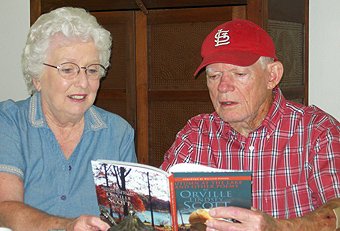
GRAND SALINE—For Orville Scott, a 136-page self-published book of original poems represents a lifetime of precious memories, a testimony to God's goodness and a labor of love.

Autumn at the Lake and Other Poems features about 60 poems ranging from serious religious themes to whimsical verse.

Orville and Emma Jean Scott enjoy the family stories behind many of the poems and photos in Autumn at the Lake and Other Poems. (PHOTOS/Ken Camp)

Scott served four decades as a Baptist journalist, including a lengthy tenure as news director for the Baptist General Convention of Texas. But long before he learned how to write a news story or human-interest feature, he developed an affinity for poetry.

"My mother loved poetry," he recalled. "She had the best scrapbook I ever saw, filled with poems she had clipped from newspapers all the way back to 1900."

As a child, he memorized poetry—often reading or reciting it to his younger brothers and sisters at bedtime. Teachers—first at his hometown of Carthage and later at Panola Junior College and the University of Texas—encouraged his love for the lyrical quality of language.

"It seems like every time in my life I came to a fork in the road, God put somebody there to help guide and encourage me," Scott said.

After he graduated with his journalism degree, Scott became managing editor of a trade journal. But he told a mentor, UT journalism professor DeWitt Reddick, he felt he was failing to fulfill God's purpose for his life.

Reddick told him he had just received a request from Lloyd Wright, public relations director for the BGCT, asking if he could recommend anyone as a press representative for the Baptist state convention. Reddick's recommendation subsequently led to Scott's long career in denominational communications.

Along the way, he wrote poems—often for family, friends and coworkers on special occasions, and sometimes simply because a particular scene or experience struck a chord that just seemed to call for a rhyme. Frequently, the printed program for the annual Texas Baptist Evangelism Conference featured a poem about that year's theme, each simply signed "O. Scott."

Before and after his retirement in 1996, friends told Scott he should publish a book of his poetry. While he dreamed of seeing his poems in a book, he questioned whether a publisher would find it commercially viable.

"A lot of people think rhyming poetry is passé—that it died with Longfellow," he said.

But Bill Pinson, BGCT executive director emeritus, and his longtime executive assistant, Doris Tinker, convinced him and his wife, Emma Jean, they should not allow the dream to go unfulfilled.

The Scotts determined the book of poetry would be published, even if they had to finance it themselves. Realizing they needed help, Scott contacted a former coworker from the Baptist Building, Debbie Sheppard, now a freelance graphic designer.

"When we talked with Debbie about the job, she said, 'I'll take it.' We told her, 'We're going to pay you.' But she said: 'No way. This is a labor of love,'" Scott recalled.

Sheppard not only designed the book, filled mostly with original photos from the Scotts' family collection, but also helped them work with Christian Book Services/Carpenter's Son Publishing.

"We went through a file drawer with 50 years worth of material," Mrs. Scott said.

As Autumn at the Lake and Other Poems began to take shape, the Scotts tried to group the poems thematically and find photos—with Sheppard's guidance—to match the themes. Many of the poems and the accompanying photos have family stories behind them, Mrs. Scott noted, but they also tried to make them universally applicable.

"Where the poems were personal in nature, we tried to select ones that were adaptable—where anyone could put someone else's name in it and still find it meaningful," she said. "But there did come a point where we had to try to make sure each family member was represented and each grandchild was pictured the same number of times."

The manager of one local store has expressed his desire to see Scott's book distributed not only at his business, but also throughout the chain of which it is a part if the corporate headquarters agrees. Beyond that, Scott hopes a few ministries close to his heart might be able to use the books in some way, whether they are sold or given away.

Mostly, Scott hopes the collected edition of his poems succeeds in doing what the ones he has given to so many people through the years have done—bring a bit of the joy of God's love into lives.

In the book's foreword, Pinson wrote: "Outstanding qualities of Orville's life, such as compassion, warmth and sincerity, have attracted a host of appreciative friends. He wrote in poetic terms that of all the works of the Master's art, 'the greatest to me is a caring heart.' Orville is indeed an example of the Master's art."

Autumn at the Lake and Other Poems by Orville Lindsey Scott is available through Amazon.com, from most booksellers or directly from the author at scott@grandsaline.com.


Equipping the equippers

Call it a buzz word, a euphemism for the emergent movement or a description of profound shifts in ecclesiology, the term "missional" is entrenched in the vocabulary of 21st century Christianity.

Theological seminaries are responding to modern challenge by helping students put the pieces together—equipping ministers by helping them make the connection between theology and day-to-day life.

Although the concept is subject to wide-ranging and at times conflicting definitions, its adherents generally circle around a fierce commitment to God's mission or missio dei, an aggressive engagement with secular society and a determination to contextualize the Christian message in specific cultures.

As congregations grope to adapt to the implications of what some call a paradigm shift, the seminaries and divinity schools to whom they traditionally turn for trained ministers have not been far behind.

"Methods of theological education rooted in Christendom systems of coercive power are not designed to equip missional leaders," says JR Rozko, who blogs at lifeasmission.com/ blog/ about missional life.

"A missional vision of theological education is one rooted in community that emphasizes the formation of Christian character marked by kingdom convictions" and which "seeks to train leaders contextually," he wrote in a recent post. "A missional vision of the church carries with it an inherent need for leaders who serve as cultural pioneers, which means we need a vision of theological education capable of equipping men and women for this task."

Rozko, an administrator at Northern Baptist Theological Seminary in suburban Chicago, worked closely last year with the American Baptist-related school to develop its doctor of ministry in missional leadership degree. Next fall, Northern will collaborate with the John Leland Center for Theological Studies in suburban Washington, D.C., to offer doctor of ministry degree classes in Virginia.

Northern and Central Baptist Theological Seminary, just outside Kansas City, Mo., are among a handful of theological institutions that have developed degree plans with an intentional missional focus. But few seminaries have been untouched by the move to reshape traditional educational approaches in missional ways.

For many institutions, contextualization and community rootedness are the stackpoles around which changes are made. And driving that change in part is a recognition that Christianity no longer is predominantly a Western religion.

"Most Christians today come from the global South," said Caleb Oladipo, professor of Christian mission and world Christianity at Virginia's Baptist Theological Seminary at Richmond. "Christianity has been de-Westernized."

Since 2002, Wilshire Baptist Church in Dallas has maintained a two-year pastoral residency program that has graduated more than a dozen ministers such as Tasha Gibson, pictured here as she works in Vacation Bible School.

That new reality confronts Christians in Europe and North America with a stark choice, Oladipo said.

"The challenge for us is whether we are going to accept the leadership of Christians in the non-Western world to lead the new church that is emerging, or whether we are going to hold onto the old categories," he said.

In response, BTSR's curriculum centers on what Oladipo calls "a fundamental pillar"—a requirement that every student spend a year immersed in an unfamiliar culture, either abroad or in the United States. The seminary supports its Mission Immersion Experience through an endowed fund.

"BTSR takes the paradigm shift seriously enough that it sends its own students to other parts of the world so that they become familiar with what God is doing among those Christians in a totally different culture," Oladipo said.

Logsdon Seminaryat Hardin-Simmons University in Abilene also takes contextualization seriously, said James Stone, the seminary's director of ministry placement and congregational resourcing.

"Our approach is in a globalized context," Stone said. "We recognize we live in a complex and interconnected world, and that it's paramount that students who engage theological education understand the connectivity of the church to their communities, to the larger social and political frameworks, and to the economics of the global marketplace. We strive to give our students that perspective."

But the global context is paired with an emphasis on rootedness in a specific community of faith—where significant practical, theological and spiritual formation occurs for seminary students—and in the social context in which that faith community lives, Stone said.

"The health of both the church and the community define us," he said of Logsdon, noting that four of the seminary's professors have doctorates in ethics. "With that ethical mindset, we are able to help our students understand that the health of the church is important not just in words, but also actions, and a healthy church contributes to a healthy community."

A profound emphasis on that community of faith for developing Christian leaders is essential to a missional approach to theological education, Rozko contended.

"If helping people learn to make decisions, live their lives and find their identity not on their own but in the community of the body of Christ is central to the task of Christian leaders, then their training must take place in that same context," he wrote recently. "This has implications for how we identify potential leaders, how we commit to and support them, the nature and structure of how we train them and for what follows the completion of their training."

George Mason, a Texas pastor who is completing a book on the congregation's role in training clergy, agrees churches play an essential role in the new theological education paradigm.

"Location has a tremendous amount to do with the mode of learning," said Mason, pastor of Wilshire Baptist Church in Dallas. "What the seminary can do extremely well, the church cannot do as well—teach things that have more to do with information than formation. … But there are practices of ministry that are best learned in the church. You can learn only so much in theory in class; you can learn so much more by digging it out of direct practice and reflecting on it with colleagues."

Since 2002, Wilshire has maintained a two-year pastoral residency program that has graduated more than a dozen ministers. Funded in part by the Lilly Foundation, Wilshire's program mentors four potential pastors at a time. Each receives a salary plus benefits. The aim to provide confidence and skills necessary to enable the residents to become effective pastors.

But ministerial formation can't be neatly divided between the church and the academy, or practice and theory, said Mason, who serves on the board of directors of the Baptist House at Duke Divinity School in Durham, N.C.

"I don't criticize the seminaries in the way that some people do when they claim they're not training students to be ministers," he said. "The churches aren't teaching Greek, are they? You want a learned clergy? Part of that is only what a seminary can do. You want a well-trained capable minister? Some of that is only what a church can do. This is a partnership."


Pioneering woman minister seeks glimpses of holy as prison chaplain

ASHEVILLE, N.C. (ABP)—As an ordained Southern Baptist woman pastor, Nancy Sehested became a celebrity in some circles when her Tennessee church was pushed out of its association in the late 1980s for hiring her. Today, she serves outside the limelight as a prison chaplain.

Nancy Sehested baptizes new believers during an Easter morning worship service at Marion Correctional Institution. (ABP PHOTO)

Twenty years ago, Sehested was in demand to speak about her experiences as a pioneer who helped dream into reality the Baptist Women in Ministry organization. 

She pursued her call to ministry in her birth denomination, where her father and grandfather were pastors, amid Southern Baptist Convention resolutions that reserved the pulpit for males.

After six years as associate pastor of Oakhurst Baptist Church in Atlanta, which ordained her in 1981, Sehested accepted a call to Prescott Memorial Baptist Church in Memphis as pastor in 1987.

Before she even got to the field, Shelby Baptist Association disfellowshipped the church and thrust Sehested into the spotlight. Ironically, local interest in Prescott surged because of the publicity, with people saying, "I always wanted to be in a church like that." 

Sehested led an active church, was raising two daughters with her husband, Ken, who was executive director of the Baptist Peace Fellowship, and traveled frequently to tell her story of a distinct calling from God that her tradition said could not be true.

It exhausted her. "I put extra pressure on myself as a pioneer to prove that I could do it," she said. "It was clear I couldn't keep up the pace I was going."

With no specific study to verify it, Sehested suspects many women involved in the early struggle for acceptance no longer are in church leadership.

"It was an extremely difficult time to get positions. And once we got positions, we had to work so hard to prove ourselves, to meet the expectations of the congregation and the expectations we had on ourselves," she said.

"I think I would have left the church completely if it had not been for the fact I cannot figure out any other community that has this grand story of Jesus."

She left Prescott Memorial after eight years. She had a "profound sense of having failed at being a pastor" and "in being able to balance attention to family and husband and children and my own soul."

She moved to North Carolina on the promise of leading a retreat center. Her husband moved Baptist Peace Fellowship offices there, and their children were at a place in school where consistency was essential. When the retreat center didn't happen, she needed to stay in the area and found an interim pastorate at tiny Sweet Fellowship Baptist Church.

She found a home, too, among the least-loved and furthest outcast of society when she became a prison chaplain.

Every day, she enters the walls of maximum security Marion Correctional Institution expecting to glimpse the holy in the midst of a population that has committed unholy acts.

"I'm a priest in the village of the damned," she said.

Even as she transitioned to the chaplaincy, she, her husband and Joyce Hollyday started Circle of Mercy as a fellowship dually affiliated with the Alliance of Baptists and the United Church of Christ.

Nancy Sehested's drop from the pioneer radar screen and presence on conference programs is no more complicated than her being a chaplain, she said.

Her congregation numbers 350 staff and 800 prisoners who claim one of 13 religious affiliations recognized by the state for which she must provide accommodation.

Sehested said she seeks to be a "companion for those who are seeking healing, who are really shattered souls."

"Prisoners are the truth bearers in our culture," Sehested said. "Regardless of what we say, this is what we model: money is all; end a conflict with violence; address any difference of opinion with blame, dismissing or shunning. They bear that truth to us in vivid and destructive ways."

She appreciates volunteers who come regularly to demonstrate and teach discipleship in the severe environment. "If you can practice discipleship here, you can do it anywhere and be an example of God's peace," she said.

"This place challenges me every day in my faith about what I really believe about grace and redemption," she said. "I'm so grateful that Jesus showed us how to live in the midst of turmoil and suffering." 

Pam Durso, director of Baptist Women in Ministry, called Sehested a "founding mother" of her agency and "the dreamer behind getting BWIM started."

"She really paved the way for this organization," Durso said. "She put the dream into motion. I consider her one of the great heroes in our journey as Baptist women in ministry."


American Muslims hopeful about life in the U.S.

WASHINGTON (RNS)—Ten years after the 9/11 attacks, an extensive new survey of Muslims finds them as optimistic as other Americans, even as large minorities of Christian Americans question Muslims' loyalty to the United States.

The survey, released by the Gallup organization's center in the Middle East, presented a community less than fully assured of its place in the United States, but generally confident in President Obama and the American economy.

An estimated 3,500 Muslims gathered Sept. 25, 2009, at the foot of the U.S. Capitol for a first-ever Islam on Capitol Hill prayer rally.?(RNS FILE PHOTO)

American Muslims' perceptions of their own well-being increased more in the past three years than those of any other religious group, according to the report, which also surveyed Protestants, Catholics, Jews, Mormons, atheists and agnostics. Muslims' expectations for their own happiness in five years similarly topped those of all other faiths.

Mohamed Younis of the Abu Dhabi Gallup Center, which is affiliated with the United Arab Emirates' constitutional monarchy, said the report showed optimistic American Muslims share certain traits.

"Muslims who tend to be thriving seem to be more fully engaged in their religious life, but also strongly identify with the United States as a place to live," Younis said. "They show a picture of someone with less cognitive dissonance about being 100 percent Muslim and about being 100 percent American."

The optimism of American Muslims particularly is noteworthy, the report's authors said, considering that much press about them focuses on terrorism and controversy, including the proposed mosque near Ground Zero in New York and congressional hearings on the radicalization of their faith community.

Although majorities across all groups surveyed said Muslims are loyal to their country, large minorities of many religious groups doubted it. Ninety-three percent of Muslims believe Muslims are loyal to their country, compared to 56 percent of Protestants, 56 percent of Mormons, 59 percent of Catholics and 80 percent of Jews.

In other instances, Jewish Americans showed a trust of Muslims less apparent among other groups and held opinions that most closely correlated with Muslims, a phenomenon the report's authors called "The Children of Abraham." They invited Rabbi David Saperstein of the Religious Action Center of Reformed Judaism to help explain the affinity of views.

"Jews view themselves as the quintessential victims of religious persecution in the history of the world over the last 3,000 years and therefore often identify with those who are subject to persecution and discrimination," Saperstein said.

More Jews (66 percent) than Muslims (60 percent) said Muslims are discriminated against in the United States, according to the report.

Among other findings of the report, a compilation of Gallup surveys of Americans' life satisfaction and polls of Muslim Americans in particular:

• On average, Muslims rate their expected life satisfaction in five years at 8.4 on a 10-point scale—higher than any other religious group.

• A small fraction of Muslims believe there is a national Muslim organization that represents them, with about 12 percent naming the Council on American-Islamic Relations, named more frequently than any other group.

• Sixty-nine percent of Muslims said they "extremely strongly" or "very strongly" identify with the United States, as compared to 91 percent of Protestants, 81 percent of Catholics and 86 percent of Jews.

• Eight of 10 Muslims expressed support for President Obama, more than any other religious group. More than any other group surveyed, they are confident economic conditions are improving.

• Muslims (57 percent) are more confident in the honesty of American elections than Protestants (44 percent), Catholics (46 percent) or any other religious group.

• Muslim Americans (70 percent) have less confidence in the military than Protestants (95 percent), Catholics (94 percent) or any other religious group.

• Muslims Americans (83 percent) are more likely to see the Iraq war as a mistake than Jews (74 percent), Protestants (45 percent) or any other religious group.

• Muslim Americans (65 percent) are less likely to be registered to vote than Protestants (91 percent), Jews (91 percent) or any other religious group, a statistic the survey's authors say correlates with the relative youth of the Muslim-American community.

Muslim leaders and the White House hailed the report as a tool for those who want to dispel myths about Muslim Americans and plot a course for their increased participation in American political life.

"It confirms for us that as we reach out to Muslims, the community will reach back," said Paul Montiero, associate director of the White House Office of Public Engagement and part of a panel invited to comment on the report at its Washington unveiling.

Imam Mohamed Magid, president of the Islamic Society of North America, said the survey shows how far Muslims have to go until they are fully accepted members of society, and that 9/11 was a setback for those who follow Islam in America.

"But the process has started," he said. "And I think it will bear fruit."


Church sees Mission Drippin’ outreach event as a rousin’ success

DRIPPING SPRINGS—Actin' , paintin', buildin', prayin', deliverin', teachin' and plumbin'—they all were part of the inaugural Mission Drippin' outreach by First Baptist Church in Dripping Springs.

Pastor Craig Curry participates in a Mission Drippin' Bible club.

The congregation kicked off the effort with a worship service on Wednesday evening. "We probably had three-fourths of our Sunday morning crowd there," Pastor Craig Curry said. David Smith, executive director of Austin Baptist Association, spoke at the kickoff event. After the worship service, teams met for last-minute strategy sessions.

The next two days, teams fanned out through the community for a variety of projects.

One team installed a walk-in shower for three elderly women who live in the same house. Another team put up a wheelchair ramp.

A man in the community previously had built an addition onto his home to accommodate his growing family, but until Mission Drippin', it had no electrical wiring.

A team also cut down a towering dead tree that threatened a home.

Mission Drippin' wasn't all manual labor, however. One team put together gift baskets for local first responders, while another team sponsored Bible clubs through town. Another group prayerwalked the community.

Constructing a wheelchair ramp during Mission Drippin'.

Mission Drippin' marked the church's first missions effort since it rebuilt its sanctuary af-ter it burned in 2007, Curry said. Initial plans called for the church to go somewhere else on a missions en-deavor, but members decided the place to start was right at home.

The church has grown considerably since Curry came as pastor in December of 2009, and Mission Drippin' provided a secondary blessing to the congregation, Curry said.

"What we found was some of our prayerwalkers, even though they were in the same church, didn't know each other. This gave them a chance to get to know one another," he said.

"It was the same on some of our construction crews. The guys working together knew each other, but they really didn't know each other. It was great to see those relationships beginning to develop."

Since no travel was involved, Mission Drippin' not only allowed more adults to be involved, but also enabled children to work alongside their parents and other adults.

Curry recalled a fifth grader who helped act out a story at a Bible club. "She asked her mother, 'Does that make me a missionary?' We were blown away by how some of these kids really got what we were trying to do," Curry said.

Team members invited everyone they encountered to attend a communitywide picnic with games.

"I think that our community really saw that we care about them and their neighbors," Curry said.


Modern hymnwriters seek timeless musical style

NASHVILLE, Tenn.—By crafting contemporary hymns that bridge the gap between traditional and contemporary worship, Keith and Kristyn Getty have influenced worshippers of all ages and walks of life for more than a decade.

Hailing from Northern Ireland, the couple remained committed to writing theologically and melodically rich songs along the lines of their most well-known composition, "In Christ Alone."

Keith and Kristyn Getty

"There are two reasons we write modern hymns," Keith Getty said. "First, it's to help teach about faith in Christ. What we sing affects how we think, how we feel and ultimately how we live. So, it's important that we sing the whole scope of truth the Bible has given us. The second reason is to try to create a more timeless musical style that every generation can sing—a style that relates to the past and the future."

Kristyn Getty agreed, adding: "In the church, the purpose of singing is to express the community we have as the body of Christ. Our hope is not in ourselves; it's in Christ. We want music for the church to be able to lift us beyond our circumstances and become a plumb line for bringing all of our life experiences to the truth."

While performing concerts around the world, the Gettys hope to take listeners on a musical journey that reflects Christ's love for the nations. 

"Our desire is to introduce people to the beauty of Christ in a new way and give them a chance to respond in song," he said.

"During our concerts, there's a strong gospel focus and narrative of redemption," she added. "We hope that we can help people focus on the Lord and encourage them to find rest in this restless world filled with constant challenge. 

"We hope to provide people with songs that might be useful in their personal walk, as we share what living for Christ means for everyday life. Life is very busy, and it's very hard in the midst of busyness to find rest. But we must make time to really focus on the Lord and dwell in his presence daily."


Can technology usher in another Pentecost?

DALLAS—The Baptist General Covention of Texas is pioneering a technologically advanced, language-barrier-breaking evangelism tool with the potential to take the gospel to the ends of the earth like never before.

Wayne Shuffield, director the BGCT Evangelism/Missions Center, logs onto ABBY.

The tool—called Hope Chat—harnesses the power of ABBY, an advanced online artificial intelligence translation platform developed at Carnegie Mellon University. It allows people to converse across languages in real time about spiritual matters, and the technology contextually translates what people type, allowing cross-language conversations to take place.

Historically, there have been two barriers to sharing the gospel—language and culture, said Wayne Shuffield, director of the BGCT Evangelism/Missions Center. The ABBY system removes one of those barriers and enables Christians to build bridges to people around the globe. In essence, organizers hope ABBY will tear down the language barrier in the most significant way since Pentecost.

Nondenominational Need Him Ministries, with whom Texas Baptists are partnering in this effort, holds the only religious license for ABBY, an acronym for Awareness Behavior Balancing Yield. The technology "speaks" 28 languages, accounting for 95 percent of the world population. ABBY corrects typographical errors, clarifies colloquialisms, understands cues and learns through interaction.

"I don't believe we can overstate what ABBY represents for evangelism and missions today," Shuffield said. "This new technology opens unimagined and unprecedented avenues for communicating the gospel. I believe the possibility of taking the gospel to every nation, every person, worldwide in my lifetime truly exists because of this new re-source."

Surveys show vast numbers of people—including 64 percent of Americans, according to the 2004 Pew Internet and American Life Project—access the Internet for spiritual matters.

Hope Chat will take that interest to the next level, connecting people across the globe in real time to discuss spiritual matters. Web users can access Hope Chat at www.hopechat.com, where trained Christian volunteers will be prepared to talk about spiritual issues.

BGCT leaders already have started recruiting and training those volunteers, who in turn are charged with training and recruiting other volunteers to be ready to respond to web traffic.

Even before the site address was publicized or distributed to a significant number of people, volunteers began seeing steady traffic to the site and have led some people to beginning a relationship with Christ.

"Already, people are coming to know Christ as Lord," Shuffield said. "People around the world are hungry for a relationship with God. They're seeking answers to their questions. They're seeking comfort during personal hardship. And they're finding both in Christ."

Drew Dickens, president and executive director of Need Him Ministires, is enthusiastic about how God will use ABBY to bring people closer to him.

"We are so excited to introduce ABBY and believe her technology could very well change the way ministry is being done around the world," Dickens said. "ABBY's capabilities are remarkable, able to perform real-time interactive dialogue between two or more parties chatting or speaking different languages. We are pleased to partner with Baptist General Convention of Texas, who can utilize ABBY to further the Great Commission of spreading the gospel to the ends of the earth."

For more information about ABBY and how to get involved in using the technology to share the hope of Christ, call Shuffield or BGCT Local Church Evangelism Specialist Scott Willingham at (888) 244-9400.


Mount Pleasant quadruplets will join sister at ETBU

MARSHALL—Five sisters will attend East Texas Baptist University in the fall. And four of them share the same birthday.

The Kent quadruplets of Mount Pleasant—Kaitlyn, Kinsey, Klaire and Karson—will join their sister, Kallie, a sophomore mass communication major, at ETBU.

Quadruplets (left to right) Kinsey, Klaire, Kaitlyn and Karson surround big sister Kallie for a picture on their first visit to East Texas Baptist University. All five daughters of Jill and Kevin Kent of Mount Pleasant will attend ETBU in the fall. Kallie is a sophomore mass communications major. (PHOTO/Courtesy of the Kent family)

"When I learned that all my sisters chose ETBU, I immediately started praying for the Lord to prepare my heart for this," Kallie said. "How could I not want for them what the Lord has done in my life while being a student at ETBU?"

Even though parents Jill and Kevin Kent both are Baylor University graduates, they are pleased their four younger daughters are joining their sister at ETBU.

"Kallie could not be happier," their mother said.

Their father added, "They are going to get the opportunity for a wonderful education at a fine Christian school."

Kallie was born in February 1991, and her sisters arrived 24 months later. Jill Kent carried the four more than 34 weeks before she went into labor.

The hospital in Mount Pleasant transferred her to Presbyterian Hospital in Dallas, where she stayed five weeks before they were born on Feb. 4, 1993. The newborns spent 11 days in the hospital in Dallas and 10 in Mount Pleasant before finally coming home.

"We have been blessed with tremendous folks providing a lot of help in all kinds of ways through the years," Kevin Kent said. "When the girls came home, people were at the house 24/7. My mom stayed with us for several months."

Members of the Kents' church—First Baptist in Mount Pleasant—also helped care for the babies.

"So many signed up to help that that we had to leave our back door open because the volunteers came during all hours of the day and night," Jill Kent recalled.

As the girls grew older, their parents learned ways to cope with their brood—sometimes to their daughters' chagrin.

"One thing our daughters have given us a hard time about is when you look at their younger pictures they all are wearing the same thing, even Kallie," Kevin Kent said.

"We did this because it was easier to keep up with everybody. When you see groups traveling together, they seem to all wear the same type of clothing so they can be identified easily. It was just a matter of survival. We wanted to make sure they survived."

A mother of five small girls learns some tricks early regarding how to get every-one ready in time to go to school or go to church, Jill Kent noted.

"When they were little, I would dress them the night before in their clothes," she said."Here was my motto: You do what you have to and what works.

"Kevin's dad is a doctor, and he thought they should all be fed from different spoons and bowls when they were infants. When he was visiting, I would try and do that, but if he wasn't here, I had a seat on rollers, feeding them from the same bowl and spoon. If they got fussy, I would pour out the box of Cheerios on the floor and say go for it."          

Will the Kent quads live together as suitemates in Linebery Hall, which houses freshmen young women at ETBU?

"We are definitely not going to room together," Klaire said.

"We have shared a room together for 18 years, so I figure it would be a nice change to be apart," Kaitlyn added.

The sisters believe choos-ing to have different roommates in college will help their transition to college life and encourage forming new relationships. 

Even though the Kents were told of all the dangers and de-velopment issues that could possibly happen in multiple births, none have occurred. All four have grown, matured and be-come fine young Christian women, their parents note. They have been involved in community, school and church activities all their lives.

"We have been so fortunate," Jill Kent said. "We learned early how trustworthy they were. They did not want anything to compromise their Christian witness."

Her husband added: "We have been extremely blessed with all five girls. Jill and I pride ourselves in knowing they will do the right thing."

At Mount Pleasant High School, Kaitlyn and Kinsey played basketball, while Klaire and Karson played tennis. All four girls were involved in the Fellowship of Christian Athletes.

Kaitlyn and Kinsey served on the school yearbook staff, and Klaire worked on the school newspaper. Kaitlyn, Kinsey and Klaire were members of the National Honor Society. Kaitlyn, Kinsey and Karson served on the student council. Klaire was on the drill team, and Karson was president of the Future Business Leaders of America chapter.

As they join their older sister at ETBU, Katilyn plans to major in accounting, Kinsey in political science and Karson in business. Klaire has not declared a major yet.

Their parents fondly recall how Kallie reacted when she saw her four sisters for the first time through the glass of a hospital nursery. Jill and Kevin Kent held two girls each while Kallie's grandfather lifted her up so she could see through the glass. Toddler Kallie declared upon seeing the new additions to her family, "Don't want, don't want." 

That sentiment clearly has changed, as evidenced by the testimony of her four sisters when asked, "Who has been the most influential person in your life?"

One by one, each responded, "Kallie, my older sister."


Traditional divinity program aids ministry in nontraditional contexts

Students who serve in nontraditional ministry settings—whether a postmodern congregation, a cowboy church or something in-between—benefit from the foundation provided in a traditional seminary curriculum, some educators and ministry practitioners insist.

Baptist Theological Seminary at Richmond sends its students to other parts of the world so they become familiar with what God is doing among Christians in a totally different culture.

Baylor University's Truett Theological Seminary does not adjust its basic course of study to accommodate ministry in specialized settings, Dean David Garland said. Rather, the seminary offers a foundation in Scripture and theology that is "timeless and can bridge various contexts," he said.

"We seek to provide a solid biblical and theological foundation that equips students to adjust to the changing realities of culture," Garland said.

Likewise, Hardin-Simmons University's Logsdon Seminary emphasizes the importance of giving students a firm grounding in unchanging principles so they can adapt to a variety of contexts.

"Logsdon absolutely affirms the need for persons engaging in nontraditional ministry settings to obtain seminary preparation. Our coursework provides an indispensible scriptural and theological foundation, along with basic ministry skills applicable to a wide variety of ministry settings," said Bob Ellis, associate dean at Logsdon Seminary.

"Logsdon is especially focused on the spiritual formation of seminary students, concerned about helping them to mature as persons in Christ who are servant ministers, which is essential for any type of ministry. A significant element in Logsdon's seminary curriculum is the equipping of students in the ability to exegete various ministry contexts, especially cross-culturally, and to creatively develop strategies for effective ministry based on solid biblical and theological foundations."

David Garland, dean of Baylor University's Truett Theological Seminary, visits with students. Truett focuses on a classical theological curriculum designed to give students the basis from which they can adapt methods to meet changing needs, he said. (Baylor University Photography/Marketing & Communications)

Overly specialized courses of study in niche ministry today likely will be as irrelevant in the future as some classes some seminarians took decades ago are now, Garland observed.

"I remember when seminaries used to offer courses in bus ministry back in the '70s. Not very helpful these days," he said.

Instead of chasing fads, Truett focuses on a classical theological curriculum designed to give students the basis from which they can adapt methods to meet changing needs, he noted.

"Things are constantly changing, and we believe that we need to give our students the theological and spiritual foundation of the body divinity and encourage them to be able to think biblically and theologically so they can adjust as times change and so that they can 'become all things to all people, that they might by all means save some,'" he said, alluding to a New Testament admonition by the Apostle Paul in 1 Corinthians.

Small classes at Baylor University's Truett Theological Seminary facilitates interaction between students and professors, such as Robert Creech, professor of Christian ministries and director of pastoral ministries. (Baylor University Photography/Marketing & Communications)

Thinking biblically means having a solid foundational knowledge of Scripture in a culture of low biblical literacy, Garland said. Thinking theologically involves not only accumulating knowledge, but also applying Scriptural truth within the context of human relationships, he added.

Truett's small classes and diverse student population help encourage meaningful interaction, as do the covenant groups students create as a part of the seminary's spiritual formations curriculum, he noted.

Furthermore, Truett students must complete service in a ministry setting as part of their seminary experience, gaining invaluable hands-on experience and developing skills in interpersonal relationships

"There are so many things that can't be learned in a classroom," Garland said.

In practical ministry settings, students work with a mentor of their choosing, a faculty supervisor and a lay committee. As a part of the process, students learn to apply scriptural principles and theological insights within a specific ministry context.

"Students reflect on actual experiences biblically and theologically," Garland said.

Toph Whisnant graduated from Truett Seminary in 2009 and last year became community pastor at University Baptist Church in Waco, a nontraditional congregation with a strong emphasis on the arts. One of his primary responsibilities on the church staff is to build relationships with students on the Baylor University campus.

The practical experience he gained working with a mentor at Calvary Baptist Church in Tuscaloosa, Ala., as he focused on campus ministry at the University of Alabama proved invaluable preparation for his current position, he noted. But so did his classroom experiences, he added.

Students benefit from small classes at Baylor University's Truett Theological Seminary, allowing them the opportunity to interact with each other and with teachers such as Stephen Reid, professor of Christian Scriptures. (Baylor University Photography/Marketing & Communications)

"The theological training I received helps me engage the students here today. It's important when I minister to college students as they are forming their worldviews," he said.

Werth Meyes, pastor of the Cowboy Church of Erath County in Stephenville, likewise believes the theological training he received at Logsdon Seminary serves him well in a western-heritage church—particularly in a college town.

"With Tarleton (State University) here, we have a tremendous number of college students in our church, as well as faculty and administrators who attend. We have discovered a lot of the professional rodeo cowboys and cowgirls here are college-educated," Meyes said.

People who attend the church want serious Bible study—albeit coupled with roping or barrel-racing practice sessions, he noted.

"They don't want a dumbed-down gospel. They want to study the Bible seriously and think deeply," said Meyes, who completed his master of divinity degree and started doctor of ministry studies at Logsdon Seminary. "My seminary education has been invaluable in helping me go deeper into Bible study."

Whether in a traditional tall-steeple county-seat church or a cowboy church, ministers find themselves evaluated by the same criteria, he noted.

"I establish credibility not by how good a job I do roping but by how well I do ministry," Meyes said.

Some aspects of ministry cut across all cultural contexts, he observed.

"There are some constants in ministry—funerals, grief ministry, hospital visitation, helping people who are dealing with divorce and providing premarital counseling and education," he said.

"Preaching is constant. My sermon illustrations have changed, but how I prepare a sermon and do good exegetical research is still the same."

Seminary provides skills that always have to be adapted by any ministry practitioner in any context, he added.

"Seminary is not a box of answers but a toolbox," Meyes said. "I learned how to do research in seminary. Now I do it reading Western Horseman and Rodeo News, but the research skills are the same."


Seminaries adapt to changing religious landscape

MURFREESBORO, Tenn. (ABP) —Six years after starting as a pilot project, Central Baptist Theological Seminary's center in Murfreesboro, Tenn., recently became fully accredited to award the master of divinity degree and diploma in theology.

Students take a major portion of their courses online and complete residency requirements by attending weekend classes in space donated by the city's First Baptist Church. Six graduates so far have received master's degrees by transferring credits to Central's main campus in Shawnee, Kan., but with accreditation, the center now can award degrees of its own.

Changes in America's religious landscape have had enormous impact on seminaries. Mainline schools that once mainly trained ministers for their own denominations now welcome students of all denominational backgrounds.

"This is a new way to offer theological education in the 21st century," said Ircel Harrison, director of the center now named Central Baptist Theological Seminary Tennessee. "Students who are already involved in the ministries of the church do not have to pack up and leave home to get a seminary degree."

During the 20th century, the three-year post-baccalaureate program of study conducted as graduate professional education became the "gold standard" for theological education, said Daniel Aleshire, executive director of the Association of Theological Schools, an organization that approves degrees granted in more than 250 graduate schools in the United States and Canada.

"It is actually quite an accomplishment, when you think about it—such divergent groups have adopted such a common pattern," Aleshire said in a series of lectures last year at Pittsburgh Theological Seminary. "It served mainline liberal and conservative, free church and connectional, sacramental and nonsacramental—all use a common model of theological education."

While the master of divinity degree program—commonly called the M.Div.—continues to be the norm by which other models for theological education are judged, Aleshire, a former professor at Southern Baptist Theological Seminary who has led the ATS since 1998, describes the current state of the field as a "wilderness experience," a temporary time comparable to the children of Israel's wandering after being delivered from Egypt.

When Aleshire graduated from seminary in 1973, he had gone to a college and seminary related to the denomination where he went to church. In those days, a strong denominational identity was the norm. Today, it is becoming an exception.

Nearly half of adults have switched denominations at least once, according to a 2008 study by the Pew Forum on Religion and Public Life. People tend to be less aware of what it means to a Baptist versus Methodist or a Lutheran. Church shoppers care less about denominational brand than whether they like the youth program. Church attendance is down, and the fastest-growing segment of the religious population is composed of those who profess no religion.

Changes in America's religious landscape have had enormous impact on seminaries. Mainline schools that once mainly trained ministers for their own de-nominations now welcome students of all denominational backgrounds. Claremont School of Theology, a 125-year-old Methodist school in California, now trains not only pastors, but also imams and rabbis in partnership with the Islamic Center of Southern California and Academy for Jewish Religion California.

Waning loyalty to denominations affects giving. Many schools once funded significantly by denominations have seen that funding drop, prompting development and institutional advancement efforts to find new funding partners such as family foundations. With red ink flowing, many campuses face cutbacks or even closure. The Assemblies of God recently merged three financially struggling schools into one.

Seminary funding woes affect students in the form of higher tuition. While tuition at ATS schools continues to be low compared to tuition for graduate or professional education, over the last decades, schools have increased tuition about twice the rate of inflation. Student debt becomes a factor in deciding whether to enroll in seminary, particularly for those entering ministry later in life.

Aleshire believes the need for theological education is greater now than ever. Along with continuing to do what they have already done well, he advocates development of new "gold standards" to meet a changing religious landscape. Those include:

Multifaith understanding and Christian witness. While much of the curriculum should remain as it is, Aleshire says two areas related to religious realties in North America need attention—the growing number of people affiliated with religions other than Christianity and with no religious affiliation. "Ministers and priests will need more sensitivity to the nature of Christian ministry in an increasingly multifaith context," he said.

Alternatively credentialed clergy. While there always have been bivocational ministers, Aleshire says, "tent making" has become a growth industry in Protestant denominations. With attendance declining in many congregations, the trend seems likely to increase.

On-the-job education. Aleshire says seminaries need education that supports students who already are involved in ministry. "Many of our students have responded to the call to Christian ministry after being involved in other careers," said Harrison of Central Seminary's Murfreesboro center. "Others are bivocational ministers or volunteers in their churches."

Lay education. Professional degree training at seminaries equips students for religious leadership, while academic degree programs prepare them for advanced study. Neither meets the needs of laity seriously interested in learning about their faith but who do not want to work vocationally in ministry. A number of students at Central Seminary's Murfreesboro center are such "life-long learners."

Technology. Twenty years ago, theology schools barely were on the Internet. Today, thousands of students complete courses online. Aleshire said online resources for theological education are increasing, but they still are less abundant than they are for medical or legal education.


Borrego resigns HBCT leadership post

Baldemar Borrego of Wichita Falls has resigned from his responsibilities with the Hispanic Baptist Convention of Texas due to health issues.

Baldemar Borrego

Borrego submitted his resignation as president of the Hispanic Baptist Pastors' Conference and as a member of the Hispanic Baptist Convention of Texas Executive Board. He was scheduled to undergo a bone marrow test Aug. 9.

"In this historical moment that we are living in, our convention needs a leader to be involved in every issue and every project in order to establish a solid foundation that will allow the convention to become strong with a great future," said Borrego, a past president of the Convencion.

"I ask for your prayers. I have been part in Baptist life for almost 35 years, and I have always believed that if we are elected to do a certain duty, we need to give all we have because we are doing it for the Lord."

Borrego is pastor of Iglesia Bautista Emanuel in Wichita Falls.