Southern Baptists ‘cannot commend’ new NIV Bible translation

PHOENIX (ABP) – The Southern Baptist Convention went on record June 15 saying it “cannot commend” the 2011 New International Version Bible translation and its use of gender-neutral language.

“This is as big as it gets,” said Tim Overton of Halteman Village Baptist Church in Muncie, Ind., who brought his resolution to the floor after a resolutions committee declined to include it in their report. “This is the word of God. The best-selling Bible translation in the United States is now gender neutral.”

Overton said the NIV retains 75 percent of gender-neutral language included in a Today’s New International Version translation denounced by the Southern Baptist Convention in 2002.

NIV BibleRussell Moore, a member of the resolutions committee and professor at Southern Baptist Theological Seminary, said the committee didn’t feel the same sense of urgency about the new NIV because the translation process was more transparent and there are other translations available that weren’t around in 2002.

“As Southern Baptists, I don’t think we have the luxury of not speaking to this important issue,” Overton said. “People are buying this translation unaware of what’s happening. We are the anchor of the evangelical world.”

The resolution expressed “profound disappointment” with NIV publishers Biblica and Zondervan Publishing House for their “inaccurate translation of God’s inspired Scripture.”

It asked LifeWay Christian Resources, the SBC publishing house, to refuse to sell the translation in its stores and encouraged pastors to make their congregations aware of concerns about the new NIV.

“We cannot commend the 2011 NIV to Southern Baptists or the larger Christian community,” the resolution concluded.


Southern Baptist messengers affirm belief in doctrine of hell

PHOENIX (ABP) – Southern Baptist Convention messengers affirmed belief in the reality of a literal hell June 15 in a resolution responding to Rob Bell’s Love Wins book that challenges traditional thinking about eternal damnation.

Citing Bell’s book, the SBC resolution affirmed “belief in the biblical teaching on eternal, conscious punishment of the unregenerate in hell.” It implored Southern Baptists to “proclaim faithfully the depth and gravity of sin against a holy God, the reality of hell, and the salvation of sinners by God’s grace alone, through faith alone, in Jesus Christ alone, to the glory of God alone.”

Bell, pastor of Mars Hill Bible Church near Grand Rapids, Mich., says in the book that the message often conveyed that Jesus was sent to save sinners from eternal wrath prevents millions of people from wanting to have anything to do with Christianity.

A video promoting the book drew quick criticism from evangelical leaders who said Bell’s views border on heresy. Albert Mohler, president of Southern Baptist Theological Seminary, said the book could have been titled "Velvet Hell," a play on Bell’s 2005 book on Jesus titled Velvet Jesus, because it cushions the whole idea.

Other resolutions adopted in the first of two reports of the SBC resolutions committee targeted religious liberty in a global society and protecting the Defense of Marriage Act.

The religious liberty resolution cited places in the Islamic world where Sharia law makes it illegal to convert from Islam. Noting “the rapidly changing religious diversity in the United States,” the resolution opposed “the imposition of any system of jurisprudence by which people of different faiths do not enjoy the same legal rights.”

The resolution on the Defense of Marriage Act, a federal law signed by President Clinton in 1996, commended Speaker of the House John Boehner for leadership in “ensuring the rule of law by accepting the duty rejected by the United States Department of Justice to defend the Defense of Marriage Act.”

The resolution further called on Congress to pass, and for states to ratify, “a constitutional amendment defining marriage as exclusively between one man and one woman.”


–Bob Allen is managing editor of Associated Baptist Press.

Previous articles:

Opinion: Listening to Rob Bell (and/or Jesus?)

McLaren, Mohler trade barbs on Rob Bell's book

Mohler critiques new book as 'Velvet Hell' 

Rob Bell discusses themes in new book

Opinion: Heaven, hell and Rob Bell  


Around the State

Dillon International will hold a free adoption information meeting at 6 p.m. July 18 at Buckner Children’s Home in Dallas. A Dillon representative will give an overview of adoption from China, Korea, Haiti, India and Hong Kong, plus new opportunities in Ghana. A domestic adoption program for Texas families and adoption programs in Russia, Ethiopia Dillon International will hold a free adoption information meeting at 6 p.m. July 18 at Buckner Children’s Home in Dallas.and Honduras, available through an affiliation with Buckner, also will be discussed. For more information or to make a reservation to attend the meeting, call (214) 319-3426.

The 187 participants in this year’s Senior Saints Summit held at the University of Mary Hardin-Baylor contributed $1,247 to a prospective endowed scholarship fund for a UMHB ministerial student. Contributions to the scholarship fund total $23,268. Next year’s summit is set for May 14-17.

Howard Payne University honored several faculty and staff members at a recognition luncheon. Daresa Voss, professor of education, was named outstanding faculty member of the year, and Lana Wagner, registrar, was named outstanding staff member of the year. Excellence in teaching certificates were awarded to Athena Bean, assistant professor of psychology; Bill Fowler, assistant professor of Christian studies; Matthew McNiece, associate professor of political science; Joshua Pickens, assistant professor of art; and Elizabeth Wallace, professor of music. Darla Collier, cashier, and Eydie Henderson, administrative assistant for the School of Christian studies, received excellence in service awards. Collier, Justin Murphy, Wallace and Randy Weehunt received 20-year service awards; Nancy Anderson, Betty Broome and Nancy Jo Humfield received 25-year service awards; Cheryl Mangrum, Allen Reed, Evelyn Romig and Ed Roth received 30-year service awards; and Glenda Huff was honored for 35 years service.

Hardin-Simmons University honored Renee Collins, professor of education, as faculty member of the year. Paula Fine, transcripts coordinator, was chosen staff member of the year. Recognized for their years of service were: Joe Alcorta, 40 years; Randy Armstrong and William Curtis, 35 years; Linda Fawcett, Omer Hancock and Alice Specht, 30 years; Diana Higgins, Mark Puckett and Alan Stafford, 25 years; and Sue Ann Biggs, Debbie Jones, Harold Preston and Donna Seaton, 20 years.

David Smith has joined the faculty of Dallas Baptist University as director of the master of arts in Christian ministry degree. He also will serve as a professor of Christian ministry and leadership in the Gary Cook Graduate School of Leadership.

Baptist Child & Family Services has named Mia Palmieri special assistant to the president.

East Texas Baptist University was presented the Greater Marshall Chamber of Com-merce’s Shining Star Award.  The award is given in recognition of special achievements and contributions to the community.

San Marcos Baptist Academy honored three faculty and staff members during commencement. Arlis Hiebert was presented the Jack and Bobbie Byrom Endowed Chair, which is held for three years. Vickie Boyer received the outstanding teacher award, while Laura Paul, dean of girls, was presented the leadership award.

Two students at Prestonwood Christian Academy in Plano, a ministry of Prestonwood Church, have received scholarships from the Southern Baptist Association of Church Schools. Hardeman Tucker earned a $500 scholastic scholarship, and Cesar Palacio was the national musicians winner of a $1,000 scholarship.

Anniversaries

Stacy Conner, 20th, as pastor of First Church in Muleshoe, May 15.

Gary Morgan, 10th, as pastor of Cowboy Church of Ellis County in Waxahachie, June 1.

First Church in Hawkins, 100th, June 12. Bill Holmes is pastor.

Friendship Church in Amarillo, 90th, June 26. A meal will follow the morning service, as well as a time of testimony and praise. People planning to attend are asked to call (806) 376-9960. Ronnie Tucker is pastor.

Wayne Kirk, 10th, as pastor of Marlow Church in Cameron.

Jim Houser, fifth, as pastor of Blue Ridge Church in Marlin.

Deaths

Antonio Caballeros, 76, May 15 in New Braunfels. He was a pastor 52 years, serving churches in San Antonio, Brady, San Saba, Roswell, N.M., and most recently as pastor of Iglesia Nueva Vida in Canyon Lake. He was a graduate of the Mexican Baptist Bible Institute, now Baptist University of the Américas, and Howard Payne University. He is survived by his wife of 51 years, Irene; sons, Jacob, Adrian and Lionel; daughter, Veronica Broughton; sister, Blanca Hernandez; and six grandchildren.

Nouleck Ketsatha, May 19 in San Antonio. Her husband is pastor of Asian Mission Christian Fellowship, a Thai/ Laotian congregation that meets at Alamo City Christian Fellow-ship in San Antonio. She is survived by her husband of 48 years, Sisavath.

Joe Darnell, 74, May 31 in Abilene. He was head of Hardin-Simmons University’s psychology department 19 years and was a  professor of psychology at the school 33 years. He retired in 2008. He was a member of First Church in Abilene. He is survived by his wife of 46 years, Barbara; sons, Chuck and Sam; daughter, Amy-Katherine Ayala; three grandchildren; and one great-granddaughter.

Licensed

Talon Patterson to the ministry at First Church in Pearsall.

Ordained

Matt Johnson to the ministry at Richards Church in Richards.

Revival

First Church, Yancey; June 19-22; evangelist, Jonathan Hewitt; music, Wes James; pastor, Lenard Dossey.


Southern Baptists re-elect president

PHOENIX (ABP) – Atlanta-area pastor Bryant Wright was re-elected president of the Southern Baptist Convention Tuesday afternoon.

Bryant Wright

Bryant Wright

Wright, pastor of Johnson Ferry Baptist Church in Marietta, Ga., received 95 percent of ballots cast.

Wiley Drake, a former convention vice president, nominated himself. Drake, pastor of First Southern Baptist Church in Buena Park, Calif., received 102 votes, 4.28 percent of the total.

There were 4,780 messengers at the time of the vote, the smallest convention since 1944.


Speakers urge WMU to ‘Proclaim’ the gospel message

PHOENIX (BP)—Missions leaders from across the nation proclaimed the good news of Jesus Christ during the 2011 National Woman’s Missionary Union missions celebration and annual meeting in Phoenix.

Woman’s Missionary Union President Debby Akerman encourages attendees to continue to proclaim the gospel with purpose, persistency and passion during the 2011 National WMU missions celebration and annual meeting in Phoenix, Ariz. (PHOTO/Baptist Press)

“Proclaim!” was the theme for the June 12-13 celebration, based on Luke 4:18–19: “The Spirit of the Lord is on me, because he has anointed me to proclaim good news to the poor. He has sent me to proclaim freedom for the prisoners and recovery of sight for the blind, to set the oppressed free, to proclaim the year of the Lord’s favor” (NIV).

Tom Elliff, president of the International Mission Board, used nine words to express his sentiments to WMU: “Thank you,” “We need you” and “Can I help you?”

He urged the women in attendance to encourage their church leaders to join the IMB in launching an initiative at the SBC annual meeting to present the gospel to the 3,800 presently unengaged people groups in the world.

Kevin Ezell, president of the North American Mission Board, gave Wanda Lee, WMU executive director/treasurer, an oversized Royal Ambassador racecar to commemorate the transfer of responsibility for the boys’ missions organization back to WMU.

“We love RAs. They were born out of our hearts and … now is the perfect time to welcome them back home,” Lee said.

NAMB missionaries Louis Spears and Jan Lows talked about “proclaiming freedom in Arizona.” Spears, a church planting strategist missionary with the Valley Rim Baptist Association in Mesa, described his focus on starting “tactical” churches, one of which he launched in Seyenna Vistas Mobile Home Park. This setting is one of 37 local properties where Spears hopes to start new works.

“If multi-housing communities were villages, we would be sending missionaries to them,” Spears noted, adding that 1.5 million Phoenix-area residents live in multi-housing units.

Lows, who serves with Mission Service Corps as director of Life Among the Nations, the international student ministry at Arizona State University, interviewed a Chinese student who became a Christian while studying at ASU. A double Ph.D. candidate, the student now seeks a career that will enable him to share the gospel in his atheist-heavy homeland.

“God is interested in the migration patterns of his people,” Lows said, explaining her intentional effort to “train the scholars and students with the gospel and send them back,” where they can make a difference.

Don and Diane Combs, IMB missionaries to European peoples, told about outreach in Sochi, Russia, during the upcoming 2014 Winter Olympics and Para-Olympics. Ministry partners Mark and Kellye Hook joined them in urging participants to pray and bring teams and resources to the strategic effort.

National WMU President Debby Ackerman of Myrtle Beach., S.C., interpreted the annual meeting theme: “From Genesis to Revelation one hears the distinct sounds of holy proclamation emanating from God’s word. … From beginning to end, God’s eternal purpose runs through the Scriptures … proclaiming the name of our Lord and his eternal gospel to all peoples of the earth.”

God has given WMU responsiblity to equip churches to be on mission, to educate and to be intentional supporters of missionaries, she added.

Ginger Smith, executive director of the Mission Centers of Houston, recounted how God is setting people free in Houston through three questions that she has asked every day for the past year: What if we believed God? What if we really loved people? What if we served others—even if we didn’t want to or wanted instead to teach them a lesson?

Acknowledging that she often felt “more freedom on the streets than in church,” the inner-city minister acknowledged that answering these questions has changed her practice of doing things “for” people to doing things “with” them, empowering them and teaching them ownership.

Exploring human exploitation, the current focus of WMU’s Project HELP, Smith noted examples about the human exploitation prevalent in the Houston area: cantinas offer “beer with a girl” for $13; a homeless man sells girls for $10.

Rather than rescuing victims, Smith focuses on prevention programs that educate children how to protect themselves, how to communicate when things don’t feel right around them, and how to respect one another.

“These children are seen as disposable. We have to do something,” Smith said.

In a missions focus segment, Gordon Fort, vice president of the IMB’s office of global strategy, facilitated a discussion of current mission issues as the two SBC mission boards cooperate to reach all peoples of the world.

Fort, a missionary kid born in Zimbabwe to missionary parents and a former missionary in Botswana, countered rumors that the two boards were merging, but he stressed they are working together in unprecedented ways to reach people throughout the world.

“When we failed to take the gospel to the people groups, God brought them to us,” Fort said, explaining that IMB and NAMB missionaries work stateside and internationally to reach the same people groups.

Also during the meeting, WMU re-elected Ackerman to a second term as president, and Rosalie Hunt of Guntersville, Ala., to a third term as national WMU recording secretary.


Southern Baptists issued ‘1 percent challenge’ for Cooperative Program

PHOENIX (ABP) – A Southern Baptist leader urged pastors June 14 to lead their congregations to increase the percentages of their budgets for the denomination by a percent. Frank Page, president of the Executive Committee of the Southern Baptist Convention, issued his “1 percent challenge” in a report at the convention’s annual gathering in Phoenix.

Frank Page, left, presents gavel to SBC President Bryant Wright Tuesday morning.

The challenge asks that churches currently giving 4 percent through the unified giving plan that supports the work of both Baptist state conventions and national and international ministries of the SBC consider moving that up to 5 percent; those from 10 percent to 11 percent; those from 1 percent to 2 percent, and so on.

“Our Cooperative Program ministries have decreased every year for many years,” Page said in his first report to the convention since his election last year. “Some of your budget committees are already at work preparing next year’s budget. This is the time to go home and say, ‘Let’s do 1 percent more.’”

Page, a former pastor, said if the national average of Cooperative Program giving by churches increased from the current 5.8 percent to 6.8 percent, the combined amount would grow from the current $500 million range to nearly $600 million. That $100 million, he said, would enable state conventions to do more work with church planting in their states, allow the appointment of 380 international missionaries and help pay for the educations of 16,000 students at six SBC seminaries.

Executive Committee reports showed that economic downturn in 2008-2009 took a toll on offering plates in Southern Baptist churches. The 2011 Book of Reports compiled for convention messengers showed parishioners in more than 45,000 churches affiliated with the nation’s second-largest faith group gave more than $10.8 billion in tithes and offerings in 2008-2009. That represented a 2.5 percent decrease from $11.1 billion collected in 2007-2008.

Receipts of the Cooperative Program fell from $548 million to $525 million — a 4 percent decline. State conventions suffered the most, declining from $343 million to $326 million – 5 percent -– while the SBC share fell 2.2 percent, from $204.3 million to $199.8 million.

Page said in his travels across the country, he has found that Southern Baptists “need a new commitment to the principle of trust.”

“I have discovered that there is little trust in our convention now — little trust in our entities, little trust in our Executive Committee, little trust in our state conventions, little trust anywhere,” he said. “It is time for God’s people to learn to trust each other again and to rebuild a covenant of trust.”

Page said the Executive Committee is trying to set an example for engendering trust by reducing bureaucracy. Already one of the smallest SBC entities, Page cut seven jobs from the Executive Committee staff, a 19 percent reduction, and reduced spending by $1.1 million, more than 13 percent.

He also led agency heads, state convention executive directors and leaders of the various ethnic fellowships within Southern Baptist life to affirm principles of trust and cooperation, including an affirmation “giving through the Cooperative Program as the most effective means of mobilizing our churches and extending our outreach as Southern Baptists.”

Southern Baptists have seen a long-term trend toward declining support of denominational programs. Gifts to the Cooperative Program decreased 9 percent over the last two years, from $548 million in 2007-2008 to $525 million in 2008-2009 and $500 million in 2009-2010.

The Annie Armstrong Easter Offering for North American Missions fell 4.5 percent from 2008-2009 to $52.4 million in 2009-2010. The Lottie Moon Christmas Offering for International Missions showed a modest gain of 1.26 percent, to $128.1 million in 2009-2010, but new figures just out reported the most recent Lottie Moon offering slipped by $3 million from the previous year.

Southern Baptists gave $4.5 million to the Executive Committee for hunger relief through the two mission boards in 2009-2010. That is 10 percent less than the $5 million collected in 2008-2009.


Executive Committee recommends changes for mission boards

PHOENIX (ABP) — The Executive Committee of the Southern Baptist Convention voted June 13 to recommend changes to working agreements that will allow the International Mission Board to work directly with internationals living in the United to States convention messengers meeting June 14 in Phoenix.

Executive Committee chair Roger Spradlin presides June 13.

“I think what we see this allowing us to do is us — in conjunction with NAMB, as NAMB works with state conventions and association and local churches — seeing places where there is need for additional training and additional expertise that IMB personnel who are in the states, usually on stateside assignment, would be able to be asked to go to a particular place to provide training, possibly to work alongside churches,” said Clyde Meador, executive vice president of the International Mission Board.

The motion, recommended by IMB trustees, would expand the agency’s ministry assignment beyond geographic borders to authorize “specialized, defined and agreed upon assistance to the North American Mission Board in assisting churches to reach unreached and underserved people groups within the United States and Canada.”

The change is designed to enhance cooperation between the convention’s international and North American mission boards. IMB personnel would lend expertise, for example, with a particular people group that lives both abroad and in the United States, while increasing communication between the two boards to prevent duplication of effort.

Meador, who served as interim president between Jerry Rankin’s retirement last year and the recent naming of Tom Elliff as his successor, said the IMB does not foresee assigning international missionaries in the United States.

“That is not what this is about, but what we do see is IMB personnel have certain cultural, and language and other expertise that may not be available otherwise, then this gives us a clear opportunity working in agreement and in communication with NAMB,” Meador said.

The proposal stems from a “Great Commission Resurgence” task force recommendation approved last year to entrust the IMB with “the ministry of reaching unreached and underserved people groups without regard to any geographic limitation.”

A separate recommendation by the Executive Committee would also change the ministry assignment of the North American Mission Board, consolidating nine ministry assignments into six.

NAMB leaders said some of the program areas were combined to give narrower focus, while one area, to “effectively use radio and television” is not needed because it is assumed the agency will use all forms of communication technology. That ministry assignment was given to NAMB when the former Radio and TV Commission was eliminated in a denominational restructuring in the 1990s.

NAMB sold its Family Net television network four years ago to Charles Stanley’s In Touch Ministries.


–Bob Allen is managing editor of Associated Baptist Press.


SBC reports statistical decline

NASHVILLE, Tenn. (ABP) – The Southern Baptist Convention reported declines last year in several categories traditionally used as markers of denominational vitality, according to annual statistics released by LifeWay Christian Resources.

The 2010 Annual Church Profile showed dips in baptisms, total church membership, worship attendance and participation in Sunday school and other Christian education programs. Declines were also reported in giving categories, but some of that was attributed to the fact that not all Baptist state conventions asked churches for information in ways that make for year-to-year comparison.

Southern Baptists reported 5 percent fewer baptisms in 2010 than in 2009 – 332,321 compared to 349,737. Total membership was counted at 16,136,044, a drop of 0.15 percent and the fourth straight year of membership losses.

“I pray that all of us will see the urgency of the moment,” said Thom Rainer, president and CEO of LifeWay. “We must make the Great Commission the heart of all we do and say. These latest numbers should be received with a broken spirit and a God-given determination to reach people for Christ.”

One area that did show increase was the number of churches, which rose 1.59 percent to 45,727. Rainer said he was encouraged by a church-planting trend that could help stall the membership decline.

In 2009 baptisms increased after four straight years of decline. The record year for baptisms was 445,725 in 1972. While there are far more Southern Baptist churches now, observers say baptisms have essentially been plateaued since 1950.

In 2010 there was one baptism for every 48 members of a Southern Baptist church. Sixty years ago the ratio was 1:19.

Convinced in the 1970s that creeping liberalism would lead to decline similar to that suffered in mainline denominations, the current SBC leadership launched a “conservative resurgence” to focus on conservative theology and evangelism. Affirming the movement for theological reform, two years ago leaders launched a “Great Commission Resurgence” aimed at renewing evangelistic zeal.

Part of that process included increasing focus of the North American Mission Board on starting of new churches. The agency’s new head, Kevin Ezell, will report on progress at the Southern Baptist Convention’s annual meeting in Phoenix. The report of the North American Mission Board is scheduled at 4:50 p.m. on Tuesday, June 14. The convention is webcast live gavel-to-gavel on the convention website, sbc.net.


Arabic Christians celebrate changed lives

WAXAHACHIE–Layth Fadhil always will remember the day he was baptized. It not only was the second day of the 2011 Texas Arabic Retreat, but also marked the moment he made a public expression of faith before his church, his family and his God.

Jalil Dawood, pastor of Arabic Bible Church of Dallas, baptizes Layth and Hanyia Fadhil during the Texas Arabic Retreat in Waxahachie. (PHOTOS/Courtesy of Jalil Dawood)

Pastor Jalil Dawood from Arabic Bible Church of Dallas, who baptized both Fadhil and his wife, helped coordinate the retreat—a Memorial Day weekend event involving Arabic churches of Dallas and Fort Worth in a time of fellowship, training and spiritual renewal.

This year, the conference included speakers from Jordan and Lebanon and provided participants an opportunity to break away from everyday distractions to worship and nurture relationships with God, Dawood said.  

Raymond Masaad, pastor of Fort Worth Arabic Christian Fellowship, described the visible fruit of their efforts.

“After this weekend, you can see their lives. There are some changes,” Masaad said. “From that expression, we can see that the Lord is working in their hearts because of this conference.”

The Arabic-speaking Christians who attend the retreat always early anticipate it, said

Patty Lane, director of intercultural ministries with the Baptist General Convention of Texas.

“For many of them, this is the only time they see each other all year,” she said, adding that the Mary Hill Davis Offering for Texas Missions helps finance the retreat and provides scholarships for families who could not attend otherwise.

Churches represented at the retreat unite in their desire to reach across cultural boundaries to Arabic-speaking people within the Dallas-Fort Worth area, particularly immigrants and refugees from Iraq, Masaad said.

“We help them spiritually and physically in many cases. We work with them throughout the year, and we follow up with them. We try to make their living and their move to this country as easy as we can do it from all sides,” he said.

Participants at the Texas Arabic Retreat in Waxahachie join in worship.

Christians often help refugees find employment, a place to live, or—most importantly—Jesus Christ, Masaad said.

“Of course, our goal is to give them the gospel of Christ and give them the spiritual nurture in life,” Masaad said. “At the same time, our goal is to put this same Arabic language and culture in the church so that they don’t feel strange when they come to church in this country.”

Since many immigrants do not yet understand English, services and worship are in Arabic, with English translation available for non-speakers.

Fadhil recalled how the ministry of Arabic Bible Church in Dallas made an impact when he arrived as an immigrant. His cousin, who lived in the Dallas area, introduced him to Dawood’s church as “the house of the Lord” where he could receive help and direction.

“She said: ‘Hey, this thing is the Arabic-speaking church, where you have people from different backgrounds—Lebanese, Assyrians, Iraqis, Egyptians, Jordanian. And all of them are Christians,’” he said.

 “Sure enough, all those people stood beside us and showed us the right way and what we needed to do,” he said, noting that beforehand, he was unfamiliar with the culture, people and practices of his new country.

“Basically, we started our life from scratch,” he said. “The church was like my shelter.”

Over the years, the Arabic-speaking church continued to become his home while he lived what he called his “American dream.” He found a job working at a car dealership until opening his own automotive shop two months ago. His goal is to be a witness in whatever he does. A sign hangs in his office that says, “Trust in the Lord with all your heart.”

“Without the Lord, I would have nothing,” Fadhil said. “This is a holy work of God. I’m so thankful for everything.”                                            


Brueggemann points to a food fight in Scripture

People of faith are in a food fight—a conflict between two narratives about food, Old Testament scholar Walter Brueggemann said.

Brueggemann labeled one “aggressive accumulation” and the other “shared, grateful abundance.” The conflict centers on three key questions about food: Who gets it? How much do they get? Who decides?

The two narratives do not break down along Catholic-Protestant lines or conservative-liberal lines, he said. They are at war in the lives of individual Christians who struggle to sort them out.

Brueggemann laid out this struggle during a recent conference titled, “Our Abundant Communities: Neighborly Nourishment in the Wilderness,” at Trinity University in San Antonio.

Old Testament scholar Walter Brueggemann sees two narratives in Scripture about food that people of faith must balance—aggressive accumulation and shared abundance. (RNS FILE PHOTO/Randy Varcho/United Church News )

The metaphor for aggressive accumulation is found in the story of Pharaoh during the time of Joseph, and it is based on a fear of scarcity, he asserted. Egypt’s ruler dreamed about cows and wheat, and Joseph told him it was a dream about scarcity, Brueggemann said.

With a scarcity mindset, the more you have, the more you worry about running out, he explained. Pharaoh dreamed scarcity out of his anxiety. Therefore, Pharaoh had the need to accumulate food.

Pharaoh’s anxiety over scarcity led to accumulation, which eventually led to a monopoly of the food supply. That monopoly by Pharaoh provided food for the people during the famine, but it also led to enslavement of the Israelites and violence.

Later, Solomon became the king of ancient Israel, and like Pharaoh, Solomon was an accumulator—not just of food, but also of weapons, wives and wisdom sayings, Brueggemann said. Solomon had productive peasants; so, the transfer of wealth was to urban elites.

The scarcity narrative dominates modern culture, Brueggemann said. It never will permit healthy, safe community because it’s designed to keep people insecure. But biblical faith imagines a second alternative narrative—shared, grateful abundance.

He outlined three preconditions for abundance:

Creation. Abundance narratives demand a firm grounding in a conviction about the reliability of God’s generous creation. The earth is blessed. God intended the world to produce abundance. The opposite of creation faith is to imagine one can be self-sufficient. Creation faith points beyond oneself.

Doxology. The total sense of self-abandonment leads back to the goodness of God and to praise. The more we accumulate, the less we have freedom to abandon it to God. People can’t let go in a scarcity system. But the desire to accumulate evaporates in wonder and awe before God.

Sabbath. In Exodus 31, God tells Moses to keep the Sabbath. He said to keep the Sabbath as God kept the Sabbath and was refreshed. The text really means God was “re-souled,” Brueggemann explained. Sabbath is a cessation from production and consumption in order to get depleted life back. Doing productive work 24/7 is a requirement of the scarcity system. The scarcity system wants exhausted people. Exhausted people do not change systems.

These three are profound acts of resistance against the scarcity narrative, Brueggemann said.

The exodus from Egypt was a departure from Pharaoh’s system. In Exodus 16, the Israelites said, “Let’s go back.” It takes enormous intentionality to step outside that narrative. But the coming of manna in the wilderness introduces the narrative of abundance. In the deepest wilderness, the creative God provides sustenance for the day.

Jesus embraced the narrative of shared abundance, Brueggemann emphasized.

In Mark 6, there is a hungry crowd in the wilderness. Jesus took, blessed, broke and gave. Jesus fed 5,000 people, and there were leftovers. In Mark 8, He again took, thanked, broke and gave, and he fed 4,000 with leftovers.

In Mark 8:14, Brueggemann explained, Jesus says, in effect, “Do you not yet understand that the scarcity system has been defeated?”

In Mark 6:52, the disciples did not understand about the bread because their hearts were hard—a situation reminiscent of Pharaoh. This is not an accident, Brueggemann insisted. The disciples couldn’t get abundance because they were situated in Pharaoh’s narrative of scarcity.


Love can cross cultural, social boundaries, church planter believes

PLANO—Ask Immanuel Thomas, Asian-Indian immigrant and founding pastor of Crosspointe Church in Plano, how to bridge the gap between cultures to reach people from varied social and religious traditions, and he will answer with a single word—“Love.”

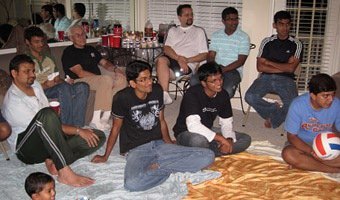
Students from the University of Texas at Dallas gather at a Crosspointe Church home group. The home group meets every Friday night, often until 3 or 4 in the morning, according to Pastor Immanuel Thomas. (PHOTOS/Courtesy of Crosspointe Church)

Thomas wants to befriend members of the rapidly growing Asian-Indian community in the Dallas-Fort Worth Metroplex to introduce them to the life-changing gospel message. Asian-Indians in the Dallas-Fort Worth area doubled in the last decade—from 49,043 in 2000 to 98,950 in 2010—the most recent census revealed.

Thomas regularly invests time, energy, home and heart to connect with his Asian-Indian neighbors and build relationships that will serve as a platform for evangelism.

“It takes time—maybe a year, two years, three years, seven years. It depends on how much time you spend with the person, but it’s basically (about) relationships,” he said.

Thomas is leading efforts to launch Crosspointe Church, sponsored by Hunters Glen Baptist Church in Plano. Texas Baptists provide assistance to new churches like Crosspointe through gifts to the Mary Hill Davis Offering for Texas Missions.

Every Thursday evening, Crosspointe Church sponsors an activity for Indian women. Pastor Immanuel Thomas provided child care while the women participated in scrapbooking. (PHOTOS/Courtesy of Crosspointe Church)

Crossroad Church in Irving provided the outreach model for the new work in Plano. W.J. Subash—founding pastor of Crossroad, who will relocate this summer to India—recalled his observations that spawned the Irving church.

 “There was a major influx of Asian-Indian immigrants, but there was no church that had a strategic outreach to Asian-Indians,” he explained. “… We developed several home groups, and in 2008, a few leaders came together, and we thought we would launch a local church that would reach out to Asian-Indians here.”

Thomas served as an intern at Crossroad and led several home groups, witnessing the cultural challenges firsthand. The Indian way of life with its ingrained social customs, religions and caste system present several barriers that often must be broken before the gospel can readily be accepted, he said.

“They’re very family-oriented. … Even if a person comes to study here, he is very closely connected to the family back in India,” Thomas said.

Every other Saturday, Crosspointe Church sponsors a couples’ night featuring food, fellowship and discussion. Deepthi Thomas (2nd from right), whose husband is Crosspointe’s founding pastor, Immanuel Thomas, joins friends in an Indian board game, Carrom. (PHOTOS/Courtesy of Crosspointe Church)

Consequently, trusting in Christ might result in an Asian-Indian being disowned by his or her family, he added.

“It’s a completely different thing for a Hindu to completely leave his background, leave his family and jump into Christianity. They’ll have to face opposition,” he said.

Since Asians generally consider America a “Christian nation,” the distorted picture of Americans presented in movies and other media may cause Indians to reject the gospel, because they see Americans as “disrespectful” and Christianity as a “white religion.”

“We have to break that idea that they have by showing them a love and affection. That’s the only way. The only way to do it is love. You have to spend money, you have to spend time, (and) you have to spend energy,” he said.

So that’s what he does—every day of the week. Each day includes some form of outreach, from Bible studies to couples’ meetings to scrapbooking nights and birthday parties. He also works extensively with area college students, particularly students of University of Texas at Dallas. He cooks, plays volleyball, gives rides, goes grocery shopping and builds bridges to people in the community.

Students enjoy food and fellowship at a Crosspointe Church home group.

“We invite them to our home, and then we build relationships slowly to share the gospel. We had two Christmas parties where we had about 250 people come, and they all heard the gospel for the very first time,” he said.

When leaders approached Thomas about taking the helm for Crosspointe, he prayed about it and felt God calling him to follow through. In July, he relocated his family to a predominantly Asian-Indian neighborhood, where he and his wife continue to lead local evangelism efforts and reach out to the community.

“One day—God is going to ask me: ‘Immanuel, I let this guy come in contact with you. Did you share the gospel?’ So, I’ve made a commitment that every student I meet every day, or any person I meet every day, I don’t stop without using the word Jesus, or I don’t end the conversation without saying something about God,” he said.  

He added that the best he can do is just “do his part,” loving them with a love he cited from Romans 5:5—“poured into our hearts by the Holy Spirit.”

“Our responsibility, our duty is to share the gospel and do all possible things. If it takes one year to befriend a person, fine. If you take one step, God can always help you take 10 steps,” he said.


2010 Lottie Moon Offering falls short

RICHMOND, Va. (ABP) – Southern Baptists gave $145.6 million to international missions through the 2010 Lottie Moon Offering, $3 million less than the previous year and $8.3 million less than the International Mission Board needs to meet its 2011 operating budget, the IMB news office reported June 8.

Tom Elliff, the recently elected president of the Southern Baptist Convention entity based in Richmond, Va., applauded Southern Baptists for generosity amid doubts about America’s economic recovery and rumors of a double-dip recession.

The total fell well short of national goal of $175 million. Elliff said the “deficit is a matter of concern, but the issue is ultimately spiritual, not fiscal.”

The largest Lottie Moon Offering on record was $150.4 million in 2007, also short of a $175 million goal. Giving dropped to $141.3 million in 2008, and then rebounded to $148.9 million in 2009.

The goal for the 2011 offering is $175 million. The year 2012 marks the 100th anniversary of the death of Lottie Moon, a Virginia-born missionary who dedicated her life to sharing the gospel in China.


–Bob Allen is managing editor of Associated Baptist Press.