Civil religion: lowest common denominator or common ground?

Some Baptists see civil religion as bland at best and idolatrous at worst. But others view broadly shared values of liberty, justice and acknowledgement of God’s providential care as a common ground Christians share with a majority of their fellow citizens.

American civil religion, as defined by sociologist Robert Bellah, includes rituals, symbols and beliefs institutionally separate from organized religion but derived from it. Examples include the ceremonial use of prayer in public settings and generic references to deity in political speech.

Politicians who sprinkle the language of Zion into political rhetoric and preachers who offer blessings for partisan political agendas corrupt genuine religion by dragging God down and lifting national interests up to the level of idolatry, some church-state experts insist.

Legitimate love for country becomes sinful veneration of a nation “when people allow any form of civil religion to replace heartfelt devotion to God,” said church historian Jim Spivey, senior fellow at the B.H. Carroll Theological Institute.

Spivey highlighted five warning signs of idolatrous nationalism:

• “Using empty slogans to play on people’s patriotic emotions.”

• “Parading political candidates before denominational conventions or letting them use the pulpit to promote political party agendas.”

• “Using strained biblical interpretations to justify wrongful political and social actions.”

• “Using the Bible to guarantee people economic prosperity and then identifying that prosperity with the American way of life.”

• “Ignoring biblical mandates for social activism when they inconveniently threaten the traditional American way of life.”

Baptizing partisan politics or nationalistic rhetoric with the language of civil religion essentially places God in a role subservient to national interests, said James Dunn, resident professor of Christianity and public policy at the Wake Forest University School of Divinity.

“It is making God the national mascot. It is pulling God down from God-ness to a subhuman level,” he said.

A lowest-common-denominator civil religion that invokes the name of God for blessing without regard to the content of faith rings hollow, Dunn insists.

“Ceremonial religion is gutless, sterile, empty and meaningless,” he said.

But Rob James, retired professor of religion at the University of Richmond, expressed his preference for the term “American public religion” over “civil religion,” and he sees it as common ground rather than lowest common denominator.

“There are values we share with the majority of our countrymen who may or may not be Christian,” he said.

“I think we sometimes have beat up people for embracing public religion as intrinsically idolatrous and as something the government does to manipulate them to support some of its policies.”

Baptists rightly have emphasized the importance of the institutional separation of church and state as a guarantee of religious liberty, James said.

However, he asserted, moderate Baptists—in particular—sometimes have driven socially conservative Christians into the arms of the Religious Right by failing to acknowledge the proper place of patriotism.

“We overdo it sometimes,” James said. “We make people feel like it’s an either/or proposition—that they can’t be both a committed Christian and a patriotic American. That’s a sad mistake. …

“By no means should we back away from the separation of church and state, but we need to correct some mistakes in how it is understood. Perhaps we should modulate our language so that that it doesn’t exclude legitimate Christian patriotism, rightly interpreted. I think it’s good to do, and it’s stupid not to do it.”


Baptists should understand, teach church-state separation

Because of their historic commitment to religious liberty and separation of church and state, Baptists have a responsibility to educate their fellow citizens what those concepts mean, church historian Jim Spivey said.

“Separation of church from state does not mean separation of religion from politics. Religious convictions can rarely be separated from social issues or political processes. Otherwise, they are just religious ideals without any action,” said Spivey, senior fellow at the B.H. Carroll Theological Institute.

Darren Valdez of Staten Island, N.Y., prays at evangelist Billy Graham's 2005 crusade in New York. (RNS FILE PHOTO/Michael Falco)

“Individual Christians must remain politically and socially engaged. Pastors must teach and preach prophetically, speaking to those social and political issues that the Bible clearly calls them to address. Churches should be involved in their communities to the degree that they become salt and light concerning social and political issues that affect those communities.”

Spivey noted the role Baptists played in securing the rights of religious liberty protected in the First Amendment as a positive example of how Christians can shape public policy for the common good.

“But the church as an organization must remain separate from the state as an organization,” he urged. “There must be an absolute separation of the two institutions, and the church must never receive funding from the government.

“Churches must maintain this separation for many reasons, but foremost among them is the need to preserve their ability to speak and act prophetically without compromise induced by financial or other gain.”

As a current example, Spivey found fault both with churches that accept government money for faith-based initiatives and with critics who claim churches’ engagement in faith-based social services violates the principle of church/state separation.

“The church has always been involved in faith-based initiatives such as feeding, housing and caring for the poor and homeless. We must not avoid these obligations because we say they are the responsibilities of government. The Bible makes it clear that churches share in this responsibility,” he said.

“On the other hand, it is equally wrong for churches to beg the state to pay them for doing what God provides them the resources to do. It is a fitting expression of Christian citizenship for churches to engage in faith-based initiatives, but it is inappropriate for them to accept state funds to do so.”


On the Move

Mike Cooper to First Church in Smithville as youth minister.

Natalie Foreman to Flatonia Church in Flatonia as summer youth and children’s minister.

Keith Guthrie has resigned as minister of youth at First Church in Mexia.

Cary Hilliard to First Church in Longview as pastor from First Church in Orangeburg, S.C.

Larry Odem to Choate Church in Kenedy as pastor.

Gordon Moore to Galloway Avenue Church in Mesquite as pastor from Immanuel Church in San Angelo, where he was associate pastor.

Jeff Parker to First Church in La Vernia as worship pastor and minister to families.

Jason Shuttlesworth to Wooster Church in Baytown as pastor from Avondale Church in Sweetwater.

Bryan Waterbury has resigned as youth and music pastor at Oak Hills Community Church in Floresville.


Around the State

Howard Payne University  will host young and summer scholars programs July 18-22 from 9 a.m. to noon on the HPU Academy of Freedom campus. Summer scholars is a program for children entering grades 4-6, with instruction in computer graphics, reading, science and physical education. Young scholars is for children entering grades 1-3 and features instruction in reading, music, science and physical education. Registra-tion is $100 and includes a book bag, snacks and supplies. Dead-line for registration is July 13. For more information, call (325) 649-8508.

Dallas Baptist University has launched a master of arts in communications degree plan. The 36-credit hour program will feature a curriculum of advanced studies in communication theory, social media, organizational communication management, media presentation and production.  

Scott Bryant has been named university chaplain and vice president for spiritual development at East Texas Baptist University. He had been a faculty member in Baylor University’s religion department and an adjunct professor at Truett Theological Seminary.

Lawson Hager has retired as dean of the School of Music at Hardin-Simmons University after 38 years on the faculty and director of bands. He became dean in 2002.

Anniversaries

Jimmy Smith, 10th, as director of missions of Frio River Association, Aug. 4.

Elm Grove Church in Belton, 100th, Aug. 7. Guest musicians, recounts of historical events in the church and re-enactments of those events throughout July will lead up to the centennial celebration. A marker from the Texas Historical Commission will be dedicated in the August service. Tom Henderson, director of missions for Bell Association, will preach, and several former pastors and staff members will recall memories of their service at the church. A meal will follow the morning service. Memorabilia, photographs and new items are being collected in preparation for the day. For more information, call (254) 947-0710. Dale Gore is pastor.

Deaths

Gerald Hendon, 70, May 19 in Houston. A Howard Payne University graduate, he was licensed to preach in 1959. He was pastor of Southern Baptist churches 46 years. A bivocational pastor, he was a financial planner and insurance consultant 39 years. He is survived by his wife, Sandra; son, Austin; daughter, Autumn Hendon; brother, Steve; and sister, Deana Fink.

James Densman, 62, June 18 in Houston. He was pastor of First Church in Davis, Okla. A graduate of Baylor University and Southwestern Seminary, he began his ministry at McClana-han Church in Marlin. He served as pastor of churches in  Purdon, Gatesville, Smithville, Groesbeck, Haskell and Navasota. He also served First Church in Hollis, Okla. He is survived by his wife, Elaine; daughters, Sarah Beth and Mary; son, Joshua; brother, Danny; and one granddaughter.

Tommy Teague, 58, June 23 in Israel. Teague, pastor of North Richland Hills Church in North Richland Hills, died while leading a group of 30 church members on a tour. He had served the church since 1998. He is survived by his wife, Rita; son, Jonathan; daughters, Julie and Joy Teague; sister, Dot; and three granddaughters.


Teen volunteers change the world, one neighborhood at a time

DALLAS—While many teenagers typically spend free time in the summer swimming at the beach or watching TV, 230 students from five states arrived in Dallas recently to paint siding, build ramps and work on roofs in 100-degree heat. And each student paid an average of $250 for the privilege.

Christian Leonard, 14, takes care to seal crevices with caulk along brick of a home in Dallas. (PHOTOS/Grace Gaddy)

Ask one of them why, and they will quickly share the reason—to show the love of Christ.

World Changers, a ministry of the Southern Baptist Convention North American Mission Board, each summer provides students across America an opportunity to demonstrate the love of God through volunteer labor repairing houses for low-income families.

Shawn Edwards, the project coordinator for Dallas and Waco, said the weeklong event shifts students’ focus and gives them a life-changing experience.

“At World Changers, it’s totally different than like at a lot of summer camps … where a lot of it is all about you,” Edwards said. “At World Changers, it’s all about you giving to somebody else. It’s all about others.”

Edwards cited Jesus’ words—“the greatest among you will be your servant”—to define their mission.

Josh Kicker, 14, uses a caulk gun for sealing as he works on a World Changers project in Dallas. (PHOTOS/Grace Gaddy)

Students from 11 churches participated in the project, with many students carpooling and traveling from out of state with youth groups. Upon arrival, students trained for positions and divided into 18 crews ranging from 10 to 16 members.

“Primarily, junior high students do painting and light repairs to homes, and the senior high students do more complicated things like roofing, vinyl siding, building wheelchair ramps—things like that,” Edwards said.

World Changers partnered with People Helping People, a Dallas program that assists elderly and disabled homeowners with exterior home repairs. Students labored on site from 7 a.m. to 4 p.m. each day, with nights reserved for worship, prayer and reflection, Edwards said.

Shelley Nixon, volunteer coordinator for People Helping People, said World Changers always makes a tremendous contribution to the city, the value of their work totaling into thousands of dollars.

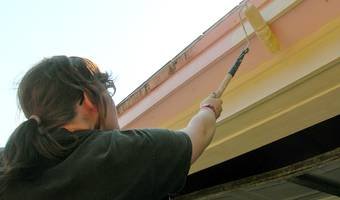
Taylor Bland, 14, paints facia board above the garage of a home in Dallas during a World Changers project. (PHOTOS/Grace Gaddy)

 “The only thing we do is provide the materials, and they provide the manpower. So, it actually helps in costs (for) the homeowners, because they’re getting all of this, of course, free of charge—they’re not charged a penny for this work to be done on their homes,” Nixon said.

Ruby Brisby, a Dallas homeowner, expressed heartfelt gratitude for the students’ willingness to serve.

“I wish the best for those kids. I really do,” she said. “They did something they did not have to do. … And they stayed here until they finished. They weren’t running around—they were working.”

Brisby bought water and Gatorade to give to students while they worked. She also enjoyed fellowshipping with each one, she said.

“It’s very seldom you run across kids that sweet this day and time,” she noted. “When they got ready to go, they all came out and hugged me and made an 81-year-old woman feel nice. … They prayed with me, and anytime they got ready to eat their lunch, (they would say) ‘Come on, Miss Ruby, come on and eat lunch with us.”

Brian Pierce, who serves as World Changers worksite supervisor and the project coordinator in Corpus Christi, brought a youth group to Dallas to serve in low-income neighborhoods. (PHOTOS/Grace Gaddy)

Brisby called their work “a blessing,” adding that her house now looks “bright and clean.” In addition to the newly renovated home, the students also gave her “a brand new Bible” with a signed group picture of the crew enclosed, she said.

“I wouldn’t get rid of that picture for nothing in the world,” she said, adding she plans to frame it and hang it on the wall. “I’m saving it for myself.”

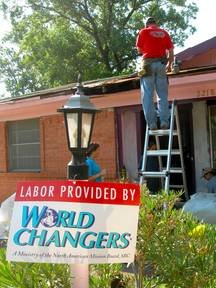
Challenged each day to “live out their faith,” students sought to paint a picture of Christ’s love while painting and repairing homes. Greeting onlookers, a street view of the project yielded a bus, lumber, tools, paint cans and a sign crediting World Changers for the free labor—and of course, a crew of happy paint-splattered teenagers hammering, sawing and working.

“You kind of stand out, and the people in the neighborhood come by and say, ‘What are you guys doing here?’ And you’re able to tell them what your doing there, and it gives you an opportunity to witness,” Edwards said.

He recalled one woman, Tina, who rode by the worksite on a bicycle every day until someone invited her to share lunch. As friendships developed, a female volunteer led Tina to the Lord. When he asked her at the end of the week what had happened, she testified of Jesus and of “being clean” for the first time in her life.

Edwards also recounted a group of elementary-aged children who indicated commitments to follow Christ. All of this took place at just one of the 18 work sites, he said.

Edwards added this happens all the time.

“This is like no other event,” he said. “The fact that you’re working hands-on to earn a hearing, and you’re able to affect an entire neighborhood, and people know why you’re there—I think that’s why students love it.”


CBF pastor says tell stories of why moderates left, not who they left

TAMPA, Fla. (ABP) – A Truett Seminary graduate said the 20-year-old Cooperative Baptist Fellowship must recast its message for a rising generation.

In order to interpret the movement’s history for younger Fellowship Baptists, Kyle Reese, pastor of Hendricks Avenue Baptist Church in Jacksonville, Fla., urged the first generation to “commit together to tell more stories regarding why we left than who we left.”

Kyle Resse preaches closing message at CBF General Assembly.

“The time is right for us to share the story of the brokenness and pain of our former life, and yet there was a clear gospel call that called us to leave the comfort, to take a risk and to celebrate the friends that we have made along the way,” Reese said during the closing session of the 20th CBF General Assembly June 21-25 in Tampa, Fla.

“Ministry to the least of these has been at the heart of this Fellowship,” said Reese, former pastor of First Baptist Church in San Angelo.

Reese was one of several speakers who compared the Fellowship’s current stage of life to a teenager moving into young adulthood.

“Compared to our teenage years, 20-somethings seem to offer stability for the first time in our lives,” Reese said. He said moving into maturity “creates a tension” for Fellowship Baptists who “on the one hand have been at our best when we have been willing to take the risk for the gospel, who on the other hand are going into those years of stability.”

“If we are willing to take risks, I think our history tells us that we are going to attract new generations of women and men who are drawn to our way of being Christian in the world,” Reese said.

Reese said one challenge facing the Fellowship in the years ahead is how to remain on the cutting edge of risk taking.

“One way, I think, is to remember that we are a fellowship not only of individual Christians but a fellowship of local churches,” he said. “Local churches are doing amazing thinks, taking risks, seeking to live and proclaim the message of the Risen Christ. In our life together we must remember the local church, and we must be a resource for them. We must be a friend to them. We must walk alongside them, and we must tell their story.”

Registration reached 1,664 as the General Assembly approved a budget and elected a new slate of officers. The two-day total given to the CBF Offering for Global Missions was $29,134.
 
During the Friday morning business session, the Assembly approved a $12.3 million budget for fiscal year 2011-2012, which begins Oct. 1. The Fellowship’s new officers were elected during the session. They include moderator-elect Keith Herron, pastor of Holmeswood Baptist Church in Kansas City, Mo., and Renee Bennett, counselor at Classic Equestrian Assisted Family Service in Dublin, Ga.

Moderator-elect and Colleen Burroughs, vice president of Passport Inc. in Birmingham, Ala., ascended to the moderator position at the conclusion of the Assembly. This year’s moderator, Christy McMillin-Goodwin, remains on the leadership team another year as past moderator.
 
In the budget discussion, Randy Parks, a hospital chaplain and member of Metro Baptist Church in New York City, expressed concern on behalf of more than 600 CBF-endorsed chaplains and pastoral counselors for the reduction of a full-time staff position in the budget relating to endorsees to a part-time contract position. Finance chair Bill McConnell said he would bring the concern to the CBF Advisory Council so that it could be discussed and acted on at the October Coordinating Council meeting.


Bob Allen is managing editor of Associated Baptist Press. Some information in this story is from CBF communications staff. 


Dunn uplifts ‘soul freedom’ at BJC luncheon

TAMPA, Fla. (ABP) – Accepting this year’s J.M. Dawson Religious Liberty Award from the Baptist Joint Committee for Religious Liberty June 24, former BJC leader James Dunn identified “soul freedom” as the driving force behind the church-state watchdog organization now in its 75th year.

Dunn wrote his doctoral dissertation on Dawson, the first executive director of the BJC, an education and advocacy organization composed of 15 national, state and regional Baptist bodies in the United States.

James Dunn

Dunn went on to become a successor to Dawson, serving as executive director of the BJC from 1980 until his retirement in 1999. He now works as president of the Baptist Joint Committee Endowment and professor of Christianity and public policy at Wake Forest Divinity School.

Dunn accepted the award at a luncheon held in conjunction with the Cooperative Baptist Fellowship General Assembly in Tampa, Fla. Dunn described Dawson’s legacy to members of the Religious Liberty Council.

Dunn said it was not a “rugged individualist, cowboy Christianity” criticized by some academicians that moved Dawson, but instead the “biblical priesthood of the believer.” It is the same notion, he said, described by Roger Williams as “freedom of conscience” and by E.Y. Mullins as “the competence of the individual before God.”

Dunn described Dawson’s “incarnational” theology — that “God was in Christ reconciling the world unto himself” — as “utterly unlike the Southern Baptist creed … that even omitted Jesus Christ as the criterion of Baptist beliefs.”

“They took that out of an earlier Baptist Faith and Message,” Dunn said of the confession of faith that the Southern Baptist Convention revised in 2000.

Dunn said Dawson applied soul freedom “to the challenge of creedalism.”

“I almost deleted part of this speech, because it is pretty strong,” Dunn said. He then quoted a line written by Dawson that, “No creed may transcend the interpretation of God’s word by the unfettered conscience of the individual.”

He said Dawson also embraced an “experiential religion” that is not “captured or capturable in creeds.” He quoted from Walter Rauschenbusch’s classic defense Why I Am a Baptist that “Baptists tolerate no creed.”

“It condemns a grownup still to think and talk like a child,” Rauschenbusch wrote. “A creed tells you what you must believe. Baptists have not bound the religious intellect.”

“Or as Bill Moyers puts it,” Dunn said, “ours is a grown-up religion.”

“Soul freedom allows authentic community to happen,” he  said. “It does not prevent community. It allows authentic community to happen.

Dunn said koinonia, a word from the Greek New Testament translated as fellowship and referring to the church, “is predicated upon soul freedom.”

Dunn said Dawson also preached a personal faith that “responds directly to God without formula or filter.” He quoted George W. Truett, Dawson’s contemporary and friend.

“The right of private judgment is the crown jewel of humanity,’ Truett opined, “and for any person or institution to come between the soul and God is a blasphemous impertinence and a defamation of the Crown Rights of the Son of God.”

Brent Walker, the current BJC executive director elected to succeed Dunn in 1999, made the presentation of what he describes as the organization’s “flagship award.”

Named for Dawson, who headed the BJC between 1946 and 1953, it recognizes the contributions of individuals in the areas of the free exercise of religion and church-state separation.

The Dawson Award was established on the BJC’s 50th anniversary in 1986 and has been presented 11 times since. Previous winners include broadcaster Bill Moyers and former President Jimmy Carter. Dunn is the 16th recipient.
 
The Religious Liberty Council, formed after the Southern Baptist Convention defunded the Baptist Joint Committee in 1989, is only BJC member body open to individuals, said Mark Wiggs of Jackson, Miss., the council’s co-chair. He said 13 of the 45 members of the BJC board are from the Religious Liberty Council.


CBF commissions self-funded missionaries

TAMPA, Fla. (ABP) — The Cooperative Baptist Fellowship commissioned 14 self-funded individuals to missions work June 23 at the General Assembly in Tampa, Fla. More than 1,600 Fellowship Baptists were in attendance on the first full day of the Assembly, which included auxiliary events, business sessions and the commissioning service.

CBF commissioning service. (CBF photo)

The Atlanta-based Fellowship has been unable in recent years to appoint fully funded global missions personnel due to lack of funding. Next year’s budget cuts funding for global missions and ministries by $1.3 million without recalling any missionaries already on the field. Some savings were accomplished by changing policies to allow spouses of fully funded field workers to raise their own support.

Rob Nash, CBF global missions coordinator, said the newest crop of missionaries is indicative of changes occurring in missions strategy.

“They’re not up here because CBF has a bunch of money to fully fund what they are doing,” Nash said. “They’re up here because they have a passion, a burning, a desire to make a difference in the world.”

SonShine Singers

The SonShine Singers, a senior adult choir from Trinity Baptist Church in San Antonio, perform at the CBF general assembly in Tampa, Fla. (CBF PHOTO)

While they do not draw a salary from CBF, self-funded field workers receive things like computers, network support and sometimes health insurance through a Global Missions Offering collected separately from the bulk of the CBF budget. CBF leaders have recently toured the country to meet with church leaders urging them to “keep the promise” to fully funded missionaries already sent by leading their churches to match or exceed totals for last year in the current mission offering.

Nash noted that next year marks the 200th anniversary of Ann and Adoniram Judson’s setting sail for India as the first American and Baptist missionaries. With Luther Rice, they helped inspire interest in foreign missions that prompted Baptists in the United States to form the first national convention for missionary support.

Nash said mission-sending organizations struggled in the 19th century, but during the 20th century got it down to a science. In the 21st century, he said, the scene is changing again, as more and more people want to become personally engaged in mission service without making it a full-time career.

“These field personnel tonight are being called out of networks focused on particular ministry in particular parts of the world as much as they are being called by CBF,” Nash said at the commissioning service. “Or they are creating those networks in order to do this thing to which God has called them.”

“It truly is something to celebrate — this passion, this energy that drives them and the rest of us together and then sends us into the world,” Nash said. “I’m convinced that we are seeing here a picture of the global mission future.”


Vietnamese-Americans voice gospel to villagers on Cambodian Lake

KBAL TAOL, Cambodia—For a moment, Josh Nguyen thought he was back in Vietnam. Rubbing the wooden floor of a floating home in this remote village on Cambodia’s Tonle Sap Lake, the 44-year-old physician from Houston remembered the country he left as a refugee in 1975.

Albert Barajas, 36, a dentist from Dallas, trains an 11-year-old to sterilize equipment during a dental clinic in a floating village on Cambodia's Tonle Sap Lake. (IMB PHOTOS)

Nguyen joined a team of nine other medical and dental volunteers working with the Vietnamese living in floating villages on Cambodia’s Tonle Sap Lake, the largest freshwater lake in Southeast Asia. He and three nurses divided into two groups and visited from boat to boat, assessing medical needs and sharing the Gospel. Nguyen, who speaks Vietnamese, also translated for the nurse who assisted him.

The trip was revealing to Nguyen, who saw himself not only in the floorboards but also in the faces and experiences of those he met on the lake.

“I thought we were back,” Nguyen, a member of Second Baptist Church in Houston . “I thought we were boat people again.”

While the trip spawned memories for the doctor, it was a wake-up call for Gina Nguyen, 30, a pharmacist from Plano, who is no relation to Josh Nguyen. She left Vietnam in 1991 under less difficult circumstances. Although she returned to Southeast Asia two years ago on a trip with her father, this was her first volunteer trip.

The member of Plano Vietnamese Baptist Church admitted she reluctantly signed up for the trip, which included medical and dental personnel from seven Baptist churches, four states and four different ethnic groups. She struggled initially with how best to contribute to the team.

“I can’t diagnose. I’m not trained. I didn’t think I knew the Bible well enough. I’ve never been a translator,” she said. “Until this trip, I thought my apartment in Texas was the center of the universe.”

Once on the lake, she also experienced the full force of the difficulty villagers experience everyday. There was no air conditioning or electric fans. The toilet and shower facilities were rudimentary and sleeping arrangements were uncomfortable, cramped and hot. Python was the main course for dinner. The nearby karaoke bar ran until all hours of the night. Her culture shock was obvious.

“We look at these people and ask, ‘Why would they swim in this water? Why would they eat and drink in this water?” she said.

When she shared these complaints with Josh Nguyen, he said simply, “Gina, this could have been us.”

Kristy Harless, Gina Nguyen and Lynne Leung visit boat-to-boat to assess medical needs in the floating village of Kbal Taol on Cambodia's Tonle Sap Lake. (IMB PHOTOS)

Once the team began its work, however, Gina Nguyen, who speaks Vietnamese, realized she could serve not only as translator for the two nurses on her team, but she could also share the gospel with villagers in their heart language.

“I was afraid,” she said. “What do I do? What do I say? But I knew God was speaking through me. So I kept praying inside, ‘God, just tell me what to say.’”

By visiting in their homes and sharing the gospel, she came to understand that the physical challenges facing the villagers are nothing compared to the spiritual ones.

“They’re lost,” Gina said. “They worship different kinds of gods. They don’t know anything else.”

She also realized God was giving her a chance to “give back”—using the material blessings she gained in America to share the spiritual blessings of her faith in Christ with the people on the lake.

“God chose us,” she said, referring to the salvation she and other Vietnamese-Americans found in Jesus Christ while living in America. “He brought us to America and gave us the opportunity to live in nice conditions. This is our chance to spread the Gospel to the Vietnamese.”

In fact, she hopes to come back to the lake, noting: “I know that the weather and the living conditions have been tough on me, but I see what we’re doing here. I know it goes beyond medical needs.”

In spite of the difficulties, she encourages other Vietnamese-Americans to come as well because of their ethnic credibility with villagers and the Vietnamese language skills they provide to volunteer teams.

“We (Vietnamese-Americans) have a great opportunity to reach the Vietnamese in Cambodia,” she said. “We can speak the language. We can approach them better than non-Vietnamese speakers. … You don’t have to be a doctor or a nurse. You can be the voice.”


Londoners find Christ when US Worldchangers share

LONDON—Hudson Smith wishes he hadn’t worn his nicest pair of jeans that day. But he’s not too bothered by the paint splatters here and there.

“I was up for whatever was needed,” he said.

Smith didn’t know he’d be painting a fence that day in a poverty-stricken neighborhood of London’s Kingston area.—just like he didn’t know he’d end up sitting next to Tadeusz on the bus ride home.

Hudson Smith (right), a student at Louisiana Tech University, talks with an international student in London during a coffeehouse outreach put on as part of the International World Changers' work in the city.

“I struck up a conversation with him about God, and he said he had been praying to the universe to show him the truth,” said Smith, a student at Louisiana Tech University. “I told him I thought that I was the first answer to his prayer, because I could show him the truth.”

For more than an hour, with his Bible open on his paint-stained jeans, Smith shared the gospel with Tadeusz, a Polish immigrant to England. Tadeusz was so engaged in the conversation he purposefully missed his bus stop just so he could keep talking with Smith.

“I gave him my e-mail address and asked if we could keep the conversation going. It reminded me of why I’m here—no matter what it feels like, God is always moving around us, working in people’s lives,” Smith said.

Smith was one of 70 students who traveled to London early this summer as part of International World Changers , an overseas student missions experience sponsored by the International Mission Board. Some were from his church—Calvary Baptist Church in Rustin, La.—and others were from churches in Virginia, South Carolina and Florida.

All of them spread out to spread the gospel in London.

“On the surface, the city is dark, but God is stirring hearts,” said Donielle Yancey, a college leader with Shandon Baptist Church in Columbia, S.C. “People are open to having conversations. We feel like a lot of our conversations were tilling the hard ground to get the rock out so that the gospel can be planted in it.”

Yancey’s team spent time on college campuses striking up conversations with students about their spiritual state.

“It was definitely challenging, but they were more open than I thought they’d be—and very honest,” said Jessi Tomlinson, a student at the University of South Carolina and a member of Shandon Baptist. “It definitely challenged me to know the word (of God) better and know answers to questions that people of other faiths have.”

With less than 2 percent of university students claiming faith in Christ in London, the student body there is considered to be an unreached people group, said Susan Goodman, an IMB missionary who does student ministry in London with her husband, Michael, former Baptist Student Ministries director at Dallas Baptist University.

“Go to any campus, and you’ll quickly see Muslims, Buddhists, Sikhs, Hindu — you can share with any faith you’d like to there,” Susan Goodman said.

In addition to campus ministry, the IWC group held barbecues in impoverished neighborhoods, helped out with homeless ministry and did sports camps for kids. They also performed street drama and handed out water and bacon rolls to partiers over the weekend.

“The conversations were amazing during the course of the evening,” said Michael Goodman, who also served previously as Baptist Student Ministries director at East Texas Baptist University and Texas A&M University at Corpus Christi.

“We shared the gospel about 250 times during that outreach. Some of these students that we met that night then came to our outreach events during the week.”

These connections will be followed up with too, Goodman said. He and his wife host a weekly Bible study for students who are seeking to understand more about God.

“The volunteer team this week really gave our work a boost,” Susan Goodman said.

Jay Mudd, student pastor at First Baptist Church in Leesburg, Fla., said the harvest came in unexpected ways sometimes.

“Two boys about 12 years old were sitting in a tree watching us build a porch, and they asked why we were there,” Mudd said. “I told them I didn’t come to build a porch, and if they’d come back to talk to me about it later, I’d buy them a drink.”

They came, and brought eight more youth with them.

“The others weren’t interested in hearing what I had to say, but these two—Luca and Dan—didn’t break their gaze when I was telling them about what it means to be a friend of God,” Mudd said. “I asked them what kept them from being a friend of God, and they begin pouring out all their sins—graffiti and a whole host of other things I could’ve done without hearing.”

He shared with them the heart of the gospel, and Luca looked him dead in the face. “I want that relationship,” he told Mudd.

Mudd was able to connect them with a local pastor who is following up with discipling them now.

“It was a good day, and a great week,” he said. “God did amazing things.”


International World Changers offers student teams and individuals the opportunity for a hands-on missions experience. For more information, visit http://www.thetask.org/iwc .


Bible Drill competitor overcomes obstacles

AUSTIN—As the last person to compete at the Austin Bible Drill regional competition, Regan Brown was ready, just like she had practiced so many times, with her sister on one side, a close friend on the other and a wide selection of Bible knowledge in her heart.

But 30-plus people didn’t gather to watch someone practice Bible Drill. They came to watch someone overcome hurdles, as Regan heard the first call and began frantically flipping through the pages of her Bible.

n spite of limitations due to cerebral palsy, Regan Brown (center) competed in Bible Drill competition, with the support of Terri McGee (left), Bible Drill leader at First Baptist Church in Hallettsville, and her mother, Christine Brown. (PHOTO/John Hall/Texas Baptist Communications)

Several things set Regan apart from others in the competition. Those who know her well reference her smile that lights up a room, her ability to encourage others and her unwavering determination to do what she wants to do—the same determination that made her one of the first physically handicapped participants in regional Bible Drill competition.   

Regan, who has Grade 2 cerebral palsy, began participating in Bible Drill last fall after seeing it in the worship bulletin at First Baptist Church in Hallettsville. Taking the challenge fully, she practiced with her mother, Christine, sister, Rebecca, Bible Drill leader Terri McGee and McGee’s son, Trevor. She practiced in her room, in the car and during weekly practice times. The practice time even rubbed off on her mother.

“I learned so much at Bible Drill coming every week with them to practice and sitting through practice and helping Mrs. McGee when she needed it,” Christine Brown said. “I absolutely cherish everything I learned from it as much or more than the girls do. I just think you should know what the Bible has to say. You should know your Scripture.”

Regan quickly took to memorizing Scripture. She and her sister learned a song to help them remember the books of the Bible.

While memorizing came easily, finding a selected Scripture passage in the eight-second time limit proved challenging. Dickie Dunn, discipleship specialist with the Baptist General Convention of Texas, granted Terri McGee permission to expand the allotted time to 30 seconds for Regan. Typically, she was able to find the passage in 20 seconds, and sometimes she did it in less than the standard eight seconds.

“I knew where it was, but I needed more time to find it,” she explained.

As Regan practiced drilling, her mother and her Bible Drill leader discussed the passages with her. They delved into what each section meant and how it fit into the Bible.

One night, as they focused on Matthew 7:21, Regan started asking questions. One question led to another, which led to another. Her mother and her Bible drill leader answered Regan’s questions—particularly about salvation—by going to various Bible verses for more than two hours.

“Later that night, it just happened,” she said, recalling her conversion experience. “Ever since then, I’ve been praying a lot, reading my Bible almost every single day.”

Regan dreams of becoming a special education teacher so she can give hope to young people with disabilities.

“Regan is our shining star,” Terri McGee said. “When Regan comes into a room, she lights it up. She has a smile that is infectious and a heart that is hungry and this incredible passion to accomplish everything.”

She’s already achieved one major goal by competing in Bible Drill. After stumbling a bit initially in the regional competition, Regan found her stride. She earned a “superior” rating—and a standing ovation from those who watched her drill.

“In all my 30 plus years of being involved with Bible Drill, I have never seen anyone—with special needs or not—as excited about Bible Drill as Regan,” Dunn said. “This experience has made a great difference in her life and in the lives of those who have had the privilege of knowing her.”

The practice and competition were fun, Regan said. They brought her closer to God by bringing her into God’s word and calling her to a relationship with him, she added.

“It doesn’t matter if you’re disabled or not,” Regan said. “God made you just the way you are. You should do Bible Drill just because you want to, not because of the competitions or because you get awards at the end. You should do it just because God would want you to.”


Reduced financial contributions still a problem, CBF council told

TAMPA, Fla. — Sagging financial contributions remain a challenge for the Cooperative Baptist Fellowship, members of the group’s Coordinating Council were told June 22.

Current receipts are running at about 82 percent of the $14.5 million budget for 2010-2011, said Bill McConnell, a Knoxville, Tenn., businessman who chairs the council’s finance committee.

“We have to do something to raise revenue,” McConnell, a member of Knoxville’s Central Baptist Church in Bearden, told council members meeting the day before the CBF’s annual general assembly kicks off. “We’re still flat. We’re still where we were last year.”

CBF moderator Christy McMillin-Goodwin (center), who presided at the group's Coordinating Council meeting, chats with moderator-elect Colleen Burroughs of Birmingham, Ala., and Keith Herron of Kansas City, Mo., who is to be nominated as moderator-elect.

The 66-member council will recommend to the general assembly this week a reduced operating budget of $12.3 million for 2011-2012, a $2.2 million drop from this year’s budget goal. But if projected trends continue, even that lower figure won’t be met, said McConnell.

Year-to-date receipts are “exactly on track to end up where we were last year,” he said, at around $11.9 million.

“The finance committee agreed on $12.3 million [as a 2011-2012 budget goal] but even that isn’t where we are going to be.”

McConnell said CBF staff is functioning on about 89 percent of its budget to compensate for reduced revenue.

Contributions to the CBF’s Global Missions Offering also are running behind, but CBF executive coordinator Daniel Vestal said an enhanced initiative to increase offering gifts has been “heartening.” The offering’s goal this year, which ends Sept. 30, is $5.5 million. So far about $3.4 million has been collected.

Vestal said he and Ben McDade, coordinator of Fellowship advancement, have had conference calls and meetings with more than 100 pastors and about 155 individual donors as part of a “Keeping the Promises” campaign to close the offering shortfall.

“Frankly, it’s been heartening,” said Vestal. “The pastors have heard our appeals.”

He encouraged the council to consider ways the offering can be adapted to increase support for it.

“People are engaged in missions, involved in missions, giving to CBF, but they are involved in a more designated way,” added Vestal. “The way we’re doing the offering now is not generating the passion we need. There are still a lot of people who want to contribute to an offering but not enough. We need to make some changes.”

Possible changes, he said, could include moving the primary promotion of the offering from Christmas and Easter to Pentecost, or naming the offering as a way of “personalizing” it.

Council members also heard an update on the 2012 Task Force, a panel  created a year ago to study the CBF’s future.

Task force chair David Hull said the group has held about 100 listening sessions at state and regional CBF meetings, with a variety of ministry partners and age groups, especially pastors in their 20s and 30s.

“We are listening to the Fellowship community and before we ever make recommendations about the future, we must listen to the hopes and dreams and thoughts and ideas of what is going on now and what has gone on in the past 20 years,” said Hull, pastor of First Baptist Church in Huntsville, Ala.

Hull said the task force’s listening sessions will end in mid-August, when the group will begin to wrestle with its proposals, which will be presented at the council’s February meeting and eventually the 2012 general assembly.

Council members also were briefed on next year’s conference on sexuality and covenant, a collaboration between the CBF and Mercer University to be held April 19-21 at First Baptist Church in Decatur, Ga.

The conference aims to broaden the conversation on church responses to homosexuality which was begun at a breakout session during last year’s general assembly in Charlotte, N.C.

Rick Bennett, director of missional congregations for the CBF, told the council he hopes to have plenary speakers committed by mid-August and small group facilitators lined up by Jan. 1.

“This conference is not designed to come to any conclusion,” Bennett emphasized. “It will resource the conversation.”