Religious freedom envoy condemns religious intolerance

GENEVA (RNS)—The Obama administration's new envoy for international religious freedom told a U.N. commission that government, political, religious and business leaders must stand ready to condemn hateful ideology.

Borrowing from recent headlines, Ambassador-at-Large Suzan Johnson Cook cited a Florida pastor who had been so "publicly reviled and rebuked" for threatening to burn a Quran that he has virtually no followers left.

The appearance before the U.N. High Commissioner for Human Rights was the first for Cook, a New York pastor who was recently sworn in after a long nomination battle during which critics questioned her credentials.

"Leaders who remain silent are contributing to the problem and hould be held politically accountable," Cook said at a forum on "Combating Intolerance and Discrimination Based on Religion or Belief."

Holding up the United States as an example, Cook said the U.S. Justice Department sought to fight and prevent "backlash" crimes and threats against people who were, or were perceived to be, Arab, Muslim, Sikh or South Asian after the 9/11 terrorist attacks.

More than 700 bias-motivated incidents were investigated after 9/11, Cook said, resulting in 34 federal convictions and more than 160 local criminal prosecutions.

"President Obama has made clear that it is in the interest of ecurity and stability worldwide to ensure fundamental freedoms for people of all backgrounds and all faiths to understand that religious freedom is a universal human right," she said.

While noting the value of legal safeguards such as the U.N.'s Universal Declaration on Human Rights, she said creating a climate to avert violence and discrimination is better than trying to prosecute it "after the fact."

Cook credited former President George W. Bush for visiting a mosque just days after 9/11 in a bid to promote tolerance and to "counter efforts to blame all adherents of Islam for the actions of a violent extremist group."

She also noted near universal condemnation of Terry Jones, "an extremist pastor in Florida" who threatened to burn a Quran on the 9/11 anniversary, which set off deadly protests in Afghanistan and the wider Islamic world.

"His behavior is publicly reviled and rebuked by virtually the entire society," Cook said. "The result has been that you can count on your fingers the number of supporters Pastor Terry Jones has in our country."


Is marriage a ‘dying’ institution?

Marriage is a “dying institution,” actress Cameron Diaz claimed recently. And the movie star’s assertion hit a nerve.

“I think we have to make our own rules,” Diaz said in the June issue of Maxim magazine. “I don’t think we should live our lives in relationships based off of old traditions that don’t suit our world any longer.”

She isn’t alone. Fox News expert Keith Ablow roiled conservative viewers by not only applauding Diaz but adding that in his clinical judgment, “marriage is—as it has been for decades now—a source of real suffering for the vast majority of married people.”

Diaz, 38, who famously has dated celebrities Justin Timberlake, Matt Dillon and most recently New York Yankees slugger Alex Rodriguez, recently shared with Elle Magazine: “I think a lot of people are married to people that they’re not romantic with anymore. I just didn’t ever marry anybody that I then had to get divorced from. We break up. We move on.”

A conference in April by the conservative think tank Ethics and Public Policy Center examined “a retreat from marriage” over the last 50 years.

Bradford Wilcox of the National Marriage Project at the University of Virginia said the United States “has witnessed a dramatic retreat from marriage, marked by the declining role of marriage as the anchor for the adult life course and the publicly recognized vehicle for lifelong love, sex and the bearing and rearing of children.”

Fewer adults are getting married. The percentage of middle-aged adults who are married has declined from about 88 percent in 1960 to about 66 percent today. Divorce has more than doubled since the 1960s but recently has seen a slight decline, attributed in part to the fact that more and more couples are living together without getting married.

Statistics just reported from last year’s census show that for the first time, married couples are the minority in America, accounting for 48 percent of all households. That’s down from 52 percent 10 years go. The number of opposite-sex couples who opt to live together without getting married is 7.5 million, up 13 percent from 2009.

A May Gallup Poll found 60 percent of Americans now believe it is morally acceptable for an unmarried man and woman to have sex, while 36 percent believe it is morally wrong. More than half, 54 percent, said it is OK for a man and woman to have a baby outside of marriage, compared to 36 percent who said it is morally wrong.

Nearly seven in 10, 69 percent, said divorce can be morally acceptable, compared to 23 percent who disagreed. Just 11 percent, however, said it is OK for a married person to have more than one spouse at a time and 91 percent said that it is immoral for a married man and woman to have an affair.

Cohabitation is competing with marriage not only as a place for sex but more and more for child-bearing, Wilcox said. Fifty years ago, 5 percent of children were born out of wedlock. Today, 41 percent are born outside of marriage.

The retreat from marriage has hit poor and working families harder than folks with a college degree, Wilcox said. In a December study done with the Center for Marriage and Families at the Institute for American Values, Wilcox found that among the affluent, marriage is stable and perhaps getting even stronger. Among the poor, marriage continues to be fragile and weak.

But the “newest and perhaps most consequential marriage trend” he said, is that marriage is foundering among “Middle Americans,” those with a high-school diploma but not a college degree.

“In the early 1980s, only 2 percent of babies born to highly educated mothers were born outside of marriage, compared to 13 percent of babies born to moderately educated mothers and 33 percent of babies born to mothers who were the least educated,” the study reported. “In the late 2000s, only 6 percent of babies born to highly educated mothers were born outside of marriage, compared to 44 percent of babies born to moderately educated mothers and 54 percent of babies born to the least-educated mothers.”

Wilcox said the children of highly educated parents now are more likely than in the recent past to be living with their mother and father, while children with moderately educated parents are far less likely to be living with their mother and father.

That trend, he said, has implications for child-rearing. Studies show boys are about twice as likely to end up in prison by the time they turn age 32, if they don’t have their father in the household.

The less a dad is around in the early years of a girl’s childhood, the more likely she is to become pregnant as a teenager. The risk doubles if the dad leaves while she is in school. If he leaves before she turns 6, it increases to seven times.

Children also are more likely to suffer physical, sexual or emotional abuse if they don’t grow up in an intact married family.

The retreat from marriage affects religion, because religion and marriage seem to go together, Wilcox observed. Having children tends to lead parents either to return to church or become active for the first time, while houses of worship play a key role in the moral education of kids.

“We know that congregations tend to offer social, religious and moral support to marriage,” Wilcox said. “People often are looking for that when they get married.”

Religious congregations “offer marriage-centered social networks that can be valuable to couples who are looking for other folks to kind of help them through the joys and challenges of married life,” he said.


Tim Tebow memoir details blessed life rooted in faith

DENVER (RNS)—Tim Tebow is a 23-year-old second-year, second-string quarterback on a so-so NFL team. So, who’s going to buy his memoirs? What’s to remember?

Heisman-winning quarterback Tim Tebow, seen here playing for the University of Florida, has been one of the most outspoken Christian athletes to take the field.

• How his missionary dad, Bob, prayed for a son and promised God to raise him to preach.

• His birth—a miracle tale told in a Super Bowl commercial.

• High school gridiron statistics that made college recruiters pant. After all, he had 80 scholarship offers. An ESPN documentary called him “The Chosen One” when he was just 17.

• A Heisman trophy and college championships at the University of Florida, where Tebow already is immortalized in a bronze statue on campus.

• His selection in the first round of last year’s NFL draft by the Denver Broncos.

Woven throughout Tebow’s new memoir, Through My Eyes, is the bone-deep religious side of the evangelical young player who writes Bible verses beneath the play codes on his wristbands, just as he once inscribed them in his eye black for his college games.

The book, written with Nathan Whitaker, starts each chapter with a Bible verse and is laced as much with “glory to God” as it is with pages of grit-and-grunt details of Tebow’s trademark punishing workouts. He trains relentlessly, determined to confound everyone who has questioned whether he can make it as an NFL quarterback.

So, the book is for anyone who ever felt a sense of defiant determination in the face of skeptics. And, it’s aimed at anyone who finds Tebow’s story just a bit insufferable.

It’s the memoir of a no-drugs, no-drinks, no-arrests player whose idea of swearing is “Holy sweet cheese-and-crackers!” Even so, there are some smudges on Tebow’s Jockey-endorsed T-shirt.

He admits to crying so often he could compete with weepy House Speaker John Boehner in a Kleenex Bowl. During his college years, a Facebook page called “I saw Tim Tebow Cry and Loved it” had 23,000 fans.

He laughs off the anti-Tebow legions.

“If those people got to know who I really am as a person, we’d get along. Holier than thou? That’s not me. I’m a real person. I fail, and then I try to keep improving and enjoying life,” Tebow said in an interview. “I’m a people pleaser. I would love everyone to love me, but they’re not, and I’m just not going to worry about it.”

Tebow seems happy, excited, eager and upbeat as he talks about faith, football and a future he says he never worries about.

The NFL lockout that threatens the 2011 season? Beyond his control.

Questions of whether he’ll start for the Broncos in 2011? Keep training.

Romance? Ha! No one special—not yet anyway, he said, laughing.

Tebow’s agenda: Live pure. Work hard. Leave the rest to God.

Tebow’s father got the preacher he promised his Lord, and the son said football is “absolutely” his pulpit.

“As a player, especially as a quarterback, you are blessed with so many things you can do with that platform,” Tebow said. “You can help a lot of kids.”

In the off-season, he has raised funds for orphanages through his Tim Tebow Foundation, running a celebrity pro-am golf tournament and tithing from his $8.7 million Broncos contract to the foundation and other causes such as Wounded Warriors.

He supports his father’s efforts in the Philippines, where Tim was born after his mother Pam’s difficult pregnancy. She rejected doctor’s advice to abort their fifth child and toughed it out, as she recounts in a Focus on the Family-sponsored commercial that broke through the NFL’s ban on issue-oriented ads during the 2010 Super Bowl.

History doesn’t count for much in the NFL, where Tebow knows he’s just another young player expected to listen and follow, not lead. Tebow wants his teammates to see that improving his play, and getting to know them on and off the field is his top priority.

“I’m with veterans who have played 10 to 15 years,” he said. “But as quarterback, you have to have everyone looking at you. You have to earn respect. Show up first. Be last to leave. After that, they begin to like you and play for you. Ultimate goal is fellows who will lay it on the line for you.”


Rebecca St. James shines spotlight on Christ

LOS ANGELES, Calif.—At age 12, when most young girls are dreaming about what they would like to be when they grow up, Rebecca St. James already was asking God to use her talents and gifts for his glory.

Rebecca St. James

“I had given my heart to God when I was 8 years old and grew up in a wonderful Christian family,” St. James said. “When I was 12, I remember a specific prayer where I said: ‘God, I want to give you my gifts and talent. They are not mine, but yours. I hope you can use my life to make a difference and change the world.”

St. James grew up attending Thornleigh Community Baptist Church in Australia. Because her father was a Christian concert promoter, she became familiar with the Christian music industry at an early age.

As a teenager, St. James broke new ground in the contemporary Christian music industry as she paved the way for many other female artists to come.

“Music has always been a natural part of my life,” she said. “I moved to America with my family when I was 14, and I sang at different youth groups and churches. Some guys from a record label saw me sing when I was 15 and signed me to that label soon after that. So, it was one of those things that God definitely led me to do.”

Along the way, she has garnered multiple honors including a Grammy Award and Dove Awards from the Gospel Music Association.

{youtube}FGtEQ2tbxaU{/youtube}

Throughout her ministry, St. James has used her influence to shape teenagers’ attitudes about sexual purity and Christian commitment by speaking at a variety of events, writing books and appearing in film projects.

Recently, her leading role in the pro-life movie, Sarah’s Choice, prompted St. James to support the work of crisis pregnancy centers. In addition, St. James has continued to connect with teenage girls and their mothers by hosting events that meld music and ministry into an evening of encouragement and practical advice on living godly lives.

Over the past few years, St. James has taken time to reflect and renew her commitment to music and ministry while staying busy with a variety of projects.

St. James’ most recent album, I Will Praise You, marked her first full-length album in five years. Shortly after the album’s release, St. James married Jacob Fink, who proposed on Christmas Day.

For St. James, the songs on this album reflect personal seasons and themes of renewal, acceptance, surrender, hope, redemption, praise and the utter dependence on the vast and unfathomable love of God.

“When I think of my life today, I have a new appreciation of ministry, music and the new season of opportunities God has for me,” St. James said. “I realize the very threads that run through this album are all very poignant and personal to me through the journey of the last five years of my life.

“In this season of new music, God has been reminding me: ‘This is about Jesus. This is about praising him and inviting other people into that journey with you.’

 “My mission statement and focus is, ‘Get out of the way, Rebecca, and just let people see Jesus.’ It’s all about his glory.”


Southern Baptists look to minorities to jumpstart growth

PHOENIX (RNS)—The Southern Baptist Convention adopted a plan to try to boost minorities in their top leadership posts as the convention faces continuing reports of stagnant baptism rates and declining membership.

Messengers to the annual meeting backed the recommendation for intentionally including minorities as nominees for positions, speakers at the annual meeting, and staff recruited for its seminaries and mission boards.

The ethnic study workgroup, members of the SBC Executive Committee, answer questions during a press conference June 14 after the close of the first day of the Southern Baptist Convention annual meeting at the Phoenix Convention Center in Phoenix, Ariz. At far left is Paul Kim, a Korean multiethnic church planter and pastor in Boston who, at the 2009 SBC annual meeting, introduced a motion regarding ethnic involvement in the convention, which led to the formation of the workgroup. Workgroup members are: left to right, Darrell Orman, pastor of First Baptist Church in Stuart, Fla.; Robert Anderson, pastor of Colonial Baptist Church in Randallstown, Md., and Scott Kilgore, senior associate pastor of Crossland Community Church in Bowling Green, Ky. (SBC PHOTO By Bill Bangham)

Before the vote, Executive Committee President Frank Page acknowledged the need for “measurable information” to help Southern Baptists evaluate their progress on ethnic relations.

“I believe we are living in a day and time where there will be increased ethnic involvement and increased sensitivity to ethnic diversity within our convention,” Page pledged. “In the principle of honesty, I tell you we have not done as we ought.”

The move toward greater diversity comes as the predominantly white denomination grapples with a 2010 baptism rate that was down 5 percent from 2009 and a 0.15 percent drop in membership—the fourth consecutive year of decline.

The recommendation was the result of two years of study after a Korean pastor from Boston requested an examination of how ethnic churches and their leaders could be more actively involved.

On the convention floor, messengers defeated a move to change the language of the statement to appoint convention leaders “who are the most gospel-minded regardless of their ethnic background.”

“If we keep the gospel as the center, everything else will follow and take place,” said Channing Kilgore, the Tennessee delegate who offered the amendment.

Others countered that the intentional language was necessary.

“We cannot any longer be a convention that is basically a white convention that anybody can come to,” said Pastor Jim Goforth, who leads a multicultural church in Florissant, Mo. “We must intentionally be a convention that reaches out to everyone, and until the stage looks like we want the pew to look like, it won’t be that way. It doesn’t happen by accident.”

President Bryant Wright noted after the vote that the SBC was founded for two reasons—“one was bad, one was great”—the defense of slavery and sharing the gospel.

“It took us 150 years to come to our senses … and seek the forgiveness of God and to apologize with our African-American friends and to ask their forgiveness for the strain of racism all through our history,” he said. “But there’s a noble reason for which we were founded, and that is for the propagation of the gospel of Jesus Christ.”

David Lema Jr., a native Cuban and associate director of theological education for Florida Baptists, said the Executive Committee’s support for greater inclusiveness means the issue no longer is a matter of a “voice crying in the wilderness” but a more authoritative stance.

“I believe that the Southern Baptist Convention is turning a corner, and it’s turning a corner not just of awareness, but it’s a corner now of reality, of action,” he said.


Courtroom drama about pistol-packing preacher offers lasting lessons, author says

FAIRFAX, Va.—When the pastor of one of the nation’s largest churches shot and killed an unarmed man who entered his study threatening him, the whole nation took notice.

J. Frank Norris, the controversial pastor of First Baptist Church in Fort Worth who earlier had been indicted but acquitted on arson and perjury charges after his church burned, stood trial for first-degree capital murder—and beat the rap.

The courtroom drama drew page-one attention in newspapers across the country in the mid-1920s. But today, more people know Norris for his part in denominational schisms than for his role as defendant in a high-profile murder trial.

Nearly 40 years ago, David Stokes first heard about how Norris shot and killed D.E. Chipps, a wealthy Fort Worth lumberman and close friend of Mayor Henry Clay Meacham—whom Norris defamed both in the pulpit and in print. Stokes found the story captivating, and he began to collect material related to the event.

“It had all the elements of a powerful drama,” he said.

Four years ago, Stokes decided the story was too compelling to remain untold, and he started conducting serious research with the intention of writing about it.

Stokes’ book about the Norris murder trial, The Shooting Salvationist, first appeared as a privately published work under the title, Apparent Danger. Steerforth Press subsequently picked up and revised the book, and it will be released July 12—the 85th anniversary of the day Norris shot Chipps.

“Any time there is a scandal involving a clergyman, it’s an ugly thing. But who better to tell the story than someone with an inside view?” Stokes reasoned.

After all, his mother “was converted under the preaching of J. Frank Norris” at Temple Baptist Church in Detroit, Mich., although she later grew quite critical of him. Stokes grew up an independent fundamentalist Baptist and attended Baptist Bible College in Springfield, Mo., a school that grew from an offshoot of the movement Norris led.

Today, Stokes serves as pastor of Fair Oaks Church in Fairfax, Va., a nondenominational congregation in the suburban Washington, D.C., area.

Stokes sees the Norris/ Chipps affair as an example of overreaction by Norris and overreaching by the prosecutors. He believes Norris probably did not act in with premeditation to kill Chipps, but he responded in fear at the possibility of being physically assaulted by the burly lumberman, who had been drinking.

Attorney W.P. “Wild Bill” McLean and the other members of the high-powered legal team assembled to prosecute the case probably could have won if they had charged Norris with second-degree murder or man-slaughter, but they became “blinded by hatred of Norris,” Stokes said.

“I think the jury fumbled the ball, but more than that, I think the prosecution fumbled it by insisting on a verdict of first-degree murder or nothing,” he said.

While The Shooting Salvationist contains all the elements of a true crime novel, Stokes sees it more an a character study of a “Lyndon Johnson-style larger-than-life” figure whose tremendous gifts and flagrant flaws continue to shape a significant segment of conservative Christianity in the United States.

Norris book“The DNA of Norris still is seen in the whole independent Baptist and fundamentalist movement,” he said.

Norris exercised authoritarian leadership utilizing “coercion, control and manipulation … and that continues to happen,” Stokes noted. “Norris was undoubtedly a person of great gifts and abilities, but he also operated out of dysfunction.”

To a large degree, the feuds Norris launched that affected the lives of many people—whether in local politics or denominations—grew out of “petty slights, hurt feelings and personality conflicts,” he added.

“But Norris was not as doctrinaire as people think he was. He was a pretty pragmatic, populist guy,” Stokes observed.

For instance, Norris built alliances with the Ku Klux Klan in the 1920s primarily because they shared his fervent anti-Catholic views. But by the early 1950s, he embraced Catholics as comrades in the fight against “godless communism.”

“Norris always needed a bogeyman. He always needed an enemy,” Stokes said. And when it came to defeating an opponent, “Norris believed the end justifies the means.”

Perhaps the greatest lesson to learn from Norris’ life centers on his ability to build a church and a movement around his own powerful personality.

“There’s a lesson concerning the danger of any cult of personality—the worship of a person,” Stokes said. “And that transcends categories of politics, religion and entertainment.”


Study examines what families want from their church

WACO (ABP)—Conventional wisdom says “the family that prays together stays together.” But one study of 15 Baptist congregations found that what families want most from their church are opportunities to serve.

In 2004, Baylor University researchers polled more than 3,000 members of churches in 12 states affiliated with the Southern Baptist Convention, Cooperative Baptist Fellowship or both. While not statistically representative of all Baptists, researchers Diana Garland and Jo Edmonds said findings shed light on the struggles church families face at different stages of life.

Seventy percent of families in the survey were married couples with or without children, far higher than the general population. One in four of those were a second marriage. Fewer than 1 percent were unmarried or separated couples, far below the national norm, while widowed single adults were double the rate of society as a whole.

Researchers asked respondents to mark items from a list of 37 possible causes of family stress. Four of the top five reported stressors involved physical or mental health. A third reported serious illness or disability of a family member, close friend or relative had caused stress for their family in the previous year. About one in four mentioned death of a loved one, depression or other serious emotional problems or financial strain.

Some stressors varied by age. Teenagers felt the same stressors their families reported, like death, illness and depression, but others—such as school problems and parent-child conflict—were unique to their age.

Among families in their 20s, 61 percent reported financial strain. Thirty-eight percent cited problems balancing work and family. Three in 10 reported stress about moving from one home to another.

Financial strain was somewhat less common for families in their 30s, but a new issue emerged—30 percent reported difficulty on the job for a family member.

Families in their 40s continued to experience stress from balancing work and family and finances, about 40 percent each, while death of a family member, close friend or relative entered the top five most prevalent stressors, affecting 28 percent of families in the survey.

Respondents in their 50s carried the dominant stressors of younger groups, along with higher rates of worries related to physical or emotional health. Nearly half (46 percent) reported stress from serious illness or disability of a family member, close friend or relative, 38 percent from caring for a sick or disabled family member, and 36 percent because of a death. Financial strain remained a problem for more than a third (36 percent) of families in their 50s.

Financial strains decreased to 19 percent for families in their 60s and older, while health-related worries became more common. Nearly half (46 percent) cited stress from serious illness or disability of a loved one, 38 percent mentioned pressure of caring for a sick or disabled family member and 36 percent the death of someone close to them.

In terms of religious practice, daily Bible study and prayer historically have been considered important for Baptists, and 86 percent of individuals reported praying on a daily basis. Barely half, however, (55 percent) reported doing so as a family.

Fewer than one in four individuals said they studied their Bible daily. That rose to 62 percent on a weekly basis. Researchers said that probably is a result of Sunday school and weekly Bible studies, but daily Bible studies by families was reported by a scant 5 percent.

The most common religious activities engaged as families were caring for the created world (more than 50 percent weekly), caring for others in need and helping their community to be a better place.

“These examples suggest that families are more likely to be engaged in the world around them as expressions of their faith than to be engaged in studying the Bible together,” researchers surmised. A majority also mentioned forgiving and encouraging others and talking and listening to one another’s deepest thoughts at least once a week.

Respondents also marked up to six items in a list of 47 ways in which they would like to see their church help their families. The most common were:

• Serving others outside our family, 26.8 percent.

• Family prayer and devotional time, 21.8 percent.

• Communication skills, 20.6 percent.

• Developing a strong marriage, 19.6 percent.

• Developing healthy habits—eating, exercise, rest and recreation, 19 percent.

• Talking about our faith together, 18.5 percent.

“A majority of these families already is engaged in their communities—serving others in need, caring for the created world, offering hospitality, seeking more justice in the world and stronger communities—and still list help in these areas at the top of their requests from their congregation,” researchers reported.

Second, researchers said, families wanted more help in developing prayer and devotional time as families instead of as individuals.

“Perhaps the most interesting challenge for the church is to offer guidance and support for families in these needs of common areas of concern that are grounded in the beliefs and values of the Christian faith,” researchers noted.

“Families can go to schools and community centers for marriage or parent education or anger or money management, but only the church can ground these life issues in Christian values and practices.

“Similarly, families can go to any number of social service agencies seeking volunteers and find ample opportunities to serve their communities. There are a myriad of ‘walks’ for various causes, community cleanups and so on. These families are asking their churches to ground their service in Christian mission.”

“They not only want to offer charity, they want to strengthen their communities,” the study concluded.

“The data suggest that these families are seeking an integration of the life of service with the life of prayer and worship.”


Ministry seeks to make marriages divorce-proof

BETHESDA, Md. (ABP)—America’s divorce rate is the highest in the world, double that of Canada and triple either England or France, but most divorces don’t need to happen, marriage specialists Mike and Harriet McManus insist.

Married since 1965, the McManuses are co-founders of Marriage Savers, a ministry to help churches and communities make marriages that are “divorce proof.”

McManus, a syndicated newspaper columnist who was Time Magazine’s youngest correspondent in 1963, was out of a job in their 10th year of marriage and could find only temporary work in Washington, D.C. They lived in Connecticut, so he became a long-distance commuter, getting on a train at 2 a.m. on Monday, working all week and coming home for dinner at 11 p.m. Friday.

A friend told him about Marriage Encounter, a religious-based weekend program designed to help couples improve their marriage. McManus protested he already had a good marriage, but his friend said the experience would make it better.

After some hesitation, the McManuses went to a retreat where four couples talked about intimate details of struggles within their own marriage. After each talk, the couples were told to write a love letter to their spouse to be exchanged and discussed in private. In response to one question about what the spouse could not or did not share, McManus was shocked to learn his wife felt bruised and deserted by his work in Washington and thought that he loved his job more than her.

It was a turning point for the couple. They began a marriage ministry in their home church, Fourth Presbyterian Church of Bethesda, Md., in 1992. They pioneered the training of couples with healthy marriages to “mentor” younger couples.

In 1986, McManus gave a speech to local pastors in Modesto, Calif., in which he suggested how the city could cut its divorce rate in half. Modesto became the first of more than 200 cities across the United States to adopt a Community Marriage Policy, an agreement across denominational lines to make marriage such a priority in their churches that divorce rates would fall.

Marriage Savers claims divorce rates in those cities have fallen by an average of 17.5 percent and cohabitation by a third.

The ministry also establishes Marriage Savers Congregations, in which mentor couples are trained to help other couples prepare for lifelong marriages, strengthen existing ones and restore troubled marriages.

The strategy can virtually eliminate divorces in the local congregation, the McManuses claim.

The McManuses conduct marriage enrichment weekends at local churches. They also train “back from the brink” couples who once considered divorce to create a “Restoration Marriage Ministry” where they help other couples in crisis restore their relationship.

There has been one divorce for every two marriages since the 1970s, and McManus said churches are part of the problem. About 80 percent of marriages are performed by clergy, but divorce rates in the church are just as high as the rest of society.

The Community Marriage Policy seeks to crack down on “quickie” marriages, requiring any couple getting married to experience a rigorous four months of  preparation that includes taking a premarital inventory of strengths and areas where they need to grow. Answers are sent to the mentor couple, which meets with the prospective newlyweds to discuss relationship issues and teach skills of communication and resolving conflict.

In the McManuses’ church, 20 percent of couples decided during the rigorous process not to marry. Of the 230 who did marry, there were 16 divorces in 18 years, a 93 percent success rate that Marriage Savers touts as “virtual marriage insurance.”

Getting clergy to buy in community-wide prevents couples turned away by one minister from shopping around until they find a church that will perform their wedding.

McManus, a conservative columnist who has written “Ethics & Religion” since 1981, recently went after “no-fault” divorce laws that swept the nation starting with the 1970s.

Before no-fault divorce, a married person had to prove grounds for a divorce, such as adultery or physical abuse. If both partners wanted to get out of the marriage, they usually succeeded by claiming “irreconcilable differences.”

Under no-fault divorce, however, a single spouse  unilaterally can terminate a marriage entered mutually by both partners, even though divorce is opposed by the other spouse in four out of five marriages. McManus said other state laws also discourage marriage and encourage cohabitation.

In 2005, McManus sparked controversy when USA Today identified him as one of three newspaper columnists to receive funds from the Department of Health and Human Services for work in support of President George W. Bush’s effort to promote marriage.

The newspaper said Marriage Savers received $49,000 from a group that received HHS money to promote marriage to unwed couples who are having children, while McManus boosted the Bush marriage initiative in several columns.

McManus insisted receiving the money did not influence the opinions written in his columns. He later apologized, saying in retrospect he recognized there was a conflict of interest and he should have disclosed that his nonprofit ministry had received a consulting fee from the administration.


Bible Drill students memorize, internalize Scripture

DALLAS—Memorizing Scripture helps a person retain biblical teaching for the rest of his or her life, insisted Dickie Dunn, discipleship specialist with the Baptist General Convention of Texas. In that case, a group of young people has built quite a foundation of biblical principles that can guide their lives.

Capping off statewide Bible Drill and speakers’ competitions that encompassed more than 1,000 students, a select few rose to win the titles of best in their areas.

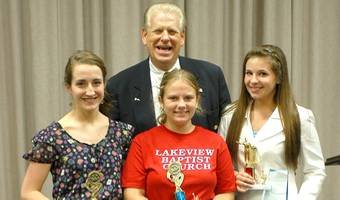
Winners of the Texas Baptist Bible Drill and Speakers’ Tournament, who will represent Texas at the National Invitational Tournament are (left to right) Jessie Price from First Baptist Church in Atlanta, senior high drill; Sherissa Blender from Lakeview Baptist Church in Mathis, youth drill; and Christa Juneau from Cornerstone Baptist Church in Cleveland, Speakers’ Tournament. They are pictured with Dickie Dunn, discipleship specialist with the Baptist General Convention of Texas. (PHOTO/Keith Lowry)

Sherissa Blender of Lakeview Baptist Church in Mathis won first place in the youth Bible Drill competition. Yana Genke of First Baptist Church in Tenaha and Silas Henderson of First Baptist Church in Atlanta tied for second place.

In the high school Bible Drill competition, Jessie Price of First Baptist Church in Atlanta won first place. Faith Walters of First Baptist Church in Albany earned second place.

In the high school speakers’ competition, Christa Juneau of Cornerstone Baptist Church in Cleveland won first place. Lauren Mandaville of First Baptist Church in Seguin won second place. The top five finishers each earned a scholarship to a Texas Baptist university.

The first place finishers in each category will advance to the national competitions June 24 in Birmingham, Ala.

Dunn, who facilitates the competitions, praised the work of the winners and noted all the students who participate in the effort benefit from the work they put into it. Practicing for the competitions brings families together around Scripture. Families memorize Scripture together, and the practice reinforces the importance of faith in a person’s life.

Former contestants tell Dunn the verses they memorized as youth regularly come back to them as adults, guiding their decisions, thoughts and actions. In nine years of competing, students will memorize 400 to 500 Bible verses.

“I think it is probably the finest disciple-making process we have for children and youth today because it teaches them how to fulfill the Great Commission. They become witnesses. They become models. They become disciples,” he said.

“For these young people, I see the discipline of committing God’s word to memory. As it says, that will not come back void. That will be with us always.”

Ten students won the inaugural Ellen Battles Lighthouse Award, which celebrates young people who have participated in the competitions from fourth grade through high school. The award is named in honor of Battles, who has been involved in the competitions 32 years.

The winners were: Walters; Price; Juneau; Cody Welch of First Baptist Church in Bryan; Timothy Mills of First Baptist Church in Cleveland; Amanda Campbell of Tabernacle Baptist Church in Ennis; Briona Keith of First Baptist Church in Comanche; Nathan Byrd of First Baptist Church in Comanche; James Smith of First Baptist Church in Comanche; and Shawnnice Davis of Mount Hebron Missionary Baptist Church in Garland.


Capital campaign at Abilene church benefits missions

ABILENE—First Baptist Church in Abilene has a long history of involvement in missions—starting churches, supporting missionaries and meeting community needs. That commitment moved to an even higher level last year when the church held a capital campaign to raise money for missions and set a $5 million goal.

First Baptisdt Church in Abilene held a capital campaign to raise money for missions and set a $5 million goal.

“Our church has a history of seeing problems, dreaming of answers and going for solutions that no one else has done. And we also have a great heritage of involvement in missions,” said Bob Ellis, one of the campaign directors.

The Faces & Places capital campaign for missions focused on three components—20 percent to renovate the 30-year-old family life center the church uses for community ministries; 20 percent to fund near-term mission projects such as a Friendship House operated in connection with Connecting Caring Communities, meeting disaster relief needs and support of missionaries sent out from the church; and 60 percent for an endowment to continue those ministries “and things we don’t even know about yet,” Ellis explained.

The portion set aside for near-term missions project also was intended to encourage church members’ involvement in mission efforts.

“We want to make it possible for every youth in our church to have an international mission experience,” Ellis said. The fund was not intended to pay 100 percent for any individual but to make the cost reasonable for everyone.

Pastor Phil Christopher (left) and Bob Ellis, a director of the Faces & Places missions campaign, stand beside a display of a church-sponsored mission trip to Egypt.

“One of our questions was, ‘In this economic time, is it crazy to do this?’” Ellis admitted. “But we felt as a church, this is what God is calling us to do, and this is the right time.”

Pastor Phil Christopher acknowledges he also was concerned about how the campaign would affect regular budget giving. Some church members asked him if the time was right.

“But what it came down to was, ‘If not now, when?’” he said.

He believes the campaign has aided giving to the regular operations budget.

“I think it has strengthened us in people’s understanding of stewardship, and it gave us an opportunity to present that—especially to some of our younger adults,” he said.

Currently, giving is running about 96 percent of budgeted receipts.

“It hasn’t shown up with our giving running 110 percent of what was budgeted, but I wonder where we would be if we hadn’t had this campaign,” Christopher said. “I think it really has given people a sense of how God empowers us at that point. This was a stepping out on faith.”

He emphasized that giving to the campaign was above and beyond giving to the Baptist General Convention of Texas, the Cooperative Baptist Fellowship and the Baptist World Alliance, which last year totaled about $150,000 from the budget. In addition, the church’s global mission offering last year totaled an additional $60,000, and this year’s goal is $100,000.

Displays throughout First Baptist Church in Abilene show members’ involvement in missions, pointing to the benefits of their investment in the Faces & Places missions capital campaign. (PHOTOS/George Henson)

At the end of the two-month Faces & Places campaign in spring 2010, members had pledged or given $3.67 million.

“So, we didn’t reach our goal, but that’s a really good start,” Ellis said.

In addition to that amount, a foundation in the city gave $600,000 toward the family life center renovations. Plans still are being made for the gym renovations.

A couple has been hired for the Friendship House and is working in the community, although a house for them to live in has not yet been secured.

The campaign will provide the majority of financial support for three couples appointed by the Cooperative Baptist Fellowship. Jimmy and Anjani Cole began serving in Spain last year. Caroline and Josh Smith will go to South Africa in the fall, and Jeff and Alicia Lee will begin serving in Macedonia next year.

The church engages in four to six mission projects in a typical year. So far, most participants are paying their own way, but the church has been able to provide the materials needed through the Faces & Places funds. Pictures of participants engaged in missions are displayed throughout the church.

“We want to keep our mission endeavors as a church—and the Faces & Places campaign—in front of our people as reminders so they will be able to give their money and fulfill their pledges with enthusiasm,” Ellis said.

“A lot of churches, especially a lot of very old, established, downtown churches, sometimes fall into the trap of looking inward, and what has happened for our church is that we started looking outward and at ways we can give ourselves away.”

The campaign’s three components helped different segments of the congregation find areas they were passionate about supporting, Ellis said.

“Some people like the bricks and mortar part of remodeling the family life center—it’s been there 30 years, and they’ve ministered there and they catch that vision,” he said. “Others just really got on fire about sending out missionaries. Others were thrilled about the notion of an endowment so that you don’t have to come to the congregation every other month saying we need money to keep this missionary on the field, but instead, you’ve got the money to keep it going.

 “It was quite a different kind of campaign. …  Faces & Places meant that it was a campaign in which we dreamed about the places we might go and the faces of the people with whom we might share the gospel of Jesus. You can’t hold an architect’s drawing of that, but we were able to paint that picture of those faces and imagine the things we might do.”


Faith Digest

Little change regarding belief in God. A new Gallup poll finds 92 percent of Americans say they believe in God, a figure that has dropped by only a few points since Gallup first asked the question in the 1940s. The percentage of Americans who respond that they believe in God now stands within six points of the all-time high in the 1950s and 1960s. About 12 percent of Americans say they believe in a universal spirit or higher power instead of “God” when given that option. The age group least likely to claim belief in God is 18-29-year-olds, at 84 percent, compared to 94 percent of older Americans.

No spits, no runs, no errors. Religious leaders hope to hit a home run in a campaign to get Major League Baseball players to ban tobacco use on fields and dugouts of the national pastime. Members of the Faith United Against Tobacco coalition wrote Michael Weiner, executive director of the Major League Baseball Players Association, focusing on the hazards of smokeless tobacco. Leaders of Christian, Jewish and Muslim organizations see baseball players’ role-model status as the biggest risk for young people. Commissioner Bud Selig has proposed smokeless tobacco be banned in the major league, just as it has been in the minor leagues. Weiner has said the issue would be part of collective bargaining talks this year, but he has called smokeless tobacco a legal substance that does not have the secondary health risks of cigarette smoke.

Most Americans OK with Mormon candidate. About two out of three Americans say it makes no difference to them if a presidential candidate is Mormon, according to a new Pew Research Center poll, although evangelicals are more cautious. The poll found 68 percent of respondents said a candidate’s Mormon faith would not matter, while one in four said they would be less likely to support a Mormon. White evangelicals were most likely to care about a candidate’s Mormon faith, with one-third saying they would be less likely to support a Mormon candidate, compared to 24 percent of the religiously unaffiliated and 19 percent of Catholics and white mainline Protestants. The survey, conducted May 25-30, is based on a national sample of 1,509 adults and has a margin of error of plus or minus 3.5 percentage points.

Clerics should give advice, not rule, Egyptians say. Four months after the fall of Egyptian President Hosni Mubarak, a new Gallup survey says most Egyptians want religious leaders to advise the nation’s officials, but they do not want a theocracy. About seven in 10 Egyptians said clerics should advise national leaders on legislation. In comparison, 14 percent said religious leaders should have full authority in creating laws, and 9 percent said they should have no authority. Even as they seek a limited advisory role for clergy, two-thirds of Egyptians (67 percent) want religious freedom as a provision in a new constitution. The findings are based on in-person interviews with about 1,000 people ages 15 and older in late March and early April, and have a margin of error of plus or minus 3.1 to 3.5 percentage points.


Southern Baptists support path to legal status in immigration reform

PHOENIX (ABP) – The Southern Baptist Convention adopted a debated resolution June 15 calling for “a just and compassionate path to legal status” for undocumented immigrants.

President Obama supports immigration reform that includes a pathway to citizenship for an estimated 11 million people who are living in the country illegally. Opponents say amnesty encourages others to enter the United States illegally and compete for American jobs.

“This will be known as Southern Baptist amnesty,” said Wiley Drake, pastor of First Southern Baptist Church in Buena Park, Calif.

“That is exactly what this is,” said Drake, a former convention vice president. “This is amnesty any way you phrase it.”

Messengers voted 766-723 against a motion by Richard Huff, pastor of Corona de Tucson Baptist Church in Tucson, Ariz., to delete a paragraph that asks the government “to implement, with borders secured, a just and compassionate path to legal status, with appropriate restitutionary measures, for those undocumented immigrants already living in our country.”

Huff said he agreed with other parts of the resolution that opposed “nativism” and any bigotry or harassment against undocumented workers, but giving them amnesty rewards them for breaking the law and puts them in line ahead of those seeking citizenship through legal means.

“They came here illegally and now we say: ‘We are going to reward you. You are already here?’” Huff asked. “The right of citizenship is too precious to reward those who are here illegally.”

After the debate, the convention approved an amendment suggested by the resolutions committee to clarify, “This resolution is not to be construed as support for amnesty for any undocumented immigrant.”

Resolutions committee chair Paul Jimenez, pastor of First Baptist Church of Taylors, S.C., defended the statement as a “realistic and biblical approach to immigration.”

While recognizing there are political implications, Jimenez said the committee’s main concern was viewing undocumented workers as prospects for evangelism and ministry.

“As churches see immigrants here among us, our first question is not ‘What is their legal status?’” he said. “The question first and foremost is ‘What is their gospel status?’”