Churches offer ‘Soul Food,’ encouragement to the unemployed

When people are in trouble following natural disasters, churches usually respond rapidly and generously.

The disaster of chronic unemployment creates a different set of challenges, but some churches across the country provide models of ministry to people affected by economic instability by meeting immediate needs for food and shelter.
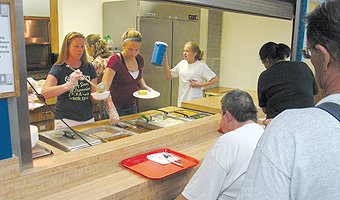
Volunteers at First Baptist Church in Jefferson City, Mo., serve a community meal, primarily to benefit the unemployed and underemployed.

First Baptist Church of Dalton, Ga., wants to concentrate on assisting its community, instead of focusing on its own survival. "We're looking at ways to expand our footprint," Pastor Bill Ireland explained.

First Baptist began its Soul Food ministry in 2008 after the economic downturn hit the construction industry. "There were people in the church who became concerned about the homeless and the working poor," Ireland said.

Often called the "Carpet Capital of the World," Dalton was hit especially hard, and unemployment remains higher than the national average.

Through Soul Food, the church provides a meal two or three times each month. This year, the congregation expanded its ministry to include special events for children and plans to start a choir.

The church is considering some other possibilities of ministry to adults. The church has called a recent seminary graduate as minister of community ministries and missions.

"We may not be able to do everything, but we want someone who wakes up every morning thinking about ways to minister," Ireland said.

Other churches across the country, such as First Baptist Church in Jefferson City, Mo., provide community meals, as well. The Jefferson City church also is considering other long-term ministries.

Several, such as First Baptist Church in Decatur, Ga., collect special offerings to assist with rent and utility bills.

Volunteers (left to right) Sandra Blackwell, Cindy Petway and Drake Bargeron serve hot dogs to participants at an end-of-school party sponsored by the Soul Food ministry at First Baptist Church in Dalton, Ga.

First Baptist in Decatur also has helped the unemployed through its Jobless, Not Faithless program. In the past, the ministry provided regular group meetings to encourage and pray with those who had lost jobs.

As the economy improved for a while in the area, attendance began to decline. Although no longer offered for groups, the ministry is available one-on-one to individuals looking for jobs.

Some churches that have provided job-search assistance—including interview, search and resume skills—have tapped into programs available through not-for-profits or government.

First Baptist in Decatur uses a ministry package available from Internet-based Crossroads Career Network, Christian employment support. According to its website, the network of member churches uses a six-step process of career exploration and job-search techniques.

In North Texas, First Baptist Church of Lewisville has participated in Career Connection, an organization that serves the Dallas-Fort Worth area. The Lewisville church served as a satellite location, open to church members and the community.

First Baptist member Steve Smith helped begin the site when he was without a job. The group stopped meeting a couple of months ago as its numbers declined.

"It did help a lot of people," he said. "But the economy has improved in North Texas, and some gave up looking for work. Some had been out of work for so long that they lost interest."

He suspects the need may arise again since the economic recovery faltered recently.

First Baptist Church in Georgetown offered Careers in Transition at one time but currently sends people to the Georgetown Job Café, a local networking opportunity, and to services offered by the Texas Workforce Commission.


Christians called to address both immediate needs, social inequities

While many churches reach out to meet the immediate needs of people who have lost jobs, Christians also are called to tackle underlying social issues related to employment and to partner with others to help make long-term changes, some ethicists advocate.

Government involvement

"Churches need to play a part in the local, state, regional and national debate about work," said Bill Tillman, the T.B. Maston Chair of Christian Ethics at Hardin-Simmons University's Logsdon Seminary in Abilene.

Not only should Christians speak up about the number of jobs available, but they also should advocate for salary levels and quality. Tillman noted the current economic downturn hit Texas at a slower pace than in many parts of the country and even more slowly in Abilene. Unemployment in the West Texas city stands at only 6 percent to 7 percent, but most jobs are lower-paying, he said.

Congregations can partner with government and social advocacy groups to affect change, David Gushee, distinguished professor of Christian ethics at Mercer University, said.

He pointed out how government, unions and social advocacy groups worked together when recession hit Germany.

"They found a way to keep people on the payroll, even if they couldn't work full time. Some work is better than no work," he said.

All strata of society—including churches and their members— should be involved in solving the unemployment problem, the ethicists insisted.

"This is a mission field," Tillman said. "But Baptists haven't been in the mindset of seeing economics as a mission."

Gushee agreed. "Those (Christians) who can should be activists and advocates for a more humane society. The economy is for people. That's the thing to remember," he said.

"This is yet one of many examples where pastors and church leaders have the opportunity to give a unique Christian perspective … on economic and social ethics … by using the pulpit and other forums."

Unemployment must be addressed systemically. "Baptists don't have an institutional or systemic approach," Tillman added. "The Baptist approach grows out of individualism."

Connections

One way to take a systemic approach is to partner with others and to use available broad system connections. For example, Tillman noted, First Baptist Church and First Central Presbyterian Church partner to minister in Abilene.

And the churches tap those who are in positions of authority. "They find the people who are in the systems, using leverage into the larger system," he said.

A state representative is a member of one church, and Abilene's mayor is a vice president in the Hendrick Medical System, a health care system related to the Baptist General Convention of Texas.

"Churches with professionals and systems … can work with the pastor to address the systems, first through conversation," Tillman said. "Opportunities are closer to us than we know, offering channels that we haven't explored before."

Create jobs

Individual Christians could use their own resources as a way to create opportunities for others. "Corporations and those (Christians) who run businesses need to think about the 25 million people out of work and open their purse strings to create jobs," Gushee said.

Christian entrepreneurs might develop businesses or not-for-profits to create jobs, said Tarris Rosell, professor of pastoral theology, ethics and ministry praxis at Central Baptist Theological Seminary in Shawnee, Kan., and the Rosemary Flanigan Chair at the Center for Practical Bioethics in Kansas City.

In collaboration with others, Rosell has been part of starting a church, a nonprofit organization for refugee resettlement, a nonprofit that matches uninsured patients with pro bono health care providers, and a program to educate clergy and faith communities about depression. Currently, he is helping create a nongovernmental organization for the prevention of intertribal violence in Kenya.

"The results have been, in part, new jobs and meaningful work as vocation," he said.

Churches can create jobs, too, by budgeting for them, whether full-time or part-time, Gushee added.

Volunteerism

While the ethicists agreed volunteerism isn't the best answer to unemployment, it can help people regain some measure of self-esteem and add productivity to society.

"I think that what people need is to be employed. It's not the best full answer … but volunteering and other forms of service should not be overlooked for meeting needs of productivity," Gushee said.

Volunteerism may lead to employment opportunities, Richard Land, president of the Southern Baptist Convention's Ethics & Religious Liberty Commission, believes.

"The church should find places for them (the unemployed) to work, even volunteer work," he said, "for often, volunteer work can launch them into a new career, or they may discover things they didn't know they could do."


Islamic terrorism a real threat, but how big is it?

WASHINGTON (RNS)—After a car bomb detonated on Wall Street killing 38 people, federal investigators came up with a possible link to an overseas group.

Islamic terrorists? Al-Qaida? No, Italian anarchists.

The year was 1920, and in those days anarchists were the equivalent of today's terrorists, waging acts of mass destruction against Western capitalism.

Charles Kurzman, professor of sociology at the University of North Carolina, thinks 20th century anarchist violence bears a resemblance to the Islamic terrorism of the 21st century in one sense: Neither resulted in a spiraling escalation of violence.

"In many ways," said Kurzman, "Islamic terrorism is simply the latest form of transnational revolutionary violence to grab global attention."

Put another way: This too shall pass.

While mindful of the pain and suffering terrorism has caused, Kurzman has written a book challenging the dominant narrative that worldwide terrorism is out of control.

In The Missing Martyrs: Why There Are So Few Muslim Terrorists, Kurzman argues Islamic terrorism has accounted for a miniscule number of murders compared with violent death tolls from other causes.

In the United States, for example, fewer than 40 people died at the hands of terrorists in the 10 years since the attacks of Sept. 11, 2001. That compares with about 140,000 other murders during the same time.

The bad news, said Kurzman, is Islamic terrorists really are out to kill Americans. The good news is there are very few of them. In fact, of less than 40 killed at the hands of terrorists over the past decade, none were tied directly to al-Qaida. These include the 2002 Beltway sniper attacks, in which 10 people were killed in the Washington, D.C., area, and the 2009 Fort Hood shootings in which U.S. Army Maj. Nidal Malik Hasan killed 14 people.

That count does not include the many failed terrorist bombings united by a common theme—incompetence. Had these plots, such as the bungled 2010 Times Square car bomb, succeeded, the death toll would have been much higher.

The truth is, Kurzman said, the more terrorists kill, the less popular they become. That does not mean the world is safe from terrorism, and he cautions America may well see another horrific terrorist attack.

It does mean the U.S. government should examine the evidence and ratchet down the discourse, he said.

That goes for the Muslim radicalization hearings held by Rep. Peter King, R-N.Y., as well as presidential candidate Herman Cain's statements that he would require Muslim government appointees to take a loyalty oath.

"The narrative right now is that Islamic terrorism is either no threat at all, or it's a pandemic throughout the community," said Alejandro Beutel, government and policy analyst for the Muslim Public Affairs Council.

"Charles Kurzman's very scholarly approach to the issue is something we want to move toward. There is a threat out there, but it's a tiny minority of individuals."

What, then, of the supposed sympathy for terrorist acts among Pakistanis or Palestinians, among whom Osama bin Laden has been a popular figure?

Borrowing a term from author Tom Wolfe, who coined the phrase "radical chic," Kurzman calls it "radical sheik," playing on the Arab word for "leader." It's an expression of resistance against Western imperialism, a kind of sign of disdain for power and authority, not an actual vote of confidence for terrorism.

A sociologist of revolutions, who has spent a large part of his academic career studying the 1979 Iranian Revolution, Kurzman is active with the Triangle Center on Terrorism and Homeland Security. The center is a think tank consisting of experts from Duke University and the University of North Carolina. He was the principal author of a recent study that showed the number of U.S.-instigated terrorist incidents dropped by more than half in 2010.

Several years ago, Kurzman started taking Arabic courses so he could do a better job reading al-Qaida propaganda and digital bulletin board discussions by young Muslims.

He knows his argument that there are few Muslim terrorists is counter-intuitive, even provocative.

But the Harvard- and Berkeley-trained professor is convinced it's a necessary corrective.

"It may be a hard sell to ask people to calm down," Kurzman said. "It doesn't make as compelling a read as scary stories and imminent threats of hidden dangers. …

"I'm not saying terrorism is insignificant, or that I have no feelings for people who have lost loved ones due to terrorism.

"But I think we should also look at the days when nothing happens. This is a story about something that did not occur."


TBM team serves in North Dakota

Baptist "mud-out" disaster relief volunteers continue to serve in the wake of floods in Minot, N.D. Billy Gilmore (second from right) of Paramount Baptist Church in Amarillo led a 14-member team sent by Texas Baptist Men.

Other members of the team are (left to right in photo) Joe Christenberry, First Baptist Church in Terrell; Kim Bowlin, Bear Creek Baptist Church in Houston; Bob Hardin, Irving Bible Church in Irving; Kathy Patterson, Clearwater Baptist Church in Scroggins; Billie Sue and Paul Morrow, Forest Home Baptist Church in Forest Home; Leroy and Lee Moore, Fort Phantom Baptist Church in Hawley; Bill Hyden, Meadowbrook Baptist Church in Waco; William and Judy Blackwell, First Baptist in Canyon Trail; Cherri Wheeler, First Baptist Church in Universal City; and Gene Shellhouse, Poetry Baptist Church in Poetry.

Since the Souris River flooded June 22, Southern Baptist Disaster Relief teams have chalked up 3,500 volunteer days; prepared nearly 80,000 meals for flood victims, volunteers and responders; completed 102 mud-out jobs for flooded-out homeowners; provided 4,160 showers and laundry loads; recorded more than 3,100 gospel presentations, chaplaincy and ministry contacts; and led 37 people to Christ, according to the latest report.


Students wind up summer awed by God’s power

Even expecting the unexpected didn't stop Texas Baptist student summer missionaries from being awed by seeing God work in surprising ways.

More than 380 Texas Baptist college students served as missionaries this summer in 25 Texas cities, 14 states and 30 countries, spreading the gospel.

Jacob Townsend, a student at the University of Texas at Austin, served in South Asia with Go Now Missions.

Brenda Sanders, who leads the Go Now Missions program, said God used these students to introduce people to Christ's love.

"In the midst of these students' faith journey as student missionaries, they see God do some amazing things," Sanders said.

"They come away with more than a photo album full of pictures. They come away with a realistic picture of what it means to take the gospel to a hurting world. Ultimately, our goal is to teach them that missions is not a trip, but a way of life. We want them to walk away ready to be missionaries on their campus, jobs or homes."

In Alaska, many people are hesitant to talk about spiritual matters, said Sarah Miller, a Texas A&M University student who served there this summer. Christians must build strong relationships with individuals before they have the opportunity to share their faith, making evangelism efforts slow.

The same Christian volunteer missionaries have re-turned year after year to build those relationships, Miller said. This year, God used those relationships to break through to people's hearts. During the salmon fishing season, Miller and other volunteers passed out hot chocolate, water, lemonade and hot dogs in an effort to foster relationships. Through that effort, more than 30 spiritual decisions were made for Christ, a result that overjoyed Miller.

David Morgan, a student at the University of Texas at Arlington, served with Go Now Missions in West Africa. (?PHOTOS/Courtesy of Go Now Missions/BGCT)

Nina Monk, a Stephen F. Austin State University student, unexpectedly encountered God's healing in her own life as she served in the Hospitality House in Huntsville, an outreach to families of prisoners. As she visited with families and the leaders of the ministry, she resolved the emotions she has held about her brother, who is in prison. The experience helped Monk grow as a Christian.

"It really brought a lot of healing to me to know that I'm not alone," Monk said.

The families of people in prison are a population that needs ministry, Monk said. They are dealing with the difficulty of not having a child, sibling or parent with them, and they struggle with the variety of emotions that come with that.

"They're all hurting," Monk said. "A lot of them are ashamed of what has happened in their families. A lot of the moms feel guilt that they could have done something different. A lot of wives feel like, 'He didn't love me enough.' Kids feel like it's their fault."

Kelley Mathis, a University of Texas at Austin student, said her summer serving in Del Rio revolutionized the way she thinks about mission work. She learned that God was working whether one person or many showed up for a ministry. God cares about each person, she learned.

"Missions is not at all the tear-inducing picture slide show with soundtrack music that I guess I thought it was," Mathis wrote in one of her weekly updates. "Missions is watching God somehow overcome our imperfect ability to love people."

For Kati Kunetz, a Texas State University student, her missions experience in Thai-land broadened her perspective of the world and God.

"God is the same everywhere," Kunetz said. "I had heard that before, but it is different to say it than to experience it."

By serving on college campuses in another country, Kunetz gained insight into what it is like to be an international student in the United States. She understands what it's like to be different, to struggle with the language and not have many relationships in a new city.

That knowledge pushed her to want to lead outreach efforts to Texas State international students in the fall, a task she did not expect before this summer.

"I really think (mission work) is something that everyone should do in their lives," Kunetz said.


Singer/songwriter clings to faith during family trials

NASHVILLE, Tenn.—Singer/songwriter Aaron Shust and his wife, Sarah, have relied on their faith in Christ to sustain them as their 2-year-old son, Nicky, has battled eosinophilic esophagitis—a rare and extremely painful condition that does not allow the body to take in any nutrition.

With a deeper understanding of God's amazing grace and immense love for his children, Aaron Shust's new album, This Is What We Believe, reflects a journey of hope and healing.

This condition has also caused Nicky to battle several other serious medical issues, including silent aspiration and septic shock.

"The doctors have told us that this is the most severe case they have ever seen, even in adults," Shust said. "It's been heartbreaking to see everything he has gone through."

While spending several months in the hospital, doctors tried six food formulas, but Nicky's body rejected each of them. With the seventh formula as the last available option, the Shusts rejoiced when Nicky's body accepted it without any problems.

Although the doctors still believed Nicky would need to be on a feeding tube and would require steroids for the rest of his life to manage the pain, this formula finally was a step in the right direction and offered a glimmer of hope. 

Throughout the ordeal, the Shusts went online to research the side effects of each steroid, and they continued to ask their family and friends to pray for Nicky's healing. 

Not long after, the Shusts re-ceived stunning news from Nicky's doctors. All of the test results were coming back normal, and there was no longer a single trace of eosinophilic esopha-gitis in Nicky's body.

The doctors could not offer any explanation as to why the disease had disappeared. But the Shusts know the reason.

"We were on our knees before God in prayer, and now we're on our knees before him with thanksgiving," Shust said. "When your whole world is suddenly shaking, you need a firm place to stand. You see what it is in your life that's stable, true and strong enough to hold you up. You reach for that, run to that and find out what you really believe."

Walking through the difficult season left an indelible mark on Shust's songwriting. With a deeper understanding of God's amazing grace and im-mense love for his children, Shust's new album, This Is What We Believe, reflects a journey of hope and healing.

"Through all of the sickness and heartache, my family has run to God and his promises," Shust said. "We've been forced to our knees, but this trial has made life exponentially more meaningful.

"And through it all, God has never left us. He brought strength to our weakness, peace to our uncertainty and healing to our wounds.

"He's given us the grace to handle what we didn't believe we could. And ultimately, he's let us experience the joy of seeing his miraculous grace at work.

"To witness your own child being healed of something that doctors told you was permanent, painful and incurable—well, if that doesn't move your heart to worship, I don't suppose there's anything that will."


Virginia man on quest to develop national religious history museum

WASHINGTON (RNS)—For Chris Stevenson, faith isn't just personal—it's national.

Stevenson, 41, first became interested in the intersection of faith and public life while studying civics in college. A few decades later, he said, he had a revelation of sorts.

"There was one great story that remains to be told by a professional museum—the indispensability of faith in America's history," he said.

Chris Stevenson, chief organizer for efforts to create a National Museum of American Religion, stands in front of the Smithsonian Castle. (RNS PHOTO)

Thus, the idea to found a National Museum of American Religion in Washington, D.C., was born.

But Stevenson, a business manager for an air traffic organization in northern Virginia, has found that turning his dream into reality is an unexpectedly complicated undertaking involving a number of logistical, professional and personal challenges.

For example, he was not the only one lobbying for a new national museum in Washington. Several other projects—the National Museum of the American Latino, the National Women's History Museum and the American Museum of American People—have been proposed to Congress and the Smithsonian Institution in recent years.

"There are new museums proposed and created all the time, but it's very hard to move from the paper stage to the practical, real stage," said Kym Rice, director of the museum studies program at George Washington University.

Rice cited money, especially in the midst of the American economic downturn, as a chief stumbling block for museum proposals.

"It's hard to make these institutions financially secure. … Even if they're nonprofits, they have to have some financial base. It's a huge endeavor," she said.

Indeed, most groups seeking to found a museum on the National Mall in Washington are backed by well-funded committees that boast big-name supporters and extensive websites. Stevenson's efforts are modest at best. The project still is run almost entirely by Stevenson, with only occasional assistance from a two-person board of advisers.

"We're just beginning the initial funding stage," Stevenson said. "I'm mostly just cold-calling and cold- e-mailing people."

Stevenson, a Mormon, also acknowledges some reservations about his project. "People think I have an agenda."

Despite roadblocks, Stevenson remains committed.

"People often underestimate people who are passionate, committed and even-handed," said Robert Wilson-Black, a vice president of the evangelical Washington-based group Sojourners, who also serves as one of the museum's advisory board members. "Lots of monuments and museums start with a person who is just dogged."

And Stevenson is nothing if not dogged. Inspired by the success of the new National Museum of African American History and Culture, he insists a National Museum of American Religion is a viable idea.

"My first thought was to make it a Smithsonian museum," Stevenson said. "We would like to have it around the Mall. Washington, D.C., is our nation's capital. … (The museum) belongs in D.C. because it's about American religion."

Stevenson even has a list of exhibits he would like to house in the museum, including expositions on religion and immigration, religion in politics, religion in American architecture and America's effect on other world religions.

And Stevenson thinks big, dreaming of large-scale, hands-on exhibits like a room that could change into any worship space at the touch of a button or an interactive experience modeled after the participatory civil rights sit-ins held at the National Museum of American History earlier this year.

"I'd like to see a participatory Scopes Monkey Trial. … People could sit in as the jury or as the people watching."

But Rice and others question how the museum would balance the need to please visitors while giving all religions fair treatment.

"It would be different in that it's thematic and not based on an ethnicity. … Museums are about the dissemination of knowledge and not about a particular view."

Stevenson insists the museum would maintain balance by remaining true to three guiding principles—objectivity, refraining from declaring one tradition as "true," and "presenting the information without judging whether a religion has been beneficial or detrimental to American history."

Stevenson also hopes to avoid bias by getting religious players from throughout the theological spectrum involved in the project, an effort he says will create a more inclusive museum.

Stevenson's fervor doesn't make the experience any less difficult.

In addition to his day job and working on the museum, Stevenson also moonlights several hours a week as the head of America's Quilt of Faith, a group that "champions the indispensability of faith to the American experiment in self-government."

Still, Stevenson finds a balance. "I use vacation days sometimes, but I'm not obsessed to the point of neglecting" his family.

Ultimately, Stevenson confesses much work must be done before construction on the museum can begin, but he hopes to get it completed in "5 to 10 years."

"I am convinced we can (build this museum) because we have a religious history." Stevenson said. "It exists. There is truth out there. … We'll just do the best we can and get at that truth."


Ralls youth group collects 1,300-plus pairs of shoes for orphans

MIDLAND—First Baptist Church in Ralls unloaded 1,305 pairs of new shoes for orphans at Rock the Desert, winning an award for collecting the most shoes at the Christian music festival.

The church's youth group responded to Buckner International's "Shoe Challenge" and collected more shoes than any other organization or group in attendance.

Bruce Harris, youth pastor at First Baptist Church in Ralls, accepts a bronzed shoe from Julia Stark, manager of Shoes for Orphan Souls, at the Rock the Desert event in Midland. The youth group at First Baptist in Ralls collected 1,305 pairs of new shoes for orphans in response to the Christian music festival's "Shoe Challenge." (PHOTO/Courtesy of Buckner International)

They were awarded a bronzed TOMS shoe by Shoes for Orphan Souls, sponsored by Buckner International , to recognize their achievement in helping others.

This is the third year First Baptist in Ralls has collected shoes for Rock the Desert. In 2010, the church collected 800 pairs of shoes; in 2009, 218 pairs.

"First Baptist Church in Ralls continues to do more and more each year," said Rachel Garton, director of Shoes for Orphan Souls. "We are so encouraged by their commitment to make a difference and hope their story can be an inspiration for other churches and youth groups to do something for orphans around the world."

Bruce Harris, youth pastor at First Baptist in Ralls, said the church took 25 youth and six adults to the event.

"I have been so blessed to be part of such a loving church and community like Ralls, where people allow Christ-like love to flow in their lives.

"The youth group has been so blessed by participating in the Buckner/Rock the Desert shoe drive for the past three years. They always look forward to working under the Buckner tent and have become leaders in this endeavor."

Shoes for Orphan Souls is Buckner's largest humanitarian aid project. Buckner is a global nonprofit ministry that seeks to make life better for orphans, vulnerable children and families.

Since 1999, Shoes for Orphan Souls has collected more than 2.2 million pairs of new shoes and shipped them to 74 countries worldwide. Learn more at www.Shoesfor-OrphanSouls.org.


Texans help with CWJC training in North Carolina

BIRMINGHAM, Ala. (ABP) —Christian Women's Job Corps and Christian Men's Job Corps were created by the Woman's Missionary Union to combat joblessness and the issues that often accompany it, such as loss of self-esteem and emotional stability.

Paula Jeser, right, from El Paso, led training for coordinators of established Christian Women's Job Corps and Christian Men's Job Corp sites during an event in Thomasville, N.C.

The national WMU is working with state chapters to implement the service of hope in 200 locations around the country.

WMU of North Carolina sponsored August training sessions both for people looking to start new CWJC sites and for some who have been at it awhile.

WMU created Christian Women's Job Corps in 1997 as a response to poverty and in 2004 added a Christian Men's Job Corps component.


Radical Islam presents a physical threat– and a spiritual one, Denison insists

Jim Denison believes radical Islam constitutes the greatest threat the West ever has faced. And while he acknowledges the political and military factors involved, he views the conflict primarily as spiritual.

"Unlike the armies of Nazism or communism, these enemies are fighting a spiritual war. They will not be defeated by killing their leaders or capturing their soldiers and cities. They are convinced that they are fighting and dying for the only true God and that he will reward their sacrifice eternally," Denison writes in his new book, Radical Islam: What You Need to Know.

Denison, president of the Denison Forum on Truth and Culture and theologian-in–residence with the Baptist General Convention of Texas, notes a Gallup survey of Muslims conducted between 2001 and 2007 revealed only 7 percent of the world's Muslims are radicalized.

"When I first read that report several years ago, I was relieved to learn that radical Muslims make up such a small percentage of the larger Muslim world," he writes. "Then I did the math. Seven percent of 1.6 billion people is 112 million people.

"In World War II, Allied armies fought against a combined military of 28 million soldiers; during the Cold War, we faced a Soviet army of some 13 million. A global force of 112 million people who agree with Osama bin Laden that Americans are enemies of Islam who must be killed is a terrifying reality."

Denison identifies two central tenets that set militant Muslims apart from their more mainstream brothers in the faith: "Muslims must take up arms to protect Islam from Western aggression" and "All citizens of the Western world are enemies of Islam."

The West underestimates radical Islam at its own peril, he insists.

"Our enemies will not rest until the entire world submits to their version of Islam. They believe that if they kill us, Allah will sort out believers from infidels in the afterlife. They believe if we kill them, Allah will welcome them to paradise," he writes.

But most Americans fail to understand radical Islam, he laments.

"After 10 years, multiplied thousands of deaths and injuries, and trillions of dollars spent, most Americans still don't know why our enemy hates us," Denison writes.

"The good news is that this is a war we can win. The bad news is that if we don't, 9/11 will have destroyed more than the Twin Towers. Our values and way of life are at stake, more than ever before in our history."

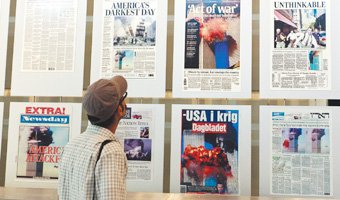
Headlines from around the world recorded the 9/11 attacks on the World Trade Center and Pentagon by Muslim extremists.

Denison provides a primer outlining the five pillars of orthodox Islam and a brief explanation of Shari'a, the Muslim code of conduct. He also notes a key principle separating radical Muslims from orthodox Islamic teaching: "For militant Muslims, killing Americans by any means necessary is a defense of Islam mandated by the Quran."

Militant Muslims see the West as aggressors who seek to impose non-Islamic government and values on the Muslim world, Denison explains. And since western democracies are governments, "of the people, by the people and for the people," all the people in a perceived aggressor nation—such as the United States—are threats.

"In my travels throughout the Muslim world, I have met followers of Islam who are among the most hospitable and peace-loving people I have ever known. I have also encountered Muslims in America and abroad who are convinced that aggression against the West is the duty of all Muslims," Denison writes.

Both peaceable and radical Muslims can cite incidents in the life of Muhammad and verses from the Quran to support their position, he concludes. Many Muslims read their holy book progressively—as do many Christians when they interpret the Bible—judging earlier teachings in light of later revelation, he notes.

"But while the Bible moves from military engagement to nonviolent missions and ministry, the Quran moves from nonviolent engagement in Mecca to military action in Medina," Denison writes.

"Muhammad's followers conducted 70 raids against their opponents in the prophet's lifetime; Jesus' followers expanded the kingdom of God through preaching, teaching and healing."

Militant Muslims have a long memory. They equate Christianity with the Crusades, he notes. And they blame the West for the decline of the Muslim Ottoman Empire after World War I and for imposing foreign—Christian or secular—values on the Muslim world, he notes.

"With the decline of the Ottoman Empire and rise of the West, the Muslim world began to interact with a culture it had never confronted before. The discovery of oil on the Arabian Peninsula brought Western governments, companies and finances to their lands. These outsiders introduced Western values such as the autonomy of the individual, the equality of women, and the separation of church and state," Denison writes.

"Their moral values especially alarmed many Muslims as the ethical relativism and deca?dence of the West were exported to their world through books and media."

Furthermore, radical Muslims view the West—particularly the United States—as defenders of Zionism, and they reject Israel's claim to the Holy Land.

"So long as America supports Israel in any way, radical Muslims will claim that we are the enemies of Islam and that they must attack us to defend their faith and people," Denison writes.

Denison sees Sayyid Qutb—an Egyptian-born educator whose experiences in the United States in the mid-20th century convinced him the only answer to Western decadence was Islamic fundamentalism and imposition of Shari'a law—as the godfather of radical Islam and the mind behind the 9/11 attacks.

"If a single book can be blamed for 9/11 and the War on Terror, that book is Sayyid Qutb's Milestones, the book that ignited the radical Islamist movement," Denison writes. "Its call for anti-Western revolution and imposition of strict Shari'a on every nation is frightening. Its continued popularity around the world is even more so."

In terms of political strategies, Denison believes the West should foster democracy and economic progress in the Islamic world and encourage moderate Muslims.

"Since America's military presence in the Middle East is the single greatest catalyst fueling radical Islam, we must act decisively to counteract the allegation that we are invading 'Crusaders' rather than agents of democratic reform," he writes.

The West also should help mediate peace in the Middle East, seeking solutions that protect the security of Israel and the rights of Palestinians, he added.

Christians can draw encouragement from a spiritual movement among Muslims toward Christianity, Denison insists. He urges daily prayer for the conversion of Muslims to faith in Christ, encouragement for ministries to Muslims and support for Muslim-background believers in Christ.

"The most important way Christians can join the War on Terror is on our knees," Denison writes.


Invincibles came to the rescue in isolated, rural churches

ABILENE—They were known as the Invincibles—a name befitting a troop of superheroes. To boys and girls in rural areas across Texas from 1940 to 1983, that's exactly how they seemed.

One of the Invincibles, Winnie White of Abilene, now 85, remembers moving around the state in a bus affectionately called the Lame Duck.

"I don't know how many miles I pushed that thing. It was always giving out," she said with a laugh.

Invincibles went all over Texas helping conduct rural Vacation Bible Schools. Their destinations probably looked a lot like this VBS gathering in 1951 at Star Baptist Church in Star. (Photo courtesy Nancy F. Payne)

The Invincibles were college students, mostly from Baylor University, who went to vast expanses of Texas where churches were small and isolated.

"This was before anybody but the big-city churches had Vacation Bible Schools," she explained. "So, they would ship us out to these churches out in the boondocks to teach them how to do Vacation Bible School."

Two students would arrive at the churches on Saturday night, meet and train any faculty from the church on Sunday and start VBS on Monday, she said.

Alan Lefever, director of the Texas Baptist Historical Collection, said the young people provided an essential service.

"The churches were too small to maintain any kind of program themselves. A lot of times when the Invincibles went into a church, there wouldn't be any adults available to do anything," he said.

"There were some churches where adults could assist the Invincibles, but in a lot of Vacation Bible Schools they did, they were the two people who conducted everything."

When a history of the Invincibles was compiled a few years ago, Gwen Griffitts Woodard wrote about her experiences during the summers of 1948 and 1949.

"I remember visiting a small country community that had a disbanded church whose building had fallen into great disrepair. We scraped the dirt daubers' nests off the old piano, swept birds' nests and horse manure out of the auditorium, roped off a corner where the floor had caved in and rearranged the pews. Enough children and adults came that we taught one group inside and another group outside under a tree. A retired minister from Brownwood was contacted, and the group decided to start having services again beginning the Sunday after we left," Woodard recalled.

"These were young people with a lot of energy," Lefever said. "They became known as the Invincibles because there wasn't anything they would let slow them down."

Participants remember Wimpy Smith, one of the staff leaders of the group and later Texas Baptist Brotherhood secretary, telling them: "I don't want you to tell me what you couldn't do. I want you to tell me how you got it done."

"There are accounts … of Invincibles who would conduct a Bible school in the morning, do another one in the afternoon at another church, and a third one at another church in the evening," Lefever said.

The group started in 1940 with 20 students. The next several years, the number of students increased to 22, and they were known as the Invincible 22. Later, that number expanded to more than 100 students who stretched across the state to take Vacation Bible School to even the most remote of areas.

"They weren't that selective," Lefever said. "They were simply looking for students with a heart for missions."

"I've read through some of these accounts where they literally went and surprised churches on a Sunday morning with: 'Hey, we're here. Let us do a Vacation Bible School.'

"In one of those situations, at the end of the week, the preacher said they could come back and surprise them next year, too."

While the student revivals of the late 1940s are better known, the Invincibles predated them, Lefever noted.

"Really, the driving force for Texas Baptists at that time was college students," he said.

The legacy they left still lives today, Lefever believes.

"I think you can make the argument that the Invincibles laid the groundwork for the youth mission trip because what do they do? They go to do Vacation Bible schools. Larger churches take a group and go to smaller churches and do a Vacation Bible School—the exact concept of what the Invincibles did," he observed.

While the Invincibles are now older, the ones Lefever knows still have the drive that propelled them to serve decades ago.

"If you talk to any of the Invincibles even now, what you get is that energy—it's almost a cockiness of what they did," he said. "And I think you needed that mentality to do all they did."


Pastors see mixed economic signs, survey says

NASHVILLE, Tenn.—Although the offerings in most American churches have met or exceeded budget requirements in 2011, the economy still is having a negative impact on local congregations.

That's the finding of a LifeWay Research survey of 1,000 Protestant pastors conducted in May and compared with similar surveys from November 2009 through January 2011.

According to the recent survey, nearly three-quarters (71 percent) of pastors report 2011 offerings at or in excess of their budget requirements. That includes 25 percent with offerings exceeding budget requirements and 46 percent with offerings approximately at budget level.

Twenty-two percent of pastors report lower offerings in 2011 than 2010. Thirty-nine percent report an increase from 2010, and 36 percent say offerings are at about the same level as last year. On average, churches report a 2 percent increase in 2011.

Churches with larger worship attendance are more likely to have increased offerings. Nearly half (49 percent) of congregations with 100-249 participants in worship report increased offerings from 2010, as do 47 percent of congregations with 250 or more.

In comparison, 34 percent of churches with 50-99 worshippers and 23 percent of those with 49 or fewer participants report increased offerings this year.

Pastors identifying themselves as "mainline" (45 percent) are more likely to have increased offerings than those who identify themselves as "evangelical" (38 percent).

When asked how the current economy is affecting their churches, a majority of pastors (67 percent) report negative impact. That includes 58 percent who say the economy is affecting their church "somewhat negatively" and 9 percent who say it is affecting their church "very negatively."

The findings are similar to what pastors said in January 2011 but more negative than their opinions in March 2010, when only 62 percent said the economy was affecting their congregations negatively.

"Just as there are some positive signs in the U.S. economy, we are seeing more churches with some growth in offerings for 2011," said Scott McConnell, director of LifeWay Research.

"However, average gains are small, and not all churches will benefit, depending on their local economy and the overall health of their church."

The news presents a mix of good and bad for local congregations. Ninety-six percent of pastors say their churches have experienced at least one of 11 economy-related changes in the past year, and more than three out of four report at least three of the changes.

Among the indicators they report:

• 70 percent are receiving more requests for financial assistance from outside the congregation.

• 45 percent have increased spending from the church budget to help the needy.

• 54 percent report a greater sense of excitement about opportunities to minister to the needy.

• 44 percent say there is a greater sense of caution within the congregation about the church trying new things that cost money.

• 15 percent say more people in the congregation have lost their homes to foreclosure.

When compared to the same indicators in November 2009, improvements are seen in the job loss trends in congregations and levels of volunteering. A full 48 percent of pastors report more people in their congregations have lost jobs in the past year, 8 percent less than the 2009 survey.

The recent survey also shows increased numbers of pastors reporting that more people are volunteering their time at church functions (49 percent compared to 41 percent in November 2009) and in the community (50 percent compared to 44 percent in November 2009).

Making do with less

When it comes to ministry, churches are making do with less. Forty-seven percent of pastors say the economy is forcing their congregations to hold staff salaries at last year's levels.

In comparison, 49 percent said the same in November 2009. Over the past year and a half, there has been a marked increase in making ministry supplies rather than buying them. While 40 percent of churches made or did more things themselves instead of buying goods or services in 2009, 49 percent say they are making and doing more today rather than buying.

In light of the economy, churches also are:

• Launching new ministries to help the disadvantaged (26 percent).

• Delaying construction or other large capital expenses that were planned (15 percent).

• Delaying hiring that was planned (10 percent).

• Reducing staff salaries from last year's levels (9 percent).

• Laying off one or more employees (7 percent).

• Reducing insurance benefits for staff (6 percent).

"Churches may be past the worst of the effects of the recession, but most continue to take actions to reduce expenses or maintain last year's spending levels," McConnell said. "Pastors' economic assessment has improved since the fall of 2010 but is still worse than their outlook last spring."