Patriotism, spiritual ties may pull Christians in opposite directions

RICHMOND, Va.—When war erupted between Russia and Georgia in 2008, repercussions included more than the 2,000 deaths and tens of thousands of refugees attributed to the conflict. Casualities also included relations between the two countries’ Baptist fellowships, torn between patriotism and historic spiritual ties.

Russian and Georgian Baptists later pledged to “facilitate the process of forgiveness and reconciliation between our peoples.” But the dispute highlights one of many challenges political realities pose for Christians around the world in balancing love of country and loyalty to a higher authority.

First Baptist Church in Gori, near Georgia's border with Ossetia, last year baptized nine new believers—the church's first baptism service in a decade. The church was at the center of fighting during the war between Russia and Georgia in 2008. Bishop Ilia Osefashvili of the Evangelical Baptist Church of Georgia baptized the converts.

In the 15 years before fighting broke out in the Caucasus, friendship between Baptists in Russia and Georgia was strained by the collapse of the Soviet Union and Georgia’s subsequent independence. Georgian Baptists’ new national loyalty led them out of the Union of Evangelical Christians-Baptists and to the creation of the Evangelical Baptist Church of Georgia.

The brutal war might have severed ties completely. But in November 2008, Baptist leaders—Malkhaz Songulashvili and Merab Gaprin-dashvili for the Georgians, and Yuri Sipko and Vitaly Vlasenko for the Russians—set aside nationalism in order to “promote mutual cooperation in the mission of God.”

Christians’ ability to transcend national pride while maintaining an appropriate patriotism especially is fraught in countries such as Russia, where national identity is associated closely with religion. Minority faiths frequently find themselves relegated to second-class status.

Last spring, a leader of the increasingly influential Russian Orthodox Church told a national television audience, “It is obvious today that the nation and church are one.”

“The Russian people will again become a Christian nation, even if this does not please everyone,” said Archpriest Vsevolod Chaplin, who chairs the church’s Synod Office for Mutual Relations between Church and Society. What’s more, he continued, the West—including the United States—has lost its Christian distinctiveness and only Russia can offer “the most positive future.”

William Yoder, a spokesman for Russian Baptists’ external church relations department, said some members of his denomination are ambivalent in their response to a patriotism with religious overtones. On the one hand, many “see in the struggle for ‘traditional Christian values’ a common cause for cooperation with the Orthodox,” he said. On the other, the “views of Protestants and conservative Orthodox on the interpretation of the Russian past and present are far apart.”

Still, Russian history retains a strong pull on the country’s Baptists and their patriotism. Last year, a bomb seriously damaged a statue of Lenin in front of St. Petersburg’s Finlandsky Station, one of the city’s main train terminals. In response, Vitaly Vlasenko of the external church relations department said: “I think monuments should remain in place, even if they represent ideologies and leaders different from our own. We need to honor our past, regardless of its negative aspects.”

In contrast to Russia’s religious-tinged patriotism, China remains an officially atheistic nation. Nevertheless, China’s burgeoning Christian population—now numbering in the millions—often reflects pride in the nation’s economic advances and  growing world stature.

Last year, during 60th anniversary celebrations of the Three-Self Patriotic Movement—China’s government-regulated Protestant church organization—admonitions to “love the country, love the church” were frequent.

“Chinese society is experiencing enormous and historic change at present,” claimed an editorial in the church monthly magazine Tian Feng.

“Chinese Christianity cannot stand aloof from these changes, but in fact has already become a part of them. Christians must not only connect with God, but must act in accordance with God’s teaching and connect with their homeland, society and people from all walks of life.”

Lin Manhong, a minister affiliated with Nanjing Union Theological Seminary, told the magazine, “Guiding our believers to identify with and share a common destiny with their country and compatriots and to join with them in building a harmonious society—this is what it means to love the country.”

Expressions of patriotism might be expected from leaders of China’s state-controlled churches. But even targets of recent crackdowns on illegal “house churches” maintain their national loyalty.

“We are not anti-government,” Wei Na, choir director of the embattled Shou-wang Church told the New York Times this spring. “But we cannot give up our church family and our faith.”

The 1,000-member Shou-wang Church in Beijing, which operates outside the state-controlled system but had benefitted from the government’s wary tolerance of big-city, unregistered congregations, was evicted from its meeting place in a new wave of crackdowns. Rather than disband or go back underground, the church determined to worship outside, sparking confrontation with police.

Even so, church supporters stress their patriotism in asking the government to change its tactics.

“We hope … the government will be able to handle the Shouwang incident in a rational and wise manner on the basis of the principles of ‘putting the people first and ruling the country by law’ and in the gracious spirit of serving the citizens …,” a petition to authorities said.


One Nation Under God

When American Christians pledge allegiance to their nation and its flag—sometimes in worship services—does that reflect narrow nationalism or proper patriotism? Some Baptists believe it all hinges on how they interpret “one nation under God.”

Nationalism, by context and common usage, has come to mean a narrow, self-justifying jingoism,” said James Dunn, resident professor of Christianity and public policy at the Wake Forest University School of Divinity. “Patriotism can be a healthy appreciation for the values, history, people and heroes of a particular country.”

Nationalists see their country as exceptional—the one and only nation under God’s exclusive protection and superior to all others. And that’s a position contrary to the biblical understanding of God as greater than any single nation or people, he noted.

“As I read it, the Scripture says all nations are under God, or at least they should be seen as so,” Dunn said.

But Rob James, retired professor of religion at the University of Richmond and chair of the Baptist General Association of Virginia religious liberty committee, believes the phrase “one nation under God” rightly expresses an important principle—God must be valued more than one’s country.

“As Christians, our worship and allegiance belongs to God, who is revealed to us in Christ. Love of one’s nation cannot take more than second place,” James said. “To give it higher place is to violate the first commandment.”

Church historian Jim Spivey agreed.

“I think God has wired all people to have an innate love of country—a deep and abiding affinity for kinsmen and neighbors of common heritage and like values. It is healthy and right for Americans to love America, to think of it as a great nation, and to be proud of its stand for liberty and equal opportunity. It is natural for citizens of any nation to feel this way as long as their homeland stands for values that are honorable and just,” said Spivey, senior fellow and professor of church history at the B.H. Carroll Theological Institute.

“However, it becomes idolatry when people take their eyes off the very God who has blessed them and has enabled their nation to become great, when they wrap the Bible in the American flag and when their pursuit of the American dream compromises the basic principles of the kingdom of God. In short, it becomes idolatry when people allow any form of civil religion to replace heartfelt devotion to God.”

Two theological principles should inform a Christian’s attitude toward his or her nation—creation and incarnation, Dunn explained.

Christians should recognize the image of God in every human being and realize that common connection to the Creator “ought to trump all other distinctions,” including those of nationality, he said.

At the same time, belief that God entered human history in the person of Jesus Christ “blesses the idea of being in a particular place and part of a particular nation,” he added.

Love for country characterizes both patriotism and nationalism, and some people use the terms interchangeably. But nationalism moves into the realm of extreme super-patriotism, said Brent Walker, executive director of the Baptist Joint Committee for Religious Liberty.

“The patriot says: ‘I love my country, right or wrong. And I want to try to make it better.’ The nationalist says: ‘I love my country. It cannot be wrong,’” Walker said.

Christians must hold in tension the kind of allegiance to country that good citizenship requires and the ultimate allegiance due to God alone, he said.

“My position is that patriotism and piety are both good things, but they are not the same thing,” Walker said. “Allegiance to Caesar always must be subservient to our allegiance to God.”

When love for country takes the place of utmost devotion that rightly belongs only to God, it becomes “sinful and idolatrous,” Walker said.

But sometimes Christians can lapse into idolatrous attitudes toward their country without even realizing it.

“There is a clear, definitive line that distinguishes healthy devotion from idolatry. But this line is hard to recognize, especially if we are not looking for it,” said Spivey, former assistant chief of chaplains of the U.S. Army, who retired as a brigadier general after more than 30 years military service.

“Unfortunately, even people of conscience who would never knowingly cross that line sometimes are lured across by a gradual, almost imperceptible, and seductive process.”

Even people who in principle recognize the importance of seeing every person as made in God’s image and guarding the religious liberty rights of all people can lapse into viewing their own country and kindred as superior to others, Dunn added.

“We all have a smidgen of the nationalist in us,” he acknowledged. “The idolatry of nationalism is one of those darling sins we can slide into without bad intentions. In fact, it’s almost accidental and often even with good motives.”


Justices rely on standing in church-state disputes

WASHINGTON (RNS)—As the U.S. Supreme Court ends its 2010-2011 term, legal scholars say one decision is likely to resonate within church-state debates for years to come.

The justices rejected a challenge to an Arizona school tuition credit program that largely benefits religious schools, saying taxpayers did not have legal grounds to challenge a tax credit as government spending.

At the heart of the decision was an arcane yet essential legal term—“standing,” or a plaintiff’s right to sue. Critics say the court increasingly relies on standing to dismiss church-state challenges without addressing the merits of the complaints.

Writing for the 5-4 majority in the Arizona case, Justice Anthony Kennedy defended the reliance on standing: “In an era of frequent litigation, … courts must be more careful to insist on the formal rules of standing, not less so.”

The Arizona ruling already is influencing other cases that touch on the First Amendment’s prohibition on a government “establishment” of religion:

• A Wiccan chaplain lost a religious discrimination case in a federal appeals court on June 1, which cited the Arizona decision in its ruling.

• Two weeks later, the Freedom From Religion Foundation voluntarily dropped its case challenging tax exemptions for clergy housing in light of the Arizona decision.

• That same atheist group now is carefully mulling whether to seek an appeal in a case it lost trying to declare the National Day of Prayer proclamation by President Obama unconstitutional.

Annie Laurie Gaylor, co-president of the Freedom From Religion Foundation, said by focusing on the standing issue, the court’s conservative majority has reduced its ability to hear cases on their merits.

“They are slamming the door shut, and they do not want any examination of the constitutionality of governmental support for religion,” she said. “It’s just rendering our Establishment Clause meaningless, because we cannot enforce it.”

Conservative Christian legal groups like the American Center for Law & Justice hope the April decision in Arizona Christian School Tuition Organization v. Winn will help them in future cases.

Melissa Rogers, a church-state expert at Wake Forest University Divinity School, said standing is not just a dry legal concept.

“It can make the difference between whether the Establishment Clause is a vibrant source of values that protect us and protect the religious liberty that we enjoy, or whether it’s a paper promise that theoretically bars certain things but not in practice,” she said.

With losses in federal court, church-state separationists hope for better success in state courts. Barry Lynn, executive director of Americans United for Separation of Church and State, estimates three dozen states have constitutions that prohibit “even more clearly the expenditure of government funds for religious purposes.” So he hopes plaintiffs may have a greater ability to sue at the state level.


Texas Baptists recruiting people to serve in Joplin, Tuscaloosa

DALLAS—Texas Baptists’ Disaster Response is attempting to recruit 100 people for a mission trip July 25-30 to Joplin, Mo., and another 100 people who will serve in Tuscaloosa, Ala., Aug. 1-6.

The need for new volunteers particularly is acute now as the people who have been serving suffer from fatigue as long hours are catching up to them, said Marla Bearden, Church2Church Partnerships coordinator with the Baptist General Convention of Texas.

A tornado destroyed this Walmart in Joplin, Mo.

“Our hope is that Texas Baptists can come together, at least 100 strong, in both of these areas and make a real difference in the lives of those who have been hurt so badly,” she said.

“While in Joplin, I met Mary, a church administrator, working to house and feed volunteers. She was tired and worn down. I prayed for her. She said, with tears in her eyes: ‘I have to go on. There is no one else to do this work, and it has to be done.’ She went on to say: ‘Most of us have a nice home, with a comfortable chair and a good TV to go home to at night. These people in Joplin affected by the tornadoes have nothing. I have to do it, and God will see me through.’”

Volunteers who participate in the trips will be involved in a variety of ministries, including construction projects, working in a distribution center and clean-up efforts.

“The people of Joplin, Mo., and Tuscaloosa, Ala., need our brotherly love,” Bearden said. “They need our fervent spirit and they need the hope of Jesus. Please join with other Texas Baptists to volunteer for one week to share your devotion with those who have been affected by this tragedy.”

Cost for the trip to Joplin is $100. Cost for the trip to Tuscaloosa is $50, and participants are asked to pay another $50 to the church where they stay in Tuscaloosa. The latter funds will cover their food during the trip. Participants will stay and be hosted by churches in each location. For more information and to register, visit www.texasbaptists.org/disaster. Individuals also can call Bearden at (888) 244-9400.


Hispanic Convention creates its own governing board

SAN ANTONIO—Standing at the start of its second century, the Hispanic Baptist Convention of Texas is seeking to move “adelante”—forward—making an impact on communities across the state with the gospel.

Throughout the annual statewide gathering at Trinity Baptist Church in San Antonio, speakers implored Hispanic Texas Baptists to be people of action known for sharing the gospel, caring for people and participating in mission work.

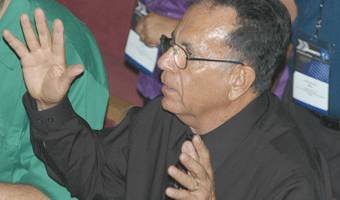
Messengers and guests at the Hispanic Baptist Convention of Texas join in worship as speakers challenge the group to move forward in reaching their communities for Christ.

In business, messengers voted to incorporate the body into a nonprofit organization with its own executive board.

Initial members of the board are Carlos Alsina, pastor of Primera Iglesia Bautista in Austin; Frances Barrera, member of Crossroad Baptist Church in Plainview; Baldemar Borrego of Wichita Falls; Alfonso Flores, pastor of Primera Iglesia Bautista Mexicana in San Antonio; Abraham Garcia, Hispanic pastor at First Baptist Church in Kaufman; Bea Mesquias, member of Second Baptist Church in Harlingen; Johnnie Musquiz, pastor of Primera Iglesia Bautista in Houston; Juan Puente, pastor of Primera Iglesia Bautista in Texarkana; Sabrina Sariles, youth minister at Iglesia Bautista Getsemani in Fort Worth; Ortega; Angel Vela, pastor of Iglesia Bautista Westway in El Paso; and longtime leader Rudy Camacho of Fort Worth.

Convention president Jesse Rincones, pastor of Alliance Church in Lubbock, said the decision allows the Hispanic convention to govern and receive funding for its own ministries designed to make an impact on communities while remaining in cooperation with the Baptist General Convention of Texas.

Currently, the Hispanic Baptist Convention receives most of its financial support from the BGCT, which provides the funds for the Hispanic convention through the Texas Baptist Cooperative Program, the primary giving channel of Texas Baptists.

Rincones encouraged continued cooperation with the BGCT, including asking messengers and congregations to increase their gifts to missions through the Cooperative Program during the next three years.

“The question has been asked, ‘Are you separating from the BGCT?’” Rincones said. “The answer is no.”

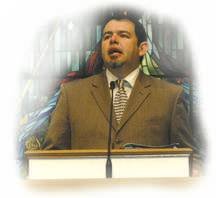
President Jesse Rincones of Lubbock.

The two conventions will continue to partner and work together on designated ministries, but each body will have its own ministries facilitated by each convention, Rincones said. Growth of the Texas Hispanic population requires increased ministry.

“This is an opportunity for Hispanic churches to administrate ministry that will impact churches,” Rincones said.

Hispanic Baptist Convention messengers also elected officers: Rincones, president; First Vice President Daniel Dominguez, pastor of Community Heights Church in Lubbock; Second Vice President Vela; Third Vice President Ruben Chairez, pastor of Primera Iglesia Bautista in Del Rio; and Secretary Rafael Munoz, member of Waves of Faith Church in Fort Worth.

Martin Ortega, pastor of Iglesia Bautista Emanuel in Midland, urged Hispanic Baptists to push through any obstacles they may encounter in the next 100 years and mirror the heart of God. To do so, they must lean on the promises of God, constantly obey the teachings of the Bible and put all their strength into kingdom work.

If they are determined and faithful, Hispanic Baptists will reflect the nature of God who delivered the Israelites, Ortega said. Likewise, God calls his followers to share the hope of Christ with others, allowing them to be delivered spiritually.

Les Hollon, pastor of Trinity Baptist Church, encouraged convention messengers to move from awareness to action and achievement for God’s kingdom.

Hispanic Baptists cannot stop at simply knowing the need, he said. They must seek to meet it by sharing the gospel in ways the people who need it understand.

David Tamez, regional coordinator of Latin American and Hispanic initiatives at Saddleback Church in Lake Forest, Calif., pushed messengers to seek God’s vision for their lives. When believers can see that vision clearly, they can create a way to make that vision a reality in faith and perseverance.

“Forward, forward, forward,” he said. “When I can see the end, I can plan the way to get there.”


Does the Star-Spangled Banner belong in the church sanctuary?

Christians should express love for country, experts on the intersection of Christianity and public life agree, but they advise caution in how churches demonstrate patriotism in worship settings.

Patriotic music, flag displays, recognition of veterans’ sacrifice and reminders of “those national values that are consistent with Scripture” could appropriately be featured in a church service around Memorial Day or some other special occasion, said Jim Spivey, a church historian with more than 30 years military experience.

An oversized American flag was lowered from the rafters, soldiers rappelled from above the crowd and fireworks blazed brightly at the Southern Baptist Convention’s Pastors Conference in 2002, held nine months after the 9/11 attacks on the World Trade Center and Pentagon. (FILE PHOTO/BP/Richard McCormack)

“But all this must be kept in proper perspective, acknowledging that God is the author of life and liberty, and that true freedom goes beyond political liberty and comes only through Jesus Christ,” said Spivey, senior fellow at the B.H. Carroll Theological Institute.

Brent Walker, executive director of the Baptist Joint Committee for Religious Liberty counseled caution regarding the display of the U.S. flag regularly in a sanctuary, unless its display is interpreted properly.

“By no means is a 50-foot flag across the front of the sanctuary that covers the cross ever appropriate,” he noted. But even more common displays of the flag in a worship center can be misinterpreted.

“An American flag displayed alongside a Christian flag could connote an equality of the two kingdoms,” he warned.

Worship leaders should make it clear under all circumstances that love for God transcends love of country—or any other allegiance, Walker said.

Placing the U.S. flag in a church sanctuary on an ongoing basis either can make the symbol of the nation an object of worship or else make it so rou-tine that it becomes almost invisible and loses its impact, said James Dunn, resident professor of Christianity and public policy at the Wake Forest University School of Divinity.

“It’s masquerading as an aid to worship, or it wouldn’t be there. It’s less than honest and less than appropriate for it to be there all the time,” he said.

On the other hand, some occasions seem to call for the display of the U.S. flag—either as part of a display of multiple flags in a missions service or displayed alone at a Memorial Day or Independence Day service, Dunn added.

“It is far more powerful and appropriately used in a legitimately patriotic sense when it’s reserved for special times,” he said.

Rob James, retired professor of religion at the University of Richmond and chair of the Baptist General Association of Virginia religious liberty committee, recommends a high degree of latitude when it comes to judging the appropriateness of an American flag displayed regularly in a worship setting.

“It can be a focus of worship and become idolatrous. Or it can be seen as a way of presenting ourselves be-fore God. We are Americans, and when we gather for worship, it may remind us as we come before God that we need God to judge our pride,” he said.


Partnership builds network of social support for families

WACO—Jan and Tom Purdy never dreamed a casual acquaintance with Kokoa and Bryan Mason would become a vibrant friendship—or develop into something even more life-changing through the Family Partnership Program.

Kokoa Mason (left) and her husband, Bryan (2nd from right), have developed a deep relationship with Jan Purdy (right) and her husband, Tom (2nd from left), through the Family Partnership Program.

The Purdys, long-time members of Calvary Baptist Church in Waco, met the Masons one year ago at Camp Hope. The camp, a Christian Women’s Job Corp initiative, offers parents opportunities to spend time together while their children attend the Calvary Bible Club summer program.

The Purdys and the Masons became friends and began to learn from and appreciate each other. Their friendship moved to the next level when they entered the Family Partnership Program, an initiative aimed at mobilizing churches to increase the social support of Waco families.

The program matches a partner family from Calvary Baptist Church with a participating neighborhood family—working alongside a graduate intern in the Baylor University School of Social Work—to strengthen the neighborhood family’s social support network. The partner family enters into a mutual relationship, giving and seeking support when needed.

The Purdys became the partner family to the Masons. Along with the investment by the Masons’ extended family and a few others at Calvary Baptist, their support system has been strengthened.

With their four children, the Masons have faced their share of difficult times. In an uncertain economy, they have found it difficult to hold down a job, raise a family and become financially stable.

However, there is something about the Masons that keeps them going—something Tom Purdy describes as a “stick-to-it-ness.” For months, even though the odds were stacked against him, Bryan Mason relentlessly pursued work until he found something that fit.

“They don’t just quit, and that’s inspiring,” Purdy said.

But the inspiration goes both ways. The Purdys’ relationship has given hope to the Masons.

“They have been married for 46 years. That’s motivation for us and is now one of our goals,” Kokoa Mason said.

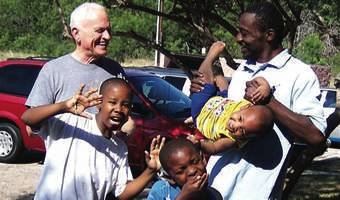
Tom Purdy (left), a longtime member of Calvary Baptist Church in Waco, enjoys time with Bryan Mason and his children, (left to right) Buddy, Cory and Elijah, as well as Bryan Jr. (not pictured).

Jan Purdy tells stories about the ups and downs of marriage, hoping to make the Masons’ dream a reality. In return, she has been impressed by Kokoa Mason’s parenting skills.

“She is great with kids, and her children are so well mannered,” she said. “I would send any kids to Kokoa’s house at any time. She’s great with them.”

Everett Smith, a social work intern, helped the Purdys and Masons navigate their relationship by highlighting their differences in communication patterns and managing conflict. If the Purdys did not know how to address a concern brought up by the Masons, they tapped into Smith’s social work knowledge and skills.

In many friendships that cross cultural, racial, or socioeconomic lines, power dynamics and simple differences can impede relational process. But that was not the case with the Purdys and the Masons, who seem to have a deeper grasp about the kingdom of God, Smith discovered. They humbled themselves as servants and learners of the other and became proud to call each other friends.

Steve Corbett, author of When Helping Hurts, distinguishes between two approaches used in helping people—relief and development. Many churches offer relief, whether that means painting a house on a mission trip, throwing a party at an orphanage overseas or paying an electricity bill for a struggling family. Relief may provide enough support for a family to get back on track, but it also may keep them from taking necessary next steps in their lives, he notes.    

Developmental work is the process of ongoing change that moves both the helper and the helped into a right relationship with their neighbors, systems around them, family members, their community and with God. That is the goal of the Family Partnership Program, a model created by the Baylor University School of Social Work and implemented in collaboration with Calvary Baptist Church in Waco.

Tapping the skills of social work interns, the program uses the natural resources, gifts and expertise of congregation members to engage and work alongside families in the surrounding neighborhood. All participants mobilize the strengths of each other to increase families’ capacity to thrive.

The Family Partnership Program “combines the best efforts of the School of Social Work, along with the best efforts of the Calvary community, to accomplish much more than either group could accomplish individually,” said Kevin Tippen, member of the Calvary Family Partnership Program advisory board.

In its first year, the program worked to engage six Waco families by utilizing church volunteers, two social work interns and a program coordinator.

The volunteers participated in a six-week book study of When Helping Hurts and a four-week training about understanding issues of poverty and the practical application of how to engage families from a strengths perspective.

Volunteers served in a long-term partner role by getting to know families or a shorter-term consultant role by offering their professional or personal expertise to families.

The program began with relationships and through conversations. Calvary members referred families with whom they were in relationship and from whom they received permission. A few members of the church created an asset map of the congregation’s skills, talents and expertise. The program moved forward because of a core group of volunteers who believed in the model and the transformative nature of helping one another.  

“We believe in this model because it is a healthy way of meeting needs of people in our church neighborhood,” said Kay Dunlap, a member of Calvary Baptist and a Family Partnership Program volunteer.

“We are able to use the gifts and talents of our members in a way that is not burdensome to any one individual. We believe this developing model will be sustainable for many years.”

Audrey Waggoner served in a research internship jointly sponsored by the Baylor University School of Social Work and the Baptist Standard, made possible by a grant from the Christ is Our Salvation Foundation of Waco.


Faith Digest

Goshen College silences national anthem. Goshen College no longer will play The Star-Spangled Banner at sporting events, school leaders announced, reversing last year’s decision to allow the use of the national anthem for the first time in the Mennonite college’s history. Some Mennonites criticized the anthem’s lyrics as glorifying war and offensive to the school’s pacifist traditions. Goshen’s board of directors said many felt the school’s “allegiance should be to Christ rather than to country.” The switch by the Indiana college, affiliated with the Mennonite Church USA, upends a February 2010 decision to permit an instrumental version of the song at athletic gatherings after decades of shunning the patriotic anthem. Supporters of the anthem, who mostly were non-Mennonites, argued it “honors our country and improves community relations by welcoming and respecting the views of non-Mennonite students.”

Faithful but not in agreement. A detailed survey by Public Religion Research Institute revealed 72 percent of Americans say it’s permissible to disagree with church teaching on abortion, and 63 percent say the same for homosexuality. Catholics closely mirror the general population’s position on abortion and church teaching, but are more open than the general population on the issue of homosexuality and church teaching. Two-thirds of evangelicals (67 percent) said they could differ with church teaching on abortion, and slightly less than half (47 percent) said the same about homosexuality. The report focused on the views of millennials (people ages 18-29) and found  they are more supportive than their parents of gay marriage. Their views on abortion closely mirror their parents’, however, with six in 10 saying abortion should be legal in all or most cases. Most millennials—68 percent—think at least some health care professionals in their community should provide legal abortions.

Young Jewish volunteerism not tied to religion. Young Jewish Americans volunteer enthusiastically for a multitude of causes, but the vast majority do not connect their service to their Jewish identity, Jewish institutions or Israel. Seventy percent of the 951 young adults surveyed said they had volunteered at least once in the past year, though much of that service was episodic, with 40 percent of respondents serving less than once a month. Only 27 percent of respondents said they volunteered based on their Jewish values, and only 10 percent indicated their primary volunteer commitment was organized by a Jewish group. Just 3 percent said the primary focus of their volunteer efforts was a cause related to Israel. The survey also showed service was linked closely to gender and religious observance, with Orthodox Jews showing the highest levels of volunteerism, at 83 percent. Of those surveyed, 78 percent of women said they had volunteered in the past year, compared to 63 percent of men. The respondents ranged in age from 18 to 35. The survey was conducted as a joint effort between the Cohen Center for Modern Jewish Studies at Brandeis University and Gerstein-Agne Strategic Communications.


Evangelicals see declining influence in United States

WASHINGTON (RNS)—Are  evangelicals losing their influence on America?

A new poll from the Pew Forum on Religion & Public Life seems to say just that, with the vast majority—82 percent—of U.S. evangelical leaders saying their influence on the country is declining.

Randall Balmer, a historian of American evangelicals, said leaders of the Religious Right such as the late Jerry Falwell promoted a “cult of victimization among evangelicalsâ€Â that may have worked in their favor at the voting booth but hurt them in the larger culture. (RNS FILE PHOTO/Courtesy of Thomas Road Baptist Church)

At the same time, their counterparts in Africa, Asia and Latin America are far more optimistic.

“There’s both a huge optimism gap and a huge influence gap in terms of the way these folks perceive things,” said Luis Lugo, director of the Pew Forum.

Researchers surveyed more than 2,000 leaders invited to attend the Lausanne Congress on World Evangelization in Cape Town, South Africa, last year.

Douglas Birdsall, executive chair of the Lausanne Movement, which worked with Pew on the survey, said American pessimism is rooted in a changed culture where Billy Graham has withdrawn from public life and government-sponsored prayer has been banned from public schools for more than a generation.

“There was a time when there was a Ten Commandments in every classroom, there were prayers in public places,” he said. “So having gone from that position of considerable influence, even though we might actually have more influence than churches in … other parts of the world, the sense is that it’s slipping from our hands.”

The perception of declining influence comes as the nation has become both more pluralistic and more secular. The vast majority of American leaders surveyed—92 percent—called secularism a major threat to evangelical Christianity.

Some evangelical denominations are starting to acknowledge pluralism in hopes of increasing their numbers. The Southern Baptist Convention, which drew the smallest attendance since World War II at a recent meeting in Phoenix, and is grappling with declining baptism rates, has launched a plan to diversify its leadership.

Evangelist Billy Graham’s withdrawal from public life has served to fuel pessimism about the influence of evangelicals on American culture. (RNS FILE PHOTO/Michael Falco)

Researchers also found evangelicals are far more pessimistic than their Global South counterparts about the current and future state of evangelicalism.

About half (53 percent ) of leaders in the United States said the state of evangelicalism is worse than it was five years ago, and nearly as many (48 percent) said they expect it to grow worse in the next five years.

Randall Balmer, a historian of American evangelicals at Barnard College, said leaders of the Religious Right—from the late Jerry Falwell to broadcaster Pat Robertson—promoted a “cult of victimization among evangelicals” that may have worked at the voting booth but hurt them in the larger culture.

“I think there is some waning of cultural influence,” he said, pointing to the politicizing of the movement as the reason for both greater visibility but also cultural decline.

“Like it or not, when you become politically active, you become associated with the politicians you support,” Balmer said, alluding to many evangelicals’ embrace of the GOP. “Once you begin to covet political power and influence, you lose the proph-etic voice.”

Researchers found just 18 percent of U.S. Lausanne representatives surveyed said religious leaders should stay out of political issues, compared to 78 percent who said they should express their political views.

Historian Mark Noll said a certain level of influence was taken for granted by evangelicals in past decades, with Graham’s prominence and fewer concerns about political involvement.

“Big churches in medium, small places knew that they were important,” said Noll, a historian of American religion at the University of Notre Dame. “And now big churches in big and medium and small places, they may not have that same sense.”

Successful congregations and ministries continue to thrive in parts of the country, especially locally, but “that local and individual strength doesn’t show up on the evening news,” Noll said.

Birdsall agreed evangelical influence may have changed, but said it still exists, although perhaps in a different form.

“Though we are losing influence, it doesn’t mean that we are pessimistic about our churches and their role in society,” he said. “They’re having influence in homes. They’re having influence in caring for those who are marginalized, those who are the poor, the oppressed. It may not be as public.”

American evangelical leaders’ sense of influence and optimism contrasted sharply with leaders of the Global South in a number of ways:

• Evangelicals in your country losing influence: U.S. 82 percent; Global South 39 percent.

• State of evangelicalism worse today than five years ago: U.S. 53 percent, Global South 27 percent.

• State of evangelicalism in your country will be worse in five years: U.S. 48 percent; Global South 12 percent.


Civil religion: lowest common denominator or common ground?

Some Baptists see civil religion as bland at best and idolatrous at worst. But others view broadly shared values of liberty, justice and acknowledgement of God’s providential care as a common ground Christians share with a majority of their fellow citizens.

American civil religion, as defined by sociologist Robert Bellah, includes rituals, symbols and beliefs institutionally separate from organized religion but derived from it. Examples include the ceremonial use of prayer in public settings and generic references to deity in political speech.

Politicians who sprinkle the language of Zion into political rhetoric and preachers who offer blessings for partisan political agendas corrupt genuine religion by dragging God down and lifting national interests up to the level of idolatry, some church-state experts insist.

Legitimate love for country becomes sinful veneration of a nation “when people allow any form of civil religion to replace heartfelt devotion to God,” said church historian Jim Spivey, senior fellow at the B.H. Carroll Theological Institute.

Spivey highlighted five warning signs of idolatrous nationalism:

• “Using empty slogans to play on people’s patriotic emotions.”

• “Parading political candidates before denominational conventions or letting them use the pulpit to promote political party agendas.”

• “Using strained biblical interpretations to justify wrongful political and social actions.”

• “Using the Bible to guarantee people economic prosperity and then identifying that prosperity with the American way of life.”

• “Ignoring biblical mandates for social activism when they inconveniently threaten the traditional American way of life.”

Baptizing partisan politics or nationalistic rhetoric with the language of civil religion essentially places God in a role subservient to national interests, said James Dunn, resident professor of Christianity and public policy at the Wake Forest University School of Divinity.

“It is making God the national mascot. It is pulling God down from God-ness to a subhuman level,” he said.

A lowest-common-denominator civil religion that invokes the name of God for blessing without regard to the content of faith rings hollow, Dunn insists.

“Ceremonial religion is gutless, sterile, empty and meaningless,” he said.

But Rob James, retired professor of religion at the University of Richmond, expressed his preference for the term “American public religion” over “civil religion,” and he sees it as common ground rather than lowest common denominator.

“There are values we share with the majority of our countrymen who may or may not be Christian,” he said.

“I think we sometimes have beat up people for embracing public religion as intrinsically idolatrous and as something the government does to manipulate them to support some of its policies.”

Baptists rightly have emphasized the importance of the institutional separation of church and state as a guarantee of religious liberty, James said.

However, he asserted, moderate Baptists—in particular—sometimes have driven socially conservative Christians into the arms of the Religious Right by failing to acknowledge the proper place of patriotism.

“We overdo it sometimes,” James said. “We make people feel like it’s an either/or proposition—that they can’t be both a committed Christian and a patriotic American. That’s a sad mistake. …

“By no means should we back away from the separation of church and state, but we need to correct some mistakes in how it is understood. Perhaps we should modulate our language so that that it doesn’t exclude legitimate Christian patriotism, rightly interpreted. I think it’s good to do, and it’s stupid not to do it.”


Baptists should understand, teach church-state separation

Because of their historic commitment to religious liberty and separation of church and state, Baptists have a responsibility to educate their fellow citizens what those concepts mean, church historian Jim Spivey said.

“Separation of church from state does not mean separation of religion from politics. Religious convictions can rarely be separated from social issues or political processes. Otherwise, they are just religious ideals without any action,” said Spivey, senior fellow at the B.H. Carroll Theological Institute.

Darren Valdez of Staten Island, N.Y., prays at evangelist Billy Graham's 2005 crusade in New York. (RNS FILE PHOTO/Michael Falco)

“Individual Christians must remain politically and socially engaged. Pastors must teach and preach prophetically, speaking to those social and political issues that the Bible clearly calls them to address. Churches should be involved in their communities to the degree that they become salt and light concerning social and political issues that affect those communities.”

Spivey noted the role Baptists played in securing the rights of religious liberty protected in the First Amendment as a positive example of how Christians can shape public policy for the common good.

“But the church as an organization must remain separate from the state as an organization,” he urged. “There must be an absolute separation of the two institutions, and the church must never receive funding from the government.

“Churches must maintain this separation for many reasons, but foremost among them is the need to preserve their ability to speak and act prophetically without compromise induced by financial or other gain.”

As a current example, Spivey found fault both with churches that accept government money for faith-based initiatives and with critics who claim churches’ engagement in faith-based social services violates the principle of church/state separation.

“The church has always been involved in faith-based initiatives such as feeding, housing and caring for the poor and homeless. We must not avoid these obligations because we say they are the responsibilities of government. The Bible makes it clear that churches share in this responsibility,” he said.

“On the other hand, it is equally wrong for churches to beg the state to pay them for doing what God provides them the resources to do. It is a fitting expression of Christian citizenship for churches to engage in faith-based initiatives, but it is inappropriate for them to accept state funds to do so.”


On the Move

Mike Cooper to First Church in Smithville as youth minister.

Natalie Foreman to Flatonia Church in Flatonia as summer youth and children’s minister.

Keith Guthrie has resigned as minister of youth at First Church in Mexia.

Cary Hilliard to First Church in Longview as pastor from First Church in Orangeburg, S.C.

Larry Odem to Choate Church in Kenedy as pastor.

Gordon Moore to Galloway Avenue Church in Mesquite as pastor from Immanuel Church in San Angelo, where he was associate pastor.

Jeff Parker to First Church in La Vernia as worship pastor and minister to families.

Jason Shuttlesworth to Wooster Church in Baytown as pastor from Avondale Church in Sweetwater.

Bryan Waterbury has resigned as youth and music pastor at Oak Hills Community Church in Floresville.