Single adults represent tremendous mission field

A hidden mission field exists—one that encompasses more people than live in many small countries. And it could be just outside the walls of any given church.

Single adults make up more than 40 percent of the U.S. population, according to some studies, and Dennis Franck believes church members just need to open their eyes to see them.

Single adults make up more than 40 percent of the U.S. population.

"We're becoming a single nation," noted Franck, national director of single adult/young adult ministries for the Assemblies of God.

And, he admits, he didn't really see singles until he became a youth pastor in the 1970s and started seeing them all around him—at church, at community events, in the grocery store.

"My wife and I started listening to their stories … and saw the need," he said.

Part of the inability to see singles as a unique group is because churches, for the most part, are family-focused.

"Churches are very family-oriented," noted Linda Hardin, the single adult ministry consultant for the Church of the Nazarene. "That's both a good and a bad thing."

Congregations need to minister to families, but, Hardin pointed out, singles can feel left out.

"I want to strengthen families … but not to the exclusion of the needs of singles," Franck agreed.

Both denominational workers added the singles population will continue to grow, particularly as aging baby boom-ers divorce or are widowed.

"We are becoming a singles nation," Franck said. He defines singles as unmarried adults, aged 18 and older, who are singles by "chance, change or choice, whether theirs or someone else's."

Personal experience opens some eyes to the need. Tommy West had been in the ministry 30 years when his marriage unraveled. Because he had been serving in Georgetown and knew the Central Texas city, he decided to remain and joined Crestview Baptist Church.

Single again, he joined Crestview's single adult Bible study group with about 30 members. Within about six months, he became the teacher. Later, the church called him as part-time singles minister, and then as full-time minister of education. "Still there was that core group … and some of that group is still in ministry," he said.

Even when a congregation recognizes the group, members often aren't sure how to minister to and with singles. "A lot of churches have a college and career class and think that, therefore, 'We have a singles ministry,'" West said.

To be effective, ministry to the group must take into account singles' needs. Churches even must recognize the difference between young adult and single adult ministries. Most young adults, those 18 to 25 years old, don't usually describe themselves as single, but rather refer to themselves as not married yet, Franck ex-plained.

He promotes ministry to two groups—singles 18 to around 30 and those 30 to 60 years old—with flexibility as life stages change. Some remain with the first group past age 30, and some stay with the second group after 60 rather joining a maturing adult ministry.

Regardless of age, the key is to meet needs—particularly for friendship and socialization. Singles are "looking for closeness. … They're looking for commonality, not just marital status," said Stacey Hamby, a single parent and a member of Pleasant Valley Baptist Church in Liberty, Mo.

"So many are lonely, especially single-agains. … Many have almost become recluses," West said. "Many are hungry for relationship, … and many, I think, are looking for and are hungry for a faith relationship."

About three years ago, West discovered Chuck, a man living in his car on Crestview's parking lot. Chuck was angry over his situation and had not been in church for about 30 years. But as he was drawn into the singles ministry, "he made the connection horizontally (with people) and vertically (with God)," West said. Now Chuck works for the church.

Franck also sees friendship as common to singles, regardless of age. "They go home to an empty apartment. They need same- and opposite-sex friendships," he said. "Churches need to provide opportunities. If the churches don't, where will they (singles) find it? I believe churches have dropped the ball."

But singles must remain aware they need more than connections with other singles, Hardin noted. "There must be balance. Singles have got to have both single and married friends, and they even need that balance in church life."

While singles perceive different needs as their life stages change, they share other common needs. Not all single individuals want to marry, but many do. Franck believes they need discussions about healthy dating and healthy marriage. Some need premarital counseling. Others who have been divorced or widowed may need re-marital education.

They need opportunities to discuss major life issues—intimacy, finances, parenting, employment and other needs—from a single perspective, Franck added.

And whether they recognize it or not, singles need opportunities for service. Many who have been deeply wounded can find renewed compassion through helping others. "Service opportunities are important because people in general are selfish, by nature and by necessity. Singles especially are selfish by necessity … because they have to do everything for themselves," Franck said.


Singles ministry tough, but vital

RALEIGH, N.C.—Greg Belcher understands why many churches avoid keeping or starting a ministry specifically to "single adults."

It's tough.

A large part of the difficulty in singles ministry is the huge umbrella the term covers.

The Assembly of God's national Caribbean cruise for single adults drew about 175 people from 25 states. "Purposes of the cruise were for a healthy vacation, fun, travel and personal growth," said Dennis Franck, national director for single adult/young adult ministries for the Assembly of God churches.

"Singles" are not monolithic but fall across every age range and life spectrum. They are never married—like Belcher—divorced, separated and widowed. And they come in all ages, from very young adults just out of high school to senior adults who have lost a spouse after 50 years together.

Single adults have unique needs. Those under age 30 are concerned primarily with intimacy and careers. Their intimacy needs are wrapped up in whom they will marry. Over age 30, their needs are transitional, he said. Some have gone through a relationship that has ended, and some are coming to terms with the fact they may never marry.

Many singles are parents and often have needs. Many churches hesitate to bring on a "needs-based ministry," Belcher said. And unfortunately, some churches don't quite know what to make of unmarried adults and are clumsy in their approach.

Belcher, singles pastor for the large Hope Community Church in Raleigh, N.C., committed to reach the bulging demographic of adults who are not married. Younger singles, especially, cringe at the "single" designation, but Belcher has not found a better term.

About 95 percent of people will marry, but nearly half will divorce, he said. Of those who get remarried, two-thirds will divorce. If they marry again, three-fourths will divorce.

"The church is not helping them to get whole," said Belcher, who admits many church members perceive single adults, especially never-marrieds, with an attitude that may be best defined as "mistrust."

Some never-marrieds skip their high school class reunions because they dread the incredulity and inevitable questions—"You're not married? You don't have kids?"—as well as the implication there is something wrong with them.

Still, Belcher views singles ministry as "kind of a marriage ministry." Since the vast majority of people will one day marry, he wants to help them develop a strong identity in Christ that will lower divorce rates.

"Singles ministry is, for me, an amazing opportunity, an untapped entrepreneurial opportunity to change lives like never before," Belcher said.

In Raleigh, often identified as a premier city for singles in America because of its universities and high-tech work force, few churches take advantage of what every corporate marketer knows—how to identify their product to the singles market.

Another difficulty is that many single adults are single parents. Lori Little, who has written curriculum for single moms, said if the mothers are not involved in the body of Christ, neither are their children.

Of 18 million single moms in America, she said, only about 10 percent are in church.

When single adult ministry was prominent, with publications devoted to Christian singles and national conferences held for them, Labor Day events at national conference centers like Ridgecrest drew 3,000. This year Belcher said organizers expect 300.

A major singles event in Oklahoma was cancelled for lack of registration. "The churches just aren't pushing it," he said.

"You have to work hard to make sure a single adult ministry stays Christ focused," Belcher said. "The gravitational pull of single adult ministry is to become something you don't want it to be."

Belcher, who was a senior pastor in Marietta, Ga., before joining Hope Community as its first full-time singles minister, said the number of people who have come through the church through various ministries who indicated they are "single" has increased from 800 to 2,400 in the past 12 months. About 900 circulate fairly regularly in the singles ministry.

Nationally, only 13 percent of all churches report offering single adult-specific activities.

According to researcher James Tanner, only 2.6 percent of churches that offer some form of singles activity (that is 2.6 percent of the 13 percent) are viewed to have single adult ministries that are growing and attracting new single adults to the church.

Rich Hurst, director of singles ministry resources with David C. Cook Publishing, said when he was pastor at McLean Bible Church, a group of over-30, never-married professionals told him, "We are the most ignored group in this church."

Maybe they're just too tough.


Political rhetoric more religious than voters

WASHINGTON (RNS)—Has America gotten more religious—or just American politics?

The country has grown less religious since the 1970s, while frequent churchgoers now are much more likely to vote Republican or support the Tea Party, according to recent studies.

Pennsylvanian Joan Falcone attends a Tea Party rally at the state capitol in Harrisburg, Pa. New research indicates the Tea Party is as much about increasing the role of religion in government as about cutting taxes and limiting the size of government. (RNS FILE PHOTO/Sean Simmers/The Patriot-News)

As a result, faith-filled rhetoric and campaign stops make Americans appear more Christian than they really are, according to Mark Chaves, a Duke University professor of sociology and religion.

The rise of megachurches, with their memberships in the thousands, also fuels the misperception that most Americans attend services weekly, when only one in four Americans actually do, he added.

"The Michele Bachmanns and Rick Perrys of the world are playing to a base that's much smaller than it was in the 1970s and 1980s," said Chaves, whose new book, American Religion: Contemporary Trends, analyzes trends based on data from the General Social Survey and the National Congregations Study.

Using data collected between 1972 and 2008, Chaves said, America not only is losing its religion, but also has lost confidence in religious leaders and wants them to be less involved in politics.

Researchers say the trends reflect myriad factors—disillusionment with clergy and political scandals; the country's increasing diversity, fueled by immigration and intermarriage; and younger generations that tend to be more highly educated and socially liberal.

Chaves also interprets these trends as a "backlash" against the politicization of religion that began with Jerry Falwell and the rise of the Religious Right in the 1970s.

Mark Chaves is a professor of sociology and religion at Duke University Divinity School. (RNS PHOTO/Courtesy Duke University )

The findings—along with new research by Harvard professor Robert Putnam and Notre Dame professor David Campbell, co-authors of American Grace: How Religion Divides and Unite Us—paint a shifting portrait of American politics.

The Tea Party's sinking approval rating—currently at 20 percent, below Republicans, Democrats, atheists and Muslims—signals a growing discomfort with mingling faith and politics, including the kind of "overt religious language and imagery" sometimes used on the campaign trail, Putnam and Campbell recently wrote in The New York Times.

What's more, Putnam and Campbell say, the Tea Party is much more religious than originally thought. "The Tea Party's generals may say their overriding concern is a smaller government," they concluded, "but not their rank and file, who are more concerned about putting God in government."

Among the other findings in American Religion:

• There is a declining (though still very high) belief in God or a higher power: In the 1950s, 99 percent of Americans said they believed in God; in 2008, about 93 percent did.

• Nearly 20 percent of Americans now say they have no religion, compared to just 3 percent in 1957.

• Only 25 percent of Americans attend weekly religious services, although up to 40 percent claim they do.

• Fewer Americans approve of their religious leaders getting involved in politics. In 1991, about 30 percent of Americans strongly agreed religious leaders should avoid political involvement; by 2008, 44 percent felt that way.

• Belief that the Bible should be taken literally dropped from about 40 percent in the early 1970s to about 30 percent in 2008; Chaves said this trend corresponds with the rise in college education.

From 1972 to 2008, the percentage of people with great confidence in religious leaders declined from 35 percent to less than 25 percent. A sharp dip around 2002 was probably due to the Catholic Church clergy abuse scandal, but otherwise the trend consistently has been downward for decades, along with interest in joining the clergy.

Immigration from Africa and Asia, intermarriage and assimilation have diversified America's religious beliefs since the early 1970s.

Continuing that trend, Chaves believes Americans will grow more accepting of Muslims over the next generation, as has happened with other minorities.

He cited Putnam and Campbell's "Aunt Susan Principle," the idea that people are less suspicious of other faiths when someone they know is a member.


Baylor alumnus leads evangelical up-and-comers

WENHAM, Mass. (RNS)—For the past decade, sociologist Michael Lindsay has been living the very phenomenon he's studied in depth—evangelicals climbing the ranks of secular institutions and becoming American elites.

Yet in a surprise move, this 39-year-old rising star traded a tenure-track position at Rice University to become president of Gordon College, a respected outpost of evangelicalism 25 miles north of Boston.

Baylor University alumnus Michael Lindsay, 39, will become the youngest president of Gordon College when he is inaugurated Sept. 16.

Some of Lindsay's former students have wondered why he would leave a highly ranked university with a growing, well-funded sociology department. For Lindsay, it's a matter of calling.

"I know that I'm the right person for Gordon," Lindsay said, "because what I bring to the table today is what Gordon happens to need right now."

Lindsay, a Baptist and a Baylor University alumnus, burnished his national reputation with his 2007 book, Faith in the Halls of Power: How Evangelicals Joined the American Elite. His broader research interest deals with leadership, and on Sept. 16, he'll be inaugurated as the youngest leader in Gordon's 122-year history.

Although he's never been a college president before, Lindsay has spent countless hours talking with CEOs, big-city mayors and even former U.S. presidents about their lives and work. His Platinum Study, featuring interviews with 550 leaders in various fields, is said to represent the largest body of interview data ever collected from a cross section of American leaders.

He's also no stranger to helping institutions grow. He's built a reputation as a capable fundraiser for numerous projects, including Rice's Program for the Study of Leadership, which he founded.

Now Lindsay plans to leverage both his experience and his power-packed Rolodex to help Gordon raise its profile. Starting Oct. 14 in downtown Boston, he'll conduct a series of onstage interviews with corporate executives whom he's interviewed for the Platinum Study.

While snagging Lindsay is a coup for Gordon, Paul Corts, president of the Council for Christian Colleges and Universities, hopes Lindsay can help galvanize interest in data collection and analysis across Christian higher education.

"We want to take advantage of his background and skills," Corts said. "Research is increasingly important for us and our institutions. … So having people like this in our leadership will be very helpful to our whole movement."

If personal style is any indicator, Lindsay is apt to hold Gordon and Christian higher education to high standards. Lindsay expected all his research assistants to wear sharp business casual attire when working on his projects. If a student's cell phone ever rang during class, Lindsay would assess a $5 fine to help pay for an end-of-semester party at his home.

"He was the only faculty member in the department who was always here every Saturday," said Elaine Howard Ecklund, who also teaches in Rice's sociology department. "When you're writing personal thank-you notes to everyone you meet, in addition to doing your scholarly work, it means you put in a lot of hours."

Here at Gordon, Lindsay's stately new office looks as if he hasn't had time to unpack. There's no dust, clutter or signs of work in progress—just books in shelves so high that they require a ladder to reach.

Lindsay smiles warmly as he talks about three young daughters and his wife, Rebecca. He says he feels comfortable at Gordon, despite his youth and lack of experience in college administration.

In his work, Lindsay said, he found the most successful leaders are those "who found their talents and skills matched up with what was needed at a particular time at a particular organization."

Location, however, doesn't hurt. Boston, he said, "is where the world comes to study," and Gordon's location is an ideal position to build bridges between evangelicals and the broader community.

"Because there's so much intellectual activity in Boston, there's an opportunity for conversation, for alliances, for collaboration that you just don't find in other places," he said.

In studying leadership, Lindsay says he's not pushing an evangelical agenda or "trying to help people who I like to get power or have influence or shape public policy."

Instead, he's curious how effective leaders get to where they are, and what helps them exercise good judgment over the long term.

Lindsay followed his mother, Susan Lindsay, from Catholicism to evangelical faith in his youth. At First Baptist Church in Jackson, Miss., an 11-year-old Lindsay committed his life to following Jesus.

At Rice, many Christian students knew him as an evangelical and wanted to work with him, according to Orestes "Pat" Hastings, one of Lindsay's former research fellows. But Lindsay took pains to assemble teams where Christians and non-Christians could bring their respective viewpoints to bear.

"He thought that by having a diverse research team, he was less likely to miss an insight or important idea," Hastings said.

Once he gets settled, Lindsay plans to teach sociology at Gordon and to stay active in sociological research. Meanwhile, some are hoping his career path will inspire more evangelicals to also find their callings in Christian colleges.

"It's a very hopeful sign for Christian higher education that Gordon has been able to attract him," said Michael Beaty, a Baylor University philosopher who studies Christian higher education. "I'm hopeful that it means we're going to see an increasing number of senior administrators who return to Christian colleges and universities (after finding) success in secular academic institutions. But we'll have to wait and see."


Labor Day no holiday for disaster relief volunteers

ALPHARETTA, Ga. (BP)—Labor Day was no picnic for Southern Baptist Disaster Relief volunteers involved in responses to flooding along the East Coast and in North Dakota.

About 60 men and women working through North Carolina Baptist Men prepare thousands of meals for residents left without utilities after Hurricane Irene. (BP PHOTO/Mike Creswell)

And those responses to floods and fires were afoot even before Tropical Storm Lee dumped up to a foot of rain along the Gulf Coast areas of Louisiana and Mississippi. The storm then moved northeast, where it spawned tornadoes in Alabama and Georgia, damaging dozens of homes and causing flash floods in the Atlanta area. At least two people died and 16,000 customers were left without electricity as a result of Lee, according to the Associated Press.

In the wake of Hurricane Irene, Mike Flannery, state disaster relief director for the New York Baptist Convention and a director of missions in Buffalo, reported recovery work will be a crucial need in upper-state New York and north New Jersey, where water levels were receding but were not yet low enough to insert mud-out units.

"We are desperate for mud-out units," said Flannery, who cited a minimum need for six mud-out teams from other state Baptist conventions.

Flannery also is having to educate inexperienced New York flood victims who don't know they must gut their homes down to the framing and do mold and mildew removal before re-occupying their houses.

Flannery is coordinating three emergency food-service operations—two in Washingtonville, N.Y., run by New York and Mississippi Baptists, and another at Trinity Baptist Church in Schenectady, run by 40 feeding volunteers from Kentucky. The Schenectady operation—preparing 6,500 daily meals—has the capacity to churn out 15,000 meals a day.

Flood damage in Wilmington, Vt., underscores the need for mud-out volunteers requested by Baptist Convention of New England officials. (BP PHOTO)

"Please tell Southern Baptists to keep us in prayer," Flannery said. "In times of crisis, people point their eyes and ears to the Lord." Flannery said the New York flooding is the most pervasive disaster in his five years in disaster relief in the state.

Volunteers from 25 of the 42 state conventions are assisting in many other disaster relief responses in the 11 states pounded by Hurricane Irene, including feeding units in North Carolina and Virginia.

In North Carolina—where Irene struck its eastern coast and 42 counties have been declared disaster areas—Southern Baptist Disaster Relief fielded more than 1,200 job requests for mud-out and chainsaw work and completed about 600, reported Gaylon Moss, state disaster relief director for the Baptist Convention of North Carolina.

"In North Carolina, four have accepted Jesus as Savior, more than 1,200 volunteer days have been recorded, and about 88,000 hot meals have been prepared," Moss said. Disaster relief units from seven state conventions have responded at 13 separate sites across North Carolina.

Mark Madison of the Baptist Convention of New England said needs are widespread in that region.

"We're focusing on four locations in southern Vermont and in Montpelier. We have 100 jobs assessed and ready to work. We really need 12 more mud-out teams as well as chaplain/assessment teams to make an impact," Madison said.

In all, after Hurricane Irene, 375 chainsaw and mud-out jobs have been completed; 13 people have made decisions for Christ through 725 gospel presentations and ministry/chaplain contacts; and nearly 2,800 showers and laundry loads have been provided.

To date, Southern Baptist Disaster Relief units have prepared nearly 268,000 meals for Irene's victims, volunteers and responders.

Bruce Poss, disaster relief coordinator for the North American Mission Board, supports Madison, Flannery and others in their desperate pleas for mud-out teams from other parts of the country.

Mud-out and feeding continues in Minot, N.D., where 66 people have made professions of faith in Christ and volunteers have delivered 123,000 meals over the last eight weeks, Poss added.

"We still need to show a strong presence in Minot, although a lot of that will start closing down in mid-September, and all of it will be shut down by the end of the month."


Grieving parents learn lessons about trust from tragedy

LUBBOCK—In the Lubbock-Cooper school district, seniors teach a seminar on a topic of their choosing. Kelsey Vines' turn came Sept. 2, 2008.

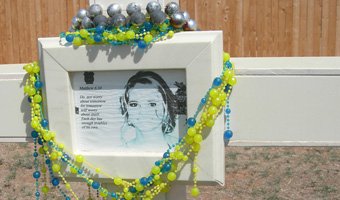
Thom Vines appreciates the memorial garden dedicated to the memory of his daughter, Kelsey, created by her twin sister, Kayla, and members of her graduating class. (PHOTO/George Henson)

"You can lead the class on anything you want to, and she led the class on Matthew 6:34—which I don't think is a coincidence," said her father, Thom Vines. "It says, 'Don't worry about tomorrow, for tomorrow will take care of itself.'"

A few hours later, Kelsey was killed. She was driving home from school when the steering controls on a 48,000-pound dump truck broke and hit the car she was driving.

Kayla, her twin sister, was sitting next to her, but her physical injuries were limited to an ankle and a few scrapes and bruises.

The days that followed were traumatic for all the members of the Vines family, as well as for Kelsey's boyfriend, John Michael Vestal.

Her father turned to Scripture to heal his broken heart and bruised faith.

"As much as anything in the past years and months, it's Proverbs 3:5 that I keep coming back to. We don't know why this happened. We certainly don't like that it happened. But we don't lean on our own understanding. We trust God," Vines said.

That deep-seated trust led Vines and Vestal to write a book, Tragedy and Trust: Can You Still Trust God After Losing a Child?

Vines describes Vestal as "without a doubt the single best human being I've ever met—a deep, deep abiding faith and rock solid."

While he is glad his daughter chose to spend her last 11 months of life in a relationship with such an exemplary young man, Vestal's character also is the source of some pain.

"Kelsey was already a Christian, but we watched her faith flower with him. And what they lost together, could have had together, that's part of the pain," he admitted.

Vestal's spiritual maturity beyond his years served as a steadying influence for Vines after his daughter's death. "After the accident, as much as anybody, he became my spiritual teacher," he said.

Vines wrestled with the question: "Why do you trust God?"

"I thought long and hard about this, and then I suddenly realized the answer was right there in front of me all the time. The reason we trust him is because he loves us," Vines said.

"Why does he love us? Because he created us, and we are his children. Just as I love my children, he loves us on an infinite scale.

"So, I can accept it. I don't understand why this happened —how this was part of his will. But I know he loves us, and therefore, for some reason I do not understand, this is the way it had to be."

Even so, Vines acknowledged he still misses his 18-year-old daughter, even after three years have passed.

"To be sure, there's still human grief. The first thing we think of each morning when we wake up is Kelsey. The last thing we think of at night is Kelsey. Every day I have one or two of what I call 'Kelsey moments.'

"Despite all that, we love our Lord, and that's what keeps us going. And I remind myself every day that I will see her again," he said. "We will always have grief. On this side of the grave, it will never be over, but what awaits us beyond is wonderful.

"The last three years have been the most horrible and most wonderful time of my life.

"The horrible is easily apparent—we lost our child, which for a parent is as bad as it gets. But the growth and the coming to the Lord and the joy we've found in that has been wonderful."

Becky Vines finds solace in knowing her daughter is in the arms of her Heavenly Father. She recalls stories that remind her of her daughter's faith.

One story is of a young man Kelsey offered a Bible to at the end of her junior year in high school.

He refused, but on the second day of school following the summer break, he asked Kelsey if he could still have the Bible.

Days later, he was at the visitation at the funeral home asking her family if they wanted it returned.

"I told him to wear it out," her father said.

Kelsey's parents agreed healing has been a process.

"I know where she is, and that gives me peace. I say, 'I know where you are, and I know you're safe and that I just can't call you on the phone.' And that's the way I have to handle it," her mother said.

For her father, a couple of dates mark his healing. The first is July 22, 2009.

"The accident site had always been the place where Kelsey died. … On July 22, it just popped into my mind, 'That's where Kelsey went to heaven.' Not where she died, but where she went to heaven.

"It took me 10 months, but that was a real turning point—when I was able to look at the place not as a negative, but a positive. I go by that spot nearly every day, and it's still painful, but it's also a place of hope," he said.

The second marker was last fall when he made contact with the driver and the owner of the dump truck to let them know of his forgiveness of them.

Vestal, now 22 and a teacher and coach in the Lubbock-Cooper school district, said the book allowed him to track the spiritual journey and see God's hand in his life.

"It's been cool to see how far God has taken us. It's three years later, and we're still here. God has a plan for our lives, and the plan God had for our lives did not stop. It continues on. The plan God had for our lives did not change at all," he said.

Just as all their lives have continued, her mother said, Kelsey lives on as well.

"People still send her Facebook messages: 'I got baptized today because of you.' Kids go on mission trips and tell her story, so she's still giving testimony for the Lord."

Figuring out why is not something Vines worries about anymore.

"We don't know, but we trust—that's the core of the book, the core of our experience," he said.

The book is available on Amazon.com as a paperback and an e-book.


Baptists among religious leaders in event to mourn victims of 9/11, promote religious freedom

WASHINGTON (ABP) – Prominent religious leaders of various faiths joined Sept. 8 in Washington to commemorate the 10th anniversary of the terrorist attacks of Sept. 11, 2001.

Baptist Joint Committee Executive Director Brent Walker, Cooperative Baptist Fellowship Executive Coordinator Daniel Vestal and Carroll Baltimore, president of the Progressive National Baptist Convention, were among leaders in the interfaith group formed to celebrate America’s faith communities’ role in bringing healing to a nation still recovering from fear and division that have defined the country during the last decade.

Along with mourning victims of 9/11, the coalition, called Shoulder to Shoulder, highlighted religious organizations that have led grassroots efforts to unite religious communities across the country in the face of anti-Muslim sentiment.

Shoulder to Shoulder was formed last year to fight anti-Muslim sentiment by encouraging freedom and peace. In Thursday’s ceremony at the New York Avenue Presbyterian Church in Washington, the leaders celebrated the religious community’s role in helping to heal the nation.
 
“A decade after our nation was attacked, we honor those who lost their lives on Sept. 11, not only with uplifting words and enduring memories, but with a renewed commitment to the common good and the bedrock values that have made America a land of opportunity for people of diverse ethnicities and faiths,” the 26-member coalition said in a joint statement.
 
“The time has come to reclaim the sense of community and shared purpose that guided us through those trying days a decade ago. Fear-based politics and discrimination against Muslim Americans and those perceived to be Muslim disgrace the memories of those who perished on Sept. 11, and desecrate the core values that make our nation great. The presence in America of people of all faiths and belief systems enriches our diverse country. The ideals that unite us are more powerful than the differences that divide us.”

After the event, Walker spoke a word of support for the families surviving those killed in the attack and the importance of religious liberty for all, particularly for Muslim Americans.   

“Our lives were changed forever on 9/11 when we suffered the most hellish act of aggression on our native soil since the War of 1812,” Walker said. “So, on this 10th anniversary, we remember those whose lives were lost and the families that survived them. We also pledge to continue our efforts to protect religious liberty for all people, particularly religious minorities. When anyone’s religious liberty is denied, everyone’s is in jeopardy.”
 
Other coalition members include American Baptist Churches USA, The Episcopal Church, the General Board of Church and Society of the United Methodist Church, the Islamic Society of North America, the National Council of Churches of Christ in the USA and the Religious Action Center of Reform Judaism. 

In the days after the attacks nearly 10 years ago, the BJC issued a statement calling for a national response that is “careful not to compound the tragedy by sowing seeds of hate, casting blame where it does not belong, and seeking vengeance instead of justice.” It continued, “The response should be directed in ways that respect the religious freedom and civil liberties of all Americans, reject religious and ethnic stereotyping, and avoid the loss of innocent life.”


–Jeff Huett is director of communications for the Baptist Joint Committee.


Texas ranks second nationally in food insecurity

AUSTIN—Texas has the second-highest rate of hunger in the nation, the U. S. Department of Agriculture announced Sept. 7. And according to a new report sponsored in part by the Texas Hunger Initiative , hunger even exists in some of the state’s wealthiest counties.

According to USDA, 18.8 percent of Texas households, or one in five were at risk of hunger between 2008 and 2010.

Coming on the heels of the announcement, the Texas Food Bank Network, the Texas Hunger Initiative and First Choice Power released “Hunger by the Numbers: A Blueprint for Ending Hunger in Texas.”

The 508-page report includes a scorecard for each of the 254 counties in Texas, as well as recommended resources for funding and programs to fight at a local, statewide and national level.

“Hunger by the Numbers: A Blueprint for Ending Hunger in Texas” incorporates the newest national data on hunger made available by Feeding America, the nation’s network of food banks, along with U.S. Census data and statewide data on usage of federal and state programs.

{vimeo}28065204{/vimeo}
Baptist Global Relief

“As Texans read this report, they will learn some startling facts about the size of the hunger problem in their state, which currently ranks second-worst in the nation when it comes to hunger," said Jeremy Everett, executive director of the Texas Hunger Initiative, a partnership involving the Baylor University School of Social Work’s Center for Family and Community Ministries and the Texas Baptist Christian Life Commission .

“They also may be surprised to learn the extent of the hunger problems in their own back yards.”

In Harris County, where Houston is located, 18 percent of the people are food insecure. In Hidalgo County, in the lower Rio Grande Valley, the number is 24 percent.

Even Montgomery County, home to The Woodlands and some of the state’s most affluent ZIP codes, has a food insecurity rate of 15 percent, meaning one in seven residents is at risk of hunger.

For more information and to view each county’s hunger scorecard, visit www.firstchoicepower.com/HungerGapReport .


Texas Tidbits

ETBU awarded foundation grant. The Butterfield Memorial Foundation awarded a $50,000 grant to East Texas Baptist University. The grant from the Christian charitable foundation serving community health needs will fund scholarships for upper-level nursing students in the Frank S. Groner Endowed Memorial School of Professional Studies. ETBU nursing students who demonstrate a strong commitment to the Christian faith and see nursing as a means to use their gifts and skills as a ministry are eligible for Butterfield Memorial Foundation scholarships.

Tillman to direct theological education. The Baptist General Convention of Texas has tapped Bill Tillman, T.B. Maston Professor of Christian Ethics at Logsdon Seminary, to leads its theological education efforts. Tillman began on a part-time basis Aug. 16 while he completes his fall teaching schedule at Logsdon. He will begin serving as full-time director of theological education Jan. 1. Tillman has been the T.B. Maston Professor of Christian Ethics since 2000. He taught at Southwestern Baptist Theological Seminary from 1981 to 1997, first as an assistant professor and later as an associate professor. A longtime Texas Baptist leader on education and ethics, Tillman has served on numerous BGCT boards, including the Christian Education Coordinating Board and the Texas Baptist Christian Life Commission. He holds bachelor's and master's degrees from Southeastern State College, now Southeastern Oklahoma State University. He earned his doctorate from Southwestern Seminary.

Historical Society event slated for Amarillo. The Texas Baptist Historical Society will hold its annual fall meeting at 11 a.m. Oct. 24 in the Heritage Ballroom A1 of the Amarillo Civic Center. The luncheon meeting will include the election of officers, recognition of the history award winners, and a presentation on Mary Hill Davis by Jennifer Hawks, a student at Baylor University's Truett Theological Seminary. The cost of the luncheon is $10 payable at the door. For reservations, contact Autumn Hendon at the Texas Baptist Historical Collection, autumn.hendon@texasabaptists.org, (972) 331-2235. Deadline for reservations is Oct. 17, and seating is limited.

Baylor core curriculum makes "A" list. Baylor University was one of only 19 institutions nationwide to earn an "A" for its core curriculum, according to a report on the state of general education at the nation's colleges and universities from the American Council of Trustees and Alumni. No other Big 12 university and only three other Texas institutions made the "A" list. The study—posted at www.WhatWillTheyLearn.com— looked at curriculum offerings at 1,007 major public and private colleges and universities in all 50 states. Institutions are assigned a letter grade ranging from "A" to "F" based on how many of seven core subjects they require— composition, U.S. government or history, economics, literature, math, science and foreign language at an intermediate level.


On the Move

Benji Morrison to Mount Carmel Church in Whitehouse as student pastor.

Austin Stevenson to Calvary Church in Tyler as student pastor.


Faith Digest

King Arthur loses burial battle. A self-styled druid who identifies himself as a legendary British king lost his bid to rebury immediately prehistoric human remains at a sacred pagan burial site. John Timothy Rothwell—who changed his name to King Arthur Pendragon in court documents—lost his court battle to win custody of the cremated remains from a team of experts at Sheffield University. London's High Court ruled scientists had not acted unreasonably three years ago when they dug up the remains of more than 40 bodies, thought to be more than 5,000 years old. Forensic experts now are allowed to keep the ashes for study and analysis until 2015. Researchers are expected to rebury them in the same spot where they were found at England's prehistoric pagan stone circle at Stonehenge.

Quote by first century apostle, not First Avenger. "We often suffer, but we are never crushed. Even when we don't know what to do, we never give up." Who said it? According to a recent poll, more Americans attributed the passage to comic book hero Captain America, Martin Luther King Jr. and former President George W. Bush than its actual source—the Apostle Paul in the New Testament book of 2 Corinthians. A survey commissioned by the American Bible Society found 56 percent of Americans surveyed misattributed the quote. Only 12 percent correctly attributed it to the Bible. The survey by Harris Interactive was conducted online among 2,572 adults.

Failed circumcision gets mom probation. A 30-year-old Portland, Ore., woman who botched a home circumcision of her 3-month-old son has been sentenced to five years probation. Keemonta Peterson, inspired after reading the Old Testament, decided she wanted her son to be circumcised. But because she believed he was too old to be circumcised by doctors, she decided to do it herself, after watching YouTube videos. She called 911 after the failed circumcision left her son bleeding uncontrollably and in great pain. Peterson pleaded guilty to first-degree criminal mistreatment and agreed to undergo mental health treatment and work with a mental health probation officer. Two other charges of abuse were dismissed. Doctors completed the circumcision and the boy has fully recovered, Multnomah County Deputy District Attorney John Casalino said.

Churches to reclaim property. A prominent Czech church leader has welcomed an agreement that would allow churches to reclaim land and buildings seized under communist rule but forfeit state subsidies in return. A draft settlement finalized in Prague allows religious groups to retrieve assets confiscated after the 1948 communist takeover, while obtaining financial compensation for others. Separately, Turkish Prime Minister Recep Tayyip Erdogan announced his government will return properties seized from recognized minority religious groups in 1936. Some Catholics and most Protestants are not on the government's official list of minority religions.

Compiled from Religion News Service


Baptist Briefs

Judge grants church planter's motion to stay in U.S. An immigration judge granted a motion allowing a Baptist church planter facing possible deportation to Mexico to remain in the United States. Hector Villanueva, who arrived in the United States 38 years ago as a toddler, found his legal status in jeopardy last August when his application for citizenship revealed a 16-year-old felony conviction in California. That was before he accepted Christ in prison and prior to passage of a law that immigrants who commit a felony can be deported. Villanueva, the bivocational pastor of Iglesia Bautista La Roca in Siler City, N.C., receives support from the Cooperative Baptist Fellowship of North Carolina as a church planter. In granting Villanueva's request for waiver, the judge said the evidence indicates the father of six has lived an "exemplary life" since his prison term and that he is "completely rehabilitated." While granting the waiver, the court warned Villanueva such a waiver can be granted only once, and any conflict with the law in the future would be grounds for immediate deportation.
 
Australian Baptists oppose same-sex marriage. Baptist leaders in Australia issued statements recently opposing a proposal to change the current legal definition of marriage to include gay couples. John Beasy, national president of Australian Baptist Ministries—formerly the Baptist Union of Australia—said members of Baptist churches in the nation "overwhelmingly support" the current definition of marriage as between a man and woman and oppose moves to change it. "A strong society needs a strong commitment to marriage and family," said Rod Benson, an ethicist and public-issues spokesperson for Australian Baptist Ministries. "Marriage is best understood as the union of a man and a woman, and the law is best left as it is." Australia's current 1961 Marriage Act defines marriage as "the union of a man and a woman to the exclusion of all others, voluntarily entered into for life." A same-sex marriage bill introduced in 2009 would have removed all discriminatory references based on sexual or gender identity from the 1961 law. The bill did not pass, but Parliament passed a motion asking all 226 members to consult with their constituents about whether gays should be allowed to marry. More than 50 church leaders representing Catholic, Orthodox and Protestant denominations recently wrote letters to Parliament members, kicking off a campaign supporting the current definition of marriage as between a man and woman.

Bibles needed for India. Book-Link, an arm of Fellowship of Baptist Educators, is collecting Bibles, theological books, biblical reference books and other materials to send to India. It costs about $4,500 to ship a 20-foot container filled with 747 boxes of books to India. Book-Link has shipped about 2 million Christian books, journals, tracts, Christian music CDs and cassette tapes to more than 5,000 recipients in 82 countries at no cost to those who received them. For more information, contact Olin Williams at Book-Link International, 100 Book-Link Way, Eubank, KY 42567, e-mail him at booklinkway1@windsteam.net or call (606) 379-17334.

Compiled from Religion News Service