God continues working in his mission, researcher says

AMARILLO—God's mission in the world is "to be glorified by making himself known" and is source for mission work, said Ed Stetzer, vice president of research and ministry development at Lifeway Christian Resources.

"We have to understand it as God's mission," he said during the Baptist General Convention of Texas annual meeting. "God is the source of the mission."

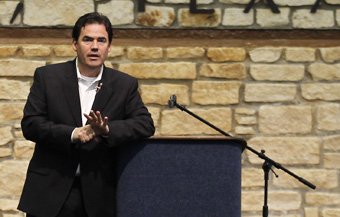
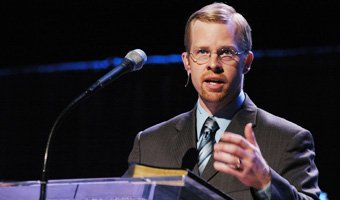
Ed Stetzer, vice president of research and ministry development at Lifeway Christian Resources.

God's mission, he continued, is "to be glorified by making Himself known." God does this in several ways – first, in the display of his glory in creation. After the fall in the Garden of Eden, God's mission continues in the form of the redemption of the world through the sending of his son, Jesus.

Jesus establishes the kingdom of God by defeating death and saving people. The church is not the kingdom of God, Stetzer said, but a sign and an instrument of the kingdom of God.

"The church is birthed in the wake of the kingdom," he said. "And God sends the Holy Spirit to the church, to us, to empower the church to join Jesus on his mission."

The church's role as an agent in God's mission is to proclaim and demonstrate the gospel to the world. The church is being redeemed in order to give glory to God. The mission will be completed when all things are restored for God's glory, he said.

"God ultimately wins and is glorified and all things are restored for his glory," Stetzer said.

All who are redeemed by Christ have spiritual gifts given to them by the Holy Spirit, he said, and because all are gifted in some way, all are called to use their gifts to minister in some way—it's simply a question of "where and among whom?"

God intends all people to use their gifts, Stetzer said. The stewardship of gifts is the church's responsibility. He calls for the development of "co-laborers" in the work of the church, rather than consumers.

Stetzner noted a hard truth—the pattern of codependence between needy congregants and pastors who need to be needed must be broken. God empowers us to serve, and church leaders have to empower their members.

Stetzer recalled a family who came to him with their young son after a service when he was an interim pastor, saying, "Brother, could you talk to our son? He's ready to receive Jesus, but he has some questions."

Stetzer told the couple, "No," because he didn't want to deprive them of their opportunity to minister to their son.

Shocked, they said, "But he has questions." They were upset and flustered at first, but two weeks later they returned to church and thanked Stetzer for what he said.

"When we do what God has called them to do, everybody gets hurt and the mission of God gets ignored," Stetzer said.


Author rediscovered vision of the parable of the Good Samaritan

AMARILLO—When Ron Hall read Jesus' parable of the Good Samaritan in Luke 10, he used to "wear out" the Levite and priest who passed by the injured man on the road without offering to help. He wondered how they could do such a thing—how they could ignore the need before them.

Ron Hall, author of Same Kind of Different as Me.

That is, he wondered until he realized he'd been doing the same thing for years, walking by the homeless outside his office building without looking them in the eye or saying a word.

"I used to call the police on them," said Hall, author of Same Kind of Different as Me. "I used to sidestep them like the priest and the Levite."

His attitude changed after his wife had a dream about a homeless man in Fort Worth and practically forced Hall to find the man in her dream and attempt to befriend him. After a few weeks serving in the Union Gospel Mission, the Halls found the man Deborah had dreamed about.

The man, Denver, was rough and difficult to approach. But after numerous invitations for meals, Denver finally capitulated to becoming Ron Hall's friend after coming to believe Hall wanted a true relationship, not an object for benevolence.

Denver became an unexpected source of wisdom and strength for Hall. Although Denver was illiterate, Hall discovered the homeless man was insightful, helping Hall look at life in a different way. Denver particularly was helpful when Deborah was diagnosed with cancer. He prayed eight hours a night by a dumpster for the Halls. He encouraged the Halls.

When Deborah died, Denver moved in with Ron Hall. Their friendship continued to grow, and they wrote the bestselling book Same Kind of Different as Me, which details how they became friends. The book has created opportunities for the duo to visit with people in more than 250 cities across the nation and raise more than $70 million for the homeless.

"I was so convicted," he said. "The man I thought had nothing to offer me in friendship gave me the most precious gift."


Christian teachers must not water down hell, G5 speakers insist

AMARILLO—Images of darkness, eternal torment and fiery flames usually don't rank high on the "greatest hits list" for sermons or conversations. But when it comes to evangelism—and the responsibility to stay true to the gospel—the reality of hell is one that fifth-generation Texas Baptists must not neglect, conference leaders said.

Pastors Howard Batson and Brent Gentzel underscored this position during an extended dialogue at the G5 conference during the Baptist General Convention of Texas annual meeting.

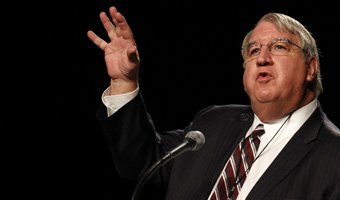
Brent Gentzel, pastor of First Baptist Church in Kaufman, discusses the reality of hell at the G5 Conference, held in conjunction with the Baptist General Convention of Texas annual meeting in Amarillo. (PHOTO/Robert Rogers)

Batson, who serves as pastor of First Baptist Church in Amarillo, specifically addressed the controversy surrounding the claims of author Rob Bell, whose book Love Wins draws the conclusion a loving God would not sentence his creation to eternal damnation.

While Batson lauded Bell as a "master communicator" with a "passion to reach people with the story of Jesus," he disputed Bell's most talked-about assertion. 

"The problem is, when you teach and preach false doctrine, it doesn't matter how noble your intentions or how eloquent your words," Batson said. "If our teachings are not based on the words of the Lord Jesus Christ and the writing and preaching of the apostles, they're a very dangerous theology."

Bell uses "hermeneutical gymnastics" to mislead his readers, Batson insisted. Under a guise of "simply asking questions," Bell twists passages of scripture to send a new and very alarming message: "That all that you learned about hell might not really be true after all."

"Bell implies that all people will eventually be saved—even if they reject the Lord's plan of salvation in this life—because 'God always gets what God wants,'" Batson explained.  "God will not fail in the end, and God doesn't want anyone to be lost."

But this falls short of the truth, he said, noting God never desires for people to sin. God failed to get what he wanted in many instances throughout Scripture, such as when the Israelites worshipped idols, he noted.

Batson pointed to Bell's lack of research and absence of any kind of "footnotes or endnotes" throughout the book.

"Bell simply rambles trying to make sense of the evangelical faith in which he was raised and the cultural diversity where he finds himself living," Batson said.

In an attempt to "rescue God from God's self," Bell creates his own image of God that is softer and more appealing to society, Batson said. But his claims fail the ultimate test of truth —the words of Christ.

"You will never turn a page in the gospel of Matthew that Jesus doesn't say something about hell or eternal punishment," Batson said. "How could Bell or anyone else seriously take the words of the writers or the evangelist and somehow edit away what the writers had to say, all the way to the end of the gospel of Matthew?"

Gentzel, pastor of First Baptist Church in Kaufman, affirmed Batson's statement when referring to Jesus' teachings. Gentzel outlined three points for Texas Baptist leaders to follow when approaching the reality of hell.

First, leaders "should not try to be 'kinder' than Jesus." Christ's entire message centered on love—loving God and loving your neighbor as yourself. Keeping in mind that "love and compassion were his motives," Gentzel noted Jesus often taught about hell.

"Perhaps our desire to avoid speaking of judgment and hell is driven more by our desire to be liked and comfortable than it is by any true love for our neighbor," Gentzel proposed. "For if it is true that those who don't by faith acknowledge Jesus Christ as Lord and Savior are going to spend eternity, or even five minutes in hell, they need to know the stakes."

Love does not ignore that truth, he said.

Secondly, leaders should "not try to be more seeker-sensitive than Paul." Gentzel pointed to a story in Acts 17, where Paul had the audacity to inform a group of philosophers—the "enlightened"—of their impending judgment. While many rejected his words, one man, Dionysius, trusted Christ as a result and went on to become a pastor. 

Gentzel's third point served as a caution for all evangelistic efforts. "We should not preach 'cheap grace,'" he said.

The decision to follow Christ is a radical one—drawing vivid imagery to "take up one's cross." Yet all across the state, there are millions of people whose lives do not measure up according to that command, Gentzel said.   

"If your commitment to following Christ doesn't lead you to care for the poor, love the unborn, stand against injustice, use your talents for the kingdom of God, seek sexual purity and honor the Sabbath, you might not be a Christian," he said. "And hell might be your eternal destination."

For this reason, the necessity to preach the reality of eternal judgment is crucial.

"To leave that part of the story out of the narrative, or to choose to present a second hope that the Bible does not clearly present does no favor to the lost," Gentzel said.

"Above all things, may the judgment that is coming spur us to greater urgencies in the evangelistic work of our churches."


Texas Baptists urged to ‘be heroes for Texans’

AMARILLO—When Brandon Wright crashed his motorcycle into a car pulling out of a parking lot in Logan, Utah, he became wedged under the car in front of it, and Wright's motorcycle caught fire.

Seeing the incident, a few people rushed to his aid but couldn't pull him out. They tried to lift the car off him but couldn't.

Steve Vernon, Baptist General Convention of Texas associate executive director, challenged Texas Baptists to be "heroes" for Christ by sharing the gospel with their neighbors. (PHOTO/Robert Rogers)

But people ran and brought other bystanders to help. They tried again to lift the car. This time they succeeded. As the group held up the car, one person pulled Wright out, saving his life.

In his report to the Baptist General Convention of Texas annual meeting, Steve Vernon, BGCT associate executive director, called the people's action heroic. They saw Wright's hopeless situation and responded together with all their individual strengths to help a person in need.

Texas Baptists face a similar situation, Vernon said—12 million Texans not connected to any church and professing no relationship with Christ. Someone needs to step up and introduce them to the hope of Christ, he said.

"I would challenge you in this report to be heroes for Texans," Vernon said.

No single Texas Baptist or church can share the hope of Christ with all 12 million non-Christians in the state, Vernon said. God calls his followers to minister in their spheres of influence. God's Acts 1:8 mandate calls Christians to minister in expanding circles locally, regionally and to the ends of the world.

If each Christian will attempt to live out that calling, together—like the bystanders in Utah who cooperated to save Wright's life—they can have a significant impact expanding God's kingdom such as sharing the gospel with 12 million Texans.

It wouldn't be the first time a group of people accomplished a task so large, Vernon noted. By intensely discipling them, Jesus turned 12 ordinary people into powerful instruments for sharing a message that changed the globe. God worked through their lives to change the lives of others.

"They ignited a hope in the world that literally changed the face of the world," Vernon said.

God is honoring Texas Baptists faithful efforts, Vernon said. Through cooperation, Texas Baptists are ministering in 51 languages across the state. They are supporting 146 campus missionaries on 118 campuses. They help fund hospitals that care for 2 million people annually.

By working together, the more than 5,500 Texas Baptist churches with more than 2 million members can deliver the saving message of Christ. Cooperation is key to accomplishing something dramatic—just like in Logan, Utah.

"One guy couldn't do it," Vernon said of amazing rescue. "Five guys couldn't do it. When the whole group got together, they save the guy's life."


Faith Digest: Death penalty opposition up

Death penalty opposition at high level. More than one-third of Americans now oppose the death penalty—the highest level in nearly 40 years—according to a new Gallup Poll. Moreover, those who believe the death penalty is being applied fairly and those who say it isn't used often enough are at the lowest levels in a decade, underscoring significant changes in attitudes, USA Today reported. The Gallup Poll found 35 percent oppose the death penalty—the highest opposition since March 1972. That year, the Supreme Court ruled the death penalty was constitutional unless it was applied unfairly. By 1976, several states reinstituted capital punishment. Now 40 percent in the most-recent poll believe the death penalty isn't imposed often enough, the lowest level since 2001.

Protestant giving hits record low. Tithing to Protestant churches as a percentage of income is at its lowest level in at least 41 years, according to a new report, and churches are keeping a greater share of those donations for their own needs. Parishioners gave about 2.38 percent of their income to their churches, according to "The State of Church Giving through 2009," a new report by Empty Tomb, a Christian research agency in Champaign, Ill. Just over 2 percent of income went toward congregational finances, such as operating costs and building expenses. Only 0.34 percent of parishioner income went to charities and seminary training beyond the four walls of the church. Those are new lows, at least going back to the first report in 1968.

Bishops warn that church teaching is nonpartisan. With the 2012 campaign gearing up, U.S. Catholic bishops reminded Catholic voters they can't cherry-pick from church teachings to justify their own political preferences, and cautioned both sides not to edit the bishops' statements into voter guides to back one party or another. The bishops' warning came in a special introduction to "Forming Consciences for Faithful Citizenship," a 30-page document on the responsibilities of Catholic voters that has been issued before every presidential election cycle since 1976. But the biggest challenge for the bishops may be getting their message read by rank-and-file Catholics. A recent poll of U.S. Catholics showed just 16 percent have ever heard of the bishops' document on politics, and just 3 percent say they have read the statement in past election cycles.

Future English royal wedding for a Catholic? Future British kings and queens would be permitted to marry Catholics for the first time in more than three centuries under reforms proposed by British Prime Minister David Cameron. In a letter to his fellow heads of government in the British Commonwealth, Cameron outlined several proposed amendments to the 1701 Act of Settlement, which bars Catholics and the spouses of Catholics from the British throne. Cameron did not propose lifting the ban on a Catholic becoming the monarch, who also serves by law as the supreme governor of the Church of England. Approval of all 16 Commonwealth "realms" would be necessary for any changes in the law governing royal succession.

-Compiled from Religion News Service


Lynn: Minorities face biggest threats to religious liberty

WASHINGTON (ABP) – An advocate for the separation of church and state told a House panel Oct. 26 that what some Americans regard as imminent threats to religious liberty are in fact attempts to maintain a favored status for the majority.

“We have a dizzying level of religious freedom in this country, even more so if you are a member of a well-established or majority faith,” Barry Lynn of Americans United for the Separation of Church and State , testified before the Constitution subcommittee of the House Committee on the Judiciary.

Barry Lynn

“There is no war against Christianity being waged by elected officials or by the courts,” said Lynn, an ordained minister in the United Church of Christ. “In truth the real threats to religious freedom come from those who seek special government blessings for those in favored faiths, and conversely, the treatment of members of other faiths as second class citizens.”

Lynn was one of three witnesses for a hearing on the state of religious liberty in the United States by the subcommittee tasked with responsibility for areas including constitutional amendments and constitutional rights. Two witnesses, Bishop William Lori of the United States Conference on Catholic Bishops and Colby May of the American Center for Law and Justice, both gave examples of laws and court decisions they claimed restrict the free exercise of religion.

May, senior counsel and director of the ACLJ’s Washington office, said some of the most controversial examples are going on in public schools and universities “where the effects of recent decisions on the young minds of our nation may adversely impact religious liberties in the future.”

May said university speech codes, intended to permit free exchange of ideas free from intimidation and harassment, have in fact been used to prevent religious students from sharing beliefs with other students out of fear of being charged with harassment. Other policies, he said, deter students from espousing beliefs on issues of public concern such as the definition of marriage in ways that “significantly burden religious expression in venues that should be open to the expression of the widest variety of ideas.”

Lynn, however, said in his day-to-day work the most serious threats to religious liberty he sees involve adherents of less-popular faiths and non-believers, like Muslims wanting to build a mosque in Murfreesboro, Tenn., who were sued in a case arguing Islam is not a “true religion” and members of the community in Katy, Texas, who protested the construction of a mosque by staging pig races next door to the property.

“Let us not be fooled,” Lynn said in his testimony. “You may hear holy horror stories with at most a scintilla of truth. You may hear claims of ‘rights’ being violated that do not exist with remedies proposed that are merely an excuse for obtaining special treatment. You will hear biblical tenets used to justify legislation where the real basis for decision-making must be not any holy scripture as interpreted by one group, but by the constitutional values shared by all of us.”

Bob Allen is managing editor of Associated Baptist Press.


Great Commission can be fulfilled, Keller pastor asserts

AMARILLO – The Great Commission can be fulfilled within the century or even possibly within the decade, Bob Roberts, pastor of NorthWood Church in Keller, told the Baptist General Convention of Texas annual meeting.

Bob Roberts, pastor of NorthWood Church in Keller, spoke at the Baptist General Convention of Texas annual meeting.

Watch Video Here.

As the world moves faster along highways of global connection—via the Internet, airplanes and social media—the challenge of evangelism and worldwide missions changes, he explained. From "every person getting to hear" the gospel, it now takes on a new question: "Do they understand the message?"

Roberts recalled the rich, nontraditional history of Texas Baptists, one steeped in passion, boldness and creativity.

"Now what would it look like if we were to take that same sense of passion, that same conviction, that same belief and see the Great Commission fulfilled?" he asked, adding emphatically, "It will happen."

In order to see that take place, "We need to look at two things—the Great Commission and the 21st century," he said. He referenced Acts 1:8, corresponding to Hope 1:8, a Texas Baptist initiative to spread the gospel through missions and outreach.

Concerning the 21st century, he outlined four specific points regarding its platform for fulfilling the Great Commission:

Christians today live in a global public square.

"There is no privacy," he noted, adding that everything is wired and connected. "The whole world is listening, and it's not a bad thing; it's a good thing. … It gives us an opportunity to think about what we say and how we are saying it."

Collaboration is key.

"When the Great Commission is fulfilled, it's because we connect the whole body of Christ around the world. It's not just about us going. It's also about us receiving those who are coming to America," he said.

Learn from Christians in places where the faith is experiencing explosive growth.

Western-culture evangelical leaders need to learn from the church outside Europe and North America, he said.

"I think we need to take the posture of a student and of a pupil and say, 'Help us—we need help.'"

Christians need to examine their relationship with other religions.

Roberts described an idea he calls "multi-faith"—learning to get along with one another "without compromising the message" of Jesus.

"We're so arrogant and harsh with the truth," he said. "Truth never makes a man haughty and arrogant; it makes him humble and broken and gentle and kind, because if he has the truth, he wants men to know the truth. And if that's the case, he's going to be broken before people, not cocky and arrogant and mean-spirited and—sometimes—Baptist."

Since God has brought all religions into Texas communities, Texas Baptists need to focus on building relationships and "loving them here" before heading halfway across the world, Roberts said.

"Faith is validated or vilified by its impact on the society," he explained.

And that can happen anywhere, all across the world.

"We want to start preaching to people. But if you're serving together — you're building the common good in a city — and you start talking about Jesus, it changes," he said.

He concluded with imperatives toward fulfilling the Great Commission.

Christians should "quit wondering about when Jesus is coming back" and just "get busy," he said. Furthermore, Christians must be filled with the Holy Spirit and make disciples.


Church deemed too Calvinist for Kentucky Baptist association

OWENSBORO, Ky. (ABP) – A Kentucky Baptist association denied membership to a church after a credentials committee found its confessional statement too Calvinistic, according to a report in the Western Recorder.

Daviess-McLean Baptist Association voted 104-9 to deny membership to Pleasant Valley Community Church in Owensboro during its annual meeting held Oct. 17-18, the Kentucky Baptist Convention news journal reported in its Oct. 25 issue.


Jamus Edwards

“Our concern in the initial stages of our investigation revolved around the fact that Pleasant Valley Community Church’s confessional statement is one that (is) Calvinistic in nature,” the newspaper quoted from a recommendation by the association’s credentials committee. “It affirms the doctrine of election and grace.”

“While we know the doctrine is not heresy, we do recognize that it is vastly different than the majority of churches within the DMBA,” the statement noted.

Pleasant Valley Community Church’s 60-page confession of faith affirms: “From before the foundation of the world, in order to display His glory, God freely and unchangeably ordained all things that would come to pass. From the casting of the lot, to the bird falling from the sky, to the activities of the nations, to the plans of politicians, to the secret acts of individuals, to what will happen to us tomorrow, to scheduling the very day that we will die, God has written our stories and the stories of the entire universe.”

That includes “the results of His plan of salvation as set forth in the Gospel of Jesus Christ.

“We believe that God’s election is unconditional — from Old Testament Israel to individual sinners,” the statement says. “That is, from before the foundation of the world, God chose in His grace to save for Himself an elect people through Jesus Christ. God’s choice of His elect was in no way affected, or conditioned by, some merit or deed that He foresaw these individuals would possess. Neither (as many argue) did God make His choice based upon those whom He foresaw ‘would’ have chosen Him of their own will and accord.”

Frank Page, head of the Southern Baptist Convention Executive Committee, recently identified the growing influence of Calvinism — also called Reformed Theology or the Doctrines of Grace — as one of the biggest challenges facing the nation’s second-largest faith group.

According to a 2007 study by LifeWay Research, about one in 10 Southern Baptist pastors considered themselves to be five-point Calvinists. Among recent seminary graduates the rate nearly tripled, to 29 percent. Page, a former SBC president elected as the Executive Committee’s CEO last year, said he hears often from churches struggling with the divide between Calvinist and non-Calvinist — also known as Arminian -– theology.

Those competing views over predestination versus free will have always been around. For generations Southern Baptists functioned with a modified Calvinist consensus that affirmed the doctrine of once-saved-always-saved while softening other teachings like double-predestination -– that God elects both the saved and the damned -– that are affirmed by other groups like Primitive Baptists but largely rejected by Southern Baptists in favor of a sawdust-trail evangelism of whosoever will may come.

That has begun to change in recent decades, with the rise of a New Calvinism influenced by leaders including Southern Baptist Theological Seminary President Albert Mohler, Pastor John Piper of Bethlehem Baptist Church in Minneapolis and lighting-rod preacher Mark Driscoll of Mars Hill Church in Seattle that some Southern Baptists view as a return to the denomination’s theological roots.

Jamus Edwards, a Southern Seminary graduate and now pastor of preaching and vision at Pleasant Valley Community Church, told the Western Recorder that the church does not self-identify as Calvinist because it is not “helpful in most contexts” but rather “distracting and largely misunderstood, precisely like it was in this situation with the DMBA.”

Greg Faulls, the pastor of Bellevue Baptist Church in Owensboro, who recommended Edwards’ church for membership in May, said he thought the church’s teachings fell within parameters of the SBC’s Baptist Faith and Message doctrinal statement, “but apparently the association didn’t agree.”

Faulls said he was disappointed by the credentials committee report but didn’t challenge it because he felt the group had “a pretty good pulse” of the association.

“It just wouldn’t be worth having a disharmonious discussion when the chances of that being voted on affirmatively were so slim,” he said. “It was obvious that the issue of more reformed thinking in this church was an issue of concern.”

In August Daviess-McLean Baptist Association convened a special session to withdraw fellowship from another church that allowed a local chapter of Parents, Families and Friends of Lesbians and Gays to use its building for meetings.

Messengers at that meeting voted 242-24 to withdraw fellowship from the Journey Fellowship, formerly named Seven Hills Baptist Church in Owensboro, deeming the church’s refusal to ask PFLAG to meet elsewhere as implied acceptance of homosexuality, which the majority of the association’s churches view as a sin.


–Bob Allen is managing editor of Associated Baptist Press.


Foundation of true disciples needed to ‘Ignite Hope’ in Texas

AMARILLO—A cannon cannot be fired from a canoe, Milfred Minatrea told Texas Baptists at an "Ignite Hope" evening rally at the Baptist General Convention of Texas annual meeting. The key to a cannon—or any powerful force—is solid ground.

"To ignite hope across Texas, it will take a firm foundation," he said.

The foundation for the work that God intends to do in Texas is available in the churches, but it needs to be strengthened by an effort to move individuals from second-order missions to first-order missions, said Minatrea, founder and executive director of the Missional Church Center in Irving.

Milfred Minatrea, founder and executive director of the Missional Church Center in Irving, spoke at the "Ignite Hope" evening rally at the Baptist General Convention of Texas annual meeting.

Second-order missions involved gathering groups of believers to engage in a single mission event with a scheduled time and addressing a specific need, such as a trip abroad or work at a local shelter, he said. While useful, second-order missions events are limited in their scope and resources.

Instead, churches need to use those events to propel their members into first-order missions, Minatrea insisted. This model sees mission activity as a part of daily life, with individuals scattered throughout a community engaging in various forms of service, addressing relational opportunities with others more than ministry needs.

To move to this model, Christians need to abandon their traditional segmented view of life, with the church as one of many elements in the world, Minatrea said. Rather, believers should see the church as intersecting every aspect of life and become missional believers.

"We as Texas Baptists need to rethink the way we understand the church in the world," Minatrea said.

Instead of churches asking for the lost to enter their sanctuaries, "The Father is saying to us, 'I have already placed you out there with lost people,'" he said.

One of the reasons for this absence of "missional" thinking is the lack of emphasis on disciple-making. Far too often, Minatrea stated, the church focuses on providing mass instruction and exhortation, but they do not become engaged in individual, daily accountability.

"Disciples are not made in mass or in class," Minatrea quipped. "Missions depends upon our effectiveness in making disciples of Jesus Christ."

Every church needs individual attention, accountability and challenge to cause individual believers to reflect the actions and heart of Christ, he said. Disciples become disciple-makers themselves and view the world through missional eyes. In turn, they provide a foundation for disciples ready to engage their world with the hope of Christ.


Fort Worth pastor calls Texas Baptists to find motivation in giving God glory

AMARILLO—Texas Baptists should find hope and motivation in the glory of God, James Hassell told the Baptist General Convention of Texas annual meeting.

Hassell, pastor of preaching and pastoral care at Agape Baptist Church in Fort Worth, preached the BGCT convention sermon, based on Colossians 3:12-17.

The glory of God should be Texas Baptists’ highest motivation, Fort Worth pastor James Hassell told the Baptist General Convention of Texas annual meeting in Amarillo. (PHOTO/Eric Guel)

Many people today subscribe to a philosophy best expressed by the late Steve Jobs, Hassell said. In a 2005 commencement speech at Stanford University, the co-founder of Apple Computers said: "You have to trust in something—your gut, destiny, life, karma, whatever. This approach has never let me down, and it has made all the difference in my life."

This "trust-your-gut philosophy" is not enough, Hassell said. Rather than living on karma and relying on destiny, individuals should realize Jesus wants to transform Christians' instincts and intuitions to align with his will by the power of the Holy Spirit.

"There has to be then something more to what drives our hope and what motivates us in life than what we consider to be our destiny," Hassell said.

"I would submit to you in light of the text in Colossians, the glory of God must be the highest motivating factor of our lives."

Hassell recalled the legacy of hope in Christ and motivation of the Baptist forefathers who established the first Baptist churches, association and institutions in Texas in the 1800s. He pointed to notable figures in Baptist history such as George W. Truett, J.B. Gambrell, J.M. Dawson, B.H. Carroll, R.C. Buckner and R.E.B. Baylor.

"In fact, it was Dr. Truett whose hope in the Lord fortified even this convention at crucial times in our history," he said. "Dr. Truett said, 'A church that is not missionary is not worth the ground on which it stands.' It's that missional, outward-looking, sustaining hope in the head of the church that motivates us.

"The hope of the Lord Jesus Christ has sustained this convention and the hope of Christ will change and continue to sustain this convention," he continued. "But I will submit to you that our motivation to give glory to God will sustain us, not because of our denominationalism, not because of the way we do things the way that they've always been done, not just because of the fact that we're a free convention.

"No, the hope of Christ motivates us because the Lord has placed in our hearts that truth that every believer in Christ—man, woman, black, Hispanic, Anglo—all have the privilege and responsibility to be a priest to our neighbors."


President urges Texas Baptists to heed God’s call

AMARILLO—Sometimes, revival may start with a whisper— the voice of God calling someone into the desert, Victor Rodriguez told the Baptist General Convention annual meeting. Often, in the midst of dry desert places, he added, God prepare the way for his perfect plan to unfold.

In his presidential sermon to the convention, Rodriguez, pastor of South San Filadelfia Baptist Church, emphasized the importance of heeding God's call while addressing the evangelistic mission and future of Texas Baptists.

Victor Rodriguez, president of the Baptist General Convention of Texas and pastor of South San Filadelfia in San Antonio, challenged Texas Baptists to heed the call of God. (PHOTO/Eric Guel)

Rodriguez encouraged listeners with the story of Philip in the New Testament book of Acts, who was moved by the Holy Spirit to go from the bustling city of Samaria into the solitude of a hot, windy desert.

"Imagine what he was thinking: 'What am I doing here in this desert?'" Rodriguez said.

Yet it was in that place where God knew another traveler would pass—the Ethiopian eunuch who was searching for answers. From there, Philip was able to introduce him to Jesus Christ.  

"I love this story because it is action, movement. The Lord just takes someone from some place to another place," Rodriguez said. "In obedience, Phillip goes into the desert alone. … We see no bargaining, no questions, no 'why's."

In the same way, Texas Baptists must be sensitive—and responsive—to the call, "Arise and go." God may whisper such a command in order to lead his people in a better direction. And it often means going through different seasons, he added. 

"Sometimes we go through lonely deserts. There are many deserts in life (and) there are many deserts in the life of a church. …when the church stops growing, when no one seems to agree with you as a leader as far as the direction that God is leading you," Rodriguez said.   

But the journey often serves for an underlying purpose—for learning, for changes, and more positively, a reminder that "God is not through."

God is at work in the midst of the desert, Rodriguez said. Philip's obedience to respond to God's call led to one man's salvation, which in turn led to revival. The eunuch went back to spread the gospel in his homeland.

"What seemed like an insignificant little whisper eventually took the gospel of Jesus Christ into the continent of Africa. And it started the historic church in Africa," he said.  

Concerning the BGCT's journey, Rodriguez highlighted the theme of this year's annual meeting—to "ignite hope" through missions and evangelism—and related a story from his childhood.

When his brother went fishing, he always observed one thing. If another fisherman across the lake caught a fish in a different spot, he would quickly lift his line and head to that location—"where the fish are."

Similarly, ministries, churches and church leadership may need to change a few things or go a different direction in order to fully embrace the evangelistic mission of reaching souls for the kingdom.

"You may be experiencing great revival, (or) you may be experiencing that desert-like season in your ministry," Rodriguez said. "But rest assured," he encouraged, one thing would never change—the gospel of Jesus Christ.  

"Ministry is very basic. We have to offer Jesus Christ," he emphasized. 

"We must continue to preach the word. The only thing that God has called us (to do)—as a convention, as a church—is to preach Jesus. Jesus is the only person that's going to give us hope as a convention, that's going to bring us a future as a church, that's going to ignite hope in people's hearts."

And with that in heart and mind, he said, Texas Baptists must be willing to heed the call, "Arise and go."


Panhandle Reach represents a partnership to spread hope

AMARILLO—Donning their cowboy boots and hats, members of two Amarillo-area cowboy churches mounted their horses and proudly rode into the arena on the south side of the city during the Panhandle Cowboy Church Ranch Rodeo finals—not only for the love of the competition, but also from the desire to see their neighbors know the love of Christ.
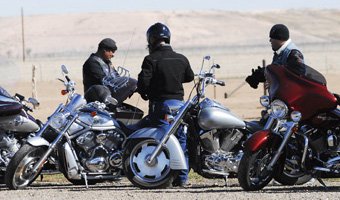
Community Heights Baptist Church in Lubbock sponsored a motorcycle rally that concluded at Palo Duro Cowboy Church in Canyon.

The Palo Duro Cowboy Church in Canyon and the Saddle Mountain Cowboy Church in Channing partnered with the Baptist General Convention of Texas to hold the ranch rodeo finals where 14 teams from the cowboy churches and local ranches competed in front of 500 people in events like wild cow milking, sorting, cow mugging and branding.

"The whole purpose is to bring Jesus Christ to people who may have not ever been introduced to the Lord," said Bobbi Norwood, a member of Palo Duro Cowboy Church and a volunteer at the rodeo.

"For some of these guys, this is the only opportunity they get to hear the word and to learn about Jesus Christ. Some of these cowboys are out there with just the horses, cows and them. So (with the rodeo), they get an opportunity to come to town and hear about the Lord and hopefully make a decision in their lives."

The ranch rodeo was part of Panhandle Reach, a partnership involving 112 Panhandle churches and ministries to reach out to those living in the area with the love of Christ through more than 20 outreach projects during the weeks leading up to the Baptist General Convention of Texas annual meeting in Amarillo.

St. John Baptist Church and Joshua Tabernacle Baptist Church joined to offer a block party with events for children such as a bounce house and a barbecue contest for adults that raised funds to purchase shoes for needy Amarillo children. (PHOTO/John Hall)

At least 432 people made first-time professions of faith in Christ, and another 584 rededicated their lives to Jesus.

The outreach efforts focused on sharing the hope of Christ with people in the western-heritage culture, Hispanic families, college students, high school and middle school athletes and coaches, bikers and many others.

"Panhandle Reach is about strengthening Panhandle churches in reaching the lost and unchurched to the glory of God," said Scott Willingham, BGCT church evangelism director and Panhandle Reach coordinator.

Panhandle Reach kicked off in early September with a back-to-school rally and Hispanic parents' conference sponsored by Iglesia Bautista Hispana in Dumas 47 miles north of Amarillo. The church was able to share the gospel with more than 200 parents and students through the two events.

"These kinds of events are important, because they give the church an opportunity to work together, grow in number, mature spiritually and minister alongside each other joyfully. These events also help us show our community that there is a church that preaches the word of God," said Ernesto Rodriquez, pastor of Iglesia Bautista Hispana.

The church saw 18 people begin relationships with Christ, and four will be baptized at the church Oct. 30, Rodriquez said.

Iglesia Bautista Nueva Vida in Hereford hosted a two-day evangelism conference to train church members to reach their communities for Christ more effectively. Participants had an opportunity to hear from evangelists and trainers like Gilbert Herrera, Ruben Hernandez and Sammy Fuentes. The effort drew more than 250 people from Hispanic Baptists churches and towns such as Friona, Bovina, Muleshoe, Morton, Littlefield and Hereford.

"What the conference did, it united our little churches to work together," said Pablo Garcia, pastor of Iglesia Bautista Nueva Vida. "God showed me that we didn't have to go to Amarillo in order to do a meeting of this sort—that it could be done in other little towns and be a witness not only for the lost, but also for the brethren in the churches. Working together, we can do more."

Wayland Baptist University and 20 churches throughout the area worked in partnership with the Baptist General Convention of Texas youth evangelism department to sponsor a BMX youth outreach event featuring the Real Encounter evangelism team.

The Saturday before the BGCT annual meeting, St. John Baptist Church and Joshua Tabernacle Baptist Church, both in Amarillo, partnered to conduct a block party and health fair in the park with the help of the BGCT as part of Panhandle Reach.

Between children playing in bounce houses and adults competing in a barbecue contest that raised money to buy shoes for Amarillo children in need, church members young and adult shared the hope of Christ through word and song.

"We wanted to connect with the community through health care, as well as music and testimony," said Larry Rhea, interim pastor of St. John Baptist Church.

Another 101 volunteers from many churches and various parts of the state spent Oct. 20-22 ministering to 3,800 offenders in the Potter and Randall County jails as well as the Neal and Clements prison units north of Amarillo through a partnership with Bill Glass Champions for Life Ministry.

More than 263 offenders made professions of faith in Christ during the rallies, and another 405 renewed their commitment to Jesus. The BGCT also is partnering with Texas Baptist Men's Inmate Discipler Fellowship in the coming weeks to follow up on the decisions made during the prison outreach, providing a way for the offenders to be encouraged and taught how to grow in their journey with God.

Big Al Alceves participated in a motorcycle rally sponsored by Community Heights Baptist Church in Lubbock. Several church members rode up from Lubbock and joined other area bikers to ride to the Palo Duro Cowboy Church in Canyon for a rally, barbecue lunch and evangelistic message by Alceves.

The BGCT youth evangelism department partnered with Wayland Baptists University and 20 churches in the Plainview area to host a BMX youth outreach. The Real Encounter evangelism team that uses BMX bikes and skateboard tricks as a platform to present the gospel, shared their faith with more than 500 students, recorded 40 professions of faith in Christ and 30 rededications.

At a Fellowship of Christian Athletes game day rally at West Texas A&M University, more than 400 students from towns throughout the Panhandle had an opportunity to worship, fellowship with other athletes and hear a message about Christ's saving grace and empowerment brought by Evangelist Jon Randles. More than 77 students began a relationship with Christ, and nearly 140 more stated again that they want Christ to rule all parts of their lives.

At the university, the Baptist Student Ministry grilled more than 500 burgers to connect with students on the campus and have an opportunity to share the hope of Christ.

More than 1,016 people made either first-time decisions for Christ or rededications, and hundreds more gospel seeds were sown as nearly 4,500 lives were touched in some way during the Panhandle Reach efforts, organizers said.

"It often takes someone seven times to hear the gospel before accepting Christ," Willingham said. "In Panhandle Reach, we did a lot of sowing, being the first, second, third and fourth times of sharing about this hope. But with the sowing and the reaping, we rejoice together."