Church preparedness crucial with upcoming freeze

As North Texas prepares for another significant winter weather system, churches across the region face heightened operational, safety, and property risks.

Forecasts indicate a wintry mix of snow, sleet, and freezing rain beginning Friday afternoon, with the greatest impact expected in the Dallas-Fort Worth area by 9 p.m. 

The National Weather Service in Fort Worth forecasts hazardous winter weather for North Texas, Jan. 23-25. (NWS Fort Worth, screenshot)

Temperatures will drop into the 20s Friday night and are projected to remain below freezing through the weekend, increasing the likelihood of power outages, hazardous travel conditions such as slick roads, and property damage. Residents in these areas are urged to stay off roads and protect their pipes from potential damage. 

According to an Associated Press article, forecasters predict Texas may be part of a potentially catastrophic storm over the weekend, resulting in heavy snow and treacherous freezing rain resulting from cold air clashing with rain and forming a cold, arctic air mass.

Meteorologists warn this system could be part of a broader, high-impact storm affecting multiple states, with dangerous ice accumulation and travel disruptions. For churches, the implications extend beyond inconvenience. They involve stewardship, safety, and continuity of ministry.

Awareness is critical

Jacob Robb, meteorologist with Risk Theory Loss Control, emphasized churches benefit most when weather intelligence is proactive rather than reactive.

“Churches may not have the infrastructure [they need.] We wanted to help them [prepare] in any way we could, starting off with freeze notices,” Robb said. 

Through KingsCover, churches enrolled in the Risk Theory church program receive advance freeze and severe weather notices. These alerts are designed specifically for church facilities and leadership teams, providing concise forecasts, impact expectations, and actionable preparation guidance.

Rather than relying solely on general media coverage, churches receive targeted communications focused on how upcoming weather conditions may affect plumbing systems, HVAC equipment, roofs, and water infrastructure.

“We send them notices, basically explaining what they can expect, and we try to break down [the information] so that we are giving them just the information they need,” Robb explained. 

When the church doors stay open

Churches, which often remain in operation during adverse weather conditions to serve the community, may be at higher risk of suffering damage.

During a freeze that occurred on Sunday in San Antonio, local nonprofits and churches opened their doors to homeless members of the community, offering shelter, clothes, and warm meals to those in need. 

According to the Voss Law Firm website, an insurance attorney in Houston, churches may be especially susceptible to winter weather due to irregular use of church buildings. 

Churches may not operate seven days a week or remain open during wintry weather, making pipes more susceptible to freezing while not in use.

Operating during these weather conditions raises liability concerns, potentially exposing to lawsuits churches that do not have proper shelter insurance in place.

In many cases, the building’s structure is unable to withstand large amounts of snow or ice. This is especially true of older buildings, which often don’t have the proper infrastructure or heating systems to prevent damages. 

Older churches may suffer from deteriorated materials, outdated construction methods, and general wear and tear associated with age. 

Tips for preventing damage

John Murphy, KingsCover senior vice president, explained many property losses are preventable when churches understand and follow basic safeguard requirements.

“In almost every commercial insurance policy that you see today, you’re going to see a required safeguards section. That section will say, ‘We require you to maintain heat in your buildings during a freeze,’” Murphy said. 

“The heat needs to be turned on a minimum of, generally, 55 to 60 degrees. You cannot turn the heat off in your building and not do the basic safeguard that will prevent your pipes from freezing,” Murphy added.

These requirements are often included in what insurers call a “protective safeguards endorsement,” making compliance a condition of coverage.

Additional precautions—such as allowing water to flow slightly in key plumbing locations, monitoring mechanical rooms, and checking unoccupied buildings—further reduce the likelihood of pipe failures. 

“If you know a deep freeze is coming, you should have the water run a little bit out of at least one faucet in each building, so that water is continuing to flow. Flowing water will not generally freeze,” Murphy advised. 

Many issues churches face during freezing weather involve a lack of routine monitoring: “The biggest thing specific to churches that we see as far as a problem, is that so often people don’t go into many of their buildings on a regular basis,” Murphy stated.

Insurance claims, according to Murphy, can get much worse as a result of church staff or volunteers not attending to potential issues in certain parts of the building. 

“You could have a water pipe burst, and nobody [would] know about it for several days. It can flood through many stories and do much more damage than if it was caught immediately,” Murphy said.

Age is also a major factor that affects churches, with many historical churches still in use today. 

“Another common issue is that so many [churches] use old buildings. They’re built with less insulation,” Murphy said. 

Because many churches do not have updated facilities, it is crucial for staff or volunteers to monitor pipes and heating and A/C units as much as possible. This extends to ancillary buildings, such as child care facilities and fellowship halls. 

Murphy notes many churches exclude property coverage from certain buildings due to cost, making it crucial to maintain basic safeguards to prevent damage in these areas. 

“More churches over the last five years have chosen to exclude property coverage from certain buildings because of concerns with cost,” Murphy said. “It is more important than ever, if you don’t have insurance on a building and you know it, that you do the basics to prevent damage.”

Serving the community with confidence

As churches experience freezing temperatures, many choose to keep their doors open, providing shelter to individuals in need. While this raises liability concerns, Murphy encourages churches to leave their doors open to those in need.

During severe weather, churches often feel called to open their doors to serve vulnerable populations. While this carries inherent risk, Murphy emphasized that properly structured church insurance programs can support outreach efforts.

“A good insurance program can provide liability for [outreach.] It would be worthwhile to make sure you have a church specific policy that doesn’t exclude anything like disaster relief efforts,” Murphy said.

“There is some liability assumed always whenever we take people in to try to help. But it’s certainly [something] we encourage churches to do. If there’s a chance for you to help the community, do it, and share the gospel while you’re at it,” Murphy said.

Faith and responsibility are not mutually exclusive, Murphy continued. When a church is prepared, it can serve confidently, knowing it has taken appropriate steps to protect both people and property, he concluded.


Cities Church considering legal options after anti-ICE protest

Leaders of Cities Church, the Minneapolis congregation whose worship service was disrupted by anti-ICE protesters, are considering legal action against the activists, saying the group that invaded the church on Sunday, Jan. 18, “jarringly disrupted our worship gathering.”

In a statement issued Tuesday, the church leaders said the protesters “accosted members of our congregation, frightened children, and created a scene marked by intimidation and threat. 

“Such conduct is shameful, unlawful, and will not be tolerated. Invading a church service to disrupt the worship of Jesus—or any other act of worship—is protected by neither the Christian Scriptures nor the laws of this nation,” the statement reads.

The church also called on federal officials to protect all houses of worship from similar protests.

Protests targeted ICE affiliated pastor

Nekima Levy Armstrong, a minister, lawyer, and activist, told The Washington Post activists were protesting against David Easterwood, a lay pastor and elder at the Southern Baptist church who also works for U.S. Immigration and Customs Enforcement. Armstrong said she was angered at seeing a video of Easterwood defending his work with ICE.

“I don’t understand how as a pastor he thinks that that’s acceptable,” Levy Armstrong told the Post.

Easterwood is one of several ICE officials, including Homeland Security Secretary Kristi Noem, named in a federal lawsuit filed by protesters in Minnesota who have accused federal officials of trying to suppress their free speech. 

“They have pepper-sprayed, violently subdued, and aimed assault rifles at protesters and observers, and even followed observers home to scare them in a tactic lifted straight from the mafia,” the lawsuit alleges. 

Easterwood, the acting field director of an ICE office in St. Paul, has denied the allegations.

Videos circulating online

Videos of the protest were shared widely on social media over the weekend, leading to outrage from Southern Baptist and other evangelical Christian leaders. SBC President Clint Pressley, in an interview with Religion News Service, said the scene was “just unbelievable.”

Pressley said he was thankful the protest ended peacefully, given how recent shootings and acts of violence at houses of worship have put congregations on edge. “It scared me to death to think about what might happen in a church if you had intruders like that,” he said.

No matter what people think about ICE, he said, disrupting a church service is wrong.

In a message on the Cities Church website, pastor Jonathan Parnell wrote: “Rejoice in the trial. See God’s blessing. Keep doing good.”

Cities Church was planted by Parnell in 2015 and worships in a former Episcopal church known as St. Paul’s on the Hill. An article on the church’s website notes the church is “neither a gym nor a theater,” unlike many modern evangelical churches. 

Through the SBC’s North American Mission Board, church leaders declined a request for an interview.

The congregation has a more formal liturgy than many SBC churches, including a weekly confession of sin and “assurance of pardon,” as well as Communion at every service. 

The church also has ties to Bethlehem College and Seminary, a school started by John Piper, a bestselling author and pastor, and Joe Rigney, an author and professor known for his belief that empathy is sinful and his critique of “woke” Christians.

On X on Monday, Rigney called himself a founding pastor of Cities Church. He is now a pastor at Christ Church DC, where Secretary of Defense Pete Hegseth attends, a congregation “which faces weekly protests by vile leftwing activists.”

Department of Justice conducts investigation

The U.S. Department of Justice is investigating Sunday’s protest for possible civil liberty violations or violations of the 1994 Freedom of Access to Clinic Entrances Act, which protects access to both abortion clinics and houses of worship. 

The FACE Act also bans protesters from intentionally “injuring, intimidating, or interfering with, or attempting to injure, intimidate, or interfere, any person by force, threat of force, or physical obstruction.”

John Greil, a law professor at the University of Texas who co-teaches a religion and law clinic, said the protesters had claimed they wanted to disrupt a worship service and that videos of the incident seem to show at least some activists appear to have intimidated worshippers.

“There’s a pretty touching image of a child who’s being consoled by her parents, and at least some of those individuals who went into the church were going into people’s faces, shouting,” he said. “I think that that satisfies intimidation or interferes with worship.”

Greil also said one protester appeared to threaten a worshipper who asked him to leave.

Though protesters could invoke a First Amendment right to protest at the church, Greil said, that would hold true only if the protest had taken place on the sidewalk or in another public forum.

In a 2011 ruling, the U.S. Supreme Court reversed a $5 million award for damages against members of Westboro Baptist Church who had been sued for protesting at a veteran’s funeral, ruling the church members had protested from the sidewalk outside the funeral, not on private property.

A protest on private property is different from a public setting, Greil said.

“I think we could very easily imagine the real harms that would happen if Black churches were interrupted by white supremacists just to chant public slogans, if Jewish services were interrupted, if Muslim prayer services were interrupted,” he said. “I think it’d be a pretty scary world to imagine.”

Greil said the church could sue protesters for trespassing on its property.

Police department further investigating

The St. Paul Police Department is also investigating the incident, in which 30 to 40 protesters entered the church, though most of them had left the building and were walking away when the officers arrived about 10:40 a.m. local time.

“This incident is an active & ongoing disorderly conduct investigation,” public information officer Alyssa Arcand told RNS in an email. “Because this is an open investigation, no additional public information is available at this time.”

The Baptist Joint Committee, a pro-religious freedom group, declined to comment specifically on the protest but issued a statement on Tuesday criticizing the Trump administration for undermining religious liberty in its immigration policies. 

“In Minneapolis and across the country, the threats to the religious freedom of all people are not the people standing up for and participating in civic life but the people who wield state power in a manner that undermines it,” the statement read. 

The statement also called on officials to “respect places of worship as spaces of conscience and community.”

Immigration issues cause fear

Trey Turner, executive director of the Minnesota-Wisconsin Baptist Convention, said Baptist churches in both states have been struggling to respond to ICE enforcement and the issue of immigration. Many of the churches in the convention, he said, including about a third of those in the Twin Cities, serve immigrant congregations.

“There are Hispanic churches that are not meeting right now because they are afraid of what’s happening in our part of the world, in part, because of the interaction between the federal government and the state government,” said Turner.

Even church members who have legal status fear ICE could raid churches, he said, causing a great deal of concern in the immigrant community. He said churches in the convention don’t all agree on how best to deal with the issue of immigrants.

This week, Turner hopes to meet with Baptist leaders from the Southeast Asian Hmong community to talk about ways SBC churches in Minnesota can work together to support one another.

Turner cautioned not all Southern Baptists hold the same view on immigration, but many other pastors in the area had reached out to offer their support. Turner said his first thought after hearing about the protest was, “How can I serve this congregation going through this trauma?”

“Because they’re going to try to get together this coming Sunday, and what will be the response?” he said.

He said Sunday’s protest felt like something sacred had been violated. People go to church to seek sanctuary from the outside world, he said. They don’t expect the kind of chaos and disruption that occurred on Sunday.

“It’s shocking to us,” he said.


Over 100 Christians abducted during worship in Nigeria

Nearly 175 worshippers were abducted Jan. 18 from three churches in Kaduna State in Nigeria’s Middle Belt, Christian advocacy groups reported, after at least 35 were killed in separate attacks on villages in the Middle Belt and eastern Nigeria.

Approximately 167 Christians remained captive today, Jan. 20, according to reports from Christian Solidarity Worldwide and International Christian Concern, with witnesses and others attributing the abductions to bandits and Fulani militants, although no group has claimed responsibility.

Fulani herdsmen are blamed for killing at least 12 Christians in various attacks in several Plateau State villages Jan. 1–9, killing 13 Christians in several attacks in Benue State Jan. 5–12, and 10 Christians in four villages in Taraba State in eastern Nigeria Jan. 10, Christian Daily International-Morning Star News said in three separate reports.

“Two Christians who are members of our community were attacked by a group of armed Fulani herdsmen in broad daylight,” Christian Daily International-Morning Star quoted Yohana Thomas, head of the Plateau Youth Council of the Gyel District in Jos South County in Plateau. “One of the victims was stabbed to death, while the second victim suffered life-threatening injuries.”

The killings and kidnappings are separate from the murder of 58 individuals in Christian villages in Niger State, Nigeria, Dec. 29–Jan. 3.

Jan. 18 attack

In the Jan. 18 abductions, attackers divided themselves into three groups and captured worshipers from three churches in the Kurmin Wali community of the Kajuru Local Government Area, including the Evangelical Church Winning All, Albarka Cherubim and Seraphim 1, and Haske Cherubim and Seraphim 2.

Yunusa Sabo Nmadu, chief executive officer of CSW Nigeria, lamented the attacks while applauding military successes he said occurred in the past few months to counter the violence.

“CSW condemns the repeated attacks on the vulnerable people in Kurmin Wali and surrounding communities,” Nmadu said in a CSW press release. “We urge the security agencies to ensure the prompt release of those abducted and to enhance security for all other vulnerable areas.

“We also call on the government to strengthen the local capacity of these villagers to serve as the first line of defense against terrorists who are increasingly emboldened by each unchallenged abduction.”

While some Nigerian federal authorities denied the kidnappings, several elected officials confirmed it, Christian Daily International-Morning Star reported.

Access denied

A ministry team of CSW Nigeria tried to visit the Kurmin Wali community to verify the kidnappings, but Nigerian military officials told them of a standing order not to let them enter the area, the group reported.

“However, several local sources who later spoke to CSW [Nigeria] on the basis of anonymity said a large number of Fulani militia men had stormed the area on foot and on motorcycles at around 9 a.m. (Jan. 18) as members of the community were attending their respective church services,” CSW said in a press release.

Sources told CSW Nigeria they were compiling a list of the names of those still held, believed to be 167 individuals.

Among the captives are Baptist church leader Daniel Bagama, CSW said, who was abducted from Tudun/Bussah village in the Chikun Local Government Area of Kaduna, Jan. 18, with his three daughters.

Call for accountability

CSW Founder and President Mervyn Thomas expressed high concern for attempts to obscure the abductions, calling on the government to do all it can to secure the captives’ release.

“The government of Nigeria at both state and federal levels must be transparent about the scale and severity of the security crisis the country is experiencing,” Thomas said, “and specifically about the asymmetry with which Christian communities are being targeted, in order to ensure an effective response to the terrorism that has blighted the lives of vulnerable citizens across central Nigeria for far too long.”

A group of 24 to 30 worshippers abducted in Kogi State in December were freed in poor condition in three separate incidents Jan. 1–13, CSW said.

The Nigerian government classified bandits and Fulani militants as terrorist groups for the first time in December 2025.

Nigeria is among the U.S. State Department’s countries of particular concern for committing and/or tolerating systematic, ongoing, and egregious violations of religious freedom.

In its 2026 World Watch List, Open Doors ranks Nigeria as 7th among the 50 most dangerous countries for Christians, and the deadliest, accounting for 3,490 of the 4,849 Christians killed for their faith in the 2026 reporting year spanning 2025.


Christian persecution at all-time high, report says

International Christian nonprofit and ministry Open Doors released its World Watch List for 2026 confirming Christian persecution is at an all-time high in 15 nations, including Nigeria and Syria.

The data released needs to be understood within a broader context, Wissam al-Saliby, president of 21Wilberforce, said.

“Around the world, violent conflict, domestic unrest, and human rights violations are increasing,” al-Saliby said. “When peace and security are threatened, when freedoms of expression and assembly are curtailed, freedom of religion is inevitably violated, and faith communities face greater pressure, discrimination, and threats of violence.”

“This dynamic is especially pronounced in countries where churches and Christian communities are growing,” al-Saliby said. “For Christians, it is essential to understand this bigger picture of where the world is heading in order to respond wisely and effectively.”

Open Doors’ 2026 World Watch List

Ryan Brown, CEO of Open Doors, told Baptist Press the increase in attacks on the church throughout the world is the result of the church advancing and the enemy’s work toward fighting the church.

The World Watch List ranks countries by their persecution scores. The score is a point system measuring from 0 to 100 with higher scores indicating severe persecution and danger for Christians residing in a specific country.

To compile the score, the World Watch Research Unit works with researchers to measure freedom of worship across six areas: private life, family life, community life, national life, church life, and violence. A score of 81-100 is considered “extreme persecution,” 41-60 “high,” and 61-80 is “very high.”

The World Watch List, according to Baptist Press, ranked North Korea first for the 24th year, with Somalia, Yemen, Sudan, Eritrea, Syria, Nigeria, Pakistan, Libya, and Iran ranked second through 10th.

Baptist Press also reported the following from Open Doors’ 2026 World Watch List:

  • 224,129 Christians were forced to leave their homes and go into hiding or leave their respective country.
  • 67,843 Christians were beaten, threatened, or physically or psychologically abused, 163 of whom were in Mexico.
  • 5,202 Christians were sexually assaulted, harassed, or forced to marry non-Christians, with an estimated 1,000 of those in the Democratic Republic of the Congo.
  • 25,794 attacks were made on Christian homes, shops, and businesses.
  • 4,849 Christians were killed for faith-related reasons, 3,490 of them in Nigeria.
  • 4,712 Christians were detained without trial, arrested, sentenced, or imprisoned, with more than 1,600 of these incidents occurring in India.
  • 3,302 Christians were abducted.
  • 3,632 churches or public Christian properties were attacked or closed, with about 1,000 of those in China.

Open Doors’ World Watch List is “an important tool for awareness,” al-Saliby said. Advocating for religious freedom, peace, and security can be built on that awareness, he explained.

“At 21Wilberforce, our advocacy for religious freedom and for peace and security is always shaped by country-specific contexts and developed in close dialogue with local Christian leaders,” al-Saliby explained.

“We listen carefully to understand their capacity, their margin of maneuver, and their sense of calling—where they believe God is leading them to advocate.”


Around the State: Church-focused insurance program announced

Risk Theory announced the successful launch of a new church-focused insurance program—KingsCover—developed in cooperation with Texas Baptists and insured by Amherst Specialty Insurance Company. The program is initially available to Baptist churches throughout Texas, with plans to expand availability to additional denominations and select states in the future. KingsCover was created in response to increasing challenges facing churches nationwide, including rising premiums, reduced capacity, higher deductibles, and limited access to comprehensive coverage. The program offers full replacement cost property coverage, including wind and hail, supported by an innovative claims model designed to reduce friction, eliminate inefficiencies, and enable faster recovery following a loss. For more information on KingsCover, contact info@kingscover.com.

Wayland Baptist expanding nursing program. (Wayland Photo)

Wayland Baptist University plans a program expansion of the Ben & Bertha Mieth School of Nursing to the university’s Plainview campus to strengthen academic opportunities in the West Texas region. Upon completion of their pre-nursing requirements, students and others will be able to apply to the program. Wayland officials say the immediate focus of the program expansion is on academic offerings and instructional delivery rather than facilities, reflecting the university’s commitment to support students at the start of their academic journey.

Baylor University Provost Nancy Brickhouse announced James R. Brockmole, professor and chair of the Department of Psychology at the University of Notre Dame, has been selected as Dean of Baylor’s College of Arts & Sciences, effective July 1. Brockmole began his academic career at the University of Edinburgh in Scotland before joining the Notre Dame psychology faculty as an associate professor of psychology in 2009. He was promoted to full professor in 2017 and appointed department chair in 2023.

Houston Christian University President Robert Sloan announced a planned transition in leadership for the HCU athletic department with current Director of Athletics Steve Moniaci moving into the role of special advisor to the president for athletics. Current Deputy Athletic Director Stan Williamson is being promoted to director of athletics, effective March 1.

East Texas Baptist University welcomed students back to campus January 12 for the start of the spring 2026 semester. ETBU President J. Blair Blackburn addressed students, faculty, and staff during chapel, launching the spring chapel series “The Way of Wisdom,” centered on Scripture that shapes understanding, cultivates a love for what is good, and guides students to live wisely throughout life. Throughout the semester, the ETBU community will gather in chapel to seek this wisdom together.


Leaders seek to block interstate Rx abortion pills

WASHINGTON––U.S. Sen. James Lankford (R-Okla.) and Family Research Council President Tony Perkins, both Southern Baptists, joined others at a press conference Jan. 14 urging federal authorities to block interstate abortion pill prescriptions.

Also on hand was Louisiana Attorney General Liz Murrill, who announced Jan. 13 her indictment of California physician Remy Coeytaux on the charge of “criminal abortion by means of abortion-inducing drugs,” alleging he prescribed the abortion cocktail of mifepristone and misoprostol for a Louisiana woman. 

Louisiana law punishes the crime by financial penalties and one-to-50 years of hard labor, Murrill reported.

Joining the three were U.S. Sen. Lindsay Graham (R-S.C.), Ohio Attorney General Dave Yost and several pro-life congressional and state leaders in their appeal to the U.S. Food and Drug Administration and the U.S. Department of Justice to outlaw the interstate shipment of abortion-inducing drugs.

The Southern Baptist Ethics & Religious Liberty Commission applauded efforts to end interstate prescriptions for abortion-inducing drugs, especially commending Murrill for issuing an indictment.

“The state of Louisiana is to be commended for its aggressive legal efforts to protect preborn children and their moms from predatory purveyors of medical abortion,” Miles Mullin, ERLC executive vice president and chief of staff, told Baptist Press.

“Many pro-life states have passed similar laws since [Dobbs v. Jackson Women’s Health Organization], so we can expect to see more of these efforts by their attorneys general in the months and years ahead,” Mullin said.

Still, federal action is the best route to saving unborn lives, Mullin said.

“In reality, there is no way that California, or other pro-choice states, will honor any sort of extradition order for those supplying abortion drugs. Neither will abortion doctors in those states stop mailing abortion drugs across state lines to pro-life states, unless the federal government takes action,” Mullin said.

“Once again, this leads to the conclusion that there is still much work to be done at the federal level to save preborn lives, starting with enforcement of the Comstock Act. Please join us in praying that our leaders in Washington, D.C., would have the fortitude to take that important step. Now is the time for action,” Mullin continued.

Lankford, a Southern Baptist, represents Oklahoma, one of 14 states banning medical abortions as recently as June 2024, according to USAFacts.

“What’s happening right now on the national level is abortion pills are being mailed into my state to go around state law to facilitate the death of children in my state,” Lankford said at the press conference.

“There is always a death that’s involved in this drug, but it is also incredibly dangerous for the mom as well. So, we’re speaking out on this, challenging the FDA and [Health and Human Services] to live up to our values,” Lankford continued.

Louisiana indictment

Murrill charged Coeytaux with violating Louisiana’s prohibition on abortion “by means of an abortion-inducing drug,” and a state law prohibiting aiding and abetting in the procurement or distribution of such drugs, according to Murrill’s press release.

“This is not health care; it’s drug dealing,” Murrill said, accusing doctors of “flagrantly and intentionally placing women in danger. We’ve seen the proof of that, with women showing up in emergency rooms after taking these pills and being coerced into abortions.”

In October 2023, Coeytaux, who resides in Healdsburg, Calif., sent a pregnant woman in Louisiana the abortion pills for a fee of $150, Murrill said in a bill of information. The pregnant woman ingested the medication and ended her pregnancy.

Louisiana sent an order to California for Coeytaux to be extradited to Louisiana for trial, but California Gov. Gavin Newsom has refused to comply, Politico reported.

It is Louisiana’s second indictment of an out-of-state doctor on such charges, following the January 2025 indictment of New York physician Margaret Carpenter, her company Nightingale Medical PC, and a third individual. New York also refused to extradite Carpenter for trial.

In her battle against medication abortions, Murrill also testified Jan. 14 before the U.S. Senate Health, Education, Labor and Pensions Committee about the dangers and interstate proliferation of the medication.

“Abortions have tragically increased in Louisiana since, despite its pro-life laws,” Murrill testified. “The pro-abortion Society of Family Planning reports that, from April to June 2024 alone, mail-order abortion drugs—sent illegally into Louisiana from doctors and activists in other states—accounted for an average of 617 abortions in Louisiana per month.”

The number exceeded 800 such abortions in December 2024, she said, “and continues to trend upward, eclipsing 900 abortions per month in Louisiana in 2025.”

Murrill is a co-plaintiff in a lawsuit to block interstate abortion pill prescriptions, citing the dangers inherent in the pills being prescribed without in-person exams by physicians. 

Press conference

At the Washington press conference, Perkins and others lamented and criticized actions under the Biden administration intended to protect abortion access through the availability of medication abortions. The effort has bicameral Republican support in concert with that of state leaders, Perkins said.

Speakers said the abortion pills are at least 20 times more dangerous than Tylenol.

“The reason we’re holding this press conference,” Perkins said, “is really to drive home the issue of the states. This is coming from conservative states, states that should be aligned with this administration. And if there are those that don’t care about the life issue, they should care about the politics of this.

“This is going to be a political problem for those who have sold out the pro-life movement,” Perkins said.


Celebrating Churches: FBC Midland celebrates 140 years

Celebrating Churches is a new feature column to celebrate Texas Baptist church and minister anniversaries, baptisms, ministries of local churches, and other items and events of note for local churches. To learn more about this new column and/or to submit an entry for inclusion, email news@baptiststandard.com.

First Baptist Church of Midland is celebrating their 140th anniversary as a church. Darin Wood is the senior pastor. The celebration featured special recognition of previous ministry leaders, such as Todd Still; Jim Denison, pastor from 1988 to 1994; and Randel Everett, pastor from 2011 to 2014.

Alliance Church and One Accord Fellowship have joined their ministries to assist and grow English- and Spanish-speaking ministry in a “1 Mission, 2 Languages, 3 Campuses” campaign for kingdom collaboration. The goal is to serve the 47,000 people in Lubbock who need this type of ministry.

Part of celebrating churches is helping them grow and develop. The Baptist Standard’s Equip column is full of resources for the growth and development of the church.


Lifeway Research finds church closures eclipse openings

BRENTWOOD, Tenn.—The changing religious landscape in the United States includes a decline in the total number of Protestant and Southern Baptist churches.

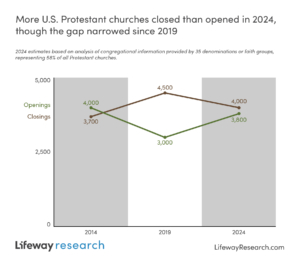
In 2024, Lifeway Research estimates 3,800 new Protestant churches were started in the U.S., while 4,000 churches were closed. This is based on analysis of congregational information provided by 35 denominations or faith groups, representing 58% of all Protestant churches.

(Lifeway Research)

“Some individual denominations release annual numbers related to church plants and church closures, but we are grateful many more were willing to contribute unpublished numbers to help us understand the bigger picture of Protestant churches today,” said Scott McConnell, executive director of Lifeway Research.

“Given recent declines in Americans identifying as Christians, churches show a remarkable ability to remain open, even with fewer attendees on average.”

The 200-church gap between those closed and those opened represents a significant improvement over the 2019 numbers.

In the most recent previous analysis, 1,500 more churches closed than opened. Five years ago, there were 4,500 closures compared to 3,000 openings. Ten years ago, however, Lifeway Research found more Protestant churches were planted (4,000) than closed (3,700) in 2014.

Using the U.S. Religion Census 2020 estimate of approximately 293,000 Protestant congregations in the U.S., the 4,000 closures in 2024 represent almost 1.4% of all U.S. Protestant churches.

Lifeway Research’s analysis of the Southern Baptist Convention found 1.4% of active Southern Baptist congregations disbanded or closed and 0.4% left or were disaffiliated between 2023 and 2024.

In 2024, 906 of the 49,380 active Southern Baptist congregations from the previous year were no longer part of the convention, including 715 that disbanded or closed, and 188 that left or were disaffiliated. 

However, many new churches were planted, and some existing churches became affiliated with the SBC. So, the SBC had 183 fewer congregations in 2024 compared to 2023, according to the SBC’s most recent Annual Church Profile.


(Lifeway Research)

The number of Southern Baptist congregations peaked in 2017 and has declined each year since. However, the 715 that disbanded or closed in 2024 represent the smallest annual loss during the decline.

“The immediate impact of COVID appears to have passed. Denominations have discovered those that closed during quarantine and never reopened,” McConnell said.

“However, the typical church in America has fewer attendees than it did 20 years ago. These assemblies are often weaker than prior generations. But at the same time, new churches are flourishing and a subset of churches are growing,” McConnell added.

Existence expectations

Most pastors aren’t planning on their churches shutting down any time soon, but a few have concerns.

The vast majority of U.S. Protestant pastors don’t expect their church to be among those closing. A Lifeway Research study found 94% of pastors believe their churches will still exist in 10 years, 4% disagree, and 2% aren’t sure.

Even among those who believe their churches have an extended future, some are concerned. Fewer than 4 in 5 (78%) strongly agree they expect their church to have at least another decade.

Smaller church pastors are most likely to be worried. Those leading churches with fewer than 50 in attendance are the least likely to agree their church will still exist in 10 years (88%) and most likely to disagree (8%).

“The typical American church has always been small. But the aging of church attendees and higher cost of living mean even a church with the same number of attendees may have fewer resources than a generation ago,” McConnell said. “However, those churches would say their power is not found in numbers or the strength of the attendees, but in the God they serve.”

Church planting priorities

A recent Lifeway Research study found more than a third of U.S. Protestant churches have participated in helping to start new churches. But while 36% say they were involved in planting new churches, the levels of participation vary.

Around 2 in 5 of these churches have helped with training (42%) and coaching (38%) for church planters. Three in 10 (30%) have been involved with church planting assessments. Just 2% of all churches have accepted direct financial responsibility as the primary sponsor of a new church in the last three years.

Not only do new churches help offset the losses of churches that close, but newer congregations are statistically more likely to be growing than others.

Specifically within the SBC, the only group of churches that demonstrated overall membership growth in the past five years is those founded in the last 25 years, according to Lifeway Research analysis.

Those churches that began in 2000 grew by 12%. Membership among congregations founded between 1950 and 1999 (-11%), 1900 and 1949 (-13%) and before 1900 (-11%) all declined.

“While the American church landscape changes slowly, it is not standing still,” said McConnell.

“The future of Protestant churches in America lies in reaching new people with the offer of salvation through Jesus Christ. Most growth in the U.S. happens in new communities. Church planting is vital to share the gospel in these new communities as well as communities in which the population is changing or previous churches have closed,” McConnell added.

Methodology

Estimates of the number of 2024 Protestant church starts and closures are based on unofficial reports Lifeway Research gathered from 35 denominational groups that represent 58% of U.S. Protestant churches. The pattern in this large sample was applied to the non-reporting and non-denominational groups to provide the overall estimate.

The SBC analysis utilized the final Annual Church Profile congregation file for 2024 compared to 2023. Lifeway Research conducted a postmortem analysis to determine what happened to each congregation in the 2023 dataset not found in the 2024 dataset. This analysis was possible thanks to information shared by data administrators and clerks in each state convention.


On the Move: Darnell

James Darnell to First Baptist Church of Monahans as youth pastor, from First Baptist Church in Roswell, N.M., where he served as an intern.


Around the State: DBU soccer player baptized on campus

Dallas Baptist University students, coaches, and friends were on campus to witness the baptism of Women’s Soccer goalkeeper, Sam Jones. This was a time when they watched a servant leader follow through in faith, leaving her old self behind, and resting in the knowledge God has control of her future. Looking back on her baptism, Sam describes how this was one of the most humbling and joyful experiences of her life. Being surrounded by her coaches, family, and teammates as she took this step in her faith made her feel deeply loved and supported. “I felt completely covered in love—God’s love and the love of the community he placed around me,” Jones said.

Baylor University announced the largest gift in the Baylor Baseball program’s history—a gift from Magnolia, the Waco-based and nationally recognized lifestyle company founded by Baylor alumni Chip and Joanna Gaines. The gift will name Magnolia Field at Baylor Ballpark and support the program’s anticipated capital projects. The Gaineses, who are also Baylor grads, rose to national prominence through their home-renovation projects, building Magnolia into a multi-platform, global brand, and launching Magnolia Network following the success of their HGTV series “Fixer Upper.”

Wayland Baptist University is launching a new digital and financial literacy initiative aimed at expanding educational and workforce opportunities for students in rural communities through collaboration with the NASDAQ Market Lab. The initiative, “Empowering Students with Digital and Financial Skills for Workforce and Community Advancement,” will be introduced during a public event at 5 p.m., Jan. 29, in the Nunn Business Building on Wayland’s Plainview campus. Guests are asked to RSVP by Jan. 22 by calling 806-291-1037 or emailing easterb@wbu.edu.

The University of Mary Hardin-Baylor is excited to announce registration is now open for the spring 2026 semester at the UMHB Arts Academy. Participants of all ages and skill levels in music, theatre, and dance are invited. Classes include instrumental and vocal lessons, musical theatre, dance, and early childhood groups. With expert instructors, supportive programs, and a welcoming environment, the UMHB Arts Academy is a place to build confidence and learn new skills.

Paul T. Sloan, associate professor of early Christianity and chair of the Department of Theology in the School of Christian Thought at Houston Christian University, was named the 2025–26 winner in the biblical studies category of the Christianity Today Book Awards for his book Jesus and the Law of Moses: The Gospels and the Restoration of Israel within First-Century Judaism.


Property sale underscores SWBTS financial turnaround

As the next step in Southwestern Baptist Theological Seminary’s long-term strategy to evaluate its property usage in keeping with its student-focused core value and to prioritize seminary resources, the seminary announced Jan. 13 Student Village Apartments and Townhomes have been sold to Bellrock Real Estate Partners, a Fort Worth-based company.

“This transaction creates an opportunity to partner with Bellrock in ways that will enhance the residential experience for our students,” said Southwestern Seminary President David S. Dockery.

“We are encouraged by Bellrock’s commitment to investing in the property and to working collaboratively to ensure it continues to serve the needs of the seminary community,” Dockery added.

Bellrock co-founder Anthony Wonderly emphasized the firm’s commitment to thoughtful ownership and continuity for residents.

“We understand the importance of this community to Southwestern Seminary and its students,” Wonderly said. “Our goal is to invest responsibly, improve the quality of life for residents, and position the property for long-term success while maintaining continuity for those who already call it home.”

The sale of Student Village represents a key component of Southwestern Seminary’s broader financial turnaround since 2022, Dockery said.

The institution has implemented disciplined financial management, reduced operational expenses, and experienced growth in operating revenue, resulting in the elimination of all short-term and long-term debt and cash reserves in excess of $20 million.

Turnaround following financial crisis

This turnaround follows a period of financial crisis under former president Adam W. Greenway, who resigned from Southwestern Seminary in Sept. 2022.

According to a previous report by the Baptist Standard, Greenway’s resignation was linked to reports of a major budget deficit and significant turnover of faculty, staff, and administration, resulting in the need for more financial guardrails to prevent spending irregularities and provide trustee accountability. 

Greenway’s tenure followed predecessor Paige Patterson’s efforts to expand faculty and lead the seminary in taking on several expensive building projects during a period of enrollment decline, contributing to Southwestern’s further financial instability, according to the report. 

Sale part of longer-term strategy

Dockery contrasted the sale of Student Village with the 2023 sale of seminary’s former B.H. Carroll Park housing complex.

While the Carroll Park sale helped address the seminary’s then “financial crisis,” he said the sale of Student Village “is an aspect of a longer-term strategy to serve students well and to prioritize the campus resources, all of which are an aspect of implementing the space and property utilization guidelines and priorities approved by the [seminary] board in the fall of 2024.”

The Student Village community, located at 2000 W. Seminary Drive, includes a total of 376 residential units, consisting of 252 traditional apartment units constructed in 2012 and 124 townhomes built between 1976 and 1995. The mix of apartments and townhomes provides flexible housing options well suited to seminary students and their families.

In April 2023, the seminary’s board of trustees created a space and property utilization task team composed of trustees and seminary personnel with a commitment to institutional stewardship and discovering the best way to utilize Southwestern’s campus, property, and assets in order to advance the seminary’s mission. In 2024, trustees approved guidelines and priorities for the task team. In the summer of 2025, the board authorized the sale of the property.

In recent months, seminary administrators have met three times with residents of Student Village to inform them of the prospective sale, Dockery noted.

Serving students is a priority

“Every aspect of the decision-making process was always shaped with the theme of how to best serve our students,” he said.

“We have worked hard to ensure a good transition for the students. We pray that current and future students will benefit in the new year and in the years ahead. Our priority all along in this process has been to find ways to strengthen this aspect of student life.”

Dockery also said Bellrock has communicated plans to make a significant capital investment in the community following the acquisition with both short-term and long-term improvements. Planned improvements include interior unit upgrades, enhanced safety and security measures, refreshed landscaping, and the development of new or improved gathering spaces intended to foster community among residents.

The partnership with Bellrock, Dockery added, is structured as an ongoing relationship rather than a one-time transaction. The two organizations will continue to work together closely as improvements are implemented and as the community develops. 

The seminary will remain involved in key areas that affect student experience, including security and facilities coordination, helping to ensure continuity for staff and student workers who have long served the Village.

“We believe the Lord has provided a way for a strong and ongoing partnership so that the student village will continue to be a vital part of seminary life for many years to come,” Dockery added.

The transaction was brokered by Jason Harrell of Transwestern, representing the Southwestern Seminary.

Additional reporting by Faith Pratt, reporter for the Baptist Standard.


Pastor and others released from Nicaraguan prison

A Protestant pastor and five friends and family members were released from prison Jan. 10 after nearly six months of incommunicado detention in Nicaragua’s Granada Department, as reported by Christian Solidarity Worldwide.

Evangelical pastor Rudy Palacios Vargas, with the La Roca de Nicaragua Church Association, was arrested in July 2025, as reported by Baptist Press in November.

Vargas was released along with his sister, two brothers-in-law, a church worship team member, and a family friend, according to the Mechanism for the Recognition of Political Prisoners in Nicaragua.

The group was among 20 political prisoners whose release was confirmed in a statement posted on X.

CSW sources reported Vargas is under house arrest and surveillance, and movements are restricted.

“While we are grateful that these individuals will be reunited with some of their loved ones after nearly six months in incommunicado detention, neither Pastor Rudy Palacios Vargas nor his friends and family members should be under house arrest or precautionary measures. Their release does not undo the injustice committed against them,” CSW’s director of advocacy and Americas team leader Anna Lee Stangl said.

CSW is calling on the Nicaraguan government to grant Vargas and others arrested “full freedom without condition, and to immediately release all remaining political prisoners.”

“We call on the international community to maintain pressure on the Ortega-Murillo regime to ensure human rights are upheld and that their crimes do not go unpunished,” Stangl said.

Baptist Press also reported the U.S. State Department in 2022 designated Cuba and Nicaragua Countries of Particular Concern for “engaging in or tolerating systematic, ongoing and egregious violations of religious freedom” under the International Religious Freedom Act of 1998.